Your cloud environment has hundreds of service principals. Nobody owns most of them. Some still have production access from projects that ended two years ago. A CI/CD token is quietly calling APIs with admin-level permissions. A new AI agent can fetch data, trigger workflows, and call external tools, but nobody has reviewed it like they review a new hire.
This is the non-human identity problem. According to Vanson Bourne research commissioned by CyberArk in 2025, machine identities outnumber human identities 82:1 across enterprise environments. ManageEngine's Identity Security Outlook 2026, a survey of 515 identity and security professionals in the US and Canada, adds another data point: only 12% of organizations have comprehensive automated lifecycle management for machine identities. Every unreviewed service account, expired token, and orphaned API key is a potential attack path.
The good news is that a growing category of non-human identity management software exists specifically to address this gap, covering discovery, ownership, credential security, lifecycle automation, and audit evidence. The challenge is that the tools come from different starting points: secrets vaults, cloud IAM, privileged access management, developer security, and authorization platforms.
This guide cuts through the category to give you a practical shortlist.
What's inside
This guide compares 13 non-human identity management tools for 2026, evaluated for security, IAM, DevSecOps, platform engineering, and presales teams supporting technical validation.
Tools were selected based on:
- Discovery and inventory depth: Ability to find NHIs across cloud, SaaS, code, CI/CD, and infrastructure
- Lifecycle and ownership management: Assigning owners, tracking events, supporting access reviews, and decommissioning stale identities
- Credential and secret security: Vaulting, rotation, scanning, and secretless access controls
- Least-privilege and audit readiness: Permission analysis, risk prioritization, and evidence for access reviews
Pricing and G2 ratings were checked against vendor pricing pages and G2 listings in October 2026. Vendors change both often, so confirm current figures before you build a business case.
TL;DR
- Best for secrets and NHI convergence: Akeyless covers secrets, certificates, PAM, and AI-agent security in one platform
- Best for Azure workload identities: Microsoft Entra Workload ID is the native choice for Microsoft-heavy environments
- Best for enterprise identity governance: Saviynt extends IGA and PAM into NHI discovery, lifecycle, and risk prioritization
- Best for infrastructure access: Teleport governs machine identity and workload access across SSH, Kubernetes, and cloud infrastructure
- Best for secrets exposure in code: GitGuardian detects leaked credentials across repositories and developer pipelines, with a free tier for up to 25 developers
- Best for runtime authorization: PlainID enforces fine-grained access decisions for applications, APIs, and AI workflows
- Best for least-privilege governance across human and AI identities: Opal Security applies just-in-time access and access reviews across employees, service accounts, and AI agents
What is non human identity management?
Non-human identity management is the practice of discovering, owning, securing, governing, monitoring, and retiring digital identities used by machines, applications, workloads, services, automations, and AI agents.
These identities authenticate and act without a person logging in. Examples include service accounts running background processes, API keys connecting two SaaS systems, OAuth apps with delegated permissions, CI/CD tokens deploying code, managed identities accessing cloud resources, SSH keys authorizing server connections, and AI agents that call tools and retrieve data across systems.
What counts as a non-human identity:
- Service accounts and managed identities
- API keys, tokens, and secrets
- OAuth apps and service principals
- SSH keys and TLS certificates
- Workload identities and automation scripts
- Bots and scheduled jobs
- AI agents and MCP server-connected agents
How non-human, machine, and human identities differ:
- Human identities represent people who log in, authenticate with MFA, and receive periodic access reviews
- Machine identities represent systems, workloads, or devices authenticating as themselves
- Non-human identity is the broader operational category covering machine identities, service accounts, application credentials, scripts, bots, and agentic systems, including identities that may combine permissions from multiple sources
Core capabilities to look for in NHI management software:
- Discovery and inventory across cloud, SaaS, code, and infrastructure
- Ownership assignment and accountability tracking
- Classification by risk, business context, and sensitivity
- Permission and privilege analysis
- Secret and credential management, including rotation and secretless access
- Lifecycle automation from creation through decommissioning
- Continuous monitoring and anomaly detection
- Audit evidence generation for access reviews and compliance workflows
- AI-agent and workload identity governance
The non-human identity security market is projected to reach $22.94 billion by 2031, according to Mordor Intelligence, up from an estimated $8.22 billion in 2026. That growth reflects how fast the attack surface is expanding, driven by cloud sprawl, DevOps automation, and agentic AI adoption.
When to use non human identity management tools
Discover unmanaged service accounts and workload identities
Security teams often inherit years of cloud services, scripts, and CI/CD automations without a clear inventory of what exists. The first job is finding which non-human identities are active, what permissions they hold, who owns them, and whether they are still needed. Start with discovery tooling before investing in governance controls you cannot yet apply.
Reduce excessive privileges before an incident
Non-human identities frequently hold broader permissions than they need because nobody logs in as them and access never gets reviewed. A good NHI platform surfaces which service accounts have standing admin access, which tokens connect to sensitive APIs, and which paths an attacker could use for lateral movement. Cutting excessive privileges before an incident is far cheaper than remediating one after.
Prepare for audits and security diligence reviews
Buyers and auditors ask for evidence of ownership, access review history, credential rotation cadence, and decommissioning records. If you are supporting a security evaluation, you need a tool that produces this evidence automatically rather than requiring someone to stitch screenshots together at the last minute. Good NHI tooling turns audit prep from a sprint into a report export. For presales teams, reviewing access review software alongside NHI tooling helps frame the full governance story for a buyer committee.
Non human identity management tools comparison
Not all tools in this category solve the same problem. Some originate in secrets vaults, some in cloud IAM, some in enterprise governance, and others in developer security or runtime authorization. The right choice depends on where the NHI risk is concentrated in your environment.
One ownership note before the table. Teleport is independent, but Cisco became its largest strategic investor in August 2026, two months after Cisco closed its acquisition of the non-human identity vendor Astrix Security. No change of control was announced, and Teleport is the only tool in this lineup with a disclosed strategic tie to a larger security vendor. Treat that as context for roadmap and partnership questions rather than as a reason to exclude it.
| # | Product | Best for | Key differentiator | Pricing | G2 rating |
|---|---|---|---|---|---|
| 1 | Akeyless | Secrets and NHI convergence | Unified secrets, certificates, PAM, and AI-agent security | Free tier available; Enterprise pricing on request | 4.6/5 (92 reviews) |
| 2 | Microsoft Entra Workload ID | Azure workload identities | Native Azure integration with conditional access and risk detection | Free tier; Premium from $3.00/workload identity/month, billed annually | 5.0/5 (1 review) |
| 3 | Saviynt | Enterprise identity governance | Combines IGA, PAM, and NHI lifecycle in one program | Quote-based (Essentials, Pro, Premium tiers) | 4.4/5 (81 reviews) |
| 4 | Teleport | Infrastructure and machine access | Certificate-based, identity-native access across cloud-native environments. Cisco is its largest strategic investor and also owns Astrix Security | Free Community Edition; Enterprise and Cloud pricing on request | 4.4/5 (109 reviews) |
| 5 | GitGuardian | Secrets exposure in developer workflows | Secrets detection across repositories, CI/CD, and pipelines with free tier | Free up to 25 developers; Teams and Enterprise pricing on request | 4.8/5 (282 reviews) |
| 6 | PlainID | Runtime authorization and AI workflows | Fine-grained, policy-based access decisions at runtime | Quote-based | Not listed on G2 |
| 7 | Opal Security | Least-privilege governance across human and AI identities | Just-in-time access with AI-guided reviews for NHI and AI agents | Opal Zero launch offer at $30,000 for the first 12 months | 4.6/5 (30 reviews) |
| 8 | P0 Security | Cloud access governance | Runtime authorization with JIT and task-scoped access | Free trial available; Enterprise pricing on request | 4.5/5 |
| 9 | Truffle Security | Secrets scanning for engineering teams | 800+ detectors with open-source TruffleHog and enterprise add-ons | Free open-source; Enterprise pricing on request | Not listed on G2 |
| 10 | Ambient Security | Identity posture and privileged access | Identity security posture management and just-in-time privileged access across human, non-human, and AI agent identities | Quote-based | Not listed on G2 |
| 11 | Clarity Security | Identity governance for hybrid environments | Dynamic risk scoring with NHI and AI identity governance | Quote-based | 4.5/5 (2 reviews) |
| 12 | Unosecur | Unified NHI and AI-agent governance | Graph-powered access mapping across cloud, SaaS, and AI agents | Quote-based | 4.8/5 (7 reviews) |
| 13 | ARCON | PAM-connected NHI controls | Runtime policy, credential brokerage, and just-in-time privilege delivery | Quote-based; no list prices published | 4.4/5 |
Non human identity management tools reviewed in detail
1. Akeyless
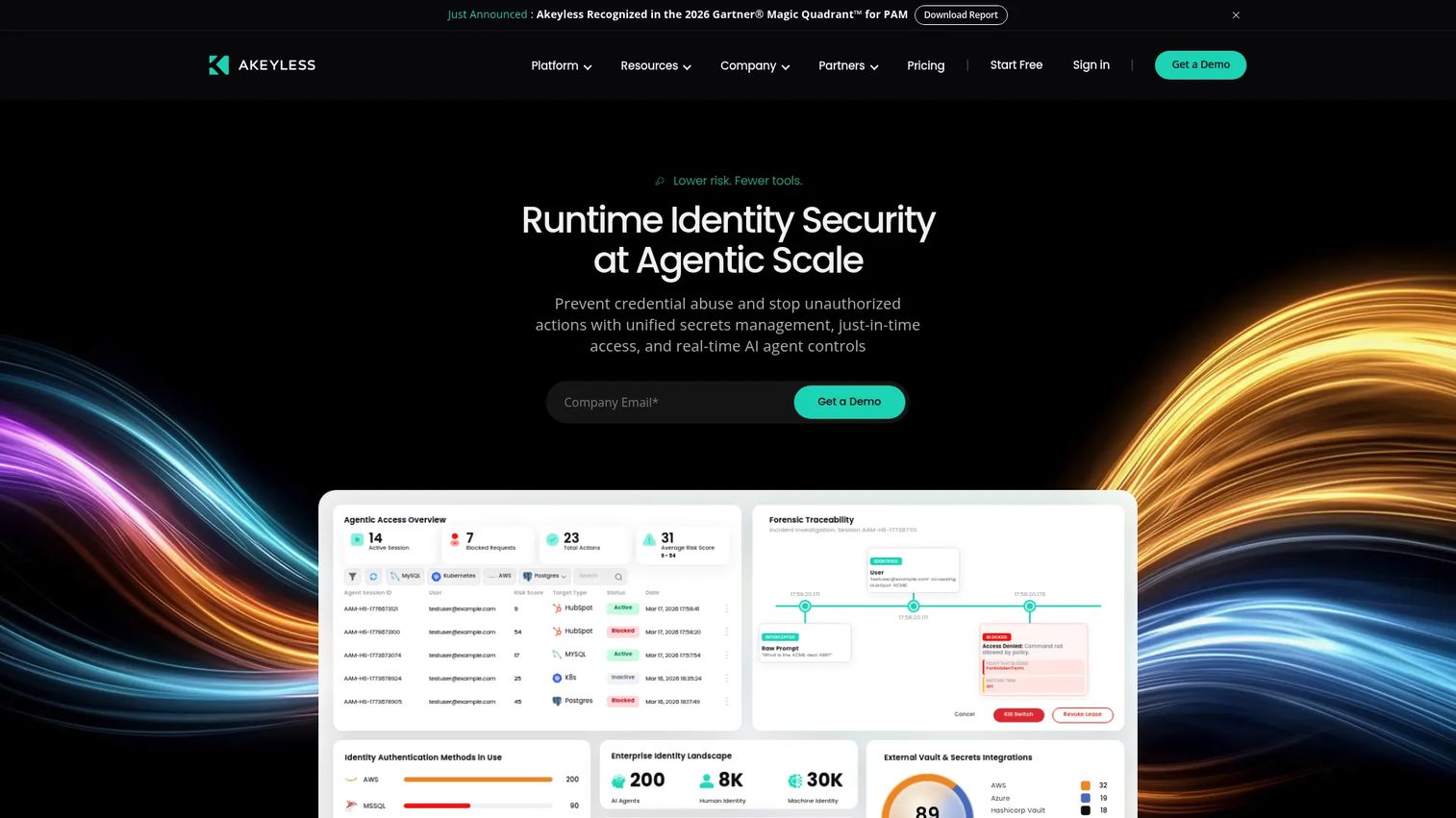
Akeyless is an identity security platform that covers secrets management, certificate lifecycle management, encryption and key management, privileged access, and AI-agent security from a single SaaS-based control layer. The platform uses Distributed Fragments Cryptography to protect keys without ever assembling them in one place. For NHI programs, Akeyless addresses the convergence of secrets, machine credentials, workload access, and AI-agent identity in one place rather than requiring separate vaulting and governance tools.
Best for: Security and platform teams that need secrets management and NHI governance in one control layer across hybrid and multi-cloud environments.
Key features
- Secrets management: static, dynamic, and rotated secrets
- Certificate lifecycle management and PKI
- Encryption and KMS using Distributed Fragments Cryptography
- Modern PAM with secure remote access
- AI-agent security with secretless, just-in-time access
Why choose Akeyless: Strong fit when the buyer's NHI risk starts with secrets, API keys, and automation credentials and they want to consolidate vaulting, rotation, and governance rather than running separate tools. Ask discovery questions about whether the team needs vaulting, lifecycle management, both, or full convergence with PAM.
Akeyless pricing: Akeyless publishes a free tier for each pricing unit on its platform, including secrets management, certificate lifecycle management, encryption and KMS, and password management. The free secrets management tier is capped at 500 static secrets, 5 dynamic secrets, 5 rotated secrets, and 5 clients, with 3-day audit log retention.
G2 rating: 4.6/5 (92 reviews)
2. Microsoft Entra Workload ID
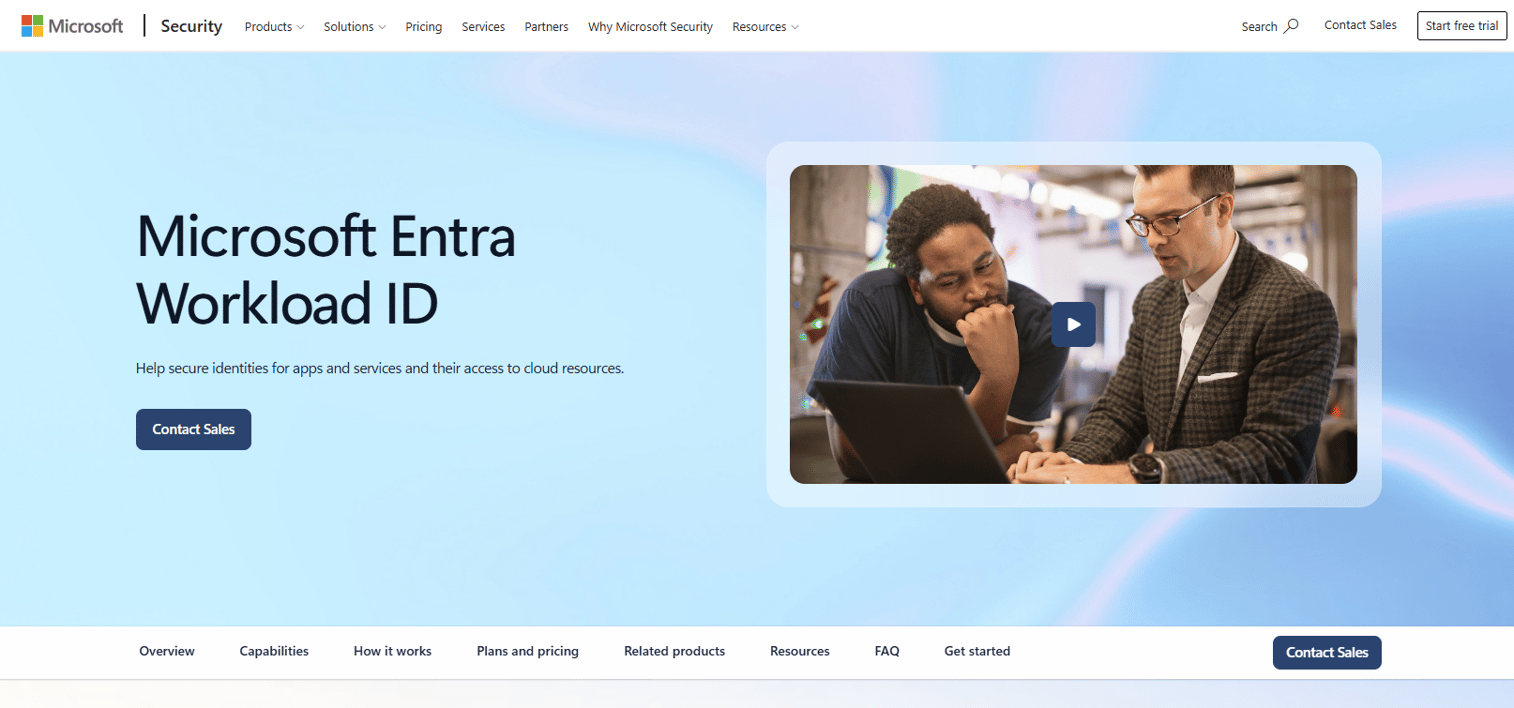
Microsoft Entra Workload ID is Microsoft's purpose-built product for securing identities used by applications and services accessing cloud resources. It governs managed identities and service principals, applies adaptive access policies to workload identities, detects compromised workload identities, and manages workload identity lifecycle with health recommendations. For organizations already running Microsoft Entra ID, this is the native starting point for non-human identity governance in Azure environments.
Best for: Microsoft-heavy organizations managing Azure workload identities, service principals, and managed identities.
Key features
- Adaptive access policies for workload identities
- Compromised workload identity detection and response
- Workload identity lifecycle management and health recommendations
- Managed identity governance
- Azure-native integration
Why choose Microsoft Entra Workload ID: Strongest fit when the environment is primarily Azure and the security team already operates inside the Microsoft security stack. Evaluate carefully if you need multi-cloud or non-Microsoft estate coverage, since Entra Workload ID is designed for the Microsoft ecosystem.
Microsoft Entra Workload ID pricing: A free edition is included with qualifying commercial online subscriptions. Premium adds conditional access, Identity Protection, access reviews, and app health recommendations at $3.00 per workload identity per month, billed annually. Each workload identity needs its own licence, so model the cost against your actual service principal count rather than your user count.
G2 rating: 5.0/5 (1 review)
3. Saviynt
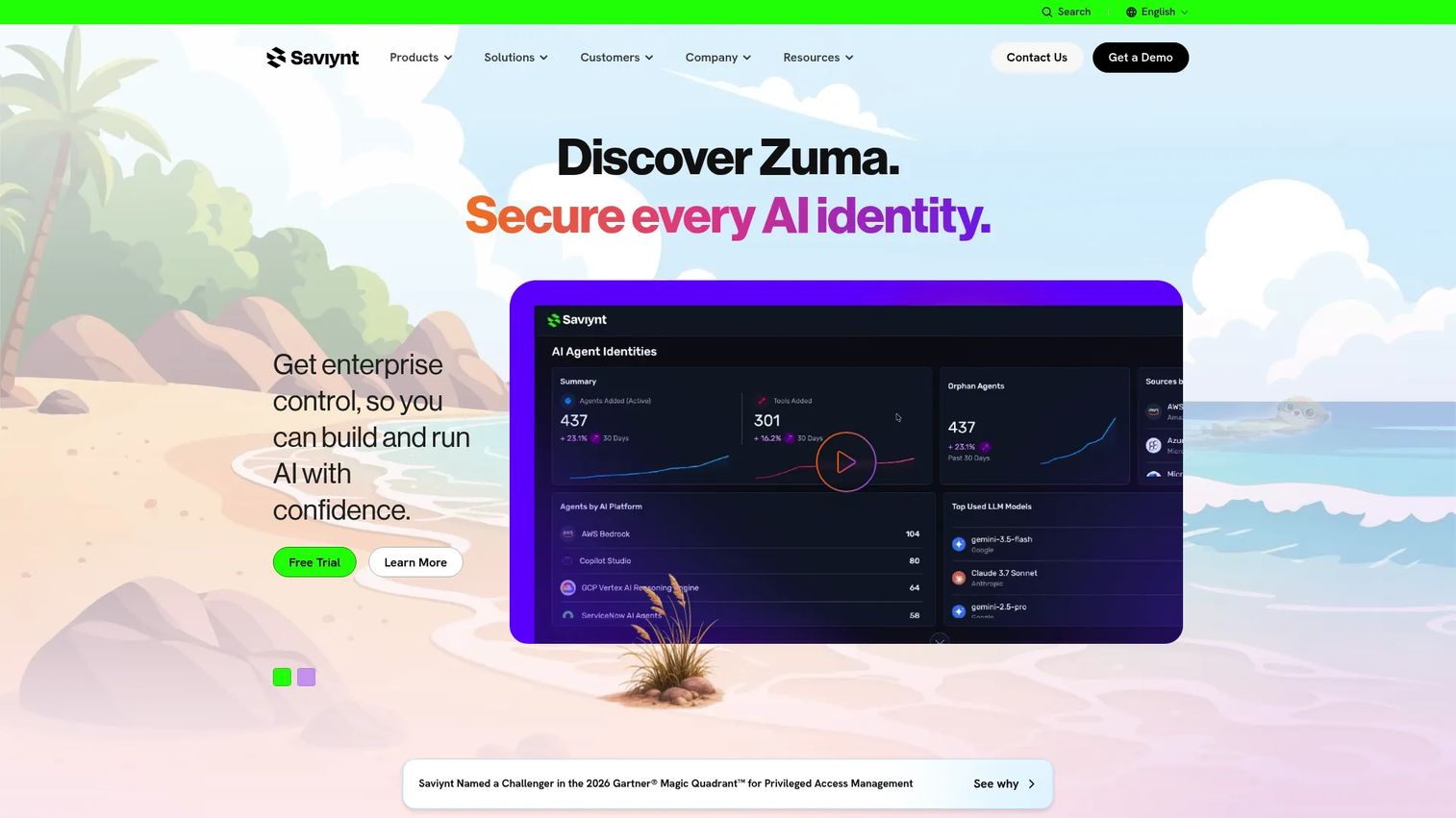
Saviynt is an AI-first identity security platform that extends enterprise IGA, PAM, and application access governance into NHI discovery, posture management, lifecycle timelines, access mapping, and risk prioritization. The platform surfaces access relationships between human and non-human identities, assigns ownership, and generates audit evidence. A free trial is available for AI and non-human identity posture management, which makes it easier to evaluate before committing to a full deployment.
Best for: Large enterprises running IGA or PAM programs that want human and non-human identity governance inside one identity security program.
Key features
- NHI discovery and inventory
- Access relationship mapping
- Identity lifecycle timelines and ownership
- Risk prioritization and posture scoring
- Audit evidence and access review support
Why choose Saviynt: Strong fit for audit-driven programs where ownership records, access review history, and lifecycle evidence already matter for SOX, GDPR, or internal control frameworks. Buyers that already think in IGA terms will find the transition to NHI governance more natural here than with a point solution. Review the audit management software landscape alongside Saviynt for a full picture of evidence and reporting requirements.
Saviynt pricing: Saviynt publicly lists Essentials, Pro, and Premium tiers. Pricing is scoped by the number of protected identities, and Saviynt-built connectors are included in the tier while partner-built connectors are sold separately, so ask for both lines in a quote.
G2 rating: 4.4/5 (81 reviews)
4. Teleport
Teleport is an identity-based access platform that governs machine identity and workload access across servers, Kubernetes clusters, databases, internal applications, and desktops. It replaces long-lived credentials with short-lived certificates and provides unified audit logging and session recording. Machine ID, Teleport's workload identity component, issues certificates to workloads and CI/CD pipelines so non-human identities never need static secrets to authenticate.
Vendor relationship disclosure: Teleport is still an independent company, but Cisco became its largest strategic investor in August 2026 under a partnership covering technology integration and licensing. No change of control was announced. Cisco separately completed its acquisition of the non-human identity vendor Astrix Security in June 2026, so a buyer standardizing on Cisco security tooling should ask how the two roadmaps relate.
Best for: Infrastructure and platform teams securing machine access across cloud-native environments where SSH key sprawl, Kubernetes access, and CI/CD credential management are primary risks.
Key features
- Certificate-based authentication for SSH and Kubernetes
- Audit logging and session recording
- Machine ID for workload identity management
- Single sign-on and role-based access controls
- Passwordless and per-session MFA
Why choose Teleport: Strong fit when the non-human identity problem is infrastructure-facing: CI/CD pipelines needing credentials, engineers accessing servers, or workloads authenticating across Kubernetes namespaces. Evaluate governance depth separately if you need enterprise IGA workflows alongside infrastructure access.
Teleport pricing: Community Edition is free, open source, and self-hosted, and Teleport positions it for hobby and personal use rather than production fleets. Enterprise is available self-hosted or as Teleport Cloud, on annual or multi-year contracts with volume discounts. Neither commercial edition publishes a price, so request a quote.
G2 rating: 4.4/5 (109 reviews)
5. GitGuardian
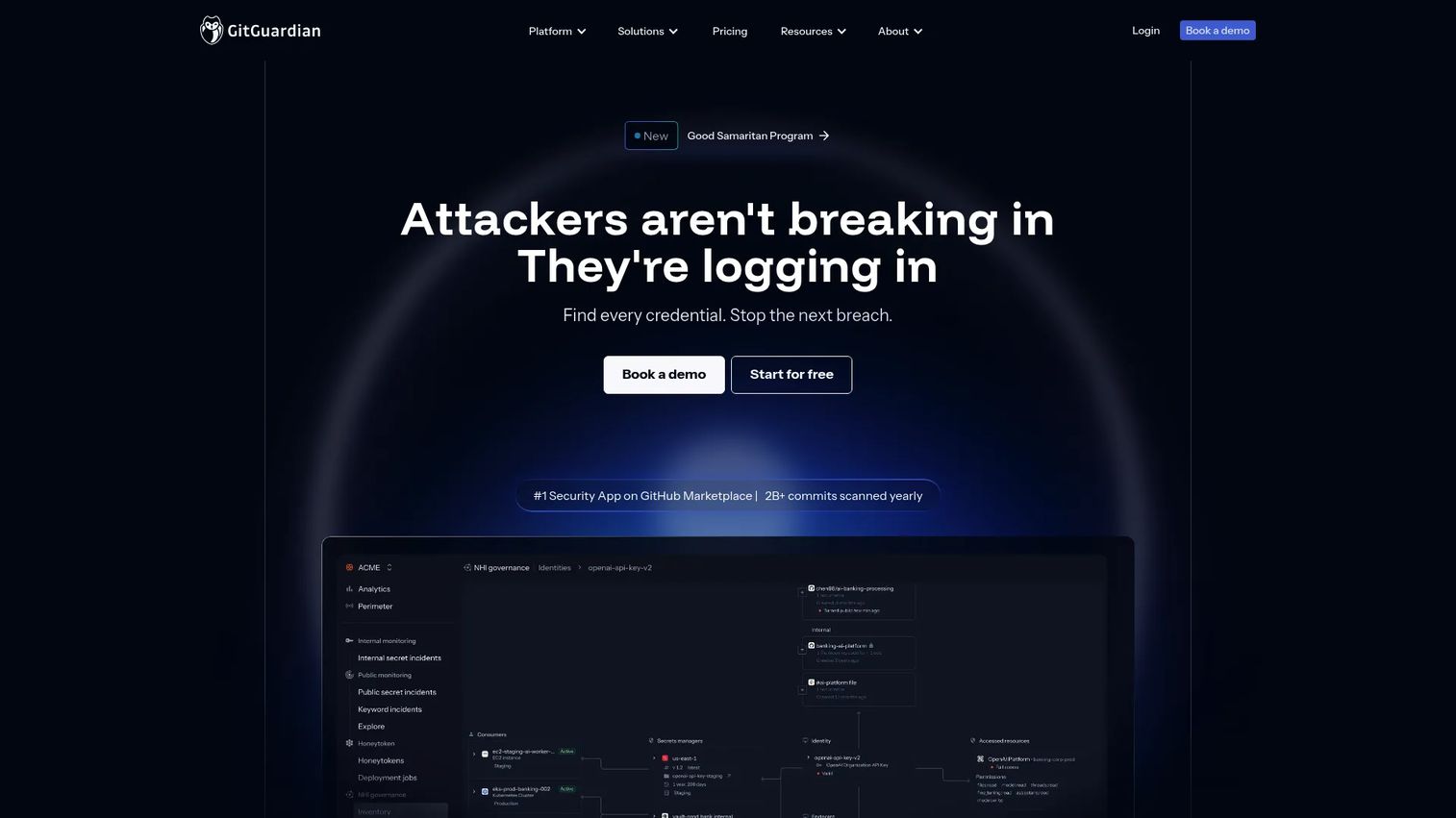
GitGuardian is a developer-first credential security platform that detects exposed secrets across code repositories, CI/CD systems, containers, and collaboration tools. It surfaces leaked API keys, tokens, and other machine credentials before they become incidents, routes findings to the right team, and tracks remediation through integrations with Slack, Jira, and ServiceNow. Enterprise plans extend into NHI governance, including identity mapping, vault coverage analysis, and OWASP Non-Human Identity Top 10 policy support. GitGuardian also offers developer endpoint protection through pre-commit hooks and IDE integrations.
Best for: DevSecOps, security, and engineering teams focused on leaked credentials in source code, CI/CD systems, and developer tooling.
Key features
- Internal secrets monitoring across code, CI/CD, containers, and collaboration tools
- Public secrets monitoring for GitHub exposure
- Developer endpoint protection with CLI and pre-commit hooks
- Remediation playbooks with Slack, Jira, and ServiceNow integrations
- NHI governance with identity mapping and vault coverage (Enterprise)
Why choose GitGuardian: Strong fit when the first NHI problem is credentials showing up where they should not: in public repos, CI pipelines, or team chat. The free Starter tier covers up to 25 developers with real-time scanning, making it low-risk to evaluate before committing. Broader access governance and lifecycle management will require additional controls.
GitGuardian pricing: Starter is free for up to 25 developers, with unlimited real-time scanning, up to 500 historical scan detections, and 10,000 API calls per month. The mid-tier plan and Enterprise are both quote-based, and developer endpoint protection is priced separately per endpoint per year. GitGuardian labels the mid-tier inconsistently across its own pricing page, so confirm the plan name and the included team count in writing.
G2 rating: 4.8/5 (282 reviews)
6. PlainID
PlainID is an enterprise runtime authorization platform that centralizes fine-grained access decisions across applications, APIs, data platforms, microservices, and AI workflows. It manages access policy centrally and distributes authorization decisions through pre-built Authorizers at the enforcement point. For NHI programs, PlainID addresses the question of what a non-human identity should be allowed to do at runtime, not only where its credentials are stored. It applies identity-first guardrails to AI prompts, MCP tool calls, API actions, and data retrieval.
Best for: Large enterprises that need centralized authorization policies across applications, services, and AI-connected workflows.
Key features
- Centralized Policy-Based Access Control (PBAC)
- Distributed runtime authorization through pre-built Authorizers
- Fine-grained controls at row, column, document, and API response levels
- Authorization discovery, testing, simulation, and audit logging
- Identity-first guardrails for AI agents and MCP tool access
Why choose PlainID: Strong fit when the NHI security question is about runtime behavior rather than credential storage. If a buyer is asking "what should this API key be allowed to retrieve?" or "how do we constrain what an AI agent can call?", PlainID addresses those questions more directly than a vault or a PAM tool.
PlainID pricing: Contact sales for a quote.
7. Opal Security
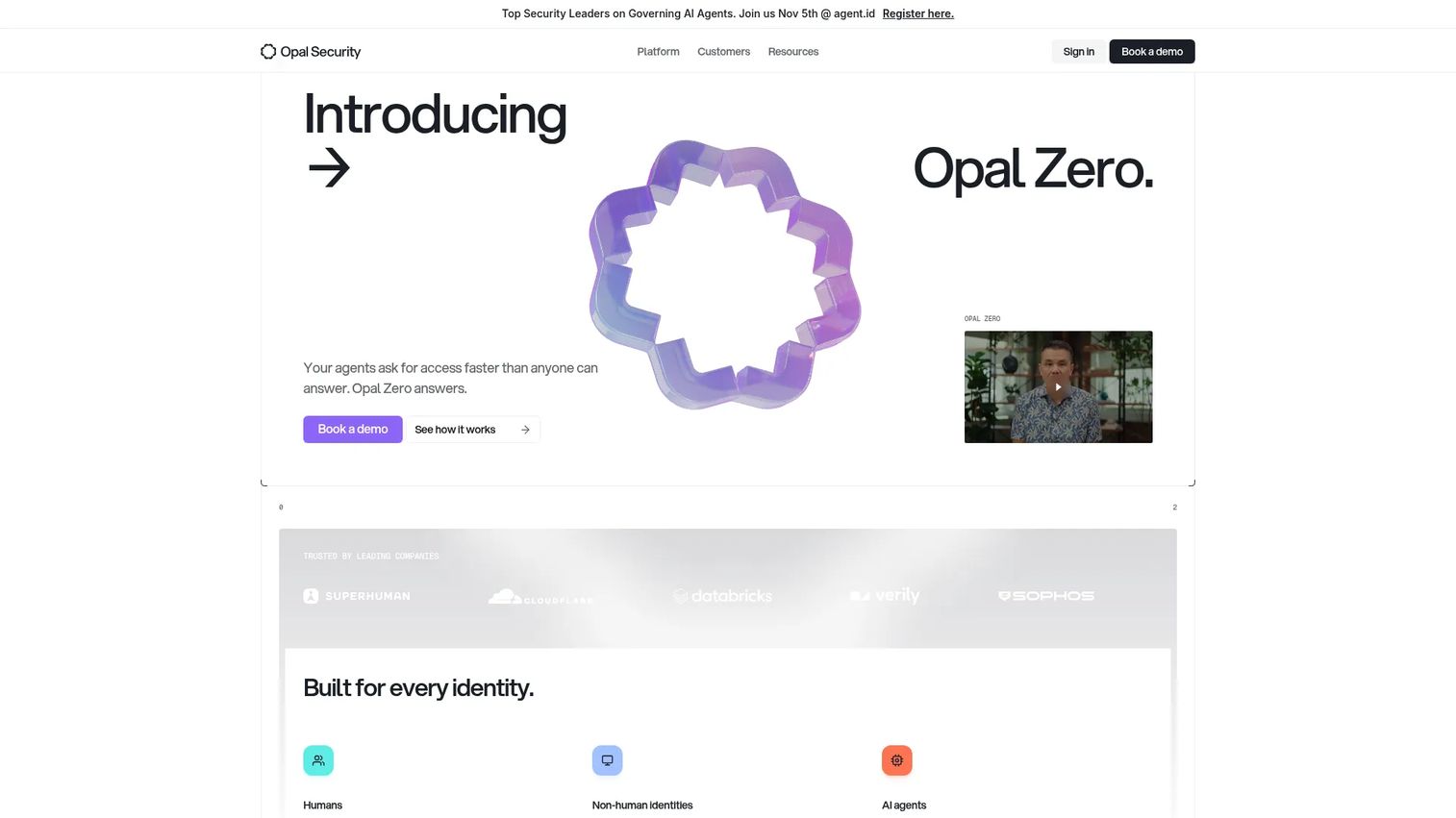
Opal Security is an AI-native access governance platform for managing identities and access across employees, non-human identities, and AI agents. It applies just-in-time access with automatic revocation, AI-guided access reviews, policy-as-code workflows, and plain-English access intelligence queries. The platform specifically covers AI-agent and non-human identity governance alongside human identity, making it relevant for organizations whose NHI programs now include agentic systems. Opal Security is also a useful reference point when evaluating the best AI agents for enterprise security workflows.
Best for: Security and engineering teams that want to reduce standing access across human and non-human identities, including AI agents.
Key features
- Just-in-time access with automatic revocation
- AI-guided access reviews
- Policy-as-code workflows
- AI-agent and non-human identity governance
- Plain-English access intelligence querying
Why choose Opal Security: Strong fit when security teams need practical access governance across both human and NHI populations, not only discovery. Good for organizations trying to cut standing privilege without creating friction that slows engineering teams.
Opal Security pricing: Opal Zero became generally available at the end of September 2026 with a launch offer of $30,000 for the first 12 months, available through December 30, 2026. That package covers agent inventory, the Risk Center, the Paladin access decision engine, Policy Insights, and Gateway Sync.
G2 rating: 4.6/5 (30 reviews)
8. P0 Security
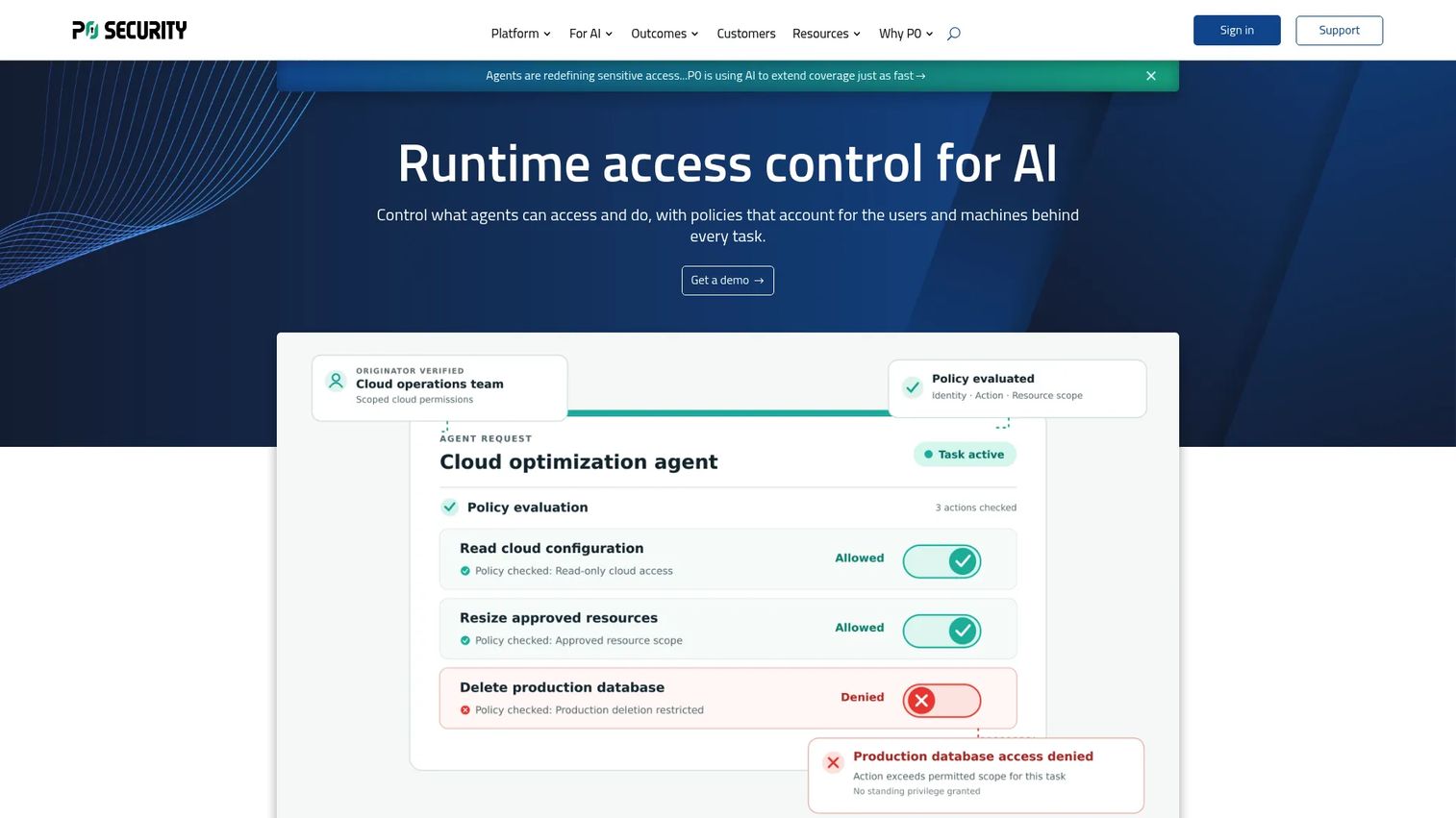
P0 Security provides runtime access control and privileged access management for users, machines, and AI agents across cloud and hybrid environments. It delivers just-in-time, task-scoped, and time-bound access grants, combined with identity and entitlement inventory and access-risk analysis. The platform governs both human and non-human access, making it relevant for teams that want to address cloud IAM risk across service accounts, workload roles, and AI-agent permissions simultaneously.
Best for: Cloud security teams focused on excessive privileges and risky cloud identities across service accounts, workload roles, and IAM policies.
Key features
- Runtime authorization for AI agents, users, and machines
- Just-in-time, task-scoped, and time-bound access
- Identity and entitlement inventory with access-risk analysis
- Access request workflows
- Cloud identity visibility and permission analysis
Why choose P0 Security: Strong fit when the risk sits in cloud IAM policies, over-permissioned service accounts, and workload roles. A free trial is available, which helps presales teams validate integration fit before a procurement decision. P0 is independent and venture-backed, with Zscaler as both an investor and a technology alliance partner, which is worth knowing if your stack already includes Zscaler.
P0 Security pricing: A free trial is available.
G2 rating: 4.5/5
9. Truffle Security
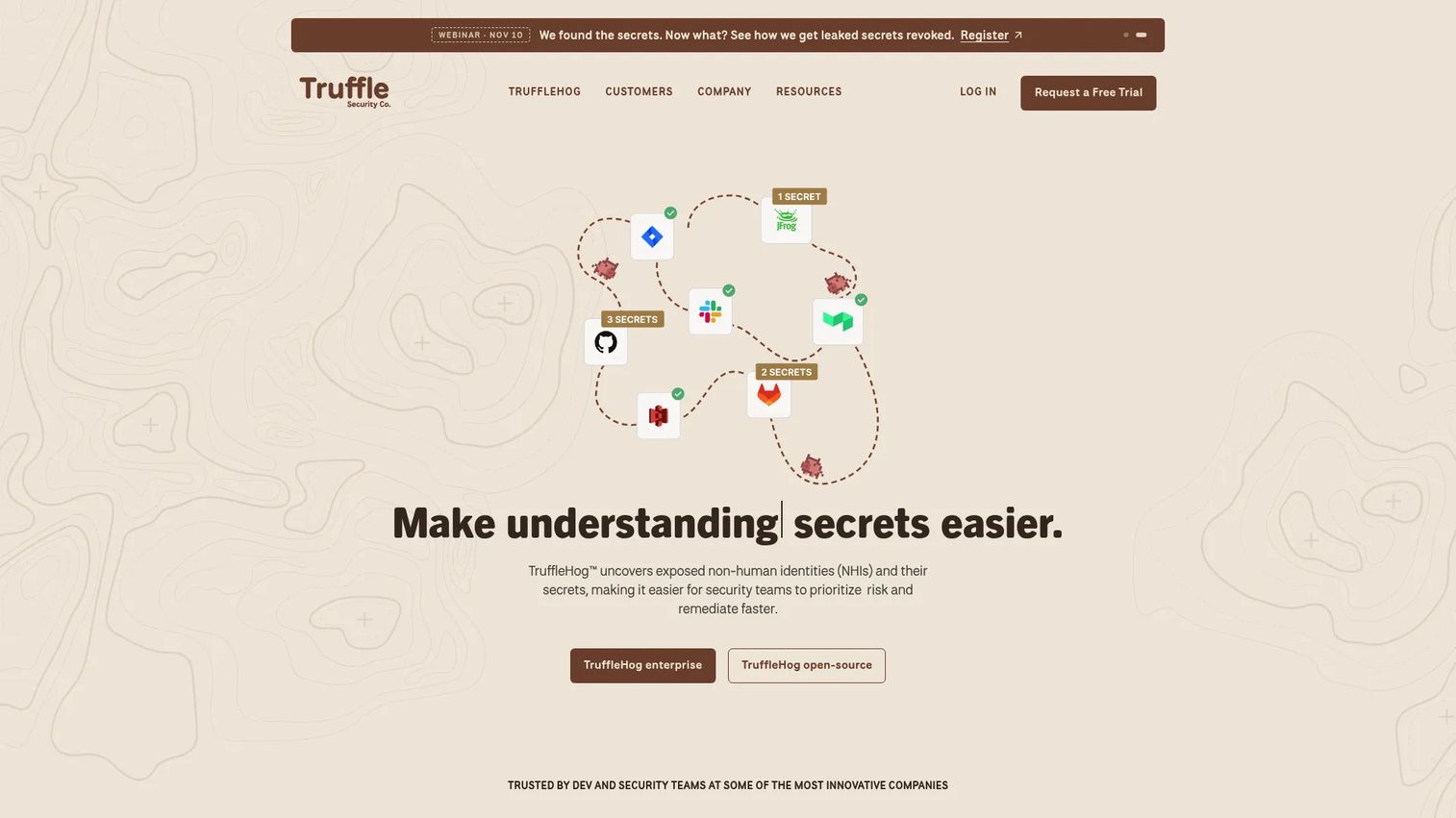
Truffle Security develops TruffleHog, a secrets-scanning platform for detecting, verifying, analyzing, monitoring, and remediating exposed non-human identities and secrets. It ships over 800 secret detectors and supports scanning across code repositories, chat systems, support tickets, and other SDLC sources. Enterprise add-ons include TruffleHog Analyze for SaaS environments, TruffleHog Analyze for cloud platforms, and Forager for broader discovery. The open-source version is freely available, which gives engineering teams a low-cost way to establish a baseline before purchasing enterprise capabilities.
Best for: Engineering and security teams scanning code repositories, developer workflows, and collaboration surfaces for exposed secrets.
Key features
- Secrets detection across repositories, chat, and SDLC sources
- Credential verification using provider protocols or APIs
- 800+ secret detectors with pre-commit and pre-receive hooks
- Continuous monitoring and remediation tracking
- On-premises and cloud scanning options
Why choose Truffle Security: Strong fit when the primary NHI risk is exposed credentials in source code and developer tooling. The open-source tier makes it easy to start. Note that Truffle Security is narrower than full lifecycle NHI governance; broader ownership, access review, and decommissioning require additional controls. For teams also managing application security testing, TruffleHog often sits alongside SAST tools in the same pipeline. The company is independent and venture-backed, having raised a $25 million Series B in November 2025.
Truffle Security pricing: Open-source TruffleHog is free. Enterprise add-ons (TruffleHog Analyze for SaaS, TruffleHog Analyze for Cloud, Forager) are priced on request from sales.
10. Ambient Security
Ambient Security is an AI-native identity security platform that discovers, assesses, and controls privileged access across human, non-human, and AI agent identities in cloud, SaaS, and on-premises environments. Its product set covers identity security posture management, privileged access management with just-in-time access, and a complimentary identity risk assessment. The positioning focuses on finding hidden access and reducing standing privilege rather than on vaulting or secrets scanning.
Best for: Enterprise security teams that want identity posture visibility and privileged access control over service accounts, machine credentials, and AI agents in one platform.
Key features
- Identity security posture management across cloud, SaaS, and on-premises environments
- Privileged access management with just-in-time access grants
- Discovery of hidden and standing privileged access
- Coverage for human, non-human, and AI agent identities
- Complimentary identity risk assessment
Why choose Ambient Security: Worth a look when the NHI problem is framed as standing privilege rather than credential storage, and when the team wants posture management and privileged access in the same tool. Ambient Security is an early-stage vendor, so presales teams should confirm deployment references, integration coverage, and scale evidence directly with the company before putting it on a shortlist. Note also that a separate, unrelated company called Ambient.ai sells AI physical security monitoring, so confirm you are looking at the right vendor.
11. Clarity Security
Clarity Security is an identity security platform for governing human, non-human, and agentic identities across enterprise environments. It provides dynamic risk scoring, lifecycle automation through joiner-mover-leaver workflows, access reviews with automated remediation, and identity explorer capabilities for visibility across hybrid environments. NHI and AI identity governance are listed as part of the platform's scope, alongside compliance and security posture reporting.
Best for: Enterprise security and IT teams managing identity risk, access governance, and lifecycle automation across hybrid environments.
Key features
- Dynamic identity and access risk scoring
- Identity Explorer with universal connectivity
- Joiner-mover-leaver lifecycle automation
- Access reviews and automated remediation
- Non-human and AI identity governance
Why choose Clarity Security: Good fit for organizations that want a specialist identity governance platform covering human and NHI populations together. Verify current product maturity, deployment references, and integration scope directly with the vendor before purchasing, since the platform is in an active growth phase. The access control software category provides useful context for how Clarity positions relative to broader IAM tooling.
G2 rating: 4.5/5 (2 reviews)
12. Unosecur
Unosecur is an AI-powered unified identity security platform covering human, non-human, and AI-agent identities across multi-cloud, SaaS, identity provider, and on-premises environments. It uses graph-powered access-path mapping to show how identities connect to resources and combines activity-based visibility, least-privilege enforcement, runtime monitoring, threat detection, and AI-agent inventory in one platform. For teams evaluating AI governance tools alongside identity security, Unosecur's AI-agent governance capability is particularly relevant.
Best for: Enterprise security teams needing unified governance and runtime protection across human, non-human, and AI identities from one platform.
Key features
- Identity discovery and activity-based visibility
- Least-privilege enforcement and access governance
- Runtime monitoring, threat detection, and remediation
- AI-agent inventory, access analysis, and governance
- Graph-powered access-path mapping
Why choose Unosecur: Strong fit for organizations that want a purpose-built NHI and AI-agent governance platform rather than extending an existing IGA or PAM tool. Unosecur is a Berlin-based, independent company that raised a $5 million seed round in 2025, so presales teams should ask for integration references, deployment case studies, and a proof of scale before positioning it in an enterprise evaluation.
G2 rating: 4.8/5 (7 reviews)
13. ARCON

ARCON provides runtime identity security and privileged access management for human, machine, vendor, cloud, and AI identities. Its core capabilities include runtime policy and authorization, just-in-time and just-enough privilege delivery, credential and secret brokerage, session and action control, automated privilege revocation, and runtime evidence capture for audit workflows. For organizations that frame NHI management as part of a broader privileged access program, ARCON connects service account controls and credential vaulting into an existing PAM architecture.
Best for: Enterprises that want NHI controls connected to PAM, privileged access governance, and session monitoring in an established enterprise access program.
Key features
- Runtime policy and just-in-time privilege delivery
- Credential and secret brokerage
- Session and action control
- Automated privilege revocation
- Runtime evidence and audit capture
Why choose ARCON: Strong fit when the buying committee already has a PAM program and wants to extend it to cover service accounts, machine credentials, and AI identity governance. Validate cloud-native and AI-agent coverage directly with the vendor if those are core requirements, since ARCON's established strength is in traditional PAM and enterprise access control.
ARCON pricing: Pricing is quote-based and scoped per deployment, with a 12-month minimum term reported on AWS Marketplace and professional services billed separately. Ask ARCON directly for current packaging and term options.
G2 rating: 4.4/5
Considerations when choosing non human identity management tools
Discovery depth
A platform should find identities across cloud environments, SaaS applications, code repositories, CI/CD pipelines, infrastructure, and identity providers. Ask whether discovery surfaces only credentials, or whether it also maps ownership, permissions, and access relationships. An inventory with no ownership data quickly becomes another dashboard nobody acts on.
Ownership and lifecycle coverage
Ownership assignment is what turns a discovery scan into a governable program. Evaluate how each tool assigns owners, tracks lifecycle events from creation through decommissioning, supports periodic access reviews, and flags stale identities for remediation. Without lifecycle automation, manual processes fill the gap and create the same risks the tool was supposed to solve. For teams building broader lifecycle workflows, asset lifecycle management software context helps frame the governance model.
Least-privilege and risk prioritization
A useful platform connects permissions to resources, attack paths, and business context rather than reporting a raw permission count. Prioritize tools that surface which identities carry exploitable access and explain why that access matters. A sorted list of risky identities with remediation guidance is more actionable than a flat inventory with no context.
Secret and credential controls
For some teams, the most urgent risk is exposed secrets in code or rotation gaps in credential management. Evaluate vaulting, automated rotation, secretless access options, repository scanning, token detection, and remediation workflow integrations. Ask whether credential controls are discovery-only or whether the platform actively manages and rotates credentials.
Vendor ownership and consolidation risk
This category has consolidated quickly. Cyera acquired Oasis Security, SailPoint acquired Entro Security, Cisco acquired Astrix Security and took a strategic stake in Teleport, ServiceNow acquired Veza, and 1Password acquired Apono, all within an 18-month window. Ask every shortlisted vendor who owns them, who has invested, and what happens to the roadmap and the contract if they are acquired mid-term. Two tools that look independent on a comparison grid can sit inside the same corporate parent by the time you renew.
Audit readiness and reporting
Ask what evidence each tool produces for access reviews, credential rotation history, ownership records, policy enforcement, and decommissioning. Presales teams should verify that evidence exports, reviewer workflows, and integrations into ticketing systems work before a buyer reaches procurement. The difference between a good evaluation and a stalled one often comes down to whether the security team can show control evidence without a manual audit sprint. Explore best AI cybersecurity solutions for context on where NHI tooling fits in the broader security stack.
Conclusion
The non-human identity management market spans tools that start from very different foundations. Akeyless, GitGuardian, and Truffle Security are strongest when secrets and credential exposure drive the project. Microsoft Entra Workload ID, Teleport, and P0 Security are strongest for cloud and infrastructure-heavy teams managing workload identities and machine access. Saviynt, PlainID, Opal Security, and ARCON are strongest for governance, least-privilege enforcement, authorization policy, and enterprise access programs. Clarity Security, Unosecur, and Ambient Security are specialist identity security platforms worth evaluating when NHI and AI-agent governance is the core requirement, with the caveat that all three are earlier-stage and deserve a direct scope and reference check.
Start by inventorying the identities that already exist. Then shortlist tools based on where the risk actually lives: code exposure, cloud IAM, infrastructure access, enterprise IAM governance, or AI-agent workflows. Presales teams supporting these evaluations should map each tool against the buyer's control environment rather than defaulting to the most familiar brand.
Evaluations in this category stall when a security team cannot see how discovery, ownership assignment, and credential controls behave in the actual product. Guideflow lets presales and product marketing teams package those workflows into an interactive demo that a buying committee can click through on its own schedule, before anyone books a live session.
Start your journey with Guideflow today!
FAQs
Non-human identity management is the practice of discovering, securing, governing, monitoring, and retiring identities used by machines, workloads, applications, services, automations, and AI agents. It covers service accounts, API keys, managed identities, tokens, OAuth apps, certificates, and agentic systems that authenticate and act without a person logging in. The goal is to apply the same ownership, access review, and lifecycle discipline to machine identities that organizations already apply to human accounts.
A service account running nightly database backups, a CI/CD token deploying code to production, an API key connecting a CRM to a billing system, and an AI agent that calls tools and retrieves data across cloud services are all non-human identities. These identities authenticate automatically and may carry significant permissions that are never reviewed the way a user account would be.
Machine identity typically refers to identities used by devices, workloads, or systems authenticating to a network or service. Non-human identity is broader and includes machine identities plus service accounts, application credentials, scripts, bots, OAuth apps, and agentic systems. Non-human identity is the operational category organizations use when building a governance program that covers all identity types outside of human user accounts.
Non-human identities often outnumber human accounts and carry persistent, broad access that nobody reviews on a regular basis. The Vanson Bourne research commissioned by CyberArk for its 2025 Identity Security Landscape report found that 42% of machine identities have privileged or sensitive access. Attackers target service accounts, stolen API keys, and exposed tokens because they provide access without triggering MFA or requiring a compromised human credential. Stale credentials and excessive privileges compound the risk.
A complete platform covers discovery across cloud, SaaS, code, and infrastructure; ownership assignment and accountability tracking; permission and privilege analysis; secret and credential management including rotation and secretless options; lifecycle automation from provisioning through decommissioning; continuous monitoring; access review support; and audit evidence generation. AI-agent and workload identity governance is becoming increasingly important as agentic systems proliferate.
These platforms generate evidence for ownership records, access review completion, credential rotation history, least-privilege enforcement, and decommissioning events. Auditors and security reviewers ask for this evidence during SOX, GDPR, and internal control assessments. A tool that produces structured reports and integrates with ticketing systems makes that evidence collection repeatable rather than a manual effort at the end of each audit cycle. Note that using an NHI tool does not make an organization compliant with any specific framework; it provides the evidence that supports a compliance program.
Yes, when an AI agent can authenticate, call external tools, retrieve data, trigger workflows, or act across systems, it qualifies as a non-human identity from a governance perspective. AI agents often combine identity, permissions, and autonomous action in ways that traditional PAM and IGA tools were not designed to handle. This is why dedicated NHI platforms are adding AI-agent inventory, access analysis, and governance capabilities as a distinct product focus. For a broader view of how AI governance intersects with identity security, see the AI governance tools landscape.
Begin with discovery: find which non-human identities exist, where they are, and what they can access. Then assign owners so accountability is clear. Classify identities by risk and business sensitivity. Remove access that is unused or excessive. Rotate or secure credentials that have been long-lived or exposed. Automate lifecycle events including provisioning, review triggers, and decommissioning. Finally, establish continuous monitoring so new identities and permission changes are caught early rather than accumulating unreviewed. Starting with a focused discovery sprint on one environment (cloud IAM, code repositories, or CI/CD) typically yields faster results than trying to cover everything at once.