Your front desk is toggling between a scheduling app, a paper chart, a card reader, and a spreadsheet of overdue reminders. A patient walks in for a recheck. Nobody can find last visit's SOAP notes in under two minutes. The invoice gets built from memory, and a vaccine charge gets missed. Again.
That is what running an animal hospital on disconnected tools feels like. Records live in one place, billing in another, and reminders live nowhere until a client calls asking why they never heard from you.
The stakes are not small. The global veterinary software market reached USD 1.44 billion in 2024 and is projected to hit USD 3.01 billion by 2030, according to Grand View Research (2025). Practice-management software held 52.45% of that market in 2025, per Mordor Intelligence (2026). Clinics are consolidating fast, because the cost of fragmentation shows up in missed charges, no-show reschedules, and staff time lost to manual reconciliation.
The right platform pulls records, scheduling, billing, reminders, and reporting into one system your whole team can run from any device.
What's inside
This guide is for clinic owners, practice managers, and operators evaluating animal hospital software in 2026. It covers cloud-first platforms, all-in-one systems, and options built for multi-location groups.
We chose the shortlist on four criteria:
- Workflow coverage: how well the system runs a full visit from intake to checkout
- Cloud access and reliability: remote access, device flexibility, uptime
- Billing and revenue capture: invoicing, payments, missed-charge prevention
- Client communication and reporting: reminders, recalls, and usable operational data
TL;DR
- Best all-in-one platform: Digitail combines PIMS, AI documentation, a pet parent app, and billing in one cloud system.
- Best for Covetrus-aligned clinics: Covetrus Pulse connects practice workflows to an existing pharmacy and product supply relationship.
- Best for cloud-first EMR depth: Instinct pairs a modern cloud architecture with treatment sheets and clinical decision support.
- Best for multi-location groups: Provet Cloud offers per-vet pricing, an open API, and centralized reporting across sites.
- Best for larger, configuration-heavy practices: ezyVet brings deep configuration and 100+ integrations for structured operations.
- Best for smaller clinics: DaySmart Vet keeps scheduling, records, payments, and communication practical without platform sprawl.
What is animal hospital software?
Animal hospital software is a practice management system that runs the daily operations of a veterinary clinic, combining patient records, scheduling, billing, and client communication in one platform. It is often called a PIMS (practice information management system) or veterinary practice management software.
Most modern systems bundle a common set of capabilities. Cloud-based veterinary software delivers these from any browser, while some legacy systems still run on-premise. On-premise still held 58.43% of the market in 2025 per Mordor Intelligence (2026), but cloud/web-based platforms reached 63.4% adoption in newer builds per Coherent Market Insights (2026).
Core capabilities usually include:
- Veterinary EMR software: electronic medical records, SOAP notes, treatment sheets
- Scheduling: appointments, online booking, room and staff management
- Billing: invoicing, integrated payments, treatment plans, estimates
- Client communication: reminders, recalls, two-way messaging, pet parent apps
- Inventory: stock tracking, reorder points, dispensing
- Reporting: financial, operational, and compliance dashboards
- Integrations: labs, imaging, diagnostics, payment processors
Here is how the pieces map to daily clinic work:
| Capability | What it handles | Why it matters |
|---|---|---|
| EMR | Records, SOAP notes, history | Fast, accurate clinical decisions |
| Scheduling | Bookings, reminders | Fewer no-shows, fuller days |
| Billing | Invoices, payments | Captures every charge |
| Communication | Reminders, recalls | Keeps clients coming back |
| Reporting | Financial, operational data | Visibility into the business |
When to use animal hospital software
Replace spreadsheets and disconnected tools
You know you have outgrown manual tracking when the answer to any question lives in three different places. A spreadsheet of appointments, a card reader that does not sync to invoices, and paper charts that nobody can read in a hurry. Every handoff between systems is a chance to lose a charge or a follow-up. Consolidating onto one platform removes the reconciliation tax that eats staff hours every week.
Standardize workflows across staff
When each technician documents a visit differently, records become unreliable and training new hires takes months. Practice management software enforces a consistent flow from intake to checkout. Treatment sheets, standardized SOAP templates, and defined room workflows mean a patient's chart reads the same regardless of who touched it. That reduces handoff errors and shrinks the admin friction that slows down a busy day.
Improve client communication and follow-up
Missed reminders are missed revenue. A vaccine recall that never goes out is a lapsed patient. Veterinary client communication software automates reminders, recalls, online bookings, and payment requests so clients stay engaged without your front desk making manual calls. Two-way messaging and pet parent apps also cut phone volume, freeing staff for the work that actually needs a human.
Comparison table
We ranked the shortlist by workflow coverage, cloud maturity, billing depth, and fit across clinic sizes. Pricing and ratings reflect verified values at the time of writing; where a vendor keeps pricing sales-led, we note that plainly rather than guess.
| # | Product | Best for | Key differentiator | Pricing | G2 rating |
|---|---|---|---|---|---|
| 1 | Digitail | All-in-one cloud PIMS | AI documentation plus a pet parent app | Sales-led (Mobile, Growth, Growth AI, Enterprise) | 5.0/5 |
| 2 | Covetrus Pulse | Covetrus-aligned clinics | Connected pharmacy and supply ecosystem | Request a demo | Not listed |
| 3 | Instinct | Cloud EMR depth | Treatment sheets and clinical decision support | Sales-led | Not listed |
| 4 | Provet Cloud | Multi-location groups | Per-vet pricing and open API | From $99 per vet/month | 3.8/5 |
| 5 | ezyVet | Larger, configurable practices | 100+ integrations and deep configuration | From $260.50/month | 3.9/5 |
| 6 | DaySmart Vet | Smaller clinics | Practical all-in-one without sprawl | From $123/month | 4.1/5 |
| 7 | Hippo Manager | Budget-conscious clinics | Straightforward cloud practice management | From $299/month (6 users) | Not listed |
Best animal hospital software for 2026
1. Digitail
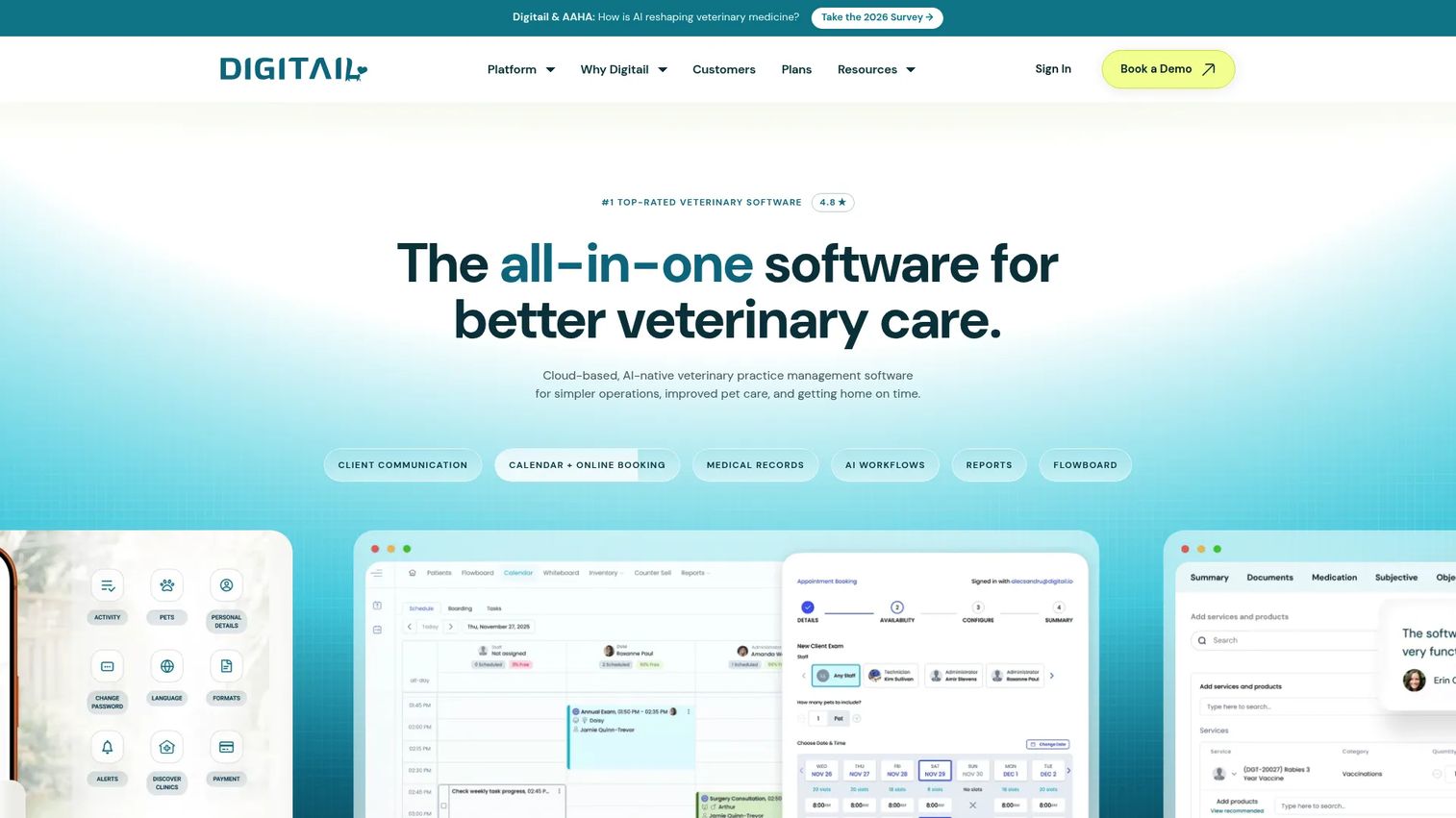
Digitail is an AI-native cloud PIMS built to run a clinic end to end without stitching together point tools. It pairs practice management with AI documentation and a pet parent app, so clinical work, billing, and client engagement live in one system. The platform targets clinics that want a modern all-in-one instead of a legacy stack held together by exports and workarounds.
Best for: Clinics that want a modern all-in-one cloud platform with AI workflows built in.
Key features
- AI SOAP dictation and AI medical records
- Scheduling, online booking, and reminders
- Client communication and pet parent app
- Billing, payments, and reporting
- 40+ integrations
Why choose Digitail: If cutting documentation time and consolidating tools matters more than deep legacy configuration, Digitail fits. It suits growth-minded clinics that would rather adopt AI workflows now than retrofit an older system later.
Digitail pricing: Digitail publishes four plan names, Mobile, Growth, Growth AI, and Enterprise, with pricing arranged through the vendor rather than posted publicly. Enterprise is sales-led.
Digitail holds a 5.0/5 rating on G2, based on a small number of reviews.
2. Covetrus Pulse
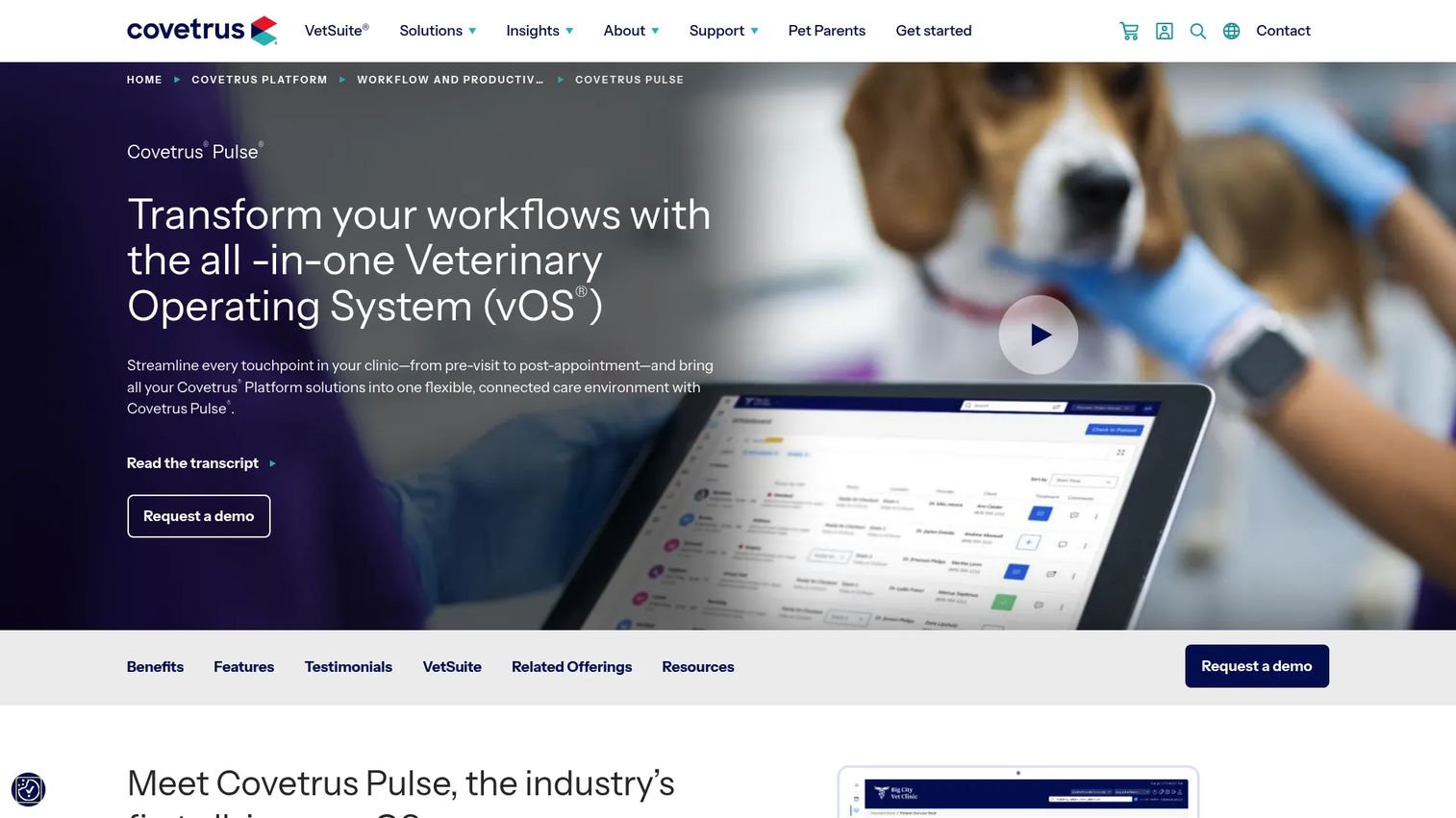
Covetrus Pulse is a cloud-based veterinary operating system that connects practice workflows to the wider Covetrus supply and pharmacy relationship. It covers electronic medical records, scheduling, and client communication, with online pharmacy integration that ties dispensing to the clinic's existing product ordering. For practices already buying supplies and prescriptions through Covetrus, Pulse keeps those threads in one place.
Best for: Veterinary practices already in the Covetrus orbit that want a connected cloud platform.
Key features
- Electronic medical records
- Online pharmacy integration
- Client communications and scheduling
- Cloud-based practice workflows
Why choose Covetrus Pulse: The pull here is ecosystem depth. If your clinic already relies on Covetrus for pharmacy and supply, Pulse reduces the number of vendors and disconnected ordering flows you manage.
Covetrus Pulse pricing: Covetrus keeps Pulse pricing behind a request-a-demo flow, so there is no public number to quote. Reach the sales team through the product page for a quote tied to your practice size.
3. Instinct
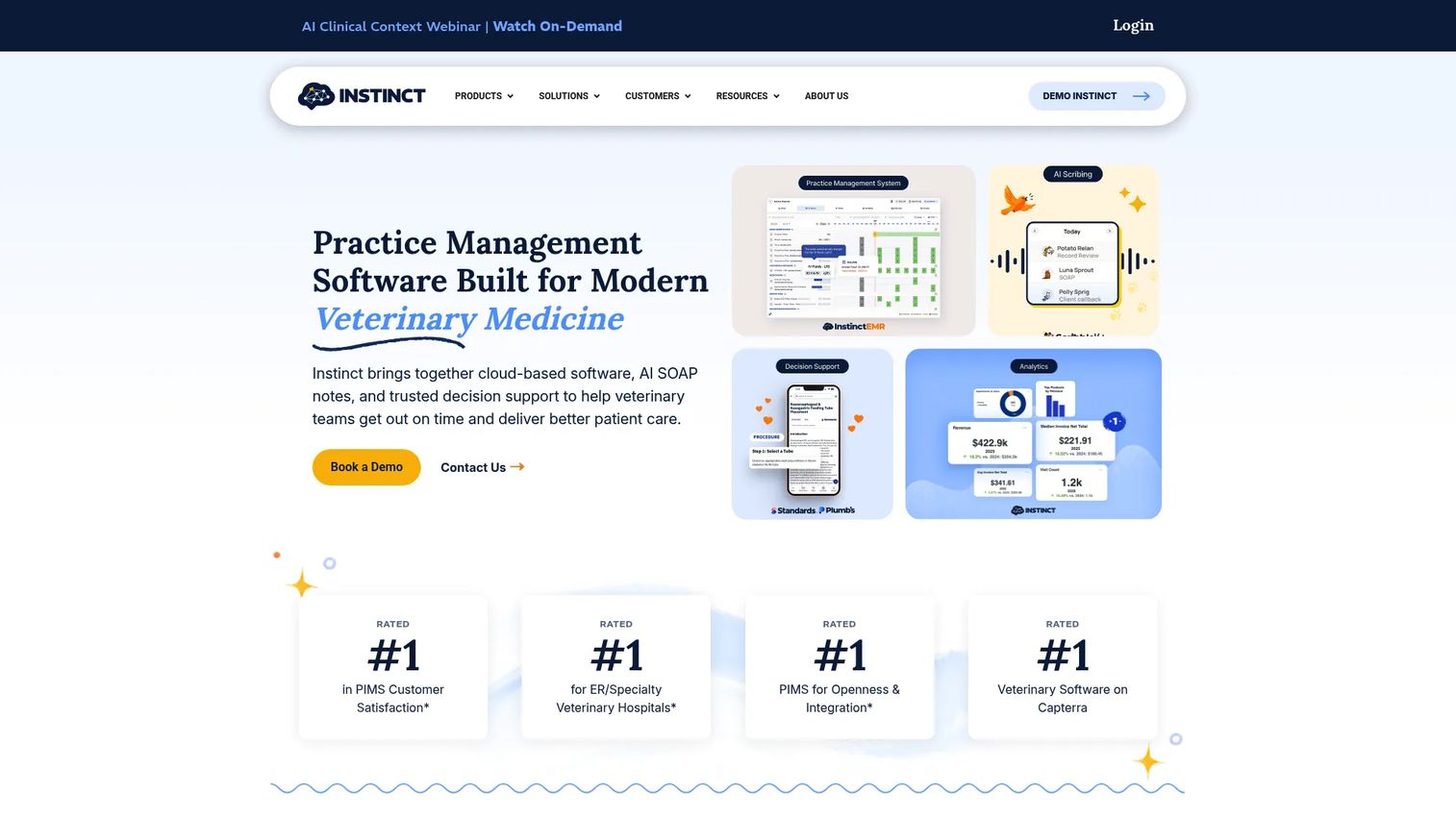
Instinct is cloud-based veterinary practice management software built around a modern EMR, digital treatment sheets, and clinical decision support. It brings together the Instinct EMR, Instinct Treatment Plan for treatment tracking, ScribbleVet AI SOAP notes, Standards of Care decision support, and the Plumb's drug reference. The combination suits hospitals that want clinical depth alongside operational visibility, from general practice to specialty and emergency settings.
Best for: Veterinary hospitals that need a unified EMR with treatment tracking and clinical decision support.
Key features
- Instinct EMR practice management
- Instinct Treatment Plan digital treatment sheets
- ScribbleVet AI SOAP notes
- Standards of Care clinical decision support
- Plumb's veterinary drug reference
Why choose Instinct: For clinical teams, the treatment sheet and decision support layer is the differentiator. It fits hospitals where accurate treatment tracking and drug reference access matter as much as scheduling and billing.
Instinct pricing: Instinct arranges pricing through a demo and contact flow rather than posting rates publicly, and Plumb's references custom plans for larger teams. Contact the team for a quote scoped to your hospital.
4. Provet Cloud
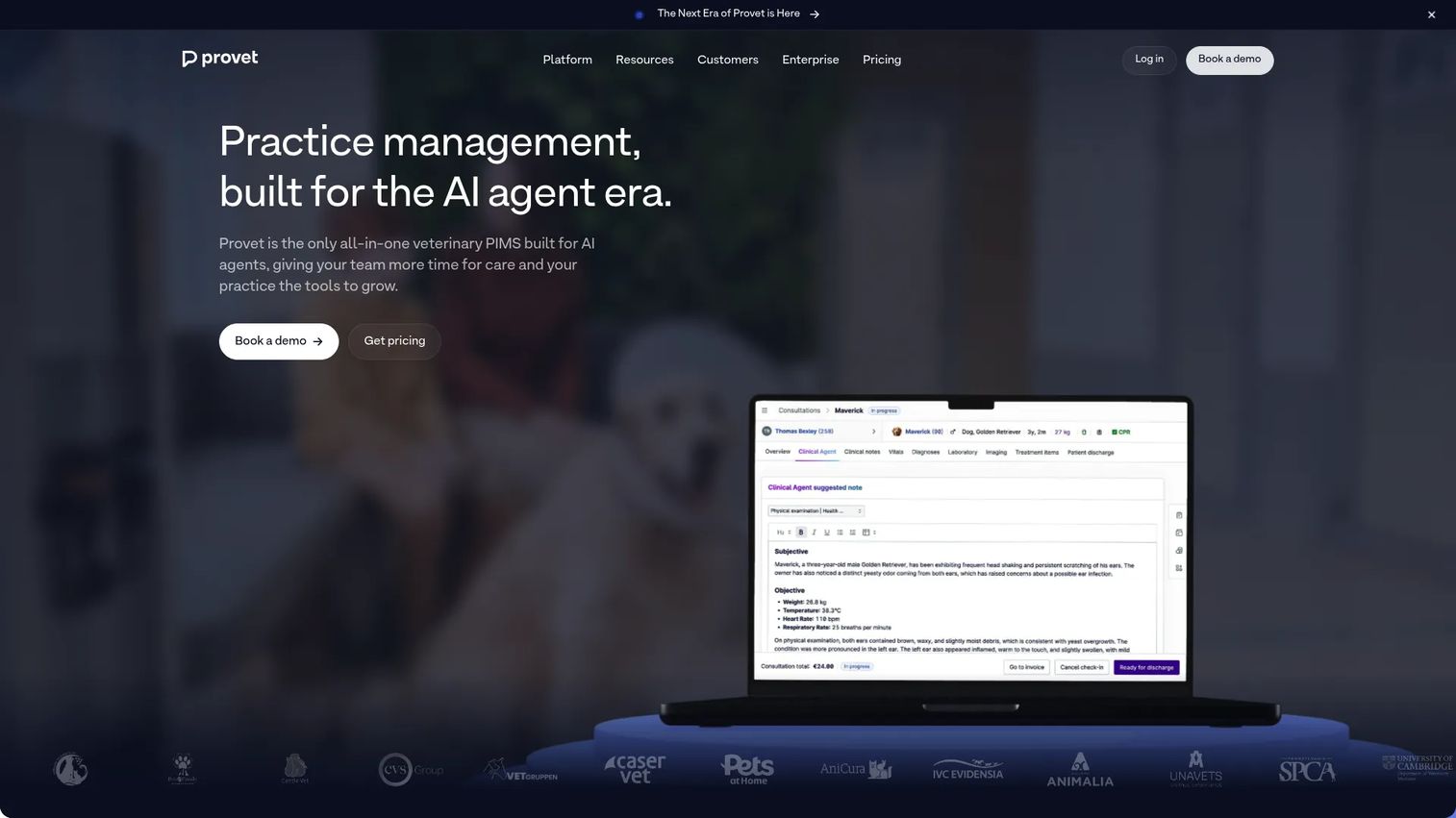
Provet Cloud is cloud-based veterinary software built for single clinics and multi-site groups that need centralized operations. Its per-veterinarian pricing model, online booking portal, and open REST API with 150+ integrations make it a fit for practices that value flexibility and connected reporting. Multi-location groups get centralized visibility without forcing every site onto identical rigid workflows.
Best for: Veterinary practices scaling across multiple locations that want per-vet pricing and centralized reporting.
Key features
- Per-veterinarian pricing model
- Online booking portal
- Open REST API and 150+ integrations
- Centralized multi-site operations
Why choose Provet Cloud: The per-vet pricing and open API suit groups that want predictable cost as they add clinicians and the freedom to integrate their own stack. It rewards clinics that treat centralized reporting as a core requirement, not a nice-to-have.
Provet Cloud pricing: The Core plan starts at $99 per vet per month in the US view, Pro starts at $129 per vet per month, and Enterprise is custom with flexible billing.
Provet Cloud holds a 3.8/5 rating on G2.
5. ezyVet
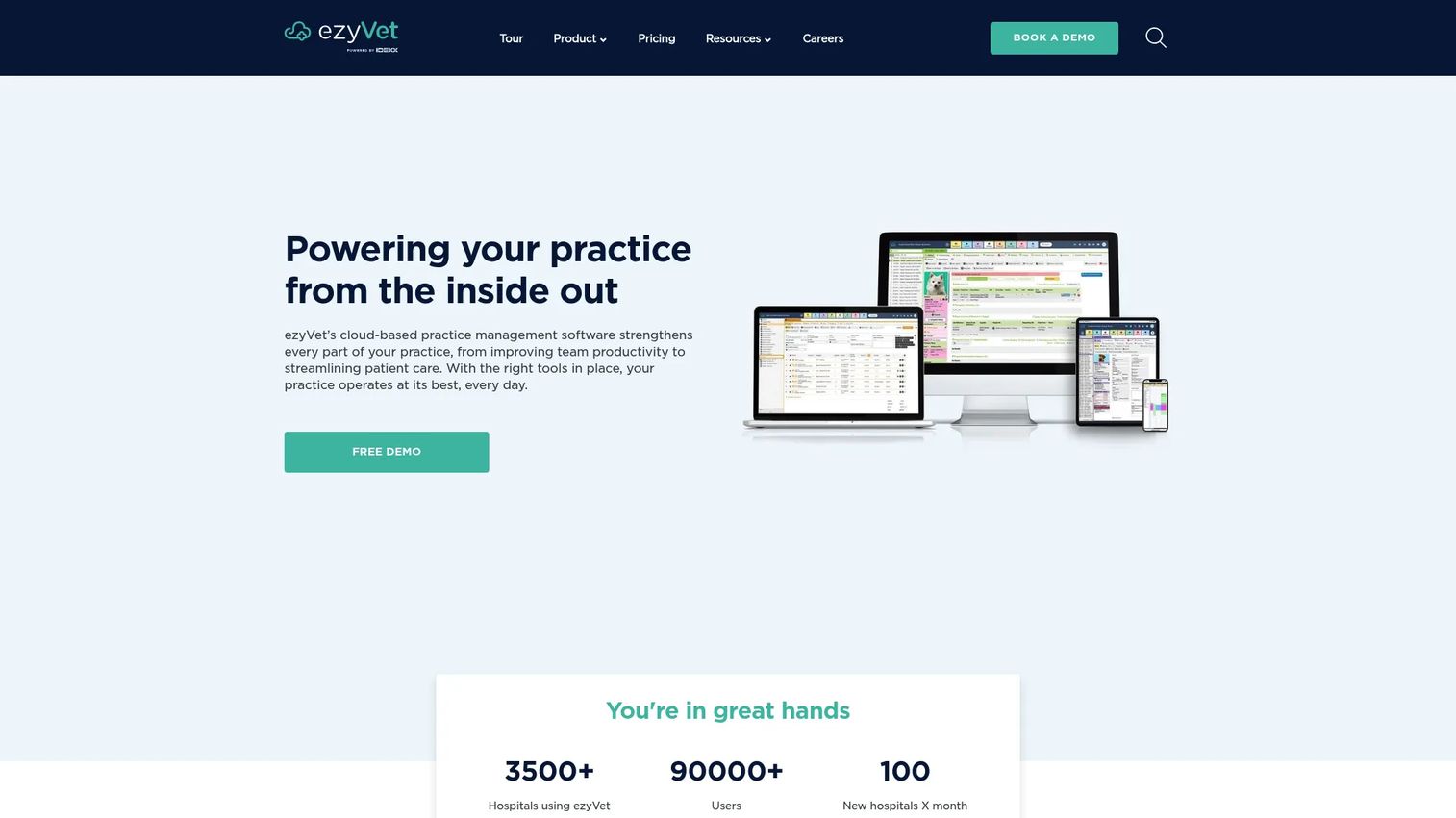
ezyVet is cloud-based veterinary practice management software built for feature-rich, structured operations at scale. It covers clinical records, invoicing, reporting, inventory, and client communications, and connects to 100+ veterinary software solutions plus IDEXX diagnostics. The configuration depth suits larger clinics and hospitals that need the system to bend to their processes rather than the other way around.
Best for: Veterinary practices and hospitals needing a feature-rich, configurable, cloud-based system.
Key features
- Cloud-based access from any device
- Clinical records, invoicing, and reporting
- Inventory and client communications
- 100+ integrations and IDEXX diagnostics
Why choose ezyVet: The trade here is depth for effort. Larger practices that need granular configuration and a wide integration surface get room to model complex operations, which is exactly what smaller clinics may not need.
ezyVet pricing: ezyVet's US pricing page shows a starting price of $260.50 per month, with additional and enterprise pricing available on request.
ezyVet holds a 3.9/5 rating on G2.
6. DaySmart Vet
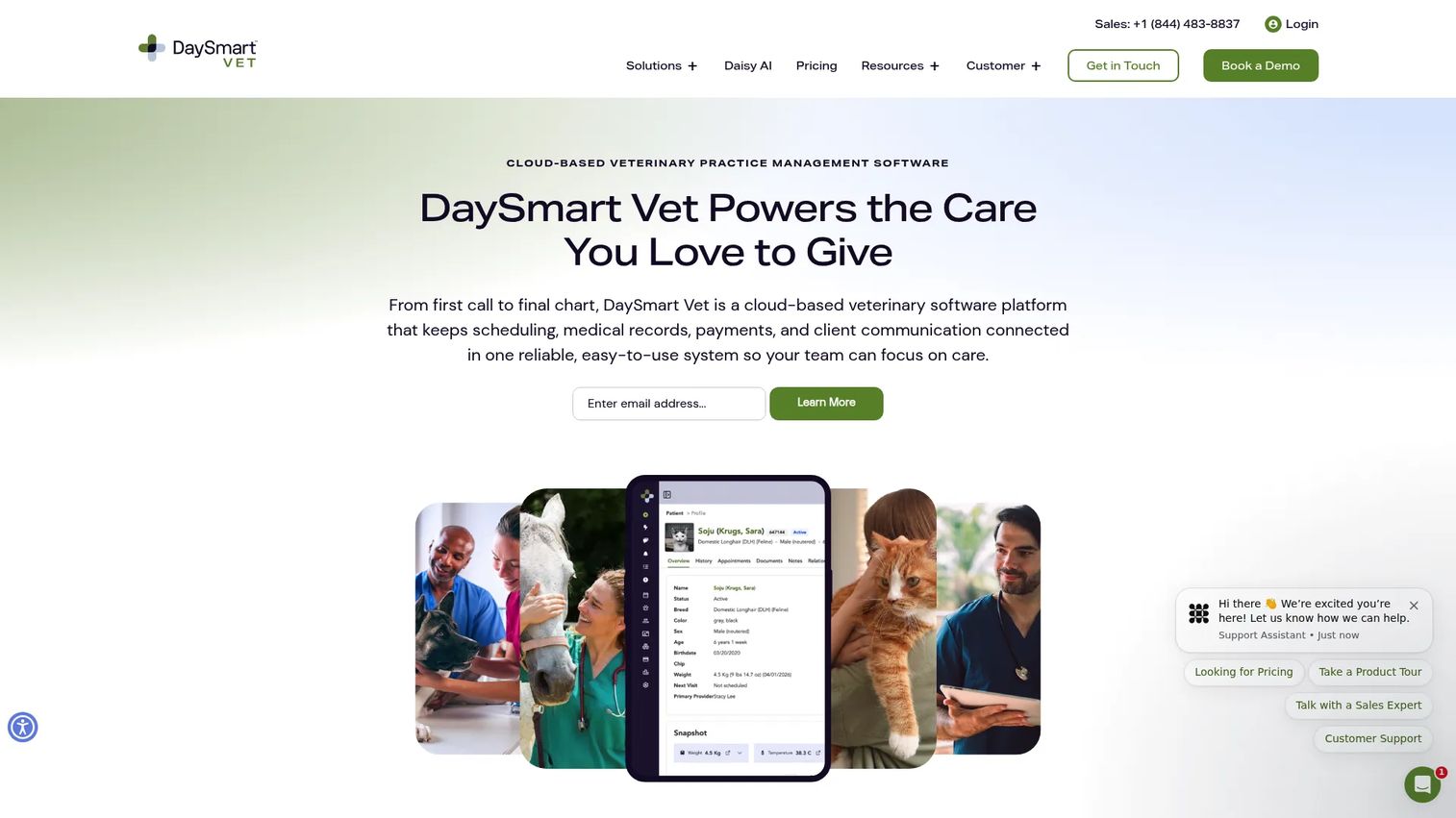
DaySmart Vet is cloud-based veterinary practice management software focused on scheduling, medical records, payments, and client communication for smaller clinics. It keeps the core workflow practical rather than sprawling, so a small team can run appointments, SOAP records, and integrated payments without wrestling an enterprise platform. For clinics that want practicality over configuration depth, that focus is the appeal.
Best for: Smaller veterinary clinics that want practical all-in-one management without platform sprawl.
Key features
- Scheduling and reminders
- Collaborative medical and SOAP records
- Integrated payments
- Client communication
Why choose DaySmart Vet: Smaller teams get a system that covers the daily essentials without the overhead of features they will never configure. It fits clinics that value quick adoption over deep customization.
DaySmart Vet pricing: Plans start at $123 per month, with custom pricing offered for larger practices through sales.
DaySmart Vet holds a 4.1/5 rating on G2.
7. Hippo Manager
Hippo Manager is cloud-based veterinary practice management software that covers the core functions a clinic needs without added complexity. It handles appointment scheduling, task management, and patient and medical record workflows, positioning itself as a straightforward option for clinics that want essential practice management. For budget-conscious teams, the appeal is core functionality at a predictable price.
Best for: Veterinary practices that want core cloud practice management without complexity.
Key features
- Appointment scheduling
- Task management
- Patient and medical record workflows
Why choose Hippo Manager: For a clinic that wants the essentials handled and does not need deep platform features, Hippo Manager keeps things simple. It suits smaller or budget-conscious practices prioritizing core functionality.
Hippo Manager pricing: Third-party listings show a Software edition starting at $299.00 for six users per month, with pricing provided by Hippo Manager. Confirm current rates directly with the vendor.
Considerations
Workflow fit
The system has to match how your clinic actually moves a patient from intake to checkout. Map your real daily flow, including room assignments, tech handoffs, and checkout, then test each finalist against it. A platform that forces you to reshape your workflow around its assumptions creates friction your staff will route around.
Cloud and accessibility
Cloud-based veterinary software lets staff access records from any device, exam room, or a second location. Check uptime commitments, offline behavior, and how the system handles a dropped connection mid-visit. Device flexibility matters if your team works across tablets, front-desk terminals, and phones.
Billing and revenue capture
Missed charges are silent revenue leaks. Look at how the veterinary billing software ties treatment plans and estimates to invoices, and whether it flags likely missed charges before checkout. Integrated payments and automated payment requests reduce the manual reconciliation that eats front-desk time.
Integrations
Your PIMS has to talk to your lab, imaging, diagnostics, payment processor, and communication tools. Confirm the specific integrations you rely on today, not just the count. An open API matters if you plan to connect systems the vendor does not support out of the box.
Reporting and visibility
You cannot manage what you cannot see. Verify the system produces the operational and financial reports you need, from production per vet to overdue reminders to inventory turns. Reporting that requires manual exports to a spreadsheet defeats the point of consolidating.
Migration and support
Switching PIMS is where deals stall. Ask exactly how historical records migrate, what data comes across, and what stays behind. Confirm onboarding, training, and the support model before you sign, because the first 90 days determine whether staff adopt the system or work around it.
How to choose the right animal hospital software
Start with the strongest all-around fit, then narrow by clinic size and complexity.
For most clinics that want broad workflow consolidation in one modern cloud system, lead with Digitail. Its AI documentation and pet parent app reduce both admin time and client friction, which matters when your goal is fewer tools and more visibility.
If your clinic already runs pharmacy and supply through Covetrus, evaluate Covetrus Pulse first. The ecosystem connection reduces vendor sprawl in a way a standalone PIMS cannot match.
If you are cloud-first and clinical depth is the priority, look closely at Instinct. Treatment sheets, AI SOAP notes, and decision support serve hospitals where accurate treatment tracking drives outcomes.
If you are scaling across multiple locations, prioritize centralized visibility and configuration depth. Provet Cloud offers per-vet pricing and an open API for connected groups, while ezyVet brings the configuration depth larger, process-heavy hospitals need. Smaller clinics that want practicality over sprawl should shortlist DaySmart Vet or Hippo Manager.
Conclusion
The right animal hospital software is the one that matches your clinic's actual workflow, not the one with the longest feature list. Digitail leads for all-in-one cloud consolidation, Covetrus Pulse for Covetrus-aligned clinics, and Instinct for cloud EMR depth. Provet Cloud and ezyVet serve multi-location and configuration-heavy operations, while DaySmart Vet and Hippo Manager keep smaller clinics practical and affordable.
Narrow to two finalists, then pressure-test each with a live demo against your own workflow and a clear conversation about migration scope. The platform that handles your busiest day without forcing workarounds is the one to pick.
FAQs
Most systems bundle a PIMS, veterinary EMR software, scheduling, billing, client communication, inventory, and reporting. Better platforms add online booking, reminders, treatment plans, and integrations with labs, imaging, and payment processors. The goal is running a full patient visit from intake to checkout in one system.
Cloud-based veterinary software lets staff access records from any device or location, and updates happen without manual installs. On-premise still held 58.43% of the market in 2025 per Mordor Intelligence (2026), but cloud adoption is climbing fast. For most clinics, cloud access and reliability outweigh the reasons to stay on-premise.
Pricing varies widely by model. DaySmart Vet starts at $123 per month, ezyVet at $260.50 per month, Provet Cloud at $99 per vet per month, and Hippo Manager at $299 for six users per month per third-party listings. Several vendors, including Digitail, Covetrus Pulse, and Instinct, arrange pricing through sales rather than posting public rates.
Provet Cloud is a strong fit for multi-location groups thanks to per-vet pricing, an open API, and centralized reporting across sites. ezyVet also suits larger operations with its deep configuration and 100+ integrations. Prioritize centralized visibility and per-site workflow control when comparing the two.
Labs, imaging, and diagnostics come first, since they feed directly into clinical decisions. Payment processing and client communication tools rank next for revenue capture and follow-up. Confirm the specific integrations your clinic uses today, and check for an open API if you rely on systems the vendor does not support natively.
Migration difficulty depends on how much historical data you move and how clean it is. Ask each vendor exactly what records transfer, what stays behind, and how long the process takes. A structured onboarding and training plan matters more than any single feature, because adoption in the first 90 days determines success.
Yes. Veterinary billing software ties treatment plans and estimates to invoices and flags likely missed charges before checkout. Veterinary scheduling and client communication software automates reminders and recalls, so lapsed patients get brought back without manual calls. Both directly protect revenue that fragmented tools tend to leak.
All-in-one platforms like Digitail reduce vendor count and keep data in one system, which cuts reconciliation work. Modular stacks give you best-of-breed tools but add integration and maintenance overhead. Choose all-in-one when consolidation and visibility matter most, and modular when a specialized workflow genuinely needs a dedicated tool.