Your product decision is buried inside a support thread, a sales call note, and a research doc that someone renamed six months ago. None of them speak the same language. Traditional keyword search returns a pile of files. What you need is a ranked, contextual answer with a clear path back to the source.
That gap is expensive. The insight engines market was valued at $2.85 billion in 2026 and is forecast to reach $8.93 billion by 2031, according to Mordor Intelligence (2026). That growth reflects a real organizational problem: Product, support, and research context is scattered across wikis, tickets, analytics dashboards, chat threads, and cloud drives, and most search layers were not built to handle that shape.
An enterprise insight engine changes the equation. It connects fragmented data, understands natural language questions, ranks relevant evidence, and returns grounded answers with citations. The question is which platform fits your data shape, governance requirements, and how your product team actually works.
What's inside
This guide covers eight insight engines across four use cases: Workplace knowledge search, customer and digital experience search, document intelligence, and developer-built search infrastructure. Platforms were selected based on:
- Source coverage and connector breadth
- Search quality, including semantic retrieval and relevance tuning
- Permission fidelity and governance controls
- Deployment flexibility and pricing model transparency
The goal is to help product managers choose by the questions their team cannot answer today, not by AI feature lists.
TL;DR
- Best for enterprise relevance and customer-facing search: Coveo
- Best for workplace knowledge discovery: Glean
- Best for governed enterprise AI and agentic search: Sinequa
- Best for complex search programs with heavy control requirements: Lucidworks
- Best for buildable search and flexible deployment: Elastic (from $99/month)
- Best for document intelligence on IBM Cloud: IBM Watson Discovery (from $500/month)
- Best for existing AWS deployments: Amazon Kendra (maintenance mode as of mid-2026; not open to new customers)
- Best for developer-led, customer-facing search: Algolia (free tier available)
What is an insight engine?
An insight engine is enterprise search software that connects data from multiple systems, understands natural language questions, ranks relevant evidence, and returns search results or generated answers with organizational context.
How insight engines differ from traditional enterprise search
Traditional enterprise search relies on keyword matching and returns documents. An insight engine adds semantic understanding, metadata signals, identity context, relevance ranking, permission enforcement, analytics, and sometimes generative AI. The useful output is not "a file that mentions the term." It is a ranked, contextual answer with a traceable path back to the source.
| Capability | Traditional enterprise search | Insight engine |
|---|---|---|
| Query understanding | Keyword focused | Natural language and semantic retrieval |
| Data context | Basic document matching | Metadata, identity, recency, role, and usage signals |
| Results | Links and documents | Ranked results, summaries, citations, recommendations |
| Governance | Varies by repository | Cross-source permissions and audit controls |
| Improvement loop | Manual tuning | Analytics, feedback, and relevance optimization |
Core capabilities to look for
- Connectors for your actual systems (not just popular ones)
- Permission-aware indexing that inherits source-level controls
- Semantic and keyword retrieval working together
- Citations and answer grounding so teams can trace claims
- Relevance tuning tied to recency, role, and product vocabulary
- Analytics on failed and zero-result searches
- APIs and developer tools for custom experiences
- Governance, monitoring, and deployment controls
The two meanings of "insight engine"
The term covers two distinct product shapes. Horizontal enterprise platforms search across workplace or customer data broadly. Vertical intelligence products are built around proprietary domain information, industry workflows, and curated analysis. This guide focuses on broadly applicable enterprise search and knowledge retrieval platforms. If your requirement is a specialized regulatory or industry intelligence product, the shortlist below will look different.
A PM workflow example: You want the latest evidence on onboarding friction. An insight engine should retrieve session research notes from your research tool, related support tickets, and relevant release notes, ranked by recency and your permission level, without requiring three separate searches.
When to use an insight engine
Find product evidence across disconnected systems
Product managers spend significant time reconstructing context that already exists somewhere in the organization. An insight engine with permission-aware access lets you retrieve customer feedback, experiment outcomes, and support signal without manually searching each tool. The permission layer protects sensitive data while giving cross-functional teams access to a shared fact base.
Give cross-functional teams a source-grounded answer layer
Product, support, sales, and customer success often ask the same questions and reach different answers because they search different places. A shared retrieval layer, with citations, timestamps, and source links, raises decision quality. The answer carries a reference, not just a summary.
Build search into a product or customer experience
Some platforms are designed for internal employee knowledge retrieval. Others are infrastructure for customer-facing search: Help center search, catalog discovery, or embedded AI experiences. Determine where the search experience will live before shortlisting vendors. A workplace search tool and a developer search API are both called "insight engines," but they solve different problems.
One important caution: An insight engine does not fix outdated source content or inconsistent taxonomy by itself. Retrieval quality reflects the quality of what is indexed.
Insight engines comparison
These eight tools span the four use cases identified above. Pricing and G2 ratings were verified against live vendor pricing pages and G2 listings in October 2026.
| # | Product | Best for | Key differentiator | Pricing | G2 rating |
|---|---|---|---|---|---|
| 1 | Coveo | Enterprise relevance and customer or employee search | AI relevance, personalization, and search analytics | Custom pricing | 4.3/5 |
| 2 | Glean | Internal workplace knowledge search | Permission-aware search across work apps | Custom pricing | 4.7/5 |
| 3 | Sinequa | Governed enterprise AI search | Multi-method retrieval with secure data grounding | Custom pricing | 4.4/5 |
| 4 | Lucidworks | Complex search programs with detailed control | Flexible deployment and relevance tuning | Custom pricing | 4.5/5 |
| 5 | Elastic | Custom search and flexible deployment | Search infrastructure with vector retrieval | From $99/month | 4.5/5 |
| 6 | IBM Watson Discovery | Document intelligence and IBM Cloud | NLP enrichment and document-based answers | From $500/month | 4.5/5 |
| 7 | Amazon Kendra | Existing AWS enterprise search deployments | Managed AWS retrieval (maintenance mode) | From $0.32/hour | N/A |
| 8 | Algolia | Developer-led customer-facing search | API-first search with usage-based scaling | Free tier available | 4.2/5 |
Pricing and ratings verified October 2026 from each vendor's pricing page and G2 listing.
Best 8 insight engines for 2026
1. Coveo
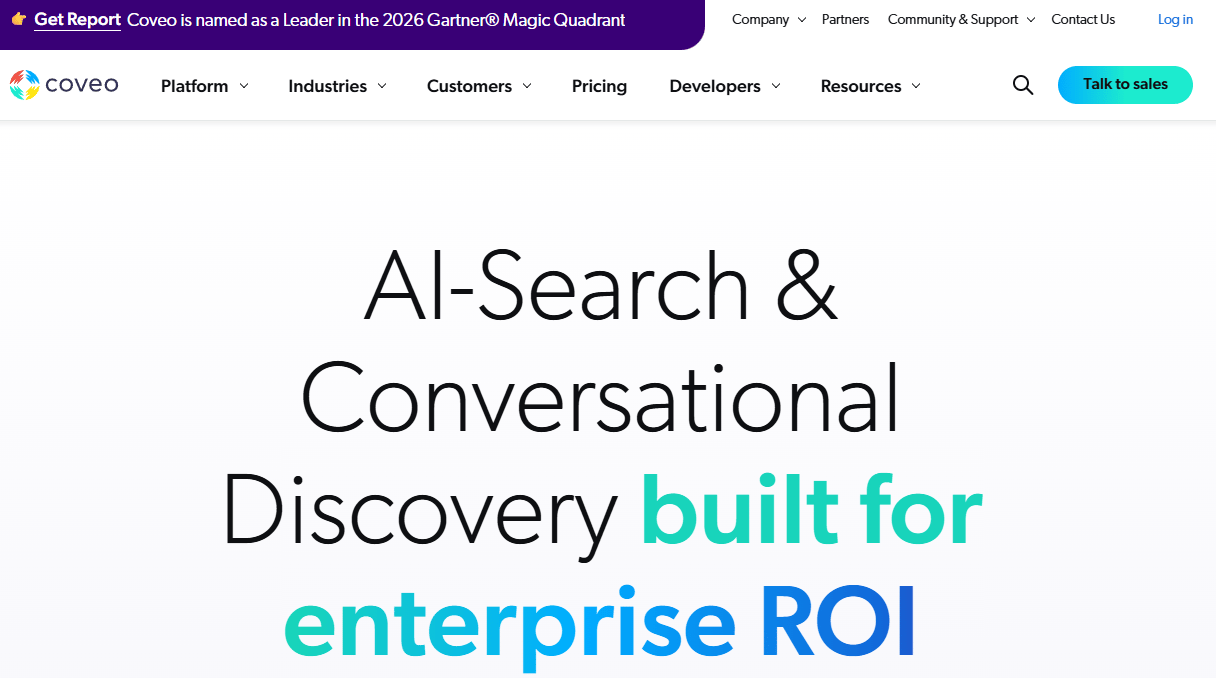
Coveo is an AI-powered search, relevance, and personalization platform for enterprise digital experiences. It supports customer service portals, ecommerce sites, websites, and workplace knowledge environments from a single platform. Its differentiation centers on measurable search quality: Relevance models, personalization signals, and analytics that show where searches succeed or fail.
Best for: Enterprise teams that treat search as a measurable customer or employee experience with clear business outcomes.
Key features
- Generative answering with source grounding
- Unified content indexing across enterprise systems
- AI-powered relevance models and personalization
- Search analytics dashboards with failure-mode visibility
- Headless APIs and developer components
Why choose Coveo: Coveo fits product managers who need to understand what customers search for, where results fail, and whether improved relevance reduces support burden. The analytics layer connects search behavior to activation and support deflection metrics that PMs already track.
Coveo pricing: Coveo does not display monetary pricing on its website. Both Pro and Enterprise platform tiers exist. Cost is shaped by indexed content volume, deployment scope, connector count, AI feature usage, and service requirements. Contact Coveo directly for a quote.
G2 rating: 4.3/5 (verified October 2026).
2. Glean
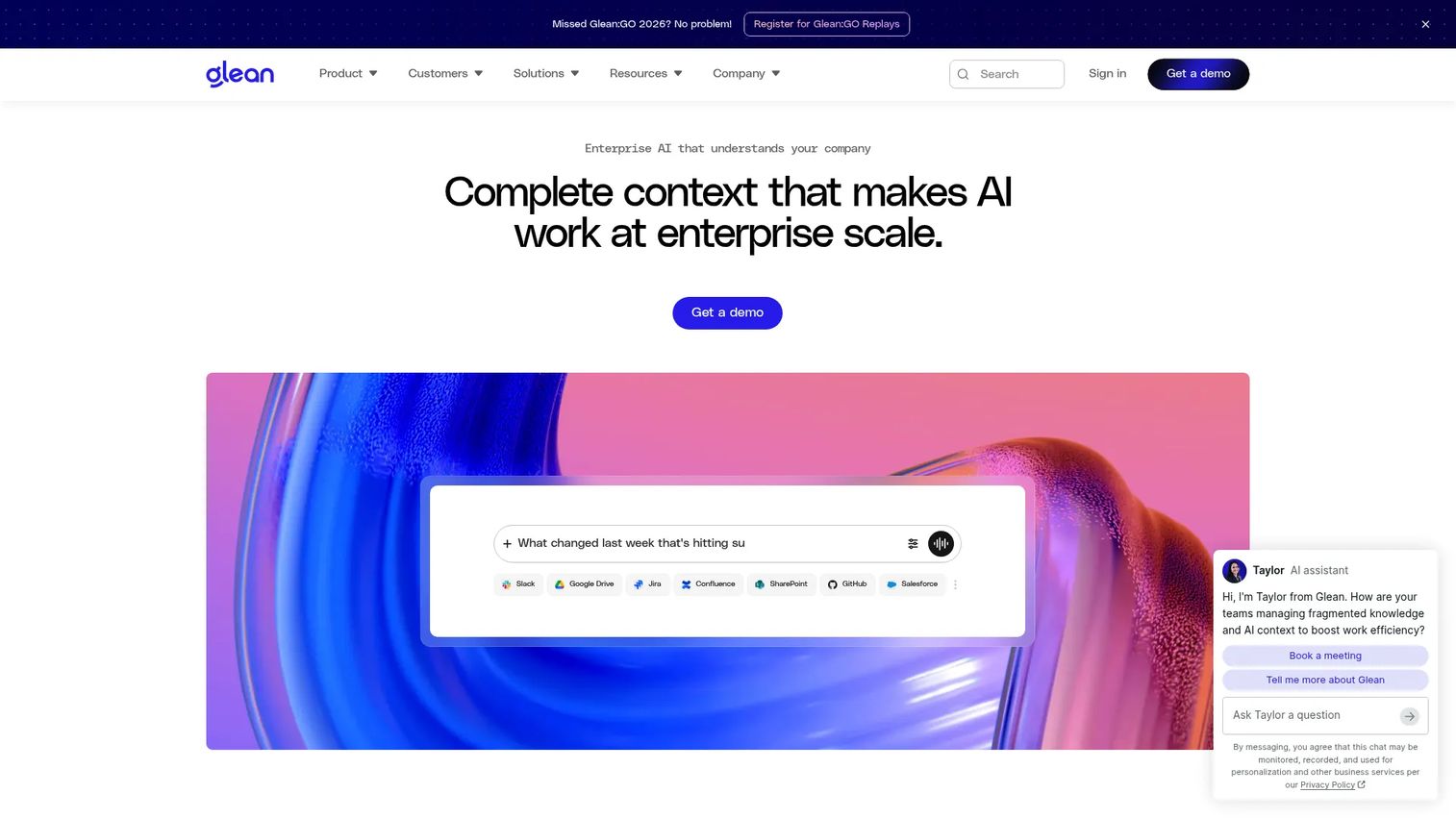
Glean is an enterprise AI platform built around workplace search, AI answers, and workflow automation across internal systems. Its connector library spans hundreds of work applications, including project trackers, documentation, CRM, and cloud storage, while respecting the access controls set in each source system. Beyond search, Glean offers AI agents, content creation, and people and expertise discovery.
Best for: Large product organizations that need employees to find trustworthy cross-functional context without leaving their workflow.
Key features
- Permission-aware search across connected work apps
- AI assistant with cited answers grounded in company knowledge
- AI agents and workflow automation
- People and expertise discovery
- Real-time indexing across connected sources
Why choose Glean: For PMs, the value is faster context reconstruction. Instead of asking five people for the latest activation evidence, you ask Glean and get a cited answer linking to session research, tickets, and prior analyses. The knowledge graph layer personalizes results based on your role, team, and past activity.
Glean pricing: Glean does not display pricing on its site. The model is enterprise and usage-based, with details available through their account team. Cost factors include user count, connector scope, indexed data volume, advanced AI usage, and governance requirements.
G2 rating: 4.7/5 from 336 reviews (verified October 2026).
3. Sinequa
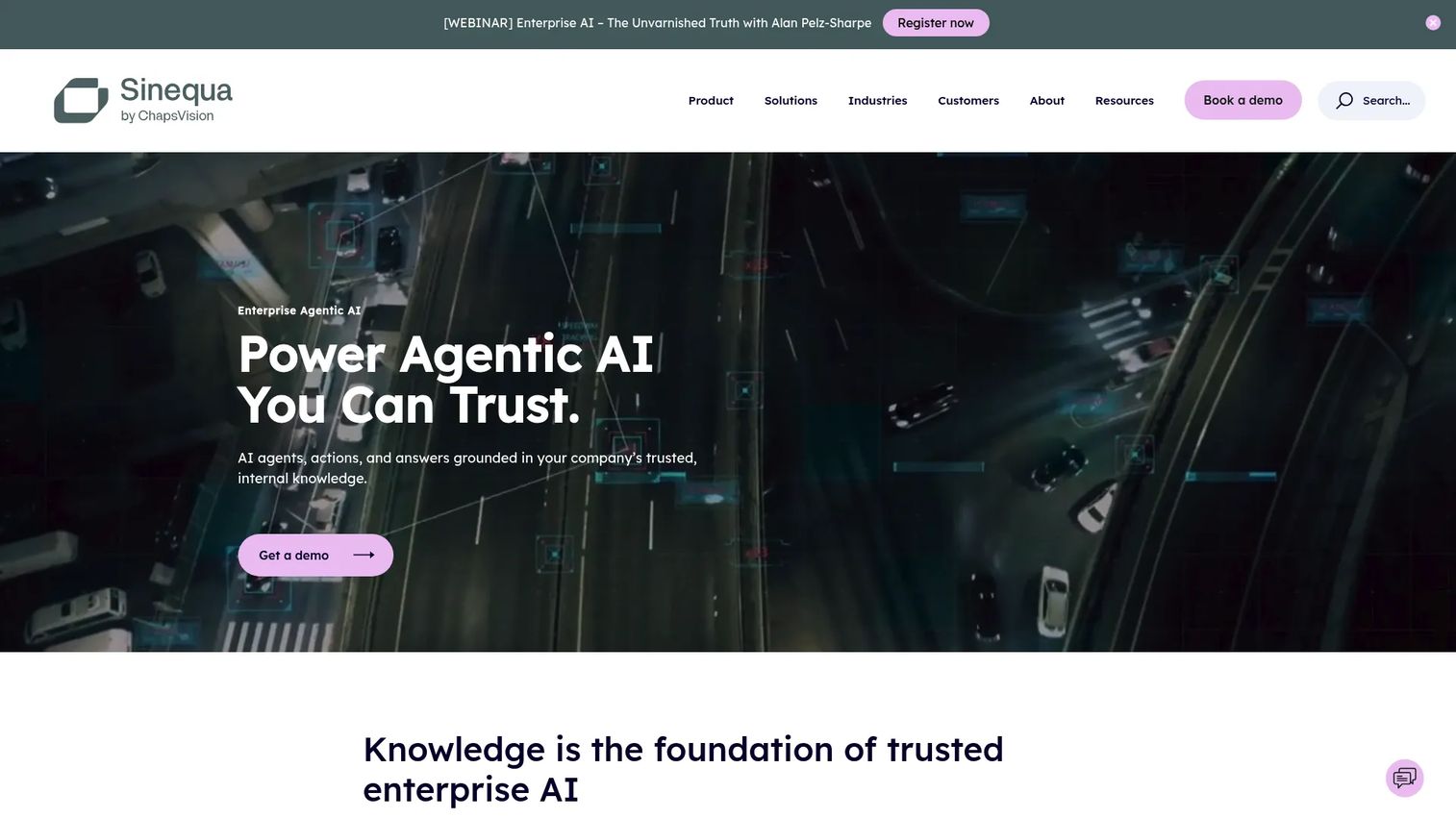
Sinequa is an enterprise agentic AI platform that connects, secures, and retrieves knowledge across siloed data environments. Its retrieval layer combines vector, keyword, graph, structured, and multimodal methods in a single query, which matters when your product context spans structured databases, unstructured documents, and multimedia artifacts. Sinequa emphasizes explainability: Answers carry source citations and access controls are enforced at the query level.
Best for: Large enterprises with complex, sensitive, or regulated data environments that need governed AI answers alongside deep search.
Key features
- Hybrid retrieval: Vector, keyword, graph, structured, and multimodal
- AI assistants with retrieval-augmented generation grounded in enterprise data
- 200+ enterprise data connectors
- Query-level security and access-control enforcement
- Explainable answers with traceable source citations
Why choose Sinequa: Sinequa belongs on shortlists where source grounding, governance depth, and retrieval breadth matter more than a lightweight deployment. For product teams working with regulated or highly technical information across many repositories, the security-aware retrieval and traceable answers reduce the risk of acting on an ungrounded AI summary.
Sinequa pricing: Pricing is not displayed on Sinequa's website. Evaluation calls are the standard entry point. Buyers should ask for specifics on user scale, data source count, deployment architecture, AI usage caps, and implementation services.
G2 rating: 4.4/5 from 5 reviews (verified October 2026).
4. Lucidworks
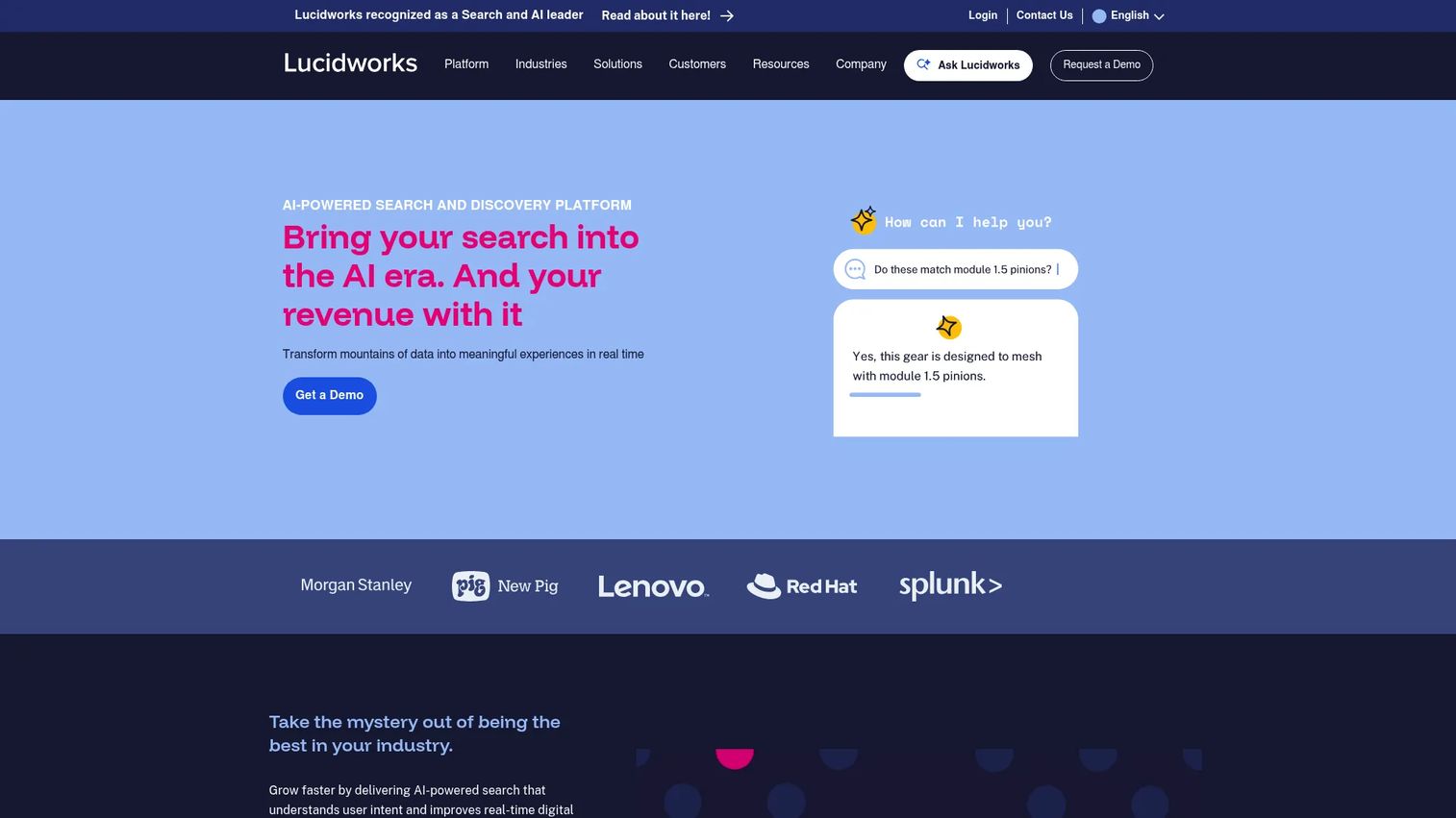
Lucidworks is an AI-powered search, discovery, and personalization platform built for complex, high-scale search programs. Its Neural Hybrid Search combines semantic and lexical retrieval. The platform offers no-code Studios for search, analytics, personalization, and AI experiences, alongside flexible deployment across SaaS, self-hosted, and hybrid models. A behavioral signals layer collects interaction data to improve ranking over time.
Best for: Organizations with significant technical ownership of search, or customer experiences where vocabulary, permissions, and relevance rules vary by user or account.
Key features
- Neural Hybrid Search combining semantic and lexical retrieval
- AI orchestration, generative AI enrichment, and LLM guardrails
- No-code Studios for search, analytics, and personalization
- Entitlement-aware results with role and account filtering
- Behavioral signals collection for ranking improvement
Why choose Lucidworks: Lucidworks fits PMs who work alongside platform engineering teams on high-stakes customer search or complex internal knowledge experiences. The control layer, spanning relevance rules, entitlements, and business logic, is deeper than most packaged workplace search tools. That depth comes with a corresponding implementation investment.
Lucidworks pricing: Lucidworks provides pricing through customer-specific discussions rather than a published page. Ask about deployment model, index scale, feature modules, support tier, and professional services scope when requesting a quote.
G2 rating: 4.5/5 (verified October 2026 for Lucidworks Fusion).
5. Elastic
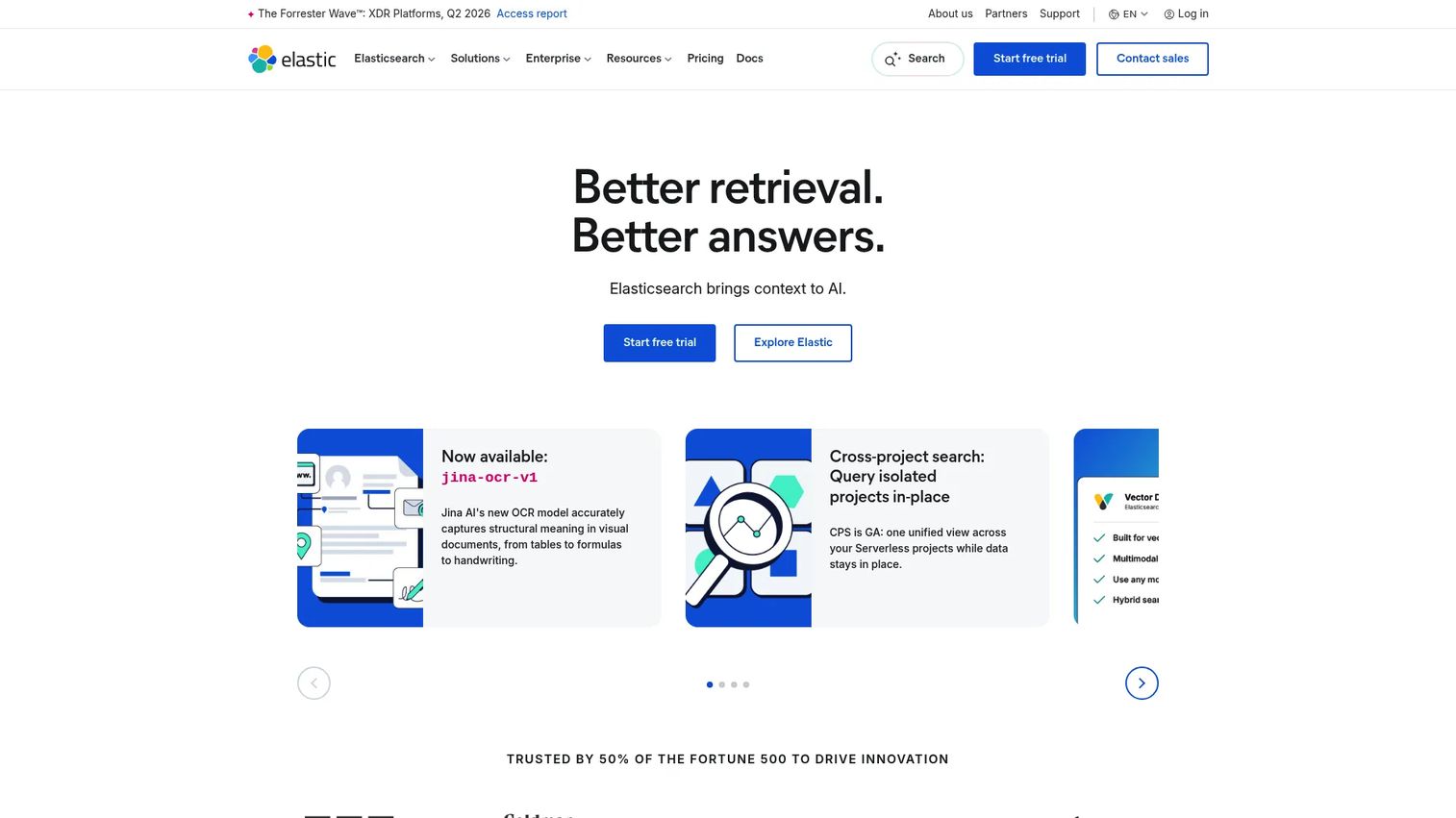
Elastic is a search, analytics, and AI platform covering search, observability, and security use cases. For product teams evaluating insight engines, the relevant surface is Elasticsearch with vector search support, which enables hybrid semantic and keyword retrieval. Elastic supports hosted, serverless, and self-managed deployment models, giving engineering teams full control over schema design, ranking logic, and infrastructure.
Best for: Product and engineering teams that need a buildable search stack with deployment flexibility and full control over the experience layer.
Key features
- Elasticsearch with vector database capabilities for semantic and hybrid retrieval
- Hosted, serverless, and self-managed deployment options
- Search APIs and connector framework
- Unified observability across logs, metrics, and traces
- Security analytics for threat detection alongside search
Why choose Elastic: Elastic is the right choice when search is a product capability that needs to be instrumented, designed, and iterated as part of your roadmap. It is infrastructure, not a plug-in workplace search layer. A team with engineering capacity that wants to control schema design, ranking logic, and the full user experience will find more flexibility here than in a packaged platform.
Elastic pricing: Elastic Cloud Hosted Standard starts at $99/month, Gold at $114/month, Platinum at $131/month, and Enterprise at $184/month. These are starting prices for a stated cloud production configuration; actual cost scales with capacity, data volume, and support tier. A free trial is available.
G2 rating: 4.5/5 (verified October 2026 for Elasticsearch).
6. IBM Watson Discovery
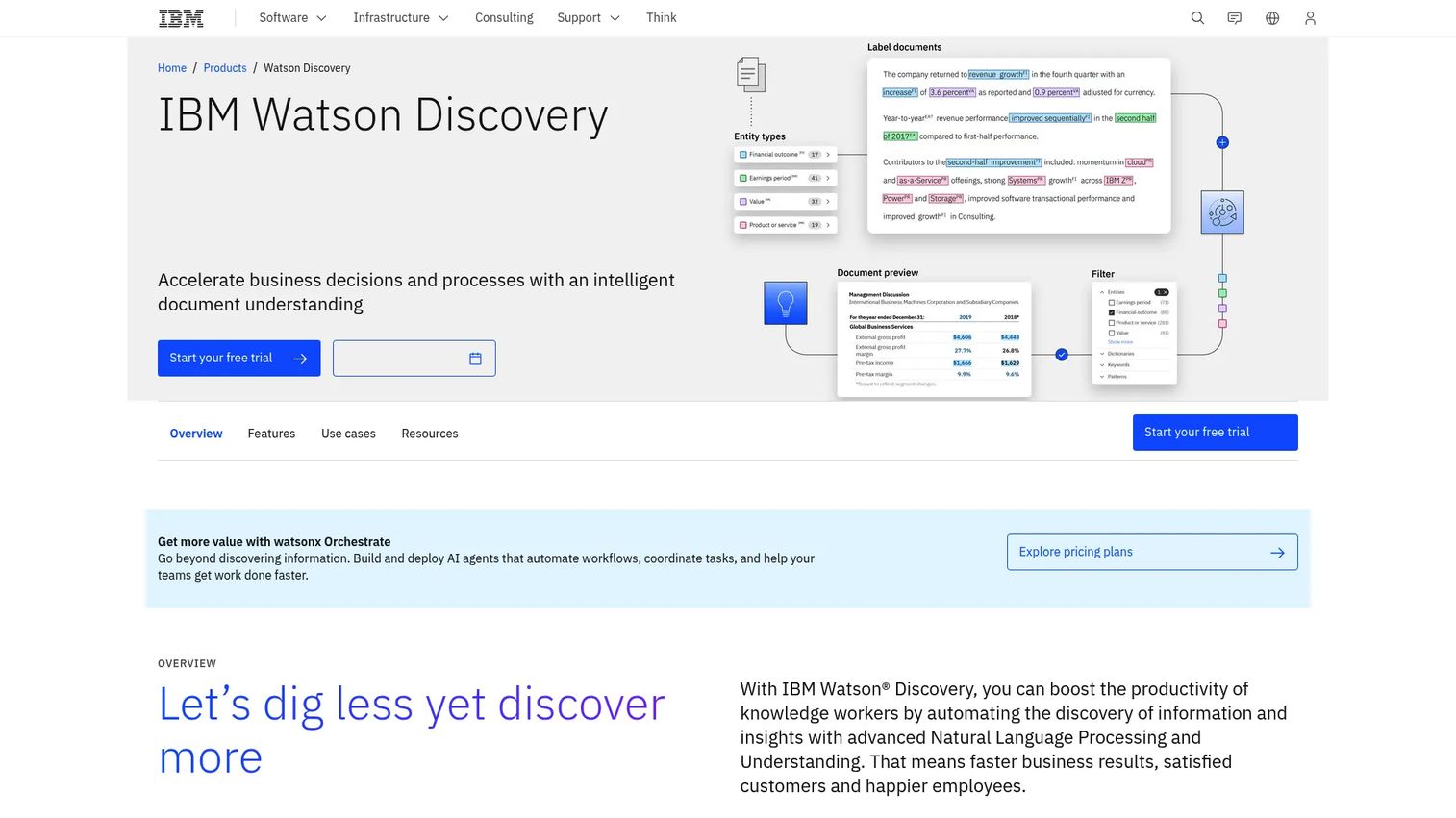
IBM Watson Discovery is a document intelligence and cognitive search platform that extracts answers and insights from enterprise content. Its Smart Document Understanding capability handles complex document structures, while NLP enrichments surface entities, sentiment, and relationships across unstructured text. The platform sits within the IBM Cloud ecosystem and integrates with other IBM Watson and IBM Cloud Pak for Data services.
Best for: Teams that need to search, analyze, and extract structured answers from large document collections inside IBM-oriented architecture.
Key features
- Smart Document Understanding for complex document structures
- OCR and image insights
- NLP enrichments: Entity extraction, sentiment, and relationship detection
- Faceted navigation and passage retrieval
- Large language model-based processing and custom domain entity extraction
Why choose IBM Watson Discovery: This platform fits organizations analyzing policy documents, research repositories, product documentation, or customer materials where the challenge is extracting answers from dense, unstructured content. If your team already runs on IBM Cloud infrastructure, the integration path is straightforward. For AI knowledge retrieval outside the IBM ecosystem, evaluate whether the deployment model matches your architecture.
IBM Watson Discovery pricing: The Plus plan starts at $500/month, covering up to 10,000 documents and 10,000 queries per month. The Premium plan starts at $5,000/month. Additional documents and queries beyond the included volume add usage charges. A 30-day no-cost trial is available on the Plus plan. IBM Cloud Pak for Data cartridge pricing requires direct contact.
G2 rating: 4.5/5 (verified October 2026).
7. Amazon Kendra
Amazon Kendra is a managed AWS enterprise search service that indexes documents across organizational repositories and supports semantic retrieval and natural language queries. It connects to sources including Amazon S3, SharePoint, Salesforce, ServiceNow, Google Drive, and Confluence, with ACL-based filtering and relevance tuning controls.
Best for: Existing AWS customers with an established Kendra deployment that needs to be maintained or extended.
Key features
- Natural-language intelligent search with extracted answers
- Generative AI retrieval through the Kendra Retriever API
- Connectors for S3, SharePoint, Salesforce, ServiceNow, and more
- Relevance tuning, custom synonyms, and metadata filtering
- No-code Experience Builder and search analytics dashboard
Why choose Amazon Kendra: Frame this carefully. AWS documentation states that Amazon Kendra entered maintenance mode on June 30, 2026, and closed to new customers on July 30, 2026. For PMs inheriting an AWS-based search deployment, maintaining and extending Kendra remains a valid operational path. For greenfield selection, explore Amazon's current agentic AI platforms and retrieval offerings instead.
Amazon Kendra pricing: The GenAI Enterprise Edition starts at $0.32/hour for the base index. The Basic Developer Edition starts at $1.125/hour, and Basic Enterprise Edition at $1.40/hour. Both the Developer and GenAI Enterprise editions include up to 750 free hours in the first 30 days. Pricing also includes storage units, query units, and connector charges on top of the base index rate.
8. Algolia
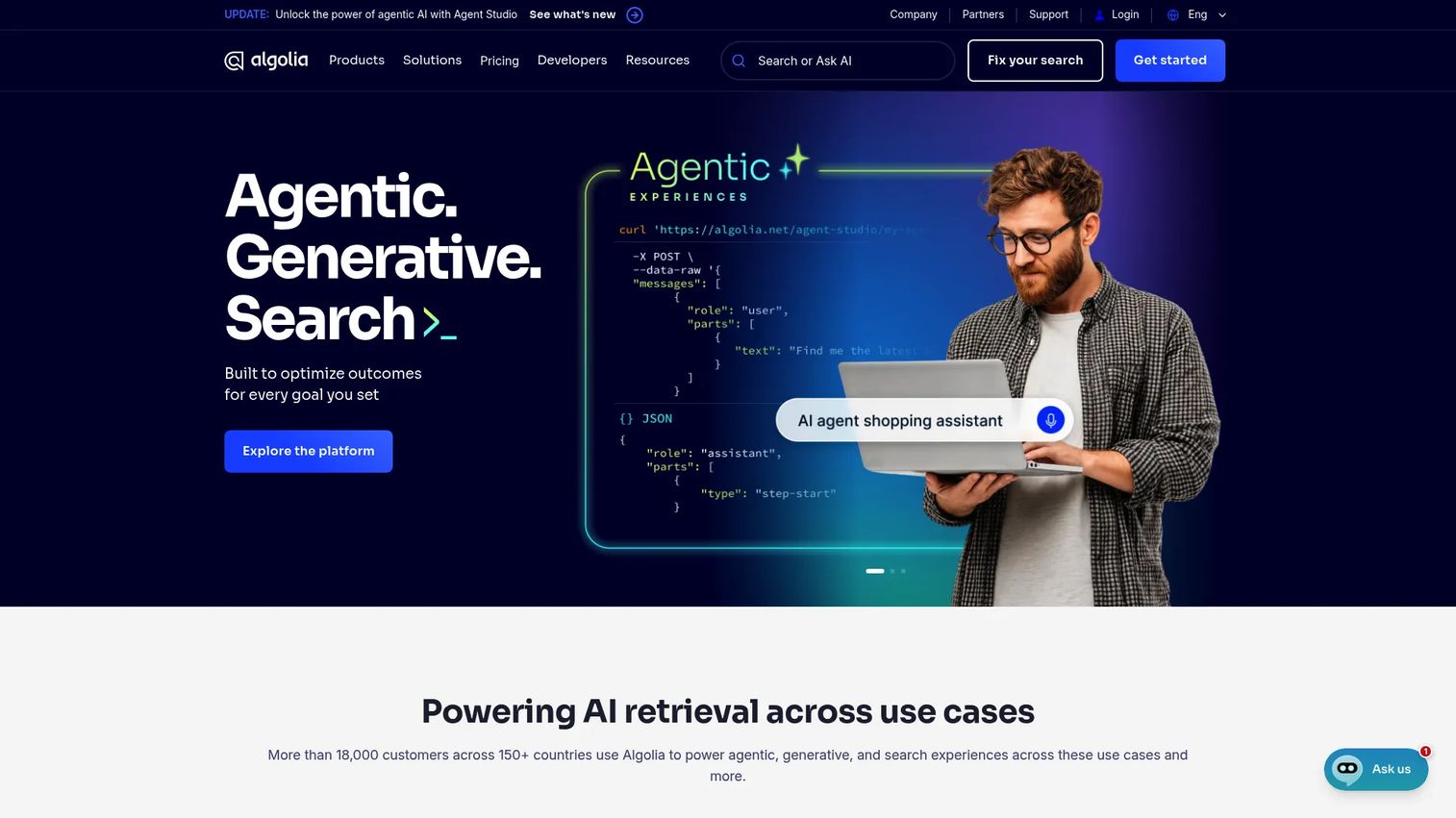
Algolia is an API-first AI search and discovery platform for digital products, content, and commerce experiences. Its strength is customer-facing search: Help centers, marketplaces, catalogs, and in-product discovery. The distinction from workplace search tools matters: Algolia is typically not the right fit for company-wide internal knowledge retrieval. It excels when the search experience is part of the product itself.
Best for: Product teams that need developer-controlled search and discovery inside a customer-facing application, marketplace, or help center.
Key features
- API-first search with keyword and hybrid semantic retrieval
- AI ranking and advanced personalization
- Recommendations, merchandising, and query suggestions
- A/B testing controls for search experiments
- Analytics and UI component libraries
Why choose Algolia: Algolia is the right choice when search quality directly affects activation, content consumption, or conversion. PMs can pair Algolia's search analytics with product instrumentation to test synonym rules, ranking strategies, and result layouts as product experiments. The usage-based model scales with query volume rather than requiring a large upfront commitment. For best ecommerce search software use cases, Algolia is one of the most developer-friendly options available.
Algolia pricing: The free Build tier requires no credit card. Grow adds keyword search and charges $0.50 per 1,000 search requests above the 10,000 included monthly, plus $0.40 per 1,000 records above 100,000. Grow Plus adds AI capabilities at $1.75 per 1,000 additional search requests. Enterprise-scale Elevate plans use custom annual pricing.
G2 rating: 4.2/5 (verified October 2026).
Considerations when choosing an insight engine
Start with the job, not the AI interface
Clarify whether you need internal workplace search, customer-facing search, document analysis, or a custom retrieval layer. A workplace search tool deployed for customer-facing discovery creates a long implementation with weak adoption. The wrong category fit costs engineering time and organizational credibility.
Audit source coverage and permissions
Ask which systems are connected, how frequently they sync, what metadata gets indexed, and whether existing access controls carry through to search results and generated answers. A strong demo means very little if critical product information sits outside the index. Permission inheritance, role changes, and external sharing controls all need explicit verification.
Test relevance with real product questions
Build a scorecard of 15 to 25 real queries drawn from your actual work. Include product naming variants, release-related questions, customer pain themes, and queries requiring current information. Measure answer usefulness, source quality, citation accuracy, and time to resolution. Synthetic queries reveal platform capabilities; real queries reveal whether the platform fits your vocabulary and data shape.
Instrument the failure modes
Evaluate analytics coverage for zero-result searches, low-click-through queries, repeated queries, and abandoned searches. Product managers need visibility into where information access breaks before they can prioritize fixes. A platform with no failure-mode analytics leaves you guessing about adoption problems after rollout.
Model operational cost beyond the subscription line
Implementation, connector setup, identity mapping, metadata cleanup, relevance tuning, model usage, document volume, and ongoing governance all shape total cost. For enterprise contracts, the subscription is often the smaller part of the investment. Ask vendors for reference customer profiles that match your scale and data complexity.
Conclusion
The right insight engine depends on what your team cannot answer today and where that evidence lives.
Coveo fits teams that need measurable relevance across customer and employee experiences. Glean excels at broad internal knowledge discovery with strong permission fidelity. Sinequa belongs on shortlists where governance depth and retrieval breadth are the primary requirements. Lucidworks suits complex search programs where engineering teams need detailed control over ranking, entitlements, and business rules.
Elastic is the choice when search is a product capability you intend to instrument and iterate. IBM Watson Discovery fits document-heavy workflows inside IBM Cloud environments. Amazon Kendra remains viable for existing AWS deployments but is closed to new customers as of July 2026, so verify that status before including it in a greenfield evaluation. Algolia leads for developer-built, customer-facing search where query analytics tie directly to product activation and conversion metrics.
Start by collecting the real questions your product, support, sales, and research teams cannot answer quickly today. Then test each shortlisted platform against those questions using current content and actual permission boundaries. The right insight engine reduces hunting. It does not replace product judgment.
For teams also evaluating how to organize and distribute product knowledge more broadly, our guides on best knowledge base software, AI governance tools, and analytics platforms that drive ROI cover adjacent decisions in the modern product stack.
Start your journey with Guideflow today!
FAQs
An insight engine is enterprise software that connects data from multiple systems, understands natural language questions, ranks relevant evidence, and returns search results or grounded answers with organizational context. The distinction from traditional search is the output: Not a list of files that contain a keyword, but a ranked, contextual answer tied to a traceable source. Enterprise insight engines typically combine semantic retrieval, metadata signals, permission enforcement, and analytics in a single platform.
Enterprise search is the broader category covering any system that indexes and retrieves organizational content. An insight engine adds semantic understanding, relevance tuning, personalization, knowledge graph signals, AI answer generation, and source grounding on top of basic retrieval. The practical difference is that insight engines return answers, not just documents, and they can adapt results based on identity, role, and usage patterns.
Focus your evaluation on source coverage, indexing freshness, permission fidelity, citation quality, and relevance for your product vocabulary. Check whether the platform indexes the specific systems your team actually uses, not just popular connectors. Test it against real cross-functional questions before purchase, and verify that search analytics expose zero-result and low-engagement queries so you can measure adoption and fix failure modes.
An insight engine can shorten the time needed to locate existing research, customer feedback, support signals, and prior product decisions. A PM who currently spends 40 minutes reconstructing context from five tools might retrieve the same context in a single query with source citations. It cannot replace direct user research, reliable instrumentation, or prioritization judgment. Think of it as reducing the retrieval cost, not the thinking cost.
Enterprise platforms should inherit source-level access controls and enforce identity permissions at query time. Buyers need to verify how the platform handles role changes (what happens when someone leaves a team), external sharing controls (whether a shared search link exposes restricted content), and audit logs (whether you can trace who retrieved what). A platform that reindexes permissions infrequently creates a window where access-controlled content can surface in results it should not.
Reliability is a function of the source content, not the generation layer. An AI answer grounded in outdated, incomplete, or poorly indexed sources will produce unreliable output regardless of the model quality. Favor platforms that provide explicit source citations, source-level access controls, answer confidence signals, and feedback loops for incorrect responses. Product teams should treat AI-generated answers as a starting point for investigation, not as a final fact.
Pricing spans a wide range. Developer-oriented platforms like Algolia start with a free tier and scale on query and record volume. Infrastructure platforms like Elastic start around $99/month for cloud-hosted configurations and scale with capacity. Document intelligence platforms like IBM Watson Discovery start at $500/month. Enterprise workplace and governed AI search platforms, including Coveo, Glean, Sinequa, and Lucidworks, use custom pricing where contract size is shaped by user count, connector scope, indexed data volume, AI model usage, and deployment model. For most enterprise deployments, the subscription is a fraction of the total cost once implementation, identity mapping, and ongoing governance are included.
Buy when your core need is broad knowledge retrieval with standard connectors, permission inheritance, and admin controls. Packaged platforms accelerate time to value and reduce the engineering opportunity cost of building connector infrastructure from scratch. Consider building, or using infrastructure like Elastic, when search is a core product capability requiring unique ranking logic, custom schema design, a proprietary user interface, or deployment requirements that packaged platforms cannot satisfy. The decision often turns on how central search quality is to your product's differentiation and whether your team has the engineering capacity to maintain it as a first-class system. For teams evaluating the broader AI stack, our roundup of best AI copilot software and agentic AI tools for sales covers adjacent buying decisions worth considering alongside your insight engine evaluation.