Your team ran the scan. The report has hundreds of findings. Engineering still needs to answer the only question that matters: Which ones can an attacker use?
That gap between "finding logged" and "finding actionable" is where release cycles stall, backlogs bloat, and security debt accumulates. Static analysis catches patterns in code but lacks runtime evidence. External scanning simulates attacks but may not trace a vulnerability back to a specific file or stack frame. IAST tools close that gap by instrumenting the running application during your tests, observing what code actually executes, and connecting a finding to the exact route, request, or line that causes it.
According to the OpenText State of Code Security report (2022), 37% of application security professionals were already using IAST, and 46% planned to adopt it within the following year. The application security testing software market has continued to grow since then, with the global IAST segment estimated at $1.23 billion in 2025 and an 18.5% CAGR forecast through 2034, according to Dataintelo (2025).
The right IAST platform gives security and engineering enough runtime evidence to fix the issue, not merely log it.
What's inside
This guide is built for product managers, AppSec leaders, QA engineers, and platform engineering teams evaluating IAST for their DevSecOps workflow. Each tool was assessed against vendor documentation, current pricing availability, and current G2 data where available.
- Seven IAST tools covering runtime vulnerability detection, CI/CD integration, and code-level remediation
- A plain-English breakdown of passive, active, and scanner-assisted IAST
- Side-by-side comparison on deployment model, supported runtimes, and pricing approach
- Selection criteria mapped to release cadence, test coverage, and remediation workflow
TL;DR
- Best for mature runtime security programs: Contrast Security Assess, built around continuous sensor-based IAST with adjacency to runtime protection
- Best for verified findings and enterprise CI/CD: Black Duck Seeker, with patented active verification and line-of-code remediation context
- Best for DAST teams adding IAST depth: Invicti AcuSensor or Acunetix AcuSensor, which extend web scanning with backend runtime visibility
- Best for broad enterprise AppSec programs: HCL AppScan, with a free CodeSweep tier and paid plans starting at $29.99 per scan
- Best for multi-method governance at scale: Checkmarx One, covering SAST, SCA, DAST, and more under one risk-orchestration layer
- Best for developer-first consolidation: Aikido Security, with a free Developer plan and paid tiers starting at 300/month
- Important caveat: IAST only observes code paths that your tests exercise. Pair it with AI software testing tools, SAST, DAST, SCA, and manual testing to cover what automated tests miss
What is IAST?
Interactive application security testing, or IAST, is a software-testing method that instruments a running application to detect vulnerabilities while the application is being exercised.
Unlike static analysis or external scanning, IAST places agents, sensors, or instrumented components inside or alongside the running application. Those components observe code execution, data flow, framework behavior, HTTP traffic, and back-end connections in real time. When a security-relevant operation occurs, IAST can connect the finding to a specific route, request, stack trace, or code location.
IAST works during manual QA sessions, automated functional tests, CI/CD tools pipelines, and sometimes controlled production scenarios.
How IAST works
- Deploy the sensor or agent in a supported runtime environment
- Exercise the application through automated tests or manual workflows
- Observe execution paths, data flow, and security-relevant operations in the running code
- Validate and prioritize findings with runtime evidence attached
- Route remediation context into developer and security workflows
IAST vs SAST vs DAST
| Approach | What it analyzes | Best timing | Main strength | Core limitation |
|---|---|---|---|---|
| SAST | Source code or compiled code | Before runtime | Broad early code coverage | May lack runtime context |
| DAST | Externally observable application behavior | Running test environment | Simulates external attack paths | May lack source-level traceability |
| IAST | Running application internals during testing | QA, CI/CD, functional testing | Runtime evidence plus code-level context | Only sees paths tests execute |
These are complementary controls. No single approach replaces the others, and strong AppSec programs combine methods based on risk and coverage requirements. For teams mapping out their broader tooling strategy, AI security posture management tools cover the cross-cutting governance layer.
Passive, active, and scanner-assisted IAST
Passive IAST: The sensor observes existing test activity without modifying or replaying requests. Coverage depends entirely on what your tests already exercise.
Active IAST: The tool validates or replays suspected exploit paths to confirm exploitability before surfacing a finding.
Scanner-assisted IAST: A DAST scanner and a runtime sensor exchange information during a scan. The scanner fires payloads while the sensor reports backend execution context, reducing false positives and adding source-level traceability.
When to use IAST tools
Validate findings before they enter the engineering backlog
Every unvalidated finding creates opportunity cost. Engineers spend time reproducing issues that may not be exploitable, and product teams lose sprint capacity to triage noise. Runtime evidence from IAST can show whether a potentially vulnerable code path was actually reached under realistic conditions, giving you a defensible signal before you escalate a finding.
Add security checks to functional testing and CI/CD
IAST fits naturally into pipelines where meaningful functional tests already exercise critical workflows. Authentication flows, payment paths, API endpoints, and admin operations are high-value targets. Define test coverage expectations before using IAST as a release gate, or you risk missing risk in code paths your tests never touch.
Trace API and microservice risks to the code path
Modern applications often expose risk through API contracts or service boundaries that external scanning cannot fully map. IAST can observe backend execution across microservices and APIs, tracing a finding to its exact location. Supported languages, frameworks, and deployment environments determine fit. Teams evaluating API testing tools should verify runtime language coverage before committing to any platform.
Use IAST when:
- DAST findings take too long for developers to reproduce
- Security lacks source-level context to prioritize a finding
- QA already runs meaningful automated functional test coverage
- Your team needs proof before escalating a vulnerability to engineering
IAST tools comparison
The table below covers the seven tools in this guide, sorted by their primary deployment model. Pricing and ratings were verified against vendor pricing pages and G2 listings in October 2026. Verify current figures before purchasing, since IAST pricing changes as vendors update tiers, module bundles, and contract terms.
| # | Product | Best for | Key differentiator | Pricing | G2 rating |
|---|---|---|---|---|---|
| 1 | Contrast Security Assess | Continuous runtime AppSec programs | Sensor-based IAST with RASP adjacency | Custom pricing | 4.5/5 |
| 2 | Black Duck Seeker | Verified findings and enterprise CI/CD | Patented active verification, line-of-code remediation | Custom pricing | Not separately verified |
| 3 | Invicti AcuSensor | DAST teams adding IAST depth | Scanner-assisted IAST with backend route visibility | Custom pricing | Not separately verified |
| 4 | Acunetix AcuSensor | Web app teams using Acunetix | IAST sensor for web runtimes and APIs | Custom pricing | 4.1/5 |
| 5 | HCL AppScan | Enterprises standardizing multiple AppSec methods | SAST, DAST, IAST, SCA, and API testing suite | Free tier; from $29.99/scan | 4.1/5 |
| 6 | Checkmarx One | Large teams needing broad AppSec governance | Multi-method platform with risk orchestration | Custom pricing | Not separately verified |
| 7 | Aikido Security | Developer-first teams consolidating AppSec signals | Unified code, cloud, and runtime security | Free plan; from 300/month | 4.6/5 |
Best 7 IAST tools for runtime application security testing
1. Contrast Security Assess
Contrast Security Assess is the IAST component of the Contrast application security platform. Its agents instrument running applications and observe code execution, data flow, HTTP traffic, and back-end connections continuously during testing. The platform connects every finding to the code location that caused it, giving engineering teams specific context instead of a generic alert.
Best for: Enterprise AppSec and development teams that want continuous runtime vulnerability analysis tied to a broader runtime protection program.
Key features
- Real-time vulnerability detection across custom code, libraries, configuration, and data flow
- Remediation guidance with code-level vulnerability details and route coverage maps
- Application security scores, flow maps, and compliance reporting
- IDE and CI/CD feedback loops for developer-facing remediation
- RASP adjacency through Contrast Protect for production defense
Why choose Contrast Security Assess: Contrast is a strong fit for organizations that need IAST as an ongoing program rather than a single point-in-time scan. Its continuous analysis model works across developer, QA, and security workflows without requiring teams to schedule separate scan runs.
Contrast Security Assess pricing: Contrast licenses Assess per application; you will need to contact sales for a quote. The official pricing page requires a sales conversation and does not display a starting figure.
G2 rating: 4.5/5
2. Black Duck Seeker
Black Duck Seeker is an enterprise IAST product built to automate vulnerability detection during functional testing. Its differentiator is patented active verification, which retests and validates findings before surfacing them, drastically reducing the noise that reaches engineering. Seeker also tracks sensitive data flows through the application and traces every finding to its exact line of code.
Best for: Organizations whose main pain is security reports that still require manual validation before developers can act on them.
Key features
- Patented active verification that retests and confirms vulnerabilities
- Sensitive-data tracking across application flows
- Line-of-code tracing with contextual remediation guidance
- CI/CD, DevOps, and functional-test integration
- Jira and Jenkins integrations for workflow routing
Why choose Black Duck Seeker: Seeker fits teams that want a prioritized, validated finding list rather than a raw alert volume. Its active verification model produces near-zero false positives, which matters when your security backlog and engineering sprint capacity are both finite.
Black Duck Seeker pricing: Black Duck directs buyers to request a no-obligation quote. Licensing is team-based; no fixed starting price appears on the official pricing page.
3. Invicti AcuSensor
Invicti is an application security platform that combines DAST, IAST, and API security. Its IAST sensor (currently marketed as Invicti Shark in first-party materials) extends web vulnerability scanning with runtime backend visibility. The scanner fires payloads while the sensor reports which backend routes and files were reached, giving engineering teams location-specific context that external scanning alone cannot provide.
Best for: AppSec teams that already run web vulnerability scanning and want deeper code-level context for remediation without adding a separate standalone IAST tool.
Key features
- Scanner-assisted IAST with backend route and file visibility
- API discovery and security testing, including stateful workflow coverage
- Proof-based vulnerability validation to confirm exploitability
- Advanced crawling for JavaScript-heavy and authenticated applications
- Continuous web-asset discovery and attack-surface management
Why choose Invicti AcuSensor: Invicti's scanner-assisted model suits teams that want IAST context inside an existing scanning program rather than a separate instrumentation deployment. Sensor installation requires planning, and connectivity between your application environment and the scanning workflow needs to be validated in staging before broader rollout.
Invicti AcuSensor pricing: Invicti's pricing page lists custom-quote plans for Web + API, AppSec Core, and AppSec Flex. Agentic Pentest is publicly listed at a maximum of $500 per pentest. Contact sales for IAST-inclusive package pricing.
4. Acunetix AcuSensor
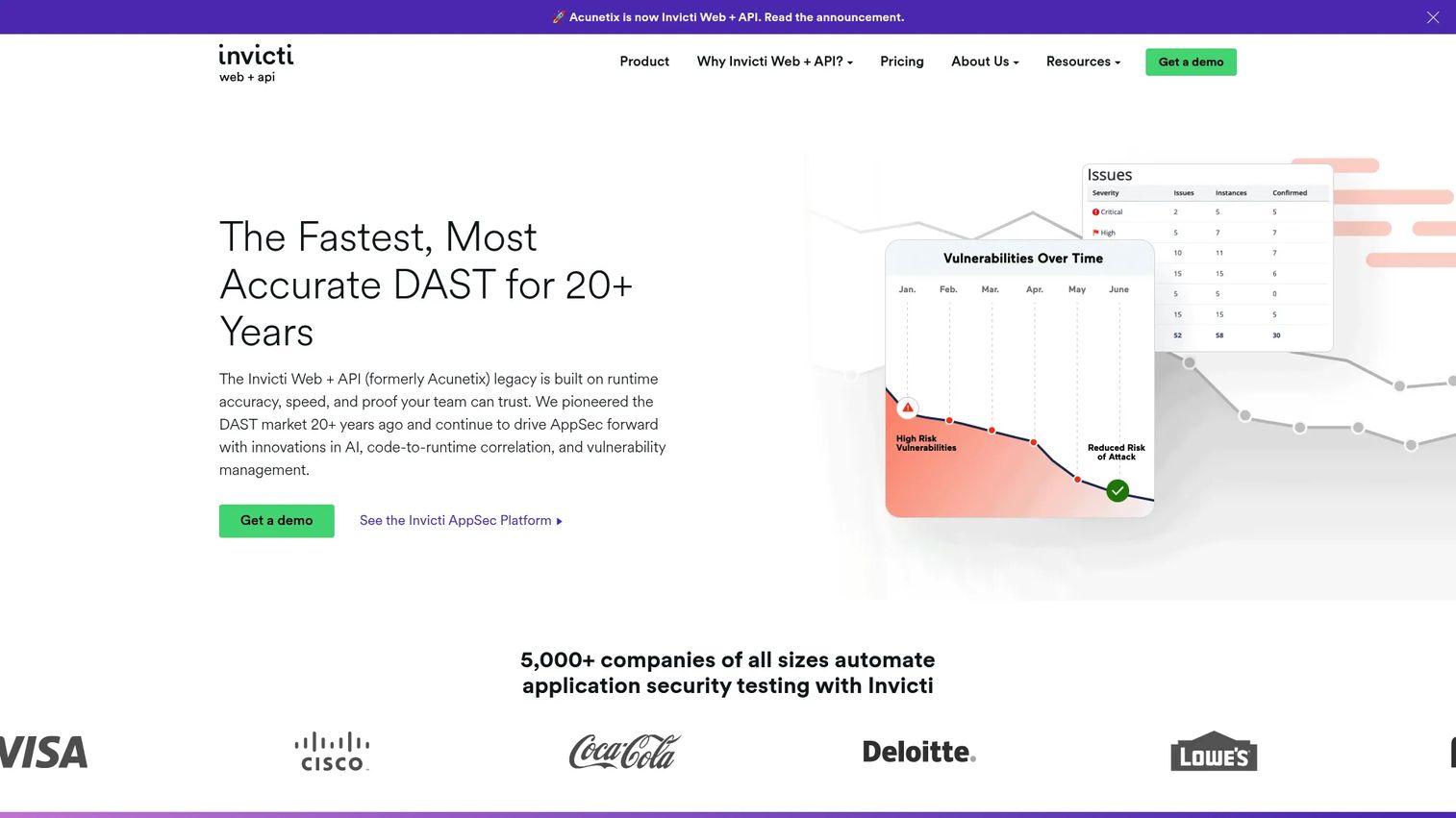
Acunetix AcuSensor is an IAST capability built into the Acunetix web security scanning workflow. Where the scanner observes external application behavior, AcuSensor adds backend visibility: It can identify the exact source-code location, stack trace, or file that produced a vulnerability, and it surfaces hidden routes and unlinked backend files that the scanner would otherwise miss.
Best for: Web application security teams already using Acunetix who want runtime-informed vulnerability details without switching to a separate IAST platform.
Key features
- Source-code location and stack-trace context for scan findings
- Discovery of hidden, unlinked files and backend application routes
- Runtime software composition analysis for open-source dependencies
- Supports Node.js, PHP, Java, and ASP.NET applications
- API discovery alongside web application scanning
Why choose Acunetix AcuSensor: AcuSensor reduces the remediation cycle for web application findings by giving developers a precise code location rather than a generic description of the issue. Teams should plan sensor deployment and bridge connectivity in a staging environment before production rollout. Acunetix documentation covers a Java 17 sensor update and deployment requirements for each supported runtime.
Acunetix AcuSensor pricing: Acunetix uses custom-quote pricing; the official pricing page does not display a starting figure for AcuSensor specifically. Contact sales and clarify whether you need Acunetix Premium, Acunetix 360, or another package for the IAST capability.
G2 rating: 4.1/5
5. HCL AppScan
HCL AppScan is an AI-powered application security suite covering SAST, DAST, IAST, SCA, API security, secrets detection, container scanning, and infrastructure-as-code checks. For organizations trying to standardize testing under one governance model, AppScan's consolidated reporting and multi-method coverage reduce the overhead of managing separate point tools. Deployment options include SaaS, on-premises, and private cloud.
Best for: Enterprises that need multiple application security testing methods, centralized reporting, and a single governance layer across a large application portfolio.
Key features
- SAST, DAST, IAST, and SCA in one platform
- API security and container scanning
- AI-powered vulnerability triage and remediation guidance
- Centralized dashboards, compliance reporting, and policy configuration
- Cloud and on-premises deployment options
Why choose HCL AppScan: AppScan fits where multiple teams need common policy, shared reporting, and consistent testing coverage. The free CodeSweep tier lets developers start running SAST scans without a procurement cycle. IAST is included at the Enterprise tier, so plan your evaluation accordingly.
HCL AppScan pricing: The CodeSweep tier is free and includes downloadable SAST scanning. The Professional plan costs $29.99 per scan (one-year SaaS subscription). Enterprise pricing requires a sales conversation and covers unlimited scans plus IAST, IaC, secrets, API security, and AI-driven triage.
G2 rating: 4.1/5
6. Checkmarx One
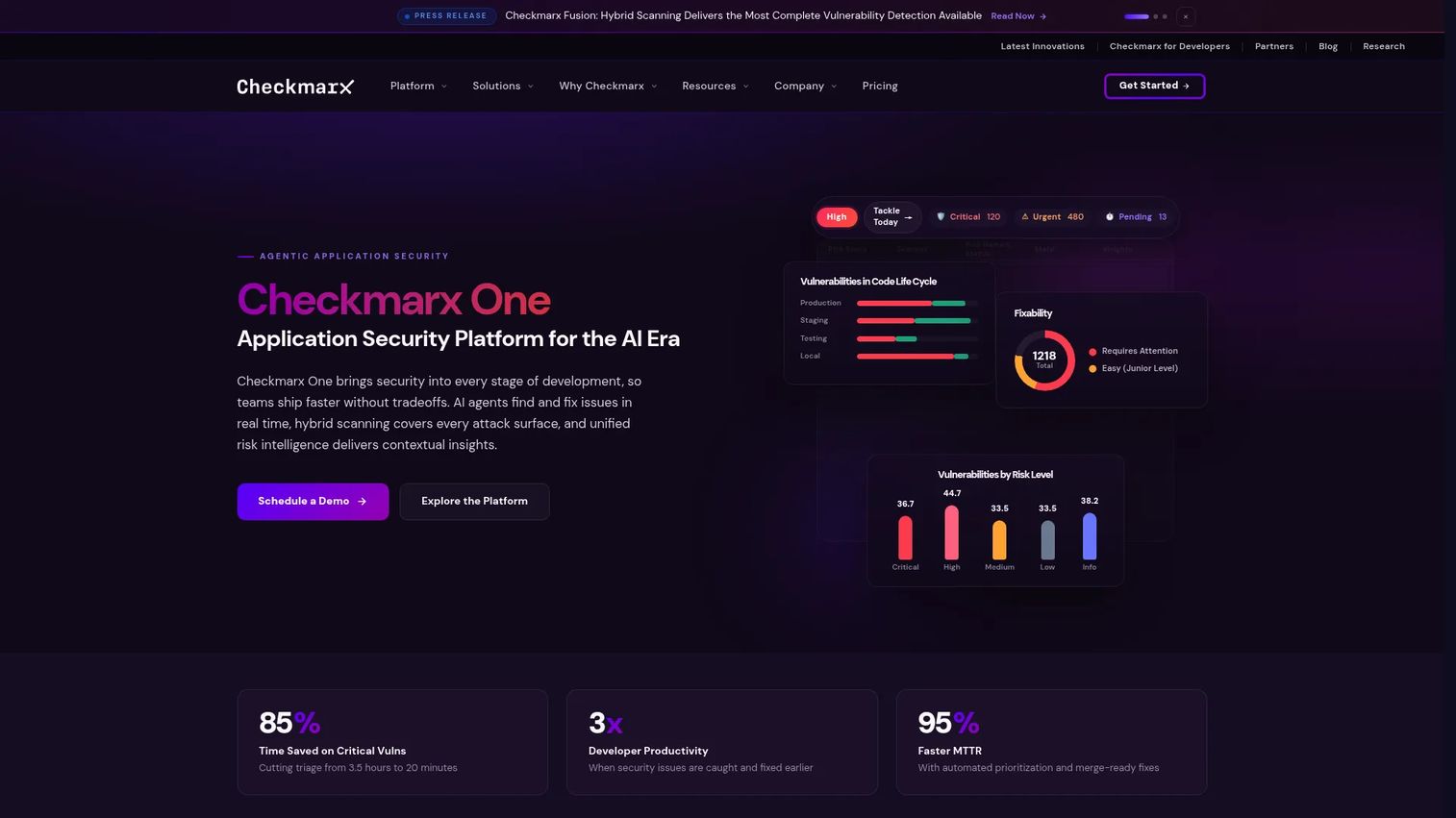
Checkmarx One is a broad AppSec platform covering SAST, SCA, DAST, API security, container security, IaC scanning, secrets detection, and supply-chain risk. Its risk orchestration layer aggregates findings across methods and applies AI-powered prioritization so teams work from one view rather than switching between scan outputs.
Best for: Large engineering organizations that need centralized AppSec governance, unified risk prioritization, and coverage across multiple codebases.
Key features
- Multi-method scanning: SAST, SCA, DAST, API security, container, IaC, and secrets
- Unified risk intelligence and risk orchestration across domains
- AI-powered triage and developer remediation guidance
- CI/CD, source-control, IDE, and cloud integrations
- Enterprise reporting and compliance governance
Why choose Checkmarx One: Checkmarx fits organizations where a single team needs to coordinate security signals across many applications and delivery teams. G2 reviewers note recurring feedback around setup effort, scan duration on complex projects, and finding triage overhead, so plan a structured proof of concept before full deployment.
Checkmarx One pricing: All tiers use custom-quote pricing, modeled on selected modules, deployment type, developer count, and application scope. Checkmarx does not offer a self-serve free trial. Contact sales and confirm required modules during evaluation.
7. Aikido Security
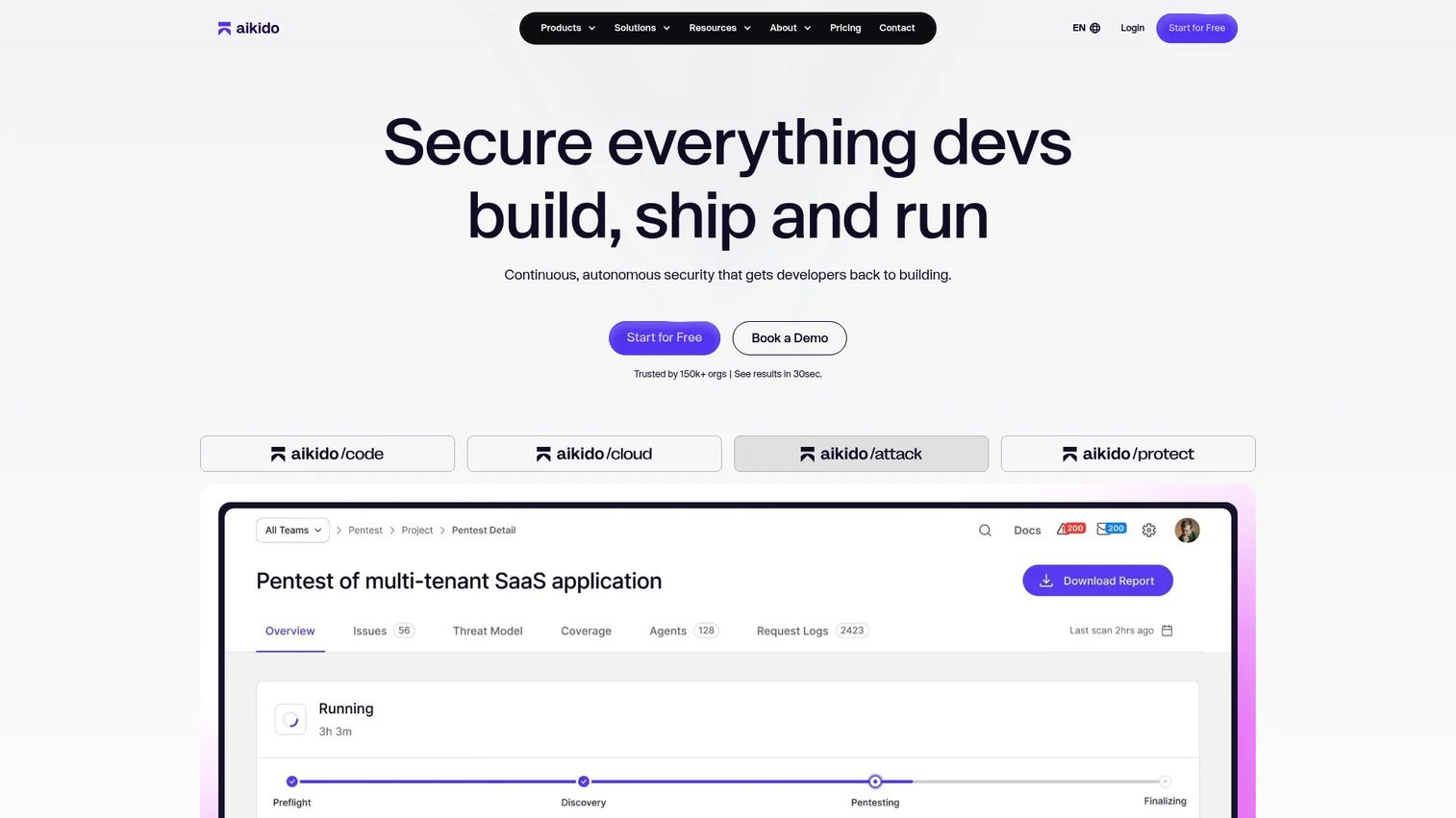
Aikido Security is a developer-first platform that consolidates code security, cloud security posture, dependency scanning, secrets detection, container scanning, DAST, API security, malware detection, and runtime protection in one workflow. Its AI-powered triage layer surfaces high-priority issues and suggests fixes, reducing the overhead of managing findings across several separate tools.
Best for: Development and security teams that want to consolidate multiple AppSec signals without adding another enterprise-only tool with a long procurement cycle.
Key features
- SAST and AI-powered code analysis
- Software composition and dependency scanning
- Secrets detection and infrastructure-as-code scanning
- DAST, API security, and malware detection
- Runtime, bot, and device protection
Why choose Aikido Security: Aikido suits teams that want broad security coverage in a single developer-oriented workflow, without the governance overhead of a traditional enterprise suite. Verify which specific IAST or runtime testing capabilities apply to your subscription tier before making capability assumptions during evaluation.
Aikido Security pricing: The Developer plan is free forever with core scanning and usage limits. Paid plans (Basic, Pro, and Advanced) are displayed at 300, 600, and 600 per month respectively on the official pricing page; the currency symbol is not explicitly shown on the pricing page, so confirm denomination with sales. Annual billing is available.
G2 rating: 4.6/5
Considerations when choosing IAST tools
Validate language and framework coverage
List your critical runtimes, frameworks, APIs, and deployment environments before any sales conversation. IAST agents are not interchangeable across language stacks. A tool that supports Java and .NET out of the box may require separate sensor versions for Node.js, PHP, or a specific containerized deployment, and support timelines for new runtime versions vary by vendor.
Measure the quality of your test coverage
IAST only observes code paths that tests actually execute. Evaluate your existing QA automation depth, authentication flow coverage, and high-risk workflow instrumentation before relying on IAST findings for release decisions. Teams using cloud data security software alongside IAST should align data-handling tests with sensor coverage so sensitive operations receive proper runtime scrutiny.
Plan the instrumentation rollout
Agent deployment requires coordination across container images, test environments, CI/CD pipelines, and secrets management. Ask who owns each deployment step, how performance is validated in pre-production, and what the rollback procedure looks like. Rushing agent rollout creates instability in test environments that slows your overall release cadence.
Connect findings to the existing engineering workflow
Prioritize integrations with your CI/CD pipeline, Jira, source control, and IDE. A finding that cannot be routed, reproduced, and assigned becomes backlog noise. Teams evaluating this alongside application portfolio management software should confirm that IAST signals feed into the same portfolio risk view.
Compare the pricing model against your application portfolio
Ask whether pricing is based on applications, modules, users, environments, or service count. Include renewal visibility and expansion costs for new microservices or additional APIs. A per-application model that looks affordable today may grow significantly as your product scales.
Conclusion
IAST is most useful when teams need runtime evidence and code-level context during functional testing, not after a deployment or in isolation from the development workflow. Each tool in this list targets a slightly different moment in that process.
Contrast Security Assess suits continuous runtime-centric programs. Black Duck Seeker fits teams whose main problem is unvalidated findings flowing into engineering. Invicti AcuSensor and Acunetix AcuSensor are strong picks for teams already running web scanning that want backend IAST depth added to existing workflows. HCL AppScan and Checkmarx One are the right direction for organizations standardizing multiple AppSec methods under one governance layer. Aikido Security works well for developer-first teams consolidating security without a heavyweight procurement process.
IAST should complement, not replace, SAST, DAST, SCA, and manual security work. The practical next step is building a requirements matrix before booking demos: List your supported languages, your test coverage depth, your deployment model, your remediation workflow, and your pricing drivers. That matrix will narrow a seven-tool shortlist to two or three realistic candidates faster than any vendor presentation will.
Start your journey with Guideflow today!
FAQs
An IAST tool instruments a running application during testing and inspects its internal execution for security weaknesses. Unlike external scanners, IAST sensors observe code execution, data flow, and framework behavior from inside the application, connecting findings to specific routes, stack traces, or code locations. This runtime evidence is what separates a validated finding from a pattern match in source code.
No single method is universally better. SAST analyzes code before runtime and catches patterns early in the software development lifecycle. DAST simulates external attack paths against a running environment. IAST observes internal execution during tests and can connect findings to specific code locations that DAST alone cannot provide. Strong programs combine approaches based on risk and coverage requirements.
Passive IAST sensors observe existing test traffic without modifying or replaying requests; coverage depends on what your tests already exercise. Active IAST validates or replays suspected exploit paths to confirm exploitability before surfacing a finding. Vendor terminology varies across products, so ask for an architecture walkthrough during evaluation rather than relying on marketing labels.
Some vendors support controlled production deployments or runtime monitoring, but teams must evaluate performance overhead, agent coverage, data handling, and operational safeguards before proceeding. Most vendors recommend starting in non-production environments and validating performance impact before any production rollout.
Runtime evidence can help validate findings and reduce false-positive rates compared to static analysis alone. Results still depend on the sensor design, your test coverage depth, application context, and the specific vulnerability class. Active verification approaches, such as those used by Black Duck Seeker, are built specifically around reducing false-positive volume before findings reach engineering.
Language and framework support differs by product and changes as vendors ship new sensor versions. Common coverage includes Java, .NET, Node.js, and PHP, but support for newer runtimes, containerized environments, and specific framework versions varies significantly. Verify support for your actual stack, including container base images and API frameworks, during a proof of concept.
IAST can find and validate many application vulnerabilities during delivery, but it does not replace human-led testing. Business-logic vulnerabilities, multi-step attack chains, threat modeling, and code paths that automated tests never exercise all require human judgment. Use IAST to reduce the surface area before a penetration test, not as a substitute for one.
Focus on the operational consequences for your team: Release impact, engineering effort required to act on findings, existing test coverage depth, remediation speed, and how pricing scales as your application portfolio grows. Involve QA, security, platform engineering, and developers in the proof of concept so the evaluation reflects actual workflow fit, not just feature checklists.