Your team ships a new onboarding flow on Tuesday. By Friday, the activation dashboard is showing a number that makes no sense. Someone changed an event name. Someone else adjusted an identity rule. The pipeline never got the memo.
This is the failure mode that DataOps platforms are built to fix. Product releases move at weekly cadence, while data definitions and pipeline checks often lag by days or weeks. The result: Metrics that stakeholders debate instead of trust, experiment readouts that arrive too late, and data engineers who become a bottleneck for every product question.
The DataOps market is estimated at $7.72 billion in 2026, projected to reach $27.91 billion by 2031, according to Mordor Intelligence (2026). The investment is there. The question is which architecture fits your stack and your team's current maturity. An AI orchestration platform solves a different slice of this problem than a testing-focused quality tool or a broad cloud data warehouse.
This guide covers 10 DataOps platforms across orchestration, observability, CI/CD, governance, and delivery, with verified pricing and G2 ratings.
What's inside
This guide is for product managers and data engineering leaders who need to shortlist platforms before a proof of concept or vendor conversation.
- 10 DataOps platforms compared for orchestration, reliability, governance, and delivery
- Selection criteria: Stack fit, automation depth, observability, data quality testing, and operating complexity
- Pricing and G2 ratings verified against live sources before publication
- Buyer checklist for choosing between an integrated platform and a composable stack
- FAQs addressing common evaluation questions
TL;DR
- Best for managed Apache Airflow: Astro, with usage-based pricing from $0.35/hr and a 14-day free trial
- Best open source orchestration foundation: Apache Airflow, free to run on your own infrastructure
- Best for unified analytics and AI workloads: Databricks, with pay-as-you-go billing from $0.07/DBU
- Best for governed cloud data and sharing: Snowflake, consumption-based with a 30-day free trial
- Best for data pipeline CI/CD: DataOps.live, with 500 free credits monthly plus pay-as-you-go
- Best for pipeline performance visibility: Unravel, with free health checks and consumption-based pricing
What are DataOps platforms?
DataOps platforms are tools that help teams build, test, deploy, monitor, govern, and improve data pipelines and data products.
The category is not a single software type. "DataOps platform" may mean a managed orchestration service, a broad cloud data lakehouse, a CI/CD automation system, an observability layer, or a composable control plane that coordinates multiple tools. According to Omdia (2024), 62% of surveyed organizations already reported operational or fully realized DataOps programs, so most buyers are not starting from scratch.
Core capabilities to evaluate:
- Workflow orchestration and scheduling
- Automated data testing and quality checks
- Pipeline observability and incident response
- Version control and deployment automation
- Metadata, lineage, and governance controls
- Collaboration across data engineering, analytics, and product teams
- Monitoring for AI and analytics data products
How the categories relate:
| Tool category | Primary job | Where it fits in DataOps |
|---|---|---|
| Data warehouse or lakehouse | Store and process data | Central data layer |
| Orchestration platform | Schedule and coordinate workflows | Pipeline control plane |
| Observability platform | Detect freshness, volume, and schema issues | Reliability layer |
| Testing platform | Validate schemas, records, and transformations | Quality gate |
| DataOps platform | Coordinate delivery practices across the lifecycle | Operating layer |
No single tool replaces every category. Many teams combine a warehouse with an orchestration layer and add observability or testing tools around it. The right approach depends on where data failures create the most visible business cost. For product managers, that usually means event instrumentation, activation reporting, and experiment analysis.
When to use a DataOps platform
Ship analytics changes without breaking product metrics
When your team changes event names, adds properties, adjusts identity rules, or launches a new onboarding path, tests and pipeline checks should be part of release readiness. Without automated validation, downstream dashboards inherit broken data silently. A DataOps platform routes quality gates into your release cadence rather than treating them as a separate manual step.
Scale data delivery across teams and use cases
Once product, sales, finance, customer success, and data science all consume the same core data, shared ownership and predictable delivery become critical. Informal coordination through Slack or pull request comments stops scaling at that point. Platforms that support shared definitions, environment promotion, and operational alerts reduce cross-team handoff friction without requiring a full-time data reliability team.
Prepare governed data for AI and automated workflows
AI features, forecasting, and autonomous workflows need current, traceable, quality-checked data. Instrumentation gaps that were tolerable for weekly reporting become blockers for real-time personalization or model serving. DataOps practices add the lineage, deployment controls, and monitoring that make the data layer behind AI features reliable enough to act on.
DataOps platform comparison
These 10 platforms solve different slices of the DataOps operating model. Compare architecture fit before comparing feature checklists. A team whose primary problem is orchestration reliability needs a different platform than one focused on governed data sharing or automated testing.
| # | Product | Best for | Key differentiator | Pricing | G2 rating |
|---|---|---|---|---|---|
| 1 | Astro | Managed Airflow orchestration | Managed deployment with observability and SLAs | From $0.35/hr | 4.5/5 |
| 2 | Apache Airflow | Open source orchestration foundation | Python-defined DAGs with broad provider ecosystem | Free (OSS) | 4.4/5 |
| 3 | Databricks | Unified analytics and AI workloads | Lakehouse with integrated ML and governance | From $0.07/DBU | 4.6/5 |
| 4 | Snowflake | Governed cloud data and sharing | Consumption-based cloud platform with secure sharing | Consumption-based | 4.6/5 |
| 5 | DataOps.live | Data pipeline CI/CD on Snowflake | Automated testing, deployment, and governance | 500 credits free/mo | 4.5/5 |
| 6 | Unravel | Pipeline performance and cost visibility | AI-powered workload optimization across platforms | Consumption-based | 4.4/5 |
| 7 | DataKitchen | Automated data quality testing | Open-source data observability and testing workflows | Free OSS tier | 5.0/5 |
| 8 | Matia | Composable DataOps orchestration | Unified ETL, reverse ETL, observability, and catalog | Usage-based (contact) | 4.9/5 |
| 9 | Saagie | Hybrid data operations | Orchestration across hybrid cloud environments | Contact sales | 2.5/5 |
| 10 | Ascend Data Automation Cloud | Automated data engineering | Metadata-driven pipeline automation with AI assist | Contact sales | 3.3/5 |
Best 10 DataOps platforms for 2026
1. Astro
Astro is Astronomer's fully managed data orchestration platform built around Apache Airflow. It handles the infrastructure, upgrades, security, and observability that teams typically manage themselves when running open-source Airflow. Product teams whose activation dashboards, lifecycle event triggers, and experiment datasets depend on reliable scheduled workflows benefit from Astro's controlled deployment environment and SLA monitoring.
Best for: Data engineering teams that need managed, scalable Airflow orchestration without operating every infrastructure component.
Key features
- AI-assisted DAG authoring and debugging
- Preview deployments with CI/CD integrations
- Centralized connection and environment management
- dbt integration through Cosmos
- Lineage, data product SLAs, and AI-assisted root-cause analysis
- Role-based access control, private networking, and secrets management
Why choose Astro: If your data reliability problem centers on Airflow, Astro removes the operational overhead while keeping the flexibility of Python-defined workflows. It fits teams that want Airflow's ecosystem without becoming Airflow infrastructure specialists.
Astro pricing: Usage-based billing. Developer deployments start at $0.35/hr, Team at $0.42/hr. Business and Enterprise plans require contacting sales. A 14-day free trial is available on the Developer plan.
G2 rating: 4.5/5
2. Apache Airflow
Apache Airflow is the open-source workflow orchestration platform that most modern data engineering teams know. You define pipelines as Python DAGs, schedule them, set dependencies, and monitor them through a web UI. It is the most widely deployed orchestration engine in the data stack, which means a large provider ecosystem and no shortage of community support. For teams that want a flexible, code-first foundation for data pipeline orchestration without a vendor lock-in, Airflow remains the reference point.
Best for: Engineering-led teams that need a flexible orchestration foundation and have the capacity to operate, upgrade, and govern it themselves.
Key features
- Python-defined DAGs with scheduling and dependency controls
- Web UI for workflow monitoring and management
- Scalable, modular architecture
- Extensible operators, hooks, and providers
- Integrations with major cloud platforms and third-party services
Why choose Apache Airflow: Choose it when your data platform team wants full control over orchestration behavior and has engineering capacity for infrastructure management, upgrades, and reliability practices. Teams that want the same capabilities without the operational burden should evaluate managed options like Astro instead. For AI software testing tools that integrate with Airflow pipelines, the provider ecosystem gives you flexibility to compose your quality layer independently.
Apache Airflow pricing: The software is open source at no license cost. Real cost comes from hosting, managed services, and engineering time to operate it.
G2 rating: 4.4/5 (
3. Databricks
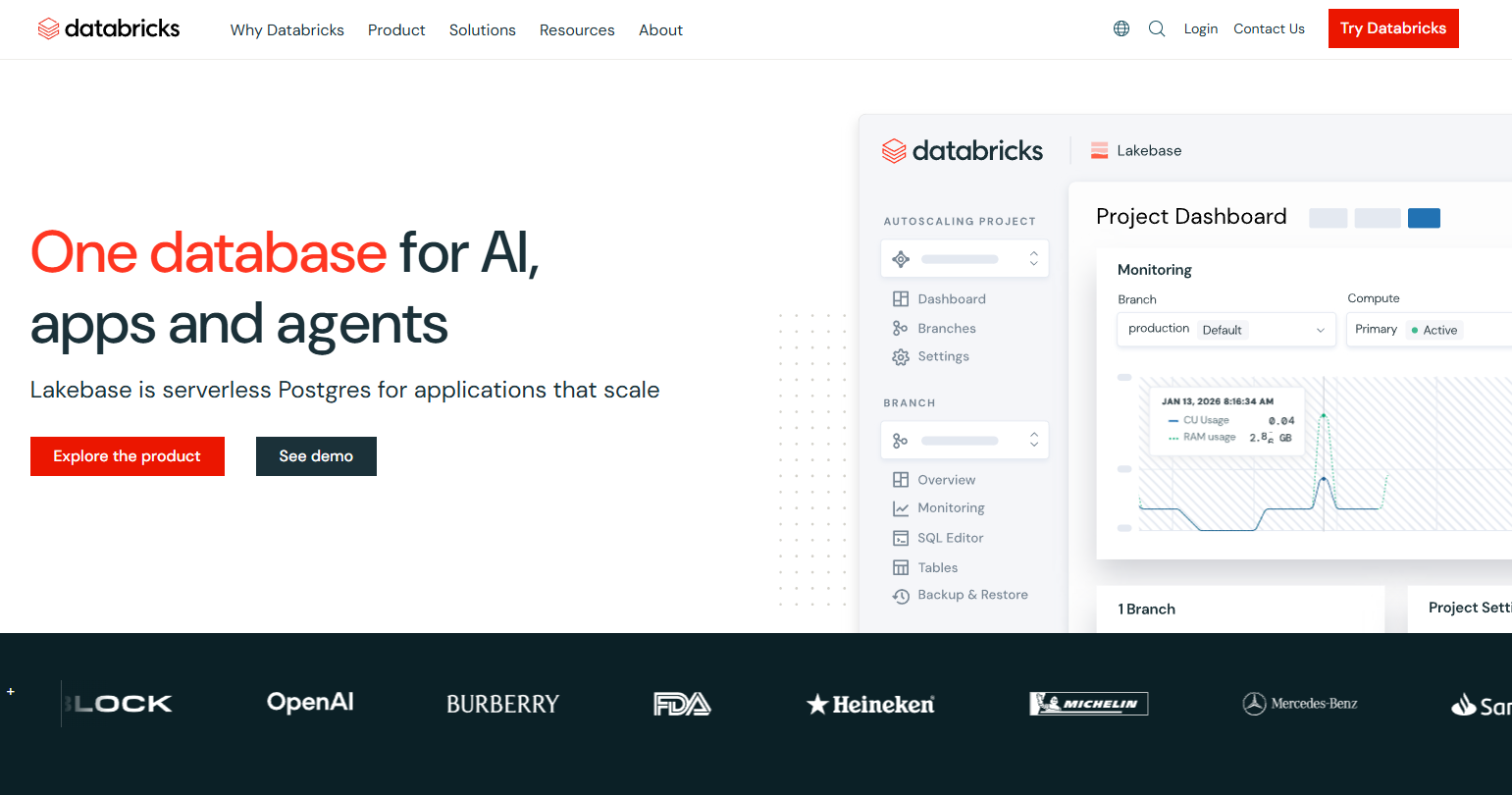
Databricks provides a unified platform for data engineering, analytics, machine learning, and AI applications on a lakehouse architecture. It consolidates the workloads that many teams run across separate tools: Pipeline authoring, notebook-based analysis, model training, model serving, and governance through Unity Catalog. For product managers trying to run experiment readouts, segment analyses, and AI feature development from a single governed data layer, the integration is the main argument.
Best for: Organizations consolidating analytical workloads, data engineering, and AI development in one cloud platform.
Key features
- Lakehouse data architecture with unified storage and compute
- Managed notebooks, clusters, and data pipelines
- Workflow orchestration built into the platform
- Unified governance through Unity Catalog
- Machine learning model training, serving, and monitoring
Why choose Databricks: It fits a broad modernization program where data products and AI workloads need to run against the same governed data layer. Teams should validate total platform usage costs and required skills before committing. Validate whether your current analytics engineering stack, including dbt or SQL-based transformation workflows, integrates cleanly with how Databricks structures compute and catalogs.
Databricks pricing: Pay-as-you-go usage billing. Data Engineering starts at $0.15/DBU, AI workloads at $0.07/DBU, with committed-use discounts available. A free trial is offered.
G2 rating: 4.6/5
4. Snowflake
Snowflake is a fully managed AI Data Cloud platform covering data engineering, analytics, AI workloads, and data sharing across organizations. Its consumption-based architecture means compute and storage scale independently, and its Secure Data Sharing capability lets teams share governed data across business units or external partners without copying it. Most teams add orchestration, testing, and observability tools around Snowflake rather than relying on it as a complete DataOps control plane. Snowflake also supports AI and ML workloads through Cortex AI and Snowflake ML.
Best for: Enterprises that need scalable, governed cloud data infrastructure for analytics, AI, and cross-organization data sharing.
Key features
- Cloud data storage and compute with workload isolation
- Secure data sharing across accounts and organizations
- Role-based governance and encryption
- Snowflake Cortex AI and ML capabilities
- Data application ecosystem and native app development
Why choose Snowflake: Strong fit when governed access and scalable analytics are the primary requirements. Many teams build a DataOps operating layer on top of Snowflake using orchestration and testing tools. For AI governance tools that need a clean data foundation, Snowflake's governance model and lineage capabilities are a practical starting point.
Snowflake pricing: Consumption-based across storage, compute, and data transfer. Editions include Standard, Enterprise, and Business Critical. New accounts start with a 30-day free trial and $400 in credits.
G2 rating: 4.6/5
5. DataOps.live
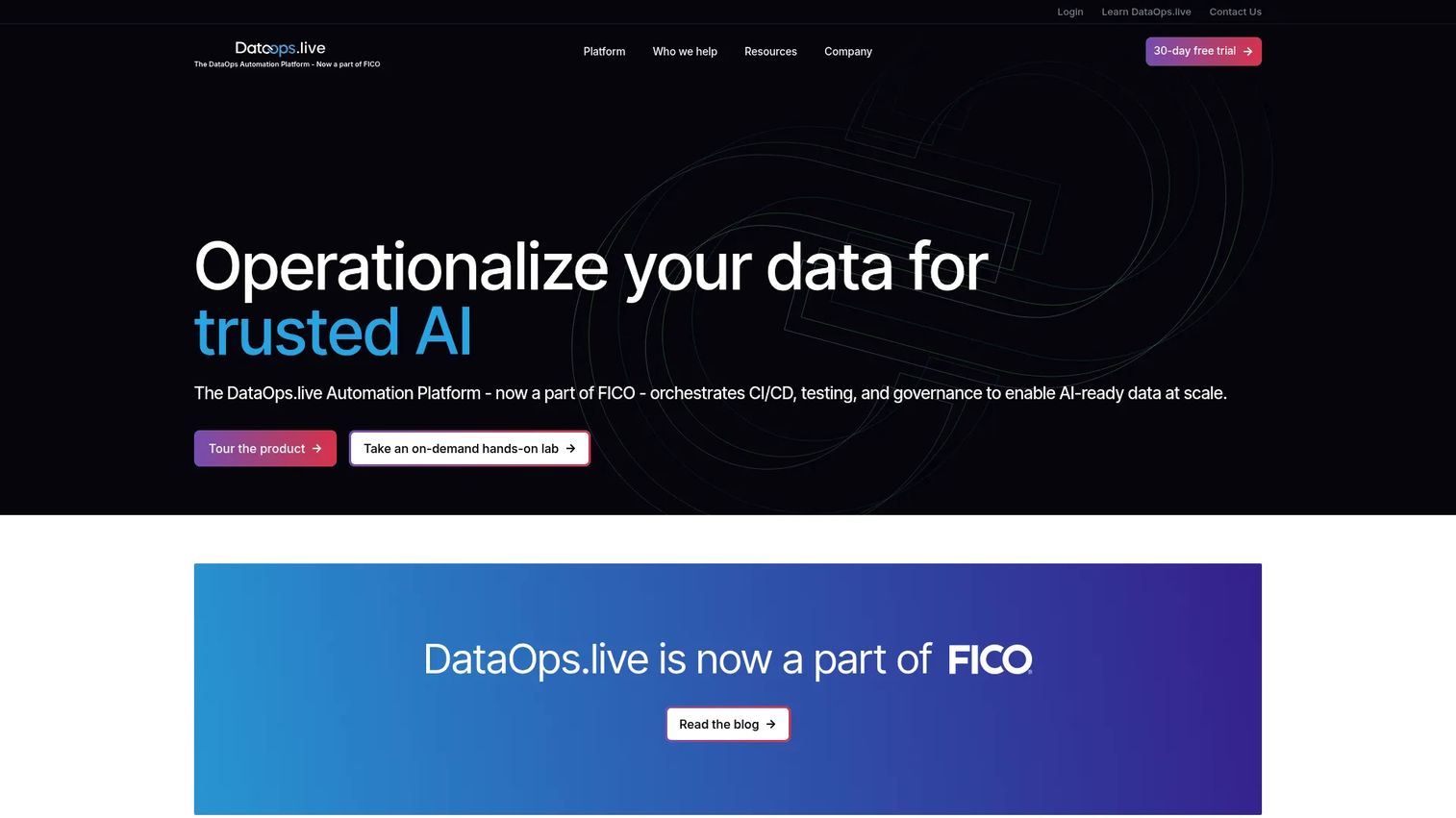
DataOps.live is an AI-native automation platform for building, testing, governing, and delivering trusted data products specifically within Snowflake environments. It applies CI/CD principles to data pipelines: Automated testing gates, environment promotion workflows, versioning, and governance policy enforcement. For product managers whose metrics definitions pass through transformation logic before reaching dashboards, DataOps.live adds the release management controls that prevent a dbt change from silently breaking a key activation metric.
Best for: Data engineering teams building and operating governed, automated data pipelines and data products on Snowflake.
Key features
- Automated CI/CD for Snowflake and dbt workflows
- Automated testing and data quality validation
- Governance, versioning, auditability, and environment management
- Data pipeline orchestration and monitoring
- Metis AI data-engineering agent for pipeline assistance
Why choose DataOps.live: Choose it when a change to transformation logic or metrics definitions needs to move through a controlled release process before reaching executive dashboards or customer-facing workflows. The Snowflake-native focus means less integration complexity, but also means it fits best when Snowflake is already your primary data warehouse. Teams not on Snowflake should evaluate alternatives. The CI/CD tools discipline it brings to data pipelines mirrors what engineering teams already do for software delivery.
DataOps.live pricing: Every install includes 500 free DataOps.live Credits (DOLCs) per company per month. After that, usage is billed through Snowflake credits, credit card, or purchase order. Enterprise plans are available through sales.
G2 rating: 4.5/5
6. Unravel
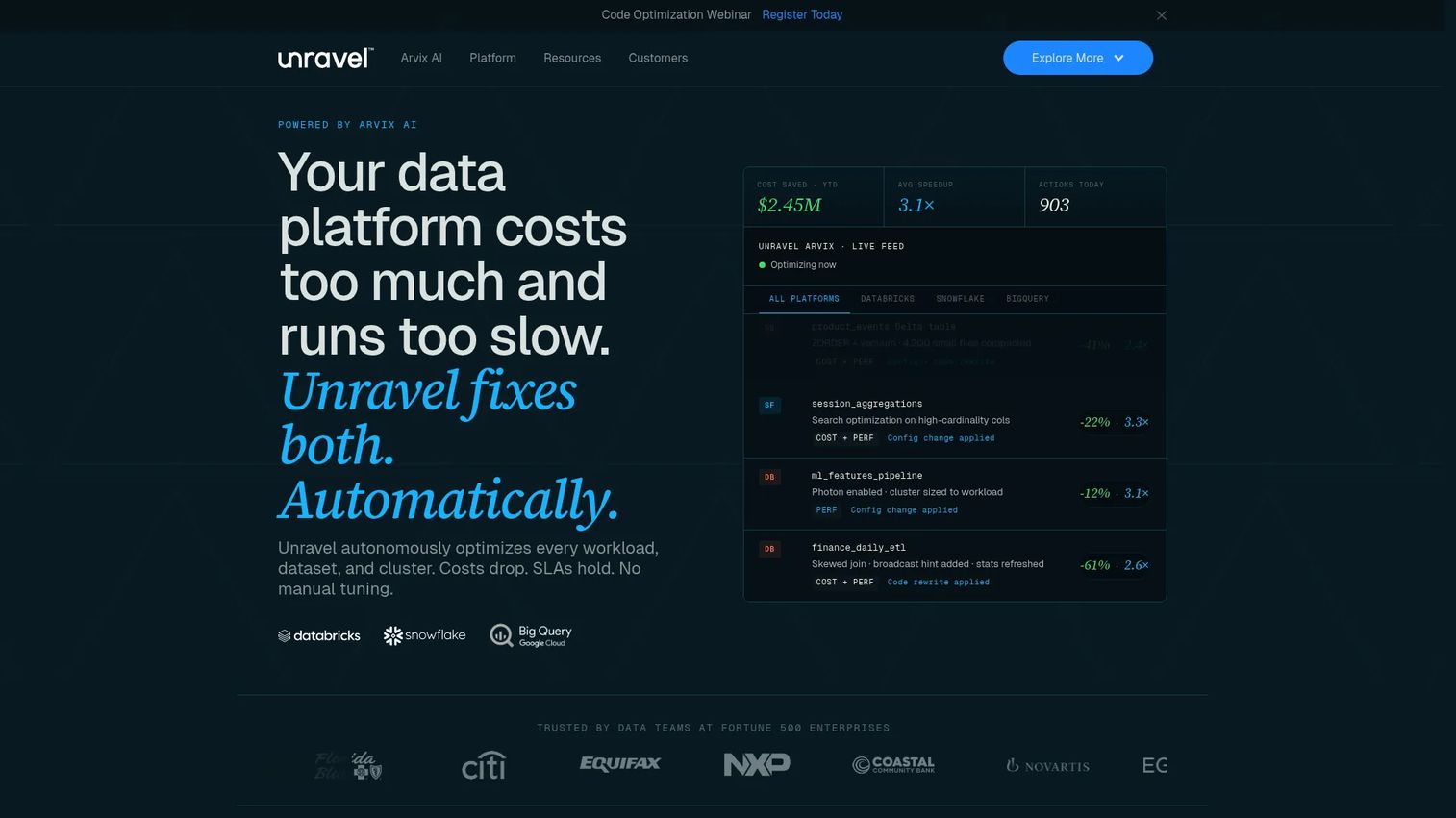
Unravel is an AI-powered data platform optimization tool focused on performance, reliability, and cloud cost across complex modern data environments. It monitors workloads, diagnoses root causes, tracks cost attribution, and generates optimization recommendations across platforms including Databricks, Snowflake, Google BigQuery, and Amazon EMR. Teams that are late to detect expensive or failing workloads before stakeholders report broken analytics will find Unravel's full-stack observability useful.
Best for: Data platform and engineering teams managing high-volume processing workloads where cost, reliability, and performance need stronger operational visibility.
Key features
- Autonomous workload, query, and cluster optimization
- Full-stack observability with root-cause analysis and run-vs-run comparisons
- Cost attribution, chargeback, budgeting, and optimization recommendations
- Data quality insights and end-to-end pipeline observability
- CI/CD checks for cost and performance regressions
Why choose Unravel: Position it as a specialist operational layer for teams whose primary pain is late detection of expensive, slow, or unstable workloads. It complements orchestration and warehouse platforms rather than replacing them. If your team spends engineering cycles diagnosing why a nightly pipeline suddenly costs three times more, Unravel's automated attribution is worth evaluating.
Unravel pricing: Free health checks are available to get started. Paid plans are consumption-based, tied to platform usage on Databricks, Snowflake, or BigQuery. Amazon EMR and Cloudera pricing requires contacting sales.
G2 rating: 4.4/5
7. DataKitchen
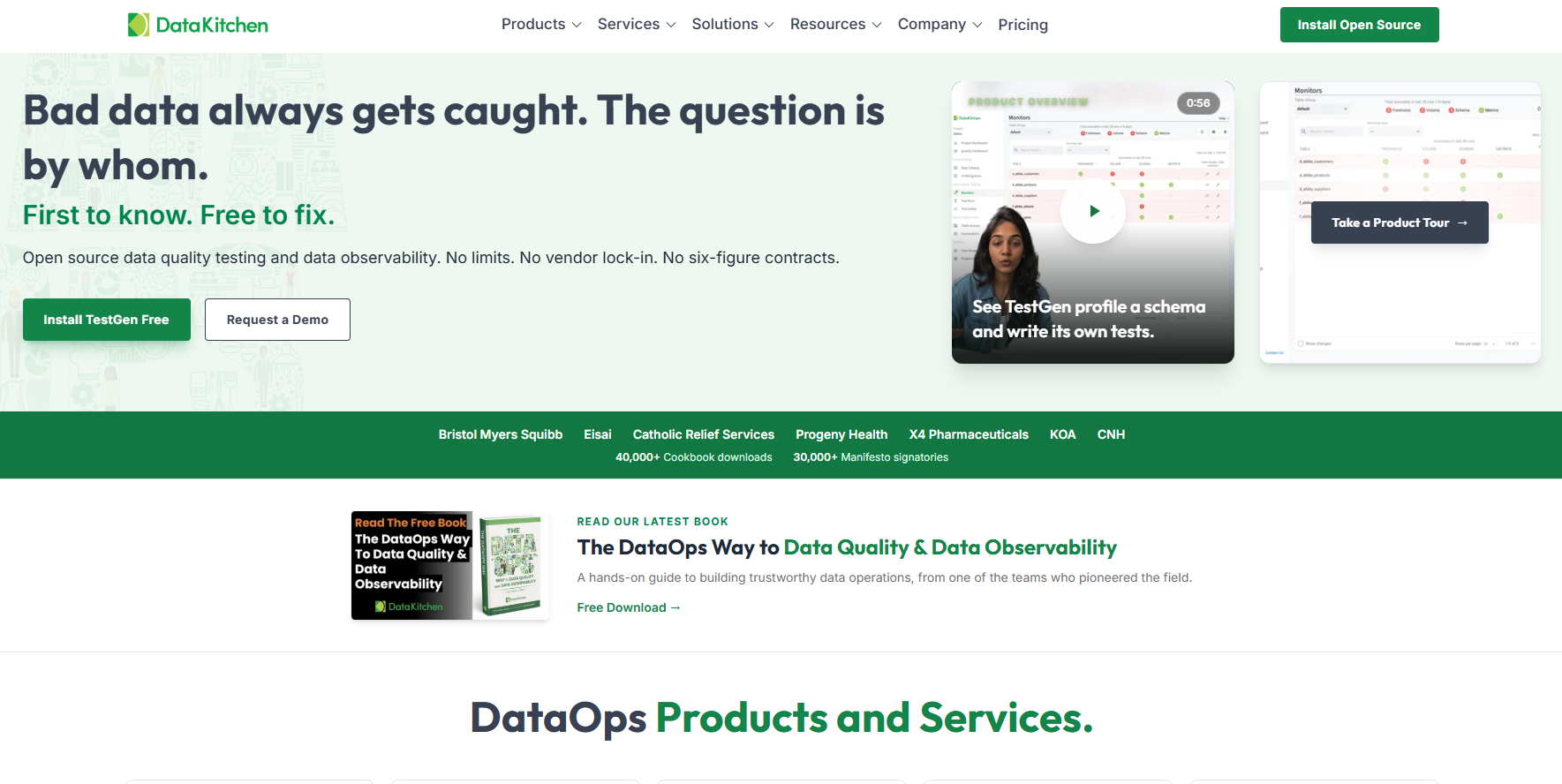
DataKitchen provides DataOps software for data quality testing, data observability, and operations automation. Its open-source tools cover automated data profiling, quality test generation, and end-to-end pipeline observability. For product teams, the relevance is direct: Broken transformations cause false conclusions about activation, retention, or feature adoption. DataKitchen's test-driven approach builds quality gates into the pipeline workflow rather than treating data validation as an afterthought. Enterprise and cloud tiers add expanded capacity, security, and automation capabilities.
Best for: Data teams that want to formalize data testing and operational quality gates around analytics delivery, starting with open-source tooling.
Key features
- Automated data profiling and quality test generation
- End-to-end data journey and pipeline observability
- DataOps automation with environment management and CI/CD deployment
- Quality rule management across datasets
- Open-source foundation with enterprise upgrade path
Why choose DataKitchen: Choose it when data quality testing is the specific reliability gap. The free open-source tier lets teams validate the approach before committing to paid capacity. It is a specialist tool rather than a broad DataOps platform, so plan to pair it with an orchestration layer. For teams evaluating AI software testing tools, DataKitchen's automated test generation reduces the setup time that typically slows test coverage adoption.
DataKitchen pricing: Open Source plans are free forever. Enterprise plans start at $100/month per user and per database connection. Cloud plans start at $150/month per user and per agent. DataOps Automation Enterprise is custom-priced through sales.
G2 rating: 5.0/5
8. Matia
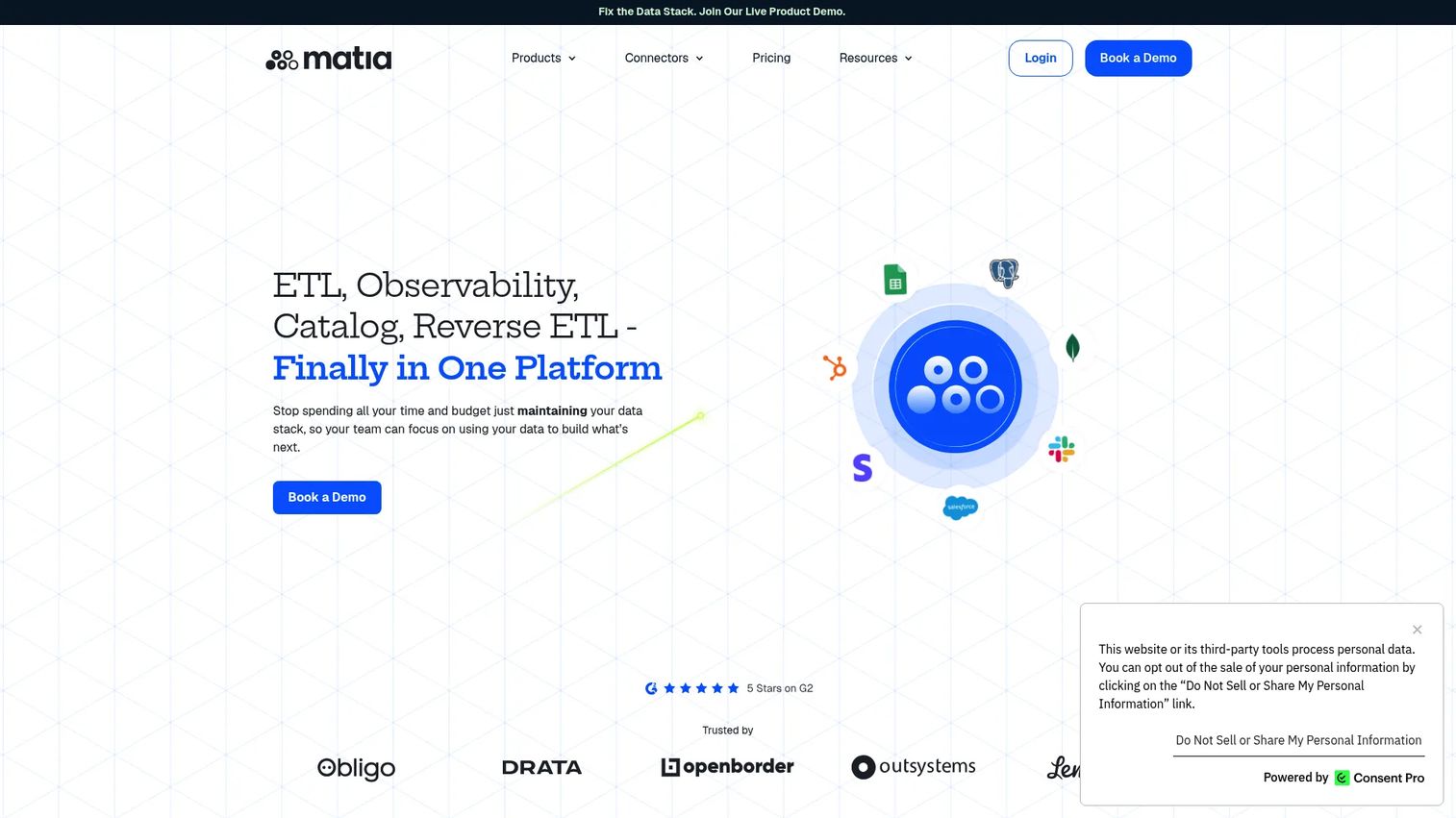
Matia is a unified DataOps platform combining ETL data ingestion, reverse ETL, observability, and data catalog capabilities in a single environment. It targets teams that prefer a composable modern data stack but need clearer workflow ownership and operational visibility across those components. Matia's reverse ETL capability, which moves processed data from the warehouse back into SaaS tools, is particularly relevant for product managers who need activation and retention metrics to flow into CRM, marketing automation, or customer success tools.
Best for: Modern data and engineering teams that prefer a composable stack but need centralized coordination across data movement, observability, and cataloging.
Key features
- ETL and data ingestion with configurable schemas and CDC support
- Reverse ETL from warehouses to SaaS tools using SQL or dbt models
- Data observability with anomaly detection, alerts, and lineage
- Pipeline monitoring and centralized workflow visibility
- dbt test integration and data catalog
Why choose Matia: Useful when your team is running multiple specialized tools and wants a single coordination layer without committing to a monolithic platform. The product manager angle is faster access to trustworthy operational data across the stack without routing every request through manually maintained scripts. Teams that need analytics platforms that drive ROI will find Matia's reverse ETL capability closes the gap between data warehouse outputs and the systems where decisions are made.
Matia pricing: Usage-based, with Starter, Standard, and Enterprise plans. Pricing requires contacting Matia directly since no numeric figures are displayed on their pricing page.
G2 rating: 4.9/5
9. Saagie
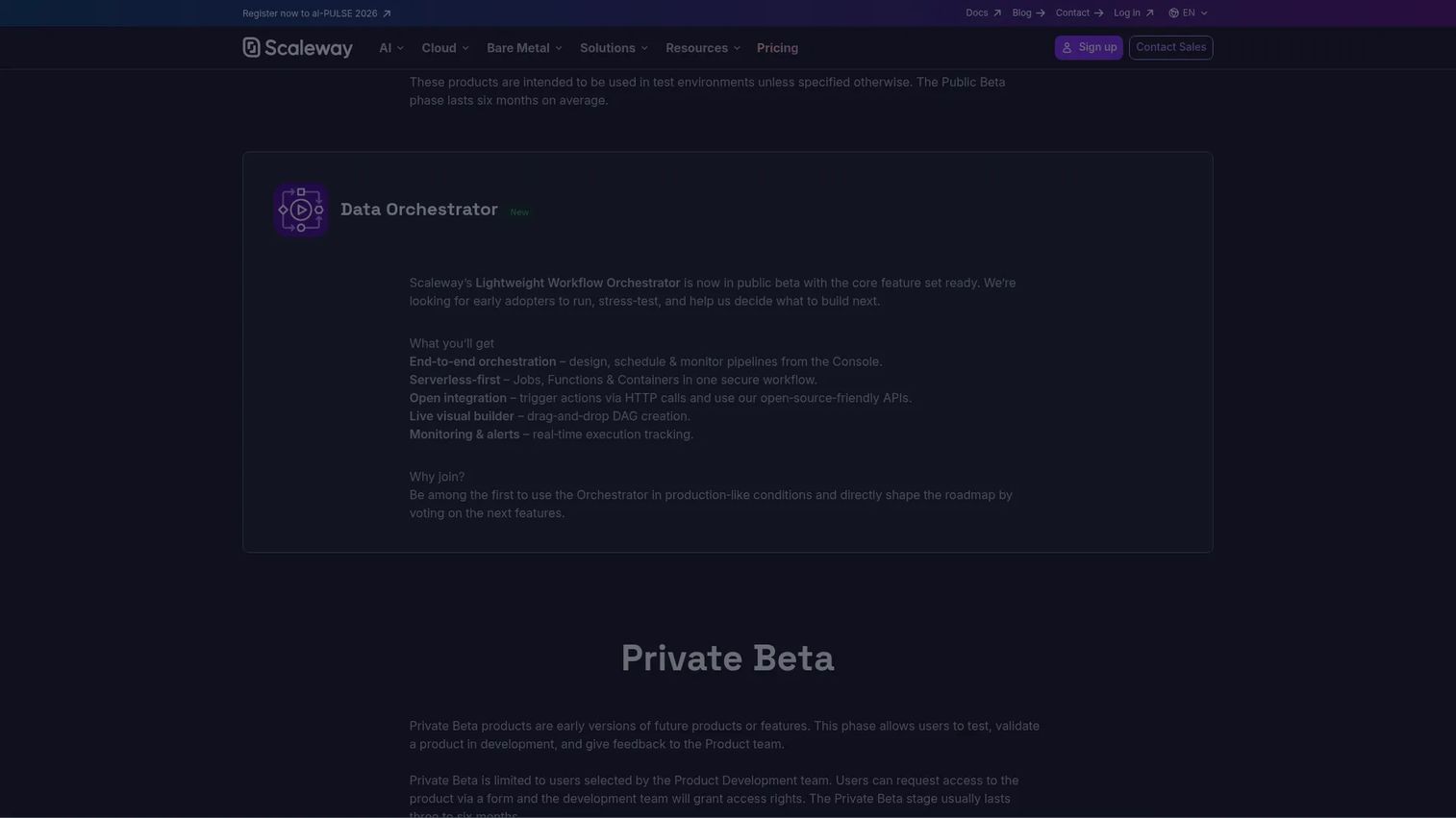
Saagie is a DataOps platform and hybrid-cloud orchestrator for managing data processes, technologies, and infrastructure. It is designed for organizations operating multiple data technologies across cloud and on-premises environments and targets teams that need a standardized way to deploy and operate data workloads without forcing migration to a single cloud provider. The hybrid positioning is the main differentiator, though the limited review volume on G2 means independent evaluation is recommended.
Best for: Organizations managing complex data and AI workflows across hybrid infrastructure who cannot consolidate to a single cloud.
Key features
- DataOps workflow orchestration across technologies
- Hybrid and multi-cloud deployment options
- Data pipeline creation and monitoring
- Enterprise governance controls
- Environment management for data and AI workloads
Why choose Saagie: It fits teams locked into hybrid infrastructure who need a coordination layer across cloud and on-premises environments. Teams that can operate entirely in a public cloud will find more mature options in the managed orchestration or lakehouse categories. Note that Saagie's G2 review count is limited, so supplement any evaluation with direct customer references.
Saagie pricing: Contact sales for pricing. No commercial package details are displayed on the official site.
G2 rating: 2.5/5
10. Ascend Data Automation Cloud
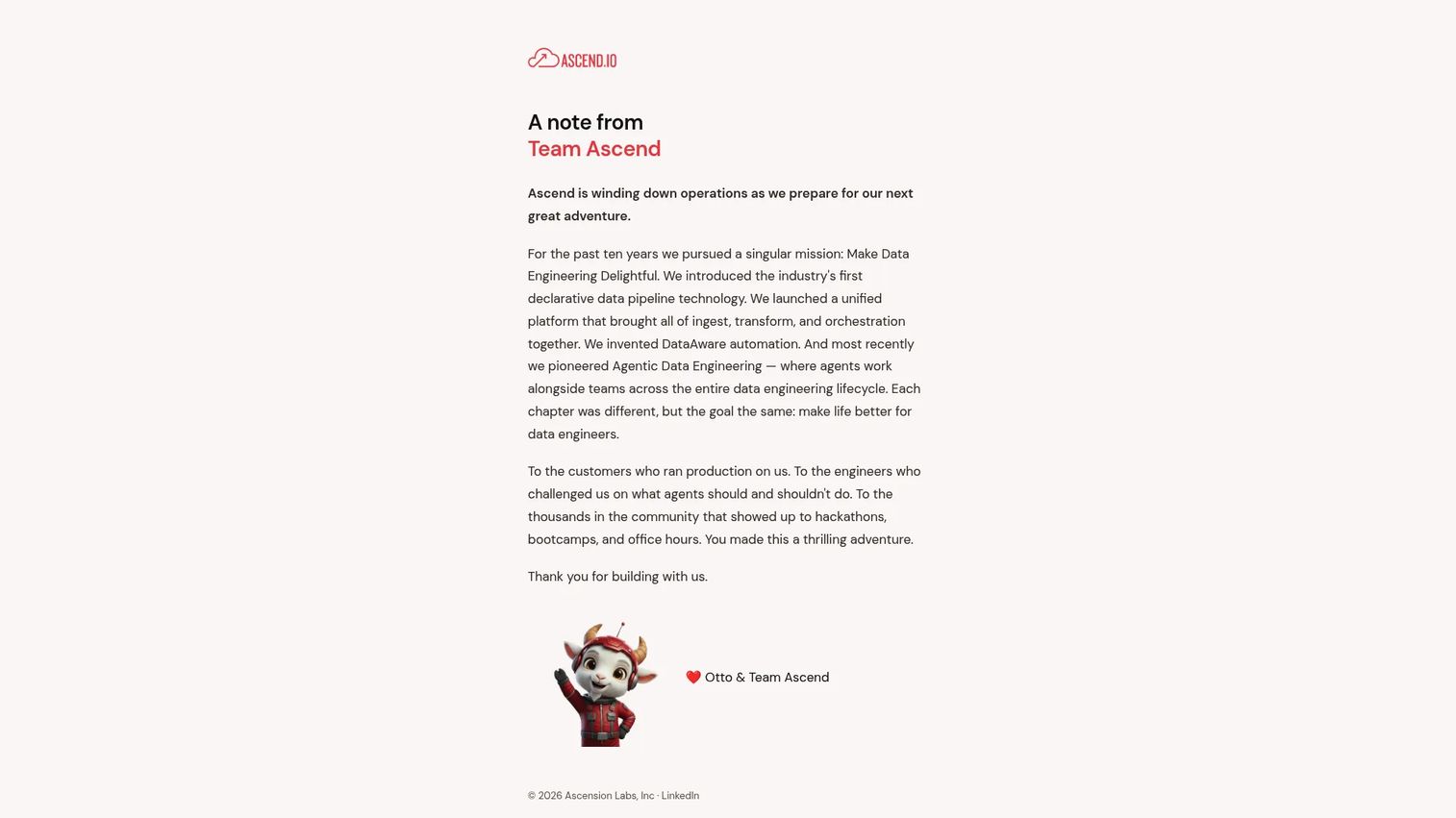
Ascend Data Automation Cloud was positioned as an agentic data engineering platform for building, deploying, automating, and observing data pipelines with AI assistance through its Otto agent. Its key capabilities included metadata-driven pipeline automation, event-driven orchestration, data lineage, observability, and Git-native CI/CD workflows. Ascend's official pricing and product pages indicate the company is currently winding down operations. Evaluate this option with that status confirmed before beginning any proof of concept.
Best for: Data engineering teams that need integrated pipeline development, orchestration, and AI-assisted data engineering, subject to confirming the vendor's current operational status.
Key features
- AI-assisted data engineering with Otto agent
- Data ingestion, transformation, and delivery pipelines
- Event-driven pipeline automation
- Data lineage and observability
- Git-native workflows and CI/CD integration
Why choose Ascend Data Automation Cloud: Its metadata-driven approach and AI assistance reduce the manual pipeline maintenance that pulls engineering capacity away from product instrumentation work and new data product development. Confirm the vendor's current operational status before beginning an evaluation.
Ascend Data Automation Cloud pricing: Contact sales. The pricing page does not display plan-level figures.
G2 rating: 3.3/5
Considerations when choosing a DataOps platform
Match the platform to your failure mode
Start with the operational problem you need to fix most urgently. Orchestration tools address scheduling and dependency failures. Observability tools address late detection of data freshness or volume issues. CI/CD platforms address controlled pipeline promotion. Broad cloud data platforms address storage, compute, and governance gaps. Buying a platform that covers the whole lifecycle may add capability you are not ready to use, at cost you are not ready to justify.
Evaluate instrumentation and data contract support
For product managers, data reliability starts at event instrumentation. Ask whether the platform supports schema checks, ownership assignment, event quality tests, and change management before metrics reach dashboards. A DataOps platform that does not connect to your instrumentation layer leaves the highest-risk upstream gap unaddressed.
Check integration depth before committing
Verify compatibility across your full stack: Warehouse, transformation framework, orchestration engine, BI platform, data catalog, incident management system, and source control. Run a test integration with your two most critical systems before evaluating UI or feature breadth. Many proof of concept failures trace back to integration assumptions rather than platform capability gaps. Also review cloud data security software requirements alongside your platform evaluation, since access controls and encryption options vary significantly by tier.
Model operating cost, not only license cost
Open-source orchestration may reduce software spend while increasing staffing and infrastructure demands. Consumption-based platforms may start small and scale rapidly with data volume, compute use, or the number of concurrent workloads. Build a 12-month total cost model that includes engineering time, infrastructure, and support before comparing headline pricing.
Define success metrics before a proof of concept
Set measurable baselines before any platform test: Pipeline failure rate, time to detect data incidents, time to restore trusted reporting, the percentage of data changes covered by automated tests, and time from product release to reliable analytics availability. A proof of concept without baseline measures tells you whether the interface works, not whether it solves the operational problem.
Conclusion
The right DataOps platform depends on where data failures create the most visible cost in your organization.
Astro and Apache Airflow fit teams whose center of gravity is workflow orchestration and scheduled pipeline reliability. Databricks and Snowflake fit teams consolidating analytics, governance, and AI workloads on a broad cloud data foundation. DataOps.live and DataKitchen fit teams focused on controlled delivery and automated quality testing. Unravel fits teams that need workload performance visibility and cost optimization across an existing platform. Matia, Saagie, and Ascend each address specific operational coordination needs across modern or hybrid stacks, with varying maturity and review coverage.
Start with the workflow where unreliable data creates the most visible business cost. For most product teams, that means event instrumentation and activation reporting. Run a proof of concept against one measurable operational problem, set a baseline, and measure outcomes rather than only checking whether the platform interface works.
Once your data is reliable and your pipelines are governed, communicating product changes to non-technical stakeholders becomes the next challenge. Start your journey with Guideflow today!
FAQs
A DataOps platform is a tool, or a coordinated set of tools, that supports reliable data delivery through orchestration, testing, monitoring, governance, and collaboration. Some products cover the full lifecycle, while others specialize in one layer such as observability or CI/CD automation. The term covers a range of architectures, from managed orchestration services to broad cloud data platforms to composable control planes.
DevOps focuses on software delivery practices: Code build, test, deploy, and monitor cycles. DataOps applies similar operational principles to data pipelines, analytics assets, governance, and data products. Data introduces concerns that software delivery does not face at the same scale: Freshness, lineage, data quality, access controls, and the downstream impact of schema or definition changes on reports and models.
The answer starts with the failure mode. Teams whose primary problem is orchestration reliability should evaluate Airflow-based platforms like Astro. Teams focused on preventing data defects from reaching analytics should evaluate testing-oriented tools like DataKitchen. Teams consolidating analytics and AI workloads should evaluate Databricks or Snowflake. For A/B testing tools and experiment analysis, the platform needs to support both reliable event ingestion and fast segment-level reporting.
Not always. A small team should start with its most urgent reliability gap. If orchestration is fragile, a managed Airflow service solves the problem without requiring a full platform investment. If data quality is the issue, an open-source testing tool adds coverage without a license cost. Add platform capabilities as pipeline complexity and team size grow, rather than buying ahead of the operational need.
Yes. AI features depend on reliable, governed, current input data. DataOps practices improve data quality checks, lineage, deployment controls, and monitoring, which helps teams manage the data layer behind AI features. Without these controls, model behavior becomes harder to explain when predictions degrade. Teams building agentic AI platforms need the same data reliability foundations as teams building simpler recommendation features.
Start with business impact. The questions to answer are: Will this reduce broken activation dashboards? Will experiment readouts arrive faster after a release? Will data engineers spend fewer hours on manual pipeline repairs? After establishing the operational value, assess integration fit with your warehouse and BI stack, the ownership model for managing the platform, and the maintenance demands across your release cadence.
Choose one measurable workflow, such as validating event data schema after a product release or reducing the time to detect failed pipeline runs. Measure the baseline before the proof of concept begins. Define who owns each step and what success looks like numerically, not just operationally. Operational outcomes, like reduced incident detection time or higher test coverage per release, are more meaningful than interface satisfaction scores.
No. Data observability is one capability within a broader DataOps approach. Observability focuses on detecting issues with freshness, volume, schema, and performance. A complete DataOps operating model also includes orchestration, deployment automation, quality testing, governance, and team collaboration. Some platforms, like Unravel and DataKitchen, specialize in observability and testing. Others, like Databricks and Snowflake, provide the data foundation on which observability tooling sits. See also API monitoring tools for teams that need to monitor upstream data delivery at the API level alongside pipeline observability.