Harvest hits, and suddenly your operation is running on eleven browser tabs and a shared spreadsheet nobody trusts. Production notes live in one file. Barrel movements live in another. Compliance deadlines live in someone's head. And when the auditor asks for a bottling record from two vintages ago, you spend three hours reconstructing it from memory and a photo of a whiteboard.
That reconciliation tax is the real cost of running a winery without a system. According to Ekos's State of Technology Adoption in the Wine Industry (2022), 46% of wineries still rely on spreadsheets for vineyard tracking and 41% use no dedicated system at all. Meanwhile, the winery software market reached $526M in 2025 and is projected to hit $1.163B by 2034 at roughly 9.2% CAGR, per Dataintelo (2025). The gap between wineries that operate on clean data and those that don't is widening every vintage.
If you evaluate vertical SaaS the way a founder evaluates any operational stack, you already know the question: which platform actually handles end-to-end winery operations, and which ones cover a narrower slice like DTC or accounting? The same discipline applies whether you're comparing audit management software, contract lifecycle management, or a winery operating system. This guide breaks down the tradeoffs so you can match the tool to your workflow complexity, not the other way around.
What's inside
This guide covers the best winery software for production, inventory, compliance, finance, and direct-to-consumer sales. It is built for operators comparing vertical platforms for a single winery, a portfolio, or a hospitality group.
We chose tools based on four criteria: workflow breadth (how much of the vineyard-to-bottle process a platform covers), operational visibility (whether it gives shared, real-time data), integrations (how well it connects to accounting, compliance, and ecommerce systems), and buyer fit (which winery profile each tool serves best). Every pricing figure and rating below reflects verified, current data from the vendor or a primary source.
TL;DR
- Best overall winery operating system: InnoVint, for teams that want one system from vineyard to bottle with production, inventory, compliance, and cost accounting.
- Best for cloud collaboration: vintrace, for winery teams that need anywhere access across production, inventory, and compliance.
- Best for compliance and stock control: Vinsight, with transparent public pricing and strong accounting integration.
- Best for DTC and ecommerce: WineDirect, the deepest option for online store, tasting room POS, and wine club.
- Best for craft beverage operations: Ekos, for producers wanting inventory, production, and cost accounting in one platform.
- Best for smaller DTC-focused wineries: VineSpring and VinNOW, for club, allocation, and POS-centric operations without a full operating system.
What is winery software?
Winery software is a category of vertical SaaS that manages the operations of a wine business, from vineyard and production tracking through inventory, compliance, finance, and sales. Also called winery management software or a winery operating system, it replaces the spreadsheets, paper logs, and disconnected tools that most wineries start with.
The strongest winery software systems cover several core workflow areas. Understanding these helps you see where each tool on this list fits.
- Production and winemaking: Wine production software tracks fermentation, additions, blending, barrel work, and bottling with full lot traceability. This is the heart of any wine making software, and it is where operating systems earn their keep.
- Inventory and traceability: Winery inventory software follows bulk wine, dry goods, and finished cases across tanks, barrels, and warehouses so you always know what you have and where it came from.
- Compliance and audit readiness: Winery compliance software automates TTB and state reporting, keeps records audit-ready, and removes the manual reconstruction that eats days during an audit.
- Reporting and analytics: Winery software for reporting and analytics surfaces cost of goods, yields, and operational metrics so decisions run on data instead of gut feel.
- Integrations: Winery software integrations connect production and inventory data to accounting, ecommerce, and shipping-compliance tools.
- Sales, ecommerce, and DTC: Direct-to-consumer wine software powers online stores, tasting room POS, wine clubs, and allocations.
Most cloud-based winery software lives in one of two camps: broad operating systems that run the whole vineyard-to-bottle process, or focused platforms that go deep on a single workflow like DTC or accounting. Knowing which you need is the first real decision.
When to use winery software
Not every winery needs a full operating system on day one. Here is how to know when the timing is right.
When spreadsheets are breaking down
The first sign is version chaos. Two people edit the same tank log, numbers stop matching, and nobody trusts the master file. When production tracking, inventory, and cost data live in separate spreadsheets that require manual reconciliation, you are already paying for software in lost hours. Dedicated winery management software gives you one source of truth that updates in real time.
When audit and compliance work is eating time
If TTB reports and state filings mean days of manual data assembly, compliance is the trigger. Winery compliance software keeps records structured and audit-ready as you work, so filing becomes a review step instead of a reconstruction project. The same logic drives adoption of audit management and contract management tools in other verticals: structured data beats reconstructed data every time.
When production, sales, and finance need shared visibility
Once your winemaking team, your DTC operation, and your finance function all need the same numbers, disconnected tools stop scaling. A winery operating system connects production costs to inventory to sales so everyone works from one dataset. This is where analytics platforms drive ROI: shared visibility shortens decision cycles and kills duplicate data entry.
Comparison table
Here is a side-by-side view of all seven platforms. Use it to shortlist two or three before reading the detailed sections. Pricing and ratings reflect verified, current values from each vendor or a primary source.
| # | Product | Intent | Key use case | Pricing | G2 rating |
|---|---|---|---|---|---|
| 1 | InnoVint | Winery operating system | Production, inventory, compliance, cost accounting | Contact sales (4 editions) | 4.3/5 |
| 2 | vintrace | Cloud operations | Grape-to-bottle production and compliance | Inquiry-based (3 plans) | Not rated |
| 3 | Vinsight | Production and stock control | Inventory, production, sales with accounting integration | From $24/mo | Not rated |
| 4 | WineDirect | DTC commerce | Online store, tasting room POS, wine club | From $79/mo | 3.5/5 |
| 5 | Ekos | Craft beverage operations | Inventory, production, cost accounting | Request pricing | 4.1/5 |
| 6 | VineSpring | DTC and club | Ecommerce, allocations, club management | From $99/user/mo | 3.5/5 |
| 7 | VinNOW | Winery DTC and POS | POS, wine club, ecommerce, inventory | From $99/mo | 4.5/5 |
1. InnoVint
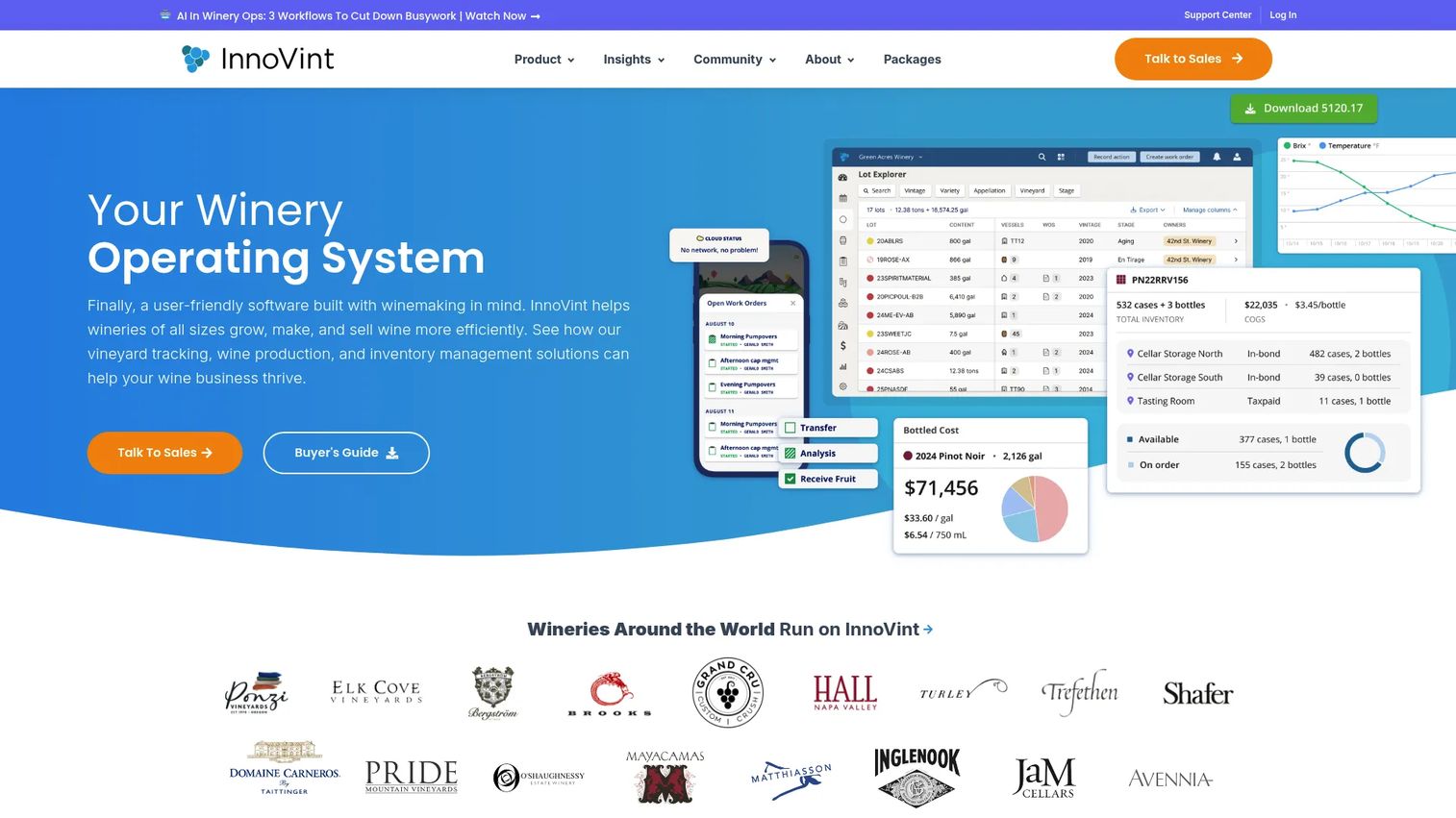
InnoVint positions itself as a winery operating system, and the framing fits. It runs vineyard tracking, wine production, inventory management, and cost accounting in one platform, with a mobile app and interactive 3D tank maps that make cellar work fast for the crew actually pulling samples and moving barrels. For a winery that wants one system from vineyard to bottle, InnoVint is the most complete answer on this list.
Best for: Wineries needing an all-in-one operating system for production, inventory, compliance, and costing.
Key strengths
- Automated compliance: Winery compliance software built in, so TTB and state reporting stay audit-ready as you work rather than at filing time.
- Cost of goods tracking: COGS tracking ties production activity to real costs, giving finance the winery accounting software visibility it needs.
- Mobile and offline cellar work: Interactive 3D tank maps and a mobile app keep production data accurate even when the crew is off wifi in the cellar.
Why choose InnoVint: If your operation spans vineyard, production, inventory, and finance, InnoVint consolidates the whole chain into one dataset. It suits founders and operators who want to remove reconciliation entirely and give a new operations lead a single system that works on day one, rather than stitching together production notes, inventory sheets, and accounting exports.
InnoVint pricing: InnoVint offers four editions, MAKE, FINANCE, GROW, and SUPPLY, and describes pricing as customizable. Public prices are not displayed, so purchase requires contacting sales. InnoVint holds a 4.3/5 rating on G2. For a portfolio or growing winery, the edition structure lets you scale the platform to the workflows you actually run.
2. vintrace
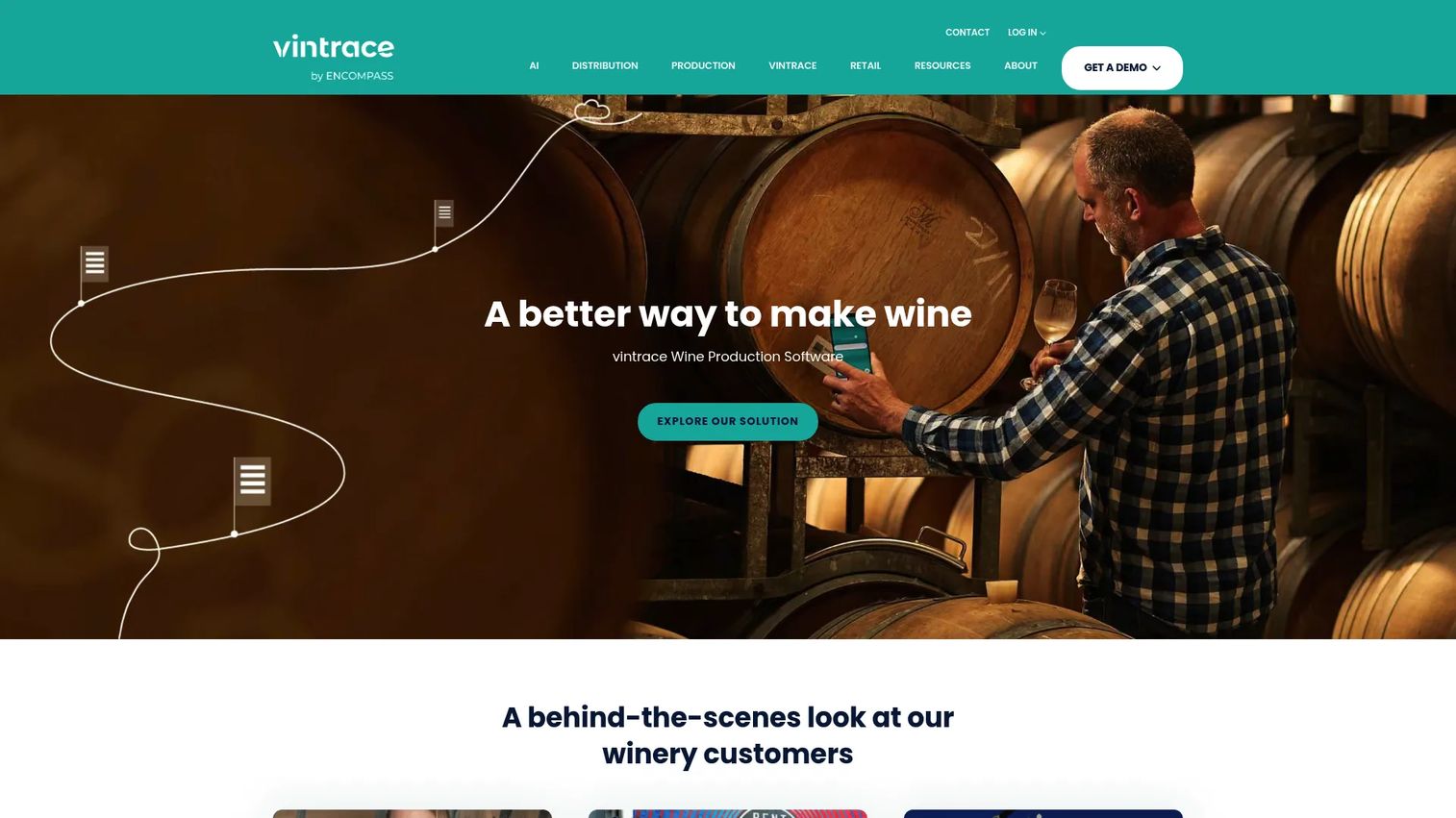
vintrace is cloud-based winery software built to track operations from grape to bottle. The strength here is anywhere access: production teams, cellar staff, and managers can all work from the same live data whether they are in the winery, the lab, or off-site. It handles dry goods tracking, bottling logistics, and direct purchasing and sales, making it a strong fit for teams that prize collaboration across production and inventory.
Best for: Winery teams needing end-to-end production, inventory, and compliance management with true cloud access.
Key strengths
- Dry goods and inventory tracking: Manage bulk wine, packaging, and dry goods with the traceability winemaking teams need across vintages.
- Bottling logistics: Plan and track bottling runs so finished-goods inventory stays accurate the moment cases come off the line.
- Direct purchasing and sales: Connect procurement and sales workflows to production data for a cleaner operational picture.
Why choose vintrace: Wineries that operate across multiple sites or need staff working from anywhere benefit most from vintrace's cloud-first design. It fits teams that want production, inventory, and compliance in one place without being tied to on-premise software. Collaboration and anywhere access are the recurring themes in its customer proof.
vintrace pricing: vintrace lists three plans, Winery Essentials, Winery Professional, and Winery Enterprise, all with inquiry-based pricing and no public numeric price. To scope cost you will need to contact the vendor. The plan tiers let you match capability to the size and complexity of your operation.
3. Vinsight
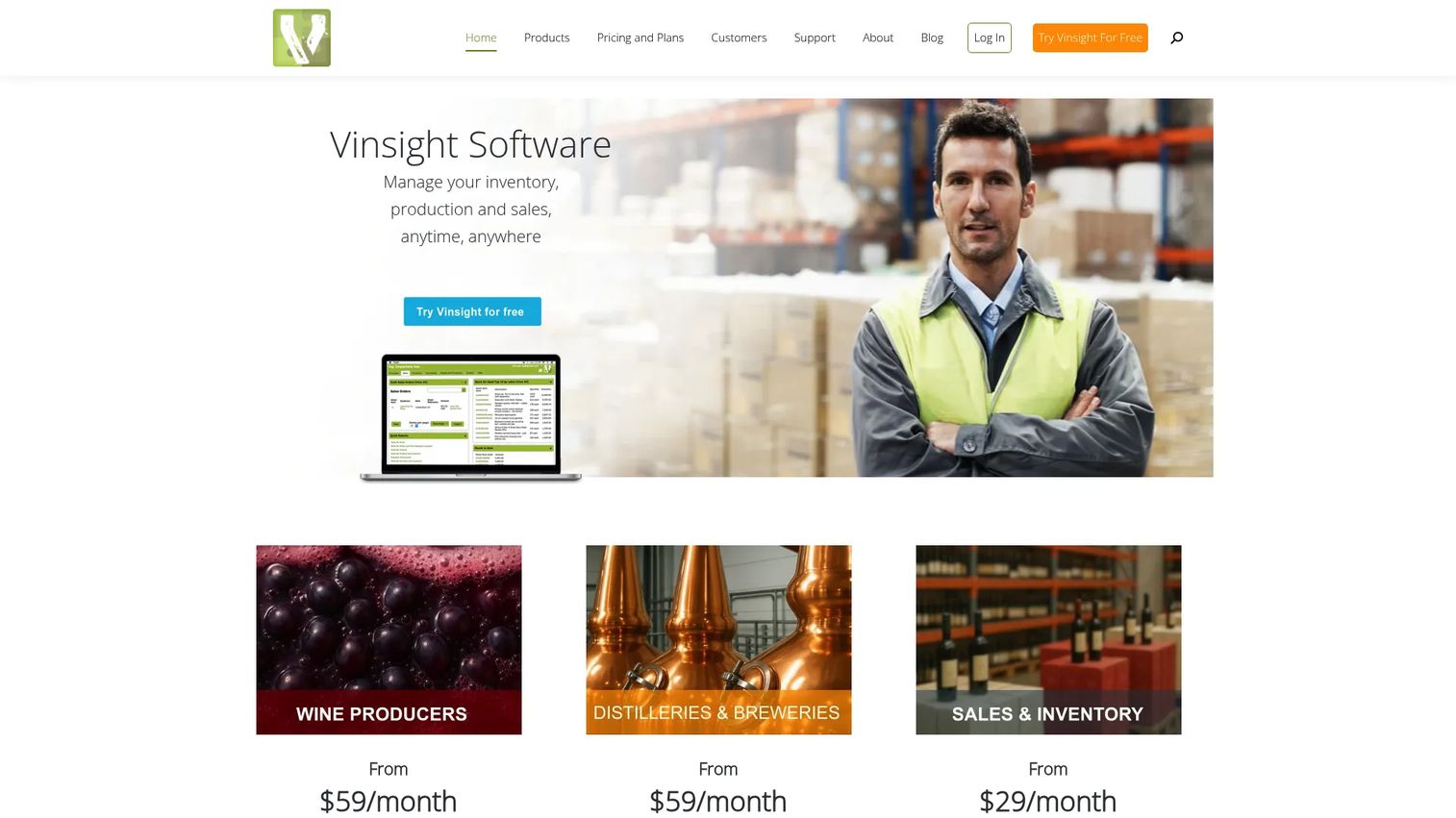
Vinsight is cloud software for wine, cider, beer, and spirits producers, covering inventory, production, and sales. What sets it apart on this list is transparent public pricing, which matters when you are budgeting a stack without a sales call for every quote. It manages winery, vineyard, and warehouse operations, handles inventory control, ordering, invoicing, and despatch, and supports multi-currency sales with accounting integration.
Best for: Wine and beverage producers needing production, inventory, and sales management with clear pricing.
Key strengths
- Inventory and stock control: Winery inventory software covering ordering, invoicing, and despatch in one flow, ideal for tighter inventory control.
- Accounting integration: Connects to accounting tools so finance data stays in sync without manual re-entry.
- Multi-currency sales: Supports multi-currency invoicing, useful for producers selling across borders.
Why choose Vinsight: For a budget-conscious operator who wants to see the number before committing, Vinsight's published tiers remove the guesswork. It fits small and mid-size producers who need production, inventory, and sales in one cloud tool and value transparent winery software pricing over a custom-quote process.
Vinsight pricing: Vinsight publishes monthly plans: Starter at $24/month, Basic at $49/month, Standard at $89/month, and Premium at $139/month, with a free trial available. That entry point makes it one of the most accessible options here for a winery testing dedicated software for the first time.
4. WineDirect
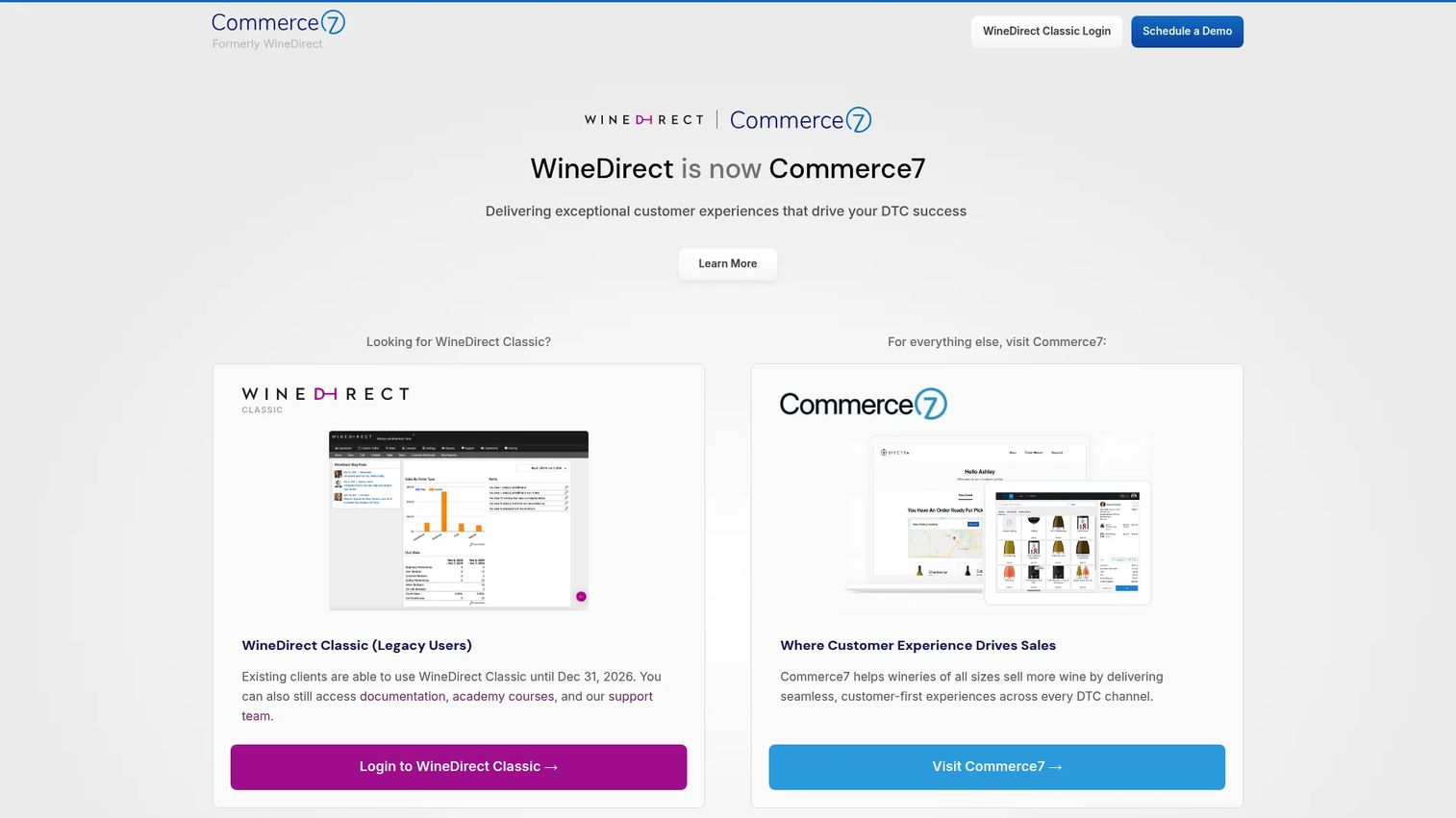
WineDirect is a direct-to-consumer commerce platform built specifically for wineries. It covers the entire customer-facing side of the business: online store, tasting room POS, wine club, and fulfillment. If your priority is winery software for sales and ecommerce rather than production, WineDirect is the strongest choice on this list for DTC revenue.
Best for: Wineries that need an all-in-one DTC platform for ecommerce, tasting room POS, and wine club operations.
Key strengths
- Online store: Templates, product management, email, and reporting tools to run a winery ecommerce storefront end to end.
- Tasting room POS: Mobile, iOS, and offline-capable POS so the tasting room keeps selling even when connectivity drops.
- Wine club management: Member portal, segmentation, and automated club processing to run recurring DTC revenue at scale.
Why choose WineDirect: WineDirect is the specialist. When DTC is your growth engine and you need club, POS, and ecommerce that talk to each other, it goes deeper on customer-facing workflows than any operating system here. Many wineries pair it with a production platform, using WineDirect for the sales side and a system like InnoVint or vintrace for the cellar.
WineDirect pricing: WineDirect publishes DTC Starter at $79/month and DTC Pro at $199/month, with DTC Advanced available as a custom quote. A one-time onboarding fee applies to each paid tier, and there is no free plan. WineDirect holds a 3.5/5 rating on G2. For a winery scaling club and online sales, the tiered structure grows with your DTC volume.
5. Ekos
Ekos is craft beverage management software serving breweries, wineries, cideries, and distilleries. Its strength is operations breadth across producer types: inventory management, production management, and sales and customer management in one platform, with mobile app workflows for the production floor. For a winery that also makes cider or spirits, Ekos handles the full craft-beverage portfolio under one roof.
Best for: Craft beverage producers needing an all-in-one operations platform across multiple product types.
Key strengths
- Inventory management: Track raw materials, work-in-progress, and finished goods with traceability across production runs.
- Production management: Manage batches, recipes, and production scheduling from a single system.
- Sales and customer management: Connect production output to sales and customer records so the whole operation shares one dataset.
Why choose Ekos: Ekos fits producers whose portfolio spans more than wine. If you run a winery alongside a cidery or distillery, its multi-beverage design means one operations platform instead of several. It suits operators who want inventory, production, and cost accounting unified rather than split across category-specific tools.
Ekos pricing: Ekos publishes three annual tiers, Essentials, Plus, and Professional, all shown as request-pricing with no public numeric price. You will need to request a quote to scope cost. Ekos holds a 4.1/5 rating on G2. The tiered annual structure lets producers align capability with the scale of their operation.
6. VineSpring
VineSpring is ecommerce, allocations, and club management software for wineries and other craft beverage producers. Rather than running the cellar, it focuses on the DTC layer: online sales and storefronts, club management with batch club processing, and allocations management. It is a focused option, not a full operating system, and it earns its place for wineries whose complexity lives on the sales side.
Best for: Wineries and craft beverage producers needing DTC ecommerce, club, and allocation management.
Key strengths
- Online sales and storefronts: Run direct-to-consumer wine sales through branded storefronts built for wineries.
- Club and allocation management: Batch club processing and allocations management to run recurring and limited-release sales.
- Broad integrations: Connects with tools like Square, Mailchimp, ShipCompliant, ShipStation, Salesforce, WordPress, and Tock for a connected DTC stack.
Why choose VineSpring: VineSpring suits a winery that already handles production well and needs a cleaner, more usable DTC and club layer. Its integration list means it slots into an existing stack rather than forcing a rip-and-replace. Wineries running allocations for limited releases will find its allocation tooling especially useful.
VineSpring pricing: According to Capterra, VineSpring lists three plans: Starter at $99 per user per month, Professional at $399 per user per month, and Enterprise at custom pricing, with no free trial or free version. VineSpring holds a 3.5/5 rating on G2. For a DTC-focused winery, the tiers scale with the size of your club and sales operation.
7. VinNOW
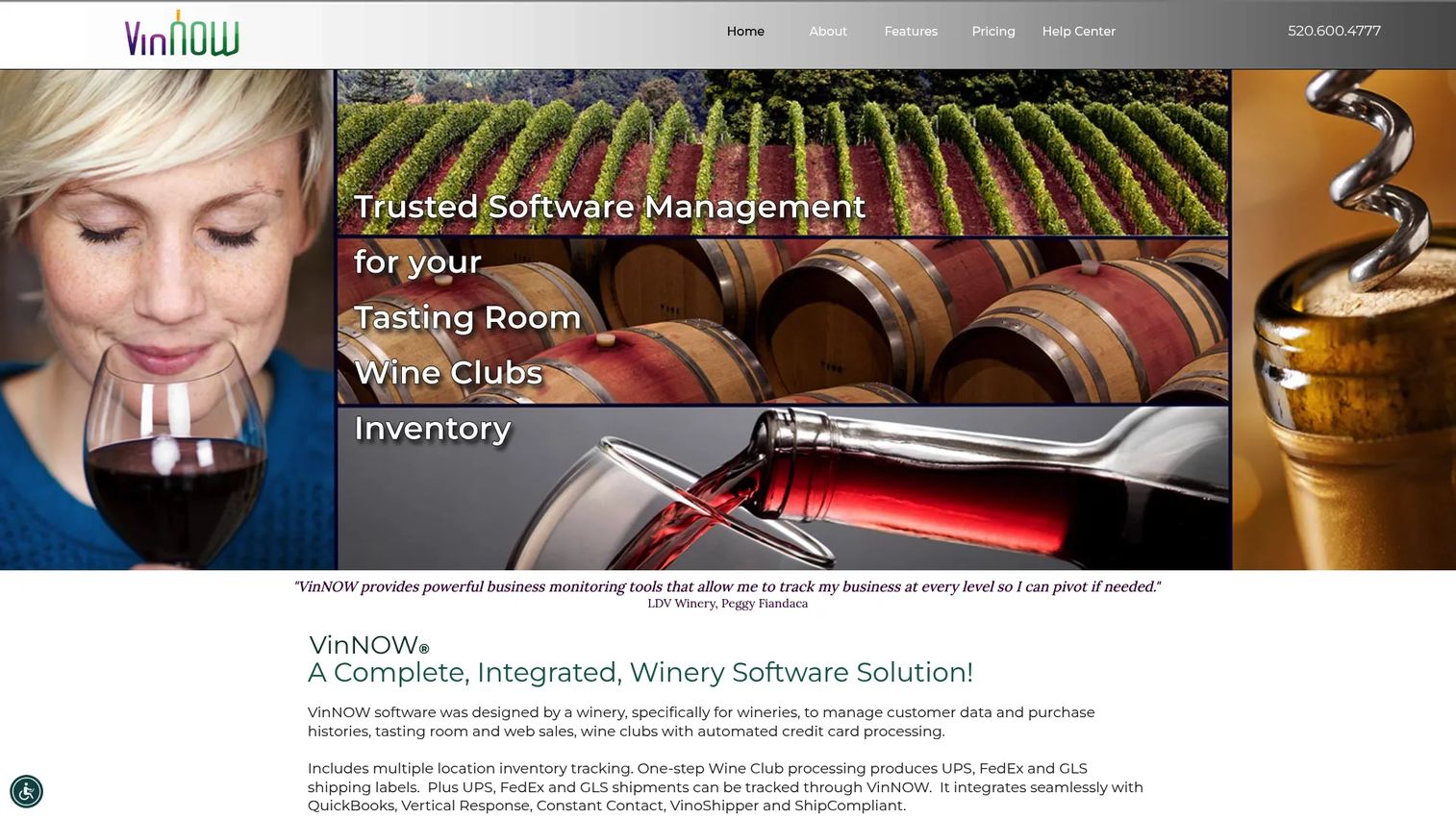
VinNOW is winery management software built around tasting room, wine club, ecommerce, inventory, and reporting workflows. It is a broad but compact system: rather than a deep vineyard-to-bottle operating system, it packages the day-to-day DTC and management functions most small and mid-size wineries actually run. Point of sale, wine club management, and an ecommerce shopping cart anchor the platform.
Best for: Wineries needing an industry-specific DTC, POS, and wine-club system in one compact package.
Key strengths
- Point of sale: Tasting room POS built specifically for wineries, tying sales directly to inventory and club records.
- Wine club management: Run recurring club shipments and member management from the same system.
- Ecommerce shopping cart: An online cart add-on extends DTC sales beyond the tasting room.
Why choose VinNOW: VinNOW fits a winery that wants POS, club, ecommerce, and reporting in one affordable, focused tool without the overhead of a full operating system. Its member-tier pricing scales with your club, so cost tracks your actual DTC size. It holds a 4.5/5 rating on G2, the highest on this list.
VinNOW pricing: VinNOW uses tiered monthly pricing based on active wine club members, with client-based plans from $99/month and web-based plans from $129/month, scaling up by member count. A web shopping cart add-on runs $50/month and the VinTracker bulk wine module runs $69/month. There is no free tier. The member-based model keeps entry cost low for smaller clubs.
Considerations before you buy
Before you commit, run each shortlisted platform against the criteria that actually determine fit. These are the questions a founder or operations lead should answer during evaluation.
Workflow breadth versus focus
Decide first whether you need an end-to-end operating system or a focused layer. A winery running its own production, inventory, compliance, and finance needs breadth. A winery that outsources custom crush and lives on DTC revenue may only need a strong sales and club tool. Buying more than you use is a common and expensive mistake.
Compliance and traceability depth
If TTB and state reporting eat your team's time, weigh how deeply each platform automates winery software for compliance and traceability. Ask whether records stay audit-ready as you work, and whether the system can reconstruct a full lot history on demand. This is where operating systems separate from DTC-only tools.
Integrations and data flow
Your winery software rarely stands alone. Check winery software integrations against your accounting, ecommerce, and shipping-compliance tools before you buy. A platform that syncs cleanly with your accounting system saves hours of re-entry every month, the same principle that makes strong contract analytics software and marketing analytics tools worth their cost.
Pricing model and total cost
Look past the headline price. Some vendors publish tiers, others quote custom, and several add onboarding fees or per-user costs. Map winery software pricing to your actual seat count, club size, and production volume so the number reflects your real operation, not the starting tier.
Ease of use and adoption
The best system is the one your crew actually uses. Mobile and offline cellar access, intuitive POS for tasting room staff, and clean reporting for finance all drive adoption. A tool nobody adopts is worse than the spreadsheet it replaced.
Conclusion
The right winery software depends entirely on where your operational complexity lives. If you need one system from vineyard to bottle, InnoVint is the most complete operating system here, with vintrace as the strongest cloud-collaboration alternative for teams working across sites. Vinsight wins on transparent pricing and stock control for producers who want to see the number upfront and Ekos covers multi-beverage operations across wine, cider, and spirits.
If your growth engine is direct-to-consumer, WineDirect goes deepest on ecommerce, POS, and wine club, while VineSpring and VinNOW offer focused, more affordable DTC and club management for smaller operations. Many wineries run a production platform and a DTC platform side by side, which is a perfectly valid stack.
Start with the tool that matches your workflow complexity. Map your production, compliance, and DTC needs against the seven options above, shortlist two, and run a trial or scoping call before committing. The best choice is the one that removes the most reconciliation from your week.
FAQs
Winery software is vertical SaaS that manages wine business operations, spanning production, inventory, compliance, finance, and sales. Also called winery management software or a winery operating system, it replaces spreadsheets and paper logs with one connected dataset. Some platforms cover the full vineyard-to-bottle process while others focus on a single workflow like DTC or accounting.
Core features include wine production tracking, inventory and traceability, compliance and TTB reporting, cost accounting, and reporting and analytics. Many platforms also add direct-to-consumer capabilities like ecommerce, tasting room POS, and wine club management. The right feature mix depends on whether you need an end-to-end operating system or a focused DTC or accounting layer.
Winery software manages the full production and business operation, including winemaking, inventory, compliance, finance, and sales. Vineyard management software focuses specifically on the growing side: blocks, crops, spraying, harvest scheduling, and vineyard tracking. Some operating systems like InnoVint include vineyard tracking as part of a broader platform, so the categories overlap.
Operating systems with built-in compliance automation handle TTB and state reporting best. InnoVint automates winery compliance and keeps records audit-ready as you work, and vintrace covers compliance as part of its grape-to-bottle platform. The strongest winery compliance software keeps data structured continuously so filing is a review step rather than a manual reconstruction.
WineDirect is the deepest direct-to-consumer wine software on this list, covering online store, tasting room POS, wine club, and fulfillment. VineSpring and VinNOW are strong focused alternatives for smaller operations centered on club, allocations, and POS. Many wineries pair a DTC platform with a separate production system rather than expecting one tool to do both.
Winery software pricing ranges widely. Vinsight starts at $24/month and WineDirect at $79/month with published tiers, while VinNOW scales from $99/month based on club membership. Operating systems like InnoVint, vintrace, and Ekos use custom or inquiry-based pricing, so you contact sales for a quote scoped to your operation.
Prioritize anywhere access, mobile and offline cellar workflows, and clean integrations with your accounting, ecommerce, and compliance tools. Verify that the cloud-based winery software keeps records audit-ready, syncs data in real time, and scales with your production and DTC volume. Ease of adoption for cellar, tasting room, and finance staff matters as much as the feature list.