The acquirer's diligence list just hit your inbox. It's hundreds of line items. Your CFO is asking where to put it all. Your lawyer said, in plain language, do not use Google Drive.
You're prepping for a fundraise, a strategic conversation, or a first real acquisition discussion. The infrastructure decision you're about to make is bigger than it looks. The data room you stand up is not just storage. It's the first long, sustained read an acquirer or lead investor gets on how you operate.
A sloppy room signals operational immaturity. Files in the wrong folder, permissions set too broadly, no audit trail of who looked at what. These things shape pricing opinions before a single term sheet gets drafted. The opposite is also true. A clean, well-structured virtual data room compresses diligence cycles and removes friction from the parts of a deal you actually want to negotiate.
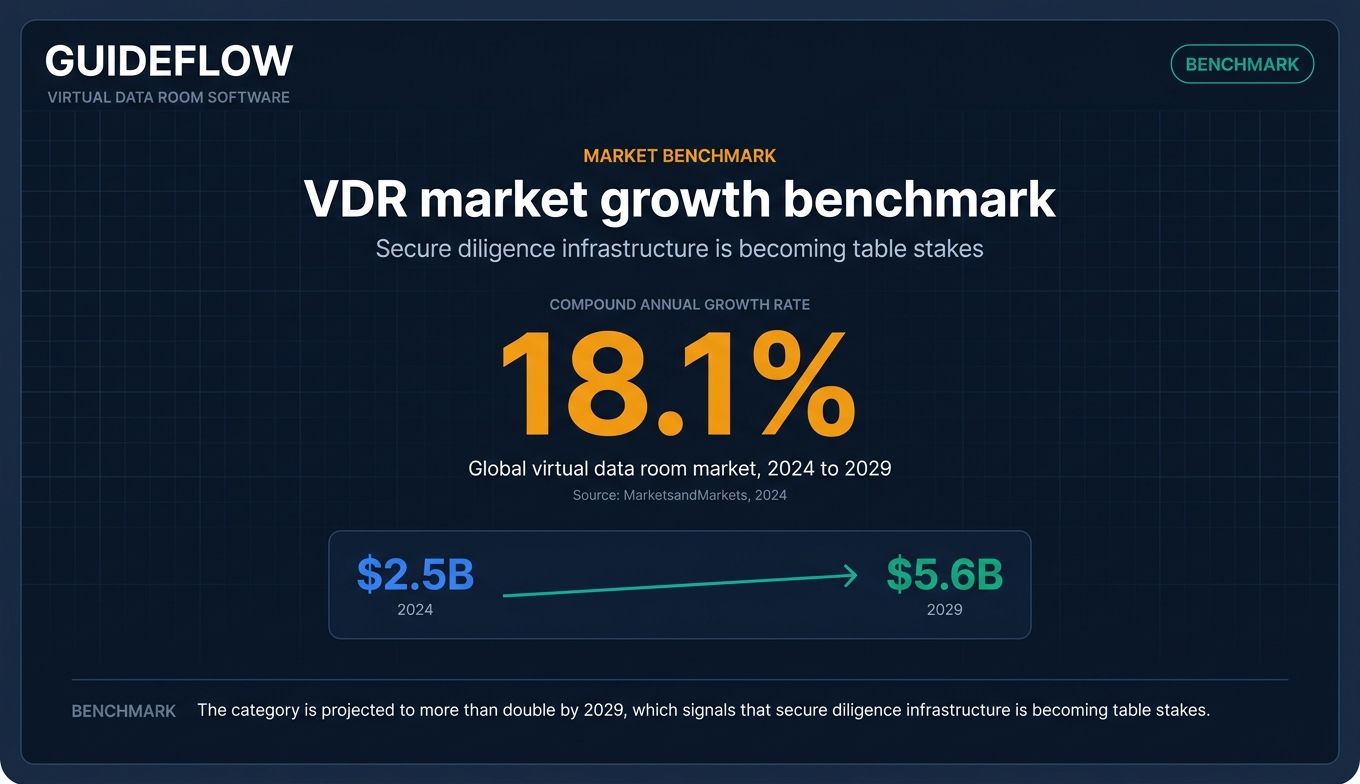
The category itself is growing fast. MarketsandMarkets values the global virtual data room market at $2.5B in 2024, projected to reach $5.6B by 2029 at an 18.1% CAGR (MarketsandMarkets, 2024). That growth reflects how much of modern dealmaking has moved away from physical rooms and toward purpose-built secure platforms.
This guide is the shortlist you can defend to your board and your counsel by Friday.
What's inside
We evaluated 10 virtual data room providers against four criteria that matter to a Series B founder running a real diligence process: security and compliance posture, fit with the actual diligence workflow (Q&A, permissions, redaction), pricing transparency, and time-to-first-room. We pulled pricing and ratings from each vendor's first-party pricing page and current G2 listing at the time of writing. Tools are ordered by relevance to SaaS founders, CFOs, and the legal and finance teams executing the evaluation, not alphabetically.
TL;DR
- Best overall for SaaS founders running a first fundraise or M&A conversation: iDeals
- Best for mid-market and enterprise M&A workflows: Datasite
- Best for large, regulated transactions and IPOs: Intralinks
- Best for AI-assisted deal readiness: Ansarada
- Best flat-rate pricing and sub-10-minute setup: SecureDocs
- Best for life sciences and biotech deals: ShareVault
- Best for buy-side teams managing a deal pipeline: DealRoom
- Best for early-stage fundraises on a tight budget: Digify
What is virtual data room software?
Virtual data room software is a secure cloud-based platform for sharing confidential business documents with external parties during high-stakes transactions like fundraising, M&A, audits, IPOs, and licensing deals.
A VDR is not generic cloud storage. The differences are functional, not cosmetic. Where Google Drive, Dropbox, and Box give you basic share links, a virtual data room gives you document-level permissions, dynamic watermarking tied to the viewer's identity, view-only and redaction controls, two-factor authentication, time-limited access, and the ability to revoke a file even after it's been downloaded. Every view, download, search, and print is logged.
Core capabilities of any modern VDR provider:
- Document-level access controls and permissions, often by user, group, or role
- Dynamic watermarking and view-only restrictions, with the viewer's email or IP burned into the page
- Audit logs of every view, download, search, and Q&A interaction
- Q&A workflow with role-based routing between buy-side, sell-side, advisors, and subject experts
- Bulk upload, automatic indexing, and document numbering
- Built-in redaction and OCR across uploaded files
- Compliance certifications, typically SOC 2 Type II, ISO 27001, GDPR, and HIPAA where the deal touches healthcare data
The category evolved from physical data rooms, the locked basement rooms where bidders flew in to review documents one binder at a time. Today's online data rooms are SaaS-native, accessible from anywhere, and built around the workflow of a modern diligence cycle. The phrase virtual deal room is sometimes used interchangeably, though deal room often implies a narrower transactional context while virtual data room covers any sensitive document-sharing workflow.
When to use a virtual data room
Run M&A diligence without losing control of sensitive files
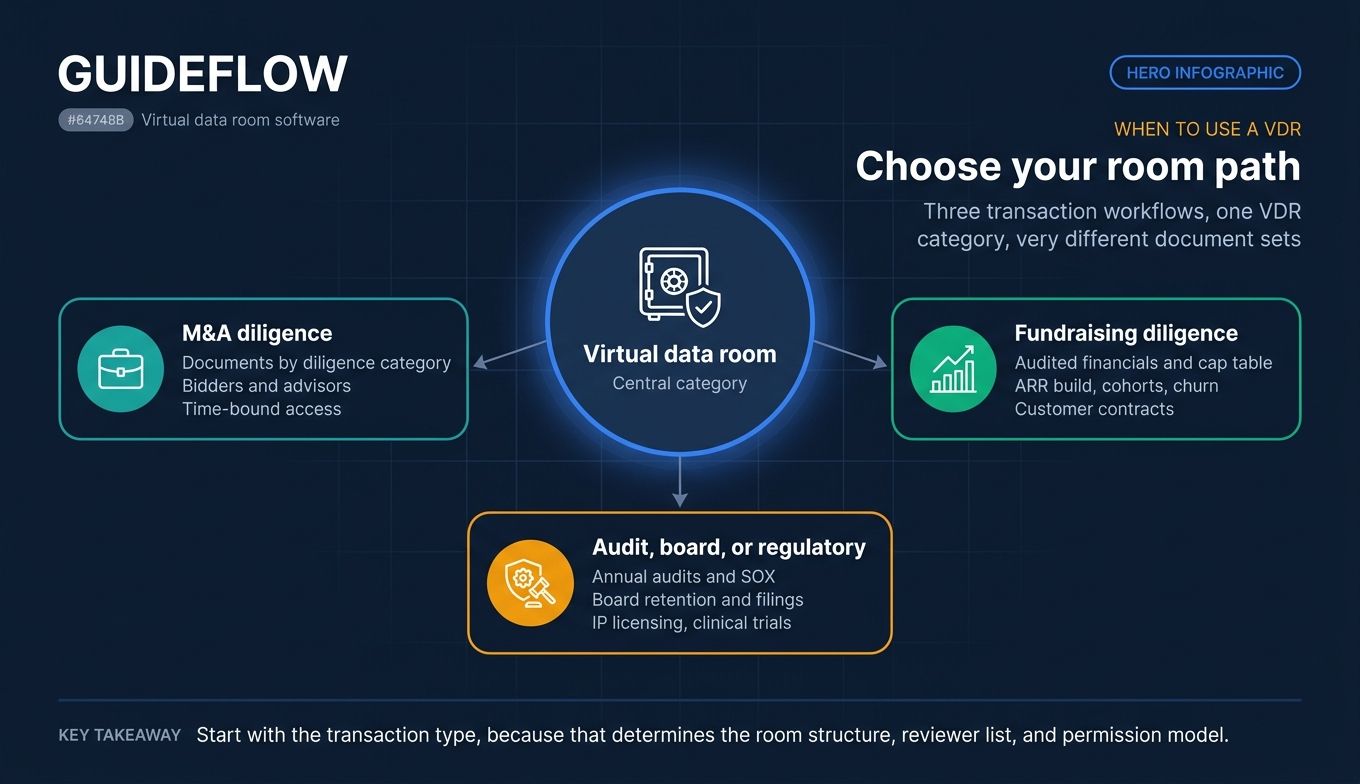
This is the dominant use case for virtual data rooms for mergers and acquisitions. On the sell-side, you stand up a room, organize documents by diligence category, and grant time-bound access to bidders and their advisors. On the buy-side, you pull diligence material from a target into a structured environment you control.
Acquirers and investors increasingly ask for live product context alongside documents. Many founders now pair their M&A virtual data room with interactive product walkthroughs so the buy-side can see how the product actually works without scheduling another live call. Pairing a clean data room with a centralized demo center gives both sides a single source of truth for product context during diligence.
Raise a Series B, C, or D round with clean diligence
Investor diligence rooms hold the same shape as M&A rooms, just with different contents: audited financials, customer cohort data, contracts, the cap table, ARR build, churn analysis. Founders who run a clean room get cleaner term sheets, because the conversation stays on terms instead of getting derailed into "can you re-send that file?"
Stand up an audit, board, or regulatory room
Annual audits, SOX disclosure, board document retention, regulatory filings, IP licensing, and clinical trial documentation all benefit from a dedicated secure data room. Less glamorous than M&A, but a recurring use case that shows up year after year.
Comparison table
The table below covers the 10 virtual data room providers evaluated in this guide. Pricing reflects what each vendor publishes on their first-party pricing page. Where pricing is quote-based, we surface the plan tier names instead of inventing numbers. G2 ratings are current as of writing.
| # | Product | Intent | Key use case | Pricing | G2 rating |
|---|---|---|---|---|---|
| 1 | iDeals | First M&A or fundraise | SaaS founders running a serious diligence cycle | Core, Premier, Enterprise (quote-based, free trial) | 4.7/5 |
| 2 | Datasite | Enterprise M&A | Investment banks and corp dev teams running concurrent deals | Quote-based, per transaction | 4.7/5 |
| 3 | Intralinks | Large regulated deals | IPOs and cross-border transactions | Quote-based | 3.8/5 |
| 4 | Ansarada | AI-assisted deal readiness | Sell-side teams that want preparation, not just storage | From $244/month (250 MB, 12-month term) | 4.5/5 |
| 5 | DealRoom | Buy-side pipeline | Corp dev teams managing multiple targets | Quote-based, flat-rate, unlimited users | 4.6/5 |
| 6 | Firmex | Mid-market and recurring transactions | Legal, accounting, and restructuring firms | Single Project or Subscription (quote-based) | 4.6/5 |
| 7 | SecureDocs | Fast setup, flat pricing | Founders who want a room live in under 10 minutes | From $250/month (12-month plan) | 4.9/5 |
| 8 | ShareVault | Life sciences and biotech | Pharma and biotech licensing and M&A | Express, Pro, Enterprise (quote-based) | 4.6/5 |
| 9 | CapLinked | Budget-conscious teams | Small-to-mid deals needing enterprise security | From $399/month (Team) | 4.4/5 |
| 10 | Digify | Early-stage fundraises | Seed and Series A founders | From $140/month (Pro) | 4.9/5 |
The 10 best virtual data room software tools for 2026
1. iDeals
iDeals is the VDR most consistently named when SaaS founders ask peers what to use for their first real diligence cycle. It covers the full feature surface of an enterprise VDR, granular permissions, secure document viewing, redaction, Q&A workflow, but the editor and reviewer experience are simple enough that a finance team can learn it in a day.
Best for: SaaS founders and mid-market dealmakers who want a secure virtual data room with an enterprise feature set and a friendly learning curve.
Key strengths
- Granular permissions and access controls: Set document-level rights by user, group, or role across complex multi-party deals.
- Due diligence checklists and Q&A: Built-in workflow for managing buyer questions, routing them to subject experts, and tracking response status.
- Document versioning and external link sharing: Track revisions cleanly and share specific files with outside counsel without granting full room access.
Why choose iDeals: For a first-time M&A or major fundraise, iDeals hits the right balance. It has the certifications and controls counsel will sign off on, and the interface won't bury your CFO. It's overkill for a small seed round, but for Series B and beyond, it's a defensible default.
iDeals pricing: iDeals lists three plans on its pricing page: Core, Premier, and Enterprise. Pricing is quote-based, with "Get price" and "Start free trial" CTAs on the page. A free trial is available for new customers. Confirm current pricing and trial length directly with iDeals before committing. G2 ratings are current as of writing.
2. Datasite
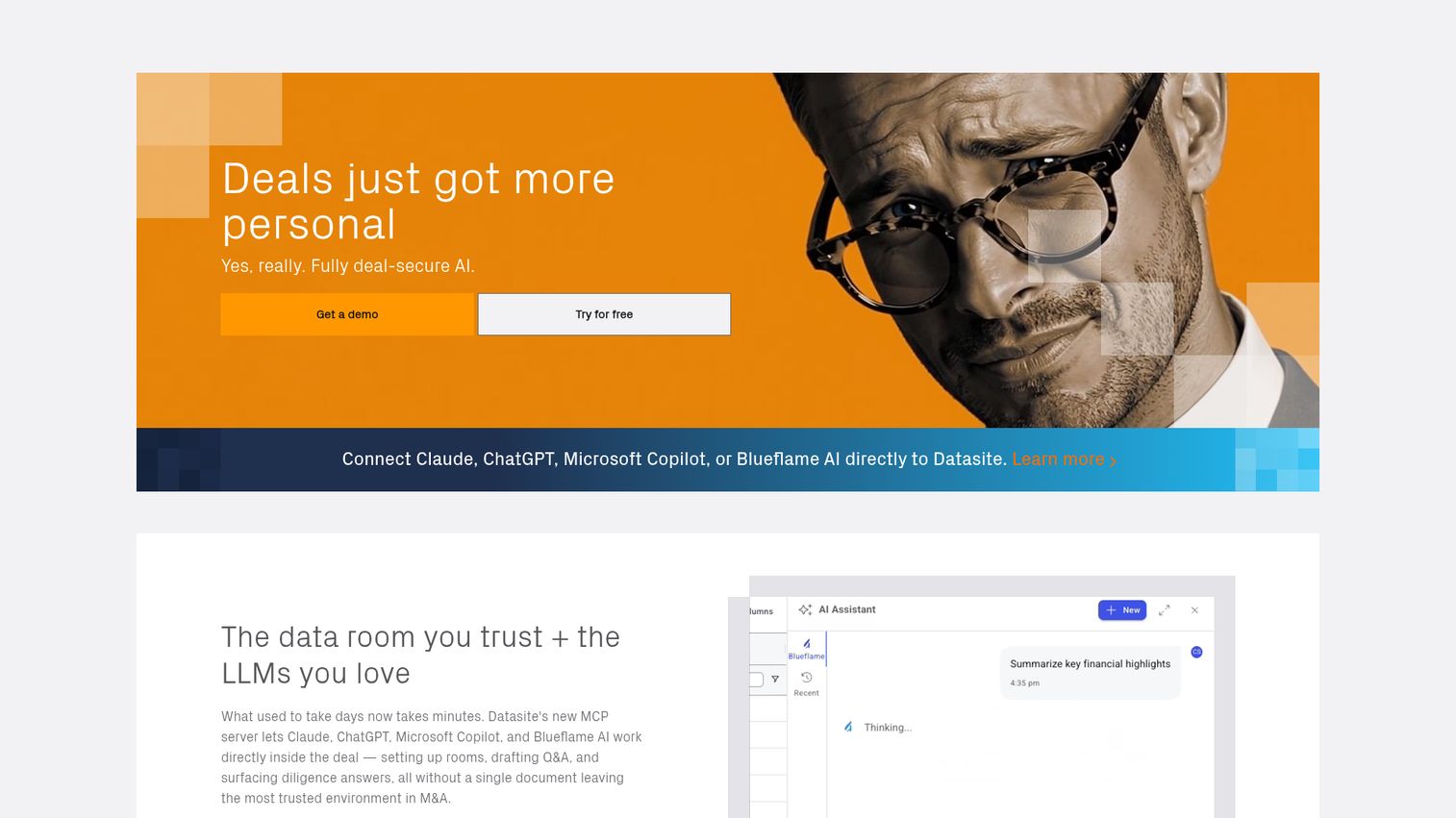
Datasite is built for the high end of M&A. Investment banks, large advisory firms, and corp dev teams at acquirers use Datasite to run concurrent transactions with full lifecycle support, from preparation through diligence to post-close integration.
Best for: Enterprise M&A and investment banking teams running multiple concurrent deals across regions.
Key strengths
- Semantic Search: Find relevant content across thousands of documents without needing exact keywords.
- Integrated Q&A workflows: Manage buyer questions and responses with role-based routing and approval chains.
- AI-powered redaction and document summarization: Automatically flag sensitive content and summarize long documents inside the room.
Why choose Datasite: Datasite is the platform large advisors expect. If your deal is being run by a bank, there's a strong chance they'll prefer Datasite by default. For a Series B founder running a sub-$50M deal direct, it's typically more platform than the situation calls for. For a $200M+ transaction with a top-tier bank on the sell-side, it's exactly the right tool.
Datasite pricing: Datasite uses transaction-based custom pricing. Its first-party pricing FAQ confirms that pricing is customized for every transaction and asks buyers to request a quote. No public plan tiers or list prices are published. Expect enterprise-level engagement and contract structure.
3. Intralinks
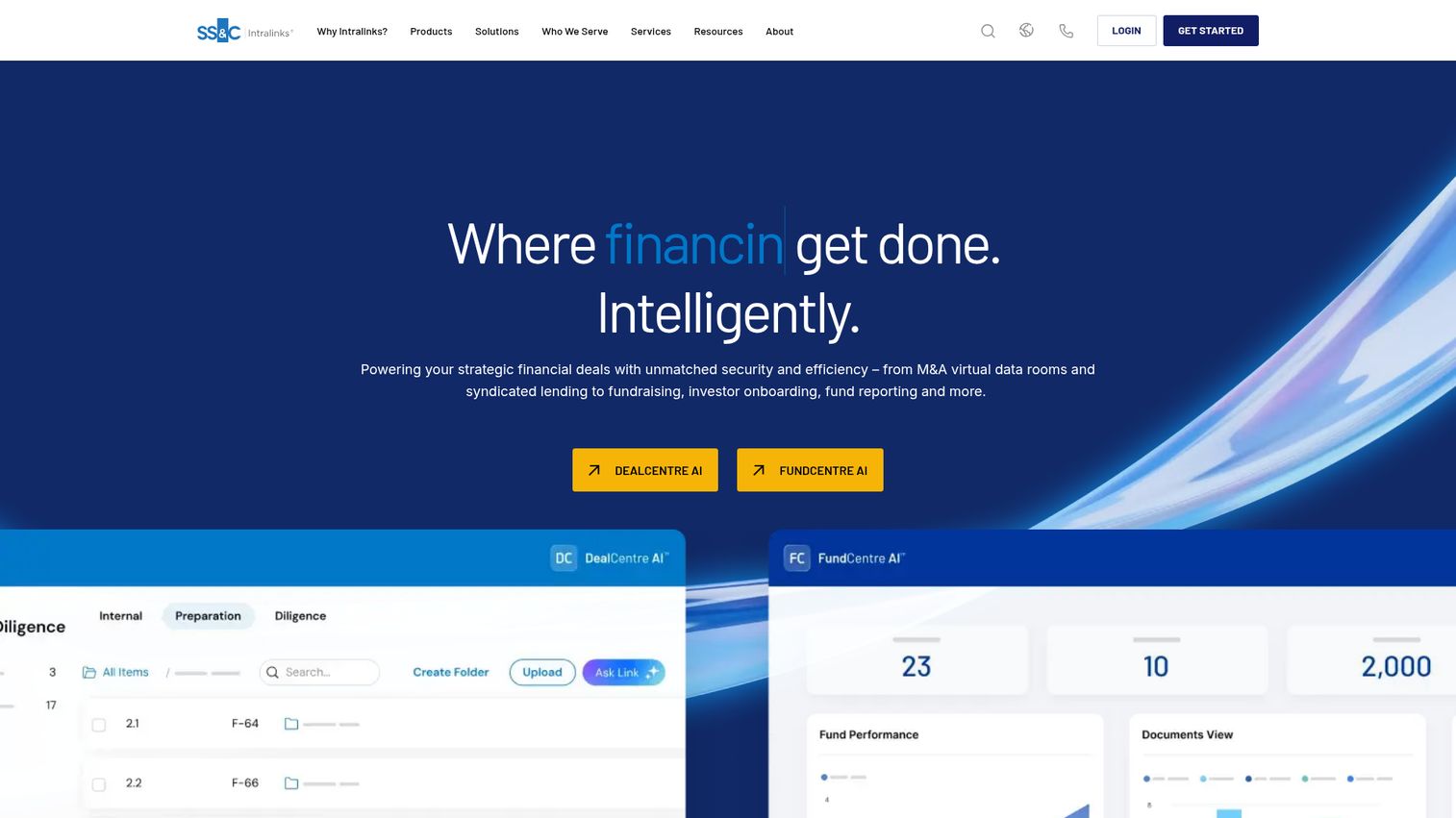
Intralinks, part of SS&C, has been a fixture in regulated financial services dealmaking for decades. It's built for environments where information rights management is non-negotiable, IPOs, syndicated lending, large M&A, and any deal where a leaked file would be a board-level incident.
Best for: Large enterprise transactions, IPOs, and regulated industry deals where compliance posture and document control are critical.
Key strengths
- Virtual data rooms with granular permissions and dynamic watermarking: Document-level control with viewer-identifying watermarks burned into every page.
- AI-assisted tools: Document redaction, summarization, categorization, and translation built into the workflow.
- Analytics, audit reporting, and mobile access: Detailed activity tracking and reporting across stakeholders, available on any device.
Why choose Intralinks: Intralinks is the tool to pick when the deal is cross-border, the document set is large, and the regulatory scrutiny is heavy. The G2 rating is lower than some peers on this list (3.8/5), and reviewers often cite a steeper learning curve, but the security and information rights posture is what keeps it on every banker's shortlist.
Intralinks pricing: Intralinks uses quote-based pricing. The first-party request-quote page is the entry point, and the company does not publish plan tiers or list pricing. Expect enterprise contracts with custom terms based on deal volume, room size, and feature scope.
4. Ansarada
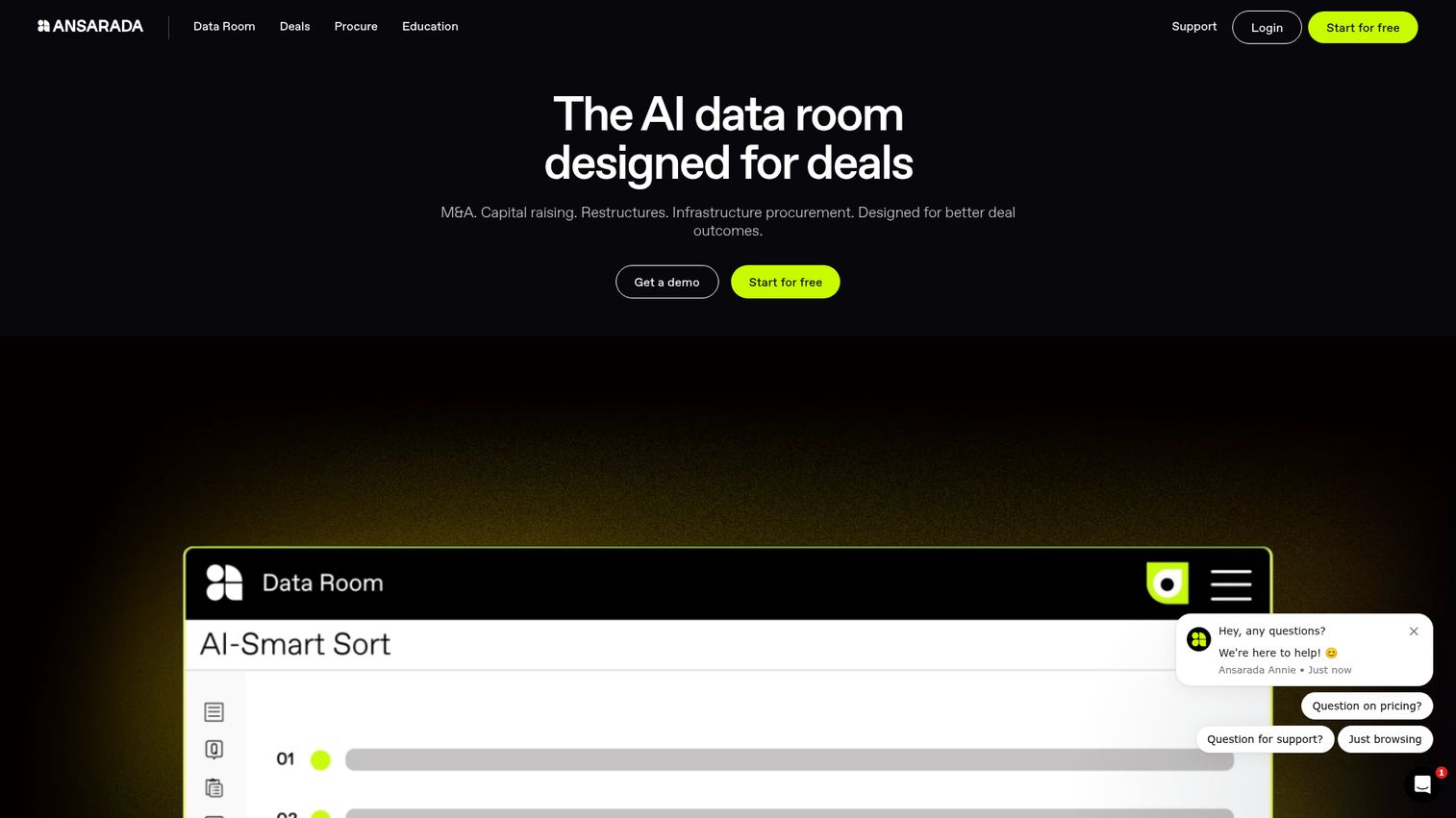
Ansarada treats the data room as part of a broader deal-readiness workflow, not just secure storage. Its AI features focus on preparation: scoring how ready you are to go to market, organizing documents intelligently, and accelerating Q&A.
Best for: Sell-side teams and advisors who want AI-assisted deal readiness alongside their data room, not bolted on after the fact.
Key strengths
- AI-Sort: Automatic document indexing and categorization so you don't spend a week structuring your folder tree.
- AI-Smart Q&A: Streamlined approvals with alerts for similar questions, cutting duplicate effort across deal teams.
- Granular access controls: Watermarking, document expiry, and remote self-destruct on downloaded files.
Why choose Ansarada: Ansarada is a strong fit for founders who feel underprepared for the diligence process and want the platform to help structure it. The AI readiness scoring is a useful internal forcing function. Ansarada originated in Australia and has a particularly strong APAC presence, though it operates globally.
Ansarada pricing: Ansarada publishes transparent storage-based pricing for its Deals product. Plans range from 250 MB at $244/month to 20 GB at $5,134/month, all on 12-month terms with unlimited internal and external users. Setup and preparation are free until the room goes live or 90 days pass. Procure is priced separately by quote.
5. DealRoom
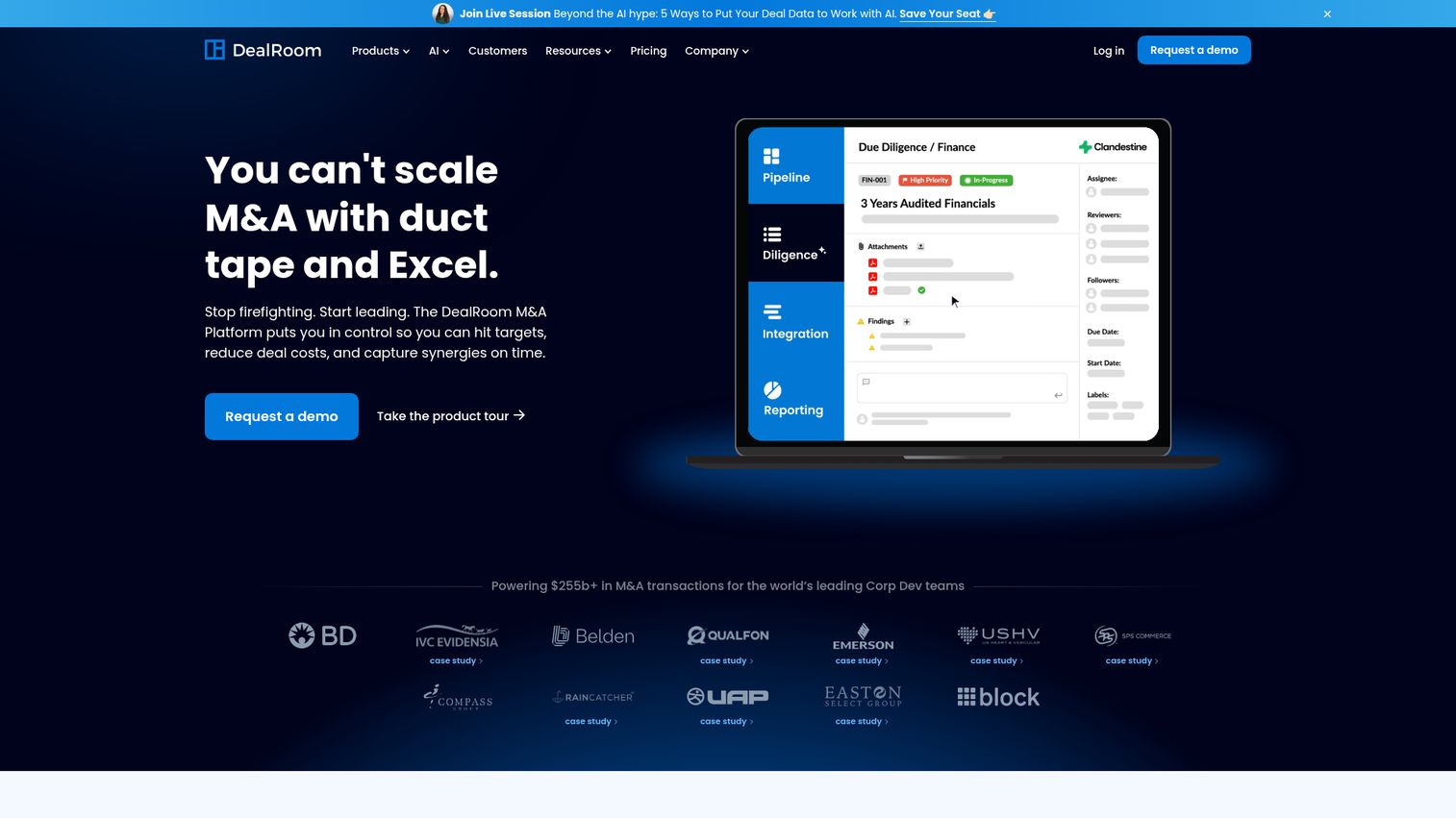
DealRoom approaches M&A as a project to manage, not a transaction to close. It combines a virtual data room with pipeline management, diligence checklists, and post-close integration tracking in one platform.
Best for: Corporate development and buy-side M&A teams running a pipeline of acquisitions, not a one-off transaction.
Key strengths
- Pipeline management: Unified view of targets, data, communications, and diligence status across multiple deals.
- AI-powered diligence document analysis: Collaborative Q&A and automated document review across the deal team.
- Virtual data room with granular permissions: SOC 2-compliant storage with role-based access.
Why choose DealRoom: If you're acquiring one company every six months, DealRoom replaces a tangle of spreadsheets, Slack channels, and one-off data rooms. For a founder running a single fundraise, it's more platform than you need. For a corp dev team at an acquirer, it's a control center. Many corp dev teams pair pipeline tooling like this with a strong CRM stack to keep target relationships organized end-to-end.
DealRoom pricing: DealRoom uses flat-rate pricing based on deal volume, with unlimited users and no per-document or per-seat charges. The DealRoom AI for Diligence module is an add-on. Specific pricing is shared after a walkthrough conversation. Volume discounts are handled case-by-case.
6. Firmex
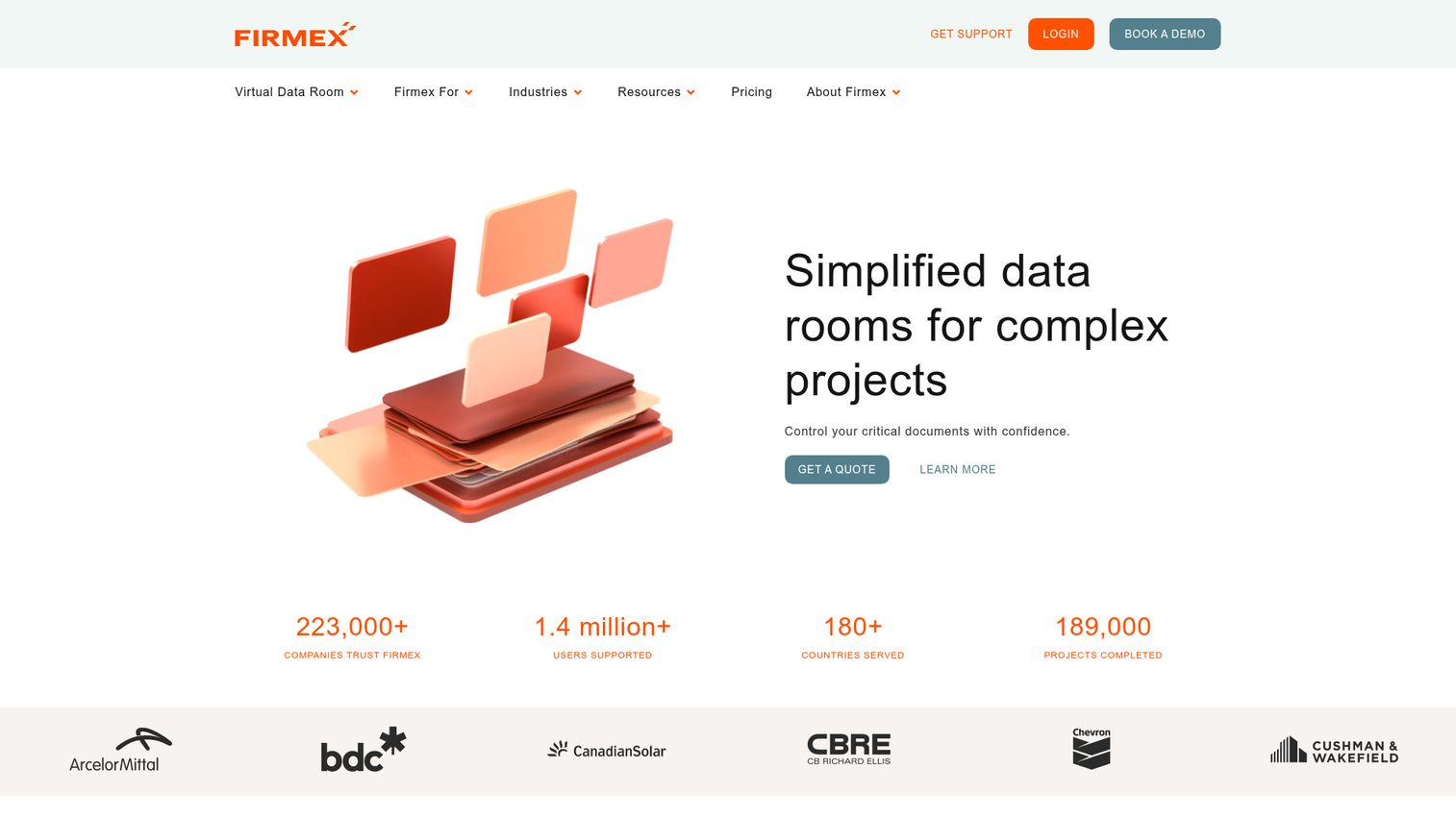
Firmex has built a strong reputation among law firms, accounting firms, and restructuring practitioners who run recurring transactions. The product is purpose-built for due diligence workflows and trades novelty for reliability.
Best for: Mid-market M&A and recurring transaction teams, especially in legal, accounting, and restructuring practice areas.
Key strengths
- Granular user and group access controls: Set permissions across complex multi-party deal teams without overhead.
- Built-in redaction: Mask sensitive information directly inside the room before sharing.
- Purpose-built Q&A: Structured workflow for managing due diligence questions across bidders and advisors.
Why choose Firmex: Firmex is what law firms and accounting firms quietly recommend when they don't want to deal with surprises. The platform is mature, the workflows are predictable, and pricing models flex between single-project and subscription. If your counsel suggests Firmex, take the recommendation seriously. For firms that also handle agreements end-to-end, pairing Firmex with e-signature software and contract management tools closes the loop from diligence to signing.
Firmex pricing: Firmex offers two plan structures: a Single Project Data Room for one project with a fixed time frame (one-time fee), and a Data Room by Subscription with unlimited projects and always-on access (annual fee). Pricing is based on data requirements, project length, or annual data volume, and is quote-based.
7. SecureDocs
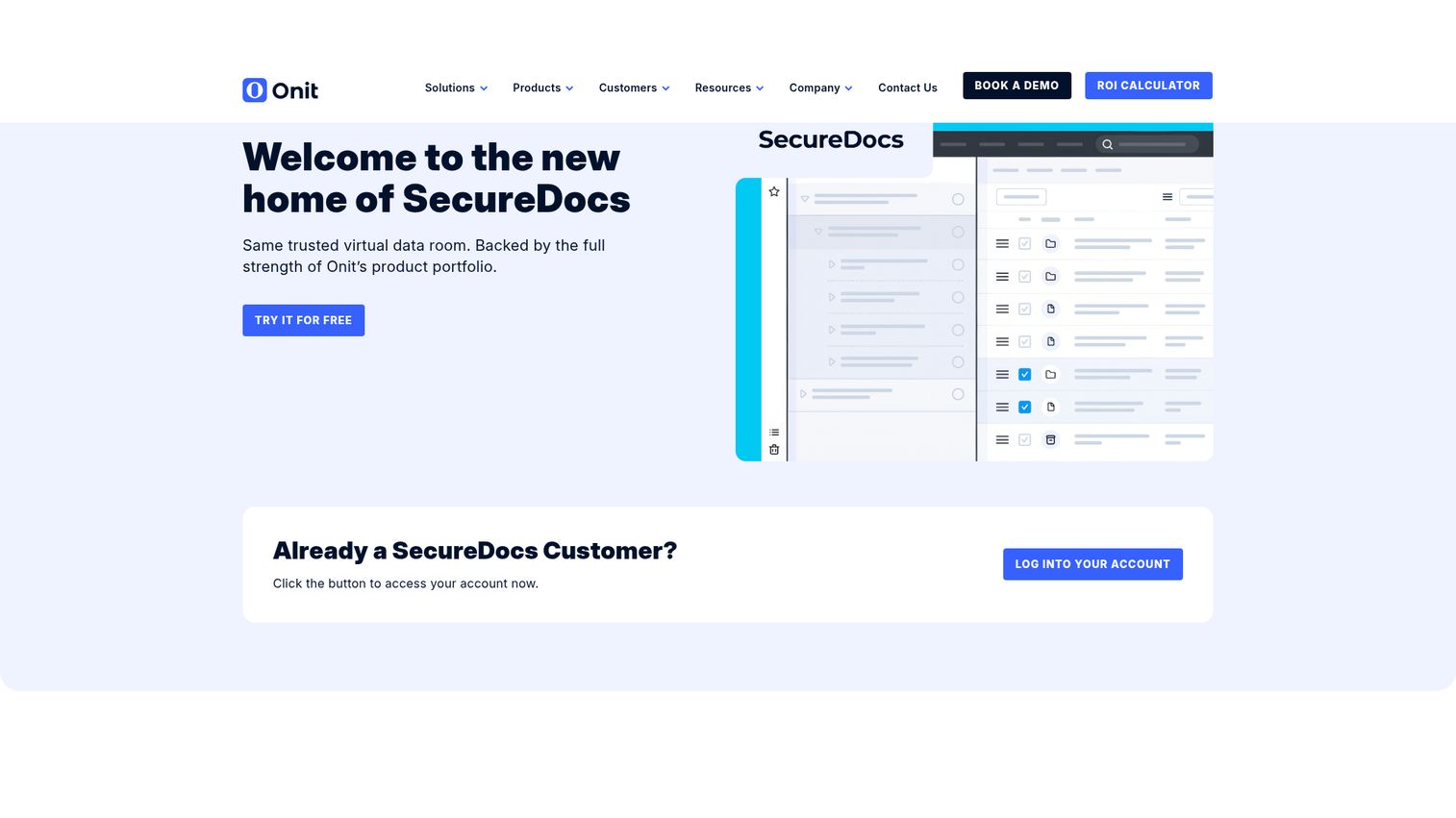
SecureDocs is the flat-rate option on this list. No per-page fees, no per-user fees, no usage-based surprises. You pay a fixed monthly rate and get unlimited users, unlimited documents, and 24/7 support.
Best for: Small-to-mid deals and founders who want predictable flat-rate pricing and a room live in under 10 minutes.
Key strengths
- Customizable dashboards: Tailor the room view to how your deal team actually works.
- Permission-based roles: Standard granular access controls without the complexity overhead.
- Audit log reporting: Full activity trails for compliance and post-deal review.
Why choose SecureDocs: SecureDocs trades advanced AI features for simplicity, and many founders find that a feature, not a limitation. If the goal is a clean diligence room without per-page math, this is the most straightforward path. SecureDocs is part of Onit, an enterprise legal management company.
SecureDocs pricing: SecureDocs lists two main plans on its pricing page: a 3 Month Plan at $400/month (billed quarterly) and a 12 Month Plan at $250/month (billed annually). Volume Packages are available for multiple deals (billed annually, quote-based). All plans include unlimited users, unlimited documents, and 24/7 support. A free trial is offered.
8. ShareVault
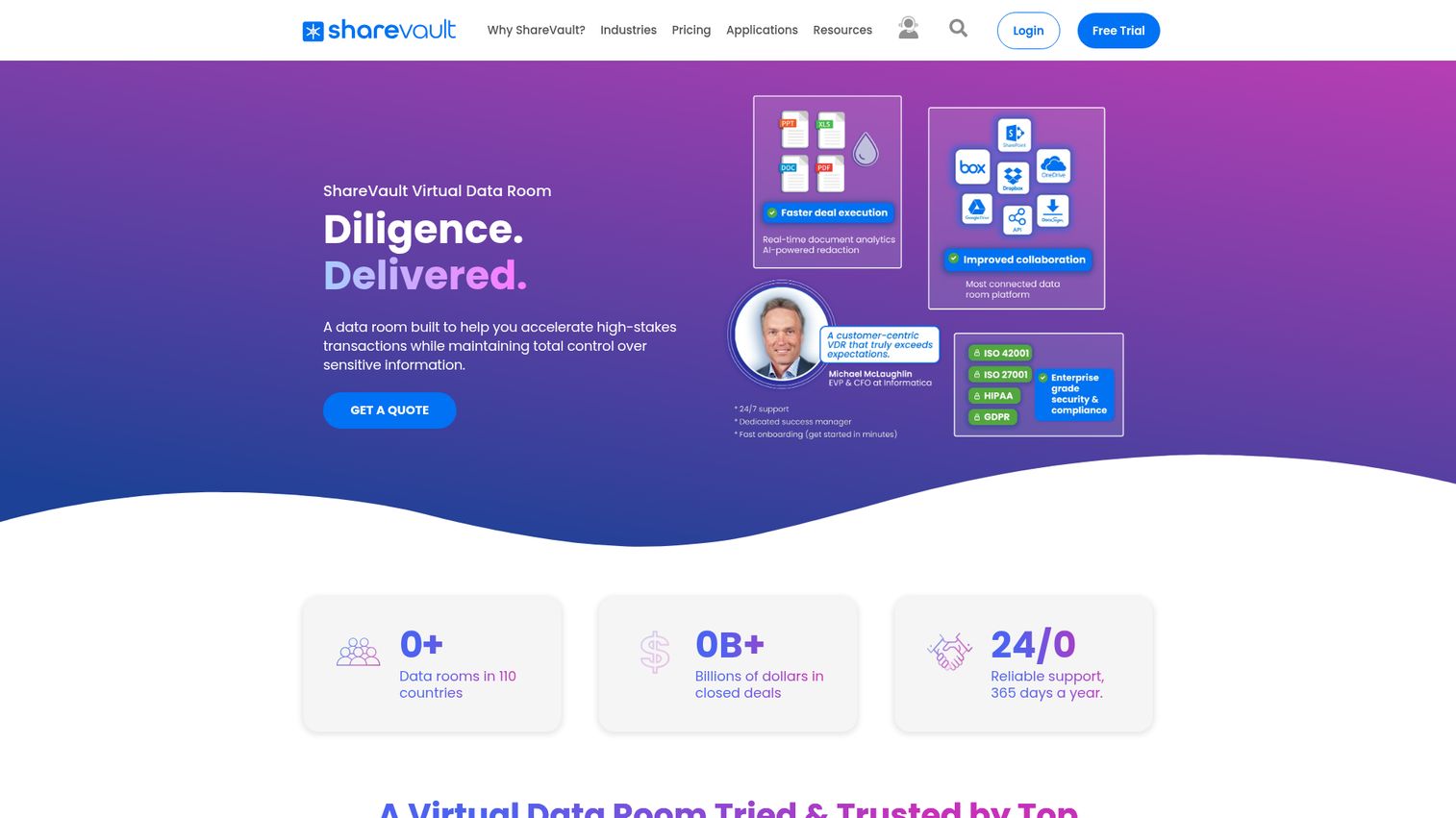
ShareVault is the specialist on this list. It's used heavily in life sciences, biotech, and pharma, where document complexity is high, regulatory scrutiny is heavier, and deals often involve licensing and partnering rather than straight M&A.
Best for: Life sciences, biotech, and pharma deals where document complexity and regulator scrutiny are high.
Key strengths
- Dynamic watermarking, redaction, and remote shredding: Document protection that persists even after files leave the room.
- Detailed audit trails and interactive reporting: User activity analytics that satisfy life sciences compliance review.
- Integrations with SharePoint, OneDrive, Google Drive, Dropbox, Box, DocuSign, and SSO providers: Plugs into the document infrastructure most life sciences teams already use.
Why choose ShareVault: If your deal involves clinical trial data, regulatory submissions, IP licensing, or partnering with a pharma company, ShareVault's vertical depth shows. For a generalist SaaS deal, it's not the obvious pick, but for the workflows it specializes in, it's hard to beat.
ShareVault pricing: ShareVault lists three plans: Express, Pro, and Enterprise. Pricing is based on data usage (GB) and project duration, with custom quotes tailored to each engagement. No numeric pricing is published on the first-party pricing page. A free trial is referenced on the site.
9. CapLinked
CapLinked targets small-to-mid deal teams that want enterprise security at a transparent rate. The platform covers the core VDR feature set and adds API access for teams that want to embed secure document sharing into their own workflows.
Best for: Small-to-mid deal teams that want enterprise security at a flat, transparent rate, with optional API access.
Key strengths
- Customizable watermarking: Burn user information such as email and IP address into every page viewed.
- 256-bit encryption, two-factor authentication, custom permissions, and activity monitoring: Full enterprise security stack at a mid-market price point.
- EZ Q&A: In-platform due diligence questions, expert assignment, and organized FAQ libraries.
Why choose CapLinked: CapLinked is a practical choice when budget matters but security review can't be compromised. It's a fit for founders running a contained fundraise or smaller acquisition where the project scope doesn't justify a Datasite or Intralinks commitment.
CapLinked pricing: CapLinked lists two plans on its pricing page: Team at $399/month for secure document sharing and advanced security features, and Enterprise at $500/month or $5,000/year with concierge services and custom options. A free 14-day trial is available. No free tier is offered.
10. Digify
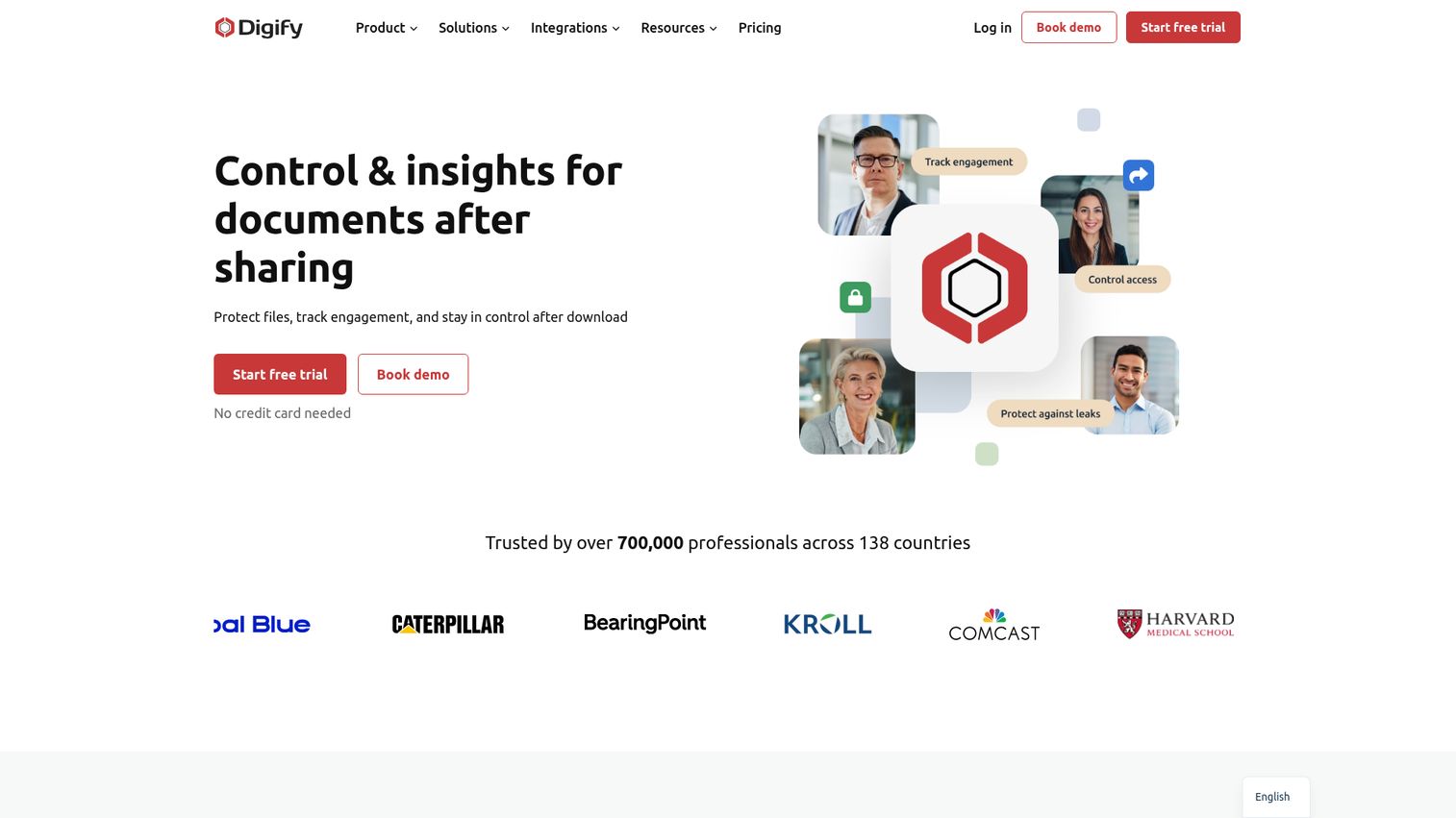
Digify is the lightest-weight platform on this list. It's a fit for founders running early-stage fundraises or smaller transactions who want strong document tracking and access control without enterprise overhead.
Best for: Founders running early-stage fundraises or smaller transactions who want strong document tracking and access controls without enterprise overhead.
Key strengths
- Page-level tracking and analytics: See exactly which pages each viewer read, for how long, and how often.
- Granular access permissions: Set rights per user, per document, per session.
- Persistent protection after download: Watermarks, expiration, and revocation that follow the file beyond the room.
Why choose Digify: Digify is the pragmatic pick for a Series A or early Series B founder who isn't running a complex multi-party process but still wants to know who looked at the deck, when, and for how long. The page-level tracking is genuinely useful in investor outreach, much like email tracking tools help founders see which investors are engaging with outbound updates.
Digify pricing: Digify lists Pro at $140/month, Team at $350/month, and Enterprise with custom pricing on its first-party pricing page. Annual billing offers up to 30% savings. A free 7-day trial is available for new users.
What to evaluate before you buy
The right virtual data room depends on the deal in front of you, not the platform with the longest feature list. Use this checklist when you sit down with your CFO and counsel.
Security and compliance posture
Confirm SOC 2 Type II and ISO 27001 as the baseline. If your deal touches healthcare data, HIPAA matters. If you have EU stakeholders, GDPR posture matters. Ask the vendor for their latest audit reports, not just a marketing page. Confirm two-factor authentication, dynamic watermarking, and document-level revocation are standard, not paid add-ons. For reference on what mature SaaS security posture looks like, see Guideflow's own security and compliance overview.
Time-to-first-room
How fast can your team upload and structure documents on a real deadline? Some platforms get you live in 10 minutes. Others take a week of configuration. For a Series B founder with a fundraise running on a 60-day clock, that gap is real money.
Pricing model fit
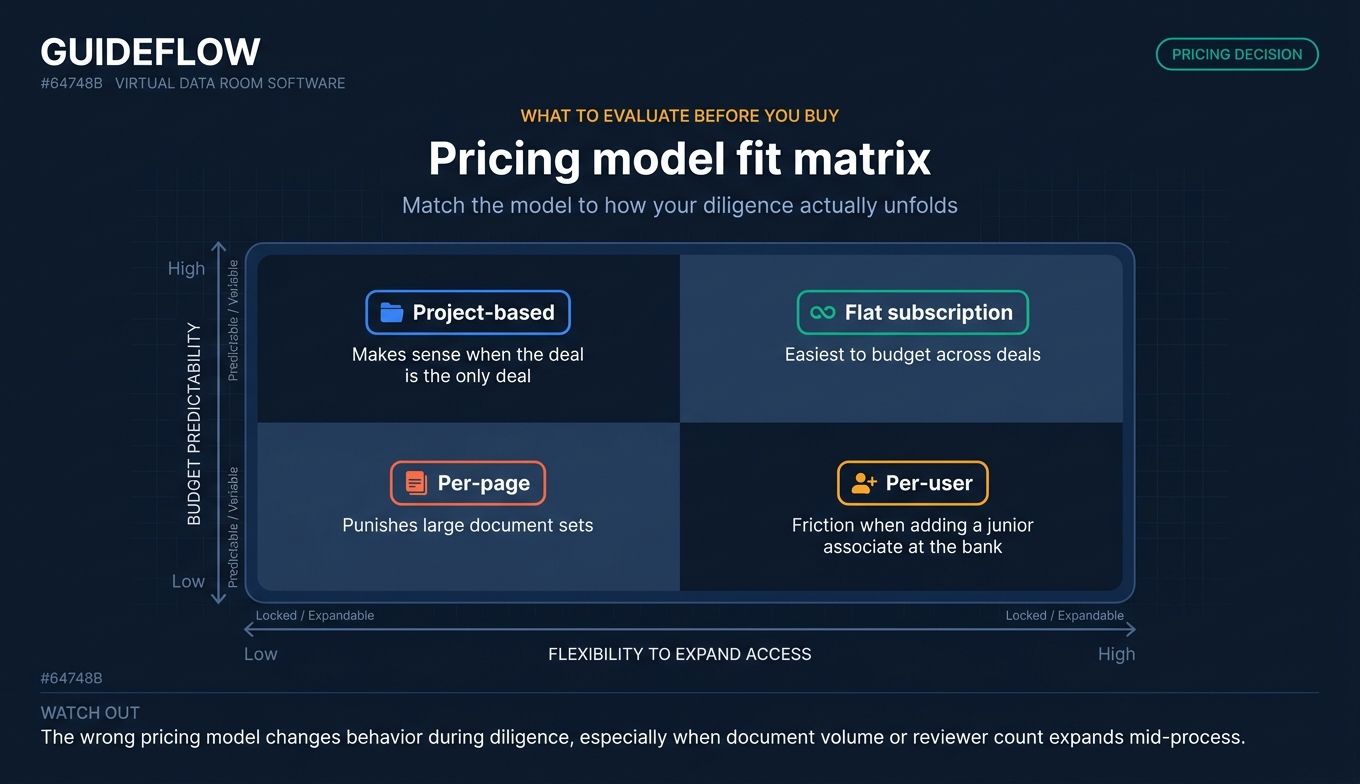
VDR pricing models split into per-page, per-user, per-room, and flat subscription. Per-page pricing punishes large document sets. Per-user pricing creates friction when you want to add a junior associate at the bank. Flat subscription is the easiest to budget. Project-based pricing makes sense when the deal is the only deal.
Diligence workflow fit
Q&A management quality varies more than vendors admit. Look at how questions get routed, how responses get approved, and how the audit log handles complex multi-party threading. Test the redaction tool with a real document before you commit. Bad redaction has ended deals.
Integrations with your stack
If your finance team lives in a specific accounting platform and your legal team uses a contract management tool, confirm the integrations exist and are maintained. SSO, DocuSign, and standard cloud storage connectors should be table stakes for any modern data room services platform. Teams running buy-side workflows often round out the stack with proposal software and contract lifecycle management tools to handle what comes after diligence.
Conclusion
Three or four picks cover most Series B founders:
- For a first fundraise or first M&A conversation, iDeals or Firmex give you the right balance of security, workflow depth, and approachability.
- For mid-market to enterprise M&A run by a bank or advisor, Datasite and Intralinks are the platforms the other side of the table will likely expect.
- For small, budget-conscious deals with fast timelines, SecureDocs, CapLinked, and Digify deliver the core feature set without enterprise overhead.
- For corp dev teams running a recurring pipeline of acquisitions, DealRoom is built for that exact motion.
Shortlist two or three. Run a 30-minute trial setup with real documents, not test files. Have your legal counsel test the permissions model before you sign. The right VDR is the one that survives that test, not the one with the best marketing site. And if your diligence cycle includes product demos for acquirers or investors, a live, interactive product demo alongside the room often closes the gap between document review and real product understanding.
FAQs
Virtual data room software is a secure cloud-based platform for sharing confidential business documents with external parties during high-stakes transactions like M&A, fundraising, audits, and IPOs. It gives sellers and buyers controlled, auditable access to sensitive files in one centralized environment. Modern VDR software replaces the physical data rooms that used to host this kind of document review in person.
A virtual data room gives you document-level permissions, dynamic watermarking tied to each viewer, audit trails of every interaction, redaction tools, and the ability to revoke access to a file even after it has been downloaded. Google Drive and Dropbox were built for general collaboration, not regulated diligence. Your lawyer will tell you the same thing on the first call: a generic share link does not survive a serious diligence review.
Pricing varies widely depending on the vendor and the deal. Subscription-based VDRs for SMB and mid-market teams typically range from roughly $140 to $1,500+ per month, with Digify on the lower end and DealRoom or ShareVault on the higher end. Enterprise M&A platforms like Datasite and Intralinks use project-based or custom pricing that can scale significantly higher based on deal size, room volume, and feature scope.
Many seed and Series A rounds run on Google Drive without serious consequence. By Series B, the diligence volume, the number of stakeholders, and the signal you send to investors all change. A clean virtual deal room reduces the friction in the parts of the process you actually want to negotiate and demonstrates operational maturity, which influences how investors price your round.
The baseline is SOC 2 Type II and ISO 27001. GDPR posture matters for any deal touching EU stakeholders. HIPAA matters if your business handles healthcare data. Beyond certifications, look for dynamic watermarking, two-factor authentication, and document-level revocation as standard, included capabilities rather than upgrade tiers.
Setup time varies dramatically by platform. On a self-serve, flat-rate platform like SecureDocs, you can have a basic room live in under 10 minutes. On enterprise platforms with custom index structures, role-based permissions, and bank-mandated workflows, expect several days to a week or more. The real bottleneck on most deals is not the dataroom software itself, it's preparing and organizing the underlying documents.
Yes. Common non-M&A use cases include investor fundraising diligence, board document storage, annual audits, regulatory filings, IP licensing, real estate transactions, clinical trial documentation, and partner due diligence. Any workflow where sensitive documents need to be shared with external parties under controlled, auditable access is a fit for an online data room.
For early-stage and smaller deals, three picks cover most needs. Digify is the lightest-weight option with strong document tracking and page-level analytics, starting at $140/month. SecureDocs offers flat-rate pricing starting at $250/month with unlimited users and documents. CapLinked starts at $399/month and adds API access for teams that want to embed secure document sharing into other workflows.