A surety bond that should have issued in an afternoon takes three days. The application sits in an inbox. Underwriting notes live in a spreadsheet that only one person edits. A renewal lapses because nobody flagged it in time. The obligee calls asking for a verification you have to dig for. If you run surety operations, you have watched this happen, and you know it does not scale.
The fix is not more people. It is software that turns the surety bond lifecycle into a repeatable system: issuance, underwriting inputs, approvals, document distribution, and partner access, all in one place instead of scattered across email chains and disconnected tools. That is what bond software does, and the market is moving fast toward it. The global surety bond platform market was valued at $1.2 billion in 2024 and is forecast to reach $3.4 billion by 2033 at a 12.1% CAGR, according to MarketIntelo (2024). North America holds roughly 38% of that market, the highest regional adoption rate for digital surety platforms.
The pull is clear. Digital surety bonding platforms captured 17.7% market share among distribution channels in 2025, growing at 8.9% CAGR, the fastest of any channel, per MarketIntelo (2025). Penetration among small contractors alone is projected to climb from 12% in 2025 to 31% by 2034. If you are still running surety bond management software as a folder of spreadsheets, the operational gap is widening every quarter. This guide breaks down the platforms worth your evaluation, what surety bond automation actually delivers, and how to match a tool to your role, whether you sit at a carrier, an agency, or an MGA. For teams thinking about broader operational modernization, the same principles that make interactive product experiences like interactive demos work also apply here: reduce friction, centralize the workflow, and measure what moves.
What's inside
This guide is for insurance carriers, surety agencies, MGAs, brokers, and operations leaders comparing software to manage bond issuance, underwriting, renewals, document flow, and partner access. It covers both enterprise modernization platforms and lighter operational tools, because the right fit depends on your scale and your existing stack.
We ranked and reviewed each platform against four criteria that matter most for surety operations:
- Lifecycle coverage: issuance, underwriting inputs, renewals, document distribution, and claims
- Workflow automation: rule-based routing, approvals, alerts, and role-specific tasks
- Integration depth: APIs, legacy system compatibility, and partner data exchange
- Role and portal coverage: support for carriers, agencies, principals, obligees, and self-service access
TL;DR
- Best for enterprise carrier and agency lifecycle: Bond-Pro, with Carrier and Agency editions, workflow rules, and APIs.
- Best for modular risk and portfolio depth: SCHUMANN, for surety insurers needing configurable credit risk workflows.
- Best for combined tracking and document workflows: A1 Tracker, a customizable platform for claims-heavy operations.
- Best for fast, credit-based small contractor bonding: FastBond, from Old Republic Surety.
- Best for compliant electronic bond issuance: Surety2000, especially for public-sector and construction workflows.
- Best used alongside a core system: SuretyPro Locator for provider discovery, Integrity Surety for bond access and education.
What is surety bond software?
Surety bond software is a platform that automates the surety bond lifecycle, from application intake and underwriting inputs through issuance, approvals, renewals, document distribution, and verification, in a single system used by carriers, agencies, principals, obligees, brokers, and reinsurers.
Unlike general insurance software, it is built around the three-party surety relationship and the specific documents, rules, and compliance steps that govern bonds. The strongest platforms replace manual tracking with structured surety bond automation, so the same process runs the same way every time.
Core capabilities to expect from modern surety software:
- Bond lifecycle automation: application intake, issuance, renewals, and expirations handled through a defined flow
- Underwriting and approvals: rule-based routing that sends the right application to the right reviewer with the right inputs
- Document management: centralized storage, versioning, and electronic distribution of bond forms and supporting files
- Self-service portals: a surety portal where agents, principals, or obligees can apply, check status, and pull documents
- APIs and system integrations: connectivity to legacy admin systems, CRM, accounting, and partner data exchange
- Role-based workflows: workbenches and permissions tuned to carrier, agency, MGA, and reinsurer roles
The category spans two ends. On one end, enterprise platforms handle the full surety bond lifecycle for carriers and MGAs with deep configuration and API integration. On the other, focused tools speed up a single job, like electronic issuance or credit-based small-contractor bonding. Knowing which end you need is the first evaluation decision.
When to use surety bond software
Modernize manual bond operations
Spreadsheet tracking and email approvals work until they don't. The break point usually arrives with volume: more bonds, more renewals, more people touching each file, and no single source of truth. At that scale, missed renewals and lost documents stop being rare accidents and become predictable failures. Bond management software with workflow automation gives you auditability, consistent process, and alerts that fire before a bond lapses. If your team can no longer answer "what is the status of this bond" in seconds, it is time.
Connect legacy systems to digital workflows
Most surety operations run on a mix of old and new: a policy admin system from a decade ago, an accounting package, a CRM, and partner data that arrives by email. API integration is what stitches these together so data moves without rekeying. This matters most when you are running a modernization project and cannot rip out the legacy core. The right platform sits on top, exchanges data through APIs, and lets you digitize the workflow without a full replacement. Integration depth is often the difference between a smooth rollout and a stalled one.
Support self-service and partner access
Every status call and document request is back-and-forth that a portal can absorb. A surety portal lets agents, principals, and obligees apply, track approvals, and download bonds on their own. That reduces the volume of "where is my bond" messages and speeds up the parts of the lifecycle that depend on outside parties. If your team spends hours each week fielding routine requests, self-service and electronic distribution pay for themselves quickly.
Comparison table
Here is a side-by-side view of the eight platforms, ranked by relevance to full surety bond management. Pricing and ratings reflect verified public data where available; where a vendor gates pricing behind a sales conversation, that is noted directly.
| # | Product | Intent | Key differentiation | Pricing | G2 rating |
|---|---|---|---|---|---|
| 1 | Bond-Pro | Enterprise carrier and agency lifecycle | Carrier and Agency editions, workflow rules, APIs | Custom, contact vendor | Not available |
| 2 | SCHUMANN | Surety insurer risk and portfolio | Configurable credit risk workflows, SaaS or on-premise | Contact vendor; 14-day FINOYO trial | Not available |
| 3 | A1 Tracker | Claims-heavy bond and risk tracking | Customizable ERM with claims, contracts, portals | $200/user/month | 4.8/5 |
| 4 | Bond Expedite | Agent-assisted consumer applications | Consumer Portal add-on to Bond-Pro | Custom, contact vendor | Not available |
| 5 | SuretyPro Locator | Provider discovery | NASBP directory of surety producers | Free directory | Not available |
| 6 | FastBond | Fast small-contractor bonding | Credit-based underwriting to $2MM | $20-$30 per $1,000 of contract | Not available |
| 7 | Surety2000 | Electronic bond issuance | Digital Staple authentication, instant verification | Free for agencies; small annual fee | Not available |
| 8 | Integrity Surety | Bond access and education | Bonds across 50 states plus education tools | Quote after application | Not available |
1. Bond-Pro
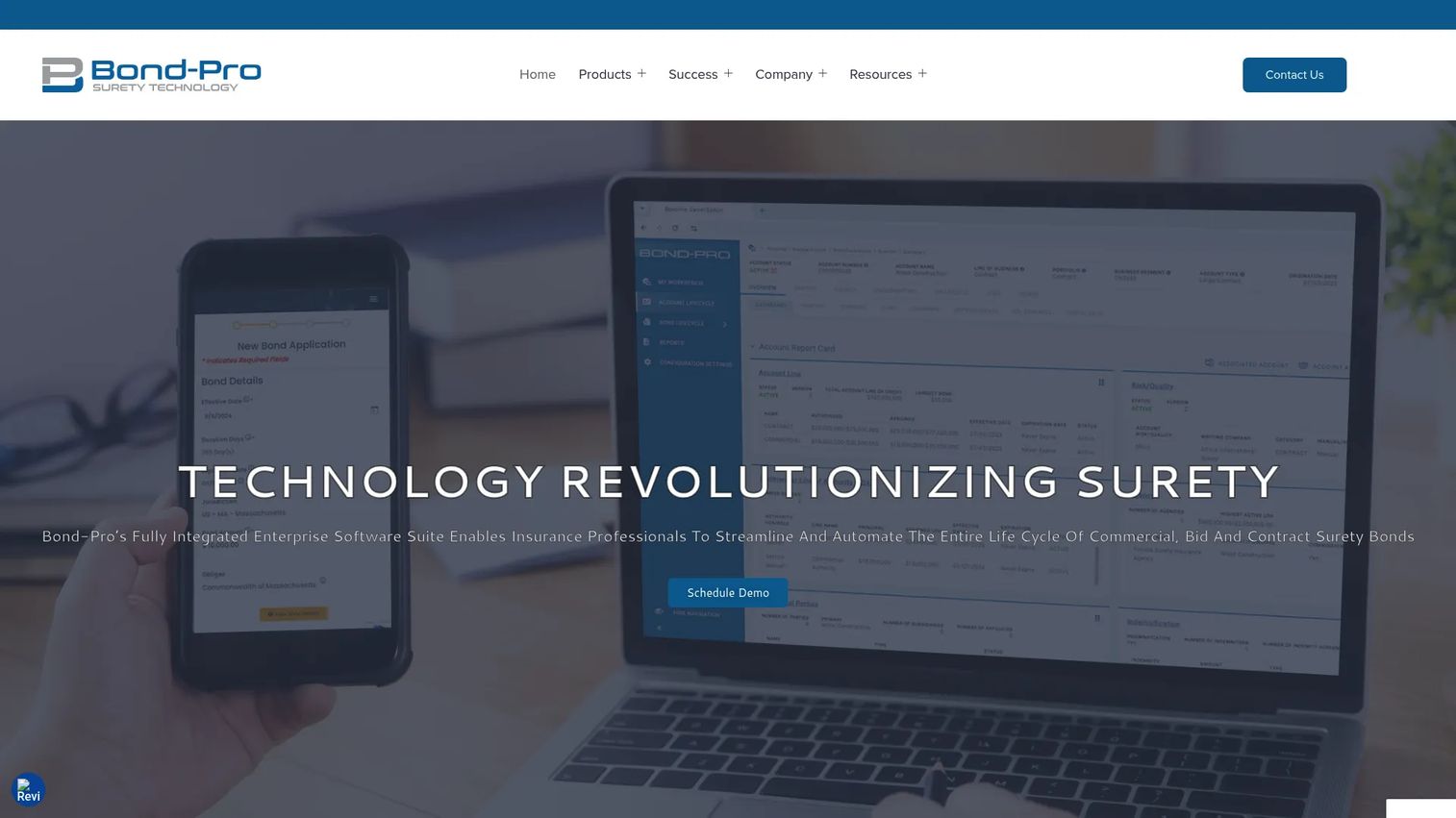
Bond-Pro is a surety software platform built for carriers, MGUs, brokers, and agencies that need to run the full bond lifecycle in one system. It handles surety accounts, jobs, and bonds end to end, with configurable business rules driving the workflow automation underneath. For a modernization project, this is the kind of platform that becomes the operating core rather than a point tool.
The reason it leads this list is coverage. Bond-Pro separates into a Carrier Edition and an Agency Edition, so the same underlying engine serves both sides of the relationship without forcing one role into the other's workflow. Role-specific workbenches route applications, approvals, and tasks to the right person, and alerts fire on-screen, by email, and by SMS so renewals and deadlines do not slip. APIs and add-ons extend it into your existing stack, which is what makes the legacy-to-digital transition workable instead of theoretical.
Best for: Carriers, MGUs, and agencies that need total surety bond lifecycle management with role-based workflows and API integration.
Key strengths
- Total lifecycle management: accounts, jobs, and bonds handled in a single system rather than split across tools
- Rule-based workflow automation: configurable business rules route applications and approvals without manual handoffs
- Multi-channel alerts: on-screen, email, and SMS notifications keep renewals and tasks from lapsing
Why choose Bond-Pro: If you are a carrier or larger agency running a genuine modernization project, Bond-Pro's dual-edition structure and configurable rules give you a platform that can serve underwriting, issuance, and agency distribution from one foundation. It is the enterprise pick when partial coverage is not good enough and you need the whole lifecycle governed by consistent rules.
Bond-Pro pricing: Bond-Pro does not publish public pricing. The vendor structures pricing around your organization and invites an introduction call to scope it. Expect a custom quote based on role, volume, and the editions and add-ons you need.
2. SCHUMANN
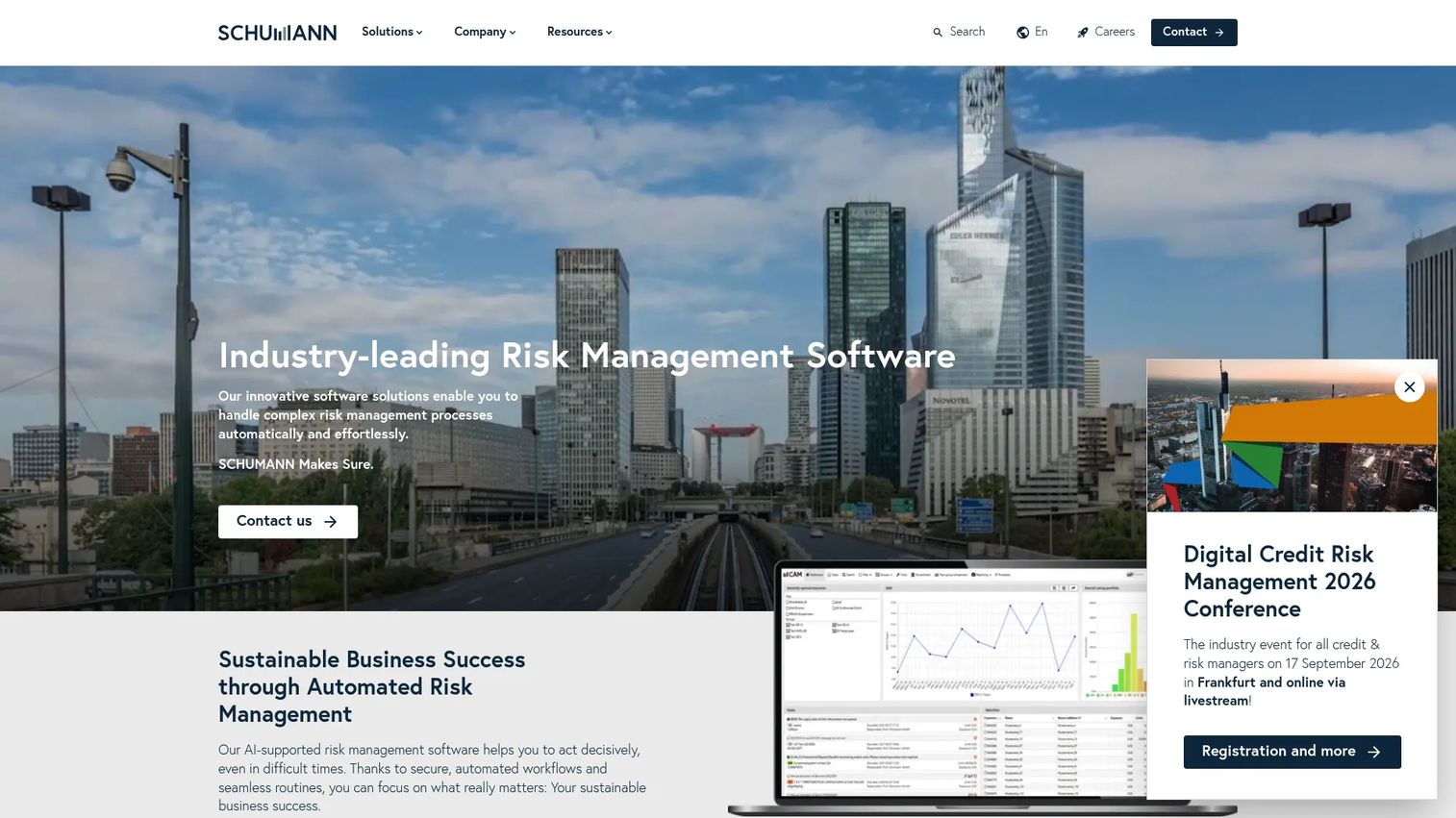
SCHUMANN is a B2B software company focused on automated credit risk and risk management processes, with a surety practice aimed at surety insurers and MGAs. Where a lifecycle platform manages the transaction, SCHUMANN brings depth to the risk side: AI-supported risk management workflows and configurable credit risk models that fit the underwriting reality of surety portfolios.
Modularity is the point here. SCHUMANN's architecture lets surety insurers assemble the risk, portfolio, and portal pieces they actually need, deployed as SaaS or on-premise depending on data and compliance requirements. A surety portal and business API layer support partner access and standardized data processing, so the underwriting workbench connects cleanly to how bonds are distributed and serviced. For organizations where portfolio management and risk assessment drive the business, that configurability matters more than a fixed feature set.
Best for: Surety insurers and MGAs that need configurable credit risk, portfolio management, and partner-facing API depth.
Key strengths
- AI-supported risk workflows: automated credit risk assessment tuned to surety underwriting
- Modular architecture: assemble risk, portfolio, and portal components to match your operation
- Flexible deployment: SaaS or on-premise to meet data privacy and compliance needs
Why choose SCHUMANN: Choose SCHUMANN when risk assessment and portfolio management are the center of gravity, not an afterthought. Its modular design suits surety insurers who want to standardize data processing and connect underwriting to distribution through a business API, with deployment flexibility that enterprise IT will appreciate.
SCHUMANN pricing: SCHUMANN does not list public pricing on its site. The company offers a 14-day free trial for its FINOYO financial analysis product, but surety and credit risk platform pricing is scoped through a sales conversation.
3. A1 Tracker
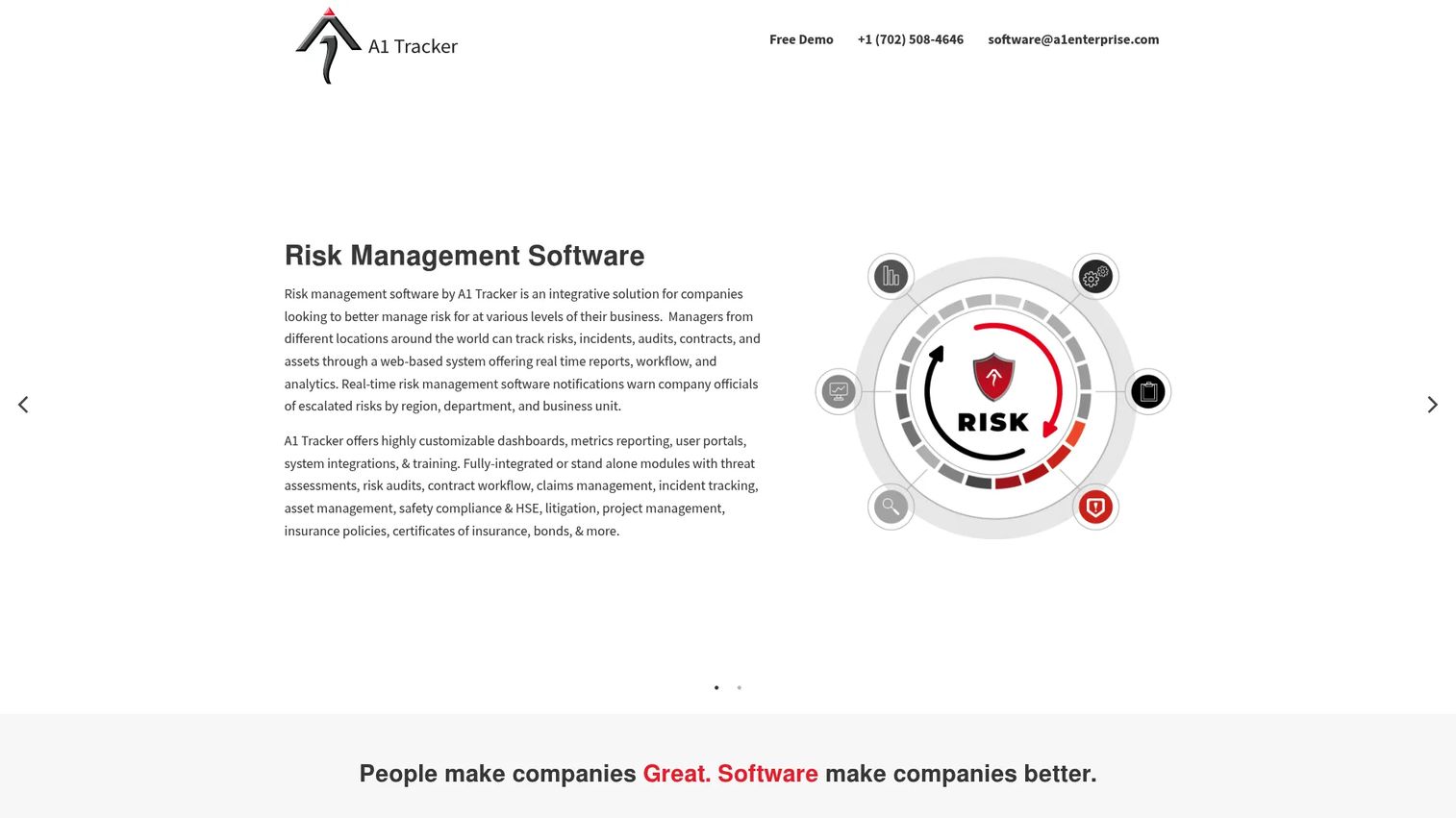
A1 Tracker is web-based enterprise risk management software with modules for claims, insurance, contracts, safety, incidents, assets, and compliance. For surety teams, it functions as practical bond management software when you need combined tracking, renewals, document handling, and email alerts inside one customizable system. It is broader than a pure surety platform, which is exactly why it fits operations that manage bonds alongside other insurance and claims work.
The strength is configurability. A1 Tracker offers highly customizable dashboards, portals, workflows, integrations, and training, so you shape it around your process instead of adapting your process to it. Claims management and incident tracking come built in, which matters for surety teams that handle claims as part of the lifecycle. Contract integration ties bond records to the underlying agreements they secure. With a 4.8/5 rating on G2, reviewers point to that flexibility as the reason it works across varied insurance operations.
Best for: Operations teams that need a customizable platform combining bond tracking, claims, contracts, and document workflows.
Key strengths
- Customizable everything: dashboards, portals, workflows, and integrations shaped to your process
- Built-in claims management: incident and claims tracking as part of the same system
- Contract integration: bond records linked to the agreements they secure
Why choose A1 Tracker: If your surety work lives inside a broader risk and claims operation, A1 Tracker consolidates tracking, renewals, documents, and claims into one configurable platform. It is the pick when you want flexibility and claims depth over surety-specific enterprise features.
A1 Tracker pricing: A1 Tracker's Enterprise plan is listed at $200 per user per month on Capterra. A free trial is available; there is no free version. Because pricing is not published first-party, confirm the current figure and scope directly with the vendor.
4. Bond Expedite
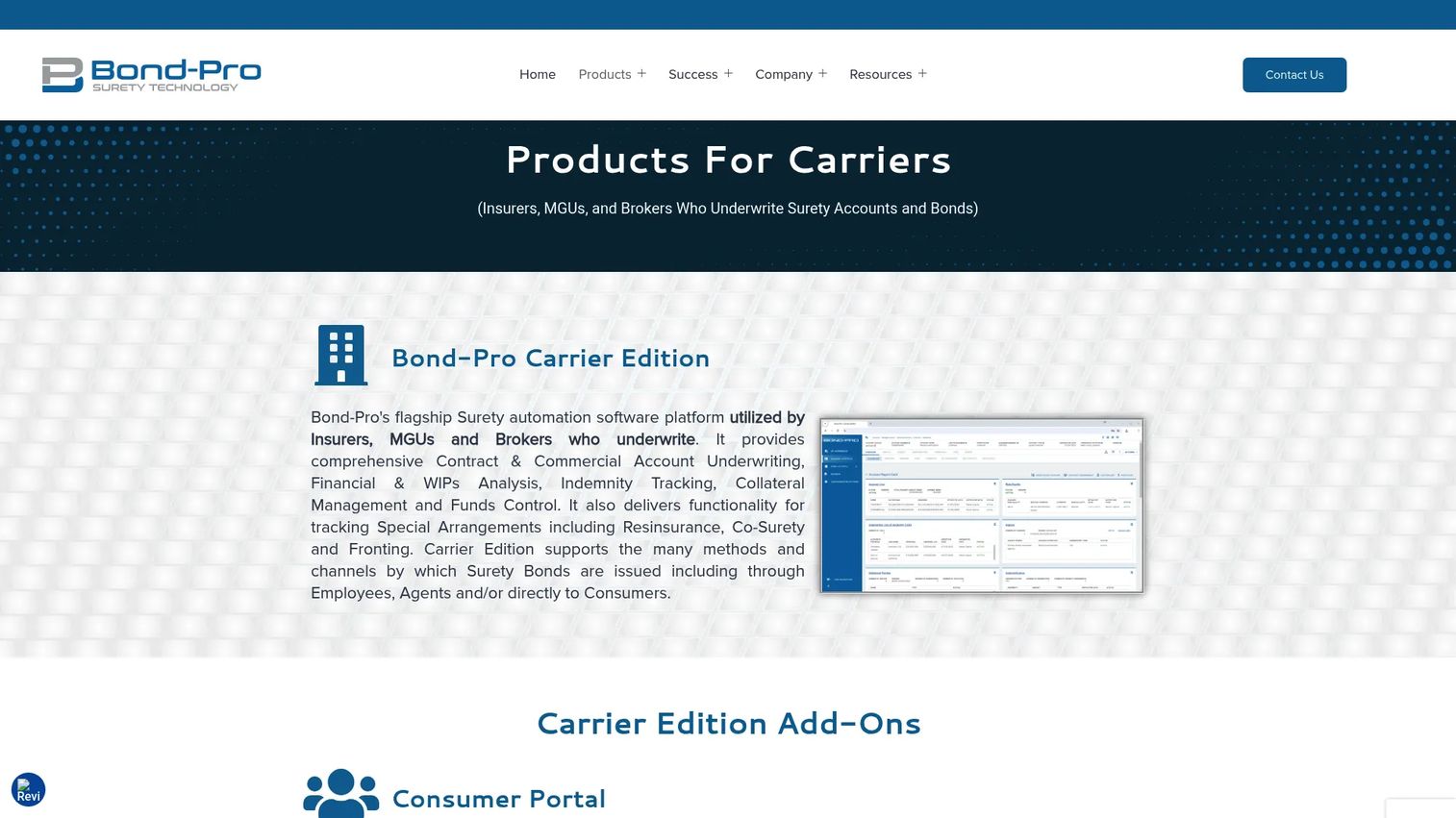
Bond Expedite is a surety technology add-on from Bond-Pro, offered as a Consumer Portal that speeds up bond applications. Rather than a standalone back-office platform, it is an experience layer: it lets agents initiate and collaboratively complete the application process with the principal, and gives consumers self-service access to apply, approve, pay, and download documents.
This is the tool when speed and buyer experience are the priority. The quote-to-issue flow is designed to compress the front end of the surety bond lifecycle, moving applications through faster and reducing the manual back-and-forth that slows issuance. Because it runs on Bond-Pro's platform, it fits organizations already using or considering that core system and wanting to extend a self-service surety portal to their agents and principals. Think of it as the front door to a fuller back office rather than a replacement for one.
Best for: Surety organizations that want an agent-assisted, self-service consumer application workflow on top of a core platform.
Key strengths
- Consumer Portal: self-service application, approval, payment, and document download for principals
- Agent collaboration: agents initiate and jointly complete applications with the applicant
- Platform-native: built on Bond-Pro's surety automation core for a connected workflow
Why choose Bond Expedite: Choose Bond Expedite when your goal is a faster, simpler application experience and you are already in the Bond-Pro ecosystem. It excels at the front-end flow and self-service access; pair it with the full platform for complete back-office coverage.
Bond Expedite pricing: Bond Expedite is offered as an add-on rather than a separately priced product. Bond-Pro notes that some offerings are priced by agents, sub-agents, and transaction volume, and invites a scoping call. No public price is listed.
5. SuretyPro Locator
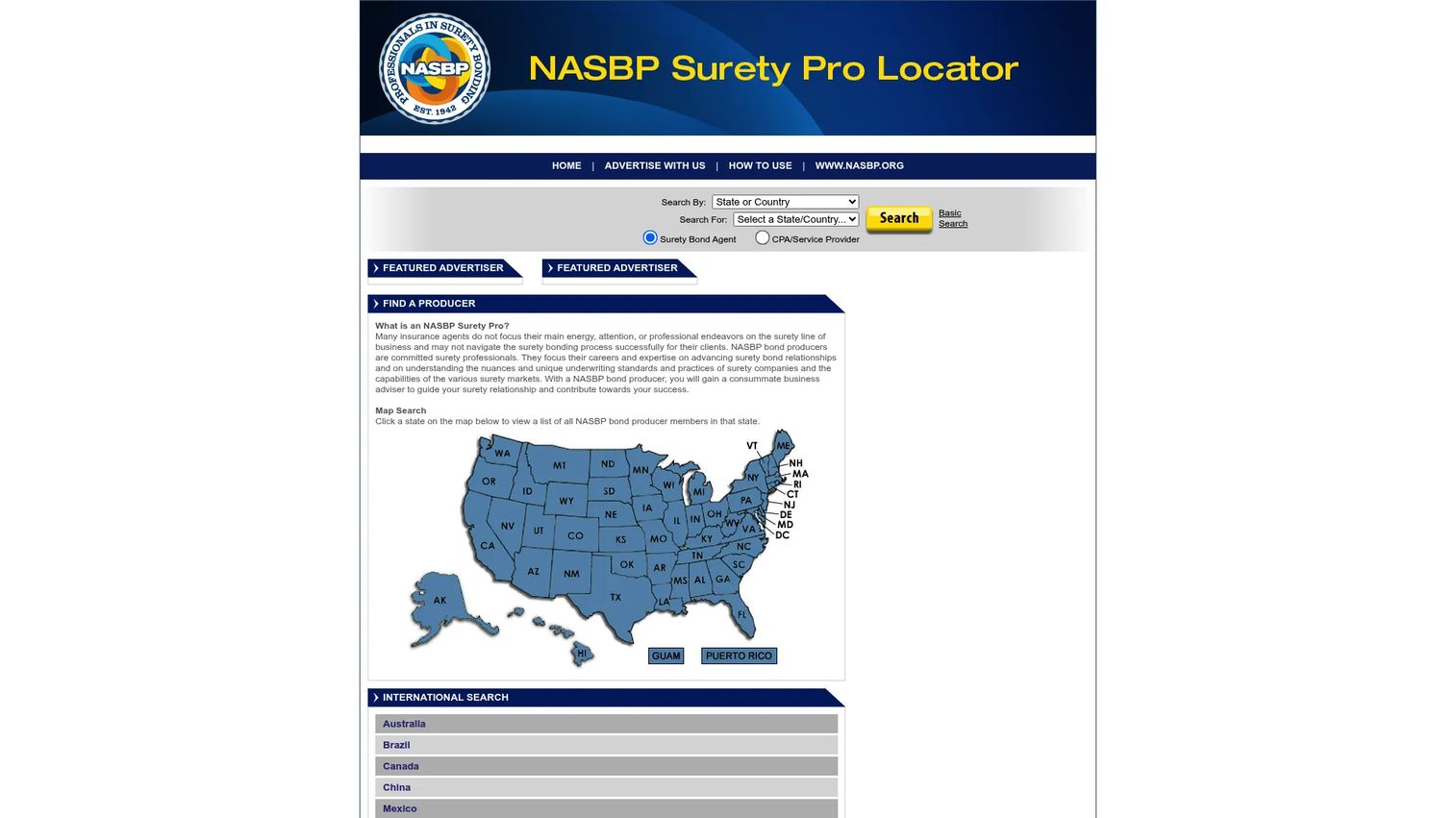
SuretyPro Locator is an NASBP directory for finding surety bond producers and construction CPA and service providers. It is not a lifecycle platform, and it is important to be clear about that. It is a discovery and access layer, valuable for locating the right surety professional rather than managing bonds after they are placed.
The utility is focused and real. It offers Advanced and Basic search modes, letting you search by state, city, company name, contact name, or radius, and filter listings by bond type and provider type. For an agency or contractor that needs to identify NASBP surety producers or connect with construction CPAs, it removes the guesswork from finding a qualified provider. Used well, it sits at the front of the process, before a bond enters any management system.
Best for: Agencies, contractors, and buyers who need to locate NASBP surety producers or construction service providers.
Key strengths
- Flexible search: find providers by state, city, name, or radius
- Type filtering: narrow listings by bond type and provider type
- NASBP-backed directory: access to vetted surety and construction professionals
Why choose SuretyPro Locator: Choose it as a discovery tool, not a system of record. It performs best alongside a core surety platform: use it to find the right provider, then manage the bond lifecycle in a dedicated system built for issuance, tracking, and renewals.
SuretyPro Locator pricing: The directory is free to use. There is no software subscription or published pricing, as it functions as an NASBP-provided search resource.
6. FastBond
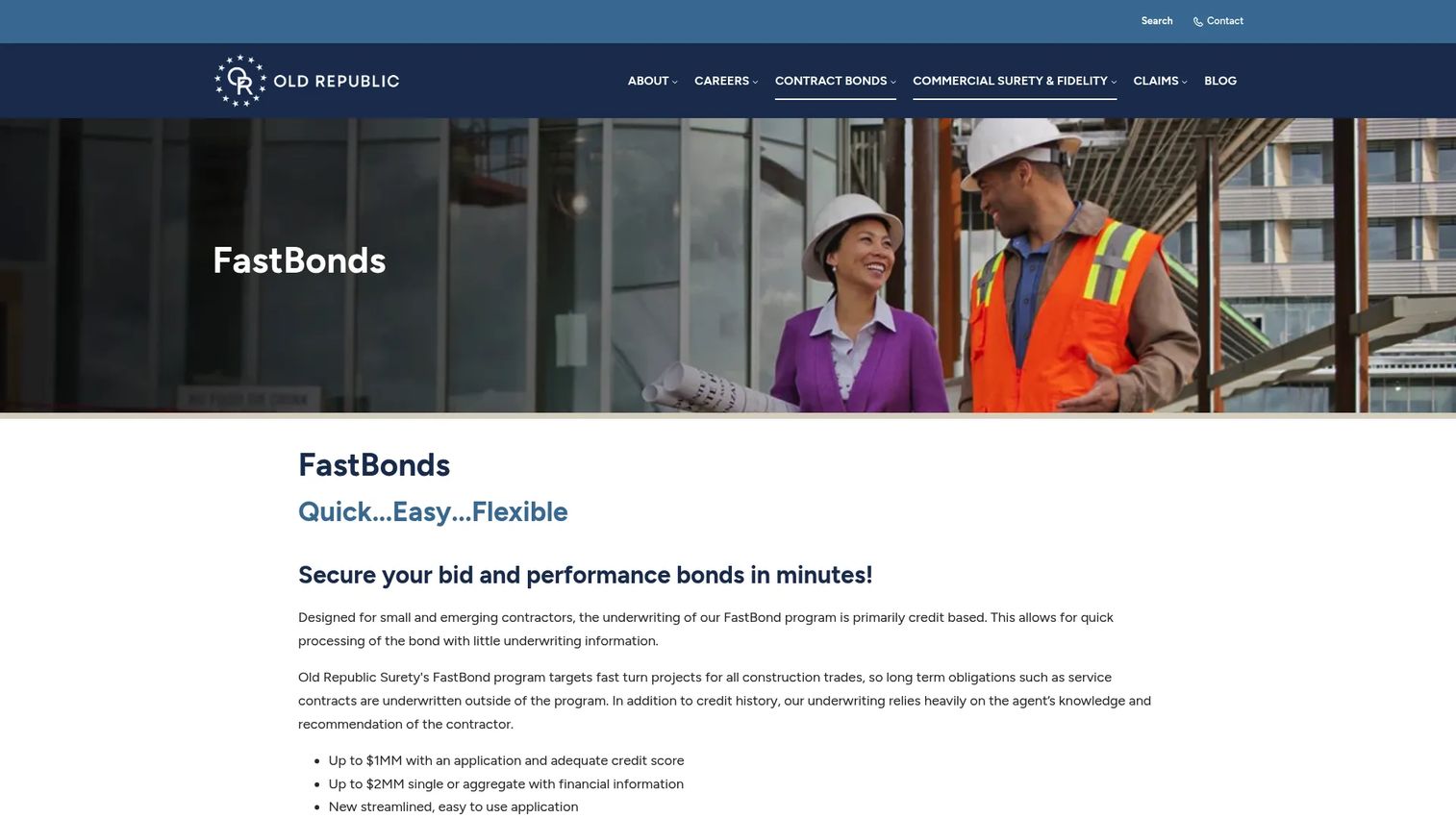
FastBond is Old Republic Surety's credit-based surety program for smaller and emerging contractors seeking bid, performance, and payment bonds. It is a program more than a full management platform, and its value is speed: primarily credit-based underwriting that gets contractors to a bond quickly without a heavy financial-review cycle.
For the situations it targets, that simplicity is the point. FastBond writes up to $1MM with an application and an adequate credit score, and up to $2MM single or aggregate with financial information. That covers a large share of small and emerging contractor needs without the underwriting overhead of a full commercial surety review. If you are a smaller contractor or an agency serving them, FastBond is about convenience and speed at the point of need rather than deep back-office control.
Best for: Small or emerging contractors needing quick bid, performance, and payment bond underwriting.
Key strengths
- Credit-based underwriting: bonds issued primarily on credit score for speed
- Meaningful limits: up to $1MM on an application, up to $2MM with financials
- Contractor-focused: built for the bid, performance, and payment bonds small contractors need
Why choose FastBond: Choose FastBond when speed and simple underwriting matter more than portfolio-wide administration. It excels at getting smaller contractors bonded fast; pair it with a management system if you need to track those bonds across a larger operation.
FastBond pricing: FastBond is priced at $20 to $30 per $1,000 of contract amount, per Old Republic Surety's published rate. There is no free tier and no separate plan table; pricing reflects the bond premium for the FastBond program.
7. Surety2000
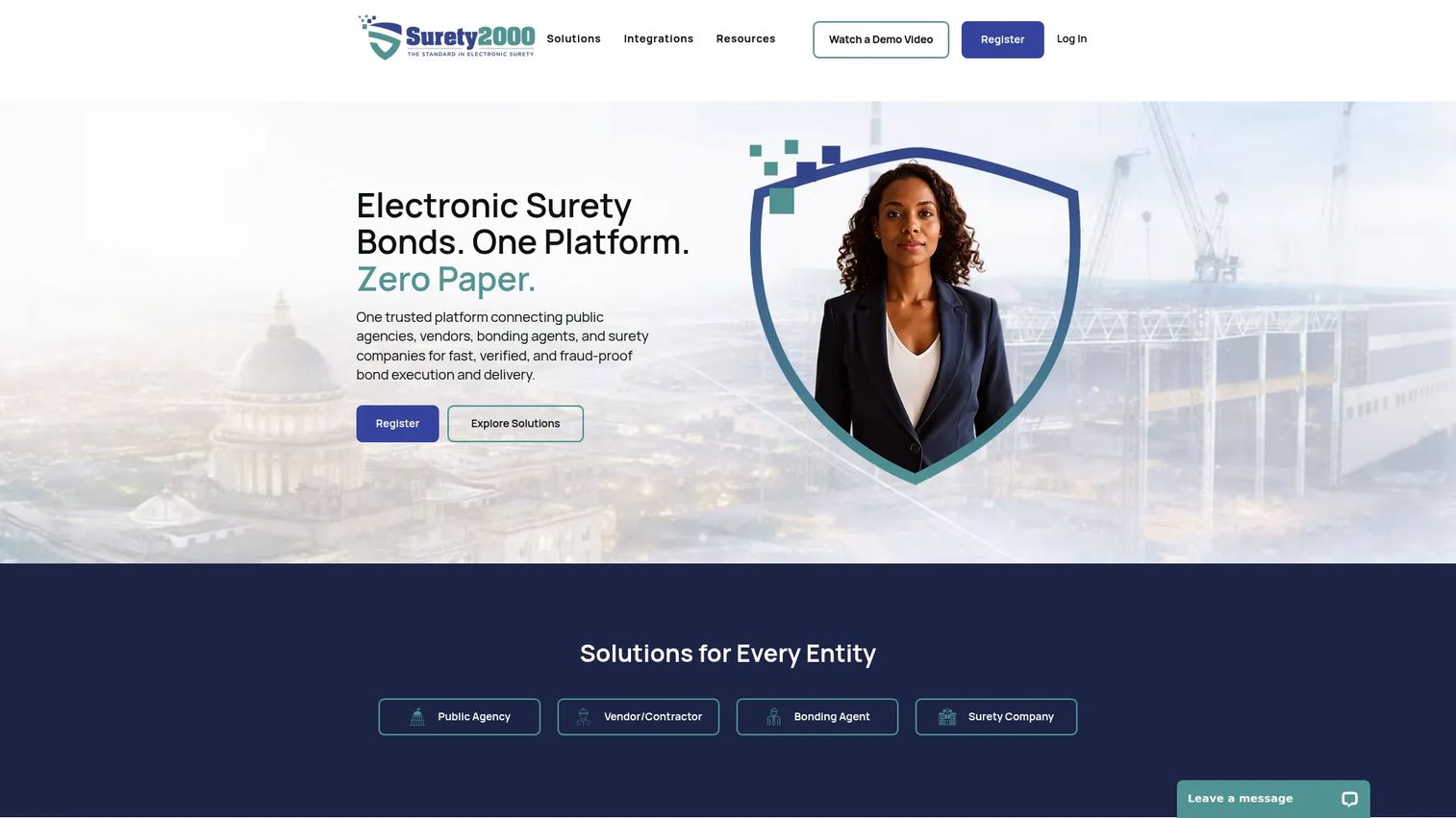
Surety2000 is an electronic surety bond platform for agencies, contractors, bonding agents, and surety companies. Its focus is the issuance and verification end of the lifecycle: electronic bond issuance and delivery, instant verification with an audit trail, and a Digital Staple authentication layer that establishes bond validity for obligees.
This is a strong fit for organizations facing compliance and verification pressure, especially in public-sector and construction contexts where an obligee needs to confirm a bond is genuine. Electronic distribution replaces paper and mail, and instant verification with an audit trail answers the "is this bond real" question without a phone call. As an established platform, it appeals to organizations with traditional workflows that are under modernization pressure and want to digitize issuance without overhauling everything else. It solves the electronic distribution problem cleanly.
Best for: Public-sector and construction organizations needing compliant electronic surety bond issuance and verification.
Key strengths
- Electronic issuance and delivery: bonds issued and distributed digitally end to end
- Instant verification: obligees confirm bond validity with a full audit trail
- Digital Staple authentication: a dedicated layer establishing bond authenticity
Why choose Surety2000: Choose Surety2000 when electronic issuance and verifiable authenticity are your priority, particularly for government and construction bonds. It excels at digitizing distribution and verification; pair it with a broader system if you need full lifecycle and portfolio management.
Surety2000 pricing: Surety2000 is free for government agencies. Contract bidders, surety agents, and surety carriers pay a small annual fee for an unlimited number of bonds to an unlimited number of agencies. Exact figures are not published; confirm with the vendor.
8. Integrity Surety
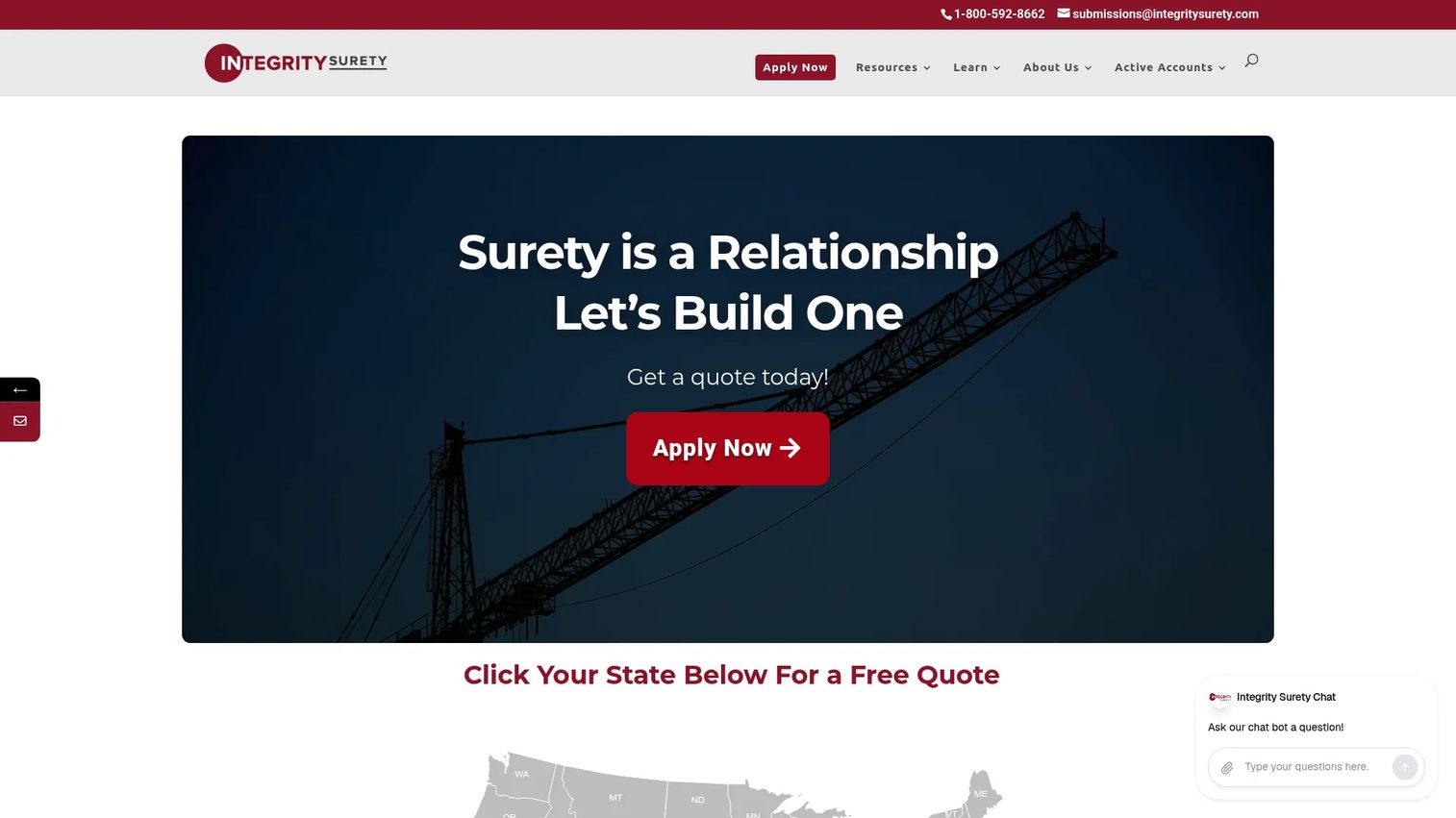
Integrity Surety is a specialized surety agency providing bonds and surety education across the United States. Being clear about fit matters here: it is a service-led agency with supporting tools, not a lifecycle software platform. Including it is about completeness, so you understand where the line sits between software you operate and a provider you work with.
The value is access and guidance. Integrity Surety writes commercial, court, construction, and performance and payment bonds across all 50 states, and layers in surety education and tools like a cost calculator to help buyers understand what they are getting. For a business or contractor that needs a bond plus underwriting guidance rather than a system to manage a bond portfolio, that combination is useful. It is the option when you want expertise and access, and you plan to manage any resulting bonds in a dedicated system.
Best for: Businesses and contractors that need bond access and underwriting guidance rather than management software.
Key strengths
- Nationwide coverage: bonds across all 50 states
- Broad bond types: commercial, court, construction, and performance and payment bonds
- Education tools: surety guidance and a cost calculator for buyers
Why choose Integrity Surety: Choose it when you need a bond and expert guidance, not a platform to run. It excels at access and education; if you are managing bonds at scale, pair it with dedicated surety bond management software for tracking, renewals, and document flow.
Integrity Surety pricing: Integrity Surety does not publish fixed software pricing. Bond premiums and quotes are provided after an application and underwriting review, since cost depends on bond type, amount, and credit.
Considerations
Before you commit to any surety platform, work through this checklist against your actual operation, not the demo script.
Lifecycle coverage
Confirm exactly which stages the tool handles: application intake, underwriting inputs, issuance, renewals, document distribution, and claims. Some platforms cover the whole surety bond lifecycle; others solve one part, like electronic issuance or discovery. Map the tool's coverage to your gaps so you do not buy overlap or leave a hole.
Integration depth
Check for real API integration, not just a marketing mention. Ask which legacy admin systems it connects to, whether it exchanges data with your CRM and accounting, and how partner data moves in and out. In a modernization project, integration depth usually decides whether the rollout succeeds or stalls, so verify it early with your own systems in mind.
Role coverage
Confirm the platform supports the roles you serve: carriers, agencies, MGAs, principals, obligees, and reinsurers. A Carrier Edition and an Agency Edition are not the same product, and a tool built for one side may force the other into an awkward workflow. Match role coverage to who actually touches the bond.
Portal and self-service
Determine whether the surety portal genuinely supports partner access, so agents, principals, and obligees can apply, check status, and pull documents themselves, or whether "portal" just means internal admin. True self-service absorbs status calls and document requests; internal-only tools do not.
Implementation and governance
Consider workflow rules, approvals, auditability, security, and change management. The best surety bond automation is only as good as the rules behind it and the governance around it. Ask how business rules are configured, how approvals are tracked, and what the audit trail looks like when a regulator or obligee asks.
Conclusion
The right surety bond software depends on your role and your scale, not on a single "best" label. For carriers and larger agencies running a genuine modernization project, Bond-Pro leads with dual-edition lifecycle coverage, configurable workflow automation, and API integration. Surety insurers and MGAs that live and die by risk and portfolio depth should look hard at SCHUMANN's modular, deployment-flexible architecture. Teams managing bonds inside a broader claims and risk operation will find A1 Tracker's configurability and 4.8/5 rating a strong fit.
For narrower jobs, the picture is just as clear. FastBond gets smaller contractors bonded fast on credit. Surety2000 solves compliant electronic issuance and verification for public-sector and construction work. Bond Expedite extends a self-service application layer onto the Bond-Pro core. And SuretyPro Locator and Integrity Surety serve discovery and bond access, best used alongside a core management system.
The through-line for 2026 is the same one driving the whole category's digital transformation: replace manual, fragmented bond workflows with a repeatable operating system that centralizes data, automates the routine, and opens self-service to the partners who need it. Start by mapping your lifecycle gaps, then match a platform to them. The next step is a scoped conversation with the one or two tools that cover what you actually run.
FAQs
Surety bond software automates the bond lifecycle: application intake, underwriting inputs, issuance, approvals, renewals, document distribution, and verification. It replaces spreadsheet tracking and email approvals with a single system that runs the same process consistently, reducing missed renewals and lost documents while giving carriers, agencies, and MGAs a clear audit trail.
General insurance software is built around policies and the two-party insurer-policyholder relationship. Surety bond software is built around the three-party surety relationship among principal, obligee, and surety, plus the specific bond forms, approval rules, and compliance steps that govern bonds. That structural difference shows up in workflows, document handling, and portal design.
Lifecycle coverage, workflow automation, and integration depth top the list. Look for rule-based routing and approvals, centralized document management with electronic distribution, a self-service portal for partners, and API integration with your legacy admin, CRM, and accounting systems. Role-based workflows for carriers, agencies, and reinsurers round out the essentials.
For most carriers and larger agencies, yes. Surety operations rarely start from a blank slate; they run on existing policy admin, accounting, and CRM systems. API integration lets a modern platform exchange data with that legacy core without rekeying, which is usually the difference between a smooth modernization and a stalled one. Verify supported systems before buying.
Insurance carriers, surety agencies, MGAs, brokers, and surety operations teams are the primary users. Within those organizations, underwriters, issuance staff, agents, and operations leaders each touch different parts of the workflow. Strong platforms use role-based workbenches so carriers, agencies, principals, obligees, and reinsurers each see the tasks and data relevant to them.
Yes. A surety portal lets brokers, agents, and principals apply for bonds, check approval status, and download documents on their own, without emailing the back office. This absorbs routine status calls and document requests and speeds up the parts of the lifecycle that depend on outside parties. Confirm the portal supports true external self-service, not just internal admin.
An MGA should prioritize configurable underwriting rules, portfolio and risk management depth, and partner-facing API and portal capabilities. Because MGAs sit between carriers and agencies, role coverage and standardized data processing matter, so the platform can serve carrier reporting requirements and agency distribution from one foundation. Modular architecture helps match the tool to the specific slice of the lifecycle the MGA owns.
Carriers look at how business rules are configured, whether approvals route automatically to the right reviewer, and how alerts prevent renewal and deadline misses. They also weigh auditability: every automated step should leave a trackable record for compliance and obligee verification. The test is whether the automation makes the process repeatable and defensible, not just faster.