You have an IP address. Every website visit, API call, and login event produces one. But on its own, an IP address tells you almost nothing actionable: Not whether the visitor is a real prospect, not whether the traffic is hiding behind a VPN, not what region or company it maps to.
That gap matters more as the internet grows. According to the ITU (2025), approximately 6 billion people were online in 2025, and the IP geolocation services market reached $2.1 billion in 2024, projected to hit $6.2 billion by 2033 at a 13.2% annual growth rate (Dataintelo, 2025). GTM teams use IP data to identify anonymous visitors and route accounts. Fraud teams use it to catch proxies and bot infrastructure before a transaction completes. Security teams use it to enforce regional access rules and flag suspicious logins.
The tools that do this work range from developer-first APIs to downloadable databases to no-code website personalization platforms. Choosing the wrong one means paying for fields you cannot use, or missing the risk signals that matter for your specific workflow.
What's inside
This guide is for presales engineers, RevOps teams, security analysts, developers, and GTM systems teams evaluating IP intelligence for account identification, fraud risk, security validation, or website personalization.
Tools were selected based on:
- Category fit: Geolocation accuracy, fraud or proxy detection depth, or website targeting capability
- API and database quality: Documentation, response fields, and integration options
- Pricing transparency: Verified from each vendor's own pricing page
- G2 presence: Rating verified or noted as unavailable
You'll get a comparison table, 13 tool entries, buying criteria, and FAQ guidance.
TL;DR
- Best overall for broad IP geolocation: MaxMind GeoIP offers mature databases and APIs with IPv4 and IPv6 coverage, starting at $0.0001 per query
- Best for developer-friendly IP metadata: IPinfo returns geolocation, ASN, company, and privacy data; paid plans start at $26/month
- Best for downloadable databases: IP2Location suits high-volume or offline lookup workflows, starting at $99/year
- Best for fraud and transaction risk: MaxMind minFraud ties IP intelligence to payment and account-creation risk scoring, starting at $0.005 per query
- Best for proxy and VPN detection depth: Spur specializes in residential proxy, bot infrastructure, and anonymizer signals; Teams plans start at $200/month
- Best for no-code website geo targeting: Geo Targetly handles location-based redirects and content personalization without engineering work, from $9/month billed yearly
What is IP address intelligence software?
IP address intelligence software turns an IP address into usable context: Location, network operator, ISP, organization, proxy status, risk signals, and sometimes company or firmographic data.
It is not identity verification. Knowing the ISP or approximate city behind an IP address does not confirm who the individual visitor is. Accuracy at the country level is typically reliable. City-level and company-level matching is less consistent, especially for residential ISPs, mobile carriers, and VPN traffic.
Core data points IP intelligence tools return
- Country, region, city, latitude, and longitude
- ASN, ISP, carrier, and connection type
- Organization or company name
- Time zone and local currency
- VPN, proxy, Tor, hosting provider, and anonymizer status
- Risk score or IP reputation category
- Domain, hostname, or abuse contact
Common product formats
- Real-time API lookup
- Downloadable database (MMDB, CSV, BIN)
- Batch enrichment endpoint
- JavaScript tag or website widget
- Fraud or risk scoring module
- No-code geo targeting dashboard
Where the category boundary sits
IP intelligence overlaps with but is distinct from full identity resolution. It supports account identification, fraud screening, routing decisions, and personalization. Replacing consented first-party data with IP inference is not what these tools are designed to do. Accuracy shifts by country, ISP, update cadence, and whether the visitor is on a corporate network, a mobile carrier, or a VPN. Test any tool against known IP samples before committing.
For teams evaluating broader data enrichment options, the best location intelligence software guide covers adjacent category tools. If you are building account-based workflows on top of IP data, the best account based marketing software tools guide maps the downstream stack.
When to use IP address intelligence software
Identify anonymous website traffic
GTM and RevOps teams use IP-to-organization data to infer which accounts are visiting the site before a form is submitted. The signal is useful for intent scoring and account routing, but expect noise: Remote employees on residential ISPs, mobile users, and VPN traffic will not map cleanly to a company. Treat it as a directional signal and pair it with firmographic enrichment from a verified source.
Detect suspicious traffic before it becomes loss
Fraud and security teams use IP reputation data, proxy detection, hosting provider flags, and risk scoring to filter account creation attempts, login events, checkout flows, and form submissions. Catching a residential proxy or Tor exit node early is cheaper than reversing a fraudulent transaction. The tools best suited for this job return structured risk signals, not just a city name.
Personalize experiences by location or network context
Product teams and marketers use country, currency, language, and routing context to serve region-specific content, redirect visitors to local storefronts, or enforce access rules. This is a legitimate use of IP data, but design the experience so users can override location assumptions. Geolocation should inform defaults, not override explicit user preferences.
IP address intelligence software comparison
The 13 tools below span geolocation APIs, downloadable databases, fraud scoring, and no-code website targeting. Use this table to shortlist by use case and then review the entries.
| # | Product | Best for | Key differentiator | Pricing | G2 rating |
|---|---|---|---|---|---|
| 1 | MaxMind GeoIP | Broad IP geolocation | Mature databases and APIs for geolocation and ISP data | From $0.0001/query | 4.5/5 |
| 2 | IPinfo | Developer-friendly IP metadata | Geolocation, ASN, company, and privacy detection in one API | From $26/month | 4.7/5 |
| 3 | IP2Location | Downloadable databases | Broad database editions and proxy detection add-ons | From $99/year | 4.6/5 |
| 4 | ipstack | Simple geolocation API | Fast setup for location enrichment with security module | From $12.99/month | 4.5/5 |
| 5 | Abstract API | API-first teams | IP geolocation inside a broader multi-API developer platform | Free tier available | 4.5/5 |
| 6 | Ipregistry | Location and threat signals | Geolocation, carrier, threat, and company data in one call | From $29/month | 4.6/5 |
| 7 | IPGeolocation | Geolocation and timezone APIs | Geolocation plus timezone, astronomy, and user-agent parsing | From $19/month | 4.4/5 |
| 8 | ipwhois.io | Lightweight IP lookup | Location, ASN, ISP, and threat data with a free tier | Free tier available | 4.3/5 |
| 9 | apiip | Quick geolocation enrichment | Straightforward IP API for websites and early-stage products | Free tier available | 4.8/5 |
| 10 | Geoplugin | Simple website localization | Geolocation with currency conversion and geo-targeted redirects | From $10/month | 4.3/5 |
| 11 | Geo Targetly | Website personalization | No-code geo redirects, popups, and content targeting | From $9/month (yearly) | 4.4/5 |
| 12 | MaxMind minFraud | Fraud risk scoring | IP intelligence combined with device, email, and payment signals | From $0.005/query | 4.6/5 |
| 13 | Spur | Proxy and VPN detection | Residential proxy, bot infrastructure, and anonymizer intelligence | Free community plan; Teams from $200/month | N/A |
Best 13 IP address intelligence software tools for 2026
The list spans different workflows: Some tools are API-first geolocation providers, some focus on downloadable database performance, and two (MaxMind minFraud and Spur) are built specifically for fraud and proxy risk. Match the tool to the job before shortlisting.
1. MaxMind GeoIP

MaxMind GeoIP is one of the longest-standing IP geolocation providers, offering both web services and downloadable databases for teams that need reliable location and network intelligence at scale. The product covers IPv4 and IPv6, returns country, city, postal code, ISP, ASN, organization, and connection type, and includes an anonymous IP detection layer for identifying VPNs, hosting providers, and anonymizers. MaxMind also offers fraud-focused products separately; GeoIP is specifically the geolocation and network intelligence line.
Best for: Teams that need a foundational geolocation layer through APIs or self-hosted databases.
Key features
- IP geolocation: Country, city, postal code, coordinates, time zone
- ISP, organization, ASN, domain, and connection type data
- Anonymous IP detection with confidence factors and user type
- Official client libraries and MMDB or CSV download formats
- Global IPv4 and IPv6 coverage with frequent updates
Why choose MaxMind GeoIP: It suits teams that want a proven geolocation layer for localization, digital rights management, traffic analysis, or ad targeting, with the flexibility to run API queries or local database lookups depending on latency and volume requirements.
MaxMind GeoIP pricing: GeoIP web services run pay-as-you-go at $0.0001 per query for Country, $0.0003 for City Plus, and $0.002 for Insights. Downloadable databases are priced separately. A free GeoLite option is available for non-commercial use with usage limits.
G2 rating: 4.5/5
2. IPinfo
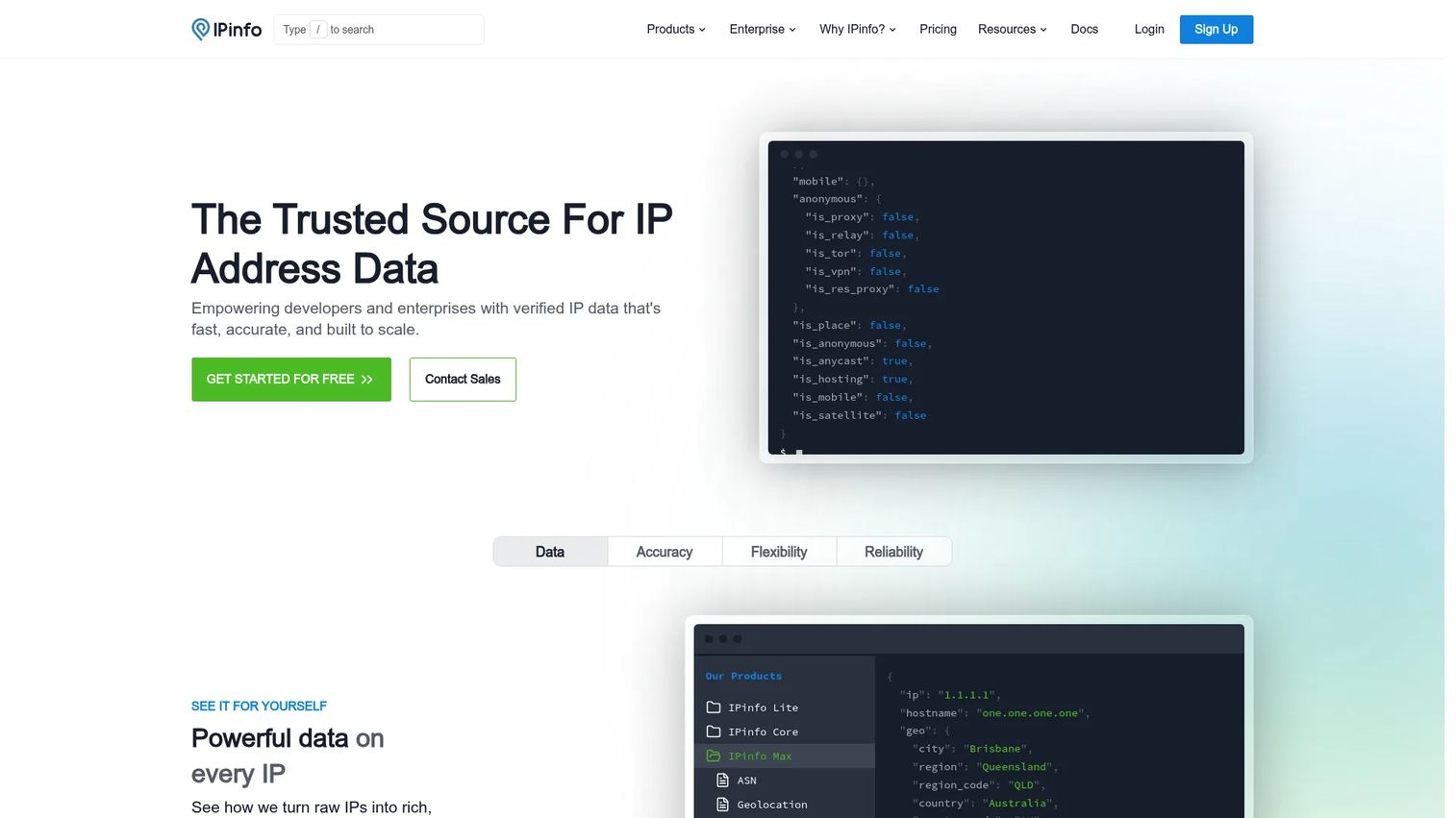
IPinfo is a developer-focused IP data platform that returns geolocation, ASN, company, carrier, privacy signals, and hosted domain data in a single API response. Its documentation is clean, the free tier covers enough volume for prototyping, and the paid plans scale for production workloads. For presales teams validating whether a vendor's IP intelligence fits a prospect's GTM or security stack, IPinfo's breadth of metadata makes evaluation straightforward.
Best for: Developers and technical GTM teams that need rich IP metadata with clear API documentation and a free starting point.
Key features
- IP geolocation API with country, city, and region fields
- ASN, carrier, and network intelligence
- VPN, Tor, proxy, relay, and residential proxy detection
- Company and organization data
- Downloadable datasets for offline use
Why choose IPinfo: It fits teams that want to combine product personalization, security screening, and GTM enrichment through one IP data layer, without managing multiple vendor relationships.
IPinfo pricing: The Lite plan is free with unlimited country-level requests. Core runs $26/month (or $310/year) and includes 150,000 API requests monthly. Max is $163/month ($1,960/year) with 250,000 requests. Enterprise pricing is custom. Database downloads start at $1,000/month.
G2 rating: 4.7/5
3. IP2Location
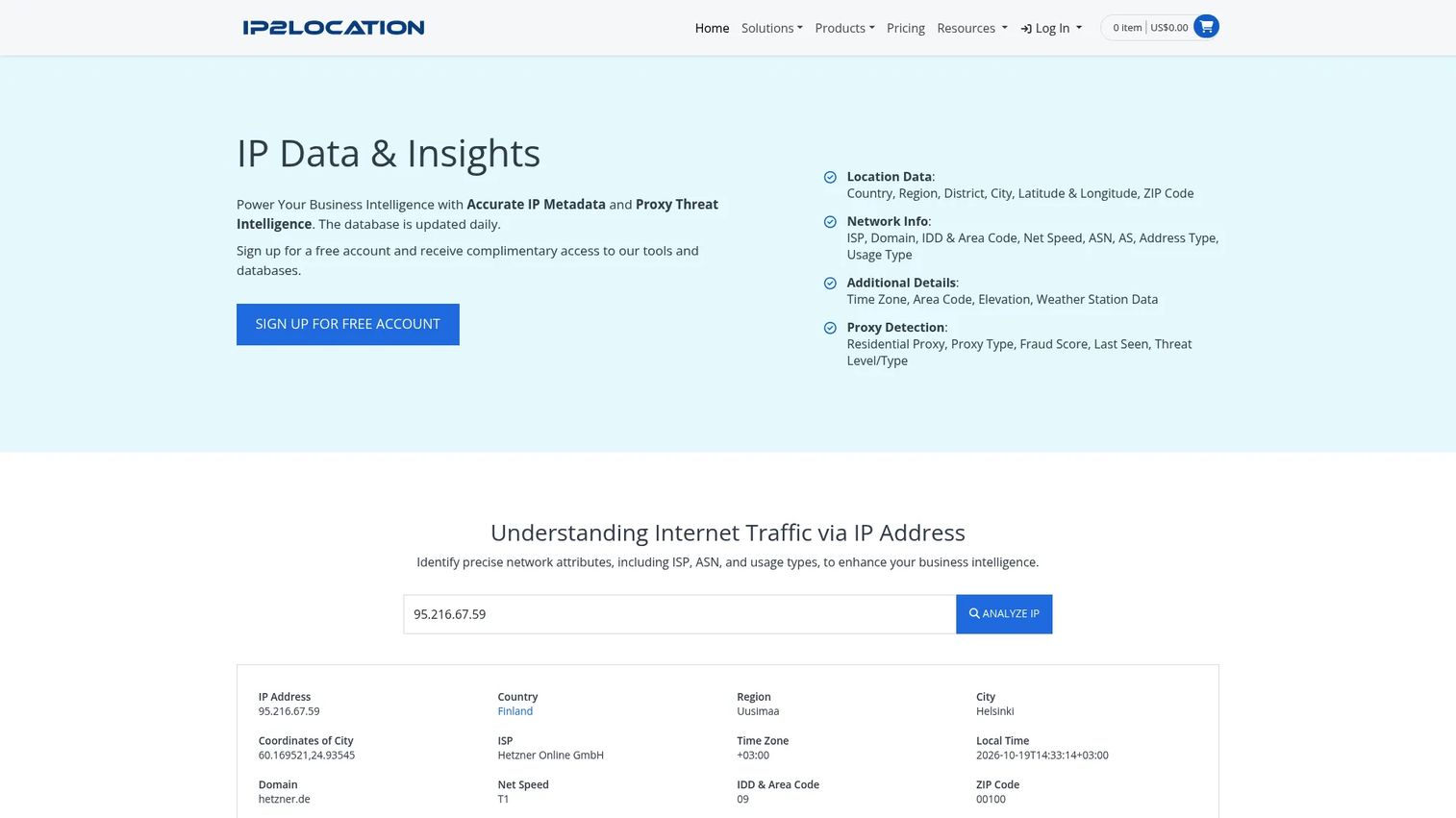
IP2Location is a database-heavy IP geolocation provider that gives engineering teams control over their lookup environment. Downloadable databases come in multiple editions covering country, region, city, ISP, proxy type, and usage type, with daily updates included. A REST API is also available for teams that prefer hosted lookups. The proxy detection product (IP2Proxy) is a separate add-on covering VPN, Tor, residential, and data center proxies.
Best for: Engineering teams that need high-volume or offline IP geolocation lookups with deployment control and flexible database formats.
Key features
- Downloadable IP geolocation databases in multiple editions
- Proxy detection covering VPN, Tor, residential, and data center traffic
- REST API supporting IPv4 and IPv6
- SDKs for multiple programming languages
- Daily database updates
Why choose IP2Location: It works well when API latency or request volume makes local database lookups more practical, and when the team wants to pick specific data fields without paying for a full intelligence bundle.
IP2Location pricing: The DB1 Standard License starts at $99/year. The Site License for DB1 is $980/year. The web service trial includes 5,000 credits at no cost; paid credits run from $49 for 100,000 to $1,960 for 5,000,000 credits per year. Note that new registrations for the legacy web service are no longer accepted on some pages; check current availability directly.
G2 rating: 4.6/5
4. ipstack
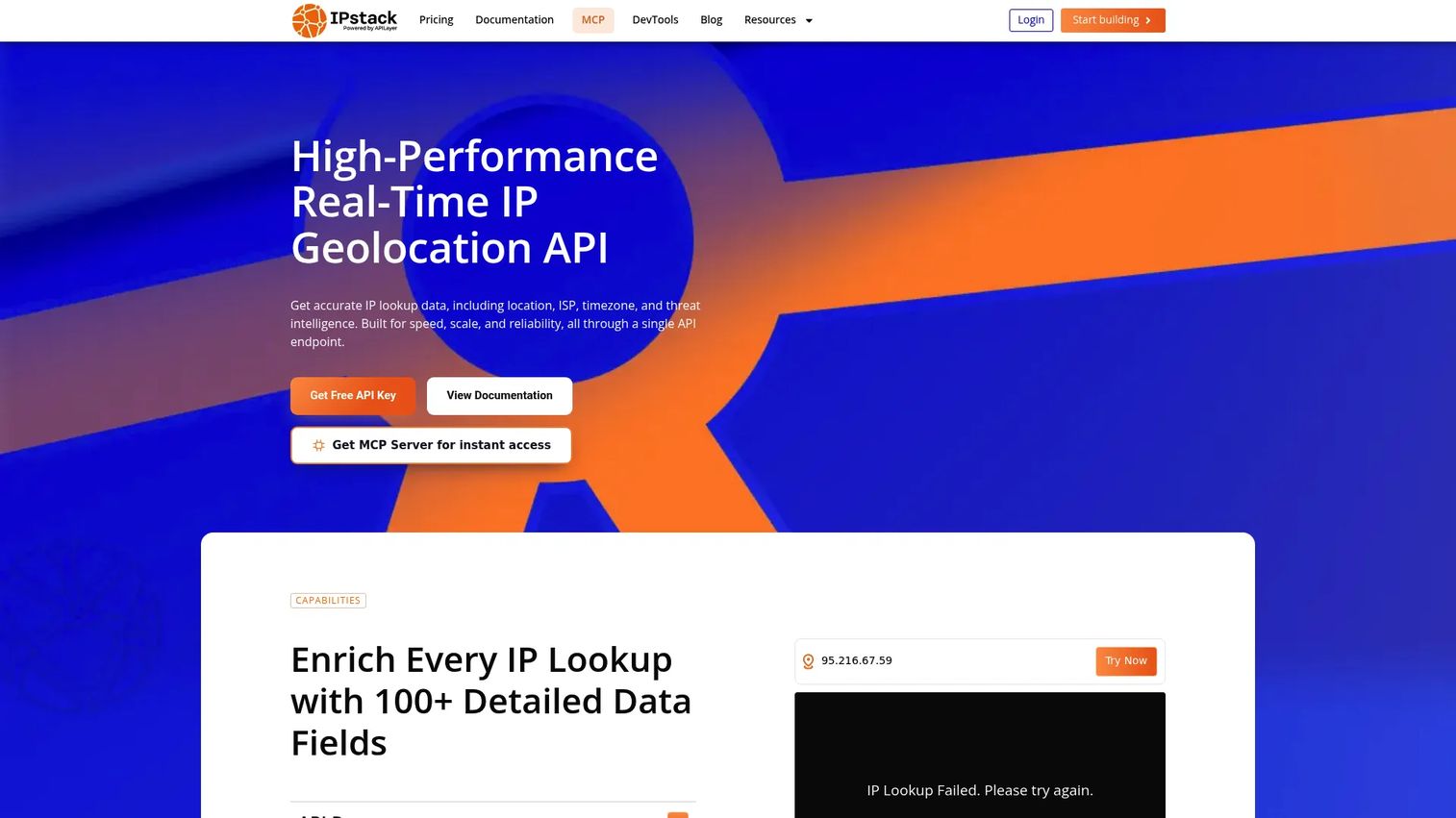
ipstack is a straightforward IP geolocation API covering over 100 data fields including location, timezone, currency, ISP, and connection data. Real-time and bulk lookup endpoints are available, and a security module on higher plans adds proxy, VPN, Tor, and crawler detection. For teams that need a fast integration without a full intelligence platform, ipstack gets them to basic location enrichment quickly.
Best for: Small teams and developers who need a simple geolocation API with predictable pricing and fast setup.
Key features
- Real-time IP lookup with 100+ fields
- Bulk lookup for multiple IPs in one request
- Timezone, currency, and ISP data
- Security module with proxy, VPN, and Tor detection (Professional+ plans)
- JSON and XML response formats
Why choose ipstack: It suits teams that want location enrichment for routing, personalization, or basic fraud screening, and do not need enterprise-depth proxy intelligence as their primary use case.
ipstack pricing: The free plan includes 100 requests per month. Basic runs $12.99/month for 50,000 requests. Professional is $59.99/month for 500,000 requests, and Professional+ is $99.99/month for 2,000,000 requests. Annual billing is available at a discount.
G2 rating: 4.5/5
5. Abstract API

Abstract API is a multi-purpose API platform with a dedicated IP geolocation endpoint that returns location, timezone, currency, connection type, and security signals. Teams already using Abstract for email validation, phone verification, or similar enrichment tasks can add IP intelligence through the same account and billing structure. Each API is priced separately.
Best for: API-first product and development teams that want IP geolocation as part of a broader validation and enrichment toolkit.
Key features
- IP geolocation endpoint with location, timezone, and currency fields
- Security signals including VPN and proxy detection
- ASN and domain data
- Free tier for initial testing
- Developer documentation with code samples
Why choose Abstract API: It fits teams that want several enrichment APIs consolidated into one vendor relationship, particularly when the IP geolocation use case is moderate-volume and not the primary intelligence need.
Abstract API pricing: A free tier is available. Paid plans for the IP geolocation API start at $17/month (Starter, billed annually), with Standard at $37/month and Professional at $39/month. Enterprise pricing is custom. Each API is metered separately, so IP geolocation pricing applies independently of other Abstract APIs.
G2 rating: 4.5/5
6. Ipregistry
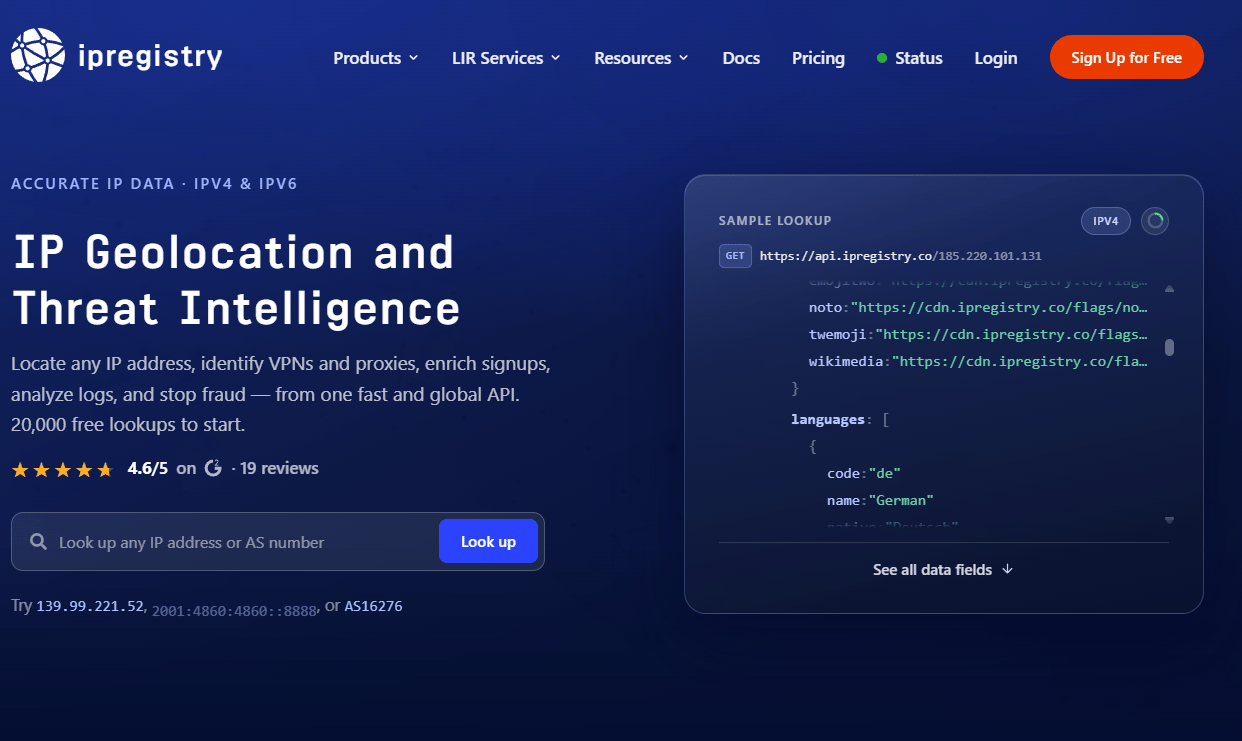
Ipregistry returns geolocation, ASN, company, carrier, currency, timezone, threat detection, and privacy signals from a single API call for both IPv4 and IPv6. New accounts receive 20,000 free credits. Official libraries cover 12 programming languages and 8 web frameworks, making it practical for teams that want a broad data response without calling multiple endpoints.
Best for: Teams that need location, company, and threat signals returned together from one API call.
Key features
- City-level geolocation for IPv4 and IPv6
- ASN, company, carrier, and currency data
- VPN, proxy, Tor, abuser, and attacker detection
- Batch IP and ASN lookups
- Downloadable offline datasets
Why choose Ipregistry: It works well for product personalization, risk screening, and account enrichment workflows where breadth of signal per IP matters more than specialized deep proxy intelligence.
Ipregistry pricing: New accounts start with 20,000 free credits. Starter is $29/month ($290/year). Professional is $79/month, Business is $199/month, and Scale is $399/month. Enterprise starts from $299/month billed annually. One-time credit packs are also available: $10 for 15,000 credits, $50 for 100,000, and $100 for 250,000.
G2 rating: 4.6/5
7. IPGeolocation
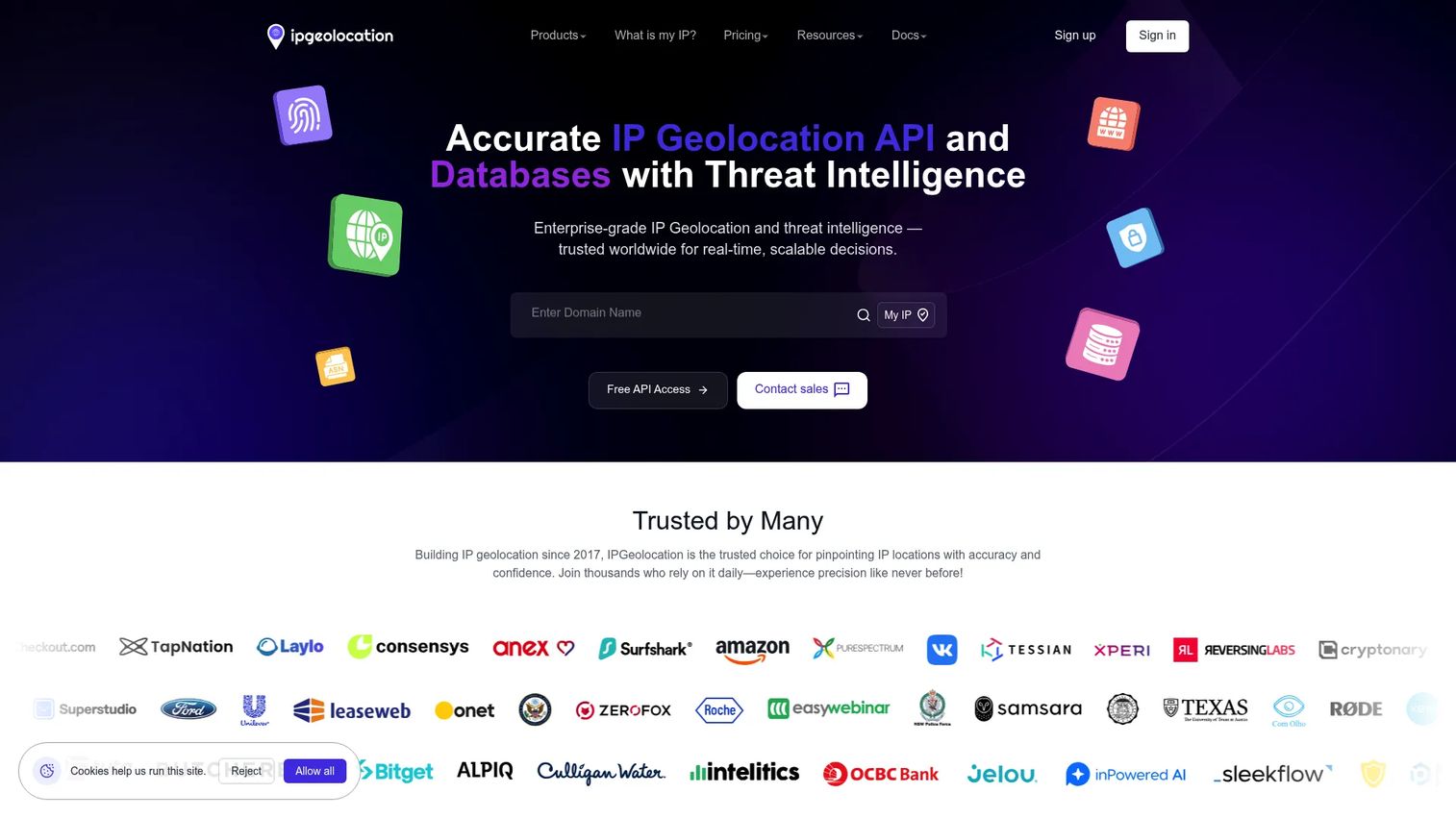
IPGeolocation offers APIs for geolocation, timezone, user-agent parsing, and even an astronomy API for local sunrise and sunset data. The core geolocation API covers country metadata, ASN, currency, connection type, and security detection. For product teams building applications that need accurate local time handling or region-specific scheduling logic, the timezone API is a practical addition to standard location lookup.
Best for: Product and engineering teams that need geolocation combined with timezone context for regional application logic.
Key features
- IP geolocation for IPv4 and IPv6 with ASN and currency data
- Timezone API for local time and offset data
- User-agent parsing API
- Security detection: VPN, proxy, Tor, and bot signals
- Bulk lookup and multilingual response support
Why choose IPGeolocation: It suits applications where accurate local time, region-specific scheduling, or location-based UI logic matters alongside standard country and city enrichment. It is less focused on enterprise fraud scoring than specialized risk tools.
IPGeolocation pricing: The free plan includes 1,000 credits per day. Starter is $19/month, Plus is $49/month, Pro is $79/month, Business is $129/month, and Premium is $249/month. Enterprise pricing is custom.
G2 rating: 4.4/5
8. ipwhois.io
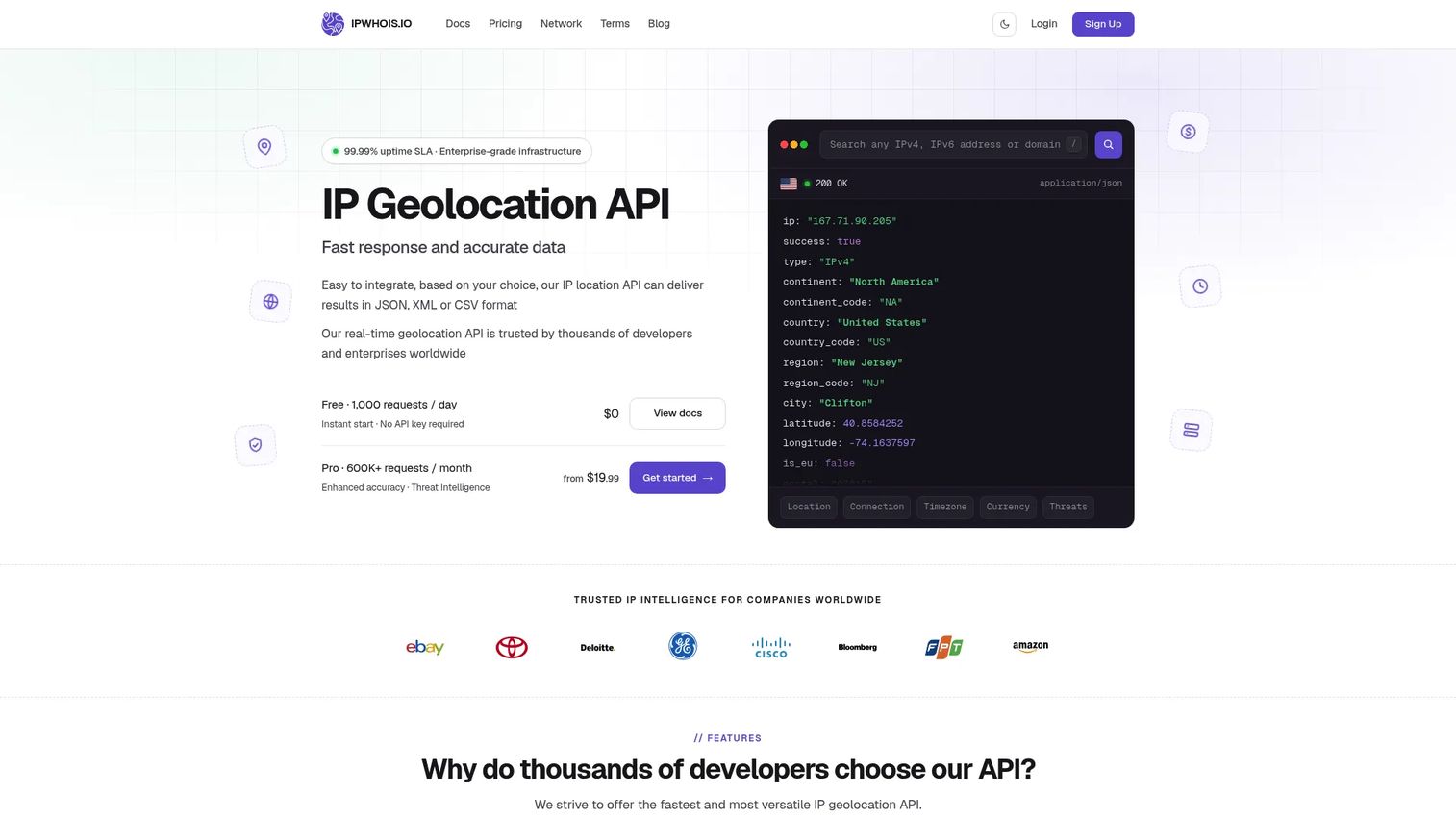
ipwhois.io is a lightweight IP geolocation and intelligence API that returns location, network, timezone, currency, and threat data. Proxy, VPN, Tor, hosting, relay, and mobile threat detection are included. The free tier allows 1,000 requests per day, making it practical for smaller projects or early-stage POCs. Responses come in JSON, XML, or CSV.
Best for: Developers who need a low-friction IP lookup API for simple enrichment, prototyping, or lightweight application use.
Key features
- IP lookup with location, timezone, and currency fields
- ASN, ISP, and network data
- Proxy, VPN, Tor, hosting, and relay detection
- JSON, XML, and CSV response formats
- Bulk IP lookup endpoint
Why choose ipwhois.io: It fits teams that need a quick, documented endpoint for basic location enrichment without committing to a paid plan upfront. When deep fraud scoring or residential proxy detection is the primary need, a more specialized tool is the better fit.
ipwhois.io pricing: The free tier covers 1,000 requests per day. Basic is $19.99/month for 600,000 requests. Business is $39.99/month, and Unlimited is $99.99/month. Higher plans add enhanced accuracy, security data, bulk access, and uptime SLAs.
G2 rating: 4.3/5
9. apiip
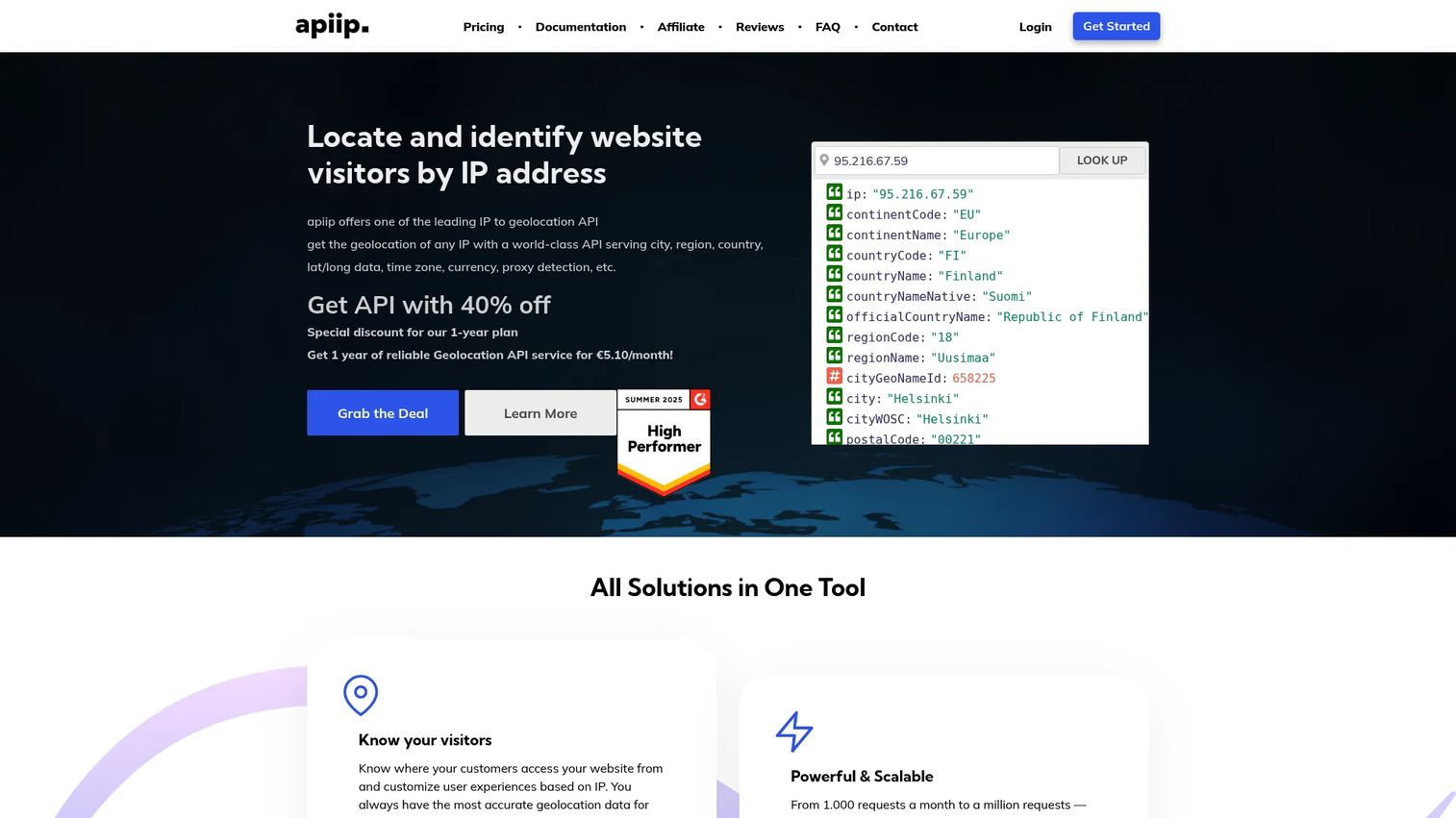
apiip is a focused IP geolocation API returning over 40 data points, including location, connection type, language, ISP, timezone, currency, and security signals. Standard, bulk, and origin lookup endpoints are available, with HTTPS encryption and JSONP callbacks. The free tier allows 1,000 requests per month, suitable for testing before scaling.
Best for: Teams that want straightforward geolocation enrichment for websites, forms, or early-stage product features.
Key features
- IP geolocation with 40+ data fields
- Location, ISP, timezone, and currency data
- Standard, bulk, and origin lookup endpoints
- HTTPS encryption and JSONP callbacks
- JSON and XML responses
Why choose apiip: It suits early-stage products validating whether IP enrichment improves routing or personalization decisions, and teams that need a clean API without a complex onboarding process.
apiip pricing: The free tier includes 1,000 requests per month. Basic is €5.99/month for 100,000 requests, and Professional is €29.99/month for 1,000,000 requests. Enterprise pricing is custom.
G2 rating: 4.8/5
10. Geoplugin
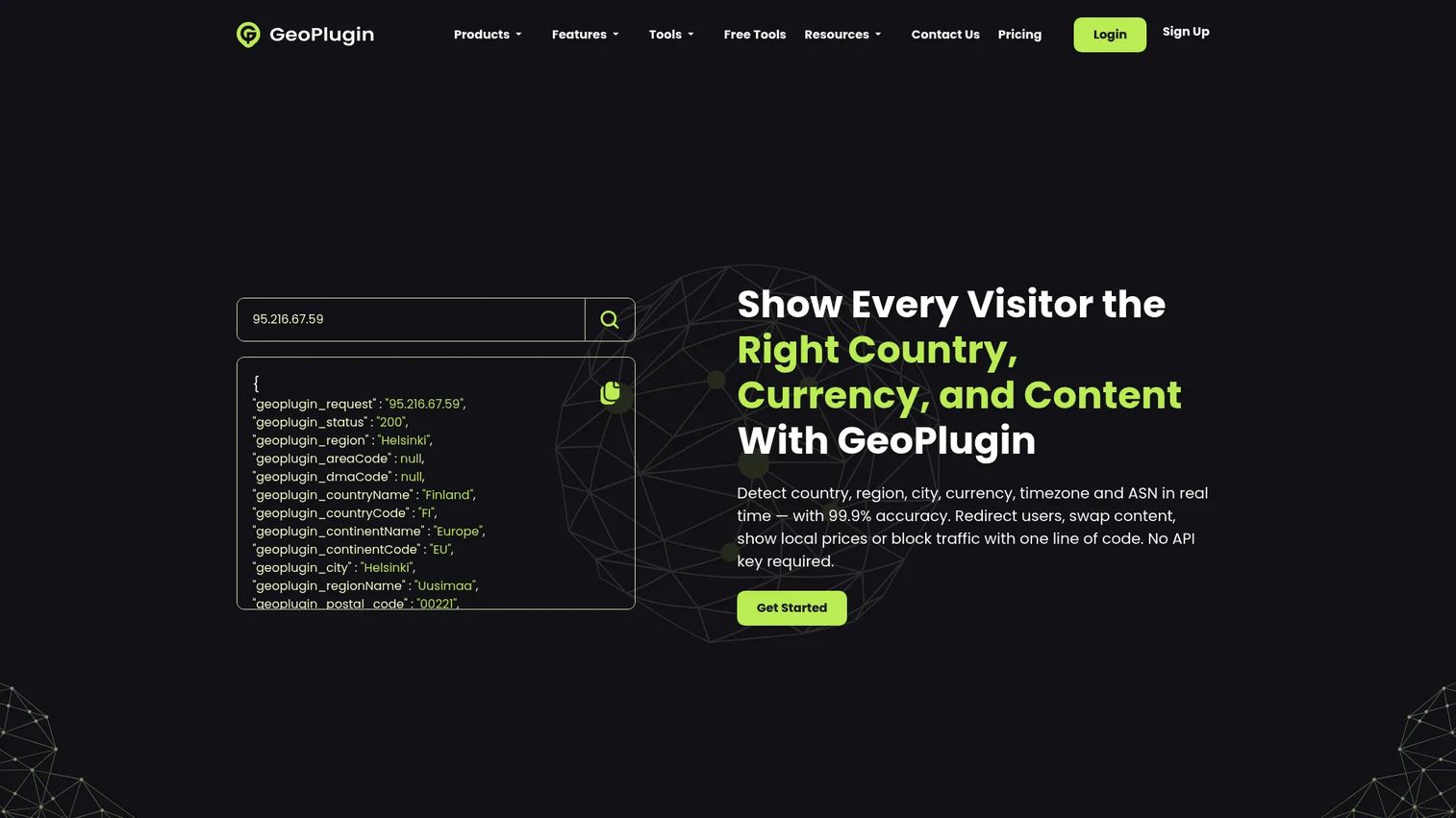
Geoplugin provides IP geolocation APIs and tools for personalizing, redirecting, and protecting websites based on visitor location. It returns country, region, city, coordinates, currency, and calling code data. Additional capabilities include geo-targeted redirects, content targeting, popups, VPN and proxy detection, and reverse geocoding. The pricing page states no free trial is available; all plans are paid subscriptions.
Best for: Small websites and developers needing basic geolocation, currency data, and geo-targeted redirects without enterprise-scale API volume.
Key features
- Country, region, city, latitude, and longitude detection
- Currency and calling-code data with currency conversion
- Geo-targeted redirects, content, popups, and cookie consent
- VPN, proxy, and Tor detection
- Reverse geocoding and place-to-coordinate lookup
Why choose Geoplugin: It fits small website localization and traffic filtering use cases. For enterprise fraud scoring or deep proxy intelligence, purpose-built risk tools are the stronger choice.
Geoplugin pricing: Basic starts at $10/month for 100 requests per day. Starter is $25/month (1,000 requests/day), Professional is $50/month (5,000 requests/day), Business is $100/month (20,000 requests/day), and Enterprise is $200/month for 100,000 requests per day.
G2 rating: 4.3/5
11. Geo Targetly

Geo Targetly is a no-code geo targeting platform that lets marketers apply location-based rules to website redirects, popups, bars, dynamic content, and JavaScript actions without engineering involvement. It targets by country, region, city, IP address, or browser language, and includes geo blocking with proxy and VPN detection. A 14-day free trial is available; no permanent free tier is listed.
Best for: Marketing teams that need location-based website personalization and redirects without writing code or involving engineering.
Key features
- Location-based redirects by country, region, city, or IP
- Dynamic content, translations, popups, and currency display by visitor location
- Geolocation-triggered JavaScript and custom scripts
- Geo blocking with proxy and VPN detection
- Location-specific consent and compliance experiences
Why choose Geo Targetly: It works best when the buyer cares about fast execution and marketing-owned control over geo targeting, rather than raw IP data access or API integration into a custom pipeline.
Geo Targetly pricing: Plans are billed yearly: Dev at $9/month, Startup at $19/month, Growth at $39/month, Business at $79/month, High Traffic at $159/month, and Enterprise from $279/month. Monthly billing starts at $12/month. A 14-day free trial is available.
G2 rating: 4.4/5
12. MaxMind minFraud
MaxMind minFraud is a transaction risk API that evaluates fraud likelihood by combining IP intelligence with device, email, payment card, and behavior signals. It is distinct from the GeoIP product: MinFraud scores risk rather than simply returning location data. Use cases include account creation screening, login risk, ecommerce checkout, and chargeback reduction workflows. A free trial of up to 1,000 queries is available.
Best for: Fraud and risk teams that need IP intelligence built into a broader transaction risk scoring workflow.
Key features
- Overall and IP risk scores per transaction
- Device, email, and payment card risk signals
- Proxy detection as part of the risk composite
- Custom inputs and custom rules
- Chargeback risk context and review workflow support
Why choose MaxMind minFraud: It is the right choice when the central question is not "where is this IP?" but "should we allow this transaction?" The combination of IP, device, and email signals in one query is what distinguishes it from pure geolocation tools.
MaxMind minFraud pricing: Three pay-as-you-go tiers with no minimum commitments. minFraud Score is $0.005 per query. minFraud Insights is $0.015 per query. minFraud Factors is $0.020 per query. A free trial of up to 1,000 queries is available.
G2 rating: 4.6/5
13. Spur

Spur provides real-time IP intelligence and session enrichment for detecting VPNs, residential proxies, bot infrastructure, and other anonymized traffic. Its Context API returns over 20 attributes including geolocation, ASN, proxy attribution, device type, and tunnel context. On-premises data feeds are available for teams that cannot route traffic through an external API. A community plan with dashboard investigations and limited lookups is free.
Best for: Security, fraud, and trust-and-safety teams that need structured, explainable signals for detecting traffic hiding its origin.
Key features
- Real-time IP enrichment via Context API
- VPN, residential proxy, and bot detection
- Session enrichment and active or custom blocking
- On-premises data feeds
- 20+ enrichment attributes including proxy attribution and tunnel context
Why choose Spur: It is the right tool when the question is whether traffic is intentionally masking its origin. If your primary need is city-level geolocation or basic ISP data, a general-purpose geolocation API will cost less and require less setup.
Spur pricing: The Community plan is free with dashboard investigations and limited lookups. Teams is $200/month and adds API access and session blocking. Pro is $1,600/month and adds historical search and commercial integrations. Enterprise pricing requires contacting sales and covers custom deployment, integrations, and support terms.
Considerations when choosing IP address intelligence software
Accuracy and confidence thresholds
Country-level geolocation is generally reliable. City-level accuracy drops for mobile carriers, residential ISPs, and VPN users. Company-level inference works for corporate networks but fails for remote employees on home broadband. Before committing, test 50 to 100 known IP samples that represent your actual traffic mix, including VPN and mobile traffic, and review how many return the fields you actually need.
API, database, and deployment model
Real-time APIs are easier to maintain; downloadable databases offer lower latency and no external dependency. If your team runs high-volume lookups or operates in an environment with data residency requirements, a local database may be the only viable option. Map the tool to your actual query volume, uptime tolerance, and developer capacity before signing up. See the API testing tools guide for evaluation frameworks that apply to IP intelligence API POCs.
Fraud, proxy, and VPN coverage
Geolocation accuracy and risk detection are separate jobs that require separate tools or separate product tiers. A tool that returns city and ISP may not flag a residential proxy. Test VPN samples, Tor exit nodes, hosting provider IP ranges, and residential proxy subnets specifically. False-positive rates on legitimate mobile or remote-work traffic matter as much as detection rates on actual abuse. For teams evaluating broader fraud tooling, the best identity verification software guide covers complementary signals.
Privacy and responsible use
IP addresses can be treated as personal data under GDPR, CCPA, and other privacy frameworks depending on jurisdiction and use case. Coordinate with your legal and privacy teams before using IP intelligence for automated decisions, behavioral targeting, or individual-level profiling. The tools in this list describe IP address capabilities; they do not guarantee compliance for how you apply those capabilities.
Workflow integrations and POC checklist
Before purchase, confirm integration paths into your CRM, SIEM, fraud stack, or marketing automation platform. For presales teams supporting a POC, bring a structured test set: Known corporate IPs, residential IPs, VPN samples from common providers, and mobile carrier addresses. Ask the vendor for confidence scores or accuracy documentation by country and connection type. Establish what fields map to your workflow and what your acceptable false-positive rate is before the POC is over. For account-based workflows, the account based selling software and best presales software tools guides cover how IP data fits into a broader GTM stack.
Conclusion
For most teams starting with IP intelligence, MaxMind GeoIP covers broad geolocation needs with a pay-as-you-go model and proven database quality. IPinfo is the cleaner option for developers who need rich metadata and clear documentation from day one. IP2Location fits engineering teams that want local database control for high-volume lookups.
If website personalization and geo redirects are the goal, Geo Targetly handles that without involving an engineering sprint. Geoplugin covers simpler localization use cases at lower volumes.
For fraud and risk workflows, MaxMind minFraud combines IP data with device and payment signals in a single transaction score. Spur is the specialized tool for teams whose primary question is whether traffic is hiding behind a proxy or VPN.
Whichever tool you shortlist, run a controlled POC with known IP samples before committing to a contract. Bring VPN traffic, mobile IPs, and residential addresses into your test set. Ask the vendor to show accuracy documentation by country and connection type. Map the response fields to your actual workflow before the free trial expires.
Start your journey with Guideflow today!
FAQs
IP address intelligence software enriches an IP address with location, network, organization, privacy, and risk context. It returns structured data fields, such as country, ISP, ASN, and proxy status, that teams use for geolocation, fraud screening, routing, and personalization. It is not identity verification and does not confirm who an individual visitor is.
Country-level accuracy is typically strong for most providers. City-level matching becomes less reliable for mobile carriers, residential ISPs, and users on VPNs. Company-level inference works on corporate networks but breaks down for remote workers on home broadband. The right approach is to test your specific traffic mix against a tool before buying, not to rely on a vendor's aggregate accuracy claim.
IP geolocation focuses on mapping an IP address to a physical or network location: Country, region, city, and coordinates. IP address intelligence extends that with additional fields like ASN, ISP, organization, proxy status, VPN detection, risk scores, and reputation signals. Most of the tools in this list offer both, but the depth of each layer varies significantly by product.
Sometimes. Tools that return organization or company data can infer the employer when a visitor is on a corporate network. The inference fails for remote employees on residential ISPs, mobile users, or anyone routing through a VPN. Treat company inference as a directional signal for account scoring rather than a confirmed identification. Pair it with firmographic enrichment from a verified source before routing a lead.
Yes, as one signal among several. IP reputation data, proxy detection, hosting provider flags, and risk scores help identify high-risk traffic at account creation, login, checkout, or form submission. Combine them with device fingerprinting, email risk signals, velocity checks, and manual review workflows. IP data alone is not sufficient to block a transaction or flag an account; it is an input into a broader decision.
In some jurisdictions it is. GDPR treats IP addresses as personal data in many contexts. CCPA applies when IP data is linked to a consumer. The classification depends on how the data is used, stored, and combined with other identifiers. Involve your legal and privacy teams before using IP intelligence for automated profiling, targeting, or decisions that affect individuals.
Build a structured test set before starting any trial. Include known corporate IP addresses, residential IP addresses from your target market, VPN samples from common providers, and Tor exit nodes. Test mobile carrier IPs if mobile traffic matters to your workflow. Evaluate response latency, the fields returned, how the tool handles unknown or unresolvable IPs, and the false-positive rate on legitimate traffic before making a purchasing decision.
The answer depends on documentation quality, response breadth, and pricing at your expected volume. IPinfo and Ipregistry both offer clear API documentation, free tiers, and rich metadata including ASN, company, and privacy signals. Abstract API works for teams already using that platform for other enrichment tasks. ipstack and apiip have lower entry prices and simpler integrations for projects that need basic geolocation fields without a full intelligence suite. For API development and testing workflows, the api testing tools and api monitoring tools guides cover how to build evaluation and observability into your IP intelligence integration.