Your SEO dashboard can look stable while your brand disappears from AI answers. Another reporting subscription only helps if it explains what changed and what to do next.
Classic rankings show where your pages appear in search results. AI search visibility tracking examines a different discovery layer, including recommendations and the sources behind them.
The pressure to measure that layer is already here. SEOFOMO’s 2025 research found that 91% of SEO professionals had received questions about AI search visibility from clients or decision-makers.
For growth marketers, the buying decision needs to connect with existing work. Will the software replace manual checks? Can it identify pages worth updating? Does its reporting support a budget discussion without overstating revenue attribution?
The best LLM SEO analysis tools answer those operational questions. A useful dashboard should produce a defensible content decision or competitive insight. Otherwise, you’re paying for another chart that needs explaining.
What’s inside
- A comparison of 17 tools: Dedicated visibility platforms alongside SEO suites, content systems, and manual research options.
- Selection criteria: Coverage of relevant answer engines, prompt-level measurement, citation detail, and usefulness within a marketing workflow.
- Stack-fit guidance: Which products replace spreadsheet monitoring, which complement existing SEO subscriptions, and which help execute content changes.
- Commercial context: Entry prices, billing terms, trial information, and G2 ratings drawn from vendor and review research dated November 2026.
- Evaluation advice: How to compare results without confusing sampled AI answers with stable rankings or attributable pipeline.
The shortlist reflects category relevance and the jobs digital marketers need to complete. It is a research-based comparison, not a claim of hands-on testing.
TL;DR
- Best dedicated starting point: AIclicks combines brand monitoring with citation analysis and content recommendations for teams building a repeatable AI visibility program.
- Best for prompt-focused evaluation: Rank Prompt connects AI answer tracking with SEO audits and reporting. Its free option includes one full visibility report.
- Best for enterprise programs: Profound suits organizations evaluating AI visibility alongside agent workflows and attribution.
- Best for stack consolidation: Semrush and Ahrefs connect AI-search analysis with established SEO research. Check the relevant package before replacing another subscription.
- Best for content execution: Surfer SEO and Clearscope support editorial optimization; Writesonic adds generation, while AirOps emphasizes governed production workflows.
- Best manual research layer: Perplexity and ChatGPT help investigate answers before committing to recurring monitoring.
What is LLM SEO analysis software?
LLM SEO analysis software helps marketers measure and improve how brands, products, and pages appear in AI-generated answers.
Traditional SEO tools focus on search rankings and website performance. LLM visibility tools examine whether an answer mentions your brand, recommends a competitor, or cites a particular source.
These categories increasingly overlap. Some SEO suites now include AI-search analysis, while content platforms combine writing assistance with visibility monitoring.
Answer engine optimization, or AEO, focuses on making information useful within answers. Generative engine optimization, or GEO, applies that work to generative AI systems. Vendors use these terms differently, so compare functions rather than labels.
Generative engine optimization tools generally address measurement, diagnosis, or execution. A tracker records what appears. A content optimizer helps improve the material that answer engines may use.
LLM citations are the sources surfaced alongside an AI response. Source URL tracking shows which specific pages appear, rather than stopping at a domain or brand mention. Those links provide evidence for content research, although they don’t reveal every factor behind an answer.
Core capabilities to look for
- Prompt tracking grouped by buyer intent
- Brand mentions and recommendation placement
- Citation extraction and source URL reporting
- Share of voice and competitor comparisons
- Sentiment or positioning analysis
- Content opportunities and technical accessibility checks
- Exports and connections to existing reporting
Prompt-level analytics matters because wording changes the question being measured. “Best accounting software” and “accounting software for a construction firm” represent different buying situations.
Keep a stable set of queries for trend reporting. Add exploratory questions separately, rather than changing the measurement set whenever results disappoint.
What LLM SEO analysis tools do not solve alone
A visibility score cannot guarantee inclusion in future answers. Content quality and technical accessibility still require attention, alongside source authority and external brand coverage.
Treat the best LLM SEO checker as a diagnostic instrument. Its value comes from the decisions it supports, including which page to improve or which publisher to investigate.
When to use LLM SEO analysis tools
Measure brand visibility across AI answers
Use LLM SEO tracking tools when leadership wants a repeatable view of AI brand visibility beyond website traffic. Define the answer engines and markets that matter before purchasing coverage.
A single manual query offers a snapshot. Recurring measurement gives you a basis for comparing results under a consistent method.
Find citation and source gaps
AI citation tracking helps identify the pages that appear alongside answers in your category. Those sources may include your documentation or third-party comparison articles.
Use the findings to build an editorial backlog and inform digital PR research. Inspect the cited material before assuming that copying its format will improve your visibility.
Benchmark competitors before budget reviews
Share of voice in AI search can support quarterly planning when competitors appear across commercially relevant prompts. Keep the comparison tied to the same query set and reporting period.
Separate broad category discovery from purchase-stage questions. A competitor’s presence across generic prompts should not automatically determine your next content investment.
AI search competitor analysis becomes useful when the report ends with a testable action. Assign an owner to each proposed change and record what you expect to learn.
LLM SEO analysis tools comparison
This shortlist spans several jobs. Dedicated platforms measure answers and citations; broader suites add search research, while content systems help execute improvements.
The pricing column shows entry points, not guaranteed access to every capability described. Check packaging for the engines and reporting functions you need.
Annual billing is labeled explicitly. Ahrefs prices remain in euros because those were the figures established in the source research.
G2 ratings describe the overall products, rather than specifically grading their LLM SEO capabilities. N/A means a current rating was not established in the November 2026 research.
Use this table to narrow the field before comparing prompt allowances. AI search ranking software can count usage differently across models and reporting schedules.
| # | Product | Best for | Key differentiator | Pricing | G2 rating |
|---|---|---|---|---|---|
| 1 | AIclicks | Dedicated AI visibility analysis | Citation diagnosis with content recommendations | From $59/month | 4.9/5 |
| 2 | Rank Prompt | Prompt-focused SEO workflows | Answer tracking with GA4 and Search Console connections | Free; paid from $39.17/month annually | 5.0/5 |
| 3 | Profound | Enterprise AI-search programs | Answer insights with agents and attribution | Custom pricing | 4.5/5 |
| 4 | Peec AI | Brand visibility and perception | Source analytics with shopping and agent insights | From $95/month | N/A |
| 5 | Scrunch | AI-agent experiences | Monitoring alongside Agent Pages | From $250/month | 4.6/5 |
| 6 | LLMrefs | Agency reporting and source research | Unlimited projects and team members | $79/month | N/A |
| 7 | SEO Site Checkup | Technical SEO with AI monitoring | Audits alongside LLM visibility tracking | From $29/month annually | 3.6/5 |
| 8 | Semrush | Broad marketing-stack consolidation | SEO research with AI visibility capabilities | Free; SEO Classic Pro from $117.33/month annually | 4.4/5 |
| 9 | Ahrefs | Search and competitive research | SEO intelligence with AI-search analysis | Free; Starter from €27/month | 4.5/5 |
| 10 | Surfer SEO | Content optimization | Editorial guidance with AI visibility tracking | From $49/month annually | 4.8/5 |
| 11 | Clearscope | Content discoverability | Query tracking with live content grading | From $129/month | 4.9/5 |
| 12 | Otterly.AI | GEO monitoring and audits | Prompt research with citation and crawlability analysis | From $29/month | 4.7/5 |
| 13 | Writesonic | Content generation and visibility | Prioritized fixes alongside production tools | From $79/month annually | 4.7/5 |
| 14 | AirOps | Governed content operations | Research-to-refresh workflows with human review | Custom pricing | 4.7/5 |
| 15 | Adobe LLM Optimizer | Enterprise Adobe measurement | Now Adobe Brand Visibility; analytics and edge optimization | Custom pricing | N/A |
| 16 | Perplexity | Manual citation research | Web answers with inline sources | Free; Pro from $17/month annually | 4.5/5 |
| 17 | ChatGPT | Qualitative answer testing | Prompt exploration and research workflows | Free plan available | 4.6/5 |
Best 17 tools for LLM SEO analysis
Each entry explains the tool’s primary job and its place in a marketing stack. Features and commercial details follow the supplied November 2026 research.
1. AIclicks
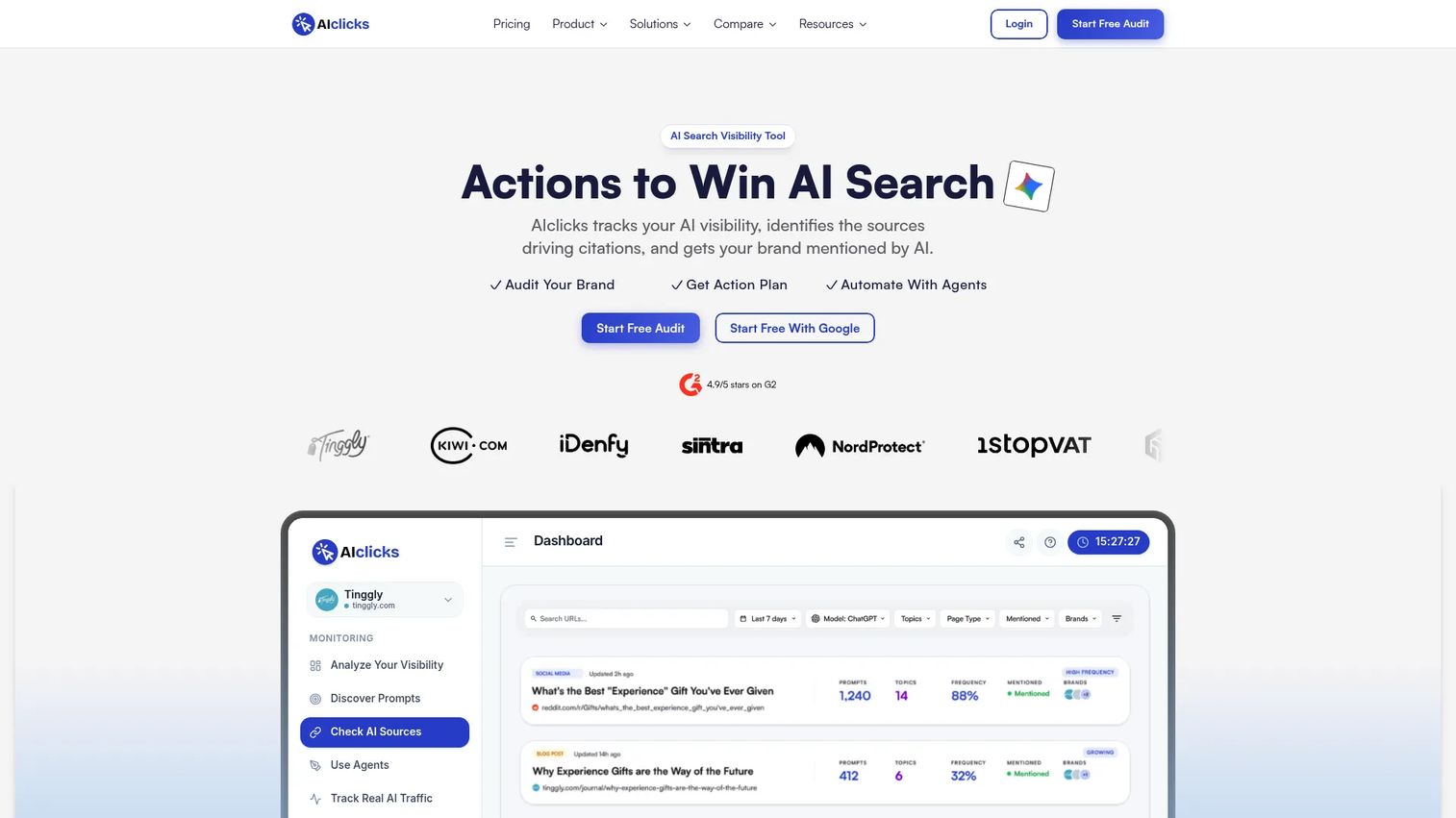
AIclicks is a dedicated AI-search visibility platform for monitoring brand presence and identifying optimization opportunities. It combines answer analysis with content recommendations and article generation. That makes it a relevant starting point when your team wants a monitoring-to-action workflow.
Best for: Growth marketers moving from occasional prompt checks to an ongoing AI-search program.
Start your evaluation with a category where you already understand the competitive landscape. Inspect whether its findings explain a missing recommendation through specific citation evidence.
The buying question is how much analysis your team can turn into action. Ask to see the route from an answer result to a proposed page update. Keep that work separate from revenue reporting unless you can connect it to observed customer behavior.
Key features
- AI mention and visibility tracking
- Competitor benchmarking
- Citation-source analysis
- Content recommendations
- AI-optimized article generation
Why choose AIclicks: Choose it when a dedicated monitoring layer would replace repeated manual research. Compare prompt and model allowances against your planned measurement set.
AIclicks pricing: Starter costs $59/month, Pro $189/month, and Business $499/month. All plans include a three-day free trial.
G2 rating: 4.9/5.
2. Rank Prompt
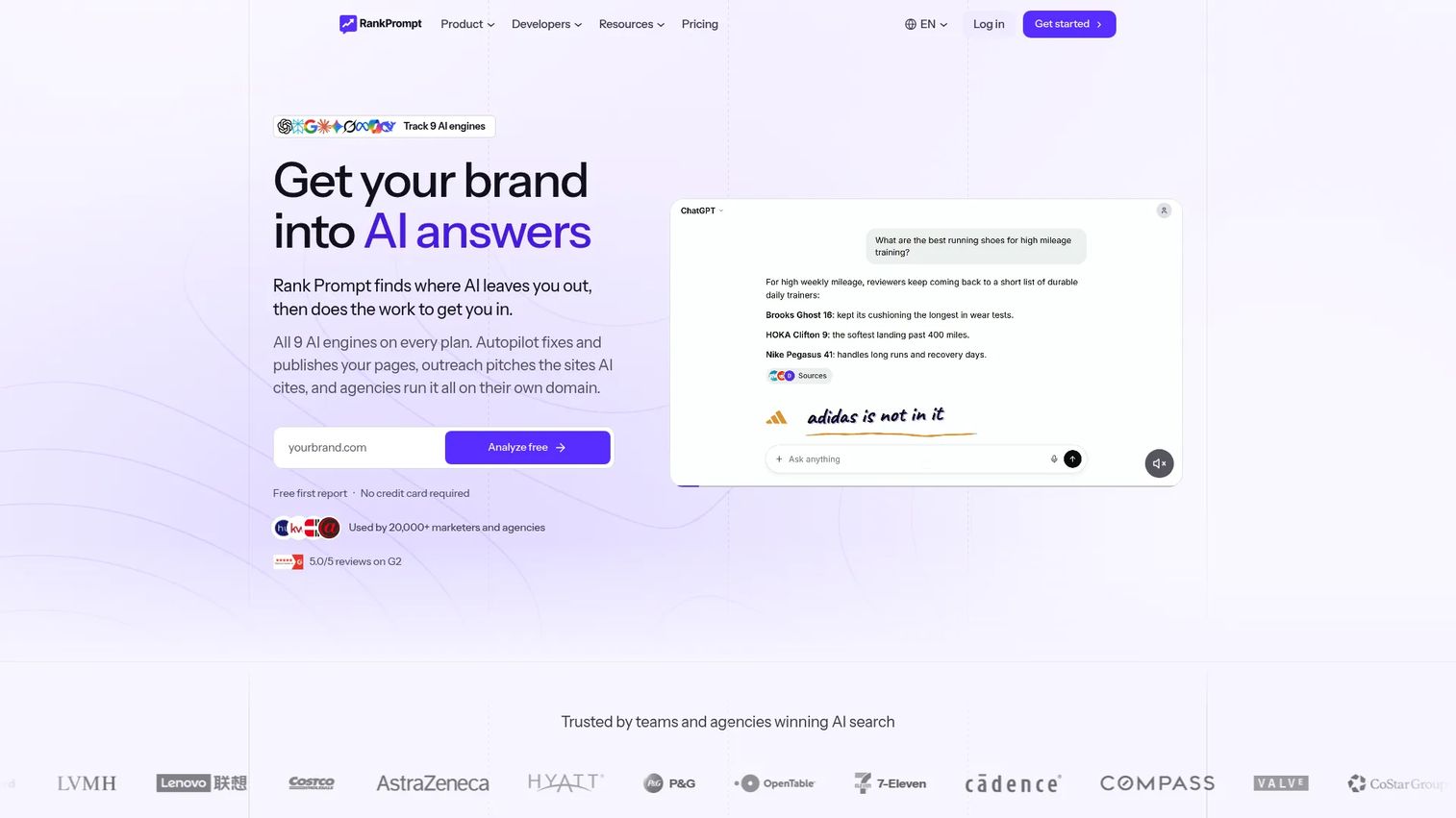
Rank Prompt combines AI answer monitoring with SEO and content tools. Its scope includes citation research and connections to GA4 and Search Console. For agencies, white-label reporting and client management extend its usefulness beyond a single brand dashboard.
Best for: SEO teams that want prompt-level tracking connected to familiar reporting workflows.
This is worth evaluating when the next step after discovering a gap already sits within your SEO process. Bring branded and nonbrand questions into the trial, then compare the evidence behind each result.
Review how credits translate into your intended monitoring schedule. A plan’s brand allowance and its usable query volume answer different budgeting questions.
The free report offers a way to inspect the output before committing. Treat it as an assessment sample rather than assuming it provides continuous monitoring.
Key features
- AI rank and mention tracking
- Citation and source tracking
- Prompt research and visibility audits
- GA4 and Search Console integrations
- White-label client reporting
Why choose Rank Prompt: It fits teams seeking AI visibility and practical SEO work within the same subscription. Agencies should examine client separation and report presentation.
Rank Prompt pricing: Starter costs $49/month or $39.17/month billed annually. A free plan includes one full AI visibility report and up to three brands.
G2 rating: 5.0/5.
3. Profound
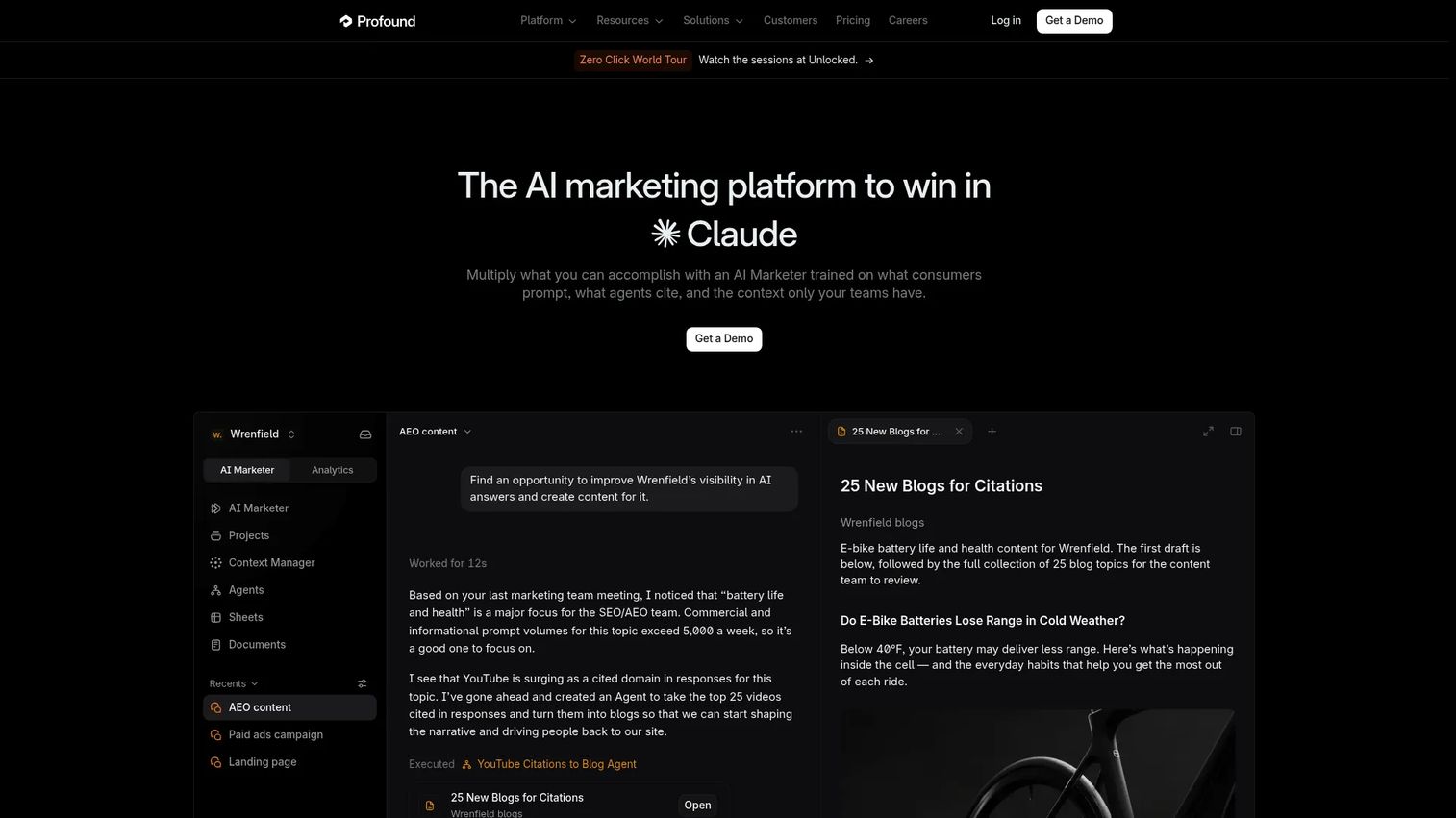
Profound is an AI marketing platform covering answer-engine insights and optimization workflows. Its documented scope includes prompt-volume analysis, citation checking, agent analytics, and brand context management. The platform is oriented toward enterprise marketing programs.
Best for: Larger organizations coordinating AI-search measurement across content and analytics teams.
The evaluation should involve whoever owns downstream reporting. Ask how agent traffic and attribution findings enter the organization’s existing measurement process.
Also request an example showing how a visibility finding becomes an assigned content task. Enterprise breadth is useful when it supports an operating model your team can maintain.
Procurement should use current packaging. Older Starter and Growth offers were retired for brands in September 2026, so historical comparisons can misrepresent the purchase.
Key features
- Answer-engine visibility insights
- Prompt and keyword volume analysis
- Citation tracking and FactCheck
- AI Marketer agents
- Agent traffic and attribution analytics
Why choose Profound: Consider it when AI-search analysis needs to support a coordinated enterprise program. Evaluate reporting depth with the stakeholders who will use it.
Profound pricing: Custom pricing for Enterprise.
G2 rating: 4.5/5.
4. Peec AI
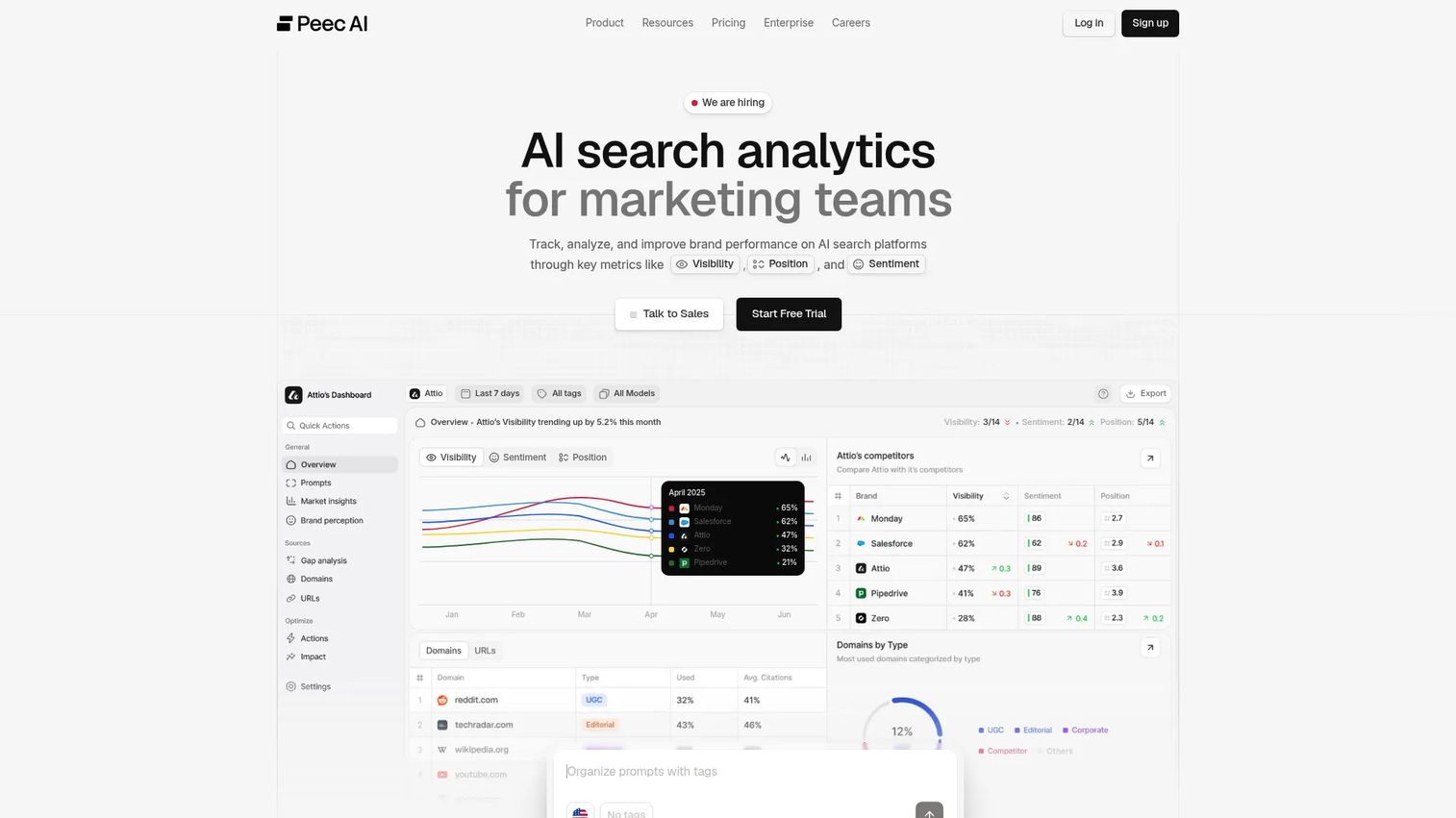
Peec AI measures brand visibility and perception across AI search. Its coverage includes ChatGPT and Perplexity, alongside Google AI Overviews, Google AI Mode, and Gemini. Source analytics provides domain and URL detail for investigating the answers behind aggregate scores.
Best for: Marketing teams that want visibility trends alongside brand-perception and source analysis.
Use it to investigate how category positioning changes between question types. A product appearing in an answer is different from that product receiving the recommendation you want.
Peec AI also covers shopping visibility and agent interactions. Include those areas in your evaluation only when they connect to your acquisition model.
For a lean team, begin with the questions that influence a content decision. Expanding the dashboard before assigning owners to findings creates more reporting work without improving execution.
Key features
- Brand visibility and position tracking
- Sentiment and attribute scoring
- Domain and URL citation analysis
- AI shopping visibility
- Agent analytics and crawlability audits
Why choose Peec AI: It suits teams investigating both presence and perception. Check whether the chosen package supports your required markets and monitoring volume.
Peec AI pricing: Starter costs $95/month, Pro $245/month, and Advanced $495/month.
5. Scrunch
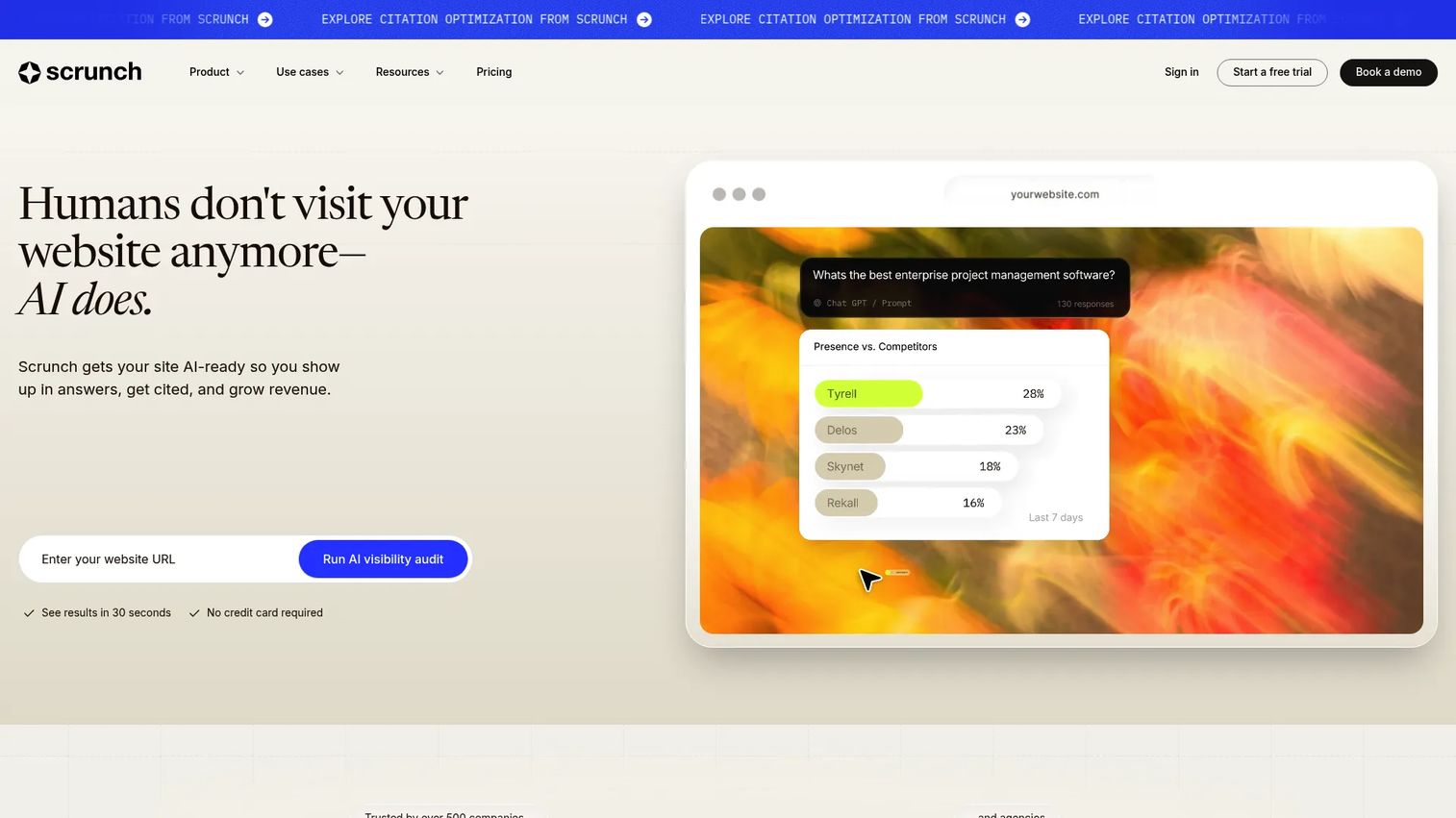
Scrunch describes itself as an Agent Experience Platform. It combines AI prompt monitoring with tools for optimizing and delivering web experiences to AI agents. Agent Pages adds a delivery component beyond visibility reporting.
Best for: Marketing teams evaluating AI-search monitoring alongside changes to how agents access content.
Bring your web team into the assessment if content delivery is part of the purchase. Review approval responsibilities before making implementation features central to the business case.
The Core package includes one brand and five seats. That gives buyers a concrete starting point for evaluating team access rather than estimating from a general platform description.
For organizations managing several business units, request the proposed brand structure early. Monitoring scope and operational ownership should match before you compare dashboard screenshots.
Key features
- AI prompt monitoring
- Citation tracking
- AI visibility insights
- Agent Pages content delivery
Why choose Scrunch: Evaluate it when your team wants to act on AI-agent access as well as measure answers. Reporting-only buyers should distinguish those requirements.
Scrunch pricing: Core costs $250/month. Enterprise uses custom pricing.
G2 rating: 4.6/5.
6. LLMrefs
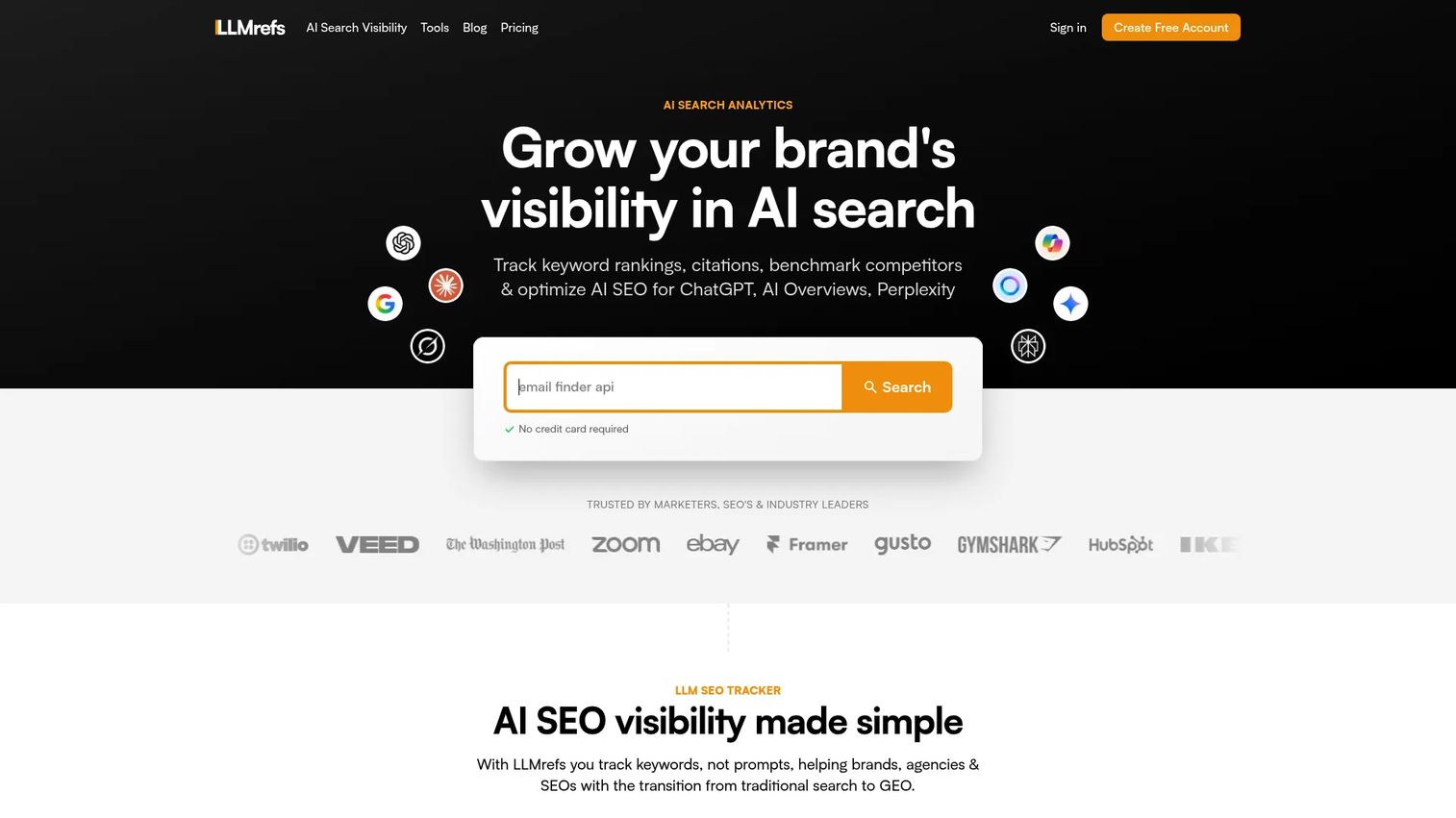
LLMrefs tracks AI-search brand visibility and citation sources. Its package includes geographic targeting and recurring reports, with CSV export and API access. Unlimited projects and team members make its account structure relevant to agencies.
Best for: Consultants and agencies that need source evidence across several client accounts.
The useful workflow starts with the cited URL. Inspect what it says about the category, then decide whether the finding belongs in content planning or outreach research.
Use exports to test how the results fit your client reporting. A dashboard is easier to justify when analysts can connect its evidence to work already under contract.
Evaluate query allocation across accounts before expanding coverage. Unlimited projects does not mean unlimited monitored prompts, so model the workload at portfolio level.
Key features
- Citation and source tracking
- Share-of-voice and position metrics
- Geographic and language targeting
- Weekly visibility reports
- CSV export and API access
Why choose LLMrefs: Its project structure suits teams managing multiple brands. Test whether the source detail gives clients evidence they can act on.
LLMrefs pricing: All in One costs $79/month, including 500 prompts. A seven-day free trial is available.
7. SEO Site Checkup
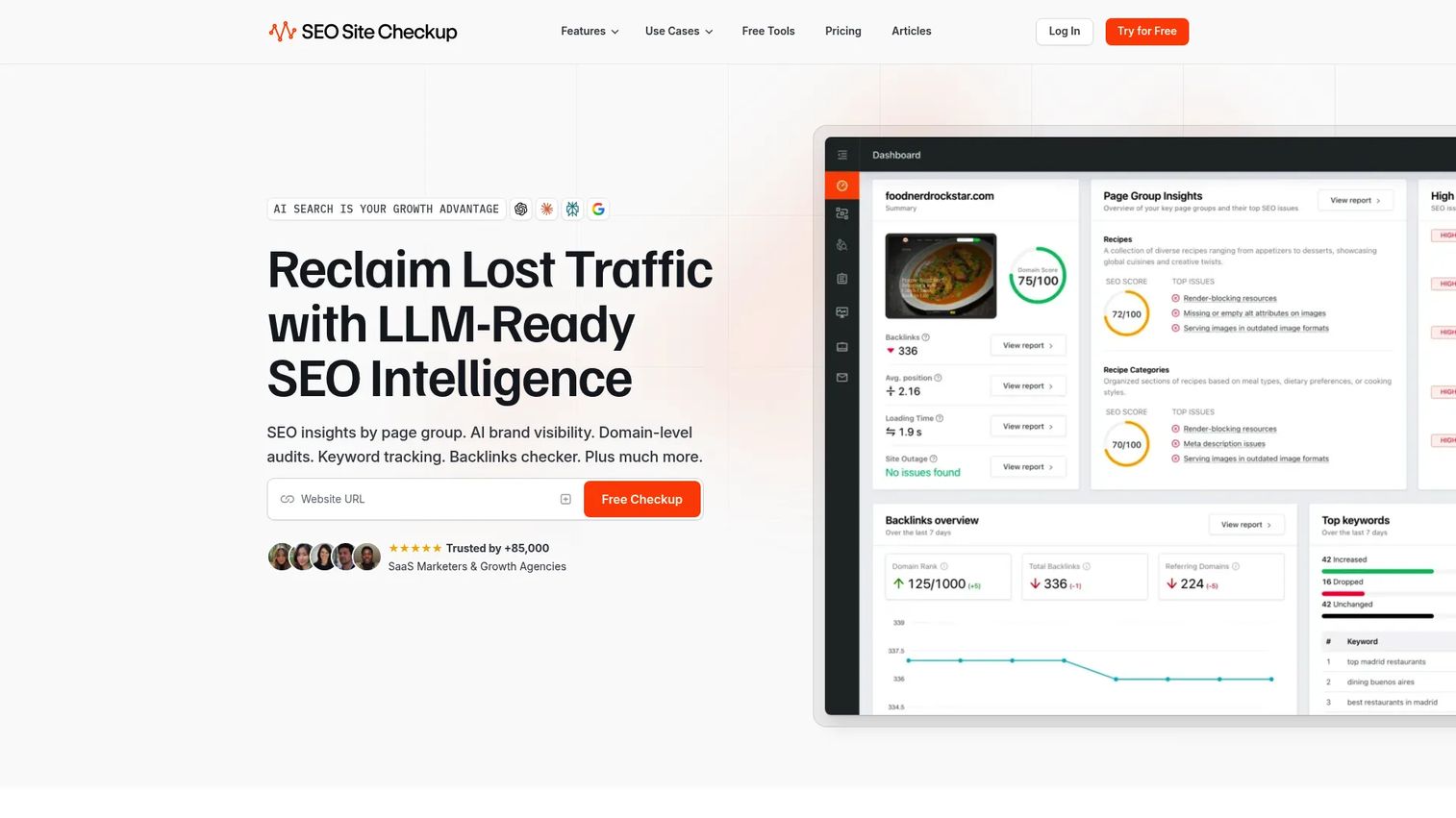
SEO Site Checkup combines technical auditing with search and AI visibility monitoring. Its offering also includes backlink analysis and website availability checks. This makes it relevant when your reporting needs extend beyond answer inclusion.
Best for: Small businesses and agencies seeking technical SEO coverage alongside LLM monitoring.
Use the product to assess two separate questions. First, determine whether the website has issues requiring attention. Then examine how the brand appears in AI answers.
Avoid treating an audit score as proof that a page will earn citations. Technical readiness and observed visibility provide different evidence.
For agencies, test whether the report can distinguish recommended fixes from measured outcomes. Clients should understand which findings require development work and which warrant further content research.
Key features
- Technical SEO audits
- LLM visibility tracking
- Keyword research and position tracking
- Speed and outage monitoring
- White-label reports
Why choose SEO Site Checkup: It is a consolidation candidate when technical health remains a recurring responsibility. Compare its AI reporting depth against your specific questions.
SEO Site Checkup pricing: Basic starts at $29/month billed annually. A seven-day free trial is available.
G2 rating: 3.6/5.
8. Semrush
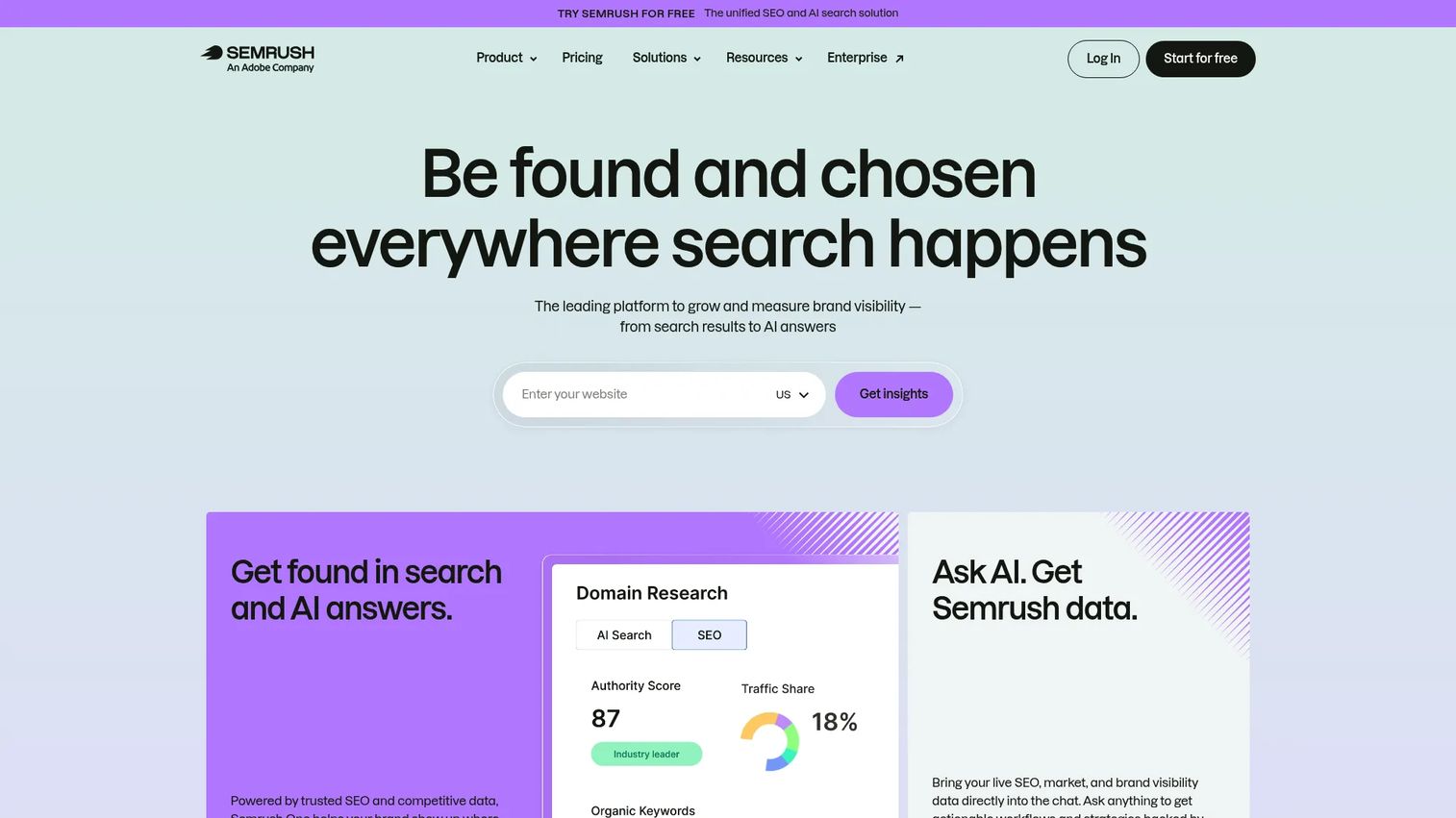
Semrush covers SEO and AI-search visibility within a broader marketing platform. Its research capabilities support teams that still depend on conventional search acquisition. The main appeal is evaluating AI discovery without abandoning established analysis workflows.
Best for: Marketing teams reviewing whether an existing SEO subscription can cover their AI-search requirements.
Start with the package your organization already owns. Map its available AI functions against your monitoring brief before buying an additional specialist platform.
Packaging matters here. Semrush offers SEO Classic plans, Semrush One, and individual toolkits; an SEO entry price should not be treated as an all-inclusive AI package.
Ask the vendor to demonstrate the precise engine and market coverage being proposed. Then compare the resulting report with what your content team needs for its next planning cycle.
Key features
- Keyword and competitor research
- Technical site auditing
- Backlink analysis
- AI visibility tracking
- Content creation and marketing reports
Why choose Semrush: It deserves consideration when consolidation is the priority. Evaluate the incremental cost of the required package against maintaining separate subscriptions.
Semrush pricing: SEO Classic Pro starts at $117.33/month billed annually. A free plan is available.
G2 rating: 4.4/5.
9. Ahrefs
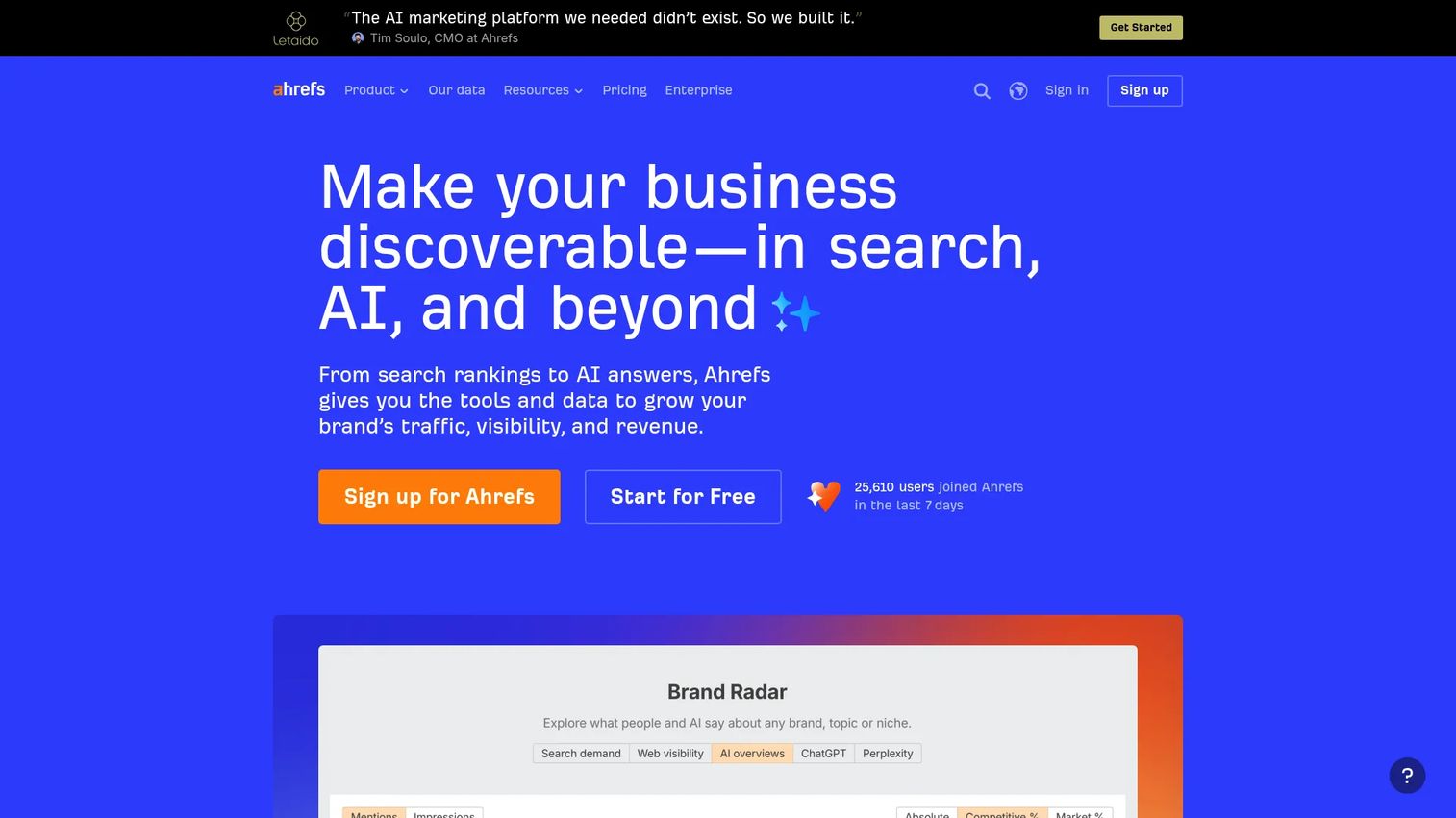
Ahrefs combines search intelligence with competitive research and AI-search analysis. It remains relevant for teams whose growth work depends on understanding websites and search demand. Evaluate it as a broader research environment rather than solely as a prompt tracker.
Best for: SEO teams connecting AI visibility investigations with existing search and competitor analysis.
An answer-source investigation often raises questions about the cited website. Use your evaluation to see whether the platform helps research that source without introducing another disconnected workflow.
Commercial scope deserves attention. Ahrefs offers separately priced tools and add-ons, so the starting subscription is not a reliable proxy for every AI capability.
Request a package-level explanation of the functions you intend to use. Keep the buying comparison anchored to those requirements rather than the total number of available features.
Key features
- Site Explorer
- Keywords Explorer
- Site Audit
- Competitive website analysis
- AI-search analysis
Why choose Ahrefs: It fits teams that need broad search research regardless of their AI-search investment. Check whether adding specialist monitoring would resolve a distinct gap.
Ahrefs pricing: Starter costs €27/month; Lite starts at €119/month. Ahrefs Free is also available.
G2 rating: 4.5/5.
10. Surfer SEO
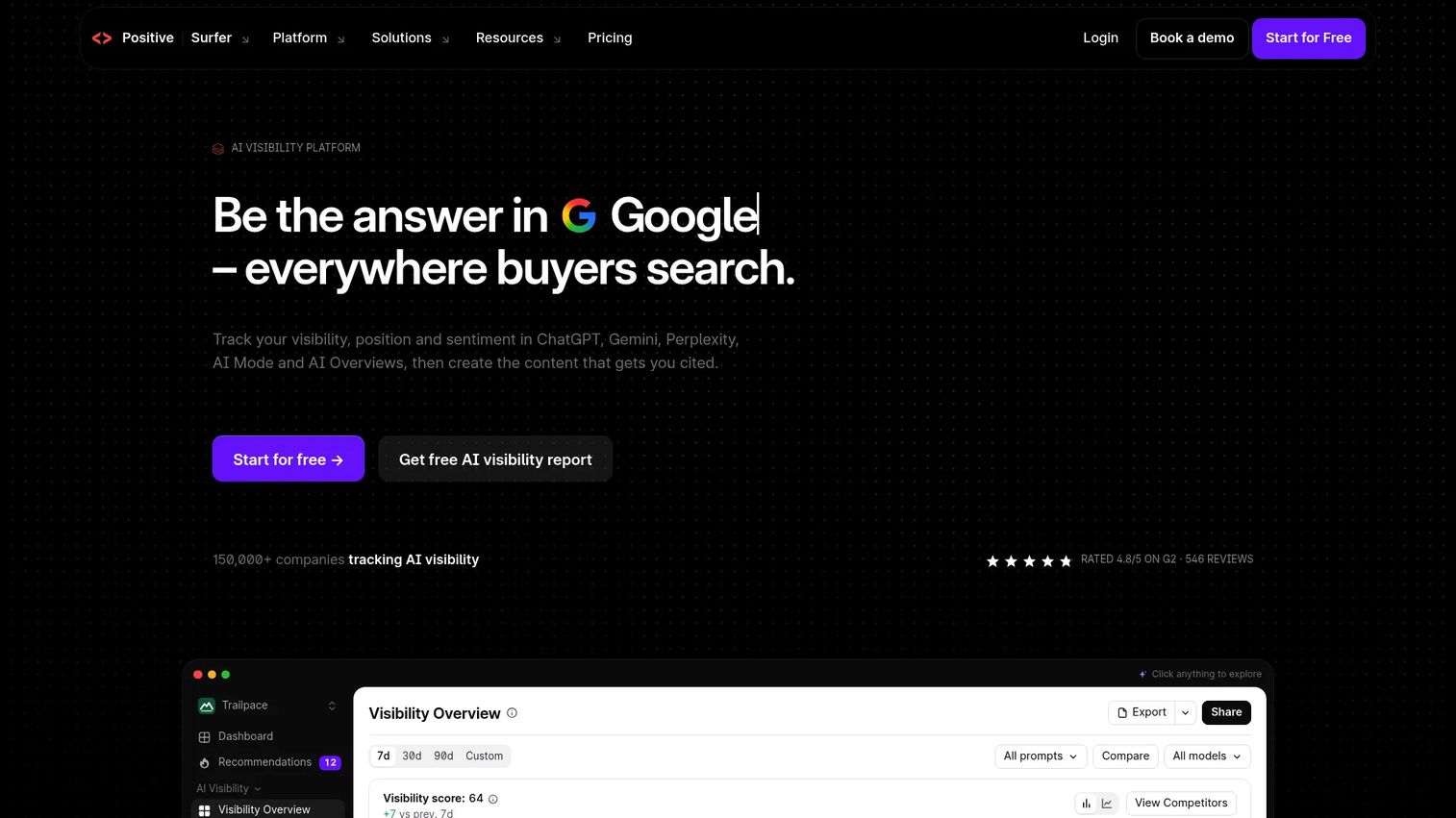
Surfer SEO combines content planning and optimization with AI visibility tracking. Its documented coverage includes ChatGPT and Gemini, as well as Google AI Overviews. Editorial guidance connects research with changes writers can make to a page.
Best for: Content teams that need to improve pages after identifying visibility gaps.
Evaluate it with an existing article rather than a blank document. Ask the editor to distinguish useful coverage improvements from suggestions that add words without answering the reader’s question.
The operational benefit depends on your publishing process. If updates wait for approval elsewhere, writing assistance alone will not resolve the bottleneck.
Keep a record of accepted changes and publication dates. That gives the team a clearer basis for reviewing subsequent visibility patterns without claiming every movement came from the edit.
Key features
- AI visibility tracking
- SERP-based content guidance
- Keyword research and topical maps
- Content optimization and internal linking
- Plagiarism checking and writing assistance
Why choose Surfer SEO: Consider it when content execution is the immediate job. Compare editorial usefulness and tracking coverage separately during evaluation.
Surfer SEO pricing: Discovery starts at $49/month billed yearly. A free trial is available.
G2 rating: 4.8/5.
11. Clearscope
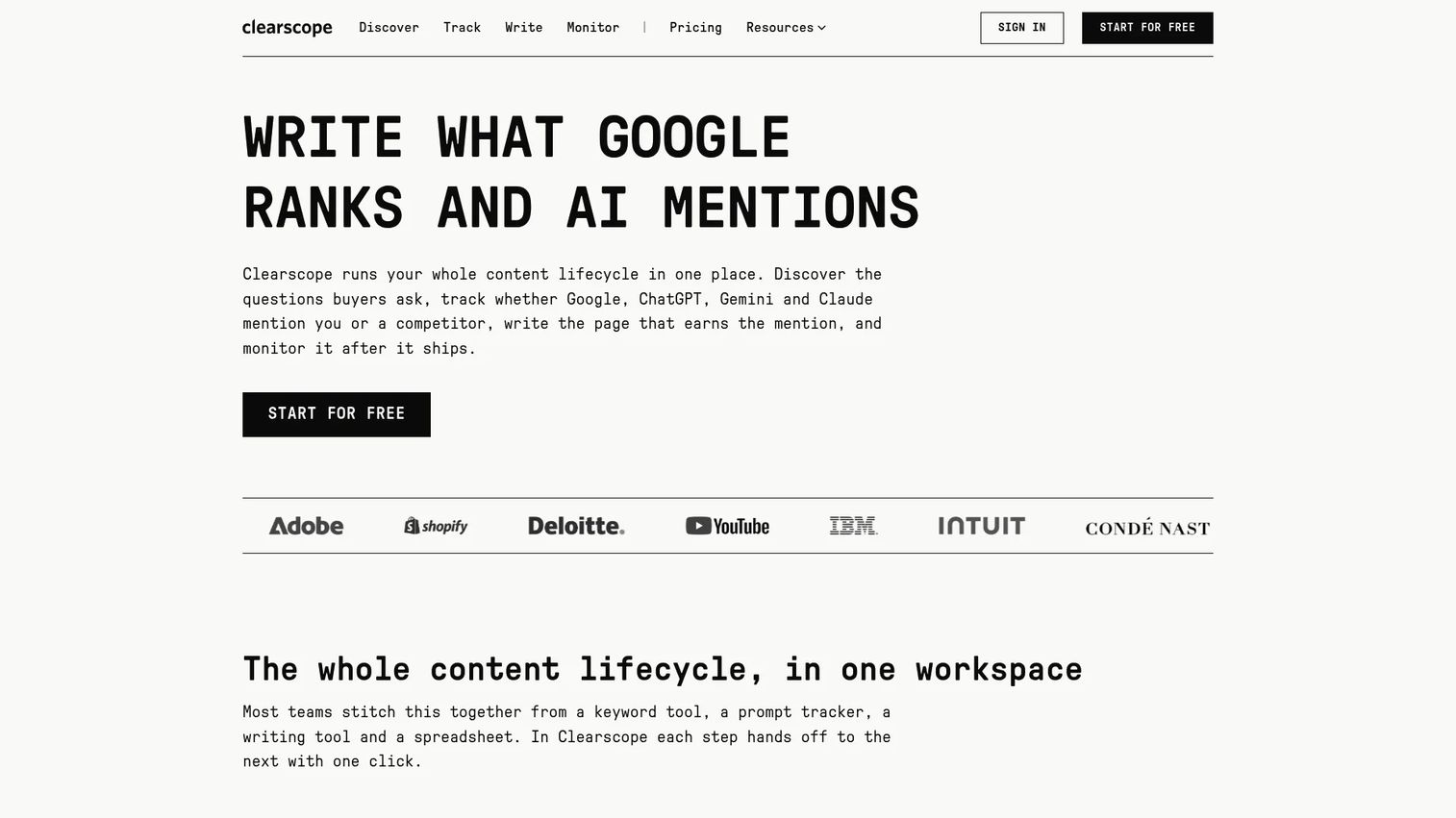
Clearscope positions itself around content discoverability across conventional and AI search. It connects buyer-question research with writing guidance and ongoing page monitoring. Its current scope includes brand mentions across Google and several AI assistants.
Best for: Editorial teams that want research and optimization within the same content workflow.
The practical test is whether its guidance improves an article’s usefulness. Have a subject expert review suggested additions rather than treating a higher grade as the publishing goal.
Clearscope connects with Google Docs, Microsoft Word, and WordPress. That is relevant when adoption depends on keeping writers within familiar tools.
Ask how query tracking maps to monitored pages. Your reporting should show which question a content update aims to answer, without implying that every citation has a single identifiable cause.
Key features
- Buyer-question and intent research
- AI-search mention tracking
- Term guidance and live grading
- Search Console-based page monitoring
- Document and publishing integrations
Why choose Clearscope: It fits teams managing a recurring editorial improvement program. Evaluate the full research-to-refresh workflow rather than content grades in isolation.
Clearscope pricing: Essentials costs $129/month, and Business costs $399/month. A free trial is available.
G2 rating: 4.9/5.
12. Otterly.AI
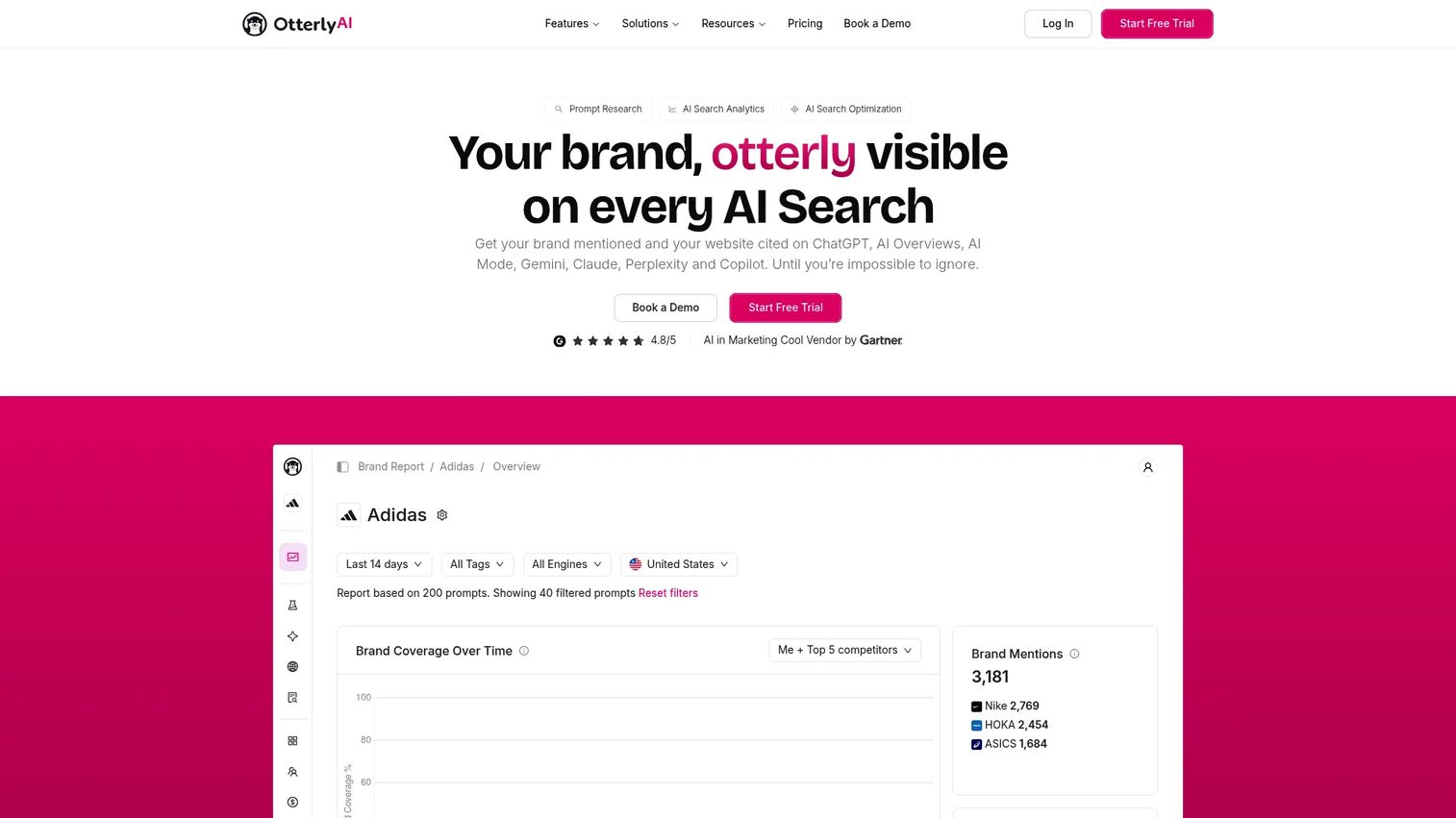
Otterly.AI combines AI-search monitoring with GEO research and recommendations. Citation analysis sits alongside content audits and crawlability checks. It offers a dedicated route for teams that want AI-search analysis without replacing their broader SEO stack.
Best for: Marketers building a focused GEO audit and monitoring process.
Start by separating audit findings from recurring measurements. An audit identifies work to investigate; monitoring helps you observe what happens over time.
The entry package has a relatively small prompt allowance. Use that scope to test a defined commercial topic rather than scattering queries across unrelated product lines.
Review the output with whoever owns content changes. A clear recommendation has more operational value when it names evidence your editor or developer can examine.
Key features
- AI prompt research
- Citation and domain tracking
- Content audits and crawlability checks
- Competitive and sentiment analysis
- Multi-country tracking and reporting connections
Why choose Otterly.AI: It is worth shortlisting for a contained AI-visibility pilot. Compare its audit recommendations with the work your team can complete.
Otterly.AI pricing: Lite costs $29/month for 15 search prompts. A seven-day free trial is available without a credit card.
G2 rating: 4.7/5.
13. Writesonic
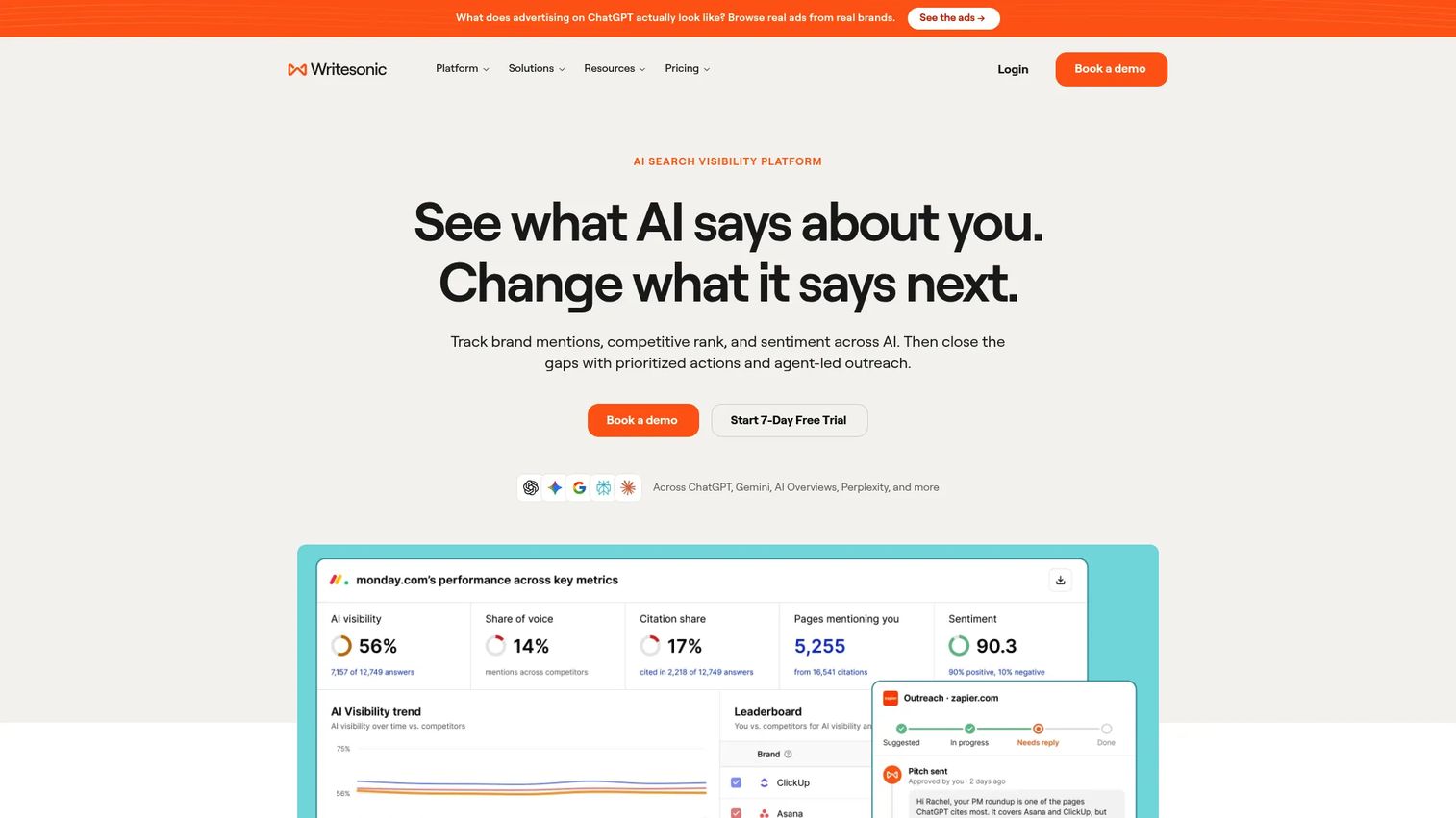
Writesonic combines AI-search visibility monitoring with content generation. Its Action Center prioritizes fixes, while agent analytics and shopping analysis extend the measurement scope. This makes it relevant when production and monitoring belong to the same team.
Best for: Lean marketing teams that want to investigate gaps and create content within a connected workflow.
Evaluate the quality of the recommendation before evaluating the generated article. The team should understand why a proposed change matters and which evidence supports it.
Editorial review remains part of the work. Check factual claims and source quality before publishing material intended to influence how AI systems describe your brand.
Also distinguish production allowances from monitoring capacity during procurement. Both affect operating cost, but they support different parts of the program.
Key features
- AI visibility monitoring
- AI agent analytics
- Article and content generation
- Action Center prioritized fixes
- Brand explorer and shopping analytics
Why choose Writesonic: Choose it when combining analysis and content production would remove handoffs. Keep a human owner accountable for each published change.
Writesonic pricing: Starter costs $79/month billed annually; Basic costs $199/month and Growth $399/month on annual billing.
G2 rating: 4.7/5.
14. AirOps
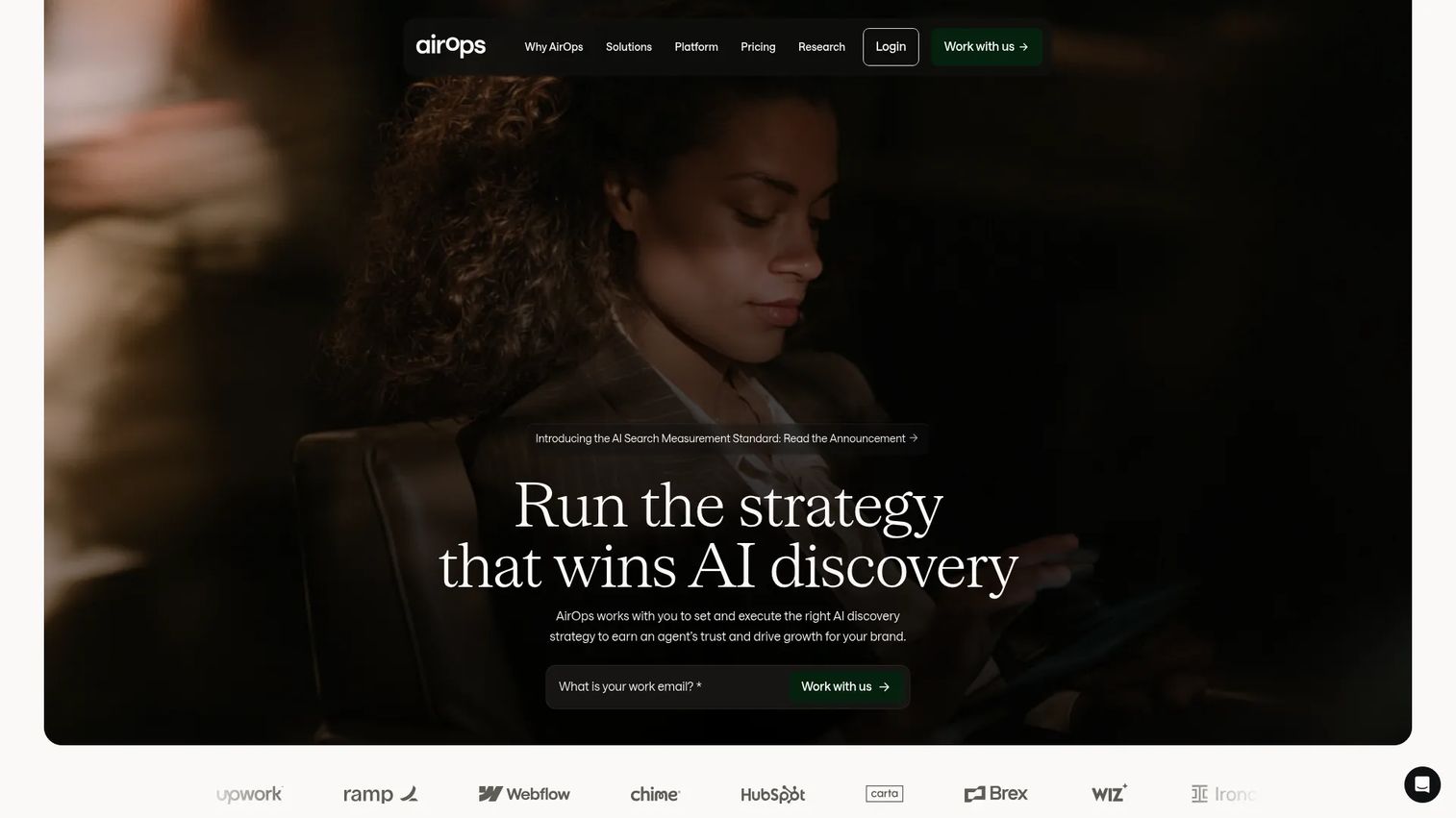
AirOps connects AI-search measurement with content operations. Its workflows cover research through publication and refreshing, with human review and brand context. The platform is relevant when findings already exist but execution remains inconsistent.
Best for: Growth teams turning a recurring content backlog into a governed production process.
Bring an existing workflow into the assessment. Trace where research enters, who approves the draft, and how the finished page reaches your CMS.
The strongest business case will often involve work replaced, rather than another dashboard added. Estimate time spent on repeated briefs and coordination before evaluating automation.
Plan usage is expressed in content-production tasks. Ask for a workload model using your intended process, since a page count alone will not explain consumption.
Key features
- AI-search visibility and competitor insights
- Research and content-production agents
- Brand Kits and Knowledge Bases
- Human review and approval workflows
- Version history and CMS integrations
Why choose AirOps: It fits teams whose main constraint is executing an AI-search strategy consistently. Assign a process owner before expanding automated production.
AirOps pricing: Custom pricing across Solo, Pro, and Enterprise plans.
G2 rating: 4.7/5.
15. Adobe LLM Optimizer
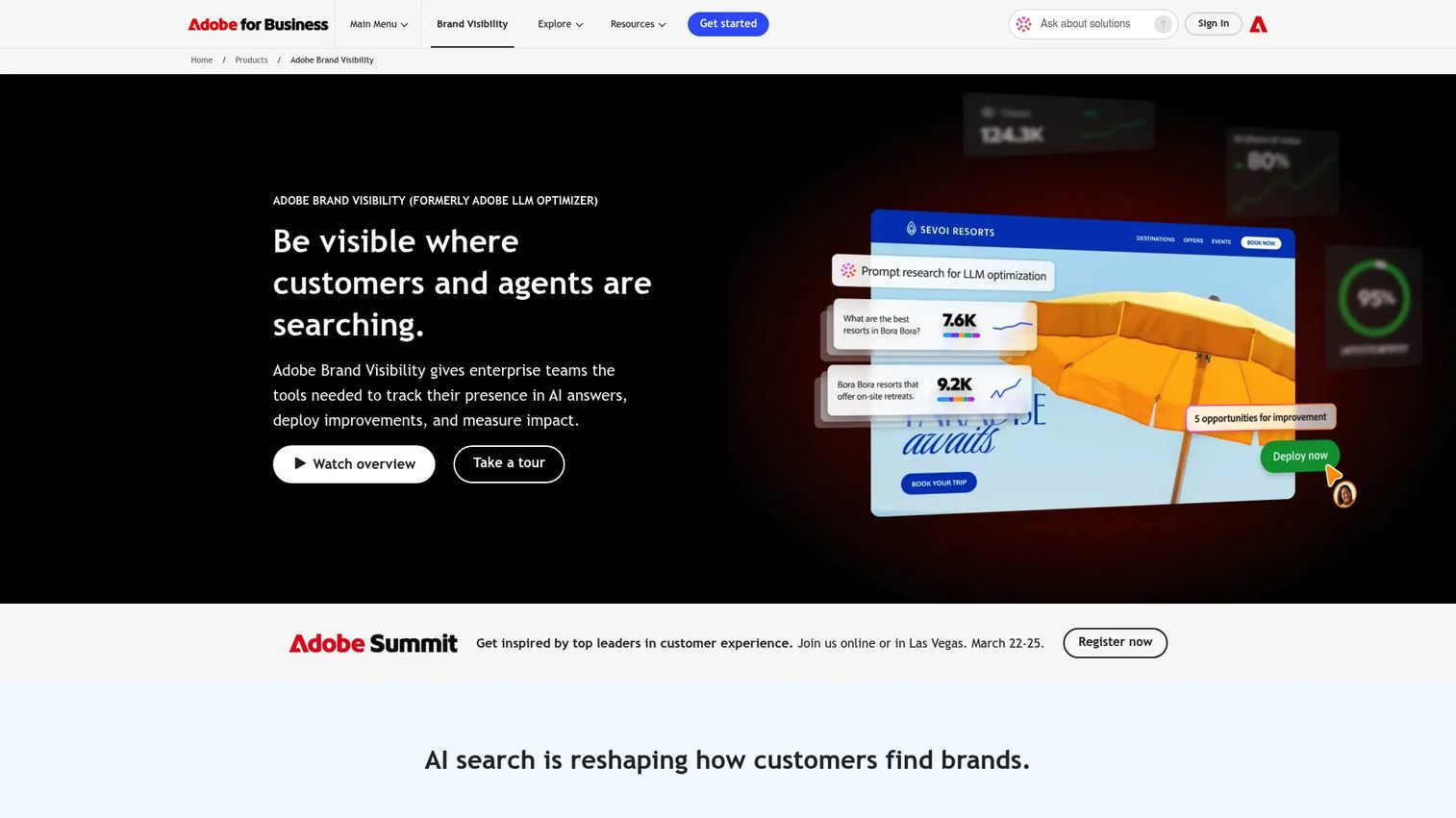
Adobe LLM Optimizer is now Adobe Brand Visibility. Adobe states that it stopped selling the product under its former name on July 31, 2026. The current offering combines AI visibility analysis with enterprise optimization and measurement capabilities.
Best for: Enterprise teams coordinating AI-search work with Adobe analytics and content operations.
Its connection to Adobe Analytics and Customer Journey Analytics is relevant to organizations evaluating downstream business impact. Inspect how those connections fit your existing attribution definitions.
The product also supports AI-oriented site optimizations at the CDN edge, with rollback capabilities. That warrants involvement from web operations rather than an SEO-only purchasing process.
Keep ownership explicit during evaluation. Content recommendations, deployment approval, and performance interpretation may sit with different teams, even when the software connects their work.
Key features
- Brand mentions and citation monitoring
- Sentiment and share-of-voice analysis
- Technical and content optimization recommendations
- CDN-edge optimization with rollback
- Adobe analytics connections
Why choose Adobe LLM Optimizer: Consider the renamed product when enterprise measurement and deployment are central requirements. A narrow prompt-monitoring brief warrants a narrower evaluation.
Adobe LLM Optimizer pricing: Custom pricing through Adobe.
16. Perplexity
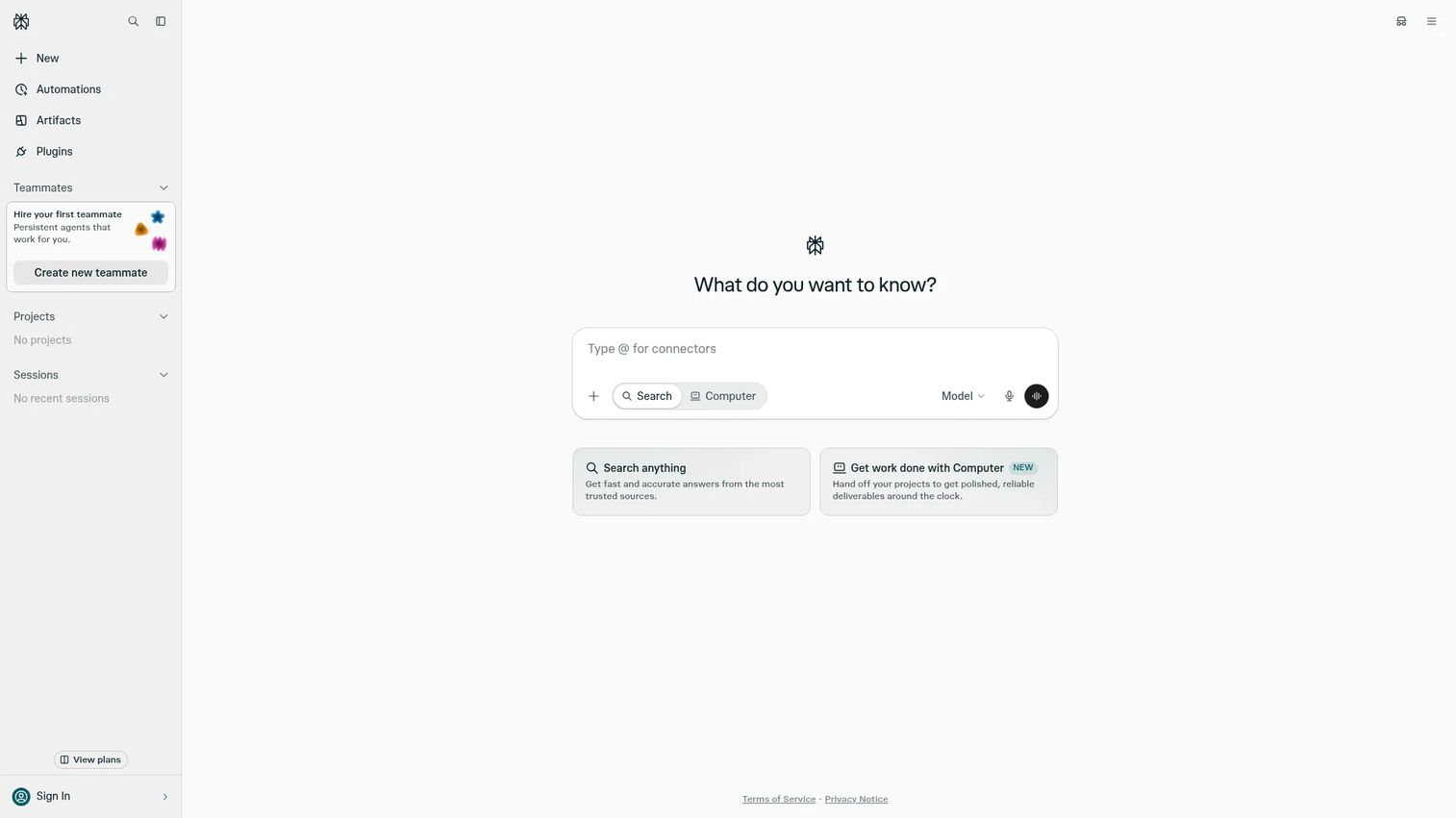
Perplexity is an answer and research platform that searches the web and provides cited responses. For marketers, it supports direct inspection of sources and answer framing. It serves as a manual research layer rather than a substitute for recurring visibility reporting.
Best for: Marketers investigating why particular sources appear before purchasing a dedicated tracker.
Perplexity citation research works best with a written log. Save the exact question and answer, then record the cited URLs and date.
Read those sources before forming a content hypothesis. A citation identifies material surfaced in that response; it does not prove a universal preference for the publisher.
This approach is useful for refining the questions you eventually monitor. It also helps your team judge whether a vendor’s citation report contains enough detail to support analysis.
Key features
- Web search with inline citations
- Deep research
- Follow-up research queries
- File uploads
- Multi-step task support
Why choose Perplexity: Use it for qualitative source investigation and early prompt research. Move to structured tracking when repeated checks become a reporting obligation.
Perplexity pricing: A free plan is available. Pro costs $17/month and Max $167/month when billed annually.
G2 rating: 4.5/5.
17. ChatGPT
ChatGPT is a general-purpose AI assistant for research and analysis. Marketers can use it to explore buyer questions and inspect how responses frame a category. Its role here is qualitative investigation, rather than a ready-made longitudinal visibility dashboard.
Best for: Teams defining a monitoring brief before buying specialist software.
Use separate sessions when testing related prompts, and record the conditions you can observe. Conversation context can otherwise make comparisons difficult to interpret.
Projects and file analysis can help organize research material. Keep the original responses available rather than asking a later summary to stand in for the evidence.
Manual ChatGPT SEO tracking becomes labor-intensive once reporting requires consistent comparisons over time. Before expanding the process, decide whether the team needs exploratory insight or scheduled measurement.
Key features
- Text-based prompt exploration
- File uploads and data analysis
- Deep research
- Projects
- Custom GPTs
Why choose ChatGPT: It is useful for developing hypotheses and reviewing answer quality. Dedicated monitoring is the better purchasing category when recurring reporting drives the requirement.
ChatGPT pricing: A free plan is available. Paid options include Go, Plus, Pro, Business, and Enterprise.
G2 rating: 4.6/5.
Considerations when choosing LLM SEO analysis tools
Engine coverage
Ask vendors to name the engines and markets included in the proposed package. “AI search” alone is too broad.
Google AI Overviews tracking and assistant monitoring answer different questions. Prioritize the surfaces relevant to your buyers rather than buying the largest coverage claim.
Prompt methodology
Build a fixed baseline containing branded questions and nonbrand discovery queries. Add purchase-stage comparisons and location-specific wording where relevant.
Ask how the platform handles repeated runs and model changes. Reporting needs enough context to distinguish movement from a changed measurement method.
Citation and source visibility
Require page-level evidence alongside mention counts. Your team needs to inspect the material behind a recommendation.
Separate content fixes from external-source opportunities. A missing citation may warrant a documentation update, while another finding belongs with digital PR.
Reporting and attribution
Keep visibility indicators separate from observed visits and conversions. Connect AI referral sessions to GA4 and CRM records where the data supports that connection.
Use Search Console as additional context, not a direct measure of AI-answer exposure. Assisted conversions can inform analysis without proving causation.
Pricing and stack consolidation
Price the intended workload, including reporting access and required coverage. Evaluate AEO tools against subscriptions and manual tasks they would replace.
A broad suite may already answer your questions. Add specialist software when it supplies evidence or workflow value your existing stack cannot provide.
Conclusion
The best LLM SEO analysis tool is the one that resolves your next marketing decision.
Dedicated visibility platforms suit teams building repeatable prompt monitoring and citation research. Start there when leadership needs an ongoing view of brand presence across answer engines.
Traditional SEO suites make sense when your team still depends on keyword and competitor intelligence. Review existing subscriptions before adding another reporting surface.
Content systems address a different requirement. Choose them when you can identify the gaps but need a dependable way to improve and publish pages.
Manual research remains useful for defining questions and inspecting sources. It gives you a practical starting point before formal reporting becomes necessary.
Choose one primary use case, then test three shortlisted tools over two weeks. Keep the prompt set consistent and compare source detail alongside reporting quality.
Ask each evaluator to document one action they could take from the findings. That exercise reveals more about workflow fit than a polished dashboard.
Turn product interest into hands-on exploration
Separately, Guideflow supports interactive demos for landing pages, sales follow-ups, customer education, and partner enablement.
Start your journey with Guideflow today!
FAQs
The best choice depends on the work you need to complete. AIclicks suits dedicated monitoring, while Semrush and Ahrefs deserve consideration when broader SEO research remains essential. Content teams should assess editorial systems separately from visibility dashboards. Compare products using the same buyer questions and ask which findings your team can act on immediately.
Traditional SEO tools analyze search rankings and website signals, including backlinks and technical health. LLM SEO analysis tools examine brand inclusion and sources within generated answers. Some platforms now cover both, which makes package-level comparisons important. Choose according to the evidence you need, rather than assuming the categories require separate subscriptions.
Dedicated platforms monitor selected prompts and analyze the resulting answers for brand references or citations. Depending on the product, reports may include source URLs, recommendation placement, sentiment, and competitor comparisons. Methods vary, so ask how results are collected and how often observations repeat. Preserve a consistent baseline when comparing reporting periods.
ChatGPT does not provide a fixed search-results page with stable positions. A monitoring tool can record inclusion and recommendation ordering, but those observations apply to the sampled answer conditions. Prompt wording and conversation context can change what appears. An LLM visibility tracker should expose enough methodology to prevent ranking-like metrics from being mistaken for universal positions.
Use weekly reviews for an active program and monthly summaries for leadership as a practical starting cadence. Daily observations can help investigate launches or sudden changes, but avoid reacting to every fluctuation. Record content updates alongside the measurement timeline. Increase monitoring frequency only when the team has a decision that requires it.
Start with brand inclusion and citation frequency across a defined set of commercially relevant prompts. Add source URLs and competitor share of voice to explain the observed answers. Track positioning separately from simple presence, because a mention can describe the wrong use case. Report referral traffic and pipeline indicators alongside visibility without presenting correlation as proven attribution.
Free options work for testing a research method and deciding which questions deserve ongoing attention. The best LLM SEO checker for that stage may be a limited report plus documented manual research. Free LLM rank tracking becomes less useful when you need scheduled comparisons or client-ready exports. Evaluate paid products once maintaining the process consumes meaningful team time.
Write down the decisions the software must support before comparing vendors. A dedicated tracker fits recurring questions about answer inclusion and citation sources, while a suite covers broader search responsibilities. Test your existing subscription first if consolidation is a priority. Add another platform only when its evidence or workflow removes a clearly identified gap.
They can contribute visibility evidence and, in some cases, connect it with agent traffic or analytics data. Revenue attribution still depends on what your measurement stack observes and how customer journeys are recorded. Keep exposure metrics distinct from sessions and qualified opportunities. Use a documented attribution method before presenting AI visibility changes as a cause of pipeline growth.