Your deal is at the finish line. Then finance needs to approve the discount. Legal wants another redline. Your champion is waiting on a quote update that's sitting in someone's inbox.
According to TrendCandy's 2025 research, 88% of B2B manufacturers, wholesalers, and distributors reported losing deals because of manual sales and quoting processes. The same study found that manual quoting costs companies an average of 5% of annual revenue. Only 37% of respondents had fully automated their quoting processes, and 71% said quotes take at least a day to produce.
For AEs, this is the problem. You own the number, but the approval chain owns your timeline. Deal desk software exists to shorten that chain: Structured routing, faster discount governance, cleaner handoffs from sales to finance to legal, and visibility into where deals actually stall.
This guide breaks down the 8 tools that handle approval routing, quote management, pricing governance, and contract workflows for complex B2B deals.
What's inside
This guide is for AEs, RevOps leaders, and sales operations managers evaluating deal desk and CPQ tools for 2026. Tools were selected based on four criteria:
- Approval routing depth: Configurable workflows for discounts, pricing exceptions, and legal review
- CPQ and pricing governance: Product configuration, pricing controls, and discount guardrails
- Integration fit: Native connections to Salesforce, HubSpot, ERP systems, and other CRM stacks
- Governance and reporting: SLA tracking, audit trails, and deal-level analytics
TL;DR
- Best for end-to-end quote-to-revenue: DealHub covers CPQ, contracts, subscriptions, billing, and deal collaboration in one platform
- Best for Salesforce-native teams: Salesforce Revenue Cloud embeds directly into existing orgs and handles quote-to-cash natively
- Best for enterprise CPQ complexity: Oracle CPQ suits large orgs with complex product configurations and multi-channel pricing
- Best for contract-heavy workflows: Conga connects document automation, CLM, and CPQ across legal and finance
- Best for pricing intelligence: Zilliant and Vendavo serve B2B manufacturers and distributors managing margin-critical pricing decisions
- Best for AI-driven pricing: PROS targets airlines and enterprise B2B teams with AI-powered revenue management
What is deal desk software
Deal desk software is a category of tools that centralizes and automates the approval, pricing, quoting, and contract workflows that sit between a salesperson and a closed deal.
Where a CRM tracks opportunity status and a CPQ produces a quote, deal desk software governs what happens between those steps. It routes discount requests to the right approvers, enforces pricing guardrails, manages exceptions, and connects sales with finance, legal, and operations so deals move without bottlenecks.
Core capabilities in this category include:
- Approval routing: Automated workflows for discount approvals, pricing exceptions, and legal sign-off, with SLA visibility
- Pricing and discount governance: Rules-based controls that enforce margin floors, approval thresholds, and discount policies
- Quote and contract workflow: Template-driven document generation, redlining, e-signature, and version control
- Cross-functional collaboration: Shared views and handoffs connecting sales, finance, legal, and procurement
- Analytics and SLA tracking: Deal-level reporting on cycle time, approval delays, exception rates, and margin impact
- CRM and ERP integration: Bi-directional sync with Salesforce, HubSpot, Microsoft Dynamics, NetSuite, and similar platforms
Deal desk software sits at the intersection of sales automation, revenue operations, and contract lifecycle management. Some platforms cover all three. Others specialize in pricing intelligence, CPQ, or document workflow. The right choice depends on where your deals actually stall.
When to use deal desk software
Standardize discount approvals across a growing sales team
When a team scales past 10 to 15 reps, discount consistency breaks down. One rep emails finance, another texts a manager, a third applies a custom rate from memory. Deal desk software enforces a single approval path with documented thresholds, audit trails, and time-stamped decisions.
Coordinate multi-stakeholder deals without losing momentum
Enterprise deals often require input from legal on contract terms, finance on margin, and procurement on vendor qualifications, all happening in parallel. Without a structured workflow, handoffs fail silently. Deal desk tools keep all parties on the same deal record with clear ownership at each stage.
Protect margin on custom pricing and non-standard deals
Non-standard deals, bundles, usage-based pricing, and enterprise exceptions are where margin leaks. Deal desk software applies pricing rules before a quote leaves the building, flags deals below margin floors, and routes exceptions to the right approver. TrendCandy's 2025 research found that 54% of respondents named digital quoting platforms a top priority for modernizing sales, specifically for this reason.
Deal desk software comparison
The table below reflects verified pricing and G2 ratings sourced from each vendor's pricing page and G2 listing. Pricing is listed annually where applicable.
| # | Product | Best for | Key use case | Pricing | G2 rating |
|---|---|---|---|---|---|
| 1 | DealHub | End-to-end quote-to-revenue | CPQ, contracts, subscriptions, billing | Custom pricing | 4.7/5 |
| 2 | Salesforce Revenue Cloud | Salesforce-native teams | Quote-to-cash with native CRM fit | From $150/user/month | 4.2/5 |
| 3 | Conga | Contract and document workflows | CPQ, CLM, and document automation | Custom pricing | 4.3/5 |
| 4 | Oracle CPQ | Enterprise product configuration | Complex CPQ with multi-channel pricing | From $240/user/month | 4.0/5 |
| 5 | Zilliant | B2B pricing and agreement management | Pricing execution and margin control | Custom pricing | 4.4/5 |
| 6 | Vendavo | Commercial pricing and rebates | Pricing optimization and deal guidance | Custom pricing | 4.3/5 |
| 7 | PROS | AI-driven pricing and revenue management | Dynamic pricing and CPQ | From $6,250/month | 4.2/5 |
| 8 | Apttus (Conga) | Enterprise quote-to-cash | CPQ, CLM, and pricing automation | Custom pricing | 4.3/5 |
Best deal desk software tools for 2026
1. DealHub
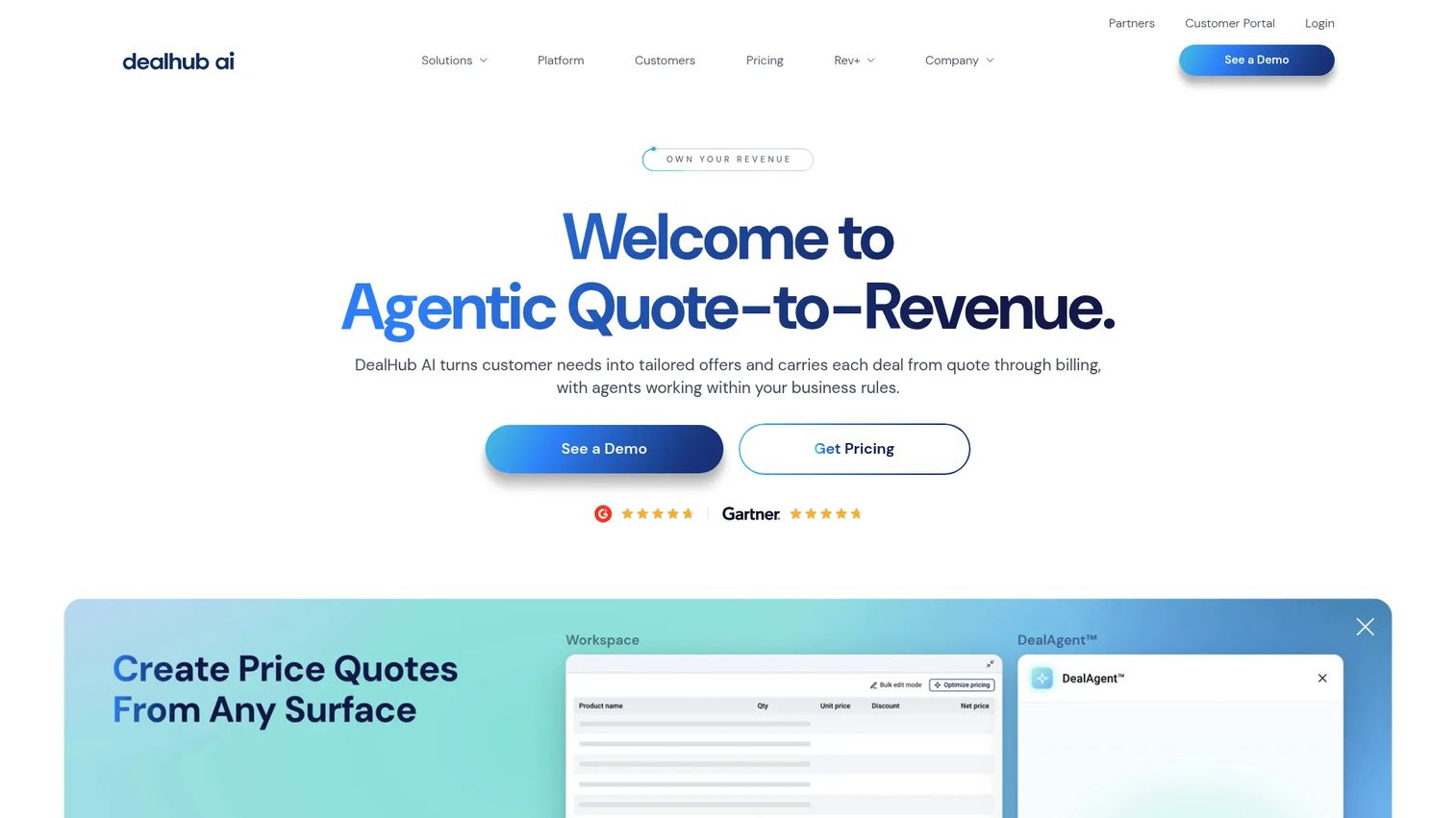
DealHub is an agentic quote-to-revenue platform that connects CPQ, contract lifecycle management, deal collaboration, subscriptions, billing, and revenue intelligence in one system. Unlike point CPQ tools, DealHub covers the full commercial motion: From configuring a complex deal to getting it signed, billed, and renewed. It integrates with Salesforce, HubSpot, Microsoft Dynamics, and NetSuite, making it a natural fit for teams that need approval routing and deal governance without bolting together separate apps.
Best for: Revenue teams managing complex quoting, contracts, and subscription workflows across sales, finance, and legal.
Key features
- CPQ with guided selling, adaptive pricing, configurable bundles, and discount approvals
- Contract CLM: Dynamic templates, clause management, redlining, and a contract repository
- Digital DealRoom with branded sales rooms and buyer intent tracking
- Subscription lifecycle and billing for recurring, usage-based, and hybrid models
- CRM and ERP integrations: Salesforce, HubSpot, Dynamics, NetSuite, and others
Why choose DealHub: DealHub is the strongest default for mid-market and enterprise SaaS teams that want a single platform for quoting through billing, without maintaining separate CPQ, CLM, and billing tools. It suits teams where the AE, finance, and legal all need to work inside the same deal record.
DealHub pricing: DealHub prices by quote only. Contact their sales team for a proposal. G2 reviewers report that pricing scales by module and company size.
G2 rating: 4.7/5
2. Salesforce Revenue Cloud
Salesforce Revenue Cloud is a revenue lifecycle management platform built natively on Salesforce. It handles product catalog management, pricing, quoting, contracts, orders, billing, invoicing, and subscription management. For teams already running their CRM in Salesforce, Revenue Cloud eliminates the integration layer that most CPQ tools require. Everything lives on the same platform the AE already uses for opportunity management. Salesforce also refers to this product as Revenue Management in some current documentation.
Best for: Organizations already on Salesforce that need to manage quote-to-cash, subscriptions, usage billing, and contract approvals without leaving their existing CRM.
Key features
- Product catalog and price management with Salesforce-native data model
- Product configuration, quoting, and order capture within the CRM
- Contracts, subscriptions, consumption management, and invoicing
- Approval workflows built on Salesforce Flow
- AI and analytics on the Revenue Cloud Advanced tier
Why choose Salesforce Revenue Cloud: If your team already runs Salesforce and your RevOps org has capacity to configure it, this avoids the data sync issues that come with third-party CPQ integrations. The tradeoff is implementation complexity and cost.
Salesforce Revenue Cloud pricing: Revenue Cloud Growth starts at $150 per user per month, billed annually. Revenue Cloud Advanced is $200 per user per month, billed annually. Billing and invoicing are priced separately on request.
G2 rating: 4.2/5
3. Conga
Conga provides an open revenue lifecycle management platform covering document automation, CPQ, contract lifecycle management, billing, digital commerce, and AI-driven pricing insights. It has a strong footprint in document-heavy commercial processes where legal, finance, and sales need to collaborate on complex terms. Conga's strength is in orchestrating the downstream of a deal: Generating contracts from approved quotes, routing redlines, managing approvals, and automating renewal workflows.
Best for: Large organizations that need connected CPQ and CLM with strong document generation and cross-functional approval flows.
Key features
- Document automation and personalized document generation from CPQ data
- CPQ workflows with approval routing and pricing controls
- Contract CLM with redlining, clause management, and approvals
- Automated billing and subscription management
- AI-driven pricing and revenue insights
- Secure e-signature
Why choose Conga: Conga works best when the bottleneck is in contract execution rather than quote configuration. Teams with high document volume, legal review cycles, or complex contract terms will get more value here than teams whose primary need is product configuration.
Conga pricing: Contact their sales team for pricing based on product modules and company size. G2 reviewers report enterprise contracts typically range from mid-five to six figures annually depending on module scope.
G2 rating: 4.3/5
4. Oracle CPQ
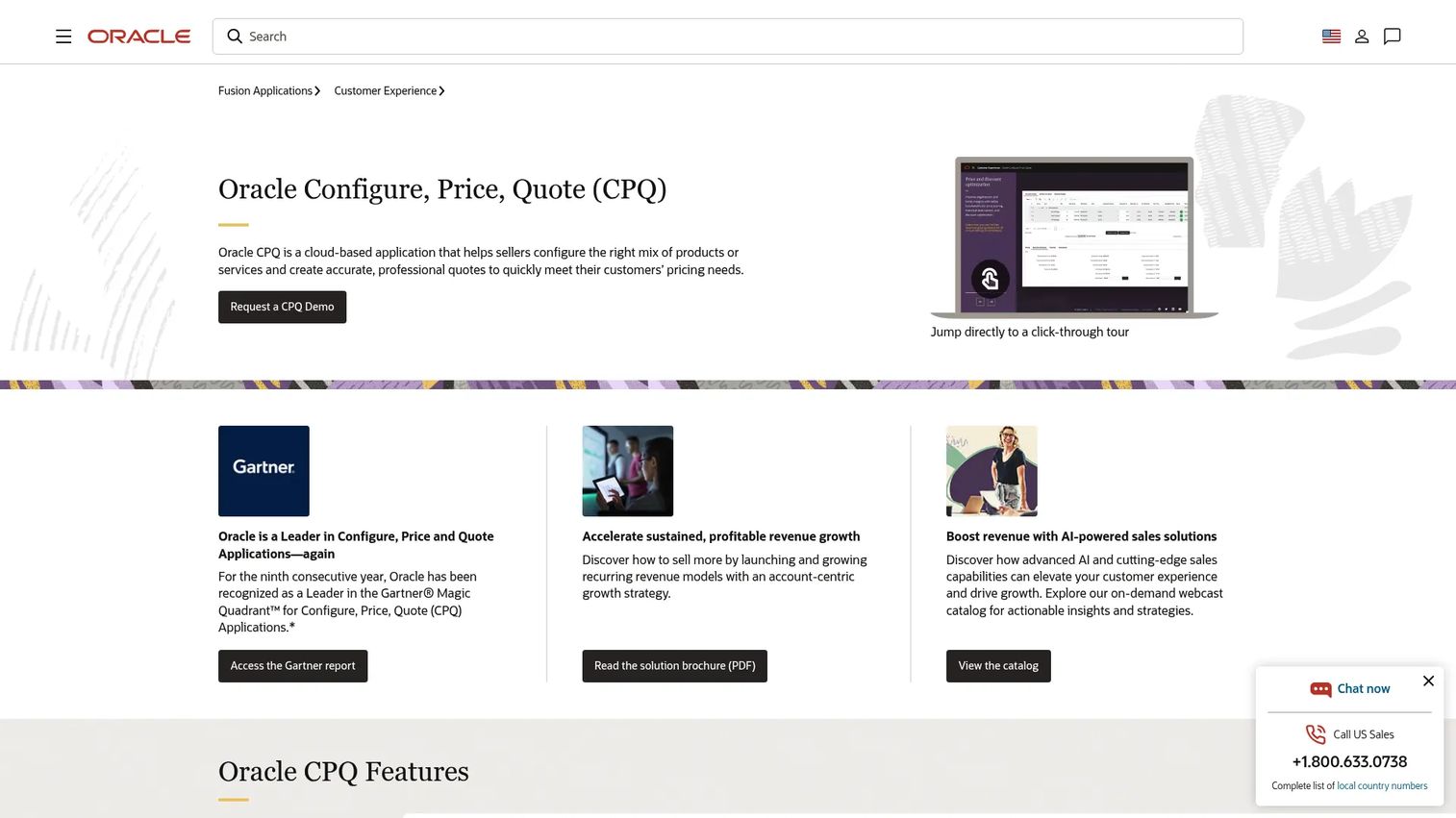
Oracle CPQ is a cloud application for configuring complex products, applying pricing rules, generating quotes and proposals, and supporting quote-to-order workflows. It includes guided selling, flexible discounting and promotions, approval workflows, and integration with Oracle's ERP, Salesforce, and other commerce platforms. Oracle CPQ suits organizations where the product catalog is large and complex, pricing is multi-dimensional, and the approval chain involves multiple business units.
Best for: Midmarket and enterprise organizations selling complex, configurable products across direct, partner, and ecommerce channels.
Key features
- Guided selling and automated product configuration rules
- Flexible pricing, discounting, promotions, and multi-level approval workflows
- Branded quote, proposal, contract, and document generation
- Integration with CRM, ERP, subscription, and e-signature platforms
- AI-driven pricing insights, recommendations, and quote summaries
Why choose Oracle CPQ: Oracle CPQ is the right call when product complexity is the primary challenge. If your quoting requires complex configuration rules, multi-channel pricing, or tight ERP integration, this platform handles it at scale. Teams outside the Oracle ecosystem will need to evaluate integration effort carefully.
Oracle CPQ pricing: Oracle CPQ Cloud Service starts at $240 per hosted named user per month, with a minimum of 10 users. A channel user license is available at $35 per user per month with a 50-user minimum. External API access is priced at $500 per month per 1,000 interactions. The Salesforce connector is $5 per user per month. Standard subscription terms are three years.
G2 rating: 4.0/5
5. Zilliant
Zilliant provides enterprise B2B pricing software focused on consistent pricing execution, optimization, and margin control. Its core use case is helping large manufacturers and distributors manage complex pricing across thousands of products, customer segments, and regional markets. Zilliant includes pricing scenario modeling, customer agreement management from proposal through renewal, and sales guidance tools that help reps quote consistently within approved margins.
Best for: Enterprise manufacturers and distributors managing complex B2B pricing agreements and margin optimization at scale.
Key features
- Complex pricing management across products, regions, and customer segments
- Pricing scenario modeling and optimization
- Customer agreement management from proposal through renewal
- Sales guidance and pricing recommendations for reps
- Pricing analytics and margin visibility
Why choose Zilliant: Zilliant is the right tool when the core problem is pricing consistency rather than approval workflow. If your team manages thousands of SKUs, regional pricing agreements, or customer-specific contracts with renewal exposure, this platform adds structure that generic CPQ tools cannot provide.
Zilliant pricing: Contact their team for a quote. This is an enterprise platform typically contracted on annual terms.
G2 rating: 4.4/5
6. Vendavo
Vendavo is an enterprise commercial platform for B2B pricing, quoting, rebates, analytics, and revenue management. It uses AI, machine learning, and elasticity modeling to optimize pricing decisions and provide deal guidance to sales reps. Vendavo also covers rebate and incentive management, channel data management, and margin bridge analysis. It is a fit for large B2B organizations where commercial excellence, pricing discipline, and profitability controls are strategic priorities, not just operational ones.
Best for: Large B2B manufacturers, distributors, and service organizations managing complex pricing, rebates, and commercial operations.
Key features
- Price management and optimization using AI and elasticity modeling
- Quoting, deal guidance, and negotiation support
- Rebate and incentive management
- Customer agreement and price lifecycle governance
- Pricing analytics, dashboards, and margin bridge analysis
- Channel data management and enterprise integrations
Why choose Vendavo: Vendavo suits organizations where pricing is a competitive differentiator and margin protection is a board-level metric. It goes deeper on rebate management and commercial analytics than most CPQ tools, making it a fit for distributors and manufacturers with complex channel structures.
Vendavo pricing: Request a demo to get a quote. G2 reviewers describe it as an enterprise investment typically contracted annually.
G2 rating: 4.3/5
7. PROS
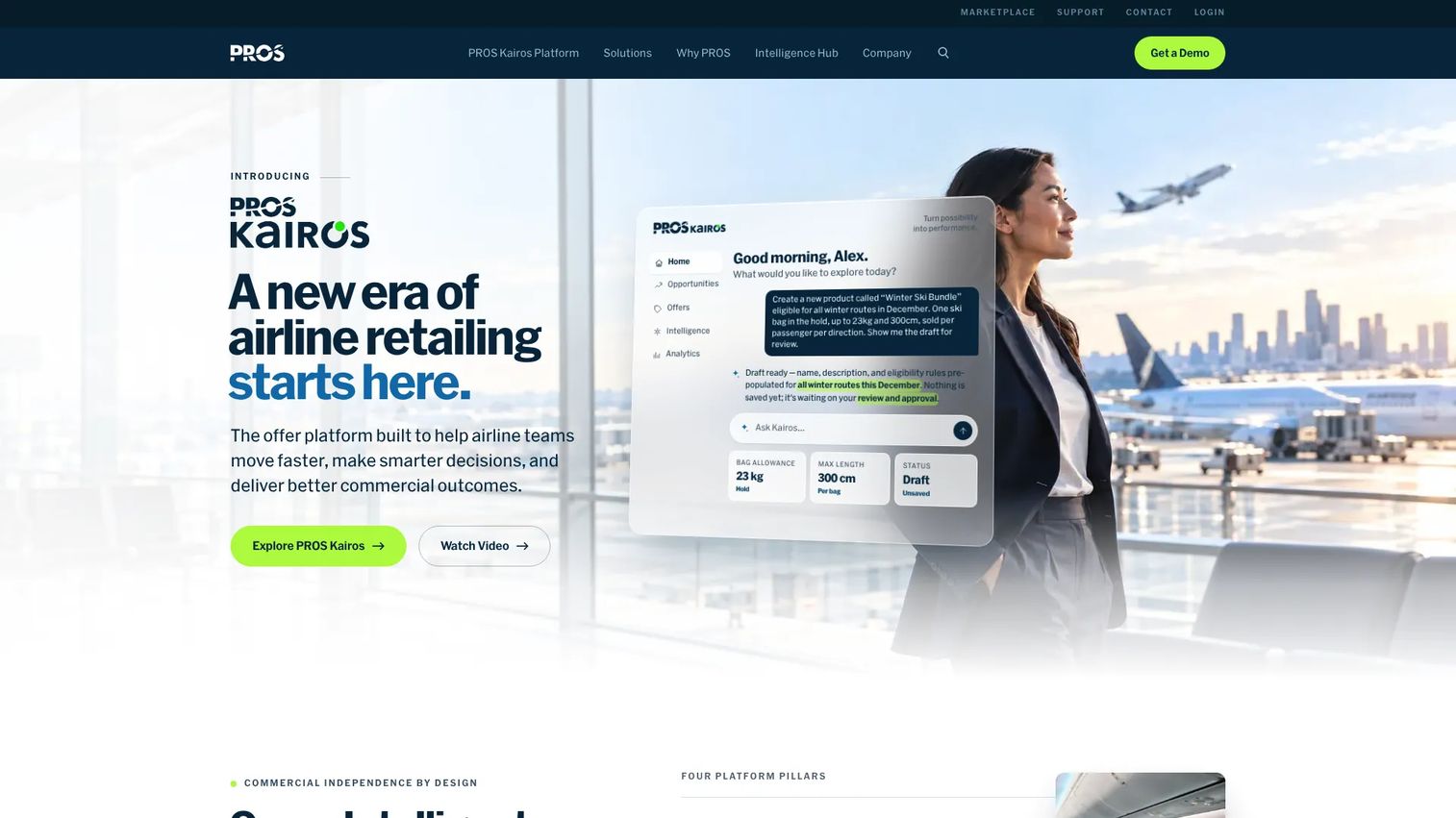
PROS provides AI-powered software for pricing, revenue management, quoting, and offer optimization. It serves enterprise airlines and B2B organizations, with AI models that generate dynamic pricing recommendations and optimize deal guidance in real time. PROS Smart Price Optimization and Management is the publicly priced product within their portfolio. The platform addresses complex pricing environments where static price lists cannot respond fast enough to market conditions or customer-specific variables.
Best for: Enterprise airlines and B2B organizations managing dynamic pricing, revenue management, and AI-driven deal guidance at scale.
Key features
- AI-powered dynamic pricing and price optimization
- Real-time offer management and pricing recommendations
- CPQ and guided selling workflows
- Revenue management for complex, variable pricing environments
- Pricing analytics and deal performance tracking
Why choose PROS: PROS fits teams where pricing is dynamic and volume-sensitive. If your AEs are quoting into markets where prices shift with demand, competition, or customer segment, the AI pricing layer gives reps guidance that spreadsheet-based price lists cannot. It is a substantial investment and suits large enterprise buying environments.
PROS pricing: PROS Smart POM Essentials starts at $6,250 per month. PROS Smart POM Advantage starts at $14,000 per month. These prices apply to their price optimization and management product. Other PROS products are priced separately on request.
G2 rating: 4.2/5
8. Apttus (now Conga)
Apttus, now operating under the Conga brand, is an enterprise commerce platform spanning CPQ, contract lifecycle management, document automation, and pricing. Apttus built a strong market position in complex CPQ and CLM for large enterprises on Salesforce, and those capabilities are now part of the broader Conga platform. Teams evaluating Apttus today are effectively buying into the Conga product suite, which continues to serve enterprise quote-to-cash and approval workflow requirements.
Best for: Large enterprises needing connected CPQ, contract automation, document workflows, and pricing governance.
Key features
- Complex product configuration, pricing, and quoting
- Contract CLM with approvals, redlining, and e-signature
- Document generation, templates, and automation
- Omnichannel price-list management and approval workflows
- Integrations with Salesforce and ERP platforms
Why choose Apttus (Conga): Teams that evaluated Apttus historically and are now re-evaluating will find the product set has expanded under Conga's umbrella. It remains a strong choice for enterprises that need CPQ and CLM to work together without additional middleware.
Apttus pricing: Pricing is custom. Contact Conga's sales team for a quote. G2 reviewers describe enterprise contracts in the mid-five to six-figure annual range depending on module selection.
G2 rating: 4.3/5
Considerations
Evaluating deal desk software looks similar to evaluating most revenue tools. These four criteria separate a good fit from an expensive mistake.
Approval routing depth
A platform that supports basic discount thresholds is not the same as one that handles multi-level approval chains with SLA tracking and exception logging. Ask vendors how they handle concurrent approvals, what happens when an approver misses an SLA, and whether approval logic is configurable without engineering support.
CPQ and pricing controls
The strength of pricing governance varies significantly across this list. PROS and Zilliant are purpose-built for complex pricing execution. DealHub and Salesforce Revenue Cloud cover CPQ as part of a broader revenue platform. Oracle CPQ focuses on product configuration complexity. Match the tool to the actual pricing problem, not just a feature checklist.
Finance, legal, and CRM integration
Deal desk software only works if it connects to your existing stack. Confirm whether the tool integrates natively with your CRM, or whether the connection requires a third-party middleware. For contract workflows, verify whether legal teams can work in the tool directly or whether documents get exported for redlining. Check contract management needs separately from CPQ needs.
Reporting and SLA visibility
You cannot fix a process you cannot measure. Ask for specific reporting on approval cycle time, exception rates by rep or deal type, and margin impact of approved discounts. Platforms with weak analytics will show you deal counts but not where the process breaks.
Implementation effort and governance
Several tools on this list, particularly Oracle CPQ and Salesforce Revenue Cloud, carry significant implementation complexity. Build a realistic estimate of time-to-value based on your team's configuration capacity. Some vendors offer implementation services; others rely entirely on partners. Ask for reference customers at similar company sizes before signing.
Conclusion
Deal desk software covers a wide spectrum. At one end, platforms like DealHub and Conga handle the entire quote-to-revenue process with integrated CPQ, contract workflow, and billing. At the other, Zilliant, Vendavo, and PROS specialize in pricing intelligence and margin optimization for manufacturers and distributors where pricing complexity is the core challenge.
For most SaaS AEs evaluating this category, DealHub is the strongest starting point for end-to-end quote-to-revenue. Salesforce Revenue Cloud is the natural fit if your team is already deep in Salesforce and can absorb the configuration investment. Oracle CPQ suits large enterprises with complex product catalogs. Conga wins where contract orchestration and document generation are the primary bottleneck.
The right evaluation starts with one question: Where do your deals actually stall? Map your approval bottlenecks before comparing feature lists.
Also worth reviewing as you build your stack: best revenue operations software, best sales management software, and best CPQ software for adjacent coverage.
Start your journey with Guideflow today!
FAQs
Deal desk software is a category of tools that automates and governs the approval, pricing, quoting, and contract workflows that sit between a salesperson and a closed deal. It routes discount requests, enforces pricing guardrails, manages exceptions, and connects sales with finance and legal so deals move without manual bottlenecks. The category overlaps with CPQ, CLM, and revenue operations software.
CPQ (configure, price, quote) handles the mechanics of building an accurate quote: Product configuration, pricing rules, and document generation. Deal desk software adds the governance layer on top of that: Who needs to approve the quote, what happens when a discount exceeds a threshold, and how the deal routes to legal or finance before it's sent to the buyer. Many platforms, including DealHub and Conga, combine both.
Small teams with simple pricing and standard contracts usually don't need a dedicated deal desk platform. The category earns its value when discounting is inconsistent, approval chains slow deals, or non-standard terms create legal review bottlenecks. Teams under 10 reps with predictable deal structures can typically manage with a CRM plus a lightweight quote management tool.
The core capabilities to evaluate are configurable approval routing with SLA tracking, pricing and discount governance with rules-based controls, quote and contract workflow including document generation and e-signature, and integration with the CRM your team already uses. Analytics on approval cycle time, exception rates, and margin impact separate mature platforms from basic workflow tools.
Deal desk software enforces pricing floors and discount thresholds before a quote reaches the buyer. When a rep attempts a discount that exceeds the approved range, the platform triggers an approval request rather than letting the deal proceed. This creates a documented record of exceptions, reduces margin leakage from ad hoc discounting, and gives leadership visibility into where exceptions concentrate.
Yes, and that is the primary operational case for the category. Manual approval chains, where reps email managers and wait for responses across time zones, routinely add days to deals that should close in hours. Structured routing with defined approvers, SLA notifications, and parallel approval flows compresses that cycle. TrendCandy's 2025 research found that 71% of respondents reported quotes take at least a day to produce, with manual processes as the primary cause.
No, though most tools on this list target midmarket and enterprise buyers because that's where deal complexity and approval chains create the most friction. SMB teams with simple, standardized deals rarely need the full governance layer. The entry point is typically when a team has multiple approvers, non-standard pricing requests, or high-value contracts requiring legal review. Some platforms, including Salesforce Revenue Cloud, can be configured for mid-market at a lower seat count.
The primary metrics are approval cycle time, the gap between when a rep requests an exception and when it's resolved; exception rate by rep, deal type, and product line; margin on approved deals versus standard deals; and quote-to-close conversion. Secondary metrics include legal review cycle time, contract redline rounds, and renewal rates on deals that went through the desk. Platforms with weak reporting will give you deal volume but not the process data that drives improvement.