A financing round, an acquisition, or a high-stakes customer agreement should not depend on one person manually reconciling email threads, redlines, signature status, and a closing checklist. Yet that is exactly how most legal transaction management works until someone builds a real system.
According to the Wolters Kluwer Legisway Benchmark (2025), 33% of legal departments still rely on general-purpose tools like Google Drive or SharePoint for contract management. The transaction complexity those tools generate is visible the moment a deal involves multiple external counsel, competing document versions, and stakeholders who each believe they have the current draft.
Legal transaction management software exists to replace that coordination tax. The right platform assigns responsibility, tracks documents to completion, manages signature workflows, and produces a clean closing record. For a founder scaling through financing rounds and enterprise contracts, it is the difference between a legal function that creates visibility and one that creates risk.
What's inside
This guide compares 10 legal transaction management platforms for 2026. It is written for in-house legal teams, law firms, legal operations leaders, and founders who need repeatable transaction infrastructure. Tools were selected based on four criteria:
- Transaction workflow depth: Checklists, status tracking, and closing coordination as core capabilities
- Document and closing management: Version control, signature tracking, and closing-book generation
- Security and collaboration controls: Permissioned access, audit trails, and external party coordination
- Pricing transparency and review presence: Verified against live pricing pages and G2 or Capterra listings
TL;DR
- Best for document-heavy closings: iManage Closing Folders, for firms that need closing checklists tied directly to document governance
- Best for dedicated transaction workflow depth: Litera Transact, for corporate legal teams handling M&A, financing, and restructuring
- Best for enterprise legal collaboration: HighQ, for large departments that need transaction workflows alongside broader legal operations infrastructure
- Best for repeatable deal closings: dealcloser or SimplyAgree, depending on whether your priority is all-in-one closing workflow or signature-first closing books
- Best for structured legal project work: Legatics, for high-volume firms that need configurable checklists and signing management across many concurrent matters
What is legal transaction management software?
Legal transaction management software is a platform that helps legal teams plan, coordinate, execute, and document complex transactions from early diligence through signed documents and final closing books.
Core jobs the software handles
- Matter-level task lists and digital closing checklists
- Document collection, version control, and approvals
- Responsibility tracking across internal and external stakeholders
- Signature coordination and completion status
- Secure document sharing with controlled permissions
- Automated closing binder or closing book generation
- Audit trails, deal dashboards, and status reporting
How it differs from adjacent legal tools
Buyers often evaluate a document tool when what they need is a transaction operating system. The distinction matters.
| Tool category | Primary job | What it does not replace |
|---|---|---|
| Legal transaction management software | Runs the legal deal workflow from diligence through closing | Full contract repository governance |
| Document management system | Stores and organizes legal documents | Transaction checklists and closing coordination |
| Virtual data room | Shares sensitive files during diligence | End-to-end closing workflow orchestration |
| E-signature software | Collects signatures | Matter-level responsibility and closing book management |
| Contract lifecycle management software | Manages contract creation and post-signature lifecycle | Complex transaction closing coordination |
Some platforms deliberately combine virtual data room and transaction management capabilities. Evaluate whether that overlap is an advantage or a pricing burden for your use case.
When to use legal transaction management software
Run financing and M&A transactions without spreadsheet sprawl
When a deal involves ancillary documents, multiple signature counterparties, and layered closing conditions, manual coordination becomes a liability. A dedicated platform gives every stakeholder a live view of what is open, who owns it, and what remains before signing. For a founder in a Series B raise or acquisition process, that visibility replaces the status meeting that pulls the GC away from substantive work.
Give outside counsel and internal teams one source of truth
Legal transactions often involve your legal team, external firm partners, finance, and counterparty counsel all working simultaneously. Controlled collaboration through a shared platform means fewer document-chasing emails and more time on the substantive deal. Permissioned access keeps each party seeing only what they should see.
Build a repeatable closing process as deal volume rises
A company moving from founder-led legal coordination to a proper legal operations function needs templates, not spreadsheets. The right platform supports reusable checklists, role-based task ownership, and closing-book generation that runs the same way every time. This is how a newly hired GC or legal operations lead earns adoption quickly: One repeatable matter type, one live transaction, measurably fewer manual follow-ups.
Legal transaction management software comparison
The table below provides a first-pass shortlist. G2 ratings reflect current live listings. Where no G2 rating is available, the column notes the source used.
| # | Product | Best for | Key differentiator | Pricing | G2 rating |
|---|---|---|---|---|---|
| 1 | iManage Closing Folders | Document-heavy legal closings | Closing checklists plus branded closing-book generation | Contact vendor | 5.0/5 |
| 2 | Litera Transact | Corporate transaction teams | End-to-end deal workflow from checklist through binder | Contact vendor | 4.7/5 |
| 3 | HighQ | Enterprise legal collaboration | Transaction workflows within a broader legal platform | Contact vendor | 4.3/5 |
| 4 | Projectfusion | Complex legal project coordination | Secure VDR with configurable collaboration workflows | Free during prep, paid at deal launch | Not listed on G2 |
| 5 | dealcloser | Repeatable transactional legal processes | Digital closing workflows with virtual data rooms | Contact vendor | 5.0/5 |
| 6 | Closd | Transaction execution and collaboration | Integrated project management, e-signature, and data room | Contact vendor | Not listed |
| 7 | SimplyAgree | Law firms closing frequent deals | Signature packets, closing books, and checklists in one workflow | Contact vendor | 5.0/5 |
| 8 | NetDocuments DELIVER | Teams using NetDocuments | Transaction workflows inside an established document governance environment | Contact vendor | 3.9/5 |
| 9 | Legatics | High-volume legal projects | Structured signing management and automated closing binders | Contact vendor | 1.0/5 |
| 10 | Naya | Commercial real estate lending | AI-powered due diligence and real-time closing checklists | Contact vendor | Not listed |
10 best legal transaction management software tools for 2026
1. iManage Closing Folders
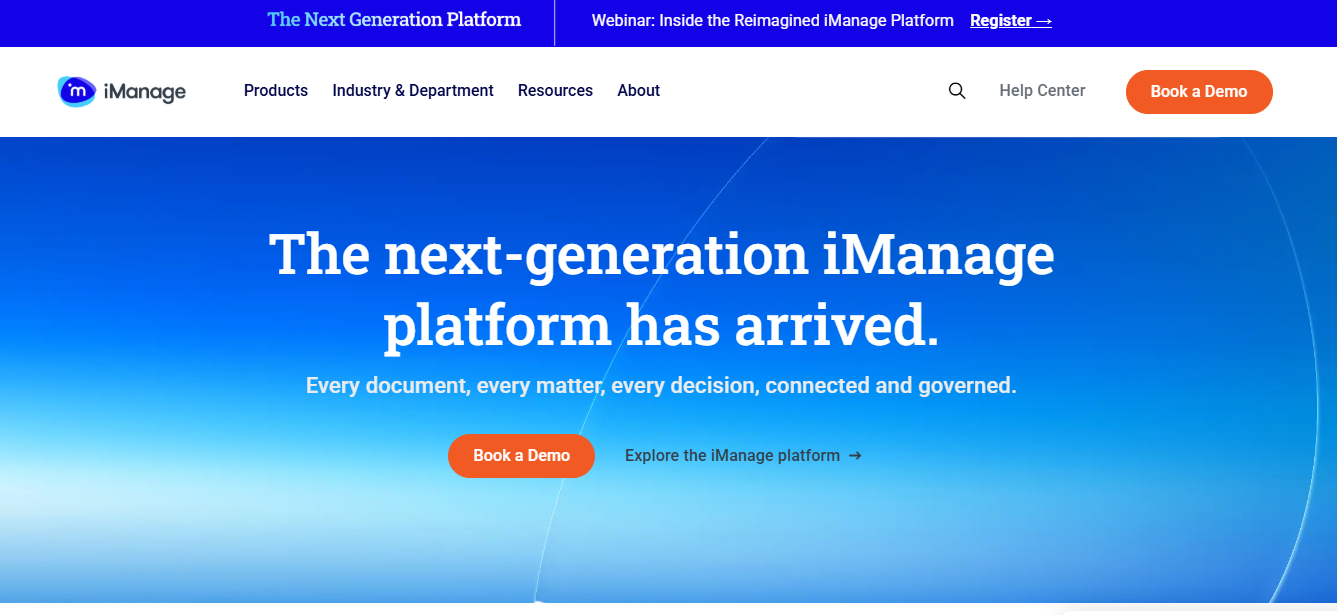
iManage Closing Folders is a transaction management platform built specifically for legal deal closings. It automates closing checklists, tracks signatures and document deliverables, and generates branded closing books, all within the iManage document governance environment. The platform targets law firms and corporate legal teams handling M&A, banking and finance, and commercial real estate transactions.
Best for: Law firms managing mergers and acquisitions, banking and finance, and real estate transactions that require document-heavy closing coordination.
Key features
- Collaborative closing checklists with task, signature, and revision visibility
- Signature page recognition and signature management
- Branded closing-book creation
- Integration with iManage document management
- Real-time reporting and deal-status visibility
Why choose iManage Closing Folders: The strongest fit is for teams already operating inside the iManage environment. Adding Closing Folders extends an existing governance layer rather than creating a parallel system, which reduces the duplicate document work that kills adoption of standalone tools.
iManage Closing Folders pricing: iManage sells through a direct sales model and does not display pricing on its website. Contact the vendor to discuss scope based on users, matters, and any existing iManage platform agreements.
G2 rating: 5.0/5 (1 review)
2. Litera Transact

Litera Transact is a dedicated transaction management platform for corporate legal work. It handles collaborative checklists, automated signature management, and instant closing-set creation across M&A, financing, private equity, and restructuring matters. The platform is built for transactional lawyers who need depth in the closing process itself rather than a general legal project tool.
Best for: Transactional legal teams handling M&A, financing, and restructuring that need a structured system for complex closings with many documents and stakeholders.
Key features
- Dynamic collaborative checklists with real-time status
- Automated signature management with signer tracking
- Instant closing-set and closing-book creation
- Document collaboration and version control
- Integrations with document management and e-signature systems
Why choose Litera Transact: For legal teams whose primary challenge is closing coordination depth, rather than broader collaboration infrastructure, Litera Transact is purpose-built for that job. It suits firms that run frequent corporate deals and need the checklist-to-binder workflow to operate predictably every time.
Litera Transact pricing: Litera does not publish tier pricing on its website. Contracts are quote-based and typically reflect the size of the legal team, matter volume, and any bundling with other Litera products. Request a quote through the vendor's sales team.
G2 rating: 4.7/5 (15 reviews)
3. HighQ
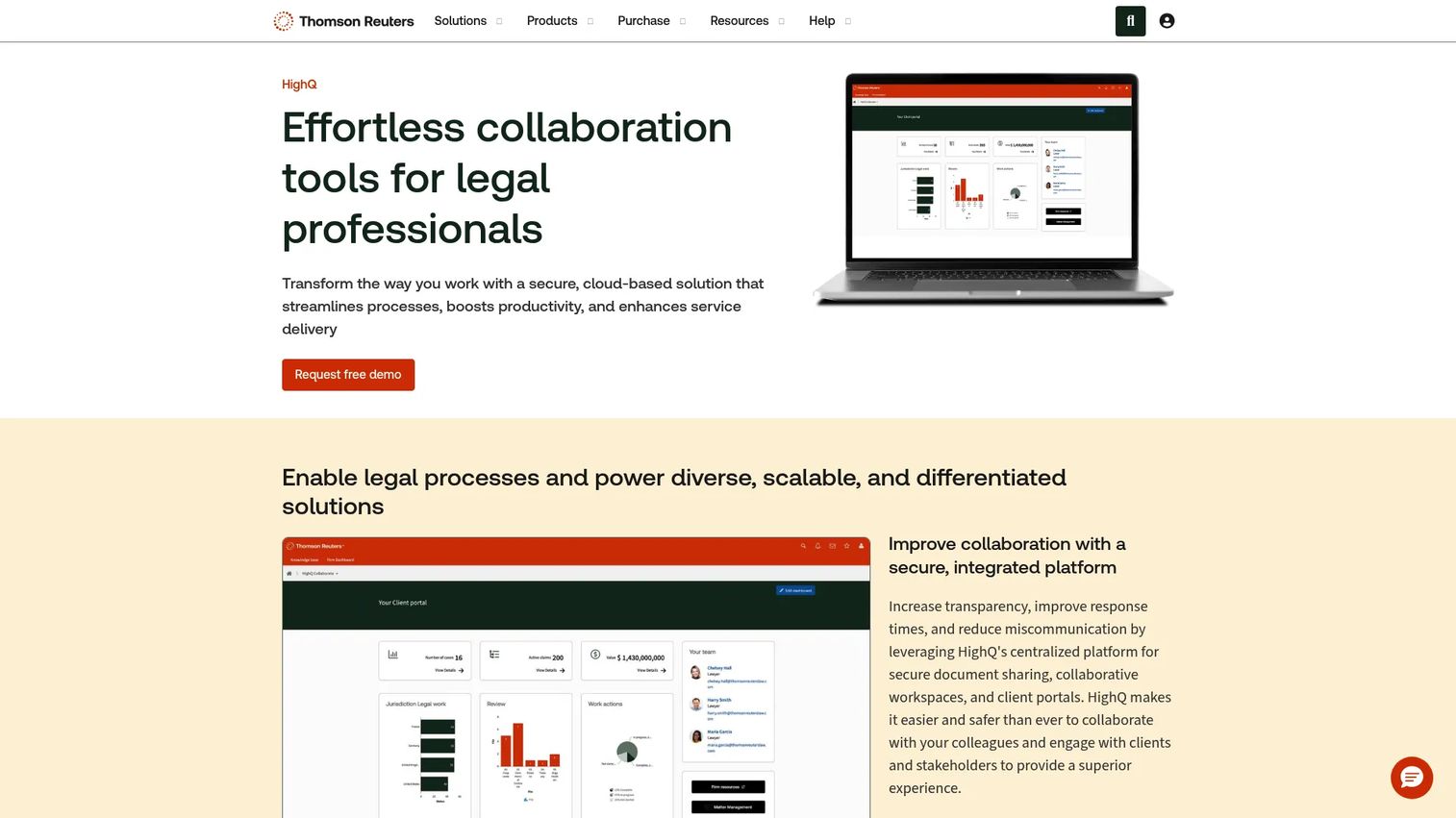
HighQ is a secure, cloud-based legal collaboration platform owned by Thomson Reuters. It combines document management, structured data, workflow automation, and AI-enabled legal processes in a single environment. For transaction work, it provides secure matter workspaces, permissioned document sharing, and task-level coordination, but its scope extends well beyond deal closing into broader legal service delivery.
Best for: Enterprise legal departments and large law firms that need transaction management connected to knowledge management, client collaboration, and AI-assisted document work.
Key features
- Secure document and file management with version control, permissions, and audit trails
- Structured data management through iSheets for spreadsheet-style collaboration
- Workflow automation for legal project management and due diligence
- AI Hub for document classification and metadata extraction
- Task and milestone tracking with reporting dashboards
Why choose HighQ: Choose HighQ when transaction management must connect to a broader legal infrastructure, including knowledge bases, client portals, or document intelligence. Teams that need a standalone closing tool may find its scope broader than necessary, but organizations already in the Thomson Reuters ecosystem gain tight integration across legal workflows.
HighQ pricing: HighQ uses a module-based model sold through Thomson Reuters. Pricing is quote-based and reflects the modules selected, seat count, and enterprise agreement terms. Contact Thomson Reuters directly for a proposal.
G2 rating: 4.3/5 (16 reviews)
4. Projectfusion
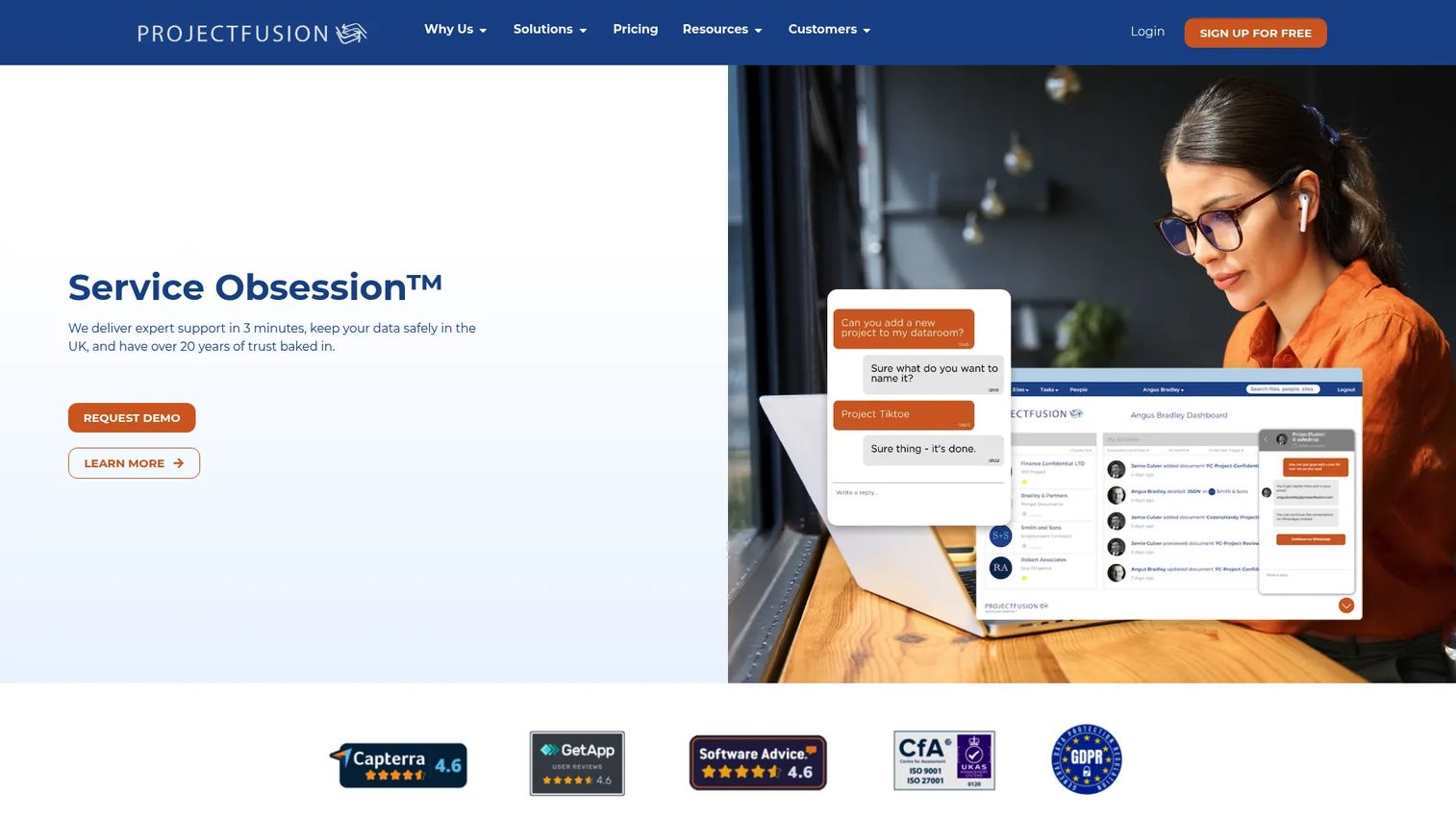
Projectfusion is a secure virtual data room and collaboration platform designed for sensitive document sharing, due diligence, and regulated legal workflows. It serves legal, M&A, real estate, life sciences, and public-sector teams with granular permission controls, auto-indexed document structures, and built-in Q&A functionality. Its core strength is controlled external collaboration on confidential matters.
Best for: Legal operations teams managing complex multi-party transactions who need configurable access controls and structured document workflows without relying on disconnected shared drives.
Key features
- Granular permissions and access controls
- Real-time audit trails and reporting
- Auto-numbering and instant document indexing
- Built-in Q&A module
- Hybrid AI redaction and dynamic watermarking
Why choose Projectfusion: Projectfusion makes sense when secure external document sharing is the primary coordination challenge. Its data room focus means it excels at diligence-phase access control. Teams that also need task assignment, signature workflows, and closing-book generation should confirm whether those functions meet their requirements before committing.
Projectfusion pricing: Data rooms are free during preparation and become paid when a deal goes live. The vendor offers flat-rate plans across four tiers, with storage options ranging from 500MB to 50GB. Tier prices are not displayed on the pricing page. Capterra reviewers report.
G2 rating: 4.7/5 from 13 reviews.
5. dealcloser
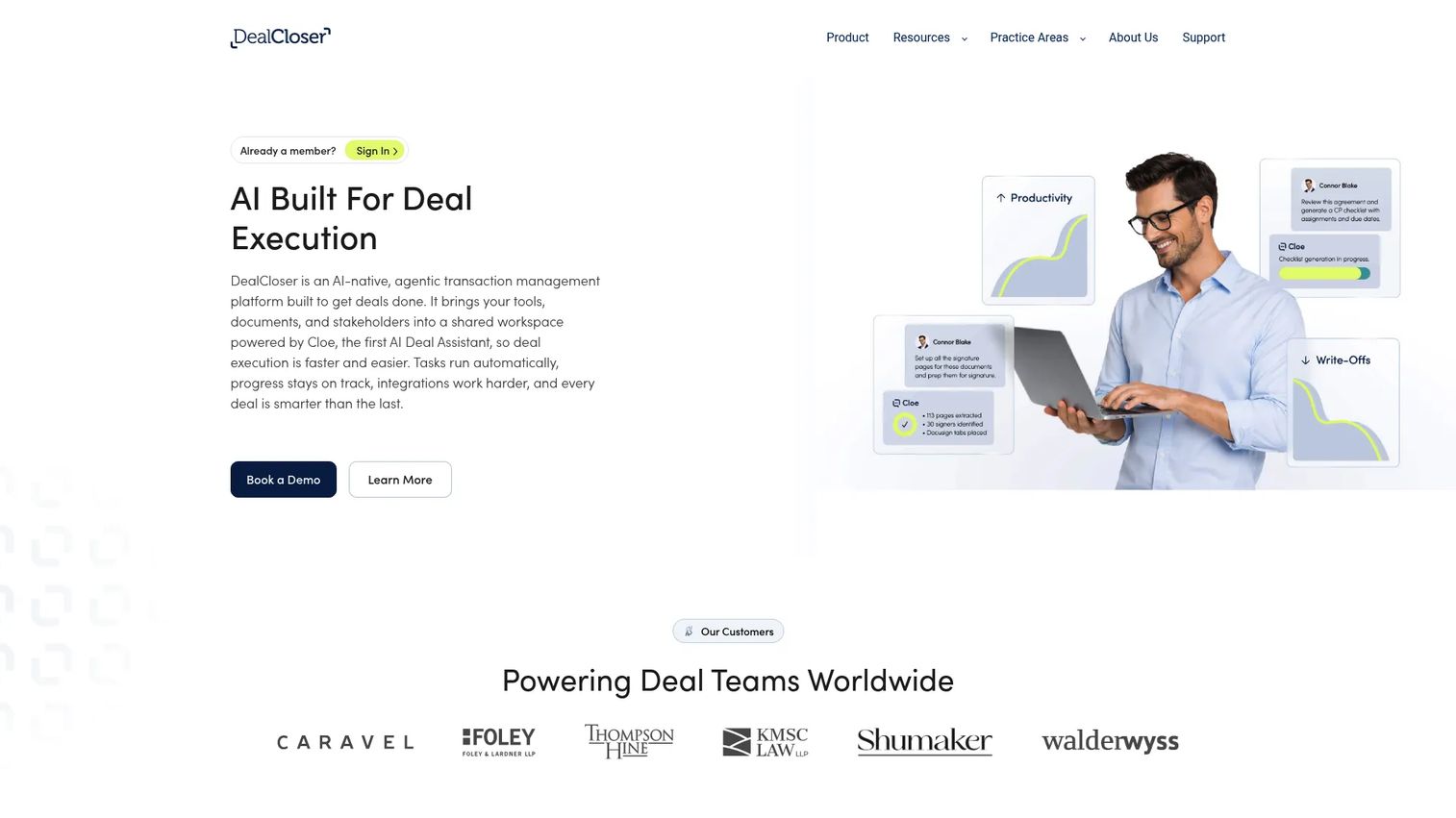
dealcloser is a transaction management platform for legal professionals that coordinates corporate deal closings from initial checklist through final binder. It includes digital closing checklists, document automation, electronic and digital signature management, a client portal, branded closing sets, and a virtual data room. An AI deal assistant is included to support closing workflow tasks.
Best for: Corporate legal teams and law firms managing complex transaction-closing workflows who want a purpose-built alternative to spreadsheet checklists and email coordination.
Key features
- Closing checklists and project management
- Document automation and version control
- Electronic and digital signature management
- Branded closing sets and binders
- AI deal assistant for closing workflow support
Why choose dealcloser: dealcloser is a strong choice for transactional lawyers replacing manual closing processes. Its all-in-one scope, covering checklists, signatures, a data room, and binders in a single platform, reduces the number of tools a legal team needs to switch between during a complex close.
dealcloser pricing: Pricing is not displayed on the vendor website. The commercial model is quote-based, and the sales page directs prospects to request pricing or book a demo. Reach out directly to discuss team size and matter volume.
G2 rating: 5.0/5 (2 reviews)
6. Closd
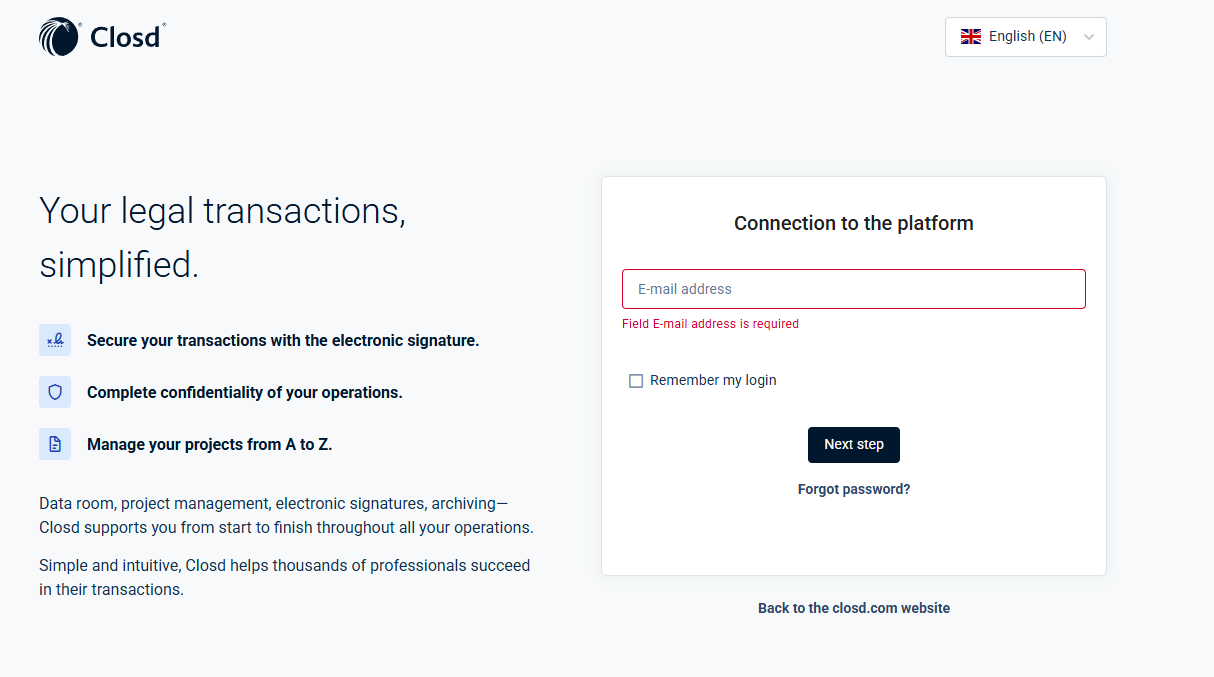
Closd is a legal transaction management and data room platform that helps law firms, M&A advisors, and corporate legal teams digitize deal closing and due diligence workflows. It offers secure file sharing with granular access rights, automated project management with checklists and deadline tracking, electronic signatures, and document-bible generation. Closd has been part of LexisNexis since 2021.
Best for: Law firms and M&A advisors managing confidential legal transactions who need integrated project management, signature coordination, and data room capabilities.
Key features
- Secure file sharing with granular access rights
- Automated project management with checklists and deadline reminders
- Electronic signature and document-bible generation
- Electronic archiving
- Deadline and milestone notifications
Why choose Closd: Closd suits teams that currently coordinate transactions across Word checklists, email, and separate data room tools. Consolidating those functions into one workspace reduces administrative overhead on active matters and gives deal leads a live view of what remains open before closing.
Closd pricing: Closd does not display pricing on its website. Contact the vendor to request a proposal based on transaction volume and team structure.
7. SimplyAgree
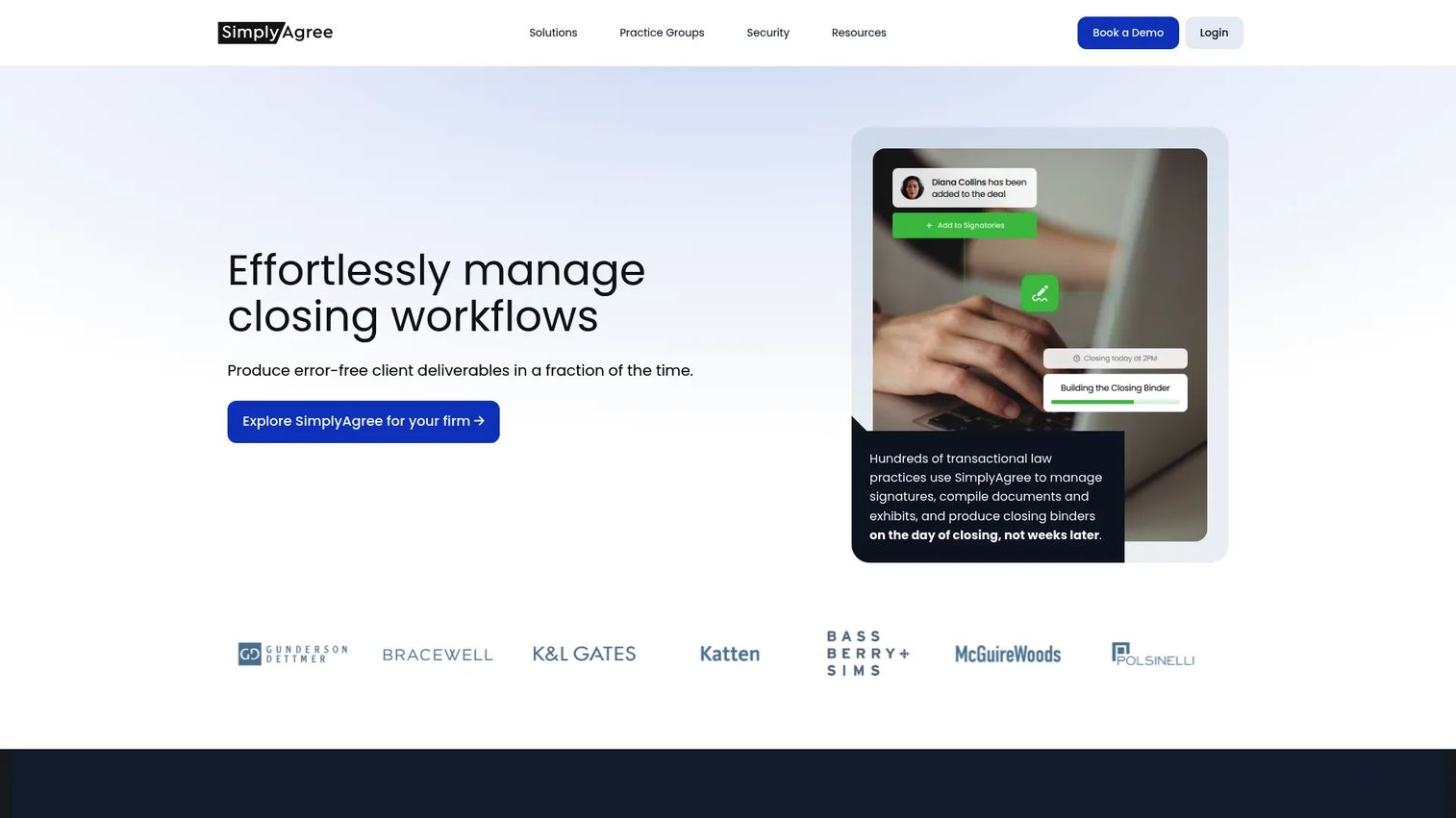
SimplyAgree is a legal transaction-closing platform focused on signature packets, electronic signing, document compilation, closing books, and checklists. It automates signature page creation with signer grouping and e-signature tagging, tracks signing progress in real time, compiles final document sets automatically, and generates closing books with branded covers, bookmarks, and hyperlinks. It integrates with document management systems and supports checklist workflows.
Best for: Law firms and legal deal teams managing complex transaction closings who need a structured system for signatures, document compilation, and closing-book generation.
Key features
- Signature page creation with automatic formatting and signer grouping
- Electronic signing with real-time progress tracking
- Automatic document compilation and version management
- Closing book generation with branded covers and hyperlinks
- Checklist creation with DMS integration and synced closing workflows
Why choose SimplyAgree: SimplyAgree is particularly strong for teams where the signature-to-closing-book workflow is the central coordination challenge. Its annual subscription model with unlimited usage suits firms that run high deal volume and want predictable costs without per-matter charges.
SimplyAgree pricing: SimplyAgree uses annual subscription pricing with unlimited usage and offers custom plans. No numeric tier price is shown on the website. Contact the vendor to request a quote based on team size and transaction type.
G2 rating: 5.0/5 (1 review)
8. NetDocuments DELIVER
NetDocuments DELIVER is a solution within the NetDocuments platform for securely sharing, organizing, packaging, and automating document delivery to clients and other constituents. Its core components include CollabSpaces for external collaboration, PatternBuilder for no-code workflow and template automation, and SetBuilder for compiling and distributing document sets and binders.
Best for: Legal organizations already operating inside NetDocuments that want transaction workflows and document delivery connected to their existing document governance environment.
Key features
- CollabSpaces for secure external file sharing within NetDocuments
- PatternBuilder for no-code workflow and document automation
- SetBuilder for compiling and distributing document sets and binders
- Permission controls and document version management
- Template automation for repeatable transaction workflows
Why choose NetDocuments DELIVER: This is primarily an ecosystem fit decision. Organizations that already depend on NetDocuments for document governance gain transaction workflow capabilities without building a parallel system. Teams not on NetDocuments should evaluate standalone transaction platforms before committing to a full platform migration.
NetDocuments DELIVER pricing: NetDocuments directs prospects to contact sales. Pricing is quote-based and reflects seat count, modules selected, and enterprise agreement scope. No public price is displayed on the vendor site.
G2 rating: 3.9/5 for NetDocuments
9. Legatics
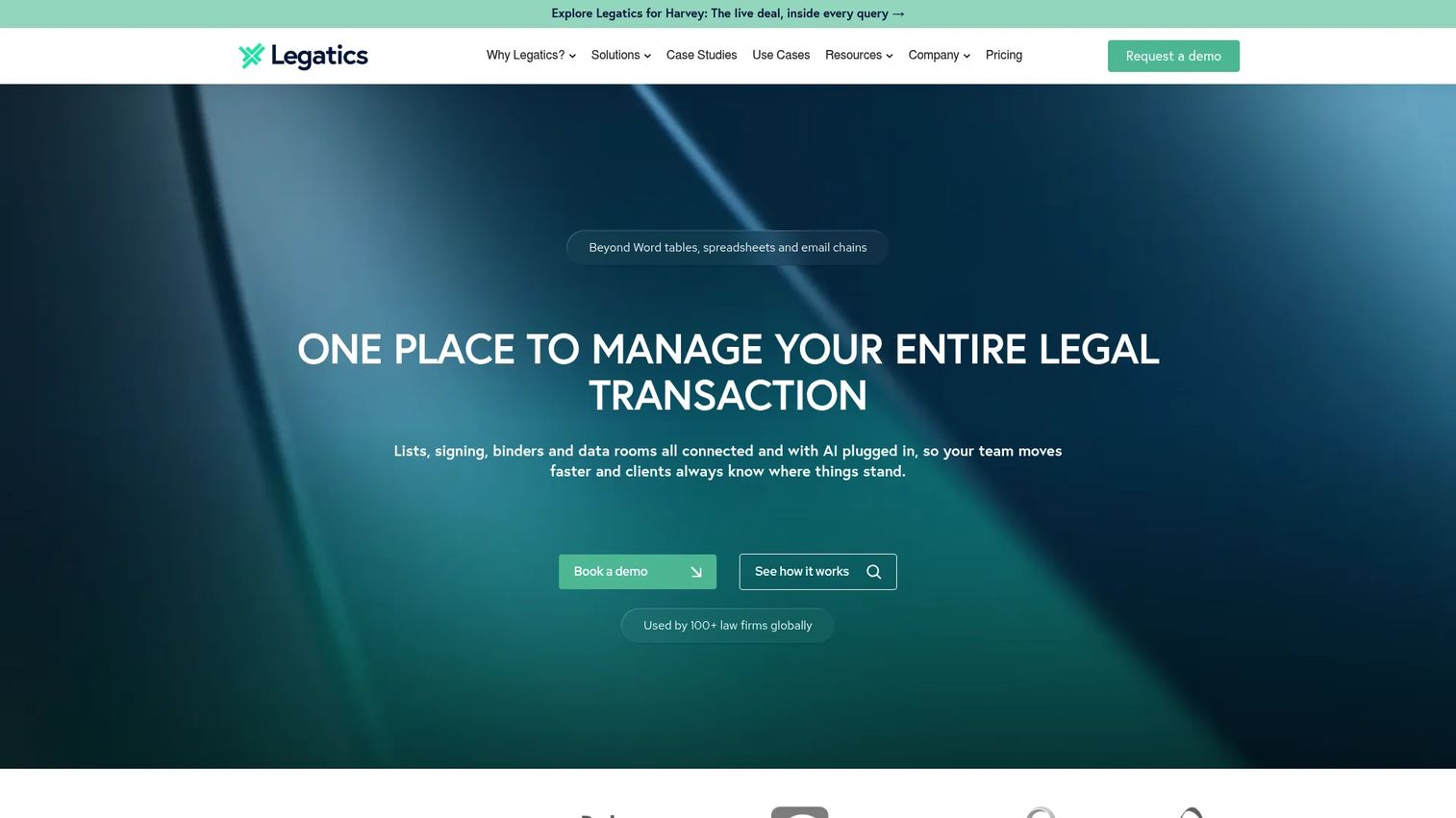
Legatics is a legal transaction management platform for managing deals, documents, signing, binders, data rooms, and related workflows. It provides real-time transaction lists for documents, tasks, and collaboration, supports both wet-ink and DocuSign signing with collation, automates closing binders with indexing, and includes data room capabilities for secure document sharing. The platform supports templates, data import, and administrative reporting.
Best for: Law firms and legal teams handling high-volume, process-heavy transactions where consistent checklist execution and signing management across many concurrent matters is the priority.
Key features
- Real-time transaction lists for documents, tasks, and comments
- Wet-ink and DocuSign signing management with signature tracking and collation
- Automated closing binders with indexing and hyperlinks
- Data rooms with secure document sharing and access controls
- Dashboards, templates, and administrative reporting
Why choose Legatics: Legatics is built for legal teams that run many matters in parallel and need a configurable workflow system rather than a tool focused narrowly on one output. Its combination of signing management, automated binders, and data rooms in a single platform suits high-volume practices.
Legatics pricing: Legatics provides custom pricing proposals after reviewing a firm's needs. No numeric price appears on the pricing page. Contact the vendor to request a proposal based on transaction volume and matter type.
G2 rating: 1.0/5
10. Naya

Naya is an AI-powered platform for commercial real estate lending, designed to accelerate loan closings and manage lending workflows. It combines document automation, real-time closing checklists, a centralized form library, AI-powered due diligence applications, and AI clause search and negotiation tools. It targets commercial mortgage lenders, agency lenders, SBA lenders, and law firms managing complex real estate loan transactions.
Best for: Commercial mortgage lenders and law firms managing real estate lending transactions who need AI-assisted due diligence and real-time closing checklist coordination.
Key features
- Document automation with version history and audit trails
- Real-time transaction closing checklists
- Centralized form library and form management
- AI-powered due diligence applications
- AI clause search and negotiation tools
Why choose Naya: Naya is a specialized choice rather than a general-purpose legal transaction tool. Its fit is strongest for commercial real estate lending workflows, where AI-assisted due diligence and form management address vertical-specific documentation complexity. Legal teams outside real estate lending should evaluate purpose-built platforms with broader transaction management scope.
Naya pricing: Naya does not display pricing on its website. Contact the vendor to discuss the commercial model based on loan volume and team structure.
Considerations when choosing legal transaction management software
Match the software to the transaction type
A financing closing has different requirements than a high-volume commercial contracting process. A platform built for M&A binders may not handle recurring corporate governance work efficiently, and vice versa. Identify your highest-risk or highest-volume matter type first, then confirm the tool handles that scenario before evaluating everything else.
Test document control and closing-book workflow
Ask each vendor to demonstrate how the platform manages document versions, signature status, final deliverables, and closing-book assembly during a live scenario. Generic project tools often break down here. The closing-book workflow in particular tends to reveal whether a platform actually handles legal transactions or merely manages tasks.
Check stakeholder access and permissions
Legal transactions regularly include counterparty counsel, outside firms, finance teams, and executives who each need different levels of access. Evaluate external collaboration controls, permission expiration, client access options, and audit-log completeness before purchase. This becomes a due diligence question during a fundraise.
Confirm integration fit before committing
Map the platform to your existing document repository, e-signature tool, matter management system, and identity provider. A tool that creates parallel document work rather than replacing it will not earn adoption from the legal team. For SaaS companies using tools like checklist management software or approval workflow software, confirm whether the transaction platform can absorb those functions or needs to run alongside them.
Measure time to first live matter
A founder should ask one practical question before signing: How soon can your legal team run its next transaction inside the system? Prioritize vendors with implementation plans that start from one repeatable matter type. A large-scale process redesign before the first live deal is a warning sign.
How to choose the right legal transaction management software for your team
If your legal work is dominated by complex closings
Start with platforms that make closing checklists, document tracking, signature collection, and closing-book generation core workflows, not optional add-ons. iManage Closing Folders and Litera Transact both prioritize this. Ask to run a live scenario, not a sales walkthrough, before committing.
If you already rely on a legal document management platform
Favor products that reduce duplicate document handling and preserve existing governance. NetDocuments DELIVER is purpose-built for this when you operate inside NetDocuments. For other document environments, confirm how documents move from draft to final executed copy inside the transaction workflow before purchasing a standalone platform.
If your team runs several transactions at once
Choose a platform with matter dashboards, task ownership, template reuse, and external collaboration controls. Legatics and dealcloser are both structured for parallel-matter environments. Your legal lead needs to see stalled items without assembling a weekly status report by hand.
If you are scaling from founder-led coordination
Start with the transaction type that currently creates the most email thread reconciliation and status meetings. Build one checklist template, run it through a live deal, and measure the reduction in manual follow-ups. SimplyAgree's unlimited-usage model suits this approach for firms that want to scale without tracking per-matter costs.
Conclusion
The right platform for legal transaction management depends on transaction type, existing document infrastructure, and how quickly your legal team needs to reach a live matter.
For document-heavy closings, iManage Closing Folders and Litera Transact offer the deepest closing workflow depth. HighQ suits enterprise departments that need transaction management connected to a broader legal collaboration environment. dealcloser and SimplyAgree are strong choices for teams focused on repeatable closing execution. Projectfusion, Closd, and Legatics each address specific needs across secure document sharing, integrated transaction management, and high-volume signing workflows. NetDocuments DELIVER is the clear fit for organizations already inside that ecosystem. Naya is purpose-built for commercial real estate lending teams.
The practical next step: Shortlist two or three platforms, then ask each vendor to run a live version of one of your current transactions. The right tool will show how it reduces status chasing, protects document control, and produces a clean closing record. Anything that cannot demonstrate that in a live scenario is a risk, not a shortcut.
FAQs about legal transaction management software
Legal transaction management software is a platform that coordinates tasks, documents, participants, signatures, and closing deliverables across a legal transaction. It replaces spreadsheet checklists and email coordination with a shared workspace that assigns ownership, tracks completion status, and generates closing records.
A virtual data room centers on secure file sharing during diligence. Transaction management software runs the workflow, assigns responsibility across stakeholders, tracks completion of tasks and signatures, and supports closing outputs like binders and closing books. Some platforms, including Closd and dealcloser, combine both capabilities in a single product.
Many platforms support closing binder or closing book workflows, but the depth varies significantly. Before purchase, verify that the platform handles document indexing, final document compilation, version control, and post-closing delivery in a way that meets your firm's requirements. Ask to see a completed closing book from a live matter, not a template.
Transactional lawyers, paralegals, legal operations teams, general counsel, corporate development professionals, finance stakeholders, and outside counsel all use these platforms. In practice, the platform spans whoever needs to coordinate on a deal, which for a SaaS company running a financing round may include internal legal, finance, and the external law firm simultaneously.
Yes, once a startup begins handling recurring financings, enterprise customer contracts, acquisitions, or complex vendor agreements. The first value is usually repeatable checklists and clear ownership, not a large enterprise rollout. Starting with one transaction type and building from there is more effective than deploying the full platform scope at once.
The most important capabilities are transaction closing checklists, document management with version control, secure external collaboration, signature tracking, permission controls, closing-book generation, reusable templates, and audit trails. According to the Thomson Reuters GC Legal Tech Pulse (2025), 44% of corporate legal departments now use legal technology frequently or all the time, up from 34% in 2024, which reflects growing recognition that manual coordination carries real risk in high-stakes matters. The right feature set connects to the specific transaction types your team runs most often.
Most vendors in this category use quote-based pricing. The commercial model typically reflects user count, transaction or matter volume, implementation scope, document platform integrations, and enterprise security requirements. Evaluate total ownership cost, including implementation and training, not only the license price. Several tools in this list bundle virtual data room and closing workflow capabilities, which changes the cost comparison against standalone tools.
The category is designed specifically to replace spreadsheet-led coordination. Shared checklists with live status, document tracking, responsibility assignments, and a searchable record of what closed are the core replacements. The challenge is adoption: A platform that legal teams, outside counsel, and counterparties all need to use only works if external collaboration is easy enough that people choose it over email.