You already have customer feedback. It lives in support tickets, renewal calls, Slack threads, and survey responses. The hard part is knowing which signal deserves action before a customer becomes a churn risk.
Most CSMs are not short on data. They are short on a system that connects a dissatisfied response to an owner, a task, and a resolution. According to Qualtrics (2025), fewer than one in three consumers even bother giving feedback directly to a company. The ones who do are telling you something important. The question is whether your stack can route that signal fast enough to matter.
The global customer satisfaction software market reached $5.96 billion in 2025 (The Insight Partners, 2026), which reflects how seriously organizations are treating this problem. PwC found that 29% of U.S. consumers stopped buying from a brand because of poor customer experience (2025). A score sitting in a dashboard does not change that number. A tool that routes a detractor to the right person in under an hour might.
This guide compares 15 customer satisfaction tools across survey depth, closed-loop workflows, integrations, pricing, and G2 ratings so you can shortlist the right fit for your team.
What's inside
This guide is for Customer Success Managers, CX leaders, support team leads, and onboarding managers at SaaS and B2B technology companies.
Tools were selected and evaluated based on:
- Feedback channel coverage: Post-ticket, in-app, email, website, SMS, and offline survey support
- Closed-loop capabilities: Detractor routing, task assignment, alert workflows, and resolution tracking
- Integration depth: Compatibility with helpdesks, CRMs, Slack, and product analytics tools
- Pricing transparency: Verified against vendor pricing pages and G2 reviewer reports
TL;DR
- Best for support-ticket CSAT: Nicereply, purpose-built for post-interaction feedback across helpdesks
- Best for teams inside a helpdesk: Zendesk or Freshdesk, where satisfaction data lives next to tickets and SLAs
- Best for enterprise Voice of Customer programs: Qualtrics or Medallia, with governance and journey analytics at scale
- Best for SaaS lifecycle surveys: Survicate or SurveySparrow, covering website, in-app, and email channels
- Best for conversational feedback forms: Typeform or Jotform, high completion rates with low setup overhead
- Best for closed-loop feedback operations: Zonka Feedback, combining survey collection with automated follow-up workflows
What are customer satisfaction tools?
Customer satisfaction tools are software platforms that collect, measure, analyze, and route customer feedback so teams can improve retention, support quality, product experience, and loyalty.
The category spans survey-first platforms, helpdesk feedback modules, CRM-connected feedback workflows, and enterprise experience management suites.
Core metrics these tools measure
- CSAT (Customer Satisfaction Score): Measures satisfaction immediately after a specific interaction, such as closing a support ticket or completing onboarding
- NPS (Net Promoter Score): Measures how likely a customer is to recommend your product, used for relationship and lifecycle health checks
- CES (Customer Effort Score): Measures how much effort a customer had to expend to complete a task or resolve an issue
Common feedback channels
- Email surveys sent after interactions or at lifecycle milestones
- In-app surveys triggered by behavior or timing
- Website pop-up or intercept surveys
- SMS surveys for field or mobile-first customers
- Post-ticket surveys embedded in helpdesk interfaces
- Offline or kiosk surveys for physical locations
- Chat and messaging-embedded surveys
Key capabilities to look for
- Survey builder with branching and logic
- Multi-channel distribution
- Sentiment and text analysis
- Dashboards and trend reporting
- CRM and helpdesk integrations
- Closed-loop follow-up workflows
- Role-based alerts and owner assignment
- Data export and ownership controls
Look for best in-app survey tools if in-product feedback is your primary channel, or explore best text analysis software if you need to process large volumes of open-text responses.
When to use customer satisfaction tools
Measure support quality after every ticket
Post-ticket CSAT is the fastest way to find agent coaching opportunities, product confusion, and repeat friction points. When a customer rates an interaction poorly, that signal is time-sensitive. Tools with helpdesk-native integration, like those embedding a rating link directly in a ticket closure email, capture feedback while the experience is fresh. The data surfaces which agents need coaching, which issues generate the most dissatisfaction, and which product areas create the most repeat contacts.
Catch churn signals before renewal risk
NPS surveys, CES scores, and open-text sentiment can surface unhappy accounts weeks before renewal conversations. Detractor alerts route low scores to a named owner who can intervene. Account-level trend tracking shows whether a specific customer's satisfaction is declining over time, not just what they scored on a single survey. Closed-loop assignment ensures someone owns the follow-up, not just the data.
Improve onboarding and product adoption
Surveys at onboarding milestones help CS teams spot where customers lose confidence or hit a wall. A drop in satisfaction during week two of onboarding may indicate a training gap or a workflow that needs better documentation. This kind of data connects directly to time-to-value and feature adoption metrics, two KPIs most CSMs are accountable for. Lifecycle survey timing tied to product events, not arbitrary calendar dates, makes the signal significantly more useful. If you want to pair satisfaction data with interactive product demos to reduce onboarding confusion, that combination can shorten time-to-value meaningfully.
Customer satisfaction tools comparison
The table below covers all 15 tools with verified pricing and G2 ratings. These are starting prices for each vendor's lowest paid tier, or the entry point where feedback features are available. Pricing was checked against each vendor's official pricing page. G2 ratings reflect current listings.
| # | Product | Best for | Key differentiator | Pricing | G2 rating |
|---|---|---|---|---|---|
| 1 | Nicereply | Support-ticket CSAT | One-click CSAT, NPS, and CES after support interactions | From $59/mo (annual) | 4.5/5 |
| 2 | Zendesk | Helpdesk-native satisfaction tracking | Feedback tied directly to support workflows | From $19/agent/mo (annual) | 4.3/5 |
| 3 | Qualtrics | Enterprise experience management | Advanced Voice of Customer analytics and governance | From $420/mo (annual) | 4.4/5 |
| 4 | Survicate | SaaS lifecycle surveys | Website, in-app, email, and product feedback surveys | From $114/mo (annual) | 4.6/5 |
| 5 | AskNicely | Service teams and frontline coaching | NPS-driven coaching and follow-up workflows | Custom pricing | 4.7/5 |
| 6 | Medallia | Large-scale CX programs | Enterprise feedback, journey, and text analytics | Custom pricing | 4.5/5 |
| 7 | HubSpot | CRM-connected feedback | Customer feedback tied to CRM records and service data | Free tier available | 4.4/5 |
| 8 | Freshdesk | Support teams needing affordable CSAT | Helpdesk feedback with ticketing and automation | From $19/agent/mo (annual) | 4.4/5 |
| 9 | SurveyMonkey | General-purpose customer surveys | Broad survey templates and accessible survey creation | From $39/mo (annual) | N/A |
| 10 | Feedbackly | Omnichannel satisfaction measurement | Emotional journey and multi-touchpoint feedback | From €199/mo (annual) | 4.3/5 |
| 11 | SurveySparrow | Conversational CSAT and NPS surveys | Chat-like survey experiences and automation | From $19/mo (annual) | 4.4/5 |
| 12 | Typeform | Polished customer feedback forms | High-completion conversational forms | From $29/mo | 4.5/5 |
| 13 | Jotform | Flexible low-cost survey forms | Large template library and form automation | Free tier available | 4.6/5 |
| 14 | QuestionPro | Research-grade customer surveys | Advanced surveys, panels, and analytics | Free tier available | N/A |
| 15 | Zonka Feedback | Closed-loop feedback management | CSAT, NPS, CES, alerts, and workflow automation | Custom pricing | 4.7/5 |
Best 15 customer satisfaction tools for 2026
1. Nicereply
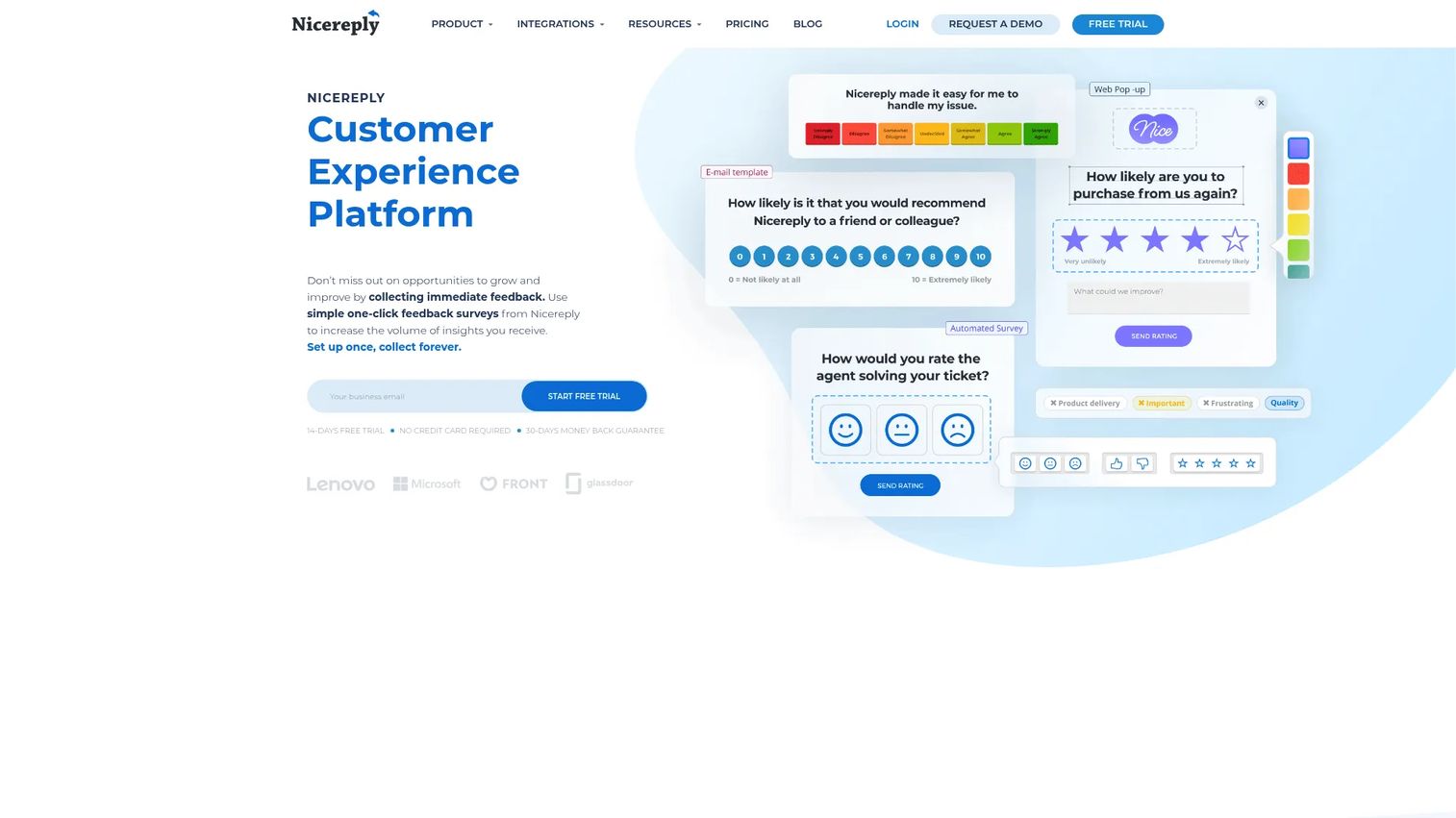
Nicereply is a customer satisfaction survey platform built specifically for support and CS teams. It collects CSAT, CES, and NPS feedback through post-resolution emails, agent signatures, direct links, and website pop-ups. Teams can segment results by agent, team, or ticket type, making it straightforward to connect feedback to individual performance or product categories.
Best for: Support and CS teams that need CSAT, NPS, and CES tied to agent performance and ticket workflows.
Key features
- CSAT, CES, and NPS surveys across four delivery channels
- Helpdesk integrations with Zendesk, Freshdesk, Front, and Help Scout
- Agent and team-level performance dashboards
- Automated follow-up triggers on low scores
- Trend charts and leaderboards for CS team reporting
Why choose Nicereply: If your primary need is measuring satisfaction right after a support interaction, Nicereply handles that job without the overhead of a full enterprise CX suite. It fits CS teams who want clean per-agent data and fast alerts on detractors.
Nicereply pricing: Plans start at $59 per month billed annually (or $79 per month billed monthly). The Starter plan covers core survey types and integrations. A 14-day free trial is available.
G2 rating: 4.5/5
2. Zendesk
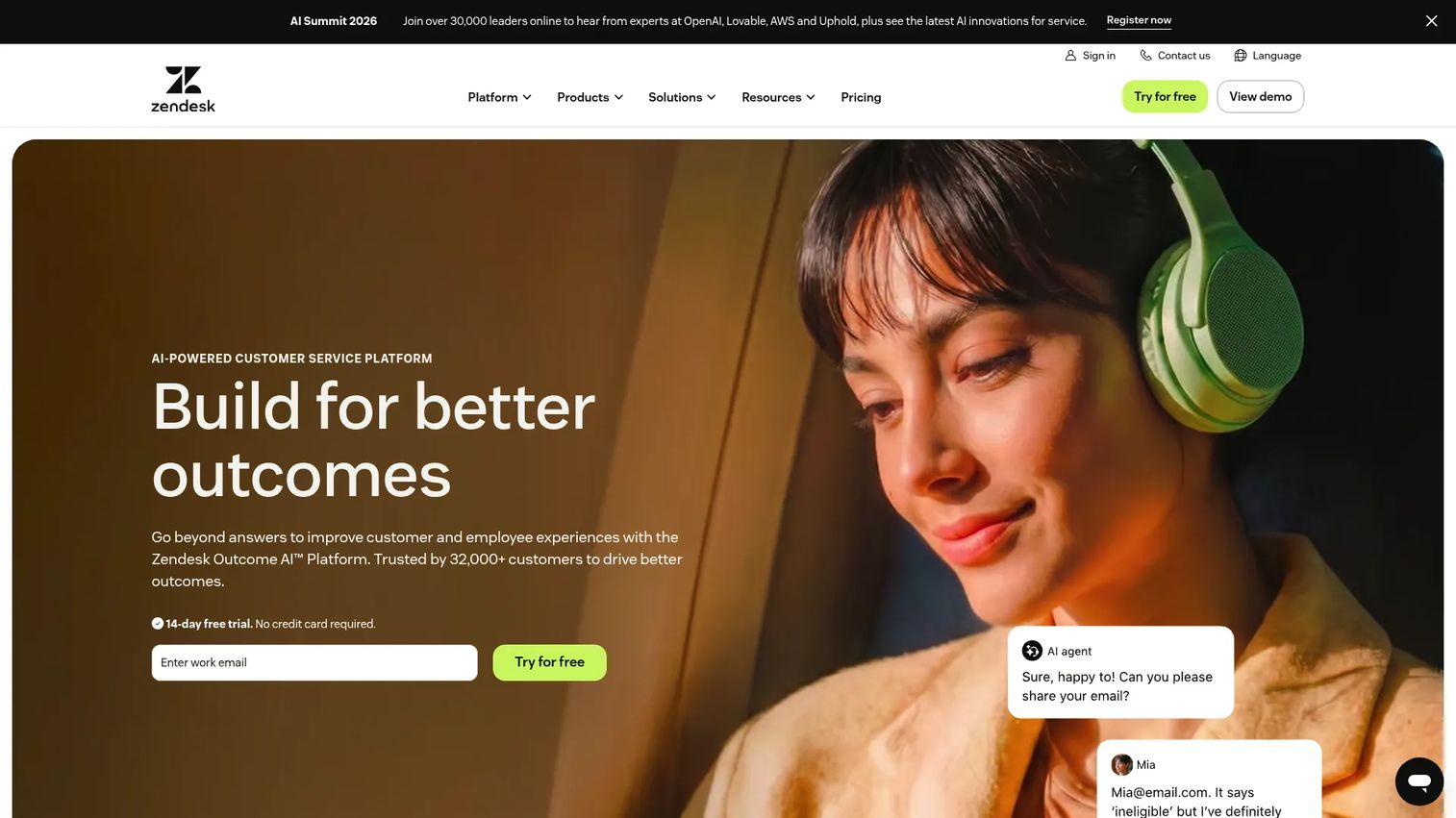
Zendesk is an omnichannel customer service platform with CSAT tracking built into its support workflows. Post-ticket satisfaction ratings are delivered automatically and sit alongside ticket records, macros, and SLA data. Zendesk also includes messaging, live chat, telephony, a knowledge base, AI agents, and analytics, making it a broader operational investment than a standalone survey tool.
Best for: Support teams that want satisfaction data inside their existing ticketing system without adding a separate feedback platform.
Key features
- Ticket-based CSAT surveys sent automatically on ticket close
- Omnichannel support inbox covering email, chat, voice, and social
- Automation and routing rules for ticket management
- Help center and AI-powered self-service tools
- Prebuilt analytics dashboards with filtering and benchmarks
Why choose Zendesk: Choose Zendesk when satisfaction feedback needs to live beside tickets, SLAs, agent notes, and routing logic. If your only requirement is a lightweight NPS or CES survey, Zendesk may be more platform than you need.
Zendesk pricing: Support Team starts at $19 per agent per month billed annually. Suite Team runs $55 per agent per month, and Suite Professional runs $115 per agent per month. Suite Enterprise pricing requires a sales conversation.
G2 rating: 4.3/5
3. Qualtrics
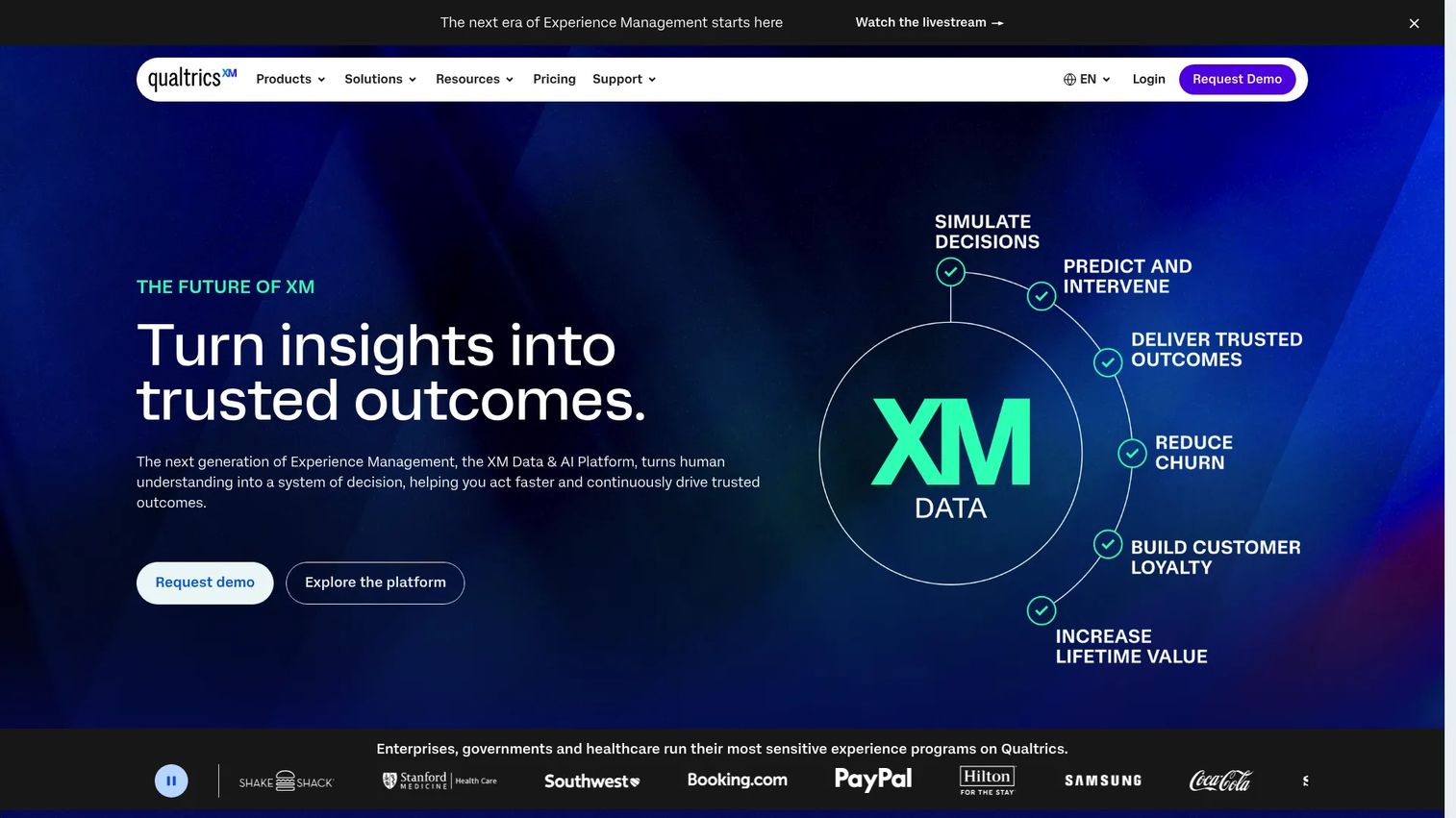
Qualtrics is an enterprise experience management platform built for Voice of Customer programs at scale. Its XM platform covers customer, employee, and market research feedback, with advanced text analytics, journey dashboards, and governance controls. For teams running multi-brand, multi-region CX programs with complex reporting requirements, Qualtrics is the most capable option on this list.
Best for: Enterprise CX teams with complex feedback governance, executive reporting needs, and multi-touchpoint journey analysis.
Key features
- Voice of Customer program management across customer and employee feedback
- AI-powered text and sentiment analytics
- Journey-level dashboards with role-based views
- Advanced survey logic, quota management, and multilingual support
- Enterprise governance and access controls
Why choose Qualtrics: Qualtrics fits large organizations that need research-grade survey infrastructure, executive reporting, and CX program governance across multiple business units. For a SaaS team with fewer than 100 accounts, the platform is typically more than necessary.
Qualtrics pricing: A free Surveys account is available for basic use. The Strategic Research plan runs $420 per month billed annually. Broader XM platform pricing is quote-based through sales.
G2 rating: 4.4/5
4. Survicate
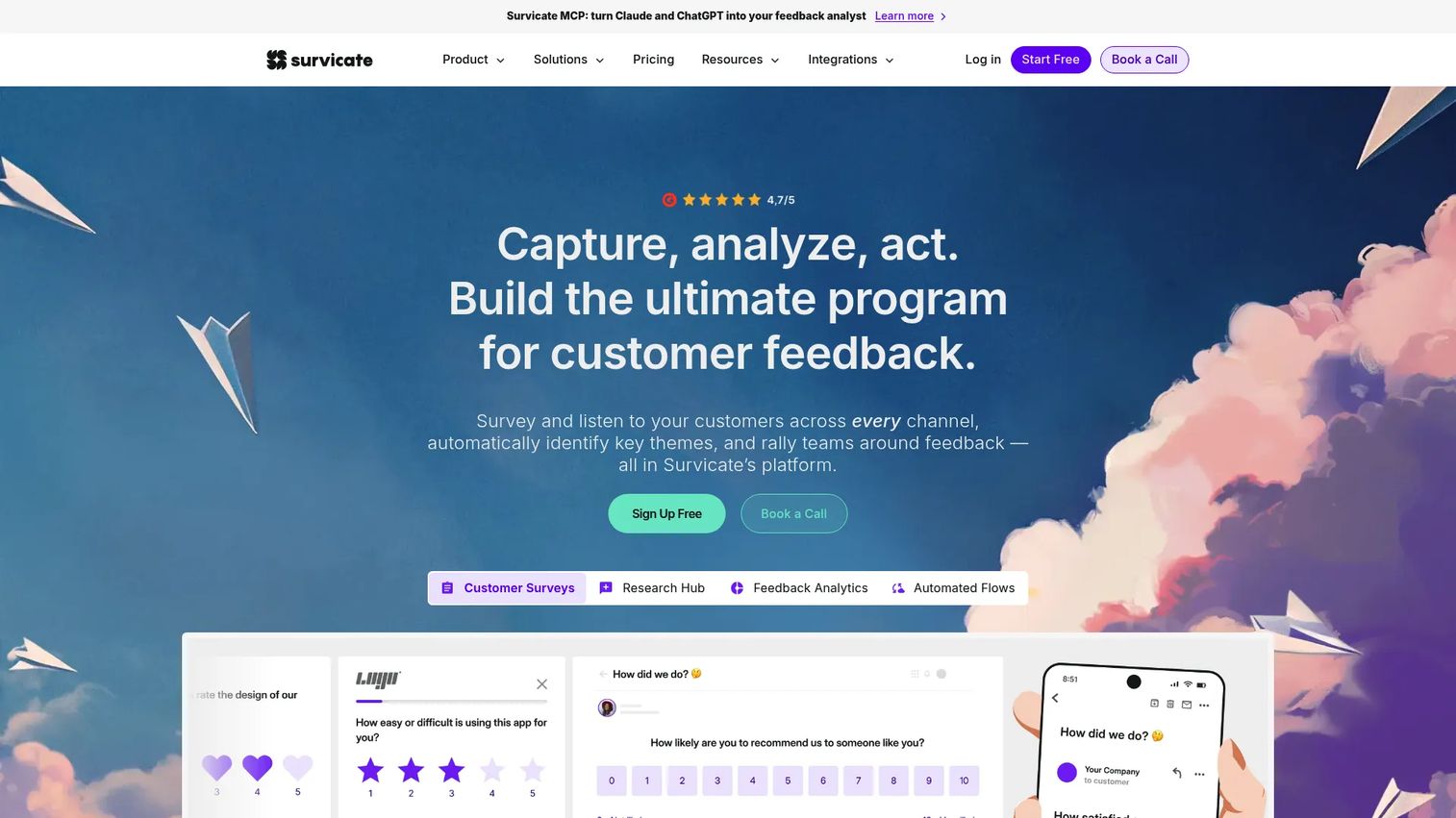
Survicate is a customer feedback platform that covers website, in-app, email, and product feedback channels in one tool. It is built for teams running lifecycle feedback programs, where the goal is to capture sentiment at multiple points along the customer journey, from onboarding through renewal. Its Research Hub uses AI to analyze open-text responses, categorize feedback automatically, and surface patterns across segments.
Best for: SaaS CS and product teams collecting lifecycle feedback across onboarding, feature adoption, and account health milestones.
Key features
- Multichannel surveys: Website, in-app, email, and product
- AI-powered feedback analysis and automatic categorization
- Sentiment analysis and customer journey mapping
- Targeting by customer attributes, segments, and behavioral events
- Native integrations with HubSpot, Salesforce, and other CRM and analytics tools
Why choose Survicate: If you need to understand where customers lose confidence during onboarding or which features are generating frustration, Survicate's lifecycle targeting and AI analysis make it one of the stronger options in this list for SaaS teams. See more context in the best product analytics software tools guide for complementary tools.
Survicate pricing: Plans start at $114 per month billed annually. Pro runs $349 per month and Enterprise runs $569 per month. A 10-day free trial is available.
G2 rating: 4.6/5
5. AskNicely
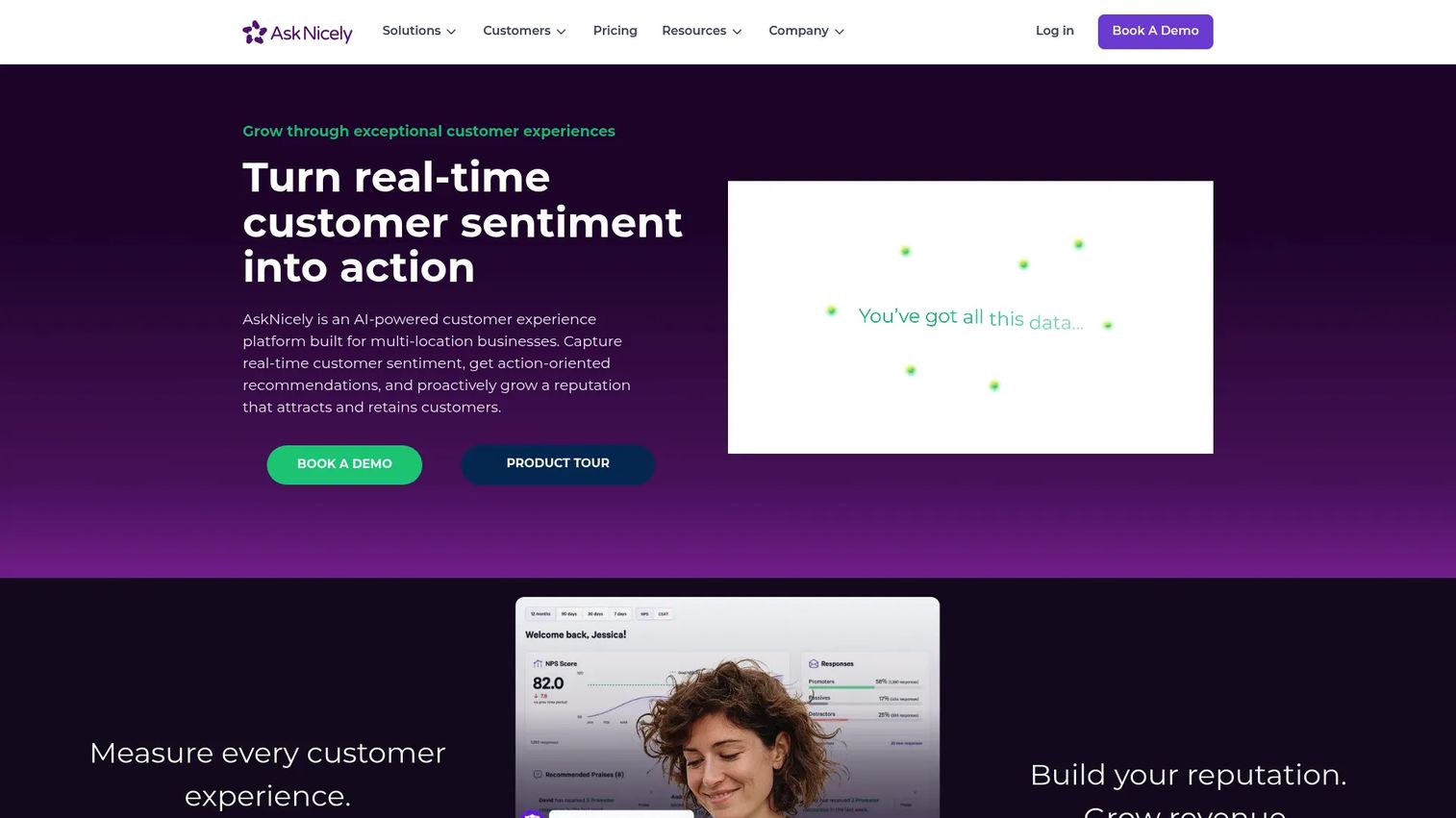
AskNicely is a customer experience platform centered on NPS, frontline coaching, and automated follow-up workflows. It is designed for service-led businesses where customer-facing staff need to see feedback signals quickly and act on them, not just analysts reviewing weekly dashboards. Its NiceAI layer adds conversational insights and automated agent coaching recommendations.
Best for: Multi-location service businesses and CS teams that connect satisfaction scores directly to frontline coaching and performance improvement.
Key features
- AI-powered dynamic NPS surveys with real-time feedback collection
- Frontline coaching workflows triggered by customer scores
- Role-based alerts and leaderboard reporting
- Google review management and review request automation
- Slack and Microsoft Teams integrations for instant score notifications
Why choose AskNicely: AskNicely works well when the goal is not just collecting NPS but driving behavioral change in customer-facing teams. It suits distributed operations, field service teams, and businesses with many customer touchpoints where coaching from live feedback matters.
AskNicely pricing: Plans scale with response volume starting from 500 responses, across three tiers: Learn, Grow, and Transform. Pricing is quote-based and primarily annual.
G2 rating: 4.7/5
6. Medallia
Medallia is an enterprise-grade experience management platform covering customer, employee, contact center, and digital feedback. It processes high volumes of experience data using AI-driven text, speech, and video analytics. For large organizations running mature CX programs, Medallia provides the kind of scale, governance, and journey-level insight that smaller platforms cannot match.
Best for: Large enterprises with complex customer journeys, high feedback volume, and mature CX programs requiring multi-channel analytics.
Key features
- Omnichannel feedback capture across surveys, speech, video, and digital signals
- AI-powered text and sentiment analytics at scale
- Customer journey insights with role-based reporting
- Closed-loop case management and alert workflows
- Enterprise workflow management and governance controls
Why choose Medallia: Medallia is the right fit when your CX program spans multiple business units, regions, or feedback types simultaneously. For teams earlier in their CX maturity or managing fewer accounts, the implementation overhead is significant.
Medallia pricing: Custom pricing through sales, structured around Experience Data Records volume. Contact Medallia for a quote.
G2 rating: 4.5/5
7. HubSpot
HubSpot is an all-in-one customer platform that includes marketing, sales, service, and CRM tools. For CS teams already running customer communication and lifecycle tracking in HubSpot, the Service Hub adds customer feedback surveys, CSAT, NPS, and CES measurement, all tied to contact records and pipeline data. Survey results appear on the same record where ticket history, deal stage, and conversation logs already live.
Best for: CS teams that already manage customer relationships in HubSpot and want satisfaction data inside the same record without a separate platform.
Key features
- Customer feedback surveys: CSAT, NPS, and CES
- Unified CRM contact and company records
- Service ticketing and pipeline management
- Automation workflows triggered by survey responses
- Reporting dashboards connected to lifecycle and deal data
Why choose HubSpot: HubSpot's main advantage for CSMs is that satisfaction scores connect directly to the customer record, renewal pipeline, and CS automation. If your team is not already in HubSpot, the feedback module alone does not justify switching CRMs. See the account management software guide for broader context on CRM-adjacent tools.
HubSpot pricing: A free tier is available. Marketing Hub Starter starts at $7 per seat per month. Professional plans start at $800 per month with a one-time $3,000 onboarding fee.
G2 rating: 4.4/5
8. Freshdesk
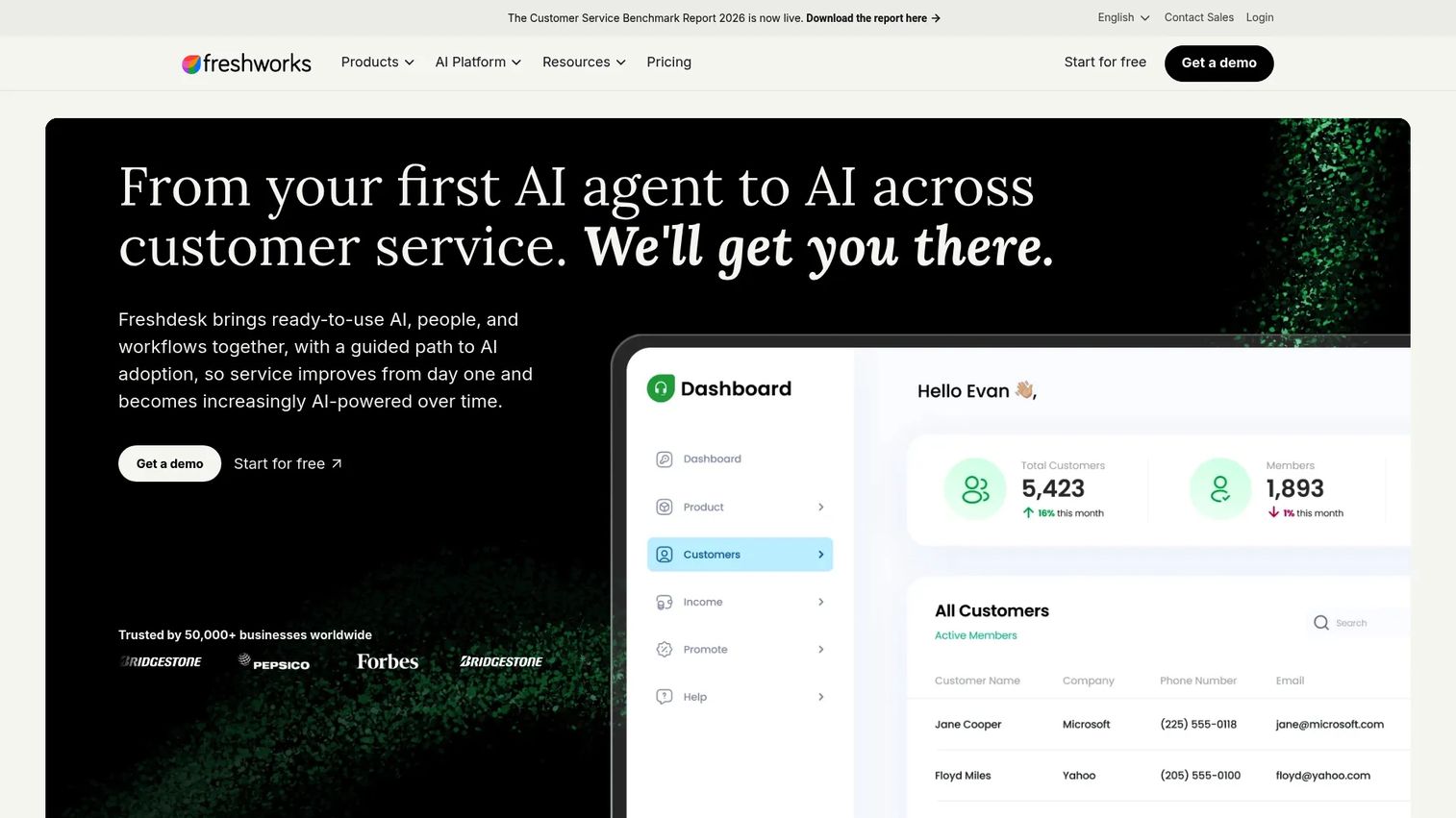
Freshdesk is helpdesk software that includes CSAT surveys, ticket automation, a knowledge base, and omnichannel support in one platform. It is a strong fit for growing support teams that want satisfaction tracking built into their ticketing system without paying for a separate survey tool. The Freddy AI Agent handles routine inquiries, reducing ticket volume before CSAT even becomes relevant.
Best for: Growing support teams that need helpdesk-native CSAT alongside ticketing, automation, and self-service tools.
Key features
- Ticket-based CSAT surveys on resolution
- Omnichannel ticketing covering email, chat, phone, and social
- Automation rules for ticket routing and escalation
- Knowledge base and customer portal for self-service
- Support analytics with agent and team-level reporting
Why choose Freshdesk: Freshdesk suits teams that need to reduce repetitive support volume and capture satisfaction data in the same workflow. The combination of knowledge base deflection and post-ticket CSAT means you can track both self-serve success and agent-handled satisfaction from one platform.
Freshdesk pricing: Growth starts at $19 per agent per month billed annually. Pro runs $55 per agent per month, and Enterprise runs $89 per agent per month.
G2 rating: 4.4/5
9. SurveyMonkey
SurveyMonkey is a general-purpose survey platform used for customer feedback, market research, employee surveys, and ad hoc data collection. It offers a large library of templates, 25-plus question types, skip logic, and multi-channel distribution. Teams looking for a flexible survey builder with broad familiarity across an organization often reach for SurveyMonkey first.
Best for: Teams that need a familiar, flexible survey builder for customer feedback without deep helpdesk or CRM integration requirements.
Key features
- Large customer survey template library including NPS and CSAT
- 25-plus question types with skip logic and multilingual support
- Distribution via email, web link, QR code, and social media
- Analytics with filtering, charts, benchmarks, and exports
- Team collaboration and survey sharing features
Why choose SurveyMonkey: SurveyMonkey is the right call when survey creation flexibility matters more than deep workflow integration. Confirm that your required CRM and helpdesk connections are supported before committing, since its integration depth is narrower than survey-native CX tools.
SurveyMonkey pricing: A free Basic tier is available. The Advantage Annual plan runs $39 per month billed annually. Standard Monthly runs $149 per month. Premier Annual runs $139 per month.
10. Feedbackly
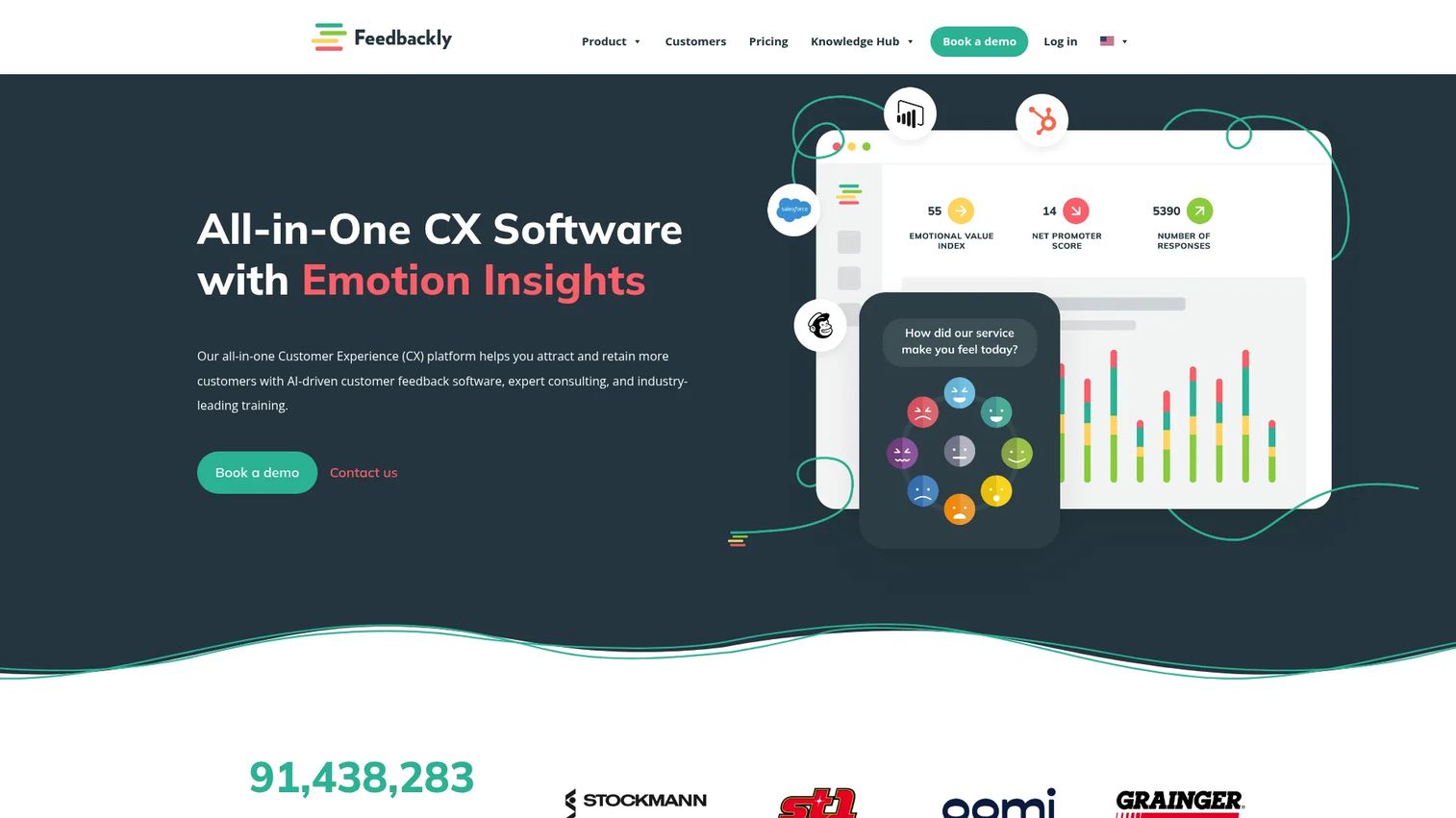
Feedbackly is a customer experience platform with a distinctive focus on emotional experience measurement across multiple touchpoints. Its Emotional Value Index (EVI) tracks how customers feel across the journey, not just whether they were satisfied at a single moment. For teams managing physical and digital customer journeys simultaneously, Feedbackly offers a broader view than a single-channel survey tool.
Best for: Organizations measuring customer satisfaction across physical locations, digital channels, and service touchpoints with an interest in emotional journey analytics.
Key features
- Multichannel feedback collection across web, kiosk, email, and app
- Emotional Value Index (EVI) for emotional experience measurement
- Customer journey analytics and touchpoint comparison
- AI-powered text analytics and root-cause analysis
- Automated alerts and third-party integrations
Why choose Feedbackly: Feedbackly makes sense when you want to compare how customers feel across different channels or locations, rather than optimizing a single survey deployment. It is a strong fit for retail, hospitality, and multi-location service businesses alongside SaaS teams.
Feedbackly pricing: Plans are priced in euros. The Single plan runs €199 per month billed annually (€249 month-to-month). Pro runs €399 per month billed annually. A 14-day free trial is available.
G2 rating: 4.3/5
11. SurveySparrow
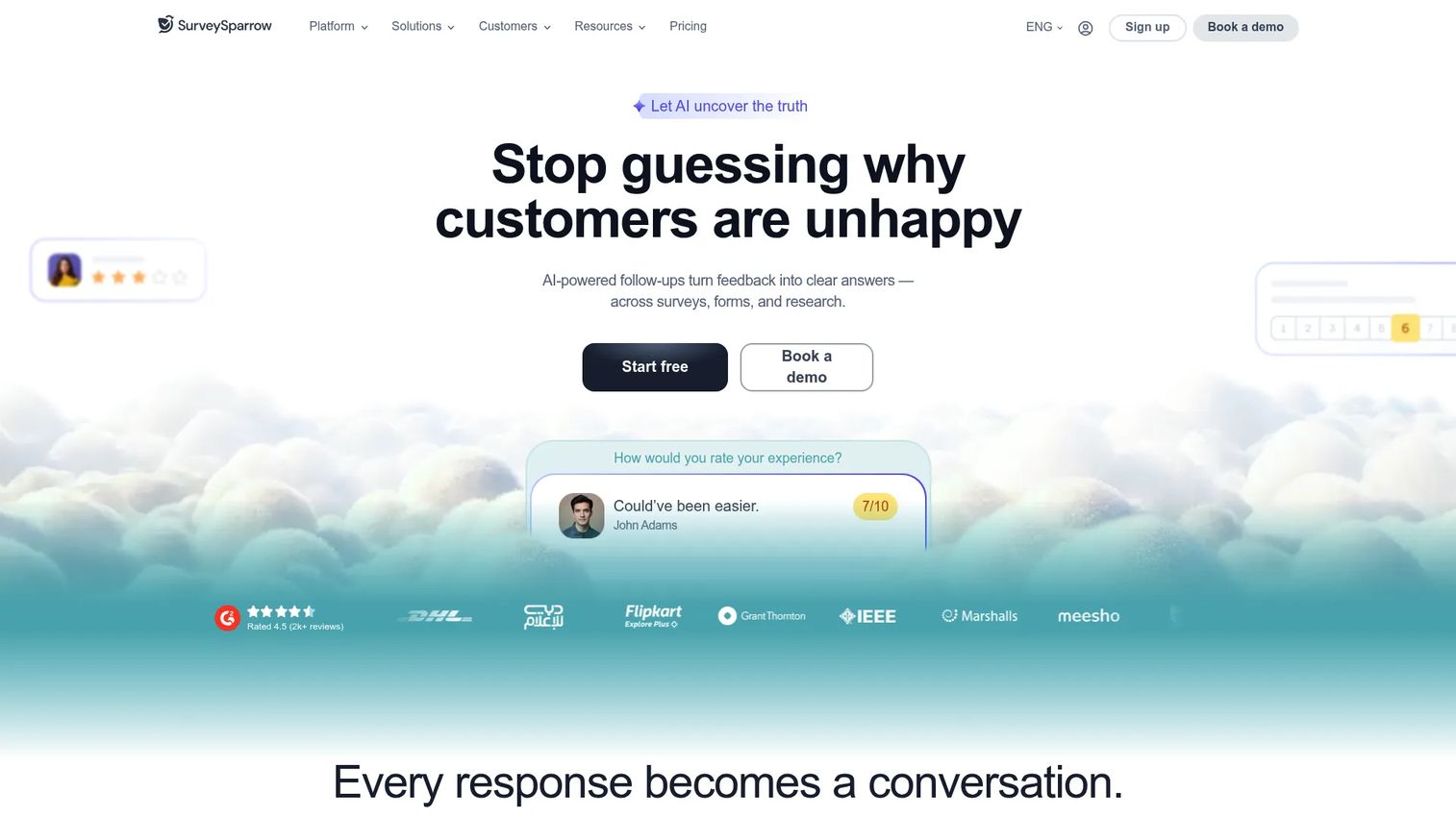
SurveySparrow is a conversational survey platform where respondents move through questions in a chat-like format rather than a traditional form. It supports CSAT, NPS, CES, recurring surveys, offline collection, and automation workflows. For CS teams running regular onboarding check-ins or relationship surveys, the recurring survey feature reduces manual effort significantly.
Best for: Teams that want higher survey completion rates through a conversational experience, with recurring and automated survey options.
Key features
- Conversational surveys with a chat-like interface
- CSAT, NPS, CES, and 360-degree feedback templates
- Recurring survey automation for lifecycle or relationship tracking
- Offline survey capability for field or in-person feedback
- Real-time dashboards and omnichannel distribution
Why choose SurveySparrow: SurveySparrow is a good fit when survey completion quality matters as much as collection volume. Its recurring automation is particularly useful for CSMs running quarterly or milestone-based relationship surveys without manual scheduling.
SurveySparrow pricing: A forever-free plan is available with 75 responses per quarter. Paid plans start at $19 per month billed annually (Basic), with Starter at $39 and Business at $79. Enterprise pricing is custom.
G2 rating: 4.4/5
12. Typeform
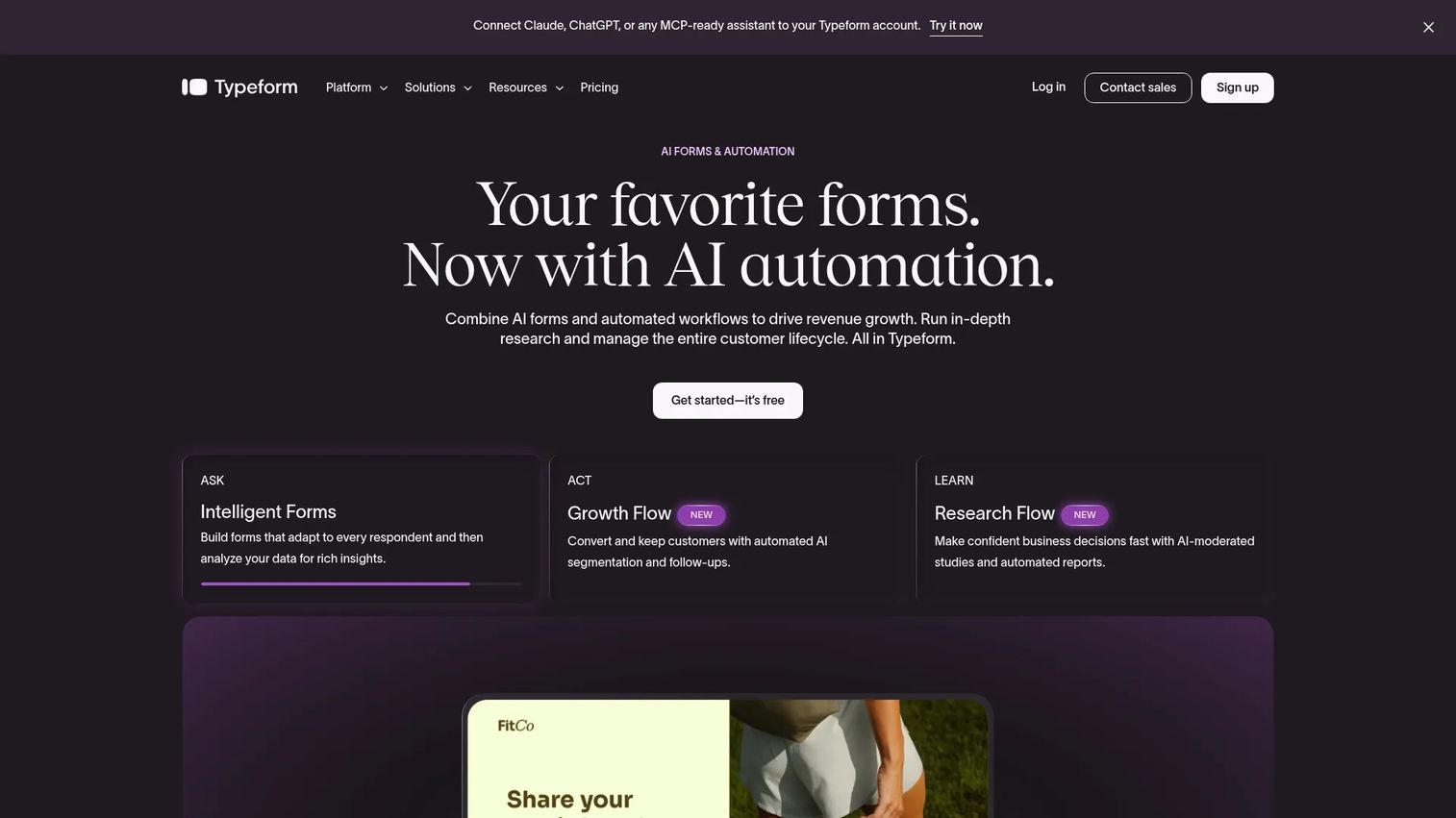
Typeform is a no-code form and survey platform known for polished, question-by-question experiences that display one question at a time. It supports customer feedback, NPS, CSAT, qualitative research, and lead capture forms. Its 300-plus integrations include HubSpot, Salesforce, Slack, Calendly, and Stripe, making it easy to route responses to existing tools.
Best for: Teams collecting customer feedback, qualitative input, or lightweight NPS surveys where completion quality and form design matter.
Key features
- Conversational one-question-at-a-time form builder
- Customer feedback and NPS templates with logic jumps
- Branded forms with custom colors, fonts, and domains
- 300-plus integrations including HubSpot and Salesforce
- AI-powered analytics and response insights
Why choose Typeform: Typeform is the right tool for lightweight customer surveys, qualitative onboarding feedback, or any context where a polished experience drives higher completion. It is not a full CX management suite, so teams with complex closed-loop requirements should pair it with a workflow tool.
Typeform pricing: A free plan is available. Basic starts at $29 per month ($25 per month billed annually). Plus runs $59 per month, Business runs $99 per month, and Growth Flow runs $349 per month.
G2 rating: 4.5/5
13. Jotform
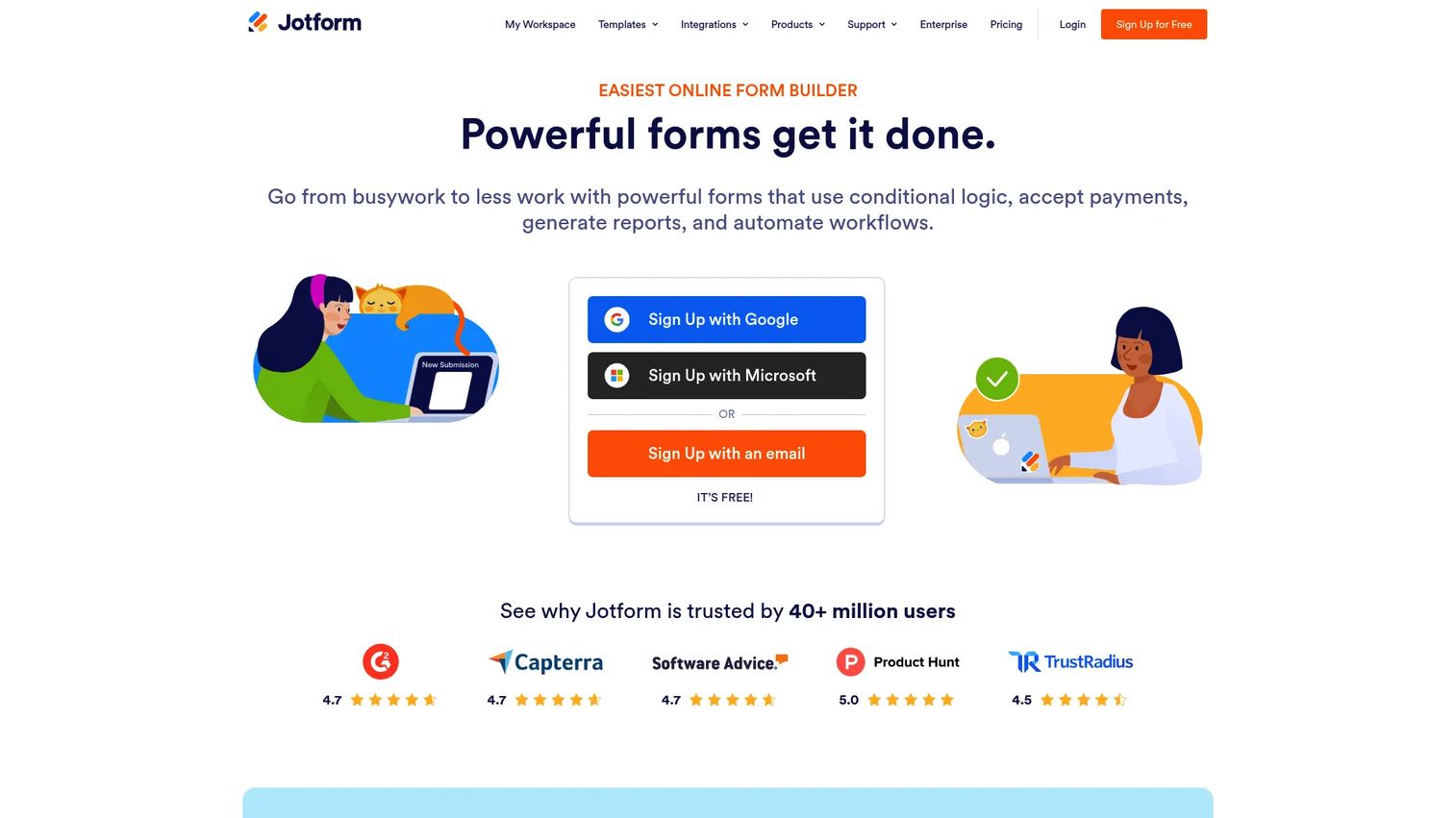
Jotform is an AI-powered form builder with more than 20,000 templates covering customer satisfaction surveys, event feedback forms, onboarding check-ins, and payment workflows. It supports offline forms, file uploads, electronic signatures, mobile collection, and 200-plus integrations. For CS teams that need a quick, low-cost survey without heavy configuration, Jotform is one of the fastest tools to deploy.
Best for: Teams that need quick, flexible customer feedback forms with minimal setup and a broad template library.
Key features
- 20,000-plus form templates including customer satisfaction surveys
- Drag-and-drop builder with conditional logic
- Offline forms and mobile-first collection
- Electronic signatures and PDF generation from submissions
- 200-plus integrations with payment, CRM, and project tools
Why choose Jotform: Jotform is the right call for ad hoc feedback collection, post-event surveys, or onboarding check-ins where you need a form live in minutes. Teams that require built-in detractor routing or account-level trend tracking will need to design their own follow-up process around it.
Jotform pricing: A free Starter tier is available. Paid plans (Bronze, Silver, Gold) are available on monthly or annual billing. Enterprise pricing is custom.
G2 rating: 4.6/5
14. QuestionPro
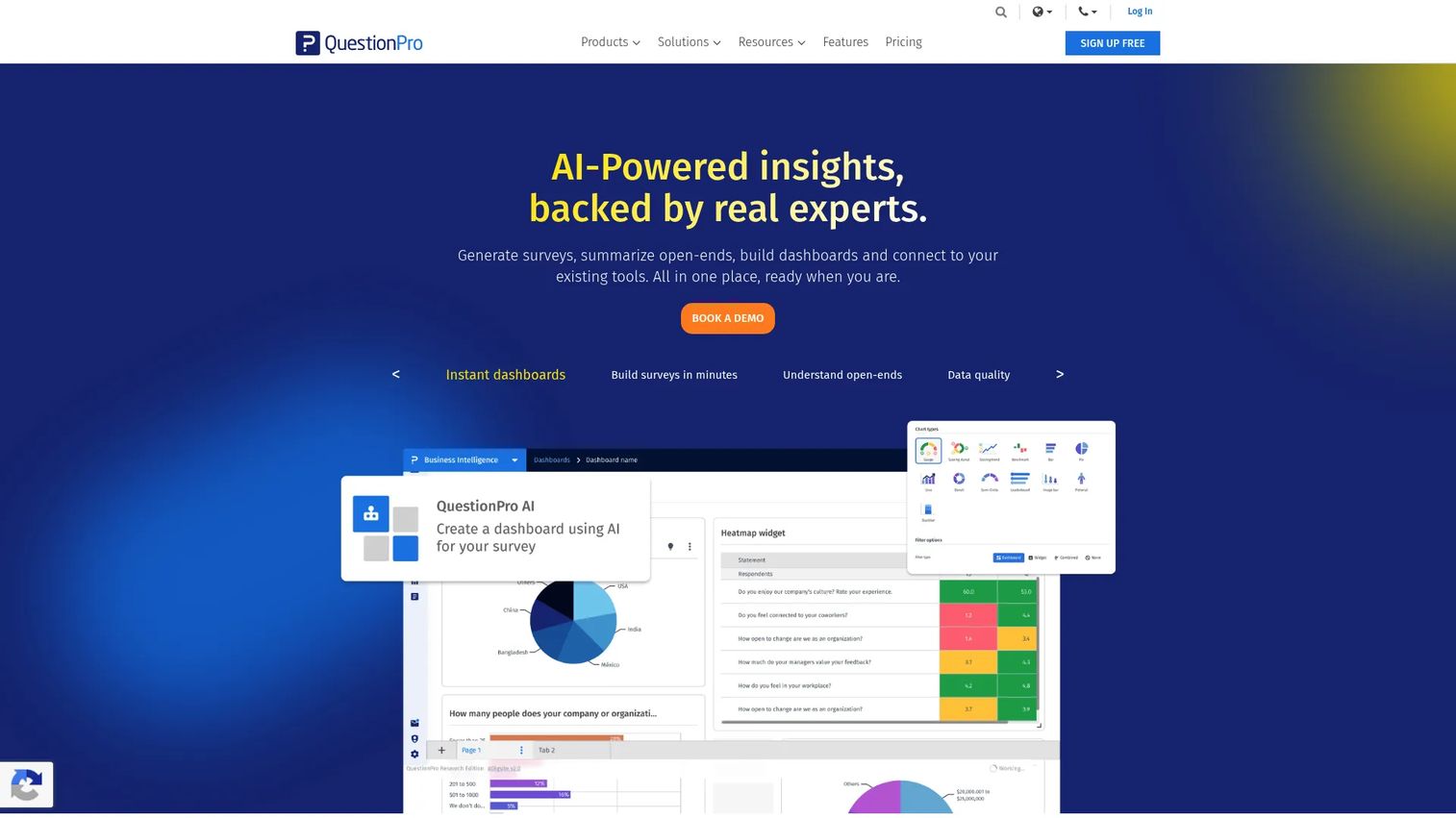
QuestionPro is an online survey and research platform built for teams that need advanced survey logic, research panels, and analytical depth beyond what a basic form builder provides. It covers CSAT, NPS, CES, conjoint analysis, and Max-Diff studies, making it useful when customer satisfaction research overlaps with product research or market studies.
Best for: Teams running structured customer satisfaction research that requires advanced survey logic, panels, sentiment analysis, or statistical exports.
Key features
- Skip logic, branching, and advanced question types
- NPS, CSAT, CES, conjoint, and Max-Diff templates
- Research panels for targeted respondent recruitment
- Sentiment analysis and real-time dashboards
- Raw data and SPSS exports for statistical analysis
Why choose QuestionPro: QuestionPro suits teams where customer satisfaction measurement overlaps with formal research methodology, like validating onboarding changes with a controlled survey or running segmented studies across customer cohorts.
QuestionPro pricing: An Essentials free plan is available with 1 user and 200 responses per survey. Advanced runs $99 per user per month billed annually. Team Edition runs $83 per user per month. Research Suite pricing is quote-based.
15. Zonka Feedback
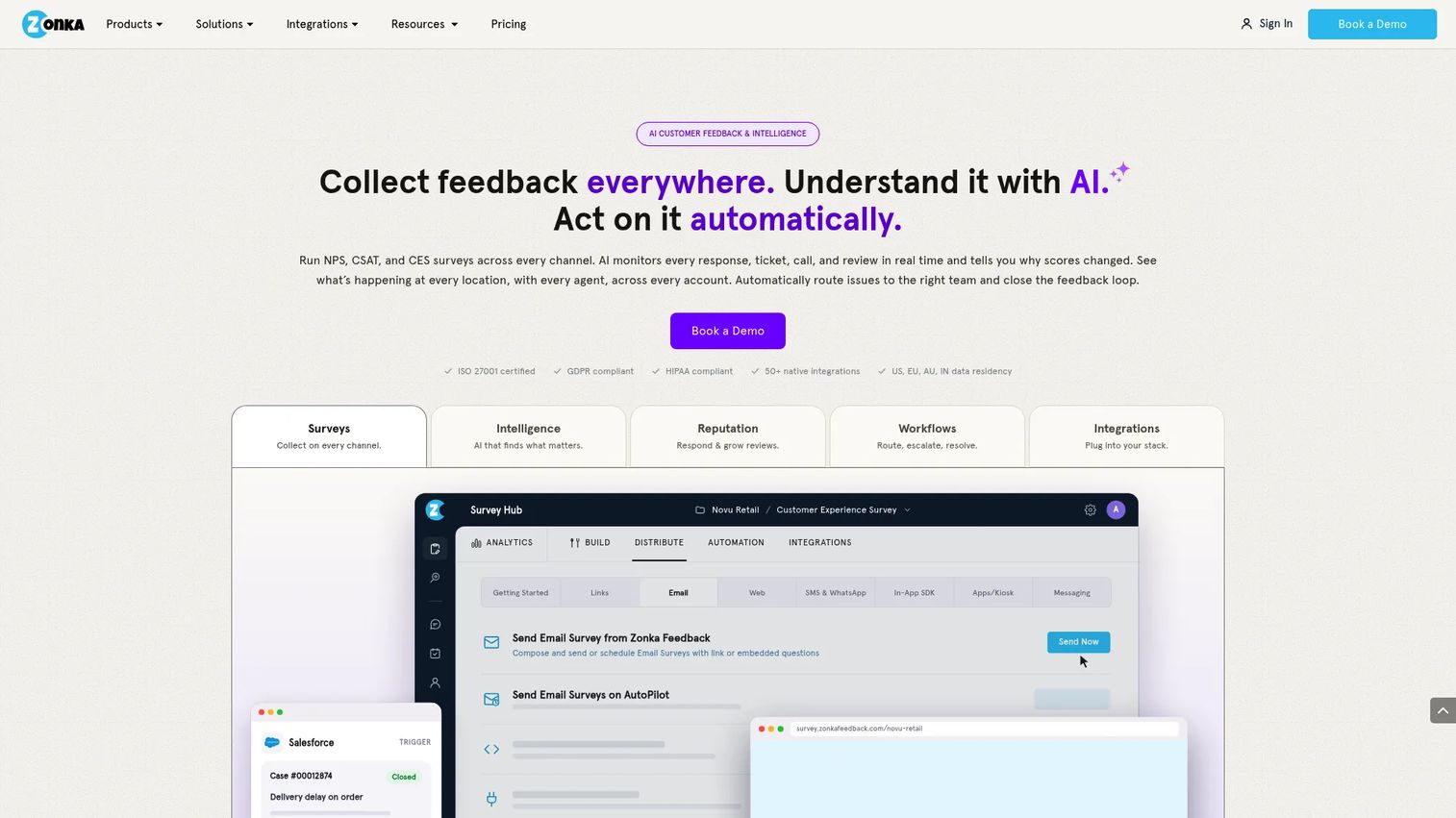
Zonka Feedback is an AI-powered customer feedback platform that handles CSAT, NPS, and CES survey collection alongside automated follow-up workflows, real-time alerts, and closed-loop task management. It supports omnichannel distribution including email, SMS, WhatsApp, web, in-app, and kiosk, making it one of the more complete closed-loop platforms on this list for CS teams that need both collection and action in a single tool.
Best for: CS and CX teams that need survey collection, detractor routing, and resolution tracking without stitching together multiple platforms.
Key features
- CSAT, NPS, and CES surveys with custom branding and logic
- Multichannel distribution: Email, SMS, WhatsApp, web, in-app, kiosk
- AI-powered sentiment analysis and feedback categorization
- Real-time alerts, digests, and task assignment for closed-loop management
- APIs, webhooks, and integrations with CRM and helpdesk tools
Why choose Zonka Feedback: Zonka Feedback is the strongest closed-loop option on this list for teams that want survey results to trigger tasks, assign owners, and track resolution without building custom workflows. It suits customer-facing operations with multiple channels or locations where follow-up speed matters.
Zonka Feedback pricing: Custom pricing based on feedback volume and CX program scope. Contact Zonka Feedback for a quote.
G2 rating: 4.7/5
Considerations when choosing customer satisfaction tools
Match the tool to your feedback channel
The right starting point is where feedback actually enters your business. Post-ticket CSAT needs helpdesk-native survey delivery. Onboarding feedback needs in-app or email targeting. Relationship NPS needs lifecycle automation. A tool that excels at one channel may be weak at another. Map your primary feedback moments before evaluating platforms.
Check closed-loop workflow depth
A CSAT score sitting in a dashboard does not reduce churn. The tool needs to route a low score to an owner, create a task, trigger an alert, and let someone track resolution. Ask vendors specifically how they handle detractor follow-up. If the answer is a webhook to Zapier, that is a workflow you are building yourself, not a built-in capability.
Verify integrations before pricing
The tools in this list connect to Zendesk, HubSpot, Salesforce, Slack, and product analytics platforms at varying levels of depth. A native integration that pushes survey data to a contact record is fundamentally different from an export to CSV. For CS teams already managing accounts inside a CRM or helpdesk, integration quality often determines whether feedback actually gets used. Explore 360 feedback software for related tools that connect feedback to performance workflows.
Decide how much analysis you need
Basic reporting covers score trends and response volume. Text analytics, sentiment analysis, and journey-level dashboards require more capable platforms. Smaller CS teams often need fast alerts and simple trend views. Enterprise teams need segmentation, executive reporting, and governance. Match analysis depth to your team's actual capacity to act on the data.
Compare pricing by response volume and channel
Most platforms on this list price by seat count, response volume, survey channels, or a combination. A plan that looks affordable at 500 responses per month may jump significantly at 5,000. Check response caps, channel limits, and integration tier requirements, not just the starting price.
Conclusion
Collecting CSAT is straightforward. Acting on dissatisfaction before it becomes churn is where most CS teams fall short, not because they lack data, but because no one owns the follow-up.
Start by mapping where dissatisfaction first appears. For support-heavy teams, post-ticket CSAT from Nicereply, Zendesk, or Freshdesk connects directly to agent workflows. For SaaS onboarding, Survicate or SurveySparrow covers lifecycle feedback across the customer journey. For enterprise CX programs with multi-channel complexity, Qualtrics, Medallia, or Zonka Feedback provide the governance and analytics depth needed.
Pick the top two or three options based on your primary feedback channel, your existing CRM and helpdesk stack, and whether you need closed-loop automation built in or can configure it yourself.
Once you know where customers struggle, the next step is reducing that friction directly. Interactive product demos can shorten time-to-value, reduce repetitive onboarding questions, and give customers a way to self-serve feature education without waiting for a CS call. Pair satisfaction data with self-serve product education and your team can spend more time on strategic accounts.
Start your journey with Guideflow today!
FAQs about customer satisfaction tools
Customer satisfaction tools are software platforms that collect, measure, analyze, and route customer feedback so teams can improve retention, support quality, and product experience. They measure metrics like CSAT, NPS, and CES, and the best ones include closed-loop workflows that assign follow-up ownership rather than leaving scores in a dashboard. The category covers survey platforms, helpdesk feedback modules, CRM-connected workflows, and enterprise experience management suites.
CSAT measures immediate satisfaction after a specific interaction, like closing a support ticket or completing an onboarding session. NPS measures how likely a customer is to recommend your product and is typically used for relationship health and lifecycle tracking. CES measures how much effort a customer had to expend to complete a task or resolve an issue. CS teams use all three: CSAT for support quality, NPS for account health, and CES for pinpointing workflow friction.
Support teams benefit most from helpdesk-native feedback, where CSAT surveys are embedded in ticket closure emails and results appear alongside ticket records. Nicereply, Zendesk, and Freshdesk all deliver that natively. The best choice depends on your existing ticketing stack: If you are already in Zendesk or Freshdesk, their built-in CSAT covers most needs. If you need richer NPS or CES alongside post-ticket feedback, Nicereply integrates with both.
SaaS teams typically need lifecycle surveys triggered by product events, in-app feedback at onboarding milestones, and CRM integration to connect scores to account records. Survicate and SurveySparrow are strong options for multi-channel lifecycle coverage. HubSpot works well when your CS team already manages accounts inside its CRM. Zonka Feedback adds closed-loop follow-up if you need detractor routing built into the same platform. See the best customer data platform guide for tools that complement satisfaction data with behavioral signals.
They surface dissatisfaction earlier, before a customer stops responding or decides not to renew. Detractor alerts, account-level trend tracking, and open-text sentiment analysis all create signals that can trigger proactive outreach. Tools only reduce churn when someone acts on the signal. The difference between a satisfaction tool and a retention tool is whether a low score creates a task with an owner or just updates a metric.
If post-ticket CSAT is your only use case, your helpdesk's built-in module likely covers it. The gap appears when you need NPS at lifecycle milestones, CES for onboarding workflows, in-app surveys triggered by product behavior, or multi-account trend tracking. Those scenarios typically require a dedicated platform. Compare workflow depth between your helpdesk's native CSAT and a purpose-built tool before deciding whether the overlap justifies adding another tool.
Post-ticket CSAT should send automatically on ticket resolution, since recency is the main driver of response rate. Relationship NPS surveys are typically sent quarterly or semiannually, depending on account volume and customer segment. Onboarding surveys should align to milestones, such as the end of week one or completion of a specific setup step, rather than arbitrary calendar dates. Sending too frequently decreases response rates and trains customers to ignore the survey.
Survey channel coverage, CRM and helpdesk integrations, closed-loop follow-up workflows, and analytics depth are the four factors that separate useful tools from expensive dashboards. Sentiment analysis and text analytics matter once response volume justifies them. For CSMs specifically, the most valuable feature is closed-loop assignment: A score should automatically create a task with an owner. A score with no owner is just a number.