Support volume keeps climbing. According to PolyAI's 2025 research, 88% of customer service and CX leaders say customer expectations increased over the past year. Meanwhile, agents are caught switching between phone systems, CRM tabs, chat tools, and help desk queues, losing context at every handoff.
A contact center platform is no longer just a phone queue. It's where routing, CRM data, AI assistance, workforce planning, and customer history either come together or fall apart. The global contact center software market reached $47.7 billion in 2025 and is projected to hit $227.6 billion by 2033, according to Grand View Research (2026). The growth reflects how much is riding on this category.
Which platform fits your team, budget, channels, and integration reality? That's the question this guide answers.
What's inside
This guide compares 20 contact center software platforms for 2026. It's written for support leaders, RevOps and IT evaluators, and product marketers building competitive landscape research or customer-facing education.
- What contact center software includes in 2026, with a clear definition
- How cloud contact center software differs from traditional call center software
- A side-by-side comparison of all 20 platforms, with verified pricing and G2 ratings
- Buyer checklist covering AI, integrations, pricing models, and reliability
- Shortlist recommendations by team size and operating model
Selection criteria: Channel coverage, AI practicality, integration depth, pricing clarity, and buyer fit across SMB, mid-market, and enterprise.
TL;DR
- Best overall for growing teams: Nextiva, for voice, UCaaS, and contact center in one buying motion
- Enterprise CCaaS shortlist: Five9, Genesys Cloud CX, NiCE CXone, and Talkdesk for complex, high-volume operations
- Best for CRM-first teams: Salesforce Agentforce Contact Center and Zendesk for teams anchored in those platforms
- Best for developer-led customization: Twilio Flex, with API-level flexibility and usage-based pricing
- Best budget and open-source options: LiveAgent, Zoho Desk, Bitrix24, VICIdial, and ICTContact for cost-conscious teams
What is contact center software?
Contact center software is a platform that helps teams manage customer conversations across voice and digital channels, route those interactions to the right agents, and measure service performance from one system.
The difference between call center software and contact center software comes down to channel coverage. Call center software focuses primarily on phone interactions. Contact center software adds digital channels, CRM context, automation, analytics, workforce tools, and self-service capabilities.
Core channels supported:
- Voice (inbound and outbound), email, SMS, and live chat
- Social messaging, web forms, and in-app support
- WhatsApp, Facebook Messenger, and other messaging apps
Core routing capabilities:
- Interactive voice response (IVR) and automatic call distribution (ACD)
- Skills-based routing, queue management, and callbacks
- Escalation rules and predictive routing
Core operational features:
- Call recording, quality assurance, and agent coaching
- Workforce management, forecasting, and scheduling
- Knowledge base access, reporting, and analytics dashboards
AI capabilities in 2026:
- Agent assist, real-time transcription, and conversation summaries
- Sentiment analysis, bot handoffs, and virtual agents
- Call scoring, predictive routing, and knowledge suggestions
Integration layer: CRM (Salesforce, HubSpot), help desk (Zendesk), UCaaS platforms, workforce management, BI tools, and identity systems.
The call center infrastructure software underneath most platforms handles telephony, SIP trunking, and media processing. Modern cloud platforms abstract most of that complexity.
Key features to look for:
- Omnichannel routing
- IVR and ACD
- AI agent assistance
- CRM screen pops
- Workforce management
- Quality assurance and QA scoring
- Analytics dashboards
- Security controls and SSO
- API and marketplace integrations
When to use contact center software
Support customers across more than one channel
When email, phone, chat, SMS, and social messages each live in separate tools, agents lose context and customers repeat themselves. Contact center software consolidates those channels into a single routing and reporting layer. For PMMs, fragmented channels create inconsistent support narratives that undermine brand positioning at every touchpoint.
Reduce agent context switching
CRM screen pops, automatic call logging, and unified agent workspaces cut the time between picking up a conversation and knowing what it's about. The practical outcome is shorter handle times and fewer repeat contacts, not vague productivity improvements.
Scale service quality without adding headcount at the same rate
Skills-based routing, workforce management, AI summaries, and self-service deflect the tier-1 volume that doesn't need a human. That said, software alone doesn't fix unclear support processes. The platform amplifies whatever operating model exists underneath it.
Contact center software comparison
The table below covers all 20 platforms in this guide, sorted in the same order as the item sections that follow. Pricing reflects verified figures from each vendor's pricing page. G2 ratings are from each tool's live G2 listing.
| # | Product | Best for | Key differentiator | Pricing | G2 rating |
|---|---|---|---|---|---|
| 1 | Nextiva | Growing teams wanting voice, UCaaS, and contact center together | Business communications and contact center in one platform | From $15/user/mo | 4.5/5 |
| 2 | Five9 | Enterprise and mid-market cloud contact centers | Mature CCaaS with AI, routing, and WFM depth | From $119/seat/mo | 4.2/5 |
| 3 | RingCentral Contact Center | Teams already on RingCentral communications | Contact center connected to UCaaS and business phone | From $65/user/mo (annual) | N/A |
| 4 | Dialpad Ai Contact Center | AI-first voice and digital support teams | Native AI transcription, summaries, and coaching | From $89/user/mo | 4.4/5 |
| 5 | Aircall | SMB and mid-market phone-first support teams | Cloud calling with CRM and help desk integrations | From $30/license/mo (annual) | 4.4/5 |
| 6 | Genesys Cloud CX | Complex enterprise omnichannel operations | Broad CCaaS with AI, journey, and workforce capabilities | From $75/user/mo (annual) | 4.4/5 |
| 7 | NiCE CXone | Enterprise teams needing WFM, QA, and analytics | Workforce engagement and CX operations suite | From $110/agent/mo | 4.3/5 |
| 8 | Talkdesk | Support teams wanting AI and industry-specific workflows | AI automation with verticalized CX templates | From $85/user/mo | 4.4/5 |
| 9 | Cisco Webex Contact Center | Cisco and Webex-centered enterprises | Contact center aligned with Webex collaboration | From $85 (list price) | 4.4/5 |
| 10 | Salesforce Agentforce Contact Center | Salesforce-first service organizations | CRM-native AI agents and service workflows | From $75/user/mo | 4.4/5 |
| 11 | Vonage Contact Center | Teams needing CRM-integrated communications | Omnichannel routing with strong Salesforce alignment | Custom pricing | 4.2/5 |
| 12 | GoTo Contact Center | Small teams needing a simpler cloud contact center | Lightweight contact center with GoTo communications | Custom pricing | 4.4/5 |
| 13 | 8x8 Contact Center | Global teams needing voice, UCaaS, and contact center | Integrated communications and contact center platform | Custom pricing | 4.1/5 |
| 14 | Twilio Flex | Developer-led teams building custom contact centers | Programmable contact center with API-level control | From $1/active user hour | 4.1/5 |
| 15 | Zendesk | Support teams already using Zendesk service workflows | Ticketing, knowledge, messaging, and AI in one workspace | From $19/agent/mo (annual) | 4.3/5 |
| 16 | Zoho Desk | SMBs using the Zoho suite | Affordable help desk with omnichannel and AI | Free plan; paid from $7/user/mo | N/A |
| 17 | LiveAgent | Small teams needing live chat, ticketing, and call basics | Multichannel service desk with accessible pricing | From $11/agent/mo (annual) | 4.5/5 |
| 18 | VICIdial | Technical teams wanting open-source call center software | Open-source dialer with predictive calling | Free software; services from $800 | 4.1/5 |
| 19 | ICTContact | Teams needing self-hosted contact center campaigns | Open-source autodialer with IVR and CRM | From $399 one-time (5 agents) | N/A |
| 20 | Bitrix24 | Small businesses wanting CRM plus communication | CRM, collaboration, and customer channel tools | Free plan; paid from $49/org/mo (annual) | 4.1/5 |
Best 20 contact center software tools for 2026
1. Nextiva
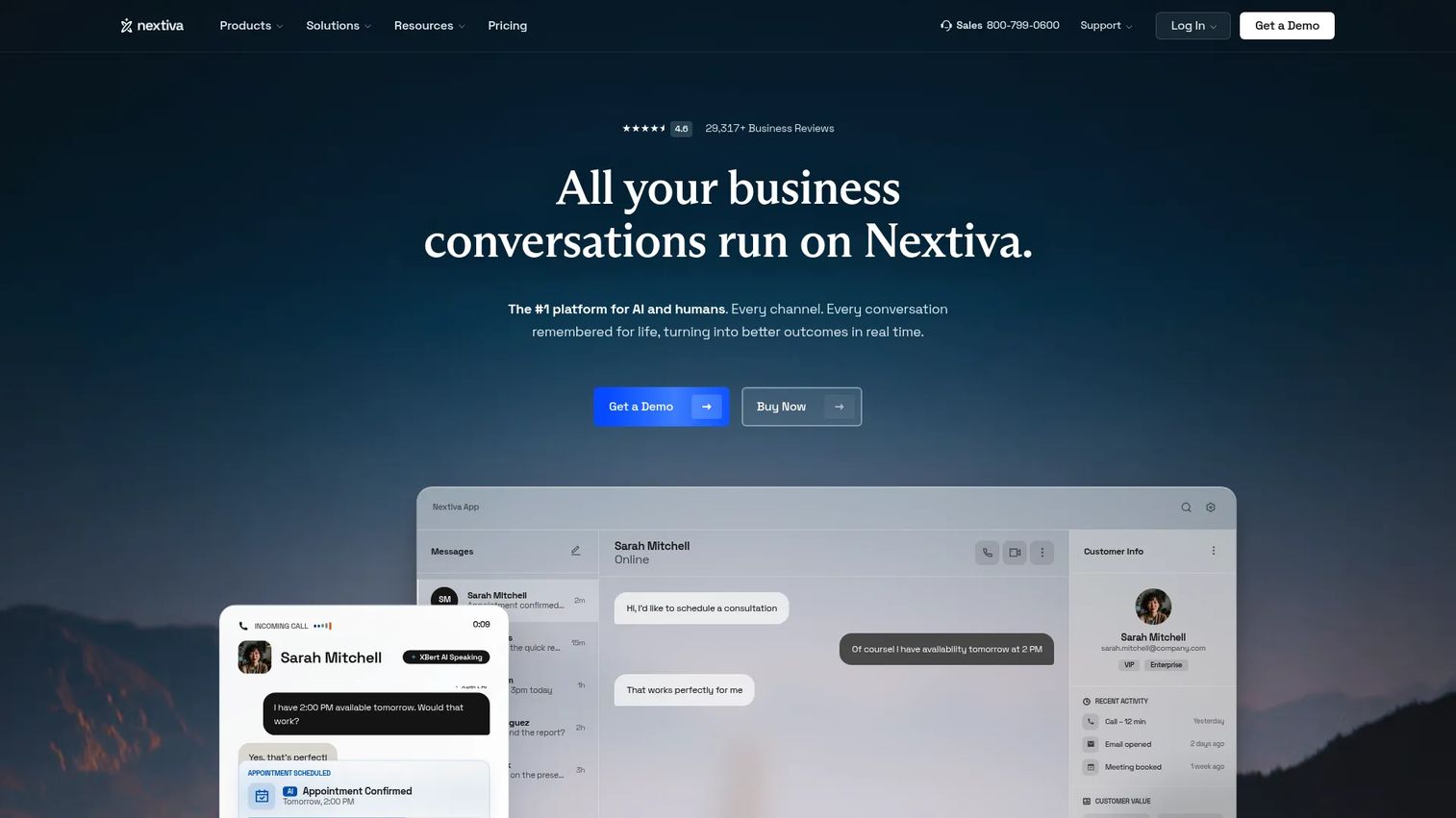
Nextiva is a cloud communications and customer experience platform that combines business voice, messaging, video, and contact center capabilities. Teams that want to consolidate their phone system and customer service tools under one vendor find Nextiva attractive because the UCaaS and CCaaS layers share a common platform. It supports omnichannel routing, AI-powered transcription and summaries, shared inboxes, and supervisor monitoring.
Best for: Growing SMB and mid-market teams that want business phone, team communications, and contact center workflows from a single vendor.
Key features
- Omnichannel contact routing and skills-based queuing
- AI transcription, call summaries, and answer assist
- Business SMS, team messaging, and video
- Supervisor monitoring and live call coaching
- CRM connectivity and virtual fax
Why choose Nextiva: The consolidation angle is real. If your team is currently paying separately for a phone system and a helpdesk call queue, Nextiva collapses both. It's strongest when you want communications and contact center workflows aligned, not stitched together from different vendors.
Nextiva pricing: Business plans start at $15/user/month (annual) for the Core tier. Contact center plans start at $75/agent/month (annual) for the Essential tier. Professional and Premium contact center tiers require a sales conversation.
G2 rating: 4.5/5
2. Five9
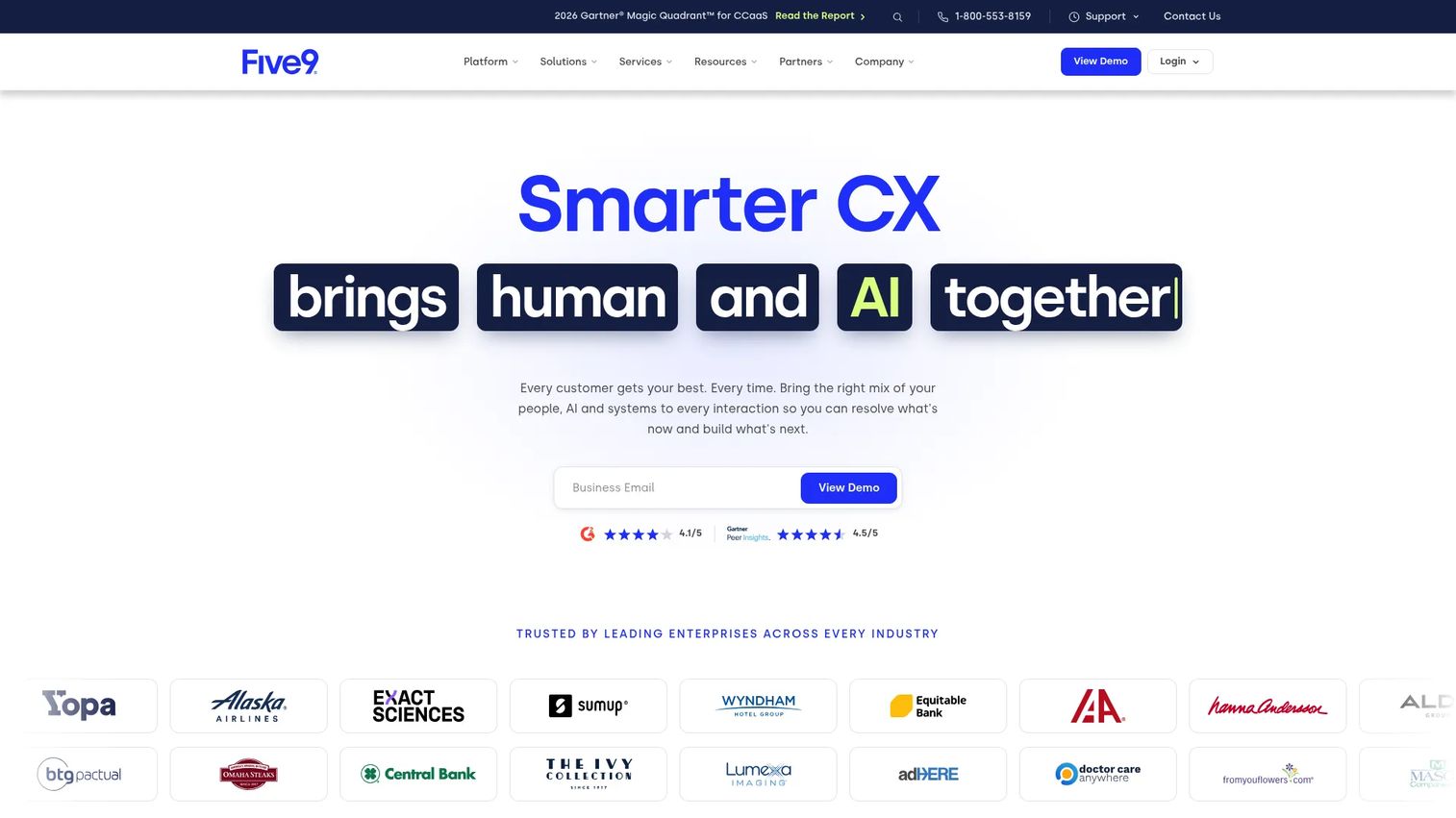
Five9 is a cloud contact center platform built for mid-market and enterprise operations handling high interaction volume. It covers inbound, outbound, and blended workflows across voice, SMS, email, web chat, WhatsApp, video, and social. The platform includes intelligent virtual agents, predictive and progressive dialers, workforce engagement, and AI features including real-time transcription, translation, agent assist, and conversation analytics. A minimum of 50 seats applies. For AI customer service software with serious outbound depth, Five9 is a credible shortlist candidate.
Best for: Mid-market and enterprise contact centers with high volume, complex routing requirements, or mature outbound operations.
Key features
- Omnichannel routing across voice, SMS, email, chat, WhatsApp, and social
- Predictive, progressive, and power dialers
- AI agent assist, transcription, and call summaries
- Workforce engagement management (WEM)
- Omnichannel analytics and reporting
Why choose Five9: It's a mature CCaaS platform for teams that need both routing sophistication and outbound campaign management. The 50-seat minimum signals enterprise intent, so smaller teams should look at Aircall or Nextiva instead.
Five9 pricing: Digital and Core plans are priced at $119 and $159 per concurrent seat per month. Plus, Pro, and Enterprise plans require contacting sales. Usage-based charges apply separately.
G2 rating: 4.2/5
3. RingCentral Contact Center
RingCentral Contact Center connects enterprise contact center capabilities to RingCentral's broader communications platform. Teams already standardized on RingCentral for calling, video, and messaging can extend into contact center functionality without adopting a separate vendor. The platform covers more than 20 digital channels, ACD, IVR, skills-based routing, AI quality management, AI agent assist, AI supervisor assist, interaction analytics, and workforce management. The tier structure maps capabilities to specific plan levels.
Best for: Organizations already invested in RingCentral communications that want contact center functionality in the same environment.
Key features
- Voice and 20+ digital channels
- ACD, IVR, and skills-based routing
- AI quality management and agent assist
- AI interaction analytics
- Workforce management and advanced omnichannel routing
Why choose RingCentral Contact Center: Stack consolidation is the primary argument. If your business phone, messaging, and video already run on RingCentral, adding contact center avoids a second vendor relationship and a second integration layer.
RingCentral Contact Center pricing: Standard starts at $65/user/month (annual) or $75/user/month (monthly). Professional is $95/user/month (annual). Elite is $145/user/month (annual). Enterprise Contact Center requires contacting sales.
4. Dialpad Ai Contact Center
Dialpad Ai Contact Center is an AI-native contact center platform built around voice and digital engagement. Its core differentiation is that AI isn't an add-on. Real-time transcription, call summaries, PII redaction, sentiment analysis, and agent coaching run inside every conversation by default. The platform also includes quality management with AI CSAT scoring, scorecards, coaching hubs, and workforce management with forecasting and scheduling. This is a good fit for teams that measure agent performance closely and want AI to reduce manual QA effort.
Best for: Support and contact center teams that want real-time AI inside conversations rather than bolted-on AI reporting after the fact.
Key features
- Live transcription and AI call summaries
- Sentiment analysis and PII redaction
- Real-time agent coaching and AI assist
- Quality management with AI CSAT scoring
- Workforce management with forecasting and scheduling
Why choose Dialpad Ai Contact Center: The practical AI features, specifically real-time coaching and automatic summaries, work during the conversation, not just in post-call review. Teams that rely heavily on phone interactions and want to reduce supervisor review time will find this useful.
Dialpad Ai Contact Center pricing: Essentials starts at $89/user/month. Advanced is $119/user/month. Premium is $149/user/month. AI Agent is separately priced using conversation-based credits.
G2 rating: 4.4/5
5. Aircall
Aircall is a cloud phone system and contact center platform designed for sales and support teams that need fast setup and reliable CRM integrations. It handles call routing, IVR, call recording, transcription, power dialing, shared call inboxes, SMS, and AI-generated call summaries. Aircall's integration catalog covers Salesforce, HubSpot, Zendesk, Intercom, and other common sales and support tools. A minimum of 3 licenses applies on Essentials and Professional, rising to 25 on Enterprise. It's lighter than enterprise CCaaS platforms, which is a feature, not a limitation, for teams that don't need a full workforce management suite. See related coverage in our call center screen capture software guide.
Best for: SMB and mid-market sales or support teams that want a cloud phone system with CRM and help desk integrations and don't need enterprise CCaaS complexity.
Key features
- Call routing and IVR
- Call recording and AI transcription
- Power Dialer for outbound teams
- Shared call inbox and SMS/MMS
- CRM and help desk integrations
Why choose Aircall: Setup is fast and integration depth into CRM and help desk tools is strong for the price point. The 3-license minimum keeps it accessible to smaller teams. For high-volume outbound operations or complex workforce management, upgrade to Five9 or Talkdesk.
Aircall pricing: Essentials starts at $30/license/month (annual); Professional is $50/license/month (annual). Enterprise requires contacting sales. AI Voice Agents start at $100/month.
G2 rating: 4.4/5
6. Genesys Cloud CX
Genesys Cloud CX is a broad enterprise CCaaS platform covering omnichannel engagement, predictive routing, speech and text analytics, workforce management, quality assurance, virtual agents, and AI-powered agent and supervisor copilots. It's built for organizations running complex, high-volume customer operations across global or multi-team deployments. The platform offers four named pricing tiers, each adding capabilities rather than just seat counts. Usage-based charges and add-ons apply beyond base subscription costs.
Best for: Enterprise contact centers that need broad omnichannel orchestration, journey analytics, and workforce engagement management at scale.
Key features
- Omnichannel routing across voice and digital channels
- Predictive routing and AI automation
- Workforce management with forecasting and scheduling
- Speech and text analytics
- Virtual agents and AI copilots for agents and supervisors
Why choose Genesys Cloud CX: The breadth is real. Few platforms match Genesys on journey orchestration, WEM depth, and AI integration at enterprise scale. The complexity and cost reflect that. Teams below mid-market should consider Dialpad or Nextiva first.
Genesys Cloud CX pricing: Plans run from $75/user/month (CX 1, annual) to $240/user/month (CX 4, annual). Usage-based pricing and add-ons may apply.
G2 rating: 4.4/5
7. NiCE CXone
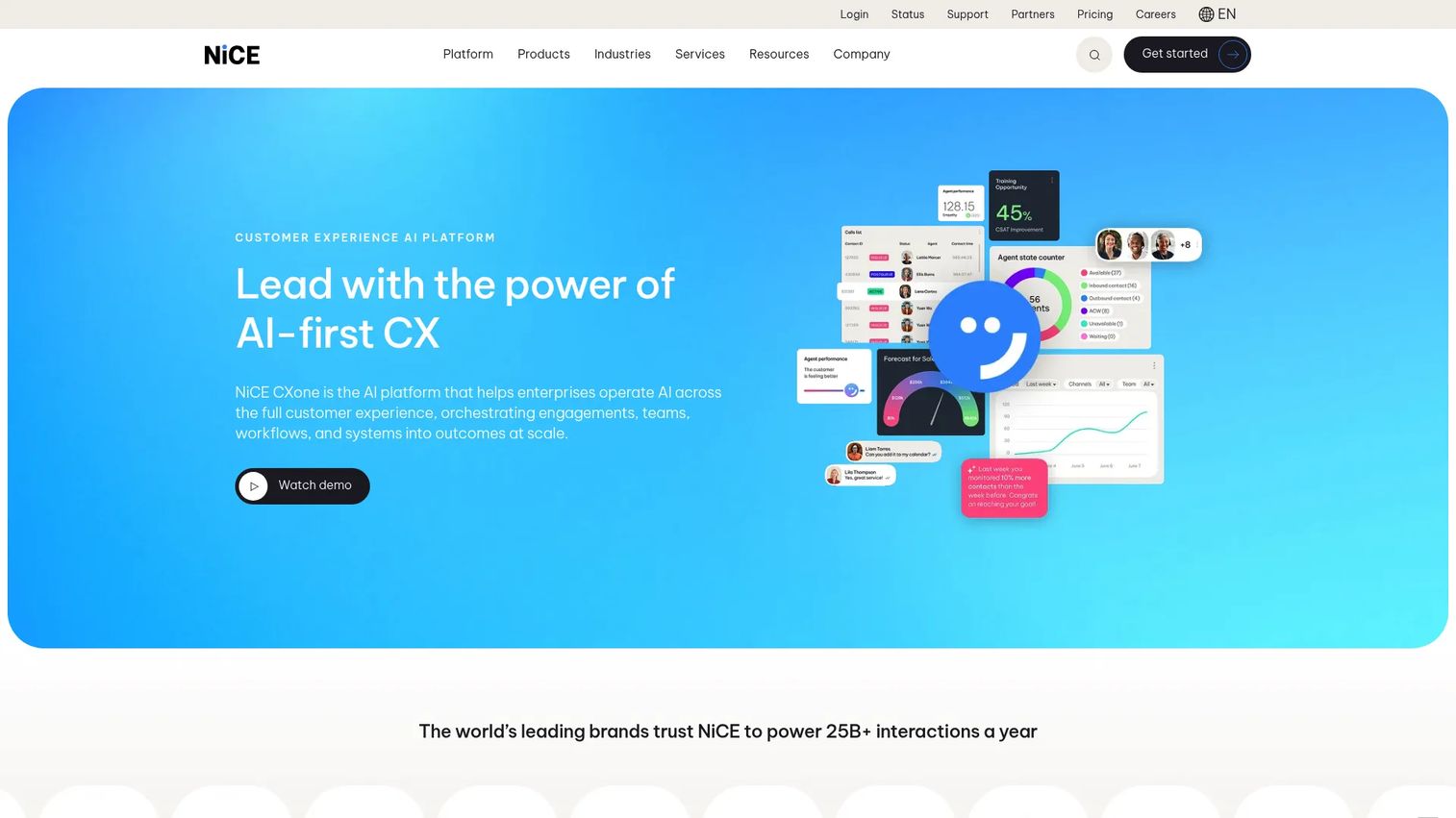
NiCE CXone is an enterprise contact center platform with strong workforce engagement, quality management, and analytics capabilities. It supports omnichannel voice and digital engagement, AI-powered routing and self-service, performance management, and interaction recording. NICE positions CXone as an AI-first platform, with AI features running across routing, agent assist, and QA workflows. The five named tiers (Omnichannel Suite through Ultimate Suite) add workforce engagement, analytics, and AI capabilities as you move up. Monthly billing in arrears is the standard model.
Best for: Large enterprise contact centers that need deep workforce engagement, quality management, and operational analytics, especially in regulated industries.
Key features
- Omnichannel voice and digital engagement
- AI-powered routing and self-service automation
- Workforce management, quality management, and performance management
- Interaction analytics and compliance recording
- AI agent assist and supervisor tools
Why choose NiCE CXone: Workforce engagement management depth sets CXone apart for teams where QA, adherence, and performance management are as important as routing. The platform suits large, structured operations more than small or mid-sized teams.
NiCE CXone pricing: Plans start at $110/agent/month (Omnichannel Suite) and run to $249/agent/month plus $0.25/session for the Ultimate Suite.
G2 rating: 4.3/5
8. Talkdesk
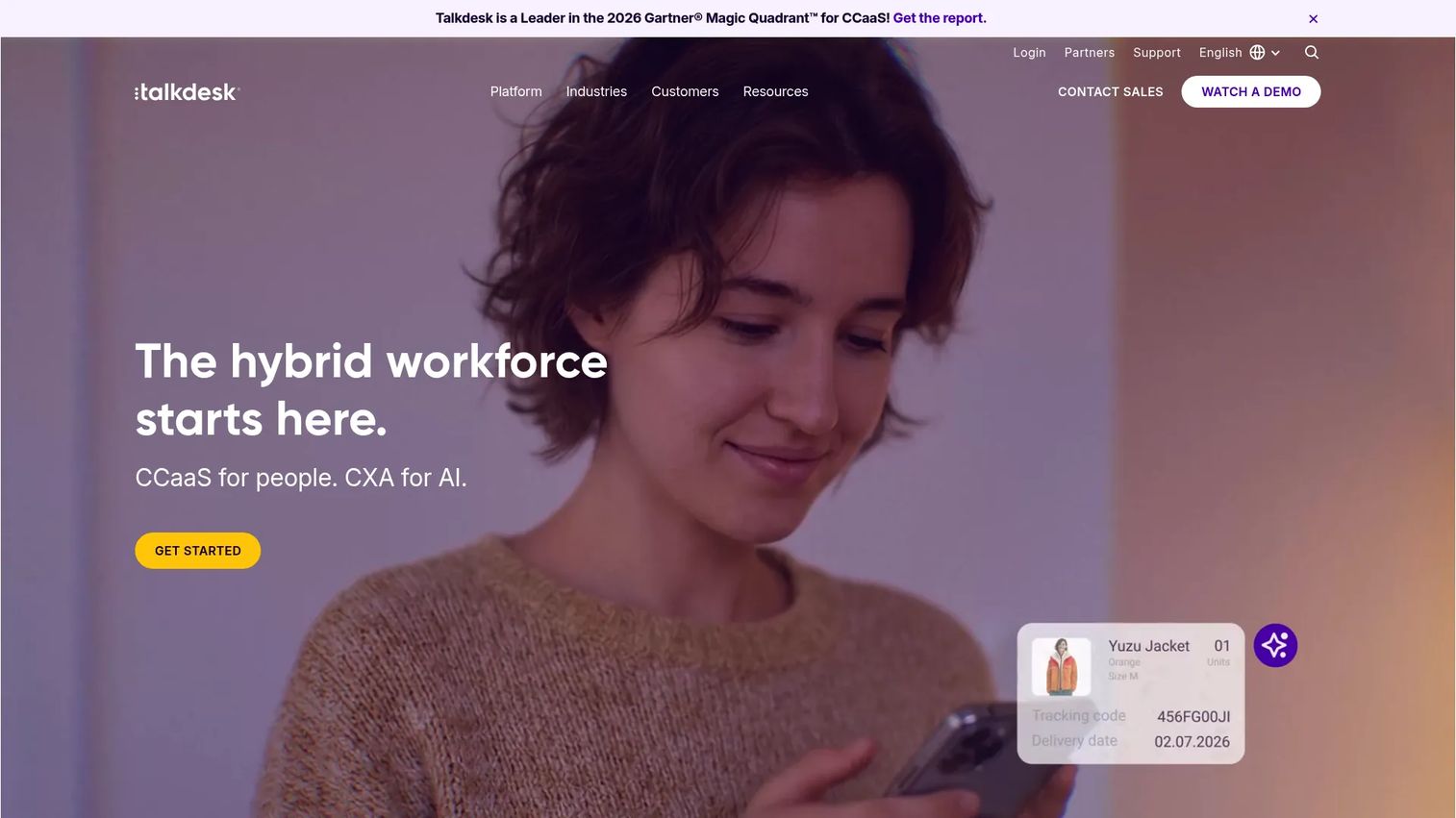
Talkdesk is a cloud contact center platform with AI, automation, analytics, and industry-specific offerings. AI features include Copilot for real-time agent assist, Autopilot for virtual agent automation, and Navigator for intelligent routing. The platform handles digital engagement across email, chat, SMS, and social, alongside voice engagement with routing and speech recognition. Integrations include Salesforce, Zendesk, Microsoft Teams, ServiceNow, HubSpot, and Microsoft Dynamics 365. The highest-priced tier adds Industry Experience Clouds for healthcare, financial services, retail, and other verticals.
Best for: Teams that want AI-assisted contact center workflows with industry-specific templates and vertically packaged capabilities.
Key features
- AI Copilot for real-time agent assist
- AI Autopilot for virtual agent automation
- Digital and voice engagement with analytics
- Workforce management and performance management
- Integrations with Salesforce, Zendesk, and ServiceNow
Why choose Talkdesk: The vertical industry packaging is a differentiator for teams in healthcare, financial services, or retail that want pre-built workflows rather than starting from scratch. AI features are well-integrated across the platform, not bolt-on.
Talkdesk pricing: Plans start at $85/user/month (Digital Essentials) and run to $225/user/month (Industry Experience Clouds). All prices are per user, per month.
G2 rating: 4.4/5
9. Cisco Webex Contact Center
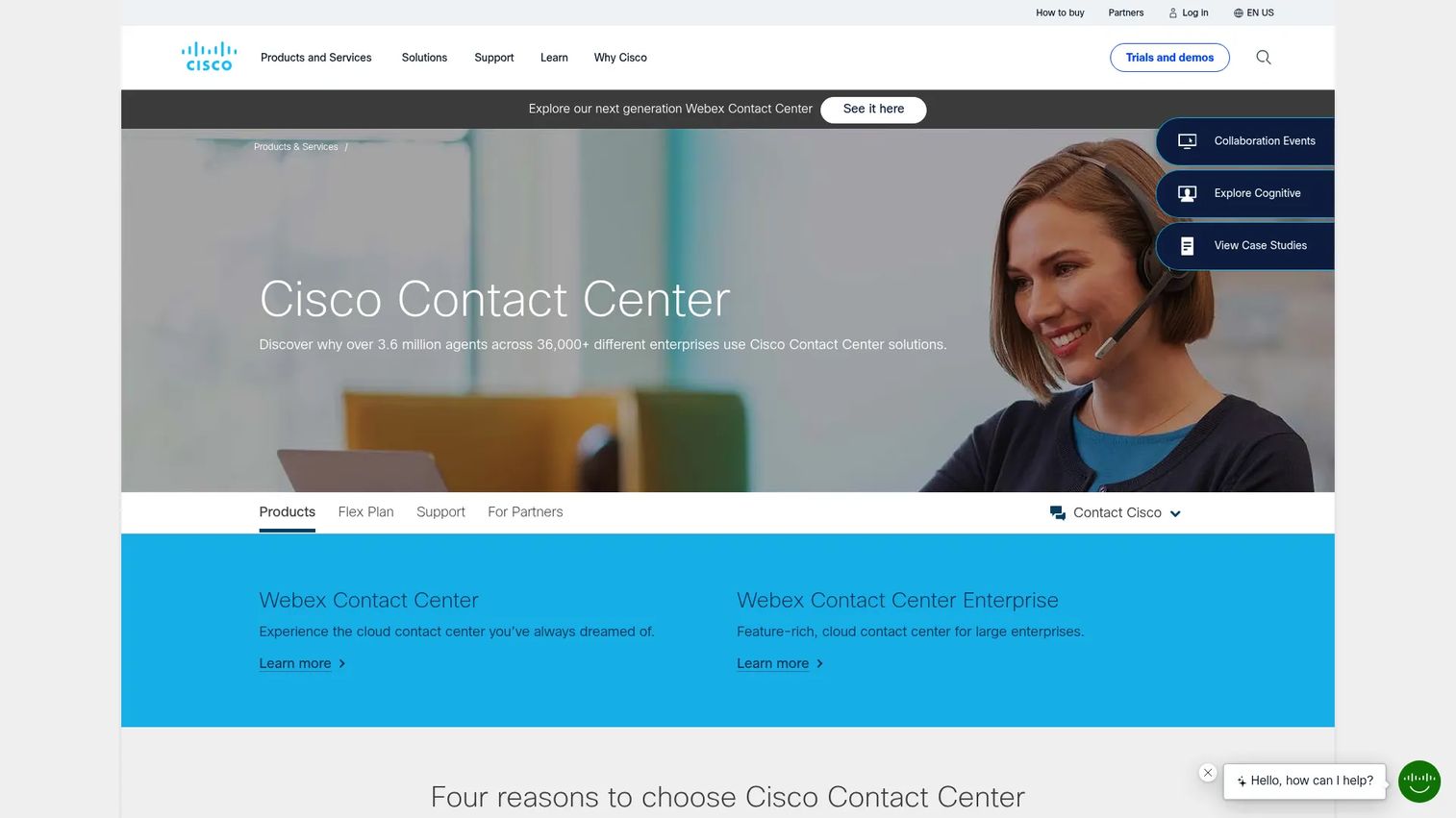
Cisco Webex Contact Center is a cloud contact center platform for organizations already running on Cisco's collaboration infrastructure. It covers inbound and outbound voice, skills-based routing, IVR with text-to-speech, browser-based agent desktop, voice and web callbacks, chat, email, SMS, WhatsApp, Facebook Messenger, and multi-channel analytics. Supervisor capabilities include monitoring, barge-in, and coaching. For IT-led enterprise procurement teams, Cisco's existing vendor relationship, security posture, and support infrastructure often carry significant weight.
Best for: Cisco and Webex-centered enterprises that want a cloud contact center aligned with existing collaboration and calling systems.
Key features
- Inbound and outbound voice with skills-based routing
- Browser-based agent desktop
- IVR, text-to-speech, and voice callbacks
- Chat, email, SMS, WhatsApp, and Facebook Messenger
- Multi-channel reporting and supervisor coaching tools
Why choose Cisco Webex Contact Center: The main argument is ecosystem alignment. Organizations with Cisco infrastructure, procurement relationships, and IT governance frameworks find the integration path lower-risk than adopting an entirely separate CCaaS vendor.
Cisco Webex Contact Center pricing: List pricing starts at $85 for Standard Named Agent and runs to $170 for Premium Concurrent Agent. Additional IVR ports are $70 each. Commercial pricing may vary from list rates.
G2 rating: 4.4/5
10. Salesforce Agentforce Contact Center
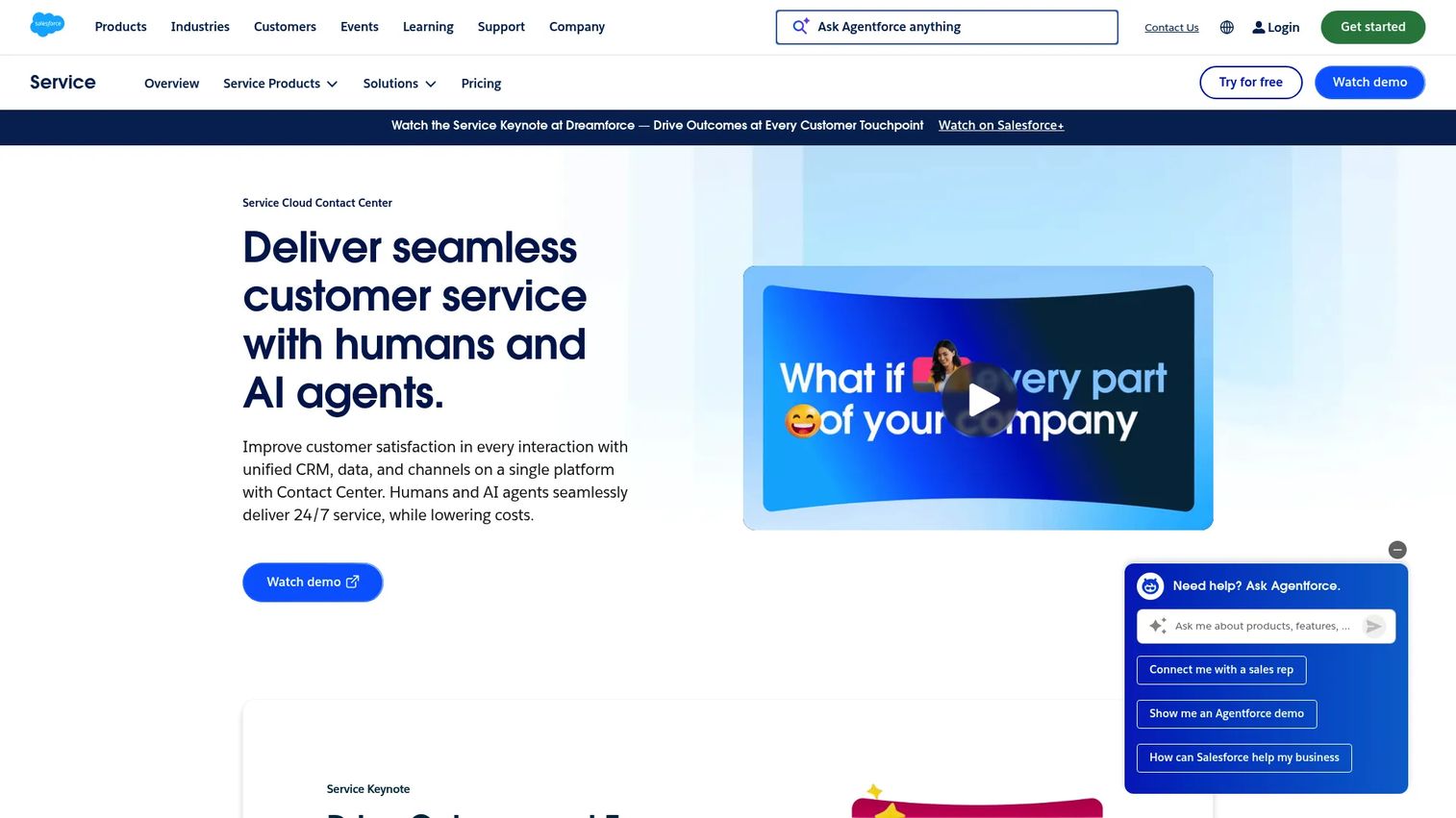
Salesforce Agentforce Contact Center is a CRM-native contact center built inside Salesforce. It combines native voice and telephony, omnichannel digital channels, AI-powered service workflows, AI agents, case automation, and workforce management. Because it sits inside the Salesforce data model, agents see full customer context without toggling to a separate CRM. The platform is distinct from standalone telephony-first CCaaS tools in that the CRM layer is native, not integrated. Compatible Service Cloud editions are required for the Contact Center and Contact Center Plus tiers.
Best for: Enterprise service organizations where Salesforce is the system of record and CRM-native contact center workflows matter more than standalone telephony depth.
Key features
- Native voice, telephony, and omnichannel digital channels
- AI agents and AI-powered service automation
- Case management and customer data context
- Call recording and transcription
- Workforce and quality management
Why choose Salesforce Agentforce Contact Center: If your service team already lives in Salesforce, putting contact center capabilities inside the same environment removes an entire integration layer. The tradeoff: Pricing and licensing complexity increases compared to standalone CCaaS tools.
Salesforce Agentforce Contact Center pricing: Agentforce Contact Center Voice starts at $75/user/month. Contact Center is $125/user/month. Contact Center Plus is $250/user/month. Workforce Management is an additional $50/user/month. Annual contracts and usage charges may apply.
G2 rating: 4.4/5 (listed as Agentforce Service on G2)
11. Vonage Contact Center
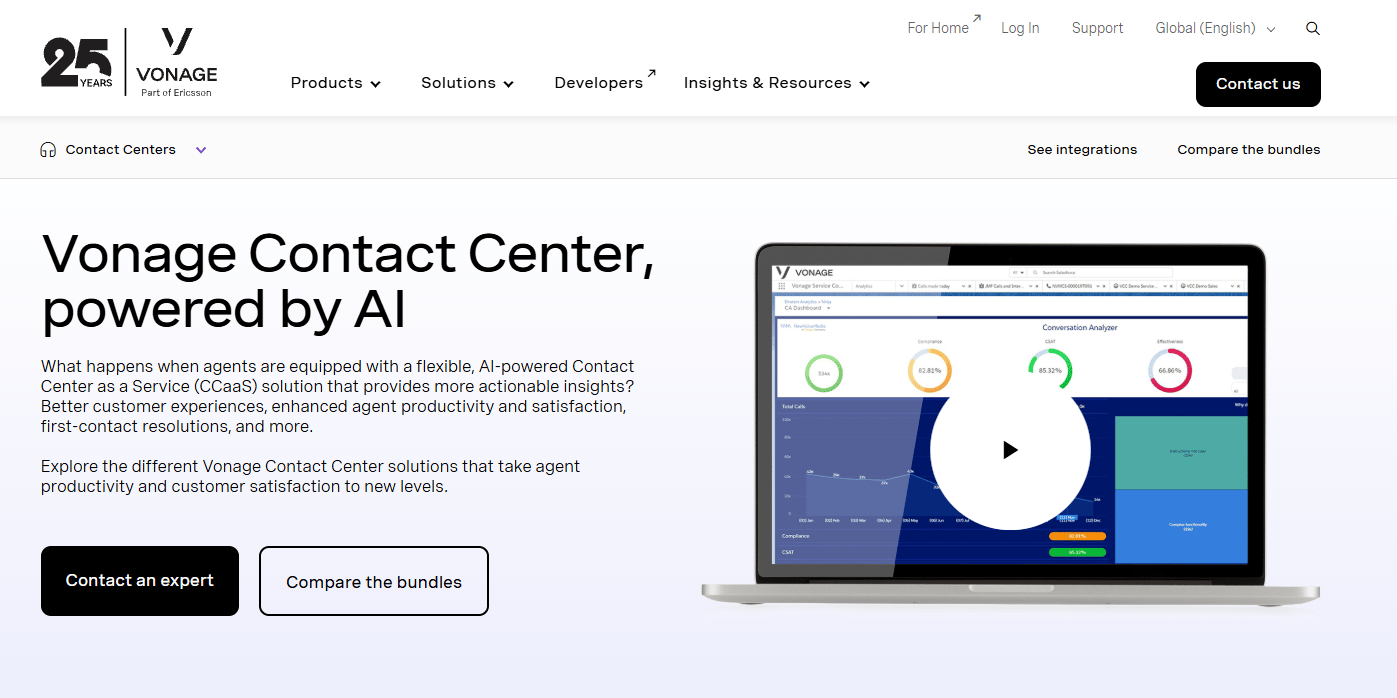
Vonage Contact Center is a cloud-based omnichannel contact center platform with strong CRM integration, particularly Salesforce. It handles voice, email, chat, SMS, video, and social channels with skills-based and dynamic routing, IVR, call recording, and analytics. AI virtual assistant and speech analytics capabilities are included in the platform. The CRM-integrated click-to-dial and automated dialing features make it practical for sales-oriented contact center workflows alongside traditional support operations.
Best for: Teams that need omnichannel contact center capabilities connected to Salesforce or other CRM platforms, with flexibility in communications architecture.
Key features
- Omnichannel routing across voice, email, chat, SMS, video, and social
- CRM integration with click-to-dial and automated dialing
- Skills-based and dynamic routing
- IVR, call recording, and analytics dashboards
- AI virtual assistant and speech analytics
Why choose Vonage Contact Center: The Salesforce integration is well-regarded among reviewers. For teams that build service operations around CRM data and need routing that responds to CRM triggers, Vonage is worth evaluating alongside Salesforce Agentforce.
G2 rating: 4.2/5
12. GoTo Contact Center
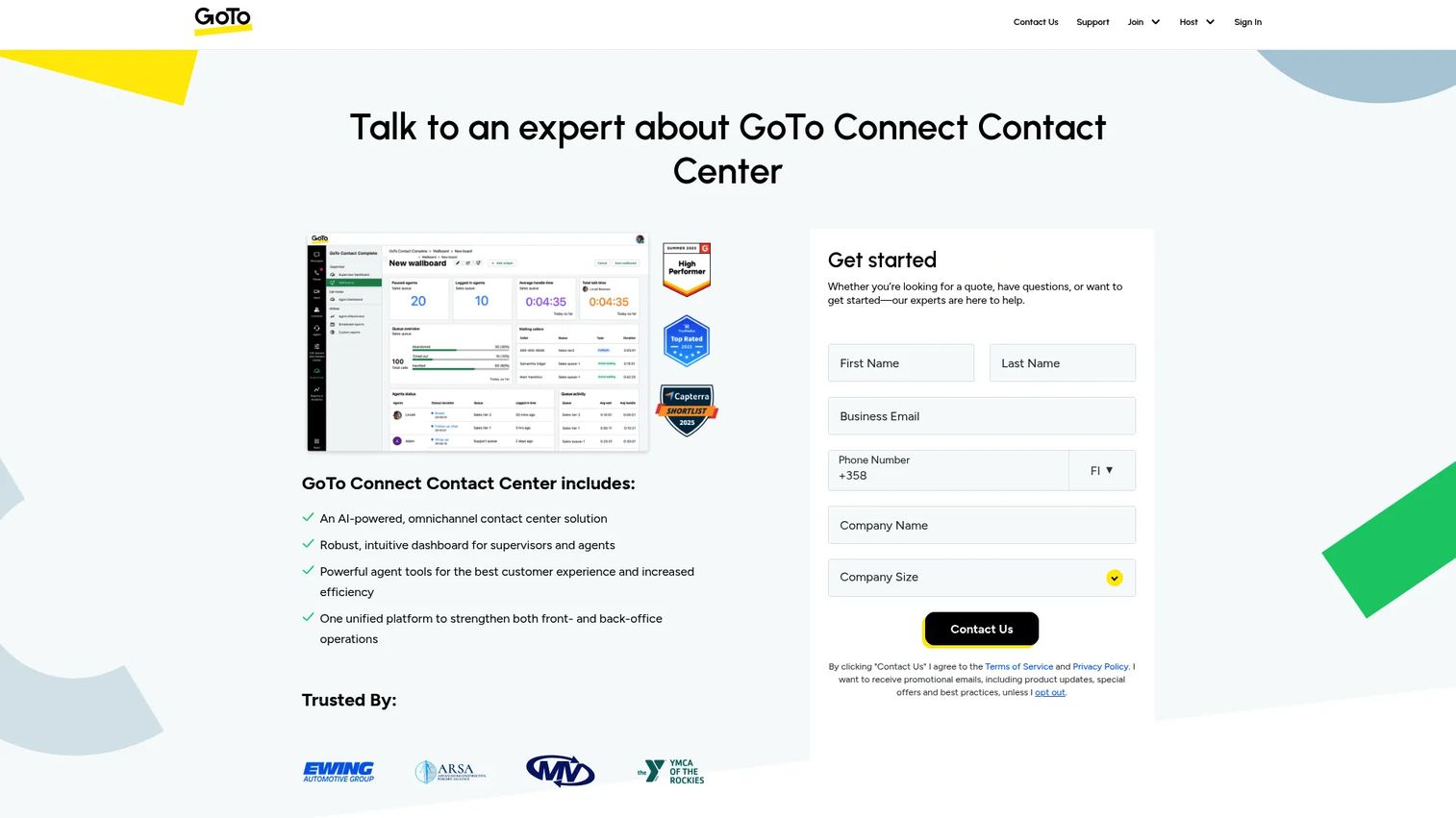
GoTo Contact Center is part of the GoTo communications platform, covering voice, video, chat, SMS, and social channels with intelligent call routing, IVR, real-time analytics, customizable dashboards, and supervisor tools. It suits smaller and mid-sized teams that want a managed cloud contact center without the implementation overhead of enterprise CCaaS platforms. The platform shares infrastructure with GoTo Connect, so teams already using GoTo for business calling can extend into contact center workflows without switching vendors.
Best for: Small and mid-sized teams that want a manageable cloud contact center paired with business communications, without enterprise CCaaS complexity.
Key features
- Voice, video, chat, SMS, and social channels
- Intelligent call routing and IVR
- Real-time analytics and customizable dashboards
- Supervisor monitoring and coaching tools
- GoTo communications platform integration
Why choose GoTo Contact Center: The buying motion is simpler than enterprise CCaaS. Teams that want a contact center they can administer without a dedicated IT resource find GoTo easier to manage day-to-day than platforms like Genesys or NiCE.
GoTo Contact Center pricing: Contact sales.
G2 rating: 4.4/5
13. 8x8 Contact Center
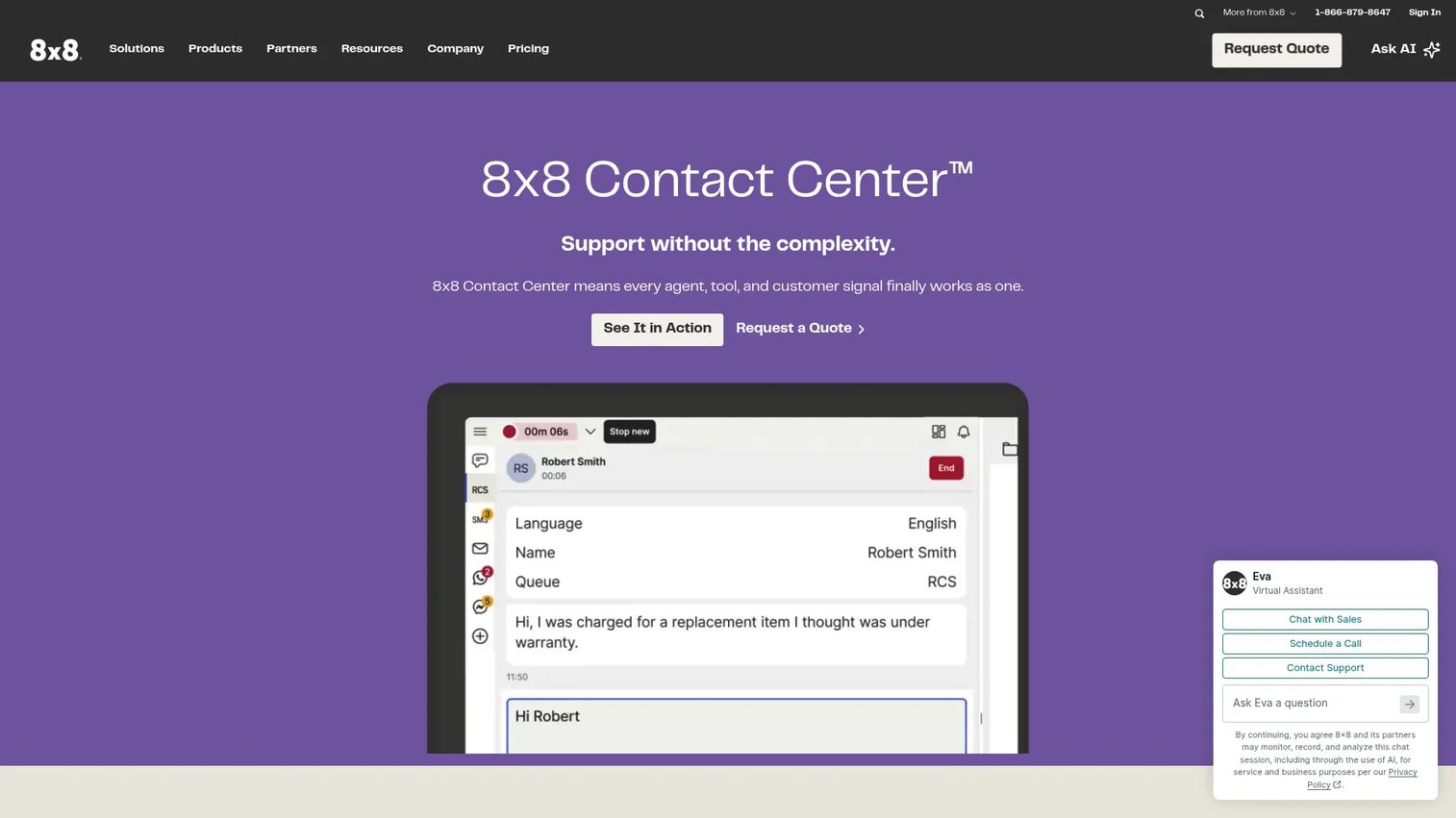
8x8 Contact Center is a cloud-based platform for managing customer interactions across voice and digital channels, with intelligent routing, AI capabilities, analytics, and automation. The Agent Workspace is browser-based, the Supervisor Workspace is customizable, and the platform supports auto dialer modes (predictive, progressive, preview), post-call surveys, graphical call-flow reports, and real-time analytics. 8x8 positions its platform as a combined UCaaS and CCaaS offering for distributed and global teams.
Best for: Organizations that want contact center and unified communications from the same provider, particularly teams with global or distributed operations.
Key features
- Omnichannel routing across voice, chat, email, SMS, social, WhatsApp, and Viber
- Browser-based Agent Workspace and Supervisor Workspace
- Auto dialer with predictive, progressive, and preview modes
- AI wrap-up, agent assistance, and customer 360
- Real-time analytics, post-call surveys, and workforce management
Why choose 8x8 Contact Center: The combined UCaaS and CCaaS model suits teams that want a single vendor for internal communications and external contact center. Global calling coverage and channel breadth are worth evaluating if your team operates across multiple regions.
G2 rating: 4.1/5
14. Twilio Flex
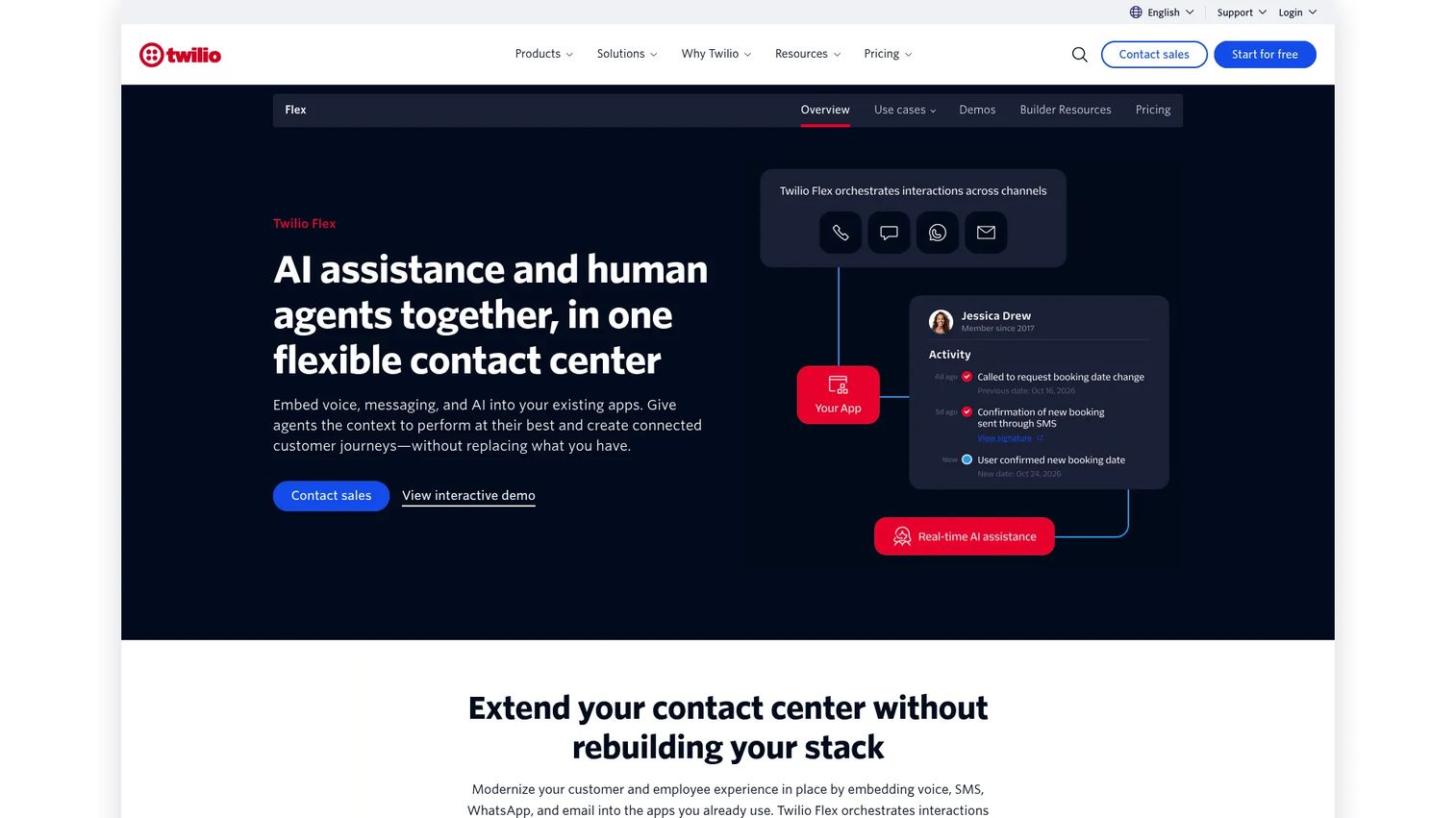
Twilio Flex is a programmable digital engagement center and cloud contact center platform. Rather than delivering a fixed product, Flex provides a customizable agent interface, programmable routing, omnichannel channel support (voice, SMS, WhatsApp, Facebook Messenger, WebChat, and custom channels), and operational analytics. Teams with engineering resources build workflows, integrations, and UI components that fit their exact operating model. The tradeoff: Flexibility requires technical ownership. Flex isn't a tool you configure; it's a platform you build on. For agentic AI tools for sales teams building fully customized contact experiences, Flex is worth exploring.
Best for: Developer-led teams with engineering resources who need API-level control over contact center workflows, routing logic, and agent interface.
Key features
- Programmable routing, queues, and agent interface
- Omnichannel support: Voice, SMS, WhatsApp, WebChat, and custom channels
- Operational dashboards via Flex Insights
- Voice and messaging APIs
- Agent Copilot available as a separate add-on
Why choose Twilio Flex: If the out-of-box products don't fit your operating model, Flex lets you build exactly what you need. The usage-based pricing is genuinely different from seat-based CCaaS. That flexibility comes with real implementation and maintenance costs.
Twilio Flex pricing: Free trial available (5,000 free active user hours). Active user hour pricing starts at $1/hour. User + Usage pricing starts at $35/monthly active user. Named user pricing starts at $150/named user/month. Agent Copilot is $0.035/voice minute or $0.005/digital message.
G2 rating: 4.1/5
15. Zendesk
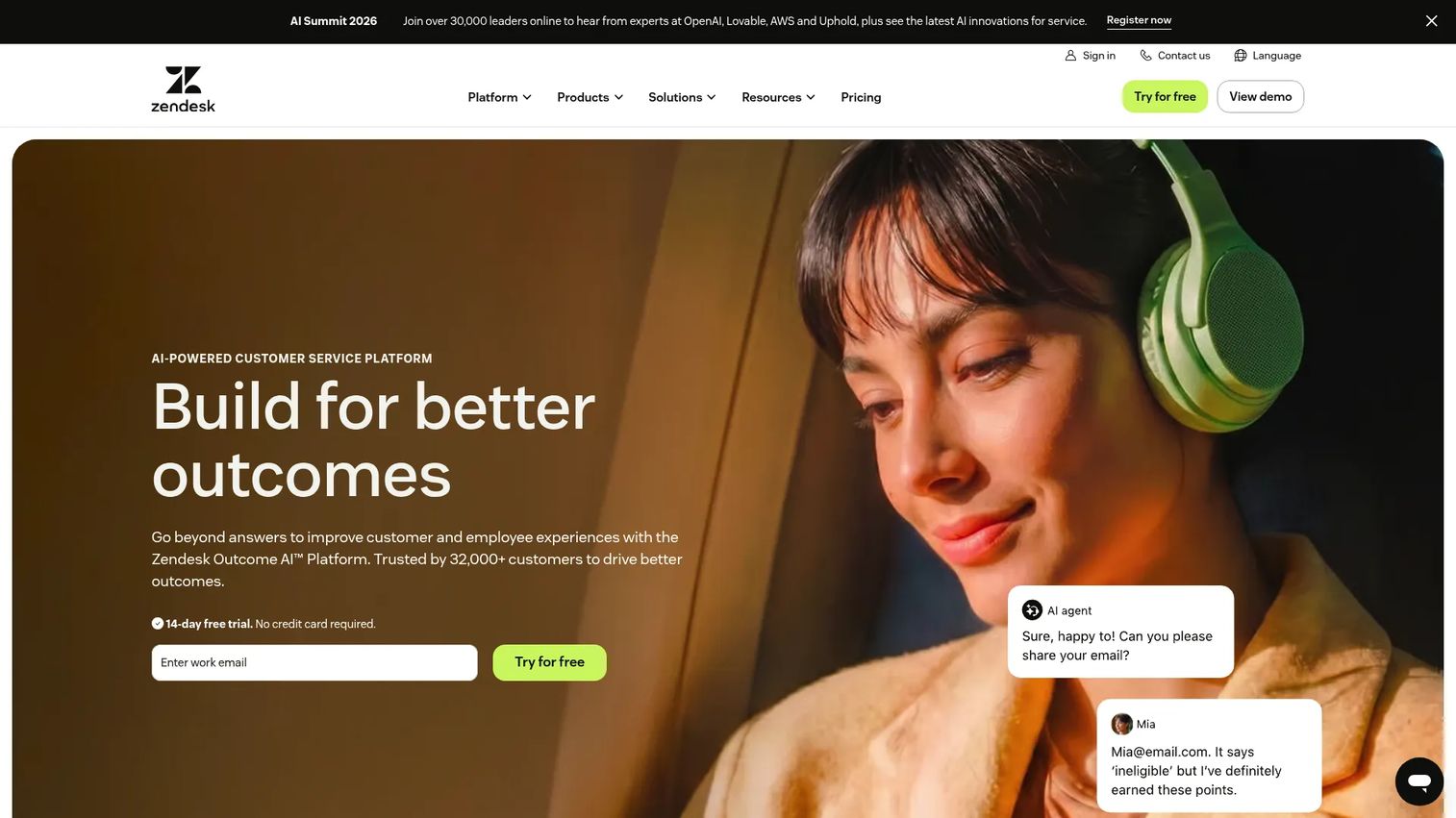
Zendesk is a customer service platform that combines ticketing, AI agents, knowledge base, omnichannel routing, messaging, live chat, telephony, and analytics. For teams already using Zendesk for support, adding contact center capabilities inside the same workspace avoids a vendor switch. Voice (Zendesk Talk), messaging, and AI automation extend the ticketing core. The platform suits support-led organizations where ticket management, knowledge management, and conversation routing need to work together. For best AI customer service agents coverage, Zendesk's AI automation is worth reviewing separately.
Best for: Support organizations that want contact center work connected to ticketing, knowledge base, and customer service workflows rather than a standalone CCaaS platform.
Key features
- Ticketing, messaging, and live chat in one workspace
- AI agents and automation
- Knowledge base and help center
- Telephony via Zendesk Talk
- Omnichannel routing and analytics
Why choose Zendesk: The integration between tickets, conversations, and customer history is tighter here than in CCaaS-first platforms. If your contact center is primarily a support function and ticket context matters more than outbound dialing depth, Zendesk is worth shortlisting.
Zendesk pricing: Support Team starts at $19/agent/month (annual). Suite Team is $55/agent/month (annual). Suite Professional is $115/agent/month (annual). Suite Enterprise requires contacting sales. A 14-day free trial is available.
G2 rating: 4.3/5
16. Zoho Desk
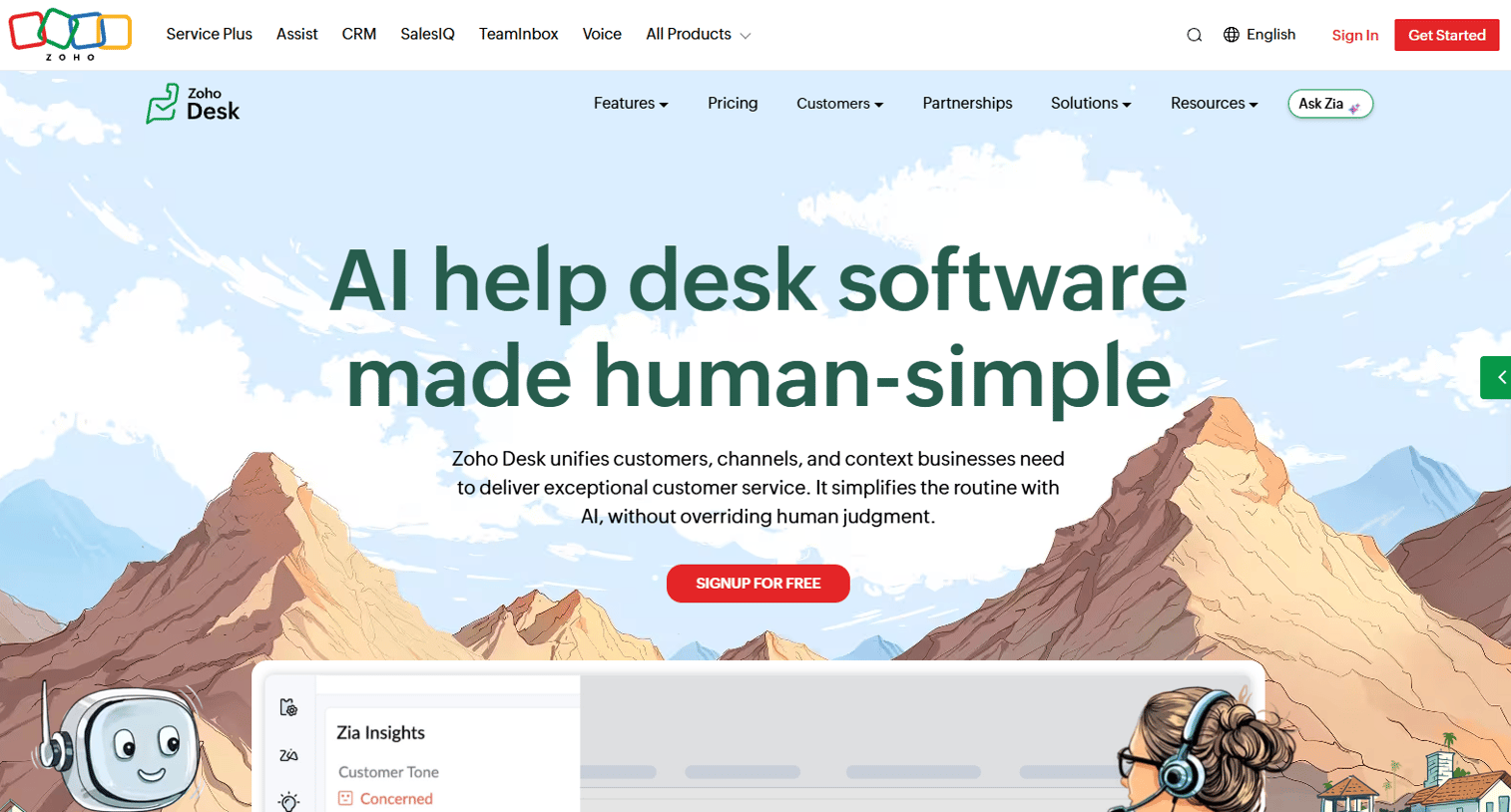
Zoho Desk is an AI-powered customer service platform for teams that want ticketing, omnichannel support, self-service, and automation at an affordable price point. It covers email, phone, instant messaging, social media, live chat, and web forms. AI features include AI agents, Zia conversational assistance, and predictive insights. The platform integrates tightly with Zoho CRM and other Zoho suite tools. A free plan supports up to 3 users, making it one of the few contact-adjacent platforms with a genuinely usable free tier.
Best for: Small businesses already using Zoho CRM or Zoho One that need affordable omnichannel customer service software with AI and automation.
Key features
- Omnichannel ticketing across email, phone, chat, social, and web forms
- AI agents, Zia AI, and conversational assistance
- Self-service knowledge base and guided conversations
- Automation: Ticket assignment, SLAs, blueprints, and workflows
- Zoho CRM and Zoho suite integration
Why choose Zoho Desk: Pricing is the standout. Few platforms at this price range offer omnichannel coverage, AI assistance, and native CRM integration. Teams not on Zoho can still use it, but the value increases significantly if you're already in the Zoho ecosystem.
Zoho Desk pricing: Free plan for up to 3 users. Paid plans start at $7/user/month (Express, annual). Standard is $14/user/month, Professional is $23/user/month, Enterprise is $40/user/month (all annual).
17. LiveAgent
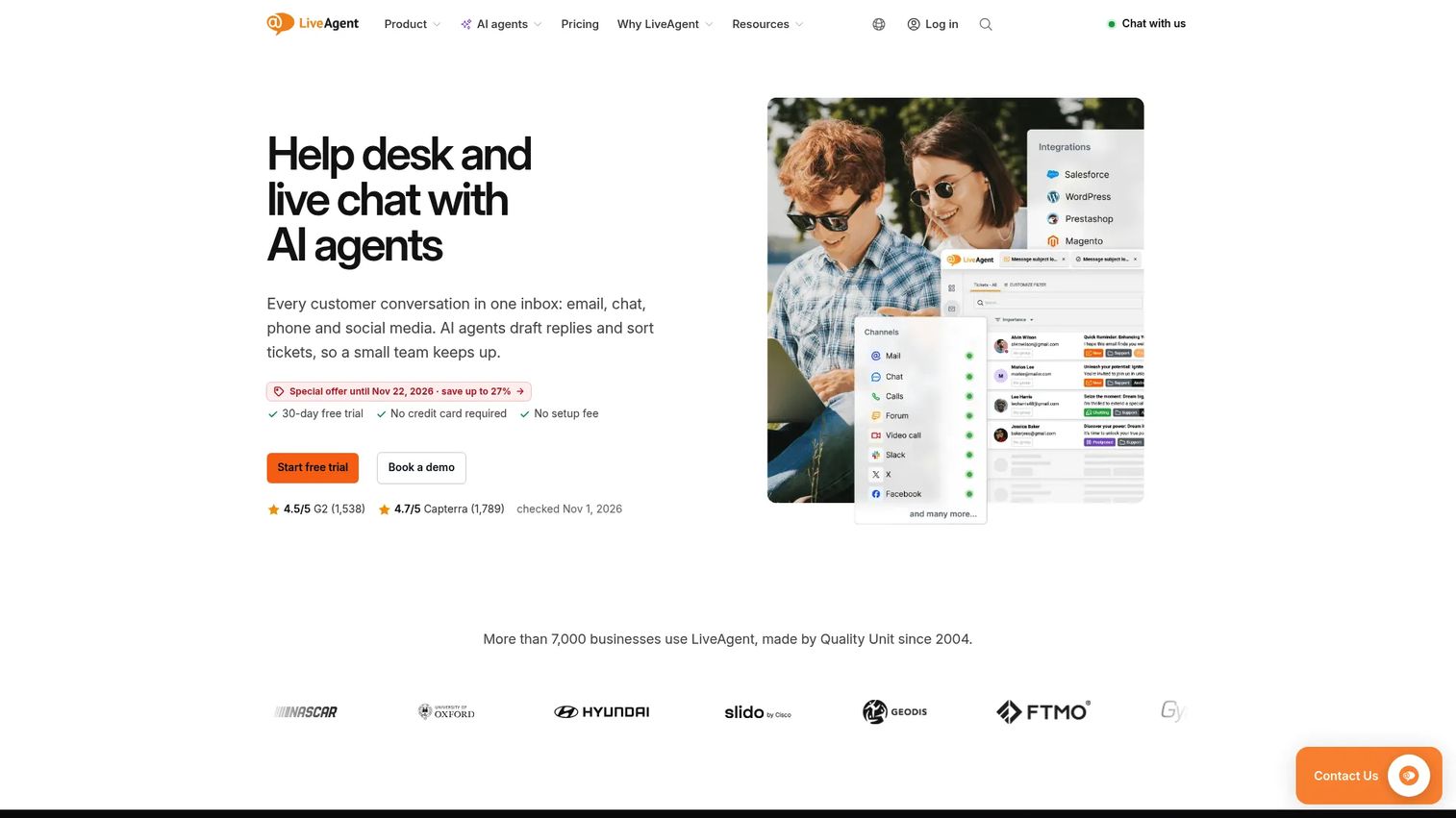
LiveAgent is a cloud help desk platform combining ticketing, live chat with visitor tracking, a built-in call center with IVR and routing, social messaging, knowledge base, customer portal, and AI features in one inbox. It's one of the most complete multichannel service desks at this price range. Starter supports up to 5 agents; Team supports up to 15. Business supports any team size. Enterprise requires contacting sales. A 30-day free trial is available.
Best for: Small support teams that need live chat, ticketing, call center basics, and knowledge base capabilities at accessible per-agent pricing.
Key features
- Omnichannel ticketing and universal inbox
- Live chat with visitor tracking
- Built-in call center with IVR, routing, and call recording
- Knowledge base and customer portal
- AI chatbot and AI answer assistance
Why choose LiveAgent: At $11/agent/month (Starter, annual), the per-agent cost is significantly lower than most contact center platforms. Teams that need voice, chat, ticketing, and knowledge base in one tool without paying enterprise CCaaS pricing will find LiveAgent practical.
LiveAgent pricing: Starter is $11/agent/month (annual; regular price $15). Team is $22/agent/month (annual; regular price $29). Business is $38/agent/month (annual; regular price $49). These are promotional prices for trials started by November 22, 2026.
G2 rating: 4.5/5
18. VICIdial
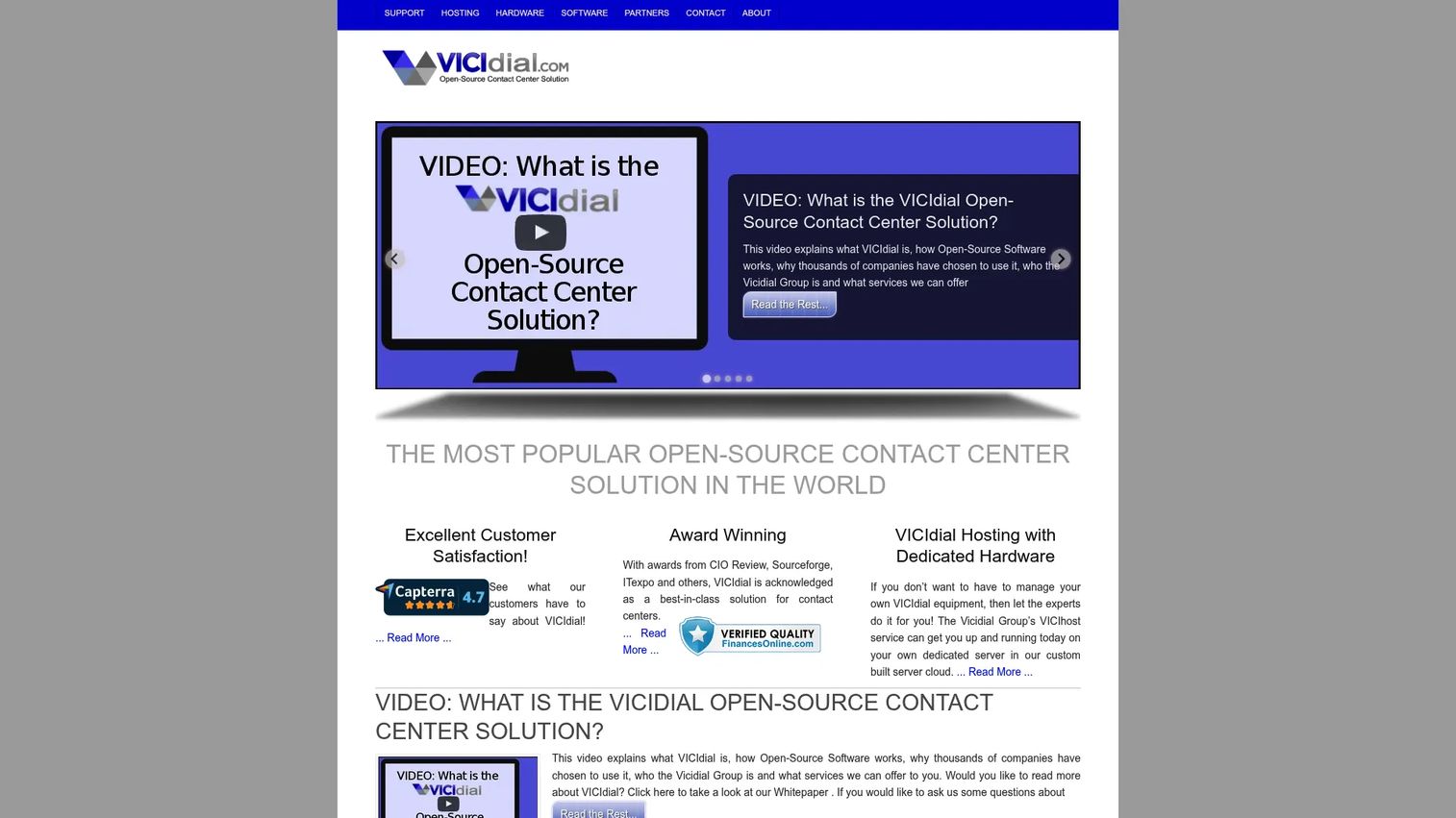
VICIdial is an open-source enterprise contact center suite supporting inbound, outbound, and blended call handling. It covers predictive, auto, preview, and manual dialing, call recording with stereo recording, skills-based routing, queue prioritization, real-time reporting, inbound email, and web chat. The software itself carries no licensing cost. What you pay for are services: Remote installation starts at $800, system planning at $200/hour, and hosting and support through their hosted service provider.
Best for: Technical teams that want open-source call center software with predictive dialing capabilities and are willing to manage hosting, configuration, and maintenance.
Key features
- Predictive, auto, preview, and manual dialing
- Inbound, outbound, and blended call handling
- Stereo call recording and monitoring
- Skills-based routing and queue prioritization
- Real-time and summary reporting
Why choose VICIdial: The software cost is zero. For outbound-heavy operations with technical staff who can manage Linux-based infrastructure, VICIdial delivers real capability without subscription fees. The tradeoff: Implementation, hosting, and ongoing maintenance require real technical investment.
VICIdial pricing: Software is free and open source. Remote installation starts at $800. System planning starts at $200/hour. Contact the official hosting provider for current hosting costs.
G2 rating: 4.1/5
19. ICTContact
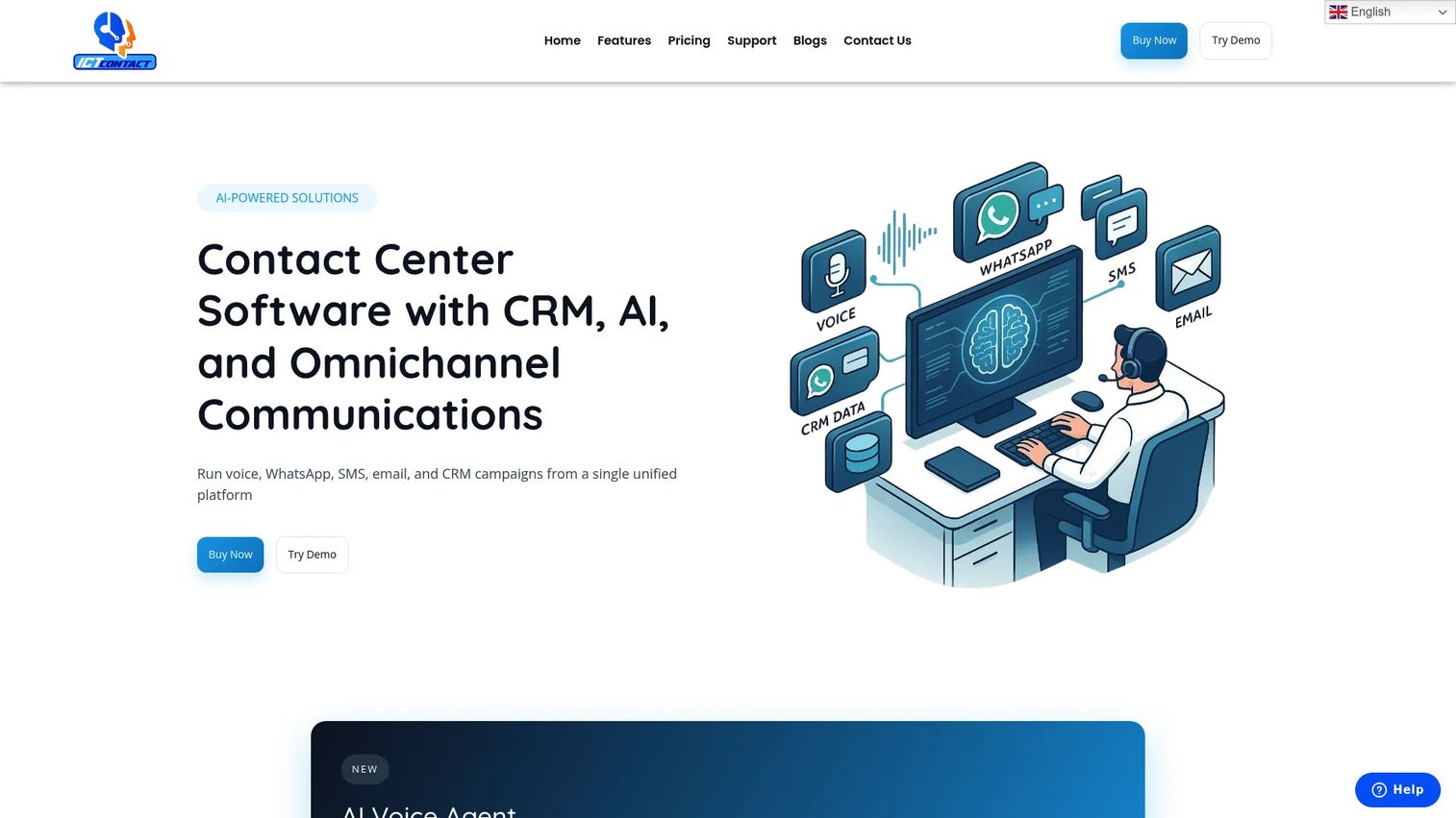
ICTContact is an omnichannel contact center platform for inbound and outbound communications with built-in CRM, dialing modes (progressive, preview, power, manual, predictive), drag-and-drop IVR Studio, WebRTC agent panel, voice broadcasting, real-time analytics, and multi-tenant deployment for service providers. The platform supports self-hosted or hosted deployment. An AI Voice Agent capability is included in the Service Provider tier. For teams that need campaign-driven contact center capabilities with open-source flexibility and multi-tenant architecture, ICTContact is worth evaluating.
Best for: Organizations and IT service providers needing self-hosted or hosted omnichannel contact center with campaign capabilities, CRM, and multi-tenant deployment.
Key features
- Progressive, preview, power, manual, and predictive dialing
- Drag-and-drop IVR Studio
- WebRTC agent panel and built-in CRM
- Omnichannel campaigns: Voice, SMS, email, and fax
- Multi-tenant white-label deployment and AI Voice Agent
Why choose ICTContact: One-time licensing avoids ongoing per-seat subscription costs. The Service Provider tier is specifically built for ITSPs and contact center businesses that need multi-tenant architecture and white-labeling. The enterprise license at $399 for 5 agents is accessible for smaller deployments.
ICTContact pricing: Enterprise Edition is $399 one-time for 5 agents. Service Provider is $1,500 one-time for 20 agents. Cloud (ICTDialer) starts at $10/agent/month.
20. Bitrix24
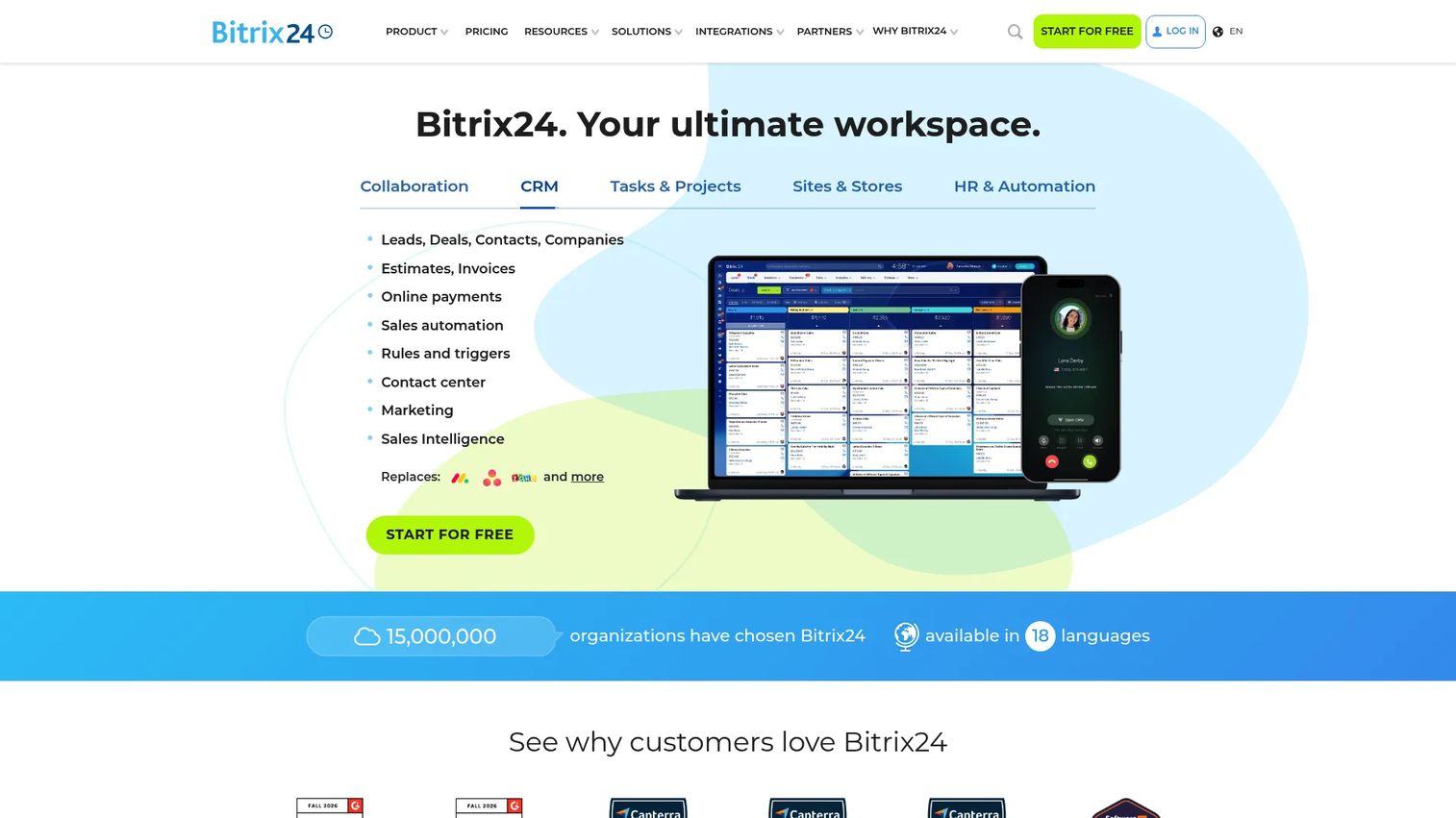
Bitrix24 is an online workspace combining CRM, tasks and projects, team collaboration, messenger, video calls, workflow automation, websites, and an AI assistant (CoPilot). Contact center-adjacent features include telephony support, live chat, open channels for social messaging, and CRM-connected customer communication. It's not a deep CCaaS platform, but for small businesses that want CRM, internal collaboration, and basic customer communication tools in one place, Bitrix24 covers a lot of ground at low cost. A free plan is available.
Best for: Small businesses that want CRM, team collaboration, and basic customer communication tools in one affordable workspace without enterprise CCaaS complexity.
Key features
- CRM with pipeline and contact management
- Telephony, live chat, and open channels
- Task and project management
- Team collaboration, messenger, and video calls
- AI CoPilot assistant and workflow automation
Why choose Bitrix24: The free plan is genuinely usable. For small teams that need CRM and basic customer communication without paying per-agent contact center pricing, Bitrix24 covers those needs. It's not a replacement for a proper CCaaS platform as call volume or routing complexity grows.
Bitrix24 pricing: Free plan available. Basic starts at $49/organization/month (annual, 5 users). Standard is $99/organization/month (annual, 50 users). Professional is $199/organization/month (annual, 100 users). Enterprise starts at $399/organization/month (annual, 250+ users).
G2 rating: 4.1/5
Considerations when choosing contact center software
Match the platform to your channel mix
A phone-heavy sales team and an omnichannel support team need different platforms. List your current and planned channels before comparing vendors, then eliminate platforms that don't cover them natively. Adding missing channels through third-party integrations usually means additional cost and routing complexity.
Test AI against real conversations
Don't evaluate AI features from a demo script. Bring realistic transcripts from your own contact center into the evaluation. The question isn't whether the platform has AI summaries. It's whether those summaries reduce manual review time and produce consistent output at your actual interaction volume.
Price the full operating model
The entry tier price rarely reflects what you'll pay. Add users, phone numbers, usage charges, digital channel add-ons, workforce management, QA modules, AI features, storage, implementation, support, and CRM integration costs before comparing vendors. The lowest headline price often excludes the capabilities driving the purchase decision.
Check integration depth, not logos
A vendor "integrating with Salesforce" covers a wide range of actual capability. Verify screen pop behavior, call logging object sync, routing triggers from CRM data, and reporting workflows. For PMMs specifically, misaligned CRM integration creates message drift between support, sales, and customer success teams.
Validate reliability, security, and governance
Ask for SLA terms, data residency options, role-based permissions, audit logs, SSO support, and compliance documentation before procurement. Uptime commitments and support escalation processes matter more during outages than during the sales cycle.
Conclusion
The right contact center software depends on your team size, channel requirements, and integration reality, not on which platform has the longest feature list.
For all-around contact center plus communications, shortlist Nextiva, RingCentral Contact Center, 8x8 Contact Center, or GoTo Contact Center. For enterprise CCaaS depth, compare Five9, Genesys Cloud CX, NiCE CXone, Talkdesk, and Cisco Webex Contact Center. When CRM context matters most, start with Salesforce Agentforce Contact Center, Zendesk, or Zoho Desk. Developer-led teams building custom workflows should evaluate Twilio Flex. For budget or open-source control, review VICIdial and ICTContact carefully, with clear eyes on implementation costs.
Bring verified pricing into every vendor conversation. The gap between the entry tier and what your team actually needs is where most contact center budgets get surprised.
If you're marketing or selling complex software and need buyers to understand your product before a call, Guideflow helps teams create interactive product experiences that let buyers explore workflows on their own terms.
Start your journey with Guideflow today!
FAQs
There isn't a universal answer. The best fit depends on team size, channels, AI requirements, integrations, and budget. For growing SMB and mid-market teams, Nextiva and Aircall are strong starting points. Enterprise operations should shortlist Five9, Genesys Cloud CX, NiCE CXone, and Talkdesk. CRM-first teams should start with Salesforce Agentforce Contact Center or Zendesk.
Call center software focuses primarily on phone interactions: Inbound queues, outbound dialers, IVR, call recording, and routing. Contact center software adds digital channels (email, chat, SMS, social messaging), CRM context, automation, workforce management, quality assurance, and self-service capabilities. Most modern platforms position themselves as contact center software even when voice is their primary channel.
Pricing varies widely. SMB-focused platforms like LiveAgent start at $11/agent/month. Mid-market platforms like Aircall start at $30/license/month. Enterprise CCaaS platforms like Five9 start at $119/concurrent seat/month. Add usage charges, channel add-ons, workforce management modules, AI features, and implementation costs before comparing vendors. Many enterprise platforms require a custom quote. See the comparison table above for a full breakdown.
The core set covers IVR, ACD, skills-based routing, queue management, call recording, omnichannel channel support, CRM integrations, analytics dashboards, and security controls. Modern platforms add AI agent assist, conversation summaries, sentiment analysis, quality management, workforce management, and self-service automation. The features that matter most depend on whether your contact center is primarily inbound support, outbound sales, or a blended operation. For a deeper look at related tools, see our guide on agent assist software.
Cloud platforms deploy faster, support remote agents more easily, and shift infrastructure maintenance to the vendor. On-premises deployments may still fit organizations with strict data residency requirements, existing telephony infrastructure investments, or regulatory constraints that cloud providers haven't fully addressed. Most enterprise CCaaS vendors now offer data residency options that satisfy many compliance requirements.
Small businesses with tight budgets and limited IT resources should look at Zoho Desk (free plan available), Bitrix24 (free plan available), LiveAgent (from $11/agent/month), Nextiva, or Aircall. Verify channel coverage and integration support for your specific CRM or help desk before committing, as lighter platforms vary significantly in what they include at entry tiers.
Enterprise teams typically need governance, uptime SLAs, AI depth, workforce management, security controls, and CRM integration at scale. Five9, Genesys Cloud CX, NiCE CXone, Talkdesk, Cisco Webex Contact Center, Salesforce Agentforce Contact Center, and RingCentral Contact Center are the platforms most commonly evaluated at enterprise scale. Each has different strengths: Five9 on outbound and routing, Genesys on journey orchestration, NiCE on workforce engagement, Talkdesk on AI and industry verticals.
Yes, if the team can manage hosting, configuration, security, and ongoing maintenance. VICIdial is a mature open-source call center platform with predictive dialing and inbound support. ICTContact is an open-source contact center with multi-channel campaign capabilities. The software licensing cost is free or low, but total operating cost includes hosting, implementation, and support. For teams without technical staff to manage Linux-based infrastructure, a managed CCaaS platform will cost less in practice.