Signing a commercial lease or acquiring a building is the easy part. The real cost shows up six months later: A tenant escalating a maintenance issue no one logged, a capital expense that blindsided the quarterly budget, or a rent roll that no one on the leadership team can read clearly enough to act on.
According to IREM's Proptech Insights (2025), 49% of commercial real estate professionals reported portfolio growth over the prior year, yet operational systems often lag that growth. The gap between owning more property and managing it without founder-level involvement is exactly where most operators get stuck.
This guide maps 10 options across the commercial real estate property management landscape, from full-service providers to listings, directories, and job market data. Use it to build a shortlist, sharpen your due diligence questions, and hand the research to your finance or operations lead with something worth acting on.
What's inside
This guide is for founders, operators, investors, and owners comparing commercial real estate property management routes in 2026. Items were selected based on recurring search and decision patterns in this category.
- Who it covers: Anyone choosing between third-party management, direct leasing, local market discovery, or in-house hiring
- How options were chosen: Operational responsibility, local market usefulness, and decision value for owners of office, retail, and industrial properties
- What each entry explains: Best fit, key use case, pricing model, and evaluation notes
- What to expect: A category and option guide, not legal, tax, or brokerage advice
TL;DR
- Best overall starting point: Full-service commercial property management services cover tenant coordination, inspections, maintenance response, financial reporting, budgeting, and capital planning in one operating model
- Best for local market discovery: Memphis commercial real estate opportunities help buyers and tenants see local supply, broker landscape, and pricing context before committing
- Best for operating-model clarity: Office, retail, and industrial property categories each carry different management burdens; understanding the distinction shapes the right provider brief
- Best for quick due diligence: Ratings, reviews, and business listing management software directories help identify providers worth researching further
- Best for hiring context: Job listings and salary data show what in-house commercial property management talent costs and what the role actually requires
What is commercial real estate property management?
Commercial real estate property management is the ongoing operation, maintenance, tenant coordination, financial oversight, and owner reporting for income-producing or business-use properties.
It differs from residential management in scope and complexity. Commercial leases are more customized. Tenants often include businesses with operational requirements, common-area dependencies, and contractual rights that residential tenants do not have. Reporting needs are more involved, covering rent rolls, expense reconciliation, capital expenditure tracking, and owner distributions. For larger assets, capital planning is not optional.
Core responsibilities covered by commercial property management services include:
- Tenant communication and retention programs
- Maintenance response and vendor coordination
- Scheduled property inspections
- Financial reporting and accounting
- Annual budgeting and expense tracking
- Capital planning and reserve management
- Lease administration support
- Local market knowledge and comparables
- Property tax appeal coordination
- Owner reporting and decision-support materials
Understanding which of these your current property or portfolio needs is the first step. A single-tenant industrial building has different inspection and vendor needs than a retail strip center with eight tenants. Office buildings with rotating occupancy and shared amenities require stronger tenant experience management than a single-occupant warehouse.
The 10 options below cover the full range: From professional management firms and local market resources to listings, directories, and the data sources that help you decide whether to outsource or hire. Cross-referencing asset lifecycle management software principles can also help frame your capital planning questions when evaluating providers.
When to use commercial real estate property management
Manage tenant and maintenance issues before they reach the owner
Commercial tenants expect fast responses on access, repairs, common-area conditions, invoicing, and operational disruptions. Without a designated property manager, those requests route to whoever picks up the phone. A property manager keeps that traffic away from the owner while maintaining a log of requests, response times, and resolution notes that becomes part of the asset record.
Turn property performance into board-ready reporting
Investors, lenders, and board members need a clear view of occupancy, rent collection, maintenance spend, and capital needs. A well-run property management relationship produces monthly or quarterly owner reports covering rent roll status, expense variance, open maintenance items, and capital projections. That is the reporting a VP of Finance can work with.
Plan capital work before it becomes urgent
Roof replacements, HVAC overhauls, and parking lot resurfacing do not have to be surprises. Regular inspections, reserve account management, and five-year capital planning turn those costs into predictable line items. Connecting inspection cadence to capital project management software principles helps operators budget ahead rather than react.
Commercial real estate property management comparison
The 10 options below are categories and information sources, not SaaS products. G2 ratings are listed where a specific platform in the category carries a verified rating; otherwise the column shows N/A. Pricing reflects the model for each category.
| # | Product | Best for | Key use case | Pricing | G2 rating |
|---|---|---|---|---|---|
| 1 | Commercial property management services | Owners needing end-to-end operations | Tenant coordination, reporting, budgeting, inspections | Management fee, quoted by provider | N/A |
| 2 | CBRE Memphis / local CRE opportunities | Local owners, tenants, and investors | Finding market-specific leasing and investment opportunities | Brokerage or listing-dependent | N/A |
| 3 | Office properties | Companies managing workplace space | Tenant experience, maintenance, occupancy planning | Lease or management-fee dependent | N/A |
| 4 | Retail properties | Owners with customer-facing tenant spaces | Foot traffic, tenant coordination, common-area upkeep | Lease or management-fee dependent | N/A |
| 5 | Industrial properties | Owners of warehouse and logistics assets | Maintenance, access, safety, vendor coordination | Lease or management-fee dependent | N/A |
| 6 | Crexi (property listings) | Buyers, tenants, and investors | Comparing available commercial spaces | Free to browse; paid plans available | 4.6/5 |
| 7 | Google Business Profile (ratings and reviews) | Early provider due diligence | Identifying providers to research further | Free | 4.6/5 |
| 8 | Yelp (business directory listings) | Local provider discovery | Finding contact information and location details | Free to browse | N/A |
| 9 | Indeed (job listings) | Hiring or benchmarking roles | Understanding duties and local demand | Free to search; employer-paid listings | 4.3/5 |
| 10 | BLS occupational data (salary data) | Budgeting for in-house management | Estimating commercial property manager compensation | Free | N/A |
Best 10 commercial real estate property management options for 2026
1. Commercial property management services
IREM is the Institute of Real Estate Management, a professional association that certifies commercial property managers and publishes benchmarking data, education, and income-expense reports by metro area and asset class. Beyond IREM's resources, the broader category of commercial property management services refers to third-party firms that take operational responsibility for commercial assets.
Best for: Owners who need a single accountable partner for day-to-day operations, financial reporting, tenant relations, and capital coordination.
Key features
- Tenant communication and lease administration support
- Maintenance response and vendor approvals
- Monthly financial reporting and rent roll tracking
- Annual budgeting and capital reserve planning
- Property inspections for roofing, life safety, and common areas
Why choose commercial property management services: This is the right route when the owner wants operational accountability rather than just brokerage support. For a Series B founder managing physical office space or investment assets alongside a growing company, handing day-to-day property decisions to a qualified manager removes a category of distraction from the leadership calendar.
Commercial property management services pricing: Management fees are almost always quoted by provider. The fee structure depends on asset type, square footage, tenant count, and whether accounting, leasing, or project oversight are included. IREM publishes income-expense benchmarking data starting at $49 for a single metro area and asset class, which helps owners evaluate whether their property's expenses align with market norms before selecting a provider.
2. CBRE Memphis / local commercial real estate opportunities
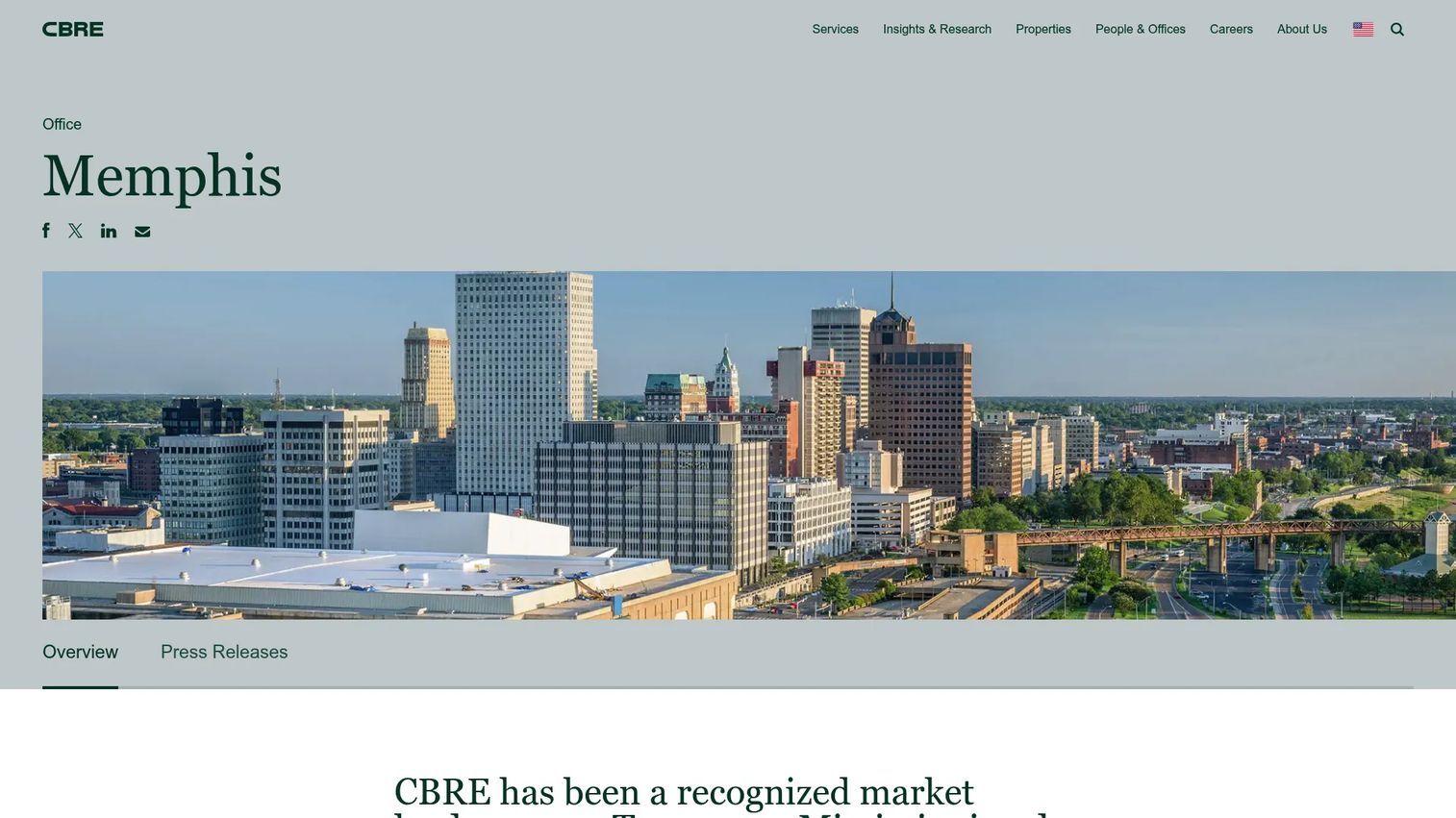
CBRE's Memphis office provides commercial real estate services and searchable listings for lease, sublease, sale, and investment opportunities in the Memphis market. Memphis and the broader Tennessee market represent a recurring local pattern in commercial real estate searches, particularly for logistics, industrial, and office assets tied to regional distribution and healthcare sectors.
Best for: Businesses, investors, and occupiers evaluating commercial real estate opportunities in Memphis or comparable mid-size metro markets before selecting a property management partner.
Key features
- Searchable commercial listings by transaction type and property type
- Available sublease inventory in the Memphis metro
- Investment sale listings filtered by location and property criteria
- Broker profiles and local market context
- Market reports covering local activity and trends
Why choose local CRE market resources: Location and opportunity fit shape management decisions before a provider is selected. Understanding what properties are available, at what price range, with what tenant characteristics, determines how much operational complexity you are taking on. Memphis, as a logistics and distribution hub, also offers a useful data point for industrial and warehouse management needs.
CBRE Memphis pricing: Browsing listings and market pages is free. Lease, sale, brokerage, and management costs depend on the specific property and deal terms negotiated with the broker.
3. Office properties

CBRE's commercial property search lets users filter office listings for lease and sale alongside brokerage, advisory, and property-management services specific to the office sector. Office properties include traditional office buildings, coworking-style environments, corporate facilities, and multi-tenant spaces where employees, visitors, and clients interact with the building daily.
Best for: Companies managing workplace space for employees or seeking office-focused management partners who understand tenant experience, occupancy planning, and facilities coordination.
Key features
- Tenant experience and comfort coordination
- Common-area upkeep and vendor scheduling
- Access control and security coordination
- Occupancy planning and lease tracking
- HVAC, cleaning, and facility maintenance oversight
Why choose office-focused property management: Office management quality shows up directly in employee experience, visitor impressions, and renewal decisions. A manager who handles maintenance requests slowly or lets common areas deteriorate creates a facility problem that eventually becomes a recruiting or retention problem. For a SaaS company scaling to 50-150 employees, the wrong office management setup reaches the founder's calendar fast.
Office property management pricing: Fees are usually quoted by asset size and service scope. Including accounting, tenant improvements, or facilities project oversight changes the cost structure. Many office listings on CBRE show contact-broker pricing rather than a fixed published rate.
4. Retail properties

CBRE's properties marketplace includes retail listings across storefronts, retail centers, restaurants, and service-business locations. Retail property management is operationally distinct from other asset types because the property's physical condition directly affects the tenant's revenue and customer traffic.
Best for: Owners with customer-facing tenant spaces who need property management that balances common-area standards, parking operations, signage compliance, and after-hours response.
Key features
- Common-area maintenance and cleanliness
- Tenant coordination and escalation handling
- Signage and visual standards oversight
- Parking operations and customer access
- After-hours emergency response
Why choose retail-focused property management: Retail tenants have operational sensitivity to parking, lighting, signage, and shared space conditions that office tenants do not. A delayed repair in a shared corridor or a consistently dark parking lot becomes a tenant complaint and eventually a lease-renewal risk. Retail management demands a tighter communication cadence than most other commercial asset types.
Retail property management pricing: Fees are quoted by property size, tenant count, and service requirements. Common-area maintenance (CAM) administration and vendor oversight are often billed separately or rolled into a comprehensive management agreement.
5. Industrial properties

CBRE's industrial property listings cover warehouses, distribution centers, light industrial facilities, manufacturing assets, and logistics properties. Industrial property management serves a different operational set than office or retail, centered on physical infrastructure, loading access, safety-sensitive maintenance, and tenant operations that run on tight schedules.
Best for: Owners of warehouse and logistics assets where maintenance failures, access disruptions, or safety deficiencies can interrupt tenant operations and create liability exposure.
Key features
- Roof inspections and structural monitoring
- Lighting checks for security and safety compliance
- Vendor coordination for specialized maintenance
- Loading dock and truck-access management
- Maintenance logs and capital project tracking
Why choose industrial-focused property management: Downtime in a distribution center or manufacturing facility has an immediate operational cost for the tenant. A property manager who understands industrial asset maintenance, spots roof membrane issues before they become water intrusion events, and keeps loading dock equipment operational is worth significantly more than a generalist who manages the building by phone. IREM's benchmarking data, available from $49 per metro area, helps owners verify whether maintenance spend and capital reserves are calibrated for industrial assets.
Industrial property management pricing: Fees depend on building size, tenant responsibilities under the lease structure, and inspection cadence. Specialized maintenance and capital projects often change the fee structure compared to office or retail agreements.
6. Crexi (property listings)
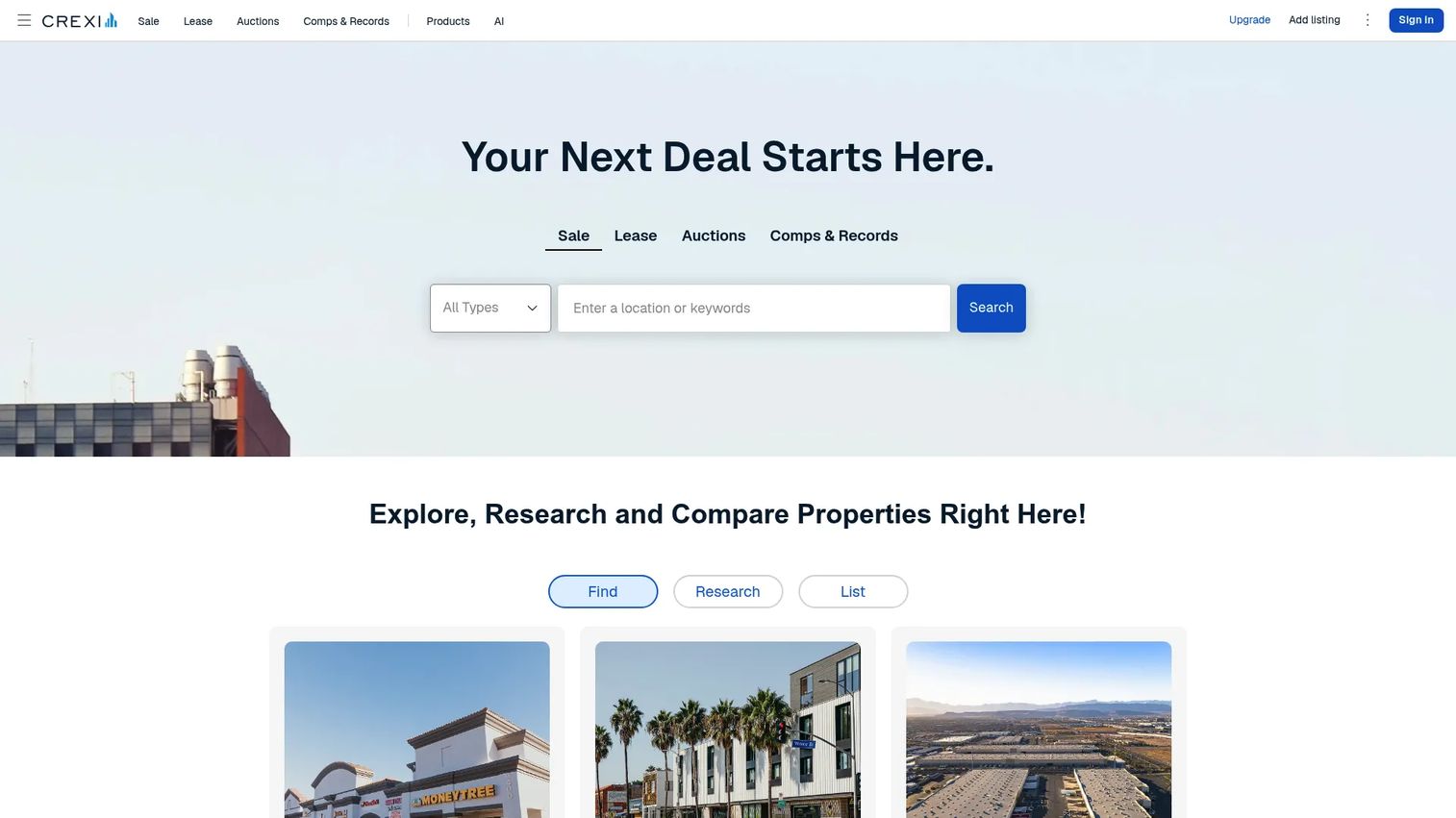
Crexi is a commercial real estate platform for listing, researching, marketing, and transacting commercial properties. It gives buyers, tenants, brokers, and investors a searchable marketplace with property intelligence, sales comparables, ownership contacts, and market trend data alongside standard listing search.
Best for: Commercial real estate brokers, investors, owners, lenders, and tenants who need property listings, market intelligence, and transaction tools in one place.
Key features
- Sale and lease listings with property filters by type, size, price, and location
- Nationwide sales comparables and ownership contact data
- Market trends, demographic maps, and property intelligence
- PRO listing tools with lead activity and campaign analytics
- Auction services with non-contingent contract support
Why choose Crexi for property listings: Listings help narrow geography, asset class, and budget before deeper due diligence begins. Crexi's intelligence layer, covering comparables, ownership records, and market data, makes it more useful than a standard listing aggregator when the first question is "what is available and what has sold nearby?"
Crexi pricing: A free plan covers basic listing search and property access. Intelligence and Pro subscriptions are available at monthly or annual rates; exact subscription prices are not displayed on Crexi's product overview page and require direct inquiry or a sales conversation.
G2 rating: 4.6/5, based on 142 verified reviews.
7. Google Business Profile (ratings and reviews)

Google Business Profile is how businesses manage their appearance on Google Search and Maps. For commercial property management research, it functions as an early screening tool. Ratings, review volumes, photo quality, and response patterns on a provider's Google listing provide first-pass signals before you request sample reports or references.
Best for: Anyone starting provider research who needs a quick read on responsiveness, communication, and overall tenant or owner satisfaction signals.
Key features
- Star ratings and review text from verified visitors
- Business photos, hours, and contact details
- Owner response history and tone
- Review volume as a proxy for market presence
- Location and service-area signals
Why choose ratings and reviews as a starting point: A provider with a 2.8-star average and recurring complaints about slow maintenance response is telling you something important before you spend two hours on a discovery call. Review patterns do not replace due diligence; they shape the question list. After a first-pass screen, validate with references, sample owner reports, and a conversation about inspection processes.
Google Business Profile pricing: Creating and managing a Google Business Profile is free. Third-party reputation management services and Google advertising are priced separately.
8. Yelp (business directory listings)

Yelp connects consumers with local businesses through searchable listings, reviews, photos, hours, and contact details. For commercial property management research, Yelp functions as a local directory layer that surfaces providers in a specific city or metro area who may not appear prominently in general search results.
Best for: Owners and operators who need a starting list of local commercial property management providers with contact details, photos, and service-area context.
Key features
- Contact details and location maps
- Category filters for property management and real estate
- Business photos and profile descriptions
- Service-area indicators for local searches
- Review text with specific service feedback
Why choose directory listings for provider discovery: Directories are useful for generating a discovery shortlist, particularly in markets like Memphis, Tennessee where the local provider landscape may not be fully captured by national listing aggregators. Cross-reference any directory result against business listing management software categories to understand how providers maintain their market presence.
One note: Featured placements and paid advertising influence directory visibility. Cross-check results against ratings platforms and direct references before making contact decisions.
Yelp pricing: Browsing and searching Yelp is free. Claiming a business listing is free for owners. Paid advertising and enhanced profile placements are available at rates that require direct inquiry.
9. Indeed (job listings)
Indeed is an online job marketplace and hiring platform. For commercial real estate property management, it serves a different function than a provider directory: Job listings reveal what in-house commercial property managers actually do, what software and certifications employers expect, and what the local talent market looks like for the role.
Best for: Founders and finance leads deciding between hiring an in-house commercial property manager and outsourcing to a third-party firm.
Key features
- Role requirements, duties, and certifications by geography
- Employer profiles and local hiring demand
- Quick-apply flow for active job seekers
- Work-location filters including hybrid and on-site
- Salary ranges embedded in qualifying postings
Why choose job listings for this research: Reading 10 to 15 commercial property manager job postings in your target market tells you what the role actually involves: Lease administration, vendor management, tenant communication, maintenance coordination, and reporting. That list becomes your due diligence checklist when evaluating third-party providers. If a firm cannot explain how they handle each of those functions, the job market already told you what to expect. The accounting practice management software research angle applies here too; financial reporting competence is a core expectation for commercial property management roles.
Indeed pricing: Job searching is free for candidates and researchers. Employers post up to three jobs per month free, with paid Standard and Premium Sponsored Jobs available at dynamic, budget-based rates that vary by role, location, and market conditions.
G2 rating: 4.3/5
10. BLS occupational data (salary data)
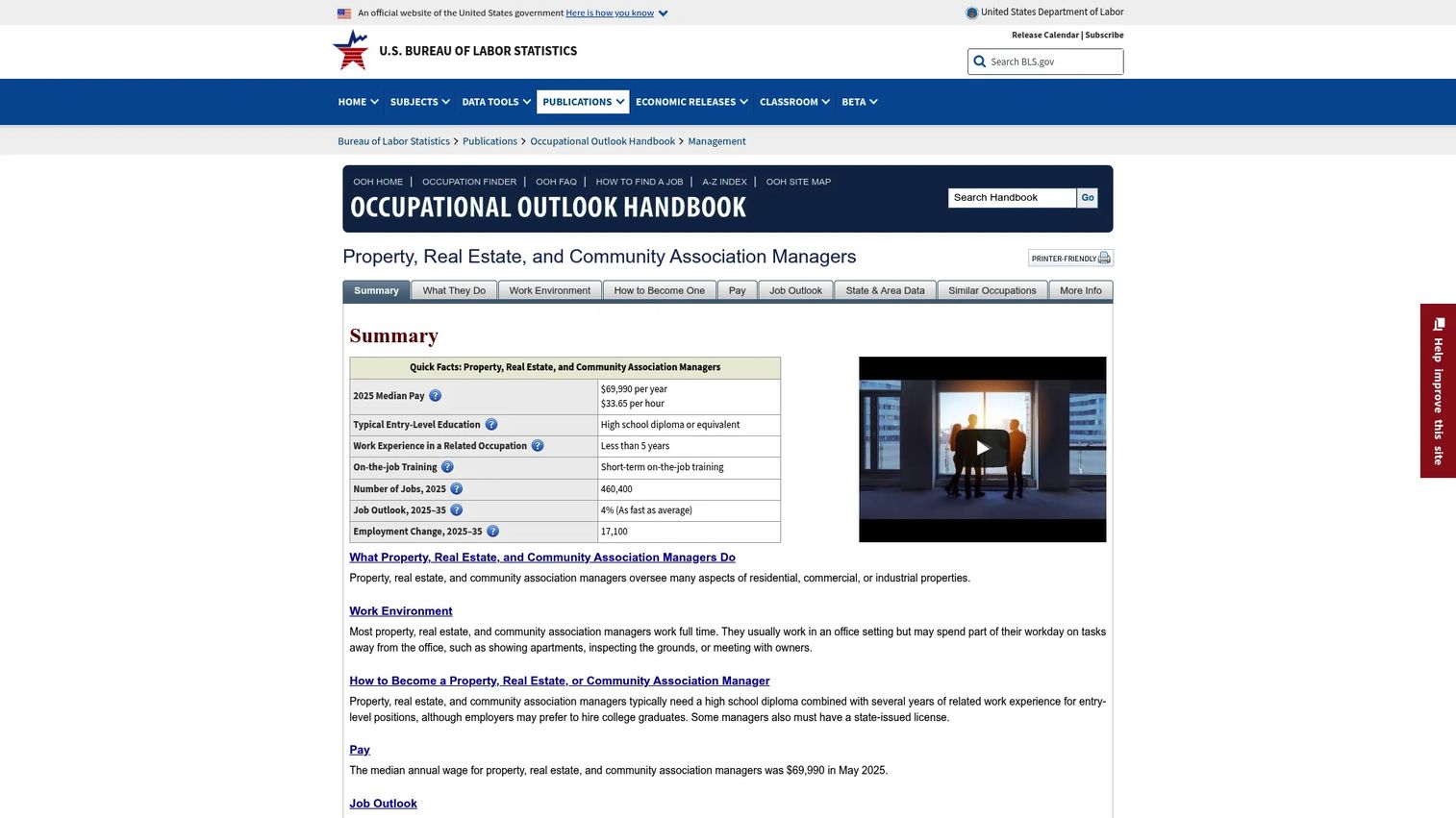
The U.S. Bureau of Labor Statistics occupational page for property, real estate, and community association managers publishes median wages, employment projections, duties, and outlook data for the role. The BLS reported a median annual wage of $69,990 for this occupational category in May 2025.
Best for: Finance leads and founders who need a credible baseline for budgeting in-house commercial property management compensation before comparing against third-party provider quotes.
Key features
- Median annual wage data by occupation
- Occupation duties and scope of responsibilities
- Employment projections and job market outlook
- Geographic wage variation indicators
- Career pathway and education context
Why choose BLS salary data for this decision: The in-house versus outsource question for commercial property management is ultimately a cost and coverage comparison. The BLS median wage of $69,990 gives finance a starting point, but total in-house cost also includes benefits, software, insurance, management overhead, and coverage gaps during vacations or transitions. Set that total against a third-party provider quote before deciding. For deeper percentile and geographic cuts, compensation platforms and paid datasets offer more granular breakdowns.
BLS data pricing: The BLS occupational data is free to access and published by the federal government. Paid compensation databases covering more granular role, geography, and percentile cuts are available from third-party providers at rates that vary by subscription scope.
Considerations when choosing commercial real estate property management
Property type fit
Office, retail, industrial, and investment assets create different operating burdens, and not every provider handles all of them well. Ask each provider which asset class they manage most and what inspection cadence they recommend for your specific property type.
Reporting quality
Do not accept vague reporting promises. Ask for a sample owner report covering rent roll status, expense line items, maintenance activity, open issues, budget variance, and capital needs. If a provider cannot produce a clean sample report, that is an answer.
Maintenance and inspection process
Ask how tenant maintenance requests are logged, triaged, approved, and closed. Clarify who conducts roof inspections, lighting checks, HVAC reviews, and life-safety system verifications, and how often. A strong maintenance process is documented, not described verbally.
Tenant communication ownership
Tenant retention depends on who owns communication and how fast escalations reach resolution. Ask specifically who handles tenant-facing communication, what the response time commitment is, and how the owner gets notified when an issue exceeds a defined threshold.
Capital planning discipline
A provider who only thinks about this month's repairs is managing maintenance, not the asset. Ask how they build annual budgets, how they approach five-year capital planning, what reserve account recommendations they make, and whether they have coordinated property tax appeal processes for clients.
Conclusion
Commercial real estate property management is an operating system for physical assets, not a vendor category to tick off a list. The options in this guide cover the full decision range: From full-service management firms to market discovery resources, provider screening tools, and the in-house hiring data that makes the outsource-versus-hire comparison concrete.
Start with commercial property management services if the core need is owner-side operational accountability. Use local listings, broker resources, and directory tools to understand what the market looks like before committing. Segment office, retail, and industrial assets in your due diligence because each creates different inspection, vendor, and tenant management work. Pull job listings and BLS salary data when finance needs a number to benchmark against provider quotes.
Build a shortlist of three to five qualified providers. Ask each for sample reports, inspection schedules, maintenance workflows, tenant communication policy, and a full fee breakdown. Compare those responses against the specific operational burden of each property. The right partner gives your leadership team clean reporting and fewer surprises. For additional context on managing business operations and financial reporting at scale, the business process management software and budgeting and forecasting categories offer adjacent frameworks worth reviewing.
FAQs
Commercial property management covers tenant coordination, maintenance response, vendor management, property inspections, rent collection support, lease administration, financial reporting, annual budgeting, capital planning, and owner communication. Scope varies by contract, so always confirm in writing which services are included and which are billed separately.
Commercial management involves business tenants with customized leases, common-area expense responsibilities, operational dependencies, and more complex reporting requirements. Residential management centers on individual renters, housing compliance, and shorter, more standardized lease terms. Capital planning, reserve accounts, and owner reporting are far more involved on the commercial side.
Pricing is almost always quoted by provider rather than published as a fixed rate. The fee structure changes based on asset type, square footage, tenant count, whether accounting is included, and local market rates. IREM benchmarking data gives owners a reference point for expense norms by metro area and asset class.
Hire in-house when the portfolio is large enough to justify full-time expertise and the oversight infrastructure to manage that person effectively. Use a third-party firm when you need market knowledge, reporting, vendor relationships, and tenant operations without building an internal real estate function from scratch. The BLS median wage of $69,990 (May 2025) is a starting point, but total in-house cost runs higher once benefits, software, and coverage gaps are included.
Ask for sample owner reports, two or three client references, their inspection schedule by property type, how maintenance requests are logged and tracked, who owns tenant communication, their insurance coverage, accounting controls, annual budgeting process, and how they approach five-year capital planning. The answers to those questions separate capable operators from generalists.
Industrial and retail assets often require specialized operational knowledge because access conditions, safety requirements, parking management, common-area standards, and tenant operations affect asset performance and tenant satisfaction in ways that generalist managers underestimate. Office properties also require attentive tenant experience management, particularly in multi-tenant buildings with shared amenities.
Listings help you understand the local market, active brokers, available property types, and pricing context. That market knowledge shapes what to expect from a management provider before you start conversations. Listings do not replace provider due diligence, but they help frame the right questions about comparable properties, local vendor ecosystems, and typical lease structures in your target market.
Salary data helps owners build a credible comparison between the cost of hiring in-house and the cost of outsourcing. It also reveals the expertise level the market expects for the role in a given geography. Using BLS data alongside local job posting research gives finance a number range to work with before provider quotes arrive.