Your cloud stack changes every day. New services ship, permissions evolve, containers spin up and disappear, and service accounts accumulate access long before a security review catches up.
The problem most security teams face is not a shortage of alerts. According to Check Point's 2025 Cloud Security Report, 65% of organizations experienced a cloud-related security incident in the past year, yet only 9% detected it within the first hour. That gap is a context problem, not a volume problem. Raw signals from AWS, Azure, Google Cloud, Kubernetes, and identity systems pile up without enough prioritization logic to tell you which incident is actually exploitable and business-critical right now.
Cloud detection and response (CDR) software is built specifically for that gap. It collects cloud telemetry, correlates events, adds identity and asset context, and routes prioritized incidents to the teams who can act. For Product Managers overseeing cloud-sensitive products, understanding the CDR landscape matters because security requirements directly influence architecture decisions, release cadence, and engineering opportunity cost.
This guide covers seven platforms, explains what CDR does and where it fits alongside CNAPP, EDR, and XDR, and gives you a practical framework for evaluating each option.
What's inside
This guide is for Product Managers, platform engineering leads, and security stakeholders evaluating cloud threat detection and response platforms for 2026. Tools were selected based on four criteria:
- Cloud telemetry breadth: Which sources does the platform ingest and correlate?
- Runtime detection depth: Does it detect active threats, or only misconfigurations?
- Integration fit: How well does it connect to existing SIEM, ticketing, and identity workflows?
- Operational ownership: What does the team need to maintain after the proof of value ends?
TL;DR
- Best overall for cloud context and attack-path prioritization: Wiz. Best when multicloud visibility and risk context are the primary gaps.
- Best for unified cloud and endpoint security operations: CrowdStrike Falcon Cloud Security. Strong fit when cloud, endpoint, and identity detections must correlate in one workflow.
- Best for Microsoft-centric environments: Microsoft Defender for Cloud. Best when Azure, Defender XDR, and Microsoft identity systems already anchor the stack.
- Best for cross-layer detection across hybrid environments: Trend Vision One. Worth evaluating when cloud, endpoint, email, and network signals need correlation in one platform.
- Best for large security programs with SecOps integration: Cortex Cloud. Best for enterprise teams that need cloud security connected to a broader analytics and automation layer.
- Best for agentless cloud risk prioritization: Orca Security. Strong for teams that want contextual exposure mapping without broad agent deployment.
- Best for Kubernetes and runtime depth: Sysdig Secure. Best for cloud-native engineering teams where container-level workload behavior is a core security requirement.
What is cloud detection and response?
Cloud detection and response, or CDR security, is a class of cloud security software that collects cloud telemetry, detects suspicious behavior, investigates events with cloud context, and helps teams contain or remediate threats across infrastructure, workloads, identities, and cloud applications.
What CDR monitors
CDR platforms ingest signals from across the cloud estate. Coverage typically includes:
- Cloud control-plane activity (API calls, configuration changes, permission grants)
- Identity and access events (logins, role assumption, privilege escalation)
- Workload and virtual machine behavior
- Kubernetes and container activity
- Serverless function execution
- API access patterns and anomalies
- Cloud storage activity (object access, data movement)
- SaaS and cloud application signals where supported
- Network and east-west traffic where supported
What CDR does after detection
Detection is only part of the workflow. A CDR platform also:
- Correlates raw events into a coherent incident
- Adds context: Identities involved, permissions held, asset exposure, and blast radius
- Prioritizes incidents by exploitability and business impact
- Supports investigation through timelines, evidence chains, and session data
- Triggers containment or remediation actions (manual or automated)
- Routes findings to SIEM, SOAR, ticketing systems, and incident workflows
CDR vs. EDR vs. XDR vs. CNAPP
Many vendors package CDR capabilities inside broader CNAPP or XDR platforms. The categories are complementary, not mutually exclusive.
| Category | Primary focus | Typical telemetry | Best used for |
|---|---|---|---|
| CDR | Cloud threats and cloud response | Cloud, identity, workload, Kubernetes | Cloud-native detection and incident response |
| EDR | Endpoint threats | Device and process telemetry | Endpoint compromise and malware investigation |
| XDR | Cross-domain detection | Endpoint, identity, email, cloud, network | Correlating attacks across security domains |
| CNAPP | Cloud risk across development and runtime | Code, configuration, identity, workloads | Cloud security posture, workload protection, runtime coverage |
When to use cloud detection and response
Investigate cloud identity abuse before it becomes an outage
Cloud identity risk includes compromised service accounts, credential theft, unusual privilege escalation, role chaining, anomalous API call patterns, and MFA-related exposure. These incidents rarely announce themselves loudly. A CDR platform surfaces them by correlating identity telemetry with workload and control-plane activity. For PMs, this matters as products add more integrations, automation pipelines, and machine identities. Each new service account is a potential entry point if its behavior goes unmonitored.
Reduce alert fatigue across multicloud environments
Fragmented alerts from AWS, Azure, Google Cloud, container tooling, endpoint platforms, and SIEM dashboards create decision latency. Security teams spend cycles reconciling signals that belong to the same incident. CDR platforms consolidate and prioritize those signals so responders act on evidence, not noise. From a product roadmap perspective, reducing security escalations and engineering interruptions is a measurable operational outcome. The metric is not alert volume. It is mean time to prioritize.
Add runtime detection to cloud posture management
Posture findings tell you what is misconfigured. Runtime detections tell you whether something is happening right now. Both matter, but they answer different questions. Runtime detection is especially relevant when product launches introduce containers, new cloud regions, AI inference endpoints, or third-party API integrations. These expand the attack surface in ways that posture scanning alone does not fully cover.
Cloud detection and response tools comparison
All seven platforms below address cloud threat detection and response, but they differ significantly in their emphasis on agentless visibility, runtime depth, cross-domain correlation, managed services options, and cloud-native architecture. Pricing across this category is quote-based for every vendor on the list. G2 ratings reflect verified scores at time of publication.
| # | Product | Best for | Key differentiator | Pricing | G2 rating |
|---|---|---|---|---|---|
| 1 | Wiz | Multicloud context and attack-path prioritization | Agentless cloud visibility with security graph and runtime threat response | Custom pricing | 4.7/5 |
| 2 | CrowdStrike Falcon Cloud Security | Unified cloud and endpoint security operations | Correlates cloud, endpoint, and identity with adversary intelligence | Custom pricing | 4.5/5 |
| 3 | Microsoft Defender for Cloud | Microsoft-centric cloud estates | Azure-native security operations with multicloud support | Pay-as-you-go (free foundational tier) | 4.4/5 |
| 4 | Trend Vision One | Cross-layer detection across hybrid environments | Correlates cloud, endpoint, email, identity, and network signals | Custom pricing | 4.7/5 |
| 5 | Cortex Cloud | Large security programs with SecOps workflows | Cloud protection connected to analytics, automation, and SOC operations | Custom pricing | 4.1/5 |
| 6 | Orca Security | Agentless cloud risk and exposure prioritization | SideScanning architecture with attack-path context | Custom pricing | 4.7/5 |
| 7 | Sysdig Secure | Kubernetes-heavy runtime protection | Deep runtime detection with container and cloud-native security context | Custom pricing | 4.8/5 |
Best cloud detection and response tools for 2026
1. Wiz
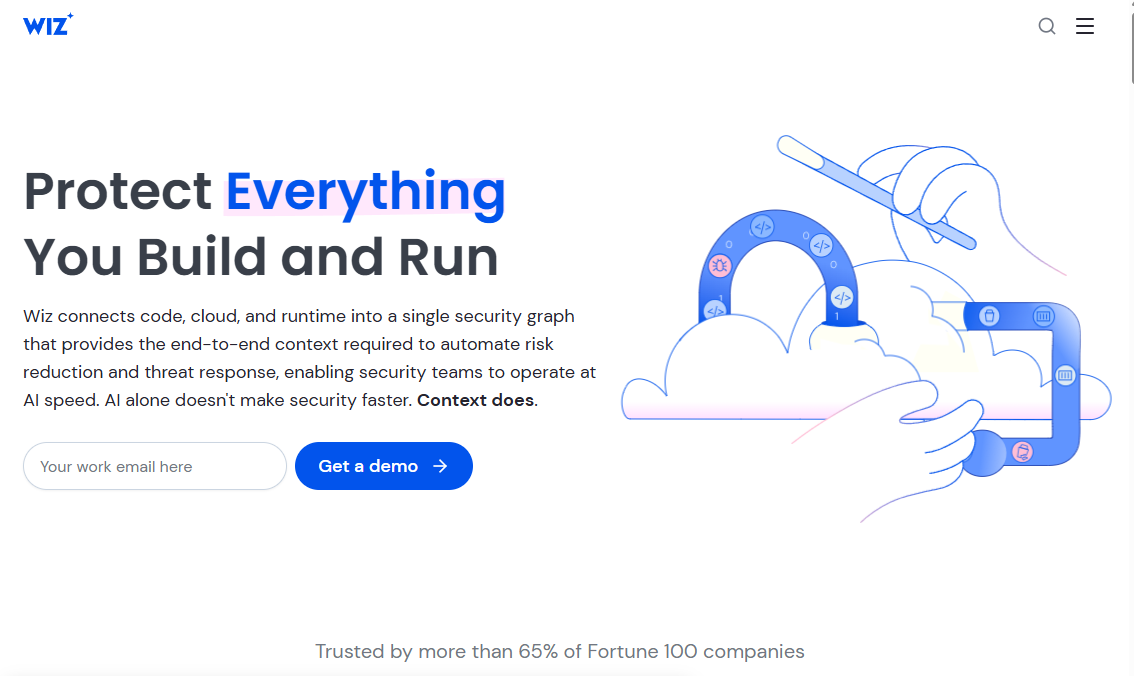
Wiz is a cloud and AI security platform that provides agentless visibility across cloud environments, correlates risk through a security graph, and delivers runtime threat detection via Wiz Sensor. It covers cloud security posture management, vulnerability management, cloud identity and entitlement management (CIEM), data security posture management (DSPM), container security, and infrastructure-as-code scanning.
Best for: Security and product teams operating across AWS, Azure, Google Cloud, Kubernetes, and complex identity environments who need prioritized cloud risk rather than raw finding volume.
Key features
- Agentless cloud environment visibility across multicloud assets
- Security graph and attack-path analysis for exploitability context
- Runtime threat detection with optional Wiz Sensor deployment
- Identity and permission context layered onto cloud risk
- Infrastructure-as-code scanning and code-to-cloud correlation
Why choose Wiz: PMs who need a high-level view of product risk without asking engineering to instrument a separate agent across every workload will find Wiz's agentless model reduces deployment overhead. Its attack-path analysis focuses remediation effort on the findings that are actually reachable and dangerous, rather than every misconfiguration in the backlog.
Wiz pricing
Wiz offers three commercial packages: Wiz One, Wiz Go, and an à la carte option. All require a custom quote. Contact Wiz for pricing details specific to your cloud account count and required modules.
G2 rating
4.7/5
2. CrowdStrike Falcon Cloud Security

CrowdStrike Falcon Cloud Security is a cloud-native application protection platform that combines agentless cloud visibility, real-time cloud detection and response, workload protection, and container security within the broader Falcon platform. Its core differentiator is correlation across cloud, endpoint, and identity telemetry using CrowdStrike's adversary intelligence layer.
Best for: Organizations already running CrowdStrike across endpoint security who want cloud detection integrated with existing incident workflows, threat intelligence, and managed detection options.
Key features
- Agentless cloud security posture management
- Real-time cloud detection and response
- Workload, container, and Kubernetes protection
- Endpoint and identity signal correlation
- Adversary intelligence context on cloud threats
Why choose CrowdStrike Falcon Cloud Security: Cross-domain correlation is the central argument here. When a suspicious cloud API call connects to a compromised endpoint or an unusual identity change, Falcon can surface that chain without requiring analysts to manually reconcile signals from separate tools. PMs building enterprise-ready products should note that this correlation capability directly reduces the engineering interruptions that follow fragmented security escalations.
CrowdStrike Falcon Cloud Security pricing
CrowdStrike offers six packaging tiers: Proactive Security, Cloud Detection and Response, Cloud Detection and Response with Containers, and managed container variants, plus CNAPP and CNAPP with Containers. All tiers require a custom quote. A 15-day free trial is available with no credit card or commitment required.
G2 rating
4.5/5
3. Microsoft Defender for Cloud
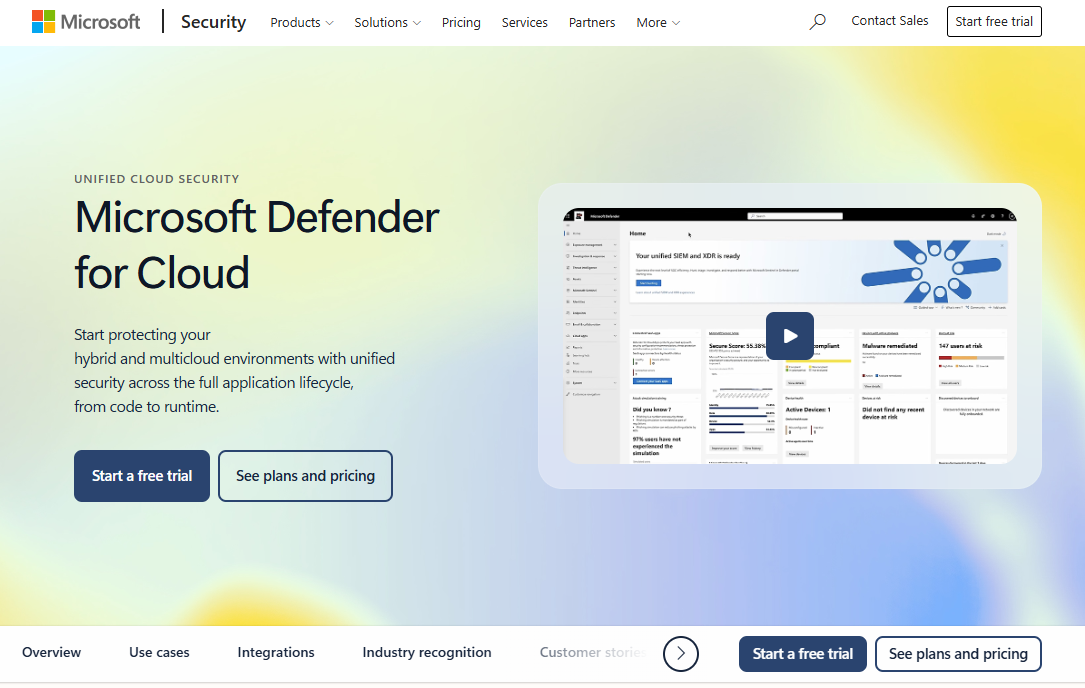
Microsoft Defender for Cloud is a cloud-native application protection platform with deep Azure integration and multicloud support for AWS and Google Cloud. It combines security posture management, workload protection for servers, containers, databases, APIs, and AI workloads, and DevSecOps integration across development pipelines.
Best for: Product and security teams that already rely on Azure, Microsoft Defender XDR, Microsoft Entra, and Microsoft Sentinel as their primary security operations stack.
Key features
- Cloud security posture management with secure score and remediation guidance
- DevSecOps integration across code, pipeline, and multicloud environments
- Workload protection covering servers, containers, storage, databases, and APIs
- Identity and endpoint signal integration via Microsoft Defender XDR
- Microsoft security operations integration and alert correlation
Why choose Microsoft Defender for Cloud: The integration depth inside a Microsoft-centric organization is the primary argument. If your team already works inside Defender XDR and Sentinel, adding Defender for Cloud avoids a separate tool for cloud telemetry. PMs evaluating this platform should test coverage beyond Azure specifically, since multicloud support for AWS and GCP varies by workload type and service category.
Microsoft Defender for Cloud pricing
Foundational cloud security posture management capabilities are free. Paid workload protection plans use pay-as-you-go pricing and vary by workload type (servers, containers, databases, storage, APIs). Microsoft provides an interactive pricing estimator on its website, and costs scale with the number of protected resources.
G2 rating
4.4/5
4. Trend Vision One
Trend Vision One is an AI-powered enterprise security platform that centralizes cyber risk exposure management, extended detection and response (XDR), and layered workload protection. It correlates signals across cloud, endpoint, email, identity, and network, making it one of the broader correlation platforms in this shortlist.
Best for: Enterprise security teams managing risk across multiple security domains simultaneously, particularly where cloud detections need to connect to endpoint, email, and identity activity in a single investigation view.
Key features
- Cyber risk exposure management with attack-path analysis and remediation prioritization
- XDR across cloud, endpoint, network, email, and identity
- Centralized security operations with threat hunting and alert correlation
- Cloud workload protection and posture management
- Automated investigation and response workflows
Why choose Trend Vision One: This platform fits organizations where security risk does not live in one domain. For PMs, the practical benefit is fewer disconnected escalation paths when an incident spans cloud services and employee systems simultaneously. Buyers should validate that cloud coverage depth meets their specific workload requirements, particularly for Kubernetes-heavy environments, where more specialized platforms may offer more granular runtime context.
Trend Vision One pricing
Trend Vision One is available through free trial and requires a custom quote for full deployment. Contact Trend Micro sales for current pricing, which varies by coverage scope and deployment scale.
G2 rating
4.7/5
5. Cortex Cloud
Cortex Cloud from Palo Alto Networks is a unified cloud security platform covering application security across the development lifecycle, cloud posture management, runtime threat detection and response, and AI-assisted investigation. It is part of the broader Cortex security operations stack and connects cloud risk to analyst workflows and automation.
Best for: Large enterprise security programs that need cloud protection connected to a broader SecOps architecture, particularly where CloudSec and SOC teams need shared evidence and repeatable response playbooks.
Key features
- Cloud security posture management with AI-assisted prioritization and automated remediation
- Real-time cloud runtime detection and response
- Application security covering the software development lifecycle
- AI-assisted threat investigation and hunting
- Software composition analysis, SBOM generation, and license compliance
Why choose Cortex Cloud: Operating-model fit is the decision driver. Cortex Cloud is strongest when CloudSec and SOC teams need to share evidence, coordinate response, and operate inside a consistent analytics layer. PMs should ask vendors specifically about the metered licensing model across Cloud Posture, Runtime, and Application Security, since the pricing structure is module-based and application security is priced per developer.
Cortex Cloud pricing
Cortex Cloud uses a metered licensing model. Cloud Posture and Runtime modules are priced separately, and Application Security is priced per developer. Palo Alto Networks does not display public numeric pricing. Contact sales for a quote, and request a coverage map across all required modules before comparing total cost.
G2 rating
4.1/5
6. Orca Security
Orca Security is an AI-powered, agentless-first cloud security platform that covers cloud security posture management, workload protection, identity and entitlement management, data security, vulnerability management, container security, compliance, and cloud detection and response. Its SideScanning technology reads cloud workload data out-of-band without requiring agents on every resource. According to Orca Security's own 2025 research, 55% of organizations now use two or more cloud providers, which is exactly the environment where agentless coverage reduces deployment complexity.
Best for: Cloud security teams managing large or fast-changing cloud estates who want contextual risk prioritization and attack-path analysis without broad agent rollout across infrastructure.
Key features
- Agentless SideScanning technology for out-of-band workload assessment
- Cloud security posture management, CIEM, DSPM, and vulnerability management
- Attack-path analysis and risk-based remediation prioritization
- Cloud detection and response with Orca Sensor for runtime protection
- Application security including SCA, SAST, secrets detection, and IaC scanning
Why choose Orca Security: The deployment model is the distinguishing factor. PMs trying to improve cloud visibility without creating significant developer or platform-engineering work will find the agentless approach reduces rollout friction. Teams that need deep runtime detection alongside posture context should evaluate whether Orca Sensor coverage meets their specific workload monitoring requirements.
Orca Security pricing
Orca offers a single all-inclusive SKU priced by the number of cloud workloads protected. Pricing requires a custom quote. Contact Orca for current rates based on your cloud account footprint.
G2 rating
4.7/5
7. Sysdig Secure
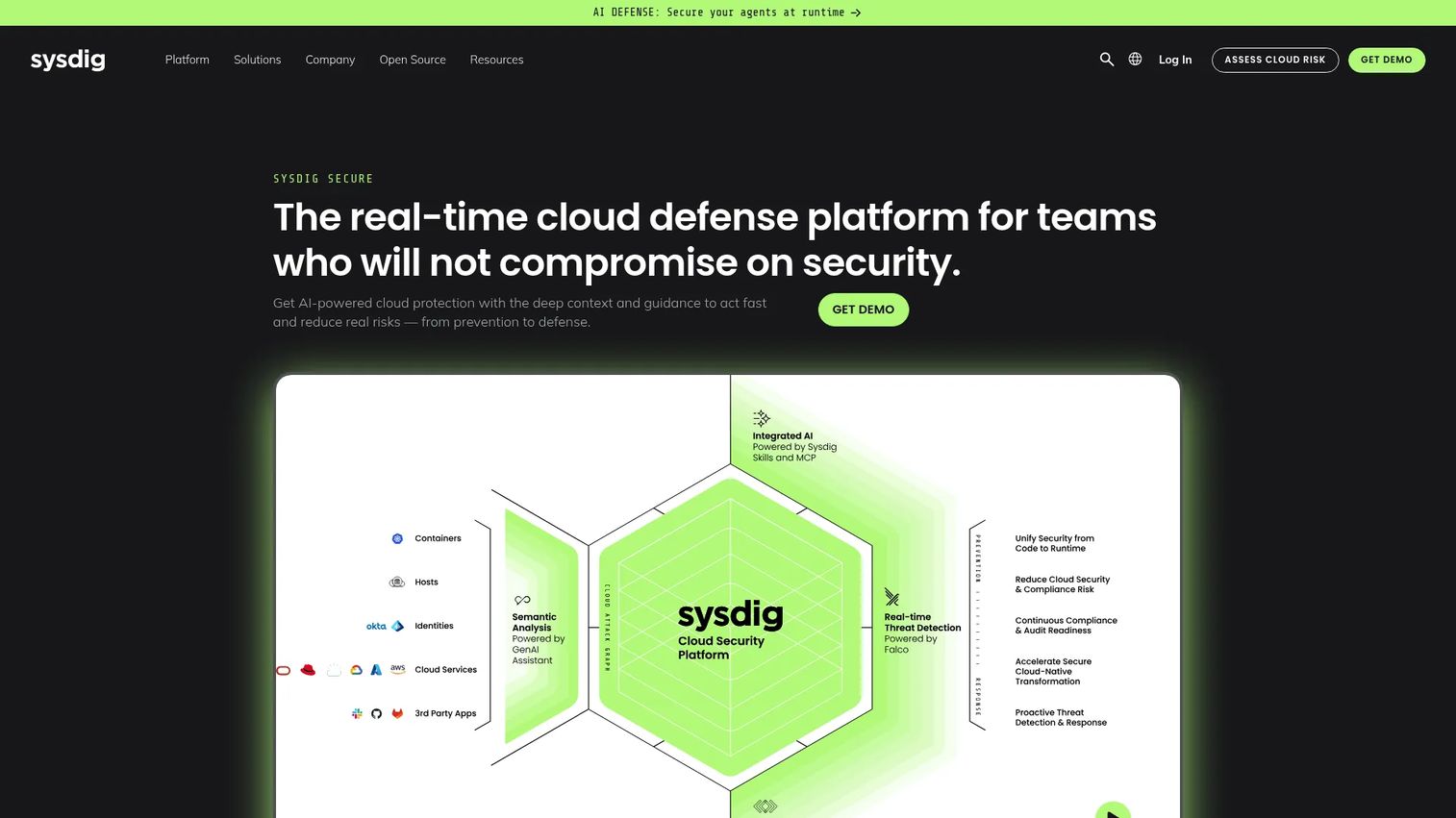
Sysdig Secure is a cloud-native application protection platform built for securing containerized, Kubernetes, serverless, and host-based workloads. It delivers real-time threat detection, vulnerability management with runtime prioritization, cloud and Kubernetes security posture management, CIEM, activity audit, forensics, and an AI-powered Sysdig Sage assistant.
Best for: Kubernetes-heavy security and engineering teams where container-level workload visibility, runtime behavior analysis, and post-incident forensics are central security requirements.
Key features
- Real-time threat detection and response with runtime behavioral context
- Vulnerability management with runtime prioritization (focus on what is actually running)
- Cloud and Kubernetes security posture management
- Cloud infrastructure entitlement management
- Activity audit, forensics, and AI-powered Sysdig Sage assistant
Why choose Sysdig Secure: For PMs building containerized products, Sysdig answers a question the posture-focused platforms often cannot: What is the workload actually doing right now, and does that behavior indicate a threat? Runtime prioritization for vulnerability management is particularly useful, since it narrows the remediation backlog to packages that are loaded in memory rather than every library present on disk.
Sysdig Secure pricing
Sysdig pricing is based on hosts (for runtime and workload protection) and on events processed for cloud logs. All plans require a custom quote. Contact Sysdig for current rates based on your host count and cloud environment scope.
G2 rating
4.8/5
Considerations when choosing cloud detection and response software
Confirm the telemetry model before comparing detection quality
Map the platform's data sources to your actual cloud architecture before evaluating detection capability. A platform cannot surface behavior it cannot see. Ask vendors for a coverage matrix that lists which sources require agents, which use cloud APIs, and which need third-party connectors. Pay particular attention to identity sources, serverless functions, and any SaaS services your product integrates with.
Separate exposure management from active threat response
A large list of misconfigurations is not a detection and response workflow. During evaluation, ask each vendor to walk through how a high-risk configuration finding becomes a prioritized, actionable incident. If the answer is "add it to the remediation backlog," that is posture management, not CDR. Require a demonstration of the full pipeline from observed behavior to containment action.
Test response controls against your actual incident process
Evaluate containment actions, approval workflows, ticket creation, Slack escalation paths, and evidence retention before committing. Confirm who can trigger each automated response and how the platform records that decision. PMs should treat automated response as a permissioned workflow with defined failure modes, rollback criteria, and auditability requirements.
Measure the integration burden honestly
Check which SIEM, SOAR, ticketing, identity, and analytics integrations are native versus middleware-dependent. A native HubSpot or Salesforce alert routing integration has different maintenance overhead than a webhook-to-Zapier path. Validate each integration against your existing stack, not against a generic integration catalog. For guidance on cloud data security software and related tooling categories, Guideflow's blog covers adjacent security platform decisions that often arise alongside CDR evaluation.
Define ownership before the proof of value ends
The best platform creates friction if CloudSec, SOC, engineering, and product teams cannot agree on who acts on a given detection. Before signing, define who owns detection tuning, response playbook maintenance, cloud asset context updates, and remediation backlog prioritization. This is the maintenance question that most proofs of value skip, and it is the one that determines long-term operational cost.
How to choose the right cloud detection and response tool for your team
Choose Wiz when the core problem is too many cloud findings with too little context about which ones are actually exploitable. Its security graph and attack-path analysis help PMs and security teams prioritize by real risk rather than severity score. Evaluate attack-path accuracy, identity context, and how well it integrates with your existing remediation workflow during the proof of value.
Choose CrowdStrike Falcon Cloud Security when cloud detection must connect directly to endpoint and identity signals in the same investigation interface. This is the right direction when your security team already operates inside the Falcon platform and when incidents tend to span cloud infrastructure and employee systems simultaneously.
Choose Microsoft Defender for Cloud when the organization already relies on Azure, Defender XDR, and Microsoft Sentinel as the primary security control plane. The integration depth reduces the overhead of maintaining a separate cloud detection tool. Test non-Azure coverage carefully, since AWS and GCP support varies by workload type.
For specialized operational fit, route by the dominant requirement:
- Trend Vision One: Broad cross-layer correlation across cloud, endpoint, email, and network
- Cortex Cloud: Connected cloud and SOC workflows inside a large enterprise security program
- Orca Security: Agentless cloud context and exposure prioritization for fast-changing cloud estates
- Sysdig Secure: Kubernetes and container-level runtime depth for cloud-native engineering teams
For further context on application security testing software and attack surface management software, both often appear on security roadmaps alongside CDR evaluation.
Conclusion
Cloud detection and response sits at the intersection of telemetry coverage, cloud context, investigation depth, and response automation. The CDR market is projected to reach $8.68 billion by 2031 (Mordor Intelligence, 2026), reflecting how central this capability is becoming to cloud-operating organizations.
For Product Managers, the decision comes down to four practical questions:
- Can the platform see the services, identities, workloads, and cloud accounts that matter to your product?
- Can it distinguish an active threat from a backlog misconfiguration?
- Does it fit the team's incident workflow without adding manual handoffs?
- Who maintains the integration and tuning work as the product changes?
Shortlist two or three options, run a proof of value against a realistic scenario (compromised cloud credentials, anomalous privilege escalation, or unusual Kubernetes workload behavior), and score each platform on detection context, response control, integration effort, and maintainability.
For teams building or evaluating AI security posture management tools alongside CDR, those categories increasingly overlap in practice.
Start your journey with Guideflow today!
FAQs
Cloud detection and response (CDR) is a category of cloud security software that collects telemetry across cloud infrastructure, identities, workloads, containers, APIs, and applications, detects suspicious behavior, and supports investigation and containment of active threats. Many CDR capabilities appear within broader CNAPP and XDR platforms rather than as standalone products. The distinguishing characteristic is the focus on active threat detection and response, not just configuration risk.
EDR focuses on endpoint devices: Laptops, servers, and workstations. It captures device and process telemetry to detect malware, credential theft, and endpoint compromise. CDR focuses on cloud activity: Control-plane events, cloud identities, workloads, Kubernetes clusters, serverless functions, and cloud storage. Enterprise security teams typically run both, since an attack that starts on an endpoint frequently moves into the cloud, and vice versa.
They are related but distinct. CNAPP (Cloud-Native Application Protection Platform) is a broader category that can include posture management, workload protection, code and pipeline security, entitlement management, and runtime detection. CDR specifically covers the detection, investigation, and response layer focused on active cloud threats. Most CNAPP platforms include CDR capabilities, but CDR is one component of the broader CNAPP scope.
Prioritize telemetry coverage, cloud identity context, runtime detection depth, response controls, integration effort, and maintenance requirements. Map the platform's data sources to your product's actual cloud architecture. Ask how the tool surfaces a detection during your release cadence, and define who owns tuning and playbook updates after initial deployment. Engineering opportunity cost is a real factor: A platform that requires frequent agent updates or integration maintenance competes with feature delivery.
Yes, when the platform correlates raw events, adds asset and identity context, prioritizes exploitability, and routes only actionable incidents to response teams. Alert fatigue persists when telemetry is incomplete, detection rules are poorly tuned, or the platform generates findings without sufficient context for prioritization. Reducing noise requires both good coverage and an effective triage layer, not just more data ingestion.
Most platforms on this list support multicloud environments, but coverage depth varies by cloud provider, workload type, identity source, and deployment method. Agentless platforms typically support more cloud providers with less deployment overhead, while agent-based runtime detection may lag for specific managed services or newer cloud regions. Always require a service-level coverage matrix during evaluation rather than accepting general multicloud claims.
Some platforms combine agentless cloud API visibility with optional agents or sensors for runtime-level workload telemetry. Agentless coverage and agent-based coverage are complementary dimensions: Agentless assessment typically covers posture, configuration, and control-plane activity, while agents surface granular workload behavior. Wiz, Orca, and CrowdStrike all offer agentless options with optional sensor deployment for runtime depth. Sysdig's approach is more agent-forward given its container runtime focus.
Build a proof of value around a realistic scenario that reflects your actual threat model: Compromised cloud credentials, anomalous privilege escalation, suspicious Kubernetes activity, or unusual data exfiltration behavior. Score each platform on detection quality (did it find the incident?), investigation speed (how long to understand the scope?), response controls (what can you do, and who authorizes it?), integration effort (how much work to connect to existing workflows?), and ongoing operational ownership. For related security tooling context, see Guideflow's coverage of cloud compliance tools and application performance monitoring tools.