Your service agreements live in one system. Your work orders live in another. Renewals live in someone's inbox, buried under threads nobody opens twice.
That gap is where money leaks. A maintenance contract promises four visits a year. Three get scheduled. The fourth slips because no automation created the job. Then the agreement expires, nobody flagged it, and a recurring-revenue customer quietly churns.
Service contract software closes that gap. It stores the agreement, ties it to recurring jobs, tracks usage against contract limits, and pushes renewals before they lapse. The category matters more every year as recurring maintenance becomes the margin engine for field service businesses. The service contract management software market was valued at $2.8B in 2025 and is projected to reach $6.4B by 2034, a CAGR of 11.2%, according to MarketIntelo (2025).
This guide compares five tools built for that job. Some are lightweight contract hubs. Others are full field service platforms where service agreement management is one layer of a broader operation. The difference decides which one fits your team, so we separate contract storage from contract-to-operations automation throughout.
What's inside
This guide is for HVAC, plumbing, electrical, and other field service operators evaluating maintenance contract software in 2026. It is written for the person who owns the outcome: fewer missed renewals, tighter recurring revenue, and less manual handoff between the contract and the field.
We chose these five tools on four criteria:
- Recurring maintenance: does it turn agreements into scheduled jobs automatically
- Work order linkage: are jobs tied back to the contract record
- Renewal and billing control: expiration visibility, contract limits, and flexible billing
- Mobile field execution: can technicians see contract context and document work on site
TL;DR
- Best for deep contract visibility: BlueFolder, with monetary and hour-based contract limits plus a dashboard for active, pending, expiring, and expired agreements.
- Best for broader field service operations: ServiceTitan, where service and membership agreements sit inside a full operations platform with scheduling, dispatch, and revenue tools.
- Best for straightforward contract workflows: Workever, a practical hub that centralizes contracts and ties them directly to jobs and invoicing.
- Best for proactive maintenance and recurring revenue: Fieldpoint, built around preventative maintenance agreements, recurring inspections, and technician assignment.
- Best for equipment-centric contract execution: Service Pro, with contract, maintenance, and work order management for asset-heavy service teams.
What is service contract software?
Service contract software is a system that stores service agreements, ties them to recurring jobs or work orders, manages renewals, and tracks usage, costs, and technician activity against each contract.
Put simply, it keeps the agreement and the work in the same place. Instead of a PDF in one folder and a schedule in another, the contract becomes the source of truth that drives what happens in the field.
Most service agreement software covers these capabilities:
- Contract storage and templates: one record per agreement, reusable templates for new ones
- Recurring job creation: agreements auto-generate scheduled visits and inspections
- Renewal reminders: alerts before expiration so nothing lapses silently
- Usage and cost tracking: hours, materials, and visits measured against contract limits
- Scheduling and dispatch linkage: contract-driven jobs flow into the calendar and to technicians
- Technician mobile execution: field staff see contract context, capture signatures, and log work
Where does this overlap with field service management software? Heavily. Full FSM platforms include service agreement management as one module alongside scheduling, invoicing, and CRM. A dedicated contract hub focuses on the agreement lifecycle and connects to the rest. The line between the two matters when you buy, which is why the tools below sit at different points on that spectrum.
When to use service contract software
Centralize recurring service agreements
You know the pattern. Contracts are spread across spreadsheets, signed PDFs, and email threads. Nobody can answer "how many visits are left on this account" without digging. When agreements scale past a couple dozen, that manual model breaks.
A central system fixes it. One record holds the terms, the visit history, the usage against limits, and the renewal date. When a customer calls, the answer is on screen in seconds instead of buried in someone's downloads folder.
Automate maintenance work from contracts
Preventative maintenance agreements only work if the visits actually happen. Manually creating each recurring job is where consistency dies. A visit gets skipped, the equipment fails, and the customer blames the contract.
This is the core case for maintenance contract software. The agreement defines the cadence, and the system generates the recurring jobs, inspections, and scheduled visits on its own. Operational consistency stops depending on someone remembering to book the next one.
Protect renewals and recurring revenue
Missed expirations quietly drain recurring revenue. An unsigned renewal, an untracked usage overage, a contract that lapsed three months ago and nobody noticed. Each one is margin you already earned and then lost.
Contract renewal automation flags agreements before they expire, prompts the signature, and keeps usage visible so overages get billed. That turns renewal from a scramble into a predictable revenue line you can forecast.
Comparison table
This table compares the five tools by best fit, key differentiator, pricing, and G2 rating so you can shortlist fast. Pricing and ratings reflect the most recent verified values available at publication and should be confirmed live before you buy, since plans and reviews change.
| # | Product | Best for | Key differentiator | Pricing | G2 rating |
|---|---|---|---|---|---|
| 1 | Workever | Small trade and service teams wanting a straightforward contract hub | Contracts tied directly to jobs and invoicing | From £29/user/month | Not listed |
| 2 | BlueFolder | Teams needing tight contract usage and expiration control | Monetary and hour-based contract limits with a lifecycle dashboard | From $62.50/user/month | Not listed |
| 3 | ServiceTitan | Larger HVAC and trades teams wanting agreements inside a full platform | Service and membership agreements within a broad operations suite | Request pricing | 4.4/5 |
| 4 | Fieldpoint | Mid-market and enterprise teams focused on preventative maintenance | Recurring inspections and technician assignment logic | Custom pricing | 4.0/5 |
| 5 | Service Pro | Equipment- and asset-centric field service teams | Contract, maintenance, and work order management for physical assets | Custom pricing | 4.4/5 |
1. Workever

Workever is cloud-based job and field service management software built for small service businesses. It centralizes service contracts, generates jobs automatically from service plans, and shares clean PDF copies so customers see exactly what they signed. Billing flexes between ad hoc and scheduled terms, and warranty tracking keeps equipment history tied to the account.
Best for: Small trade and service teams that want service contracts tied directly to jobs, scheduling, and invoicing without a heavy implementation.
Key strengths
- Contract details centralized in one record
- Automatic job creation from service plans
- Billing on ad hoc or scheduled terms
- PDF contract copies for customer clarity
- Offline mobile apps for iOS and Android
Why choose Workever: It is the practical option when you want service contracts connected to field execution without standing up a large platform. Teams that need visible contract records and jobs that flow straight to technicians get value fast, and the offline mobile apps keep crews working where signal drops.
Workever pricing: Base plan starts at £29 per user monthly, or £25 per user when billed yearly. A free trial is offered. No free tier is listed.
For teams that want easy service contract software with clear records and quick setup, Workever fits the brief without asking you to adopt an entire operations stack first.
2. BlueFolder
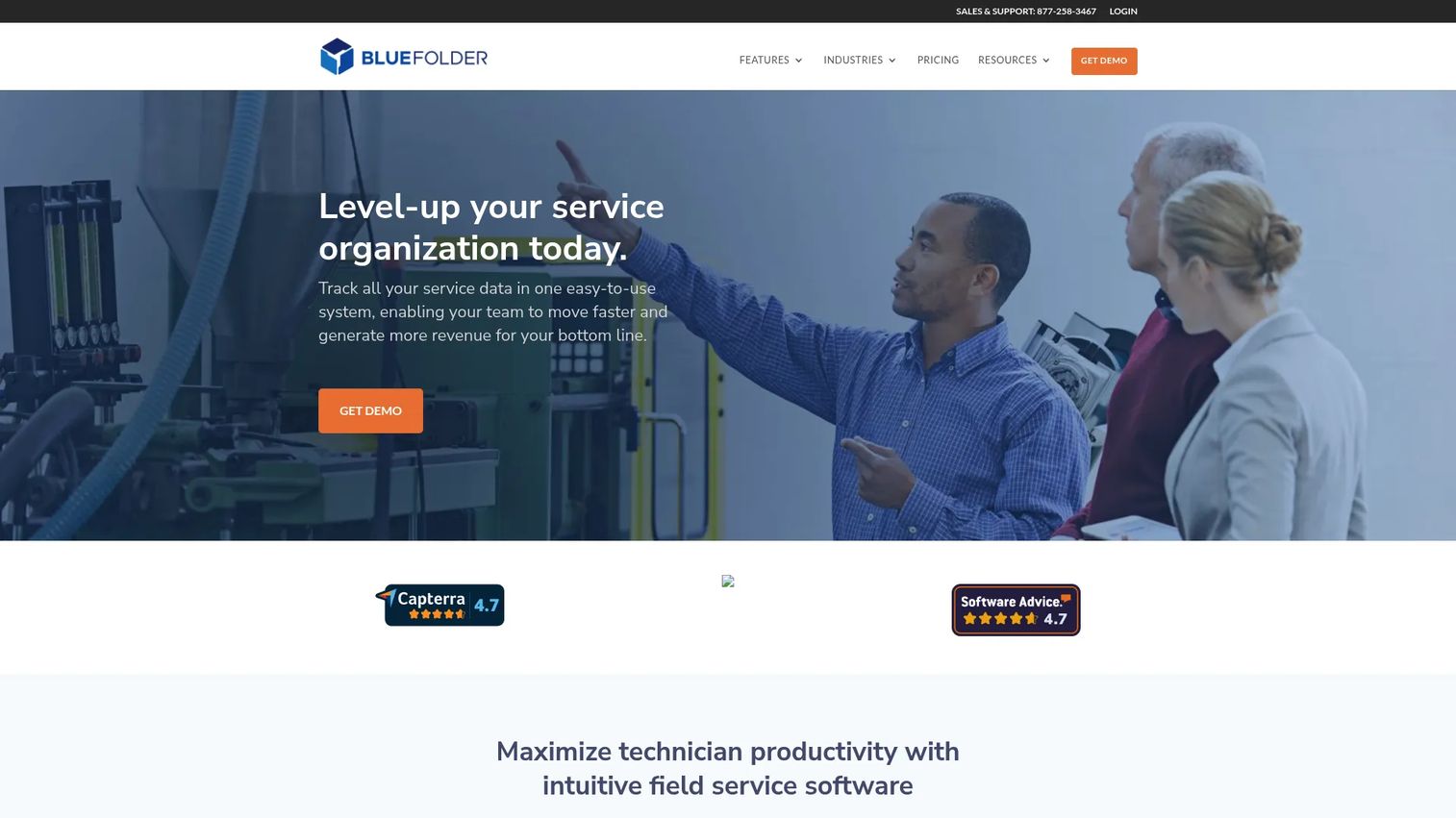
BlueFolder is field service management software focused on work orders, scheduling, assets, customer communication, and invoicing. Its contract features stand out for control. You can set monetary or hour-based contract limits, tie work orders directly to contract records, and watch a summary dashboard that separates active, pending, expiring, and expired agreements. A customer portal gives clients visibility into their own contracts.
Best for: Teams that need tighter control over contract usage and expiration states, where margin visibility matters as much as storing the agreement.
Key strengths
- Monetary or hour-based contract limits
- Work orders tied to contract records
- Lifecycle dashboard for active, pending, expiring, and expired contracts
- Customer portal for contract visibility
- Asset and equipment management
Why choose BlueFolder: Pick it when operational control and margin tracking matter more than a lightweight repository. The contract limits and lifecycle dashboard give you a running view of usage against terms, which is exactly what stops overages from going unbilled and renewals from slipping.
BlueFolder pricing: Pay-as-you-go monthly plans with minimum user counts. Pro starts at $62.50 per user monthly, Pro Plus at $92 per user monthly, and Enterprise at $110 per user monthly. No free tier is listed on the pricing page.
BlueFolder's strength in service agreement management comes from that work-order-to-contract linkage. Every job draws down against the agreement, so usage and profitability stay visible instead of getting reconstructed at renewal time.
3. ServiceTitan
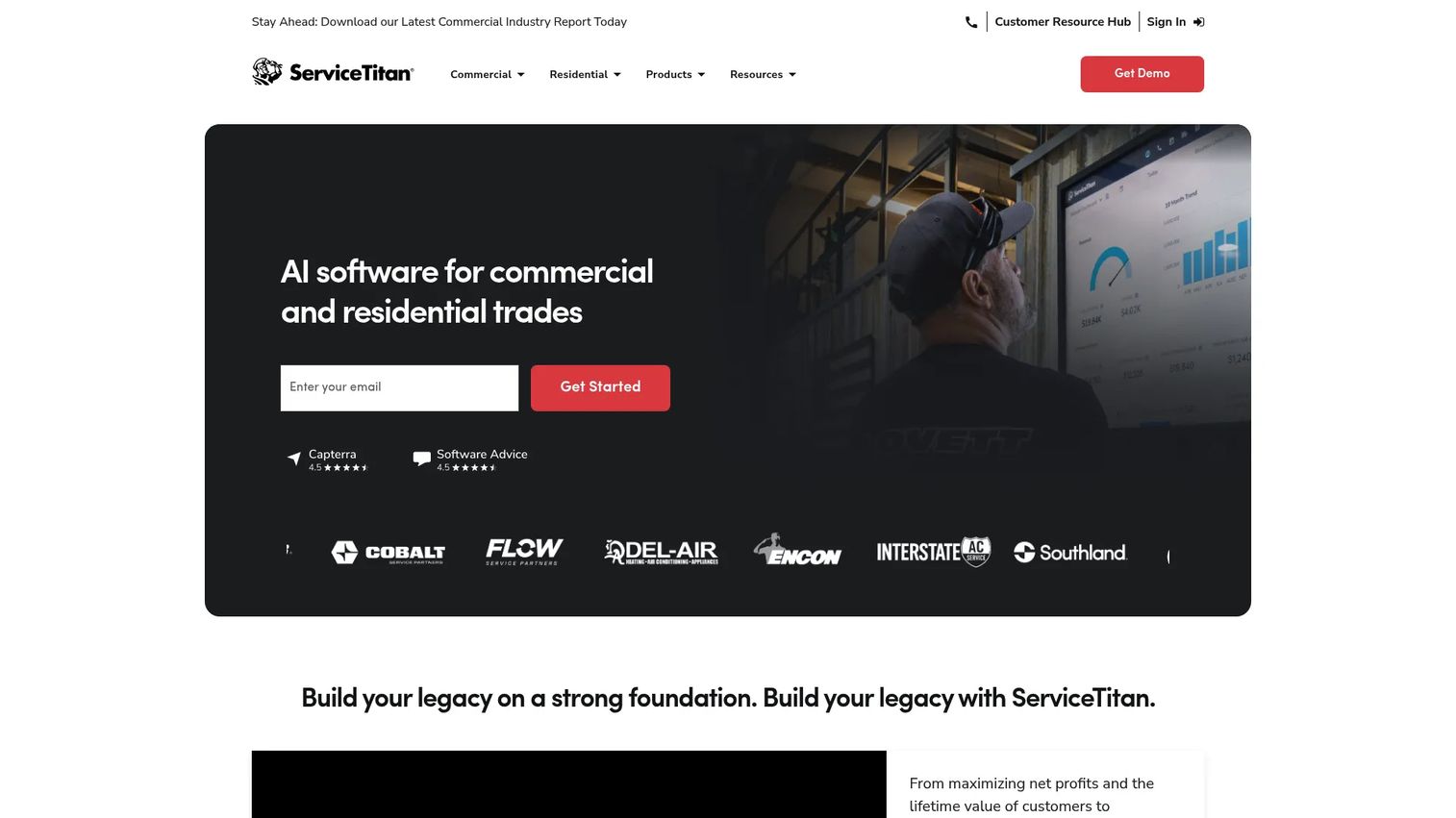
ServiceTitan is cloud software for contractors and field service businesses, with service and membership agreements built into a broad operations platform. Beyond contract creation and editing, it handles digital signatures, email sharing, recurring reminders, and follow-ups, and it ties agreements into scheduling and dispatch. For teams that already run their whole operation in one system, agreements become one connected layer rather than a separate tool.
Best for: Larger HVAC and trades teams that want service agreements inside a wider field service system alongside scheduling, CRM, and revenue tools.
Key strengths
- Service and membership agreement creation and editing
- Digital signatures and email sharing
- Recurring reminders and automated follow-ups
- Scheduling and dispatch integration
- CRM, marketing, and sales tools
Why choose ServiceTitan: It is the strongest fit when service agreements are one part of a larger field service operation, not the whole job. As HVAC service agreement software, it connects membership plans to the scheduling and revenue engine, so recurring visits and renewals flow through the same platform your dispatchers and office staff already use.
ServiceTitan pricing: The public pricing page lists three packages, Starter, Essentials, and The Works, priced per technician. No public dollar amount is shown; each plan uses a request-pricing flow.
ServiceTitan holds a 4.4/5 rating on G2.
If your evaluation is really about running the entire operation and not just the contract, ServiceTitan puts service agreement management in the same place as everything else.
4. Fieldpoint
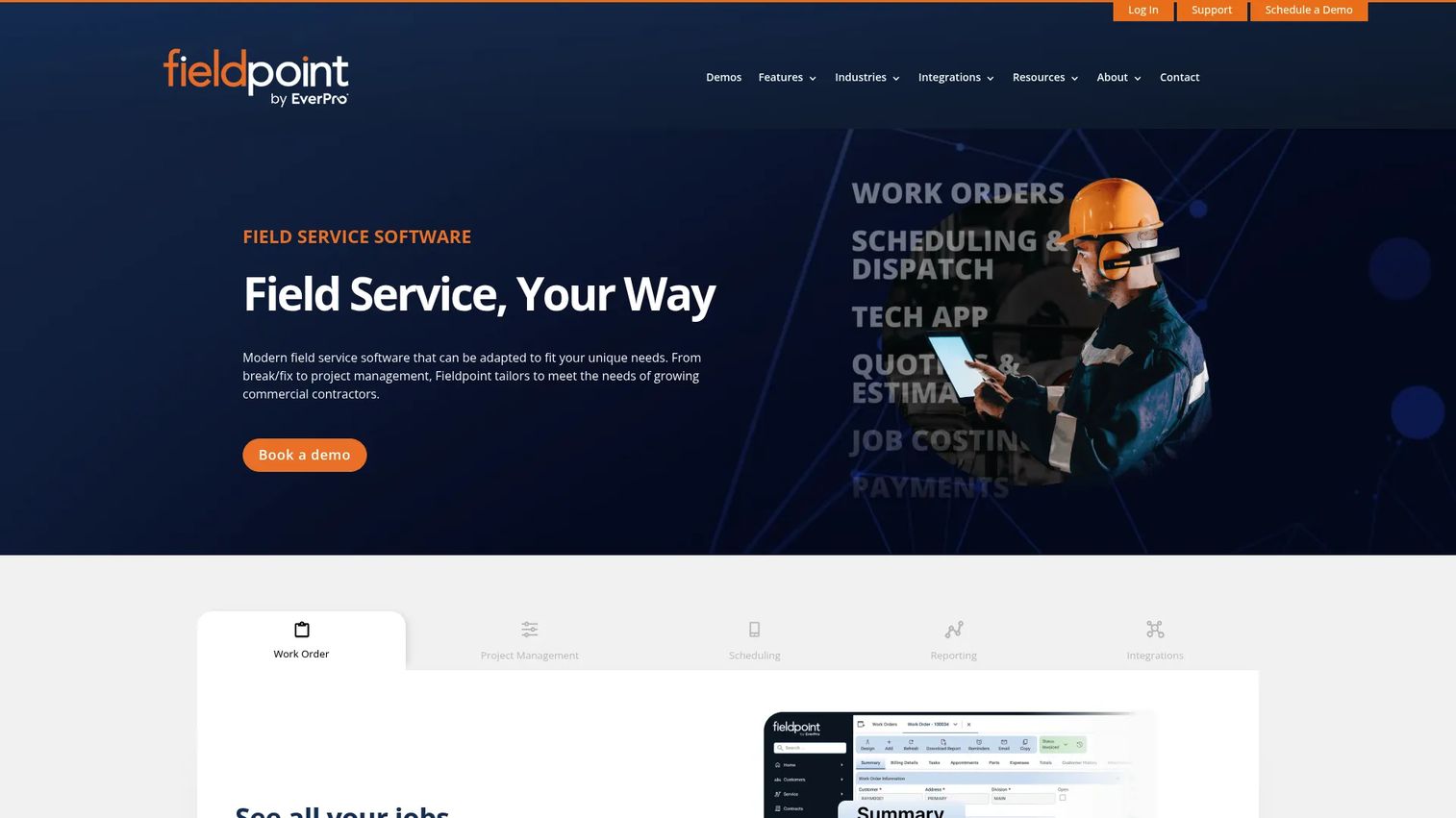
Fieldpoint is a field service management platform for scheduling, work orders, projects, inventory, quoting, mobile field work, and ERP or accounting integrations. Its contract angle is uptime-first. It builds maintenance contracts, schedules recurring inspections, applies technician assignment logic, and frames the whole motion around predictable recurring revenue and profitability rather than paperwork.
Best for: Mid-market and enterprise field service teams that want proactive maintenance automation with configurable FSM and ERP integrations.
Key strengths
- Maintenance contract creation
- Scheduled recurring inspections
- Technician assignment logic
- Work order and project management
- Quoting, inventory, and reporting
Why choose Fieldpoint: Choose it when you want contracts to drive uptime, not just live in a filing cabinet. The preventative maintenance agreements generate the recurring inspections, and the assignment logic routes the right technician, so the contract becomes an operational engine that protects equipment and recurring revenue at once.
Fieldpoint pricing: No public software subscription price is posted on the site, which emphasizes demos and contact rather than listed plans. Pricing is quote-based.
Fieldpoint holds a 4.0/5 rating on G2.
As service contract management software, Fieldpoint leans hardest into the maintenance side of the category. If preventative maintenance agreements and uptime are the reason you are buying, it maps closely to that goal.
5. Service Pro
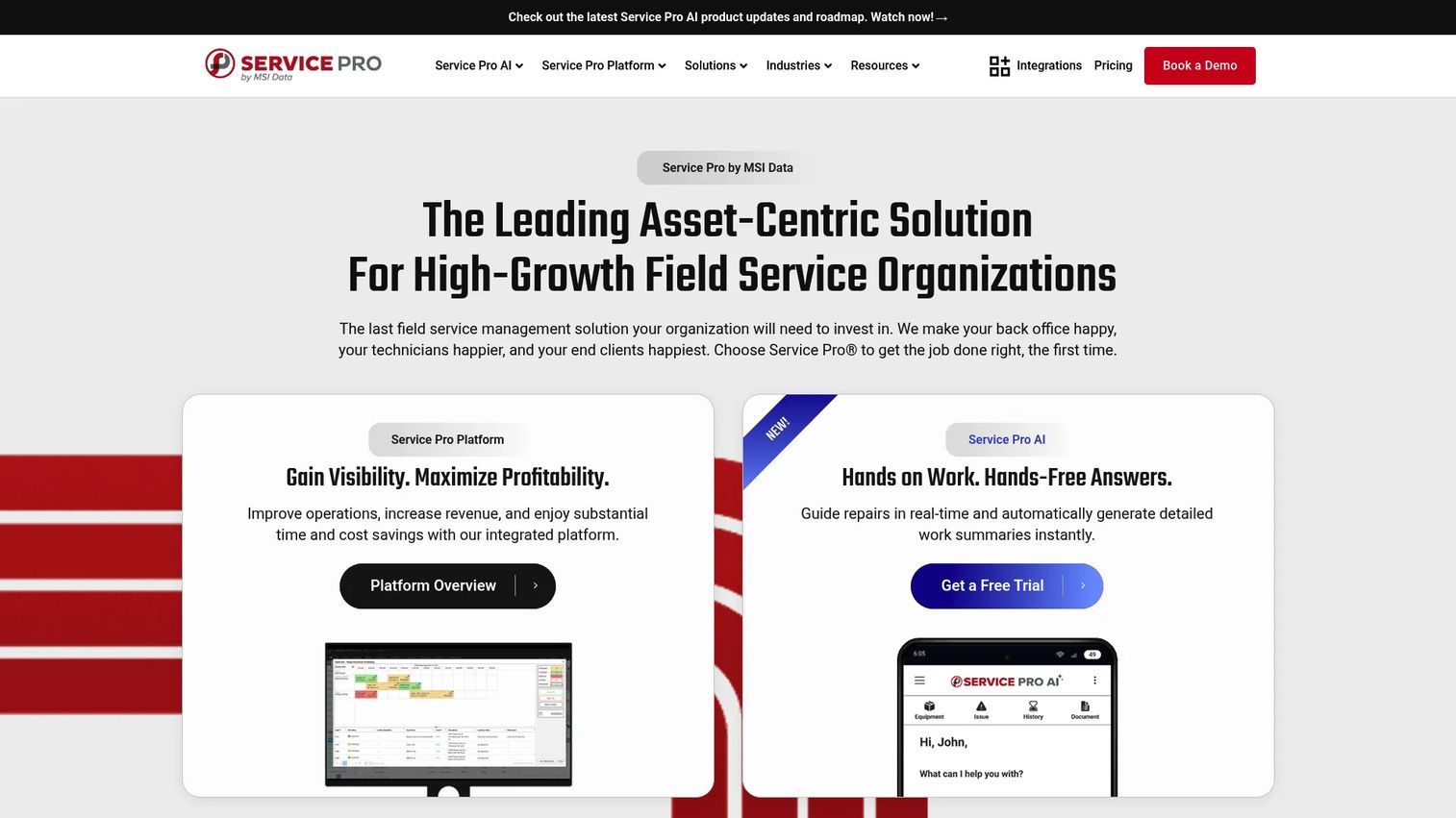
Service Pro is cloud-based field service management software built for equipment- and asset-centric service organizations. It runs contract, maintenance, and work order management alongside scheduling, dispatching, and a mobile field app with offline access. Contracts sit inside a broader operational suite that covers quoting through to installment invoicing, with preventive maintenance and inspection support.
Best for: Field service teams managing repairs, maintenance, inspections, and dispatch for physical equipment, where contracts and execution need to live in one system.
Key strengths
- Contract, maintenance, and work order management
- Scheduling and dispatching
- Mobile field service app with offline access
- Quoting to contract flow
- Preventive maintenance and inspection support
Why choose Service Pro: Pick it when contract creation, invoicing, and field execution belong together, especially for asset-heavy operations. The equipment focus means contracts stay tied to specific assets and their service history, which is where a lot of maintenance-heavy businesses lose track.
Service Pro pricing: Pricing is customized and quote-based, described as a per-user annual recurring subscription plus implementation fees. No public starting price is posted.
Service Pro holds a 4.4/5 rating on G2.
For service agreement management inside a full field service contract software suite, Service Pro fits teams whose work revolves around physical equipment and its lifecycle rather than one-off jobs.
Considerations
Contract lifecycle visibility
Check whether the tool separates active, pending, expiring, and expired contracts on one screen. That distinction is what prevents missed renewals. When you can see which agreements lapse next month, renewal management becomes a scheduled task instead of a fire drill. Ask to see the dashboard, not a screenshot of it.
Work order and scheduling automation
Test how easily a contract turns into recurring jobs, visits, or inspections. The value of maintenance contract software lives here. If a tech has to create each recurring visit by hand, consistency will drift. Look for tight dispatch and calendar integration so contract-driven work flows straight to the schedule without a manual step in between.
Technician mobile workflow
Verify what technicians actually see in the field. Can they pull up contract context, capture signatures, and document work against the agreement? Offline access matters when crews work where signal drops. Strong mobile execution keeps the contract record accurate and gives you an audit trail instead of paperwork someone re-keys later.
Billing and margin controls
Look for contract limits, flexible billing terms, and labor and material tracking against each agreement. This is where recurring revenue turns into actual profit. Job costing tied to the contract shows you which agreements make money and which quietly lose it, so you can price the next renewal from real data instead of a guess.
Customer communication and portal access
Assess whether customers can view their own contract information, receive renewal reminders, and sign digitally. A portal cuts the back-and-forth of "what does my agreement cover" and makes renewals easier to close. When the customer has visibility, transparency improves and your office staff field fewer status calls.
Conclusion
The right pick depends on where your team sits on the contract-to-operations spectrum.
BlueFolder fits teams that want deep contract visibility, with usage limits and a lifecycle dashboard that keep renewals and margins in view. ServiceTitan suits larger HVAC and trades operators who want service agreement management inside a full field service platform. Workever is the straightforward hub for small teams wanting contracts tied to jobs without heavy setup. Fieldpoint leans into preventative maintenance and recurring revenue for mid-market and enterprise teams. Service Pro fits equipment-centric operations that need contracts, invoicing, and execution in one system.
The real fork is lightweight contract storage versus full field service contract software. A hub stores the agreement and connects to the rest. A platform runs the whole operation with contracts as one layer. Neither is better in the abstract; the right one depends on how much of your operation you want in a single system.
Next step: shortlist two tools that match your spectrum position, then compare their contract lifecycle views, billing controls, and scheduling workflows side by side using your own real agreements. That test tells you more than any feature list.
FAQs
Service contract software focuses on the agreement lifecycle: storing contracts, tracking usage against limits, and managing renewals. Field service management software is broader, covering scheduling, dispatch, invoicing, and CRM, with service agreement management as one module. Many tools blend both, so the practical difference is how much operation you want in a single system.
Yes. Most service agreement software tracks expiration dates and sends renewal reminders before agreements lapse. The stronger tools also show a lifecycle view separating active, pending, expiring, and expired contracts, plus digital signing to close renewals faster. That combination is what turns renewals from a scramble into predictable recurring revenue.
Yes, and this is one of the strongest reasons to buy it. The agreement defines the visit cadence, and the system generates recurring jobs, inspections, and scheduled visits automatically. That removes the manual step where preventative maintenance agreements usually break, and it keeps operational consistency from depending on someone remembering to book the next visit.
Very. HVAC service agreement software supports membership plans, seasonal maintenance visits, and recurring inspections that drive predictable revenue. It ties those agreements to scheduling and dispatch so seasonal tune-ups actually get booked, and it flags renewals before members lapse. For HVAC operators, recurring maintenance is often the margin engine, so contract automation directly protects revenue.
Prioritize four things: automatic recurring job creation, work orders linked to the contract, a lifecycle view for renewals, and strong mobile execution in the field. Then check billing flexibility and contract limits if margin control matters. Test each against your own real agreements rather than a demo dataset, because that reveals how the tool behaves under your actual contract complexity.
Look for tools that set monetary or hour-based contract limits and draw down against them as work orders are logged. That keeps usage visible in real time, so overages get flagged and billed instead of eating margin silently. A dashboard that shows remaining balance per agreement is the practical version of this, and it doubles as an early renewal signal.
It depends on your customer base, but it usually pays off. A portal lets customers view their own contract details, see remaining visits, receive reminders, and sign renewals digitally. That cuts the "what does my agreement cover" calls your office fields and improves transparency. For teams managing many recurring agreements, the reduced back-and-forth alone tends to justify it.
By tying labor, materials, and visits back to each contract, it shows which agreements make money and which lose it. Job costing against the contract turns recurring revenue into a margin you can actually measure. Contract limits prevent unbilled overages, and renewal visibility protects the revenue you already earned, so you price the next agreement from real data instead of a guess.