Your service team is handling 200 inbound calls a week. Producers are chasing policy documents instead of qualified leads. Renewal follow-up falls through because no one owns the queue. And leadership wants an AI pilot running by next quarter, without a compliance mess.
That pressure is not unique to your agency. According to the Geneva Association's 2025 research, 68% of insurance customers have already used general-purpose generative AI while shopping for insurance, and 50% say it makes their interactions with insurers more efficient. The demand is there. The gap is on the operations side.
The challenge is figuring out which category of AI tool actually fits your workflow. Voice AI, chat automation, CRM copilots, document review, and agency management platforms all carry the "AI assistant" label. They are not interchangeable. Picking the wrong one means another tool that sits unused while your VP asks where the efficiency went.
This guide helps you cut through that. Each tool is mapped to the workflow it actually solves.
What's inside
This guide compares 15 AI insurance assistant tools for 2026. Tools were selected based on insurance workflow fit, AI capability relevance, buyer usefulness, and visibility across the competitive landscape. Pricing and G2 ratings reflect verified sources.
- Who it's for: Founders and operators at insurance agencies, insurtechs, and insurance-adjacent SaaS companies evaluating their AI stack
- Selection criteria: Insurance or adjacent workflow relevance, verified pricing, confirmed G2 presence, and category diversity across voice, chat, CRM, documents, and agency platforms
- What you'll decide: Which tool category to pilot first and which tools fit your existing system of record
TL;DR
- Best for insurance call workflows: CloudTalk for AI-supported phone operations, routing, and call analytics
- Best for insurance CRM: HubSpot for growing agencies; Salesforce for enterprise teams with complex governance needs
- Best for insurance-native operations: Vertafore and Applied Systems for agencies that need automation tied directly to policy and carrier data
- Best for document-heavy work: Arteria AI for contract and policy document workflows; Aveni for regulated conversation review
- Best general-purpose copilots: Claude for long-document reasoning; ChatGPT and Google Gemini for teams standardized on their respective productivity stacks; Microsoft 365 Copilot for Microsoft environments
- Best first step: Choose one measurable workflow, such as missed-call handling or renewal follow-up, before committing to a platform
What is AI insurance assistant software?
AI insurance assistant software helps insurance agents, agencies, brokers, and carriers automate or accelerate repetitive workflows such as customer service, lead qualification, policy document review, claims intake, renewals, and customer follow-up.
The category covers several distinct tool types that insurance teams often conflate:
- Voice assistants: Handle inbound calls, call routing, transcription, and lead qualification before a human agent steps in
- AI chatbots: Answer policyholder questions on the web or portal, collect intake details, and triage service requests
- CRM AI: Prioritize leads, summarize customer interactions, suggest next-best actions, and automate renewal outreach
- Document AI: Extract data from, compare, review, and summarize policy forms, claims documents, and contracts
- Agency management AI: Works inside insurance-native systems of record, connecting policy data, carrier integrations, and operational workflows
- General copilots: Support writing, summarization, research, and internal productivity across any team
Key capabilities to look for across the category:
- Call summaries, transcription, and IVR routing
- Chat automation with guided intake and FAQ handling
- CRM updates, lead scoring, and next-best-action recommendations
- Policy document extraction and clause comparison
- Claims intake and FNOL support
- Renewal reminders and at-risk account alerts
- Compliance controls, audit logs, and human review workflows
- Integrations with CRM, agency management systems, telephony, and document repositories
One important boundary: AI tools in insurance should support licensed professionals, not replace the judgment or regulatory review those professionals are required to provide. Any coverage decision, claims determination, or underwriting conclusion still needs human accountability.
When to use AI insurance assistant tools
Reduce missed calls and slow intake
Agencies receiving more inbound volume than their staff can answer lose leads and frustrate policyholders who get voicemail instead of answers. AI voice assistants and call routing tools can handle first-contact qualification, collect intake details, and route calls to the right producer. This frees agents for conversations that actually require their expertise, rather than administrative triage.
Speed up policy and claims document review
Policy comparison, claims intake, underwriting support, and contract review are document-intensive processes where AI can significantly reduce manual time. Tools in this category extract key data points, flag differences between documents, and generate summaries for human review. The human still makes the coverage or claims decision; the AI removes the hours of reading that precede it.
Make renewals and follow-ups repeatable
Renewal conversations are predictable in timing but inconsistent in execution. CRM AI and AI agents can identify at-risk accounts based on engagement signals, draft outreach sequences, create follow-up tasks, and surface cross-sell opportunities. This turns renewal management from a reactive scramble into a system that runs without founder oversight.
AI insurance assistant tools comparison
The table below maps all 15 tools to the workflow they fit best, with verified pricing and G2 ratings. Use it as a first filter before reading the detailed sections.
| # | Product | Best for | Key differentiator | Pricing | G2 rating |
|---|---|---|---|---|---|
| 1 | CloudTalk | Insurance phone operations | AI voice agents and call routing | From €25/user/mo | 4.4/5 |
| 2 | HubSpot | Agency CRM and marketing | All-in-one CRM with free tier | From $0/mo | 4.4/5 |
| 3 | Jasper | Insurance marketing content | Brand-controlled AI writing | From $59/mo | 4.7/5 |
| 4 | Kenyt.AI | Conversational AI for agencies | Chat, voice, and CRM in one platform | From free | N/A |
| 5 | Salesforce | Enterprise insurance CRM | Financial services data model and governance | From $25/user/mo | 4.4/5 |
| 6 | Vertafore | Insurance agency management | Insurance-native workflow automation | Custom pricing | 3.8/5 |
| 7 | Claude | Long-form document reasoning | Strong summarization across dense documents | From $0 | 4.7/5 |
| 8 | Agentforce | Autonomous CRM workflow execution | AI agents operating inside Salesforce | From $0 | 4.4/5 |
| 9 | AlphaChat | Insurance customer service chat | Multilingual chatbot with agent handoff | From €399/mo | 4.8/5 |
| 10 | Aveni | Regulated financial services AI | Compliance-focused conversation oversight | Custom pricing | N/A |
| 11 | Arteria AI | Insurance document workflows | AI document processing for complex agreements | Custom pricing | N/A |
| 12 | Applied Systems | Agency management and policy workflows | Insurance-specific operating platform | Custom pricing | 4.4/5 |
| 13 | Microsoft 365 Copilot | Internal productivity | AI inside Outlook, Teams, Word, Excel | From $30/user/mo | 4.4/5 |
| 14 | ChatGPT | General AI assistance | Flexible drafting, analysis, and research | From $0/mo | 4.6/5 |
| 15 | Google Gemini | Google Workspace productivity | AI across Gmail, Docs, Sheets | From $19.99/mo | 4.4/5 |
Best AI insurance assistant tools for 2026
1. CloudTalk
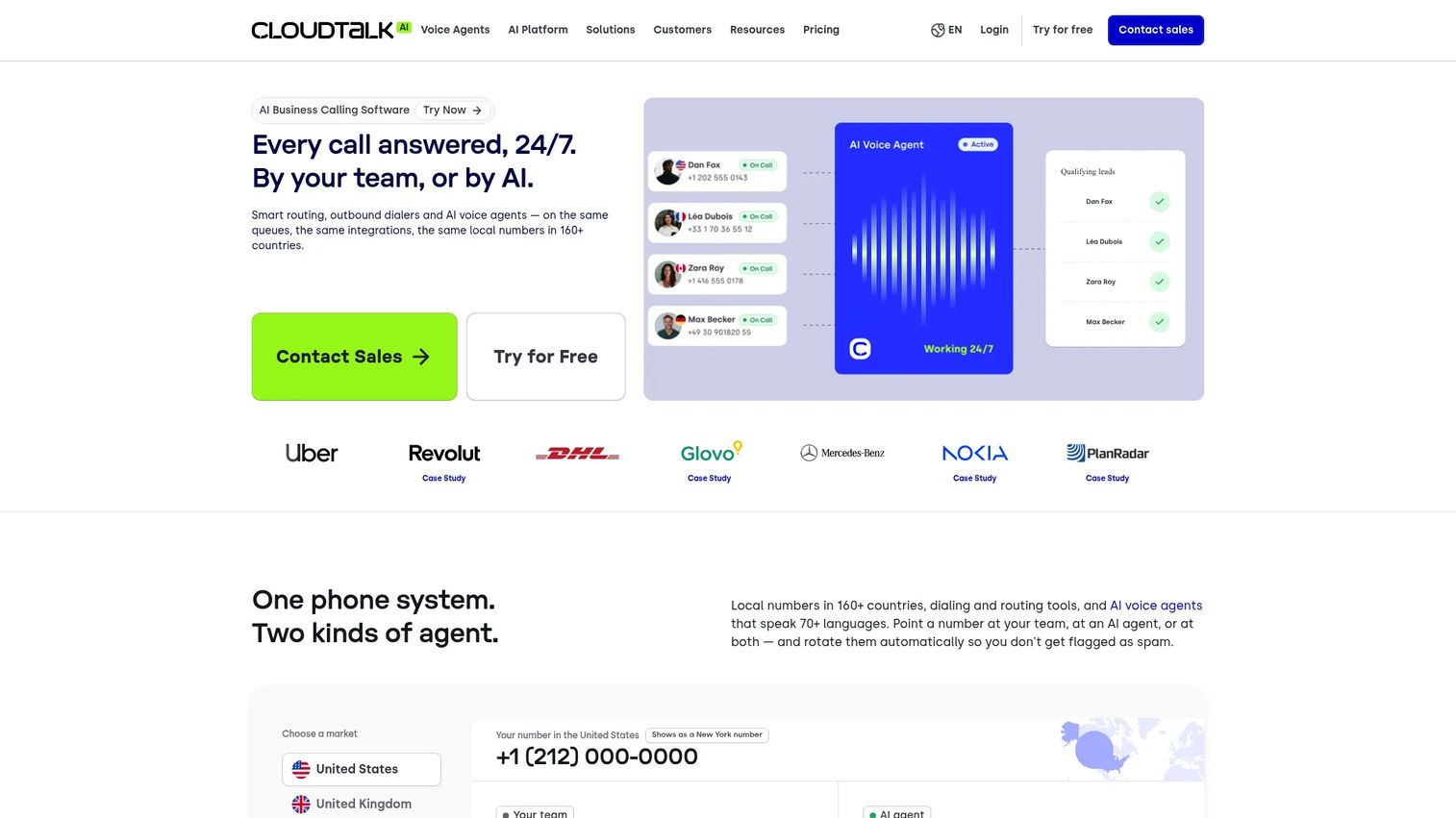
CloudTalk is an AI-powered cloud call center and business phone platform built for sales and customer support teams. For insurance agencies, it addresses the most immediate operational problem: More inbound volume than agents can answer. CloudTalk's AI Voice Agents handle first-contact qualification and routing, while its call analytics give managers visibility into what's happening across the phone queue.
Best for: Insurance agencies where the primary bottleneck is call volume, missed leads, and inconsistent follow-up.
Key features
- AI Voice Agents for inbound call handling and qualification
- Call routing and IVR for directing calls to the right producer
- AI Sales Dialer for outbound follow-up campaigns
- Call recording and analytics dashboards
- CRM and helpdesk integrations
Why choose CloudTalk: Choose CloudTalk when the phone queue is your highest-friction point. It gives you AI-assisted call coverage and visibility before you tackle back-office automation. For AI voice assistants specifically, it's one of the more insurance-applicable options in the market.
CloudTalk pricing: Plans start at €25 per user per month on the Starter tier, billed annually. Essential is €29/user/month and Expert is €49/user/month, both billed annually. Monthly billing is available at higher rates. A 14-day free trial is included, and additional AI Voice Agent charges may apply depending on usage volume.
G2 rating: 4.4/5
2. HubSpot

HubSpot combines CRM, marketing automation, sales engagement, and customer service into one platform, with AI features woven across each hub. For insurance agencies and insurtech teams that haven't yet standardized on an enterprise CRM, HubSpot provides enough range to run marketing, service, and sales from a single system without a heavyweight implementation.
Best for: Growing agencies and insurtech teams that need CRM, marketing automation, and customer service in one place before committing to enterprise software.
Key features
- AI email drafting and content generation
- CRM with lead scoring and pipeline management
- Marketing automation and nurture workflows
- Service ticketing and customer data management
- Activity summaries and next-step recommendations
Why choose HubSpot: Choose HubSpot when scattered customer data is the real problem. It consolidates marketing, sales, and service into a shared view without requiring a full enterprise rollout, which matters when your VP of Sales needs something operational on day one.
HubSpot pricing: A free CRM plan is available. Marketing Hub Starter runs $7 per seat per month on annual billing. Professional is $800 per month billed annually, with a required $3,000 onboarding fee. Enterprise is $3,600 per month. Each hub is priced separately, and plans combine depending on what your team needs.
G2 rating: 4.4/5
3. Jasper
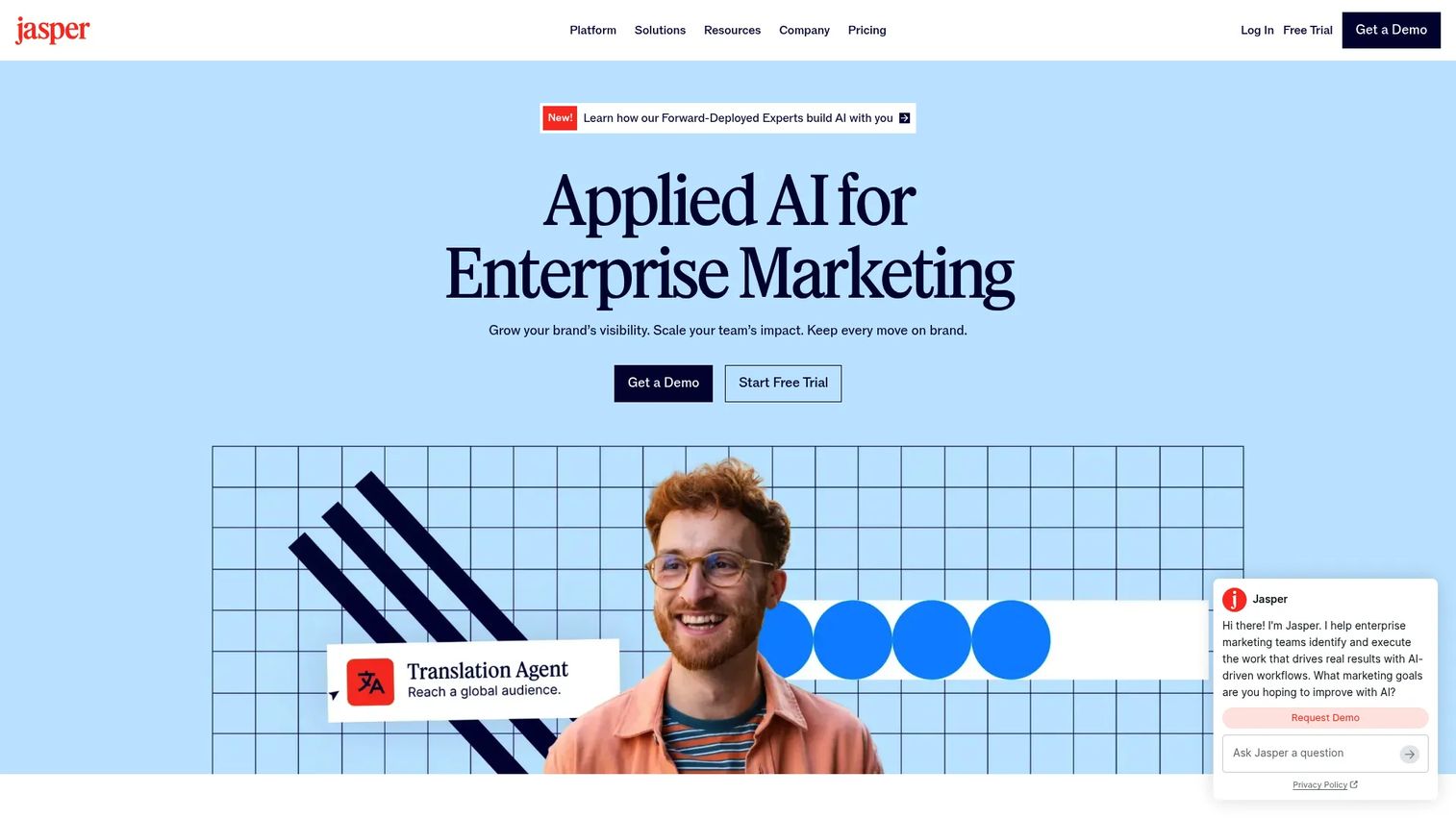
Jasper is a generative AI platform built for marketing teams producing on-brand content at scale. For insurance marketing teams, it handles the content production side: Policy education pages, renewal campaign emails, broker enablement one-pagers, and social content. It applies brand voice controls so output stays consistent across writers and channels.
Best for: Insurance marketing teams running campaigns at higher volume who need consistent brand output without hiring more writers.
Key features
- Brand voice and style guide controls (Jasper IQ)
- Marketing agents for SEO, campaigns, email, and social content
- Content pipelines for scalable repeatable workflows
- Team collaboration with shared assets and templates
- Content governance controls on Business plans
Why choose Jasper: Choose Jasper when campaign content production is the bottleneck, not the lack of AI strategy. Keep human review in place for anything that touches policy terms or regulatory claims.
Jasper pricing: Pro starts at $59 per month billed annually, or $69 per month on monthly billing, and includes one seat. Business pricing is custom with a 12-month commitment. A 7-day Pro free trial is available.
G2 rating: 4.7/5
4. Kenyt.AI
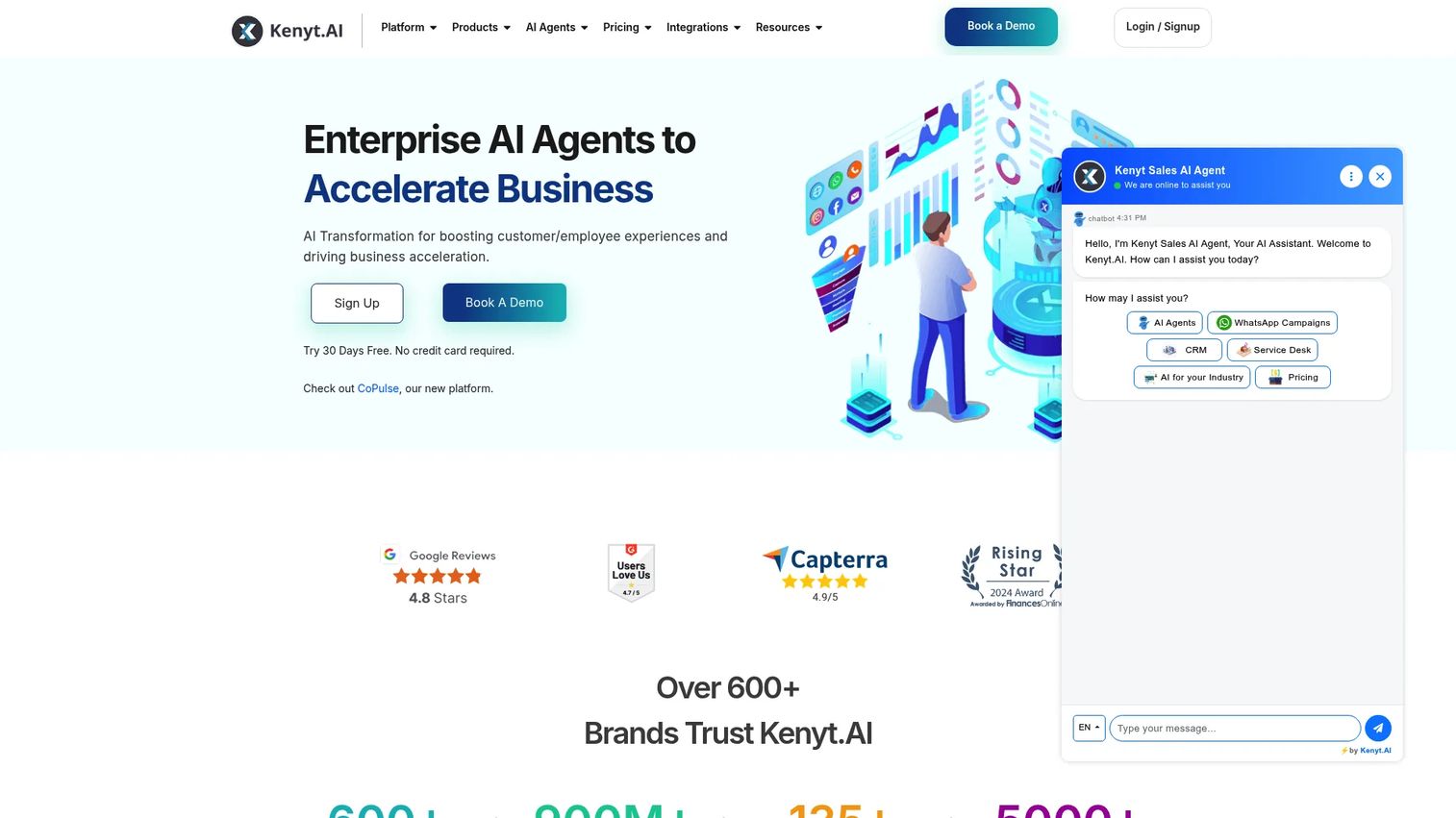
Kenyt.AI provides AI agents for customer engagement across chat, voice, WhatsApp, email, and other messaging channels. Insurance agencies can use it to automate first-touch conversations, capture leads from web or messaging channels, schedule appointments, and triage service requests before a human agent responds.
Best for: Insurance agencies that want AI-powered first-response automation across web chat, WhatsApp, and voice before scaling into deeper policy-system integrations.
Key features
- Omnichannel AI agents across web, WhatsApp, voice, and email
- Lead capture, qualification, and appointment scheduling
- CRM with pipeline management and sales automation
- Service desk with ticket routing and knowledge base support
- Multilingual NLU with intent detection and context retention
Why choose Kenyt.AI: Choose Kenyt.AI when first-touch automation and lead qualification across messaging channels is the gap. It fits teams that need intake and routing covered before investing in back-office AI.
Kenyt.AI pricing: Kenyt CRM offers a free Starter plan. Paid plans start at $11 per month for Growth, $15 per month for Professional, and $21 per month for Enterprise. All-in-one bundle pricing varies by package and currency.
5. Salesforce
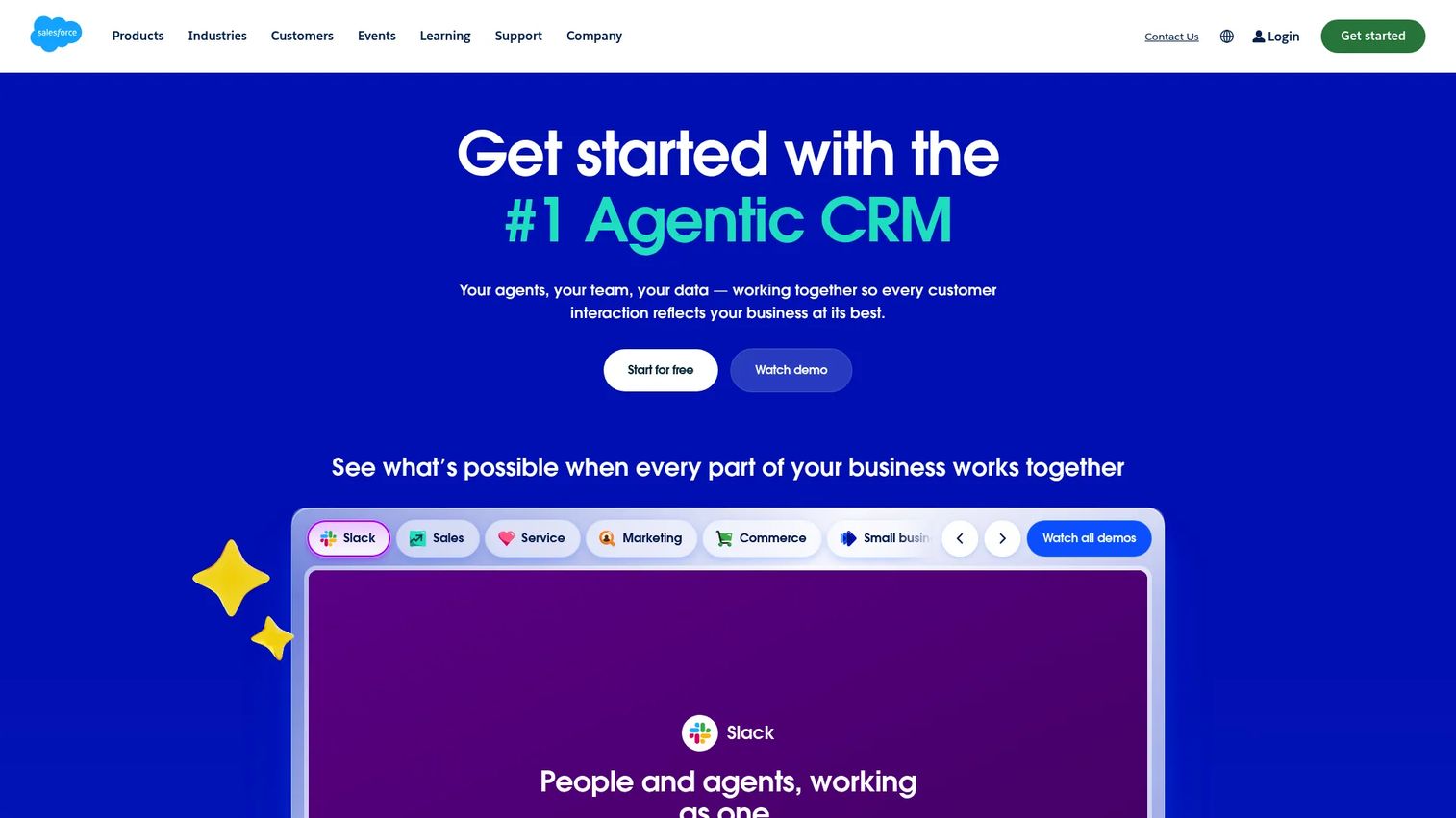
Salesforce is an enterprise CRM platform covering sales, service, marketing, commerce, and data, with AI capabilities built throughout. For insurance teams, it supports financial services workflows, service case management, lead scoring, and workflow orchestration across large organizations. Financial Services Cloud adds an insurance-specific data model on top of the core platform.
Best for: Enterprise insurance teams with complex CRM requirements, multi-team governance needs, and existing Salesforce infrastructure.
Key features
- CRM AI assistance across sales, service, and marketing
- Financial Services Cloud data model for insurance workflows
- Service automation and case management
- Lead scoring and workflow orchestration
- Agentforce integration for autonomous AI agents
Why choose Salesforce: Choose Salesforce when insurance operations span multiple teams and require centralized governance. It's the right fit when your data, compliance requirements, and reporting all need to live in one auditable system.
Salesforce pricing: Sales Cloud Starter Suite begins at $25 per user per month, with Pro Suite at $100 per user per month. Higher tiers (Core, Advanced, Max) run from $195 to $550 per user per month. A free 30-day trial is available, though no permanent free tier exists.
G2 rating: 4.4/5
6. Vertafore
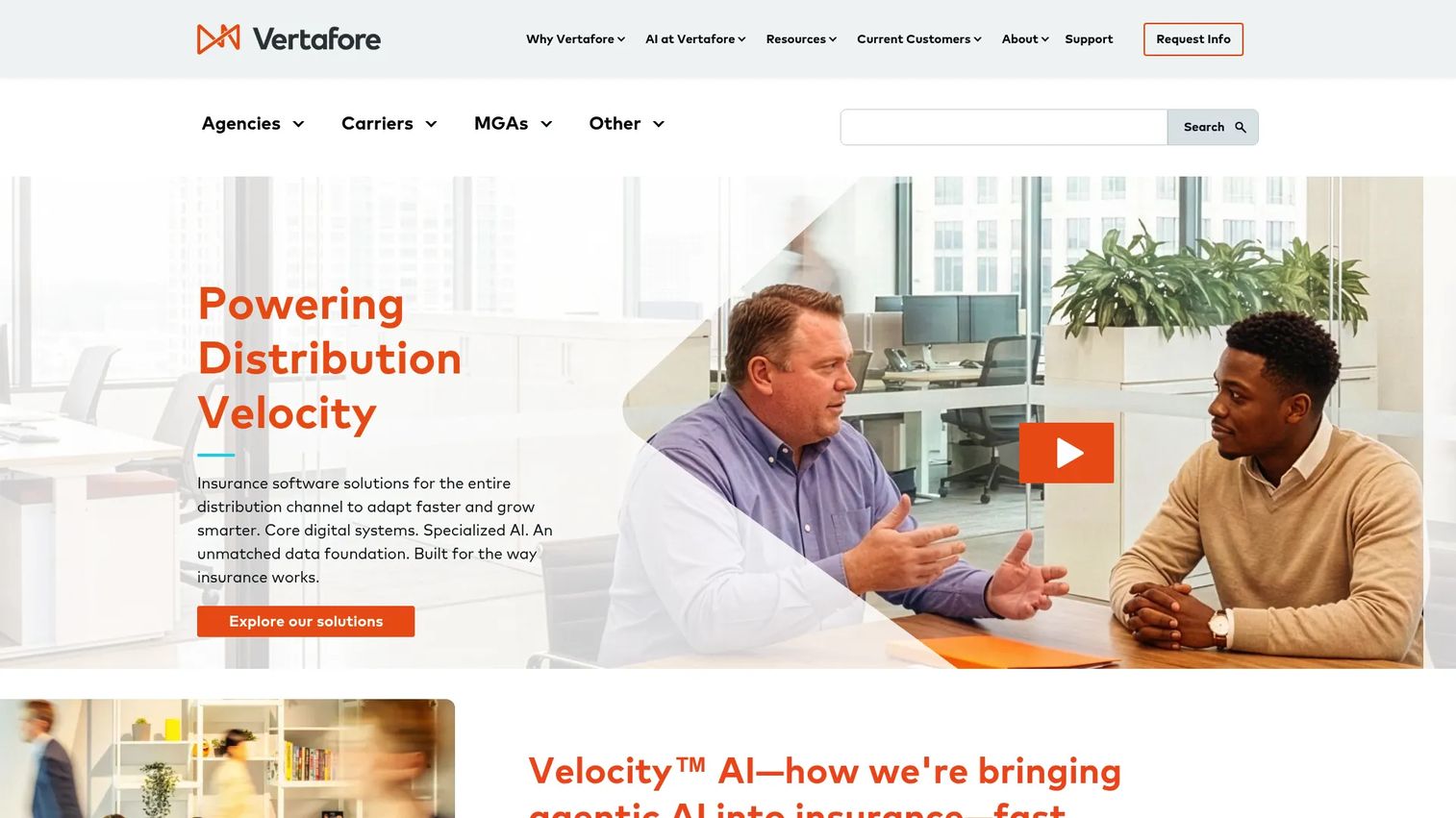
Vertafore is an insurance technology provider serving agencies, carriers, and managing general agents. Its platform covers agency management, distribution, policy workflows, carrier integrations, and data management. The focus is on insurance-native operational automation, not generic AI on top of a CRM.
Best for: Insurance agencies that need automation tied directly to policy, carrier, and distribution workflows rather than a standalone AI layer.
Key features
- Insurance lifecycle and agency management tools
- Policy workflow automation across lines of business
- Insurance data connectivity and reporting
- Carrier integrations and distribution management
- AI-powered workflow automation within the platform
Why choose Vertafore: Choose Vertafore when your priority is improving an existing insurance operating model. Generic AI tools cannot see your agency's system of record; Vertafore's automation operates inside it.
Vertafore pricing: Vertafore prices by quote. Contact their sales team for package details, as pricing varies by product family, agency size, and deployment scope.
G2 rating: 3.8/5
7. Claude

Claude is Anthropic's AI assistant, known for strong performance on long-context analysis, document summarization, drafting, and research tasks. For insurance teams, it handles the reading-intensive work: Turning dense policy documents, claims reports, and research materials into decision-ready summaries. Claude is a general assistant, so teams need clear usage rules around sensitive policyholder data before deploying it on regulated documents.
Best for: Teams that spend significant time turning long, complex insurance documents into summaries or briefings for human decision-makers.
Key features
- Long-context document analysis and summarization
- Drafting assistance for internal and external communications
- Web search, file access, and connector integrations
- Scheduled and parallel task execution
- Team and Enterprise plans with administration and security controls
Why choose Claude: Choose Claude when dense document review is slowing down your operations team. Set clear boundaries on what data goes in, and keep human review as the final step for coverage or claims-related outputs. For teams comparing AI writing assistants, Claude is one of the strongest options for structured analytical work.
Claude pricing: A free plan is available. Pro costs $17 per month billed annually, or $20 per month monthly. Team seats run $20 per seat per month annually. Enterprise starts at $20 per seat per month with a 20-seat minimum plus API usage.
G2 rating: 4.7/5
8. Agentforce
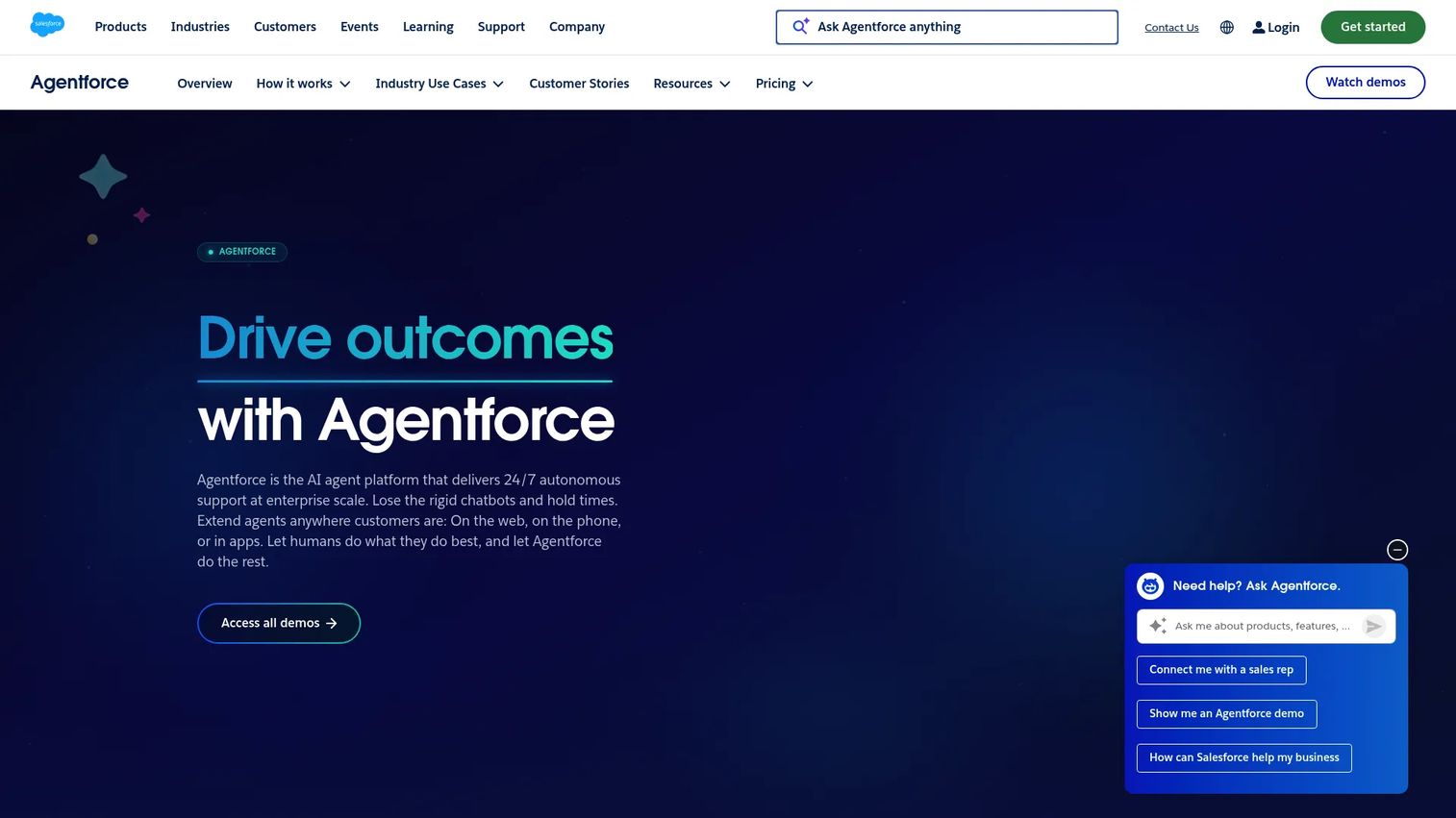
Agentforce is Salesforce's autonomous AI agent platform. Where standard Salesforce AI makes suggestions, Agentforce builds and deploys agents that take action inside CRM workflows: Handling service cases, following up on leads, executing renewal tasks, and updating records. It is built specifically for organizations already running on Salesforce.
Best for: Salesforce-based insurance organizations that want AI agents executing tasks inside existing CRM operations, not sitting in a separate tool.
Key features
- Agent Builder for configuring autonomous agents and subagents
- Agentforce Voice for AI-powered phone interactions
- Multi-agent orchestration for collaborative workflows
- Agentforce Observability for monitoring agent performance
- Salesforce data grounding for context-aware actions
Why choose Agentforce: Choose Agentforce when your data and workflows already live in Salesforce and you want agents doing work rather than making suggestions. It's the wrong fit for teams that haven't yet standardized on Salesforce.
Agentforce pricing: Salesforce Foundations is free. Conversation-based pricing runs $2 per conversation. Per-user licensing starts at $5 per user per month, with add-ons from $125 per user per month. Max Edition starts from $550 per user per month.
G2 rating: 4.4/5
9. AlphaChat
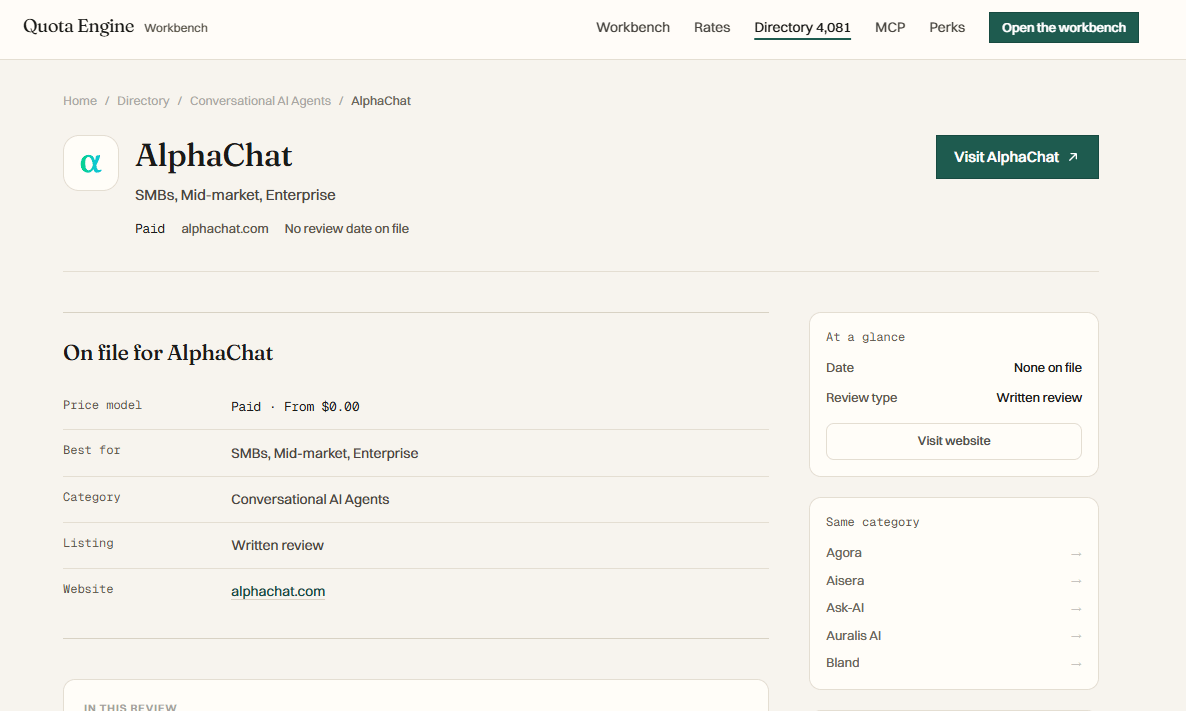
AlphaChat is a conversational AI platform for customer service chat automation. It handles repetitive policyholder questions on the web, automates FAQ responses, and routes conversations to a live agent when the query exceeds what the bot can handle. Its multilingual support makes it practical for agencies serving diverse customer bases.
Best for: Insurance teams that need to deflect repetitive inbound chat volume and qualify policyholder requests before a service rep engages.
Key features
- Natural-language understanding chatbot for insurance FAQs
- Built-in live chat with bot-to-agent handoff
- Multilingual support for diverse customer bases
- APIs and enterprise integrations
- Chat analytics for volume and deflection tracking
Why choose AlphaChat: Choose AlphaChat when your highest-volume channel is web chat and you're spending agent time on questions that don't require human judgment. Start with the FAQ and self-service layer before expanding into voice or back-office automation.
AlphaChat pricing: The Standard Package runs €399 per month and includes bot automation, intent training, one live-chat license, and a website widget. Enterprise features are available separately; contact AlphaChat for enterprise package pricing.
G2 rating: 4.8/5
10. Aveni
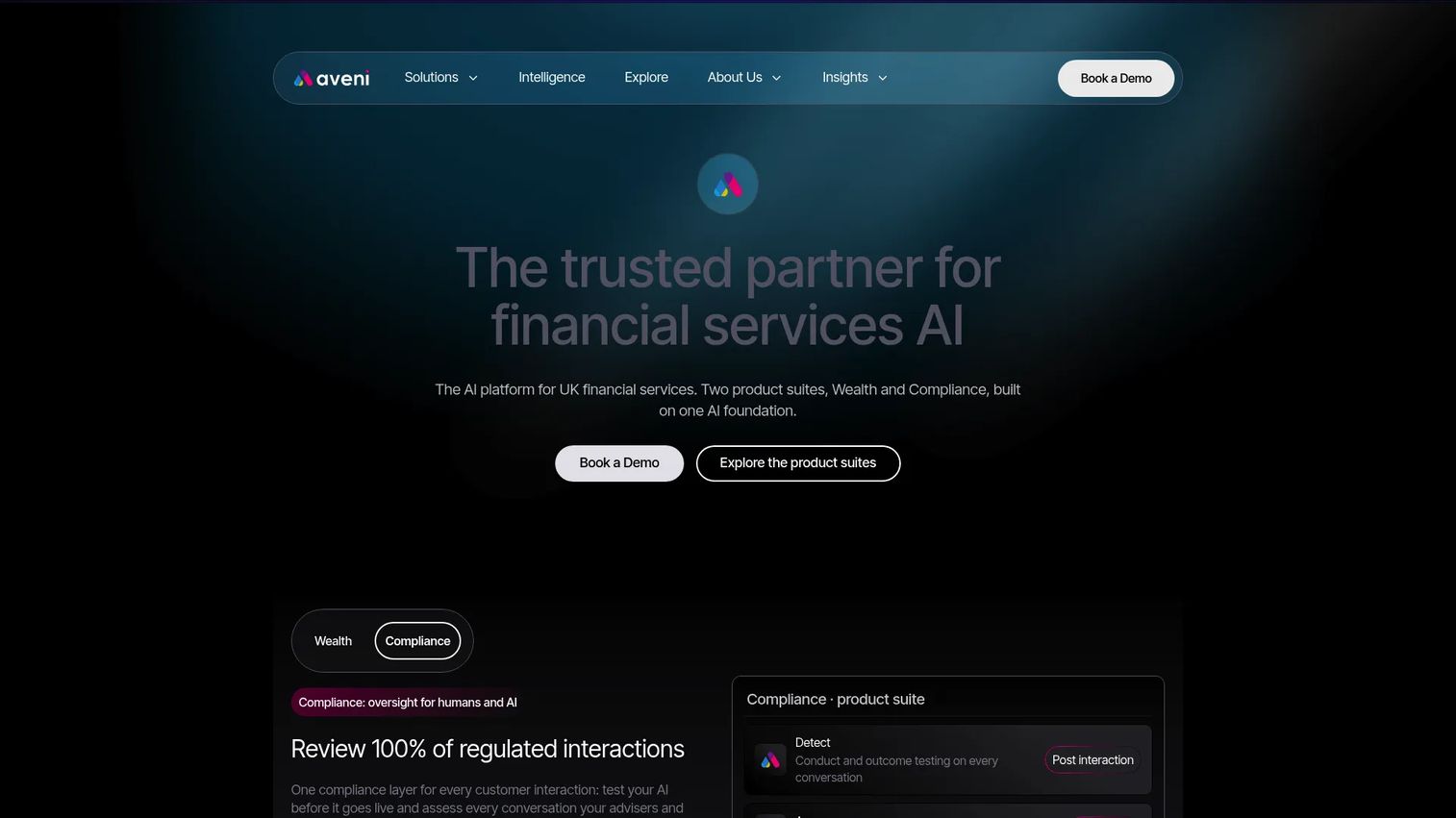
Aveni is an AI platform built for regulated financial services, focused on conversation intelligence, compliance monitoring, and quality assurance. For insurance firms operating under regulatory oversight, it automates the review of adviser and customer-service conversations, flags risk, and generates evidence for compliance files. It is a tool for oversight and audit, not primarily for customer-facing speed.
Best for: Regulated insurance and financial services teams that need conversation monitoring, QA automation, and compliance evidence alongside productivity gains.
Key features
- Conversation intelligence with compliance monitoring (Aveni Detect)
- Meeting capture and suitability drafting for advisers (Aveni Assist)
- Advice-file review with cited findings (Aveni File Check)
- Pre-deployment testing of customer-facing AI (Aveni Approve)
- Real-time oversight and escalation for deployed AI (Aveni Assure)
Why choose Aveni: Choose Aveni when call quality and regulatory evidence matter as much as speed. It fits insurance teams that cannot treat AI as a black box because regulators require documentation of customer interaction outcomes.
Aveni pricing: Aveni prices by quote. Deployment scope and regulatory requirements drive the package. Contact Aveni directly for pricing details.
11. Arteria AI
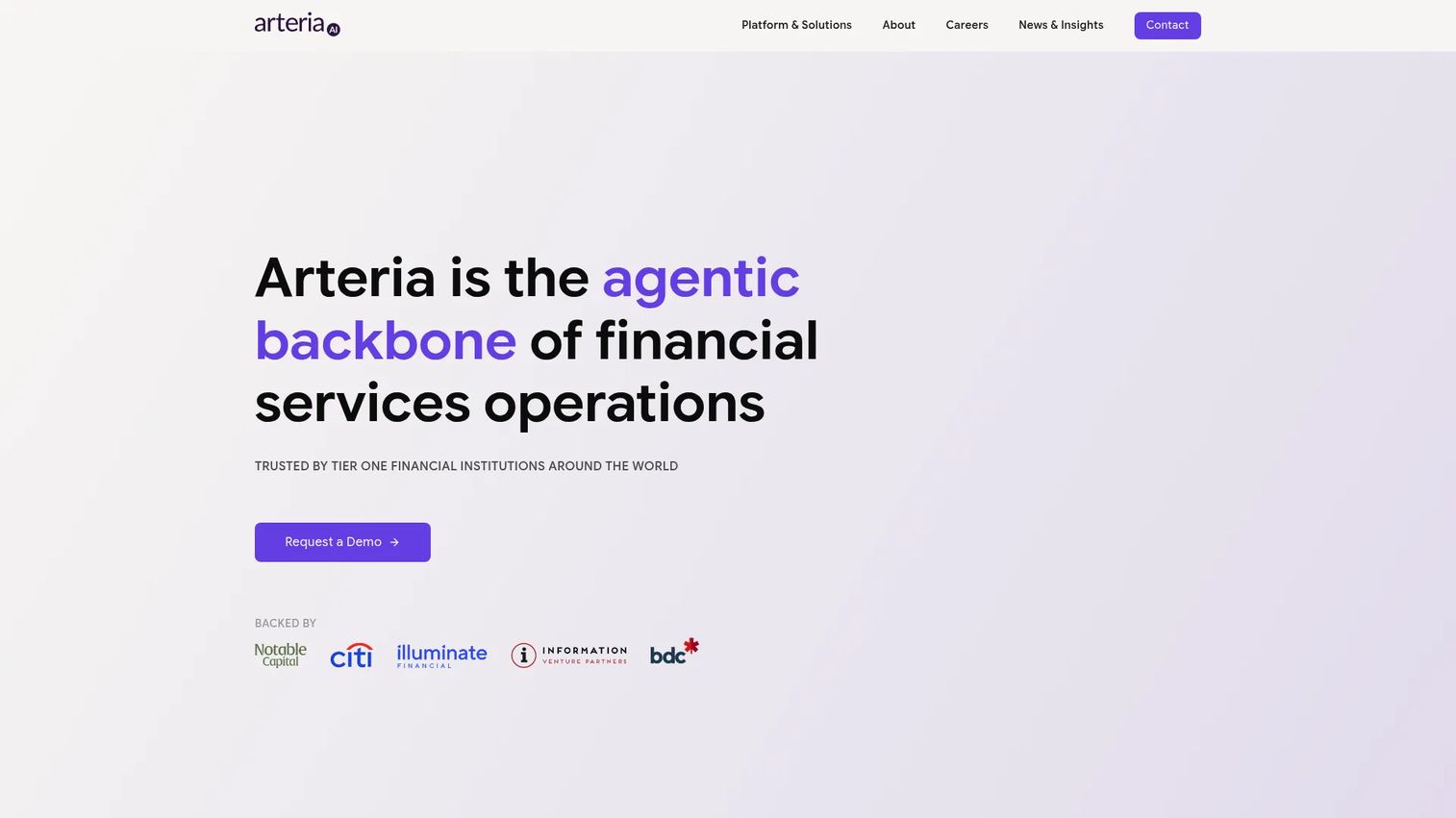
Arteria AI is an enterprise AI platform for automating documentation-intensive workflows in financial services. For insurance teams, it covers the document complexity that slows down policy agreements, contract reviews, onboarding, and reporting. It generates documents from data, extracts information from incoming documents, compares clauses, and manages approval workflows.
Best for: Enterprise insurance and financial services teams where document complexity is the operational bottleneck, not customer-facing speed.
Key features
- Automated document generation from structured data
- Information extraction from complex financial and insurance documents
- Clause comparison with recommendations
- Intelligent document repository with hierarchical categorization
- Enterprise workflow automation with approval routing
Why choose Arteria AI: Choose Arteria AI when your team spends significant time negotiating, reviewing, or generating insurance documents. It is built for enterprise document complexity, not quick-turnaround consumer chat. For more context on AI legal assistant software adjacent to this category, see the linked guide.
Arteria AI pricing: Arteria AI prices by quote for enterprise engagements. Contact their team for package details based on document volume and deployment scope.
12. Applied Systems
Applied Systems provides insurance software for independent agencies, brokerages, and MGAs. Its platform covers policy management, quoting and submissions, insurance accounting, carrier connectivity, and AI-powered workflow automation. The key distinction from general AI tools is that Applied Systems operates inside the insurance system of record, where policy and carrier data already live.
Best for: Independent insurance agencies and brokerages that need operational automation connected to their policy lifecycle, financial workflows, and carrier relationships.
Key features
- Policy management across property and casualty lines
- Commercial and personal lines quoting and submissions
- Insurance accounting, billing, payments, and reconciliation
- Carrier connectivity and data exchange
- AI-powered workflow automation within the agency management platform
Why choose Applied Systems: Choose Applied Systems when generic AI tools are blocked from your actual agency data. Automation that can't see your policy records and carrier feeds can't meaningfully speed up your servicing workflows.
Applied Systems pricing: Applied Systems prices by quote. Contact their sales team for pricing based on agency size, lines of business, and required modules.
G2 rating: 4.4/5
13. Microsoft 365 Copilot
Microsoft 365 Copilot is AI embedded directly in Microsoft's productivity suite: Outlook, Teams, Word, Excel, and PowerPoint. For insurance teams already standardized on Microsoft 365, it provides AI assistance in the tools employees open every day, without requiring a separate platform or login. It is strongest for internal productivity, not insurance-specific decisioning. For teams comparing AI meeting assistants, Copilot's Teams integration is worth evaluating.
Best for: Insurance teams fully standardized on Microsoft 365 that want AI inside their daily productivity environment.
Key features
- Outlook drafting and email summarization
- Teams meeting summaries and action item extraction
- Word document drafting and editing assistance
- Excel data analysis and formula support
- Enterprise security controls and compliance features
Why choose Microsoft 365 Copilot: Choose Copilot when the fastest AI win for your team is inside tools they already use, not a new platform to learn. It won't automate insurance-specific workflows, but it reduces administrative time across every function.
Microsoft 365 Copilot pricing: Copilot Chat is included at no additional cost with eligible Microsoft 365 plans. The Microsoft 365 Copilot add-on costs $30 per user per month billed annually, or $31.50 per month on monthly billing, and requires a qualifying Microsoft 365 license.
G2 rating: 4.4/5
14. ChatGPT
ChatGPT is OpenAI's general AI assistant for drafting, summarization, file analysis, research, and workflow planning. For insurance teams, it's a flexible starting point before committing to a specialized platform. It handles a wide range of tasks but requires clear organizational rules around sensitive policyholder data, since it's a general tool without insurance-specific governance by default.
Best for: Teams that need broad AI assistance across many insurance workflows before they're ready to invest in a specialized platform.
Key features
- Text drafting and rewriting across any format
- File upload and document analysis
- Custom GPTs for repeatable insurance workflows
- Web search and deep research capabilities
- Team and Enterprise workspace options with admin controls
Why choose ChatGPT: Choose ChatGPT when you need to run fast experiments across multiple workflows before narrowing to a category-specific tool. Define your data use policy before giving it access to anything policyholder-related.
ChatGPT pricing: A free plan is available. Go, Plus, Pro, and Business are paid per-user plans with monthly or annual billing. Enterprise pricing requires contacting OpenAI's sales team. Specific prices for paid tiers were not displayed on the official pricing page at time of writing.
G2 rating: 4.6/5
15. Google Gemini

Google Gemini is Google's AI assistant integrated across Gmail, Docs, Sheets, Slides, Meet, and search. For insurance teams running on Google Workspace, it brings AI into the daily tools without requiring a migration or separate subscription. Like Microsoft 365 Copilot, it is strongest for internal productivity tasks rather than insurance-specific workflow automation.
Best for: Insurance teams fully standardized on Google Workspace that want AI inside their daily environment.
Key features
- Gmail drafting and email summarization
- Google Docs writing and editing assistance
- Sheets data analysis and formula support
- Multimodal AI for text, images, and uploaded files
- Deep Research for synthesizing information across sources
Why choose Google Gemini: Choose Gemini when your team already works in Google Workspace and wants AI without adding a new tool. Pair it with an insurance-specific platform for policy workflows that require structured data access.
Google Gemini pricing: Google AI Pro costs $19.99 per month, or $199.99 billed annually. Google AI Ultra costs $99.99 per month. The Gemini app is accessible through the product homepage; a free access tier exists, though the specific pricing structure for entry-level access was not fully detailed on the official pricing page at time of writing.
G2 rating: 4.4/5
Considerations when choosing AI insurance assistant tools
Start with one workflow, not a platform mandate
Pick the single most painful workflow first: Missed calls, renewal follow-up, policy document summarization, or service FAQ volume. Define what success looks like before comparing vendors. A clear before-and-after metric (missed-call rate, renewal conversion, handle time) makes the pilot decision simple.
Check data access and retention before you sign
Insurance teams handle policyholder data, personally identifiable information, payment records, and regulated communications. Before deploying any AI tool, review the vendor's data retention policy, model training terms, encryption standards, access controls, and audit log capabilities. If a tool trains on your data by default, that changes the risk calculus for sensitive workflows.
Keep licensed human review in the decision loop
AI can draft outreach, summarize claims documents, route calls, and flag at-risk accounts. It should not independently determine coverage, resolve claims, or make underwriting decisions without proper human review. Build human checkpoints into any AI workflow that touches a regulated outcome.
Match integrations to your system of record
A tool that can't connect to your CRM, agency management system, telephony stack, or document repository becomes another isolated tab. Confirm which integrations are native versus API-dependent before committing, and test the integration quality with a pilot workflow rather than a demo environment.
Measure payback in operational metrics
Tie your evaluation to metrics you already track: Response time, missed-call rate, renewal conversion rate, quote turnaround, producer productivity, or cost per serviced policy. Tools that can't move one of those numbers within 60 days probably don't fit the workflow you assigned them to.
Conclusion
The right AI insurance assistant tool depends on where your operations actually break down, not on which vendor has the most impressive feature list.
For phone-heavy agencies, CloudTalk addresses the call queue before anything else. HubSpot fits growing agencies that need a full CRM motion; Salesforce and Agentforce suit teams already running on that platform at scale. Vertafore and Applied Systems are the right call when automation needs to touch policy and carrier data directly. Arteria AI handles document complexity for enterprise teams, while Aveni adds the compliance oversight layer for regulated conversation workflows. For general productivity across your existing Microsoft or Google environment, Microsoft 365 Copilot and Google Gemini drop into the tools your team already uses. Claude and ChatGPT give teams flexibility to experiment across workflows before committing to a category-specific platform.
Pick one workflow. Run a 30 to 60-day pilot. Measure one operating metric before expanding.
If your team sells complex insurance software and your buyers need to understand the product before they'll schedule a call, showing them a self-serve interactive product demo can remove that friction entirely. Guideflow helps SaaS teams build and share interactive product experiences that let buyers evaluate the product on their own terms.
Start your journey with Guideflow today!
FAQs
AI insurance assistant tools are software platforms that help insurance agents, agencies, brokers, and carriers automate or accelerate repetitive workflows. The category covers call handling and routing, chat automation, CRM updates and lead scoring, policy document review, claims intake, renewal outreach, and internal productivity. The tools range from insurance-native platforms like agency management systems to general-purpose copilots that any team can use across daily tasks.
There's no single best tool for every agency because the right fit depends on where your operations break down. CloudTalk suits phone-heavy agencies; HubSpot works for teams that need a full CRM and marketing motion; Vertafore and Applied Systems are purpose-built for insurance-native workflows. For AI customer service software that spans multiple channels, the starting point is identifying your highest-volume inbound channel and mapping a tool to that before anything else.
No. AI can automate repetitive tasks like call routing, FAQ responses, renewal reminders, and document summarization. It cannot replace the licensed judgment that insurance agents provide for coverage decisions, claims handling, advice conversations, or regulatory-required disclosures. The agents who adopt AI tools well tend to handle more accounts with less administrative overhead, not fewer clients overall.
Start by identifying which workflows involve sensitive policyholder data and reviewing each vendor's data retention and access policies before deploying. Use data minimization: Don't feed an AI tool more information than it needs for the task. Build human review into any workflow that produces a recommendation touching coverage, claims, or underwriting. Keep audit logs for regulated conversations. This isn't a compliance guarantee; it's basic operational hygiene that reduces exposure.
Missed-call handling and lead qualification are strong starting points because the volume is high and the success metric (fewer missed calls, faster response time) is easy to measure. Renewal reminder automation is another reliable pilot because the trigger, timing, and outcome metric (renewal conversion rate) are well-defined. Policy document summarization works well for teams where analysts spend hours reading before they can advise. Pick whichever workflow has the clearest before-and-after metric for your team.
General AI tools like Claude, ChatGPT, and Microsoft 365 Copilot handle drafting, summarizing, and internal productivity well. They fall short when workflows require access to CRM records, agency management data, carrier integrations, or compliance-grade audit trails. If you need AI to do anything beyond text tasks, you'll eventually need a tool that connects to your system of record.
Verify the vendor's data retention terms and whether the product trains on your data. Confirm which integrations are native versus custom-built. Check whether the tool produces audit logs for regulated workflows. Understand the pricing model: Per-seat, per-conversation, and usage-based models all scale differently as your team grows. Finally, ask what operating metric the tool is designed to move and whether that metric matches your actual bottleneck.
Chatbots handle typed conversations on websites or customer portals. They answer FAQ-style questions, collect intake details, and route complex requests to a human agent. Voice assistants handle inbound phone calls: They qualify the caller, collect initial information, route to the right producer, and sometimes handle simple requests end-to-end. Many agencies need both, but the right starting point is whichever channel carries the most volume. Agencies fielding high call volumes should prioritize voice; agencies with high web traffic and self-service demand should start with chat. For a broader overview of the best AI voice assistants across categories, that linked guide covers the landscape in more detail.