Life sciences teams do not buy "pharma software" in the abstract. They buy systems that protect trial data, track samples, document experiments, keep quality processes running, and move regulated workflows forward without breaking under audit. The hard part is figuring out which system should own which workflow before you sign anything.
That decision gets harder as the category grows. According to Mordor Intelligence (2026), the global pharmaceutical manufacturing software market alone is estimated at $4.01 billion in 2026. That figure covers just one slice of a stack that spans R&D, LIMS, clinical operations, quality, safety, commercial analytics, and scientific data infrastructure. For a founder or operator building out a life sciences team, the real question is not "what software exists" but "which workflow carries the most risk right now, and which vendor should own it?"
Most pages you find on this topic give you a directory. This guide gives you a shortlist by workflow.
What's inside
This guide compares 21 pharma and biotech software vendors across every major life sciences workflow for 2026.
- Who it is for: founders, R&D leaders, clinical operations teams, quality and regulatory professionals, and commercial operations managers evaluating life sciences software
- How tools were chosen: category relevance, workflow ownership, enterprise adoption in pharma and biotech, and usefulness to buyers in regulated environments
- What the comparison covers: best-fit workflow, key differentiator, pricing model, and G2 rating
- How to use this guide: identify the workflow that carries the highest risk or bottleneck in your org, then shortlist two or three vendors from that row
TL;DR
- Best for enterprise pharma commercial and regulated operations: Veeva Systems owns the CRM, content, regulatory, and quality layer for large pharma organizations
- Best for clinical and real-world data at scale: IQVIA covers clinical development, commercial analytics, and global data assets under one umbrella
- Best for biotech R&D teams: Benchling is the default for structured scientific data, ELN, and molecular biology workflows
- Best for LIMS and lab operations: LabWare, CloudLIMS, LabKey LIMS, and STARLIMS each fit different lab sizes and deployment preferences
- Best for quality management: MasterControl and Qualio cover QMS needs across large enterprise and scaling life sciences companies respectively
- Best for pharmacovigilance and drug safety: ArisGlobal and RxLogix handle safety case management and regulatory reporting
What is pharma and biotech software?
Pharma and biotech software is a category of life sciences software used to manage scientific research, clinical development, laboratory operations, quality, regulatory, manufacturing, safety, and commercialization workflows for pharmaceutical and biotechnology organizations.
This is an umbrella category. No single platform covers everything. The stack typically spans several specialized systems, each owning a specific part of the product lifecycle.
Key subcategories within pharma and biotech software:
- R&D and discovery platforms: Experiment design, molecular data, biologics, assay data, and AI-assisted discovery
- LIMS and ELN systems: Laboratory information management (sample tracking, lab workflows, results), and electronic lab notebooks (experiment documentation and protocols)
- Clinical trial software: Study startup, electronic data capture (EDC), electronic clinical outcome assessment (eCOA), decentralized trials, and trial analytics
- Quality and regulatory software: Quality management systems (QMS), document control, corrective and preventive action (CAPA), audits, submissions, and validation
- Pharmacovigilance and safety software: Adverse event intake, case processing, signal detection, and regulatory reporting
- Manufacturing and supply-chain systems: Manufacturing execution systems (MES), batch records, production control, serialization, and distribution
- Commercial and market-access tools: CRM, territory planning, HCP engagement, and market intelligence
- Scientific data infrastructure: Data pipelines, harmonization, storage, and AI-ready datasets
The right tool depends less on company size and more on the workflow that carries the most risk. For regulated teams, auditability, validation, and data governance matter as much as usability.
When to use pharma and biotech software
Manage regulated research data
When your lab data needs to survive handoff, audit, and scale, spreadsheets stop working. Research teams generating assay results, omics data, sample inventories, or experimental protocols need structured systems where data is traceable, searchable, and defensible. The moment a second scientist joins a project or a regulator asks for raw data, you need something beyond shared folders.
Run clinical development without scattered systems
Fragmented clinical data slows decisions and makes inspection readiness harder. When you are running studies across multiple sites or relying on decentralized trial models, disconnected systems mean someone is always reconciling data by hand. EDC, eCOA, and patient engagement tools become critical infrastructure once trials move past Phase I.
Control quality, safety, and commercialization
Quality management software becomes urgent the moment a regulated workflow depends on controlled documents, training records, or CAPA processes. Pharmacovigilance systems are not optional once you are post-approval. Commercial CRM becomes strategic when HCP engagement and market access determine revenue. The software earns its place when the workflow has regulatory, patient, or revenue impact.
Pharma and biotech software comparison
The table below is a shortlist, not a universal ranking. Use the "Best for" column to filter by workflow. Pricing reflects what each vendor shows publicly; most enterprise life sciences platforms price by quote because cost varies by modules, user count, study volume, and implementation scope. G2 ratings are pulled from current live listings.
| # | Product | Best for | Key differentiator | Pricing | G2 rating |
|---|---|---|---|---|---|
| 1 | Veeva Systems | Enterprise pharma commercial and regulated content | Deep life sciences cloud suite | Custom pricing | 4.1/5 |
| 2 | IQVIA | Clinical and real-world data at scale | Data, analytics, and services breadth | Custom pricing | 4.3/5 |
| 3 | Benchling | Biotech R&D and scientific collaboration | Cloud-native R&D data platform | Custom pricing | 4.5/5 |
| 4 | Medidata Solutions | Clinical trial operations | Broad clinical development platform | Custom pricing | 4.5/5 |
| 5 | LabWare | Enterprise LIMS | Configurable lab operations system | Custom pricing | 4.5/5 |
| 6 | Certara | Biosimulation and drug development modeling | Model-informed drug development | Custom pricing | 4.6/5 |
| 7 | ArisGlobal | Pharmacovigilance and regulatory operations | Life sciences safety and regulatory platform | Custom pricing | N/A |
| 8 | CloudLIMS | Cloud LIMS for regulated labs | Published per-user pricing; faster deployment | From $42/user/month (billed annually) | 4.5/5 |
| 9 | LabKey LIMS | Research data and sample management | Flexible biomedical data platform | From $34,080/year (10 users) | 4.6/5 |
| 10 | Clinisys | Laboratory and diagnostics networks | Lab informatics at healthcare scale | Custom pricing | 3.5/5 |
| 11 | STARLIMS | LIMS and scientific data management | Enterprise lab informatics suite | Custom pricing | 4.5/5 |
| 12 | MasterControl | Quality management for regulated industries | Connected QMS, manufacturing, and compliance | Custom pricing | 4.4/5 |
| 13 | TetraScience | Scientific data infrastructure | Instrument data and AI-ready data cloud | Custom pricing | N/A |
| 14 | Sapio Sciences | LIMS, ELN, and lab informatics | Unified lab and scientific informatics | Custom pricing | 4.3/5 |
| 15 | Medable | Decentralized clinical trials | Patient-centered digital trial platform | Custom pricing | N/A |
| 16 | Clario | eCOA and clinical endpoint data | Endpoint technology and evidence generation | Custom pricing | 4.5/5 |
| 17 | Qualio | Quality management for scaling teams | QMS built for life sciences growth | Custom pricing | 4.4/5 |
| 18 | SciNote | Electronic lab notebooks | ELN with free tier for research teams | Free plan available; Premium by quote | 4.2/5 |
| 19 | DrugPatentWatch | Pharma patent and market intelligence | Drug patent, exclusivity, and litigation data | From $299/month | 4.3/5 |
| 20 | Körber Pharma | Pharma manufacturing operations | MES and manufacturing execution depth | Custom pricing | 4.4/5 |
| 21 | RxLogix | Pharmacovigilance operations | Safety case management and AI automation | Custom pricing | N/A |
Best 21 pharma and biotech software tools for 2026
1. Veeva Systems
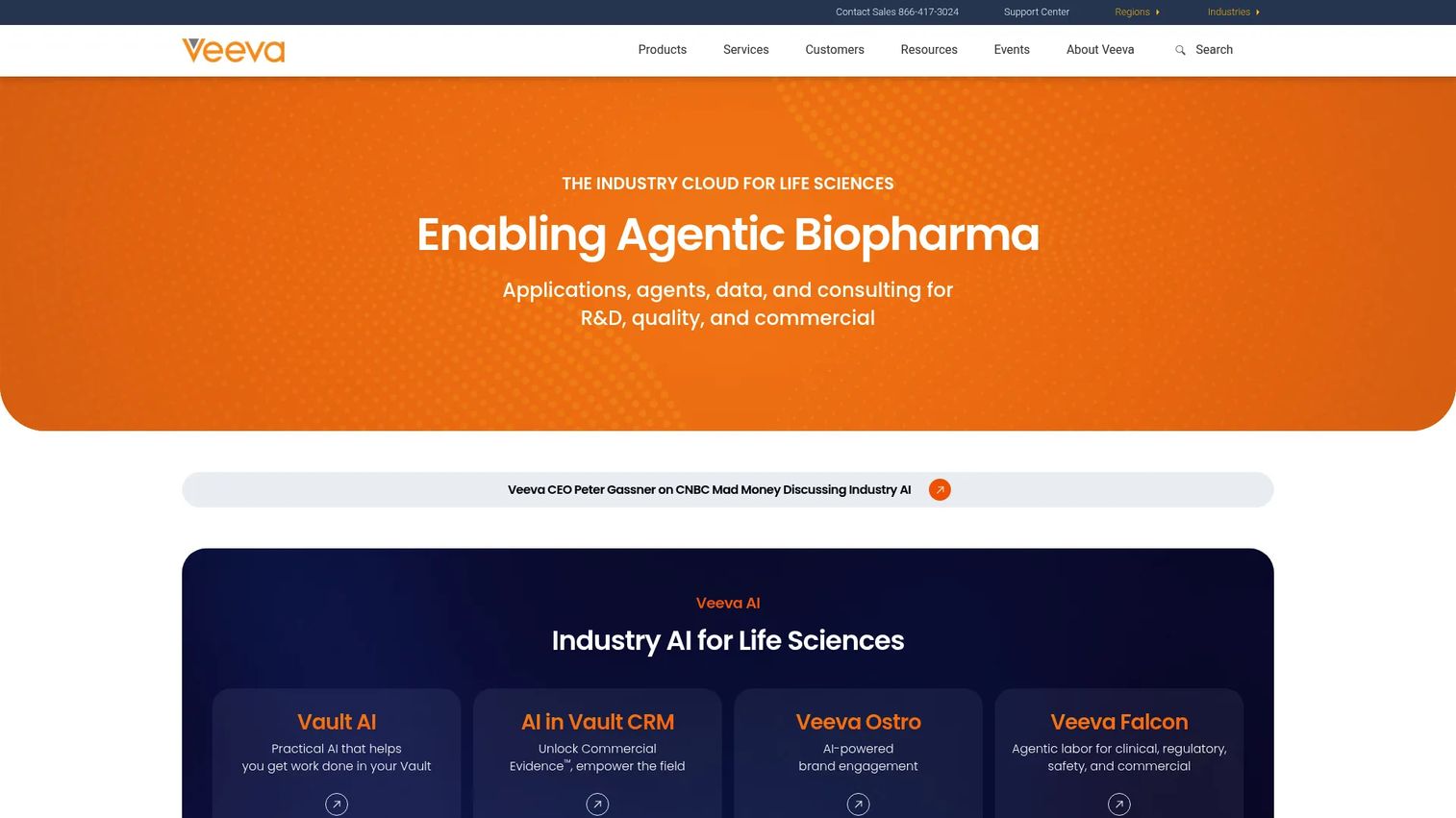
Veeva Systems provides cloud software, data, and services specifically built for life sciences. Its Vault platform covers clinical data collection, regulatory document management, quality workflows, medical affairs, and commercial operations. Veeva is the default shortlist pick for large pharma organizations that need a connected suite across multiple regulated functions.
Best for: Enterprise pharmaceutical and biotech organizations standardizing regulated operations across commercial, clinical, regulatory, and quality.
Key features
- Vault content and data management platform
- Veeva EDC for clinical data capture and review
- Regulatory, quality, safety, and commercial applications
- Cloud-based workflows with enterprise integrations
Why choose Veeva Systems: Veeva's depth across life sciences functions means fewer integration headaches when you need clinical, commercial, and regulatory workflows talking to each other. Smaller companies should evaluate implementation scope carefully before committing.
Veeva Systems pricing: Veeva prices by quote. Contact sales with your specific cloud modules and user mix to get accurate numbers.
G2 rating: 4.1/5 (Veeva Vault)
2. IQVIA
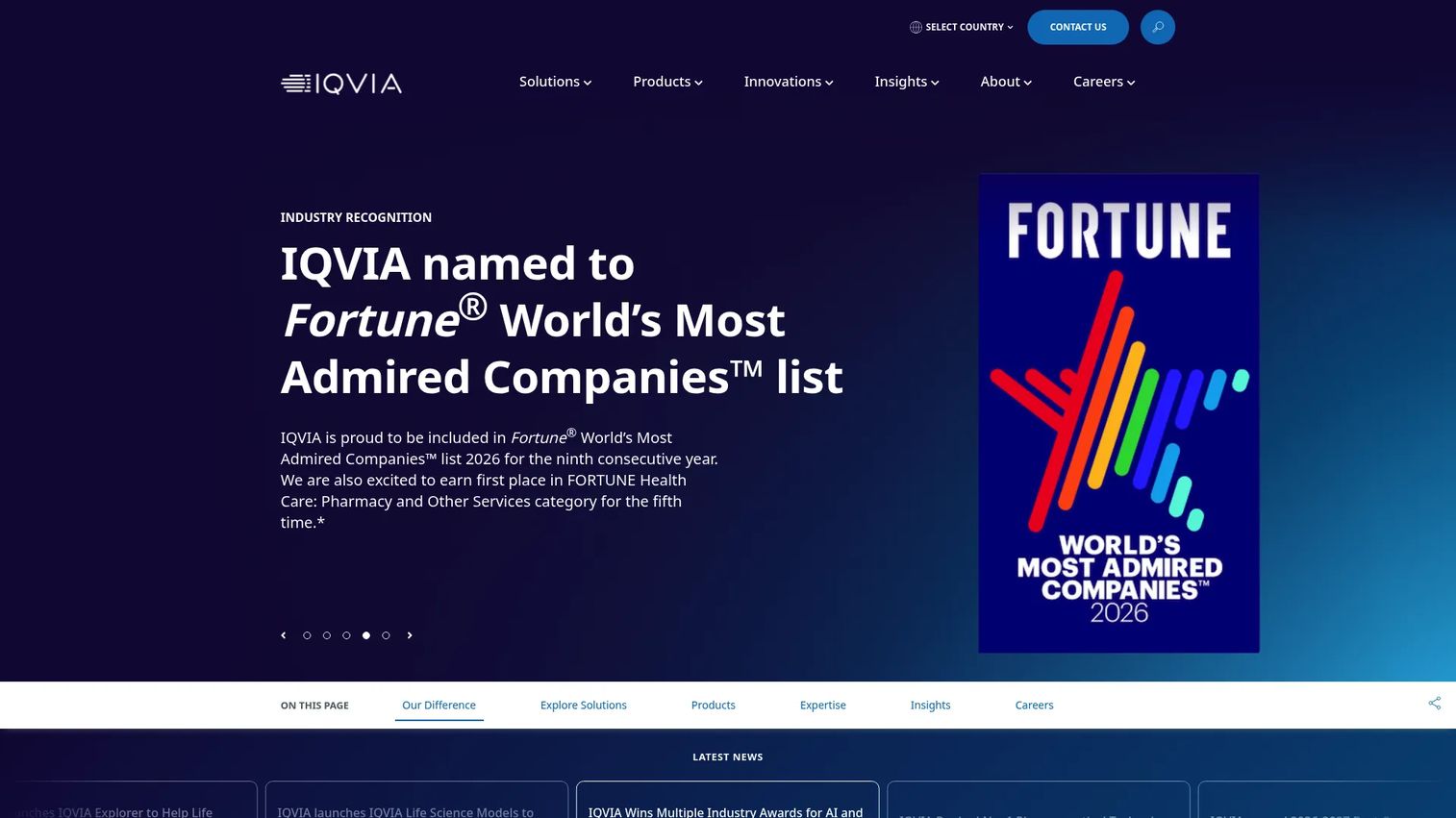
IQVIA provides data, analytics, technology, and services for life sciences and healthcare organizations globally. It covers clinical development technology, real-world evidence, commercial analytics, and HCP engagement, backed by one of the largest healthcare data assets in the industry. IQVIA is not just software: It combines platform access with consulting and managed services.
Best for: Pharma and biotech organizations that need clinical technology, real-world data, and commercial analytics backed by execution capacity.
Key features
- Clinical development and trial technologies
- Real-world evidence and healthcare data assets
- Commercialization, market access, and analytics
- Safety, regulatory, and quality compliance tools
- Healthcare-focused AI and agentic AI capabilities
Why choose IQVIA: The case for IQVIA is strongest when you need data depth and operational support together, not just a software subscription. For buyers who want pure SaaS, scoping the right IQVIA product takes time and enterprise-level conversations.
IQVIA pricing: IQVIA prices by offering and service scope. Request a quote through their sales team.
G2 rating: 4.3/5
3. Benchling
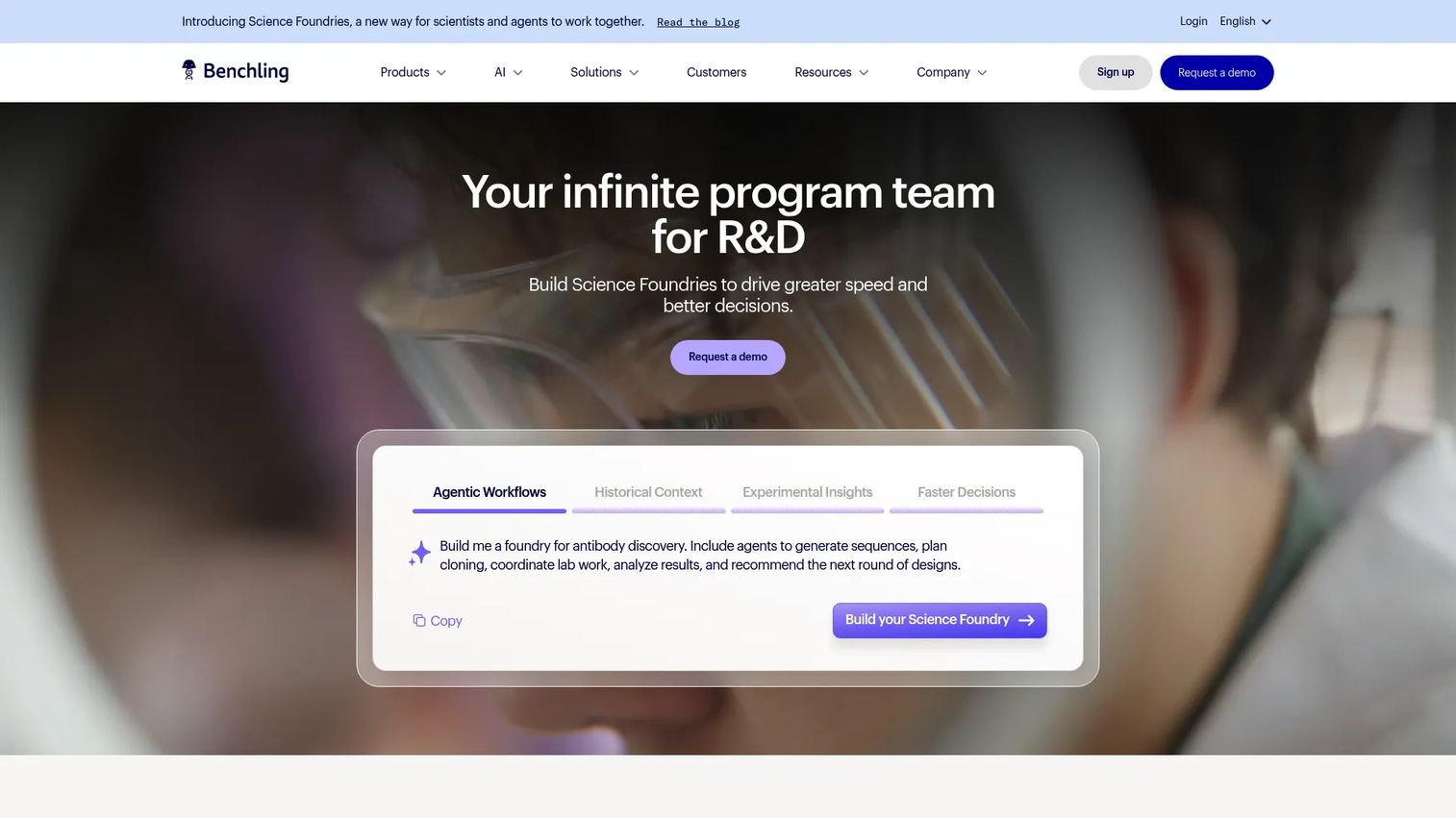
Benchling is a cloud R&D platform built for biotech and life sciences. It unifies electronic lab notebooks, molecular biology tools, sample and entity registries, and workflow automation in one environment. If your scientists are still running experiments in spreadsheets and email threads, Benchling is worth putting first on the shortlist.
Best for: Biotech companies scaling past founder-led science and building a structured R&D data foundation.
Key features
- Collaborative electronic lab notebook
- Molecular design for DNA, RNA, and proteins
- Sample and entity registration and management
- Workflow automation and scientific analytics
- Lab automation and platform integrations
Why choose Benchling: Benchling is the right call when your R&D data needs to survive handoff from scientists to regulatory, manufacturing, or a future acquirer. The platform is designed for the messy reality of modern biotech, not a textbook lab.
Benchling pricing: Benchling customizes pricing per organization. A startup program is available for early-stage companies. Academic use may qualify for free access. Contact Benchling for a quote.
G2 rating: 4.5/5
4. Medidata Solutions
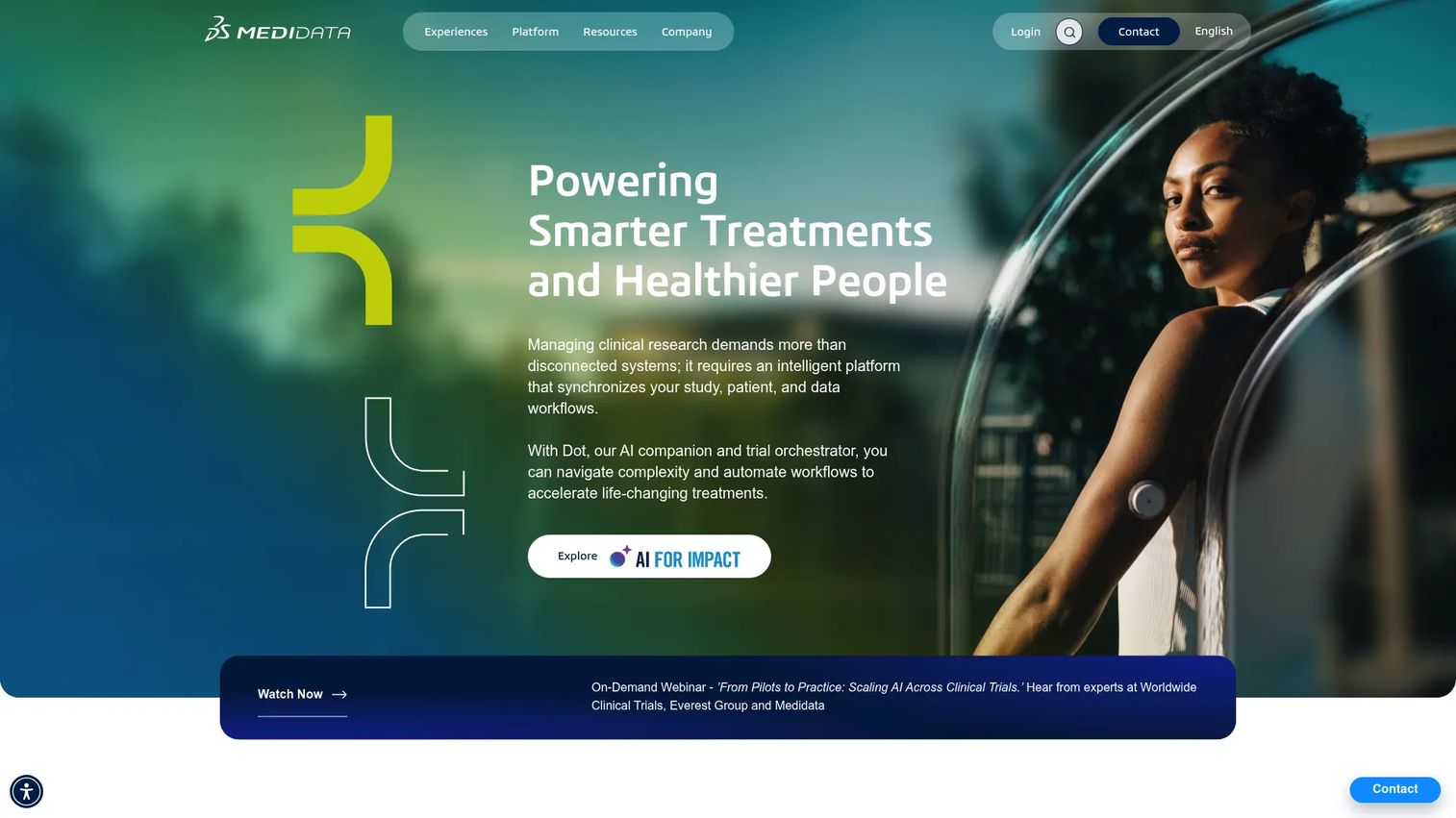
Medidata Solutions, part of Dassault Systèmes, provides an AI-powered unified platform for clinical research and trial management. Its capabilities cover EDC, patient engagement, eCOA, eConsent, decentralized trial support, risk monitoring, and analytics. Medidata is one of the most widely adopted clinical development platforms among sponsors and CROs running complex studies.
Best for: Pharmaceutical, biotech, and medical device organizations running multi-site clinical trials at scale.
Key features
- Rave EDC for clinical data capture and management
- Patient engagement, eCOA, and eConsent tools
- Decentralized trial and sensor technologies
- AI-powered study design and risk monitoring
- Analytics and workflow automation
Why choose Medidata: Medidata's maturity in clinical trial operations reduces setup risk for sponsors who cannot afford platform instability mid-study. Evaluate CRO workflows and integration requirements before committing, as complexity varies significantly by study design.
Medidata Solutions pricing: Medidata directs prospective customers to contact a specialist. Pricing is enterprise quote-based.
G2 rating: 4.5/5
5. LabWare
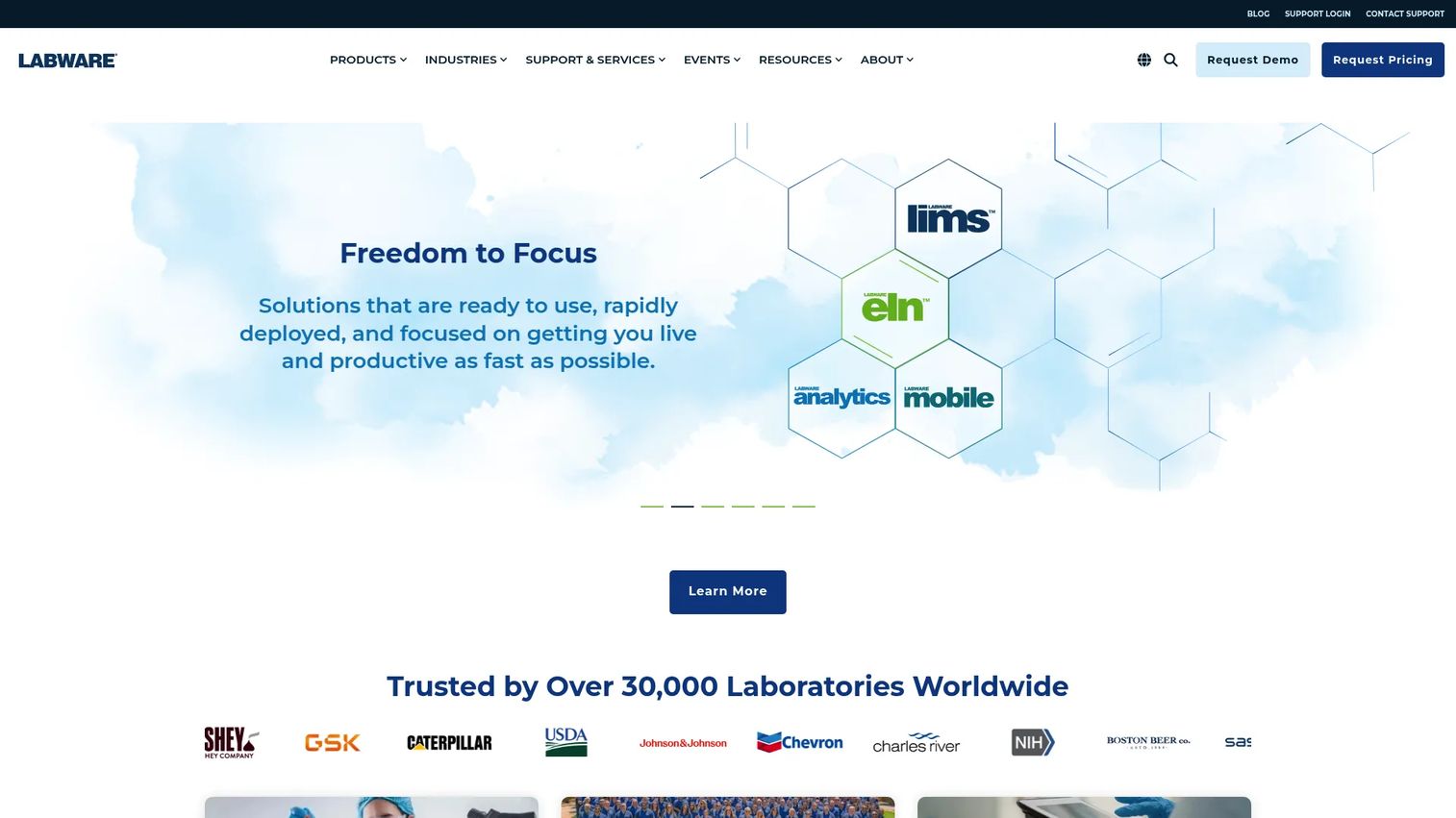
LabWare provides LIMS (laboratory information management system) and ELN software for enterprise labs. It handles sample login and management, instrument interfacing, lot and stability management, environmental monitoring, inventory, and integrated analytics. LabWare is configurable across complex lab operations, making it a serious contender for regulated pharma and biotech labs with mature processes.
Best for: Enterprise labs needing highly configurable LIMS across regulated pharmaceutical and quality-control operations.
Key features
- Sample lifecycle management and login
- Instrument interfacing and integration
- Lot and stability management
- Environmental monitoring
- Integrated ELN with data visualization
Why choose LabWare: LabWare suits labs where a generic LIMS would require too many workarounds. The configuration depth means implementation planning matters, so factor in internal ownership before purchase.
LabWare pricing: LabWare directs buyers to request a demo or contact a local office. Pricing is not displayed and requires a quote.
G2 rating: 4.5/5
6. Certara
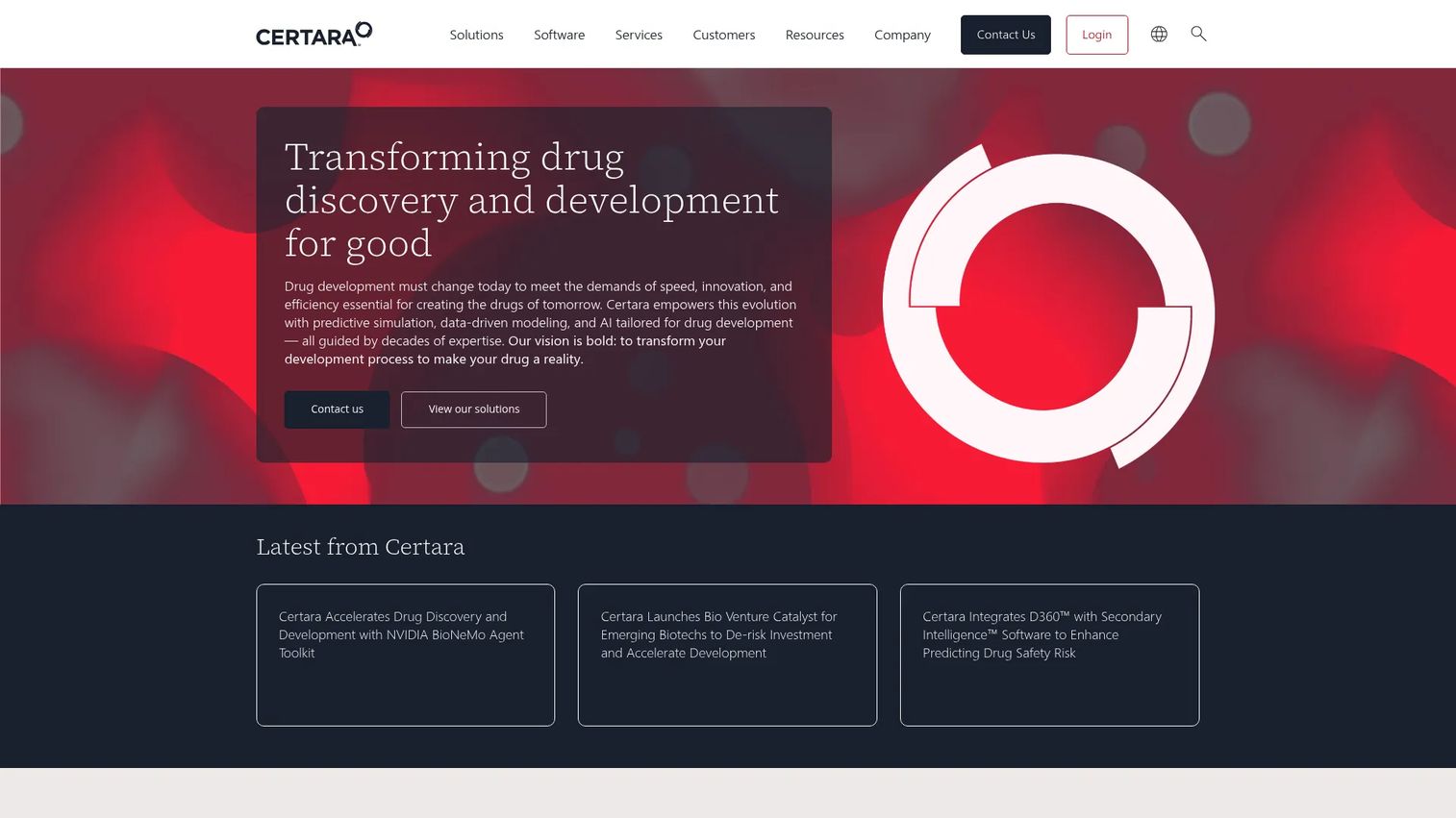
Certara provides software, technology, and services for drug discovery, development, regulatory submissions, and market access. Its core strength is biosimulation, covering PK/PD modeling, PBPK, QSP, and pharmacometrics. Certara also supports clinical data validation, regulatory writing, and submissions, which makes it relevant across multiple stages of drug development.
Best for: Drug development teams using modeling to support dosing decisions, regulatory submissions, and development strategy.
Key features
- Drug discovery informatics and compound screening
- Biosimulation, PK/PD, PBPK, and QSP modeling
- Pharmacometric modeling tools
- Clinical data validation and regulatory submission support
- Market access and regulatory science services
Why choose Certara: Certara is the right tool when modeling quality directly affects development strategy or submission credibility. Teams where dosing, exposure, and safety data carry regulatory weight will find the investment defensible.
Certara pricing: Contact Certara's sales team. Pricing varies by software product and service scope.
G2 rating: 4.6/5
7. ArisGlobal
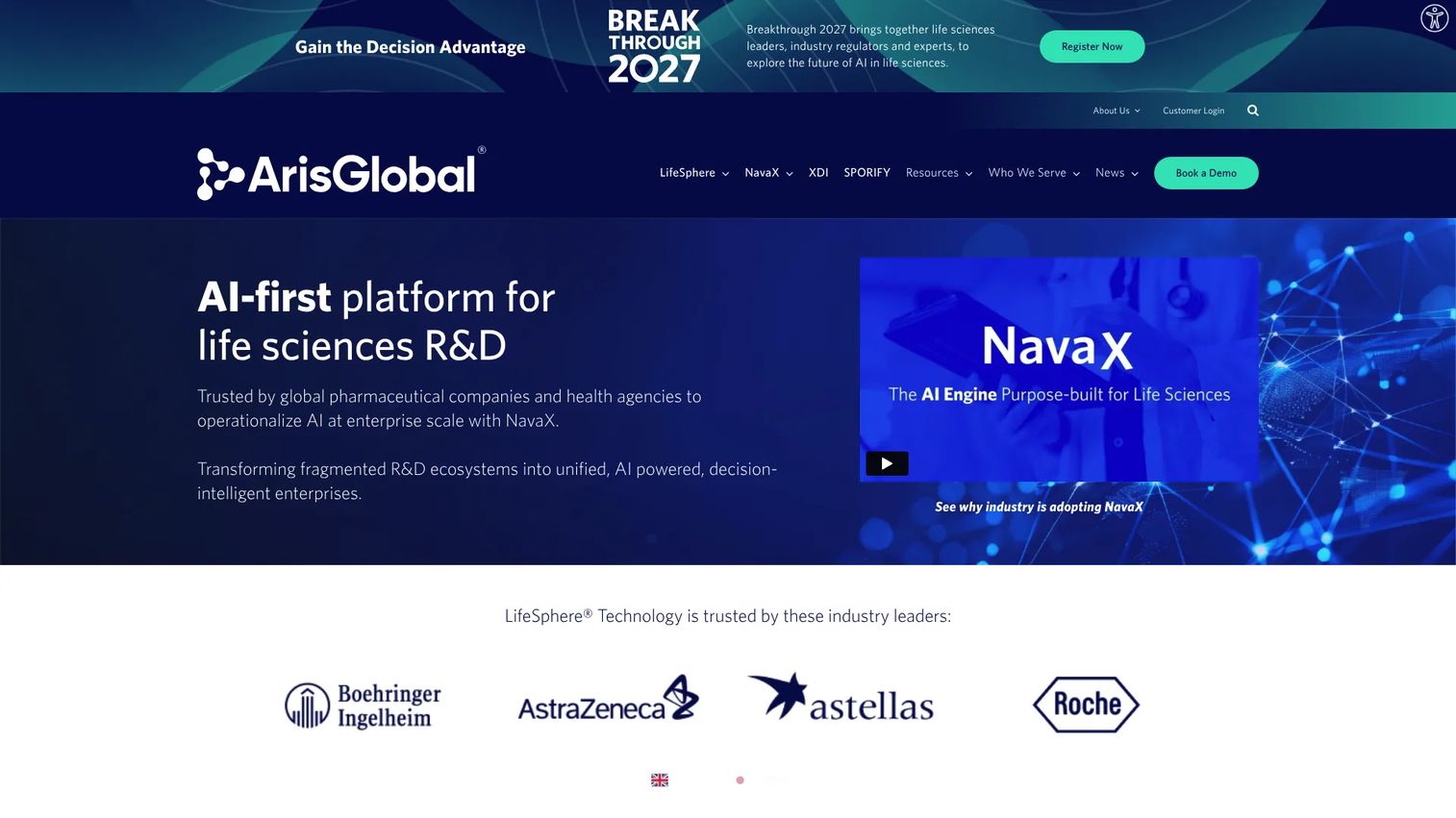
ArisGlobal provides cloud-based R&D software for life sciences safety, regulatory, quality, and medical affairs. Its LifeSphere platform covers pharmacovigilance workflows, regulatory information management, quality documentation, and medical affairs automation, with GenAI and agentic AI capabilities built in. ArisGlobal is focused on organizations that need connected safety and regulatory operations.
Best for: Life sciences companies managing pharmacovigilance case processing, regulatory submissions, and medical affairs workflows.
Key features
- AI-powered pharmacovigilance and safety workflows
- Regulatory information management and registration tracking
- Quality management and documentation
- Medical affairs workflow automation
- GenAI capabilities via the NavaX platform
Why choose ArisGlobal: PV bottlenecks and audit gaps are not small operational issues. ArisGlobal reduces the manual process burden in safety case handling and regulatory operations at the same time, which matters when both functions share timelines and risk.
ArisGlobal pricing: Contact ArisGlobal sales. Pricing is not publicly displayed and varies by modules, users, regions, and case volume.
8. CloudLIMS
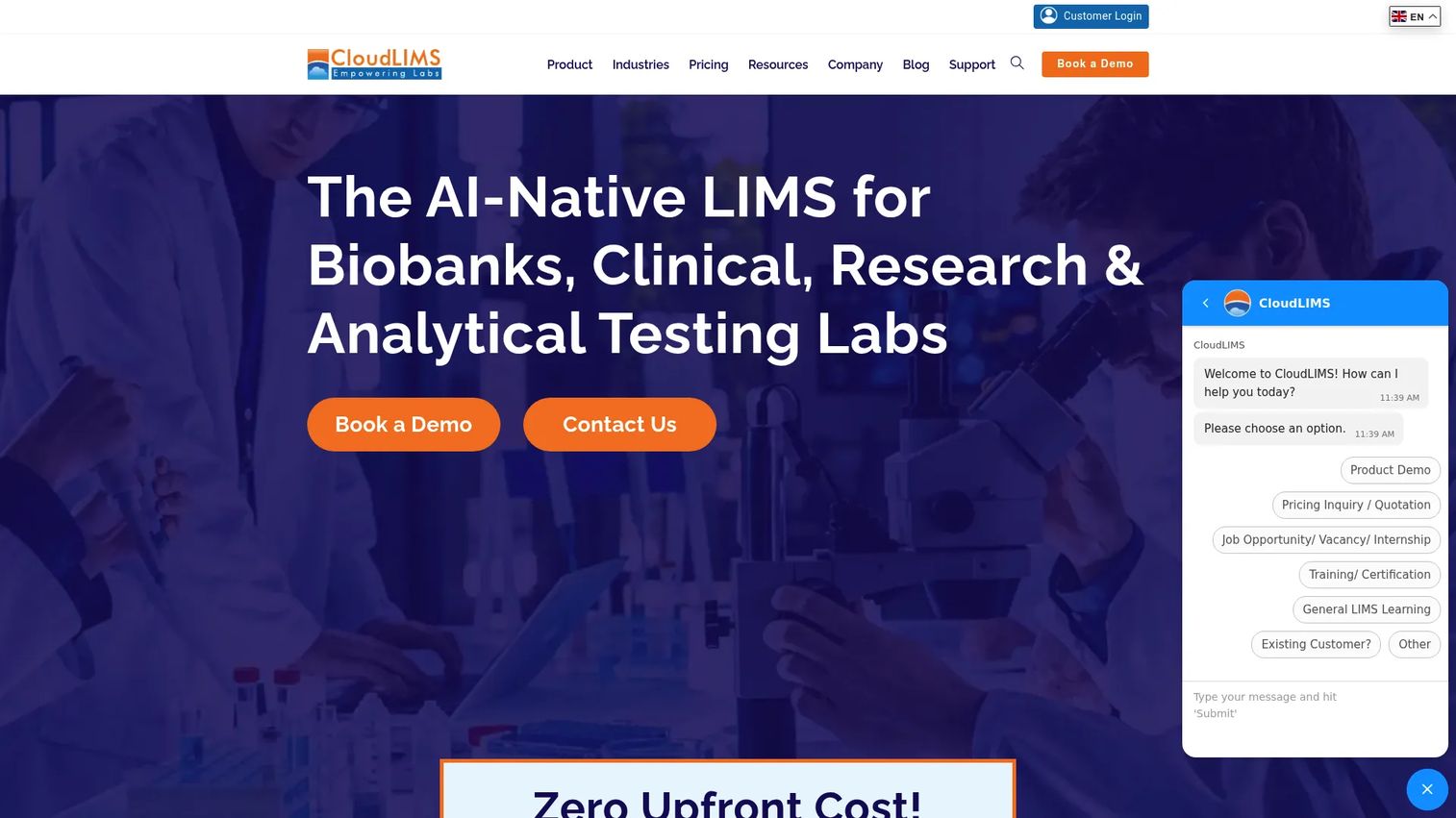
CloudLIMS is a cloud-based laboratory information management system designed for biobanks, clinical labs, research labs, and analytical testing labs. It handles sample lifecycle management, audit trails, validated electronic signatures, workflow automation, and regulatory compliance capabilities. For labs that want LIMS without a long infrastructure project, it is a practical starting point.
Best for: Regulated labs needing cloud LIMS with structure and audit trails, without a heavy on-premise deployment.
Key features
- Sample lifecycle management with chain-of-custody tracking
- AI-powered predictive analytics and anomaly detection
- Audit trails, electronic signatures, and role-based access
- Lab workflow automation and instrument maintenance tracking
- HIPAA support and regulatory compliance capabilities
Why choose CloudLIMS: CloudLIMS is the LIMS category's most transparent pricing option, which removes one step from your shortlisting process. Growing labs that need structure quickly without building an internal IT project will find the cloud-native model practical.
CloudLIMS pricing: Published per-user annual pricing varies by lab type and user count, starting from $42/user/month (billed annually) for 100-user plans, up to $310/user/month for 3-user configurations. Minimum order quantities apply.
G2 rating: 4.5/5
9. LabKey LIMS
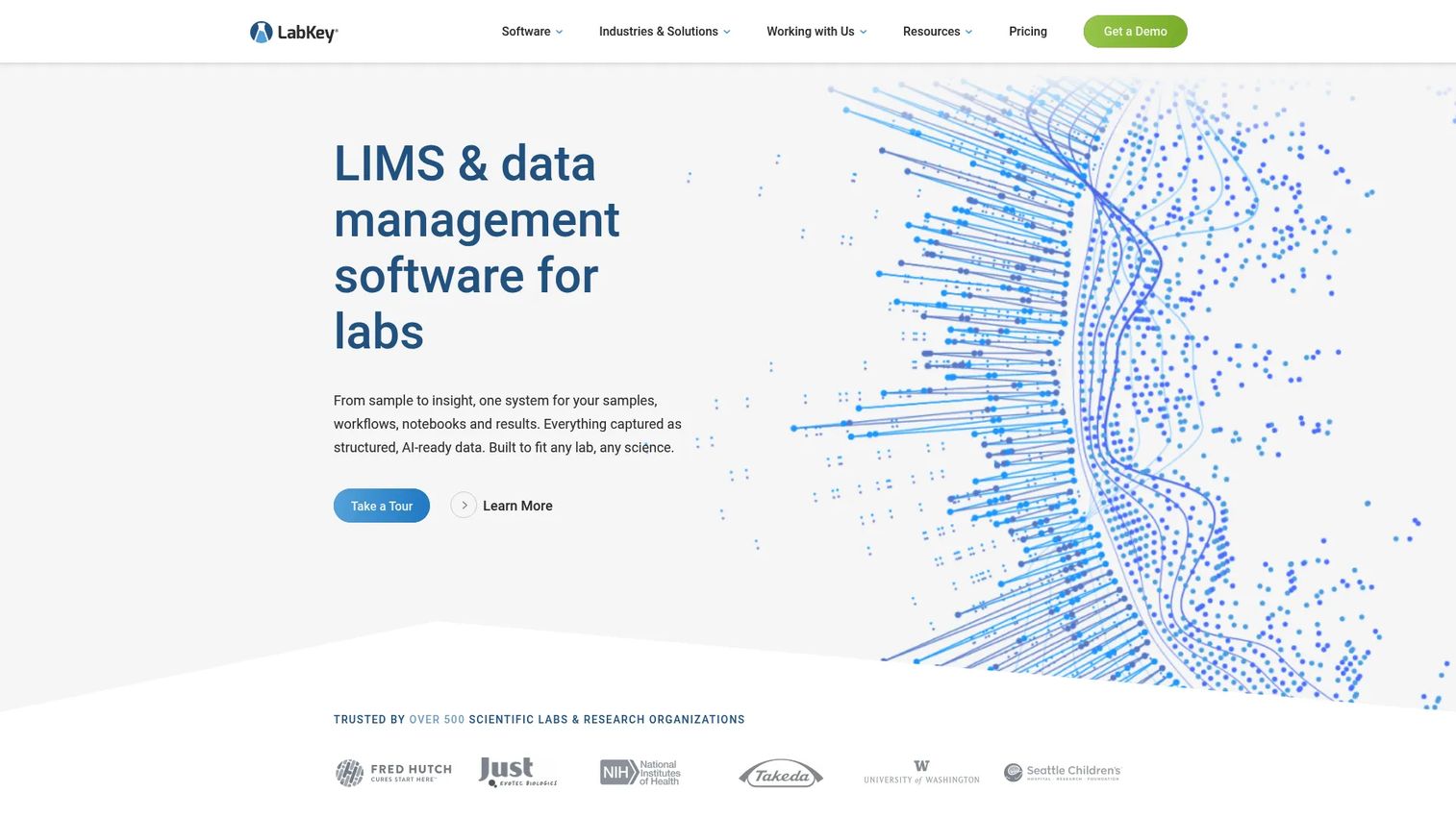
LabKey provides configurable laboratory information management software for managing samples, workflows, assay data, and electronic lab notebooks. It is designed for research, biotech, industrial, and regulated labs. The platform offers LIMS Starter and LIMS Enterprise annual plans with published pricing, which is unusual in this market.
Best for: Research organizations and regulated labs that need flexible sample and study data management with clear annual pricing.
Key features
- Sample and inventory management with chain-of-custody tracking
- Automated lab instrument data capture and transformation
- Configurable workflow management and automation
- Integrated electronic lab notebook
- Assay data management and reporting
Why choose LabKey LIMS: LabKey's public annual pricing gives buyers a concrete budget anchor before entering a sales process. The platform's configurability suits biotech and pharma R&D groups that need to adapt workflows as studies evolve.
LabKey LIMS pricing: LIMS Starter is listed at $34,080 per year (includes 10 users). LIMS Enterprise is listed at $53,520 per year (includes 10 users). Volume discounts are available.
G2 rating: 4.6/5
10. Clinisys
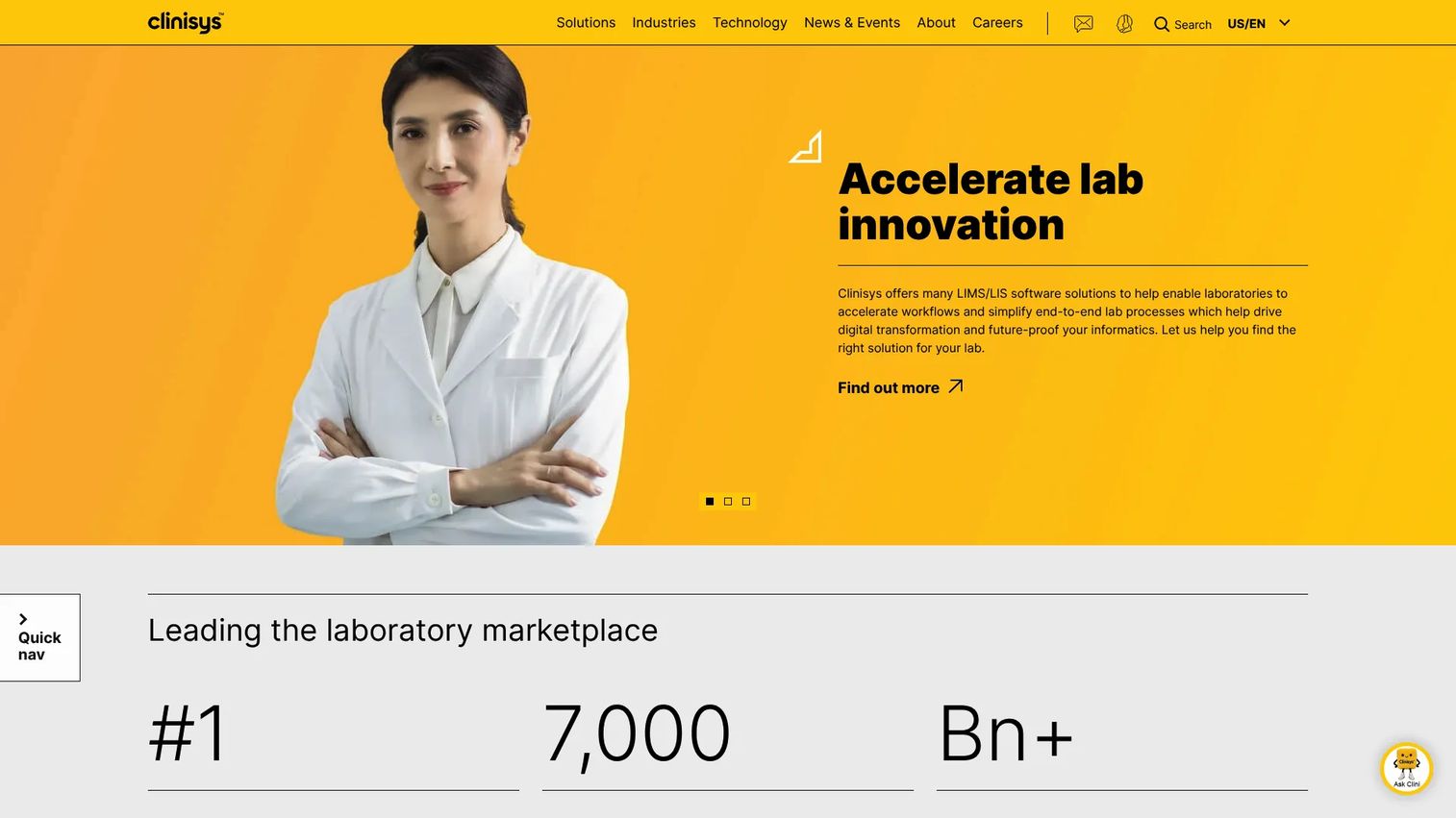
Clinisys provides cloud-based laboratory information system (LIS) and LIMS software for healthcare, life sciences, public health, environmental, and food testing labs. It covers sample and specimen management, workflow automation, results reporting, and integration with analyzers, EHRs, and billing systems. Its strength lies in connecting lab operations at network scale.
Best for: Laboratory networks and diagnostics organizations that need informatics across healthcare, public health, and pharma-adjacent testing.
Key features
- Sample and specimen management
- Workflow automation and results tracking
- Reporting, analytics, and data mining
- Integration with analyzers, EHRs, and billing systems
- Quality control, audit trails, and traceability
Why choose Clinisys: Clinisys earns its place when lab operations connect to healthcare systems and population-scale testing. For pharma and biotech teams that run lab services alongside clinical development, it handles the healthcare-side complexity well.
Clinisys pricing: Contact Clinisys for pricing. No standard plan prices are displayed.
G2 rating: 3.5/5
11. STARLIMS
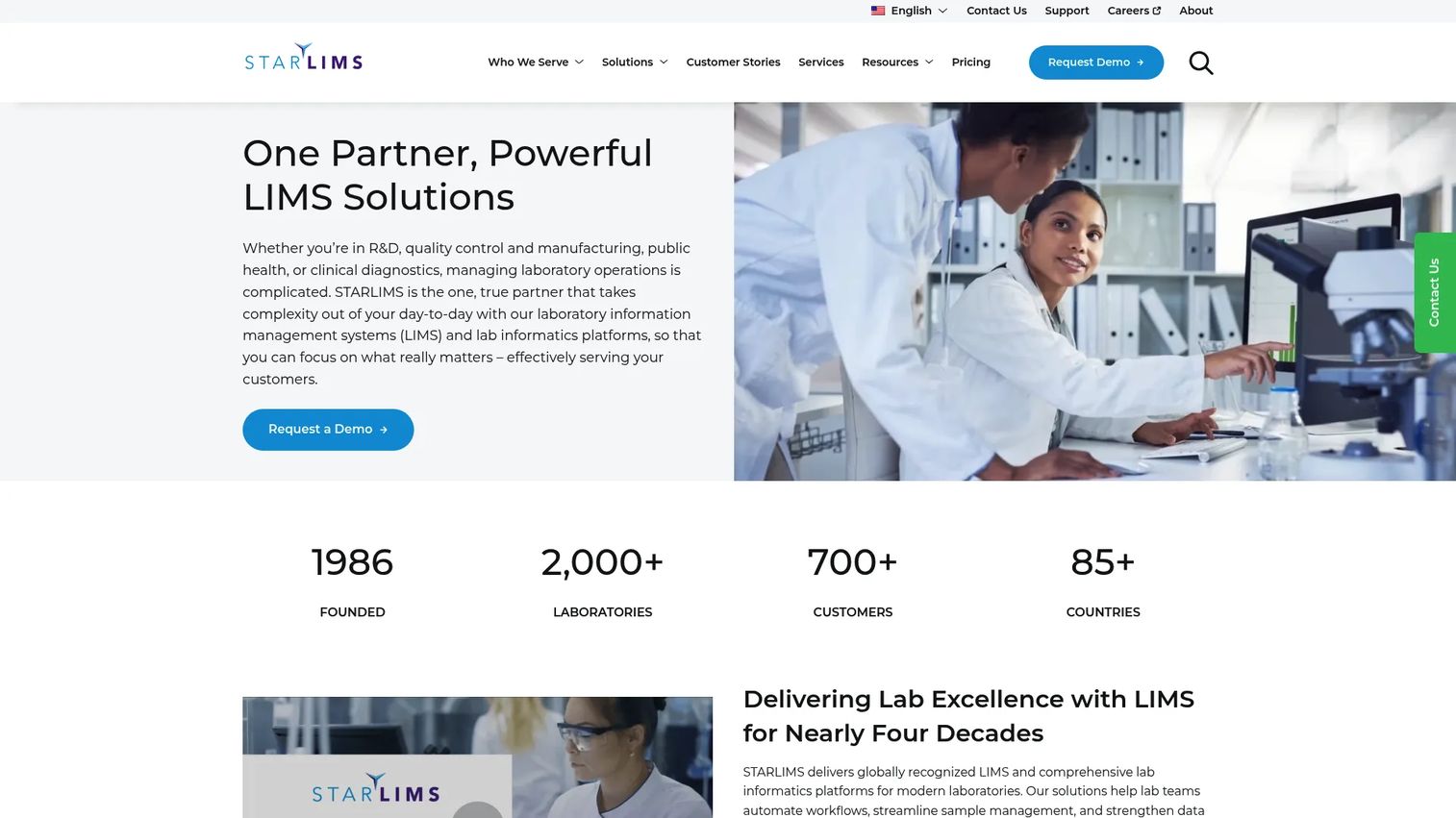
STARLIMS provides laboratory information management and scientific data management software for regulated clinical, public health, life sciences, manufacturing, and QC labs. It covers sample tracking, scientific document management (SDMS), ELN, instrument integration, advanced analytics, audit trails, and electronic signatures.
Best for: Enterprise labs needing structured lab data, controlled workflows, and compliance support across complex sample flows.
Key features
- Laboratory information management and sample lifecycle tracking
- Scientific data and documentation management
- Electronic laboratory notebook and execution tools
- Instrument and enterprise-system integration
- Audit trails and electronic signatures
Why choose STARLIMS: STARLIMS suits labs that have outgrown lighter LIMS options and need end-to-end informatics with documented compliance support. Implementation success depends on workflow design upfront, so build that into the evaluation.
STARLIMS pricing: Cloud subscription and deployment options are available. Contact STARLIMS for pricing; no standard amounts are displayed.
G2 rating: 4.5/5
12. MasterControl
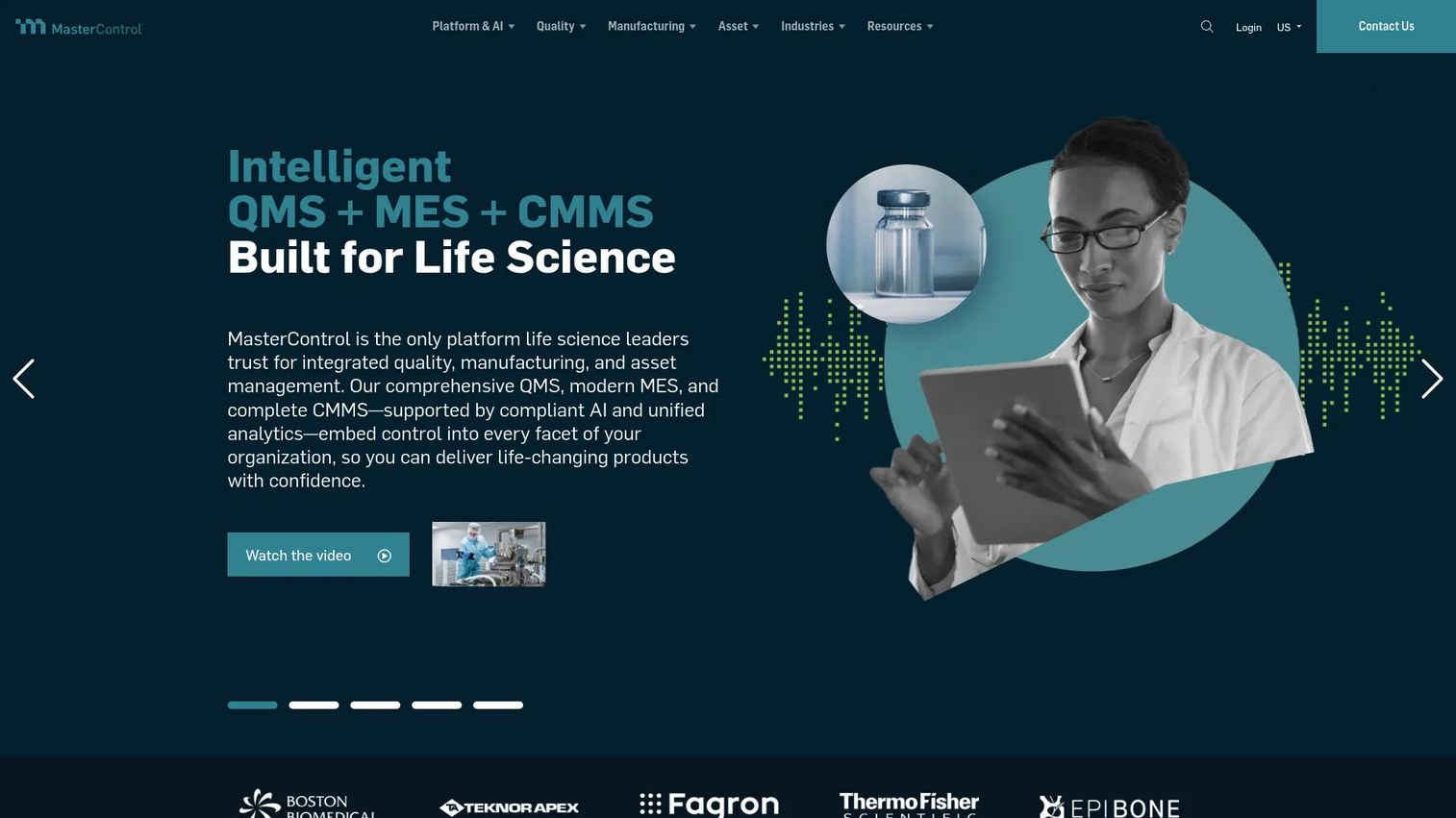
MasterControl provides cloud-based quality, manufacturing, clinical, regulatory, and asset-management software for life sciences and regulated industries. It covers document control, change control, training records, audit management, CAPA, risk management, and electronic batch records. The global pharmaceutical quality management software market reached $2.1 billion in 2025 (Grand View Research), and MasterControl is one of the key platforms in that category.
Best for: Pharma and biotech quality teams that need connected QMS, manufacturing quality, and inspection-ready workflows.
Key features
- Document control and change management
- Training management and records
- Audit management and CAPA
- Risk management workflows
- Electronic batch records and device history records
Why choose MasterControl: MasterControl addresses the moment when quality workflows become too risky for spreadsheets or shared folders. For teams hiring a new quality leader, having a working QMS in place on day one removes a significant bottleneck.
MasterControl pricing: MasterControl tailors pricing to organizational needs. Contact their representatives for a customized quote based on modules and scope.
G2 rating: 4.4/5
13. TetraScience
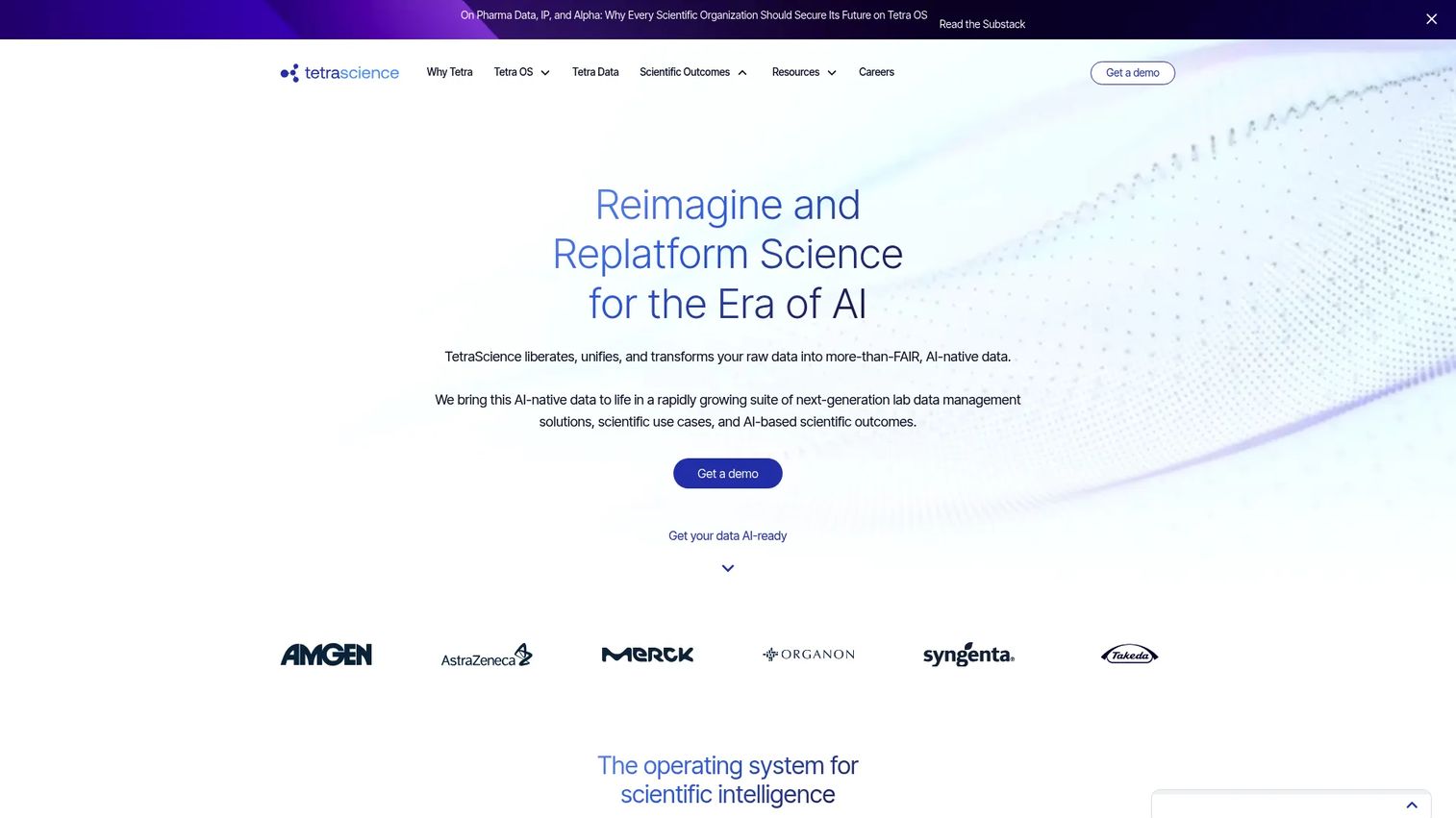
TetraScience provides an open, vendor-agnostic scientific data and AI platform for life sciences. It focuses on scientific data replatforming, instrument data ingestion, harmonization, data pipelines, GxP compliance, and AI-ready datasets. TetraScience is not a LIMS or ELN. It is the infrastructure layer that makes scientific data usable across other systems.
Best for: Biopharmaceutical R&D organizations that need centralized, harmonized scientific data to support analytics and AI workflows.
Key features
- Scientific data replatforming and centralization
- Data engineering, contextualization, and harmonization
- Instrument, ELN, LIMS, and analytics integrations
- GxP compliance, audit trails, and data provenance
- AI-ready dataset preparation
Why choose TetraScience: TetraScience is the right pick when the lab data problem is no longer about storage but about usability. If your R&D team cannot reliably query instrument data across studies, this is the layer that fixes that before it becomes an AI bottleneck.
TetraScience pricing: Contact TetraScience for a quote. Enterprise pricing varies by data volume and integration scope.
14. Sapio Sciences
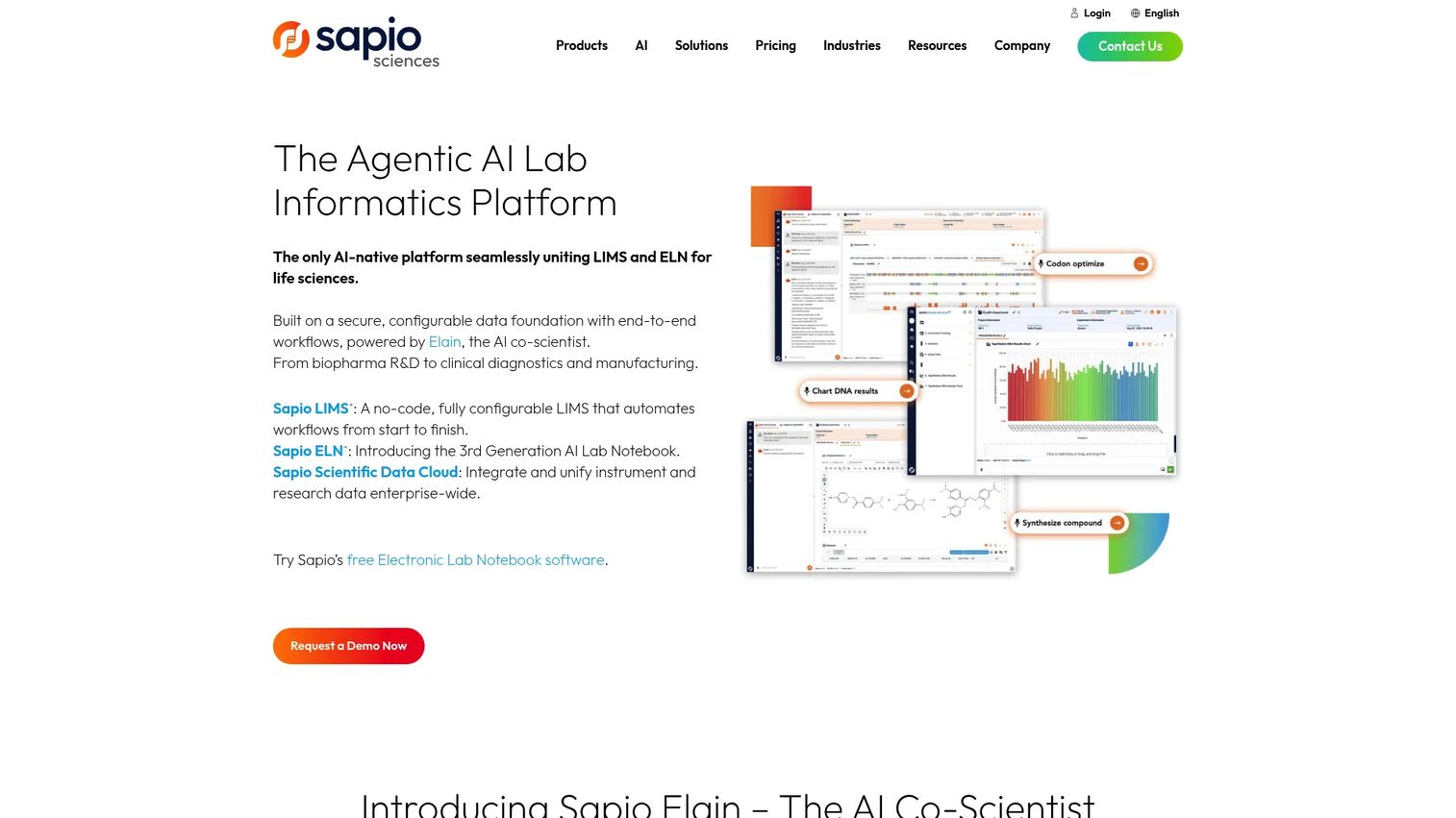
Sapio Sciences provides an AI-native laboratory informatics platform combining LIMS, ELN, and scientific data management. It supports no-code workflow automation, sample and materials management, instrument integration, GxP-compliant traceability, and an AI scientific assistant called ELaiN. The platform targets biopharma, biotech, clinical diagnostics, and regulated manufacturing labs.
Best for: Life sciences teams wanting LIMS, ELN, and scientific informatics in one platform rather than separate tools.
Key features
- No-code workflow automation and configuration
- Sample, inventory, and materials management
- Instrument integration and scientific data unification
- AI scientific assistant (ELaiN)
- GxP-compliant workflows and traceability
Why choose Sapio Sciences: Sapio Sciences is a fit for teams trying to reduce lab data fragmentation. Combining LIMS, ELN, and data management under one roof reduces the handoff cost between research and operations, which matters when teams are scaling.
Sapio Sciences pricing: Sapio offers tailored pricing proposals for each application bundle. Contact them with your specific combination of ELN, LIMS, and data needs.
G2 rating: 4.3/5
15. Medable
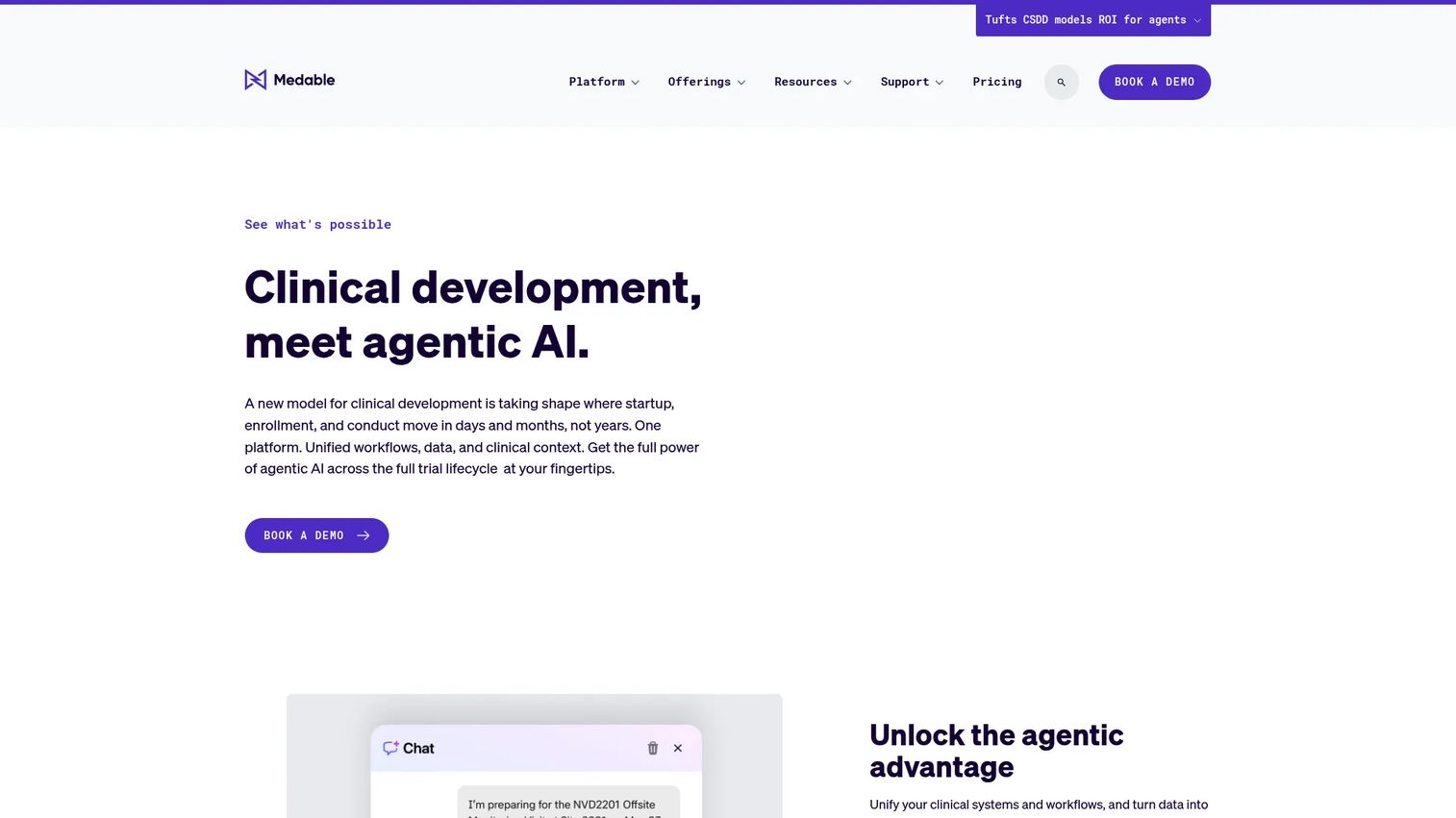
Medable provides a unified, AI-enabled clinical trial platform covering eCOA, eConsent, telehealth visits, device integration, clinical monitoring, and trial management. Its no-code Study Studio allows configuration of validated instruments and study flows without heavy IT involvement. Medable is built for sponsors running decentralized, hybrid, or site-based clinical trials.
Best for: Clinical teams running decentralized or hybrid clinical trials where patient experience and remote data capture are central.
Key features
- Unified eCOA, eConsent, and TeleVisit platform
- No-code Study Studio for instrument configuration
- Clinical monitoring and TMF management
- Reporting, dashboards, and integrations
- Agentic AI capabilities
Why choose Medable: Medable is strongest when patient convenience and remote participation are core to your trial design. Trial geography, device strategy, and study complexity all affect fit, so evaluate those factors early in the selection process.
Medable pricing: Custom pricing based on study requirements. Contact Medable for a quote.
16. Clario
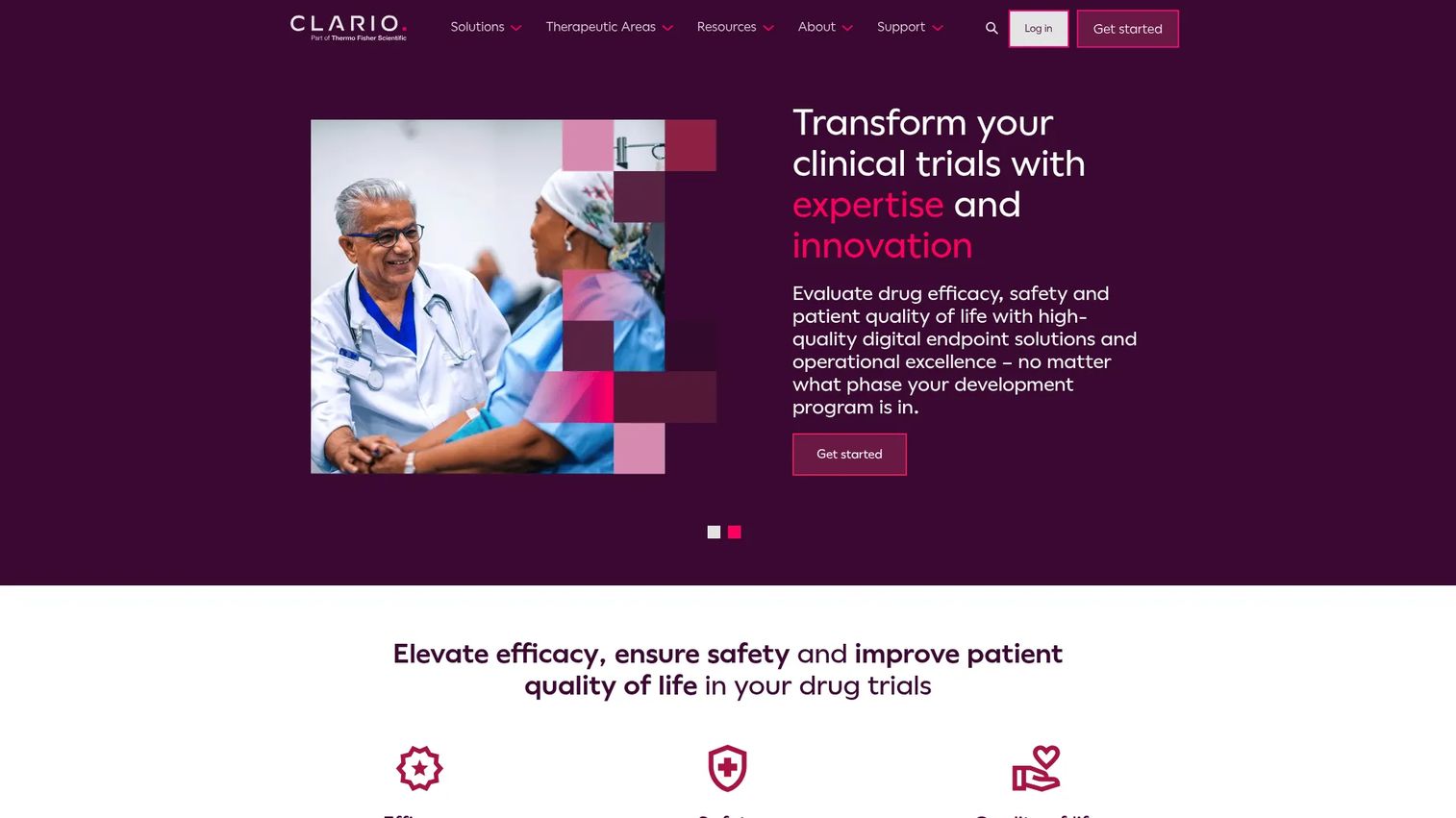
Clario provides clinical trial endpoint technology and evidence-generation capabilities across eCOA, medical imaging, cardiac safety, precision motion, and respiratory workflows. Its platforms support BYOD and provisioned-device eCOA modalities, AI-enabled data collection, image de-identification, and independent blinded review. Clario serves sponsors, CROs, and research sites.
Best for: Trial teams that need specialized endpoint data capture and evidence generation where endpoint quality drives study credibility.
Key features
- eCOA supporting BYOD, web, and provisioned-device modalities
- Medical imaging workflows with quality control and blinded review
- AI-enabled data collection and quality assessment
- Cardiac safety and respiratory trial data
- 21 CFR Part 11 and GDPR-compliant platforms
Why choose Clario: Clario earns consideration when endpoint strategy is complicated enough to affect regulatory submission quality. Endpoint decisions should be made at protocol design, not after data collection begins.
Clario pricing: Contact Clario for pricing. No standard plan amounts are displayed.
G2 rating: 4.5/5 (Clario eCOA)
17. Qualio
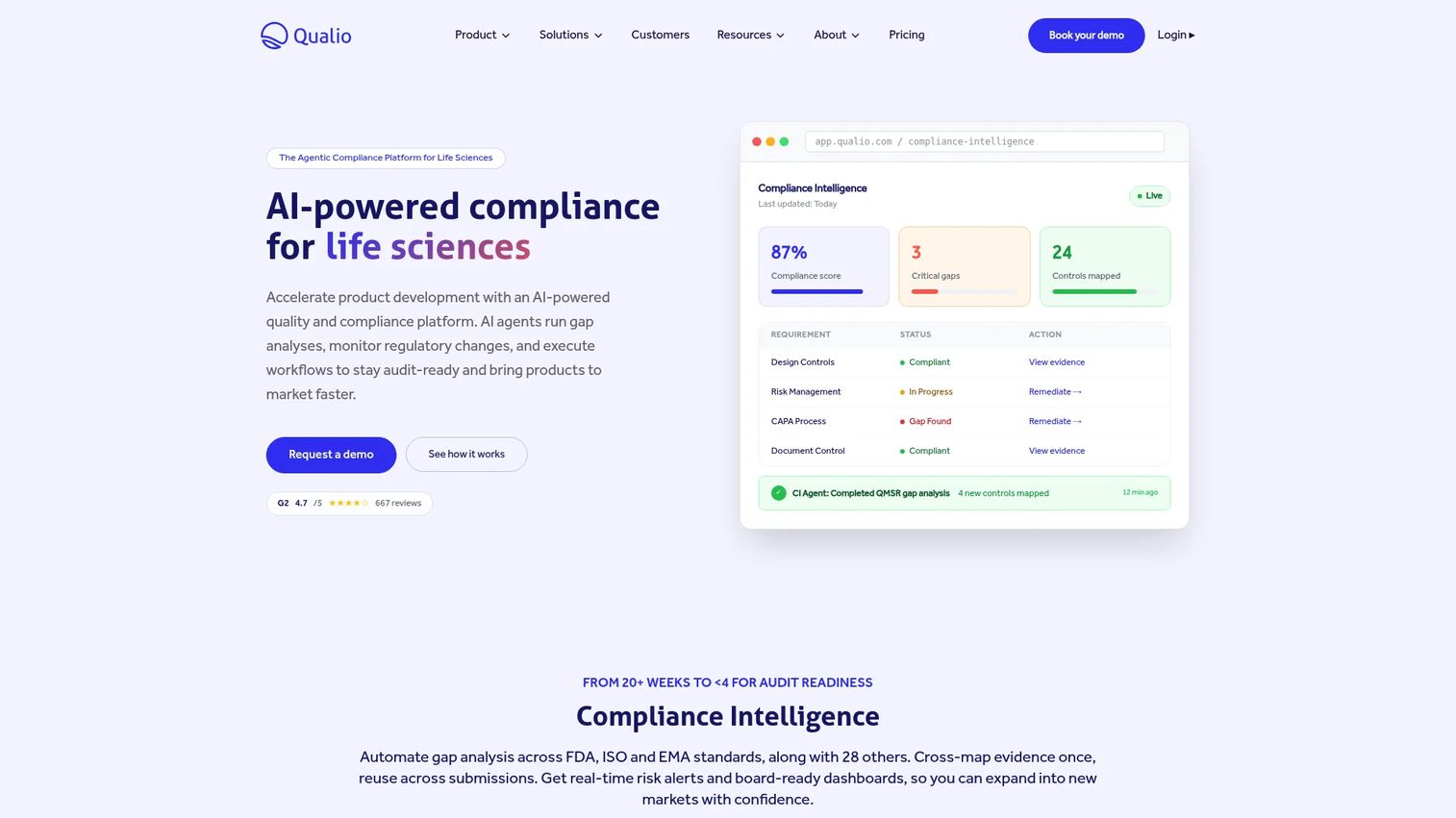
Qualio is an AI-powered quality management and compliance platform built for life sciences companies. It covers document control, CAPA, training management, supplier quality, audit management, design controls, and risk management. Qualio also includes compliance intelligence with AI-powered gap analysis. It targets scaling biotech, medtech, and life sciences companies that need QMS without enterprise sprawl.
Best for: Growing life sciences teams moving from startup-stage quality practices to repeatable, audit-ready operations.
Key features
- Document management and control
- CAPA and non-conformance management
- Training management and records
- Supplier quality and audit management
- AI-powered compliance gap analysis
Why choose Qualio: Qualio fits the company that just hired its first quality leader and needs a working QMS on day one. Foundation and Growth plans are available; contact Qualio for pricing based on your team size and compliance scope.
Qualio pricing: Foundation and Growth plans are available. An implementation fee applies. Contact Qualio for specific pricing.
G2 rating: 4.4/5
18. SciNote
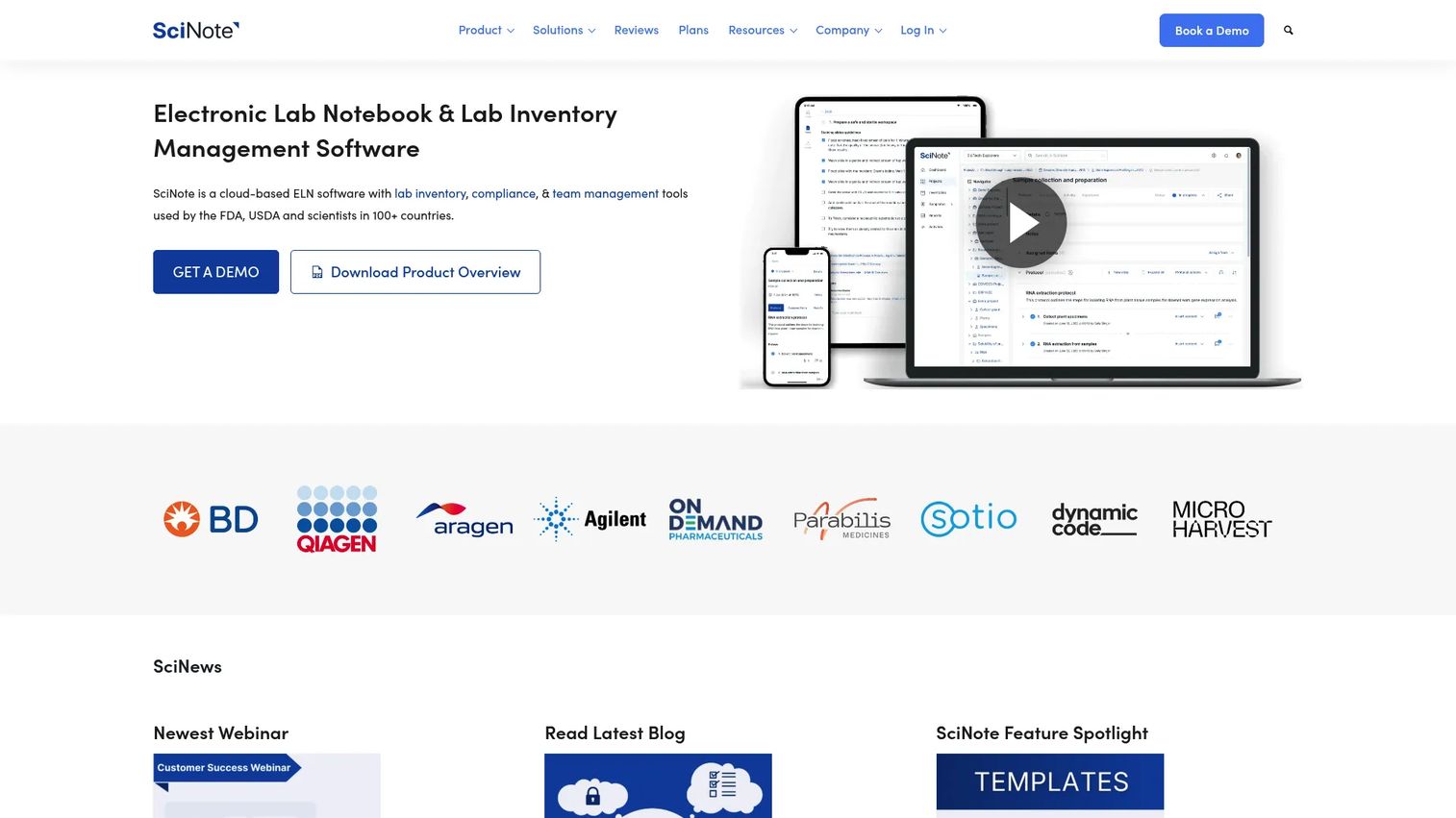
SciNote is a cloud-based electronic lab notebook (ELN) with laboratory inventory, compliance, workflow, and team-management tools. It supports project and experiment organization, interactive protocols and SOP management, laboratory inventory tracking, team collaboration, and 21 CFR Part 11, GLP, and GMP support with audit trails and electronic signatures.
Best for: Research laboratories that need structured experiment documentation, protocol management, and inventory tracking with a free entry point.
Key features
- Project, experiment, and task-based research organization
- Interactive protocols, SOPs, and workflow visualization
- Laboratory inventory with barcodes and custom labels
- 21 CFR Part 11, GLP, and GMP support with audit trails
- Team collaboration, permissions, and task assignment
Why choose SciNote: SciNote is the practical starting point for research teams where lab knowledge is still trapped in paper notebooks. ELN adoption depends heavily on clean templates and team habits, so factor in change management time.
SciNote pricing: A Free plan is available. Premium pricing is quote-based; contact SciNote for details.
G2 rating: 4.2/5
19. DrugPatentWatch
DrugPatentWatch is a biopharmaceutical intelligence platform for researching drug patents, regulatory exclusivity, generic and biosimilar entry, litigation, pricing, suppliers, and market opportunities. It covers global pharmaceutical and biologic patent data across 134 countries and supports custom alerts, dashboards, and API access.
Best for: Pharma strategy, IP, business development, and investment teams analyzing patent risk, market entry timing, and generic competition.
Key features
- Global pharmaceutical and biologic patent coverage
- Generic, biosimilar, and 505(b)(2) entry tracking
- US drug patent litigation and exclusivity intelligence
- Drug pricing, sales, supplier, and formulation data
- Custom alerts, dashboards, and API access
Why choose DrugPatentWatch: DrugPatentWatch is a specialized intelligence tool, not an operational system. It earns its place when patent timing directly affects market entry or portfolio strategy decisions.
DrugPatentWatch pricing: Formulary plans start at $299/month. General subscriptions include Starter at $1,000/month (or $8,000/year) and Professional at $3,000/month (or $24,000/year). Enterprise pricing is custom.
G2 rating: 4.3/5
20. Körber Pharma
Körber Pharma provides pharmaceutical and biopharmaceutical manufacturing software, inspection, packaging, and digitalization capabilities. Its PAS-X MES Suite controls, monitors, and documents pharmaceutical, biotech, and cell and gene therapy production. Körber Pharma also offers AI-powered visual inspection, aseptic processing, and packaging systems.
Best for: Pharmaceutical manufacturers needing integrated production software, batch records, serialization, and regulated manufacturing execution.
Key features
- PAS-X MES Suite for production control and documentation
- Electronic batch records and manufacturing workflows
- Line Optimizer and AI digital transformation tools
- AI-powered visual and container inspection
- Packaging, aseptic processing, and serialization
Why choose Körber Pharma: Körber Pharma is the right choice when manufacturing execution, batch control, and regulated production documentation form the core bottleneck. For cell and gene therapy producers, the platform's specialized capabilities carry additional weight.
Körber Pharma pricing: Contact Körber Pharma for pricing. No standard amounts are publicly available.
G2 rating: 4.4/5
21. RxLogix
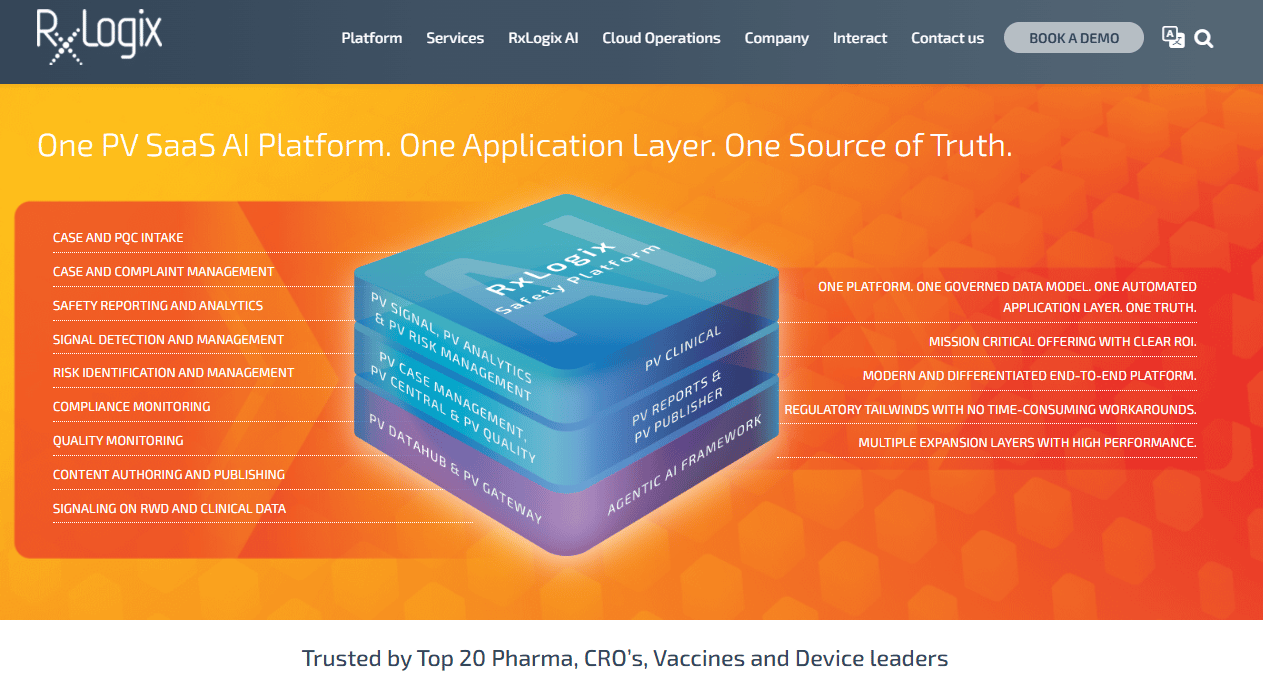
RxLogix is an AI-powered pharmacovigilance platform for end-to-end drug safety operations. It covers case intake with AI-driven triage and processing, automated regulatory reporting, signal detection, risk management, compliance monitoring, and regulatory publishing. RxLogix targets pharmaceutical, biotech, CRO, and regulatory organizations that need to modernize PV operations.
Best for: Pharmacovigilance teams that need scalable drug safety case management, signal detection, and regulatory reporting.
Key features
- PV case management with AI-driven intake and automation
- Automated regulatory reporting and analytics
- Signal detection and management
- Risk management and compliance monitoring
- Regulatory publishing and content authoring
Why choose RxLogix: PV bottlenecks create operational and regulatory exposure simultaneously. RxLogix addresses both by automating case processing and reporting, which matters when case volumes grow faster than team capacity.
RxLogix pricing: Contact RxLogix for pricing. No standard plan amounts are displayed.
Considerations when choosing pharma and biotech software
Start with the workflow, not the vendor name
"Pharma and biotech software" is too broad to buy directly. Identify whether you need R&D, lab operations, clinical trial infrastructure, quality management, safety reporting, manufacturing execution, or commercial analytics first. The vendor shortlist follows from that answer, not the other way around.
Verify regulatory and validation requirements before contracting
Audit trails, electronic records, access controls, and data retention are not optional features in regulated environments. Check whether the vendor provides validated deployment options or documentation that supports your own validation effort. Do not assume the tool handles compliance for you.
Ask whether the tool becomes a system of record
Systems that own critical data, such as sample lineage, clinical data, or batch records, require deeper governance, longer implementation planning, and internal admin ownership. Visualization tools and point analytics do not carry the same burden, but they also do not provide the same foundation. Know which type you are buying.
Evaluate implementation cost alongside license cost
Configuration, data migration, integrations, training, and change management can exceed the first year of license fees. For founders hiring a new VP or quality leader, factor in their ramp time and whether the system can be owned by that person without ongoing vendor support.
Demand clean integration paths to your operating data
The best tool loses value if data cannot move into your CRM, data warehouse, or weekly reporting. Check whether the vendor integrates with the instruments, EDC systems, ELN platforms, and identity providers already in your stack. API availability and documented integration support are the questions to ask.
Conclusion
The best pharma and biotech software depends entirely on which workflow carries the most operational or regulatory risk for your organization right now.
Veeva Systems and IQVIA anchor enterprise pharma commercial operations and global data programs. Benchling is the default for biotech R&D. Medidata, Medable, and Clario cover clinical development across EDC, decentralized trials, and endpoint capture. LabWare, CloudLIMS, LabKey LIMS, STARLIMS, and Sapio Sciences each serve different LIMS and lab informatics needs depending on deployment preference and budget transparency. MasterControl and Qualio handle quality management at different company sizes. ArisGlobal and RxLogix own pharmacovigilance operations. TetraScience sits underneath other systems as scientific data infrastructure. Certara supports model-informed development. Körber Pharma serves manufacturing execution. SciNote gives research teams a practical ELN entry point. DrugPatentWatch handles patent and market intelligence.
Build your evaluation around three questions: Which workflow owns the budget or the risk? Who internally will own the system post-implementation? Does it integrate cleanly with what you already run?
Start with a 3-vendor shortlist per workflow rather than evaluating the whole market at once.
If your team sells complex software and buyers need to understand workflows before a call, an interactive demo lets them explore the product on their own terms, without scheduling a meeting first. Start your journey with Guideflow today!
FAQs
Pharma and biotech software is an umbrella category of life sciences software used to manage scientific research, clinical development, laboratory operations, quality, regulatory, manufacturing, safety, commercial, and data workflows for pharmaceutical and biotechnology organizations. It is not a single product type but a stack of specialized systems, each owning a specific part of the product lifecycle. The right combination depends on which workflow carries the most risk or operational burden.
Enterprise pharma organizations typically rely on Veeva Systems for commercial, regulated content, and broad life sciences cloud operations, and on IQVIA for clinical, commercial, and real-world data at scale. For specific regulated workflows, MasterControl covers quality and manufacturing, ArisGlobal handles pharmacovigilance and regulatory operations, Medidata supports clinical trial execution, and Körber Pharma addresses manufacturing. No single platform covers everything; the best stack is built workflow by workflow.
Biotech R&D teams commonly use Benchling for ELN, molecular biology, and structured R&D data. For LIMS, the choice varies by lab size: LabWare for large enterprise labs, CloudLIMS for teams wanting published pricing and cloud deployment, LabKey LIMS for flexible research environments, and STARLIMS for enterprise lab informatics. Sapio Sciences combines LIMS and ELN in one platform. TetraScience sits underneath those systems as a scientific data infrastructure layer. SciNote is a lighter ELN option with a free tier for research documentation.
LIMS (laboratory information management system) manages samples, lab workflows, inventory, testing results, and chain-of-custody tracking. ELN (electronic lab notebook) manages experiment documentation, protocols, observations, and team collaboration. LIMS focuses on lab operations and compliance. ELN focuses on scientific knowledge capture. Several platforms, including LabWare, Sapio Sciences, LabKey LIMS, and STARLIMS, combine both capabilities.
Clinical trial software selection depends on the need. Medidata Solutions covers EDC, trial management, and analytics for complex studies. Medable specializes in decentralized and hybrid trial models with eCOA, eConsent, and telehealth. Clario handles specialized endpoint data capture across eCOA, imaging, and cardiac safety. IQVIA provides clinical development technology alongside its data and services model. Evaluate based on trial design, sponsor or CRO workflow, and whether the study is site-based, hybrid, or fully decentralized.
Start with the workflow that carries the most regulatory risk or operational delay. Then evaluate whether the platform supports your validation requirements, what implementation looks like, who internally will own the system, and how data flows into your other tools. Pricing structure matters too: Most enterprise platforms price by quote based on modules, users, and study or case volume. Request a structured demo for the specific workflow you need to fix, not a general product tour.
Most enterprise life sciences platforms use quote-based pricing because cost varies by modules, user count, geographic regions, validation requirements, integrations, and implementation scope. CloudLIMS and LabKey LIMS are notable exceptions with published per-user and annual pricing. DrugPatentWatch also publishes tiered subscription pricing. SciNote offers a free plan for research documentation. For all others in this list, expect a sales conversation before seeing numbers.
ArisGlobal and RxLogix are the two dedicated pharmacovigilance platforms in this list. ArisGlobal's LifeSphere platform covers safety case intake, processing, regulatory reporting, and signal detection with GenAI automation. RxLogix provides AI-powered case management, automated regulatory reporting, and signal detection for pharmaceutical and biotech safety teams. Both are designed for organizations managing post-market safety obligations at scale.