You have a VPN concentrator that buckles when half the company works remote. A separate SD-WAN box at every branch. A secure web gateway licensed per seat. A CASB bolted on after the last cloud audit. Each tool enforces its own policy, in its own console, with its own logs. When security asks a simple question, like which user touched which app from which device, nobody can answer without stitching four exports together.
That is the sprawl a secure access service edge platform is built to collapse. The category is growing fast because the pain is real. Dell'Oro Group reported single-vendor SASE revenue hit USD 2.6B in Q1 2025, up 17% year over year, and multiple analyst firms project the broader SASE market to clear USD 15B to USD 19B in 2026. Buyers are not chasing a trend. They are consolidating a stack that stopped making sense the moment their users left the office.
For presales teams, this is the harder conversation. You are not just picking a product. You are helping a buyer validate that one architecture can absorb networking and security functions that lived in five separate contracts, without breaking policy consistency or the security review. This guide compares seven credible SASE platforms for 2026 by architecture depth, Zero Trust coverage, WAN integration, and how they actually deploy against an existing stack.
What's inside
This guide compares seven SASE platforms built for real technical validation, not marketing categories. We selected each based on architecture depth (how completely networking and security converge), Zero Trust coverage, WAN and branch integration, and deployment fit against common enterprise stacks. It is written for presales engineers, solutions consultants, and IT buyers who need to support a security review, map components to requirements, and shortlist vendors without overselling. You will find a component-level comparison table, individual vendor sections with pricing and ratings where public, and evaluation guidance you can bring into a live call.
TL;DR
- Best overall for breadth across networking and security: Cloudflare One, a cloud-native platform with a global network and broad Zero Trust coverage.
- Best for Fortinet-centric environments: FortiSASE, with deep security controls and unified SD-WAN plus SSE.
- Best for globally distributed cloud networking: Cato SASE Cloud, built on a single-pass cloud backbone with unified management.
- Best for enterprises standardizing on Palo Alto: Prisma SASE, with integrated security, SD-WAN, and experience management.
- Best for policy-driven WAN and branch modernization: Versa SASE, with flexible cloud, on-prem, or blended deployment.
- Best for Zero Trust access consolidation: Zscaler Zero Trust Exchange, with least-privileged brokered access and full TLS inspection at scale.
- Best for Cisco-aligned estates: Cisco Secure Access, a cloud-delivered SSE platform for private and internet access.
What is a SASE platform?
A SASE platform is a cloud-delivered architecture that combines wide-area networking and network security into a single, identity-driven service delivered from points of presence close to users. The term, coined by Gartner, stands for secure access service edge. In plain terms: instead of routing traffic back to a data center to apply security, a SASE platform enforces policy in the cloud, wherever the user connects from.
The SASE meaning matters most when you contrast it with the old model. Traditional networking assumed users, apps, and data sat inside a perimeter. SASE architecture assumes none of that. Users are remote. Apps are SaaS. Data lives across clouds. So the platform moves both connectivity and enforcement to the edge, tied to identity rather than network location.
Core components buyers should expect
A real SASE platform converges networking and security functions that used to ship as separate products. When you scope a vendor, expect these components:
- Zero trust network access (ZTNA): identity-aware, least-privilege access to private apps, replacing broad network-level VPN tunnels.
- Secure web gateway (SWG): inline inspection and filtering of web and internet traffic.
- Cloud access security broker (CASB): visibility and control over sanctioned and shadow SaaS usage.
- Data loss prevention (DLP): policy enforcement to stop sensitive data from leaving.
- SD-WAN: application-aware routing and traffic engineering across branches and clouds.
- Firewall as a service (FWaaS) or NGFW: cloud-delivered firewalling and threat prevention.
- Centralized management: one console for policy, one place for logs and visibility.
- Identity-driven access: enforcement tied to user, device posture, and context.
- Cloud-native delivery and PoPs: a distributed network that puts enforcement near the user.
The security service edge (SSE) subset of these functions, ZTNA, SWG, CASB, and DLP, is where many buyers start. 360iResearch reported 79% of organizations intended to deploy SSE within two years. A full SASE platform pairs that SSE stack with the networking side, SD-WAN and traffic steering.
Why SASE matters now
Hybrid work broke the perimeter model. A workforce spread across homes, offices, and third-party locations cannot funnel every request through a VPN back to headquarters without paying for it in latency and exposure. SaaS adoption made the data center a detour, not a destination. Branch offices need direct, secure internet access rather than backhauled MPLS circuits.
Point tools created the gap. When SWG, CASB, DLP, and access control each enforce policy independently, consistency erodes. A user allowed by ZTNA might be blocked by a proxy rule nobody synced. Security reviews take longer because evidence lives in four systems. SASE cybersecurity closes that gap by making one identity-driven policy the source of truth across every function, which is the operational heart of a zero trust architecture.
What a real platform should do
"Platform" is an overused word, so hold vendors to a standard. A real SASE platform should steer traffic intelligently based on application and identity, enforce policy in the cloud regardless of where the user sits, verify trust continuously rather than once at login, and surface unified visibility across networking and security in a single pane. A single gateway or a partial SSE product is a component. A platform ties the components together under one control plane.
When to use a SASE platform
Replace VPN for distributed users
Legacy VPN grants network-level access, which means a compromised credential can reach far more than one app. It also concentrates traffic through choke points that struggle under a fully remote or hybrid load. A SASE platform functions as a VPN replacement by brokering identity-aware, least-privilege connections to specific applications. This is where SASE earns its keep for remote employees, contractors, and third-party vendors who need scoped access without a seat on the corporate network.
Modernize branch and cloud access
Branches backhauling traffic over MPLS to a central data center pay in latency and cost. A SASE platform with integrated SD-WAN lets each branch connect directly and securely to SaaS and cloud apps, with the same policy applied everywhere. CASB governs which cloud apps are sanctioned and how data moves through them. The result is simpler operations and one consistent policy set instead of per-site firewall rules that drift over time.
Reduce tool sprawl in security and networking
Consolidating SD-WAN, SWG, CASB, DLP, and access control under one architecture cuts vendors, contracts, and consoles. Presales teams will hear the objection early: "we already own most of these tools." The honest framing is that SASE is not about ripping everything out on day one. It is about a migration path where overlapping point tools retire as the platform absorbs their function, and policy consistency improves as consoles collapse into one.
Comparison table
The shortlist below is ordered by breadth of converged networking and security coverage and general relevance to buyers evaluating a full SASE platform in 2026. Pricing for enterprise SASE is almost always quote-based, so treat public figures as entry context, not final cost. Ratings reflect current G2 listings where a verified product-level score was available.
| # | Product | Intent | Key differentiation | Pricing | G2 rating |
|---|---|---|---|---|---|
| 1 | Cloudflare One | Cloud-native SASE and Zero Trust standardization | Global network with broad ZTNA, SWG, CASB, DLP coverage | Free tier; $7/user/mo pay-as-you-go; custom contract | Not published |
| 2 | FortiSASE | Fortinet-centric unified SASE | Single-vendor SD-WAN plus SSE with deep security controls | Subscription, quote-based | 4.3/5 |
| 3 | Cato SASE Cloud | Globally distributed cloud networking | Single-pass cloud backbone with SSE 360 stack | Quote-based | 4.5/5 |
| 4 | Prisma SASE | Palo Alto standardization | Integrated security, SD-WAN, and experience management | Quote-based | 4.4/5 |
| 5 | Versa SASE | Policy-driven WAN and branch modernization | Cloud, on-prem, or blended deployment with unified console | Quote-based | 4.7/5 |
| 6 | Zscaler Zero Trust Exchange | Zero Trust access consolidation | Least-privileged brokered access, full TLS inspection at scale | Quote-based | 4.3/5 |
| 7 | Cisco Secure Access | Cisco-aligned estates | Cloud-delivered SSE with SIA and SPA, user-based tiers | Essentials and Advantage tiers, quote-based | Not published |
1. Cloudflare One
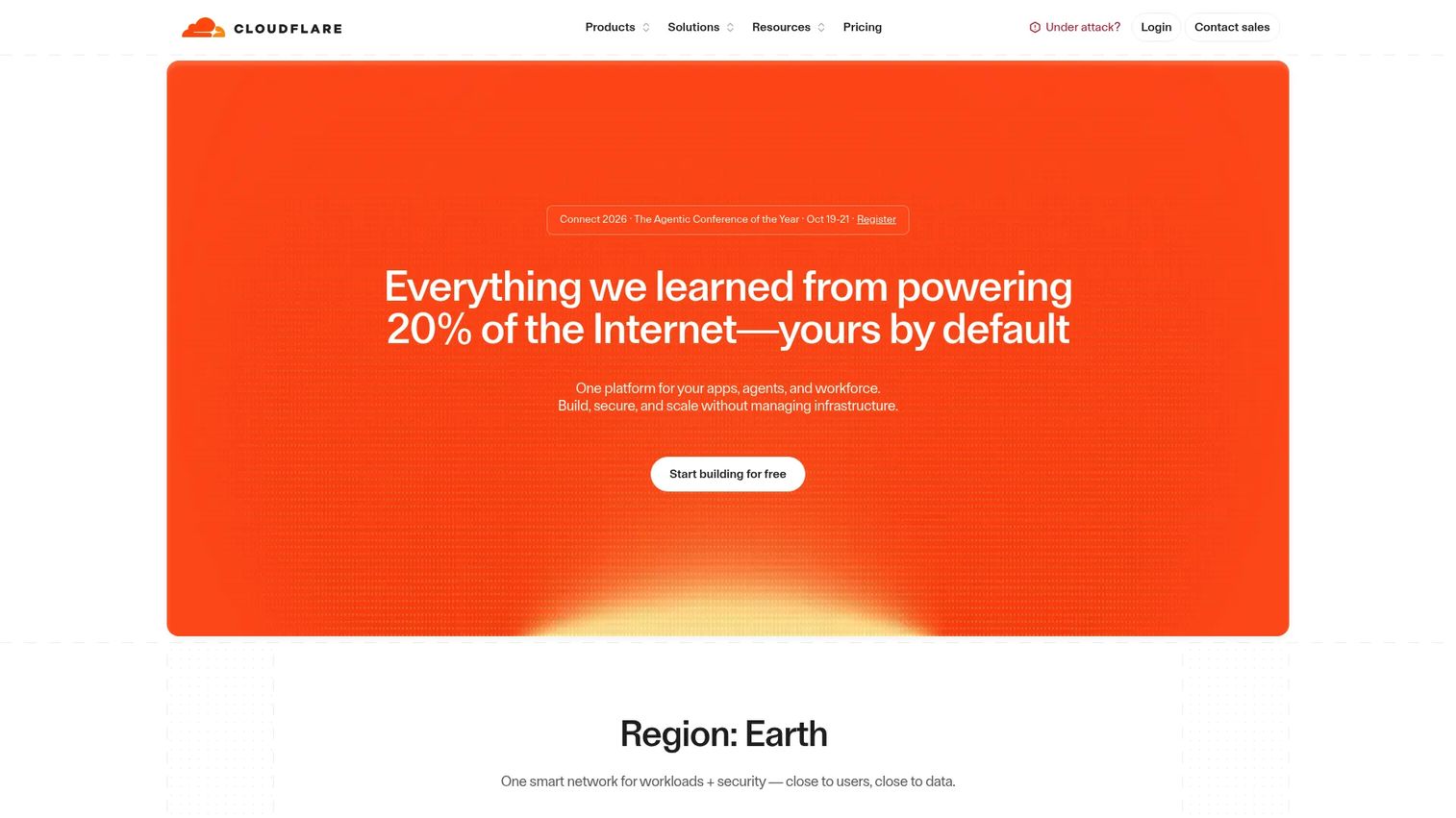
Cloudflare One is Cloudflare's SASE and Zero Trust platform for securing users, devices, applications, and network traffic. It runs on the same global network Cloudflare built for its CDN and DNS business, which gives it enforcement points close to users almost everywhere. For buyers modernizing access, routing, and cloud security together rather than in separate projects, it is often the first name that comes up.
Best for: Organizations standardizing on a cloud-native SASE and Zero Trust security stack.
Key strengths
- Zero Trust Network Access: Identity-aware, least-privilege access to private apps without exposing the network.
- Secure Web Gateway: Inline inspection and filtering of internet and web traffic across the global network.
- CASB, DLP, email security, and DEM: Broad security coverage layered onto the same control plane.
Why choose Cloudflare One: Presales teams bring Cloudflare One into architecture discussions when a buyer wants network scale and Zero Trust framing without stitching together several vendors. Its breadth across ZTNA, SWG, CASB, and DLP means a single policy layer can cover a lot of ground, which shortens the "how do the pieces fit" part of a technical review.
Cloudflare One pricing: Cloudflare publishes a Free plan at $0 for teams under 50 users or for enterprise proof-of-concept testing. A Pay-as-you-go plan runs $7 per user per month for teams over 50 with narrower SSE use cases. Full-featured SASE and workspace security move to a custom Contract with annual per-user pricing. The free tier makes it unusually easy to run a hands-on evaluation before committing budget.
2. FortiSASE
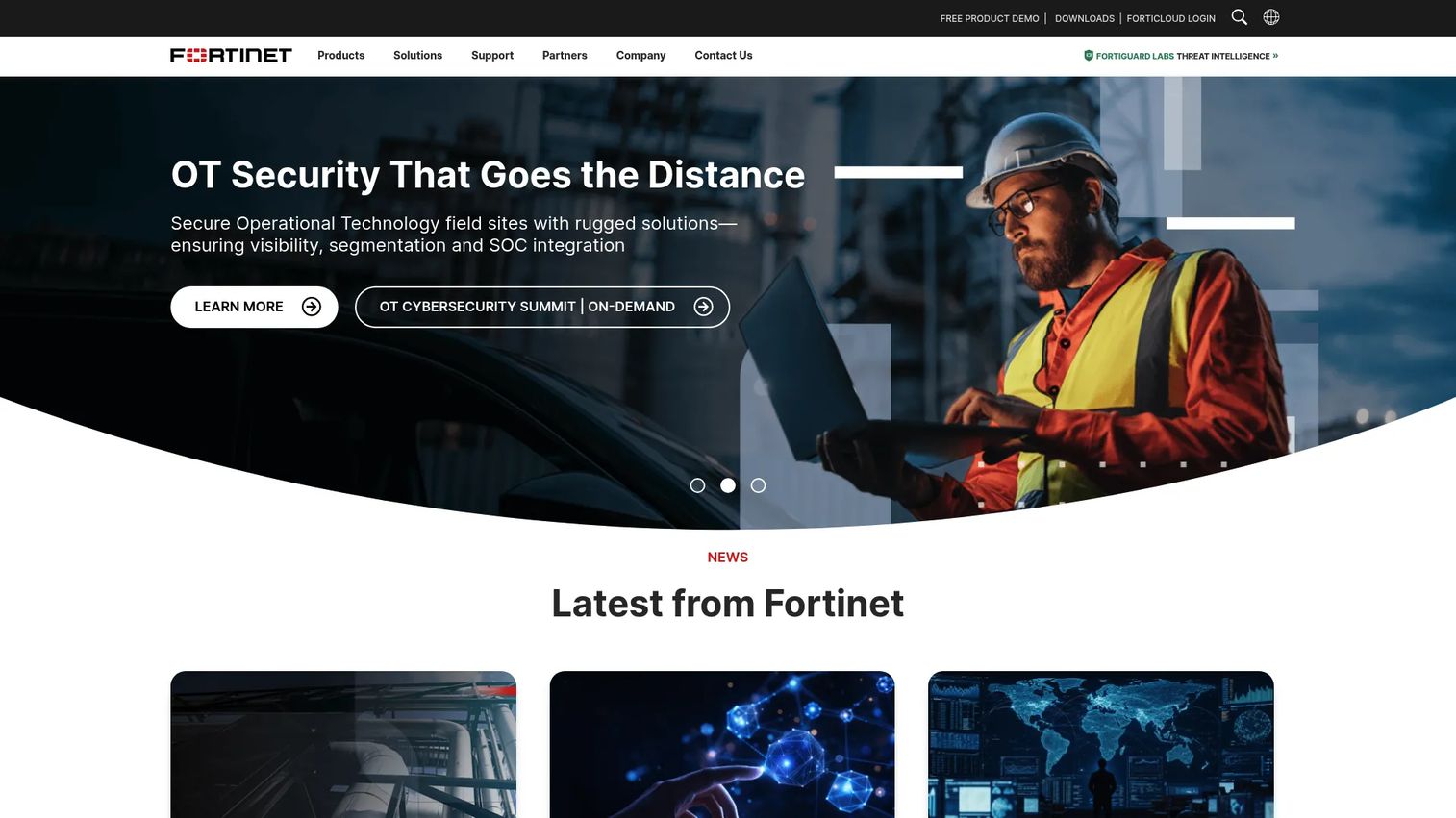
FortiSASE is Fortinet's cloud-delivered SASE for securing remote users, cloud apps, and private access. Its story is security-heavy, which makes sense given Fortinet's firewall heritage. For environments already running Fortinet security appliances, FortiSASE extends the same policy model and threat prevention out to the cloud edge rather than introducing a second security philosophy.
Best for: Organizations that want a unified SASE platform from a single vendor.
Key strengths
- Unified SASE with SD-WAN and SSE: Networking and security converge under one vendor and one policy framework.
- Flexible connectivity: Agent-based and agentless access to fit managed and unmanaged devices.
- Security depth: CASB, DLP, SSL inspection, and ZTNA delivered from the cloud.
Why choose FortiSASE: For a Fortinet-heavy shop, the appeal is continuity. Security teams already know the policy language and threat feeds, so the platform folds into existing operations instead of forcing a parallel one. Presales should map which on-prem FortiGate functions migrate to the cloud edge and which stay, because that boundary shapes the deployment plan and the security review.
FortiSASE pricing: Fortinet does not publish public list prices. FortiSASE is licensed on a subscription basis, described through an ordering guide rather than a self-serve price table, so expect a quote scoped to user count and features. FortiSASE holds a 4.3/5 rating on G2.
3. Cato SASE Cloud
Cato SASE Cloud is a cloud-native SASE platform that unifies networking, security, and access in a single service built from the ground up rather than assembled from acquisitions. It runs on Cato's own global backbone, which appeals to teams that want one operational model across every site and user instead of coordinating separate networking and security products.
Best for: Enterprises wanting unified SASE networking and security from one vendor.
Key strengths
- Global cloud network and backbone: A private backbone that carries and secures traffic between all edges.
- SSE 360 security stack: FWaaS, SWG, IPS, DNS Security, RBI, CASB, DLP, and ZTNA in one stack.
- Single-pass management: One policy engine and one console for enforcement everywhere.
Why choose Cato SASE Cloud: The single-pass, single-console design is the differentiator worth surfacing in a technical review. Because networking and security share one architecture, policy consistency is built in rather than negotiated across products. Presales teams evaluating branch connectivity and global performance alongside security will find the unified model easy to explain to both network and security stakeholders. Cato SASE Cloud carries a 4.5/5 rating on G2.
Cato SASE Cloud pricing: Cato does not display public pricing. Cost is quote-based and scoped to sites, users, and the security modules in play, so plan for a scoping conversation early in the evaluation.
4. Prisma SASE
Prisma SASE is Palo Alto Networks' cloud-delivered SASE platform for securing users, apps, data, and devices with integrated networking and security. It carries Palo Alto's security-first reputation, which is why it lands on shortlists at enterprises that already standardize on Palo Alto tooling and want their SASE layer to speak the same language.
Best for: Enterprises seeking a single-vendor SASE platform with integrated security, SD-WAN, and experience management.
Key strengths
- Unified SASE architecture: Security and networking functions delivered as one integrated platform.
- Zero trust security: Continuous trust verification rather than one-time authentication.
- App-aware path selection: SD-WAN and user experience optimization tied to application needs.
Why choose Prisma SASE: For a Palo Alto estate, evaluation is less about learning a new security model and more about extending a familiar one to the edge. The integrated experience management layer helps network teams see and fix performance issues, not just enforce security. Presales should expect a thorough security review, since enterprises choosing Prisma usually have mature compliance requirements that the platform is built to satisfy. Palo Alto Networks holds a 4.4/5 rating on G2.
Prisma SASE pricing: Palo Alto Networks does not publish public pricing for Prisma SASE. Expect enterprise, quote-based pricing scoped to users, sites, and modules. Budget for a vendor-led scoping and proof-of-concept phase as part of the evaluation.
5. Versa SASE
Versa SASE is a unified SASE platform that combines networking and security in one converged stack, with a notable strength in deployment flexibility. Where many platforms are cloud-only, Versa supports cloud, on-premises, or blended models. That flexibility matters for organizations with data residency requirements or heavy branch footprints that cannot move everything to the cloud at once.
Best for: Enterprises needing unified SASE with integrated networking and security.
Key strengths
- Flexible deployment: Cloud, on-premises, or blended to match real infrastructure constraints.
- Unified console and data lake: One policy layer and one place for logs and analytics.
- Application-aware fabric: Traffic-engineered routing tuned to application performance.
Why choose Versa SASE: For teams prioritizing networking control alongside security consolidation, Versa's WAN heritage shows. The blended deployment option is the standout for regulated industries and complex branch networks where a pure cloud model does not fit the compliance picture. Presales should scope which functions run where, since the flexibility that makes Versa attractive also means the architecture needs to be designed deliberately. Versa SASE holds a 4.7/5 rating on G2.
Versa SASE pricing: Versa does not display public pricing on its site; product pages direct buyers to contact sales or request a demo. Expect quote-based pricing scoped to deployment model, sites, and modules.
6. Zscaler Zero Trust Exchange
Zscaler Zero Trust Exchange is a cloud-native zero trust platform for securing access to users, workloads, IoT and OT, and B2B partners. Its identity is Zero Trust access done at cloud scale. Rather than connecting users to a network, it brokers a one-to-one connection between a verified user and a specific application, which removes lateral movement as a risk entirely.
Best for: Enterprises modernizing network access and security with a zero trust platform.
Key strengths
- Least-privileged brokered access: One-to-one connections between user and app, never network-level access.
- Full TLS/SSL inspection at scale: Inspecting encrypted traffic without becoming the bottleneck.
- Context-aware security: Enforcement based on user, device, and context, tied to network transformation.
Why choose Zscaler Zero Trust Exchange: When the buying motion is driven by a VPN replacement mandate or an aggressive Zero Trust initiative, Zscaler is frequently the platform under evaluation. The brokered-access model is a clean story for security stakeholders because it eliminates the "flat network" risk that keeps auditors up at night. Presales should map which apps move to ZTNA first and how internet-bound traffic routes through the exchange. Zscaler Zero Trust Exchange carries a 4.3/5 rating on G2.
Zscaler Zero Trust Exchange pricing: Zscaler publishes bundle and standalone product categories but does not show public numeric pricing for the Zero Trust Exchange itself. Expect quote-based pricing scoped to users and the modules selected.
7. Cisco Secure Access
Cisco Secure Access is Cisco's cloud-delivered SSE platform for secure access to private and internet resources. For estates already built on Cisco networking, it is the natural first evaluation, because it extends a familiar operational and support relationship into cloud-delivered security rather than introducing a new vendor into a Cisco-standardized environment.
Best for: Organizations wanting a Cisco-managed SSE and zero-trust access platform.
Key strengths
- Zero Trust Network Access: Identity-aware access to private applications.
- Secure Internet Access (SIA): Cloud-delivered protection for internet-bound traffic.
- Secure Private Access (SPA): Unified access to private apps across the enterprise.
Why choose Cisco Secure Access: Cisco-heavy organizations weigh continuity heavily. Existing licensing relationships, support contracts, and network operations familiarity all lower the friction of adding Cisco's SSE layer. Presales should confirm which SASE networking functions the buyer needs beyond the SSE core, since Cisco positions this platform on the security service edge side and pairs it with its broader networking portfolio.
Cisco Secure Access pricing: Cisco prices Secure Access by user, with Essentials and Advantage subscription packages. Pricing is dynamically determined by covered-user count and subscription term, and public list prices are not shown on the site. Expect a quote scoped to your user base and term length.
Considerations before you buy
A SASE evaluation lives or dies on architecture fit, not feature checklists. Use this to structure the technical validation.
Single-vendor versus dual-vendor SASE
A single-vendor SASE platform gives you one policy engine, one console, and one support relationship, which is why single-vendor revenue is growing fastest. A dual-vendor approach pairs a best-of-breed SSE with a separate SD-WAN. Decide early, because it shapes every other criterion.
Component coverage against your stack
Map ZTNA, SWG, CASB, DLP, SD-WAN, and FWaaS against what you already own. The realistic goal is a migration path where overlapping tools retire over time, not a big-bang cutover. Identify which contracts expire when.
Policy model and Zero Trust depth
Confirm that policy is genuinely identity-driven and enforced continuously, not just at login. Ask how device posture, user context, and application sensitivity feed a single policy versus separate rule sets per function.
Integration and security review readiness
Check how the platform integrates with your identity provider, SIEM, and endpoint tooling, and what certifications it holds. A platform that surfaces unified logs shortens the security review, which is often the longest stage of the deal.
Conclusion
There is no single best SASE platform, only the best fit for your current stack, your security priorities, and how far you want to consolidate in 2026. If you want breadth on a cloud-native network, Cloudflare One is a strong starting point. Fortinet and Palo Alto estates should look first at FortiSASE and Prisma SASE respectively, where continuity lowers risk. Cato SASE Cloud rewards teams wanting one unified operational model, Versa SASE fits organizations needing deployment flexibility, Zscaler Zero Trust Exchange leads on Zero Trust access, and Cisco Secure Access suits Cisco-standardized environments.
The practical next step is to shortlist two or three vendors, then run a presales-led evaluation that validates architecture fit against your real requirements. Scope which components migrate, how policy stays consistent, and how the platform survives a security review. That hands-on validation, not the datasheet, is what tells you which platform your organization can actually operate.
FAQs
A SASE platform is a cloud-delivered architecture that converges wide-area networking and network security into a single, identity-driven service. Core components include ZTNA, SWG, CASB, DLP, SD-WAN, and FWaaS, all managed from a centralized console and enforced at points of presence close to users rather than in a central data center.
SD-WAN is a networking component that routes traffic intelligently across branches and clouds. SASE is the broader architecture that combines SD-WAN with cloud-delivered security functions like ZTNA, SWG, CASB, and DLP under one policy layer. Put simply, SD-WAN handles connectivity, while SASE handles connectivity and security together.
Yes, for most distributed-access use cases. A SASE platform uses ZTNA to broker identity-aware, least-privilege connections to specific applications, rather than granting the broad network-level access a legacy VPN provides. This reduces lateral-movement risk and removes the choke points that strain VPN concentrators under a hybrid or fully remote workforce.
A complete SASE platform should include ZTNA, SWG, CASB, DLP, SD-WAN, and FWaaS or NGFW capabilities, all tied together by centralized management and identity-driven policy. The SSE subset (ZTNA, SWG, CASB, DLP) covers security service edge functions, and a full platform pairs that with the networking side.
For most organizations consolidating a sprawling stack, yes. Point tools each enforce policy independently, which creates gaps and slows security reviews because evidence lives in separate consoles. A SASE platform makes one identity-driven policy the source of truth across every function, improving consistency and cutting the number of vendors and consoles to manage.
Focus on architecture fit, policy coverage, integration depth, and deployment model. Map the platform's components against the buyer's existing stack, confirm policy is genuinely identity-driven and continuous, and verify integrations with the identity provider, SIEM, and endpoint tools. Deciding between single-vendor and dual-vendor SASE early shapes the rest of the evaluation.
SASE operationalizes zero trust by tying every access decision to identity, device posture, and context rather than network location. It grants least-privilege access to specific applications through ZTNA, verifies trust continuously instead of once at login, and enforces one consistent policy across networking and security functions, which is the core of a zero trust architecture.