Your site gets flagged by Google for distributing malware. The security review on a deal asks whether your web application has been penetration tested. A scanner finds an exploitable SQL injection vulnerability two days before launch. Each of these moments has one thing in common: The team scrambling to answer does not have the right tool in place.
The IBM Cost of a Data Breach Report (2025) put the average global cost of a breach at $4.44 million USD. Web application attacks remain one of the most common entry points. Whether you own the site, build on it, or help buyers validate that a product is safe to procure, the choice of website security software shapes how fast you can detect, prove, and fix risk.
This guide covers 15 tools across malware scanning, managed cleanup, vulnerability scanning, WAF protection, penetration testing, and attack surface management. The goal is to help you route to the right category before you route to a specific vendor.
Which website security software fits the risk you are trying to reduce?
What's inside
This guide is for website owners, IT and security teams, agencies managing client sites, and presales or sales engineering teams supporting security diligence conversations.
Items were chosen based on:
- Protection scope: Does the tool cover the actual attack surface at risk?
- Remediation support: Detection only, or does cleanup come with it?
- Reporting quality: Can the output satisfy a technical evaluator or an enterprise buyer's questionnaire?
- Pricing transparency: Are real figures available, or is everything gated behind a sales call?
TL;DR
- Best for continuous vulnerability monitoring: Intruder
- Best for enterprise DAST: Invicti
- Best for human-led web app pentesting: Astra Pentest
- Best for CMS malware cleanup: Sucuri
- Best for small-business website protection: GoDaddy Website Security (entry price $6.99/month) or SiteLock ($19.99/month)
- Best for enterprise WAF and edge security: Akamai Kona Site Defender or Imperva App Protect
- Best for attack surface discovery: Detectify or ImmuniWeb Discovery
- Best for server-level hosting protection: BitNinja
What is website security software?
Website security software protects websites and web applications from malware, vulnerabilities, malicious traffic, data exposure, and availability attacks.
The category is not a single product type. It spans several distinct capabilities, and most buyers need to understand which one they are actually missing before they evaluate tools.
Core tool types:
- Malware scanners: Detect malicious files, injected scripts, malicious redirects, and SEO spam inserted into CMS files
- Malware removal services: Clean infected files and request blacklist removal from search engines
- Vulnerability scanners: Find outdated components, exposed endpoints, and OWASP Top 10 issues across web apps and APIs
- Web application firewalls (WAF): Filter malicious requests before they reach the application, including SQL injection and cross-site scripting (XSS) payloads
- DDoS protection: Absorb or rate-limit traffic floods that target availability
- Penetration testing platforms: Combine automated scanning with human validation to confirm exploitability
- Attack surface management: Continuously discover and monitor all web-facing assets, subdomains, and exposed services
Common threats this software defends against:
- SQL injection: Attackers submit malicious input to manipulate backend database queries
- Cross-site scripting (XSS): Injected scripts run in a victim's browser, stealing session data or credentials
- Remote file inclusion: Attackers force a server to load and execute remote malicious code
- Malicious redirects: Infected sites quietly forward visitors to phishing or malware pages
- Credential attacks: Automated tools attempt logins using known username-password combinations
- Phishing pages: Compromised servers host fake login or payment pages
Website security software differs from endpoint antivirus in a fundamental way. Antivirus protects devices. Website security protects the public-facing server, application layer, CMS codebase, and incoming traffic path. An infected WordPress installation or an exploitable checkout page requires a completely different set of controls.
Also worth noting: The global web security software market was valued at $8.94 billion in 2025 and is projected to grow at 11.2% annually through 2034, according to Dataintelo (2025). Demand is rising because attack surfaces are expanding, not shrinking.
For security teams evaluating application security testing software, this category overlaps with several adjacent product types covered in that guide.
When to use website security software
Protect a revenue-critical website
Ecommerce checkouts, SaaS login portals, and partner portals generate revenue directly. A blacklist warning from a search engine or a browser security alert can drop traffic within hours. Presales teams regularly face questions about monitoring, alerting, and remediation ownership during procurement reviews. Having a clear answer to "who owns incident response and what is the SLA?" is often the difference between a stalled deal and a signed contract.
Validate a web application before launch or audit
Security teams need evidence before production release, enterprise buyer sign-off, or compliance certification. Dynamic application security testing (DAST), vulnerability scanning against the OWASP Top 10, and penetration testing all produce the technical artifacts buyers and auditors ask for. Running these checks after launch rather than before is a pattern that creates expensive last-minute delays. For teams also tracking API monitoring tools or API testing tools, website security scans should run alongside those checks.
Recover from a hacked site
Detection is only the first step. A compromised site needs malware removed, injected files cleaned, blacklist removal requested, a WAF activated to block reinfection, and vulnerable plugins or CMS components patched. Several tools on this list handle cleanup alongside detection. Others detect only. Knowing which category a tool falls into before you buy it avoids the situation where a scan tells you exactly what is wrong but leaves you to fix it manually.
Website security software comparison
The table below organizes each tool by its strongest use case. Pricing and ratings were verified from vendor pricing pages and G2 at time of publication.
| # | Product | Best for | Key differentiator | Pricing | G2 rating |
|---|---|---|---|---|---|
| 1 | Intruder | Continuous vulnerability monitoring | External attack surface scanning with risk prioritization | Free plan; paid plans available | 4.8/5 |
| 2 | Invicti | Enterprise DAST | Proof-based vulnerability confirmation | Custom quote | 4.3/5 |
| 3 | Astra Pentest | Human-led web app pentesting | Automated scans plus expert pentest support | From $69/month | 4.6/5 |
| 4 | Sucuri | CMS malware cleanup | Malware removal plus WAF and blacklist monitoring | From $9.99/month (firewall); from $229/year (platform) | N/A (G2) |
| 5 | SiteLock | Small-business website protection | Monitoring, remediation, WAF, and site health scoring | From $19.99/month | 2.4/5 |
| 6 | GoDaddy Website Security | GoDaddy-hosted sites | Website scanning and cleanup inside GoDaddy workflows | From $6.99/month (2-yr term) | 4.1/5 |
| 7 | Imperva App Protect | Enterprise web app protection | WAF, DDoS, bot protection, and API security | Custom quote | 4.1/5 |
| 8 | Acunetix by Invicti | Web vulnerability scanning | Automated scanning for web apps and APIs | Custom quote | N/A (G2) |
| 9 | Detectify | External attack surface management | Crowdsource-informed web asset monitoring | From €0 (Starter); from €2,500/year (Standard) | 4.5/5 |
| 10 | Pentest-Tools.com | Security teams running web checks | Automated scanning with exploit validation | From $96/month | 4.8/5 |
| 11 | Beagle Security | Automated web app pentesting | Pentest-style compliance reports for web apps and APIs | From $99/month | 4.7/5 |
| 12 | BitNinja | Server-level website protection | Linux server security for hosting providers | From $0.10/website (min $5 billing) | 4.6/5 |
| 13 | AppTrana | Managed WAF | WAF plus managed security tuning and vulnerability scanning | From $99/app/month | 4.8/5 |
| 14 | ImmuniWeb Discovery | External attack surface discovery | Digital asset inventory and dark web exposure monitoring | From €1,495/month | N/A (G2) |
| 15 | Akamai Kona Site Defender | Large-scale edge protection | Edge WAF and DDoS defense on Akamai's network | Custom quote | 4.7/5 |
Best 15 website security software tools for 2026
1. Intruder
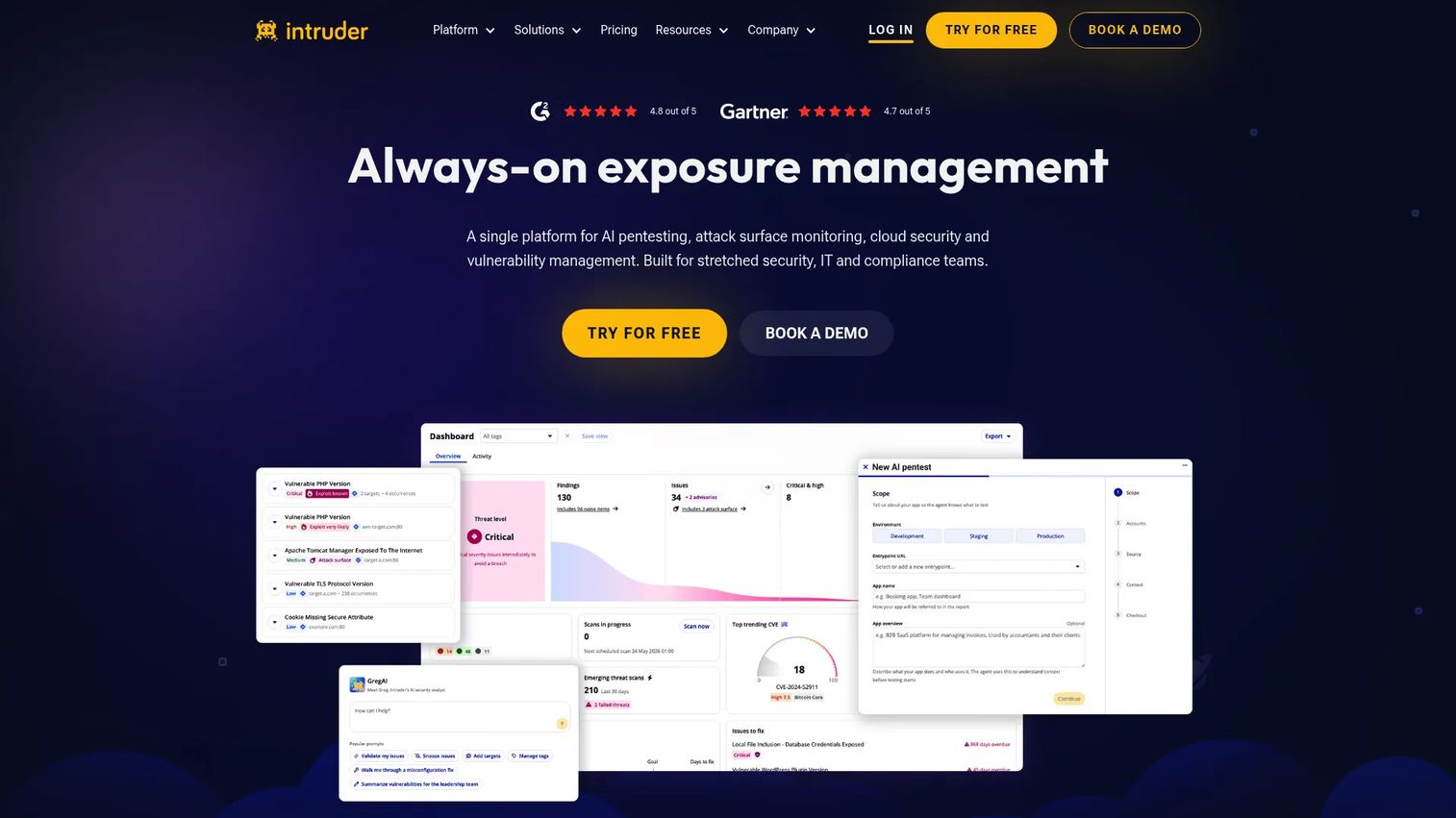
Intruder is a continuous vulnerability management and exposure monitoring platform covering internet-facing infrastructure, web applications, APIs, cloud environments, and internal systems. It runs recurring scans and surfaces new findings when the threat landscape changes, not just when you manually trigger a test. For security teams with limited headcount, the risk-based prioritization means the most exploitable issues surface first rather than a flat list of findings that requires hours of triage.
Best for: Lean security, IT, and engineering teams that need ongoing external attack surface monitoring without a dedicated scanning operator.
Key features
- Continuous external infrastructure vulnerability scanning
- Authenticated web application and API security testing
- Cloud and container image security checks
- Emerging threat scanning triggered by new CVEs
- Attack surface monitoring and asset discovery
Why choose Intruder: The recurring scan model makes it easier to stay ahead of new exposures between formal audits. It fits teams that need a consistent, automated signal rather than point-in-time testing.
Intruder pricing: A free plan is available with no time limit. Cloud and Pro plans use a base fee plus per-target pricing; annual billing saves 20%. Enterprise pricing requires a quote. Pentest engagements start at $3,500 per test and are separate from the subscription.
G2 rating: 4.8/5
2. Invicti
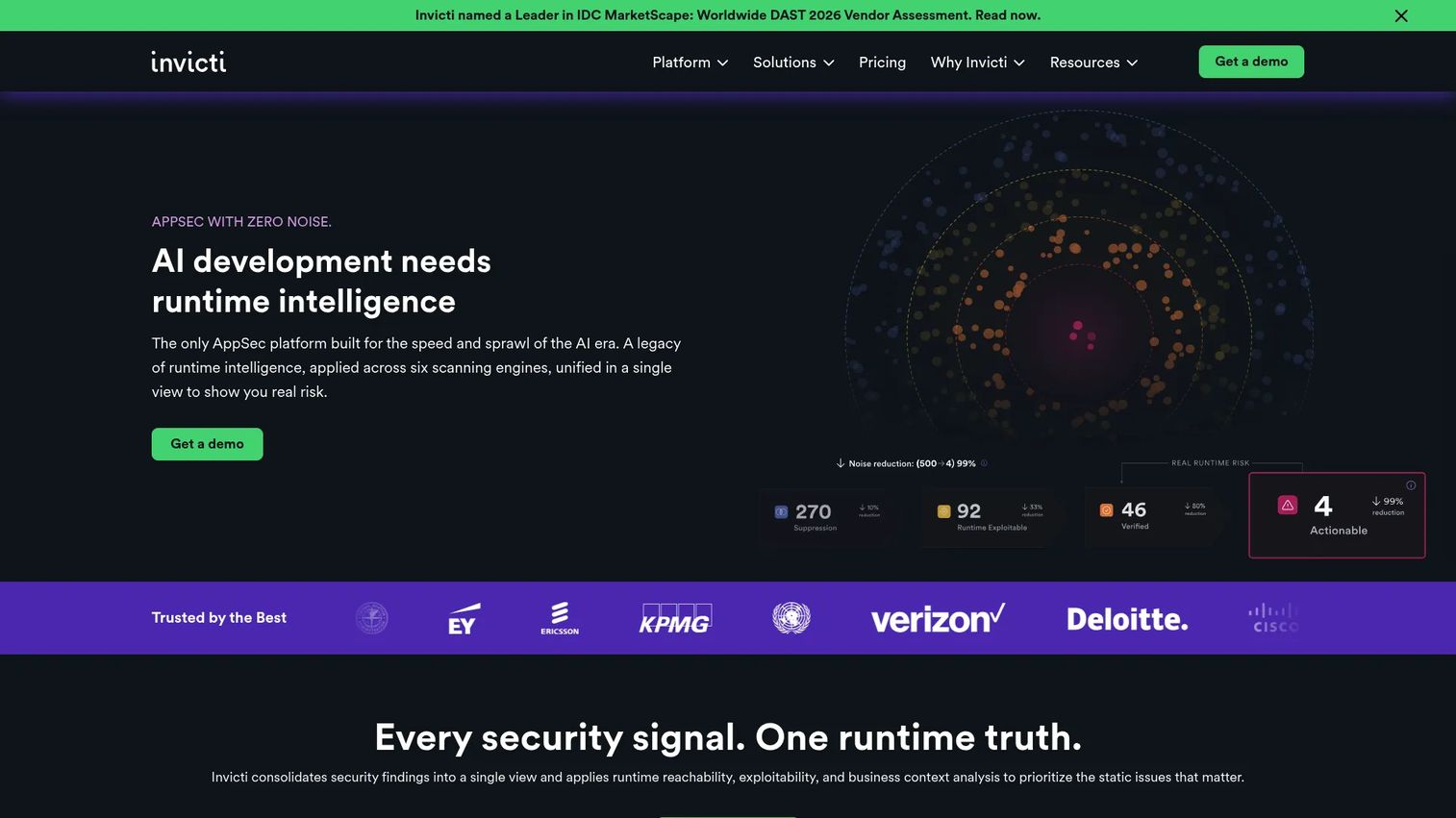
Invicti is an enterprise application security platform built for finding, prioritizing, and validating vulnerabilities across web applications, APIs, and software supply chains. Its proof-based scanning goes a step further than most DAST tools by confirming that a found vulnerability is actually exploitable before surfacing it, which cuts down on false positives that slow remediation teams. The platform also covers SAST, software composition analysis, and infrastructure-as-code security alongside dynamic testing.
Best for: Enterprise application security and development teams managing large, complex web application portfolios that need scalable DAST with low noise.
Key features
- Proof-based dynamic application security testing (DAST)
- Web asset and API discovery with advanced crawling
- SAST, SCA, IaC, secrets, and container security
- CI/CD and developer-workflow integrations
- Agentic penetration testing capability
Why choose Invicti: The proof-based approach reduces time spent investigating false positives. Teams running many web properties simultaneously benefit from centralized visibility and SDLC integration.
Invicti pricing: Most packages use custom quotes. The Agentic Pentest offering is publicly priced at a maximum of $500 per pentest. Web + API, AppSec Core, and AppSec Flex plans require contacting sales.
G2 rating: 4.3/5
3. Astra Pentest
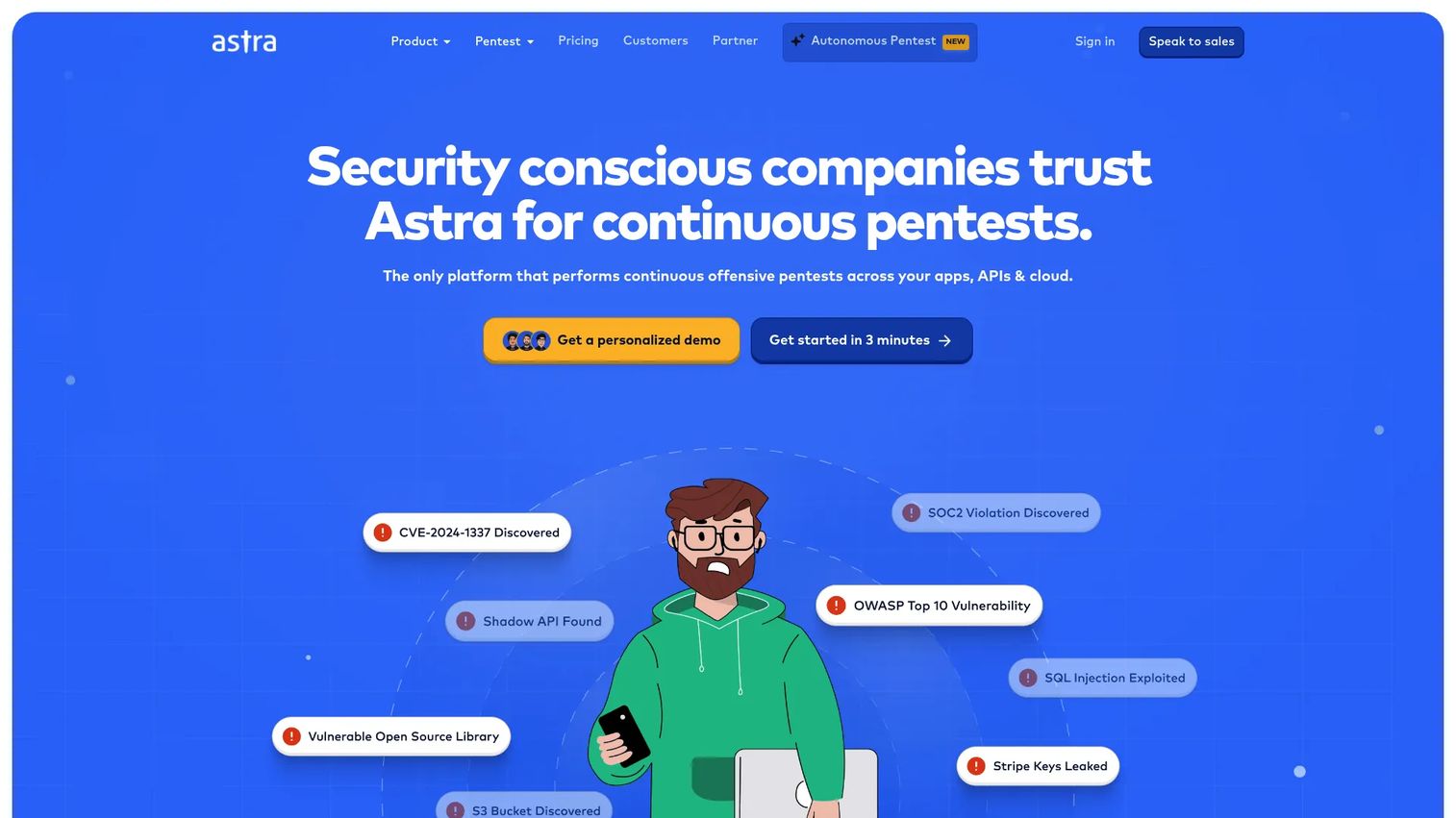
Astra Pentest combines AI-powered autonomous testing with certified expert-led penetration testing, running more than 15,000 test cases across web applications, APIs, cloud environments, and network infrastructure. The platform produces compliance-mapped reports that buyers and auditors can read without needing to decode raw scanner output, which is a practical advantage when a deal stalls on a security questionnaire. Teams preparing for SOC 2, PCI DSS, ISO 27001, or enterprise procurement reviews regularly use it to generate evidence of third-party testing.
Best for: SaaS teams preparing for enterprise security reviews, compliance audits, or product launches where third-party pentest evidence is required.
Key features
- Automated DAST scanning with 15,000+ test cases
- Manual penetration testing by certified security experts
- AI-assisted threat modeling and remediation guidance
- Compliance-mapped reports for major frameworks
- Web app and API testing with retest support
Why choose Astra Pentest: When a buyer asks for a pentest report rather than just a scanner output, Astra produces the right artifact. The combination of automation and human review also reduces the risk of missing business-logic vulnerabilities that automated tools commonly skip.
Astra Pentest pricing: Scanner Lite starts at $69/month. The Scanner plan is $199/month. Annual plans include Scanner Agency at $2,999/year, Pentest Auto at $5,999/year, and Pentest Expert from $9,999/year. Enterprise pricing is custom.
G2 rating: 4.6/5
4. Sucuri
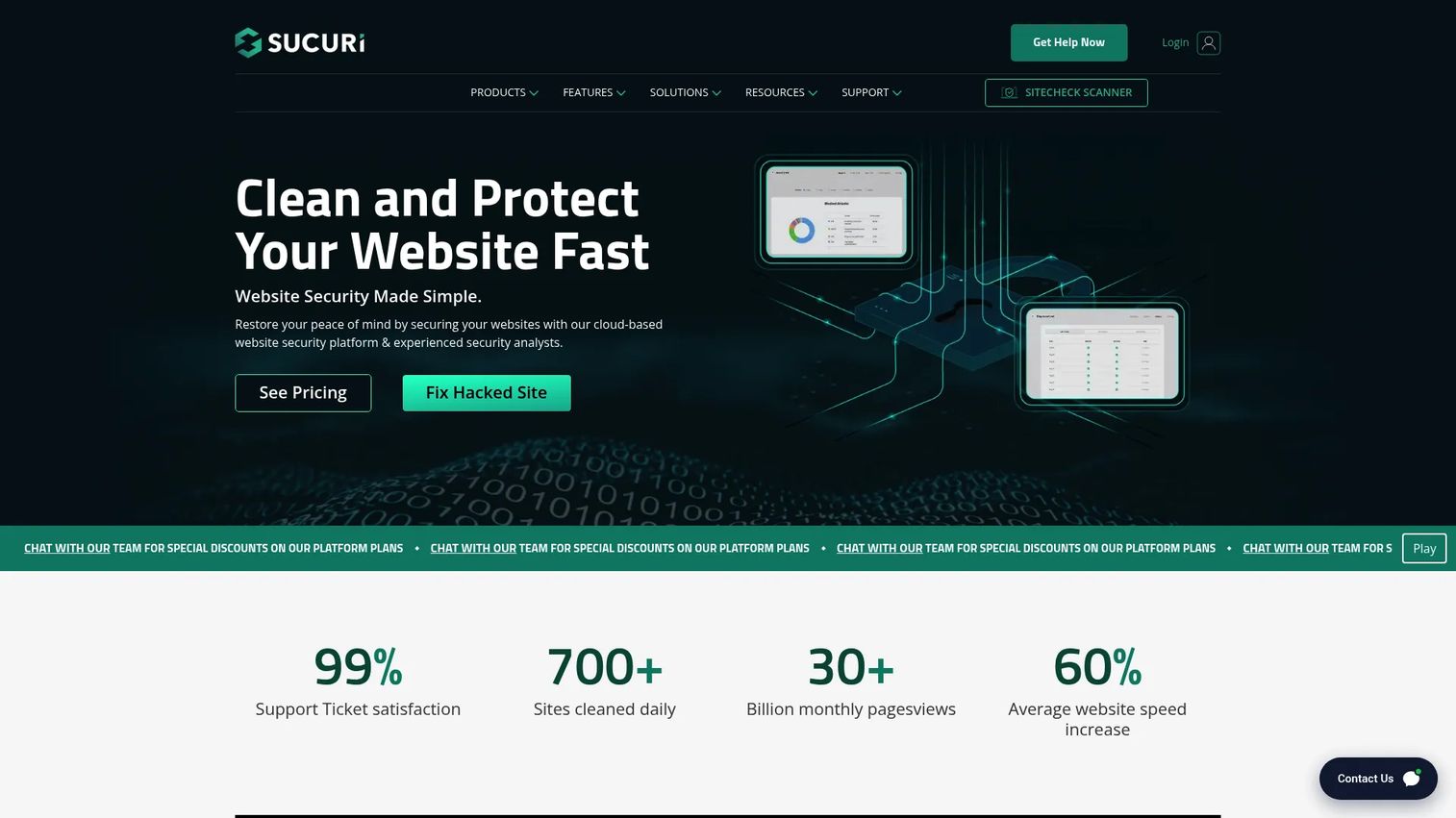
Sucuri is a website security platform well known for managed malware removal, web application firewall protection, blacklist monitoring, and CDN performance. It operates at the DNS and proxy layer, meaning protection activates without requiring server-side code changes. For CMS-heavy sites running WordPress, Joomla, or Magento, Sucuri's malware cleanup includes file-level remediation and blacklist removal requests to Google, Bing, and major security vendors.
Best for: Website owners and agencies that need managed malware cleanup plus ongoing firewall protection, particularly for CMS-based sites.
Key features
- Cloud-based web application firewall with virtual patching
- Managed malware removal and hack cleanup
- Blacklist, DNS, uptime, redirect, and SEO spam monitoring
- Advanced DDoS mitigation
- Global Anycast CDN and performance optimization
Why choose Sucuri: The combination of cleanup and prevention in a single subscription removes the gap between "we found the infection" and "we fixed it." Agencies managing multiple client sites also benefit from the centralized monitoring view.
Sucuri pricing: The Basic Firewall plan starts at $9.99/month. Pro Firewall is $19.98/month. Platform plans that include malware cleanup start at $229/year (Basic), $339/year (Pro), and $549/year (Business). Multi-site plans are priced on request.
5. SiteLock
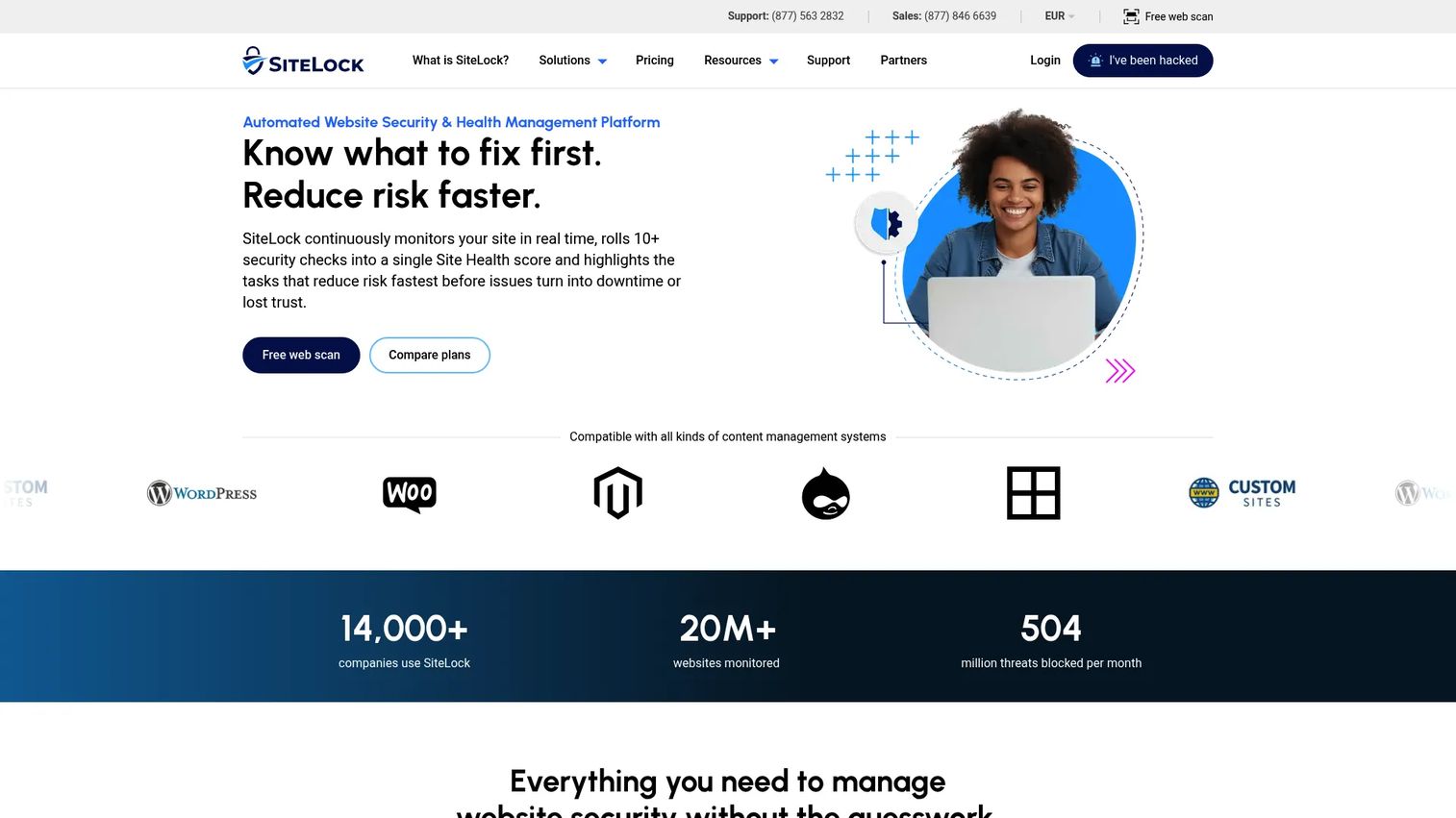
SiteLock provides cloud-based website security including daily scanning, automatic malware removal, CMS vulnerability patching, WAF with CDN, bot blocking, DDoS protection, and site backups. The platform presents risk through a site health scoring model that shows owners exactly which issues need attention and in what order, which suits non-technical buyers who need clear direction without a security background.
Best for: Small businesses and ecommerce site owners that want a guided, packaged view of site risk alongside automatic remediation.
Key features
- Daily website, code, database, and vulnerability scanning
- Automatic malware removal and CMS vulnerability patching
- WAF, CDN, malicious bot blocking, and DDoS protection
- Site health scoring with prioritized remediation tasks
- Secure site backups
Why choose SiteLock: The health-score interface reduces the cognitive burden of interpreting raw scanner findings. Teams that want monitoring, patching, and cleanup in a single subscription without manual triage will find the format practical.
SiteLock pricing: The Basic plan starts at $19.99/month. Pro is $29.99/month and adds WAF, CDN, and DDoS protection. Business is $44.99/month and adds larger backups, backdoor protection, PCI reporting, and custom WAF rules. Annual billing includes two months free.
G2 rating: 2.4/5
6. GoDaddy Website Security
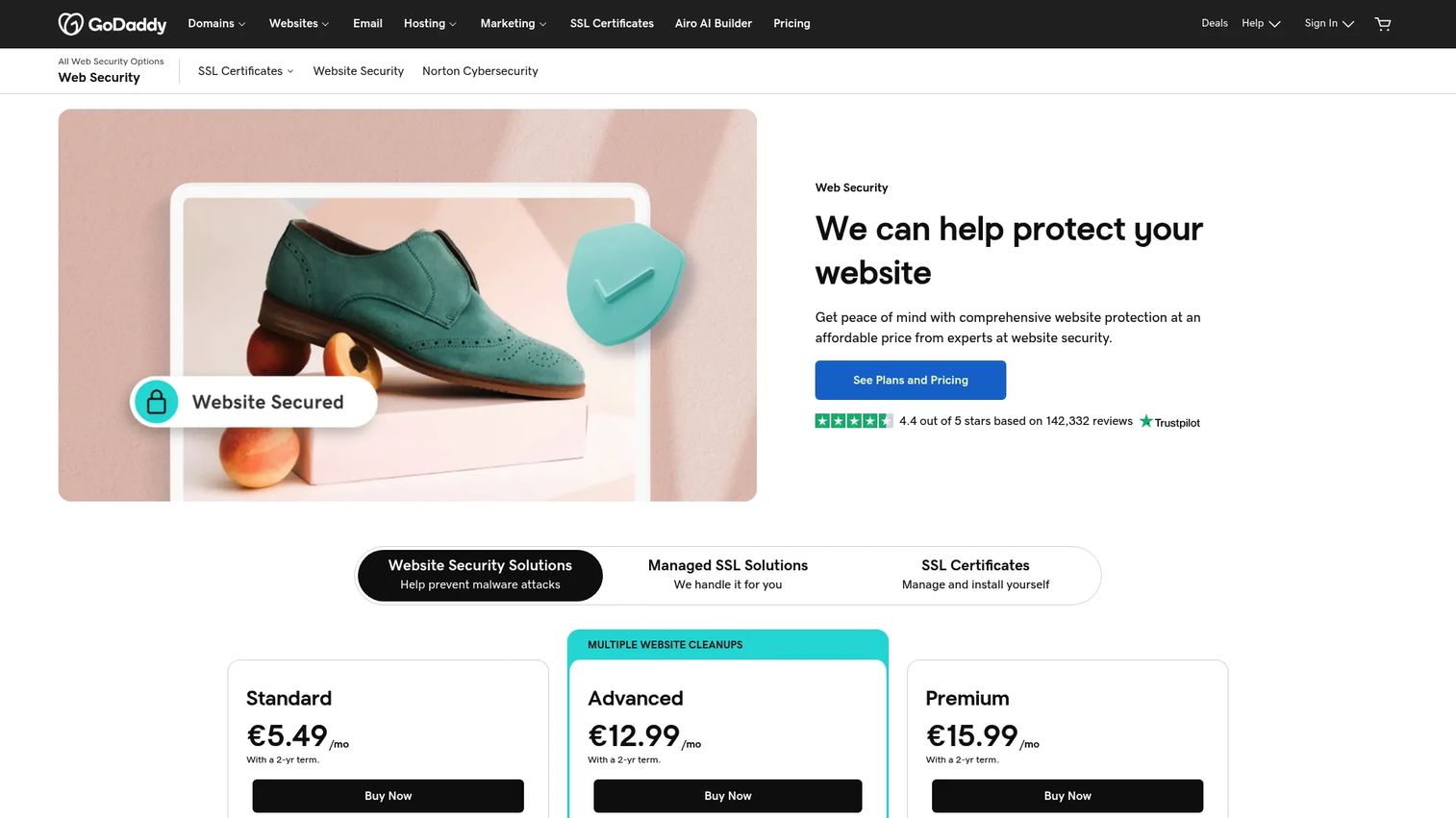
GoDaddy Website Security delivers malware scanning, cleanup, WAF, DDoS protection, backups, SSL, and CDN capabilities through GoDaddy's hosting and domain management environment. For website owners already managing DNS, hosting, and email through GoDaddy, adding security protection through the same account reduces the overhead of managing separate vendor relationships.
Best for: Small businesses running GoDaddy-hosted websites that want security management inside their existing GoDaddy account.
Key features
- Malware scanning and managed cleanup
- Web application firewall and DDoS protection
- Secure daily website backups
- Continuous security and blacklist monitoring
- SSL encryption and CDN performance optimization
Why choose GoDaddy Website Security: The workflow advantage is real for teams already inside GoDaddy's environment. The Standard plan handles one cleanup per year, while Premium covers unlimited repairs and backup storage.
GoDaddy Website Security pricing: Standard starts at $6.99/month with a 2-year term, covering one cleanup per year. Advanced is $11.99/month and includes five cleanups plus 25 GB backup. Premium is $16.99/month with unlimited cleanups and unlimited backup storage.
G2 rating: 4.1/5
7. Imperva App Protect
Imperva App Protect is an enterprise application security platform that consolidates WAF protection, advanced bot management, API security, DDoS mitigation, account takeover protection, and client-side protection for digital skimming attacks. The platform covers web applications, mobile apps, and APIs across cloud, on-premises, and hybrid environments from a single policy model.
Best for: Enterprise organizations with high-traffic applications and APIs that need consolidated protection across multiple attack vectors under a single security policy.
Key features
- WAF protection against SQL injection, XSS, and OWASP Top 10 attacks
- Advanced bot management for web, mobile, and API traffic
- API security with discovery and sensitive-data classification
- DDoS protection and account takeover defense
- Client-side protection for PCI DSS 4.0 compliance
Why choose Imperva App Protect: The consolidated policy model reduces the number of separate security controls a team must configure and maintain. Teams facing bot abuse, API scraping, and credential stuffing alongside standard web attacks benefit from the integrated coverage.
Imperva App Protect pricing: Four subscription plans exist (App Protect Core, Professional, Enterprise, and 360), but pricing is not publicly displayed. Contact Imperva for a quote.
G2 rating: 4.1/5
8. Acunetix by Invicti
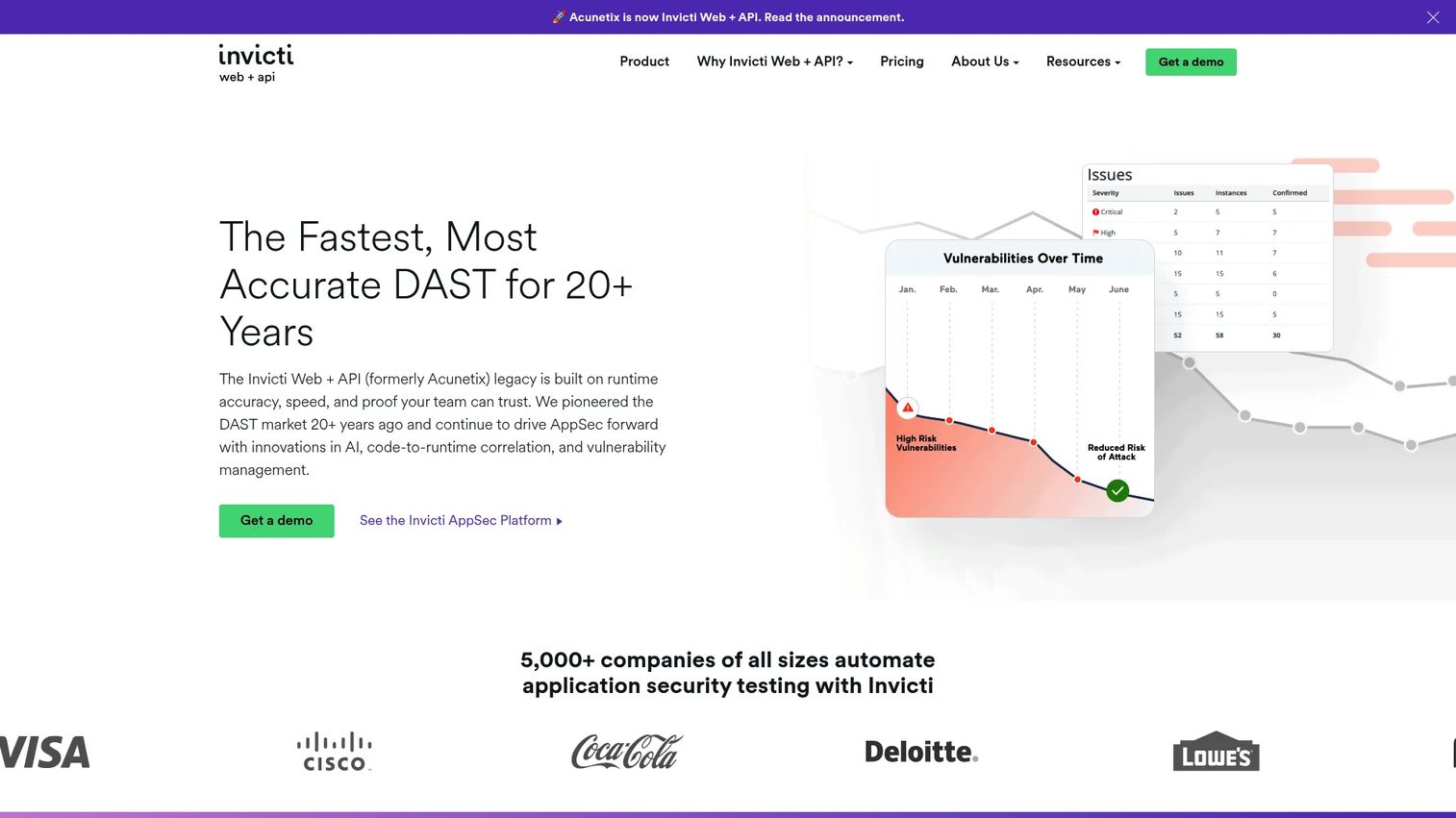
Acunetix by Invicti is a web application and API security scanner that discovers, tests, validates, and surfaces vulnerabilities across modern web apps and APIs. The tool covers SOAP, REST, and GraphQL APIs alongside deep crawling of JavaScript-heavy applications, making it practical for teams working with contemporary frontend architectures. It is now marketed under the Invicti Web + API product line.
Best for: Security and development teams that need automated, proof-based web vulnerability scanning with issue-tracker integrations for developer-friendly workflows.
Key features
- Automated web application vulnerability scanning
- API scanning for SOAP, REST, and GraphQL
- Proof-of-exploit vulnerability validation
- Deep crawling of JavaScript-heavy applications
- CI/CD and issue-tracker integrations
Why choose Acunetix by Invicti: The proof-of-exploit validation reduces time spent chasing false positives. Developer-friendly integrations make it easier to route findings directly into the existing remediation workflow rather than a separate security backlog.
Acunetix by Invicti pricing: The Agentic Pentest offering is publicly priced at a maximum of $500 per pentest. The Web + API plan uses a custom quote. Contact sales for subscription pricing.
9. Detectify
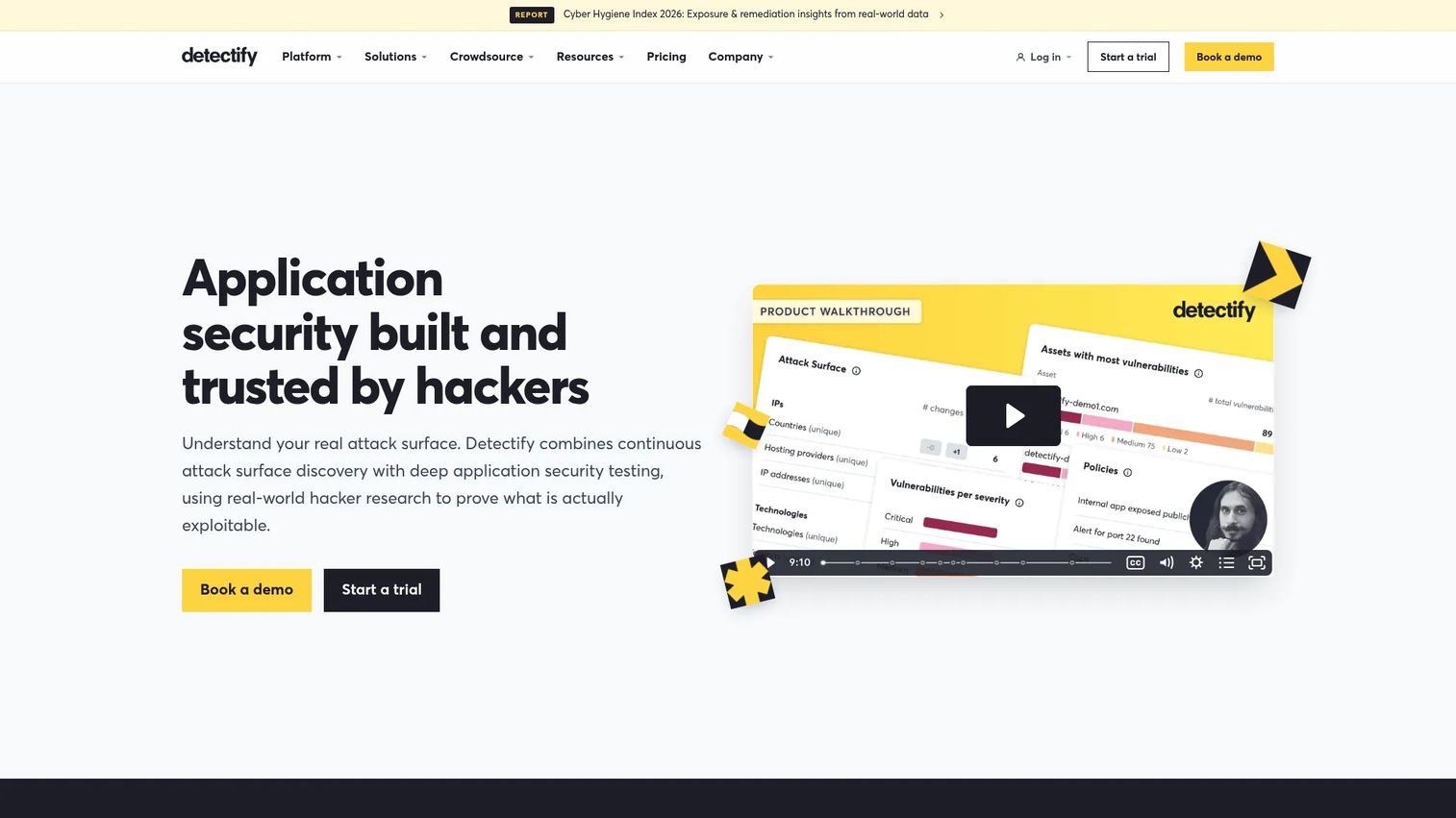
Detectify is an external attack surface management and application security platform that continuously discovers web assets and identifies exploitable vulnerabilities using a model informed by its security research community. When subdomains, forgotten staging environments, or newly exposed services appear, Detectify surfaces them automatically rather than waiting for a manual scan to be triggered. REST and GraphQL API testing and authenticated application scanning are included.
Best for: AppSec and security teams managing many web assets, subdomains, and exposed services that need continuous discovery and monitoring.
Key features
- Continuous external attack surface discovery and monitoring
- Payload-based web application scanning with crawling and fuzzing
- REST and GraphQL API security testing
- Authenticated application testing
- Internal network and PCI ASV scanning
Why choose Detectify: The asset discovery capability is the practical differentiator for teams that have grown beyond a single website. Knowing what is exposed before an attacker finds it changes the security conversation from reactive to proactive.
Detectify pricing: Starter is available from €0 annually. Standard starts from €2,500/year. Professional starts from €5,000/year. Enterprise starts from €15,000/year. Per-target fees may apply in addition to platform fees.
G2 rating: 4.5/5
10. Pentest-Tools.com
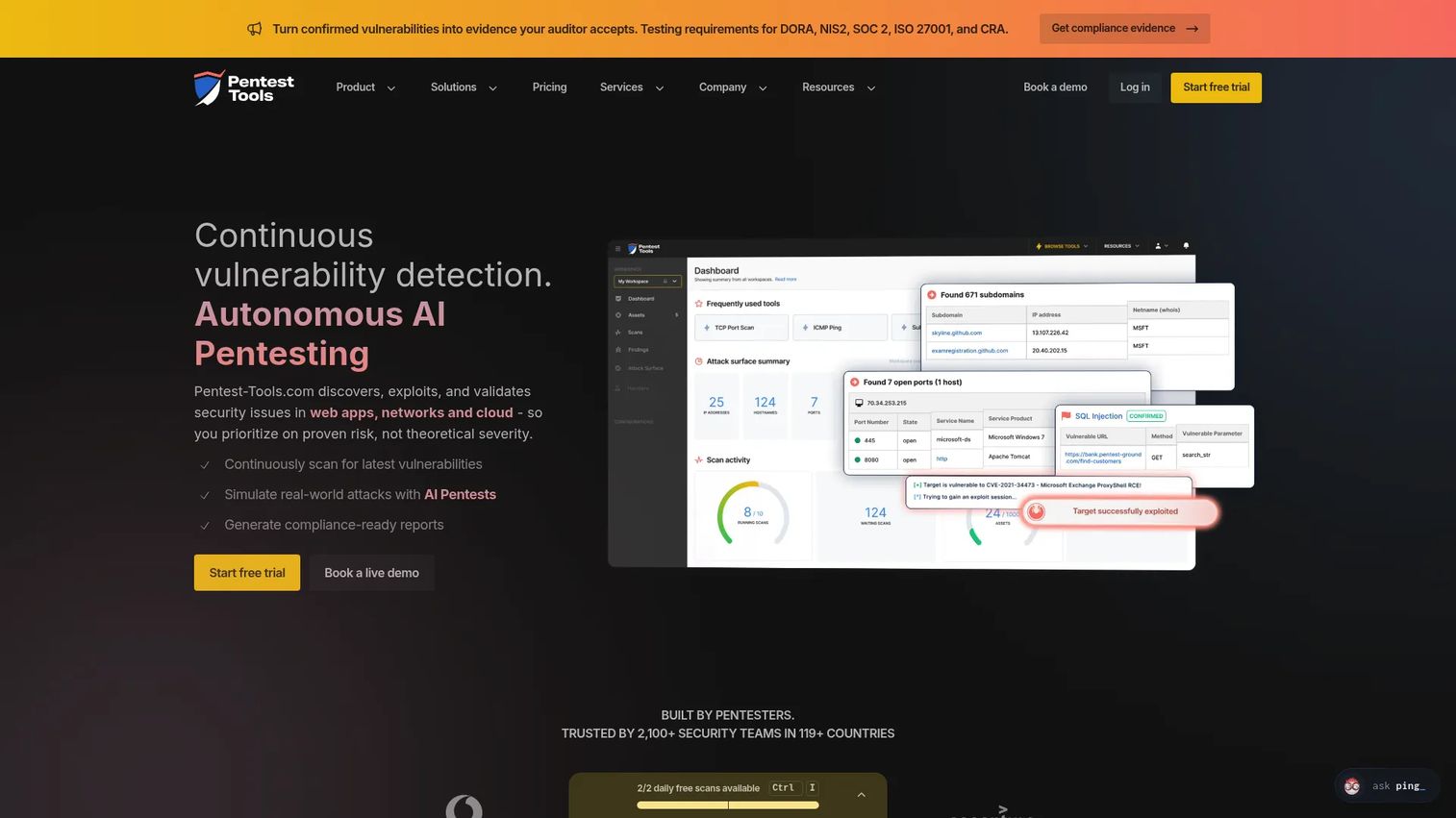
Pentest-Tools.com is an offensive security platform for continuous vulnerability detection, autonomous AI pentesting, and human-led penetration testing across web applications, networks, APIs, and cloud assets. Security teams and MSSPs use it for repeatable scanning workflows, exploit validation with automatic evidence capture, and compliance-ready reporting without building and maintaining their own toolchain.
Best for: Security teams, consultants, and MSSPs running structured web security checks that need scanning, exploit validation, and reporting in a single platform.
Key features
- Network, web application, API, and cloud vulnerability scanning
- Autonomous AI pentests with validated findings and audit logs
- Exploit validation with automatic evidence capture
- Authenticated scanning and attack surface mapping
- Compliance-ready reporting and scan automation
Why choose Pentest-Tools.com: The toolbox model suits teams that prefer hands-on control over which scans run and when, rather than a fully managed service. The exploit validation capability produces evidence that answers "is this actually exploitable?" before escalating a finding.
Pentest-Tools.com pricing: NetScan starts at $96/month for 16 assets. AppScan starts at $140/month for 5 assets. Exploit starts at $190/month for 5 assets. A free edition and a 7-day trial are available.
G2 rating: 4.8/5
11. Beagle Security
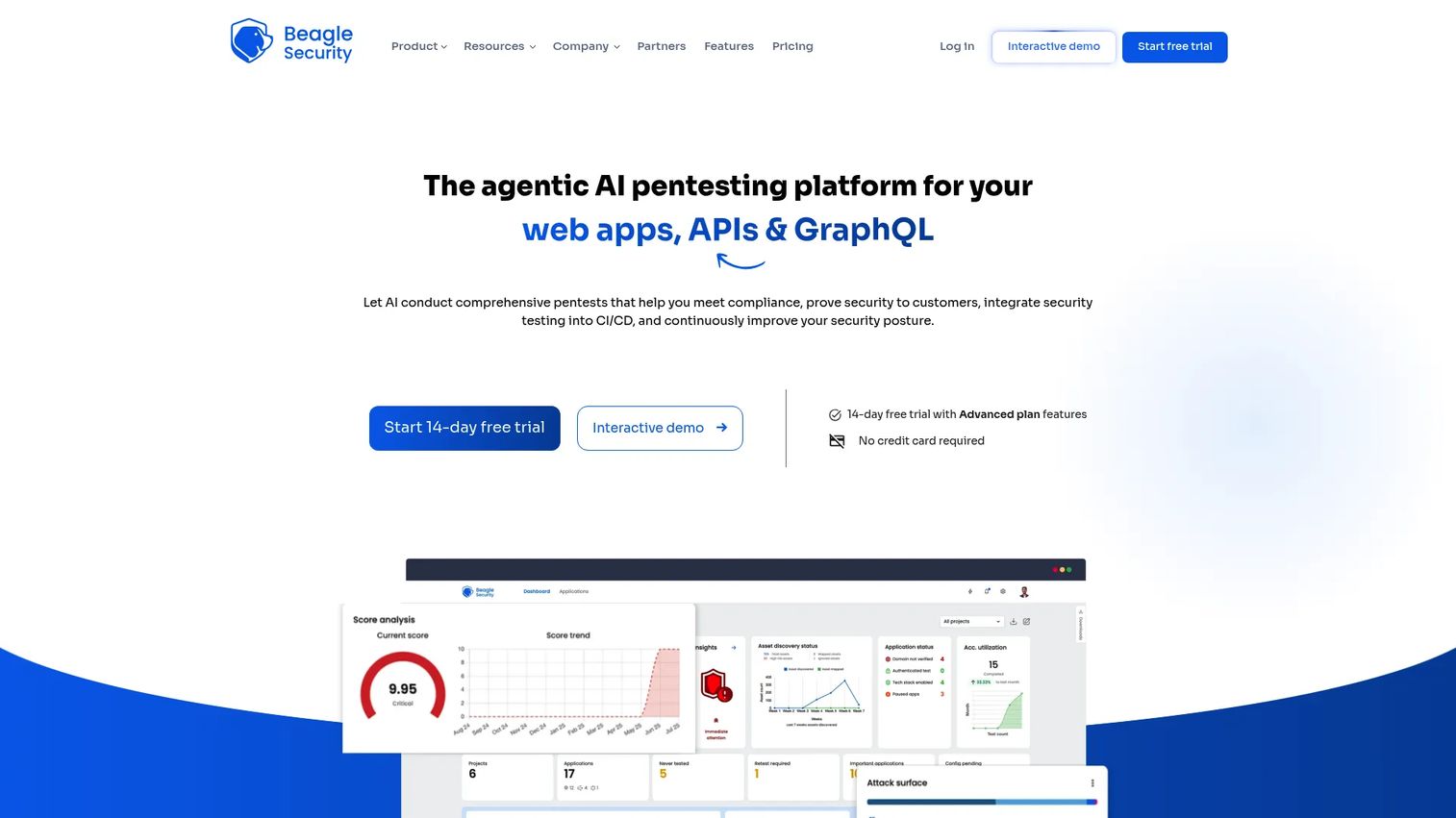
Beagle Security is an AI-powered automated penetration testing platform for web applications, APIs, and GraphQL. It runs more than 3,000 vulnerability test cases including authenticated testing and business-logic validation, then produces compliance-mapped reports for HIPAA, PCI DSS, GDPR, ISO 27001, and SOC 2. The retest workflow lets teams verify that a fix actually resolved the finding without scheduling a new full engagement.
Best for: Development and security teams that need automated pentest-style reports with compliance mapping and retest verification.
Key features
- Automated penetration testing across 3,000+ vulnerability types
- Authenticated testing and business-logic vulnerability detection
- Compliance-mapped reports for HIPAA, PCI DSS, GDPR, ISO 27001, SOC 2
- Web app, API, and GraphQL coverage
- Retest workflows to verify remediation
Why choose Beagle Security: The compliance-mapped output makes it easier to share findings with non-technical stakeholders and respond to external auditors without translating raw scanner data. A free tier allows evaluation before committing to a paid plan.
Beagle Security pricing: A free plan is available with limited monthly tests. Essential is $99/month with 2 tests included. Advanced is $299/month with 15 tests. Enterprise pricing is custom. A 14-day Advanced trial is available.
G2 rating: 4.7/5
12. BitNinja
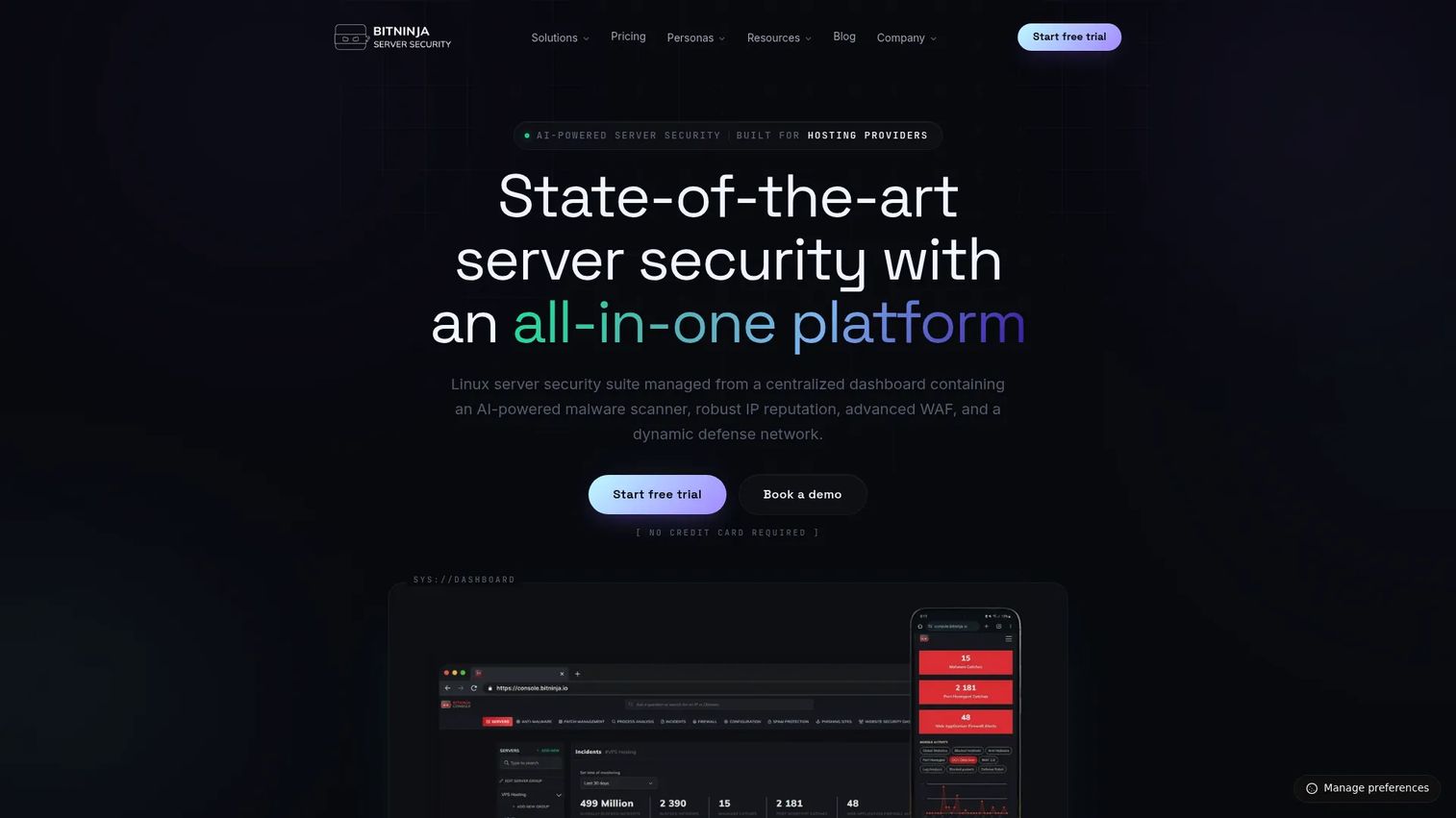
BitNinja is an AI-powered Linux server security platform providing centralized, multi-layered protection for hosting providers, server owners, VPS environments, and shared servers. It operates at the server layer rather than the application layer, which means a single deployment protects every website running on that server simultaneously. The global crowd-sourced defense network shares threat intelligence across all BitNinja-protected servers.
Best for: Hosting providers and Linux server operators managing multiple websites that need server-level protection covering all hosted sites from a centralized dashboard.
Key features
- AI-powered malware detection across all hosted sites
- WAF protection against SQL injection, XSS, and CMS exploits
- Global IP reputation and crowd-sourced threat intelligence
- Lightweight security agent with centralized cloud dashboard
- Crowd-sourced Defense Network for shared threat data
Why choose BitNinja: The server-layer model means protection applies to every site on the server without configuring each site individually. Hosting providers and agencies managing dozens of client sites find this operationally more practical than per-site licensing.
BitNinja pricing: A free plan is available for VPS environments. The Enhance Control Panel option charges $0.10 per website with a minimum billing amount of $5. Larger shared-hosting and VPS deployments are priced through a custom quote.
G2 rating: 4.6/5
13. AppTrana
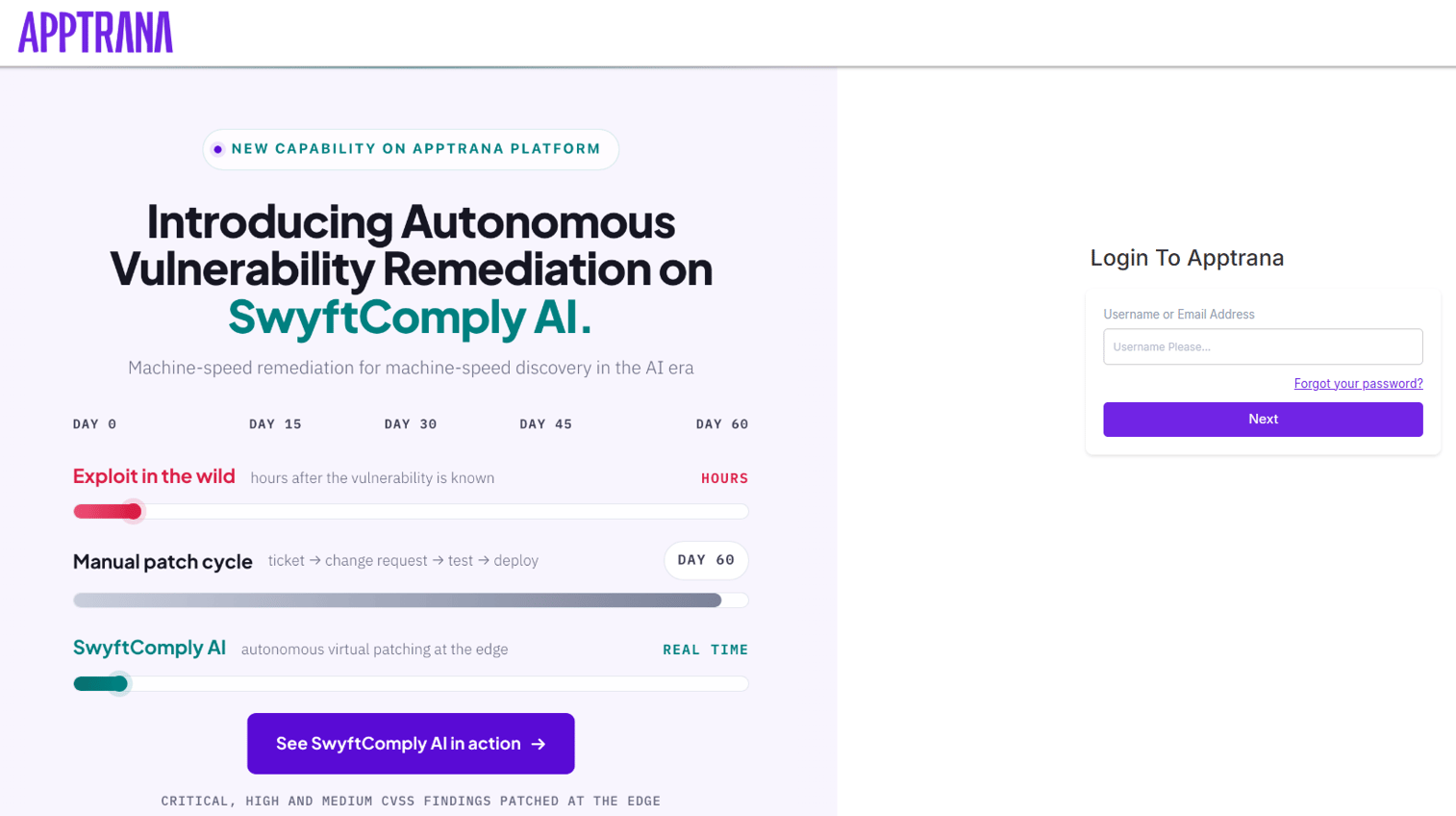
AppTrana is Indusface's managed Web Application and API Protection (WAAP) platform for web applications, APIs, and AI workloads. The managed service model means AppTrana's security team tunes WAF rules, handles false positives, and applies virtual patches based on scan findings, rather than leaving that work to the buyer. DDoS protection and bot mitigation are included alongside continuous DAST vulnerability scanning.
Best for: Organizations that need WAF protection with managed security tuning and do not want to maintain WAF rule sets internally.
Key features
- Web application firewall (WAF)
- API protection and discovery
- DDoS and bot mitigation
- Continuous DAST vulnerability scanning
- 24x7 managed security services and autonomous remediation
Why choose AppTrana: The managed tuning service removes one of the most common WAF failure modes: Rule sets that are too aggressive (blocking legitimate traffic) or too permissive (missing attacks). Teams without dedicated security engineers get a maintained, tuned firewall rather than one that drifts.
AppTrana pricing: The Advanced plan starts at $99/app/month on a monthly basis. Premium and Enterprise plans use custom annual pricing.
G2 rating: 4.8/5
14. ImmuniWeb Discovery
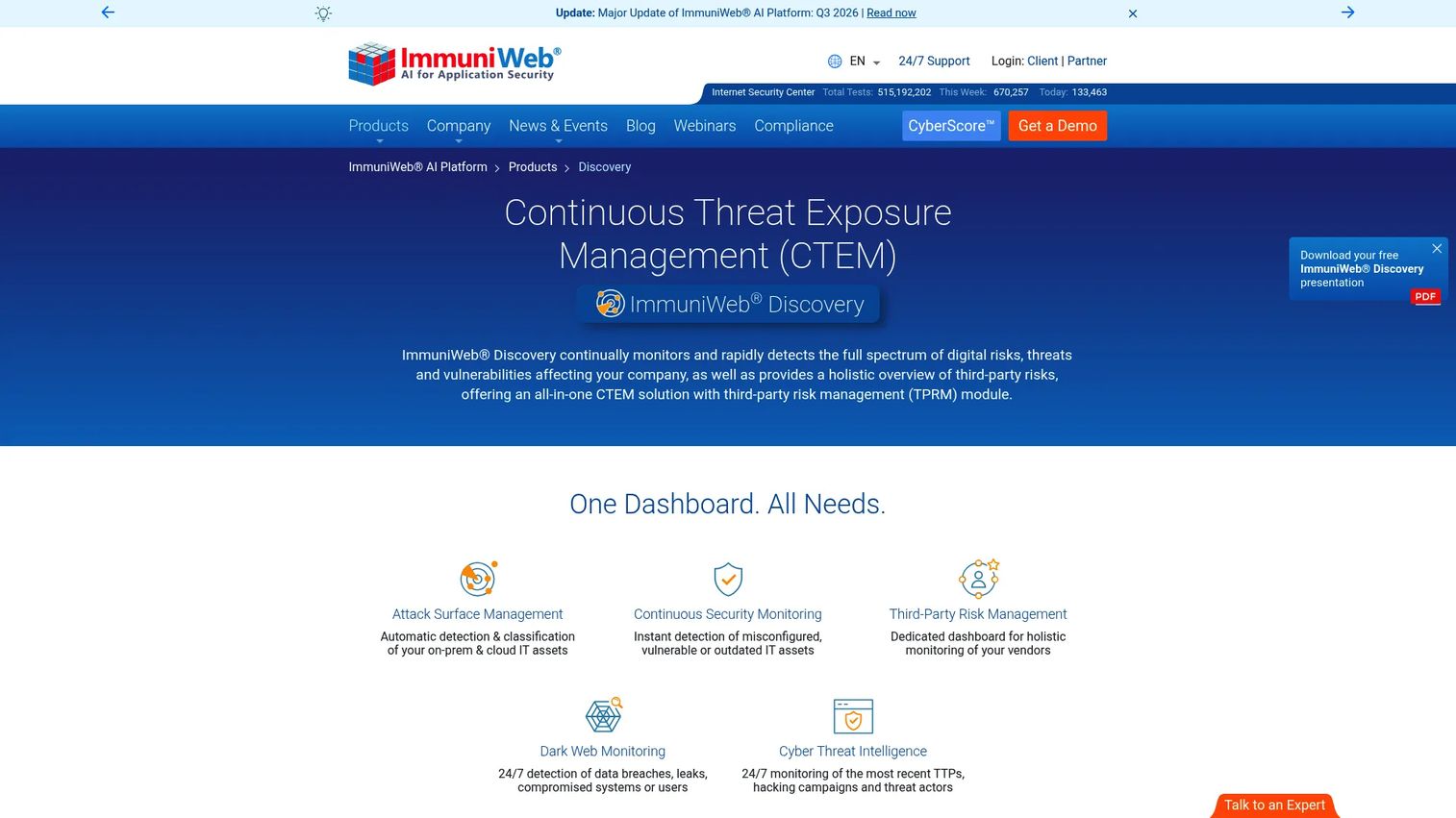
ImmuniWeb Discovery is a continuous threat exposure management platform covering external attack surface monitoring, cloud security posture, third-party risk, dark web monitoring, and cyber threat intelligence. Enterprise teams use it to build an inventory of all internet-facing assets before deciding where to apply targeted scanning or WAF protection.
Best for: Enterprises that need to discover and continuously monitor web-facing assets, shadow IT, vendor exposures, and dark web mentions before applying targeted controls.
Key features
- External attack surface discovery and monitoring
- Dark web exposure monitoring and cyber threat intelligence
- Third-party risk and supply chain monitoring
- Cloud security posture management
- Network infrastructure and SaaS monitoring
Why choose ImmuniWeb Discovery: The discovery-first approach addresses a gap that targeted scanners miss: Teams often do not know all the assets that need protecting. Identifying forgotten subdomains, misconfigured cloud storage, and exposed credentials before an attacker finds them changes the risk calculation.
ImmuniWeb Discovery pricing: Packages are priced in EUR on an annual basis. The ASM package starts at €1,495/month. The Dark Web package is also €1,495/month. Corporate Pro is €2,495/month. The Ultimate package is €4,495/month. Packages cover up to 10,000 assets or incidents per company.
15. Akamai Kona Site Defender
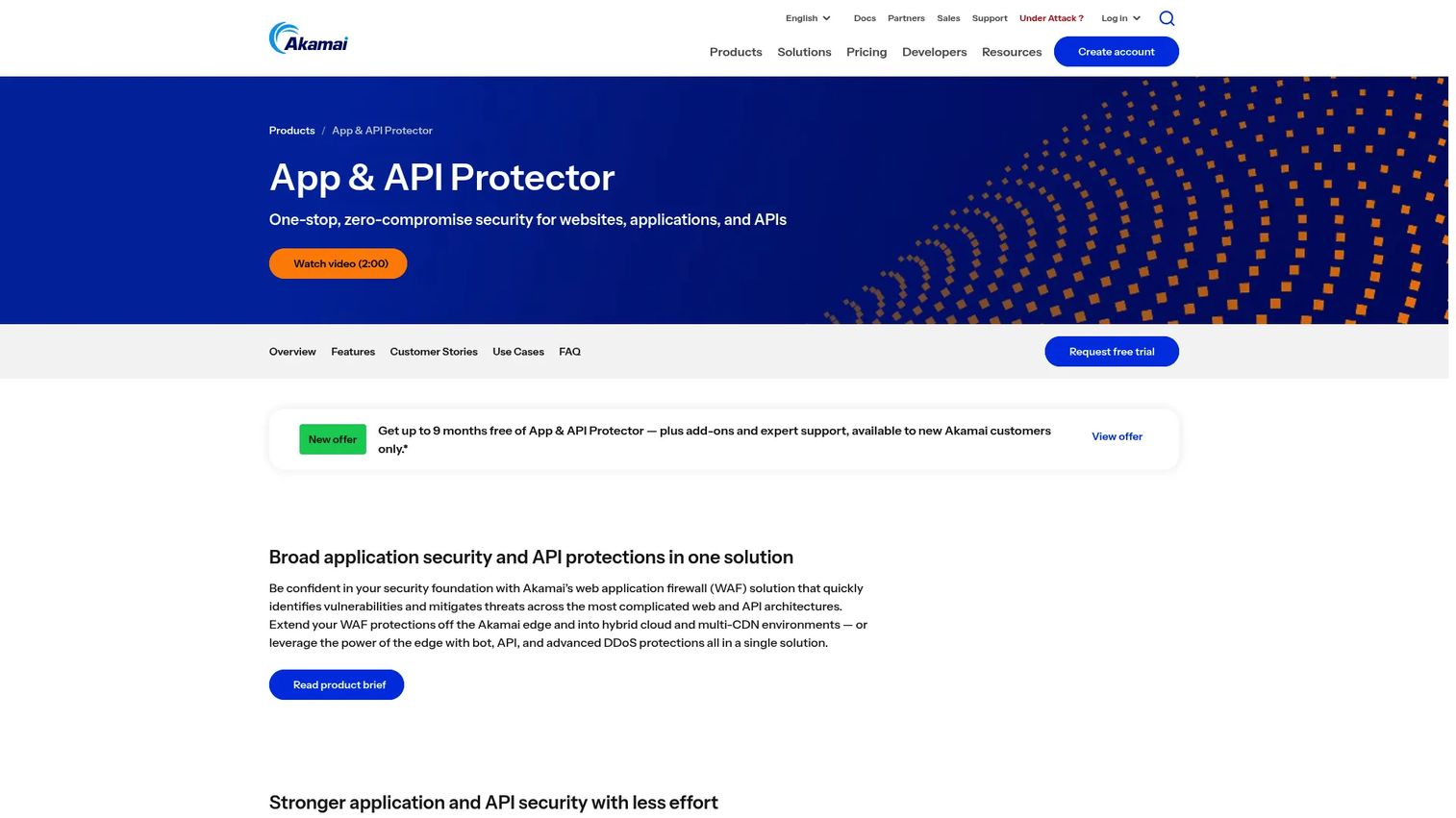
Akamai Kona Site Defender is a cloud-based web application and API security product delivered through Akamai's edge network. It applies WAF rules, DDoS defense, rate controls, and automatic API discovery at the network edge, meaning attacks are stopped before they reach the origin server. For large enterprises running globally distributed, high-traffic applications, the edge delivery model provides both protection scale and performance.
Best for: Large enterprises with globally distributed, high-traffic web applications and APIs that need WAF and DDoS protection delivered at edge scale.
Key features
- Web application firewall with configurable application-layer protections
- DDoS protection against volumetric and application-layer attacks
- Automatic API discovery and API security controls
- Site Shield origin server protection
- Security monitoring, analytics, and custom policy controls
Why choose Akamai Kona Site Defender: For applications where availability is the primary risk, edge-layer protection at Akamai's scale is difficult to replicate with on-premises or small-cloud deployments. The edge delivery model also maintains application performance while filtering attacks.
Akamai Kona Site Defender pricing: Contact Akamai for a quote.
G2 rating: 4.7/5
Considerations when choosing website security software
Match the tool to the risk profile
A CMS site infected with malware needs cleanup and a WAF, not a DAST scanner. A SaaS web application preparing for enterprise procurement needs a pentest report, not just a firewall. Defining the attack surface first (website, web app, server, APIs, external assets) points directly to the right tool type. Buying a scanner when you need cleanup, or a WAF when you need asset discovery, creates a gap that attackers will find.
Check remediation depth before buying
Detection and remediation are separate capabilities. Some tools scan and report. Others scan, clean, and re-verify. For presales teams supporting security diligence conversations, the question "who performs remediation and what is the response time?" is one buyers ask consistently. Verify cleanup response times, blacklist removal workflows, virtual patching availability, and retest processes before committing to a plan.
Validate reporting quality for security reviews
Enterprise buyers, auditors, and procurement teams expect reports that map findings to known frameworks like the OWASP Top 10 or specific compliance standards. Raw vulnerability lists are useful internally but rarely sufficient for external evaluation. Look for executive summaries alongside technical evidence, compliance exports, and remediation status tracking. Presales teams evaluating application security testing software for buyers will find this criterion consistently appears in security questionnaires.
Review integrations and workflow fit
Findings that stay inside a security tool do not get fixed. Check whether the product integrates with your CI/CD pipeline, issue tracker (Jira, GitHub), SIEM, or CRM. For teams using API testing tools alongside website security scanning, integration depth determines whether findings flow into one queue or create separate tracking overhead.
Compare total cost, not entry price
Website security pricing models vary significantly. SiteLock charges per site monthly. AppTrana charges per application per month. Detectify charges per platform tier plus potential per-target fees. ImmuniWeb Discovery charges per asset package annually. BitNinja charges per website hosted. Entry price alone does not predict actual spend. Calculate cost against the number of sites, apps, domains, or servers you need to protect before comparing plans across vendors.
Conclusion
Website security software covers more ground than any single tool can handle alone. The right choice depends on whether the primary risk is malware on a CMS site, exploitable vulnerabilities in a web application, DDoS attacks on a high-traffic platform, or unknown assets sitting exposed at the edge.
For continuous vulnerability monitoring, Intruder fits teams that need an ongoing signal without manual scan triggers. Invicti and Acunetix by Invicti suit enterprise teams running large web app portfolios with DAST requirements. Astra Pentest and Beagle Security cover pentesting needs where third-party evidence is required. Pentest-Tools.com suits security consultants and MSSPs running hands-on web checks.
For CMS and SMB protection, Sucuri handles malware cleanup plus firewall protection. SiteLock and GoDaddy Website Security work for smaller sites that need packaged, guided monitoring and remediation.
For enterprise WAF and edge defense, Imperva App Protect, AppTrana, and Akamai Kona Site Defender each bring different strengths around managed services, edge scale, and consolidated API protection.
For attack surface visibility, Detectify and ImmuniWeb Discovery address the discovery gap. BitNinja handles server-level protection for hosting environments managing many sites at once.
If you sell website security software or any security product, buyers ask to see how scanning, remediation, and reporting actually work before they trust your claims. Building interactive demos of those workflows lets prospects experience the product before a call, which shortens the technical validation cycle and reduces the number of "can you show me that again?" follow-up requests.
Start your journey with Guideflow today!
FAQs
For small businesses, the right tool depends on whether the site is already infected or just needs ongoing protection. Sucuri, SiteLock, and GoDaddy Website Security all offer packaged monitoring and cleanup at accessible price points. Verify that cleanup is included in the plan you are evaluating, not sold separately, and check how many malware removal incidents are covered per year before committing.
Antivirus software protects devices and endpoints from malicious files, ransomware, and phishing attempts on local machines. Website security software protects the public-facing web server, CMS files, application layer, incoming traffic, and server-side code. An infected WordPress plugin or an exploitable checkout form requires server-side scanning and cleanup, which endpoint antivirus cannot address.
A WAF is useful when a site faces automated attacks, form abuse, malicious bots, or known vulnerability windows before a code fix can be deployed. Virtual patching through a WAF can block exploit attempts against a known weakness while the underlying software gets patched. A WAF does not replace secure coding or regular patching. Think of it as a layer that reduces risk during the gap between discovery and remediation.
Revenue-critical sites collecting payments, logins, or personal data should run continuous or daily scanning. Static informational sites with no user data carry lower risk and may scan less frequently. The key variable is consequence: A compromised ecommerce checkout or login page causes immediate, measurable damage, so the scan cadence should match the risk level.
Some tools include managed cleanup as part of the subscription, while others detect and report only. Sucuri and SiteLock include malware removal in their platform plans. GoDaddy Website Security includes cleanup incidents per plan tier. Before buying, verify the cleanup response time SLA, whether blacklist removal requests are included, and what reinfection prevention looks like after a site is cleaned.
The most relevant features depend on the attack surface. Malware scanning and cleanup matter most for CMS sites. Vulnerability scanning, DAST, and WAF protection matter most for web applications collecting user data or processing payments. Penetration testing output matters most when enterprise buyers or compliance auditors ask for third-party validation evidence. Attack surface discovery matters most for organizations with many web properties, subdomains, or external vendors. For teams reviewing best endpoint protection software alongside web security, note that the two categories address separate layers and are both necessary in most enterprise environments.
Vulnerability scanning automates the detection of known weaknesses, misconfigurations, and outdated components. It produces a list of findings but does not confirm whether an attacker could actually exploit them or what the business impact would be. Penetration testing validates exploitability, traces the realistic impact path, and often involves human judgment to identify business-logic flaws that automated tools miss. Buyers preparing for enterprise security reviews or compliance certification generally need pentest-level evidence, not just scanner output. Teams evaluating AI software testing tools alongside security scanning will find that the two serve different purposes in the testing workflow.
Pricing varies significantly based on what is being protected and what is included. Per-site models (SiteLock, GoDaddy Website Security) start below $20/month for a single domain. Per-application WAF models (AppTrana) start at $99/app/month. Platform scanning tools (Detectify, ImmuniWeb Discovery) are priced in annual tiers starting at €0 and €1,495/month respectively. Enterprise platforms (Imperva, Akamai) use custom quotes. The number of sites, applications, or servers you need to cover, alongside whether managed remediation is included, determines actual spend more than the advertised entry price.