Trade spend is the second-largest line item on most consumer goods P&Ls, right behind cost of goods. And for most teams, it lives in a tangle of spreadsheets nobody fully trusts. You commit budget, run the promotion, and then spend weeks reconciling what the retailer actually charged against what you planned. The numbers rarely match.
That gap is expensive. The global trade promotion management software market is projected to grow from US$1.5B in 2025 to US$4.8B by 2034, a 14.05% CAGR, according to The Insight Partners (2025). The reason is simple: teams are tired of guessing. They want forecast accuracy they can defend, ROI they can prove, and a single source of truth that survives an audit.
The challenge is that the market is crowded. G2 (2026) lists 59 distinct products in the trade promotion management category. Sorting the enterprise demand-planning suites from the CPG-native trade tools is its own project. If your job involves positioning, proof points, and cross-functional alignment, you already know the pattern: scattered data and inconsistent process kill credibility faster than any single bad number. The same logic applies whether you are evaluating marketing resource management software or trade promotion tools. This guide cuts the noise.
What's inside
This guide is for consumer goods, CPG, grocery, and FMCG teams evaluating trade promotion management software in 2026. It is built for the person who owns the buying decision: someone comparing platforms across planning, execution, settlement, analytics, and retailer collaboration, not just reading a definition.
We selected the eight platforms below based on four criteria: workflow coverage across the full promotion lifecycle, ROI and forecast-accuracy capabilities, data quality and integration depth, and fit for cross-functional teams. We pulled verified ratings and feature sets from each vendor's primary site and G2 listings. Pricing is shown where vendors publish it and noted as quote-based where they do not.
TL;DR
- Best for CPG trade and deduction management: Vividly, built for brands that need forecasting, trade spend analytics, and deduction handling in one place.
- Best for managed trade planning: CPGenius Trade Management System, ideal for brands that want planning plus deduction support as a managed service.
- Best for advanced analytics and optimization: Periscope By McKinsey Advanced Insights, strong for teams that need deep modeling and consulting-grade insight.
- Best for connected, cross-functional planning: Anaplan Platform, suited to finance, supply chain, and trade aligned on one model.
- Best for demand forecasting in an Oracle stack: Oracle Demantra, for teams already inside the Oracle ecosystem.
- Best for end-to-end lifecycle management: TELUS International Exceedra, for large CPG and foodservice teams managing trade spend at scale.
What is trade promotion management software?
Trade promotion management software is a platform that helps consumer goods companies plan, execute, settle, and analyze trade promotions while controlling trade spend and measuring promotion ROI. It replaces the spreadsheet-and-email workflow most teams outgrow once trade spend crosses a meaningful share of revenue.
A complete trade promotion management system typically covers these capabilities:
- Planning and forecasting: Model promotions, predict lift, and forecast volume before committing spend.
- Budget governance: Set, allocate, and track trade budgets against actuals with approval controls.
- Execution and approvals: Route promotion plans through structured workflows so nothing ships without sign-off.
- ROI analysis: Measure incremental volume, margin impact, and return on every promotional dollar.
- Deduction and settlement workflows: Match invoices, validate claims, and reconcile deductions after events.
- Scenario planning and optimization: Run what-if models to find the promotion mix that protects margin. This is the core of trade promotion optimization.
- Retailer and internal collaboration: Align sales, finance, and retail partners on a shared plan.
- Data integration and reporting: Pull syndicated, shipment, and POS data into one reporting layer.
The distinction worth holding onto: a trade promotion management solution handles the operational lifecycle, while trade promotion optimization software adds the predictive and prescriptive layer on top. The strongest platforms deliver trade promotion management and optimization together, so planning and analysis feed each other instead of living in separate tools. The same governance and versioning discipline that makes contract lifecycle management software work applies here too.
When to use trade promotion management software
Not every team needs a dedicated platform on day one. These are the moments when the move pays for itself.
Replace spreadsheets for promotion planning
When promotion plans live in twelve versions of the same workbook, errors compound and accountability disappears. A trade promotion management system gives you one plan of record, with version control and audit trails. If your team spends more time reconciling files than analyzing performance, that is the signal. This is the spreadsheet-replacement use case, and it is the most common trigger for buying trade spend management software.
Forecast promotion lift before committing spend
Guessing at lift is how budgets evaporate. Trade promotion optimization software models expected volume and margin before you fund a promotion, so you commit dollars to events that actually return. Better forecast accuracy directly improves the quality of every downstream decision.
Reconcile deductions and settlement after events
Deductions are where trade spend quietly leaks. Retailers charge against promotions, and matching those claims to plans by hand is slow and error-prone. Deduction management and settlement workflows automate the match, surface disputes, and recover dollars that would otherwise be written off.
Align sales, finance, and retail teams on one planning system
Trade promotion touches sales, finance, and retail partners at once. When each works from a different number, plans drift and trust erodes. A shared planning system keeps everyone on the same proof points, the same way loyalty management software keeps customer programs consistent across channels.
Comparison table
The table below sorts the eight platforms by relevance to trade promotion management software buyers. Pricing reflects what each vendor publishes; many use quote-based models for enterprise deployments. Ratings are pulled from each tool's current G2 listing.
| # | Product | Intent | Key use case | Pricing | G2 rating |
|---|---|---|---|---|---|
| 1 | Vividly | CPG trade and deduction management | Forecasting, trade spend analytics, deductions | Quote-based | 4.8/5 |
| 2 | CPGenius Trade Management System | Managed trade planning | Account planning, execution, P&L tracking | Quote-based (by revenue/volume) | 4.7/5 |
| 3 | Periscope By McKinsey Advanced Insights | Analytics and optimization | Pricing and promotion optimization | Quote-based | 4.8/5 |
| 4 | Anaplan Platform | Connected enterprise planning | Cross-functional scenario modeling | Quote-based | 4.6/5 |
| 5 | Oracle Demantra | Demand forecasting and S&OP | Consensus forecasting, demand planning | Quote-based | 3.7/5 |
| 6 | Acumen Invest | Trade spend analysis and TPO | Investment decisions, optimization | Quote-based | 5.0/5 |
1. Vividly
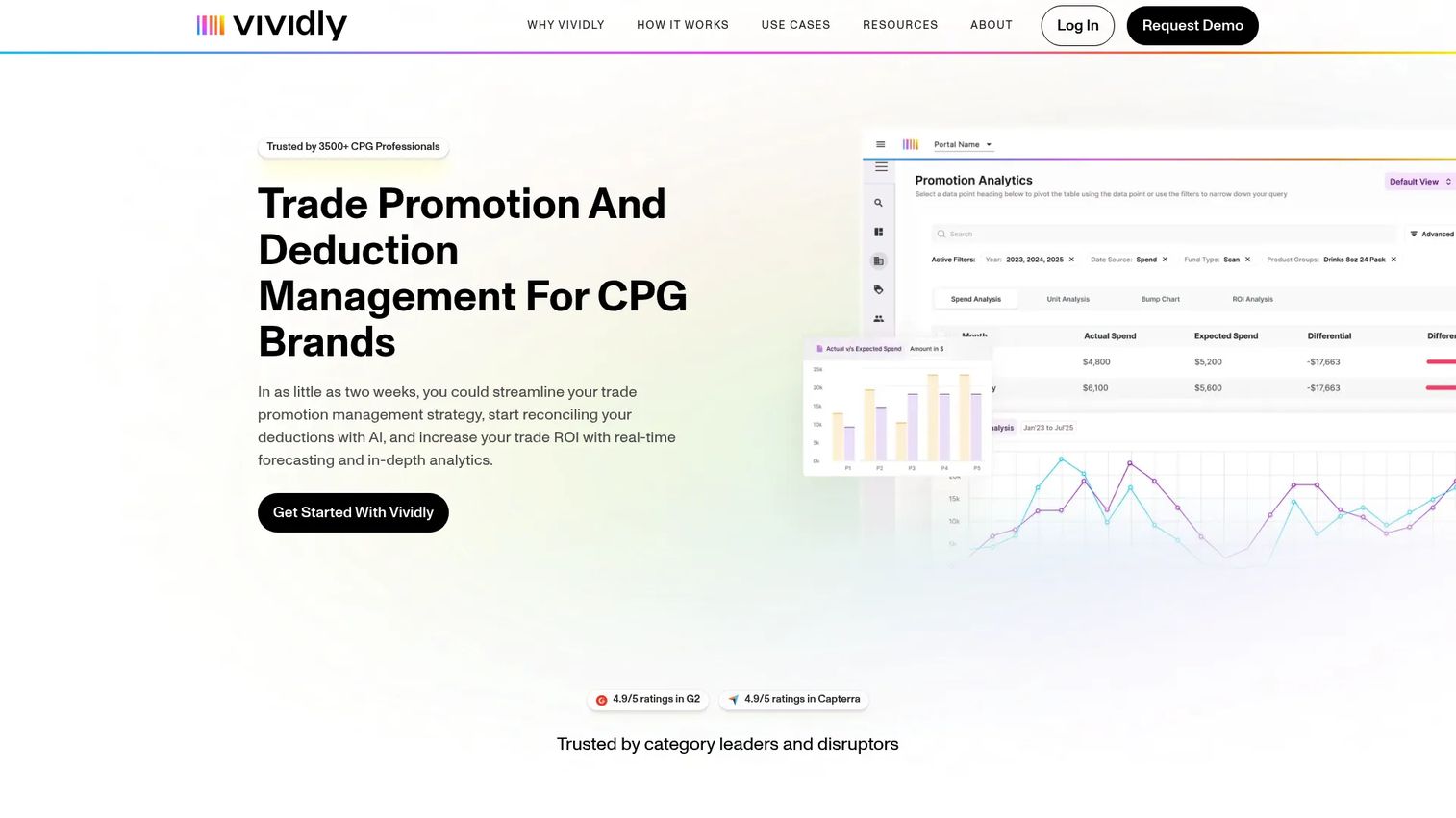
Vividly is trade promotion and deduction management software built specifically for CPG brands. It pulls planning, trade spend analytics, and deduction handling into one workflow, so the team that plans a promotion is the same team that can see how it settled. That continuity is the point. Most trade leaks happen in the gap between planning and reconciliation, and Vividly is designed to close it.
The platform leans into automation where manual work usually piles up. Real-time forecasting and trade spend analytics give planners a live view of committed versus available budget, and the deduction engine matches claims so disputes surface early instead of at quarter close.
Best for: CPG brands managing trade promotions, deductions, and forecasting in one connected system.
Key strengths
- Real-time forecasting and analytics: See committed spend and projected ROI as plans change, not weeks later.
- End-to-end deduction management: Match, validate, and dispute retailer claims without spreadsheets.
- AI-powered promotion optimization: Surface the promotion mix that protects margin before you commit budget.
Why choose Vividly: If your biggest pain is the disconnect between what you planned and what the retailer charged, Vividly is built around that exact problem. It fits brands that want one system for the full lifecycle rather than stitching planning and settlement tools together. The CPG-native focus means less configuration to make it fit your reality.
Vividly pricing: Vividly does not publish pricing on its site, so plans are quote-based and tailored to brand size and scope. Its current G2 listing shows a 4.8/5 rating. Expect a sales conversation to scope deduction volume and trade spend before you see a number.
2. CPGenius Trade Management System
CPGenius Trade Management System is Promomash's managed trade promotion management platform for CPG brands. The defining feature is the managed-service angle: it is not only software, it is software paired with a team that helps run trade planning and deduction support. For lean brands without a dedicated trade analyst, that combination matters.
It centralizes trade promotion and account planning, then tracks plan versus actuals so you can adjust forecasts mid-flight instead of discovering variance after the fact. Execution, settlement, and P&L impact all live in the same view.
Best for: CPG brands that want managed trade promotion planning plus deduction support rather than software alone.
Key strengths
- Centralized account planning: Bring trade promotion and account plans into one place across your retail partners.
- Plan versus actual tracking: Monitor variance and adjust forecasts in-flight instead of at quarter end.
- Execution and P&L visibility: Track promotion execution, settlement, and bottom-line impact together.
Why choose CPGenius: This trade promotion management solution fits teams that need the operational lift of a managed service. If you are scaling trade spend faster than you can hire, the managed model buys you capacity. It also suits brands that want a single partner across planning and deduction work.
CPGenius pricing: Promomash offers Essentials and Full Service plans priced by annual revenue range, plus volume-based tiers tied to deduction invoice and event volume. Numeric prices are not published, so pricing is quote-based by your revenue band. There is no free tier. The platform holds a 4.7/5 rating on G2.
3. Periscope By McKinsey Advanced Insights
Periscope By McKinsey Advanced Insights is McKinsey's revenue-growth software and analytics backbone, covering pricing, promotions, assortment, and performance management. It sits at the analytics-heavy end of this list. Where operational TPM tools manage the lifecycle, Periscope leans into prescriptive analytics and the modeling depth that comes with a consulting pedigree.
For trade promotion specifically, the value is in optimization. The platform applies prescriptive analytics to pricing and promotion decisions, helping teams find where promotional dollars generate the most lift across categories and retailers.
Best for: Enterprises that need pricing and promotion optimization software backed by consulting-grade analytics.
Key strengths
- Prescriptive analytics: Cloud-based tools that recommend actions, not just report on the past.
- Pricing and promotion optimization: Model the trade promotion and optimization decisions that move margin.
- Industry solutions: Purpose-built capabilities for consumer goods, retail, manufacturing, and finance.
Why choose Periscope: Choose this when modeling depth and decision support matter more than out-of-the-box lifecycle workflows. It fits enterprise teams that want analytics paired with advisory support to interpret the output. If your trade promotion optimization questions are genuinely complex, the consulting layer earns its place.
Periscope pricing: McKinsey does not publish public pricing for Periscope, and the site routes to a contact form rather than a plan table. Pricing is quote-based and enterprise-scaled. Its G2 listing shows a 4.8/5 rating based on a small number of reviews.
4. Anaplan Platform
Anaplan Platform is an AI-driven scenario planning platform for connected enterprise planning. It is not a CPG-native trade tool, and that is precisely its appeal for some teams. Anaplan connects trade spend planning to finance and supply chain on one model, so a change in promotion assumptions flows through to the revenue forecast and the demand plan automatically.
That connected approach is what makes it strong for cross-functional alignment. When sales, finance, and operations work in the same model, scenario planning stops being a series of disconnected spreadsheets emailed between teams.
Best for: Enterprises that need trade spend planning connected to finance, operations, and strategic planning in one model.
Key strengths
- Connected planning: Link trade spend, finance, and supply chain so changes propagate across plans.
- Scenario modeling at scale: Run what-if analysis across the full planning model, not just one promotion.
- Anaplan Intelligence: AI capabilities and enterprise-grade security for large, governed deployments.
Why choose Anaplan: Choose Anaplan when trade promotion is one node in a larger planning problem. It suits organizations that have outgrown siloed tools and want one platform where finance, supply chain, and trade share a model. The trade-off is that you build the trade logic on a flexible platform rather than buying a CPG-specific workflow out of the box.
Anaplan pricing: Anaplan does not expose public pricing and directs visitors to request a demo. Pricing is quote-based and scales with workspace size and model complexity. The platform holds a 4.6/5 rating on G2.
5. Oracle Demantra forecasting, demand management and S&OP
Oracle Demantra is Oracle's web-based demand forecasting and sales-and-operations planning software for collaborative planning and consensus forecasting. Its relevance to trade promotion is upstream: better demand forecasts make trade promotion planning more accurate, because lift is layered onto a baseline you can trust.
For organizations already running Oracle, Demantra slots into the existing stack and feeds demand signals into the broader planning process. The collaborative S&OP workflows are built to drive consensus across functions before a number gets locked.
Best for: Enterprise teams needing collaborative demand forecasting and S&OP planning, especially inside an Oracle ecosystem.
Key strengths
- Demand planning and forecasting: Build the baseline forecasts that trade promotion lift is measured against.
- Collaborative S&OP workflows: Drive consensus across sales, finance, and operations.
- Consensus forecast approval: Route forecasts through structured approval and scenario planning.
Why choose Oracle Demantra: This is the pick when your forecasting and demand management challenge is bigger than trade promotion alone, and when you already live in Oracle. It strengthens the forecast accuracy that everything downstream depends on. Teams outside the Oracle ecosystem will weigh integration effort against the benefit.
Oracle Demantra pricing: Oracle does not publicly list pricing for Demantra; it is quote-based through Oracle sales. Its G2 listing shows a 3.7/5 rating. Scope and integration depth will drive the quote.
6. Acumen Invest
Acumen Invest is revenue growth management software and consulting for CPG manufacturers, focused on trade promotion management and pricing. It frames trade spend as an investment decision, which shapes how the product works: the emphasis is on analyzing where trade dollars generate the strongest return and optimizing the mix accordingly.
That investment lens makes it a fit for teams treating trade spend as a portfolio to optimize rather than a budget to administer. Strategic pricing management sits alongside the trade promotion capabilities, with consulting support to interpret the analysis.
Best for: Large CPG teams needing trade promotion management and optimization plus pricing management capabilities.
Key strengths
- Trade promotion management: Plan and manage promotions with an investment-return focus.
- Strategic pricing management: Connect pricing decisions to trade promotion strategy.
- Revenue growth consulting: Pair software with advisory support to act on the analysis.
Why choose Acumen Invest: Choose Acumen when you want to treat trade spend as an investment portfolio and need both software and consulting to optimize it. It fits large CPG teams whose questions span trade promotion and pricing together. The advisory layer suits teams that want help turning analysis into decisions.
Acumen Invest pricing: Acumen does not publish public pricing, and its site routes to the vendor for details. Pricing is quote-based. Its G2 listing shows a 5.0/5 rating, based on a small number of reviews, so weigh that against the volume.
Considerations before you buy
Before you sign anything, run your shortlist through these criteria. The right trade promotions management software is the one that fits your workflow, not the one with the longest feature list.
Workflow coverage across the lifecycle
Map your current process from planning to settlement, then check which steps each platform actually owns. Some tools are strong on planning but thin on deduction management; others reverse it. Buy for the gaps you have, not the features you might use.
ROI and forecast accuracy
The whole point is proving return on trade spend. Ask how each platform models lift, measures incremental volume, and reports promotion ROI. Look for forecast accuracy you can defend in a finance review, not a black box that spits out a number.
Data quality and integrations
A TPM tool is only as good as the data feeding it. Confirm it ingests your syndicated, shipment, and POS data, and that it connects to your ERP and finance systems. Dirty or disconnected data undermines every downstream analysis, the same way it does in contract management software.
Cross-functional collaboration
Trade promotion spans sales, finance, and retail partners. Evaluate how each platform handles shared planning, approval routing, and retailer collaboration. A tool that keeps everyone on one number prevents the message drift that erodes trust across teams.
Deployment and total cost
Most vendors here are quote-based, so pricing scales with your size and complexity. Factor in implementation, integration, and any managed-service component. Match the deployment model to your team's appetite for setup and ongoing maintenance.
Conclusion
The right trade promotion management software depends on where your pain lives. If the disconnect between planning and deductions is bleeding margin, Vividly is built around exactly that. If you are scaling faster than you can staff, CPGenius pairs software with a managed team. For deep optimization and modeling, Periscope By McKinsey Advanced Insights and Acumen Invest bring analytics and advisory depth. When trade is one piece of a larger planning problem, Anaplan connects it to finance and supply chain, while Oracle Demantra strengthens the forecast underneath it. For enterprise lifecycle management at scale, TELUS International Exceedra covers planning through settlement, and Oracle Siebel Consumer Goods folds trade into a broader CRM suite.
The next step is not a demo. It is mapping your current trade-spend workflow and marking exactly where it breaks: planning, execution, settlement, or analysis. Buy for those gaps. A platform that closes your specific leaks will pay for itself faster than the one with the most impressive feature grid.
FAQs
Trade promotion management software helps consumer goods companies plan, fund, execute, settle, and analyze trade promotions while controlling trade spend. It replaces manual spreadsheet workflows with one system of record covering planning, forecasting, deduction management, and promotion ROI analysis, so teams can prove return on every promotional dollar.
Trade promotion management handles the operational lifecycle: planning, execution, settlement, and reporting. Trade promotion optimization adds a predictive and prescriptive layer that models lift and recommends the promotion mix that protects margin before you commit spend. The strongest platforms deliver trade promotion management and optimization together so planning and analysis feed each other.
Map your full promotion lifecycle and check which steps each platform actually owns, from planning through deduction settlement. Prioritize ROI measurement, forecast accuracy you can defend in a finance review, clean integration with your ERP and syndicated data, and collaboration features that keep sales, finance, and retail partners on one number.
Yes. Spreadsheet replacement is the most common reason CPG teams adopt trade spend management software. Once promotion plans live across multiple workbook versions, errors compound and accountability disappears. A TPM system gives you one plan of record with version control and audit trails, which matters when trade spend is a major share of revenue.
TPM platforms measure promotion ROI by comparing incremental volume and margin against a baseline forecast, then netting out the trade spend committed to each event. Accurate ROI depends on clean syndicated, shipment, and POS data plus a trustworthy baseline, which is why forecast accuracy and demand planning feed directly into ROI quality.
Trade promotion involves both the manufacturer and the retailer, and deductions are charged against agreed promotions. When both sides work from different numbers, plans drift and disputes multiply at settlement. Retailer collaboration features keep promotion plans, calendars, and claims aligned, which reduces deduction disputes and recovers spend that would otherwise be written off.
The most important integrations are syndicated market data, shipment and POS data, and your ERP and finance systems. These feeds drive baseline forecasts, lift measurement, and deduction matching. Without clean, connected data, every downstream analysis weakens, so confirm integration depth before committing to any trade promotions management platform.
No. While enterprise suites like Anaplan and Oracle Siebel Consumer Goods target large manufacturers, CPG-native tools and managed-service options serve growing brands too. The right choice scales with your trade spend volume and team capacity, so smaller brands replacing spreadsheets have viable options alongside the enterprise platforms.