You quote a customer over the phone, then walk to the back and find the size you promised is gone. A repeat customer books a rotation and no one follows up on the two tires you flagged as bald last visit. Your counter runs on a spreadsheet, your scheduling lives in a paper book, and your invoicing happens somewhere else entirely. Every disconnected step is a slow leak in your margin.
The global tire shop software market was valued at $1.2 billion in 2025 and is projected to reach $2.3 billion by 2034, growing at a 7.8% CAGR, according to MarketIntelo (2025). Cloud-based deployments already account for 62.1% of that revenue, which tells you where operators are voting with their budgets. Around 67% of small and medium auto service businesses are actively implementing automated workflow software to improve operational efficiency, per Persistence Market Research (2024).
The problem is not whether you need tire shop software. It is picking the one that matches your actual bottleneck. A used tire operation moving high volume needs different tools than a general repair shop, and a mobile installer needs something else again. The core decision comes down to how a platform handles inventory, quoting, POS, scheduling, billing, CRM, reporting, and mobile workflows, and whether it fits the way your shop already runs.
What's inside
This guide compares 8 tire shop software tools across inventory, POS, scheduling, CRM, reporting, integrations, and mobile workflows. It is written for shop owners, tire dealers, multi-location operators, and managers who already know they need software and are now comparing operational depth and fit.
We selected tools based on four factors: tire-specific workflow depth (quoting, VIN scanning, fitment, storage), all-in-one operational breadth, pricing transparency where public data exists, and trust signals like verified ratings and mobile support. Each entry names who the tool fits best, its key strengths, and verified pricing where a vendor publishes it.
TL;DR
- Best general-purpose tire shop platform: Tire Shop Software pairs mobile work orders, VIN scanning, and customer texting for shops that want a tire-first system.
- Best for used tire and high-volume inventory: Used Tire Shop is built around new and used tire inventory, labeling, and repair workflows, and runs for under $2 per day.
- Best all-in-one shop management platform: Tekmetric and AutoLeap both deliver full estimating, inspections, payments, and reporting with public pricing starting at $179/month.
- Best for multi-location and mobile service: Orderry handles work orders, scheduling, inventory, and CRM from $39/month, with a mobile-friendly build for fast-moving operations.
- Best modern operations UI: Shopmonkey gives shops a polished, unified workflow for estimates, inspections, and communication.
What is tire shop software?
Tire shop software is a shop management platform that runs the day-to-day operations of a tire or auto service business from a single system, replacing disconnected spreadsheets, paper tickets, and standalone POS terminals. Most modern products are cloud-based, meaning your data, inventory, and schedule sync across the counter, the bays, and any mobile device.
A tire shop management software product typically bundles these capabilities:
- Tire inventory software: track new and used tire stock, sizes, DOT numbers, and rack or storage locations in real time.
- Quoting and fitment: match a vehicle to the right tire, pull fitment data, and build an estimate without guessing.
- Tire shop POS system: ring up sales, apply labor items, take integrated payments, and close out service.
- Tire shop billing software: generate invoices, track balances, and handle wholesaler and fleet accounts.
- Tire shop scheduling software: manage appointments, bay capacity, technician assignments, and online booking.
- Tire shop CRM software: store customer and vehicle history, send reminders, and run marketing follow-ups.
- Reporting dashboard: see revenue, margin, technician productivity, and inventory turns in one view.
- Mobile workflows: run work orders, VIN scanning, inspections, and texting from a phone or tablet in the bay.
The distinction between tire dealer software and general auto repair software matters. Tire-first tools go deeper on stock management, DOT tracking, tire storage, and fitment, while broader shop management platforms add digital inspections, parts ordering, and repair estimating that a full-service shop needs.
When to use tire shop software
Software earns its place when it removes a specific bottleneck, not when it adds features you never open. Here is how to pattern-match your situation.
Reduce quoting mistakes and inventory misses
When quoting runs on memory and a stock check means walking to the back, you lose deals to slow answers and promise inventory you do not have. A tire center software product with live inventory and fitment lets staff match a vehicle, confirm the size is in stock, and quote in seconds. Every quote is tied to real stock counts, so you stop selling tires that already left the building.
Speed up billing, payments, and service closeout
A slow checkout is a customer sitting in your lobby longer than they should. A tire shop POS system with integrated payments and tire shop billing software collapses the estimate-to-invoice-to-paid sequence into a few taps. Two-way texting lets you send an invoice or approval request while the vehicle is still on the lift.
Keep repeat customers coming back
Most shops leave money on the table by not following up. Tire shop CRM software stores vehicle history, flags upcoming service, and automates reminders for rotations, seasonal changeovers, and the tires you flagged last visit. Retention is cheaper than acquisition, and a good CRM turns a one-time installer into a recurring account.
Run multiple locations or mobile service
If you run more than one bay location or a mobile install van, you need scheduling, reporting, and mobile workflows that travel. The mobile tire installation market was valued at $0.68 billion in 2026 and is projected to reach $1.55 billion by 2035, with 78% of vehicle owners open to mobile tire services, per QuoteIQ industry research (2026). Software that runs work orders and payments from a tablet in the field is no longer optional for that segment.
Comparison table
The table below sorts tools by relevance to tire-first buyers, then broader shop management platforms. Pricing and ratings reflect verified public data at the time of writing. Where a vendor gates pricing behind a demo, that is noted.
| # | Product | Intent | Key differentiation | Pricing | G2 rating |
|---|---|---|---|---|---|
| 1 | Tire Shop Software | Tire-first shop management | Mobile work orders, VIN scanning, customer texting | Demo-based | Not rated on G2 |
| 2 | Used Tire Shop | Used and high-volume tire inventory | New and used tire inventory, labeling, repairs | Under $2/day | Not rated on G2 |
| 3 | Tekmetric | All-in-one shop management | Digital inspections, integrated payments, analytics | From $179/month | 4.9/5 |
| 4 | Orderry | Multi-location and mobile operations | Work orders, scheduling, inventory, CRM | From $39/month | 4.4/5 |
| 5 | AutoLeap | All-in-one auto repair management | Inspections, estimates, parts lookup, payments | From $179/month | 4.8/5 |
| 6 | Shopmonkey | Modern operations UI | Unlimited estimates, 2-way messaging, mobile app | From $215/month | 4.6/5 |
| 7 | Mitchell 1 | Repair information depth | ProDemand repair data, Manager SE, SocialCRM | Demo-based | 3.8/5 |
| 8 | GaragePlug | Multi-service workshop management | Job cards, CRM, inventory, multi-outlet | Custom | Not rated on G2 |
1. Tire Shop Software
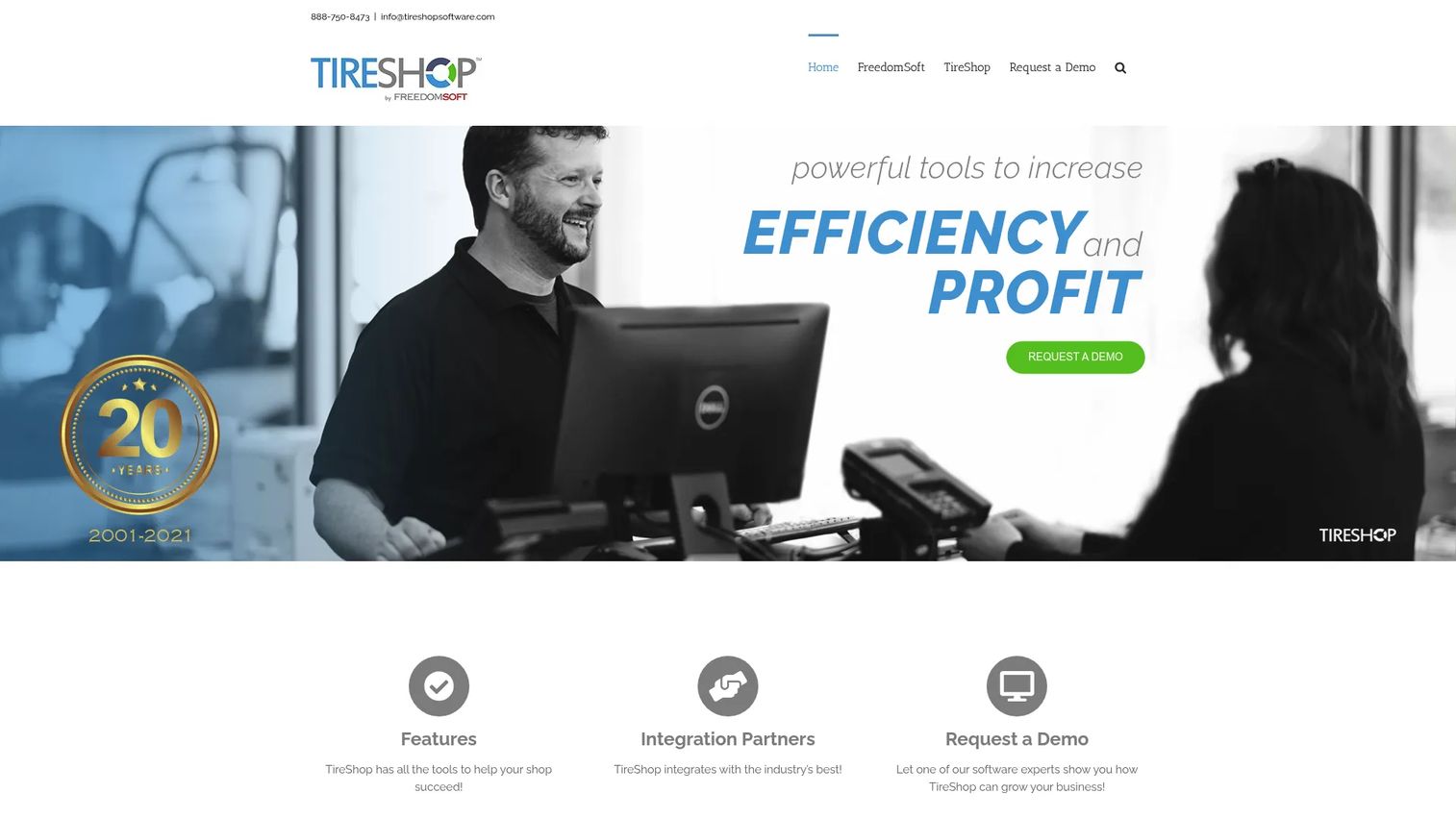
Tire Shop Software is a shop management platform built specifically for tire and auto repair businesses, with a feature set that leans into the mobile-heavy reality of a busy bay. It supports multi-location management, tire quoting with vendor integrations, and a mobile-first workflow for work orders, VIN scanning, and customer texting. For shops that want tools designed around tires rather than adapted from general repair software, it is a strong general-purpose starting point.
Best for: Tire and auto repair shops that want a tire-first management system with heavy mobile and texting support.
Key strengths
- Multi-location shop management: run several locations from one system with shared inventory and reporting visibility.
- Tire quoting and vendor integrations: build quotes fast and pull from vendor catalogs to check availability.
- Mobile work orders, VIN scanning, and texting: capture the vehicle, build the ticket, and message the customer from the bay.
Why choose Tire Shop Software: the platform is purpose-built for tire operations rather than a general repair tool with tire features bolted on. If your daily friction is slow quoting, walking to the back to check stock, and chasing customers by phone, the mobile and texting workflows target exactly those pain points. It fits owners who want the counter and the bay working from the same live data.
Tire Shop Software pricing: the vendor does not publish public pricing tiers. Pricing appears to be demo or quote-based, so you will need to request a walkthrough to get numbers for your shop size and location count. Capterra reviewers have rated the product favorably, though it does not yet carry a G2 review score.
2. Used Tire Shop
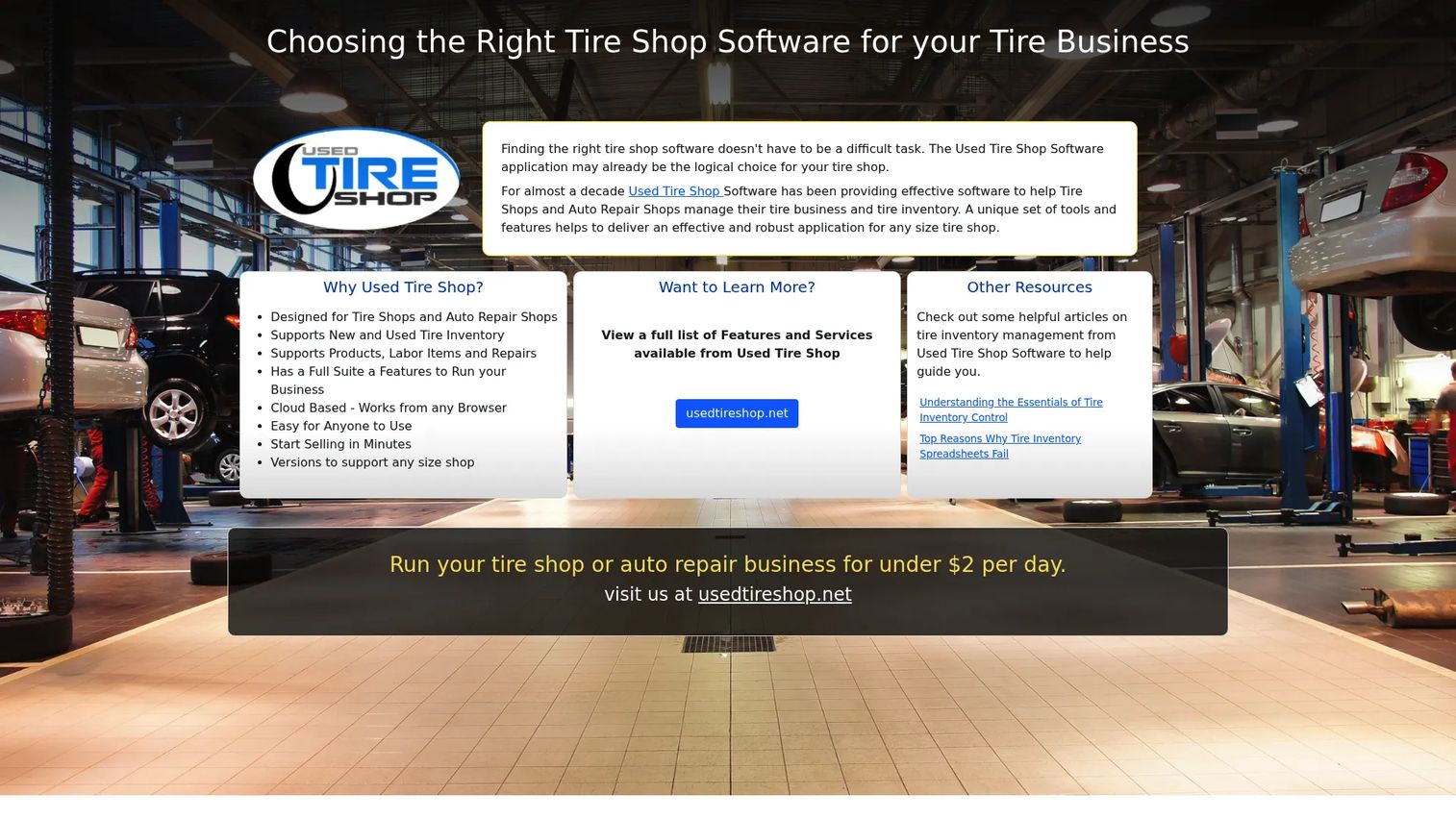
Used Tire Shop is cloud-based software built for tire shops that handle both new and used inventory, along with auto repair work. It supports products, labor items, and repairs in one system, which makes it a natural fit for high-volume used tire operations where inventory turns fast and every tire needs to be tracked, labeled, and priced quickly. The tire inventory software depth is the core draw here.
Best for: Small to mid-size tire shops, especially used tire operations, that need fast inventory and repair workflow software.
Key strengths
- New and used tire inventory: track both categories in one system, built for shops where used stock moves fast.
- Products, labor, and repairs: manage tire sales, labor items, and repair jobs from a single ticket.
- Tire-shop and auto-repair focus: designed around the workflows tire operations actually run daily.
Why choose Used Tire Shop: high-volume used tire shops have inventory needs that general repair platforms do not cover well. This tool is built around that reality, with the labeling and inventory workflows a used operation depends on. The pricing is also refreshingly transparent for this category.
Used Tire Shop pricing: the homepage states the software can run for under $2 per day, which makes it one of the more budget-friendly options for a small operation. The vendor does not publish structured tiers or a documented free plan, so confirm the exact terms and any inventory limits during a demo. It does not currently carry a G2 review score.
3. Tekmetric
Tekmetric is a cloud-based auto repair shop management platform that runs the full operation: estimating, invoicing, digital inspections, parts and inventory, reporting, and integrated payments. Its Tire Suite adds tire-specific workflows on top of a broader shop management platform, which suits operators who do tire work but also want digital vehicle inspections, benchmarking, and marketing in the same system. For shops outgrowing a tire-only tool, it is a strong step up in operational depth.
Best for: Auto repair shops that want an all-in-one platform covering both tire work and full-service repair.
Key strengths
- Digital vehicle inspections: document findings with photos and send them to customers for approval.
- Estimating, invoicing, and integrated payments: move from quote to paid without leaving the platform.
- Reporting, analytics, and two-way texting: track shop performance and keep customers updated in real time.
Why choose Tekmetric: if your shop does tires plus brakes, alignments, and general repair, a tire-only tool leaves gaps. Tekmetric covers the full service mix with strong inspections, reporting, and communication, and it carries one of the highest verified ratings in the category. The trade-off is that it is a broader platform, so tire-specific inventory depth may be lighter than a dedicated tire tool.
Tekmetric pricing: plans are public and start at $179/month for the Start tier billed annually ($199 monthly). Grow runs $309/month annually ($349 monthly), Scale runs $409/month annually ($439 monthly), and Enterprise is custom-quoted. All tiers include unlimited users and repair orders. Tekmetric holds a 4.9/5 rating on G2.
4. Orderry
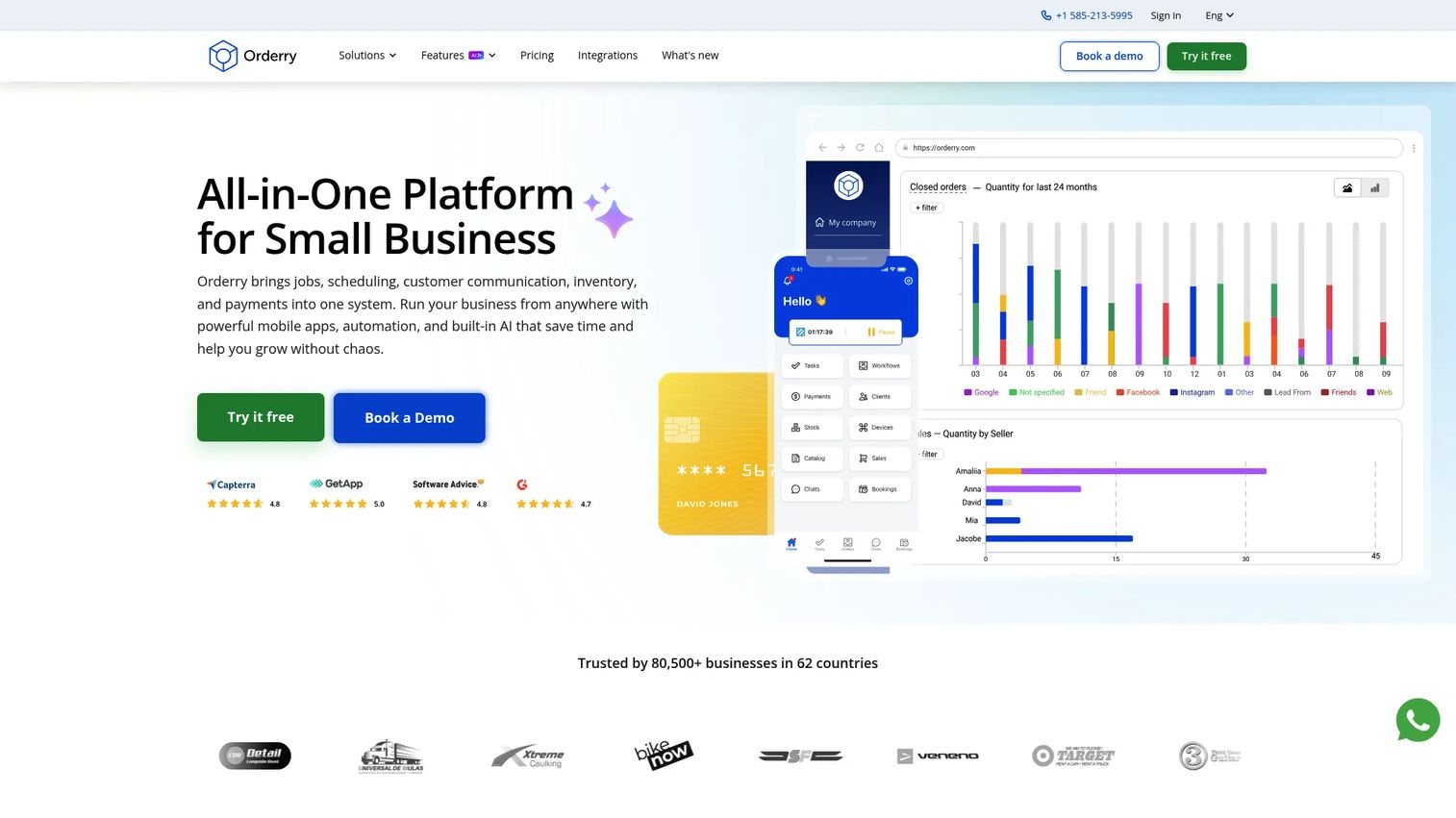
Orderry is cloud software for service businesses and repair shops, covering work orders, inventory, scheduling, CRM, finance, and communications. Its all-in-one operations angle and mobile work order support make it a good fit for multi-location shops and mobile service businesses that need to run jobs from anywhere. The tire shop scheduling software and inventory tracking are strong, and the entry pricing is the lowest of the full-platform options here.
Best for: Multi-location, mobile, or fast-moving repair businesses that need an affordable all-in-one operations platform.
Key strengths
- Work order and job management: create, assign, and track jobs across locations and technicians.
- Inventory, sales, and invoicing: manage stock, ring up sales, and generate invoices from one system.
- Scheduling, payroll, and reporting: handle appointments, staff pay, and shop analytics together.
Why choose Orderry: for operators running multiple locations or a mobile install operation, Orderry's mobile work orders and low entry price make it easy to standardize operations without a heavy investment. It is broad rather than tire-specialized, so a pure used tire shop may want to weigh inventory depth, but for general service businesses it covers a lot of ground affordably.
Orderry pricing: plans are public and start with a Hobby tier at $39/month. Startup begins at $69/month, Business at $99/month, and Enterprise at $199/month, all in USD. A 7-day free trial is available. Orderry holds a 4.4/5 rating on G2.
5. AutoLeap
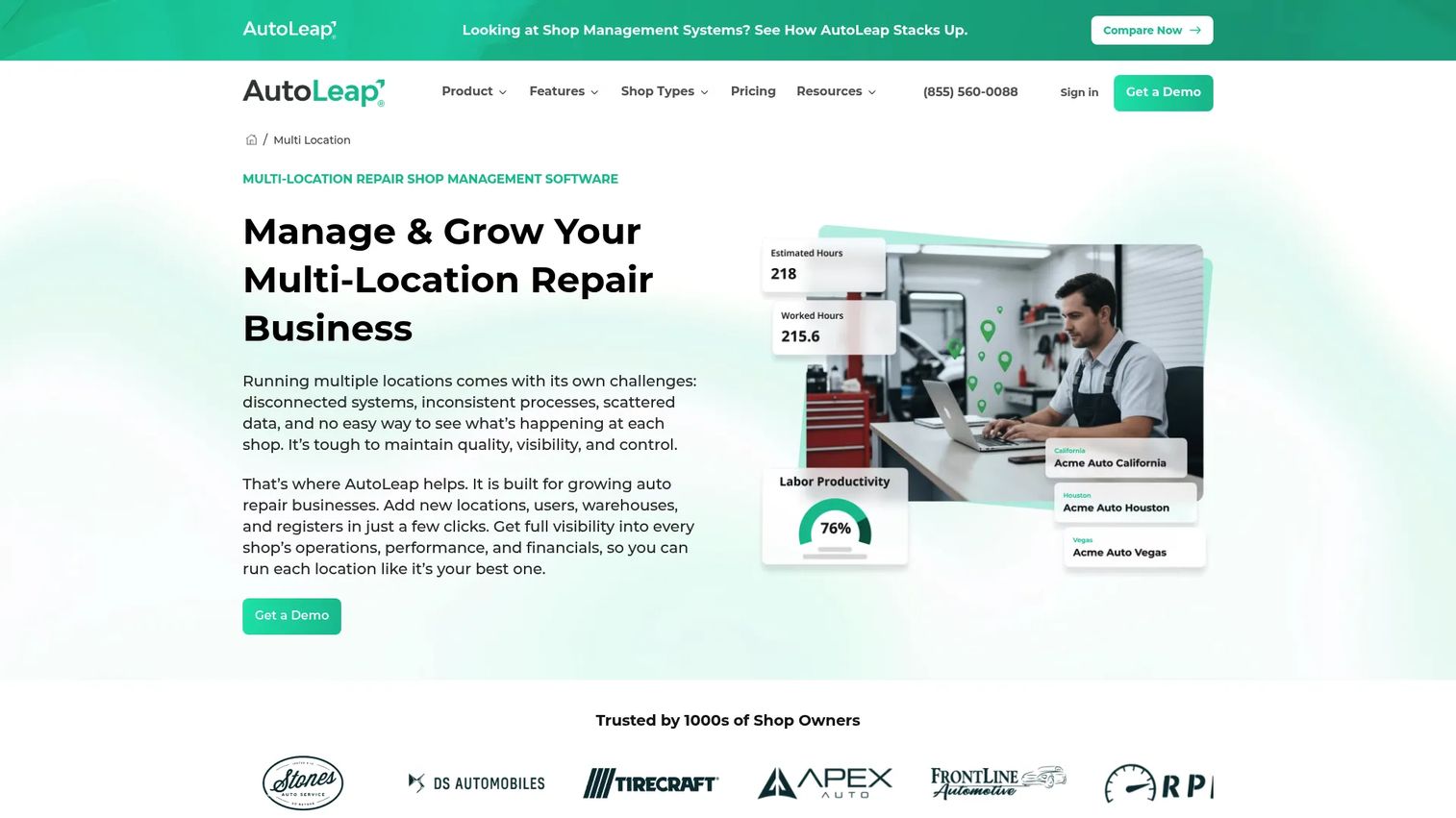
AutoLeap is auto repair shop management software that serves both auto and tire shops with a full operational toolkit: digital vehicle inspections, estimates, invoicing, scheduling, work orders, inventory, parts lookup, and integrated payments. It is a broader shop management option with clear tire-shop relevance, well-suited to shops that want polished workflows and public pricing rather than a tire-only feature set.
Best for: Auto repair shops needing an all-in-one shop management platform that also handles tire work.
Key strengths
- Digital vehicle inspections: send photo-backed inspection reports for faster customer approvals.
- Estimates, invoicing, scheduling, and work orders: manage the full service cycle in one place.
- Inventory, parts lookup, and integrated payments: check stock, source parts, and take payment without switching tools.
Why choose AutoLeap: AutoLeap sits close to Tekmetric in scope and price, so the choice often comes down to workflow feel and which demo resonates with your team. It fits a full-service shop that wants strong inspections and invoicing with transparent pricing. A pure tire operation may still prefer a tire-first tool for deeper stock and DOT tracking.
AutoLeap pricing: plans are public and start at $179/month for Essentials, with Pro at $309/month and Elite at $409/month; annual billing shows different figures on the pricing page, and Enterprise is custom. There is no free trial listed. AutoLeap holds a 4.8/5 rating on G2.
6. Shopmonkey
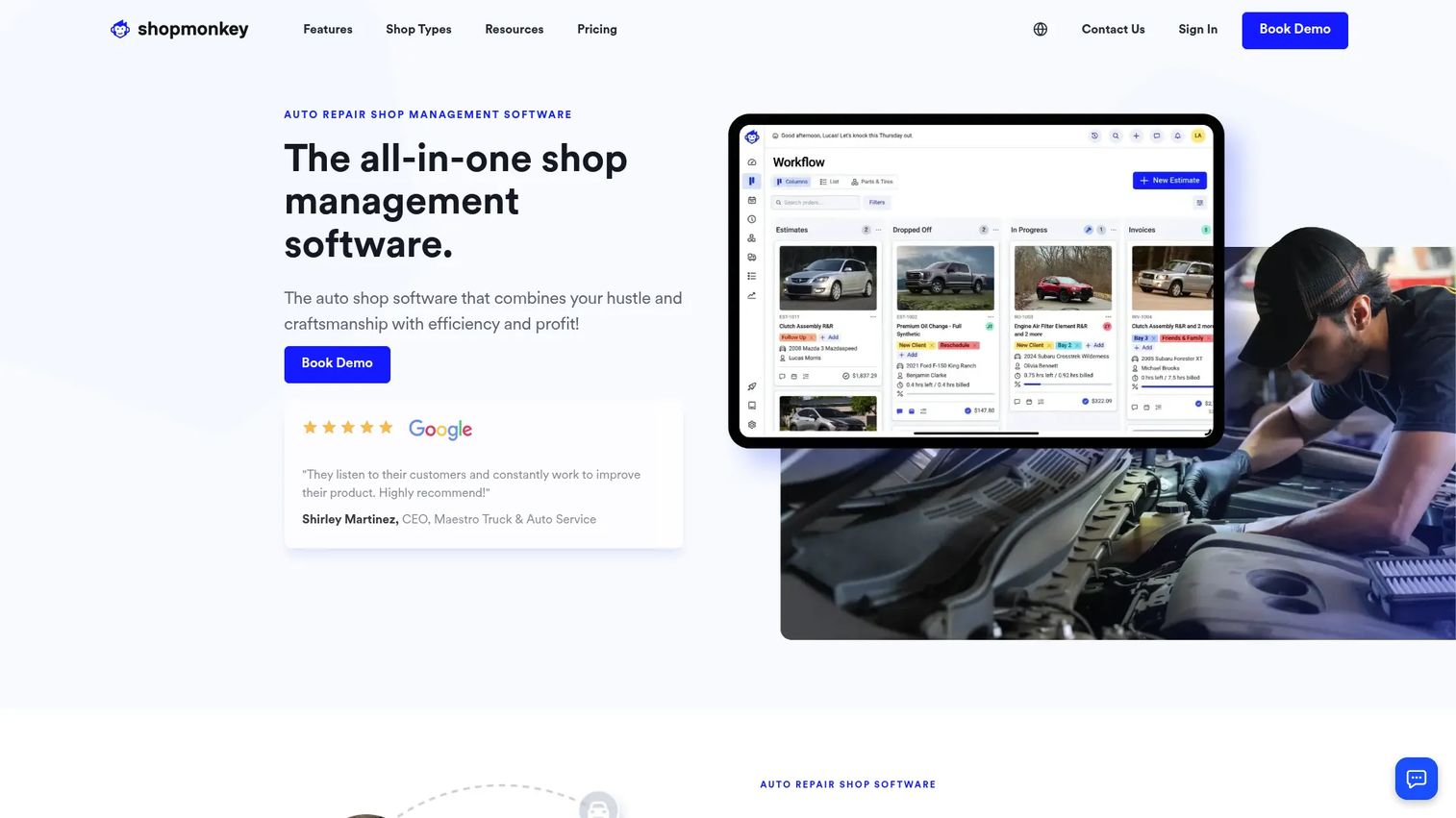
Shopmonkey is cloud-based shop management software for auto repair shops and service centers, built around a clean, modern interface. It delivers unlimited estimates and invoices, two-way text and email communication, and a mobile app for iOS and Android. For shops that value a polished, unified UI where the counter, bays, and customer communication all live in one workflow, Shopmonkey is a strong operations platform.
Best for: Auto repair and service shops that want an all-in-one management platform with a polished, modern interface.
Key strengths
- Unlimited estimates and invoices: build as many quotes and invoices as you need with no per-document caps.
- 2-way text and email: keep customers updated and collect approvals without picking up the phone.
- Mobile app for iOS and Android: manage jobs and communication from a phone in the bay or on the go.
Why choose Shopmonkey: if your current setup feels clunky and your team resists adopting it, Shopmonkey's interface is often the deciding factor. The modern UX drives adoption, which is what actually makes software pay off. It is broad shop management rather than tire-specialized, so pair it with strong tire inventory practices if used stock is your core business.
Shopmonkey pricing: plans are public, starting at $215/month for Basic (annual pricing), with Clever at $359/month, Genius at $449/month, and Multi-Shop custom-quoted. Annual billing shows savings of up to 10% versus monthly. No free tier is listed. Shopmonkey holds a 4.6/5 rating on G2.
7. Mitchell 1
Mitchell 1 is a long-established provider of auto repair software and shop management tools for automotive and commercial truck businesses. Its strength is repair information depth through ProDemand, paired with shop management via Manager SE and marketing through SocialCRM. For shops that value deep, established repair data alongside estimating and scheduling, Mitchell 1 brings decades of automotive workflow tooling.
Best for: Auto repair shops that want proven repair information, estimating, and shop management from an established vendor.
Key strengths
- ProDemand repair information and estimating: access detailed repair data and build accurate estimates.
- Manager SE shop management: handle scheduling, work orders, and shop operations in one system.
- SocialCRM shop marketing: run customer follow-up, reviews, and retention campaigns.
Why choose Mitchell 1: shops that do heavy diagnostic and repair work, not just tire sales, lean on repair information databases daily. Mitchell 1's ProDemand depth is the reason to pick it, with shop management and marketing rounding out the suite. For a tire-focused operation, the repair-data emphasis may be more than you need, so match it to your service mix.
Mitchell 1 pricing: the vendor does not publish public list pricing on the pages reviewed. Pricing appears to be quote-based, and demos are available, so request one to get numbers for your shop. Mitchell 1 holds a 3.8/5 rating on G2.
8. GaragePlug
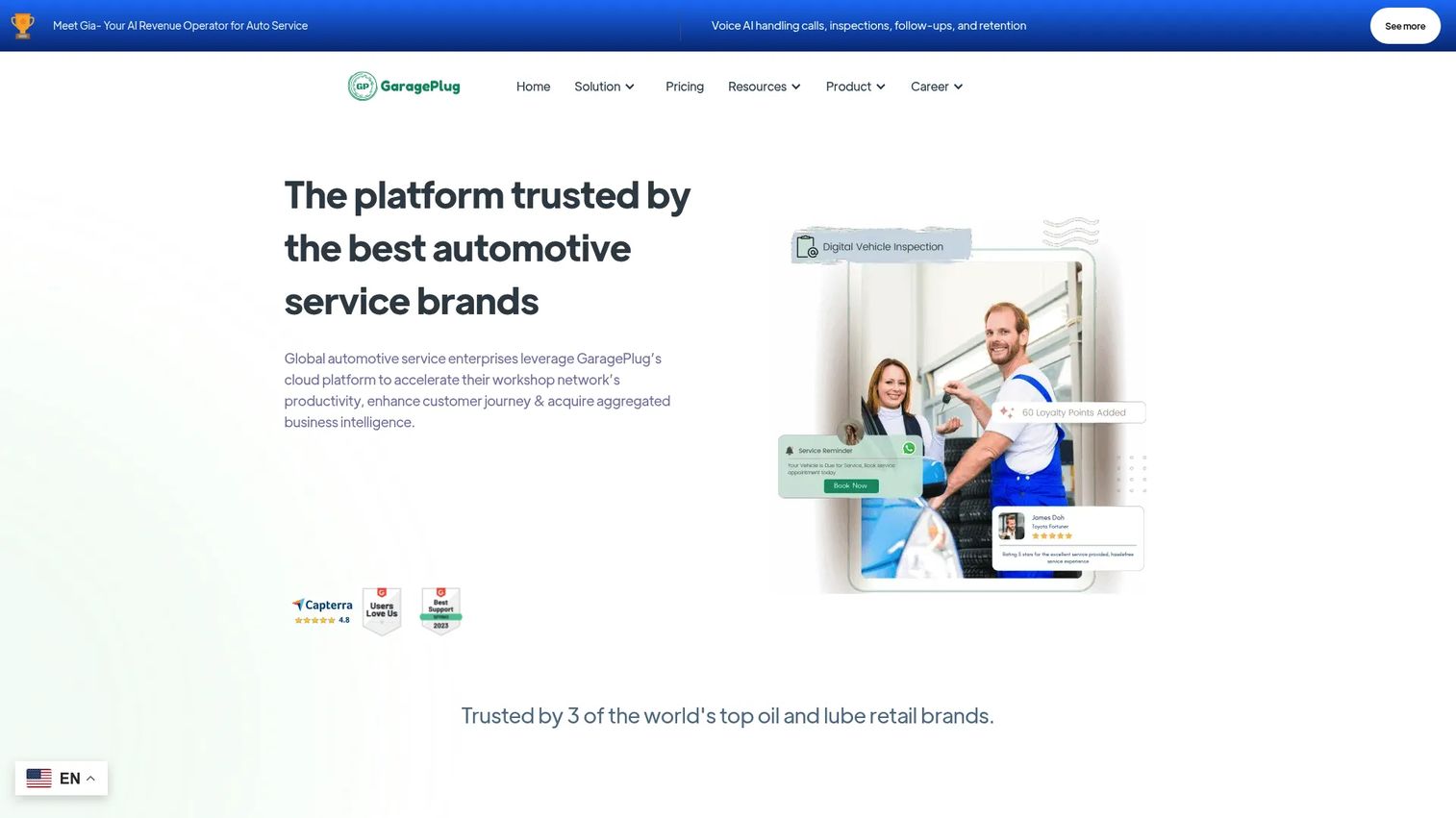
GaragePlug is cloud-based garage management software for auto repair workshops, detailing centers, and related automotive service businesses. It covers digital inspections, job cards, invoicing, CRM, scheduling, technician tracking, and multi-outlet management, with a mobile-friendly build. For independent shops that want a simple operational platform covering multiple service types, GaragePlug is a practical option.
Best for: Independent auto repair and multi-service shops that want a straightforward all-in-one workshop platform.
Key strengths
- Digital inspections, job cards, and invoicing: document work, track jobs, and bill customers in one flow.
- CRM, reminders, and customer communication: keep customers engaged and coming back with automated follow-up.
- Inventory, reporting, and multi-outlet management: run stock, analytics, and multiple locations together.
Why choose GaragePlug: for a growing independent shop that handles more than tires, GaragePlug's mix of inspections, CRM, and multi-outlet support gives you room to expand without switching platforms. The mobile-friendly build helps shops that manage work on the move. Confirm the module mix during onboarding so you only pay for what you use.
GaragePlug pricing: the vendor customizes pricing based on the modules and requirements you select, so there is no public list price. A 7-day free trial is available, and you book a call to get a quote. Capterra reviewers rate it highly, though it does not currently carry a G2 review score.
Considerations before you buy
Feature lists all look similar on a pricing page. What separates a good fit from an expensive mistake is how the software handles your specific operating reality. Run every shortlisted tool through these checks.
Tire-specific workflow depth
If tires are your core business, confirm the platform tracks DOT numbers, tire sizes, storage or rack locations, and fitment data. General repair platforms often treat tires as generic line items, which creates inventory blind spots for a high-volume operation. Ask to see the inventory screen in a demo, not just the marketing page.
Mobile and VIN scanning workflows
Your techs work in the bay, not at a desk. Check whether work orders, VIN scanning, inspections, and texting run cleanly from a phone or tablet. A clunky mobile experience means staff will avoid it, and software no one uses is money wasted.
Integration partners and payments
Look at which vendors, payment processors, and accounting tools the platform connects to. Strong integration partners save hours of double entry every week. Confirm the integrations you actually need exist before you commit, not after.
Pricing transparency and total cost
Some vendors publish clear monthly tiers; others quote by demo. Neither is automatically better, but hidden pricing makes it harder to budget. Factor in payment processing fees, add-on modules, and per-location costs, not just the headline number.
Adoption and support
The best software is the one your team actually uses. Weigh the interface, onboarding, and support quality. A polished UI and responsive support drive adoption, which is where the real return comes from.
Conclusion
The right tire shop software depends on your biggest bottleneck, not the longest feature list. Match the tool to the problem you feel most.
If tires are your core business and inventory is your pain, a tire-first tool wins. Tire Shop Software fits shops that want mobile work orders and texting, while Used Tire Shop is built for high-volume used tire operations that need deep inventory and repair tracking at a low price point.
If you run full-service repair alongside tires, a broader shop management platform serves you better. Tekmetric and AutoLeap both deliver strong inspections, estimating, and payments with transparent pricing, Shopmonkey stands out on interface and adoption, and Mitchell 1 brings established repair data depth. For multi-location or mobile operations on a budget, Orderry covers work orders, scheduling, inventory, and tire shop CRM software affordably, and GaragePlug suits independent multi-service shops.
Used tire and high-volume inventory shops need different software than general repair shops, so do not just copy what the shop down the road runs. Shortlist your top two or three fits, then request demos or trials to see the inventory and mobile screens with your own data before you commit.
FAQs
Tire shop software is a shop management platform that runs a tire or auto service business from one system, covering inventory, quoting, POS, scheduling, billing, CRM, and reporting. Most modern products are cloud-based, so your counter, bays, and mobile devices all work from the same live data. It replaces the disconnected mix of spreadsheets, paper tickets, and standalone terminals that create inventory and quoting errors.
At minimum, tire shop management software should include tire inventory software with DOT and size tracking, a tire shop POS system with integrated payments, tire shop scheduling software with online booking, tire shop billing software for invoicing, and tire shop CRM software for follow-up. A reporting dashboard and mobile workflows round out the core. Prioritize the capabilities that match your biggest daily bottleneck rather than the longest feature list.
Yes, though they overlap. A tire shop POS system goes deeper on tire-specific workflows like DOT tracking, tire storage, wheel fitment tools, and fast used-tire inventory, while general auto repair software emphasizes diagnostics, repair information, and broader parts management. Many all-in-one platforms like Tekmetric and AutoLeap now cover both, so the choice depends on how much of your revenue comes from tires versus general repair.
For pure tire inventory, tire-first tools go deepest. Used Tire Shop is built around new and used tire inventory, labeling, and fast stock turns, which suits high-volume used operations. Tire Shop Software adds tire quoting with vendor integrations. For shops that also do full-service repair, Tekmetric and AutoLeap offer strong parts and inventory management within a broader platform.
VIN scanning speeds up ticket creation and reduces errors by pulling vehicle details automatically instead of typing them. It is valuable for any shop doing service work, since it ties the right vehicle to the right fitment and history. Tools like Tire Shop Software and Orderry include VIN detection, which cuts a few minutes off every work order and helps prevent mismatched fitment.
Several platforms support online booking and appointment scheduling. Orderry offers scheduling and online booking within its operations platform, and full shop management tools like Tekmetric, AutoLeap, Shopmonkey, and GaragePlug include scheduling with customer-facing booking options. Confirm the exact online booking flow in a demo, since the customer experience varies between vendors.
Very important, because your techs work in the bay and increasingly in the field. Mobile workflows let staff run work orders, VIN scanning, inspections, and texting from a phone or tablet instead of walking back to a desk. With 78% of vehicle owners open to mobile tire services per QuoteIQ (2026), mobile-capable software is essential for any shop offering on-site installation.
A used tire shop needs deep, fast inventory management for stock that turns quickly, plus labeling and used-tire-specific workflows, which is where a dedicated tool like Used Tire Shop fits. A general tire and repair shop benefits more from an all-in-one shop management platform like Tekmetric, AutoLeap, or Shopmonkey that adds inspections, estimating, and broader parts management. Start by mapping your revenue mix, then shortlist the two or three tools that match it and request demos.