Your churn rate looks fine until it doesn't. By the time a cancellation request arrives, the warning signs were already sitting in your product usage data, your support tickets, and your billing events for weeks. Most teams miss them because that data lives in separate systems with no one connecting the signals to action.
According to Verint's 2025 research, 78% of consumers are likely to switch brands after a bad customer experience. The gap between keeping a customer and losing one is rarely a single moment. It's a series of small friction points that go unaddressed because no one had visibility early enough.
Acquisition costs keep climbing. Leadership expects more revenue from the customers you already have. That pressure is landing on growth marketers who now own lifecycle and retention alongside campaigns. Proactive customer retention software is how teams move from reacting to cancellations to catching risk before it compounds.
What's inside
This guide compares 15 proactive customer retention software tools for 2026, covering customer success platforms, subscription cancellation tools, support intelligence, and customer experience analytics.
- Who it's for: Growth marketers, CS leaders, RevOps teams, and subscription businesses connecting retention work to revenue
- How tools were chosen: Clear retention use case, recognizable market presence, and category relevance
- What we compare: Best fit, key differentiator, pricing, and G2 rating
- What to check before buying: Data sources, integrations, workflow ownership, and reporting depth
TL;DR
- Best overall customer success retention platform: Gainsight Customer Success for enterprise teams managing renewals, health scores, and CS workflows at scale
- Best for subscription cancellation saves: Churnkey for SaaS teams reducing voluntary cancellations inside the billing flow
- Best for predictive churn analytics: FunnelStory for teams that want early account risk scoring from behavioral data
- Best for support-led churn risk: SupportLogic for surfacing retention signals from support conversations
- Best for subscription billing retention: Chargebee Retention, Paddle Retain, and ProfitWell Retain for teams connecting churn prevention to billing events
- Best for customer-facing success journeys: EverAfter for post-sale engagement hubs and shared success plans
What is proactive customer retention software?
Proactive customer retention software helps teams identify churn risk early, prioritize at-risk customers, trigger retention workflows, and measure the impact of retention efforts before a customer cancels or fails to renew.
The core idea is that churn rarely comes from nowhere. Product inactivity, low feature adoption, unresolved support tickets, negative sentiment, missed QBRs, and payment friction all signal risk weeks before a cancellation request. Proactive retention software collects those signals, scores their severity, and routes the right action to the right team.
This category includes several distinct tool types:
- Customer success platforms: Full CS operating layers with health scoring, playbooks, renewal forecasting, and CSM workflows (Gainsight, ChurnZero, ClientSuccess, ZapScale)
- Subscription retention and cancellation tools: Focused on save flows, cancellation deflection, and payment recovery (Churnkey, Chargebee Retention, Paddle Retain, ProfitWell Retain)
- Support intelligence platforms: Turn ticket data and sentiment into churn-risk signals (SupportLogic, TeamSupport)
- Customer experience and feedback platforms: Collect and analyze voice-of-customer data to surface loyalty and retention drivers (Qualtrics Customer Experience)
- Customer portals and success plan platforms: Keep customers aligned on value through shared journeys and engagement hubs (EverAfter)
- Predictive analytics tools: Score account risk from behavioral and usage data (FunnelStory, Hook)
Key capabilities to look for
- Customer health scoring and churn-risk prediction
- Renewal forecasting and renewal management workflows
- Cancellation-flow intervention and save offers
- Lifecycle segmentation and retention campaign automation
- In-app engagement and onboarding tracking
- Support sentiment analysis and escalation prediction
- Feedback analytics and NPS workflows
- CRM and billing integrations
- Retention reporting tied to net revenue retention and expansion
Growth marketers care about this category because retention is now a revenue channel. Improving churn rate by even a few percentage points has a larger NRR impact than most acquisition campaigns, and the measurement is more direct.
When to use proactive customer retention software
Catch churn risk before the cancellation request
By the time a customer submits a cancellation, most of the warning signals have already been visible for days or weeks. Product inactivity, a cluster of unresolved support tickets, payment failures, or low adoption of a core feature all predict churn long before a cancellation form is filled. Proactive retention software surfaces those signals continuously so your team can intervene while there's still time to change the outcome.
Turn retention signals into lifecycle campaigns
Growth marketers can use health scores, usage drops, and engagement gaps as triggers for campaigns rather than waiting on static segments. A declining health score can fire a re-engagement email, an in-app prompt, or a task for a CSM to reach out. The difference between a dashboard and a tool that earns its place in your stack is whether a signal automatically triggers an action.
Connect retention work to revenue impact
Retention software should close the attribution loop. Churn rate, net revenue retention, renewal forecast accuracy, and expansion revenue are the metrics that answer whether the effort is working. For growth marketers who need to prove pipeline and revenue impact beyond acquisition, retention tools are one of the cleaner ways to demonstrate measurable ROI directly tied to revenue kept.
Proactive customer retention software comparison
The table below is a shortlist organized by tool type. Some products are full customer success platforms; others focus narrowly on cancellation saves, subscription revenue recovery, support intelligence, or customer experience analytics. Use it as a starting point, not a universal ranking.
| # | Product | Best for | Key differentiator | Pricing | G2 rating |
|---|---|---|---|---|---|
| 1 | Gainsight Customer Success | Enterprise CS retention | Full retention operating system with AI Copilot | Custom pricing | 4.5/5 |
| 2 | ChurnZero | SaaS CS automation | In-app engagement plus journey automation | Custom pricing | 4.7/5 |
| 3 | Churnkey | Subscription cancellation saves | Cancel flows with adaptive save offers | From $250/mo (billed yearly) | 4.6/5 |
| 4 | FunnelStory | Predictive churn analytics | Customer intelligence graph with AI outcome agents | From $2,399/mo | 4.8/5 |
| 5 | ClientSuccess | Mid-market CS management | Relationship-first health scoring and success planning | Custom pricing | 4.4/5 |
| 6 | SupportLogic | Support-driven churn risk | Sentiment analysis and escalation prediction from tickets | From $4,000/mo | 4.7/5 |
| 7 | Chargebee Retention | Subscription churn reduction | Personalized cancel experiences tied to billing | Custom pricing | 4.3/5 |
| 8 | Paddle Retain | Billing-integrated retention | Included with Paddle Billing; payment and cancellation recovery | Included with Paddle Billing | 4.8/5 |
| 9 | ProfitWell Retain | Payment-related churn recovery | Personalized recovery messaging and term optimization | From $500/mo | 4.8/5 |
| 10 | Qualtrics Customer Experience | Enterprise CX and feedback | Omnichannel voice-of-customer with closed-loop analytics | Custom pricing | 4.3/5 |
| 11 | Freshdesk Customer Success | Freshworks-native CS workflows | Health scoring inside the Freshworks support ecosystem | Custom pricing | 4.5/5 |
| 12 | TeamSupport | B2B support-to-retention intelligence | Account-level support visibility with customer distress signals | From $45/mo (billed annually) | 4.4/5 |
| 13 | EverAfter | Customer-facing success hubs | AI-powered no-code customer portals and success plans | Custom pricing | 4.6/5 |
| 14 | Hook | AI-assisted account health | AI agents for churn risk and expansion opportunity detection | Custom pricing | 4.7/5 |
| 15 | ZapScale | Startup and mid-market CS | Pre-built playbooks and health KPIs for fast CS ramp | Custom pricing | 4.8/5 |
Best 15 proactive customer retention software tools for 2026
1. Gainsight Customer Success
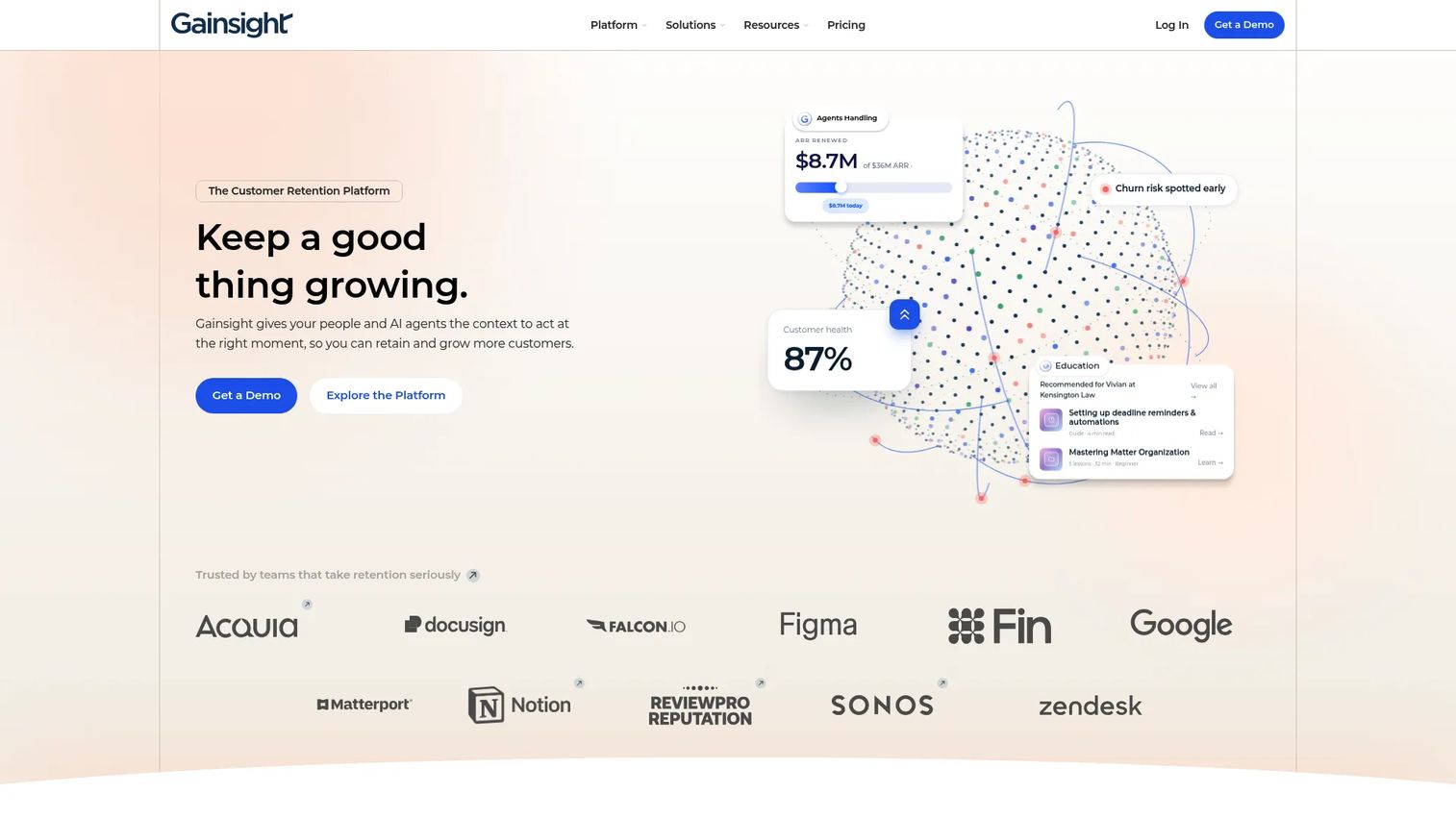
Gainsight Customer Success is an enterprise customer success platform that centralizes customer context, health scoring, CS workflows, and retention analytics into one operating layer. It covers everything from automated playbooks and journey orchestration to renewal forecasting and an AI Copilot that surfaces account risk and recommended actions. Gainsight is strongest when your retention program is owned by a mature CS organization with RevOps support and a need for executive-level visibility.
Best for: Enterprise and upper-mid-market teams managing renewals, CS workflows, health scoring, and cross-functional retention accountability.
Key features
- Customer 360: Unified account context across product, support, and CRM data
- Health scorecards: Configurable risk scoring across multiple signal sources
- CS playbooks and success plans: Automated and manual intervention workflows
- Renewal forecasting: Pipeline visibility for renewal and expansion revenue
- AI-powered Copilot: Conversational insights and recommended next actions
Why choose Gainsight Customer Success: Choose Gainsight when retention is owned at the organizational level, not just by individual CSMs. It suits teams that need process discipline across CSMs, managers, renewal owners, and executives, and where health scoring must feed directly into revenue forecasting.
Gainsight Customer Success pricing: Gainsight sells through two packages: Essentials (10 full users, 100 included customers per user) and Enterprise (20 full users, 200 included customers per user). Both require requesting a price quote from sales.
G2 rating: 4.5/5
2. ChurnZero
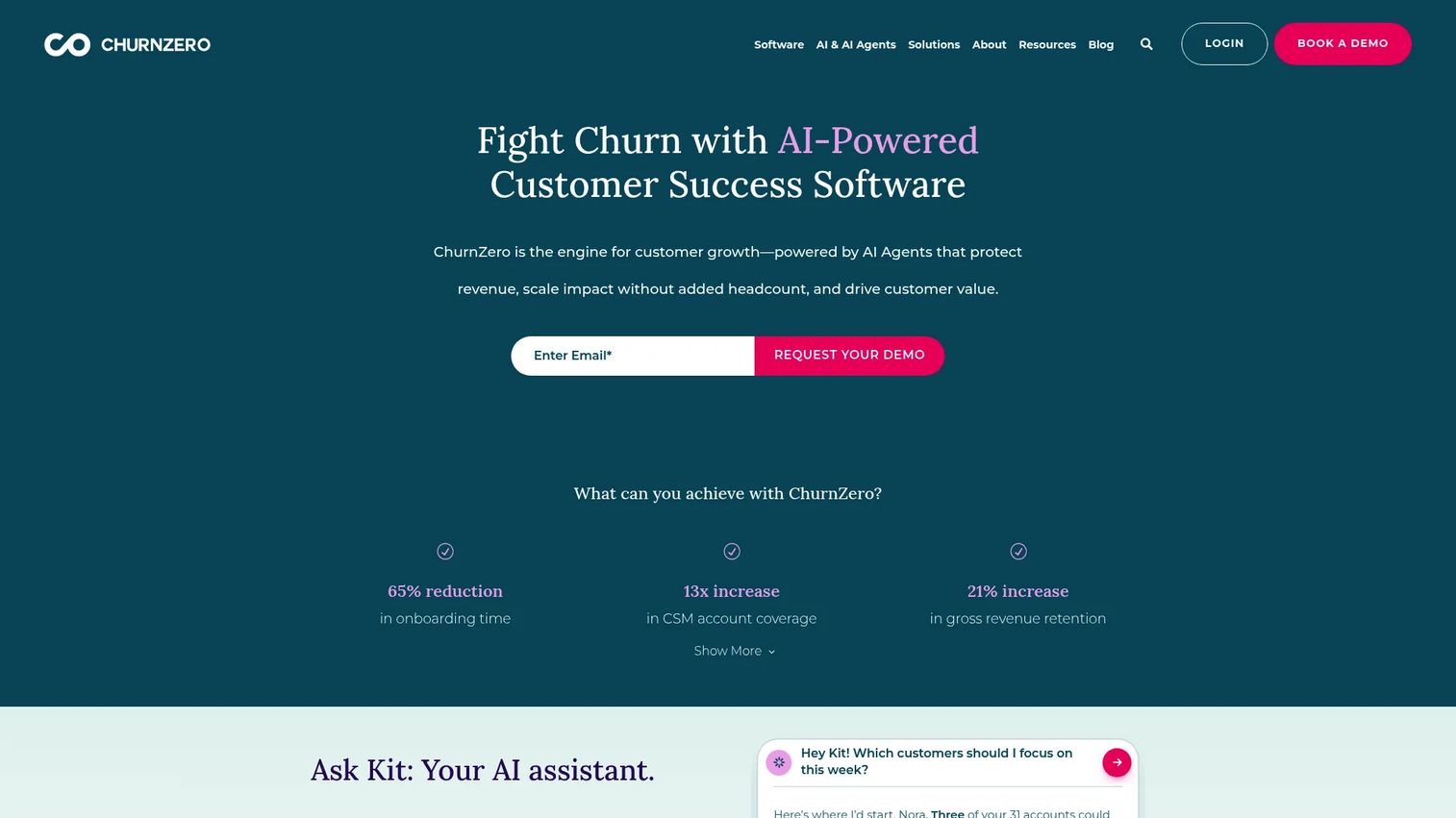
ChurnZero is an AI-powered customer success platform built for subscription SaaS teams that want to automate retention workflows, monitor account health, and keep customers engaged throughout their lifecycle. It combines health scores, in-app messaging, success centers, and journey automation into a single platform, with 70+ native integrations and AI agents for proactive account intelligence. ChurnZero is a strong fit for teams scaling a CS motion without wanting to stitch retention logic manually across CRM and marketing tools.
Best for: B2B SaaS customer success teams that want retention automation and account-level health visibility tied to renewal outcomes.
Key features
- Customer health scores: Multi-signal account risk and engagement tracking
- In-app messaging and WalkThroughs: Direct product-layer engagement for adoption
- Journey automation and plays: Triggered workflows at key lifecycle moments
- Renewal forecasting and alerts: Visibility into renewal pipeline and risk
- Engagement AI: AI-generated account insights and recommended actions
Why choose ChurnZero: ChurnZero suits SaaS CS teams that need proactive account intervention without building retention logic from scratch. The in-app engagement layer is particularly useful when low product adoption is the primary churn driver.
ChurnZero pricing: ChurnZero offers Professional and Enterprise editions on annual subscriptions.
G2 rating: 4.7/5
3. Churnkey
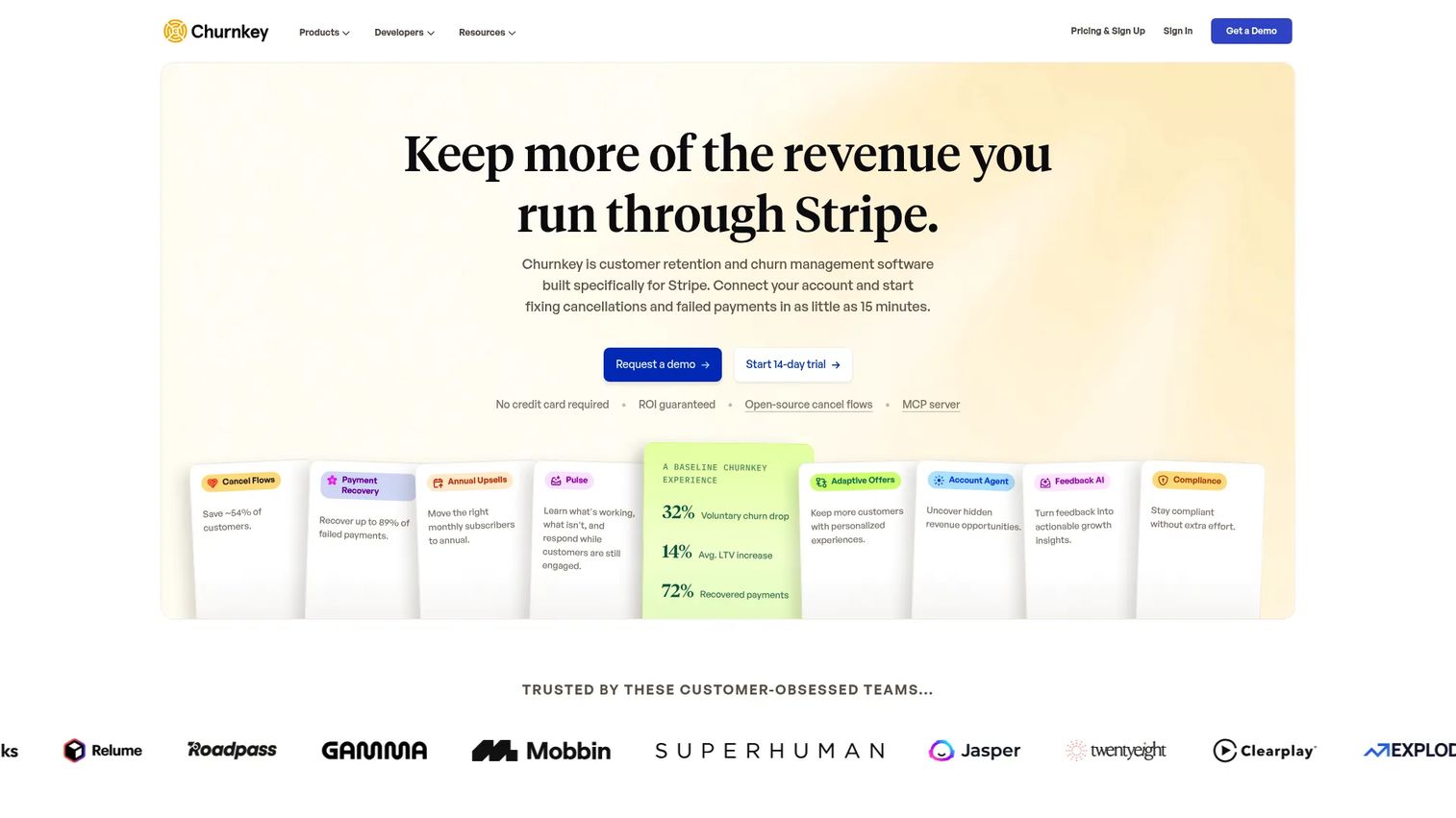
Churnkey is a cancellation-flow and revenue-recovery platform for subscription businesses. It focuses on saving customers at the moment they attempt to cancel through personalized save offers, pause options, adaptive targeting, and win-back workflows. Beyond cancel flows, Churnkey handles payment recovery, compliance automation, and exit surveys with AI-powered feedback analysis. It's the right tool when you know cancellation volume is a measurable revenue leak.
Best for: SaaS and subscription teams reducing voluntary cancellations directly inside the billing flow, especially where churn volume is at least $5k per month.
Key features
- Cancel flows: Personalized cancellation experiences with adaptive save offers
- Payment recovery: Precision retries and pre-dunning to recover failed payments
- A/B testing: Experiment on offers, messaging, and cancel flow design
- Unlimited segmentation: Target offers by plan, usage, tenure, or behavior
- Feedback AI: Automated analysis of exit survey responses
Why choose Churnkey: Churnkey delivers fast value for companies where the cancellation moment is the biggest retention lever. The Starter plan starts at $250/month (billed yearly) for teams with under $5k/month in churn volume, making it one of the more accessible options in this category to get started.
Churnkey pricing: The Starter plan is $250/month billed yearly, designed for teams with less than $5k/month in churn volume. Core and Intelligence plans are for teams with $10k+ monthly churn volume; pricing requires a quote. Enterprise pricing is custom.
G2 rating: 4.6/5
4. FunnelStory
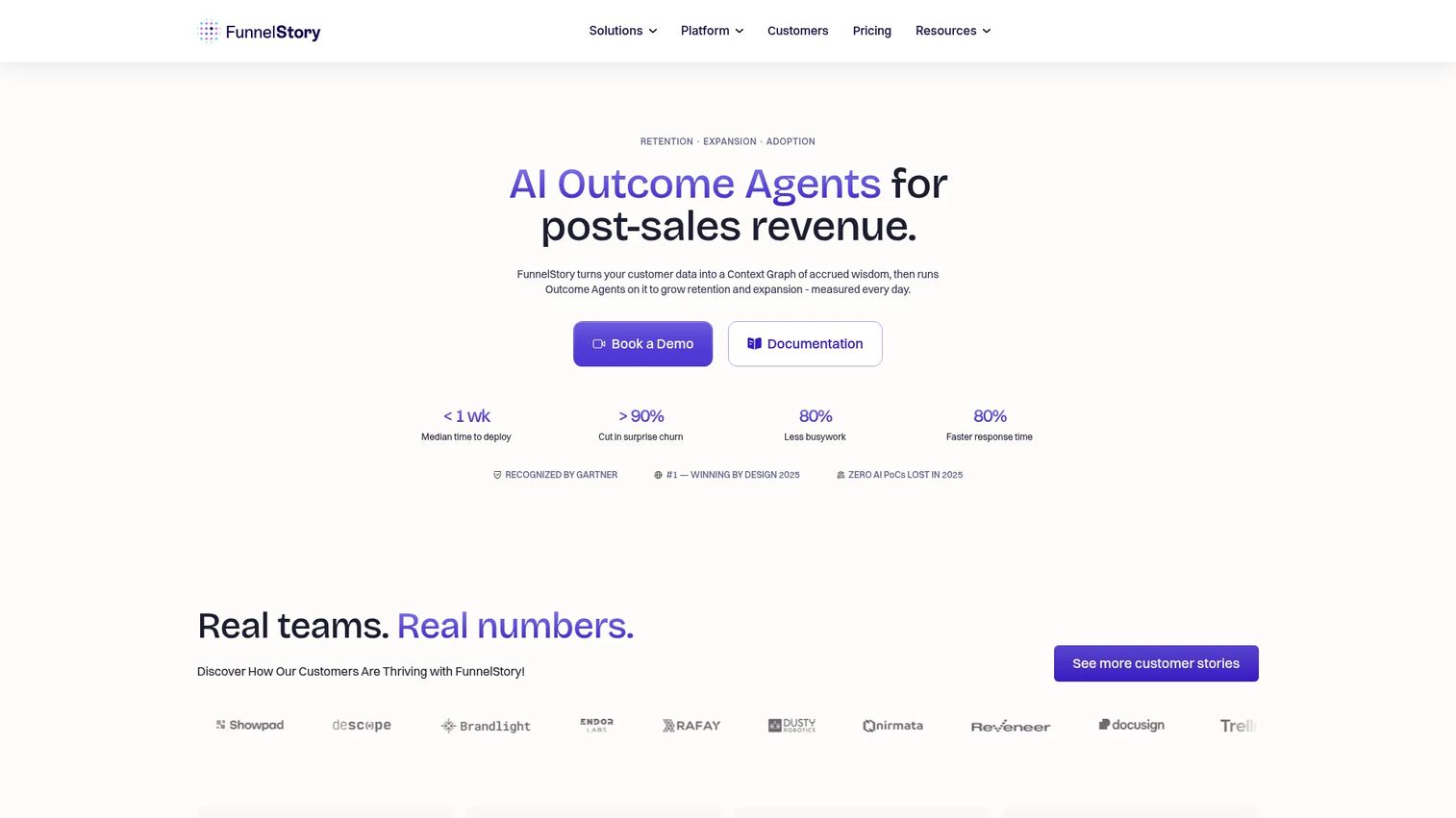
FunnelStory is an AI-powered customer intelligence platform that maps account behavior into a Customer Intelligence Graph, then scores churn risk, expansion likelihood, and account health from those signals. It surfaces what it calls "Needle Movers," early warning indicators that an account is heading toward risk or opportunity, and pairs them with AI Outcome Agents that automate post-sales workflows. FunnelStory is built for revenue and CS teams that want data science around customer lifecycle risk rather than a manually curated health score.
Best for: Revenue and growth teams that want predictive churn scoring from account behavior data, particularly those with complex post-sales motions.
Key features
- Customer Intelligence Graph: Maps account relationships and behavioral signals
- Churn and retention predictions: Risk scoring with identified driving factors
- Needle Movers: Early risk and opportunity signals before they become obvious
- Outcome Agents and AI Agents: Automated post-sales actions and workflows
- Conversation and support-ticket intelligence: Signals from CS and support interactions
Why choose FunnelStory: Choose FunnelStory when you need better segmentation than "active" versus "inactive." It's the right fit for teams that want predictive analytics to prioritize which accounts need attention this week, not which ones already submitted a cancellation request.
FunnelStory pricing: The Starter plan is $2,399/month, covering one workspace, the Customer Intelligence Graph, churn prediction for up to 50 accounts, SOC 2 Type II compliance, and email/Slack support. Enterprise includes custom AI agents, CRM sync, SSO, and enterprise LLM support; pricing is custom.
G2 rating: 4.8/5
5. ClientSuccess
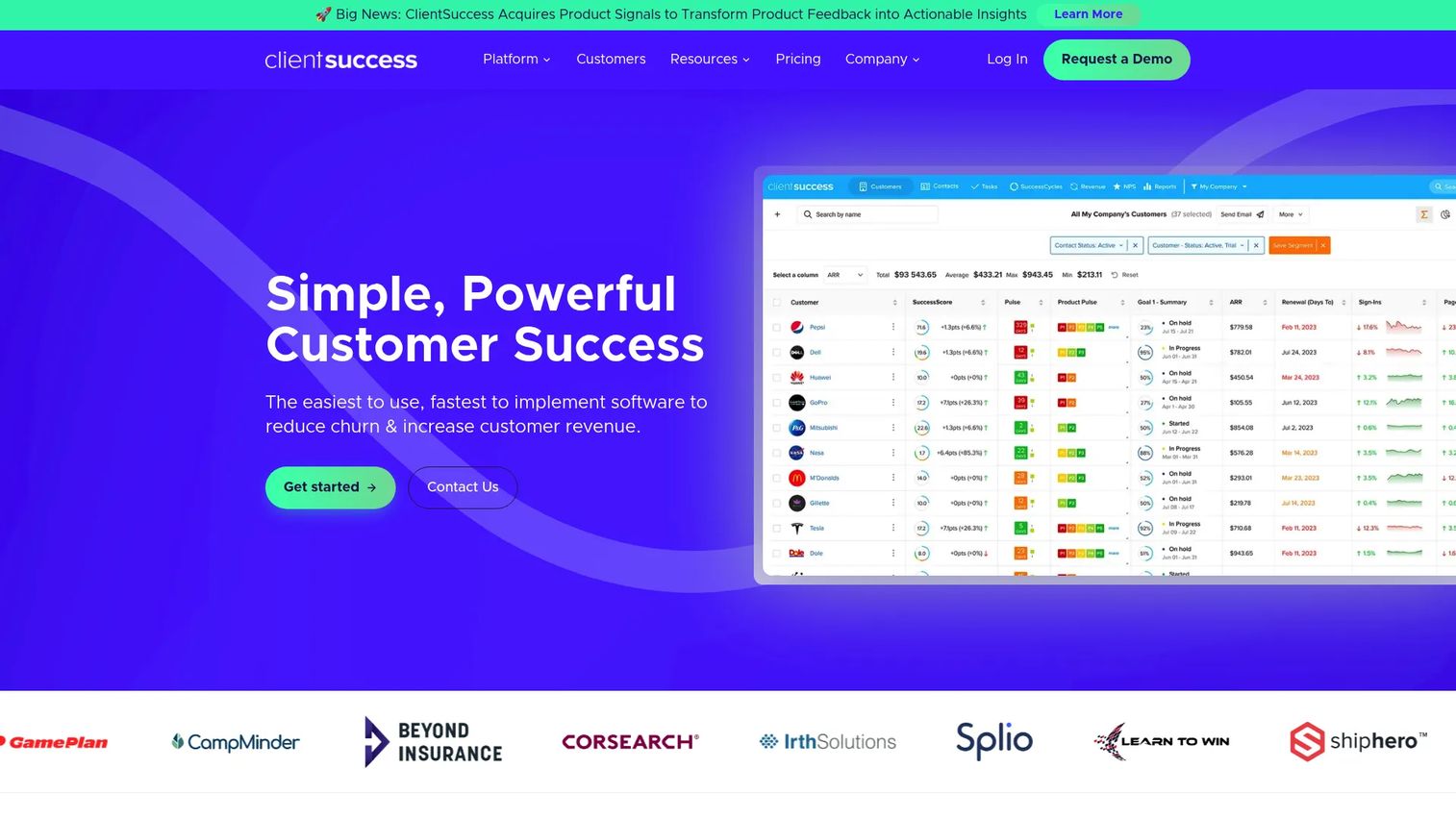
ClientSuccess is a customer success management platform focused on relationship management, customer health, success planning, and renewals. It provides lifecycle playbooks, NPS surveys, AI-assisted communications, and CRM integrations to give CS teams a structured layer for managing their accounts without the complexity of an enterprise platform. It suits teams that want usability and relationship tracking over deep configurability.
Best for: Mid-market B2B SaaS customer success teams that want centralized health visibility, success planning, and onboarding workflows.
Key features
- Customer health scoring: 360-degree account visibility across key signals
- Lifecycle playbooks: Onboarding, adoption, and renewal automation
- NPS surveys and feedback analysis: Built-in voice-of-customer collection
- AI-assisted communications: Meeting intelligence and account summaries
- CRM and product analytics integrations: Connects to core GTM and product stack
Why choose ClientSuccess: ClientSuccess fits teams that want structure without over-engineering the CS motion. It emphasizes relationship tracking and success planning over advanced predictive analytics, which makes it practical for mid-market CS teams building their first real retention process.
ClientSuccess pricing: Pricing is custom across Startup, Growth, and Enterprise packages. The price depends on CSM seat count, integrated modules, and contract length. Contact sales for a detailed quote.
G2 rating: 4.4/5
6. SupportLogic
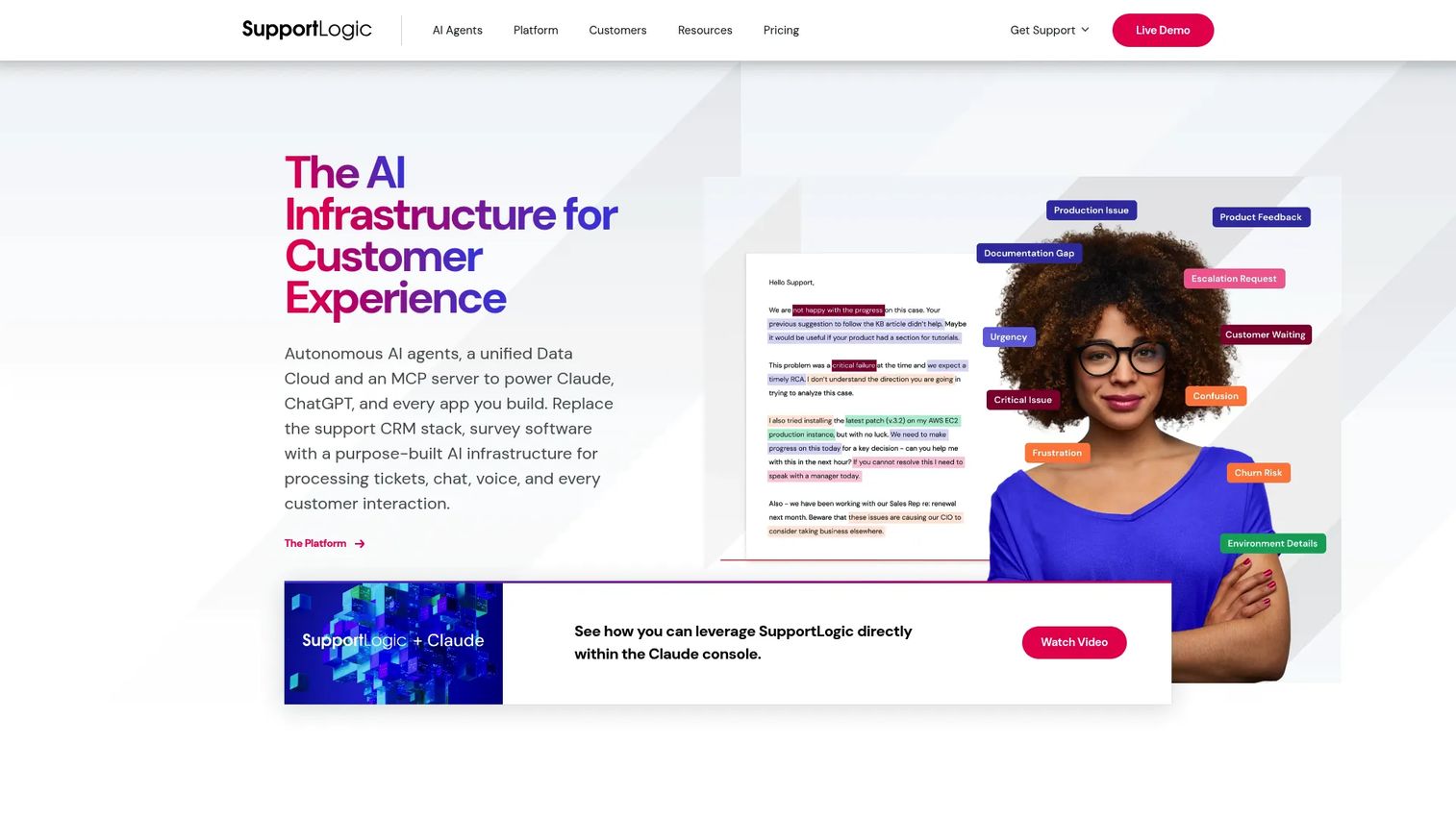
SupportLogic is an AI-powered Support Experience platform that analyzes existing support interactions (tickets, calls, chats) to surface sentiment signals, predict escalations, prioritize case backlogs, and coach agents. For retention purposes, its core value is turning support ticket data into churn-risk signals that CS and account teams can act on. Support tickets often reveal at-risk customers before CRM health scores catch up, and SupportLogic makes that data actionable.
Best for: Enterprise support and CX organizations that want to turn ticket and conversation data into proactive churn-risk signals and escalation prevention.
Key features
- Sentiment analysis: Signal extraction from customer messages and conversations
- Escalation prediction: Proactive alerts before cases escalate or churn risk spikes
- Intelligent case prioritization: Routing and backlog management by risk level
- Automated quality assurance: Voice analytics and agent coaching
- Knowledge search and case summarization: GenAI tools for faster resolution
Why choose SupportLogic: SupportLogic suits growth and support teams whose biggest churn signal is hidden in support interactions. If your CS team lacks visibility into which support cases represent genuine churn risk, SupportLogic surfaces those signals before they're lost in a ticket queue.
SupportLogic pricing: Pricing starts at $4,000/month with a prepaid annual contract, covering the Core SX bundle including AI features and Snowflake-native Data Cloud access. Individual tier pricing (Elevate SX, Resolve SX) requires a quote from sales.
G2 rating: 4.7/5
7. Chargebee Retention
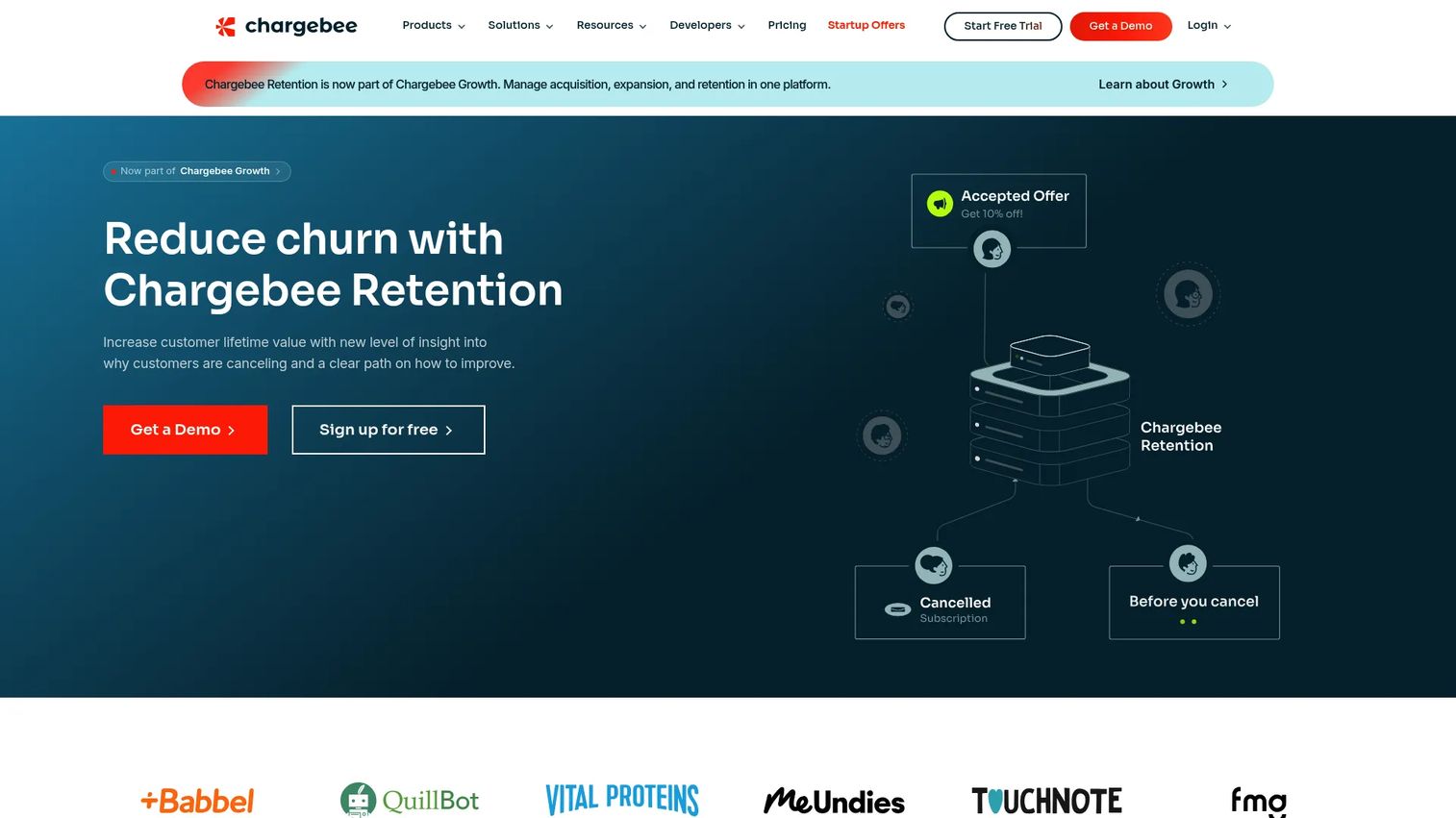
Chargebee Retention is a subscription retention product that reduces cancellations through personalized cancel experiences, targeted offers, and experimentation. It connects retention decisions to subscription billing data, allowing teams to test different retention strategies by audience segment and measure saved revenue directly. The platform supports A/B testing, rules-based targeting, and Smart Targeting experiments across cancellation flows.
Best for: Subscription businesses already using or evaluating Chargebee's revenue infrastructure that want to reduce voluntary churn inside the cancellation experience.
Key features
- Personalized cancel experiences: Tailored flows by plan, segment, and behavior
- Audience targeting and segmentation: Rules-based and smart targeting for retention offers
- A/B and randomized experiments: Test cancel flow designs and offer types
- Retention insights and reporting: Measures cancel reasons and intervention performance
- Retained revenue reporting: Direct billing-connected revenue impact tracking
Why choose Chargebee Retention: Choose Chargebee Retention when you want cancellation intervention tightly connected to subscription billing data and existing Chargebee infrastructure. The experimentation layer is useful for teams running A/B tests on retention offers.
Chargebee Retention pricing: Chargebee Retention is part of Chargebee Growth. Contact Chargebee sales for the retention product package and confirm whether it requires or integrates with your current billing platform.
G2 rating: 4.3/5
8. Paddle Retain
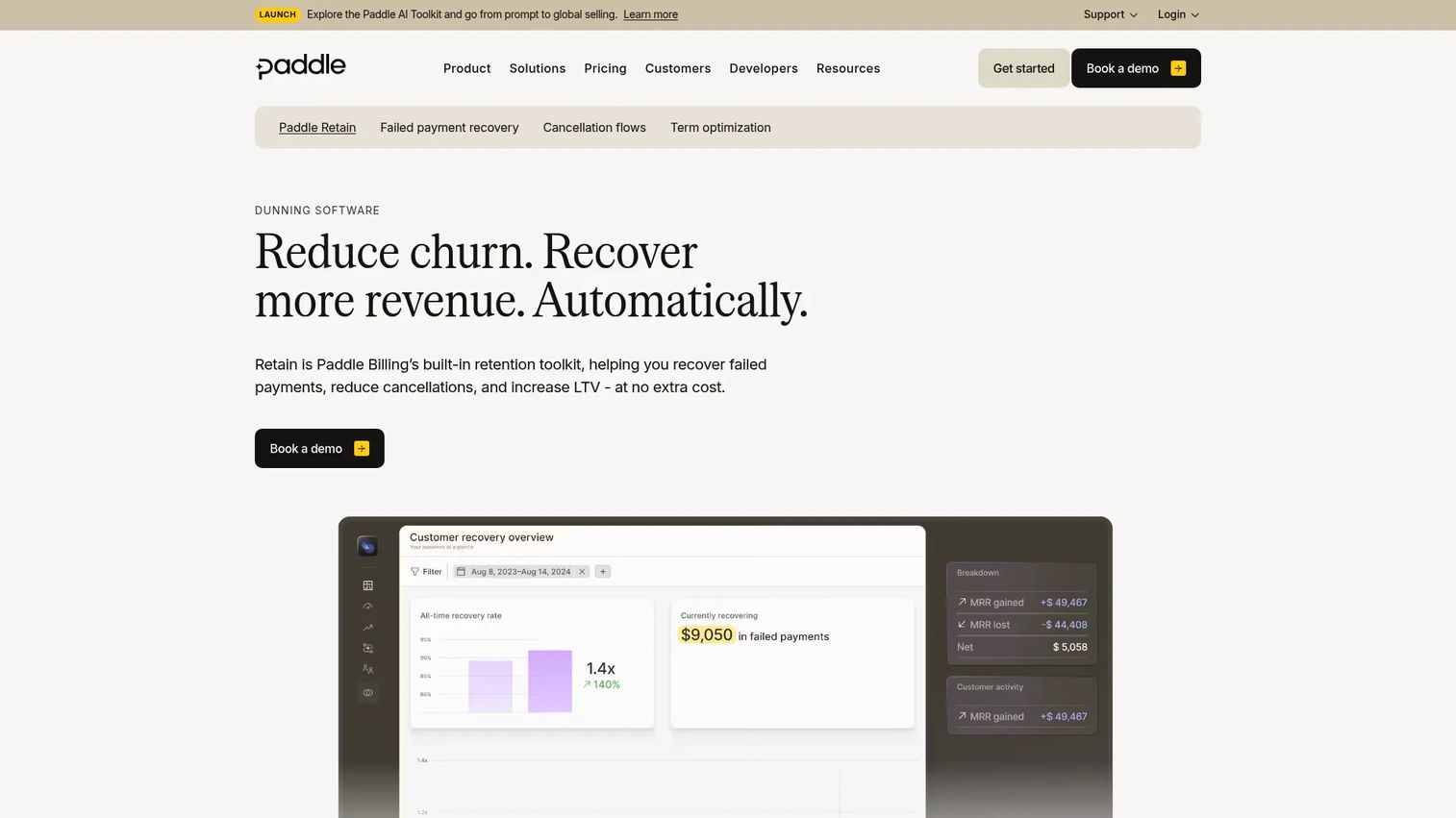
Paddle Retain is a retention platform that recovers failed payments, reduces cancellations, and increases customer lifetime value. It handles automated dunning, cancellation flows with personalized retention offers, term optimization for upgrades to longer plans, and localized outreach via email, in-app notifications, and SMS. Paddle Retain integrates with Paddle Billing and several other billing platforms, including Stripe, Chargebee, Zuora, Recurly, and Braintree.
Best for: SaaS subscription businesses using Paddle or planning to manage billing and retention through a connected platform.
Key features
- Automated payment recovery and dunning: Intelligent retry logic for failed payments
- Cancellation flows with retention offers: Personalized save offers and surveys
- Term optimization: Upgrades to annual or longer-term plans
- Localized outreach: Email, in-app, and SMS across regions
- Multi-platform integrations: Paddle Billing, Stripe, Chargebee, Zuora, Recurly, and Braintree
Why choose Paddle Retain: Paddle Retain works best when retention is tightly tied to billing, payment recovery, and subscription lifecycle management. Teams using Paddle Billing get it included at no extra cost, which removes the typical barrier to adding a retention layer.
Paddle Retain pricing: Paddle Retain is included with Paddle Billing at no extra cost. For teams not using Paddle Billing, ask Paddle sales about standalone Retain pricing and processing model requirements.
G2 rating: 4.8/5
9. ProfitWell Retain
ProfitWell Retain (now part of Paddle) is a subscription retention product that recovers failed payments, reduces cancellations, and optimizes subscriptions through personalized recovery messaging, targeted retries, pre-dunning, and term optimization. It handles both payment-related churn and voluntary cancellations through dedicated cancel flows and one-click reactivations.
Best for: Subscription businesses where the biggest churn source is failed payments or voluntary cancellations, and where revenue recovery is a primary KPI.
Key features
- Personalized recovery messaging: Tailored payment recovery outreach by account context
- Targeted payment retries: Precision retry logic to maximize payment recovery
- Pre-dunning and in-app reminders: Proactive outreach before payment failure
- Term optimization: Moves customers to longer-term plans to reduce cancellation risk
- Cancellation flows: Personalized cancel experiences with save offers
Why choose ProfitWell Retain: ProfitWell Retain fits subscription teams where payment failure and voluntary cancellations are the two biggest churn vectors. The focus is narrow and practical: Recover the revenue that was about to leave through two specific leaks.
ProfitWell Retain pricing: Smaller companies pay a flat fee starting at $500/month.
G2 rating: 4.8/5
10. Qualtrics Customer Experience
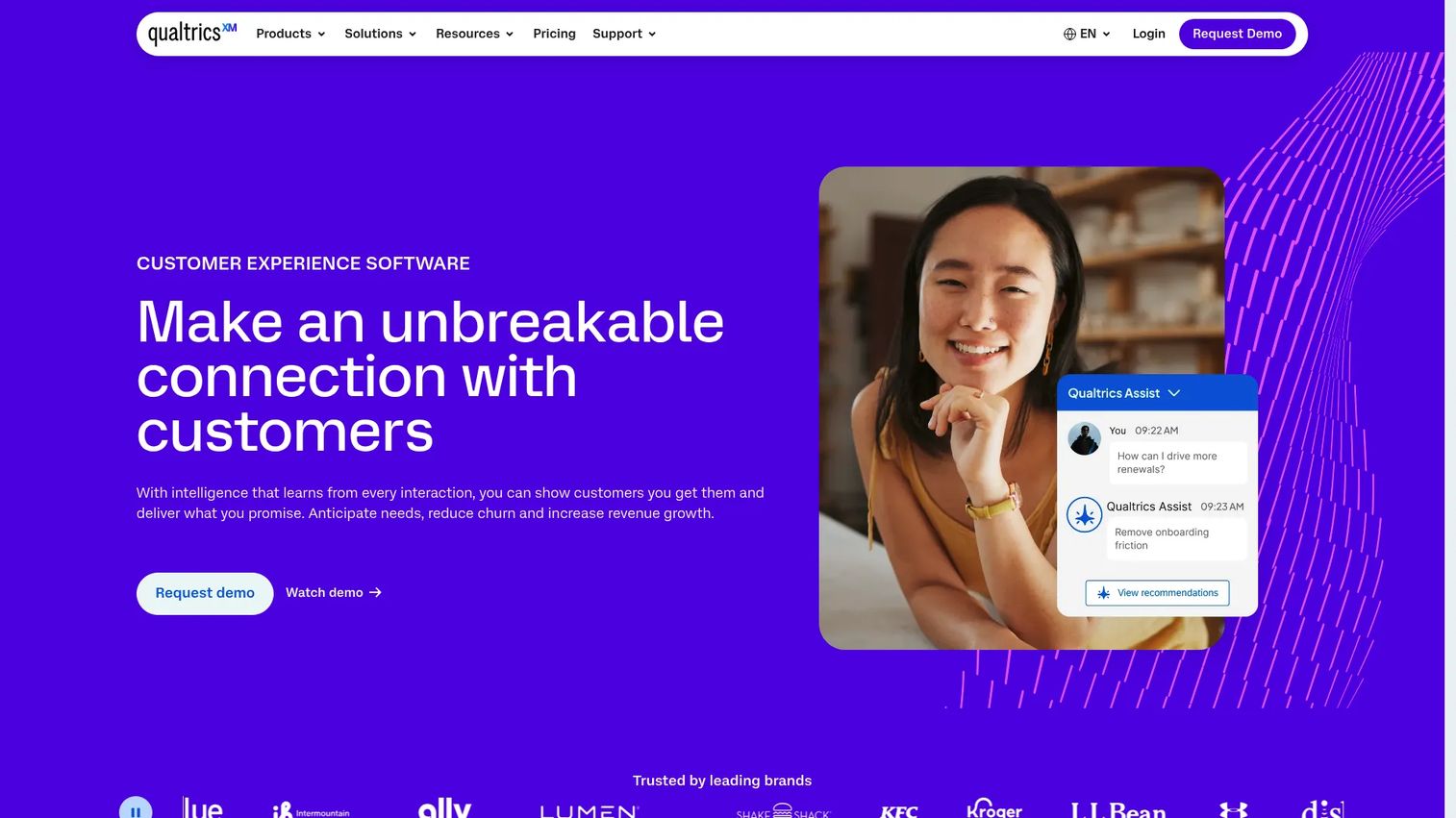
Qualtrics Customer Experience is an enterprise experience management platform that collects customer signals across digital, voice, chat, and social channels, analyzes them with automated text analytics and AI, and routes findings into closed-loop action workflows. Its retention relevance comes from helping organizations understand the experience drivers that affect loyalty, NPS, and churn risk at scale.
Best for: Enterprise CX and contact-center teams that need omnichannel voice-of-customer data, closed-loop action workflows, and executive retention reporting.
Key features
- Voice of Customer feedback: Collection across digital, voice, chat, and social channels
- Omnichannel experience management: Automated text analytics across all touchpoints
- Digital experience analytics: Session replay, heatmaps, funnel analytics, and frustration signals
- Contact center experience analytics: Call, chat, email, and social channel intelligence
- Closed-loop workflows: Route findings to action owners and track resolution
Why choose Qualtrics Customer Experience: Use Qualtrics when retention depends on understanding customer experience quality at scale, not just usage behavior or billing events. It's the right choice for organizations where NPS, journey friction, and CX leadership reporting are the primary lens for retention strategy.
Qualtrics Customer Experience pricing: All CX plans (CX Foundational, Frontline Digital, Frontline Care, Frontline Locations) are priced by request. The price depends on program scope, interaction types, survey volume, analytics needs, and user seats. Contact Qualtrics sales for a quote.
G2 rating: 4.3/5
11. Freshdesk Customer Success
Freshdesk Customer Success is a customer success management platform within the Freshworks ecosystem. It provides health scoring, customer monitoring, lifecycle playbooks, churn-risk and upsell-opportunity prediction, and product engagement tracking for B2B teams already working inside Freshworks. Teams using Freshdesk for support can connect support context directly to customer success workflows without switching platforms.
Best for: B2B companies managing customer health, engagement, and retention inside the Freshworks ecosystem.
Key features
- Customer health scores: Risk signals across product engagement and account activity
- Lifecycle playbooks: Structured workflows for onboarding, adoption, and renewal
- Churn-risk and upsell prediction: AI-driven signals for account risk and opportunity
- Surveys: Built-in feedback collection for NPS and customer sentiment
- Support context integration: Connects support ticket data to CS workflows
Why choose Freshdesk Customer Success: Freshdesk Customer Success fits teams already using Freshworks tools who want CS workflows close to their support and engagement data. It avoids the need to route customer signals across separate platforms.
Freshdesk Customer Success pricing: Contact Freshworks sales directly for the current Customer Success package details.
G2 rating: 4.5/5
12. TeamSupport
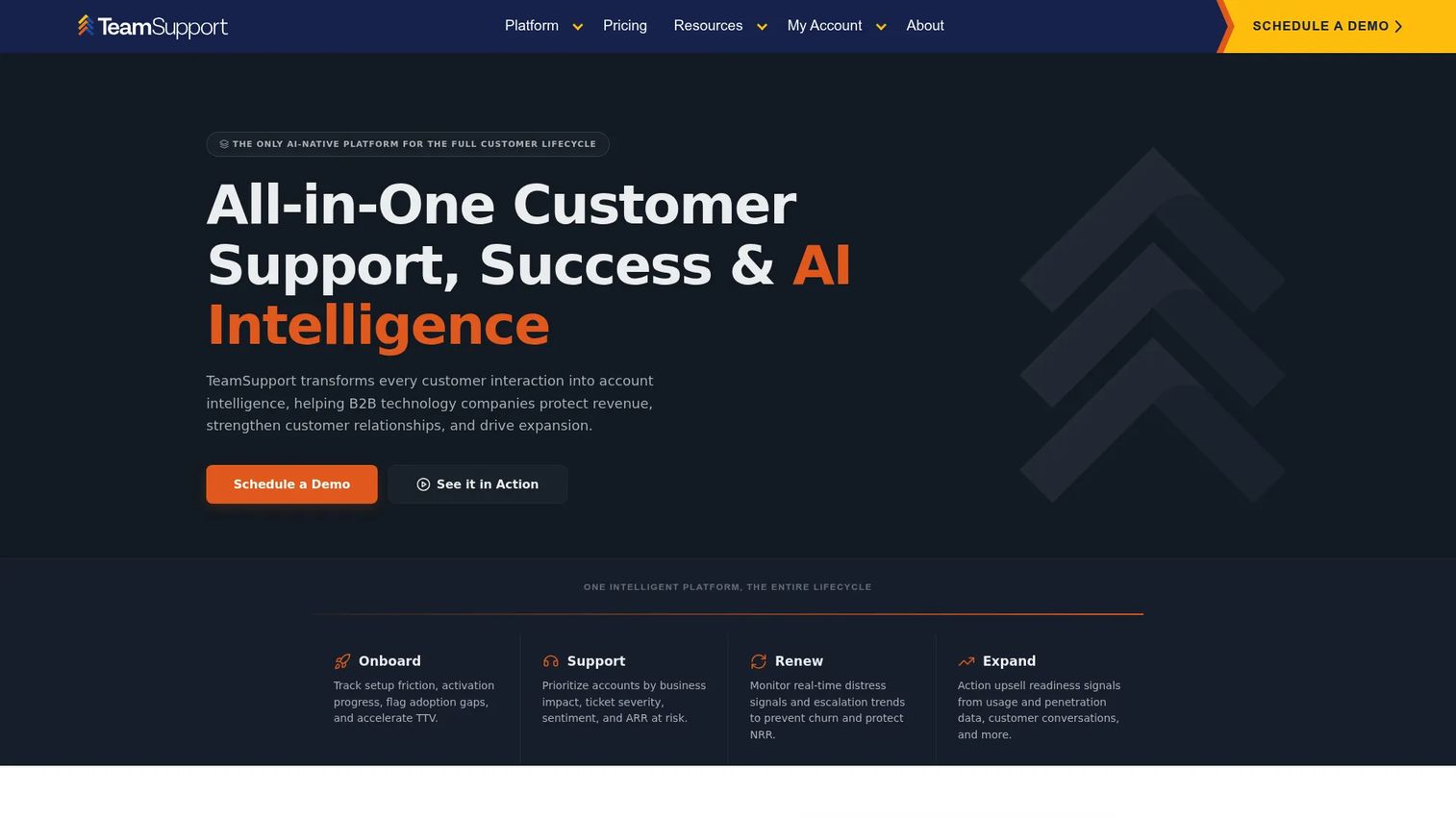
TeamSupport is an AI-native customer operations platform that unifies support ticketing, customer success, and onboarding for B2B companies. Its retention relevance comes from account-level visibility: Customer distress signals, full ticket history, shared account timelines, and AI productivity tools that surface which accounts are heading toward risk. It's designed for B2B support teams that want shared account context rather than individual ticket management.
Best for: B2B support and customer operations teams that want account-level support visibility and proactive customer intelligence tied to retention.
Key features
- Account-level customer views: Full account context across tickets, history, and health
- Ticketing and omnichannel support: Unified queue across channels with collaboration tools
- Customer distress signals: AI-driven alerts for accounts showing risk patterns
- Automation and playbooks: Workflow automation and knowledge base management
- Custom dashboards and reporting: Account health and support performance analytics
Why choose TeamSupport: TeamSupport works for B2B support teams where the ticket queue is the primary source of customer intelligence. If support experience is a core driver of renewal confidence, TeamSupport gives CS and support a shared view of account risk.
TeamSupport pricing: The Starter plan is $45/month (billed annually, max 5 users) and covers ticketing and messaging. Professional is $65/month (billed annually, unlimited users) and adds customer intelligence, AI tools, and playbooks. Scale is $85/month (billed annually) and adds automation, custom fields, and broadcast features.
G2 rating: 4.4/5
13. EverAfter
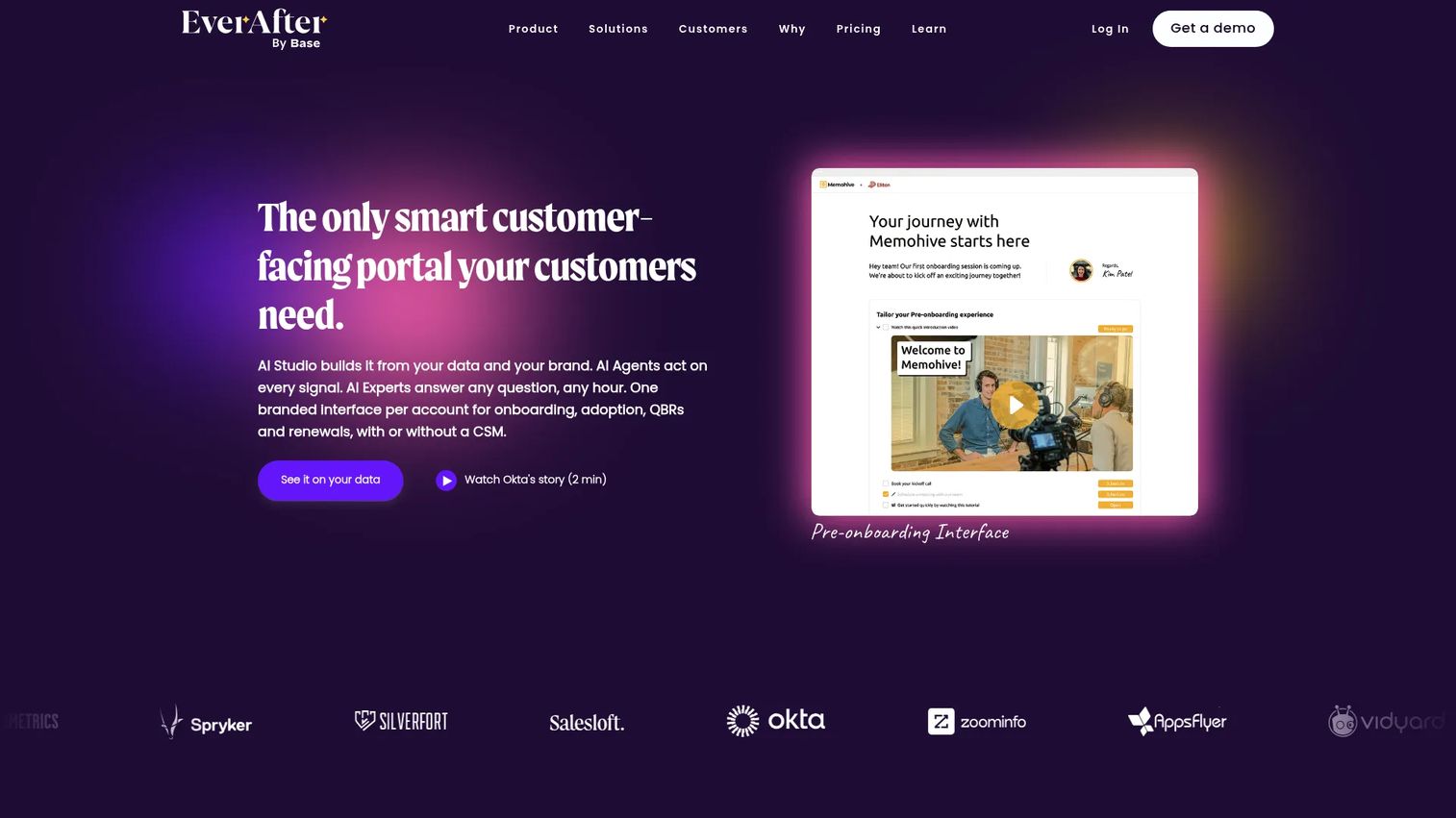
EverAfter is an AI-powered digital customer success platform that builds customer-facing portals and success hubs for onboarding, adoption, QBRs, renewals, and other post-sale journeys. Teams create no-code, white-labeled customer interfaces with AI agents that automate customer actions, task management, engagement tracking, and reporting. EverAfter positions retention as a customer alignment problem: Customers who are aligned on value, next steps, and outcomes are far less likely to churn.
Best for: B2B customer success teams that want scalable, personalized customer-facing hubs for onboarding, adoption, renewal readiness, and QBR management.
Key features
- AI-powered customer interface builder: No-code portal creation with white-label branding
- AI agents for customer journeys: Automated customer actions and milestone management
- AI Experts: Cited answers from knowledge bases and documentation inside the portal
- Task management and data collection: Shared accountability between CS and customers
- Engagement tracking and reporting: Visibility into how customers interact with their hub
Why choose EverAfter: Choose EverAfter when the retention issue is customer alignment rather than data signals or billing recovery. If customers churn because they lose sight of their own goals, QBR readiness, or expected outcomes, EverAfter addresses that gap directly.
EverAfter pricing: EverAfter prices are customized per customer. The price depends on portal volume, integrations, seat count, and program scope. Contact EverAfter sales for a quote.
G2 rating: 4.6/5
14. Hook

Hook uses AI agents to analyze customer data, detect churn risk and expansion opportunities, and automate actions through email, Slack, and CS team workflows. It focuses on practical account prioritization: Surfacing which accounts need attention this week, with AI-generated insights on why, rather than requiring CS teams to build complex health score configurations from scratch.
Best for: B2B SaaS customer success and revenue teams that want AI-assisted account health monitoring and churn-risk prioritization without heavy configuration.
Key features
- AI-powered account insights: Risk and opportunity signals from connected data sources
- Churn-risk and expansion detection: Automated identification of at-risk and high-potential accounts
- Automated playbooks and actions: Triggered workflows via email, Slack, and CS tools
Why choose Hook: Hook suits teams that want AI-driven account prioritization without the overhead of building a full CS platform. It's practical for growing CS teams that need to know which accounts require action now, rather than teams that need deep lifecycle orchestration.
Hook pricing: Contact Hook sales for details on account volume, data source connections, and seat count.
G2 rating: 4.7/5
15. ZapScale
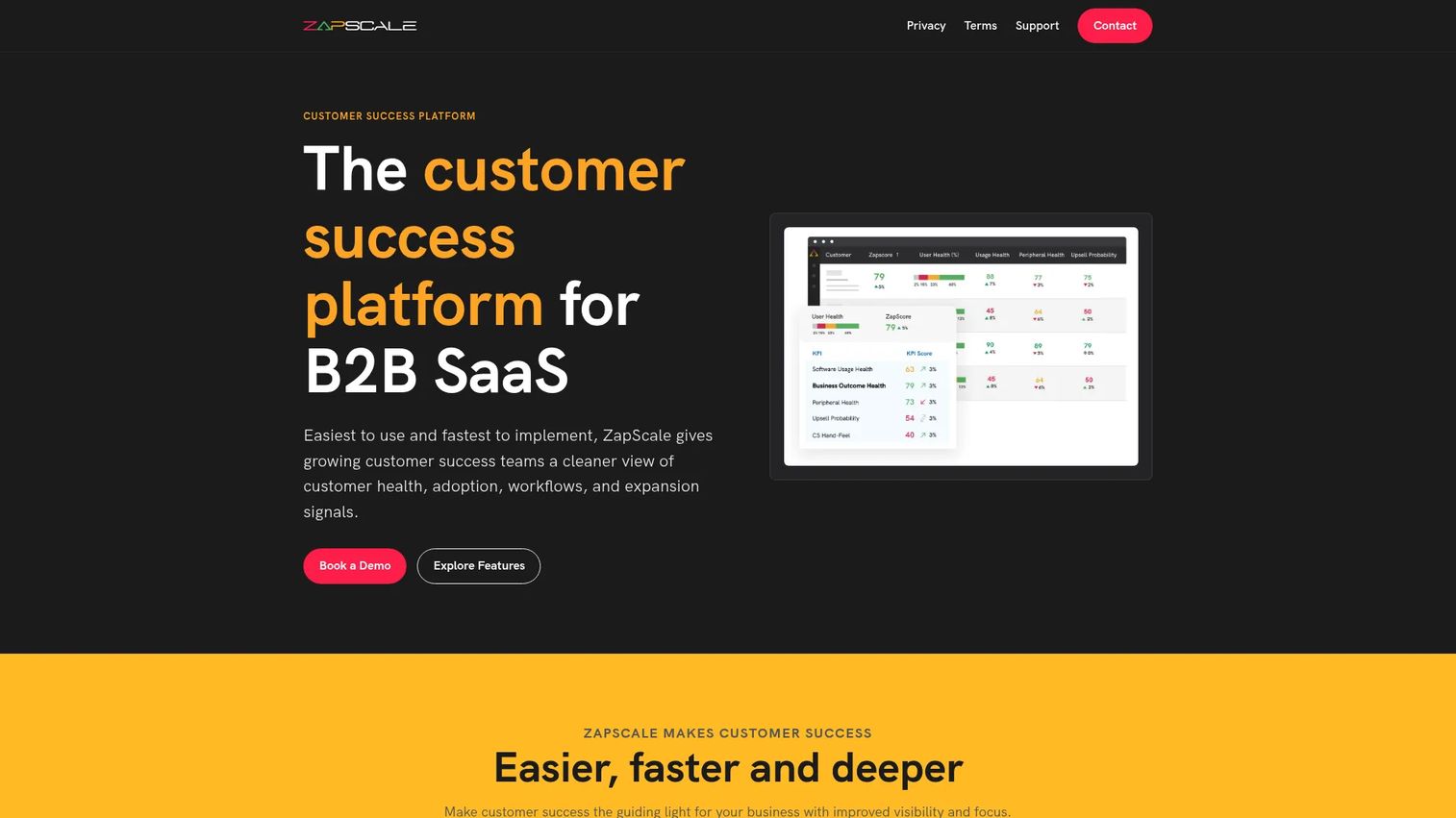
ZapScale is a customer success platform built for B2B SaaS teams that need centralized account health, adoption tracking, automated workflows, and churn-risk prediction without starting from scratch. It includes pre-built playbooks, 40+ pre-built health KPIs, success plans, and AI-assisted account summaries and sentiment analysis. ZapScale is well-suited for startup and mid-market CS teams moving from spreadsheets into a structured retention platform.
Best for: Startup and mid-market B2B SaaS customer success teams building repeatable retention processes and looking for a faster path to structured CS operations.
Key features
- 360-degree customer view: Segmented account visibility across health signals
- Health analytics with pre-built KPIs: 40+ ready-to-use indicators across product and engagement
- Product adoption tracking: Usage monitoring tied to lifecycle stage and health
- Automated workflows and pre-built playbooks: Triggered actions at key retention moments
- AI-assisted inbox and account summaries: Sentiment analysis and account context at a glance
Why choose ZapScale: ZapScale suits teams moving from spreadsheet-based CS into a dedicated retention platform. The pre-built playbooks and health KPIs reduce the time to get meaningful health scores running compared to platforms requiring heavy configuration.
ZapScale pricing: Contact ZapScale sales for details by CSM seat count, account volume, and connected data sources.
G2 rating: 4.8/5
Considerations when choosing proactive customer retention software
Start with the retention motion you need to fix
Match the tool to the specific leak. If the core problem is subscription cancellations, evaluate Churnkey, Chargebee Retention, Paddle Retain, or ProfitWell Retain before looking at full CS platforms. If the problem is CSMs missing at-risk accounts, start with health-scoring platforms. Buying a broad CS platform when you need a targeted cancellation fix creates implementation overhead without proportional return.
Check the data your team can actually connect
Retention tools generate better signals when fed richer data. CRM, billing, product analytics, support desk, marketing automation, and data warehouse connections all matter. Before evaluating a platform's predictive capabilities, audit what data you can actually pipe in. A sophisticated health score built on incomplete data produces worse decisions than a simple one built on clean inputs.
Decide who owns the workflow after the alert fires
A churn alert without an action owner is just a dashboard. Map each type of alert to a specific response before selecting a tool: A lifecycle campaign, a CSM task, a support escalation, a billing save flow, or an executive outreach sequence. The tool that fits best is the one whose alert types match your team's available response paths.
Measure saved revenue, not only activity
Growth marketers need retention tools to close the attribution loop. Track churn rate reduction, net revenue retention impact, renewal forecast accuracy, expansion revenue, and campaign-influenced saved accounts. If a tool can't connect its interventions to revenue outcomes, it's hard to defend the budget in a growth review.
Watch for implementation and adoption load
Enterprise CS platforms can be powerful, but setup requires clean data, internal configuration ownership, and change management across CS, RevOps, and sometimes product. Smaller teams often get more immediate value from narrower tools with faster time to first signal. Evaluate the implementation path alongside the feature set.
Conclusion
The right proactive customer retention software depends on where your churn is coming from and who owns the response.
For enterprise retention operating depth, start with Gainsight Customer Success or ChurnZero. If subscription cancellations and billing events are the core issue, evaluate Churnkey, Chargebee Retention, Paddle Retain, or ProfitWell Retain. Teams whose churn signals are buried in support tickets should look at SupportLogic, TeamSupport, or Freshdesk Customer Success. For customer-facing success journeys and alignment-driven retention, EverAfter stands out. Teams building their first structured CS motion will find ClientSuccess, Hook, or ZapScale faster to implement than a full enterprise platform.
Shortlist three tools: One for your core retention motion, one for your data reality, and one for your team's capacity to implement. The global customer success management market reached $2.4 billion in 2025 (Grand View Research, 2026), and the category keeps expanding. The winning bet is on the tool that connects signal to action to revenue, not the one with the most features on a slide deck.
Retention starts earlier when customers understand your product faster. If interactive product experiences or self-serve onboarding are part of your retention plan, Guideflow lets you help customers see value before a CSM has to intervene.
Start your journey with Guideflow today!
FAQs
Proactive customer retention software helps teams detect churn risk before a customer cancels, then trigger the right intervention at the right time. It aggregates signals from product usage, support interactions, billing events, and customer feedback into health scores or risk alerts, then routes those alerts to campaigns, CSM tasks, or cancellation save flows.
Customer success software is one major type of proactive retention software, focused on CS workflows, health scoring, renewal management, and account orchestration. Proactive retention is a broader category that also includes subscription cancellation tools, support intelligence platforms, customer experience analytics, and predictive analytics products. Not all proactive retention tools require a CS team to operate them.
The answer depends on the company's size and growth motion. Enterprise SaaS teams managing complex portfolios typically prefer full CS platforms like Gainsight or ChurnZero. Subscription SaaS teams focused on reducing cancellations and recovering failed payments should evaluate Churnkey, Paddle Retain, or ProfitWell Retain. Product-led SaaS teams often benefit most from tools that use product usage and onboarding signals, like FunnelStory or ZapScale, alongside lifecycle campaigns tied to those signals.
The most effective retention platforms draw from CRM data, billing and payment events, product usage and feature adoption, support ticket history, marketing automation engagement, renewal dates, and customer feedback. The more signal types connected to the platform, the more accurate its churn prediction and health scoring. If data quality is poor, fix the signal layer before expecting accurate predictive output.
Most tools combine multiple signal types: Product usage patterns, support ticket sentiment, billing anomalies, lifecycle stage milestones, NPS scores, and engagement gaps. These feed into configurable or AI-driven health scores that assign risk levels to accounts. Some platforms, like FunnelStory and Hook, use machine learning to weight signals automatically based on historical churn patterns in your account data.
Yes, particularly for lifecycle campaigns and revenue attribution. Retention signals like health score drops, feature adoption gaps, or renewal risk can trigger re-engagement emails, in-app prompts, or targeted expansion campaigns. Growth marketers can use this data to prove NRR impact, demonstrate that lifecycle campaigns reduce churn, and connect retention effort to pipeline and revenue metrics that leadership tracks. For more on analytics approaches relevant to this work, see our guide to best predictive analytics software tools and best revenue intelligence platforms.
Pricing varies significantly across tool types. Subscription cancellation tools like Churnkey start at $250/month for smaller teams. Payment recovery tools like ProfitWell Retain start at $500/month with performance-based pricing for larger volumes. Support intelligence platforms like SupportLogic start at $4,000/month. Full enterprise CS platforms like Gainsight require custom contract pricing with no self-serve entry point. The price depends on account volume, CSM seat count, connected data sources, and feature package.
Start with these four: Data readiness (can you connect your CRM, product, billing, and support data?), workflow ownership (who acts on each alert type?), integration quality (does it connect to your existing CRM and marketing automation?), and reporting depth (can it tie retention interventions to churn rate, NRR, and expansion?). Also check whether the best onboarding flow software you use can feed adoption signals into the retention platform, since onboarding gaps are one of the most common early churn drivers. For teams building a broader data layer, our best customer data platform guide covers the foundation.