You booked eight patients today. Two rescheduled by text, one no-showed, and the intake form for a new patient is still sitting on a clipboard you have to type in later. Charting for the day is three hours behind. The insurance claim you meant to submit last week is still open.
That is the day-to-day reality for most acupuncture clinics running on a mix of paper, spreadsheets, and generic scheduling tools. None of those tools were built for how an acupuncture practice actually runs: point prescriptions, herbal formulas, treatment history that spans months, and billing that toggles between self-pay and insurance. The right acupuncture practice management software collapses those handoffs into one system, and the wrong one just moves the chaos onto a screen.
This matters more than it used to. The global acupuncture practice management software market was estimated at USD 0.33 billion in 2023 and is projected to reach USD 0.77 billion by 2032, growing at an 11.22% CAGR, according to WiseGuy Reports (2024). Small practices drive roughly 45% of that demand, which tells you most buyers are solo or small-team clinics, not hospital systems. They need acupuncture clinic software that reduces admin without a six-month rollout.
Software choice touches everything you actually feel: no-show rates, how fast you finish charting, whether payments land on time, and what your patients experience from booking to follow-up. Pick well and the clinic runs itself between treatments. Pick poorly and you added a monthly bill to the same problems. This guide compares four options for acupuncture software for clinics of every size.
What's inside
This is a comparison of acupuncture-specific practice management software, not generic medical or wellness scheduling tools that happen to advertise to acupuncturists. Every tool here supports the workflows an acupuncture clinic runs daily.
We selected and ranked these four based on four criteria: acupuncture workflow fit (point charts, herbal formulas, SOAP notes), charting depth and speed, billing and claims support, and the patient-facing experience across booking, reminders, portal, and telehealth. The list covers both solo practitioners and multi-practitioner clinics, so each section flags who the tool fits and where it stretches thin. Pricing and ratings reflect verified vendor and G2 sources at the time of writing.
TL;DR
- Best acupuncture-native operating system: Unified Practice, built specifically for acupuncture and Chinese medicine with EHR, scheduling, and billing in one place.
- Best for herbalist-heavy and fast-setup clinics: AcuBliss, with AI-assisted charting and turn-key onboarding.
- Best for polished all-around clinic operations: Jane App, strong on booking, SOAP notes, payments, and mixed self-pay plus insurance workflows.
- Best for telehealth and multi-practitioner scheduling: Zanda, with deep appointment workflows, forms, and client portal tools.
- In a hurry? If you want software designed around acupuncture from the ground up, start with Unified Practice. If you want the smoothest general clinic experience, test Jane App. Shortlist two and run a real week of appointments through each.
What is acupuncture software?
Acupuncture software is practice management software built for the workflows of acupuncture and Chinese medicine clinics: scheduling, clinical charting, billing, patient communication, and reporting in a single system. It differs from generic scheduling apps because it accounts for treatment history, point and herbal documentation, and the self-pay-plus-insurance billing mix common in acupuncture practices.
Most acupuncture management software bundles a consistent set of modules. Knowing the pieces helps you compare tools on the same terms.
- Scheduling: Online booking, multi-practitioner and multi-room calendars, automated reminders, and waitlist management. This is the backbone of acupuncture scheduling software.
- Charting and acupuncture EHR: SOAP notes, custom and acupuncture-specific templates, treatment history, and point or formula documentation. Strong acupuncture charting software is what separates purpose-built tools from generic ones.
- Billing and payments: Invoicing, integrated payments, superbills, and, in some tools, insurance claims and clearinghouse support. This is your acupuncture billing software layer.
- Patient communication and portal: An acupuncture patient portal for booking, forms, and messaging, plus SMS and email reminders.
- Patient intake forms: Digital intake and consent forms patients complete before arrival.
- Telehealth: Acupuncture telehealth for virtual consults, herbal follow-ups, and remote check-ins.
- Reporting: Revenue, retention, and appointment analytics for running the business.
The goal of any acupuncture EHR is fewer handoffs. One record moves from booking to chart to invoice without re-entry, and the clinic sees less manual work between treatments.
When to use acupuncture software
Not every clinic needs every module on day one. Here is how to match the software to your actual pressure points.
Streamline scheduling and reduce no-shows
If your calendar is busy enough that gaps and cancellations cost real money, scheduling automation earns its keep first. Online booking removes the phone-tag layer. Automated reminders cut missed appointments, and a waitlist fills the slot when someone cancels late. This matters most for high-volume solo practitioners and multi-practitioner clinics where an empty room is lost revenue. No-show reduction is often the fastest, most visible payback from any acupuncture software.
Replace paper charting and manual SOAP notes
If you are still writing clinical notes by hand or retyping them after hours, digital charting is where the time comes back. Templates for common presentations, saved point prescriptions, and reusable formulas turn a fifteen-minute note into a two-minute one. Treatment history sits in one place, so continuity across a course of care is instant. This is the trigger for clinics whose charting backlog is eating evenings.
Centralize billing, claims, and patient communication
When you are juggling invoices, superbills, insurance claims, and patient messages across separate tools, integrated payments and claims support pull it together. Fewer handoffs mean fewer dropped balls: the appointment, the note, the invoice, and the follow-up message all share one record. Clinics that bill insurance, or run packages and memberships, feel this most.
Comparison table
Use this table as a shortlist filter, not a final verdict. Match the intent column to your clinic's biggest pain, then read the two full sections that fit before you trial anything. Pricing reflects the lowest publicly listed starting tier; ratings come from G2 at the time of writing.
| # | Product | Intent | Key use case | Pricing | G2 rating |
|---|---|---|---|---|---|
| 1 | Unified Practice | Acupuncture-native all-in-one | EHR, scheduling, billing, and payments built for Chinese medicine | From $49/mo. | 4.2/5 |
| 2 | AcuBliss | Fast setup with herbalist tools | AI-assisted charting, smart scheduling, forms, and herbalist workflows | Not publicly listed | Not listed |
| 3 | Jane App | Polished all-around operations | Booking, SOAP notes, payments, and mixed self-pay plus insurance | From $54/mo. | 4.0/5 |
| 4 | Zanda | Telehealth and multi-practitioner depth | Scheduling, forms, telehealth, and client portal at scale | From $9.50/mo. | 4.7/5 |
1. Unified Practice

Unified Practice is acupuncture practice management software built from the ground up for acupuncture and Chinese medicine clinics. It combines EHR, scheduling, billing, payments, reporting, and patient communication in one platform, so the clinic runs on a single record instead of a stack of disconnected tools. Where generic wellness software adapts to acupuncture, Unified Practice starts there.
The acupuncture-native design shows in the details that matter to practitioners. Charting is built around the way acupuncturists actually document, and the platform's licensed reference library and partner ecosystem give it depth that general tools do not carry. For a clinic that wants an operating system rather than a scheduling add-on, that focus is the differentiator.
Best for: Acupuncture clinics that want an all-in-one platform designed specifically for Chinese medicine workflows.
Key strengths
- Acupuncture-native EHR and charting: Documentation is built for point prescriptions and treatment history, not retrofitted from a general template.
- All-in-one operations: Scheduling, billing, payments, and reporting live in one system, cutting handoffs between tools.
- Reference library and ecosystem: A licensed reference library and partner integrations extend the platform beyond core practice management.
Why choose Unified Practice: If acupuncture-specific fit is your top priority, this is the tool built around your exact workflow. It suits clinics that would rather learn one purpose-built system than bend a general platform to fit. Clinics wanting the broadest possible integration marketplace or the most polished consumer-style booking may want to compare it against Jane App before committing.
Unified Practice pricing: Public pricing starts at $49/mo. for the Starter plan billed monthly with UnifiedPay, or $588/year billed annually. The Enhanced plan runs $74/mo. and Premium runs $99/mo., both with UnifiedPay. A 7-day free trial is available. Its G2 rating is 4.2/5. Confirm current plan details on the vendor site, since pricing varies with and without UnifiedPay.
2. AcuBliss

AcuBliss is acupuncture clinic software focused on fast setup and herbalist-specific workflows. It covers smart scheduling, acupuncture charting software, a patient portal, patient intake forms, and multi-practitioner support, with an emphasis on getting a clinic live quickly rather than through a long implementation. The positioning is turn-key: import your data, configure your calendar, and start booking.
Its standout is the AI Scribe, which assists with clinical notes so documentation keeps pace with treatment, plus herbalist-specific tools that other general platforms tend to overlook. For clinics that dispense herbs alongside acupuncture, that dual focus removes a workflow gap.
Best for: Herbalist-heavy acupuncture practices that want quick onboarding and AI-assisted charting.
Key strengths
- AI Scribe for charting: AI assistance speeds up clinical notes so documentation stays current instead of piling up after hours.
- Herbalist workflows: Tools built for herbal formulas and dispensing sit alongside acupuncture charting, not as an afterthought.
- Fast setup and data import: Turn-key onboarding and data import get a clinic operational without a drawn-out migration.
Why choose AcuBliss: Choose it when speed to launch and herb-focused practice matter most, and you would rather be booking patients this week than mid-migration next month. It fits solo and small multi-practitioner clinics that lean on herbal medicine. Clinics that need extensive, independently verified integration and billing depth should trial it against the specific claims workflows they rely on.
AcuBliss pricing: AcuBliss does not publicly list pricing or a verified G2 rating at the time of writing. Request a current quote directly from the vendor and confirm which plan includes AI Scribe, claims, and multi-practitioner support before you commit.
3. Jane App
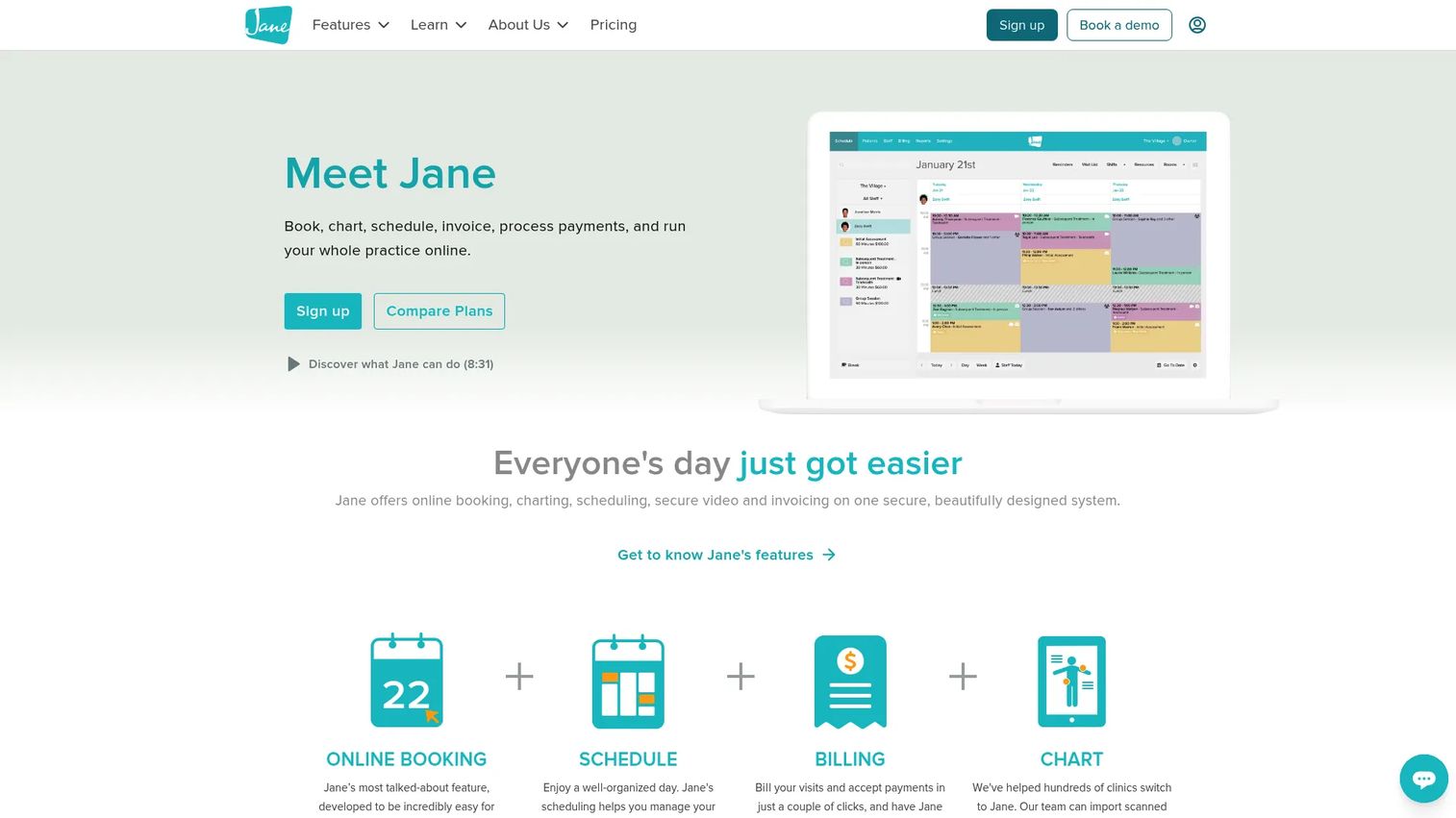
Jane App is practice management software for health and wellness clinics, including acupuncture, with a reputation for a clean, polished experience across the whole clinic workflow. It handles online booking, charting, SOAP notes, billing, integrated payments, insurance tools, AI Scribe, intake forms, reporting, and patient communication. It also integrates with Fullscript for supplement dispensing, which extends its clinical toolkit.
Where Jane App stands out is breadth done well. It is not acupuncture-only, but its booking and billing are genuinely strong, which makes it a fit for clinics that run mixed self-pay and insurance and want one system that patients enjoy using.
Best for: Clinics and solo practitioners in health and wellness who need booking, charting, billing, and telehealth in one polished system.
Key strengths
- Strong booking and payments: Online booking and integrated payments are refined enough to feel consumer-grade for patients.
- SOAP notes and charting: Structured clinical notes with progress tracking and an AI Scribe keep documentation fast and consistent.
- Mixed billing support: Billing and insurance tools handle both self-pay and insurance workflows, with Fullscript for supplements.
Why choose Jane App: Pick it when you want broad, reliable clinic operations with a patient experience that looks modern, especially if your revenue mixes self-pay and insurance. It suits practices that value polish and reporting over acupuncture-only specialization. If you need deep acupuncture-native charting like point prescription templates out of the box, compare it against Unified Practice first.
Jane App pricing: Plans start at USD $54/month for Balance, which is limited to one practitioner profile and 20 appointments per month. Practice runs USD $79/month and Thrive runs USD $99/month, both with unlimited appointments and staff profiles plus higher-tier features. There is no free tier, and usage-based practitioner charges apply. Its G2 rating is 4.0/5.
4. Zanda
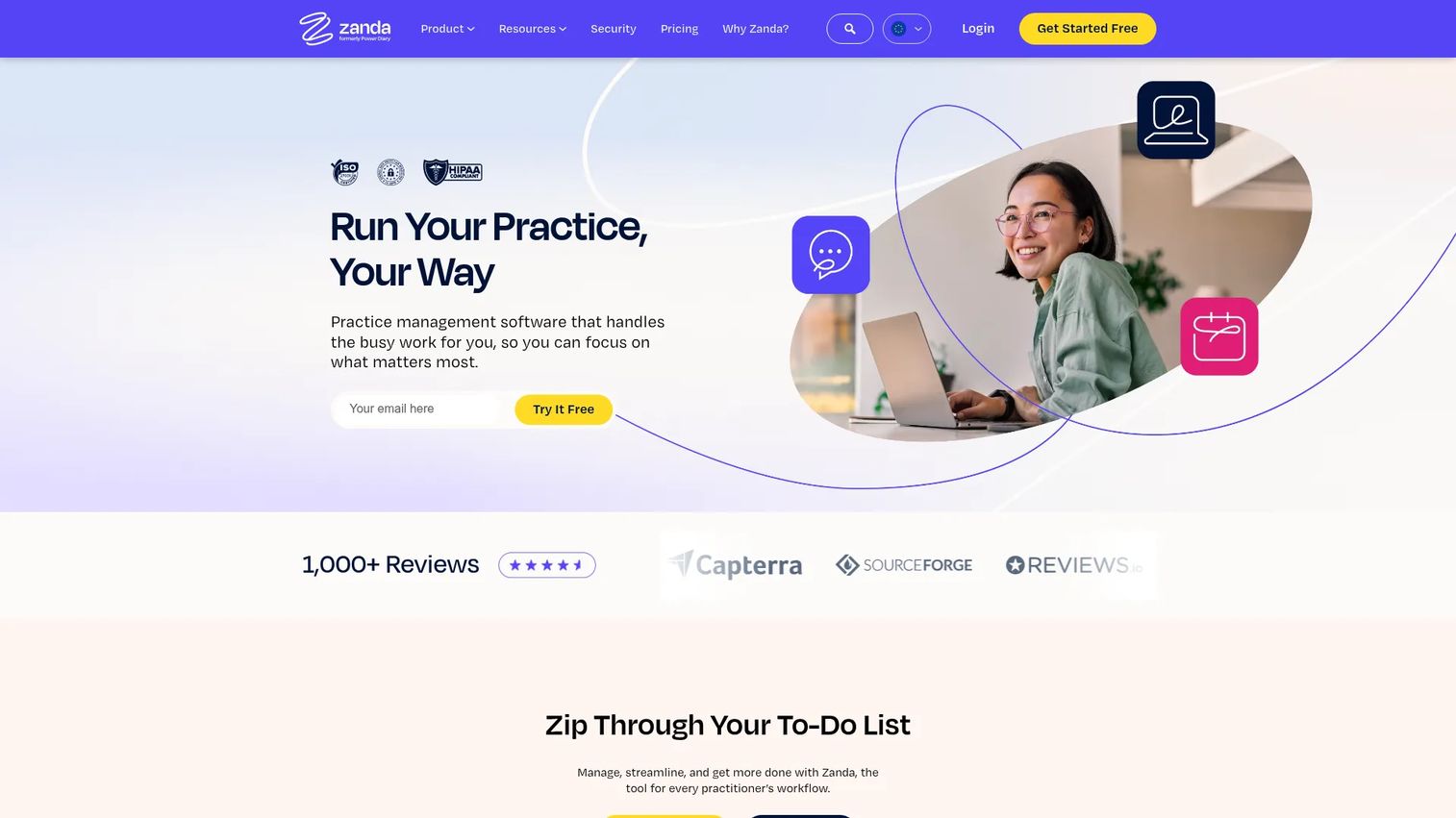
Zanda is practice management software for health clinics and allied health practices, with particular depth in telehealth and appointment workflows. It covers online booking, an acupuncture patient portal, automated reminders, intake forms, acupuncture telehealth, billing, invoicing, reporting, and integrations. The appointment engine and form-driven intake are where it shows the most range.
Its telehealth focus makes it a fit for clinics running virtual consults or herbal follow-ups, and its scheduling scales from a single practitioner up to a hundred or more. That multi-practitioner and multi-location support means it grows with a practice rather than capping it.
Best for: Solo clinicians and multi-practitioner health practices needing scheduling, billing, telehealth, and client portal workflows.
Key strengths
- Telehealth depth: Built-in telehealth supports virtual consults and remote follow-ups without bolting on a separate video tool.
- Multi-practitioner scheduling: Appointment workflows scale from one practitioner to 100-plus, with client portal and reminder automation.
- Form-driven intake: Online intake forms and a client portal move paperwork off the clipboard and into the record before arrival.
Why choose Zanda: Choose it when telehealth and scalable multi-practitioner scheduling top your list, and you want an affordable entry point to test the workflow. It fits growing clinics and any practice with a meaningful virtual component. If acupuncture-specific charting is your priority over general allied-health breadth, weigh it against the acupuncture-native tools above.
Zanda pricing: The Starter plan is $9.50/mo. for one practitioner (an introductory price for the first six months, then $19/month). Growth is $34/mo. for 1 to 100-plus practitioners (introductory, then $68/month). A 14-day free trial is available with no credit card required. Its G2 rating is 4.7/5.
Considerations
Before you sign anything, pressure-test each shortlisted tool against the criteria that actually change your day.
Charting depth
Look past the feature list and time a real note. Do the SOAP templates and custom notes fit how you document points and formulas, or do they force you to work around them? The question is not whether charting exists, but how many clicks a routine treatment note takes on a busy afternoon. Acupuncture charting software that saves five minutes per patient compounds fast.
Billing and claims
If you bill insurance, verify the depth directly. Some tools handle invoices and integrated payments cleanly but stop short of full claims, EDI, or clearinghouse integrations. Confirm superbill generation, claim submission, and payment reconciliation match your actual acupuncture billing software needs before you assume they are covered.
Patient experience
Book a test appointment as a patient. Walk the online booking, the reminder sequence, the intake forms, the acupuncture patient portal, and messaging exactly as a new patient would. Friction here shows up as no-shows and drop-off, so the patient-facing side deserves as much scrutiny as the back office.
Clinic scale
Confirm the software handles your structure now and in a year. Check multi-practitioner scheduling, room management, multiple locations, and shared resources. A tool that fits a solo practice can stall a three-practitioner clinic, so match the plan to where you are heading.
Setup and migration
Ask how data import works and how much manual cleanup lands on your team. Onboarding speed varies widely, and a migration that drags for weeks costs more than the subscription. Get a concrete answer on importing patient records, history, and templates before you switch.
Conclusion
There is no single best acupuncture software, only the best fit for what your clinic prioritizes right now. If acupuncture-native charting and an all-in-one operating system matter most, Unified Practice is built around your exact workflow. If herbalist tools and fast setup lead your list, AcuBliss gets you live quickly with AI-assisted charting. For polished all-around clinic operations with strong booking and mixed billing, Jane App is hard to beat. And if telehealth and scalable multi-practitioner scheduling top your needs, Zanda offers depth and an affordable entry point.
The right choice comes down to one question: is your biggest pain charting speed, billing complexity, patient experience, or setup effort? Answer that honestly and the shortlist narrows itself.
Do not buy on a demo alone. Shortlist the two tools that fit your priorities, then run a real week of appointments through each: book a patient, chart a treatment, send an invoice, and walk the patient portal. The software that survives your actual workflow is the one to keep.
FAQs
Acupuncture software is practice management software built to run an acupuncture clinic: scheduling, clinical charting, billing, patient intake, and communication in one system. It is tailored to acupuncture and Chinese medicine workflows, including treatment history, point and herbal documentation, and mixed self-pay and insurance billing that generic scheduling tools do not handle well.
At minimum, look for scheduling with online booking, SOAP notes and acupuncture charting, billing and payments, a patient portal, automated reminders, and telehealth. Stronger platforms add acupuncture-specific charting templates, insurance claims support, patient intake forms, and reporting. Match the feature set to the workflows your clinic actually runs rather than the longest list.
Many vendors market HIPAA-compliant workflows, but compliance depends on how the software handles data and whether the vendor signs a Business Associate Agreement. Do not take a badge at face value. Ask about data encryption, access controls, hosting, and the BAA in writing before you store any patient information in the system.
For a solo clinic, prioritize simplicity, clean booking, fast charting, and pricing that fits one practitioner. Zanda's Starter plan and Jane App's Balance plan are both built for single-practitioner use, while Unified Practice offers an acupuncture-native option at a solo-friendly entry price. Trial the charting and booking flows before deciding.
Multi-practitioner clinics should focus on shared calendars, room and resource management, practitioner roles and permissions, and clinic-wide reporting. Zanda scales from one to 100-plus practitioners, and Unified Practice and Jane App both support multi-practitioner scheduling. Verify how each handles overlapping calendars and per-practitioner billing before committing.
Some tools support insurance claims and billing, but depth varies widely by vendor. Jane App includes insurance tools alongside its billing, and acupuncture-native platforms often support superbills and claims workflows. Confirm claim submission, EDI, and clearinghouse support directly, since many tools handle invoices and payments but stop short of full insurance billing.
Yes. Automated reminders by SMS and email, easy online booking and self-service rescheduling, and waitlist automation all cut missed appointments. When a patient cancels, a waitlist can fill the slot automatically, and confirmation prompts reduce forgotten bookings. No-show reduction is often the fastest and most visible payback from adopting acupuncture scheduling software.