

A rep opens their commission statement and the number is wrong. Again. Now they are in your Slack, the deal owner is defending the split, and someone in finance is rebuilding a spreadsheet formula from three quarters ago to figure out who is right.
That cycle is the real cost of manual commission management. It is not just the payout error. It is the trust erosion, the hours lost to disputes, and the version-control chaos that follows every plan change.
The category exists to stop that. The global sales commission software market is projected to reach USD 6.09B in 2026, according to Business Research Insights (2026), and roughly 75% of organizations adopt sales automation specifically to reduce commission errors, per Industry Research (2026). Accuracy, speed, and visibility are the reasons buyers move off spreadsheets.
Commission accuracy is not only a finance problem. When reps trust the numbers, they trust the plan, and trust drives the behavior your compensation design is supposed to reward.
What's inside
This guide is for Sales Ops, RevOps, finance, and sales enablement teams comparing commission plan software in 2026. It covers both mid-market and enterprise options so you can match the tool to your plan complexity.
We chose tools based on four criteria that matter most in day-to-day operations:
- Calculation accuracy and commission automation
- Plan flexibility for tiers, accelerators, SPIFs, bonuses, and draws
- Integrations with CRM, ERP, payroll, and data warehouse systems
- Reporting, real-time dashboards, and governance controls
TL;DR
- Best overall for complex commission operations: CaptivateIQ
- Best for plan modeling and collaborative workflows: QuotaPath
- Best for Salesforce-centric teams: Salesforce Spiff
- Best for transparency and auditability: Everstage
- Best for flexible incentive management: Qobra
- Best for enterprise scale and governance: Varicent
- Best for established enterprise SPM programs: Xactly Incent
Most teams should shortlist two or three of these, then validate the shortlist against real comp data before signing.
What is commission plan software?
Commission plan software is a system that automates sales commission calculations, models compensation plans, tracks quota attainment, and gives reps visibility into their earnings. It replaces spreadsheets as the single source of truth for how sellers get paid.
At its core, this category handles the math and the workflow behind every payout. It ingests deal data, applies your plan logic, calculates what each rep earns, routes approvals, and produces statements everyone can trust.
Typical features across commission management software include:
- Commission formulas, tiers, and quota attainment logic
- Accelerators, SPIFs, bonuses, and draw structures
- Real-time dashboards, statements, and payout visibility
- Integrations with CRM, ERP, payroll, and data warehouses
- Audit trails, approvals, and governance controls
The strongest sales compensation software connects these pieces so a plan change flows through calculations, statements, and reporting without a manual rebuild. That is the difference between commission tracking software that documents payouts and a platform that operates them.
When to use commission plan software
Replace spreadsheets before payout errors compound
Spreadsheets work until they do not. As plans add tiers, roles, and exceptions, a single broken formula cascades into wrong payouts across dozens of reps.
The failure points are predictable: version control, disputes, and reporting load. When three people maintain four versions of the same comp file, the question stops being whether an error happens and becomes when. Commission automation removes the manual recalculation that creates those errors.
Support fast-changing compensation plans
Quotas shift mid-year. Accelerators get retuned. New roles need new logic. Every one of those changes is a chance to break something in a spreadsheet.
Dedicated software lets you update plan logic once and apply it everywhere, with governance around who can change what. That matters when a mid-quarter accelerator adjustment has to reach every affected rep without re-keying formulas by hand.
Give reps visibility into earnings
Reps who cannot see how a payout was calculated do not trust it. That distrust shows up as disputes, disengagement, and time your managers spend explaining math instead of coaching deals.
Real-time payout visibility fixes the trust gap. When a rep can trace a commission back to the deal and the plan rule, the conversation shifts from "this is wrong" to "how do I earn more." That connection between transparency and execution is why enablement and sales leadership care about this category, not just finance.
Comparison table
Here is how the seven tools compare on fit, differentiator, pricing, and rating. Pricing reflects publicly listed figures where vendors disclose them; several use custom, quote-based pricing.
| # | Product | Best for | Key differentiator | Pricing | G2 rating |
|---|---|---|---|---|---|
| 1 | CaptivateIQ | Complex commission operations | AI Assist plus SmartGrid data management | Custom | 4.7/5 |
| 2 | QuotaPath | Plan modeling and collaboration | AI-powered plan builder with ASC 606 accounting | From $35/user/mo + platform fee | 4.7/5 |
| 3 | Salesforce Spiff | Salesforce-centric teams | Salesforce-native automation and visibility | $75/user/mo | 4.6/5 |
| 4 | Everstage | Transparency and auditability | Plan simulation with commission and CPQ | Custom | 4.8/5 |
| 5 | Qobra | Flexible incentive management | No-code plan builder with native integrations | Custom | 4.8/5 |
| 6 | Varicent | Enterprise scale and governance | Unified planning plus incentive compensation | Custom | 4.5/5 |
| 7 | Xactly Incent | Established SPM programs | Compensation configurator and dashboards | Custom | 4.2/5 |
Best 7 commission plan software tools for 2026
1. CaptivateIQ

CaptivateIQ is sales performance management software for commissions, planning, and incentives. It targets mid-market to enterprise teams running complex commission logic, where tiers, accelerators, and exceptions multiply faster than a spreadsheet can track. The platform pairs a data layer with AI features aimed at both admins and payees.
Its SmartGrid data management handles the ingest-and-calculate work behind every payout, while AI Assist surfaces plan insights and helps admins and reps make sense of the numbers. That combination is what draws teams whose plans have outgrown manual maintenance.
Best for: Mid-market to enterprise teams managing complex sales commissions and sales performance workflows.
Key strengths
- AI-powered Assist for admins, payees, and plan insights
- SmartGrid-based data management and calculations
- Integrations, APIs, dashboards, approvals, and audit logs
Why choose CaptivateIQ: Pick it when your plan complexity is the actual problem, not just the payout math. If your team only needs basic commission tracking, the depth here is more than most small teams will use.
CaptivateIQ pricing: Pricing is customized. CaptivateIQ does not list public prices and asks buyers to contact sales for a custom quote.
2. QuotaPath
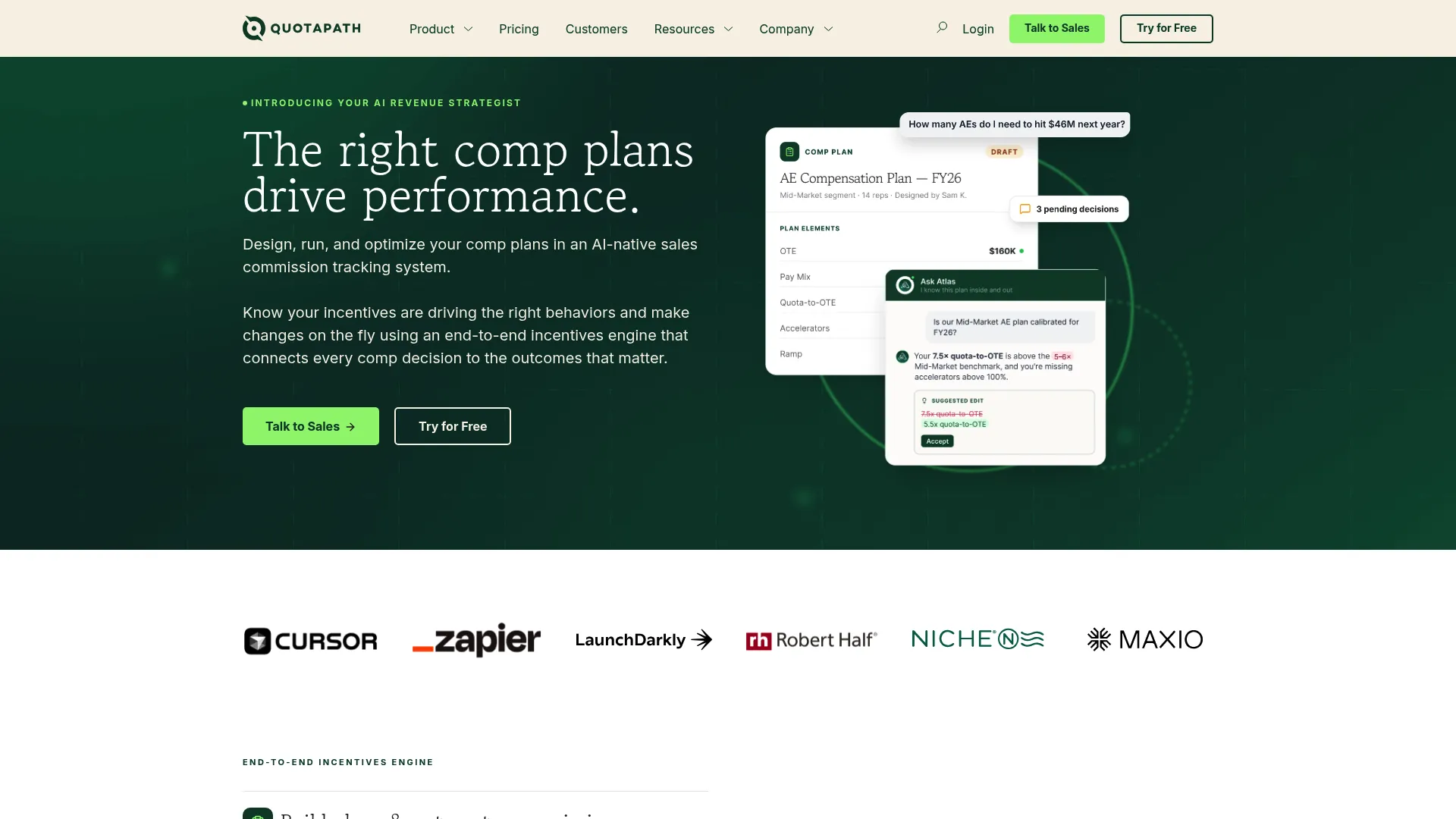
QuotaPath is sales compensation management software for building, automating, and paying commissions. It leans into transparent commission management and payout automation, which makes it a strong fit for teams that want comp strategy to be a shared, visible workflow rather than a finance black box.
The AI-powered plan builder speeds up plan modeling, and the platform handles commission tracking, payouts, and ASC 606 commission accounting in one place. Reps get visibility into earnings, and RevOps can iterate on plans without a full rebuild each cycle.
Best for: Teams that need transparent sales commission management and payout automation.
Key strengths
- AI-powered plan builder
- Commission tracking and payouts
- ASC 606 commission accounting
Why choose QuotaPath: Choose it if collaborative plan design and fast iteration matter more than heavyweight enterprise controls. It fits growing sales teams that want to move quickly on comp changes.
QuotaPath pricing: The Growth plan is $35 per user per month plus a $525 monthly platform fee, billed annually. Premium is $50 per user per month plus an $800 monthly platform fee, billed annually. A Strategic tier is custom, and a free trial is available.
3. Salesforce Spiff
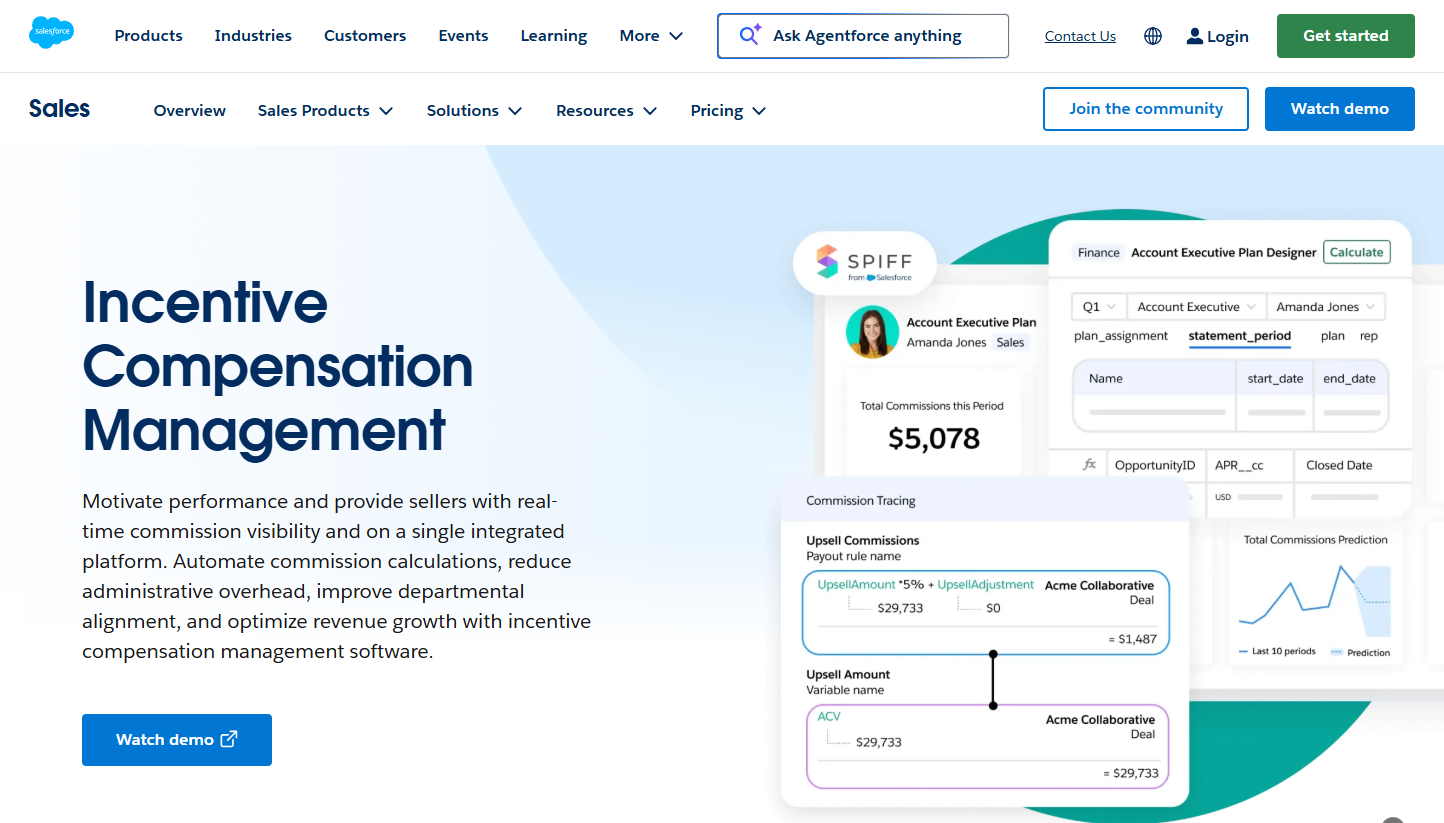
Salesforce Spiff is Salesforce's incentive compensation management software for automating commissions and giving sellers real-time visibility into earnings. For teams already living in Salesforce, the native connection removes a data-sync layer that other tools have to bridge.
The product emphasizes rep-facing clarity: real-time commission visibility, automated commission calculations, and commission statements with tracing and audit trails. That audit and tracing framing speaks directly to governance and compliance needs when finance has to defend every number.
Best for: Mid-market and enterprise teams that need Salesforce-native commission automation and rep earnings visibility.
Key strengths
- Real-time commission visibility
- Automated commission calculations
- Commission statements with tracing and audit trails
Why choose Salesforce Spiff: Choose it when your CRM is Salesforce and you want commission data, plan changes, and statements to sit inside that same environment. Teams outside the Salesforce world may find less pull here.
Salesforce Spiff pricing: Salesforce Spiff is $75 per user per month, billed annually. It can also be purchased as part of the SPM Product Suite or Agentforce 1 Sales Edition.
4. Everstage
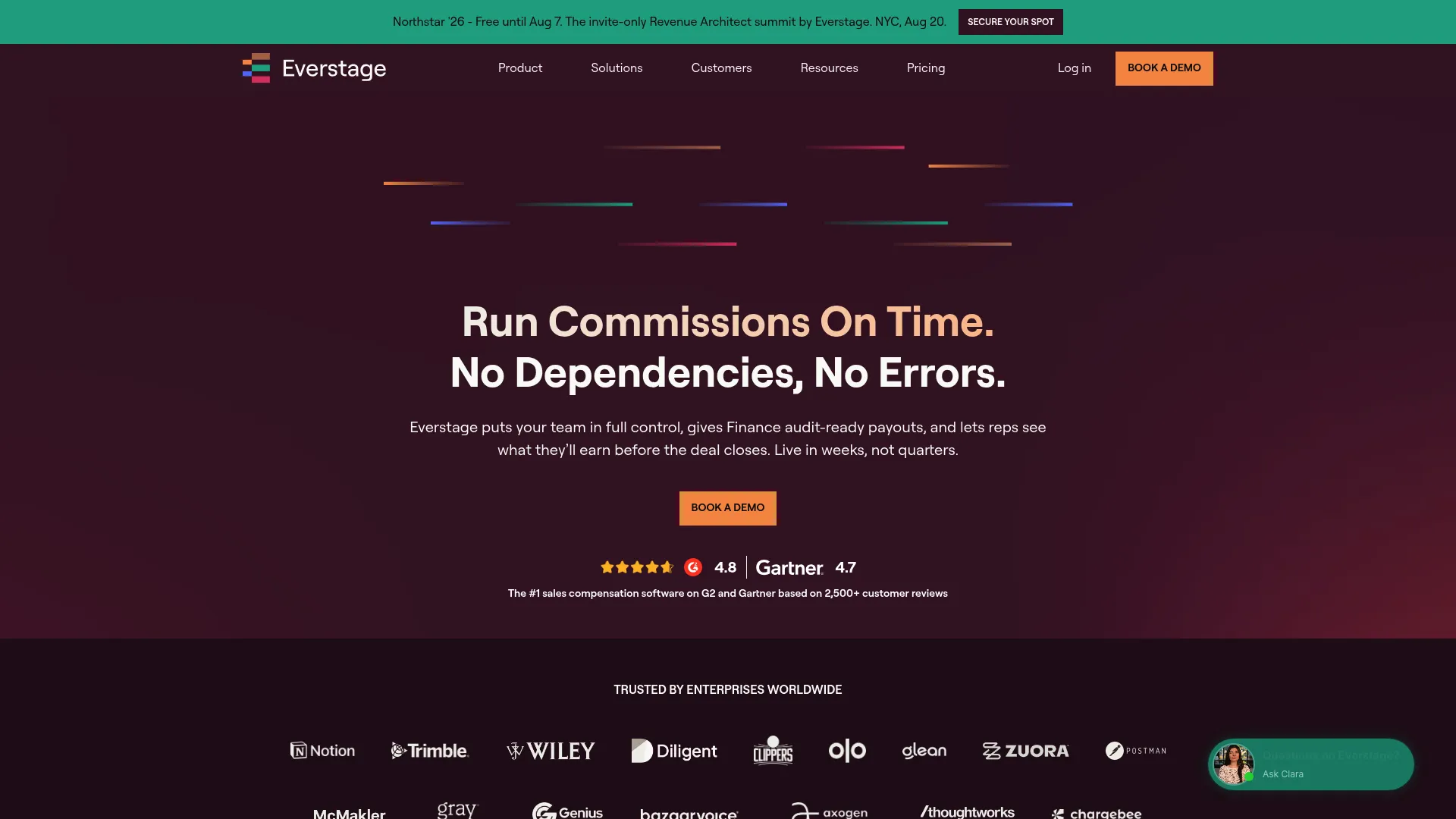
Everstage is an AI-first revenue transformation platform for sales compensation, planning, and CPQ. It positions itself around transparency and finance alignment, which makes it a strong option for teams that need auditable payout logic and forecastable commission costs.
Commission tracking and incentive management sit at the core, with plan simulation and a self-serve plan builder that let ops model changes before rolling them out. The added planning and CPQ scope means comp does not live in isolation from the rest of the revenue motion.
Best for: Enterprises needing commission automation and revenue operations control.
Key strengths
- Commission tracking and incentive management
- Plan simulation and self-serve plan builder
- Planning and CPQ
Why choose Everstage: Choose it when leadership reporting and forecastable commission costs are priorities, and you want plan simulation before committing changes. It fits teams that treat comp as a controllable line item, not a surprise.
Everstage pricing: Pricing is custom. Everstage does not disclose public prices and asks buyers to get a quote or book a demo.
5. Qobra
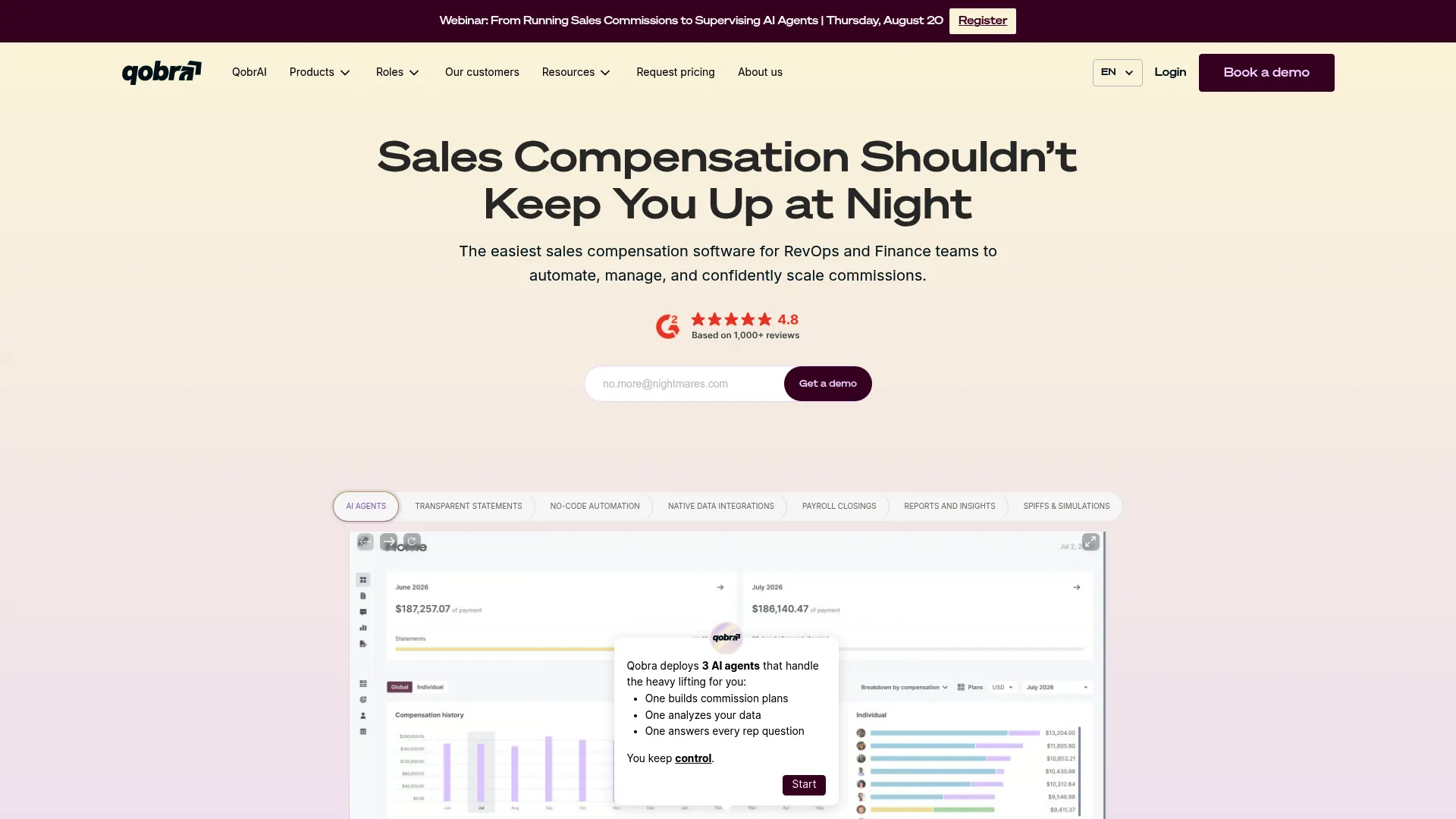
Qobra is sales compensation software for automating and tracking commission plans. Its no-code plan builder is the standout, letting revenue operations and finance teams manage flexible incentive structures without leaning on engineering for every plan change.
Real-time commission tracking gives reps visibility into earnings as deals close, and native CRM and data integrations keep the underlying numbers current. The result is a practical setup for teams that need flexibility without a drawn-out configuration project.
Best for: Revenue operations and finance teams managing sales commissions at scale.
Key strengths
- No-code plan builder
- Real-time commission tracking
- Native CRM/data integrations
Why choose Qobra: Choose it when you want flexible incentive management and fast plan changes handled by ops rather than developers. It suits teams that value ease of plan management alongside real-time visibility.
Qobra pricing: Qobra does not publish a public price on its website. Contact the vendor for a quote based on your team size and plan complexity.
6. Varicent
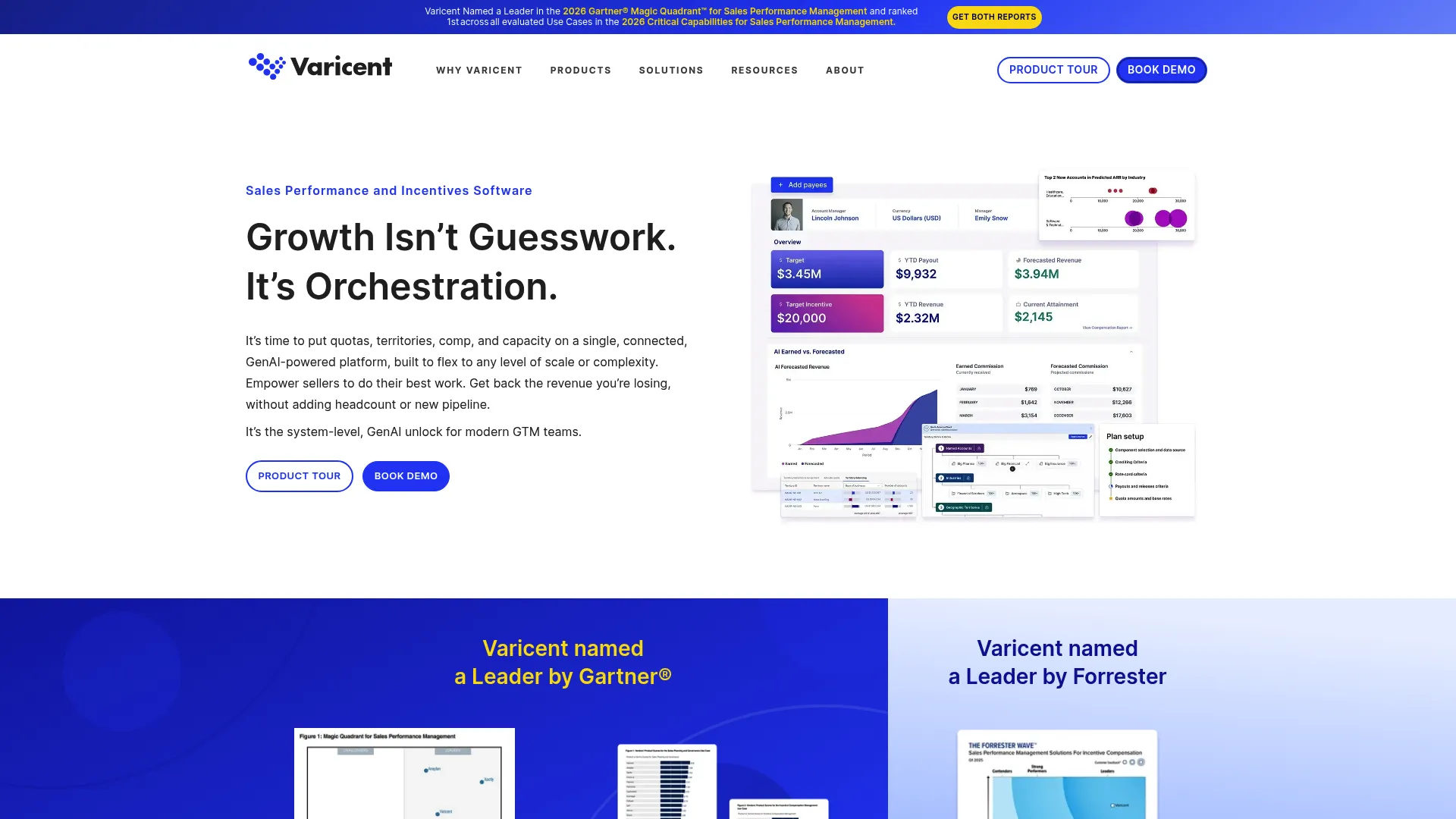
Varicent is AI-native sales performance software for planning, incentives, and revenue operations. It is built for larger orgs with advanced sales performance management requirements, where commission is one part of a wider planning and analytics need.
Beyond incentive compensation management and commission tracking, Varicent covers sales planning for quotas, territories, capacity, and resource allocation. Sales performance analytics tie it together, giving enterprise teams the breadth and control they need across the full comp and planning cycle.
Best for: Enterprise teams needing a unified platform for sales planning and incentive compensation.
Key strengths
- Sales planning for quotas, territories, capacity, and resource allocation
- Incentive compensation management and commission tracking
- Sales performance analytics and monitoring
Why choose Varicent: Choose it when you need one platform spanning sales planning and incentive compensation at enterprise scale. Smaller teams that only need commission calculations may find the scope broader than required.
Varicent pricing: Varicent uses quote-based pricing. No public price is listed on its site, and buyers engage through a demo or contact form.
7. Xactly Incent
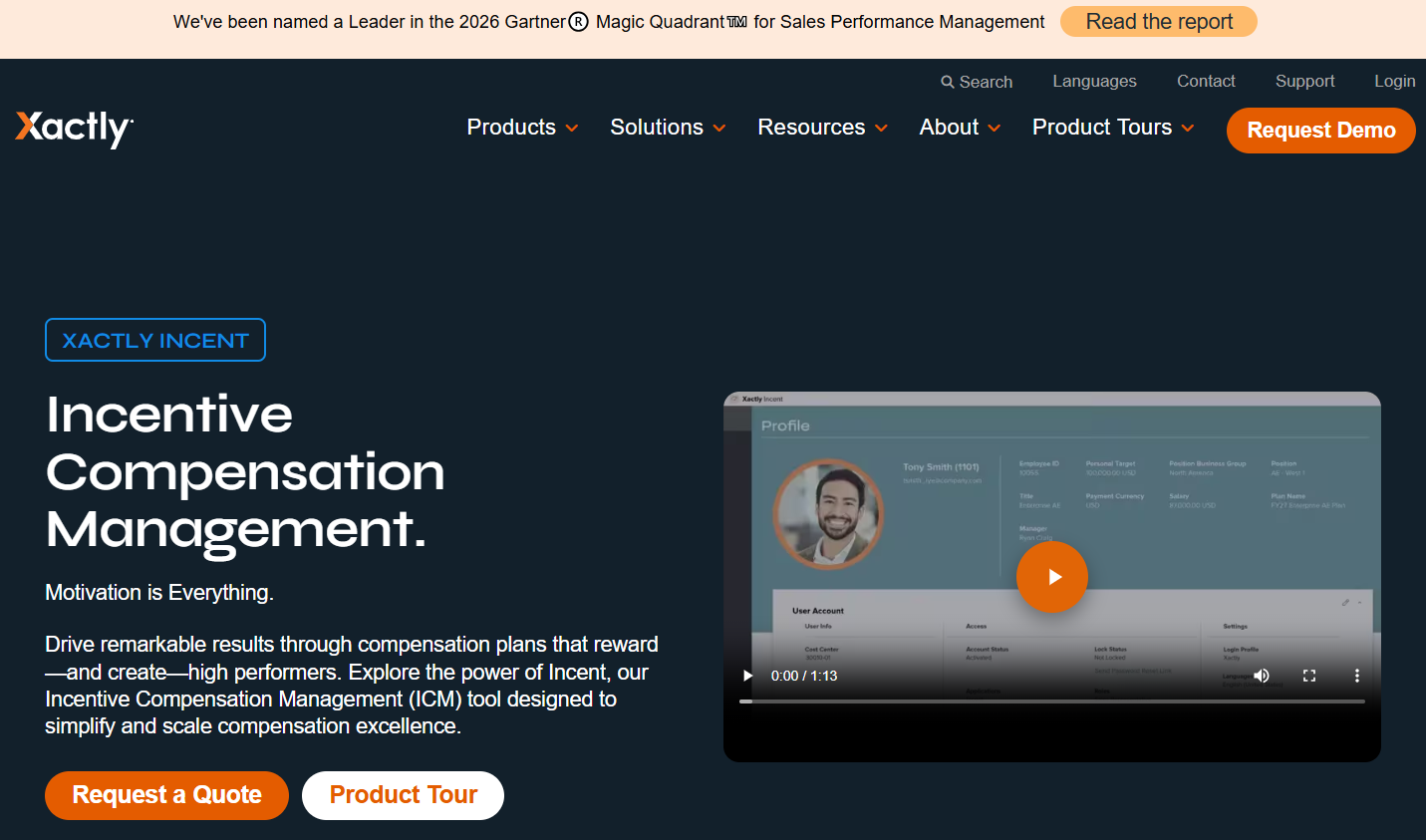
Xactly Incent is incentive compensation management software for automating commissions, transparency, and compliance. It is a fit for established compensation programs and larger orgs that value process rigor and scale.
The compensation configurator handles complex plan setup, custom incentive statements give reps clarity, and real-time reports and dashboards keep leadership and finance aligned. Xactly offers Incent in Core, Plus, and Ultimate tiers, so scope scales with how many people you pay and how complex your plans get.
Best for: Enterprises needing commission automation and incentive compensation visibility.
Key strengths
- Compensation configurator
- Custom incentive statements
- Real-time reports and dashboards
Why choose Xactly Incent: Choose it when you run a mature incentive program and need enterprise controls, analytics, and process discipline at scale. Teams early in their comp journey may not need this level of rigor yet.
Xactly Incent pricing: Xactly offers Incent in three tiers, Core, Plus, and Ultimate. Pricing is quote-based and depends on how many people you pay and how complex your plans are.
Considerations
Plan complexity
Confirm the tool can handle your actual plan mechanics: tiers, accelerators, bonuses, SPIFs, draws, and one-off exceptions. Model a real plan during evaluation, not a simplified version. The gap between a demo plan and your messiest live plan is where tools break.
Integrations
Check native support for your CRM, ERP, payroll, and data warehouse. Commission accuracy depends on clean data flowing in from these systems automatically. A tool that requires manual data exports reintroduces the exact errors you are trying to eliminate.
Visibility and trust
Look for rep-facing statements, real-time dashboards, and a clear dispute workflow. Reps need to trace a payout back to the deal and the plan rule. Payout visibility is what turns commission software from a finance tool into a trust tool.
Governance and auditability
Verify approvals, version control, audit trails, and security permissions. When a plan changes, you need a record of who changed what and when. Governance is not optional once finance and compliance are in the room.
Implementation effort
Estimate setup cost against your rate of plan change and data maintenance. A heavy enterprise rollout makes sense for complex, stable programs. A faster setup fits teams iterating on comp frequently. Match the effort to your reality.
Conclusion
The right commission plan software depends on complexity, governance, and integrations, not a single best label. CaptivateIQ fits teams whose plan complexity is the core problem. QuotaPath suits collaborative plan modeling and fast iteration. Salesforce Spiff is the natural pick for Salesforce-centric orgs.
Everstage leans into transparency and forecastable comp costs, Qobra offers flexible no-code plan management, and Varicent and Xactly Incent serve enterprise SPM programs with scale and governance. Each earns its place for a specific buying profile.
Shortlist two or three tools that match your plan complexity and integration needs. Then run a real comp plan through each during evaluation, ideally your messiest one, and validate the payouts against numbers you already trust. That test tells you more than any feature list.
If part of your evaluation involves showing stakeholders how a tool works, interactive product experiences from Guideflow let teams walk buyers through a workflow at their own pace across landing pages, sales follow-ups, onboarding, and internal enablement.
Start your journey with Guideflow today!
FAQs
It automates sales commission calculations and tracks payouts so teams stop managing comp in spreadsheets. The software applies your plan logic to deal data, produces rep statements, and gives finance an auditable record. The goal is accurate, transparent payouts without manual recalculation.
It centralizes formulas, data sources, and approval workflows in one system. Instead of copying deal data across spreadsheets, the software pulls from your CRM and applies plan rules consistently. That removes the manual steps where version errors and broken formulas usually creep in.
Prioritize commission calculations, plan modeling, real-time dashboards, integrations, and audit trails. Confirm it handles your plan mechanics: tiers, accelerators, SPIFs, bonuses, and draws. Rep-facing visibility and governance controls matter as much as the underlying math.
Yes, if spreadsheets are already causing errors, disputes, or too much admin time. The trigger is not team size but plan complexity and error frequency. If a broken formula regularly costs you rep trust and finance hours, the software pays for itself.
At minimum, your CRM such as Salesforce, plus ERP, payroll, and your data warehouse. These integrations keep the underlying deal and payment data current automatically. Native connections reduce the manual exports that reintroduce accuracy problems.
It depends on plan complexity and data quality. Simpler plans with clean data can go live quickly, while multi-plan enterprise programs with messy source data can take several months. Data readiness is usually the bigger factor than the tool itself.
Commission software focuses on payout calculations, statements, and commission automation. Sales performance management is broader and can also include quota setting, territory management, and wider sales planning. Some platforms cover both, so match the scope to what your team actually needs.