
Your scanners are working. That's the problem. SAST flags 4,000 findings. SCA adds a few thousand more. DAST, IaC, secrets, container scans, each one produces its own queue, its own severity scale, its own noise. By Friday your AppSec team has triaged maybe 3% of it, and nobody can answer the one question that matters: which of these can actually be exploited in production right now?
That gap is why application security posture management exists. The global ASPM market is projected to rise from $686.8M in 2025 to $2,284.5M by 2030, a 27.2% CAGR, according to Frost & Sullivan (2025). Adoption is already deep inside the enterprise: 68% of enterprises had ASPM-integrated DevSecOps workflows in 2024, and 61% of Fortune 1000 companies reported mandatory ASPM deployment across their pipelines, per Electronics Media / Marketintelo (2026). The spend is following a real operational need, not hype.
An ASPM platform sits above your existing scanners. It ingests findings from SAST, SCA, DAST, IaC, and CI/CD, deduplicates them, correlates them against runtime and business context, and then does the thing scanners cannot: it tells you what to fix first and routes that fix to the person who owns the code. The best ASPM tools turn a wall of red into a short list of exploitable risk with an owner attached.
This guide ranks the platforms worth evaluating in 2026, judged the way a presales or AppSec buyer actually judges them: prioritization quality, code to cloud visibility, remediation workflow depth, integration breadth, and governance.
What's inside
This list covers 9 ASPM software platforms selected against five criteria that matter during a real technical evaluation: how well the platform prioritizes exploitable risk, whether it delivers code-to-cloud visibility, the depth of its remediation workflows, the breadth of its integrations across your scanner stack and CI/CD, and its governance and reporting maturity.
The picks favor platforms useful to DevSecOps, AppSec, and engineering teams that are drowning in scanner output and need consolidation, not another scanner. Where adjacent categories like ASOC, CSPM, and CNAPP come up, they appear only to clarify fit, never to pad the definition. Pricing and G2 ratings reflect what vendors publish and what reviewers report.
TL;DR
- Best overall ASPM platform: Wiz, for teams that want code-to-cloud correlation, attack path analysis, and runtime-aware prioritization in one graph.
- Best for unified AppSec and supply chain: Cycode, for context-graph prioritization, deduplication, and remediation across the full development lifecycle.
- Best for SDLC visibility and discovery: Legit Security, for teams that need to surface shadow assets and centralize control across tools.
- Best for existing platform ecosystems: CrowdStrike Falcon ASPM and Palo Alto Networks Cortex Cloud Application Security, when you already run those platforms.
- Best for open source and cost-conscious teams: DefectDojo, for aggregation, workflow management, and affordable scanning.
What is ASPM software?
Application security posture management (ASPM) software is a platform that continuously ingests, correlates, and prioritizes application security findings across the software development lifecycle, then routes remediation to the teams that own the code.
ASPM sits above your point tools. SAST, SCA, DAST, IaC scanning, and CI/CD pipelines each generate findings in isolation. An ASPM platform connects to all of them, normalizes the output, removes duplicates, and applies context, reachability, runtime exposure, asset criticality, and business impact, to rank what actually needs attention.
Core capabilities to expect from ASPM tools:
- Correlation: Aggregate and deduplicate findings from SAST, SCA, DAST, IaC, secrets, and container scanners into a single view.
- Prioritization: Rank issues by exploitability and business risk, often using reachability analysis, to cut false positives and surface what matters.
- Ownership mapping: Attach every finding to the code, service, and team responsible for it.
- Remediation workflows: Push fixes into developer-native workflows through tickets, pull requests, and alerts.
- Reporting: Track continuous posture, compliance status, and risk trends over time.
- Integration: Connect across the existing scanner stack, CI/CD, cloud, and collaboration tools.
ASPM matters now because cloud native architectures and AI-generated code have multiplied the volume of findings faster than any team can triage manually. When the same vulnerability shows up in a library, a container, and three services, teams need one system that recognizes it as one problem and prioritizes it against everything else.
When to use ASPM software
Not every team needs a dedicated ASPM platform on day one. These three situations are the clearest signals that you do.
When scanner noise is slowing down remediation
When your tools produce thousands of findings and your team fixes a fraction of them, the bottleneck is not detection. It is prioritization. ASPM software applies reachability analysis and runtime context to separate the exploitable from the theoretical, so engineering spends its limited hours on the issues an attacker could actually reach. This is the core case: less noise, more resolved risk.
When you need code to cloud visibility
Teams running cloud native workloads need context that spans code, runtime, identity, and deployment. A vulnerability in source looks very different once you know it runs on an internet-facing workload with an over-permissioned role. ASPM platforms correlate a finding across every place it appears and enrich it with runtime exposure, so you stop treating one risk as five separate tickets.
When DevSecOps needs a shared workflow
Security, developers, and platform teams need a common system for triage and ownership. Without one, findings sit in a security dashboard nobody on the engineering side opens. ASPM tools route issues into developer-native workflows, pull requests, Jira tickets, Slack alerts, so the fix lands where the work already happens and next steps do not get lost in a handoff.
Comparison table
The shortlist below is arranged by buyer relevance for a typical enterprise AppSec evaluation, not alphabetically. Pricing for most ASPM vendors is quote-based, which is standard for this category, so ratings and intent carry more signal than a sticker price.
| # | Product | Intent | Key differentiation | Pricing | G2 rating |
|---|---|---|---|---|---|
| 1 | Wiz | Enterprise cloud native AppSec | Code-to-cloud graph with attack path analysis | Custom quote, free trial | 4.7/5 |
| 2 | Cycode | Unified AppSec and supply chain | Context Intelligence Graph prioritization | Custom quote | 4.0/5 |
| 3 | Legit Security | SDLC visibility and discovery | AI-native discovery of shadow risk | Contact sales | Not yet rated |
| 4 | CrowdStrike Falcon ASPM | Platform-aligned AppSec | Production-aware application risk | Bundled / contact sales | 4.6/5 |
| 5 | Palo Alto Cortex Cloud App Security | Platform-aligned AppSec | Unifies native and third-party scanners | Per developer, contact sales | 4.1/5 |
| 6 | Ivanti Neurons for ASPM | Risk-based vuln management | Normalizes 100+ sources, VRR scoring | Asset-based quote | Not yet rated |
| 7 | OpenASPM | Open source and flexible | Community-driven, vendor-neutral | Open source | Not yet rated |
| 8 | DefectDojo | Aggregation and vuln management | Open-source orchestration hub | Free; Pro custom quote | 4.6/5 |
| 9 | Check Point Cloud Security | Platform-aligned cloud security | Prevention-first, code-to-cloud posture | Custom quote, free trial | 4.5/5 |
1. Wiz
Wiz is a cloud and AI security platform (CNAPP) that secures cloud environments from code to runtime, with ASPM capabilities folded into a broader security graph. Its differentiator is context: instead of ranking findings by CVSS alone, Wiz maps how a code-level issue connects to a running workload, an exposed asset, and an exploitable attack path. That is what puts it at the top of an enterprise shortlist focused on exploitability-first prioritization.
For AppSec and cloud native teams, the appeal is correlation at scale. Wiz ingests findings, connects them across the environment, and surfaces the toxic combinations, a vulnerable package on an internet-facing workload with excessive permissions, that scanners in isolation never flag.
Best for: Enterprises that want unified cloud, code, and runtime security with posture, workload, and attack path coverage in one platform.
Key strengths
- Security graph and attack path analysis: Correlates findings across code, cloud, and runtime to show which risks are actually reachable.
- Agentless cloud visibility: Deploys without agents on workloads, so coverage spans the environment quickly.
- Runtime protection and threat detection: Adds production context to prioritization so exploitable risk rises to the top.
Why choose Wiz: If your evaluation is anchored on code-to-cloud visibility and you want ASPM as part of a broader cloud security platform rather than a standalone tool, Wiz is the most complete fit. It suits teams with real cloud native complexity and multiple stakeholders across security and engineering.
Wiz pricing: Wiz uses modular, custom-quoted pricing across products including Wiz Cloud, Wiz Code, Wiz Defend, and a Wiz Go bundle for SMBs. The pricing page does not display public numeric prices, and a free trial is available. Wiz holds a 4.7/5 rating on G2.
2. Cycode
Cycode is an application security platform that spans SAST, SCA, secrets, IaC, container, and source control and CI/CD security, unified under what it calls a Context Intelligence Graph. That graph is the engine behind its prioritization: it connects findings across the development lifecycle and scores them by business risk, not just raw severity.
For teams tired of stitching together separate scanners, Cycode's value is consolidation plus deduplication. Findings that appear across multiple tools collapse into a single prioritized issue, and remediation gets routed with context attached. It leans into software supply chain security and AI governance for teams shipping AI-driven code.
Best for: Enterprises that need unified application security and software supply chain security under one prioritization model.
Key strengths
- Context Intelligence Graph: AI-driven prioritization that correlates findings across the full development lifecycle.
- Broad scanner coverage: SAST, SCA, secrets, IaC, container, and source control security in one platform.
- ADLC governance and remediation agents: Guardrails and automated remediation across the application development lifecycle.
Why choose Cycode: Choose Cycode when you want native scanning and ASPM correlation from the same vendor, rather than layering ASPM on top of third-party tools. It fits teams prioritizing supply chain risk and AI-code governance alongside traditional AppSec.
Cycode pricing: Cycode's site presents demo and contact flows without a public numeric price, so pricing is quote-based. It holds a 4.0/5 rating on G2, based on a small number of reviews at the time of writing.
3. Legit Security
Legit Security is an AI-native ASPM platform built around discovery, prioritization, and remediation across the SDLC. Its strongest angle is visibility: it maps your development pipelines, code repositories, and security tools to surface shadow assets and unmanaged risk that never make it into a formal inventory.
For teams that suspect their real attack surface is larger than their asset list, Legit Security's discovery and correlation help centralize control. It ties findings back to owners and tracks posture continuously, which matters when governance and audit readiness are part of the mandate.
Best for: Enterprises seeking ASPM and software supply chain security in a single platform with strong discovery.
Key strengths
- Unified vulnerability remediation: Correlates findings across tools and routes them to owners for resolution.
- Code security coverage: Native SAST and SCA alongside third-party ingestion.
- Secrets detection and prevention: Catches exposed credentials across the pipeline before they reach production.
Why choose Legit Security: Choose Legit Security when reducing shadow risk and getting a complete, continuous inventory of your SDLC is the priority. It fits teams that need to centralize control and defensible reporting across a fragmented tool set.
Legit Security pricing: Legit Security uses a plans-and-packages model with a contact-sales path; no public numeric price is displayed on its site. Public G2 reviews were not yet established at the time of writing.
4. CrowdStrike Falcon ASPM

CrowdStrike Falcon ASPM delivers application security posture management inside CrowdStrike Falcon Cloud Security, focused on identifying, assessing, and prioritizing application risk with production-aware context. It observes how applications actually run and maps application-to-cloud relationships, which grounds prioritization in real behavior rather than static analysis alone.
For teams already operating in the CrowdStrike ecosystem, the pull is consolidation into a single security operations platform. ASPM data lives alongside endpoint, cloud, and threat intelligence, which shortens the path from a flagged application risk to a coordinated response.
Best for: Security teams that want application-risk visibility inside a unified cloud security platform.
Key strengths
- Production-aware context: Sees how applications run to prioritize risk by real exposure.
- Application and cloud relationship mapping: Connects application components to their cloud footprint.
- Embedded AI governance: Identifies and governs AI components inside applications.
Why choose CrowdStrike Falcon ASPM: Choose it when you already run CrowdStrike and want ASPM to feed the same security operations workflows rather than stand alone. Consolidation and centralized operations are the driving reasons here.
CrowdStrike Falcon ASPM pricing: ASPM is delivered within Falcon Cloud Security and priced through a bundled, contact-sales model; no standalone ASPM list price is published. Falcon Cloud Security holds a 4.6/5 rating on G2, where ASPM is listed as a feature category.
5. Palo Alto Networks Cortex Cloud Application Security

Palo Alto Networks Cortex Cloud Application Security is a cloud-native application security solution within Cortex Cloud that works to prevent risk from code to production. Its ASPM layer unifies data across native and third-party scanners, software supply chains, cloud infrastructure, and runtime, then integrates that context for prioritization and remediation.
For organizations invested in Palo Alto Networks, the value is a single pane across code, cloud, and runtime without adding another vendor relationship. The platform centralizes findings from tools you already run and applies unified policy to prioritize what to fix.
Best for: Enterprises that need unified application security across code, cloud, and runtime inside an existing Palo Alto footprint.
Key strengths
- Application security posture management: Centralizes AppSec findings across the software lifecycle.
- Native and third-party unification: Ingests scanner, supply chain, infrastructure, and runtime data together.
- Code, cloud, and runtime context: Correlates the full picture for risk prioritization and remediation.
Why choose Cortex Cloud Application Security: Choose it when Palo Alto Networks is already your platform of record and you want ASPM to extend that investment rather than fragment it. It suits large teams standardizing on one cloud security vendor.
Cortex Cloud Application Security pricing: The ASPM add-on is priced per developer, sold through contact-sales; no public numeric tier table is displayed. Cortex Cloud holds a 4.1/5 rating on G2.
6. Ivanti Neurons for ASPM
Ivanti Neurons for ASPM is a cloud-based application security posture management product focused on prioritizing and remediating application vulnerabilities based on risk. It normalizes vulnerability data from more than 100 sources and applies threat intelligence, asset criticality, and its own Ivanti VRR score to rank issues.
For teams that want a focused ASPM capability rather than a broad platform, Ivanti's strength is normalization and remediation automation. It reduces the manual work of triage through playbooks, alerts, and SLA-driven workflows, which helps AppSec keep pace with a large, noisy backlog.
Best for: Security teams needing risk-based application vulnerability management and remediation prioritization.
Key strengths
- 100+ source normalization: Consolidates vulnerability data from a wide range of scanners and feeds.
- VRR-based prioritization: Ranks issues using threat intelligence, asset criticality, and Ivanti's vulnerability risk rating.
- Automated remediation workflows: Playbooks, alerts, and SLAs cut repetitive triage work.
Why choose Ivanti Neurons for ASPM: Choose it when risk-based prioritization and remediation automation are the core need and you want a dedicated ASPM tool rather than a full CNAPP. Its normalization across many sources fits fragmented scanner stacks.
Ivanti Neurons for ASPM pricing: Pricing is based on number of assets, with a contact-sales quote path; no public numeric price is published. A usable aggregate G2 rating was not yet available at the time of writing.
7. OpenASPM
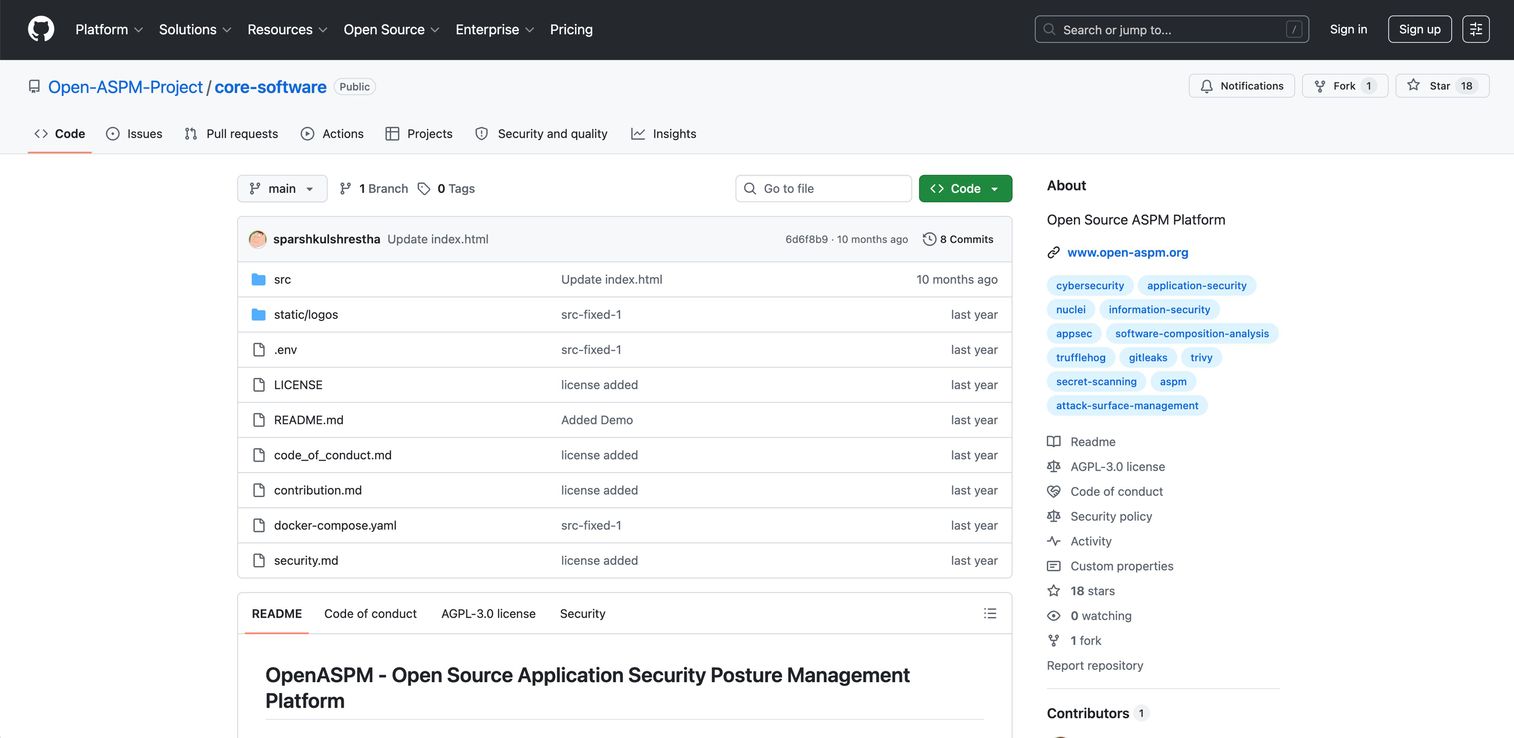
OpenASPM represents the open-source, vendor-neutral end of the ASPM market. For budget-conscious or tooling-flexible teams, the appeal is transparency and control: an open codebase you can inspect, extend, and run on your own terms without committing to a commercial contract or a single vendor's roadmap.
Open source ASPM fits teams with the engineering capacity to self-host and customize, and organizations that value community-driven development. Before adopting, buyers should evaluate the same factors they would for any open project: maturity of the codebase, size and activity of the community, documentation quality, and the availability of support, since production reliance on any open-source security tool depends on those foundations.
Best for: Budget-conscious or highly technical teams that want a vendor-neutral, community-driven ASPM approach.
Key strengths
- Vendor neutrality: No lock-in to a single commercial roadmap or contract.
- Transparency: An inspectable, extensible codebase you control.
- Community-driven development: Roadmap and improvements shaped in the open.
Why choose OpenASPM: Choose an open-source approach when you have the internal engineering capacity to run and extend it, and when transparency and cost control outweigh the convenience of a managed commercial platform. Confirm community activity and support before production use.
OpenASPM pricing: As an open-source project, there is no commercial license fee. Buyers should factor in the cost of self-hosting, maintenance, and internal support when comparing total cost against commercial ASPM vendors.
8. DefectDojo
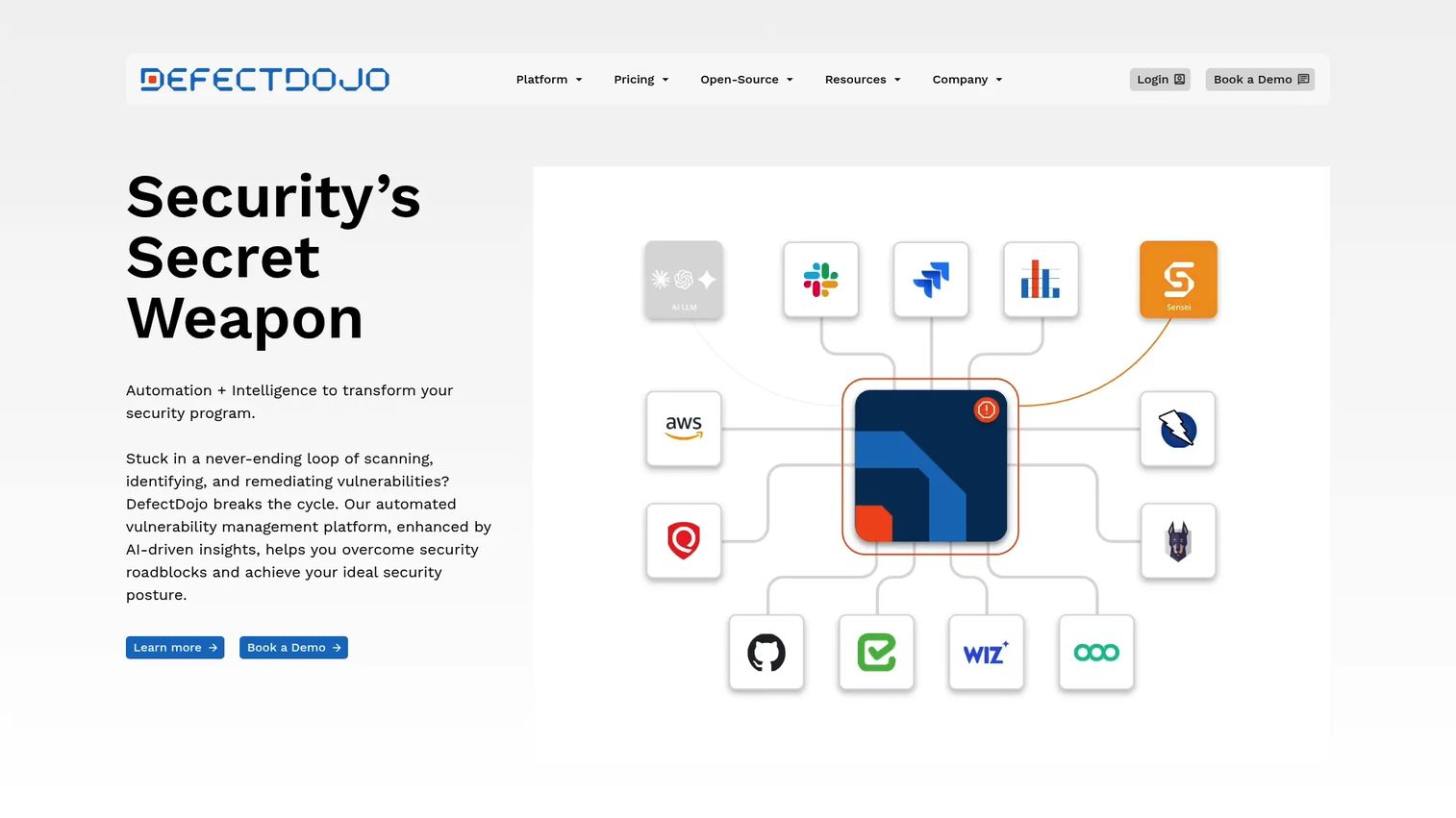
DefectDojo is a vulnerability management platform, offered in open-source and Pro editions, that aggregates, deduplicates, and tracks security findings. It plays an ASPM-adjacent role: rather than scanning, it acts as the orchestration and workflow hub that pulls findings from your existing tools into one place for triage and reporting.
For teams that want aggregation, workflow management, and reporting without a full commercial ASPM platform, DefectDojo is a proven, widely adopted choice. It imports and dedupes findings, supports flexible authentication, and exposes a REST API for automation across your pipeline.
Best for: Security teams that want a centralized vulnerability management system with open-source and enterprise options.
Key strengths
- **Finding