IoT attacks surged 124% in 2024, according to SonicWall's 2025 threat report. Yet most enterprise asset inventories were built for laptops and servers, not for the IP cameras, building controllers, infusion pumps, and industrial sensors that now outnumber managed endpoints on most networks.
The gap is not ignorance. Product and security teams know the devices exist. The problem is that standard endpoint tooling cannot enroll them, patch them, or even see them reliably. A connected-device security strategy has to operate across device discovery, risk prioritization, network segmentation, identity and certificates, and behavioral monitoring, often simultaneously, often on hardware that cannot run an agent.
This guide gives you a shortlist of 21 IoT security platforms and tools evaluated for capability fit, deployment model, and the operational ownership they create. Pricing and ratings were verified against vendor sources and live G2 listings. Use it to build a proof-of-concept shortlist, not to pick a winner in a browser tab.
What's inside
This guide is for product managers, security architects, and infrastructure leads evaluating connected-device security in 2026. Items were selected based on:
- Capability breadth: Device discovery, asset inventory, risk assessment, identity, segmentation, or monitoring
- Deployment fit: Cloud, on-premises, appliance, hybrid, and air-gapped support
- Operational cost: Engineering ownership, maintenance burden, and integration depth
- Vertical coverage: Enterprise IT, OT, IoMT, automotive, and embedded environments
TL;DR
- Best overall for broad IoT visibility: Forescout Vistaro Platform covers IT, OT, IoMT, and ICS from one platform
- Best for OT and industrial environments: The Claroty Platform uses passive monitoring for operational technology
- Best for healthcare device security: CyberMDX Healthcare Cybersecurity provides medical-device-specific risk context
- Best for device identity and certificates: DigiCert Device Trust Manager handles PKI and certificate lifecycle at scale
- Best for agentless asset intelligence: Armis Centrix discovers managed and unmanaged assets without installing agents
- Best for Microsoft-centered security teams: Microsoft Defender for IoT integrates directly with Microsoft security workflows
What are IoT security solutions?
IoT security solutions are software platforms, services, and tools that identify connected devices, assess their risk, control network access, monitor behavior, and reduce attack paths across enterprise environments.
The category spans five distinct capability layers:
Device discovery and asset inventory
Passive and active discovery finds devices on wired and wireless networks, classifying each by vendor, model, firmware version, operating system, owner, and communication behavior. Strong asset discovery software covers managed endpoints alongside unmanaged IoT, OT, and IoMT devices that never appear in a CMDB.
Risk assessment and vulnerability management
Once devices are visible, the platform scores each one across outdated firmware, weak or factory-default credentials, exposed services, configuration drift, and unsupported system status. Risk prioritization separates high-impact exposures from noise, which matters when you have tens of thousands of devices.
Network segmentation and access control
Least-privilege policies, microsegmentation, and zero trust controls contain unmanaged devices before they become a lateral movement path. Dynamic policy enforcement adapts as devices move across sites.
Device identity and certificate management
Authentication, PKI, certificate issuance, rotation, and revocation give each device a verifiable identity. Certificate lifecycle management, explored further in asset lifecycle management software roundups, is particularly critical for IoT manufacturers embedding identity at the point of production.
Monitoring and threat detection
Traffic analysis, behavioral baselines, anomaly detection, and threat intelligence flag unusual device behavior in real time. Incident response integration connects alerts to SIEM, SOAR, and ticketing systems so security operations can act without manual correlation.
When to use IoT security solutions
Discover unmanaged devices on your network
If your asset inventory covers fewer devices than your DHCP logs suggest exist, you have a visibility gap. IoT security platforms use passive network telemetry and traffic analysis to enumerate devices that never register with endpoint management tools. This matters most when infrastructure, manufacturing, or facilities teams connect devices outside the standard IT provisioning process.
Protect operational and medical environments
OT and IoMT environments run 24/7 processes where active scanning creates risk. Platforms built for these environments use passive monitoring and protocol-aware inspection, so they can classify an industrial controller or a patient monitor without sending disruptive traffic. The uptime and safety constraints in these verticals make specialized tooling a prerequisite, not an option.
Control device identity and access
When certificates, PKI, or device authentication are the main security gap, a certificate lifecycle management or machine identity platform solves the problem more directly than a broad visibility platform. This is the right entry point for IoT product teams embedding identity into connected hardware at manufacturing time, and for enterprise teams managing certificate expiration across large device fleets.
IoT security solutions comparison
Products in this category differ significantly in their primary strength. A platform built for OT passive monitoring is a different purchase than a certificate authority for IoT manufacturers. The table below maps each tool to its primary use case so you can identify which shortlist candidates belong in the same evaluation.
Pricing and G2 ratings verified from vendor pricing pages and live G2 listings, September 2026.
| # | Product | Best for | Key differentiator | Pricing | G2 rating |
|---|---|---|---|---|---|
| 1 | Forescout Vistaro Platform | Broad enterprise IoT visibility | Unified IT, OT, IoMT, and ICS discovery | Custom pricing | 4.5/5 |
| 2 | EasyNAC | Network access control | Agentless ARP-based enforcement | Custom pricing | N/A |
| 3 | The Claroty Platform | OT and industrial environments | Passive OT monitoring and risk analysis | Custom pricing | 4.7/5 |
| 4 | DigiCert Device Trust Manager | Device identity and PKI | Certificate lifecycle and zero-touch provisioning | Custom pricing | 4.8/5 |
| 5 | CyberMDX Healthcare Cybersecurity | Healthcare device security | Medical device visibility and risk scoring | Custom pricing | 4.5/5 |
| 6 | Armis Centrix | Agentless asset intelligence | Cloud-based discovery across IT, OT, and IoMT | Custom pricing | 4.4/5 |
| 7 | Entrust Certificate Services | Enterprise certificate management | Automated certificate lifecycle for multi-environment teams | Custom pricing | 4.2/5 |
| 8 | Nozomi Networks Platform | OT and critical infrastructure | AI-powered industrial anomaly detection | Custom pricing | 5.0/5 |
| 9 | Asimily | IoT and IoMT risk management | ATT&CK-based risk prioritization with remediation workflows | Custom pricing | N/A |
| 10 | Axonius Cybersecurity Asset Management Platform | Cyber asset inventory | Cross-tool asset reconciliation from $8.55/asset | From $8.55/asset | 4.2/5 |
| 11 | Microsoft Defender for IoT | Microsoft-centered security teams | OT site licensing from $70/month | From $0.85/device/month | 4.3/5 |
| 12 | Palo Alto Networks Medical IoT Security | Healthcare network protection | ML-based medical device segmentation and virtual patching | Custom pricing | 4.4/5 |
| 13 | Ping Identity Platform | Identity and access management | Workforce and customer IAM from $3/user/month | From $3/user/month | 4.4/5 |
| 14 | Phosphorus Unified xIoT Security Management Platform | Extended IoT management | Automated credential, firmware, and certificate remediation | Custom pricing | N/A |
| 15 | Pulse IoT Security Platform | Connected-device monitoring | IoT visibility and security operations | N/A | N/A |
| 16 | Check Point IoT Protect | Threat prevention and virtual patching | Zero trust profiles with IoT Nano-Agent runtime protection | Custom pricing | N/A |
| 17 | Pwnie Express | IoT exposure assessment | Network and wireless security testing | N/A | N/A |
| 18 | Karamba Security | Automotive and embedded device security | Runtime protection and binary SBOM analysis | Custom pricing | N/A |
| 19 | Keyfactor | Machine identity and PKI | Certificate lifecycle automation and code signing | Custom pricing | 4.5/5 |
| 20 | EJBCA Enterprise | Enterprise certificate authority | Production PKI with 30-day cloud trial | Custom pricing | 4.5/5 |
| 21 | ServiceNow | Security workflow orchestration | Connected asset workflows across Foundation, Advanced, and Prime tiers | Custom pricing | N/A |
Best 21 IoT security solutions for 2026
1. Forescout Vistaro Platform
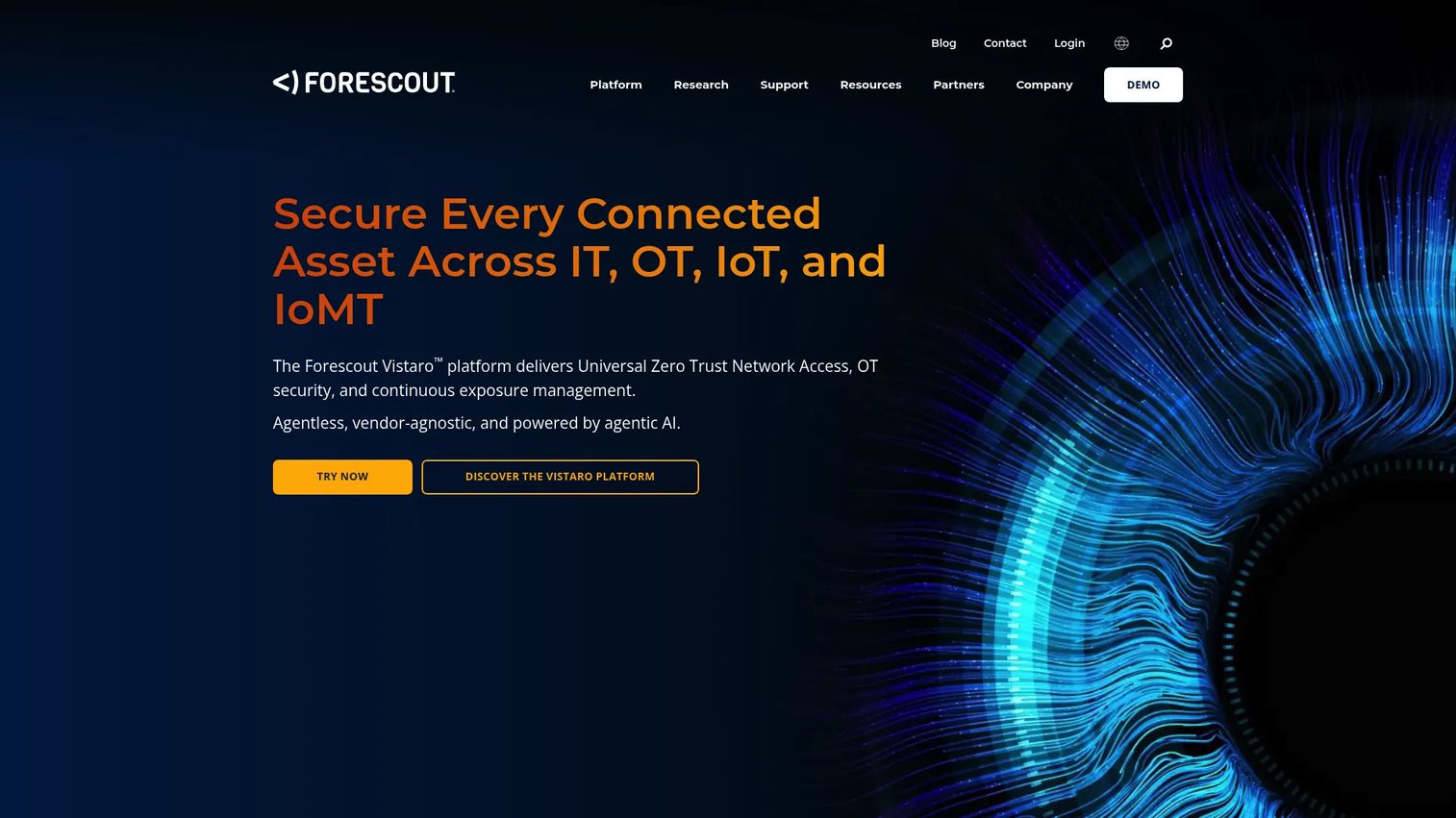
Forescout delivers real-time visibility, access control, compliance monitoring, and security management across IT, OT, IoT, and IoMT environments. The platform spans managed endpoints, unmanaged connected devices, and operational technology assets from a single interface. VistaroAI adds risk summaries, automated investigations, and remediation recommendations on top of the core visibility layer.
Best for: Enterprise organizations that manage mixed environments spanning corporate IT, factory floors, and clinical networks.
Key features
- Real-time device and asset visibility across IT, OT, and IoMT
- Policy-based access control with automated enforcement
- Risk, vulnerability, and compliance assessment
- Network segmentation and security orchestration
- VistaroAI-powered risk summaries and investigation workflows
Why choose Forescout Vistaro Platform: Product and security teams managing heterogeneous environments get a single control plane instead of separate tools for each device category. The tradeoff is deployment complexity: Cloud, appliance, hybrid, and air-gapped options exist, but each requires configuration effort proportional to the environment size.
Forescout Vistaro Platform pricing: Forescout uses endpoint-based subscription licensing, but does not display prices. Contact Forescout directly for a quote based on your device count and deployment model.
G2 rating: 4.5/5 (verified September 2026 from Forescout Platform listing on G2).
2. EasyNAC
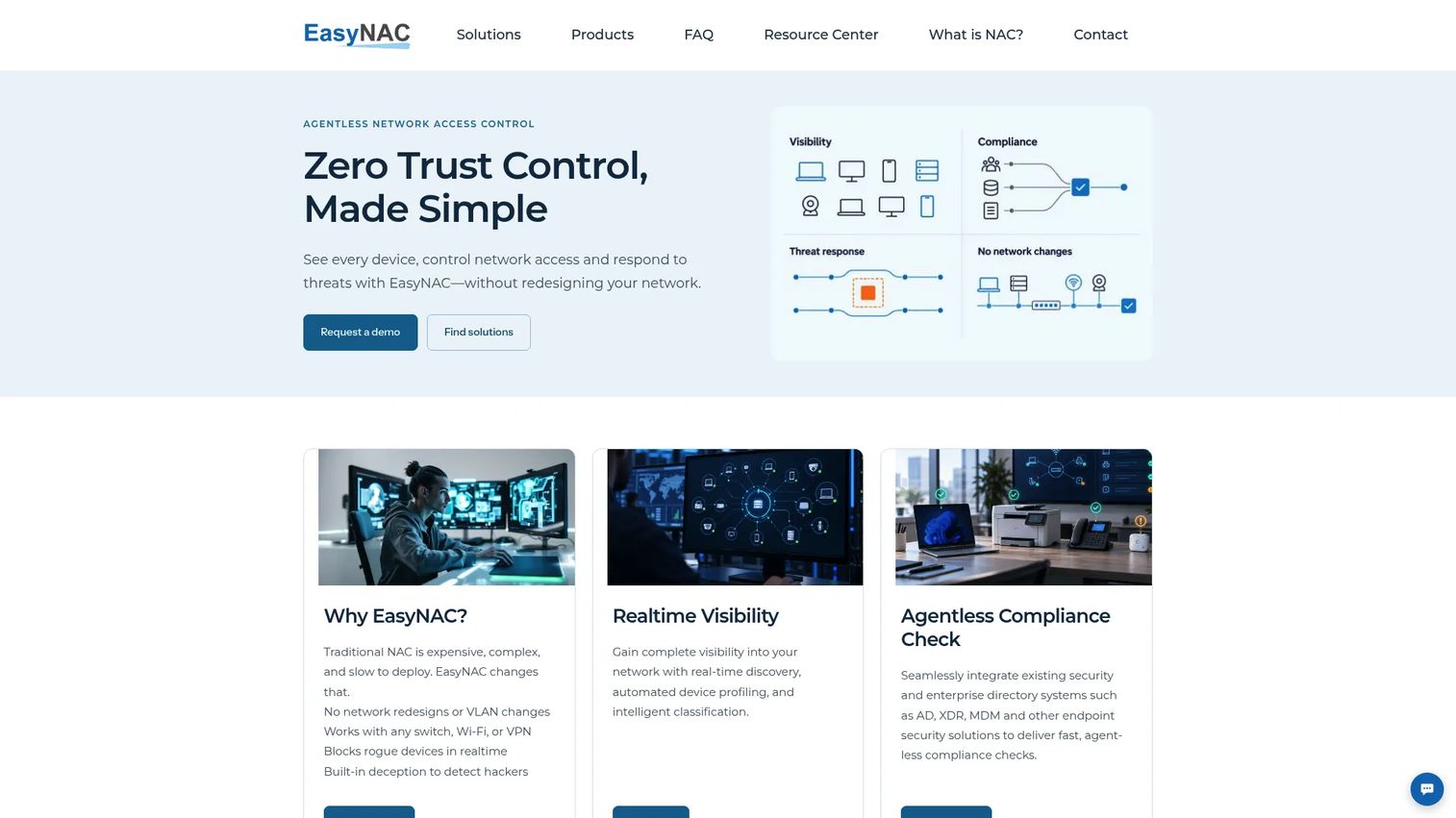
EasyNAC is an agentless network access control platform that provides device visibility, zero-trust policy enforcement, and automated threat response across LAN, WLAN, VPN, and branch environments. ARP-based enforcement means no network changes are required to get started. Device fingerprinting catches MAC-spoofing attempts that fool simpler NAC approaches.
Best for: Organizations that need access control and policy enforcement for unmanaged devices without deploying agents or redesigning the network.
Key features
- Agentless network visibility and device profiling
- ARP-based enforcement without network infrastructure changes
- Automated device quarantine on threat detection
- MAC-spoofing protection via device fingerprinting
- Guest and BYOD registration with role-based access control
Why choose EasyNAC: Teams whose primary concern is access policy, not deep analytics, benefit from its focused scope. It is a point solution for enforcement rather than a broad visibility platform, so pair it with a discovery tool if asset inventory is also a gap.
EasyNAC pricing: EasyNAC does not display pricing. Contact the vendor for a quote; pricing is likely based on device count and deployment scope.
G2 rating: No verified G2 listing was found for EasyNAC at the time of publication.
3. The Claroty Platform

Claroty is an AI-powered cybersecurity platform built for cyber-physical systems across industrial, healthcare, commercial, and public-sector environments. It covers OT, CPS, IoT, and IoMT asset visibility alongside exposure management, network protection, secure access, and threat detection in a single architecture. Passive monitoring means it can profile industrial assets without generating traffic that might affect process control systems.
Best for: Organizations securing mission-critical operational technology and industrial environments where active scanning creates unacceptable operational risk.
Key features
- Passive OT, CPS, IoT, and IoMT asset inventory
- Exposure management and vulnerability prioritization
- Network protection and secure remote access
- Threat detection with behavioral baselining
- Incident response workflows and SIEM integration
Why choose The Claroty Platform: Production environments in manufacturing, energy, utilities, and critical infrastructure need a monitoring approach that does not interfere with running processes. Claroty's passive architecture fits that constraint. Deployment and tuning require dedicated operational technology expertise, which adds to the implementation timeline.
The Claroty Platform pricing: Claroty does not display pricing and directs prospects to request a demo. Contact Claroty for a quote based on site count, asset volume, and required modules.
G2 rating: 4.7/5 based on 6 reviews (verified September 2026 from Claroty's G2 listing).
4. DigiCert Device Trust Manager
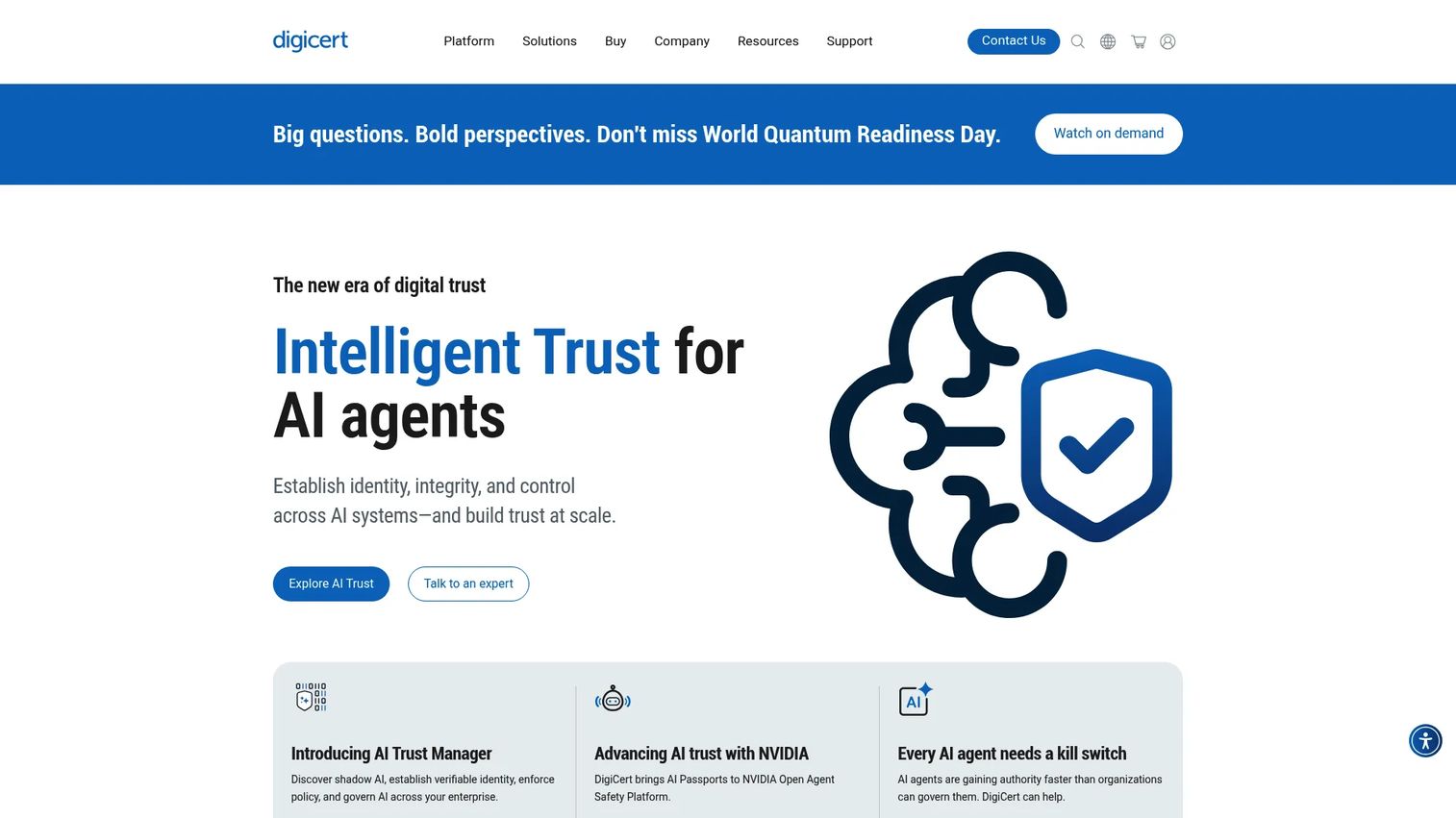
DigiCert Device Trust Manager is an end-to-end IoT security platform for managing device identity, certificate lifecycle, provisioning, firmware updates, and compliance. It supports certificate issuance via EST, SCEP, ACME, CMPv2, and REST API, and includes over-the-air update delivery and hardware-backed identity with post-quantum cryptography readiness. Two tiers exist: Essentials for single-certificate-per-device use cases, and Advanced for full device management with multiple certificates and TrustEdge automation.
Best for: IoT manufacturers and enterprises embedding device identity at production time and managing certificate lifecycle across large connected-device fleets.
Key features
- Certificate issuance via EST, SCEP, ACME, CMPv2, and REST API
- Secure device registration with batch and just-in-time options
- Zero-touch provisioning and automated certificate renewal
- Over-the-air software and security updates
- Post-quantum cryptography readiness
Why choose DigiCert Device Trust Manager: Product teams building identity into connected hardware from the start get a platform designed for manufacturing integration rather than retrofitting. The Advanced tier adds operational scope that Essentials does not cover, so assess which tier matches your device management requirements before procurement.
DigiCert Device Trust Manager pricing: Licensing is per managed certificate on Essentials and per device on Advanced, billed annually. DigiCert does not display prices; contact sales for a quote based on fleet size and selected tier.
G2 rating: 4.8/5 based on 2 reviews (verified September 2026 from DigiCert Device Trust Manager's G2 listing).
5. CyberMDX Healthcare Cybersecurity
CyberMDX was acquired by Forescout, and its capabilities now appear within Forescout's medical device security portfolio following the end-of-life of the standalone CyberMDX product in June 2024. The successor capabilities provide continuous discovery and classification of IT, OT, IoT, and IoMT devices, medical-device vulnerability scoring with regulatory recall enrichment, and policy-driven network access control with segmentation and threat response.
Best for: Healthcare delivery organizations that need visibility, risk assessment, and policy-based protection across clinical and enterprise connected devices.
Key features
- Continuous discovery of IT, OT, IoT, and IoMT devices
- Medical-device vulnerability scoring with recall enrichment
- Policy-driven network access control and segmentation
- Threat response workflows for clinical environments
- Integration with Forescout's broader platform
Why choose CyberMDX Healthcare Cybersecurity: Healthcare teams evaluating this capability today are effectively evaluating Forescout Medical Device Security. If your organization already uses Forescout for enterprise IT, the medical device extension reduces vendor sprawl. New healthcare buyers should evaluate whether the full Forescout platform is the right entry point or whether a standalone healthcare IoT product fits the procurement scope better.
CyberMDX Healthcare Cybersecurity pricing: Pricing follows Forescout's subscription model and is not displayed publicly. Contact Forescout for a quote.
G2 rating: 4.5/5 (verified September 2026 from Forescout's G2 seller listing).
6. Armis Centrix
Armis Centrix is a cloud-based cyber exposure management platform providing real-time visibility, risk assessment, and protection across IT, OT, IoT, IoMT, cloud, and virtual assets. The agentless architecture classifies devices using network traffic and behavior rather than installed software, which means it reaches asset classes that agent-based tools miss entirely. Threat containment and compliance reporting are built into the same platform.
Best for: Large enterprises and regulated organizations needing unified cyber exposure management across complex environments without deploying agents on every device.
Key features
- Unified asset inventory and classification across all device types
- Real-time threat detection and behavioral anomaly detection
- Risk prioritization and vulnerability remediation guidance
- Network segmentation and automated threat containment
- Compliance reporting and SIEM integration
Why choose Armis Centrix: Agentless discovery is the defining reason to evaluate this platform. Organizations with large populations of devices that cannot run agents, including OT hardware, medical equipment, and building systems, get coverage from a single cloud-based platform. Pricing is not disclosed, so budget conversations happen during the sales process.
Armis Centrix pricing: Armis does not display pricing. Contact Armis for a quote; pricing is driven by asset volume and required modules.
G2 rating: 4.4/5 (verified September 2026 from Armis G2 listing).
7. Entrust Certificate Services
Entrust Certificate Services is a certificate lifecycle management and digital certificate platform for managing Entrust and third-party certificates from a centralized interface. The platform automates certificate installation, deployment, renewal, reissue, and revocation, along with domain verification and lifecycle visibility. Subscription-based licensing with reusable certificate options fits teams that need predictable cost structure for large certificate inventories.
Best for: Organizations centralizing and automating management of public and private digital certificates across enterprise environments.
Key features
- TLS/SSL certificate lifecycle management
- Automated certificate installation, renewal, and revocation
- Certificate inventory visibility across the organization
- Integrated TLS/SSL server testing
- Support for Entrust and non-Entrust certificates
Why choose Entrust Certificate Services: Teams that need a certificate management layer over an existing PKI, or want to consolidate scattered certificate procurement under one platform, find this a practical fit. It is a certificate management tool rather than a full IoT identity platform, so pair it with a device identity solution if provisioning new connected hardware is also in scope.
Entrust Certificate Services pricing: Entrust uses subscription licensing with reusable certificate and signing licenses, but does not display prices. Contact Entrust for a quote.
G2 rating: 4.2/5 (verified September 2026 from Entrust Certificate Manager on G2).
8. Nozomi Networks Platform
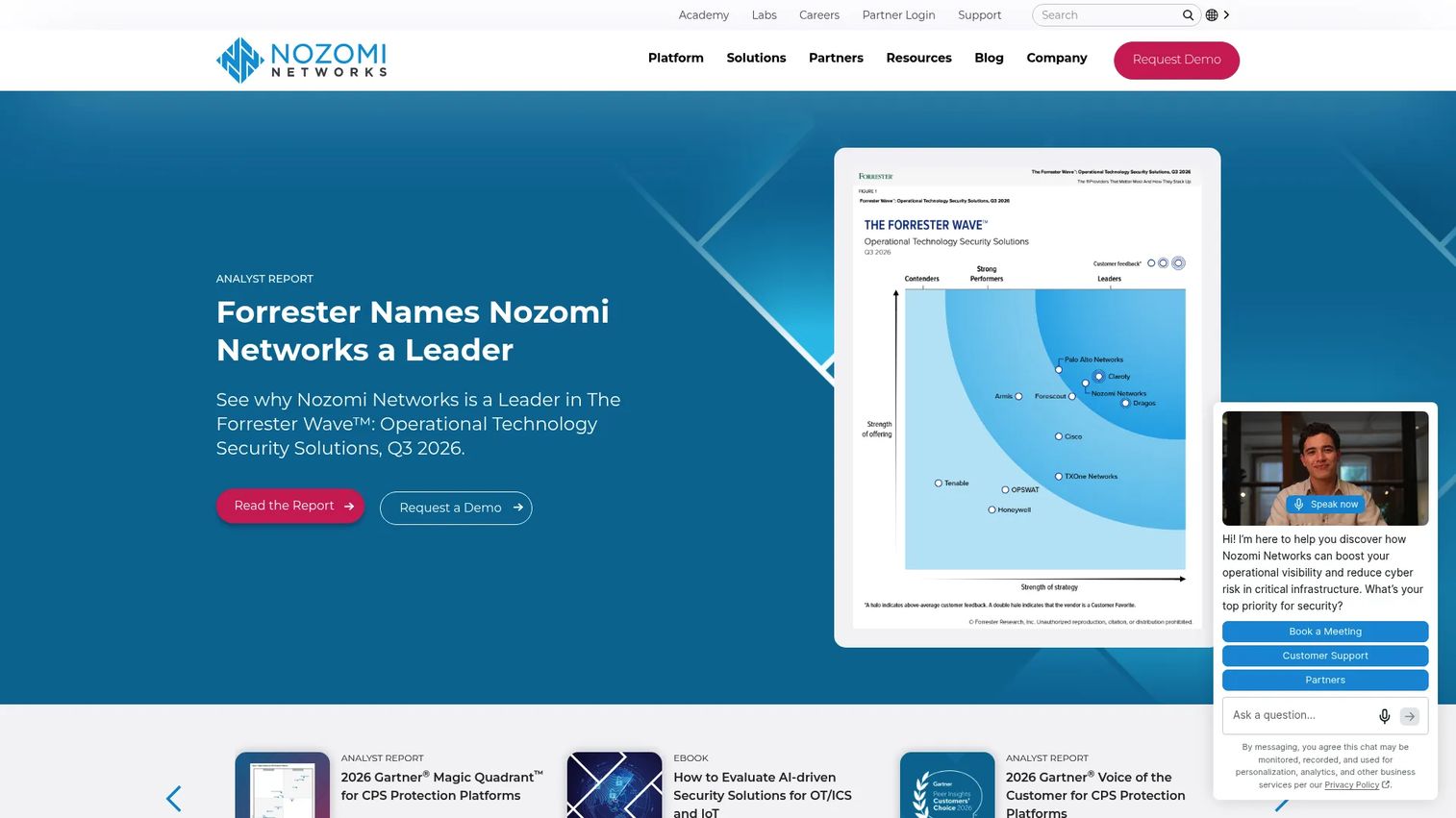
Nozomi Networks provides an AI-powered OT and IoT cybersecurity platform covering asset visibility, threat detection, risk management, and incident response for industrial and critical-infrastructure environments. Vantage and OnePass subscription models address different scale and deployment requirements. AI-powered anomaly detection and threat intelligence reduce the manual analysis burden on lean operational technology security teams.
Best for: Large industrial, commercial, and critical-infrastructure organizations that need scalable OT and IoT visibility with AI-assisted threat detection.
Key features
- Unified OT and IoT asset visibility and inventory
- AI-powered anomaly and threat detection
- Vulnerability detection and risk scoring
- Coordinated incident response workflows
- Subscription models including Vantage and OnePass
Why choose Nozomi Networks Platform: Industrial security teams get a purpose-built platform that understands OT protocols and asset behaviors without requiring agents on equipment that cannot support them. The G2 rating reflects a small review sample; reference customer conversations will give you more signal than review aggregates for a platform at this price point.
Nozomi Networks Platform pricing: Quote-based pricing with subscription models. Contact Nozomi Networks for a quote based on asset count and deployment scope.
G2 rating: 5.0/5 based on 1 review (verified September 2026 from Nozomi Networks Platform on G2).
9. Asimily
Asimily provides a proactive cyber asset defense platform for discovering, assessing, and mitigating risks across IT, IoT, OT, and IoMT devices. Risk prioritization uses ATT&CK Analysis and vulnerability context to separate actionable exposures from background noise. Segmentation orchestration includes policy generation and impact simulation, which reduces the risk of applying a segmentation change that breaks a clinical or operational workflow.
Best for: Healthcare, manufacturing, and government organizations securing complex connected-device environments where remediation context matters as much as discovery.
Key features
- Automated inventory across IT, IoT, OT, and IoMT
- ATT&CK-based risk prioritization with vulnerability context
- Segmentation orchestration with policy generation and impact simulation
- IoT patching and password management
- Configuration control and drift detection
Why choose Asimily: The impact simulation capability for segmentation changes is a meaningful differentiator for healthcare teams where a misconfigured policy can affect patient care workflows. Asimily does not yet have G2 reviews, so peer reference checks carry more weight during evaluation.
Asimily pricing: Asimily does not display pricing and directs prospects to request a demo. Contact Asimily for a quote based on device count and required capabilities.
G2 rating: No reviews currently listed on G2 (verified September 2026).
10. Axonius Cybersecurity Asset Management Platform
Axonius provides unified asset intelligence and exposure management by aggregating and reconciling device, identity, SaaS, software, cloud, IoT, and OT data from the security tools you already run. Natural-language querying and AI-assisted recommendations sit on top of a continuously updated asset model. At 15,000 to 24,999 assets, pricing starts at $8.55 per asset, making Axonius one of the few platforms with a publicly available starting point.
Best for: Enterprise security, IT, and GRC teams that need a continuously reconciled source of truth across their existing security tool stack, including IoT and OT data.
Key features
- Continuous asset discovery and reconciliation across security tools
- Unified asset model spanning devices, identities, SaaS, cloud, IoT, and OT
- Cross-domain exposure management and risk prioritization
- Automated remediation workflows with bi-directional integrations
- Natural-language querying and AI-assisted recommendations
Why choose Axonius Cybersecurity Asset Management Platform: Product and security teams that already run multiple security tools but lack a single reconciled asset view get immediate value from Axonius without replacing existing investments. It is an aggregation layer, not a monitoring sensor, so it complements rather than replaces OT-specific or IoMT-specific platforms.
Axonius Cybersecurity Asset Management Platform pricing: Device-based pricing starting at $8.55 per asset for 15,000 to 24,999 assets, with tiered rates for larger or smaller populations. No free tier. Contact Axonius for a personalized quote.
G2 rating: 4.2/5 (verified September 2026 from Axonius G2 listing).
11. Microsoft Defender for IoT
Microsoft Defender for IoT discovers, monitors, assesses, and protects IoT and OT environments using agentless network-layer monitoring across cloud, on-premises, and hybrid deployments. Enterprise IoT is included with Microsoft 365 E5 or E5 Security, or available as a per-device add-on. OT monitoring uses site-based licenses sized by device count per site, starting at $70 per month for up to 100 devices.
Best for: Organizations securing unmanaged IoT and OT environments that already run Microsoft security operations workflows and want native SIEM integration.
Key features
- IoT and OT device discovery and inventory
- Risk-based vulnerability prioritization and remediation recommendations
- Threat detection, incident investigation, and response
- Agentless network-layer monitoring
- Native integration with Microsoft Sentinel and Microsoft security stack
Why choose Microsoft Defender for IoT: Teams already investing in Microsoft 365 E5 or E5 Security get enterprise IoT coverage without an additional procurement conversation. OT site licensing is straightforward to scope by site and device count. Teams without existing Microsoft security investments should evaluate whether the broader platform commitment justifies the IoT capability alone.
Microsoft Defender for IoT pricing: Enterprise IoT add-on starts at $0.85 per device per month, billed annually. OT site licenses run from $70 per month (up to 100 devices) to $1,500 per month (up to 5,000 devices), billed annually. Enterprise IoT is included with Microsoft 365 E5 and E5 Security.
G2 rating: 4.3/5 (verified September 2026 from Microsoft Defender for IoT on G2).
12. Palo Alto Networks Medical IoT Security

Palo Alto Networks Medical IoT Security is a cloud-delivered zero trust security solution for discovering, assessing, segmenting, and protecting connected medical devices. Machine learning classifies devices and maps CVEs, SBOMs, and recall data to each asset. Context-aware segmentation recommendations include one-click enforcement through Next-Generation Firewalls, and virtual patching protects devices that cannot receive firmware updates.
Best for: Healthcare environments using Palo Alto Networks firewalls that need centralized medical device visibility, segmentation, and threat prevention.
Key features
- ML-based medical device discovery and classification
- Risk assessment with SBOM, CVE mapping, and recall monitoring
- Context-aware segmentation with one-click enforcement
- Behavioral anomaly detection and virtual patching
- Integration with Strata Cloud Manager, Cortex XSIAM, and Epic Systems
Why choose Palo Alto Networks Medical IoT Security: Healthcare teams with existing Palo Alto Networks firewall infrastructure get medical device security that plugs into the enforcement layer already in place. The product is transitioning into the broader Device Security offering, so confirm the current product name and licensing path with Palo Alto Networks during evaluation.
Palo Alto Networks Medical IoT Security pricing: Subscription licensed per firewall or through Device Security X. Palo Alto Networks does not display prices; contact sales for requirements and a quote.
G2 rating: 4.4/5 (verified September 2026 from Palo Alto Networks IoT/OT Security on G2).
13. Ping Identity Platform
Ping Identity is an enterprise identity and access management platform covering customer, workforce, partner, and AI agent identities. Capabilities span identity verification, lifecycle management, single sign-on, MFA, passwordless authentication, just-in-time privileged access, fraud prevention, and no-code identity orchestration. Deployment options include multi-tenant SaaS, dedicated-tenant SaaS, self-managed, and FedRAMP High.
Best for: Large and enterprise organizations where identity governance and access management are the primary IoT and device security bottleneck, not device discovery.
Key features
- Single sign-on, MFA, and passwordless authentication
- Authorization and just-in-time privileged access
- Identity verification and verifiable credentials
- No-code identity orchestration
- FedRAMP High deployment option
Why choose Ping Identity Platform: Organizations where the security gap is identity control, not asset inventory, find Ping Identity more directly applicable than a broad IoT visibility platform. It covers workforce, customer, and partner identity alongside device controls, so procurement can consolidate IAM rather than adding a separate tool.
Ping Identity Platform pricing: PingOne for Workforce starts at $3 per user per month (Essential) or $6 per user per month (Plus), billed annually with a 5,000-user minimum. PingOne for Customers starts at $35,000 annually (Essential) or $50,000 annually (Plus). A 30-day free trial is available for PingOne for Workforce and PingOne for Customers.
G2 rating: 4.4/5 (verified September 2026 from Ping Identity on G2).
14. Phosphorus Unified xIoT Security Management Platform
Phosphorus is an xIoT security and management platform for discovering, assessing, remediating, and monitoring IoT, OT, IoMT, and IIoT devices. Automated remediation covers credentials, firmware, certificates, and configuration changes, making it one of the few platforms that closes the loop between discovering a vulnerability and fixing it without manual intervention. Subscription pricing is based on device count and selected features.
Best for: Enterprise organizations managing large, distributed fleets of IoT, OT, IoMT, and IIoT devices that need automated remediation, not just discovery and scoring.
Key features
- xIoT asset discovery and device profiling
- Vulnerability assessment across credentials, firmware, CVEs, and certificates
- Automated password, firmware, certificate, and configuration remediation
- Continuous device-state monitoring and drift detection
- Log management integration
Why choose Phosphorus Unified xIoT Security Management Platform: The automated remediation capability is the primary reason to shortlist Phosphorus. Most IoT security platforms identify vulnerabilities; Phosphorus acts on them. Teams with large unmanaged device populations and limited security engineering bandwidth will find that distinction significant.
Phosphorus Unified xIoT Security Management Platform pricing: Annual subscription, priced by device count and feature set. Phosphorus does not display prices; contact Phosphorus for a quote.
G2 rating: No reviews currently listed on G2 (verified September 2026).
15. Pulse IoT Security Platform
Pulse IoT Security Platform is listed in this shortlist based on its inclusion in industry IoT security roundups. During research for this article, the listed domain redirected away from an active product site, and first-party feature, pricing, and rating details could not be verified. Treat this entry as a flag: Confirm current product status directly with the vendor before including it in an active evaluation.
Best for: Confirm current product availability and positioning with the vendor before assessing fit.
Key features
- Connected-device discovery and monitoring (verify current scope with vendor)
- IoT visibility and security operations integration (verify current scope)
Why choose Pulse IoT Security Platform: Verify current product availability before evaluation. The domain status at the time of research raises questions about continuity that warrant a direct vendor conversation.
Pulse IoT Security Platform pricing: Not verifiable at this time. Contact the vendor directly to confirm product and pricing status.
G2 rating: No verified G2 listing was found at publication.
16. Check Point IoT Protect
Check Point IoT Protect covers network-level and on-device protection for enterprise, healthcare, industrial, and IoT-manufacturer environments. Zero-trust device profiles and network segmentation limit lateral movement, while IoT Nano-Agents provide runtime protection directly on the device. Virtual patching protects devices with unpatched firmware by blocking exploits at the network layer before they reach the endpoint.
Best for: Organizations and device manufacturers that need threat prevention and virtual patching for IoT devices that cannot receive firmware updates.
Key features
- IoT discovery and risk analysis
- Zero-trust device profiles and network segmentation
- Virtual patching via network-layer threat prevention
- On-device runtime protection using IoT Nano-Agents
- IoT-specific threat intelligence feeds
Why choose Check Point IoT Protect: Virtual patching is the capability that sets this platform apart from pure discovery tools. For environments with legacy or unmanageable devices, blocking known exploit paths at the network layer buys time that firmware updates cannot. Check Point's existing firewall and threat prevention infrastructure is a prerequisite for full benefit.
Check Point IoT Protect pricing: Pricing is not displayed. Contact Check Point or a partner for a quote.
G2 rating: No verified G2 listing was found for Check Point IoT Protect at publication.
17. Pwnie Express
Pwnie Express has historically provided IoT and network security testing, device exposure assessment, and wireless security evaluation capabilities. During research for this article, current first-party product descriptions and pricing could not be verified from the official domain. Confirm current product availability and scope directly with the vendor before including Pwnie Express in an active evaluation.
Best for: Security teams validating connected-device attack paths and wireless exposure through structured testing. Confirm current product availability before evaluating.
Key features
- IoT and network security testing (verify current scope)
- Wireless device exposure assessment (verify current scope)
Why choose Pwnie Express: Testing and validation tools serve a different purpose than continuous monitoring platforms. If your team needs to validate the attack surface before deploying a monitoring tool, a dedicated testing capability may belong in the evaluation. Confirm current product status directly before proceeding.
Pwnie Express pricing: Not verifiable at this time. Contact the vendor to confirm product and pricing status.
G2 rating: No verified G2 listing was found at publication.
18. Karamba Security
Karamba Security provides product-security software and services for edge devices, embedded systems, and containerized workloads. XGuard runtime protection applies eight security controls including binary allowlisting, execution access control, and control-flow integrity. VCode binary analysis generates binary-derived SBOMs, detects vulnerabilities, and provides supply-chain visibility without requiring source code access.
Best for: OEMs and Tier 1 suppliers securing connected devices, automotive products, medical devices, and energy equipment at the product level, not the network level.
Key features
- XGuard runtime protection with eight embedded security controls
- VCode binary analysis with SBOM generation and CVE detection
- Continuous CVE monitoring and prioritized findings
- CycloneDX and SPDX export support
- Penetration testing, compliance support, and cybersecurity reporting
Why choose Karamba Security: Karamba operates at the device and firmware layer rather than the network monitoring layer. Product teams building connected hardware need a different class of tool than enterprise security teams monitoring a network. Karamba is a strong fit for the former, not the latter.
Karamba Security pricing: Pricing is not displayed. Contact Karamba Security for a quote based on product type and deployment scope.
G2 rating: No verified G2 listing was found at publication.
19. Keyfactor
Keyfactor provides trust infrastructure for machine identities and cryptography, covering PKI, certificate lifecycle automation, code signing, and cryptographic asset management. Cryptographic discovery and inventory give teams visibility into certificates they did not know existed. G2 reports a 4.5/5 seller rating based on 125 reviews, making it one of the more reviewed platforms in the certificate and machine identity segment.
Best for: Enterprises that need centralized management and automation of PKI, machine identities, certificates, and cryptographic assets across large device fleets.
Key features
- Cryptographic discovery and inventory
- Certificate lifecycle automation and PKI management
- Secure code signing
- Integration with enterprise security and DevOps workflows
- Machine identity management at scale
Why choose Keyfactor: Teams managing certificate expiration across thousands of devices, servers, and IoT endpoints get automation that reduces both operational risk and manual effort. The platform covers PKI operations and code signing alongside certificate management, which consolidates identity infrastructure for organizations building or maintaining connected products.
Keyfactor pricing: Keyfactor does not display pricing. Contact Keyfactor for a quote.
G2 rating: 4.5/5 based on 125 reviews (verified September 2026 from Keyfactor on G2).
20. EJBCA Enterprise
EJBCA Enterprise is enterprise PKI and certificate authority software for production-scale certificate issuance, management, enrollment, and validation. It supports X.509 issuance, CA, RA, and VA modules, HSM and crypto-token integration, high availability, and deployment as software, hardware appliance, cloud, or SaaS. A free 30-day trial is available through AWS and Azure marketplaces.
Best for: Organizations that need to operate their own production certificate authority for enterprise IT, IoT, telecom, government, or high-assurance environments.
Key features
- X.509 certificate issuance and management
- CA, RA, and VA module architecture
- HSM and crypto-token support with high-availability options
- CMP, SCEP, EST, ACME, SOAP, and REST API enrollment protocols
- Deployment as software, appliance, cloud, or SaaS
Why choose EJBCA Enterprise: Organizations that need full control over their certificate authority infrastructure, rather than delegating trust to a managed CA service, choose EJBCA. The on-premises deployment option meets air-gapped and regulatory requirements that cloud-only certificate services cannot. The 30-day trial on AWS and Azure lowers the evaluation barrier compared to most enterprise PKI options.
EJBCA Enterprise pricing: Pricing is not displayed. A free 30-day cloud trial is available on AWS and Azure. Contact Keyfactor (which maintains EJBCA) for enterprise pricing.
G2 rating: 4.5/5 based on 36 reviews (verified September 2026 from Keyfactor EJBCA on G2).
21. ServiceNow
ServiceNow is an AI-powered enterprise workflow platform that connects incidents, changes, service requests, and asset data across IT, security, HR, customer service, and operations. In the IoT security context, it functions as a workflow and orchestration layer: Routing device security alerts into ticketing, connecting asset data from discovery tools to CMDB, and automating remediation workflows. Three product tiers exist: Foundation, Advanced, and Prime, all priced on a contact-sales basis.
Best for: Large enterprises that need to connect IoT security data from specialized monitoring tools into operational workflows, incident management, and CMDB.
Key features
- IT service management for incidents, changes, and service requests
- CMDB and configuration management
- AI agents and workflow automation
- Low-code application development for custom workflows
- Enterprise security, governance, and integrations
Why choose ServiceNow: ServiceNow is not a device discovery or monitoring tool. It becomes valuable when IoT security data exists but security alerts do not flow into operational workflows automatically. Teams that find device alerts sitting outside their incident management process benefit most from the integration layer ServiceNow provides.
ServiceNow pricing: Foundation, Advanced, and Prime tiers are available, but prices are not displayed. Contact ServiceNow for a quote.
G2 rating: A current numeric G2 rating for ServiceNow could not be verified from accessible sources at the time of publication.
Considerations when choosing an IoT security solution
Start with asset visibility
Ask whether the platform discovers managed, unmanaged, legacy, and specialized devices. Confirm it identifies vendor, model, firmware version, operating system, network location, owner, and communication behavior. An inventory that covers only managed endpoints leaves the riskiest devices invisible. Review our asset discovery software guide for broader context on discovery approaches across asset categories.
Separate discovery from risk prioritization
An inventory alone does not reduce exposure. Evaluate how the platform scores vulnerabilities, weak credentials, exposed services, outdated firmware, and business impact. Risk prioritization determines which findings your team can realistically act on. Platforms that generate thousands of undifferentiated alerts transfer the triage burden to your team without solving it.
Check deployment constraints before shortlisting
Confirm support for cloud, on-premises, appliance, virtual machine, hybrid, and air-gapped environments. Determine whether deployment requires agents, network changes, active scanning, or dedicated hardware. OT and clinical environments often prohibit active scanning and agent installation, which immediately narrows the viable platform list. For more on managing asset state across deployment models, see our asset lifecycle management software roundup.
Map identity and access controls to your device population
Assess certificates, PKI, device authentication, access policy, segmentation, and revocation workflows. Confirm how the platform handles legacy devices that cannot run modern agents or support certificate-based authentication. Zero trust segmentation without compensating controls for legacy endpoints creates coverage gaps.
Measure operational fit before committing
Check integrations with SIEM, SOAR, CMDB, network infrastructure, ticketing, and security operations tools. Assess alert volume, policy maintenance cadence, and reporting overhead. A platform that generates accurate alerts but routes them nowhere useful adds toil without improving response time. For teams evaluating AI cybersecurity solutions more broadly, understanding integration depth is equally critical.
How to choose the right IoT security solution for your team
If your main problem is unknown devices
Prioritize broad discovery, classification, and asset context. Forescout Vistaro Platform covers the widest range of environment types from one platform. Armis Centrix handles agentless discovery at scale. Axonius Cybersecurity Asset Management Platform reconciles asset data across tools you already own. Phosphorus Unified xIoT Security Management Platform adds automated remediation for teams that want to act on what they find.
If you protect industrial or operational environments
Prioritize passive monitoring, OT protocol awareness, risk analysis, and minimal operational disruption. The Claroty Platform and Nozomi Networks Platform both use passive architectures suited to production environments. Claroty has broader CPS coverage; Nozomi has a strong track record specifically in industrial and critical-infrastructure deployments.
If device identity is the core gap
Prioritize certificates, PKI, machine identity, issuance, rotation, and revocation. DigiCert Device Trust Manager fits teams embedding identity into connected hardware at manufacturing time. Keyfactor and EJBCA Enterprise fit teams operating or automating enterprise PKI. Entrust Certificate Services works for teams that need lifecycle management over existing certificate inventories. For additional context on certificate and identity management tooling, the best AI security posture management tools guide covers related security automation capabilities.
If you protect medical devices
Prioritize clinical context, medical asset discovery, risk prioritization, and segmentation. CyberMDX Healthcare Cybersecurity (now within Forescout) suits organizations already in the Forescout ecosystem. Palo Alto Networks Medical IoT Security suits teams with existing Palo Alto Networks firewall infrastructure. Asimily's impact simulation for segmentation changes makes it worth evaluating for clinical environments where policy changes carry patient safety risk.
If your team needs security workflow integration
Prioritize asset normalization, ticketing integration, incident response automation, and operational ownership. ServiceNow connects IoT security alerts to enterprise workflows. Axonius Cybersecurity Asset Management Platform normalizes asset data across the security stack. Microsoft Defender for IoT integrates directly into Microsoft Sentinel for teams already running Microsoft security operations.
Conclusion
IoT security spending is projected to reach $47.49 billion by 2034, up from $7.78 billion in 2025, according to IMARC Group. The growth reflects a hard reality: 21.1 billion connected IoT devices now exist worldwide, per IoT Analytics 2025, and most enterprise security tooling was not designed to handle them.
The shortlist above covers the five capability layers that matter: Discovery, risk prioritization, identity, segmentation, and monitoring. No single platform dominates all five for every environment.
Broad enterprise visibility favors Forescout and Armis Centrix. OT environments favor Claroty and Nozomi Networks. Healthcare device security favors CyberMDX and Palo Alto Networks Medical IoT Security. Identity gaps favor DigiCert, Keyfactor, and EJBCA Enterprise. Workflow integration favors ServiceNow and Axonius.
Pick two or three finalists that match your environment, then run a proof of concept using representative devices and existing workflows. Require each finalist to demonstrate discovery coverage, risk prioritization accuracy, integration depth, and policy maintenance overhead before committing to a purchase.
Start your journey with Guideflow today!
FAQs
IoT security solutions are software platforms, services, and tools that identify connected devices, assess their risk, control network access, monitor behavior, and reduce attack paths across enterprise environments. The category covers device discovery, asset inventory, risk assessment, network segmentation, device identity management, and threat detection. Some platforms address all of these; others specialize in one or two capability areas.
Core capabilities include passive or agentless device discovery, asset inventory with vendor and firmware details, risk scoring across vulnerabilities and misconfigurations, access control and network segmentation, certificate and identity management, and behavioral monitoring with threat detection. The right feature mix depends on the environment: OT teams need passive monitoring and industrial protocol support, while product teams embedding identity into connected hardware need PKI and certificate lifecycle management.
Unmanaged devices cannot receive agents, so IoT security platforms use passive network telemetry, traffic analysis, and behavioral baselining to discover and classify them without touching the device. Network segmentation and access control contain these devices within network policies. Virtual patching blocks known exploits at the network layer when firmware updates are not possible. These compensating controls reduce attack surface without requiring device-side software.
IoT refers to general connected devices including cameras, sensors, building systems, and consumer hardware. OT refers to operational technology: Industrial control systems, SCADA environments, and manufacturing equipment where uptime and safety are primary constraints. IoMT refers to connected medical devices in clinical environments where patient safety and regulatory requirements add additional constraints. Each category requires different discovery approaches, monitoring sensitivity, and policy frameworks because the operational consequences of disruption differ significantly.
Many IoT security platforms operate agentlessly, using network telemetry, passive traffic capture, and integrations with existing infrastructure rather than software installed on each device. This matters because most IoT and OT devices cannot run agents due to hardware constraints, vendor restrictions, or operating environment requirements. Some platforms offer optional agents for devices that can support them, providing richer telemetry when available. Check deployment prerequisites carefully before shortlisting.
Pricing typically varies by device count, deployment model, selected modules, support tier, and contract scope. Microsoft Defender for IoT is one of the few platforms with a published starting point: $0.85 per device per month for enterprise IoT (billed annually), or OT site licenses from $70 per month. Axonius starts at $8.55 per asset for midrange device populations. Most other platforms in this category use quote-based pricing. Verify current pricing directly with each vendor, as enterprise quotes change.
IoT security platforms complement rather than replace SIEM and endpoint security tools. They provide device context and specialized telemetry that SIEMs cannot generate on their own, then integrate that data into existing security operations workflows via API or native connectors. Endpoint security tools cover managed devices with agents; IoT platforms extend coverage to the device classes that endpoint tools miss. The two categories are additive, not competitive.
Run a structured proof of concept using representative devices from your actual environment, realistic network conditions, and existing security workflows. Define measurable success criteria upfront: Discovery coverage percentage, false-positive volume per day, deployment time, integration depth with your SIEM or CMDB, and policy maintenance time per week. Compare finalists against those criteria rather than feature checklists. Teams evaluating broader AI security posture management tools should apply the same structured evaluation approach.