Every board meeting has the same uncomfortable moment. Someone asks about margin by segment, cash position by entity, or inventory burn rate. And the answer is: "Give us a few days to pull that together."
That delay is not a reporting problem. It is a systems problem. Finance lives in one tool, ops runs on spreadsheets, procurement emails approvals, and revenue data sits in a CRM that does not talk to accounting. According to Grand View Research (2026), the global ERP software market was valued at $77.1 billion in 2025 and is projected to reach $157.1 billion by 2033, growing at a 9.5% CAGR. The adoption pressure is real: Eurostat (2025) found that 46.45% of EU enterprises already used ERP software in 2025, up from 2023, with rates reaching 88.71% among large enterprises.
ERP software is not an enterprise luxury. For a scaling company, it is the point where you stop treating operations as a data-cleanup problem and start treating them as a system decision. This guide compares 9 ERP platforms to help you find the right fit.
What's inside
This guide is built for Series B SaaS founders, heads of finance, and operations leaders evaluating ERP systems for the first time or replacing disconnected tools.
Tools were selected based on:
- Category fit: Coverage of finance, operations, inventory, procurement, manufacturing, or HR
- Scalability: Ability to grow with a company from 30 to 300+ employees
- Pricing visibility: Verified against vendor pricing pages or confirmed as quote-based
- Review presence: G2 ratings sourced directly from current listings
The guide covers ERP basics, a comparison table, 9 tool sections, buying considerations, and FAQs.
TL;DR
- Best overall for scaling SaaS and service businesses: Oracle NetSuite, with broad cloud ERP covering finance, inventory, CRM, and multi-entity consolidation
- Best for global enterprise operations: SAP S/4HANA Cloud, for organizations with complex cross-functional and regulatory requirements
- Best for Microsoft-first companies: Microsoft Dynamics 365 Business Central, at $80/user/month for the Essentials plan
- Best for manufacturing and distribution: SYSPRO or Sage X3, depending on operational complexity and geography
- Best modular option: Odoo, with a free single-app plan and paid tiers from $24.90/user/month
- Best for smaller teams consolidating tools: Striven or 24SevenOffice ERP, both suited to businesses replacing several disconnected systems
What is ERP software?
ERP software, short for enterprise resource planning software, is a business management system that connects core processes such as finance, accounting, inventory, procurement, manufacturing, HR, and reporting around a shared data model.
Unlike point tools that handle one function at a time, an ERP system gives every department access to the same underlying data. That means your VP Finance sees the same numbers as your head of operations, and board reporting does not require a manual reconciliation across five exports.
Key ERP modules
- Financial management and accounting
- Procurement and vendor management
- Inventory and warehouse management
- Manufacturing and production planning
- Supply chain management
- CRM and order management
- HR and workforce management
- Reporting, analytics, and forecasting
- Compliance and audit controls
ERP deployment models
Cloud ERP: Hosted by the vendor or cloud provider, accessed via browser. Updates are automatic and infrastructure burden stays with the vendor.
On-premises ERP: Installed on company servers. Gives maximum control, but requires internal IT capacity for maintenance.
Hybrid ERP: A combination of cloud and on-premises modules, often used during migration or when specific workloads require local hosting.
Two-tier ERP: A model where a corporate parent runs one ERP system and subsidiaries or business units run a second, lighter system. Common in complex enterprise structures.
ERP vs. accounting software
Accounting software manages financial transactions. ERP connects finance with procurement, inventory, HR, sales orders, and project data. If your VP Finance asks why a margin number changed and nobody can trace it to a specific product line or purchase order, that is the gap accounting software does not fill on its own.
When to use ERP software
Replace spreadsheet-driven reporting
The first place founders feel the pain is reporting. Board prep turns into a week of manual reconciliation. Cash flow models live in personal spreadsheets that only one person can update. ERP consolidates that data into governed workflows so finance can answer operating questions without chasing inputs.
Connect finance with operations
An ERP system earns its place when finance needs reliable, real-time inputs from sales orders, procurement, inventory movements, or project delivery. If the cost of a customer is calculated differently by sales and by finance, the data model is broken. ERP fixes that at the source.
Standardize workflows before scale breaks them
A 30-person company can survive with strong individual contributors filling gaps. At 80 or 150 employees, every manual approval, every Slack-based purchase request, and every spreadsheet handoff becomes a bottleneck. Standardizing ERP workflows before the next hiring wave saves the new VP Finance or COO from inheriting a process problem on day one.
ERP software comparison
The table below summarizes 9 ERP platforms, sorted by relevance to growing businesses. Pricing and G2 ratings reflect figures verified against vendor pricing pages and G2 listings.
| # | Product | Best for | Key differentiator | Pricing | G2 rating |
|---|---|---|---|---|---|
| 1 | Oracle NetSuite | Scaling SaaS, services, multi-entity businesses | Broad cloud ERP with finance, CRM, inventory, and global controls | Contact sales for standard plans; QuickStart free for eligible startups | 4.1/5 |
| 2 | SAP S/4HANA Cloud | Global enterprises with complex operations | Deep finance, supply chain, and embedded AI across all core processes | Contact SAP for subscription quote | 4.4/5 |
| 3 | Microsoft Dynamics 365 Business Central | Microsoft-first small and mid-sized businesses | Native integration with Microsoft 365, Teams, Excel, and Power BI | From $80/user/month (Essentials, billed yearly) | 4.0/5 |
| 4 | Sage X3 | Mid-market manufacturers and distributors | Finance, production, inventory, and multi-site support with Sage Copilot | Contact Sage for pricing | 3.9/5 |
| 5 | SYSPRO | Manufacturers and distributors | Industry-specific ERP for production, inventory, and supply chain | Contact SYSPRO for a quote | 4.1/5 |
| 6 | Odoo | Modular ERP buyers and cost-sensitive teams | Open-source roots, broad app ecosystem, flexible deployment | Free (one app); from $24.90/user/month (Standard, yearly) | 4.2/5 |
| 7 | QT9 ERP | Regulated manufacturers and life sciences teams | ERP plus native quality management for compliance-driven production | Contact QT9 for a quote | 4.9/5 |
| 8 | Striven | Small and mid-sized businesses replacing several tools | All-in-one operations suite with accounting, CRM, projects, and HR | Contact Striven for pricing | 4.5/5 |
| 9 | 24SevenOffice ERP | Nordic and European businesses | Cloud ERP with accounting, payroll, time tracking, and project modules | From 71 kr/month (Mikro plan); 30-day free trial | 4.1/5 |
Best 9 ERP software tools for 2026
1. Oracle NetSuite
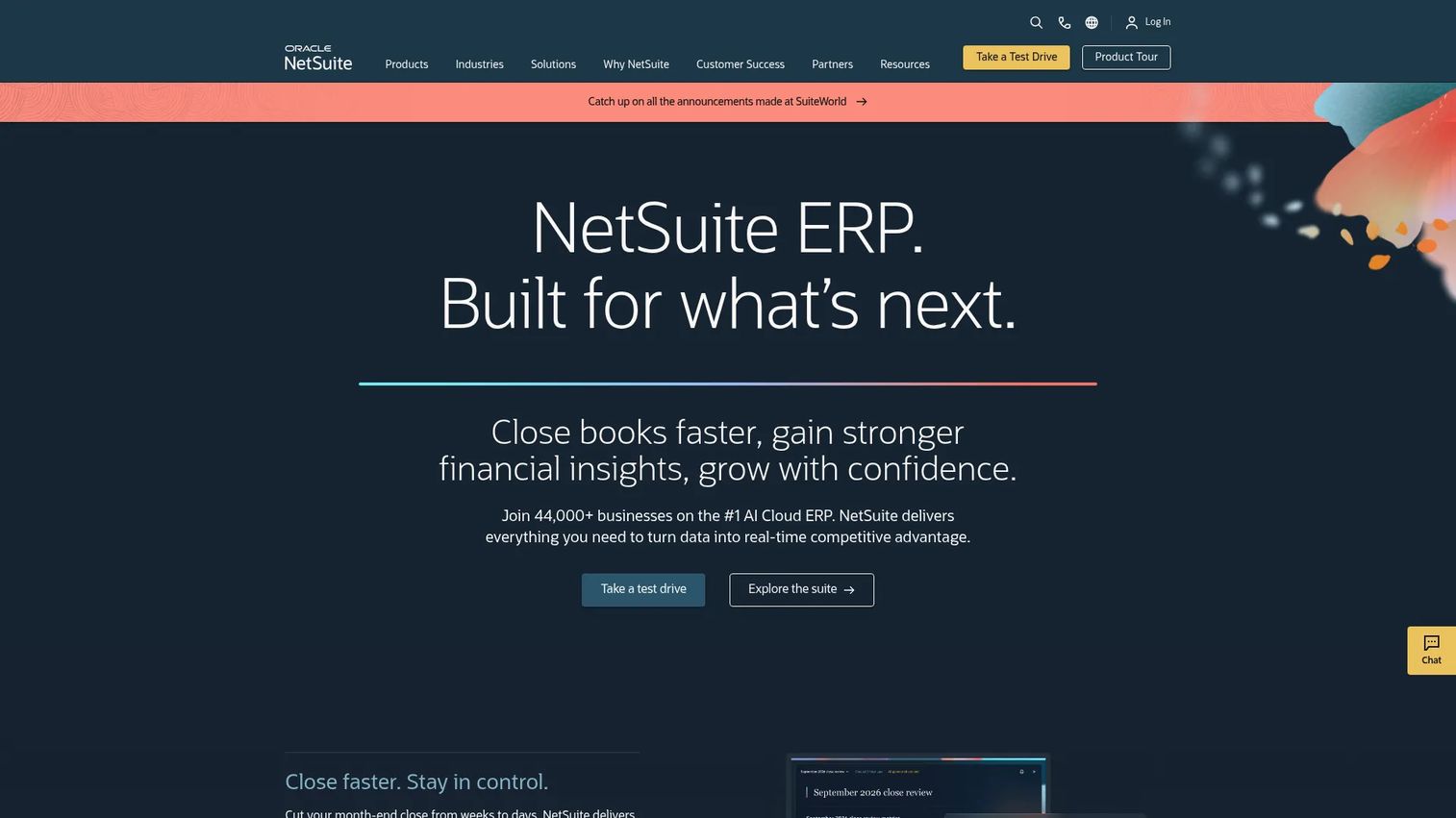
Oracle NetSuite is a cloud ERP platform used by scaling companies that need finance, accounting, CRM, procurement, inventory, order management, and multi-subsidiary visibility under one system. For founders who have outgrown QuickBooks plus spreadsheets, NetSuite provides the kind of financial infrastructure that holds up under board scrutiny. It covers the full arc from core accounting to revenue recognition, global entity consolidation, and embedded AI features through its Ask Oracle and NetSuite Next capabilities.
Best for: Scaling SaaS, services, and multi-entity businesses that need a finance-first cloud ERP.
Key features
- Financial management and accounting across entities
- Multi-entity consolidation and intercompany eliminations
- Revenue management and recognition
- Inventory, procurement, and order management
- CRM and professional services automation
Why choose Oracle NetSuite: NetSuite fits companies that need a single operating system connecting finance, operations, and customer data. Implementation planning matters significantly; NetSuite often becomes a core business layer, not a quick tool swap.
Oracle NetSuite pricing: NetSuite QuickStart is free for eligible early-stage U.S. technology startups within stated usage limits. Standard NetSuite pricing requires contacting sales, with the final figure depending on edition, user count, modules selected, and implementation scope.
G2 rating: 4.1/5
2. SAP S/4HANA Cloud
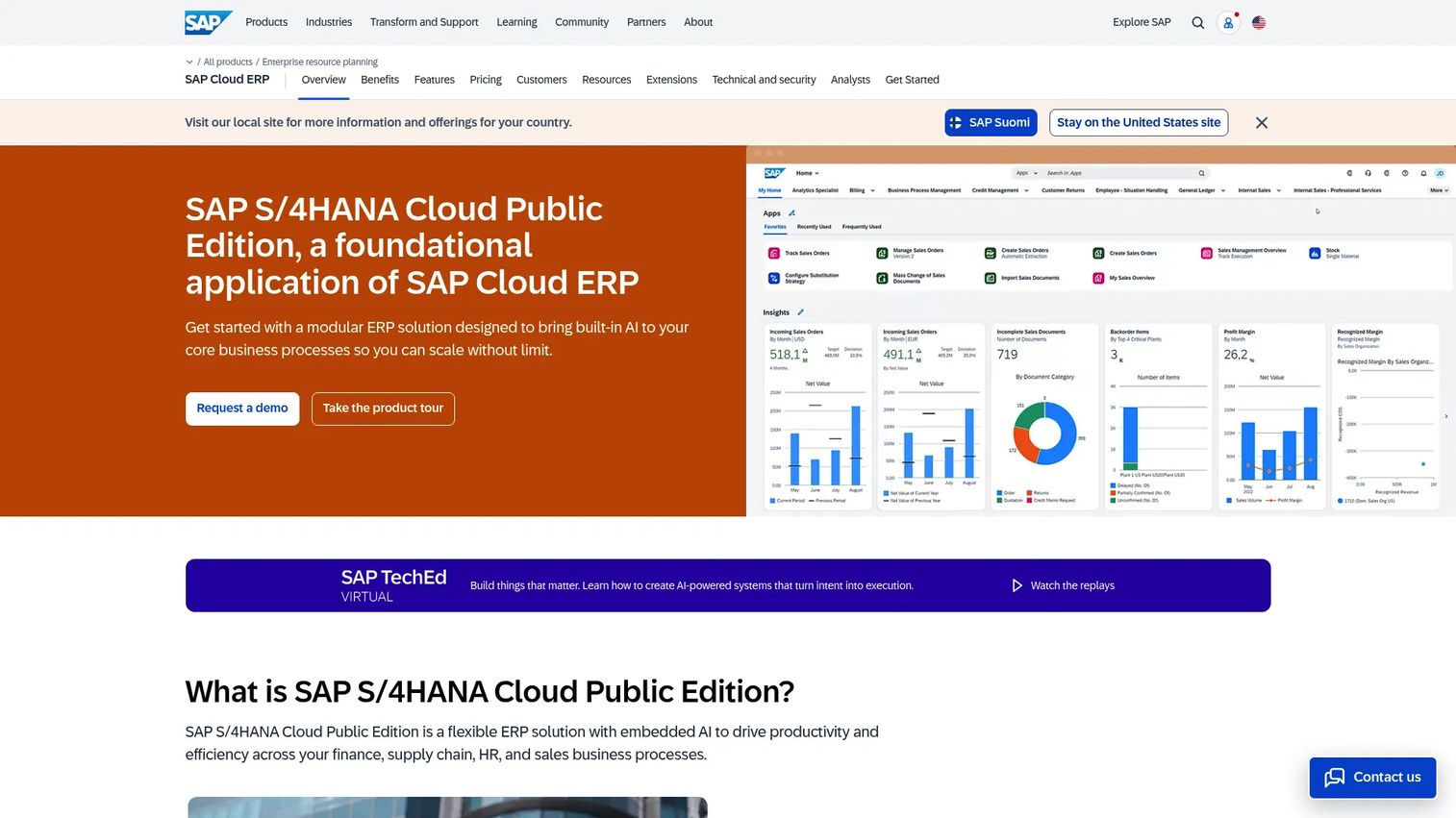
SAP S/4HANA Cloud is enterprise resource planning software for large and mid-sized organizations that need integrated finance, supply chain, procurement, manufacturing, HR, and analytics at scale. It runs on in-memory processing and embeds AI across its core workflows. For a founder whose company is approaching global operations or multi-division complexity, SAP provides the depth that lighter ERP systems do not. The platform suits organizations with mature internal teams that can manage an enterprise-grade implementation.
Best for: Global enterprises and complex businesses that need deep process coverage across finance, supply chain, and operations.
Key features
- Financial management and real-time consolidation
- Supply chain planning and execution
- Procurement and vendor management workflows
- Manufacturing and production management
- Embedded AI, analytics, and in-memory processing
Why choose SAP S/4HANA Cloud: SAP works best when operational complexity and regulatory requirements outgrow what mid-market platforms can handle. It is less appropriate if you are still in early-scale mode and cannot dedicate implementation resources.
SAP S/4HANA Cloud pricing: SAP uses subscription-based pricing but does not display figures on its product pages. The price depends on deployment model, modules, user count, and the scope of implementation partner services. Request a full quote that separates the subscription from migration, integrations, and partner work.
G2 rating: 4.4/5
3. Microsoft Dynamics 365 Business Central
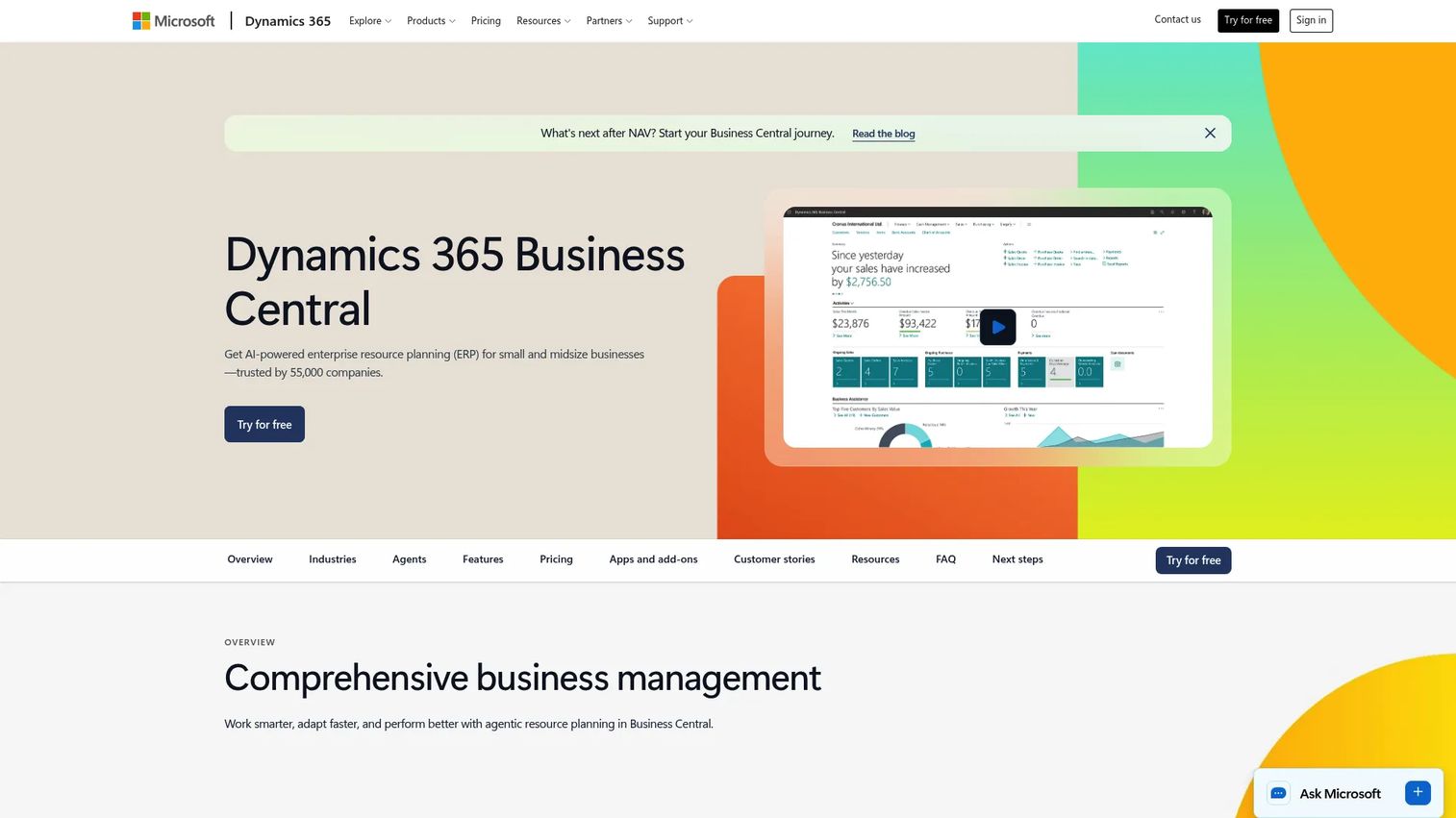
Microsoft Dynamics 365 Business Central is AI-powered ERP software for small and mid-sized businesses. It covers finance, sales, purchasing, inventory, project management, and manufacturing, with native integration into the full Microsoft stack. For companies already running on Microsoft 365, the adoption curve is shorter because teams work in familiar tools: Outlook, Excel, Teams, and Power BI. Business Central includes Microsoft Copilot for automated workflows and AI-assisted tasks.
Best for: Microsoft-first small and mid-sized businesses that want ERP integrated into familiar work tools.
Key features
- Financial management and accounting
- Inventory and supply chain tracking
- Project accounting and service management
- Microsoft 365, Teams, and Excel integration
- Power BI reporting and dashboards
Why choose Microsoft Dynamics 365 Business Central: If your team already lives in Microsoft tools, Business Central reduces the friction of ERP adoption. The transition is not effortless, but the interface is familiar. It is a strong starting point for companies that want ERP without leaving their existing software environment.
Microsoft Dynamics 365 Business Central pricing: Essentials plan is $80/user/month, billed yearly. Premium, which adds service management and manufacturing, is $110/user/month. Team Members, for limited access users, is $8/user/month. A 30-day free trial is available.
G2 rating: 4.0/5
4. Sage X3
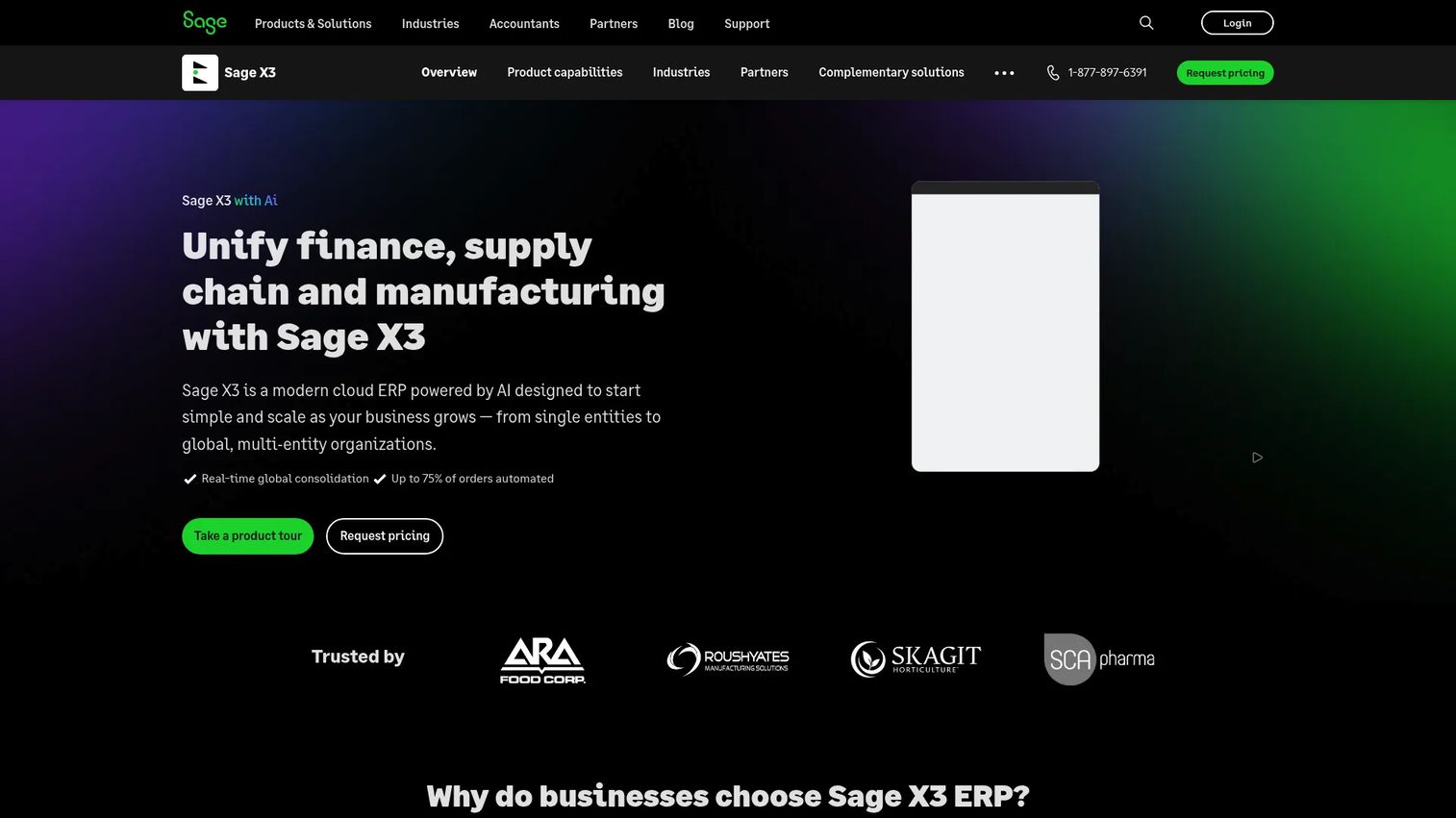
Sage X3 is an AI-powered cloud ERP platform built for mid-market manufacturers, distributors, and product-centric organizations. It covers financial management, supply chain, production, inventory, and multi-site or multi-country operations. Sage Copilot is embedded for conversational insights and accounts-payable automation. For founders managing physical goods, complex procurement cycles, or multi-currency operations across regions, Sage X3 provides controls that general-purpose accounting tools do not offer.
Best for: Mid-market manufacturers and distributors that need finance plus deep operations coverage.
Key features
- Financial management with multi-currency and multi-entity support
- Supply chain and procurement management
- Production and BOM planning with shop-floor control
- Inventory control and traceability
- Multi-site and multi-legislation operations
Why choose Sage X3: Sage X3 is a fit when the operational model centers on production, distribution, or inventory and finance needs to stay tightly connected to those workflows. It is less suited to pure-service businesses where manufacturing and supply chain features would go unused.
Sage X3 pricing: Request a quote directly; the price depends on user count, modules, deployment, number of sites, and implementation services. G2 reviewers describe it as a mid-market platform, with total investment typically reflecting the complexity of manufacturing and distribution operations.
G2 rating: 3.9/5
5. SYSPRO
SYSPRO is an industry-specific ERP platform for mid-sized manufacturers and distributors. It covers manufacturing operations management, inventory and warehouse control, supply chain execution, lot traceability, and financial management. SYSPRO is moving toward named-user subscriptions and supports cloud deployment alongside on-premises options. For founders whose business revolves around production planning, materials management, and distribution execution, SYSPRO provides the operational depth that horizontal ERP platforms often lack.
Best for: Manufacturers and distributors that need an industry-focused ERP for production, inventory, and supply chain.
Key features
- Manufacturing operations and production scheduling
- Inventory optimization and lot traceability
- Distribution and warehouse management
- Supply chain visibility and execution
- Financial controls and embedded analytics
Why choose SYSPRO: SYSPRO makes sense when production, materials, and distribution are the core operating model. If your company sells physical goods, manages complex inventory, or runs multi-step production workflows, SYSPRO is worth evaluating. For pure SaaS companies without supply chain complexity, the manufacturing depth goes underused.
SYSPRO pricing: The final cost depends on user count, module selection, deployment method, customization, and implementation partner work. Contact SYSPRO directly for a scoped quote.
G2 rating: 4.1/5
6. Odoo
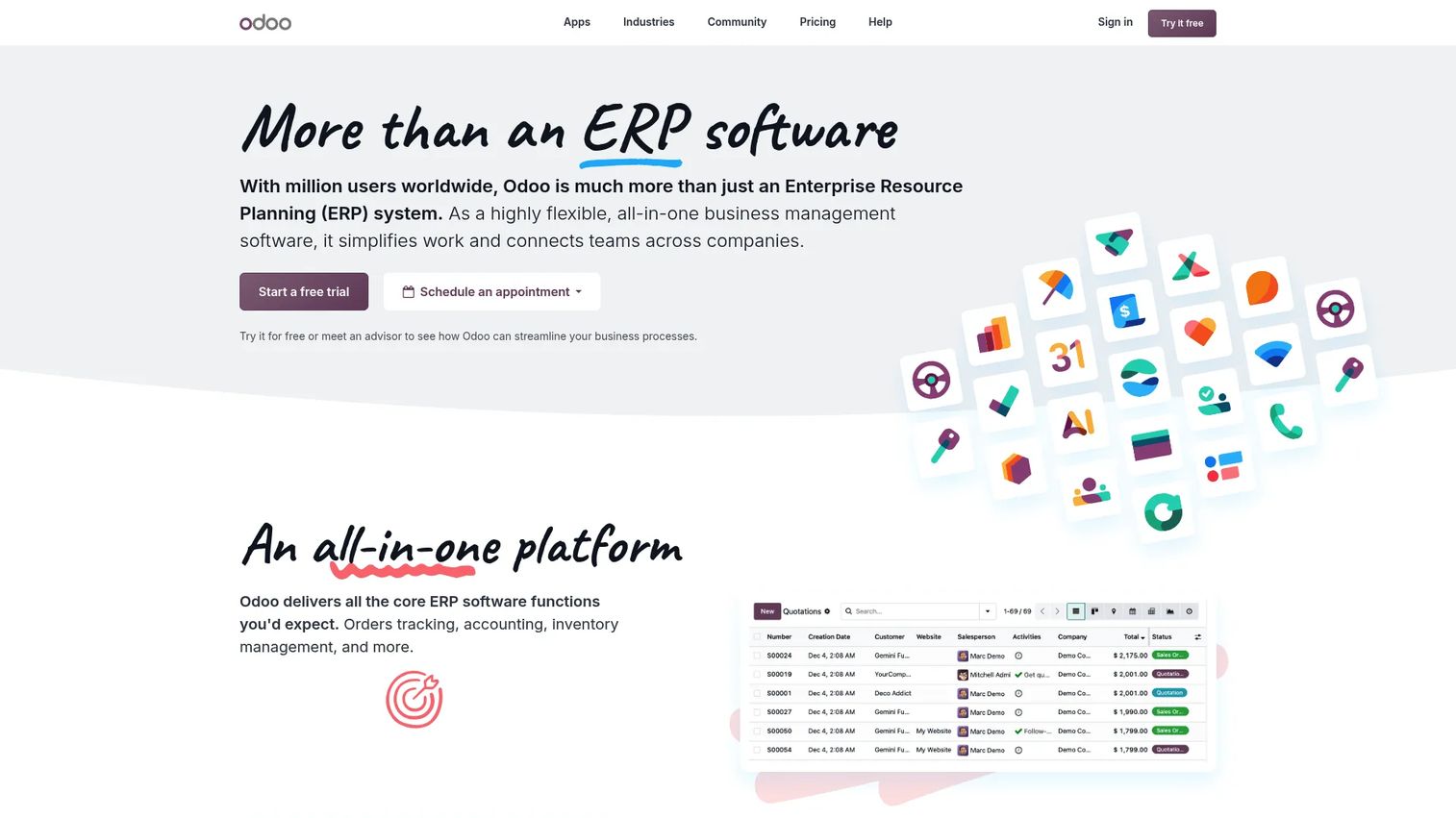
Odoo is an integrated suite of open-source business applications covering accounting software, CRM, sales, inventory, manufacturing, HR, project management, eCommerce, and marketing automation. Its modular architecture lets companies start with one app and add more over time. Odoo offers three deployment options: Odoo Online, Odoo.sh, and on-premises. The open-source foundation means a large ecosystem of community and enterprise apps, plus customization through Odoo Studio on paid plans.
Best for: Teams that want modular ERP coverage without committing to a full enterprise suite upfront.
Key features
- Modular business apps across accounting, CRM, inventory, and HR
- Accounting and invoicing
- Inventory and manufacturing management
- CRM and sales pipeline
- Studio customization and external API access (Custom plan)
Why choose Odoo: Odoo fits companies that want to grow their ERP footprint incrementally. The free single-app plan is a genuine starting point, not a lead magnet. The governance challenge comes with customization: Each module added and each Studio change requires someone to own the configuration as the product evolves.
Odoo pricing: One App Free plan covers one app with unlimited users. Standard plan is $24.90/user/month, billed yearly, covering all Odoo Online apps. Custom plan is $49/user/month, billed yearly, adding Odoo.sh or on-premises deployment, Studio, agentic AI, multi-company support, and external API access.
G2 rating: 4.2/5
7. QT9 ERP
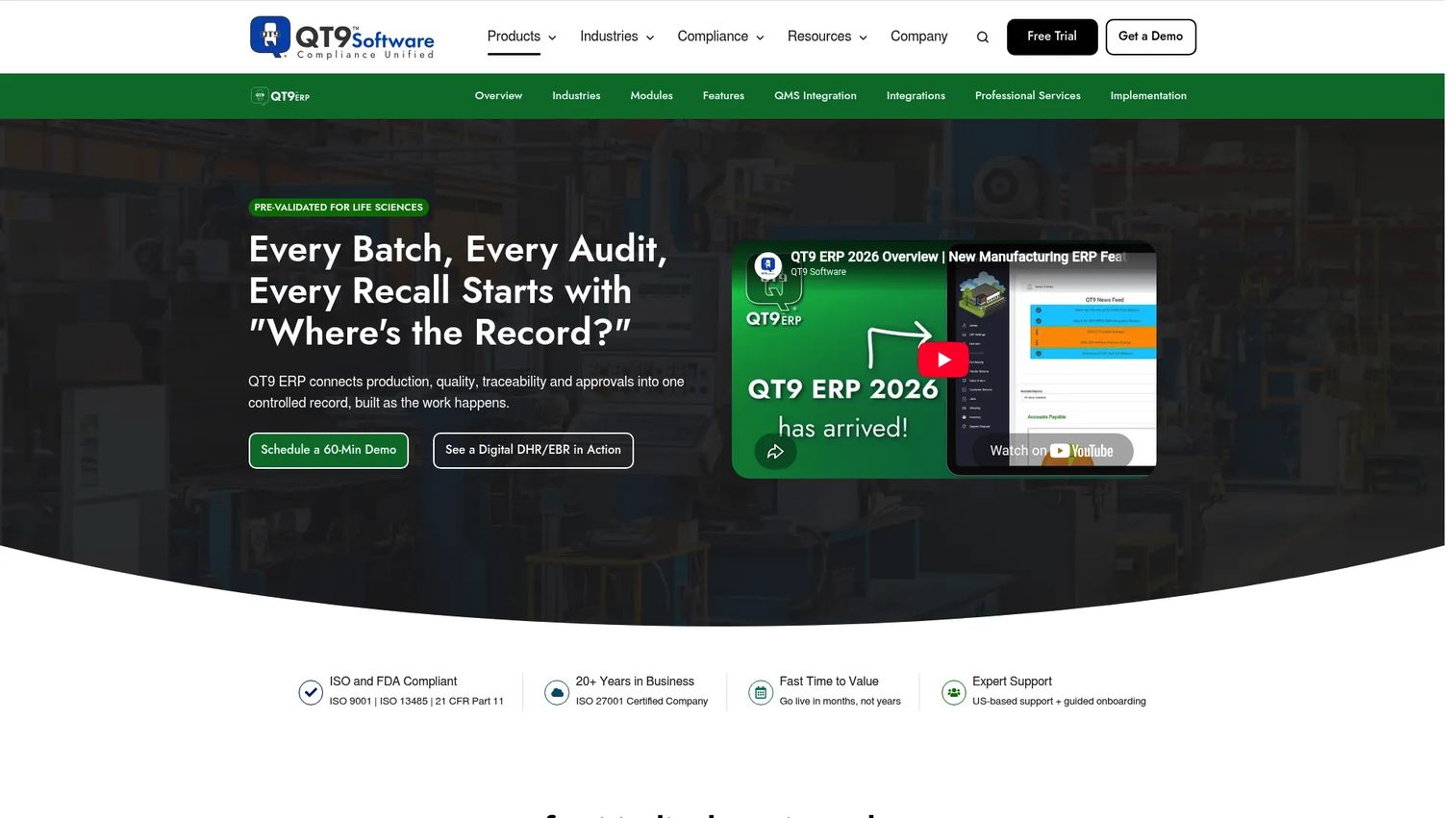
QT9 ERP is cloud-based ERP software for manufacturers and regulated industries, integrating production, inventory, purchasing, accounting, traceability, and quality management in one platform. Its native integration with QT9 QMS means quality processes connect directly to production workflows. For regulated manufacturers in medical devices, pharmaceuticals, life sciences, or aerospace, QT9 combines an ERP system with the quality infrastructure those industries require without bolting on a separate QMS.
Best for: Regulated manufacturers and life sciences teams that need ERP and quality management under one platform.
Key features
- Production and job management
- Inventory and warehouse control with lot and serial traceability
- Purchasing and material requirements planning
- Native QT9 QMS integration for quality management
- Pre-validation with IQ/OQ/PQ documentation for regulated environments
Why choose QT9 ERP: QT9 is purpose-built for buyers where compliance and traceability are operational requirements, not optional features. If your ERP evaluation includes nonconformance workflows, audit trails, or FDA-regulated production, QT9 addresses those needs without requiring a separate quality platform alongside it.
QT9 ERP pricing: The cost depends on user roles, modules required, integrations, and deployment configuration. A free trial is offered. Contact QT9 for a scoped quote.
G2 rating: 4.9/5
8. Striven
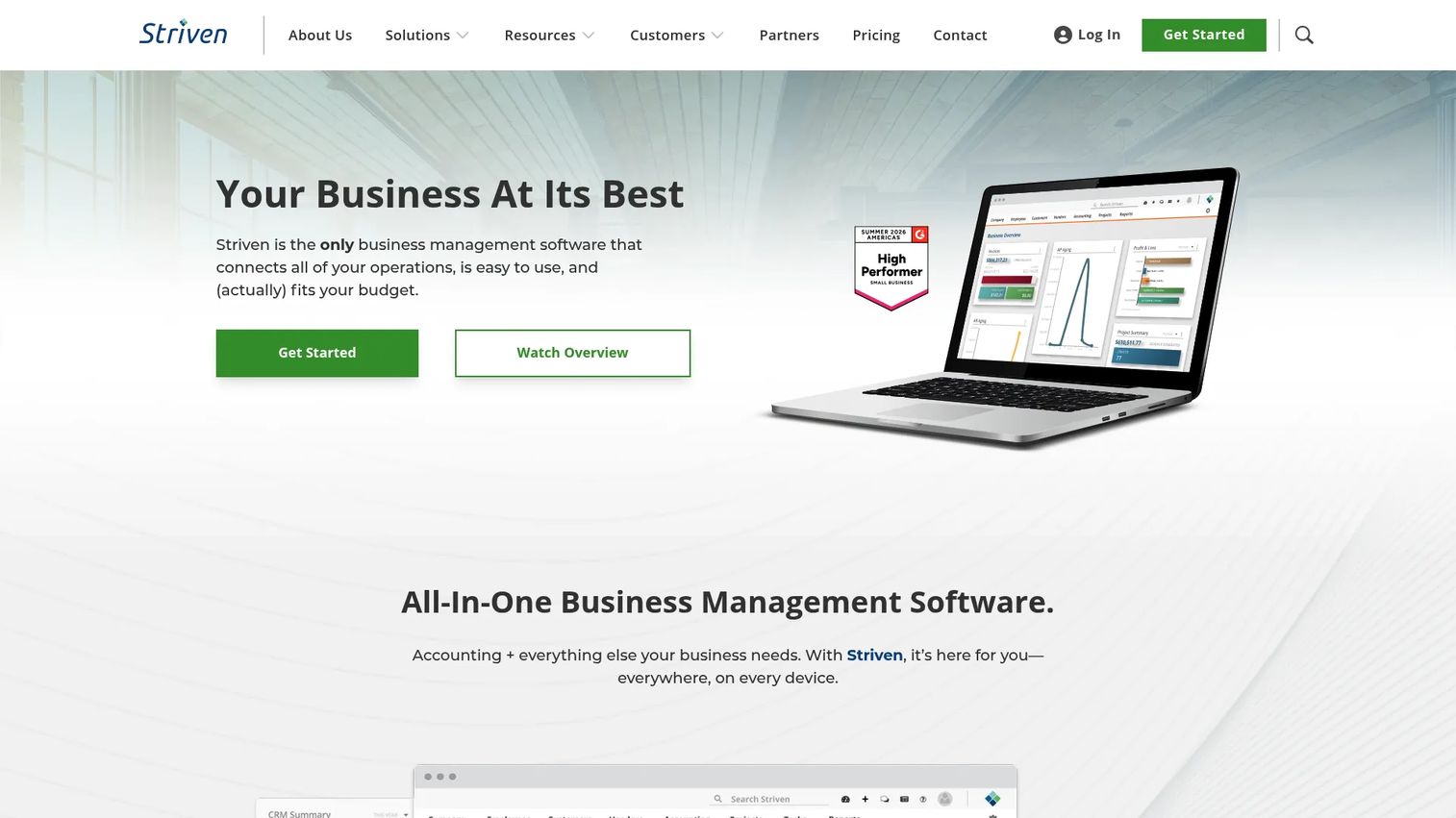
Striven is an all-in-one business management platform for small and mid-sized companies. It combines accounting, CRM, inventory and supply chain management, project management, HR, workflow automation, and reporting. For founders looking to consolidate three or four disconnected tools into a single operating environment without buying an enterprise ERP, Striven sits in a practical middle ground. Its account management software approach covers both customer-facing and back-office workflows.
Best for: Smaller teams replacing several disconnected operations tools with one integrated platform.
Key features
- Accounting and financial management
- CRM and sales workflows
- Inventory and supply chain tracking
- Project management
- HR and workflow automation
Why choose Striven: Striven fits companies that need operational consolidation but are not ready for the implementation overhead of a full enterprise ERP. For a 20 to 80 person business replacing a mix of QuickBooks, a CRM, and project management tools, Striven reduces tool sprawl without overbuying.
Striven pricing: Striven's pricing page requires direct contact for plan details. Reach out to their team for current pricing by user count and module scope.
G2 rating: 4.5/5
9. 24SevenOffice ERP
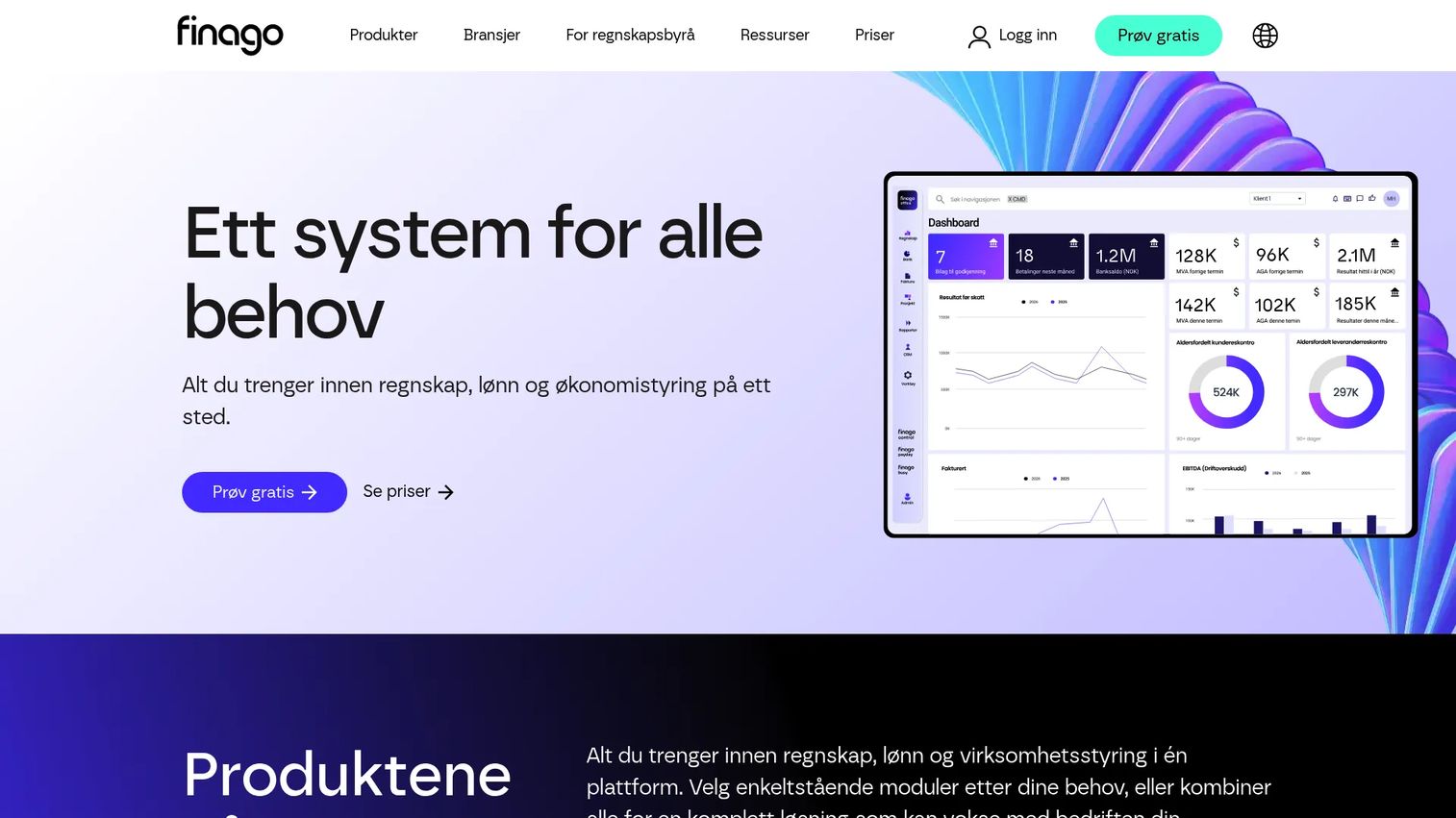
24SevenOffice ERP is a cloud business-management platform covering accounting, payroll, invoicing, time tracking, project management, CRM, and reporting. The platform currently operates as Finago in Norway, where its pricing and product pages are hosted. It offers a 30-day free trial and tiered plans in Norwegian kroner. For Nordic or European businesses that need cloud ERP with strong accounting, payroll, and project operations, 24SevenOffice provides an integrated alternative to assembling separate tools for each function.
Best for: Businesses, particularly in Nordic and European markets, that want cloud ERP with accounting, payroll, and project operations in one place.
Key features
- Accounting and financial administration
- Invoice processing and billing
- Payroll management
- Time tracking and project management
- CRM and third-party integrations
Why choose 24SevenOffice ERP: The platform is a practical fit for companies that need finance, payroll, and project billing to work together without maintaining separate systems. Geographic fit matters: Its strongest customer base and support infrastructure are Nordic-focused, so evaluate regional support availability before committing.
24SevenOffice ERP pricing: Mikro plan starts from 71 kr/month. Komplett plan is 289 kr/month. Additional client packages start from 659 kr/month. All prices exclude VAT. A 30-day free trial is available.
G2 rating: 4.1/5
Considerations when choosing ERP software
Match ERP scope to the business you are becoming
The temptation is to buy for today's pain and hope the system scales. For a Series B company, the more useful question is: What will finance, entity structure, revenue model, and procurement look like in 24 months? Buying ERP that fits now but requires replacement in 18 months costs more than selecting for a slightly longer horizon.
Price the implementation, not just the subscription
ERP total cost of ownership includes data migration, partner services, internal process redesign, training, integrations, and ongoing administration. Many teams sign contracts based on per-seat pricing and are surprised by the partner fees. Get a full project estimate from the implementation partner before signing the vendor agreement.
Decide how much customization you can support
Configuration, changing settings within the platform's existing options, is manageable. Customization, writing code or modifying the platform's core behavior, adds maintenance burden and can slow upgrades. Know which workflows genuinely need custom code and which can be adapted to standard ERP processes.
Check integrations with your operating stack
For SaaS founders, the critical integrations are CRM, billing, revenue recognition, payroll, and board reporting. Confirm that the ERP connects to your existing tools, whether HubSpot, Salesforce, or a billing platform, through supported connectors rather than manual exports. See also our guide to advanced planning and scheduling software for supply chain integration context.
Assign an internal owner before signing
ERP implementations that drift or fail usually share one characteristic: Nobody owned the operating model inside the company. Define an executive sponsor, a finance owner responsible for data accuracy, a technical admin, and a named implementation lead before the project starts. Without that structure, vendor onboarding alone does not drive adoption.
Conclusion
The right ERP system is not the one with the most features. It is the one your leadership team will actually use to run the business.
For scaling SaaS and service companies, Oracle NetSuite provides the broadest cloud ERP coverage, from multi-entity finance to revenue recognition. SAP S/4HANA Cloud handles global enterprise complexity but requires a mature implementation team to get the value. Microsoft Dynamics 365 Business Central is the clearest choice for companies already committed to the Microsoft stack, with transparent pricing starting at $80/user/month.
For manufacturing and distribution, Sage X3 and SYSPRO both cover production, inventory, and supply chain in depth. QT9 ERP adds quality management for regulated industries, with a 4.9/5 G2 rating earned from exactly that audience. Odoo gives modular flexibility at a price point accessible to growing teams.
For smaller companies consolidating tools, Striven and 24SevenOffice ERP offer integrated operations without the overhead of an enterprise rollout.
Do not buy ERP because the category feels inevitable. Buy it when the cost of fragmented data is higher than the cost of implementing a system properly. That moment is different for every company, but once your board prep requires more than two working days of manual reconciliation, the math has usually shifted.
For teams looking at the broader software stack alongside ERP, see also our guides to accounting practice management software, budgeting and forecasting software, and best revenue operations software.
FAQs
ERP software, short for enterprise resource planning software, is a business management system that connects finance, accounting, procurement, inventory, manufacturing, HR, and reporting through a shared database. Instead of each department maintaining its own records, all functions draw from and write to the same data model. The result is consistent numbers across the organization without manual reconciliation between systems.
Accounting software manages financial transactions: Invoicing, payments, general ledger, and financial statements. ERP connects accounting to the rest of the operating model, including sales orders, procurement, inventory, project delivery, and HR. If your margin calculation depends on knowing production costs, supplier terms, and inventory movements, accounting software alone does not provide the full picture.
There is no universal answer, but the key criteria are revenue recognition, multi-entity support, CRM or billing integrations, and reporting depth. Oracle NetSuite is a strong fit for SaaS companies approaching $5M to $50M ARR that need a finance-first operating system. Microsoft Dynamics 365 Business Central is worth evaluating if the team already runs on Microsoft tools and wants a faster adoption curve.
ERP pricing varies considerably. Microsoft Dynamics 365 Business Central starts at $80/user/month for the Essentials plan, while Odoo Standard runs $24.90/user/month. Oracle NetSuite, SAP S/4HANA Cloud, Sage X3, and SYSPRO all require direct quotes. The subscription fee is only part of the total cost of ownership. Data migration, implementation partner fees, integrations, training, and ongoing administration often equal or exceed the first year of subscription costs.
Implementation length depends on module count, data quality, integrations required, degree of customization, and internal decision speed. Smaller deployments with limited customization can go live in a few months. Complex multi-entity or multi-site rollouts commonly take 9 to 18 months. Setting a realistic timeline with your implementation partner before the project starts reduces the risk of cost overruns.
Standard ERP modules include financial management and accounting, procurement and vendor management, inventory and warehouse management, manufacturing and production planning, supply chain management, CRM and order management, HR and workforce management, reporting and analytics, and compliance and audit controls. Not every business needs all of them. Start by identifying which operational areas produce the most data fragmentation today.
Cloud ERP is hosted by the vendor or a cloud provider and accessed through a browser, with no on-premises server infrastructure required. Updates are managed by the vendor, which reduces IT maintenance burden. Data migration and process redesign still require significant planning, but the infrastructure question is simpler than with on-premises deployments. Most major ERP platforms, including NetSuite, SAP S/4HANA Cloud, and Business Central, now offer cloud-first or cloud-only options.
The clearest signals are slow board reporting, duplicate data entry across departments, conflicting metrics between finance and operations, manual revenue or inventory reconciliation, broken approval workflows, and leadership decisions delayed because nobody has clean data. If your head of finance spends more than two days per month reconciling numbers that should already be in one place, the cost of that manual work is probably higher than the cost of an ERP system sized for your stage.