A digital banking launch rarely breaks because the team cannot design a mobile dashboard. It breaks when account opening stalls, money movement fails silently, business entitlements are missing, or fraud controls and core data don't behave as one product.
The market for digital banking software is broad, and that breadth creates a real evaluation problem. You are not choosing between equivalent tools. You're choosing between platform categories that solve different layers of the same stack: The customer experience layer, the core ledger, banking workflow infrastructure, and low code development environments for teams that want to build their own experience. Picking the wrong category means a two-year rebuild.
This guide cuts through that confusion. It profiles 12 digital banking platform providers, separates what each one actually replaces, and gives you the decision criteria that hold up in a board conversation or a diligence review.
What's inside
This guide is for founders, fintech product leads, and banking technology executives narrowing a vendor list before procurement. Platforms were selected based on:
- Coverage across consumer digital banking and business digital banking
- Core banking integration depth and API maturity
- Architecture fit for engagement-layer, core-replacement, and build-your-own motions
- Implementation reality: Services model, migration ownership, and internal staffing requirements
You'll also find a comparison table, per-platform profiles, a buyer's checklist, and FAQs covering digital banking platform pricing and implementation timelines.
TL;DR
- Best enterprise digital engagement layer: Backbase AI Native Banking OS, for institutions orchestrating customer journeys across existing cores and systems
- Best broad banking suite: Temenos Digital Engagement Solution, for banks that want channel and suite coverage in one vendor relationship
- Best for configurable retail and corporate banking: Finacle Digital Engagement Suite, strong across complex product catalogues and multi-market operations
- Best for U.S. community and regional institutions: Jack Henry Banno or Apiture, both built for the community bank and credit union operating model
- Best cloud-native core banking: Mambu, for fintechs and banks that want to build on a composable API-first core
The right pick depends on whether you need a customer experience layer, a core banking replacement, workflow infrastructure, or a low code platform to build custom banking applications.
What are digital banking platforms?
A digital banking platform is software that lets financial institutions or fintech companies deliver banking services through web and mobile channels, including account access, payments, onboarding, service workflows, and personalized financial experiences.
What digital banking platforms typically include
- Online and mobile banking interfaces for consumer and business customers
- Account management, payments, transfers, card controls, and bill pay
- Digital account opening and identity verification workflows
- Authentication, fraud controls, and entitlement management
- Core banking, CRM, and fintech partner integrations
- APIs, workflow automation, and developer tools for configuration
- Analytics, personalization, and financial wellness features
Digital engagement platform vs. core banking platform
Many buyers conflate these categories. The distinction determines your integration architecture, your implementation program, and how much engineering capacity you commit for the next several years.
| Platform type | Primary job | Typical buyer | Examples in this article |
|---|---|---|---|
| Digital engagement platform | Delivers web and mobile banking experiences | Bank or fintech product team | Backbase, Temenos, Finacle |
| Core banking platform | Runs accounts, products, transactions, and ledger | Bank modernization team | Mambu |
| Community banking platform | Channel experiences for regional institutions | Community banks and credit unions | Jack Henry Banno, Apiture |
| Banking workflow platform | Onboarding, lending, and operating model | Operations and transformation teams | nCino |
| Low code banking platform | Configurable banking app development | Digital product and engineering teams | Veritran |
Many vendors span categories, but you must identify the primary job first. A polished mobile interface cannot replace a ledger. A cloud core does not automatically deliver a finished consumer banking experience.
When to use a digital banking platform
Launch consumer and business banking without building every channel layer
When a bank or fintech needs web and mobile banking, onboarding, money movement, financial wellness, and self-service support in one coordinated experience, a digital engagement platform handles that scope. This is the right motion when you want a production-ready channel experience without assembling every component individually.
Replace fragmented digital channels around an existing core
The engagement-layer use case keeps the existing core in place while replacing outdated digital experiences. Institutions choose this path to add personalization, business banking capability, or modern APIs without a full core replacement. The critical question is whether the existing core's API surface can support the new experience layer.
Build a new banking product with API-first infrastructure
Fintechs and banks launching differentiated products often need configurable infrastructure rather than a packaged experience. The platform must support rapid product configuration, third-party fintech connections, and an architecture that evolves as product requirements change. Do not select a full core replacement when the problem is only channel experience.
Digital banking platform comparison
The table below is a shortlist for evaluation, not a final procurement recommendation. Pricing across this category is enterprise and quote-based. Verify G2 ratings directly before publication, as review counts on some platforms are low.
| # | Product | Best for | Key differentiator | Pricing | G2 rating |
|---|---|---|---|---|---|
| 1 | Backbase AI Native Banking OS | Enterprise engagement modernization | AI-native OS coordinating customers, employees, and agents | Custom quote | 4.3/5 |
| 2 | Temenos Digital Engagement Solution | Broad banking suite coverage | Omnichannel channels tied to full Temenos banking suite | Custom quote | 4.5/5 |
| 3 | Finacle Digital Engagement Suite | Retail and corporate digital transformation | 4,500+ pre-configured features across banking segments | Custom quote | 4.1/5 |
| 4 | Jack Henry Banno | U.S. community banks and credit unions | API-first platform tied to Jack Henry's ecosystem | Custom quote | 4.5/5 |
| 5 | Apiture | Community financial institutions | Account opening, data intelligence, and fintech connectivity | Custom quote | Not listed |
| 6 | nCino Cloud Banking Platform | Banking workflow and lending operations | Onboarding, lending, and portfolio management on the cloud | Custom quote | 4.2/5 |
| 7 | FIS Digital One | Large institutions with broad digital needs | Omnichannel consumer and business banking at scale | Custom quote | 4.2/5 |
| 8 | Candescent Digital Banking Platform | Digital channel modernization | Unified consumer, business, and account-opening platform | Custom quote | Not listed |
| 9 | Mambu | Fintechs building cloud-native products | API-driven composable core banking | Custom quote | 3.8/5 |
| 10 | Oracle Banking Digital Experience | Oracle-aligned banking environments | SaaS digital banking across retail, corporate, and SMB | Custom quote | 4.2/5 |
| 11 | ebankIT Omnichannel Platform | Unified omnichannel banking journeys | Low-code configuration across digital and assisted channels | Custom quote | Not listed |
| 12 | Veritran Low Code Platform | Custom digital banking app development | Low-code omnichannel development with built-in security | Custom quote | Not listed |
G2 ratings verified from live listings. "Not listed" reflects no current verified rating for that specific product on G2.
Best 12 digital banking platforms for 2026
1. Backbase AI Native Banking OS
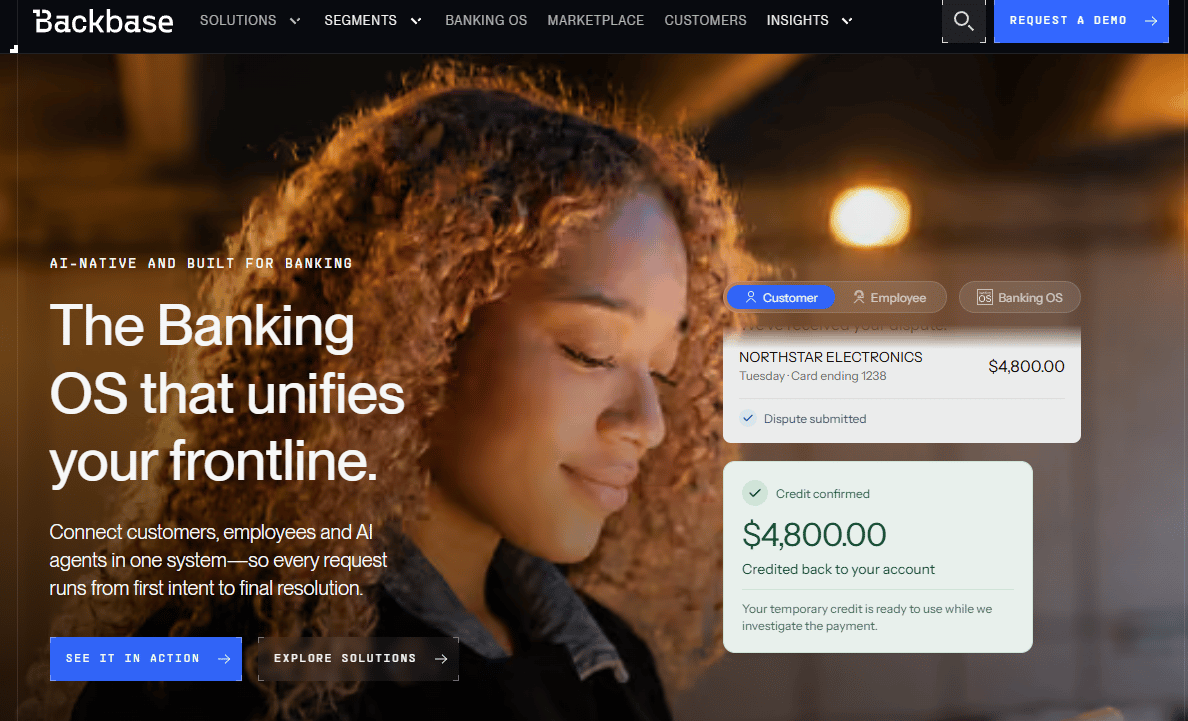
Backbase positions its AI Native Banking OS as a coordination layer across customers, employees, and AI agents, sitting on top of existing cores, CRMs, payment rails, and risk systems. The platform uses a shared customer context layer called Nexus and a governance layer called Sentinel to manage approvals and authority across the organization.
Best for: Enterprise banks and financial institutions rebuilding digital engagement without replacing the core.
Key features
- Shared customer context via Nexus across all channels and systems
- Governed authority and approval controls via Sentinel
- Multi-agent workflow orchestration across banking systems
- AI signals, recommendations, and continuous learning capabilities
- Connectivity to cores, CRMs, payments, risk systems, and fintech services
Why choose Backbase: It belongs on the shortlist when you need more than a mobile banking reskin, specifically when the goal is coordinated frontline operations across a complex existing technology estate. Evaluation must account for enterprise implementation scope and program resources.
Backbase pricing: Backbase sells through enterprise contracts with custom quote pricing. Pricing details are not posted on the vendor's website; request a scoping conversation to understand module, user, and implementation cost drivers.
Backbase holds a 4.3/5 rating on G2, based on 10 reviews.
2. Temenos Digital Engagement Solution
Temenos is a large banking technology provider with digital engagement products that operate alongside its broader suite, covering retail banking journeys, business banking capabilities, digital onboarding, and real-time personalization across web, mobile, wearables, conversational interfaces, and branches.
Best for: Banks seeking digital channel coverage tied to a wider Temenos banking technology estate.
Key features
- Omnichannel delivery across mobile, web, wearables, and branch
- Digital onboarding and origination workflows
- Real-time personalized campaigns and cross-sell engagement
- Retail and business banking journeys
- Suite integration with Temenos banking products
Why choose Temenos: The platform suits large institutions looking for suite alignment, broad geographic support, and a single vendor relationship spanning digital channels and the underlying banking stack. Evaluate whether your institution already operates in the Temenos environment or is migrating toward it.
Temenos pricing: Temenos uses enterprise contract pricing, with no figures published on the product pages. Contact the vendor to understand module packaging, regional availability, and managed service options.
Temenos holds a 4.5/5 rating on G2.
3. Finacle Digital Engagement Suite
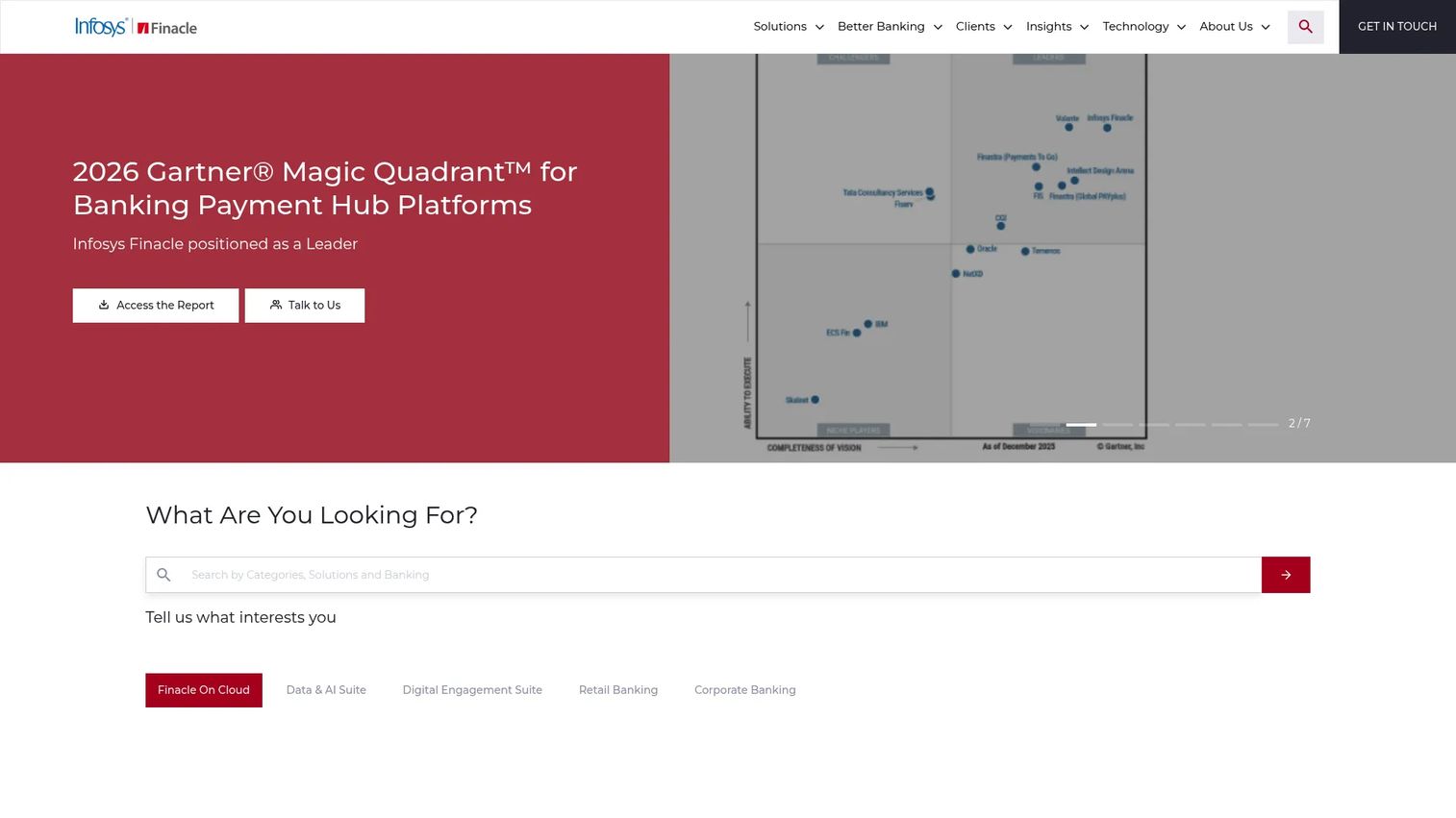
Finacle offers a cloud-native omnichannel digital banking platform covering onboarding, selling, servicing, and engaging customers across retail, wealth, SME, and corporate segments. Its catalog covers more than 4,500 pre-configured features, and the platform uses a composable, headless architecture with low-code and no-code tooling for configuration.
Best for: Banks that need configurable digital banking experiences across retail and corporate segments, particularly in multi-market operating models.
Key features
- GenAI-powered UX Experience Studio for interface configuration
- Hyper-personalized omnichannel journeys across mobile, web, and branch
- Composable, headless architecture with low-code and no-code tools
- 4,500+ pre-configured features across retail, SME, wealth, and corporate banking
- Open APIs and Finacle App Center ecosystem for fintech connectivity
Why choose Finacle: It fits institutions with complex product catalogues, corporate banking requirements, or operations across multiple countries. The breadth of pre-configured features reduces custom development, but implementation requires planning for configuration, integration, and rollout.
Finacle pricing: Finacle's website does not post pricing. The vendor supports both software license and SaaS commercial models. Contact Finacle's sales team to understand country-specific availability and deployment options.
Finacle holds a 4.1/5 rating on G2.
4. Jack Henry Banno
Jack Henry Banno is a cloud-native, API-enabled digital banking platform for community banks and credit unions in the United States. It covers consumer banking, small-business banking, and commercial accounts, with money movement tools, connected account experiences, financial wellness features, and secure digital conversations including authenticated chat, video chat, and screen sharing.
Best for: U.S. community banks and credit unions that want digital banking closely integrated with the Jack Henry operating environment.
Key features
- Online and mobile banking for retail, small-business, and commercial accounts
- Open API-first architecture with fintech partner integrations
- Business banking entitlements, treasury management, and payment workflows
- Secure digital conversations: Authenticated chat, video, and screen sharing
- Fraud controls including account-takeover prevention and transaction monitoring
Why choose Jack Henry Banno: Ecosystem fit matters here. Banno is strongest when the institution already values the Jack Henry operating model and wants consumer and business channel capabilities within a familiar support structure. Evaluate it first if your core processing relationship is already with Jack Henry.
Jack Henry Banno pricing: Jack Henry directs prospects to request a demo or contact the company directly. Pricing is not posted on the product pages; costs vary by institution size, processing relationship, selected modules, and support model.
Jack Henry Banno holds a 4.5/5 rating on G2, based on 2 reviews.
5. Apiture
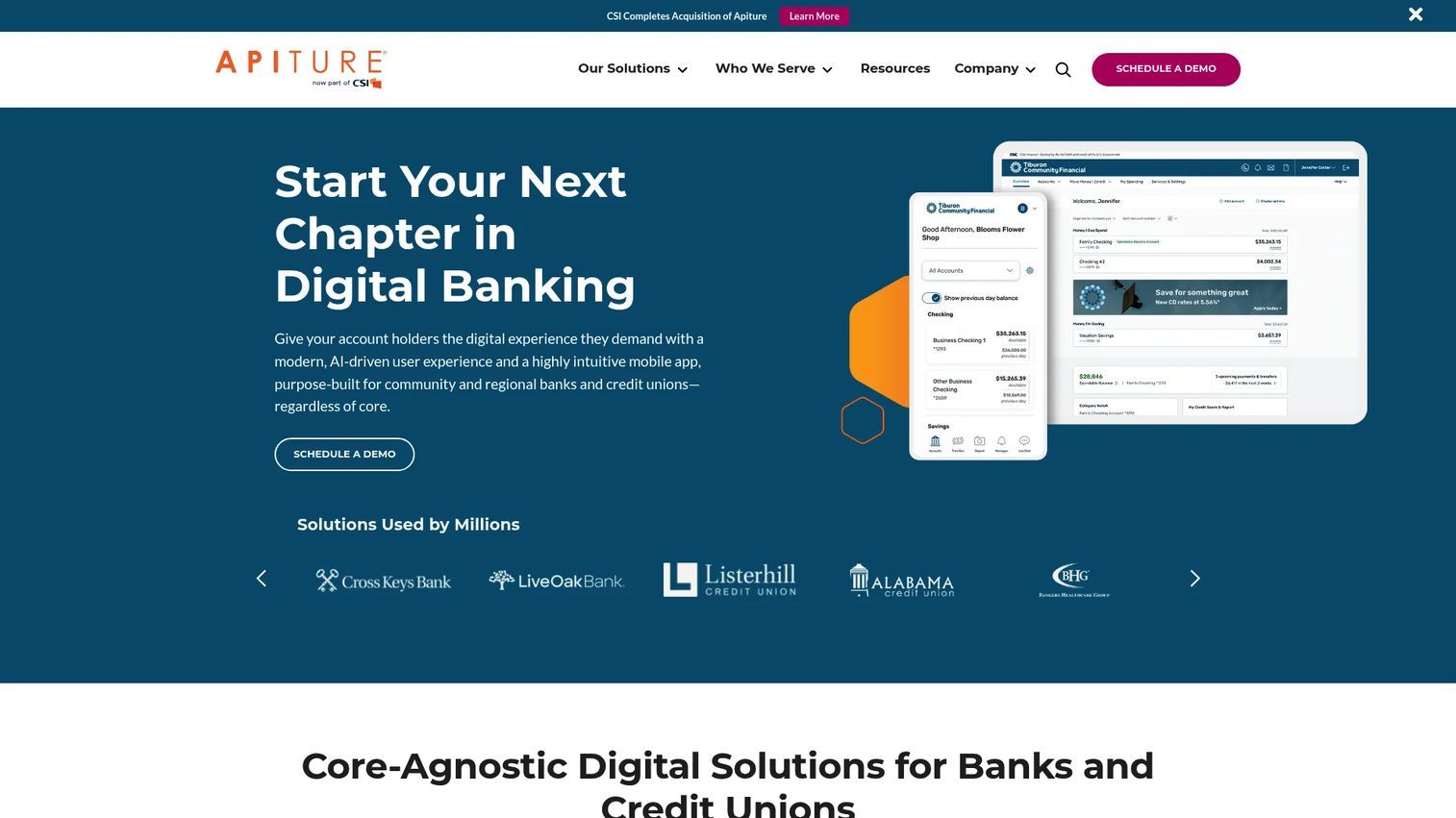
Apiture delivers AI-driven digital banking for community and regional banks and credit unions, covering consumer banking, business banking with cash management and real-time payments, digital account opening with identity verification and application decisioning, API banking for embedded banking components, and data intelligence tools.
Best for: Community financial institutions that need modern digital banking and a practical integration path without a large enterprise transformation program.
Key features
- Consumer banking: Web, mobile, financial wellness, bill pay, and P2P payments
- Business banking: Cash management, fraud prevention, and real-time payments
- Digital account opening with identity verification and external-account funding
- API banking with embedded components, events, and banking APIs
- Data intelligence tools: Data Portal, Data Engage, and Data Direct
Why choose Apiture: It is a credible shortlist candidate for community institutions that need digital account opening and fintech connectivity without the implementation complexity of a global universal banking suite. Validate integration architecture against your current core environment.
Apiture pricing: Apiture does not post pricing on its website. Request a quote to understand implementation fees, product module packaging, and ongoing subscription terms.
Apiture does not have a current verified G2 rating for this product.
6. nCino Cloud Banking Platform
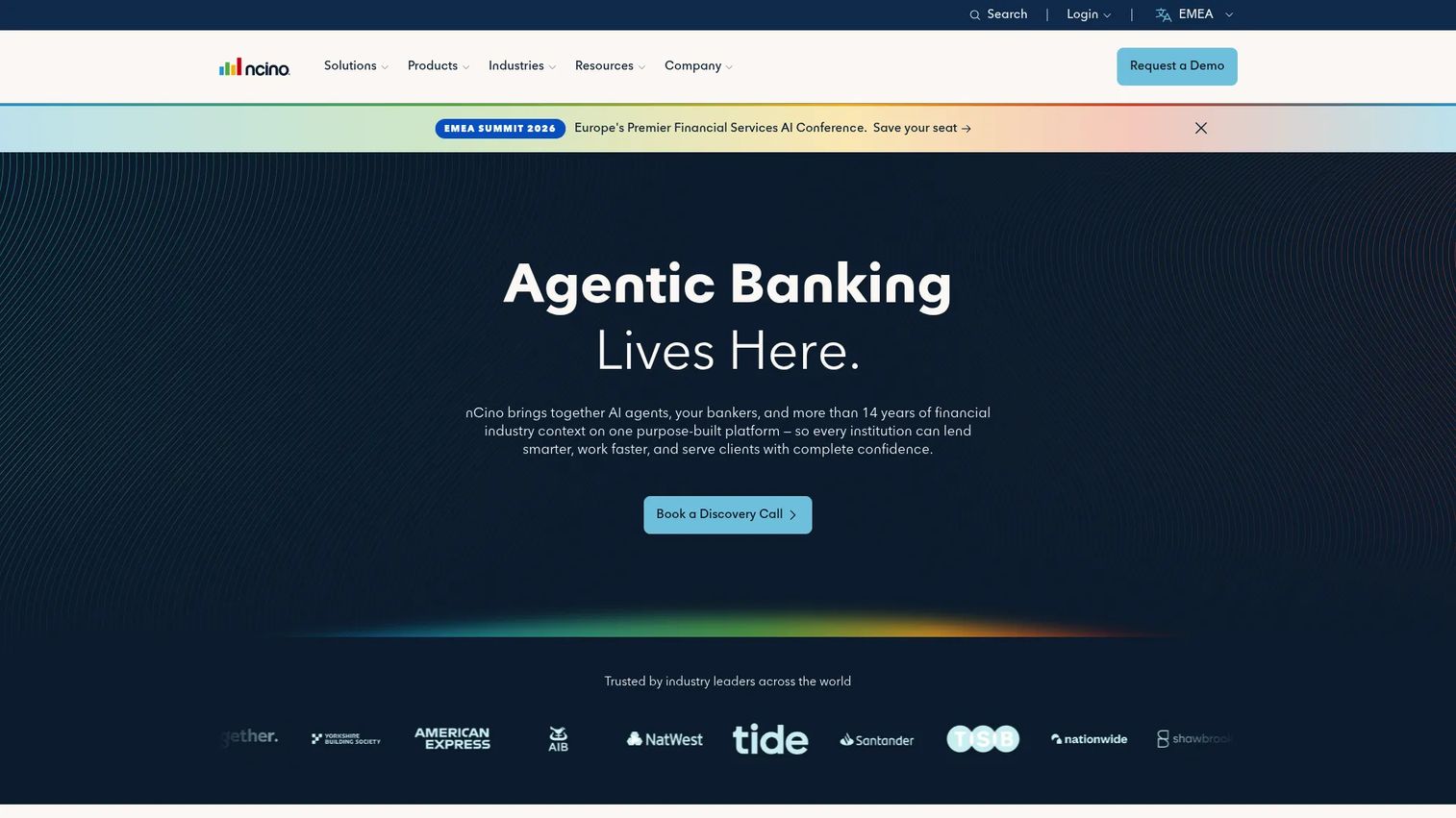
nCino is more workflow and operating model oriented than a conventional consumer digital banking front end. Its platform handles commercial and consumer loan origination, underwriting, pricing, compliance, and portfolio monitoring, alongside digital account opening, KYC/KYB workflows, customer lifecycle management, and real-time risk monitoring.
Best for: Financial institutions that need to standardize lending operations, banking workflows, and onboarding processes rather than deliver a consumer channel experience.
Key features
- Commercial and consumer loan origination, underwriting, and pricing
- Digital account opening with KYC and KYB workflows
- Real-time risk monitoring, covenant testing, and portfolio analytics
- Integration Gateway connecting cores, credit bureaus, and fintech platforms
- AI capabilities including Banking Advisor, automated spreading, and operational analytics
Why choose nCino: Evaluate nCino alongside, not instead of, a channel experience platform. It is the right choice for operating workflow modernization, lending infrastructure, and onboarding standardization. Confirm Salesforce dependencies where relevant to your existing stack.
nCino pricing: nCino describes subscription pricing based on deployed products, with some offerings priced by assets, transaction volumes, or Intelligence Units. Pricing is not published numerically; contact the sales team to scope by product module and volume.
nCino holds a 4.2/5 rating on G2, based on 14 reviews.
7. FIS Digital One
FIS Digital One is a configurable omnichannel digital banking platform for financial institutions, supporting retail banking, business banking, and banker-assisted servicing experiences. The platform uses a low-code development environment, open API architecture, and single integrated channel delivery.
Best for: Large financial institutions that require broad digital banking functionality across consumer and business customers, with complex integration requirements.
Key features
- Single integrated omnichannel platform across customer and employee channels
- Low-code development and configurable user experiences
- Open API architecture with third-party integrations
- Business banking payments, reporting, and entitlements
- Digital account opening and banker-assisted servicing
Why choose FIS Digital One: Position it for established institutions that need scale, breadth, and integration depth within an existing FIS relationship or a complex multi-system environment. Evaluation must focus on implementation services, roadmap governance, and institution-specific configuration requirements.
FIS Digital One pricing: FIS directs prospective customers to contact sales or request pricing directly. Pricing is not published on the product pages; ask vendors to separate recurring software fees from implementation and service program costs.
FIS holds a 4.2/5 rating on G2.
8. Candescent Digital Banking Platform
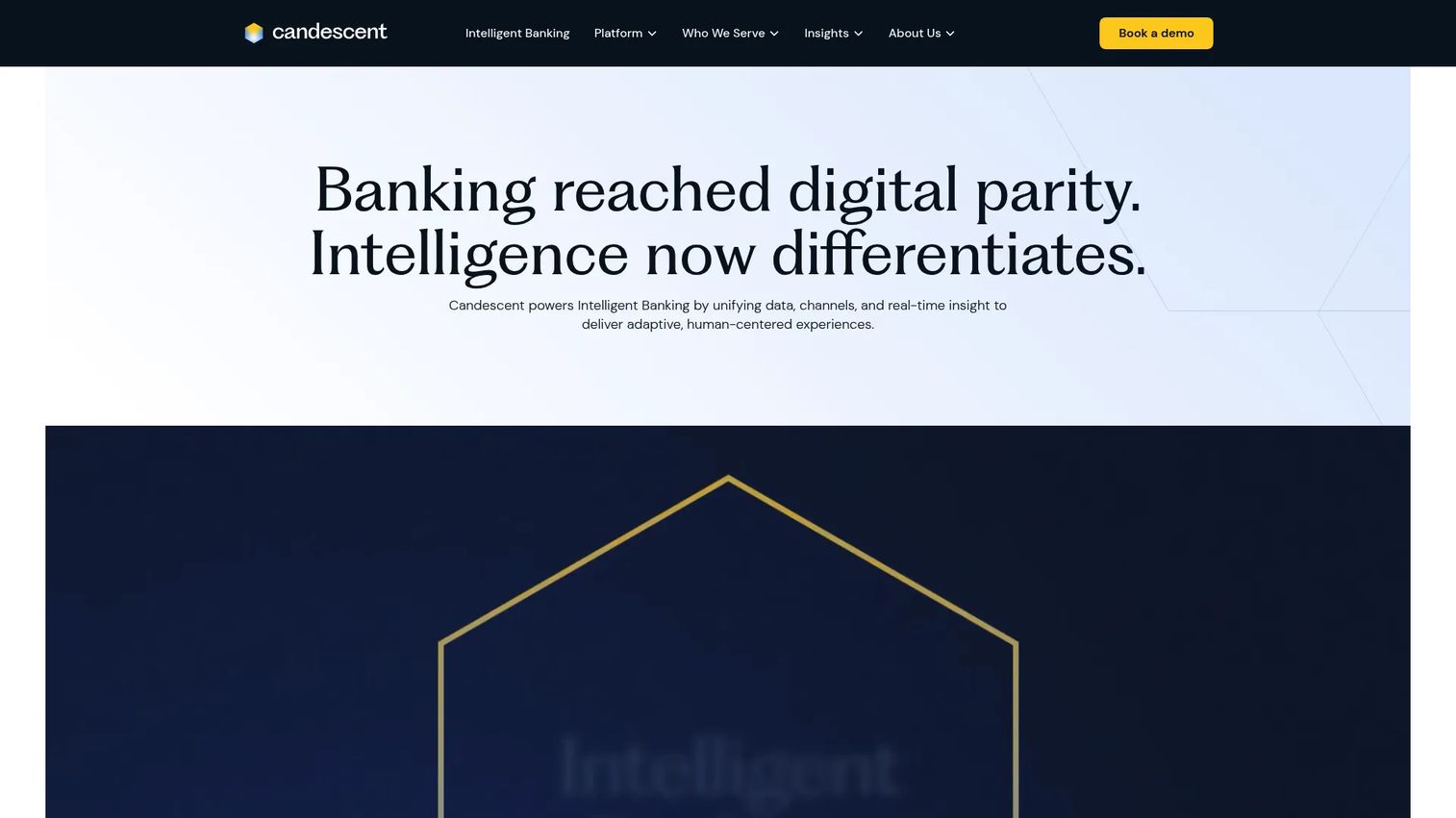
Candescent is a cloud-native digital banking platform for banks and credit unions, covering consumer banking, business banking with ACH, wire, and real-time payment orchestration, digital account opening with document capture and fraud checks, and AI-powered data intelligence and personalization.
Best for: Banks and credit unions evaluating dedicated digital channel modernization with extensible integration architecture.
Key features
- Consumer banking across mobile, web, and assisted channels
- Business banking: Payment orchestration, approvals, controls, and automation
- Digital account opening with document capture and fraud checks
- Open APIs, SDKs, microservices, and pre-built integrations
- AI-powered intelligence, personalization, and next-best-action recommendations
Why choose Candescent: It belongs on the shortlist for institutions running a channel modernization program that needs consumer and business banking in one platform. Verify target market fit, deployment model, and available fintech integrations before committing.
Candescent pricing: Candescent does not post pricing on its website. Contact the vendor to understand whether fees are based on accounts, modules, transaction activity, or contract term.
9. Mambu
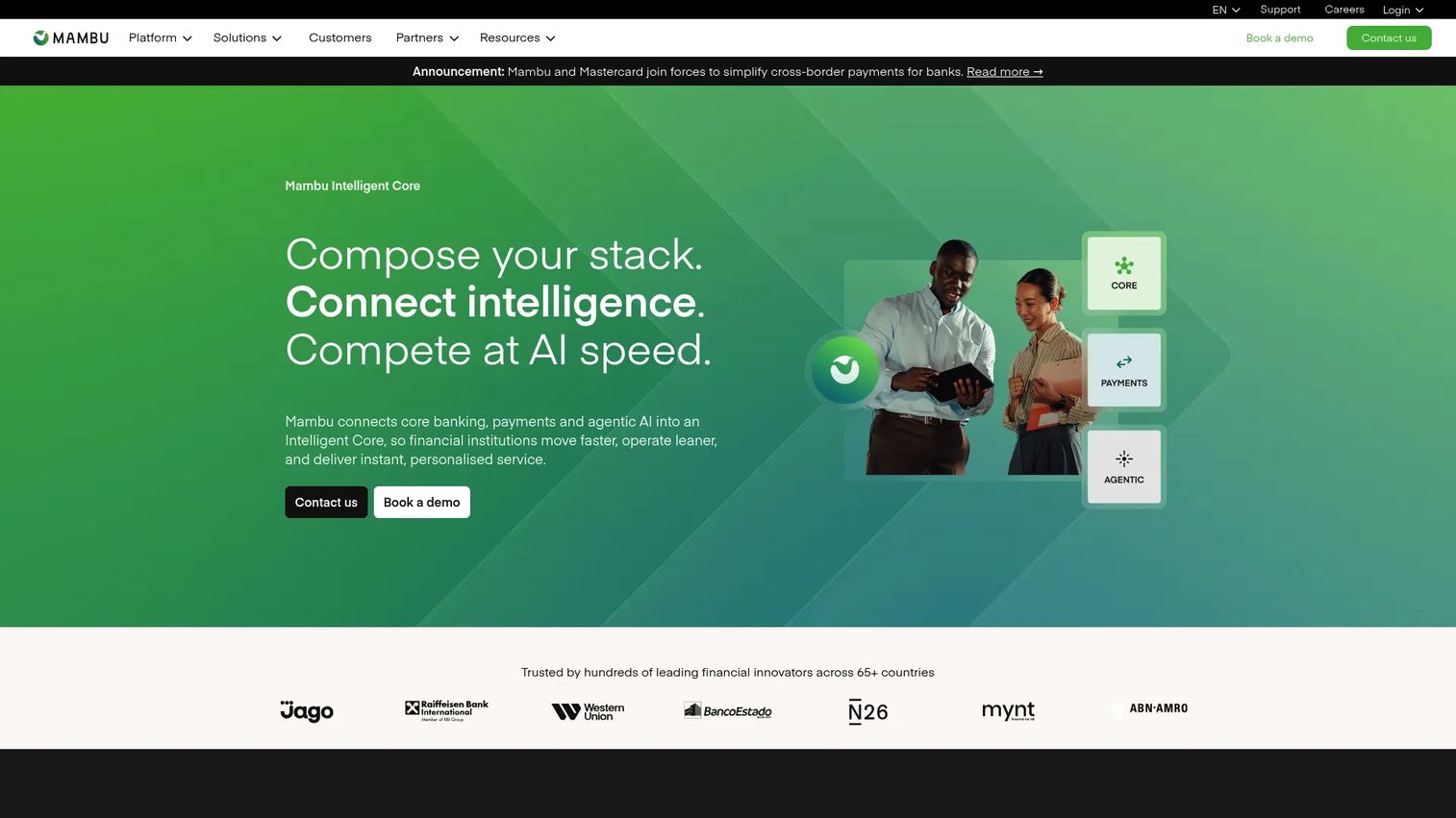
Mambu is a cloud-native, composable banking as a service software platform covering deposits, lending, payments, and agentic AI. It uses RESTful APIs, a Streaming API, and webhooks to connect with digital experience layers, card processors, and fintech partners. Mambu is infrastructure, not a packaged consumer banking experience.
Best for: Fintechs and banks with engineering capacity that want to build differentiated banking products on a composable API-first core.
Key features
- Cloud-native core: Loan management, deposits, and current accounts
- Payments orchestration and connectivity
- RESTful APIs, Streaming API, and webhooks for integration
- Configurable audit trail, accounting, notifications, and insights
- Agentic AI capabilities within the platform
Why choose Mambu: The flexibility is real, but so is the ownership requirement. Confirm who owns the digital channel, onboarding, card, payment, and customer service layers before committing. Mambu suits teams that want to build those layers intentionally rather than inherit them from a packaged platform.
Mambu pricing: Mambu uses custom pricing with no standard plans published. The vendor's BNPL page confirms pricing is custom. Contact Mambu to understand drivers including products, accounts, transaction volumes, and regions.
Mambu holds a 3.8/5 rating on G2, based on 2 reviews.
10. Oracle Banking Digital Experience

Oracle Banking Digital Experience is a SaaS-based, cloud-native digital banking platform supporting retail, corporate, small-business, and Islamic banking experiences. The product covers digital onboarding, self-service originations, cash and liquidity management, trade finance, supply-chain finance, and corporate lending, alongside AI/ML-powered engagement and a no-code dashboard builder.
Best for: Enterprise banks that want a digital experience platform with close alignment to Oracle banking products and enterprise systems.
Key features
- Retail, corporate, small-business, and Islamic banking experiences
- Digital onboarding and self-service product originations
- Cash, liquidity, virtual account, trade finance, and supply-chain finance
- No-code dashboard builder and configurable persona-based personalization
- Multi-entity, multi-brand, multi-currency, and multi-country support
Why choose Oracle Banking Digital Experience: Prioritize it when Oracle is already strategic to the organization. Do not treat it as an automatic fit if your team lacks the implementation capacity to support enterprise banking software programs.
Oracle Banking Digital Experience pricing: Oracle confirms a subscription-based model and handles purchasing through Oracle Sales. Pricing is not posted on the product page; ask Oracle to scope licensing approach, required Oracle products, and cloud versus on-premises options.
Oracle Banking Digital Experience holds a 4.2/5 rating on G2.
11. ebankIT Omnichannel Platform
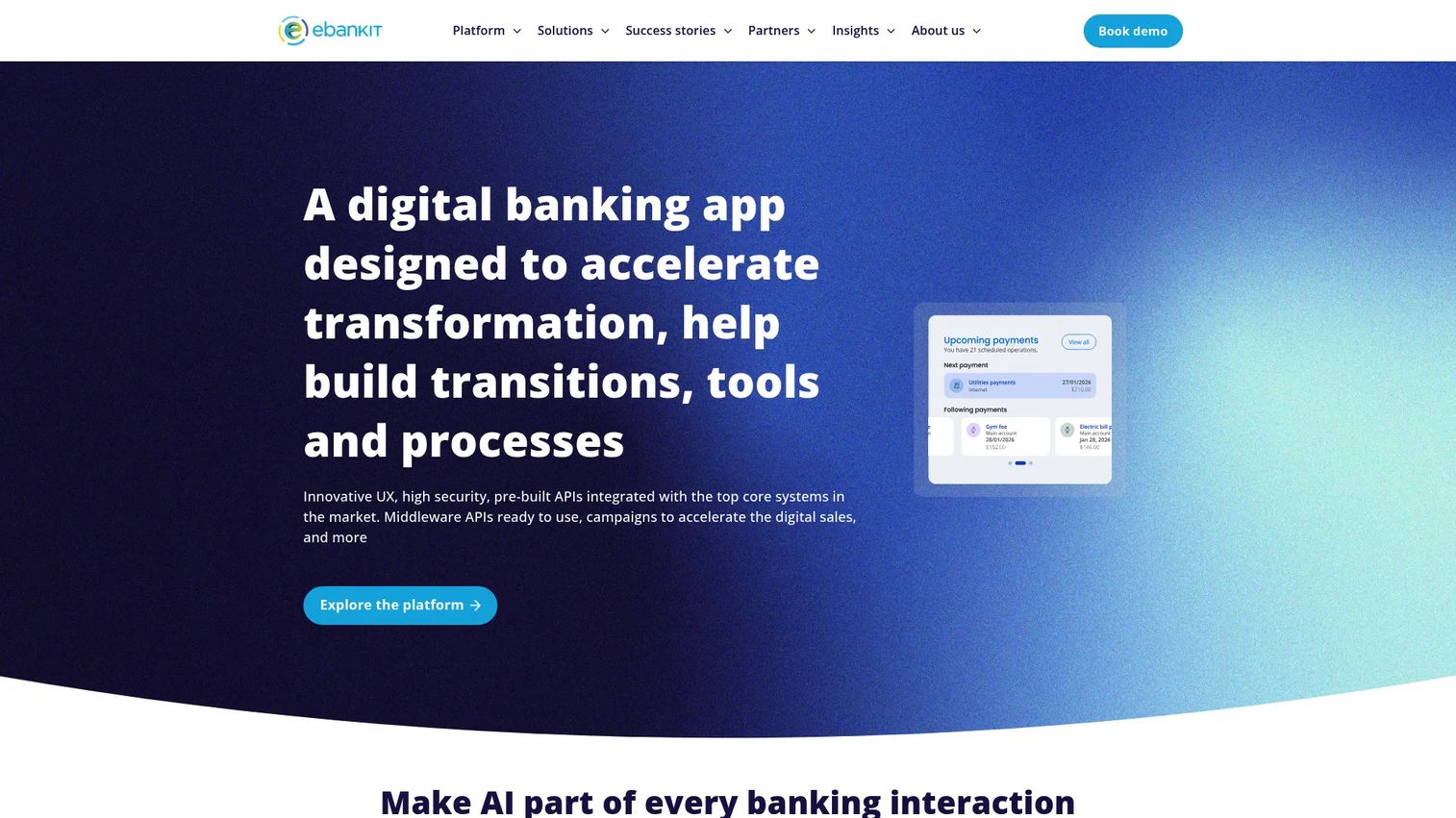
ebankIT is an omnichannel digital banking platform for financial institutions, supporting retail, SMB, and commercial banking across digital and assisted channels. The platform uses ebankIT Studio, a low-code configuration environment, and an API-first integration layer for core banking and third-party ecosystem connectivity.
Best for: Financial institutions that want to coordinate digital and human-assisted banking experiences through a single channel strategy.
Key features
- Unified experiences across web, mobile, wearables, contact center, and branch
- AI-enhanced journeys: Personalization, onboarding validation, and proactive communications
- API-first integration with core banking systems and third-party ecosystems
- Low-code configuration through ebankIT Studio
- Digital onboarding, KYC, biometric authentication, payments, and campaign management
Why choose ebankIT: Worth evaluating when a bank needs consistent journeys across self-service and branch or contact center interactions, and wants low-code control over configuration without full custom development. Validate deployment model and ecosystem integration scope before shortlisting.
ebankIT pricing: ebankIT does not post pricing. Contact the vendor to understand deployment model, module packaging, and ecosystem integration costs.
12. Veritran Low Code Platform
Veritran is an enterprise low-code platform for building and deploying secure digital banking applications across web, mobile, and SmartPOS channels. It uses visual low-code development, configurable business logic, modular architecture, and built-in testing, authentication, tokenization, and notification services.
Best for: Product and engineering teams that want more control over digital banking app development without building core components from scratch.
Key features
- Visual low-code application development environment
- Omnichannel deployment: Web, mobile, and SmartPOS
- Configurable business logic, transactions, and third-party integrations
- Modular and scalable architecture for banking applications
- Built-in testing, authentication, tokenization, and business-rules services
Why choose Veritran: It fits teams with a defined product delivery function that value customization and want to own the application experience. It may be less suitable when the buyer wants a fully packaged banking operating model with minimal configuration ownership.
Veritran pricing: Veritran does not post pricing on its website. Contact the vendor to understand platform licensing, application pricing, implementation services, and ongoing maintenance requirements.
Considerations when choosing a digital banking platform
Match the platform to the job you need done
Choose between digital engagement, core banking, workflow modernization, and low-code product development before comparing feature checklists. The category mismatch is a common and expensive mistake. A cloud core does not automatically provide a finished consumer banking experience, and a polished front end cannot replace ledger infrastructure.
Validate core banking and fintech integration depth
Map your existing core, card processor, payment rails, CRM, fraud tools, identity provider, and data warehouse. Ask vendors for reference architectures tied to your current environment. Integration claims on product pages often obscure the real connectors, data models, and latency requirements.
Price the implementation, not only the platform subscription
Implementation services, migration work, integration builds, QA, security reviews, and staff training can dominate year-one cost. Ask vendors to separate recurring software fees from one-time program costs. This separation is the most useful thing you can do in an initial commercial conversation.
Check consumer and business banking parity
Business banking often needs entitlements, approvals, cash management, user administration, and payment controls that consumer platforms do not cover. Validate these workflows through a live demonstration, not a feature checklist. Many platforms support consumer banking well and business banking as an add-on with material gaps.
Treat data, security, and operating ownership as first-class requirements
Evaluate access controls, authentication, fraud tooling, auditability, data residency, API governance, and incident support before signing. Confirm which team owns updates, security patches, and the deployment pipeline after launch. Refer to best AI cybersecurity solutions for context on how security tooling integrates with platform infrastructure evaluations.
Conclusion
No single digital banking platform wins across every context. The right pick depends on what layer you are buying.
Backbase suits enterprise institutions rebuilding digital engagement across a complex existing stack. Temenos and Finacle serve banks that want broad banking coverage and suite alignment. Jack Henry Banno and Apiture are the strongest starting points for U.S. community banks and credit unions. nCino belongs in the conversation when the priority is lending operations and banking workflow modernization rather than consumer channel experience. Mambu is the infrastructure choice for fintechs and banks that want to build differentiated products on a composable API-first core. Veritran is worth evaluating for teams that want more control over the application layer without starting from scratch.
Before booking vendor demos, build a two-page platform scorecard. Include your current core, target customer segments, launch markets, required payment flows, and the workflows your team cannot afford to customize from scratch. That scorecard cuts the shortlist from twelve to three.
Start your journey with Guideflow today!
FAQs
A digital banking platform is software that helps financial institutions or fintech companies deliver banking experiences through web and mobile channels. Capabilities typically include account servicing, onboarding, payments, authentication, core system integrations, and customer communication across digital touchpoints.
Core banking software runs the underlying accounts, product rules, balances, and transaction processing. A digital banking platform typically focuses on how customers access and manage those services through web and mobile channels. Many institutions run both, with a digital engagement platform sitting on top of a separate core system.
The best choice depends on the institution's existing core, target customer mix, business banking requirements, and implementation capacity. Community institutions should prioritize ecosystem fit, digital account opening capability, the vendor's support model, and whether business banking entitlements are included or require a separate add-on.
Core capabilities include mobile and web banking, payments, digital account opening, authentication, fraud protection, account management, and integrations with core systems and fintech partners. The required mix differs between retail banks, credit unions, commercial banks, and fintechs, so map requirements to your specific customer segments before evaluating vendors. Useful context on related tooling appears in the best business intelligence software guide for analytics layer considerations.
Most enterprise vendors in this category use annual contract pricing with no figures posted. Total cost typically includes recurring software fees, implementation services, integration builds, migration work, training, support, and optional modules. The implementation program often equals or exceeds the first-year software fee, particularly for core integrations and account opening workflows.
Yes. Many organizations use an engagement layer or low-code platform on top of an existing core. Feasibility depends on the core's API surface, data access model, integration governance, and whether the digital platform vendor has reference implementations for that core environment. Mambu and similar composable platforms are often chosen when the fintech wants to own the core itself.
Map product scope, launch geography, bank sponsor relationships, ledger ownership, payment needs, compliance obligations, and engineering capacity. Also evaluate which approval workflow software and account management software tools connect to the platform. The right option depends on whether you need configurable infrastructure or a complete channel experience with managed services attached.
Implementation duration ranges widely because it depends on integration count, product modules, migration scope, regulatory reviews, and testing requirements. Adding a digital channel layer on top of an existing core typically takes less time than replacing a core system outright. Programs can run from several months to over two years; ask vendors for reference timelines tied to comparable institution sizes and integration profiles.
Pricing drivers vary by vendor and model. Common variables include number of accounts or users, transaction volume, deployed product modules, number of integrated systems, implementation services scope, geographic deployment, and annual contract term. Ask each vendor to separate software subscription fees from professional services, since the latter can be the larger cost in year one.
Composable banking architecture refers to a design approach where banking capabilities are assembled from modular, independent components rather than delivered as a monolithic suite. Each component exposes APIs, allowing institutions to swap or extend functionality without replacing the entire stack. Mambu and Finacle's headless architecture are examples in this guide. The approach gives product teams more flexibility but requires stronger internal engineering governance. For context on related api gateway software and api monitoring tools that support composable environments, those guides cover the adjacent infrastructure layer.