Audio looks attractive when search CPCs climb and social creative burns out. The hard part is not deciding whether people listen. It is proving what the channel did after the impression.
U.S. digital audio advertising revenue reached $8.4 billion in 2025, up 10.2% year over year, according to the IAB/PwC Internet Advertising Revenue Report released in 2026. That growth reflects real advertiser commitment, but it also reflects how easy it is to buy audio badly. Fragmented inventory, opaque measurement, and creative requirements that most lean teams are not prepared for combine to make this channel punishing for teams that jump in without a plan.
The right digital audio advertising software closes that gap. The choice comes down to buying workflow, inventory access, targeting depth, creative support, and measurement quality. This guide helps you match platform to program.
What's inside
This guide compares four digital audio advertising software platforms shortlisted for 2026. It covers self-serve options and omnichannel DSPs, with practical guidance on who each fits.
- Who this is for: Growth marketers, demand gen teams, media buyers, agencies, and lean startup marketers evaluating audio as a channel
- How tools were chosen: Inventory breadth, targeting depth, creative production support, and measurement quality
- What to verify before buying: Live pricing, campaign minimums, creative fees, and current G2 ratings
- What is not covered: Podcast hosting, audio editing software, or radio station management tools
TL;DR
- Best for self-serve audio campaign launch: AudioGo. Minimum $250 per campaign, synthetic-voice ads included at no extra cost
- Best for omnichannel audio with cross-device attribution: Viant DSP. Household ID targeting connects audio to CTV, mobile, and offline conversion data
- Best for programmatic audio inside a multi-channel DSP: StackAdapt DSP. Podcast show targeting, companion display ads, and multi-channel optimization in one platform
- Best for dynamic audio creative: Perion WAVE. Real-time personalization by weather, location, and audience context
- Self-serve vs. DSP: Start with AudioGo to test the channel fast. Move to a DSP when audio is part of a broader omnichannel media plan
What is digital audio advertising software?
Digital audio advertising software helps marketers buy, create, target, deliver, optimize, and measure audio ads across streaming music, podcasts, digital radio, internet radio, audiobooks, and connected audio environments.
An advertiser defines an audience, geography, budget, and campaign objective. The platform matches that campaign to available audio inventory, either through direct publisher access, programmatic real-time bidding, or a self-serve buying interface. Some platforms include creative tools, voiceover services, synthetic voice generation, or dynamic creative optimization. Reporting connects delivery to reach, listen-through rates, clicks, conversion lift, or ROAS.
Key capabilities to look for:
- Programmatic buying and real-time bidding across streaming, podcast, and digital radio inventory
- Audience targeting by demographics, behavior, location, interests, and contextual signals
- Pre-roll, mid-roll, post-roll, and companion display ad formats
- Creative production support, including scripts, synthetic voice, voice actors, and dynamic creative
- Frequency capping and budget controls to manage spend efficiency
- Measurement covering reach, completion rate, brand lift, conversion lift, and ROAS
What this category is not: Podcast hosting software, audio editing tools, and radio station management software are separate categories. The buyer here is choosing a platform for running and measuring audio ad campaigns, not for publishing audio content.
One useful distinction: Self-serve platforms prioritize speed and simplicity, with campaign minimums and built-in creative help. Omnichannel DSPs treat audio as one channel inside a broader media plan and add identity resolution, cross-device tracking, and advanced attribution. Knowing which model fits your team determines where to start. For brand awareness tools in adjacent channels, the same logic applies.
When to use digital audio advertising software
Reach buyers during screen-free moments
Commuters, gym goers, and anyone cooking or working with headphones in are consuming audio when no other ad channel can reach them. Audio provides incremental reach that paid social and search miss because those channels depend on screen-based intent. A B2B SaaS team running a product launch can use streaming audio to reinforce brand messaging with their target persona during the 60% of the day that happens away from a screen.
Test podcast and streaming audio without a full media buying process
Self-serve platforms let lean teams go from zero to a live campaign in days. Before spending anything, nail down: Target audience, geographic focus, landing page URL, ad creative or voiceover plan, and a measurement plan tied to UTMs or a landing page conversion event. Without those four elements, audio spend is untrackable from day one.
Add audio to an omnichannel paid media strategy
Audio pairs with display advertising, CTV, and mobile to extend reach and reinforce frequency. Omnichannel DSPs handle this coordination natively, managing frequency across channels so the same person is not hammered by the same message on five surfaces. One caution: Measuring audio by click-through rate alone misses most of its value. Audio drives awareness and assisted conversion, not direct clicks.
Digital audio advertising software comparison
The table below compares platform fit across buying model, differentiator, pricing, and G2 rating. This is not a ranking of overall company size or inventory scale. It is a guide to which platform matches which buying scenario.
| # | Product | Best for | Key differentiator | Pricing | G2 rating |
|---|---|---|---|---|---|
| 1 | AudioGo | Self-serve audio ad launch | Fast setup with built-in creative support | From $250/campaign | 4.5/5 |
| 2 | Viant DSP | Omnichannel audio and cross-device attribution | Household ID targeting across CTV, audio, and offline | Custom pricing | 4.2/5 |
| 3 | StackAdapt DSP | Programmatic audio in a multi-channel DSP | Podcast show targeting with companion display ads | Custom pricing | 4.7/5 |
| 4 | Perion WAVE | Dynamic, context-aware audio creative | Real-time personalization by weather, location, and audience | Custom pricing | 4.0/5 |
Best 4 digital audio advertising software for 2026
1. AudioGo
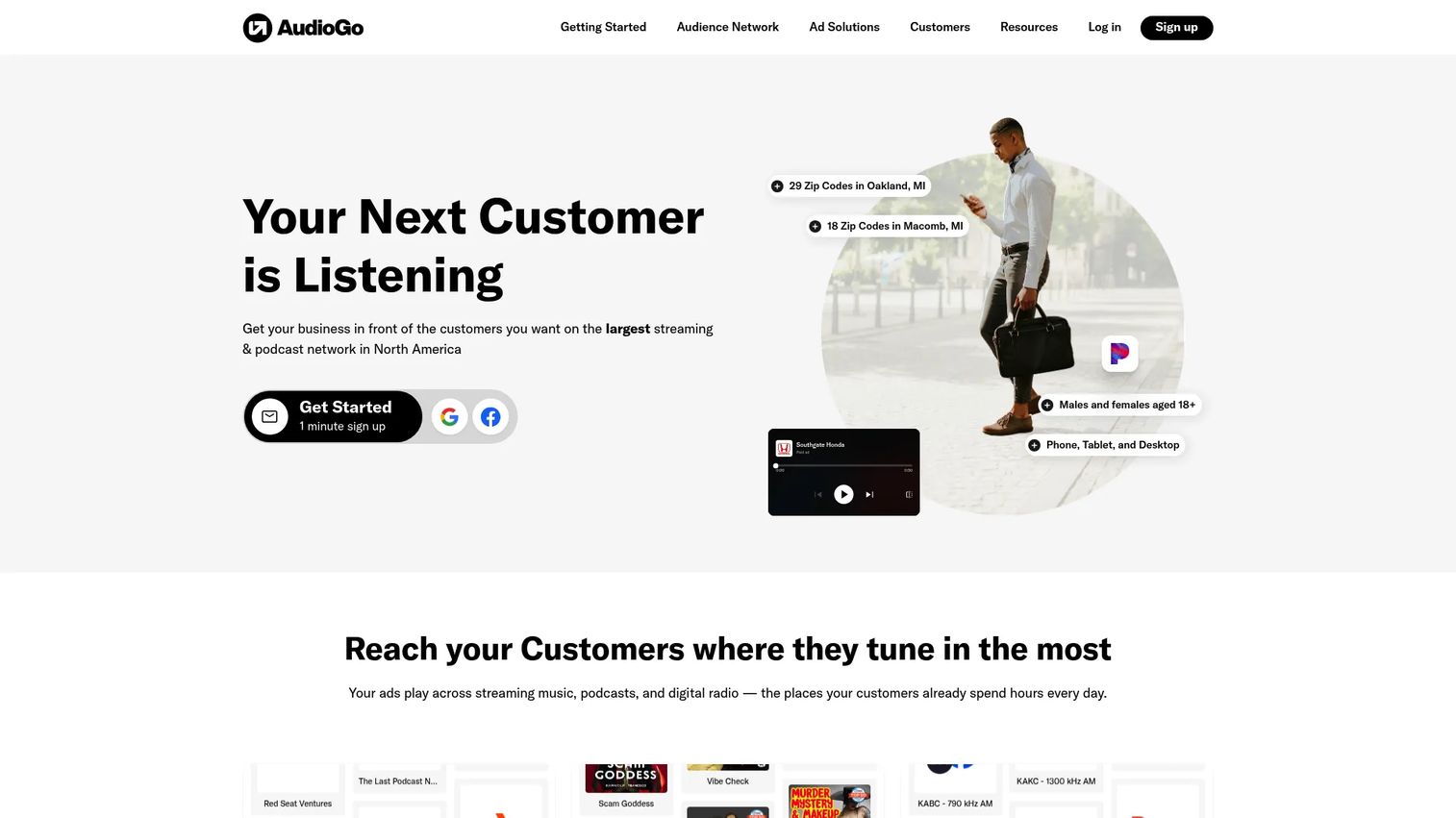
AudioGo is a self-serve audio advertising platform for launching campaigns across streaming music, podcasts, and digital radio. The platform handles the full campaign workflow: Audience setup, targeting, creative production, delivery, and reporting. It is built for teams that want to run audio without hiring a media buying agency or committing to a DSP contract.
Best for: Small businesses, agencies, and marketing teams that need to get an audio campaign live quickly without a large production budget.
Key features
- Self-serve campaign builder with dynamic and manual bidding
- Streaming music, podcast, and digital radio inventory
- Targeting by geography (zip-code level), demographics, behavior, content, and device
- Synthetic voice ad creation at no additional cost
- Professional voice-actor ads available for $10 per spot
Why choose AudioGo: AudioGo is the right starting point for teams testing audio for the first time. The built-in creative options remove the production bottleneck that stops most lean teams from even launching a first campaign. If ROAS measurement and cross-device attribution are the priority, a DSP will serve you better.
AudioGo pricing: Campaigns start at $250 USD minimum (or $300 CAD). Synthetic-voice ads are free to create; professional voice-actor spots cost $10 each. Pricing is campaign-based rather than subscription-based, so you pay for delivered impressions without an ongoing platform fee.
G2 rating: AudioGo holds a 4.5/5 rating on G2.
2. Viant DSP
Viant DSP is an omnichannel demand-side platform for planning, buying, and measuring programmatic advertising campaigns. Audio sits alongside CTV, digital out-of-home, mobile, desktop, and display within a unified buying environment. Its defining capability is household-level identity resolution, which links audio exposure to in-store visits, online conversions, and cross-device behavior.
Best for: Mid-market and enterprise advertisers running audio as part of a broader omnichannel media plan who need defensible attribution across channels.
Key features
- Programmatic audio buying across streaming, podcasts, and internet radio
- Household ID-based identity resolution with cross-device targeting and frequency management
- Cross-channel measurement including multi-touch attribution and conversion lift
- Foot-traffic attribution and online/offline ROAS reporting
- First-party data activation, audience segmentation, and machine-learning bid optimization
Why choose Viant DSP: Viant fits the growth marketer who needs to prove audio's contribution to pipeline, not just impressions. If your CFO will ask for ROAS and your media plan already spans CTV or DOOH, Viant handles that measurement without stitching together separate reporting tools.
Viant DSP pricing: Viant describes pricing as tailored to client needs. Contact Viant's sales team directly for platform fees, media minimums, and managed-service options.
G2 rating: Viant DSP holds a 4.2/5 rating on G2.
3. StackAdapt DSP
StackAdapt DSP is an AI-powered demand-side platform that supports multi-channel programmatic advertising, including audio across podcasts, streaming music, audiobooks, and digital radio. Audio activates within the same workflow as CTV, display, native, video, and email, so a media buyer already running campaigns in StackAdapt can add audio without switching platforms or rebuilding audience segments.
Best for: Agencies and performance marketing teams that want audio inventory and measurement inside a broader programmatic workflow.
Key features
- Podcast show-level targeting and content-category targeting
- Companion display ads for click-based engagement alongside audio spots
- Brand lift measurement and advanced attribution
- Creative Studio services for ad production support
- Multi-channel optimization with machine-learning bidding across five plan tiers
Why choose StackAdapt DSP: The strongest case for StackAdapt is team consolidation. If your team already runs paid channels through a DSP, adding audio in StackAdapt means one campaign view, one reporting dashboard, and no incremental tool sprawl. Podcast show-level targeting also gives content-focused buyers placement control that broad programmatic buys do not.
StackAdapt DSP pricing: StackAdapt offers five plans: Basic, Grow, Scale, Accelerate, and Enterprise. Basic uses a credit card billing path; higher tiers move to net terms. Contact StackAdapt for specific platform fees and media minimums.
G2 rating: StackAdapt DSP holds a 4.7/5 rating on G2.
4. Perion WAVE
Perion WAVE is a generative AI-powered dynamic audio advertising platform focused on real-time creative personalization. Rather than serving a single static audio spot to all listeners, WAVE adjusts ad content based on contextual signals, delivering a version of the message that matches the listener's moment, location, weather, or audience segment. It is built for brands that already understand audio inventory but need better creative relevance across a large campaign.
Best for: Brands and retailers running audio campaigns at scale where message variation and contextual relevance are the primary performance levers.
Key features
- Real-time creative personalization by weather, location, time of day, and audience data
- AI-generated scripts and voice talent for scalable dynamic ad production
- Delivery across premium streaming, podcast, and digital radio inventory
- Context-aware messaging using price, item, or promotional data triggers
- ROAS reporting tied to campaign performance
Why choose Perion WAVE: Creative fatigue is the reason most audio campaigns plateau. WAVE addresses that by generating multiple relevant variants rather than running one spot until listeners tune it out. This is the right fit when the team has already validated audio as a channel and wants to lift performance through message relevance, not just more spend.
Perion WAVE pricing: Reach out to Perion's sales team for campaign minimums, creative fees, and platform pricing.
G2 rating: Perion carries a 4.0/5 overall G2 rating
Considerations when choosing digital audio advertising software
Inventory quality and buying path
Self-serve platforms provide direct access to streaming and podcast networks. DSPs add programmatic real-time bidding across a broader supply pool, including inventory that self-serve tools do not reach. Confirm which networks, publishers, and podcast networks are accessible through each platform before committing spend.
Audience targeting depth
Basic targeting covers age, gender, and geography. The platforms that drive better ROAS support behavioral signals, contextual matching, first-party data upload, and show-level podcast placement. Verify that the platform can target your actual ICP, not just broad consumer segments that waste budget on irrelevant listeners. See audience intelligence platforms for a broader view of audience data tools.
Creative production support
Audio production is the most underestimated cost in this category. Script writing, voiceover talent, music licensing, and editing all add up before a single impression runs. Confirm which creative services are included in the platform, which carry additional fees, and whether the platform supports dynamic creative if message variation matters for your campaign goals.
Measurement and attribution
Impressions and completion rates tell you the ad was heard. They do not tell you what happened next. Prioritize platforms that support conversion lift, landing page attribution, offline attribution, or ROAS reporting before you commit spend. If your team cannot connect audio exposure to pipeline or revenue, leadership will cut the budget before the channel gets a fair test. For a broader view of attribution tooling, see best attribution software tools.
Pricing model and test budget
Self-serve tools set a campaign floor, often $250 or $500. DSPs require custom agreements with platform fees, media minimums, data costs, and sometimes managed-service requirements on top. Ask for a full cost breakdown: Media spend, platform fee as a percentage or flat rate, creative fees, and data costs. What sounds like a $5,000 test can land at $8,000 once fees are totaled.
Conclusion
Audio is easy to buy badly. The four platforms above cover different positions on the spectrum from fast self-serve testing to enterprise omnichannel measurement.
AudioGo fits teams running their first audio campaign. The $250 minimum and built-in creative support remove the two biggest barriers to getting started. Viant DSP fits brands that need household-level attribution across CTV, audio, and offline conversion data. StackAdapt DSP fits performance teams already running programmatic campaigns who want to add audio without adding another reporting silo. Perion WAVE fits brands that have validated audio and want to push performance through dynamic creative personalization.
If audio is a first test: Define your audience, geography, landing page, creative approach, and measurement plan before you open a platform account. If audio is already part of your media mix: Prioritize platforms that connect audio targeting and reporting to your existing paid media workflow. The channel works. The reporting is what determines whether you can prove it.
For related reading on paid media tooling, see ad network software and best PPC software.
Start your journey with Guideflow today!
FAQs
Digital audio advertising software is a platform category that helps marketers buy, create, target, deliver, optimize, and measure audio ads across streaming music, podcasts, digital radio, and internet radio. It includes both self-serve tools with campaign minimums and enterprise DSPs with identity resolution and cross-device attribution. The category is distinct from podcast hosting, audio editing software, and radio station management tools.
An advertiser sets audience parameters, budget, targeting logic, and bidding strategy inside the platform. When a listener opens an audio app or podcast player, the platform enters a real-time auction for the available ad slot. The winning bid determines which advertiser's audio spot plays, and the whole process completes in milliseconds. The advertiser pays for delivered impressions or completed listens depending on the platform's pricing model.
The core formats are pre-roll (before content begins), mid-roll (during a break in content), and post-roll (after content ends). Companion display ads appear on screen alongside the audio spot for listeners using an app with a screen, adding a visual click-through element. Beyond those, some platforms support sponsored sessions, native audio integrations, rewarded audio (a listener opts in for ad-free time), and dynamic creative formats that swap message elements in real time.
Podcast advertising software typically focuses on podcast-specific inventory, often through direct publisher deals or show-level sponsorships with reporting tied to episode downloads. Digital audio advertising software is a broader category: It can include podcasts, streaming music services, digital radio, internet radio, and audiobooks, often bought programmatically across multiple inventory sources in one campaign. Some platforms cover both; others specialize in one.
Start with delivery metrics: Reach, impressions, and listen-through or completion rate. Layer in engagement signals: Clicks to landing page, UTM-tracked sessions, and form completions. For upper-funnel campaigns, brand lift studies measure whether exposed listeners are more aware or favorable toward the brand. Conversion lift and ROAS reporting tie audio exposure to downstream purchases or revenue. Click-through rate alone underestimates audio's contribution, because most listening happens on locked-screen devices where clicking is not possible.
Self-serve platforms like AudioGo use a campaign budget model, with a minimum of $250 per campaign. Creative production on those platforms may cost an additional $10 for a professional voice-actor spot, while synthetic-voice ads are free. DSPs like Viant DSP, StackAdapt DSP, and Perion WAVE use custom pricing based on media spend, platform fees, data costs, and sometimes managed-service requirements. Ask each vendor for a full cost breakdown covering all line items before comparing options.
At minimum: Geography (country, region, city, zip code), demographics (age, gender), and device type. More useful are behavioral targeting, interest categories, contextual matching to content type or show topic, podcast show-level targeting, time-of-day and daypart controls, and language. First-party data upload and lookalike modeling add significant precision for teams with existing customer data. Verify that the platform's targeting options match your ICP, not just broad consumer segments. For related audience intelligence platforms, the same targeting depth question applies.
Yes, for teams that meet three conditions: A defined audience with known listening habits, a creative approach that works in audio-only contexts, and a measurement plan tied to something beyond impressions. According to EMARKETER and Amazon Ads (2026), 67% of surveyed marketers already include digital audio in their media mix, and 65% plan to increase spend over the next year. That adoption level signals a channel with real advertiser conviction, not just experimental budgets. Audio performs best when paired with a landing page designed for audio-driven traffic and a retargeting workflow on paid social or display.