Most patients now expect healthcare to work like the rest of their digital life. They want to book online, complete paperwork before arrival, pay from their phone, and hear back without calling three times. But most care teams still stitch that journey together across portals, reminders, paper forms, and disconnected systems.
The gap between what patients expect and what practices deliver is measurable. According to a 2025 JLL survey, only 9% of patients reported using no technology in their care experience. Yet staff still spend hours on phone scheduling, manual intake, and follow-up that better-configured software could handle automatically.
The patient experience technology market hit $740 million in 2026 and is projected to reach $1.29 billion by 2031, according to MarketsandMarkets. That growth reflects real operational pressure: Call volume, no-show rates, intake bottlenecks, and patient retention are all problems that the right platform addresses directly.
This guide cuts through 21 platforms across medical, dental, behavioral health, and enterprise settings so you can build a defensible shortlist, not just a long one.
What's inside
This guide compares 21 patient experience software platforms for 2026, covering tools built for hospitals, independent practices, dental groups, and behavioral health organizations. Tools were selected based on four criteria:
- Digital access: Online scheduling, intake forms, portals, and appointment reminders
- Communication: SMS, email, voice, telehealth, and two-way messaging
- Experience intelligence: Surveys, reviews, sentiment analytics, and feedback routing
- Integration fit: EHR, practice management, payment, and CRM compatibility
TL;DR
- Best overall for modern patient access: NexHealth covers scheduling, digital intake, reminders, reviews, and payments in one layer on top of existing systems
- Best for enterprise digital front door: Epic Systems suits large health systems that want patient engagement embedded inside a complete EHR environment
- Best for patient intake and check-in: Phreesia digitizes registration, payments, and eligibility verification for ambulatory and enterprise providers
- Best for feedback and experience analytics: Relias Experience Management connects patient surveys to employee performance data in one loop
- Best for dental patient communication: Intiveo and Solutionreach both cover reminders, recalls, and two-way messaging built for dental workflows
- Best for independent practices: SimplePractice and Tebra offer all-in-one operations for smaller teams that need practice management, billing, and patient engagement together
What is patient experience software?
Patient experience software helps healthcare organizations manage digital interactions across the patient journey, from scheduling and intake through communication, feedback, payments, and ongoing engagement.
The category is broader than scheduling tools alone. It overlaps significantly with patient engagement software, which focuses on outreach and interaction, but patient experience platforms typically cover the full care journey including financial touchpoints, satisfaction measurement, and service recovery.
For a product marketing manager mapping this landscape, the category narrative is clear: Reduce friction for patients while giving care teams measurable engagement data they can act on. That is a positioning claim you can defend across multiple care settings.
Core capabilities to look for:
- Online scheduling and self-scheduling
- Digital intake and pre-visit registration
- Appointment reminders via SMS, email, and voice
- Two-way patient messaging
- Patient portal access
- Feedback surveys and review generation
- Payment collection and estimates
- Telehealth and remote engagement
- Analytics, dashboards, and operational reporting
- EHR and practice management integration
Category boundaries worth knowing:
Patient experience software is not the same as a clinical EHR, though many EHRs now include patient engagement modules. Tools like Epic, athenahealth, and eClinicalWorks operate at the EHR layer and include patient-facing features. Purpose-built patient experience platforms like NexHealth and Phreesia operate on top of existing systems. Dental practice management tools like Curve Dental, Dentrix, tab32, and Open Dental include patient communication as part of broader clinical and billing workflows.
The right category framing for your care setting determines which tool type fits.
When to use patient experience software
Reduce call volume and front-desk workload
When patients cannot book, cancel, or reschedule without calling the office, your front desk absorbs a workload that scheduling software could eliminate. Digital intake removes paper forms from the waiting room. Automated reminders cut no-show rates without staff intervention. If your team tracks call volume and staff hours on administrative tasks, this is where to start measuring before rollout.
Improve patient engagement across the care journey
Engagement differs by setting. A hospital needs broadcast communication and bedside tools. A behavioral health practice needs secure messaging with care-gap reminders. A dental group needs recall automation by procedure type. Choose a platform that maps to your specific patient journey, not one built for a generic clinic. The right fit produces measurable improvements in appointment conversion and retention.
Turn feedback into operational improvement
Collecting patient satisfaction scores is not the same as doing something with them. Platforms that include service-recovery workflows, real-time alerts, and trend dashboards let you identify where the experience breaks and assign accountability for fixing it. For feedback software to produce proof points you can defend internally, it needs routing and reporting, not just survey collection.
Patient experience software comparison
The 21 platforms below are sorted by relevance to different care settings. Use the "Best for" column to filter quickly by your organization type, then verify pricing and ratings with each vendor before shortlisting.
| # | Product | Best for | Key differentiator | Pricing | G2 rating |
|---|---|---|---|---|---|
| 1 | NexHealth | Medical and dental practices seeking integrated patient access | Real-time scheduling, intake, reminders, and reviews with practice-system sync | Custom pricing | 4.8/5 |
| 2 | Luma Health | Enterprise healthcare organizations needing AI-powered access automation | Patient journey orchestration across scheduling, waitlist, referrals, and outreach | Custom pricing | 4.8/5 |
| 3 | Phreesia | Organizations digitizing intake, check-in, and payment collection | Digital registration, payments, eligibility, and VoiceAI in one platform | Free through Dec 31, 2026; custom pricing after | 3.9/5 |
| 4 | Epic Systems | Large health systems needing enterprise digital front door | Integrated EHR, portal, scheduling, bedside, and financial experience modules | Custom enterprise pricing | 4.2/5 |
| 5 | Relias Experience Management | Feedback, surveys, and operational experience analytics | Real-time patient and employee experience insights in one performance loop | Custom pricing | Not listed on G2 |
| 6 | Solutionreach | Practices needing automated communication and recall workflows | Reminders, recalls, two-way texting, and 400+ PM/EHR integrations | Quote-based plans | 4.3/5 |
| 7 | SimplePractice | Solo and small group behavioral health practices | Practice management, telehealth, billing, and client communication together | From $49/month | 4.1/5 |
| 8 | Intiveo | Dental practices and groups focused on patient communication | Dental-specific reminders, recalls, messaging, and waitlist automation | From $199/month | 4.8/5 |
| 9 | Adit | Dental practices combining patient engagement and growth tools | AI-powered communications, forms, reviews, payments, and CRM | Custom pricing | 4.8/5 |
| 10 | Doctible | Practices prioritizing reviews and patient feedback | Reputation management paired with communication automation | From $199/month (annual) | 4.5/5 |
| 11 | Pomelo Health | Clinics and provider networks needing centralized communication | Secure messaging, reminders, digital forms, and broadcast messaging | Custom pricing | 3.5/5 |
| 12 | Mend | Behavioral health organizations reducing no-shows and filling capacity | AI-powered no-show prediction, patient outreach, and capacity recovery | Custom pricing | Not listed on G2 |
| 13 | Tebra | Independent practices needing an all-in-one operating system | EHR, billing, patient engagement, telehealth, and reputation management | Custom pricing | 4.1/5 |
| 14 | athenahealth | Ambulatory care organizations wanting networked EHR and engagement | athenaOne: EHR, revenue cycle, patient portal, and messaging in one platform | Percentage of collections (custom) | 3.6/5 |
| 15 | eClinicalWorks | Practices wanting EHR-native patient engagement tools | Cloud EHR, healow patient portal, telehealth, and AI documentation | From $499/month per provider | 3.7/5 |
| 16 | NextGen Enterprise | Specialty and ambulatory practices with complex workflows | EHR, patient portal, analytics, interoperability, and specialty-specific modules | Custom pricing | Not listed on G2 |
| 17 | Curve Dental | Dental practices wanting a cloud-first practice management system | Cloud dental PMS with scheduling, charting, imaging, billing, and engagement | Quote-based pricing | 4.6/5 |
| 18 | Dentrix | Established dental practices with mature operational needs | Full dental PMS with Essentials, Pro, and Accelerate packages | Quote-based packages | 4.1/5 |
| 19 | tab32 | Dental groups and DSOs needing cloud-based multi-location management | Cloud dental PMS with AI eligibility, analytics, and multi-location support | From $125/month (Alpine Start-Up) | 4.5/5 |
| 20 | Open Dental | Cost-conscious dental practices that want flexibility and integration choice | Open-source dental PMS at $199/month per location with broad integration support | $199/month per location | Not listed on G2 |
| 21 | Marketing 360 | Healthcare practices focused on marketing and patient acquisition | CRM, websites, email, paid ads, reputation, and campaign management | From $65/month (Essentials) | 3.5/5 |
Best 21 patient experience software platforms for 2026
1. NexHealth
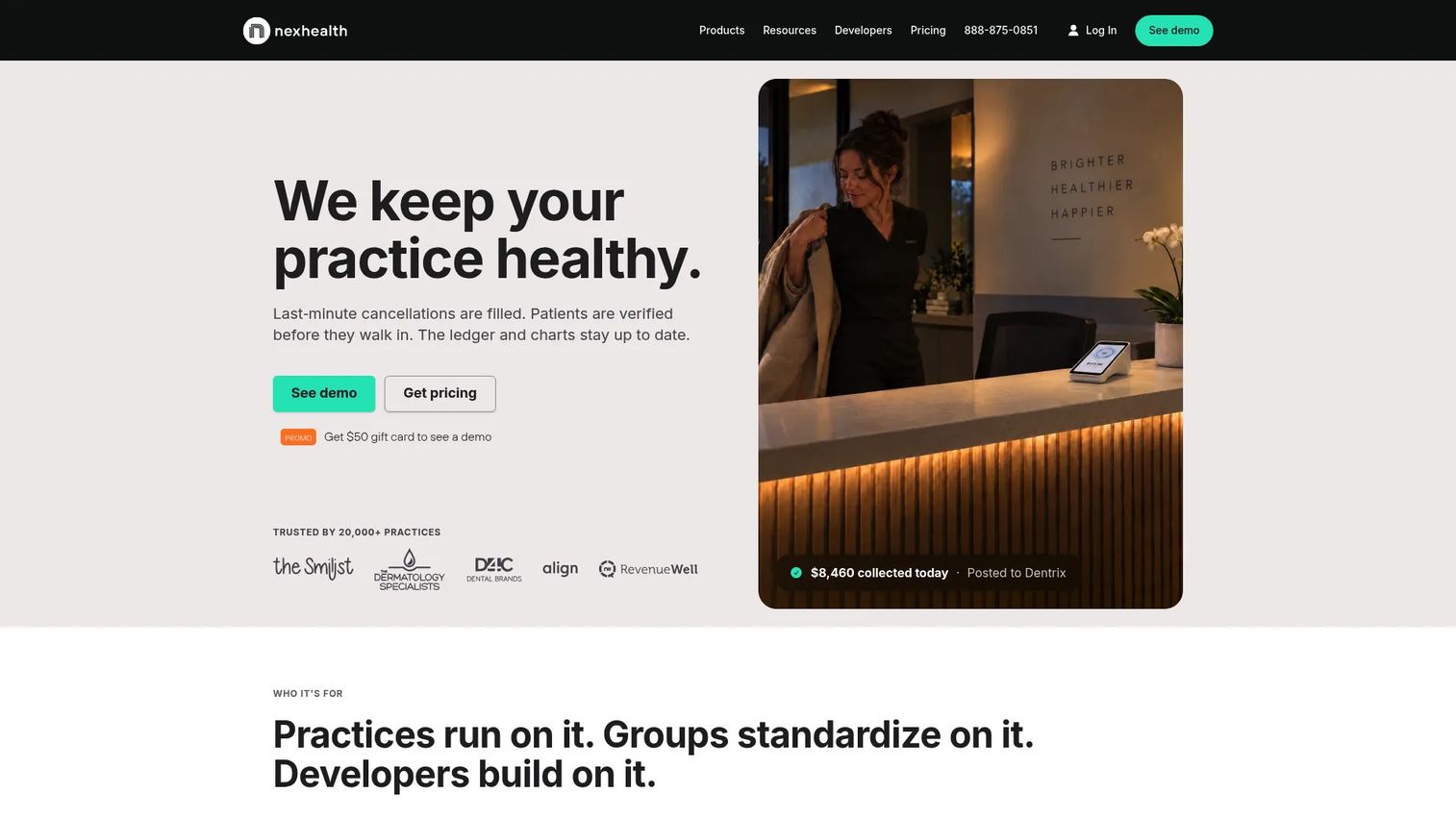
NexHealth is a patient experience platform built for medical and dental practices that want a modern digital front desk without replacing their existing systems. It covers online scheduling, digital forms, automated messaging, patient reviews, payments, and insurance eligibility verification. The platform synchronizes with practice management systems in real time, so appointment data stays consistent across the front-end experience and the back office.
Best for: Healthcare and dental practices that need integrated patient engagement on top of existing practice systems.
Key features
- Real-time online scheduling and self-booking
- Digital patient intake forms with EHR sync
- Automated reminders, recalls, and review requests
- Online payments and in-office payment workflows
- Insurance eligibility verification
Why choose NexHealth: NexHealth suits practices that want a single patient-facing layer covering access, communication, and reputation without rebuilding their practice infrastructure. Its "real-time sync" positioning is a genuine differentiator for PMMs mapping category claims across scheduling competitors.
NexHealth pricing: NexHealth sells custom plans; the vendor directs prospects to contact sales for a quote. G2 reviewers note that pricing is practice-specific based on selected modules and volume.
G2 rating: 4.8/5
2. Luma Health
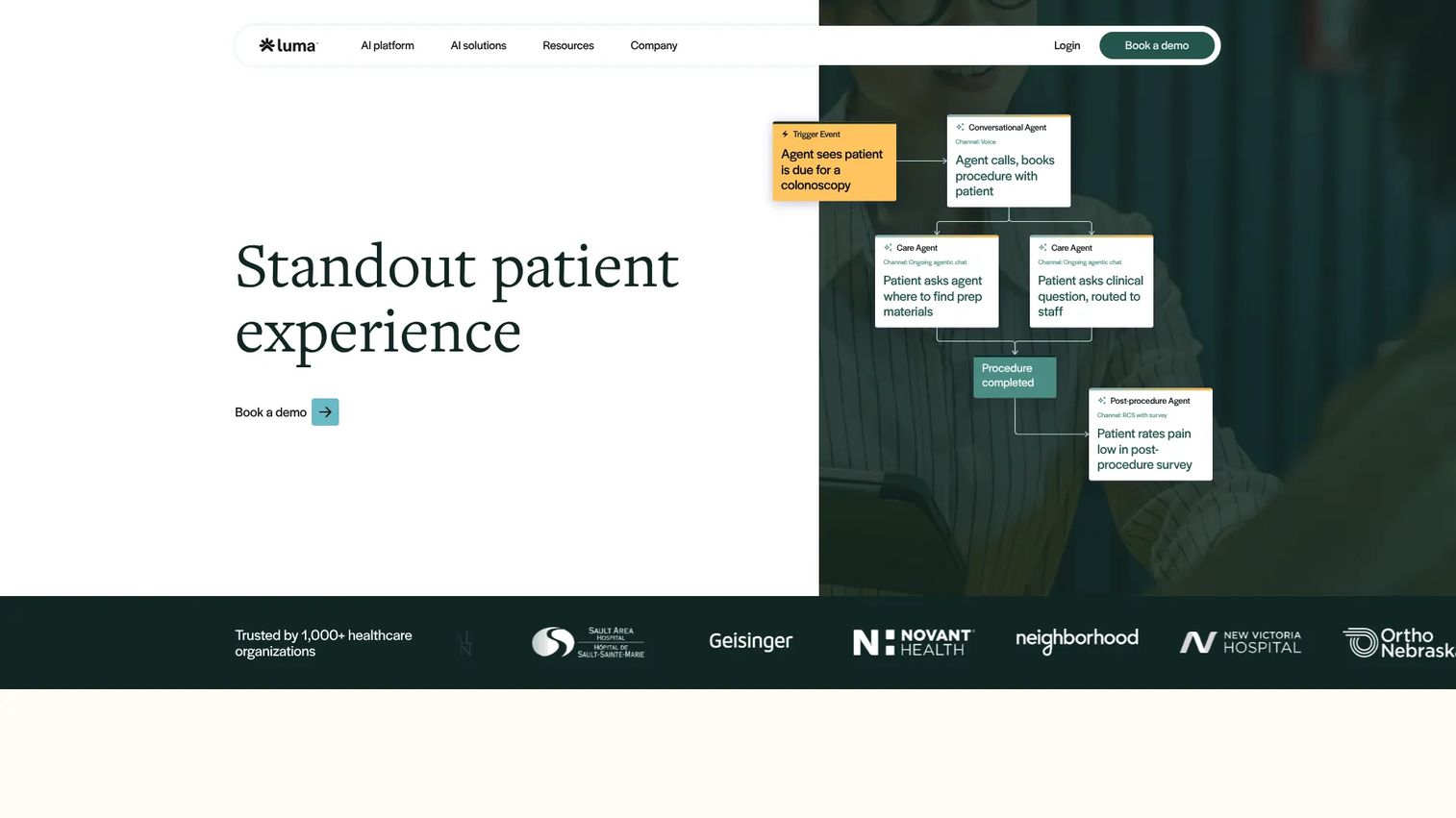
Luma Health is an AI-powered healthcare operations platform that automates patient access, scheduling, referrals, and outreach across the care journey. It handles appointment scheduling, waitlist management, fax and referral workflows, digital intake, eligibility checks, payments, and pre- and post-care communication. Bidirectional EHR integrations keep patient data synchronized across access touchpoints.
Best for: Health systems and larger clinic networks that need patient communication and access workflows orchestrated across multiple channels and care settings.
Key features
- AI-powered scheduling, waitlist, and cancellation recovery
- Referral and fax workflow automation
- Patient intake forms, eligibility, and payments
- Pre-care and post-care outreach and recalls
- Bidirectional EHR integrations
Why choose Luma Health: Luma Health performs best when access, appointment volume, referral coordination, and multi-channel outreach all need to work together. It is a strong fit for organizations that have outgrown point tools for individual workflows.
Luma Health pricing: Luma Health does not display pricing on its website. Contact sales for a quote. G2 reviewers confirm pricing is custom and enterprise-oriented.
G2 rating: 4.8/5
3. Phreesia
Phreesia provides a healthcare patient-access and intake platform covering registration, scheduling, payments, communication, and eligibility verification. It is widely used by ambulatory care organizations and enterprise providers that want to digitize the pre-visit and check-in experience. Phreesia VoiceAI handles inbound calls around the clock, and its smart waitlist fills open slots automatically.
Best for: Organizations that want to eliminate paper intake, reduce waiting-room bottlenecks, and digitize payment collection before the visit starts.
Key features
- Digital patient intake and pre-visit registration
- Self-scheduling and appointment management
- Phreesia VoiceAI for 24/7 call handling
- Patient payments, card-on-file, and payment plans
- Smart waitlist and appointment acceleration
Why choose Phreesia: Phreesia is strongest when intake, eligibility, and payment friction are the primary pain points. Organizations dealing with long paper-form completion times and manual insurance lookups see the clearest operational impact.
Phreesia pricing: The Phreesia Intake platform is currently available at no cost through December 31, 2026. Standard pricing begins May 1, 2027 and is customized by organization size and selected modules. Contact Phreesia for a post-trial quote.
G2 rating: 3.9/5
4. Epic Systems
Epic Systems develops integrated healthcare software for hospitals, clinics, specialty providers, and payers. Its patient experience capabilities center on the MyChart patient portal, digital scheduling, bedside engagement tools, financial experience modules, and remote patient monitoring. For large health systems already invested in Epic's clinical workflows, patient experience functions sit inside the same environment as EHR, billing, and population health.
Best for: Large health systems evaluating an enterprise digital front door strategy inside a complete EHR and clinical workflow environment.
Key features
- MyChart patient portal and digital front door
- Bedside patient engagement tools
- Online scheduling and financial experience modules
- Remote patient monitoring
- Interoperability and cross-provider data exchange
Why choose Epic Systems: Epic fits organizations where patient experience cannot be separated from clinical workflow and revenue cycle. The integration depth is the differentiator; it is not a lightweight add-on to an existing system.
Epic pricing: Epic sells through enterprise contracts and does not display pricing. Contact Epic or your procurement team for a proposal scoped to your organization's size and modules.
G2 rating: 4.2/5
5. Relias Experience Management
Relias Experience Management is a healthcare experience-management platform that combines patient feedback collection with employee engagement data in one performance loop. It supports real-time surveys, service-recovery alerts, reputation monitoring, and AI-powered comment analysis. Dashboards show correlation between patient satisfaction scores and staff performance indicators, giving operations and quality teams data they can act on.
Best for: Healthcare organizations that need to connect patient satisfaction measurement to operational improvement workflows and employee performance.
Key features
- Customizable real-time patient surveys
- Service-recovery alerts and routing workflows
- Multimodal engagement via text, email, tablet, and phone
- Reputation monitoring and review management
- Analytics, trend dashboards, and AI comment analysis
Why choose Relias Experience Management: Choose Relias when the primary problem is not access but understanding where the patient experience breaks and why. Its connection between patient and employee data is a positioning differentiator for organizations running continuous improvement programs.
Relias pricing: Pricing is custom and requires a personalized demo. Contact Relias directly for a quote.
6. Solutionreach
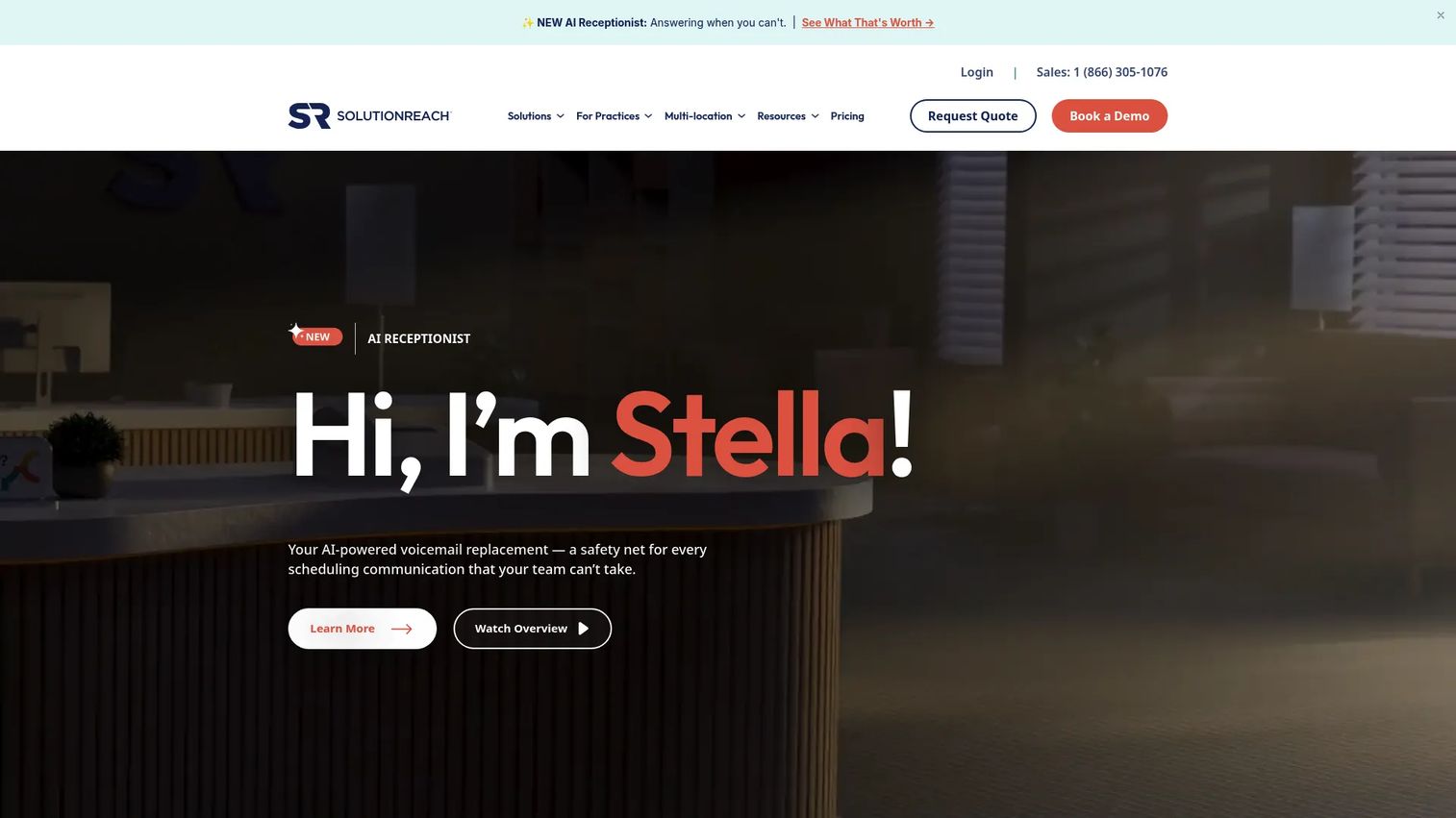
Solutionreach is a patient relationship management and communication platform for medical, dental, vision, and specialty practices. It automates appointment reminders, recall campaigns, two-way texting, patient newsletters, review requests, and online scheduling. The platform integrates with over 400 practice management and EHR systems, which makes it a practical choice for practices that want communication automation without replacing their core system.
Best for: Practices across medical, dental, and vision settings that need automated communication, recall workflows, and broad PM/EHR integration coverage.
Key features
- Appointment reminders and patient recall
- Two-way SMS texting
- Online patient scheduling and digital check-in
- Insurance verification and eligibility
- [400+ PM/EHR system integrations
Why choose Solutionreach: Solutionreach helps practices stay present before and after visits without manual front-desk follow-up. Its integration breadth is the main differentiator for practices running existing PM systems](https://www.solutionreach.com/platform/solutions-overview) they want to keep.
Solutionreach pricing: Solutionreach offers Patient Connect, Practice Efficiency, Practice Growth, and Enterprise packages. Pricing is quote-based across all tiers; yearly contract options are available. Request a quote through the vendor.
G2 rating: 4.3/5
7. SimplePractice
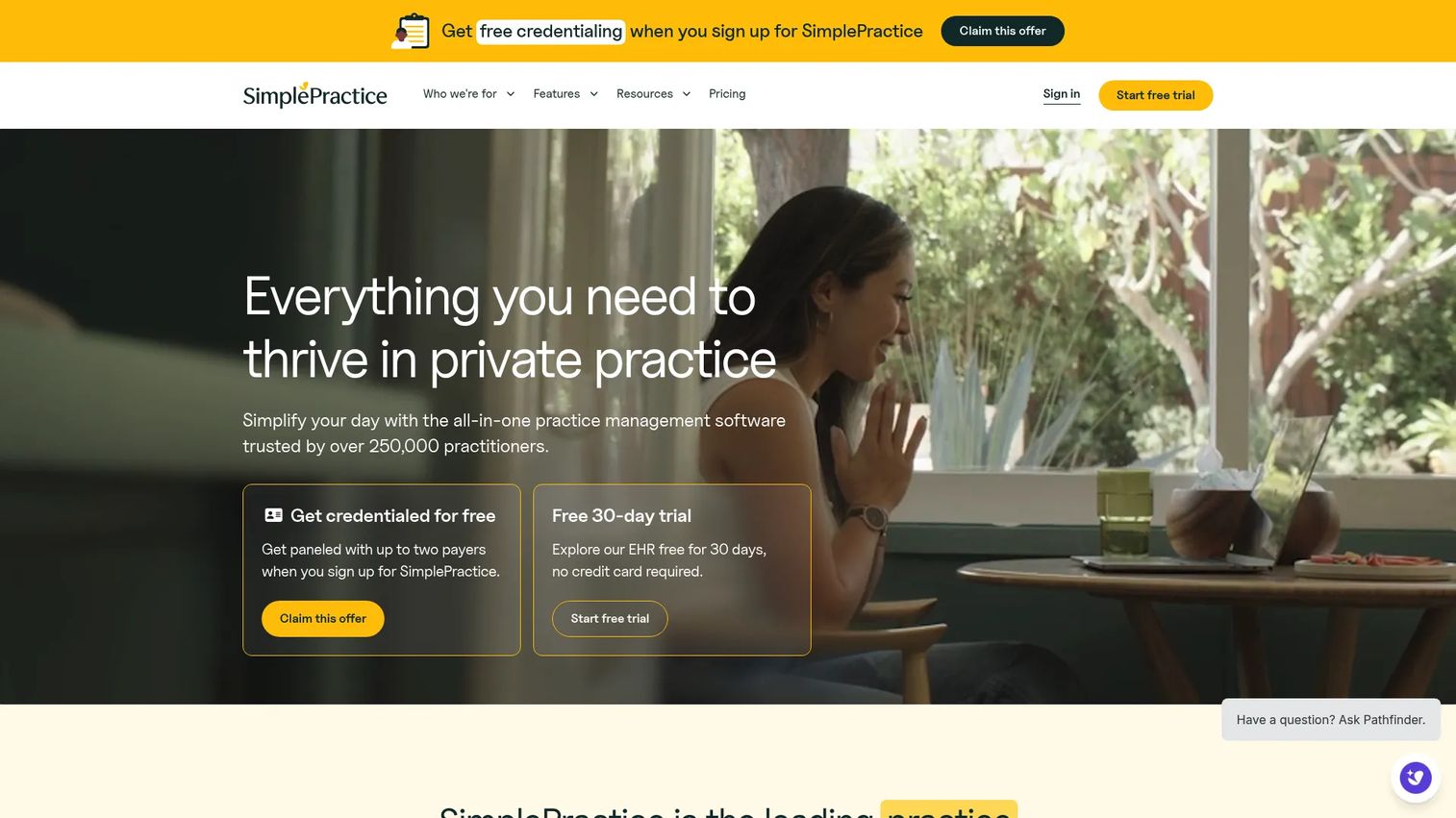
SimplePractice is practice management and EHR software built for therapists and wellness professionals. It combines client scheduling, HIPAA-compliant telehealth, digital paperwork, online payments, billing, and a client portal in one platform. A 30-day free trial is available, and promotional pricing may offer 50% off for the first three months for eligible new customers.
Best for: Solo therapists and small group practices in behavioral health, counseling, nutrition, and wellness that want an all-in-one practice management environment.
Key features
- Online appointment scheduling and client portal
- HIPAA-compliant telehealth
- Digital intake forms and paperless documentation
- Online payments and insurance billing
- Customizable note templates and clinical documentation
Why choose SimplePractice: SimplePractice is the right fit when a practice needs scheduling, telehealth, documentation, and billing in one platform rather than separate tools. It is less suited to complex enterprise patient experience programs, but for independent behavioral health providers it removes the need to manage multiple subscriptions.
SimplePractice pricing: Plans start at $49/month (Starter), $79/month (Essential), and $99/month (Plus), billed monthly. A 30-day free trial is available. Insurance billing and some add-ons carry separate fees.
G2 rating: 4.1/5
8. Intiveo
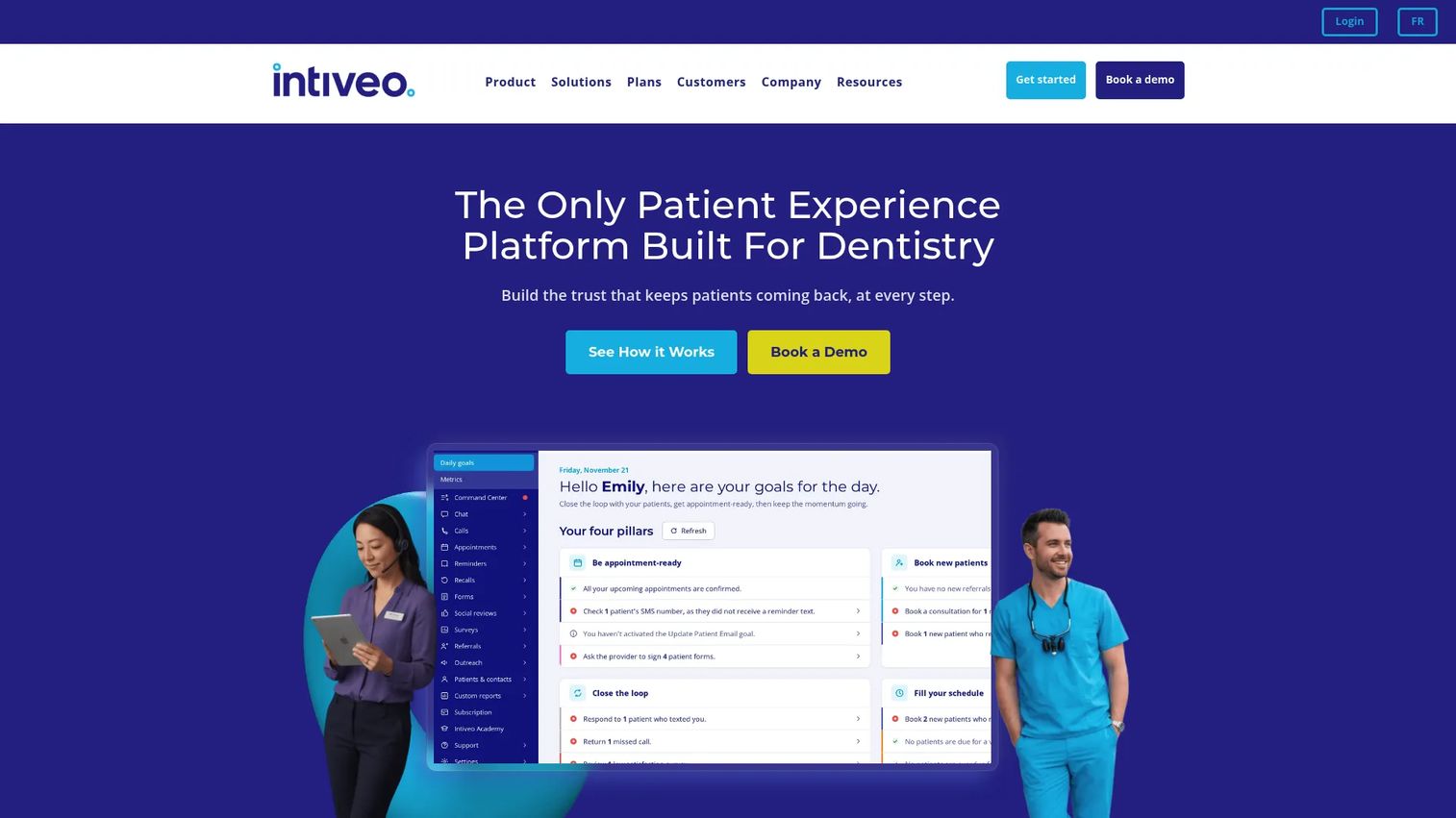
Intiveo is a patient experience and engagement platform purpose-built for dental practices and dental groups. It automates appointment reminders, recall messaging, two-way chat, digital forms, waitlist management, and referral coordination. The Command Center tier adds workflow goals and performance tracking across locations, making it relevant for multi-site dental organizations.
Best for: Dental practices and groups that want automated patient communication, recall automation, and dental-specific workflow tools.
Key features
- Automated dental reminders and patient recall
- Two-way patient chat and messaging
- Digital patient intake forms
- Waitlist automation and referral management
- Practice management system integrations
Why choose Intiveo: Intiveo is a stronger fit for dental teams than generic communication platforms when recall rate, hygiene appointment fill, and confirmation workflows are the primary revenue levers. Dental-specific workflows are built in rather than adapted from a general healthcare model.
Intiveo pricing: Intiveo Direct starts at $199/month (or $2,388/year) for single-location practices. Expand, Command, and Enterprise tiers are sold through sales; contact Intiveo for a quote on multi-location or DSO deployments.
G2 rating: 4.8/5
9. Adit
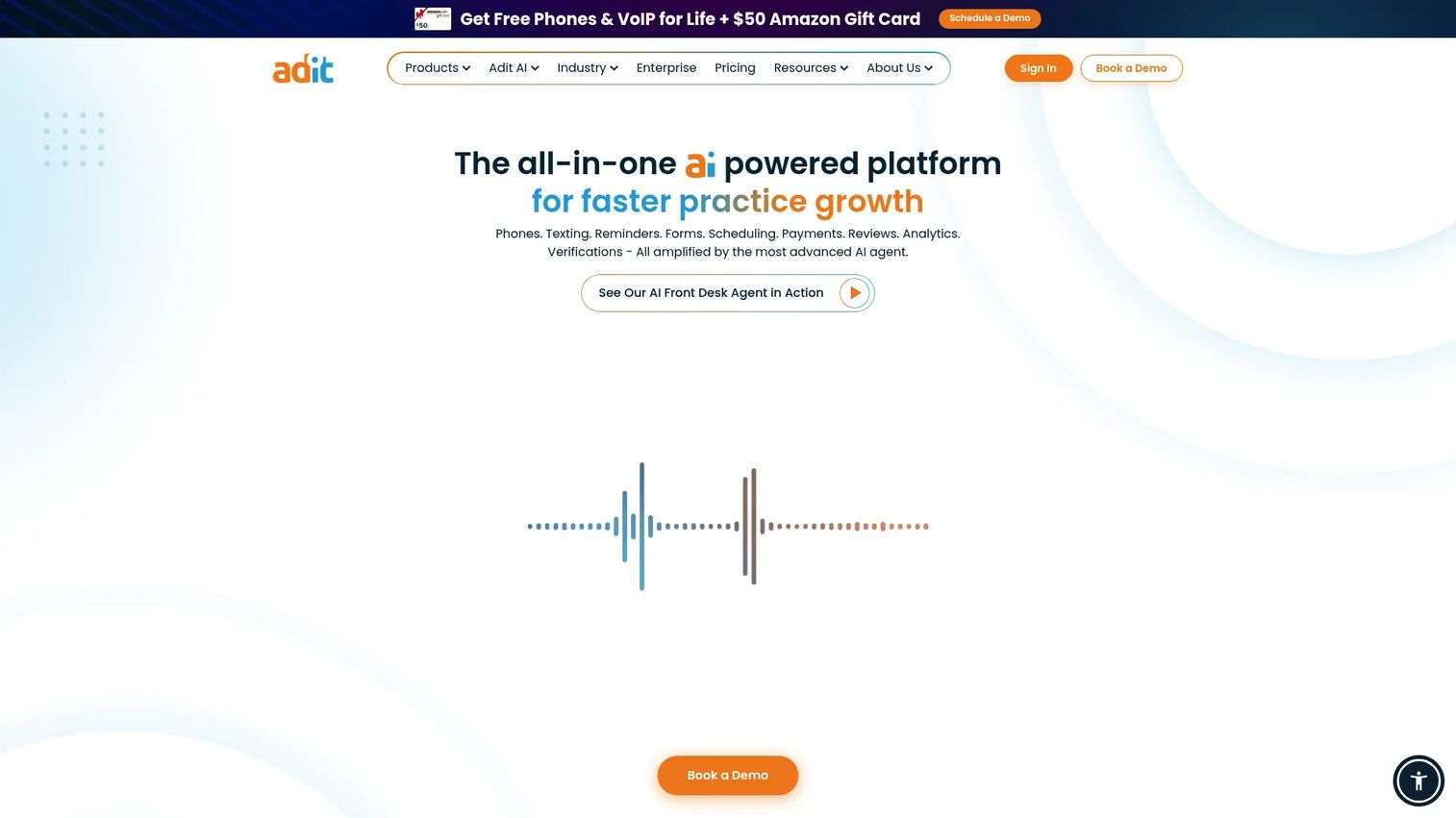
Adit is an AI-powered practice management and patient engagement platform for dental and healthcare practices. It combines voice, texting, email, internal chat, and eFax communications with digital forms, online scheduling, automated reminders, review management, payment collection, and insurance verification. AI Front Desk, AI Call Intelligence, and AI Webchat are included alongside a CRM layer.
Best for: Dental practices that want patient communication, growth tools, and revenue-cycle workflows consolidated in one AI-assisted platform.
Key features
- Voice, SMS, email, and eFax patient communications
- Digital forms, online scheduling, and automated reminders
- Review management and patient reputation tools
- Adit Pay payment processing and insurance verification
- AI Front Desk, AI Webchat, and CRM
Why choose Adit: Adit consolidates patient acquisition, experience, and reputation workflows for dental practices that want fewer vendor relationships. It is particularly relevant for practices where patient communication, online reviews, and revenue collection currently run in separate tools.
Adit pricing: Adit's core platform pricing is not displayed publicly. The vendor directs prospects to schedule a demo. Adit Pay processing runs at 2.25% + $0.20 for card-present and 2.90% + $0.30 for card-not-present transactions. Insurance verification packages start at $99/month. Contact Adit for platform pricing.
G2 rating: 4.8/5
10. Doctible
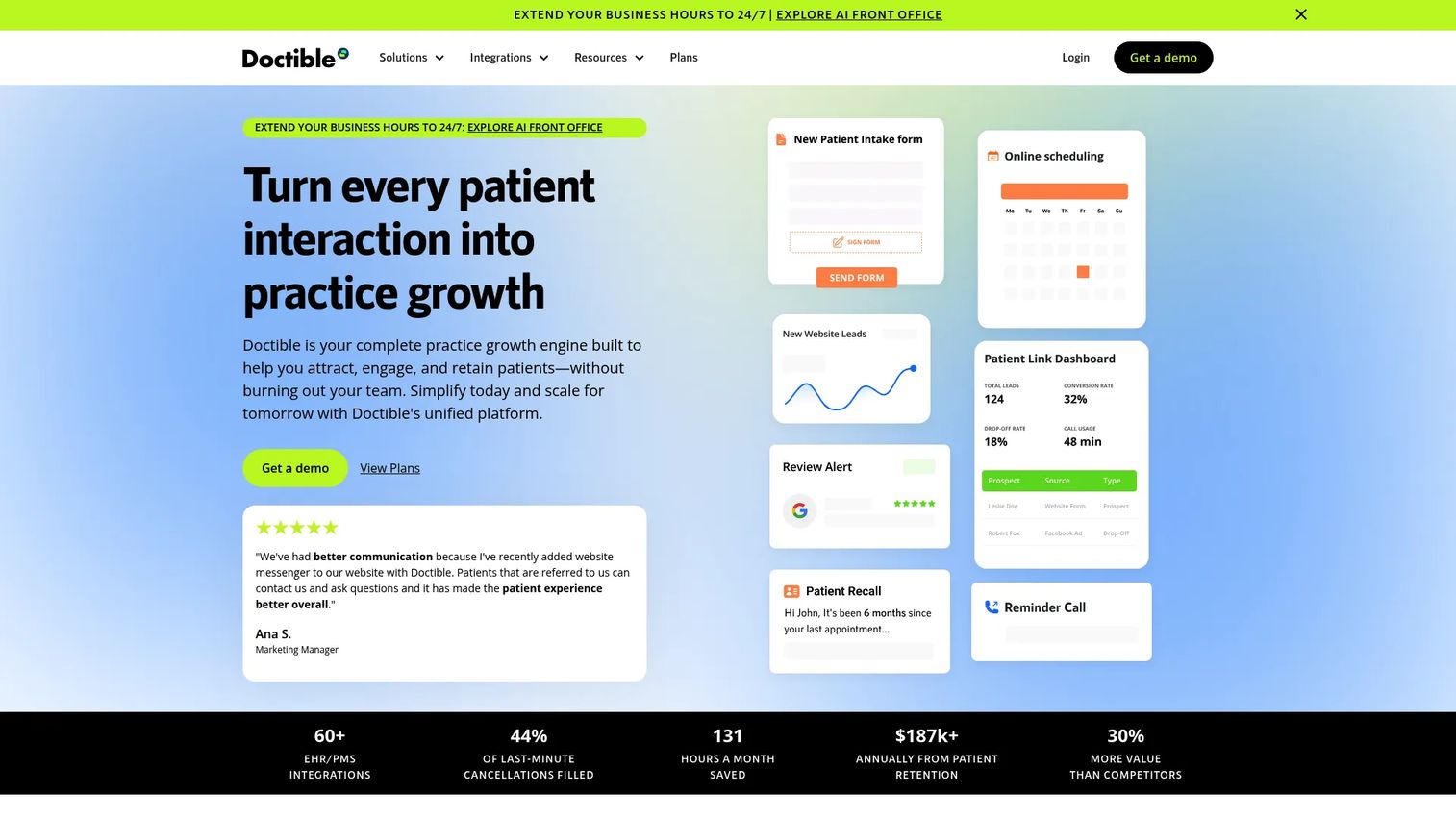
Doctible is a patient engagement and practice growth platform for dental, medical, chiropractic, orthodontic, and vision practices. It covers patient texting, automated voice and digital reminders, online appointment requests, digital forms, patient recall, review generation, and website chat. The Gold Plus tier adds appointment request workflows and an automated waitlist.
Best for: Practices where patient reviews, reputation management, and communication automation are the primary growth levers.
Key features
- Review requests and online reputation management
- Automated appointment reminders (voice and digital)
- Patient texting and two-way communication
- Online appointment requests and smart scheduling
- Patient recall and digital forms
Why choose Doctible: Doctible works well when a practice's primary problem is review volume and service recovery rather than clinical workflow complexity. Its reputation management and communication features are tightly paired, which gives practices a single place to track patient feedback and follow up.
Doctible pricing: Gold plans start at $199/month on an annual agreement or $249/month on a monthly agreement. Gold Plus is $299/month (annual) or $399/month (monthly). Platinum pricing requires a consultation.
G2 rating: 4.5/5
11. Pomelo Health
Pomelo Health is a digital patient engagement and communication platform for clinics and healthcare networks. It covers online booking, secure messaging, appointment reminders, digital forms, and broadcast patient communication. The platform is designed for provider networks that need communication workflows to scale beyond a single clinic location.
Best for: Clinics and provider networks that need centralized patient communication across multiple care sites.
Key features
- Online patient booking
- Secure two-way messaging
- Appointment reminders
- Digital forms and patient campaigns
- Broadcast communication tools
Why choose Pomelo Health: Pomelo Health suits organizations where patient communication needs to operate consistently across locations without requiring separate setups per clinic. It is a fit when the communication problem is larger than one office.
Pomelo Health pricing: Pricing is not displayed publicly. Contact Pomelo Health for a quote.
G2 rating: 3.5/5
12. Mend
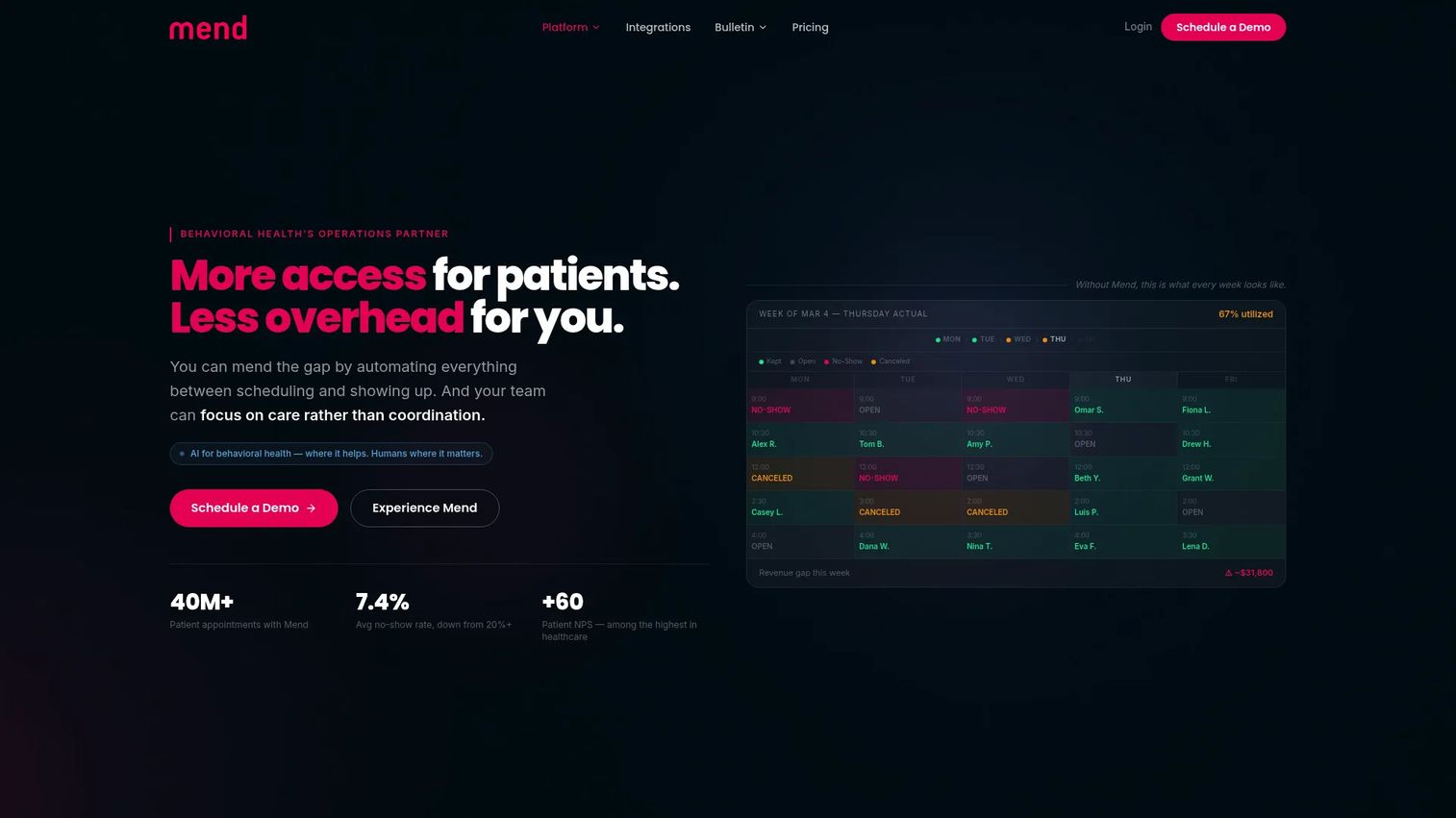
Mend is an AI-powered operations platform for behavioral health organizations. It automates patient outreach, appointment confirmation, digital intake, clinical screeners, insurance and copay collection, self-scheduling, no-show prediction, and capacity recovery. Its four product families, Engage, Access, Coordinate, and Signal, can be combined depending on organizational need.
Best for: Behavioral health organizations that need to reduce no-shows, fill open capacity, and automate patient workflows at scale.
Key features
- AI-powered no-show prediction and automated rescheduling
- Patient self-scheduling and smart waitlist management
- Digital intake, consent forms, and clinical screeners
- Insurance and copay collection at intake
- Bidirectional behavioral-health EHR integrations
Why choose Mend: Mend performs best in behavioral health settings where no-show rates and capacity utilization are the operational metrics that matter most. Its AI-driven outreach and rescheduling automation addresses a specific bottleneck that general-purpose communication tools do not optimize for.
Mend pricing: Pricing scales with the organization and is not displayed publicly. Contact Mend for a quote based on selected product families and deployment size.
13. Tebra
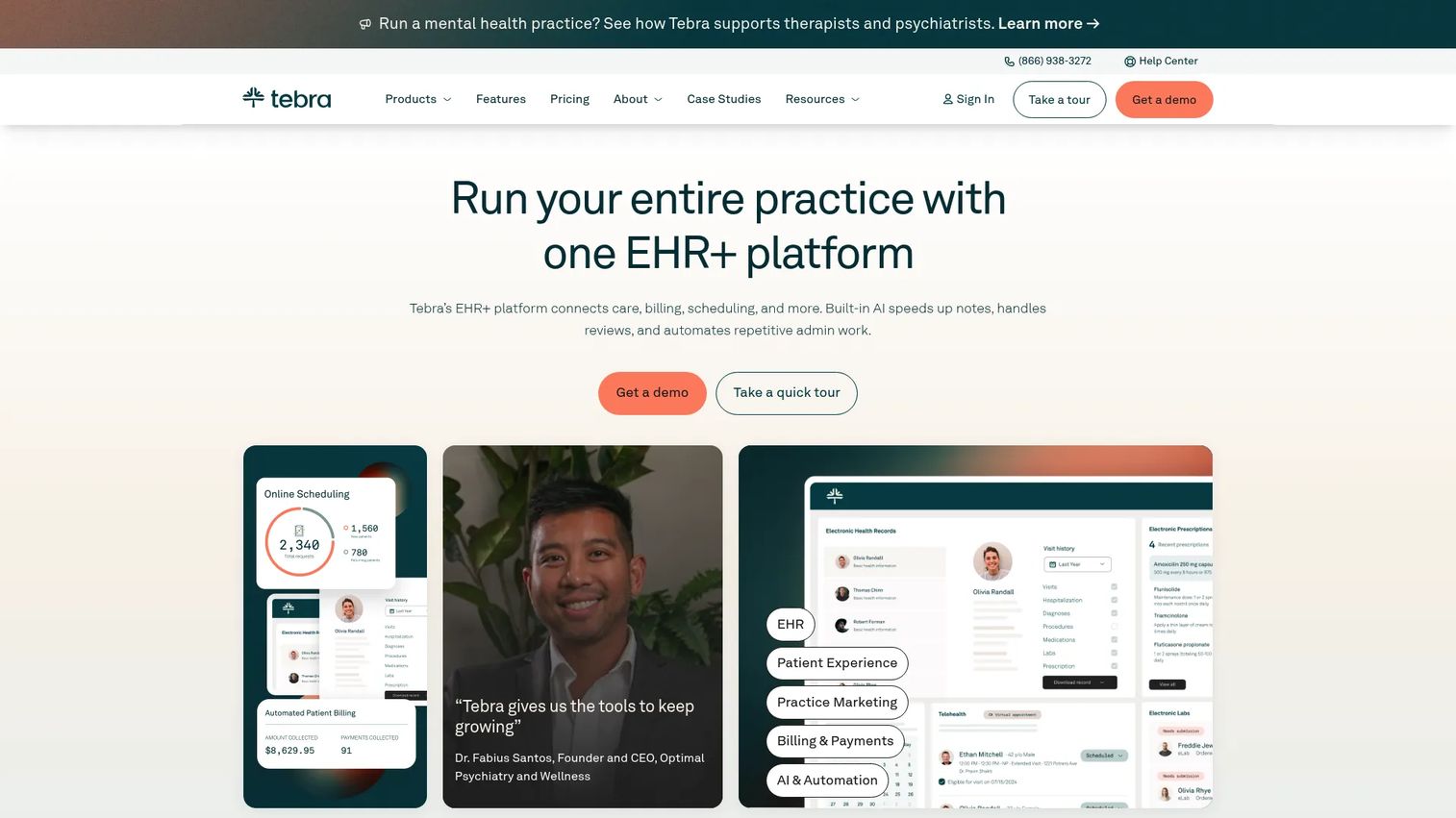
Tebra is an all-in-one operating system for independent healthcare practices. It combines EHR with AI-assisted charting, medical billing with denial management, online scheduling, digital intake, appointment reminders, secure messaging, telehealth, and reputation management. Three packages are available: All in One, EHR+, and EHR Starter.
Best for: Independent medical practices that need EHR, billing, patient engagement, and marketing tools without managing multiple vendor relationships.
Key features
- EHR with AI-assisted charting and e-prescribing
- Medical billing, eligibility checks, and denial management
- Online scheduling, digital intake, and appointment reminders
- Secure patient messaging and telehealth
- Reputation management and practice marketing
Why choose Tebra: Tebra gives independent practices a broader operating system rather than a narrow patient communication tool. For smaller teams managing billing, clinical documentation, and patient engagement across the same staff, consolidation reduces both cost and workflow complexity.
Tebra pricing: Package prices are not displayed publicly. Tebra lists All in One, EHR+, and EHR Starter as available packages; contact sales for pricing. Transaction and account-dependent fees are listed separately.
G2 rating: 4.1/5
14. athenahealth
athenahealth provides athenaOne, an integrated ambulatory care platform combining EHR, practice management, revenue cycle management, and patient engagement. Patient-facing features include portal access, secure messaging, online scheduling, payments, and telehealth. Pricing is structured as a percentage of organizational collections rather than a flat subscription.
Best for: Ambulatory care organizations that want patient engagement, clinical workflows, and revenue cycle management in a single networked platform.
Key features
- AI-native EHR with specialty-specific workflows and mobile access
- Medical billing, claim scrubbing, and denial management
- Patient portal, secure messaging, and online scheduling
- Telehealth and patient payment tools
- Population health and care coordination tools
Why choose athenahealth: athenahealth suits teams that want patient access to connect directly with the clinical and financial sides of care delivery. The networked model means benchmark data from similar practices is part of the value, not just the software itself.
athenahealth pricing: Pricing is a percentage of organizational collections, customized by practice size and services. Contact athenahealth for a specific proposal.
G2 rating: 3.6/5
15. eClinicalWorks
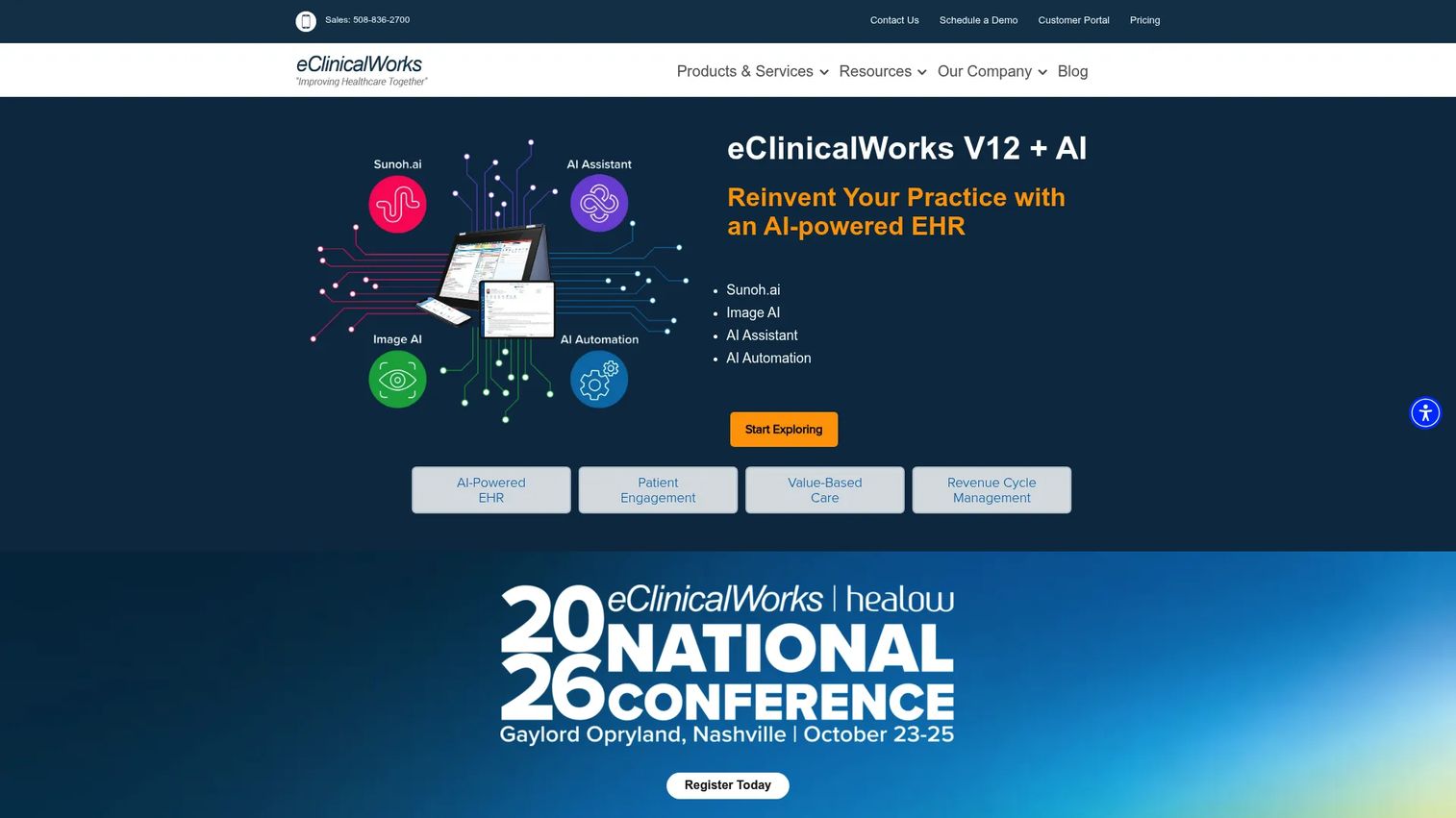
eClinicalWorks is a cloud-based healthcare IT platform offering EHR, practice management, patient engagement, population health, and revenue cycle management. Patient-facing tools include the healow patient portal, telehealth, mobile apps, and online booking. Sunoh.ai provides ambient AI clinical documentation inside the same environment.
Best for: Ambulatory practices that want patient engagement and clinical documentation tools built natively into their EHR rather than integrated from outside.
Key features
- Cloud EHR and practice management
- AI-powered clinical documentation with Sunoh.ai
- healow patient portal and mobile patient apps
- Telehealth and online booking
- Revenue cycle management and population health tools
Why choose eClinicalWorks: eClinicalWorks suits practices that do not want patient experience workflows split across external tools. The healow app gives patients self-service access without a separate engagement platform. The EHR-native approach simplifies governance and reduces integration management.
eClinicalWorks pricing: EHR Only is $499/month per provider. EHR with Practice Management is $599/month per provider. RCM as a Service is priced at 2.9% of practice collections. No startup costs are listed for standard plans.
G2 rating: 3.7/5
16. NextGen Enterprise
NextGen Enterprise is an enterprise EHR and practice management platform for mid-size to large ambulatory healthcare practices. It includes patient portal, self-scheduling, virtual visits, online payments, specialty-specific clinical workflows, analytics, and interoperability tools. The platform addresses both the patient-facing and back-office sides of specialty practice operations.
Best for: Specialty and ambulatory practices with complex clinical workflows that need integrated patient engagement, analytics, and interoperability tools.
Key features
- Integrated EHR and practice management
- Patient portal, self-scheduling, and virtual visits
- Specialty-specific clinical workflows
- Analytics and reporting
- Interoperability and cross-provider data exchange
Why choose NextGen Enterprise: NextGen Enterprise is relevant when generic engagement software cannot carry the clinical and operational complexity of a specialty practice. Its specialty-specific workflows are a differentiator for orthopedics, dermatology, cardiology, and similar settings.
NextGen pricing: Custom pricing. Contact NextGen for a tailored proposal based on specialty, size, and required modules.
17. Curve Dental
Curve Dental is a cloud-based, all-in-one dental practice management platform covering scheduling, charting, native cloud imaging, insurance billing, treatment planning, payment processing, patient engagement, automated reminders, and ambient clinical AI. The platform is built as a complete dental operating environment rather than a communication layer added to an existing system.
Best for: Dental practices that want a cloud-first practice management environment where patient communication and clinical workflows share the same data.
Key features
- Dental scheduling, self-scheduling, and automated reminders
- Clinical charting, perio charting, and native cloud imaging
- Insurance billing, eligibility verification, and treatment planning
- Patient engagement and smart online forms
- Business analytics and ambient clinical AI
Why choose Curve Dental: Curve Dental suits practices transitioning from server-based systems or looking to consolidate imaging, billing, and patient communication under one cloud platform. Patient experience features are native rather than added on, so data consistency is stronger.
Curve Dental pricing: Quote-based. The pricing page directs prospects to schedule a demo. Contact Curve Dental for a practice-specific proposal.
G2 rating: 4.6/5
18. Dentrix
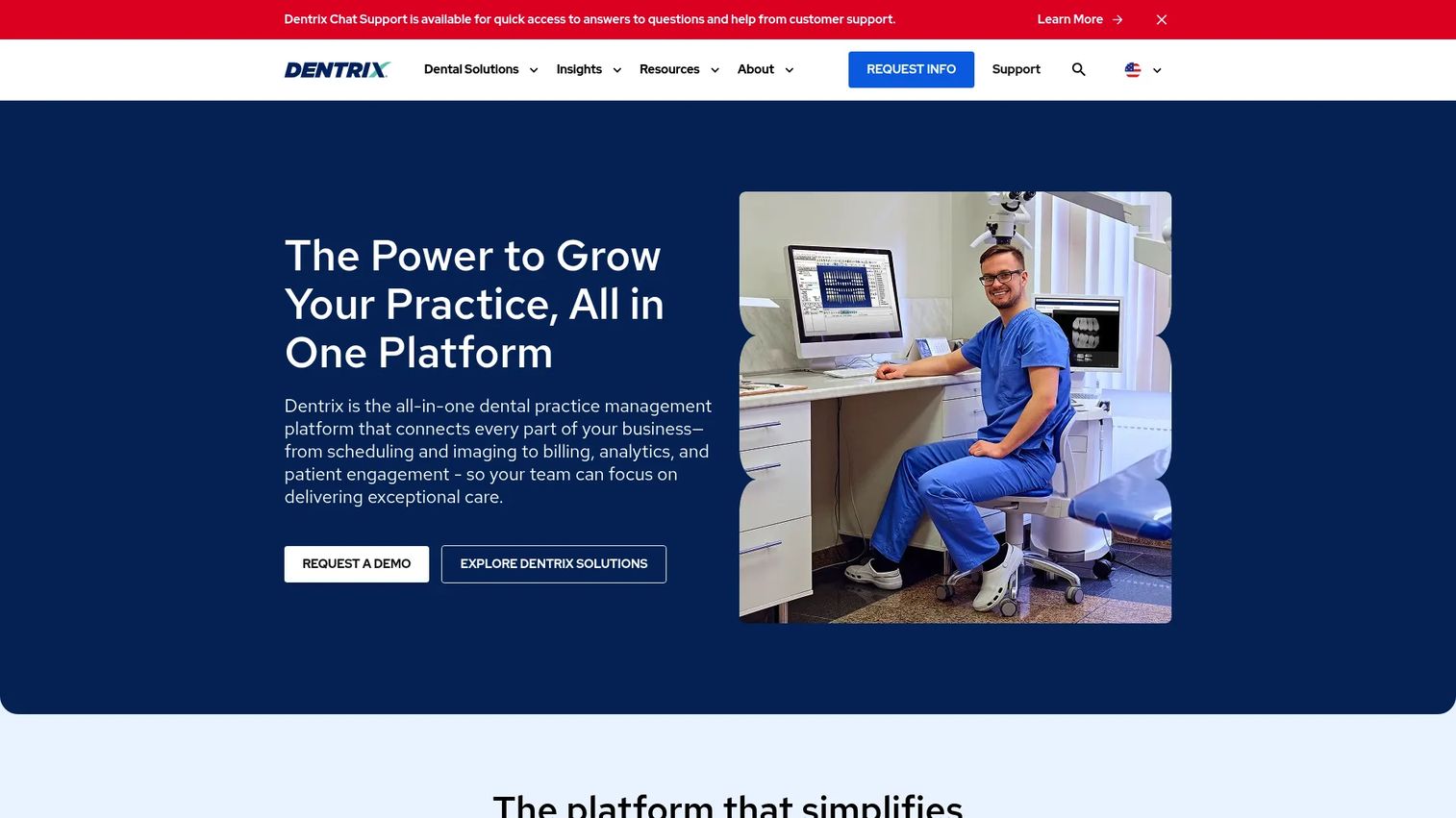
Dentrix is an all-in-one dental practice management software covering scheduling, insurance billing, AI-powered caries detection, integrated imaging, digital patient intake, treatment planning, and patient communication. Three packages are available: Essentials, Pro, and Accelerate. A broad add-on ecosystem and a large established user base make it one of the most widely deployed dental practice management systems.
Best for: Established dental practices that want a mature, broadly adopted dental practice management environment with a large partner ecosystem.
Key features
- Dental scheduling and treatment planning
- Insurance eligibility, claims, and billing workflows
- Integrated imaging and AI-powered caries detection
- Digital patient intake forms and online scheduling
- Practice analytics and reporting
Why choose Dentrix: Dentrix fits practices that value a mature system with deep third-party integrations and a large support community. If your staff already knows Dentrix, the ecosystem of add-ons makes it easier to extend patient communication capabilities incrementally.
Dentrix pricing: Essentials, Pro, and Accelerate packages are available. Package prices are not displayed publicly; contact Dentrix for a quote.
G2 rating: 4.1/5
19. tab32
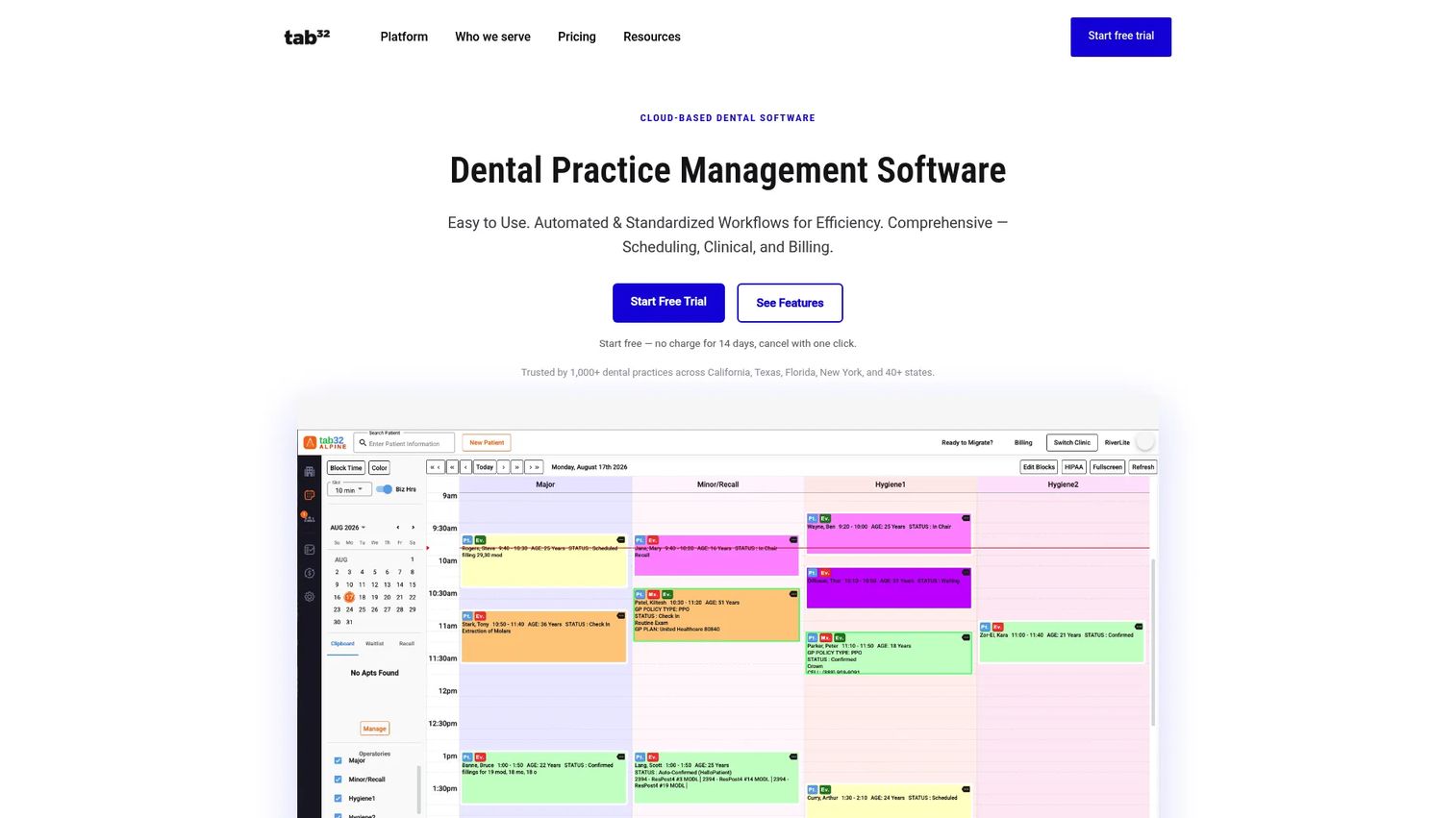
tab32 is a cloud-based dental practice management platform for practices and DSOs. It combines scheduling, clinical charting, digital imaging, billing, AI-powered eligibility verification, voice documentation, patient communication, two-way messaging, digital forms, and real-time analytics. The Summit tier adds centralized multi-location reporting, cross-location scheduling, and dedicated account management.
Best for: Dental groups and DSOs that need a cloud-native platform capable of standardizing operations and patient workflows across multiple locations.
Key features
- Cloud dental scheduling and online booking
- Clinical charting, treatment planning, and digital imaging
- AI-powered eligibility verification and payment posting
- Patient communication, reminders, and digital forms
- Multi-location analytics and centralized management (Summit tier)
Why choose tab32: tab32 suits DSOs and multi-location groups where a single system controlling operations across sites is more valuable than best-of-breed point tools. A 14-day free trial is available.
tab32 pricing: Alpine Start-Up is $125/month in Year 1, then $225/month from Year 2, for up to three providers. Alpine Established Practice is $225/month for up to five providers. Summit (large group) pricing is custom.
G2 rating: 4.5/5
20. Open Dental
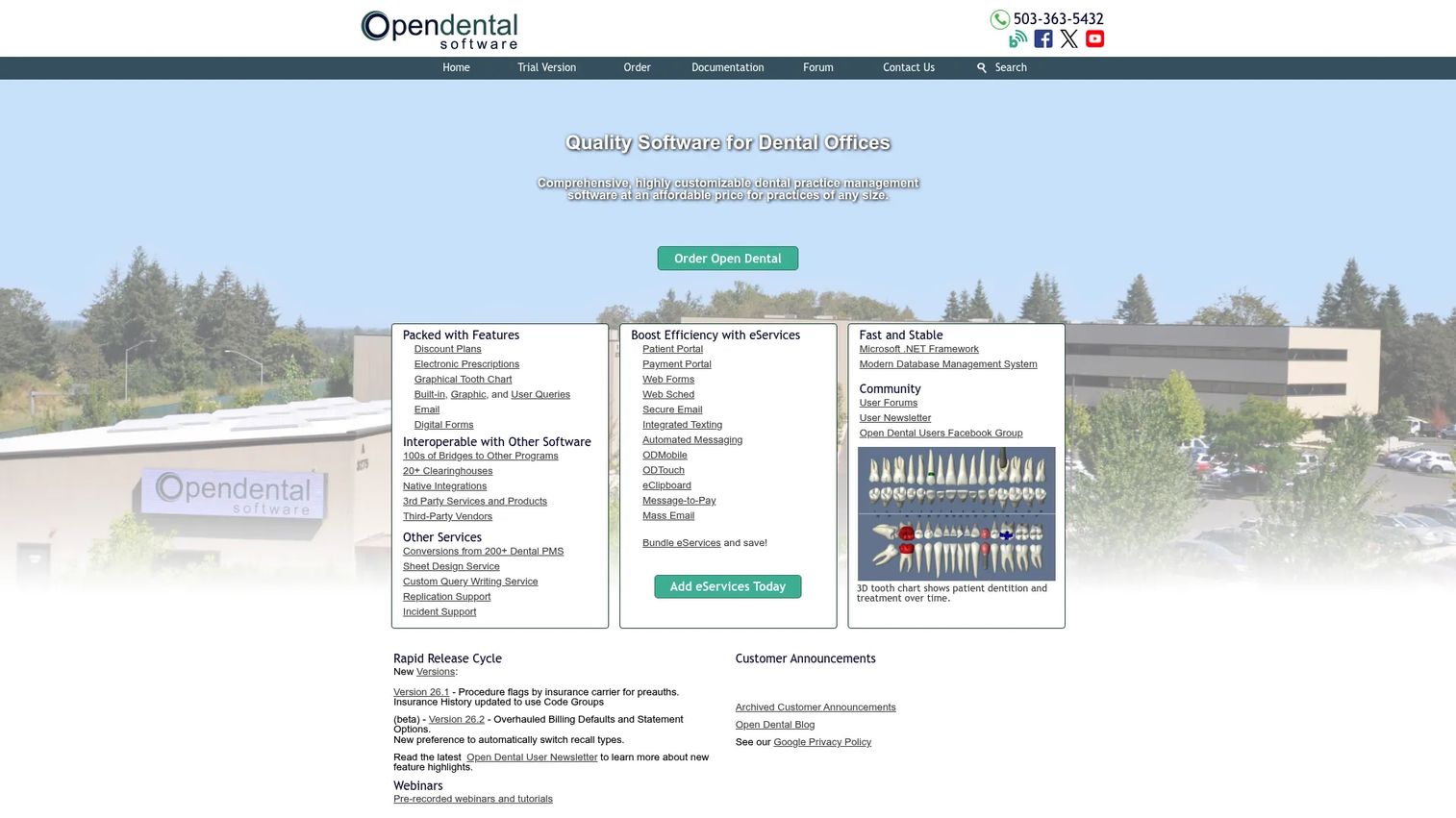
Open Dental is dental practice management software with scheduling, clinical charting, insurance and treatment planning, patient portal, integrated texting, digital forms, web scheduling, electronic prescriptions, and a wide range of third-party integrations. Its open-source foundation gives practices control over customization and integration choices that proprietary platforms typically restrict.
Best for: Cost-conscious dental practices that want flexibility, broad integration options, and control over their practice management environment.
Key features
- Graphical tooth chart and clinical charting
- Patient portal and integrated texting
- Web scheduling and digital forms
- Insurance and treatment planning
- Electronic prescriptions and third-party integrations
Why choose Open Dental: Open Dental works well when a practice wants to control their integration stack and avoid per-module fees for capabilities they can add through third-party tools. The pricing structure is predictable and location-based.
Open Dental pricing: $199/month per location on a 12-month contract, reduced to $149/month after 12 consecutive months. Developing country and dental school deployments are available at no cost.
21. Marketing 360
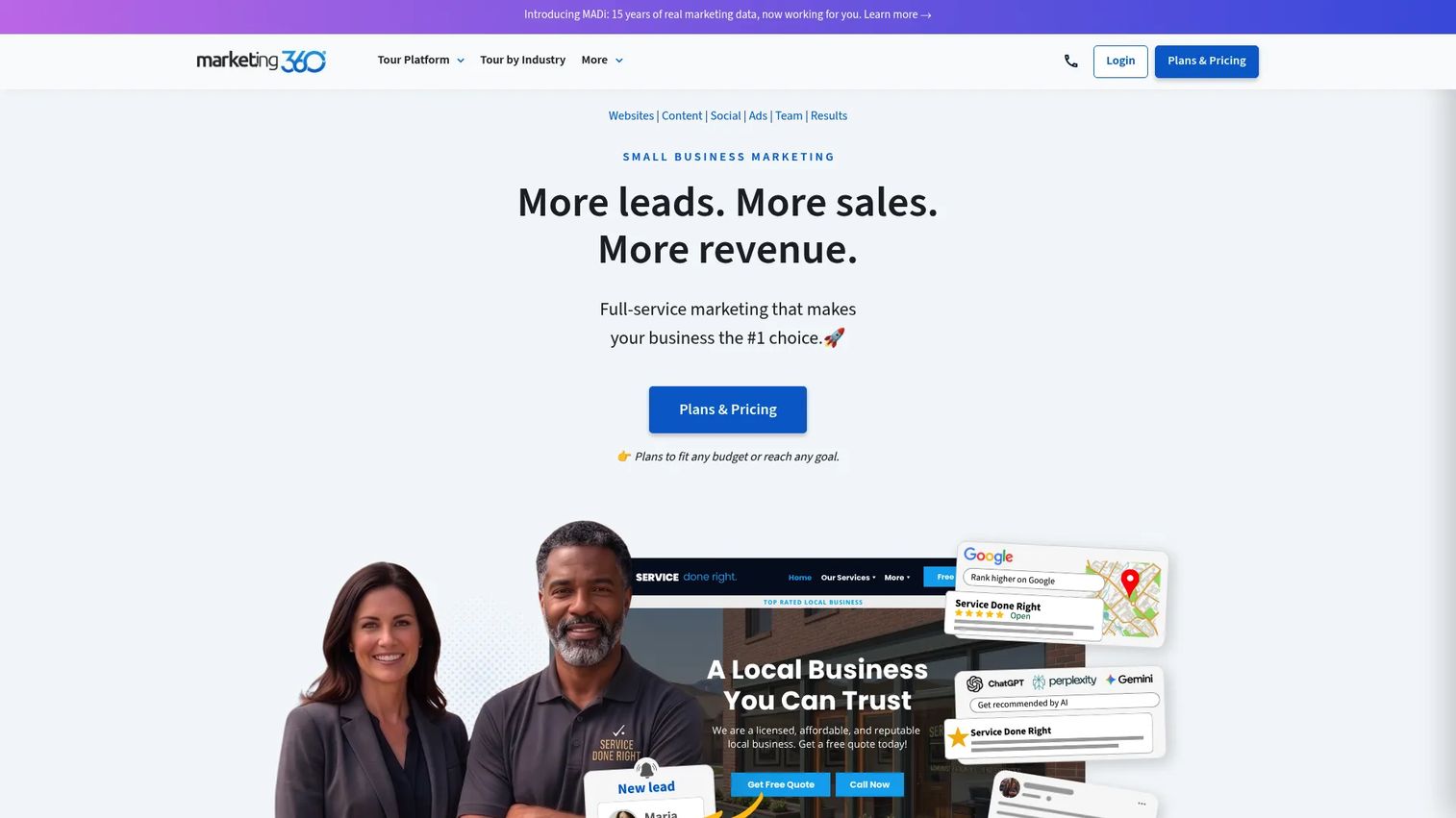
Marketing 360 is a small business marketing and CRM platform that includes website management, email marketing, paid advertising, social media management, SEO, listings, reputation management, and campaign reporting. For healthcare practices, it addresses the front end of patient acquisition and reputation rather than clinical or operational engagement.
Best for: Healthcare practices focused on patient acquisition, online marketing, and reputation management rather than clinical patient experience workflows.
Key features
- CRM for contacts, leads, and deals
- Website and e-commerce tools
- Email marketing, paid ads, and social media management
- Reputation management and review tools
- SEO, listings, and campaign reporting
Why choose Marketing 360: Marketing 360 belongs on the list for practices that define patient experience from the first marketing touchpoint. It does not cover scheduling, intake, or clinical communication, but for practices where patient acquisition and online reputation are the primary gaps, it covers ground that clinical tools do not.
Marketing 360 pricing: Essentials is $65/month on a 12-month term. Full Platform is $495/month on a 6-month term. Professional is $1,295/month. A Lite archive plan at $12/year is available after completing an initial term.
G2 rating: 3.5/5
Considerations when choosing patient experience software
Match the tool to your care setting
A dental recall workflow is not the same as an enterprise digital front door. Hospitals need bedside engagement and portal access integrated with clinical data. Dental groups need recall automation tied to procedure-specific messaging. Behavioral health practices need secure, asynchronous communication. Start by identifying your setting before evaluating features.
Verify EHR and practice management integration
Name the specific system you need to connect to, then confirm sync direction, the data fields exchanged, and how errors are handled. Generic integration claims often mask limitations around write-back rules, data latency, and support ownership. Ask vendors to demonstrate the specific integration before signing.
Separate engagement from experience intelligence
Scheduling and reminders improve access metrics. Surveys, reviews, and analytics reveal where the experience breaks. Some organizations need both, but tools tend to be stronger on one side. If your current problem is call volume, focus on access tools first. If your problem is retention and satisfaction, prioritize feedback software with routing and reporting capabilities.
Check governance and compliance requirements
Patient messaging, consent workflows, and data handling all carry compliance implications. Ask vendors about audit trails, access controls, message template governance, and consent documentation. This is particularly relevant for behavioral health, where communication privacy requirements are stricter than in general medical settings.
Baseline operational metrics before rollout
Measure call volume, no-show rate, intake completion time, payment collection, patient satisfaction scores, and review volume before selecting a platform. This baseline is what gives your team proof points to defend the investment and assess whether the tool is actually moving the numbers that matter.
Conclusion
The right patient experience software depends on where friction shows up first in your specific care setting. For a clear shortlist, work through these decisions:
Choose NexHealth if the priority is modern scheduling, intake, reminders, and reviews across medical or dental workflows. Choose Epic Systems for enterprise digital front door within an existing Epic environment. Choose Phreesia if intake and payment friction are the primary operational bottlenecks. Choose Relias Experience Management when feedback and analytics matter more than access automation. For dental-specific operations, Intiveo, Solutionreach, Curve Dental, Dentrix, tab32, and Open Dental each serve different practice sizes and workflow priorities. SimplePractice and Tebra are the strongest fits for independent practices that need operations and engagement together.
The practical next step is to shortlist three tools based on your care setting, the EHR or practice management system you cannot replace, and the one metric, whether it is call volume, no-show rate, or patient satisfaction score, that needs to move first. Build your evaluation criteria around that metric, and you will make a decision you can explain to leadership with proof points attached.
Looking to understand how healthcare software vendors present complex products to their own buyers? See how marketing automation tools and marketing analytics software fit into the broader go-to-market stack for SaaS companies in this space.
FAQs
Patient experience software helps healthcare organizations manage digital interactions across the patient journey, covering scheduling, intake, messaging, portals, feedback, payments, and engagement. It sits between the patient and the clinical or administrative system of record. Most platforms automate repetitive communication tasks while giving practices visibility into how patients are experiencing care.
Patient engagement software focuses on outreach, activation, and interaction, primarily reminders, recalls, and portal messaging. Patient experience software covers the broader journey, including access, financial touchpoints, service recovery, and satisfaction measurement. The two categories overlap significantly, and many platforms include both types of capability.
Dental practices typically need scheduling, automated reminders, recall automation, review generation, and integration with their dental practice management system. NexHealth, Solutionreach, and Intiveo focus on dental patient communication. Adit and Doctible add marketing and reputation tools. Curve Dental, Dentrix, tab32, and Open Dental are practice management platforms that include patient-facing workflows alongside clinical and billing operations.
Hospitals and large health systems need a digital front door strategy that includes patient portal, online scheduling, bedside engagement, financial experience, and remote monitoring. Epic Systems covers all of these inside an integrated EHR environment. Luma Health addresses patient access and communication for health systems that want a layer on top of existing EHR workflows.
Core features to evaluate include online scheduling and self-scheduling, digital intake and pre-visit registration, appointment reminders, two-way patient messaging, patient portal access, feedback and survey collection, review generation, payment collection, analytics and reporting, and bidirectional EHR or practice management integration. The right combination depends on which workflows are currently causing the most friction.
Pricing varies by organization size, care setting, selected modules, user count, message volume, and contract terms. Purpose-built platforms like Intiveo and Doctible publish starting prices around $199/month for single practices. EHR-native platforms like eClinicalWorks start at $499/month per provider. Enterprise systems like Epic and Luma Health are sold through custom contracts. Always compare the full cost: Implementation, training, per-message fees, and support are often separate from the base subscription.
Start with a baseline before rollout. Track call volume, no-show rate, appointment conversion, intake completion time, payment collection rate, patient satisfaction scores, and review volume. Compare the same metrics six and twelve months after implementation. Operational staff hours saved on scheduling and intake are often the fastest wins. Retention and review volume improvements typically show up over a longer horizon.
Most major patient experience platforms integrate with at least some EHR and practice management systems, but integration depth varies significantly. Some platforms offer bidirectional sync; others only pull appointment data in one direction. Before signing, confirm which EHRs are supported, what data fields are exchanged, how often data syncs, and who owns support when the integration breaks. EHR-native platforms like athenahealth and eClinicalWorks eliminate the integration challenge by including patient engagement inside the same environment.