
A customer opens your email, then gets a text that contradicts it, then receives a printed statement formatted like it came from a different company. Three channels, three voices, one frustrated person. That fragmentation is exactly what customer communications management software exists to fix. Most teams patch it with separate tools for print, email, SMS, and in-app messages, then spend hours reconciling templates by hand.
The cost adds up fast. The global CCM market sits at USD 2.31 billion in 2025 and is projected to reach USD 5.29 billion by 2032, according to global CCM market size and forecast data. That growth tracks a simple shift: customers expect personalized cross-channel experiences, consistent and on-brand, regardless of channel. Manual processes cannot keep pace with that expectation at scale.
For the customer success and CX teams reading this, the stakes are concrete. Inconsistent communications create support tickets, erode trust, and slow time-to-value during onboarding. A customer communications management platform centralizes composition, delivery, and compliance so the same message reaches the same person the same way, every time. The right setup also frees your team from re-explaining the basics and lets you focus on the accounts that need a human touch. Pairing written communications with interactive product tours can further reduce repetitive education during onboarding.
This guide breaks down 12 of the strongest CCM platforms for 2026. Each entry includes who it fits, what it does well, and what it costs where pricing is public.
What's inside
This guide is for CCM buyers, CX and operations leaders, and customer-facing teams (including customer success managers) who need to standardize how their company communicates. We evaluated each customer communication management solution against four criteria that matter most for real-world buying decisions:
- Omnichannel delivery breadth: support for print, email, SMS, web, mobile, and emerging channels.
- Personalization and data integration depth: how well the platform pulls from CRM, ERP, and legacy systems to tailor content.
- Compliance, governance, and accessibility: audit trails, approval workflows, and accessible output for regulated industries.
- Ease of use for business users: how much non-technical teams can do without IT cycles.
Pricing and ratings reflect publicly available sources at the time of writing. Verify current figures with each vendor before you buy.
TL;DR
Short on time? Here are the quick picks by buyer type:
- Best for large regulated enterprises: Quadient Inspire and OpenText Communications (Exstream) lead on omnichannel composition and compliance depth.
- Best for cloud-native omnichannel CCM: Smart Communications (SmartCOMM) and Doxee handle digital-first delivery at scale.
- Best for AI-assisted business-user authoring: Messagepoint gives non-technical teams content control with readability and plain-language tooling.
- Best for Salesforce-native document generation: Conga Composer and Nintex DocGen generate data-rich documents inside existing workflows.
- Best for secure digital delivery: Striata specializes in encrypted bills, statements, and messages.
- Best for ERP-integrated output management: Lasernet connects document generation to Dynamics, banking cores, and legacy systems.
What is customer communications management software?
Customer communications management software is a platform for creating, personalizing, delivering, and tracking customer communications across print and digital channels from a single system. It replaces the scattered mix of word processors, email tools, and print vendors that most companies use to produce statements, policies, onboarding messages, and notifications.
The category is sometimes shortened to CCM software or software CCM in vendor materials. At its core, a CCM platform standardizes how a company speaks to customers so that every message stays consistent, compliant, and on-brand, no matter where it lands.
Core capabilities of a customer communications management platform include:
- Content and document composition: centralized template design with version-controlled content libraries and reusable components.
- Omnichannel delivery: output across print, email, SMS, web, mobile, and digital channels from one source.
- Data integration: connections to CRM, ERP, DAM, and legacy systems that feed accurate customer data into each communication.
- Personalization: dynamic content that adapts to the recipient, segment, or account.
- Workflow orchestration and output management: approval routing, proofing, and batch or on-demand generation.
- Compliance, auditability, and accessibility: audit trails, version control, and accessible document output for regulated communications.
- Analytics: visibility into delivery, engagement, and communication performance.
The difference between a CCM platform and a generic email tool is scope. A marketing email tool sends campaigns. A CCM solution composes a regulated insurance policy, personalizes it per policyholder, routes it through legal approval, delivers it by mail and email, and keeps an audit record of the whole process. That operational and compliance depth is what defines the category and separates serious CCM solutions from lightweight messaging apps. For teams comparing campaign-focused tools, our roundup of the best email marketing software tools covers the marketing side of the equation.
For regulated industries like banking and insurance (banking, insurance, healthcare, utilities, telecom), a customer communication platform is not a convenience. It is the system of record for every customer-facing document the company produces.
When to use customer communications management software
Not every team needs a full CCM platform. These three scenarios signal that you do.
Unify customer messaging across every channel
When customers receive disconnected messages (an email that says one thing, a letter that says another), you have a coordination problem, not a content problem. A CCM platform replaces siloed email, SMS, and print tools with one orchestration layer. You compose once and deliver everywhere, so the same customer sees the same message in the same voice across channels. Teams that lean heavily on text outreach may also evaluate dedicated SMS marketing software alongside a CCM platform.
Stay compliant in regulated communications
Banking, insurance, and healthcare communications carry legal weight. A CCM solution gives you audit trails, approval workflows, version control, and accessible output so every document meets regulatory standards. When an auditor asks who approved a policy change and when, the answer is one click away instead of buried in email threads.
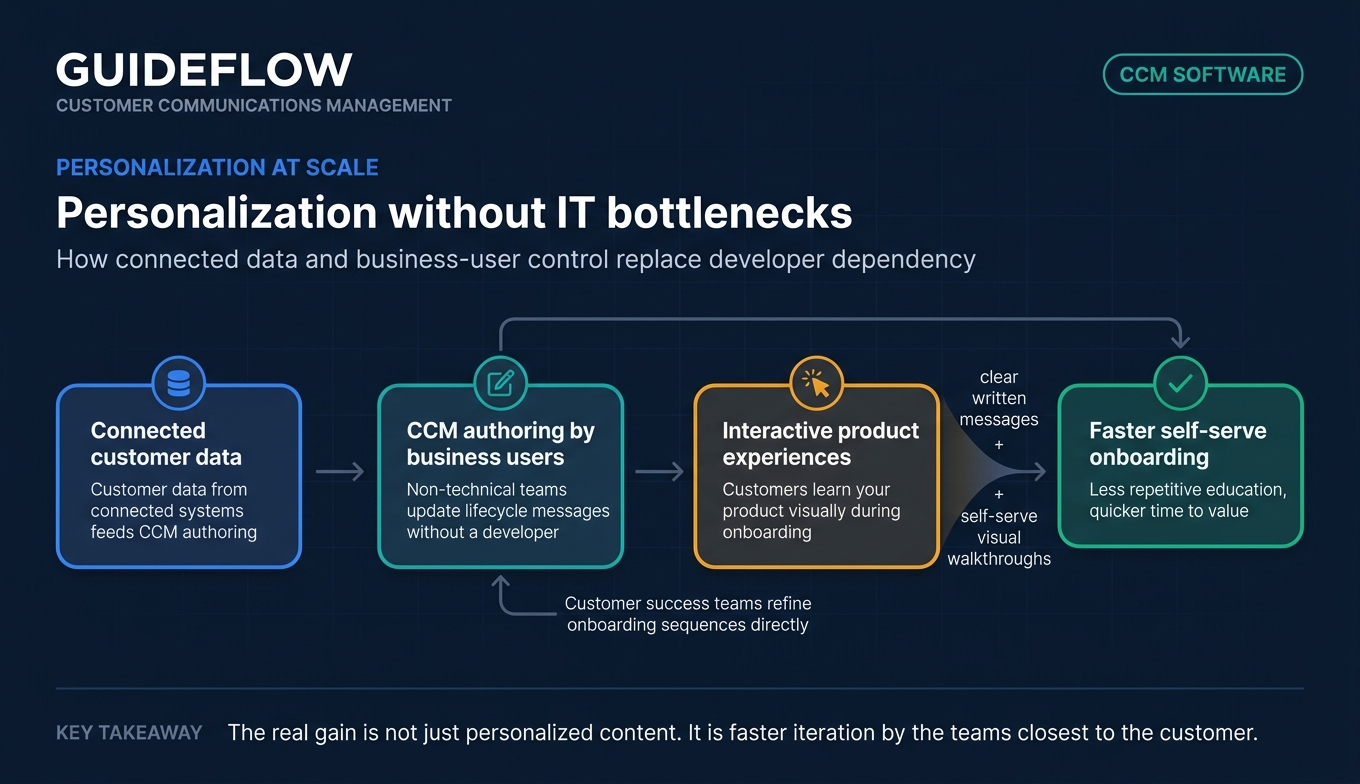
Personalize at scale without IT bottlenecks
Most personalization stalls because business users cannot update communications without a developer. Modern CCM solutions hand authoring control to non-technical teams using customer data from connected systems. Customer success teams can refine onboarding sequences and lifecycle messages directly. This pairs well with interactive product experiences, which complement written communications by letting customers learn your product visually during onboarding. Together, clear written messages and self-serve visual walkthroughs reduce repetitive education and speed up customer onboarding. Dedicated personalization software can also help tailor content per recipient or segment.
Customer communications management software comparison
The table below summarizes all 12 tools by intent, primary use case, pricing, and G2 rating where available. Most enterprise CCM vendors use quote-based pricing, so several entries list custom pricing. Always confirm current figures and ratings with the vendor before shortlisting.
| # | Product | Intent | Key use case | Pricing | G2 rating |
|---|---|---|---|---|---|
| 1 | Quadient Inspire | Enterprise omnichannel CCM | Personalized, compliant communications across digital and print | Custom pricing | 4.8/5 |
| 2 | OpenText Communications (Exstream) | Enterprise document automation | High-volume, AI-assisted communications | Custom pricing | 4.8/5 |
| 3 | Smart Communications (SmartCOMM) | Cloud-native CCM | Regulated, omnichannel customer communications | Custom pricing | 4.7/5 |
| 4 | Adobe Experience Manager Forms | Forms-led CCM | Digital enrollment, onboarding, and forms | Custom pricing | 4.2/5 |
| 5 | Messagepoint | AI content-intelligence CCM | Business-user authoring for regulated content | Custom pricing | 4.1/5 |
| 6 | Doxee | Digital-first CCM/CXM | Interactive documents, video, and omnichannel | Custom pricing | Not available |
| 7 | Conga Composer | Document generation | Salesforce-native document automation | Custom pricing | 4.4/5 |
| 8 | Nintex DocGen | Document automation | Workflow-driven document generation | From $15,000/year | 4.3/5 |
| 9 | Striata | Secure digital delivery | Encrypted bills, statements, and messages | Custom pricing | 4.8/5 |
| 10 | Lasernet | Output management | ERP-integrated document generation | Custom pricing | 5.0/5 |
| 11 | UniServe NXT | Digital CCM/CXM suite | Telecom and BFSI omnichannel communications | Custom pricing | Not available |
| 12 | Papyrus Platform | Inbound/outbound CCM | Document framework and process automation | Custom pricing | Not available |
The 12 best customer communications management software tools 2026
Each section below covers what the tool does, who it fits, its key strengths, and pricing where it is public. Use the comparison table above to narrow your shortlist, then read the full entries for the two or three that match your needs.
1. Quadient Inspire
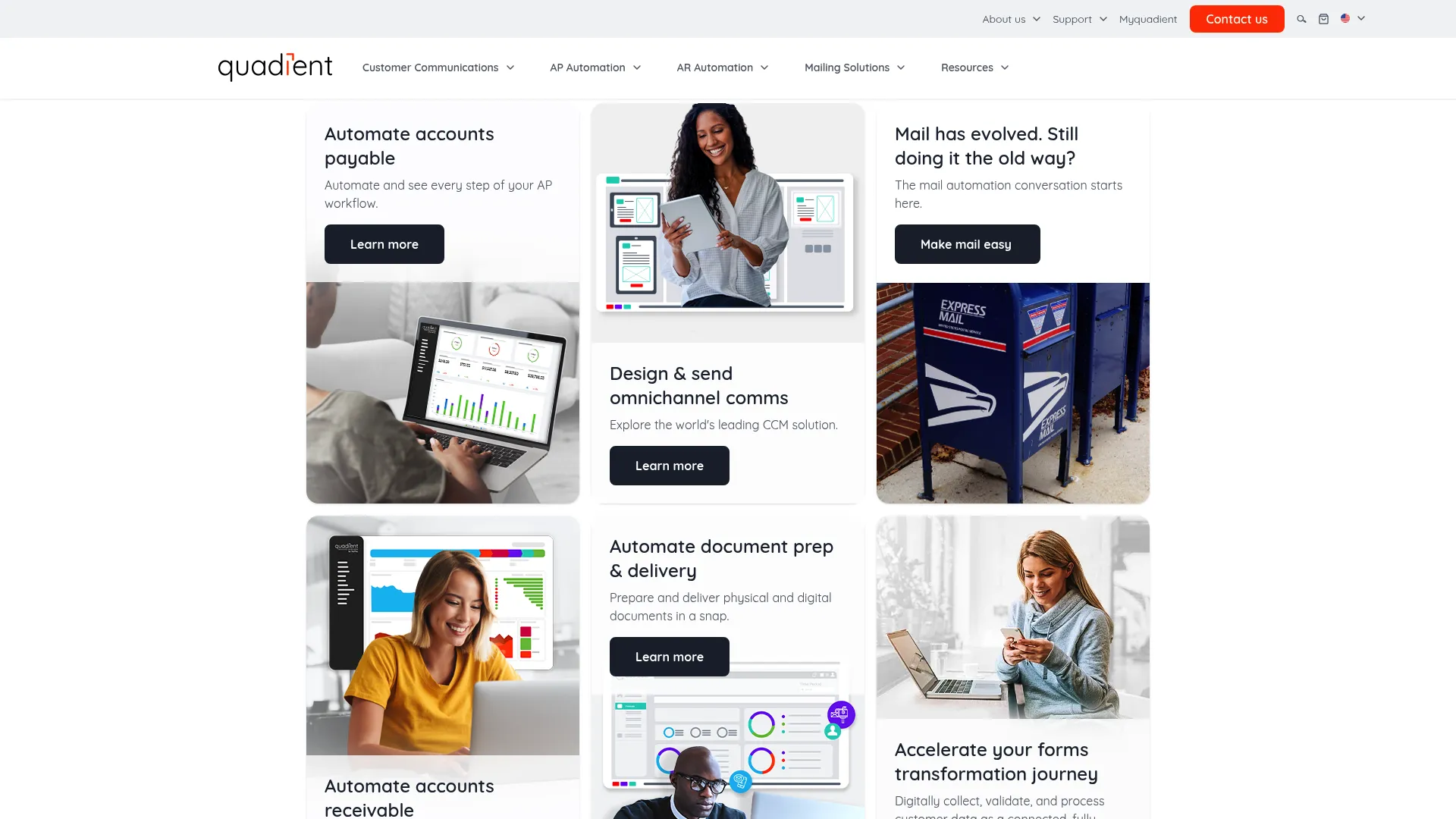
Quadient Inspire is a customer communications management platform for creating and delivering personalized, compliant communications across digital and traditional channels from a centralized hub. It is one of the most recognized names in enterprise CCM, with a long track record in regulated, high-volume environments. Inspire centralizes template design and content management so teams can produce communications at scale without rebuilding assets for every channel.
Best for: Enterprise and midmarket teams that need omnichannel CCM for complex, high-volume, regulated communications.
Key strengths
- Centralized design and content management: Drag-and-drop design with version-controlled content libraries keeps templates consistent across teams.
- Omnichannel composition: Create and deliver personalized communications across digital and traditional channels from one source.
- Flexible deployment: Cloud, hybrid, or on-premise options with customer journey mapping, omnichannel proofing, and migration tools.
Why choose Quadient Inspire: If your communications span print and digital, touch regulated content, and run at high volume, Inspire is built for exactly that. The platform suits teams that need centralized governance and consistent output without sacrificing personalization. It earns its enterprise reputation through breadth, not gimmicks.
Quadient Inspire pricing: Quadient does not publish numeric pricing for Inspire. Pricing is quote-based and varies by deployment, volume, and modules. Contact Quadient for a tailored quote. The platform holds a 4.8/5 rating on G2.
2. OpenText Communications (Exstream)
OpenText Communications (Exstream) is customer communications management software for creating personalized, compliant communications across multiple channels. Exstream is a long-standing enterprise CCM engine, now layered with AI-driven authoring to speed content creation and review. It targets large organizations that produce communications at significant scale and need assured delivery.
Best for: Large organizations that need enterprise-scale personalized, compliant, omnichannel customer communications.
Key strengths
- Cohesive authoring environment: A thin-client design, authoring, and editing environment keeps composition consistent across teams.
- GenAI content support: Knowledge-driven generative AI assists with content creation and review.
- Assured delivery: Pre-built integrations for document creation and delivery support reliable, high-volume output.
Why choose OpenText Communications: Exstream fits enterprises that have outgrown simpler tools and need a platform proven at massive scale. The AI authoring layer helps content teams move faster without losing compliance control. It is a heavyweight choice for heavyweight communication volumes.
OpenText Communications pricing: OpenText uses a contact-and-demo model rather than a public SaaS pricing table. A public government contract price list shows Exstream-related line items, including per-transaction pricing starting around $0.90 per transaction per year and perpetual license items in the thousands of dollars. Actual commercial pricing is quote-based. The product holds a 4.8/5 rating on G2.
3. Smart Communications (SmartCOMM)
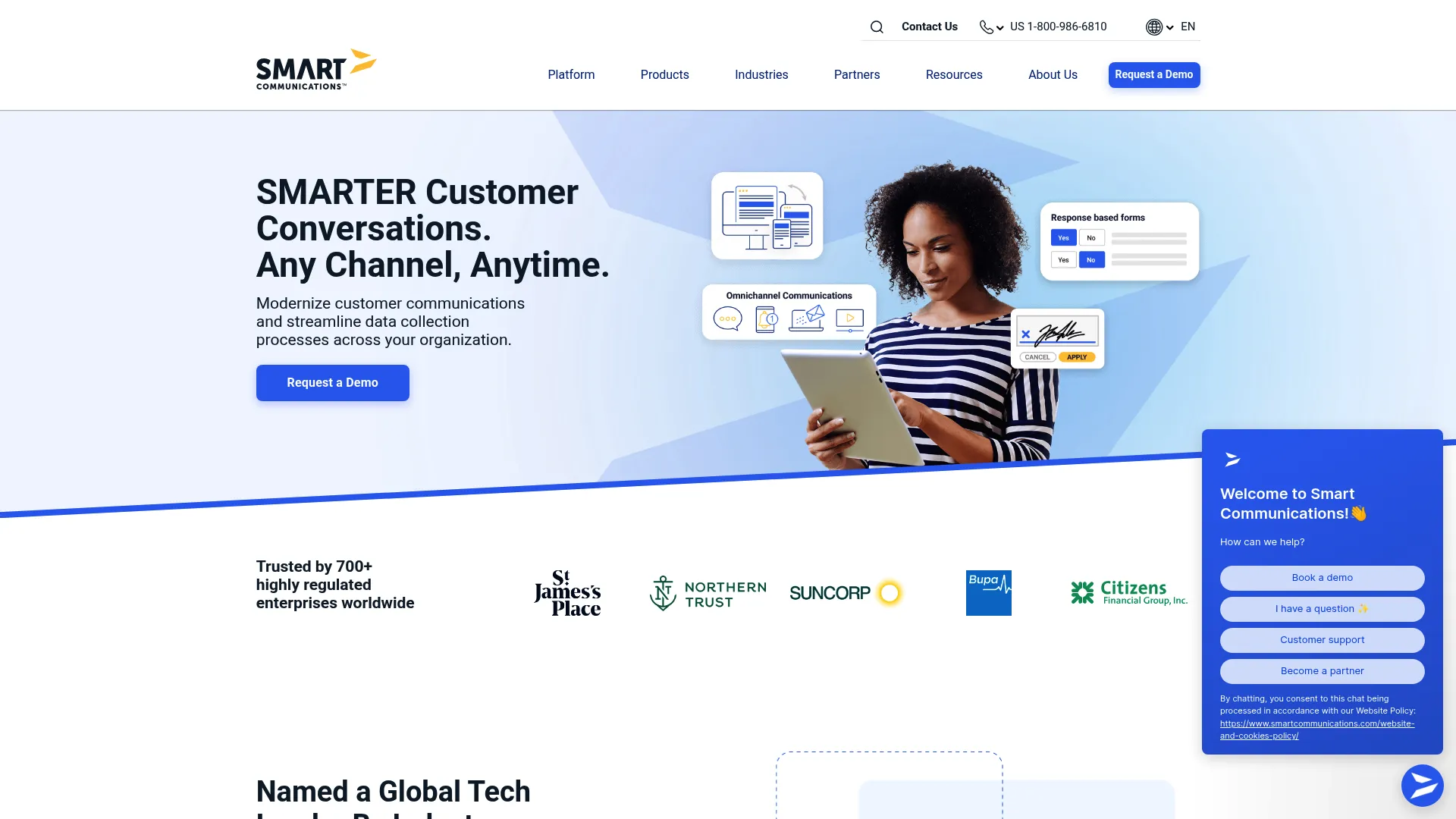
Smart Communications (SmartCOMM) is an enterprise customer communications management platform for creating, personalizing, and delivering regulated customer communications across print and digital channels. SmartCOMM is built cloud-first and leans into conversational, interactive communications. It suits regulated enterprises that want to modernize how they produce and deliver high-volume documents.
Best for: Enterprises in regulated industries that need high-volume, compliant customer communications across multiple channels.
Key strengths
- Personalized omnichannel output: Deliver tailored communications across print and digital channels from one platform.
- Automated document generation: Support for both batch and on-demand output handles steady volume and one-off requests.
- Template management at scale: Manage templates across brands, jurisdictions, and channels without duplication.
Why choose Smart Communications: SmartCOMM is a strong pick for regulated teams that want cloud-native delivery and the flexibility to handle both batch runs and real-time, on-demand communications. Its template management shines when you operate across multiple brands or jurisdictions. The platform is purpose-built for compliance-heavy industries.
Smart Communications pricing: Smart Communications does not publish public pricing. Its own materials note that pricing varies by communication volume, communication type, and user licenses, and the company directs buyers to contact sales. SmartCOMM holds a 4.7/5 rating on G2.
4. Adobe Experience Manager Forms

Adobe Experience Manager Forms is an enterprise digital forms solution for creating, managing, publishing, and updating complex digital forms and customer communications integrated with back-end processes and systems of record. It sits inside Adobe Experience Cloud, which connects forms-led communications to personalization and analytics. AEM Forms fits organizations already invested in the Adobe ecosystem.
Best for: Enterprise organizations that need scalable, secure digital enrollment, onboarding, and customer communications workflows.
Key strengths
- Adaptive forms: Mobile-friendly forms with cross-device completion and pre-fill reduce abandonment.
- Code-free authoring: WYSIWYG tools, editable templates, reusable fragments, and visual business rules empower non-developers.
- Connected workflows: Out-of-the-box connectors, automated workflows, analytics, digital signatures, and security and compliance controls.
Why choose Adobe Experience Manager Forms: AEM Forms makes the most sense for enterprises already running Adobe Experience Cloud, where forms tie directly into personalization and analytics. The forms-led approach is ideal for enrollment and onboarding journeys. Teams outside the Adobe stack may find lighter-weight options easier to adopt.
Adobe Experience Manager Forms pricing: Adobe states that pricing is customized based on use case, usage requirements, service-level agreement, and product options. No public price or plan tiers are displayed. Contact Adobe for a quote. The broader Adobe Experience Manager product, which includes Forms, holds a 4.2/5 rating on G2.
5. Messagepoint
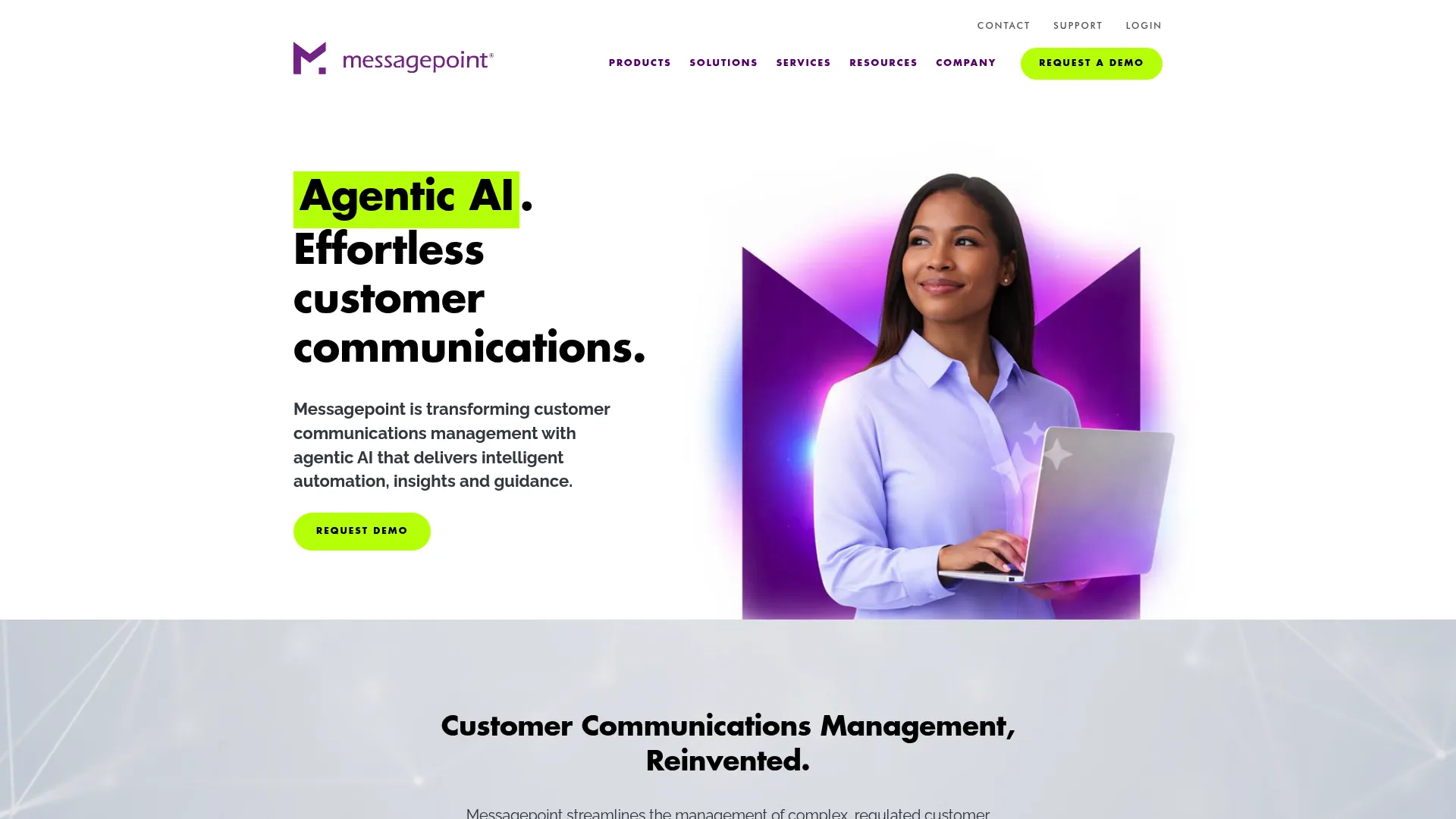
Messagepoint is a SaaS-based, AI-powered content hub for managing complex, regulated customer communications across print and digital channels. It centers on content intelligence, giving business users control over communication content without constant IT involvement. Messagepoint suits regulated teams that want AI assistance baked into authoring.
Best for: Enterprises in regulated industries that need business-user control, compliance, personalization, and AI assistance for customer communications management.
Key strengths
- Centralized content hub: Share and manage communication content across teams, touchpoints, and channels from one place.
- AI-powered assisted authoring: Identify duplicate content, align plain language, score readability, tune sentiment, and rewrite content with AI.
- Headless CCM: RESTful APIs deliver personalized content to digital endpoints in HTML or JSON.
Why choose Messagepoint: Messagepoint is the standout when you want non-technical teams to own content while keeping compliance intact. The AI authoring tools (readability scoring, plain-language alignment, sentiment tuning) directly help teams that must communicate clearly in regulated contexts. Its headless capabilities also fit modern digital architectures.
Messagepoint pricing: Messagepoint does not publish public pricing, and its site emphasizes request-a-demo and contact paths. Pricing is quote-based. Contact Messagepoint for details. The platform holds a 4.1/5 rating on G2.
6. Doxee
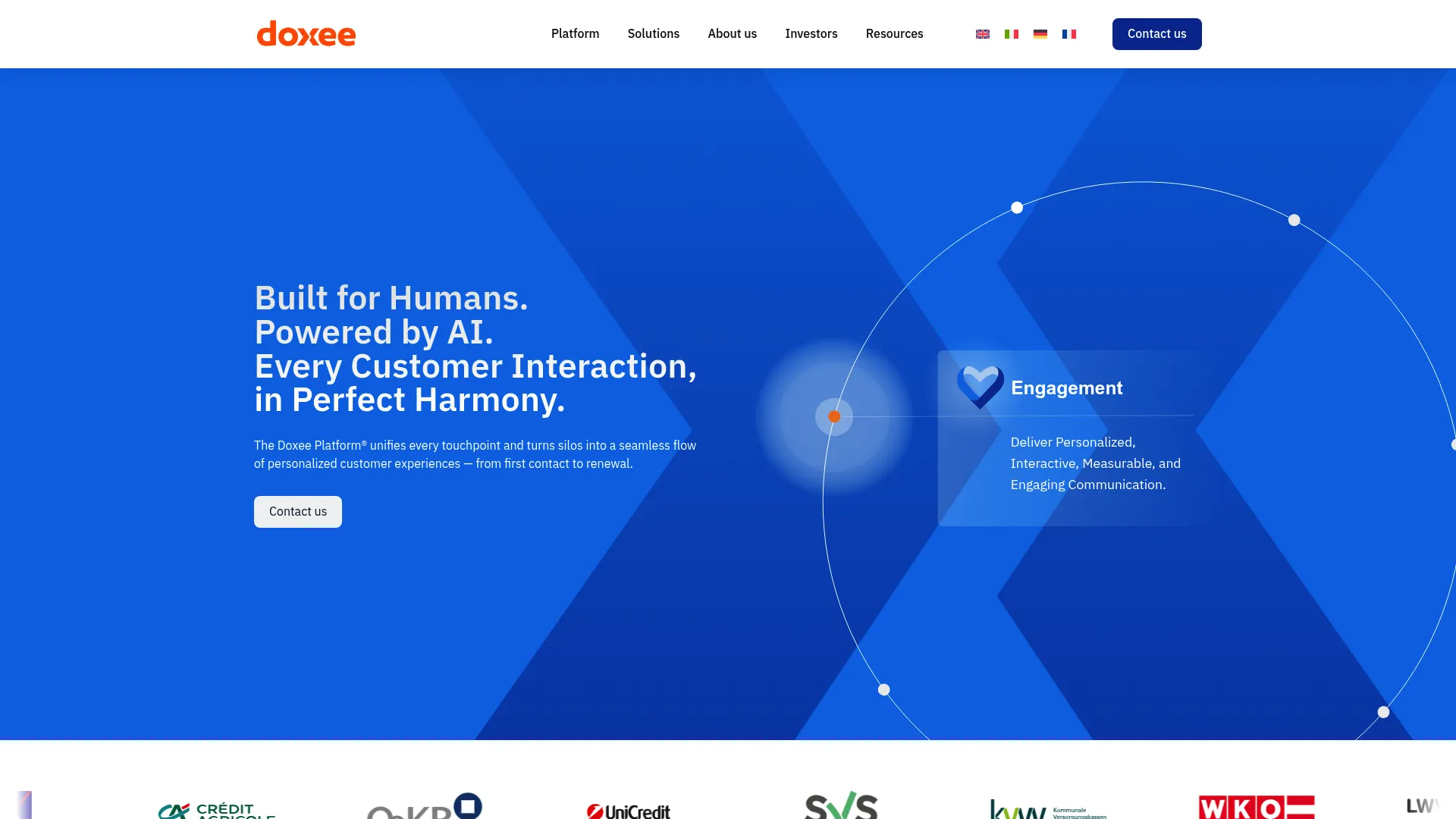
Doxee is a cloud-native, AI-powered platform for enterprise customer communications management and customer experience management. It blends document experience with interactive video and microsites, pushing CCM toward richer digital engagement. Doxee fits enterprises that want digital-first communications beyond static documents.
Best for: Enterprises that need scalable, compliant customer communications, omnichannel engagement, and digital document and customer-experience workflows.
Key strengths
- No-code communication design: Visual tools for templates, data transformation, personalized videos, and process orchestration.
- Omnichannel engagement: Interactive documents, videos, forms, microsites, email, SMS, apps, and print from one platform.
- Integrated and governed: Analytics, automation, CRM and ERP integrations, governance, and AI-assisted content and template migration.
Why choose Doxee: Doxee stands out for teams that want to move past plain documents into interactive video and microsite communications. Its digital-first approach pairs personalization with engagement-focused formats. The platform suits enterprises modernizing their customer experience alongside their document output.
Doxee pricing: Doxee does not publish public pricing, and its site primarily exposes contact and get-in-touch calls to action. Pricing is quote-based. Contact Doxee for a tailored estimate. A current G2 rating was not available at the time of writing.
7. Conga Composer
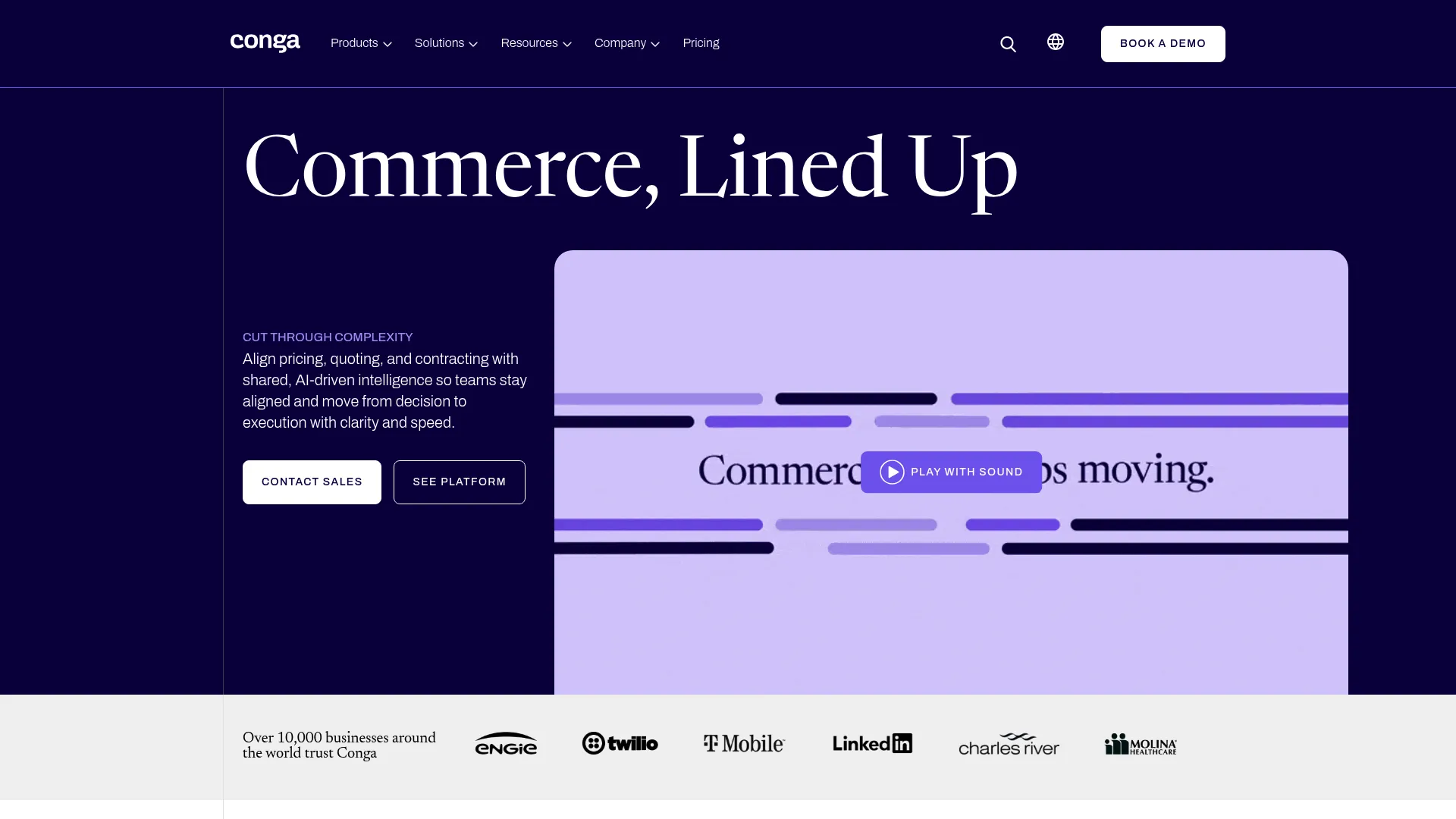
Conga Composer is document generation software for automatically creating on-brand documents from business data across CRMs, ERPs, and other systems. It is best known for deep Salesforce integration, generating data-rich documents directly from records. Conga Composer fits teams anchored on Salesforce that need automated document creation.
Best for: Teams that need to automate high-volume, data-driven document creation and delivery from Salesforce or other business systems.
Key strengths
- Automated document generation: Produce documents from data sources using pre-built or custom templates.
- API and connectors: A RESTful API and connectors embed document generation into existing systems, including Salesforce.
- Broad output support: Generate DOCX, XLSX, PPTX, PDF, and HTML with conditional logic, eSignature support, tracking, and cloud storage.
Why choose Conga Composer: Conga Composer is the natural choice for Salesforce-centric teams that want documents generated straight from CRM data. It handles quotes, proposals, and reports without manual assembly. Organizations outside the Salesforce orbit may prefer a more channel-oriented CCM platform.
Conga Composer pricing: Conga does not display public pricing numbers, plan names, or a free-tier statement on its pricing page. The page directs buyers to contact sales for a quote. Conga Composer holds a 4.4/5 rating on G2.
8. Nintex DocGen
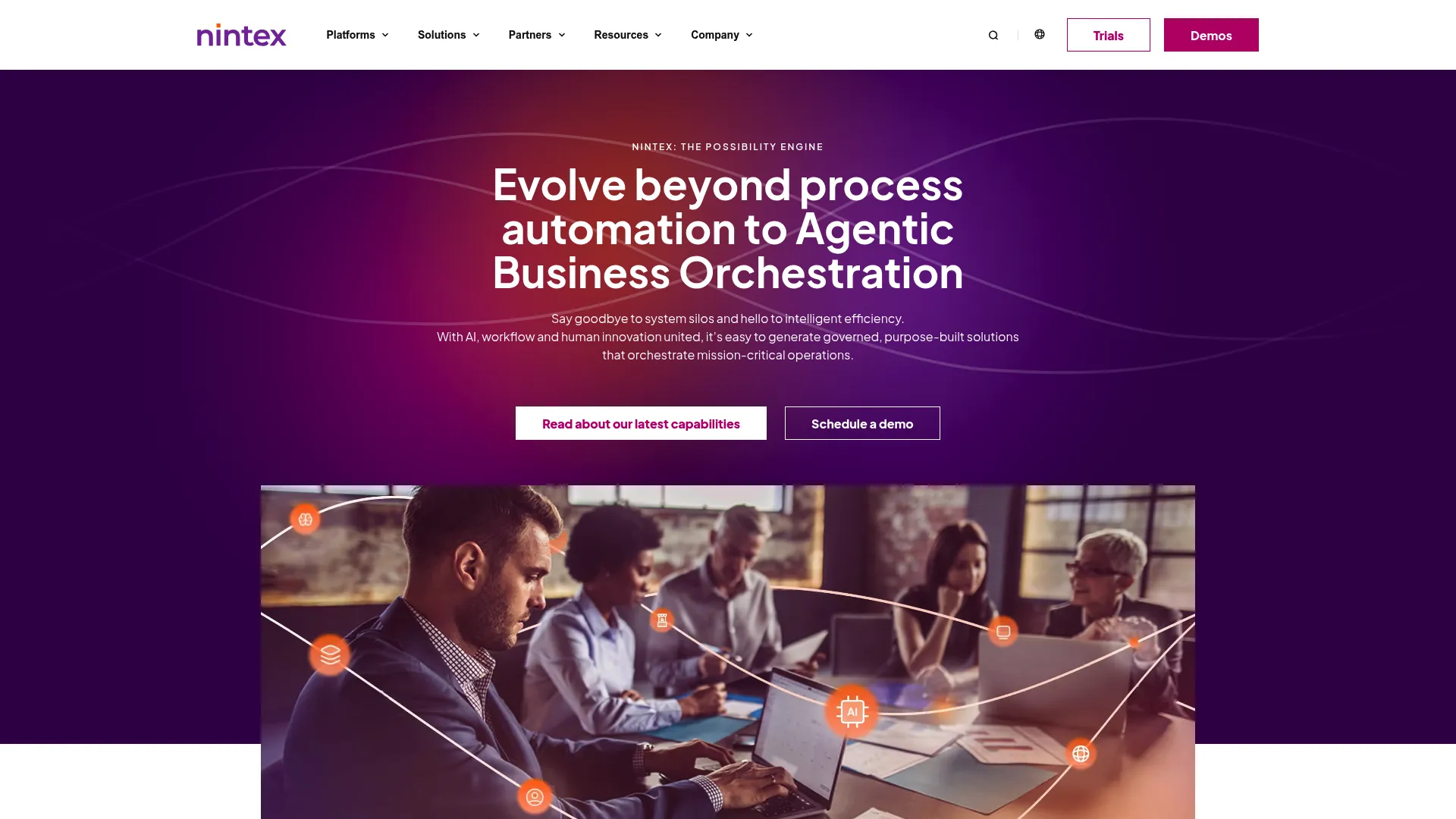
Nintex DocGen automates document creation and delivery by generating customized documents from workflow and business-system data. Formerly known as Drawloop, it combines document automation with broader process and workflow integration. Nintex DocGen fits teams that want document generation woven into automated workflows.
Best for: Organizations that need to automate generation of contracts, quotes, proposals, reports, and other data-rich business documents within workflows or Salesforce.
Key strengths
- Multi-format generation: Produce documents in Word, Excel, PowerPoint, and PDF.
- Data merging: Merge data from CRMs, ERPs, Salesforce, and cloud storage platforms.
- Routing and approvals: Route generated documents for review, approval, delivery, or e-signature.
Why choose Nintex DocGen: Nintex DocGen suits teams that already think in workflows and want documents generated as part of automated processes. The Salesforce and broader process integration makes it a fit for operations-heavy organizations. It is a practical pick when document generation needs to live inside larger automation.
Nintex DocGen pricing: Nintex does not publish DocGen-specific pricing. Its Nintex Automation Cloud, which includes document automation capabilities, lists pricing starting at $15,000 per year, billed annually, across Essentials, Pro, and Expert tiers. A free trial is available, though no permanent free tier was verified. Nintex holds a 4.3/5 rating on G2.
9. Striata
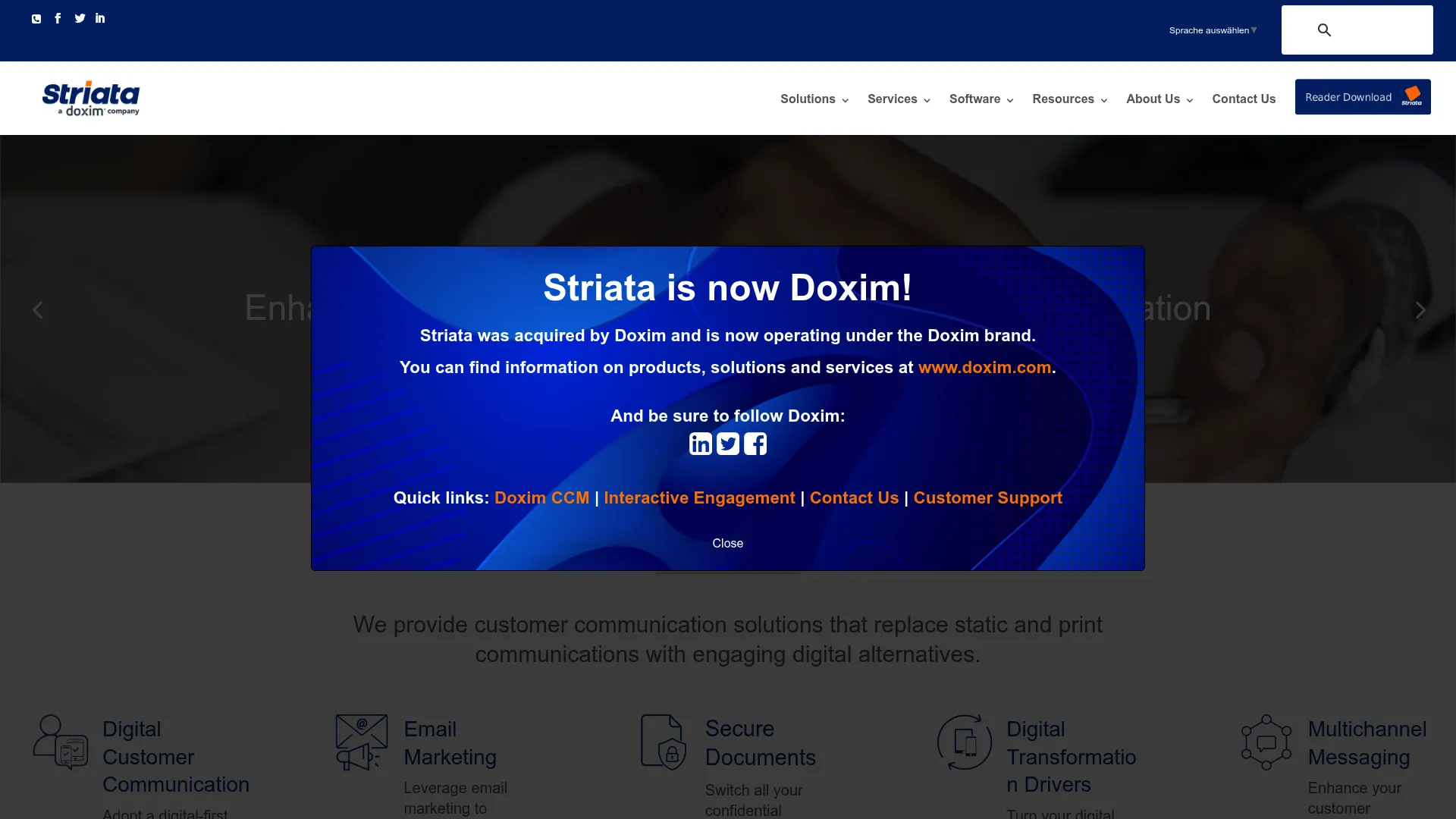
Striata provides digital customer communication software, strategy, and professional services for secure multi-channel document and message delivery. It specializes in secure delivery of statements, bills, and policies, with strong email and text capabilities. Striata, now operating under the Doxim brand, fits enterprises that prioritize secure, high-volume digital delivery.
Best for: Enterprises that need secure, high-volume digital customer communications for statements, bills, policies, and marketing or operational messages.
Key strengths
- Customized composition: Design and generate customized messages and documents using templates, data, and composition rules.
- Secure distribution: Distribute documents and messages via email and text messaging with SPF, DKIM, and DMARC email authentication support.
- Secure storage: Store customer documents and messages for retrieval through existing user interfaces or an API.
Why choose Striata: Striata is the specialist pick when secure delivery is the priority (encrypted bills, statements, and sensitive policy documents). Its email authentication and secure storage make it a fit for finance and insurance. Teams needing full omnichannel composition may pair it with a broader platform.
Striata pricing: Striata does not publish public pricing on its site. Pricing is quote-based. Contact Striata (now under Doxim) for details. The product holds a 4.8/5 rating on G2.
10. Lasernet
Lasernet is an end-to-end document management platform for generating, designing, distributing, archiving, and retrieving documents and customer communications. It is known for strong ERP integration, particularly with Microsoft Dynamics, and multichannel output. Lasernet fits organizations that need document output tightly connected to their core business systems.
Best for: Organizations that need scalable, compliant document generation and output management integrated with ERP, banking, CRM, or legacy systems.
Key strengths
- Dynamic document design: Low-code drag-and-drop tools speed up document creation.
- Deep data integration: Connect to ERP, banking core, CRM, office tools, and legacy systems.
- Compliance-ready management: Archiving, audit tracking, version control, access histories, encryption, and retention policies.
Why choose Lasernet: Lasernet is the right call when document output must connect deeply to your ERP or banking core. Its low-code design and compliance features suit finance and operations teams. The platform excels at output management rather than broad marketing-style communications.
Lasernet pricing: Lasernet does not publish public plan names or prices. The site offers demo and contact paths, so pricing is quote-based. Contact Lasernet for details. It holds a 5.0/5 rating on G2, though that rating is based on a small number of reviews.
11. UniServe NXT
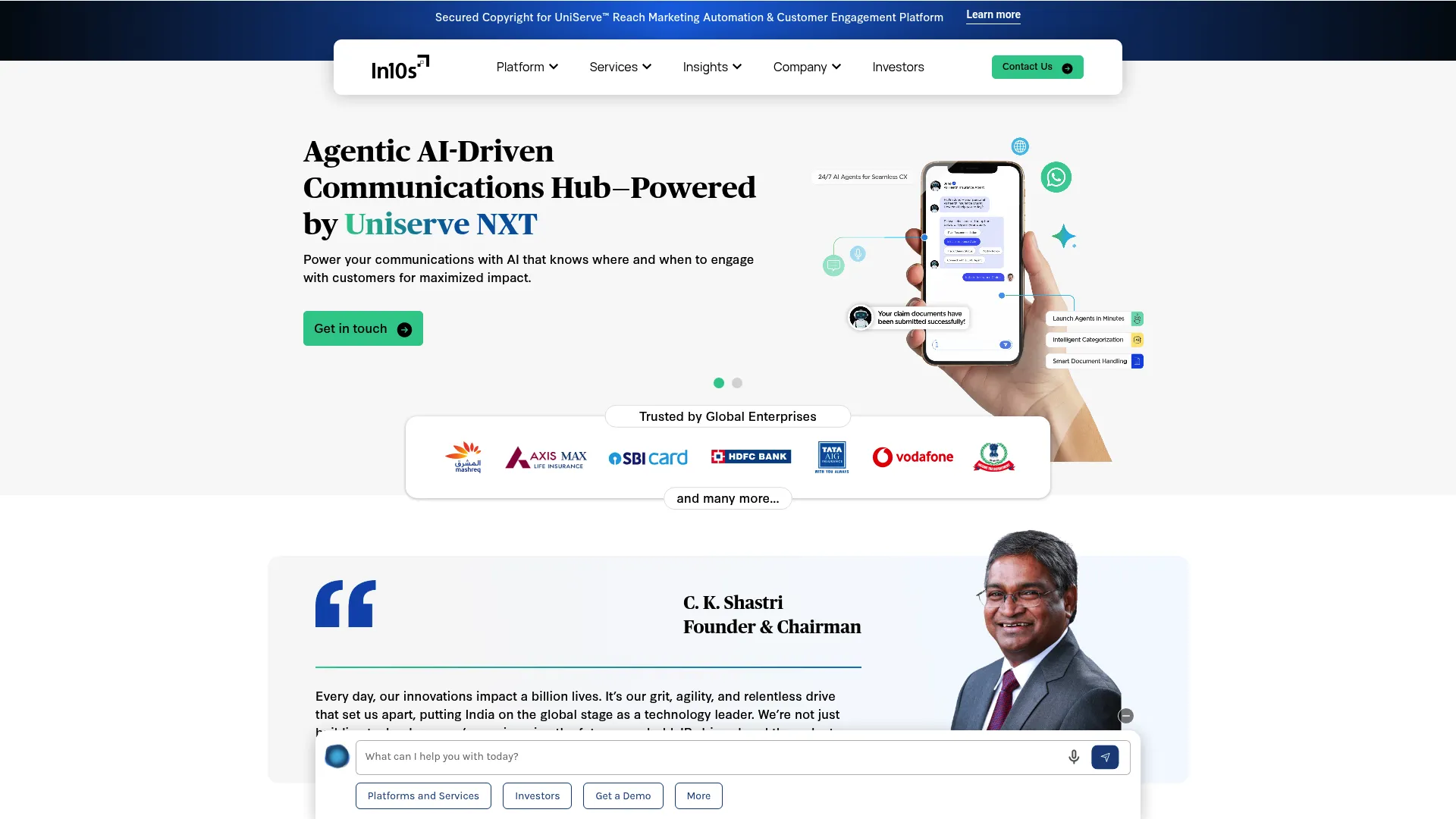
UniServe NXT is an AI-driven centralized communications hub for enterprise customer communications, governance, personalization, and multi-channel engagement. Built by Intense Technologies, it covers onboarding, billing, and omnichannel communications, with particular strength in telecom and BFSI. UniServe NXT fits large regulated enterprises that want a digital CCM and CXM suite.
Best for: Large enterprises in regulated sectors such as BFSI, telecom, and government that need centralized, compliant, AI-assisted customer communications.
Key strengths
- AI-driven smart templates: Standardize communications from disparate systems with AI-assisted templates.
- Hyper-personalized authoring: Create interactive statements and personalized videos for individual customers.
- Broad channel coverage: Optimize journeys across mobile apps, social media, SMS, IVR, email, WhatsApp, Telegram, RCS, and in-app push notifications.
Why choose UniServe NXT: UniServe NXT suits telecom and BFSI enterprises that need communications spanning onboarding through billing across many channels. Its wide channel coverage, including WhatsApp and RCS, fits markets where messaging apps dominate. The AI templating helps standardize communications pulled from fragmented legacy systems.
UniServe NXT pricing: Intense Technologies does not publish public pricing for UniServe NXT. Pricing is quote-based. Contact the vendor for details. A current G2 rating specific to UniServe NXT was not available at the time of writing.
12. Papyrus Platform
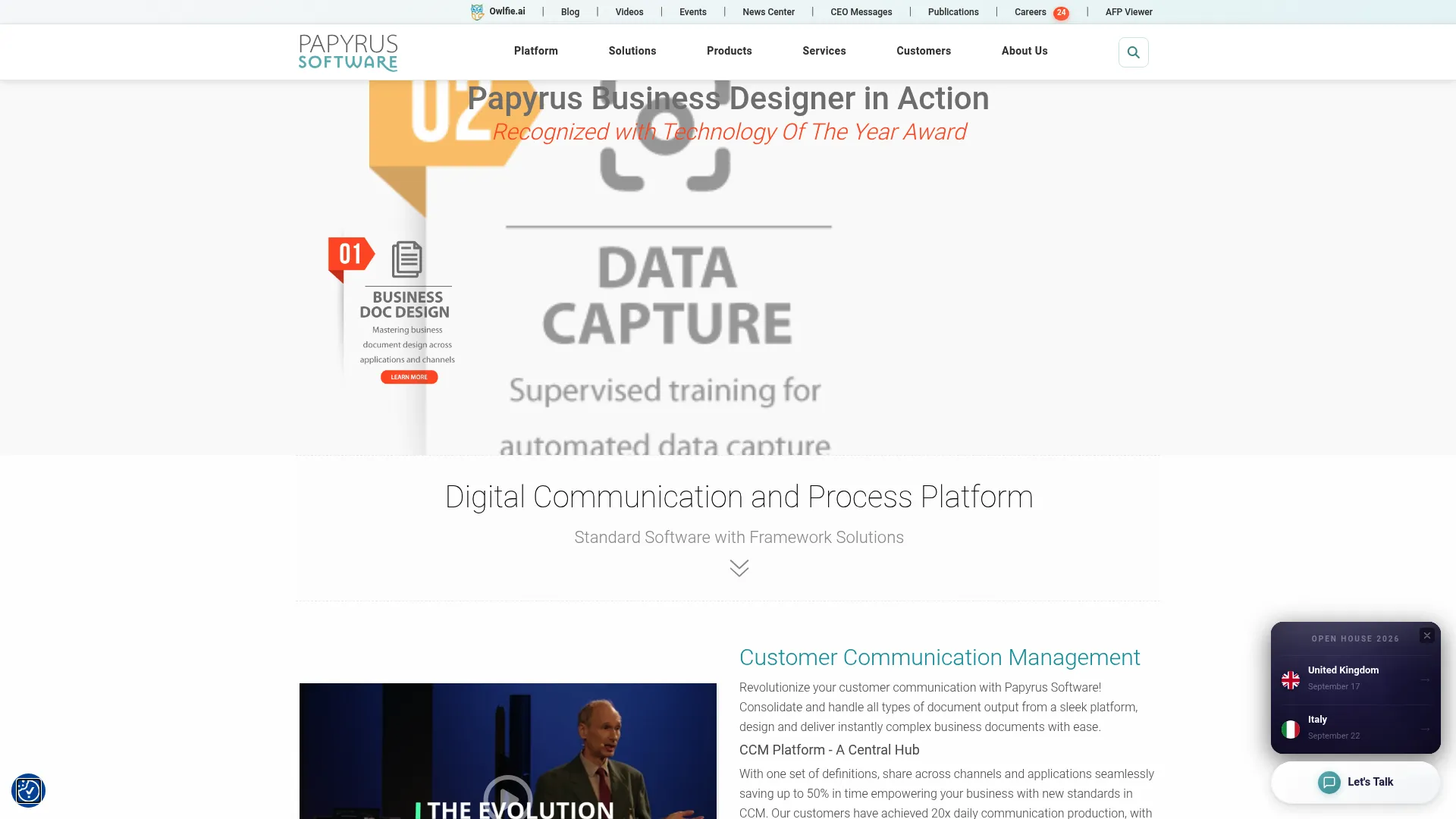
Papyrus Platform is a business communications and process platform for modeling, managing, and delivering business processes, content, and customer communications across channels. Built by ISIS Papyrus, it covers both inbound and outbound communications within an integrated document and process framework. Papyrus fits enterprises that want CCM combined with adaptive case and process management.
Best for: Enterprises needing an integrated platform for customer communications, document and content management, adaptive case management, and multi-channel delivery.
Key strengths
- Adaptive case and process management: Manage cases and processes with auto-documentation built in.
- Business-user modeling: Model data and content entities through the Papyrus WebRepository, with natural-language rule definitions for executable business rules.
- Inbound and outbound coverage: Capture and classify inbound content, then design and deliver outbound documents across print, email, web, mobile, fax, and archive.
Why choose Papyrus Platform: Papyrus is the integrated choice when you need communications, document management, and process automation in one framework. Its inbound capture and adaptive case management distinguish it from output-only tools. The platform suits enterprises that treat communications as part of broader process workflows.
Papyrus Platform pricing: ISIS Papyrus does not publish public software pricing or plan tiers. Pricing is quote-based. Contact ISIS Papyrus for details. A current, confidently matched G2 rating was not available at the time of writing.
How to choose customer communications management software: considerations
A CCM platform is a long-term commitment, often tied into regulated workflows and legacy systems. Use this checklist to pressure-test your shortlist before you buy.
Omnichannel delivery breadth
Verify the platform supports the channels your customers actually use, including print, email, SMS, web, and mobile. If your audience relies on messaging apps like WhatsApp or RCS, confirm those are covered natively. A customer communication management tool that only handles print or only handles email leaves gaps you will pay to fill later.
Compliance, governance, and accessibility
For regulated communications, confirm the platform offers audit trails, approval workflows, and version control out of the box. Check accessibility support for document output and ask about data residency requirements across regions if you operate across regions. These features are non-negotiable in banking, insurance, and healthcare.
Integration with your existing stack
Confirm connector depth, not just availability, for your CRM, ERP, DAM, and legacy systems. A logo on an integrations page does not guarantee the platform pulls the data you need cleanly. Ask vendors to demonstrate the specific integrations your workflows depend on.
Business-user enablement vs IT dependency
Evaluate whether non-technical teams can compose and update communications without developer cycles. The more business users can do independently, the faster you can personalize and iterate. Tools with strong authoring environments reduce the IT bottleneck that stalls most communication updates.
Analytics and personalization depth
Look for engagement tracking and dynamic content driven by customer data. The best CCM solutions show you how communications perform and let you tailor content per recipient or segment. This visibility helps teams improve customer success and lift product adoption over time.
Conclusion
The right customer communications management software depends on your scale, your industry, and how much your business users need to own. For large regulated enterprises, Quadient Inspire and OpenText Communications (Exstream) lead on omnichannel composition and compliance depth. For cloud-native, digital-first delivery, Smart Communications and Doxee handle modern channels well. Salesforce-anchored teams should look at Conga Composer and Nintex DocGen, while Striata specializes in secure delivery and Lasernet in ERP-integrated output.
If business-user control and AI-assisted authoring matter most, Messagepoint is worth a close look. For telecom and BFSI enterprises spanning many channels, UniServe NXT and Papyrus Platform offer integrated suites.
The practical next step: pull two or three options from the comparison table that match your channels, compliance needs, and existing stack. Request guided demos and ask each vendor to show the exact integrations and approval workflows you rely on. The right CCM platform reduces manual work, lifts personalization, and keeps every communication compliant, no matter how many channels your customers use.
FAQs
Customer communications management software is a platform for creating, personalizing, delivering, and tracking customer communications across print and digital channels. It centralizes document composition, omnichannel delivery, and compliance so a company can communicate consistently at scale. CCM software is most common in regulated, high-volume industries.
A CRM manages customer relationships and data, tracking interactions, deals, and contact records. A CCM platform creates and delivers the actual communications customers receive, such as statements, policies, and notifications. The two often integrate, with the CCM platform pulling data from the CRM to personalize each communication. To compare CRM options, see our guide to the best CRM software.
The main features of a CCM platform are content composition, omnichannel delivery, personalization, data integration, workflow and approval routing, compliance and auditability, and analytics. Together these capabilities let teams produce consistent, compliant communications across channels. Stronger platforms also add AI-assisted authoring and accessibility controls.
Most enterprise CCM software uses custom, quote-based pricing that varies by volume, channels, and modules. Public figures are rare. Where pricing is visible, related platforms can start in the range of $15,000 per year for adjacent automation products. Always request a tailored quote and verify current figures with the vendor.
CCM software is used most heavily in banking and finance, insurance, healthcare, utilities, telecom, and government. These sectors share two traits: high communication volume and strict regulatory requirements. CCM platforms help them produce consistent, compliant, auditable communications at scale.
No. CCM software focuses on operational, transactional, and regulated communications and document composition, such as statements and policies. Marketing automation focuses on campaigns, lead nurturing, and promotional messaging. The two can complement each other, but they solve different problems and serve different teams.
CCM software supports compliance through audit trails, version control, and approval workflows that document who changed and approved each communication. For accessibility, leading platforms produce accessible document output that meets standards like WCAG accessibility standards. These controls are essential for client communication management software used in regulated industries.
Customer-facing teams, including customer success managers, should prioritize business-user authoring, integration with their existing stack, and analytics on communication engagement. Strong personalization helps reduce repetitive manual communication and scale onboarding. The goal is a platform that lets non-technical teams keep messaging consistent and personalized without waiting on IT.