A shopper lands on your product page at 11 p.m. with a question about sizing. There is no one to ask. They open a chat widget, get a canned reply, and leave. That moment, repeated thousands of times a month, is where revenue quietly leaks out of most ecommerce stacks.
Conversational commerce closes that gap. It turns chat, messaging, and voice into a buying channel instead of a support afterthought. And the market is moving fast: Fortune Business Insights projects the global conversational commerce market will reach USD 14.47 billion in 2026 on its way to USD 39.53 billion by 2034. Retail and ecommerce already make up the largest share of that spend, according to Mordor Intelligence.
For a digital marketer, the real question is not "what is this category?" It is "can a conversational commerce platform replace or consolidate part of my chat, support, and lifecycle stack while lifting conversion and retention?" That is the lens this guide uses. If you are also evaluating adjacent categories, our roundups of the best AI customer service agents and agentic AI tools for sales cover overlapping ground. For deeper automation reading, see our breakdown of the best AI agents.
What's inside
This guide compares seven conversational commerce platform tools worth shortlisting in 2026. The list spans commerce-first platforms and support-to-commerce platforms, because most teams need both motions. We selected and ranked tools on four criteria that matter to marketers: channel coverage (web chat, messaging apps, SMS, voice), AI and NLP capability, integration depth with CRM, CDP, and ecommerce systems, and how much of the purchase journey each tool covers, from discovery through post-purchase. We also note measurement, because a platform you cannot tie to conversion is hard to defend.
TL;DR
- Best for enterprise omnichannel commerce: Salesforce, when you already run CRM and commerce on its platform.
- Best for AI-driven journey personalization: Bloomreach, for search and lifecycle-led shopping experiences.
- Best for customer service plus commerce workflows: Gorgias, for ecommerce brands that lead with support.
- Best for unified messaging and customer context: Intercom, when commerce overlaps heavily with support.
- Best for commerce orchestration and customer data activation: Insider One, for WhatsApp-led, cross-channel execution.
- Best for cross-channel lifecycle automation: SAP Emarsys, for teams coordinating email, SMS, and commerce offers.
- Best AI-first conversational architecture: IBM, for structured conversational experiences and broad automation.
What is a conversational commerce platform?
A conversational commerce platform is software that lets brands sell, support, and engage customers through chat, messaging apps, SMS, and voice, using AI to guide shoppers from discovery to purchase to post-purchase help inside a single conversation.
Conversational commerce works by collapsing what used to be separate steps. Product discovery, product questions, checkout, and after-sale support all happen in one thread, on the channel the customer already uses. A shopper can ask "which of these jackets is waterproof?", get a recommendation, receive a payment link, and later check their order status without ever leaving the conversation. That is how conversational commerce works in practice: the channel becomes the storefront, the cart, and the help desk at once.
Core platform capabilities to expect:
- Messaging channel support: web chat, WhatsApp, SMS, Instagram, Messenger, and voice, ideally in one inbox.
- AI or chatbot layer: a conversational AI ecommerce engine that understands intent, answers questions, and handles routine tasks.
- Recommendation and personalization engine: product suggestions tied to behavior, history, and segment.
- Checkout or payment support: in-conversation payment links, cart recovery, and order placement.
- Integrations: connections to CRM, CDP, and ecommerce systems like Shopify, plus marketing automation.
- Analytics and conversion tracking: attribution from conversation to revenue, so you can prove impact.
The strongest conversational commerce solutions treat these as one system, not bolt-ons. That is the difference between a chatbot widget and a platform.
When to use a conversational commerce platform
Turn product discovery into a guided buying journey
When shoppers face too many choices, they stall. Conversational commerce helps by acting as an AI-powered shopping assistant: it asks a few questions, narrows options, and recommends the right product. This is assisted browsing plus lead qualification in one motion. For high-consideration categories like electronics, beauty, or furniture, a guided conversation can move a hesitant browser to a confident buyer faster than a static product grid.
Reduce support friction after purchase
Most post-purchase questions are predictable: where is my order, how do I return this, can I change my shipping address. A conversational commerce platform can resolve these in the same channel the customer bought through. Order tracking, returns, and account changes get handled by automation, which lowers ticket volume while protecting satisfaction. Agents then spend their time on the cases that actually need a human.
Capture revenue from high-intent messaging moments
Messaging is where intent lives. Abandoned-cart follow-ups over WhatsApp or SMS, time-bound discount offers, and one-tap payment links turn a passive nudge into a completed sale. Because these moments reach customers on channels they check constantly, they tend to convert better than email alone. Done well, omnichannel conversational commerce lifts both conversion and repeat-purchase retention.
Comparison table
The table below ranks the seven tools by relevance to conversational commerce buyers. Pricing reflects publicly listed first-party figures where available; several enterprise platforms publish custom pricing only. G2 ratings are included where verified.
| # | Product | Intent | Key differentiation | Pricing | G2 rating |
|---|---|---|---|---|---|
| 1 | Salesforce | Enterprise omnichannel commerce | CRM, commerce, and Agentforce AI on one platform | From $25/user/mo (Starter Suite) | Not listed |
| 2 | Bloomreach | AI journey personalization | Autonomous search and conversational shopping | Request pricing | 4.6/5 |
| 3 | Gorgias | Support-led commerce | Ecommerce helpdesk with AI Agent and order workflows | From $10/mo (Starter) | 4.6/5 |
| 4 | Intercom | Unified messaging + support | Fin AI Agent across a single customer inbox | From $29/seat/mo (Essential) | 4.5/5 |
| 5 | Insider One | Commerce orchestration + CDP | WhatsApp Commerce plus unified customer data | Request pricing | 4.8/5 |
| 6 | SAP Emarsys | Cross-channel lifecycle | Omnichannel automation and personalization | Request pricing | 4.3/5 |
| 7 | IBM | AI-first conversational architecture | watsonx AI and enterprise automation | Free tier; Standard from $1,110/mo | 4.3/5 |
1. Salesforce
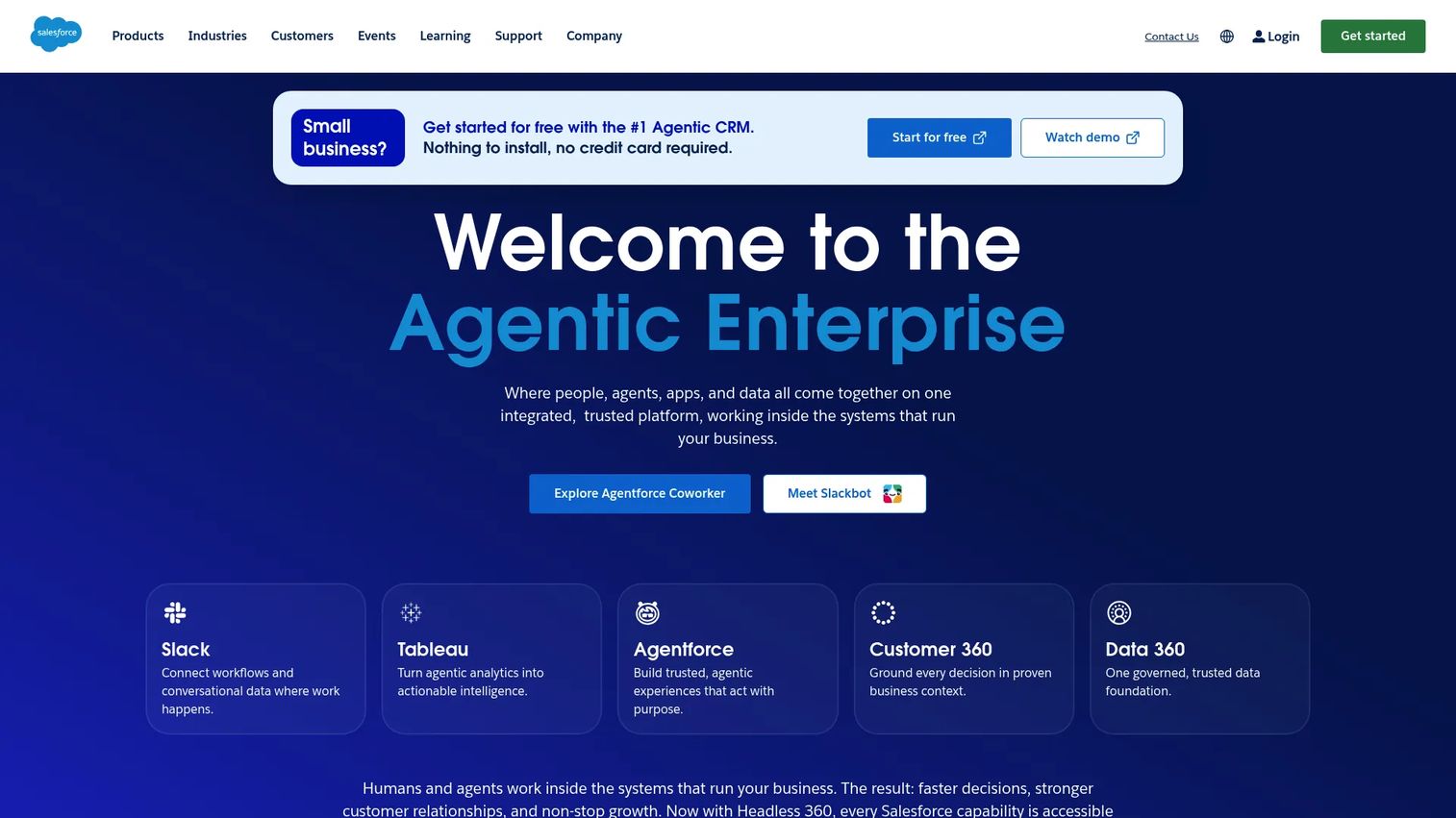
Salesforce is a cloud software platform spanning CRM, sales, service, marketing, analytics, data, and AI agents. For conversational commerce, its strength is breadth: Commerce Cloud, Service Cloud, and Agentforce AI agents sit on the same customer record, so a chat conversation, a service ticket, and a purchase all share context. That makes it a natural fit for enterprise teams that want commerce, support, and CRM governed in one place.
Best for: Enterprise teams already running CRM and commerce on Salesforce who want AI-driven conversational experiences without stitching together separate systems.
Key strengths
- Customer 360 platform: A unified record means a conversation knows the customer's full history, order, and service context.
- Agentforce AI agents: AI agents handle pre-sale questions and post-sale support across channels.
- Modular clouds: Sales, Service, Marketing, and Commerce Cloud can be adopted as the stack matures.
Why choose Salesforce: If your organization already lives in Salesforce, the consolidation argument is strong. You get conversational commerce AI on top of data you already trust, with the governance and scale enterprise procurement expects. The trade-off is that it rewards teams willing to invest in the platform rather than those wanting a lightweight, standalone chat tool.
Salesforce pricing: Public CRM and service pricing starts at $25/user/month for the Starter Suite, with Pro Suite at $100, Enterprise at $175, Unlimited at $350, and Agentforce 1 Service at $550/user/month. A free tier and trials are available, and some products or add-ons require a sales conversation.
2. Bloomreach
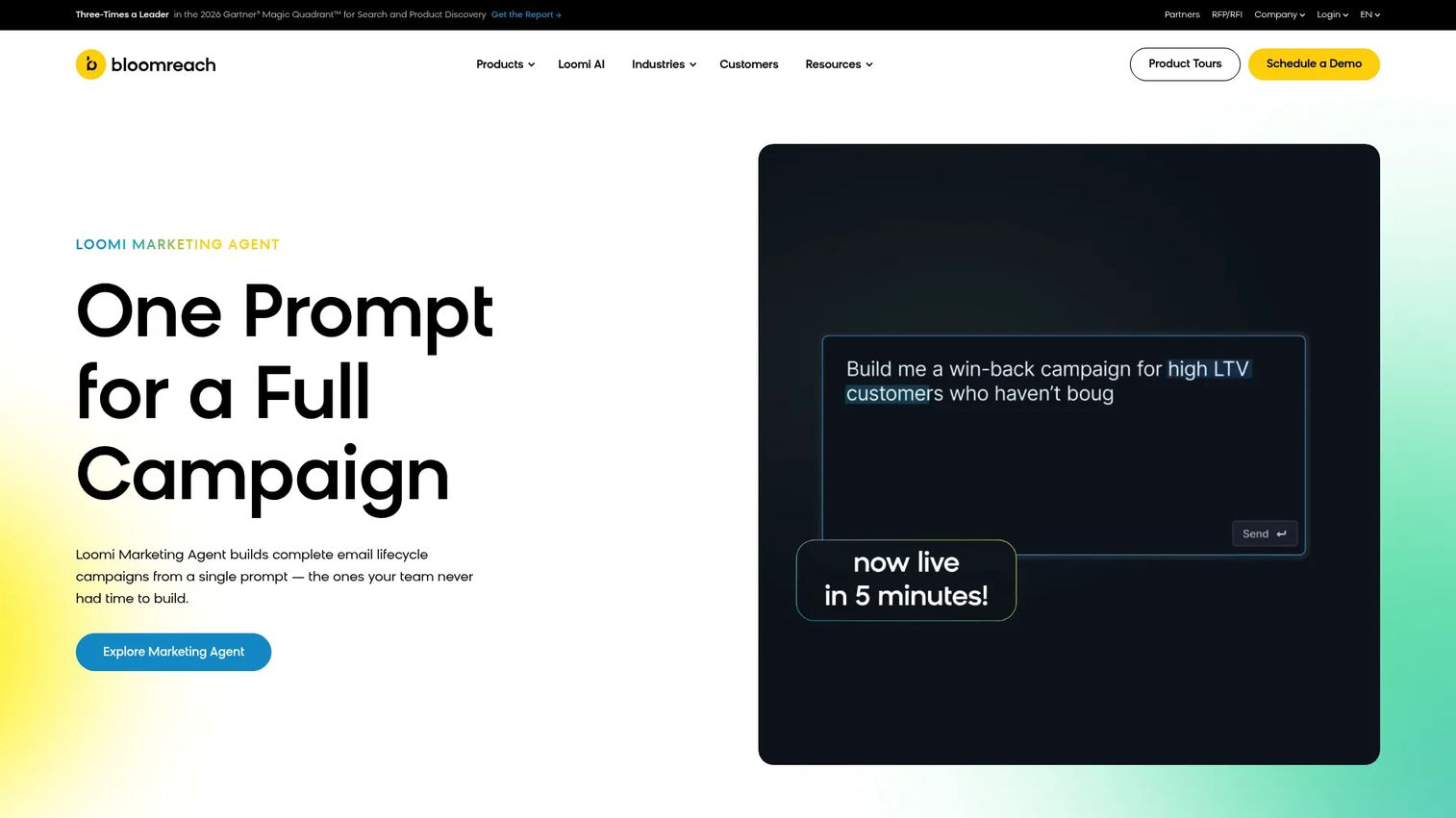
Bloomreach is an AI-powered personalization platform for ecommerce search, marketing, and shopping experiences. Its conversational angle centers on Conversational Shopping, paired with Autonomous Search and Autonomous Marketing. The result is a platform that ties what a shopper searches, sees, and asks into one personalized journey, which is where its AI conversational commerce story is strongest.
Best for: Mid-market to enterprise ecommerce teams that want personalized search and lifecycle marketing driving the conversation, not just a chat box bolted on.
Key strengths
- Conversational Shopping: AI-led product discovery that responds to natural questions with relevant results.
- Autonomous Search: Search and merchandising that adapt to each shopper's intent and behavior.
- Autonomous Marketing: Lifecycle campaigns that extend the conversation into email and other channels.
Why choose Bloomreach: If your conversion problem is discovery and relevance, Bloomreach attacks it directly. Its data engine connects search, recommendations, and post-purchase engagement, so the conversation gets smarter with every interaction. It fits teams that treat personalization as the core growth lever rather than a feature.
Bloomreach pricing: Bloomreach uses custom pricing. Subscriptions combine a module fee plus a usage fee, billed annually, with Autonomous Marketing, Autonomous Search, and Conversational Shopping available as separate modules. Pricing is available on request. Bloomreach holds a 4.6/5 rating on G2.
3. Gorgias

Gorgias is an AI-powered customer support helpdesk and conversational commerce platform built specifically for ecommerce brands. It centralizes email, chat, social, SMS, and voice in one inbox, then layers automation and an AI Agent on top. Because support and commerce are tightly linked in ecommerce, Gorgias is strongest when the conversational motion is support-led: order lookups, returns, and questions that quietly drive repeat purchases.
Best for: Ecommerce brands, especially on Shopify, that want a unified helpdesk plus AI-driven support automation that doubles as a sales channel.
Key strengths
- Omnichannel inbox: Email, chat, social, SMS, and voice handled in one place with full order context.
- AI Agent: Automates pre-sale and post-sale support workflows, deflecting repetitive tickets.
- Automation tools: Rules, macros, routing, and reporting that scale support without scaling headcount.
Why choose Gorgias: For ecommerce teams that lead with service, Gorgias turns the support queue into a conversion surface. An agent answering "is this back in stock?" can recommend and sell in the same thread. It is purpose-built for ecommerce, which means less configuration than a general-purpose suite for a Shopify-centric brand.
Gorgias pricing: Gorgias publishes five plans: Starter at $10/month, Basic at $50, Pro at $300, Advanced at $750, and Enterprise as a custom quote. Pricing scales with ticket volume and AI Agent usage, billed monthly or yearly, with a free trial available. Gorgias holds a 4.6/5 rating on G2.
4. Intercom

Intercom is an AI-first customer service platform built around a shared inbox, automation, and its Fin AI Agent. For conversational commerce, its value is unified messaging: every conversation carries customer context, so guided support, product questions, and conversion assistance happen without the customer repeating themselves. It is a strong fit when your commerce motion overlaps heavily with support and onboarding.
Best for: Teams that want one inbox and an AI agent handling product questions, guided support, and conversion assistance with full customer context.
Key strengths
- Fin AI Agent: Resolves questions autonomously and hands off to humans with context intact.
- Shared inbox and ticketing: One view of every conversation across channels.
- Workflows automation builder: Visual automation for routing, follow-ups, and proactive messages.
Why choose Intercom: If support and commerce are effectively the same conversation for your customers, Intercom keeps them unified. Fin can answer a product question, surface a recommendation, and escalate cleanly when a human is needed. It suits SaaS-leaning and digital-first brands where onboarding and conversion blur together.
Intercom pricing: Intercom lists three seat-based plans: Essential from $29 per seat/month, Advanced from $85, and Expert from $132, billed monthly. The Fin AI Agent is priced separately from $0.99 per resolution on a usage basis, with add-ons available. Intercom holds a 4.5/5 rating on G2.
5. Insider One
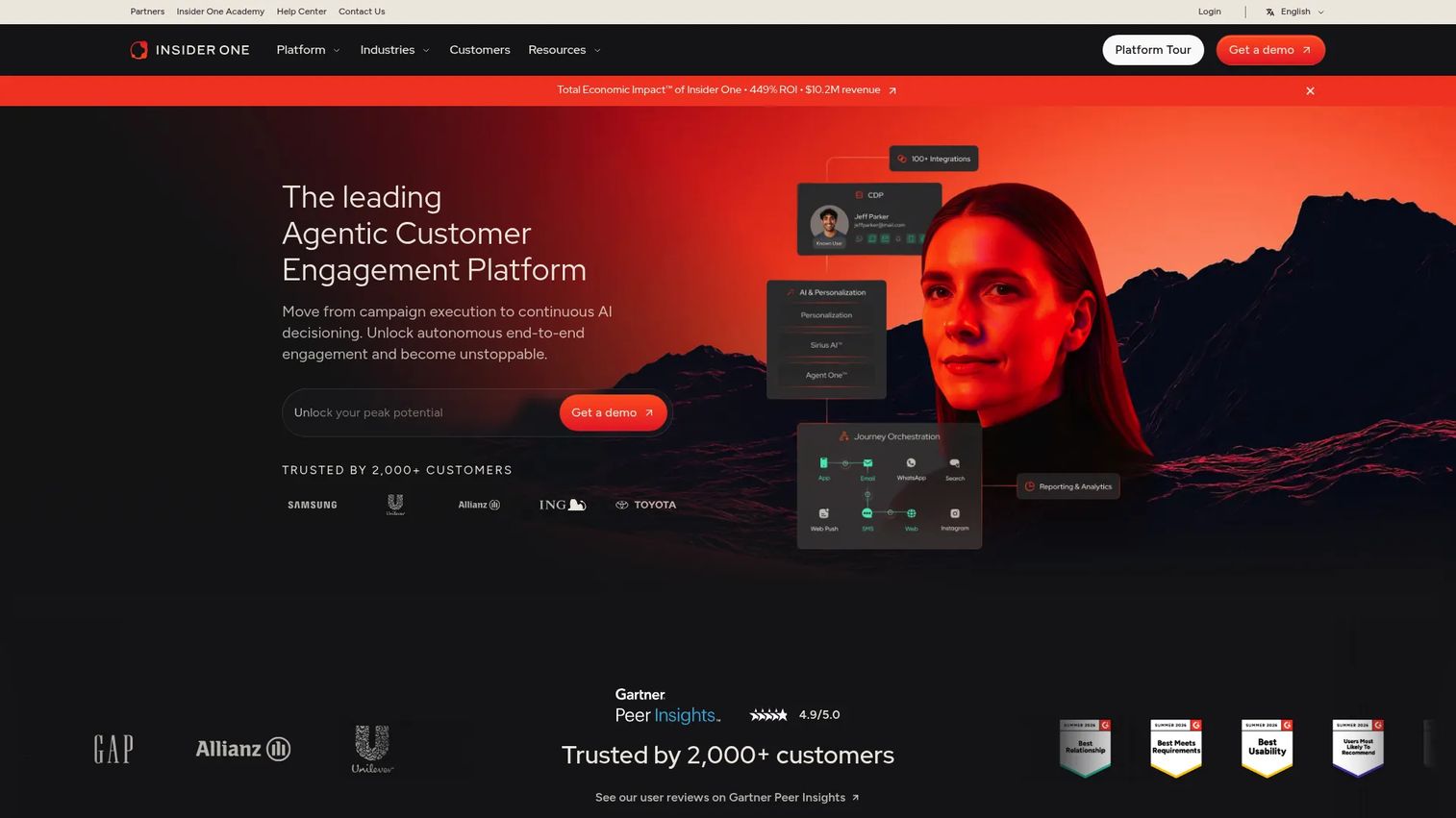
Insider One is an AI-powered customer engagement platform combining a customer data platform, personalization, and journey orchestration. Its conversational commerce narrative leans heavily on WhatsApp: WhatsApp Commerce and WhatsApp Flows let brands run discovery, recommendations, and checkout inside the messaging app, backed by unified customer data. That CDP foundation is what separates it from point chat tools.
Best for: Enterprise marketing teams that want unified customer data driving cross-channel, WhatsApp-led conversational experiences from discovery through post-purchase.
Key strengths
- Customer Data Platform: Unifies customer data so every conversation is personalized and consistent.
- Personalization: Tailors recommendations and messaging across web, app, and messaging channels.
- Journey Orchestration: Coordinates the full path from discovery to post-purchase engagement.
Why choose Insider One: If WhatsApp and other messaging apps are central to your market, and you want personalization grounded in a real CDP, Insider One covers the full journey rather than a single touchpoint. It connects with CRM, CDP, and ecommerce systems, making it a practical platform for teams focused on multi-channel execution at scale.
Insider One pricing: Insider One does not publish public pricing; the site directs visitors to request a demo and a custom quote. Insider One holds a 4.8/5 rating on G2, among the highest in this list.
6. SAP Emarsys
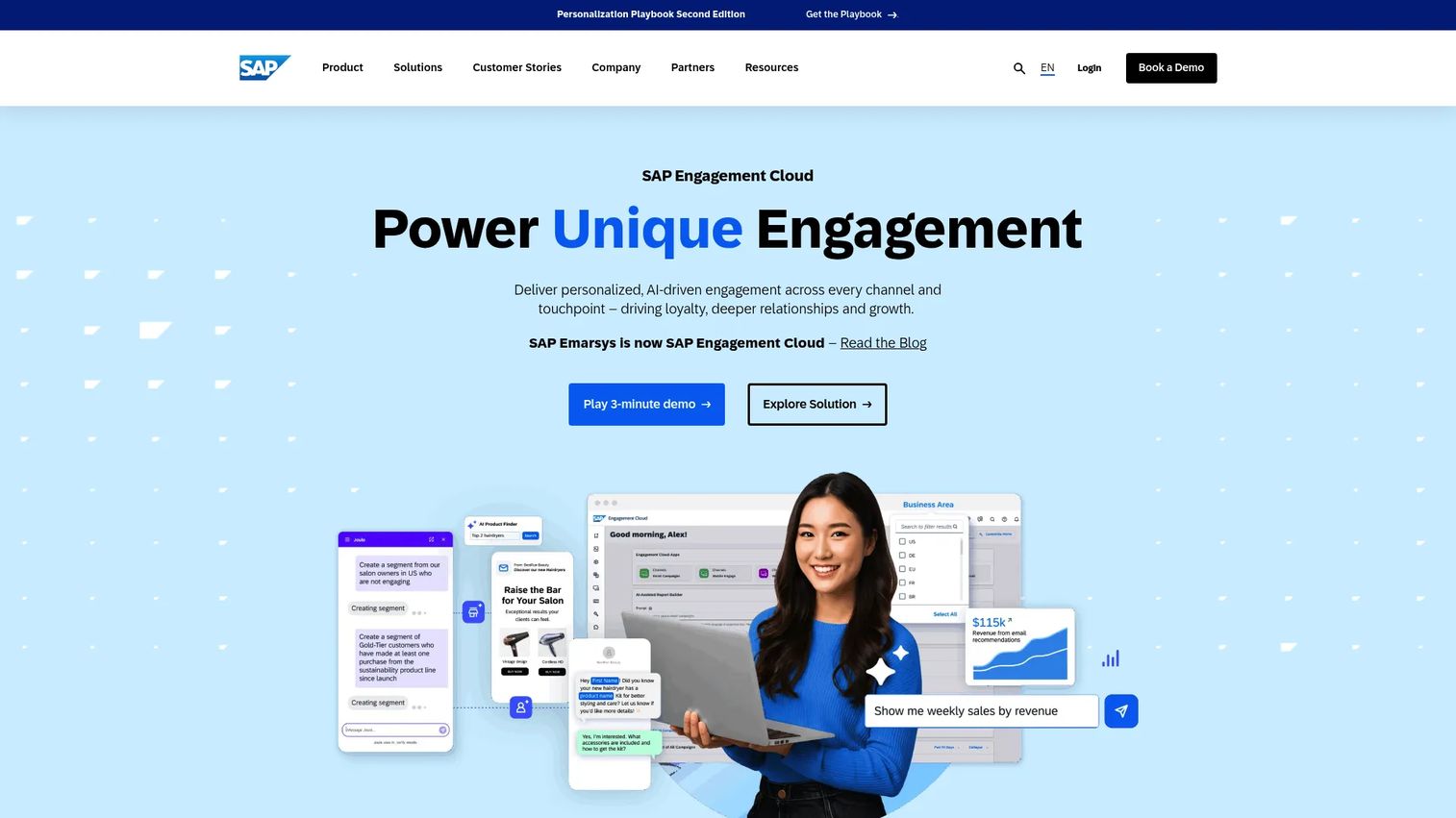
SAP Emarsys, now positioned as SAP Engagement Cloud, is an omnichannel customer engagement platform for personalized marketing, automation, analytics, and loyalty. It belongs in a conversational commerce shortlist because it coordinates messaging across email, SMS, and commerce interactions, turning lifecycle data into timely, personalized offers. It is broader than a pure chat tool, which is exactly its appeal for teams orchestrating the whole lifecycle.
Best for: Enterprise marketing teams that want omnichannel customer engagement and personalization tied to lifecycle automation and loyalty.
Key strengths
- AI-driven personalization: Tailors content and offers across channels based on customer behavior.
- Marketing automation and journey orchestration: Coordinates messaging from acquisition through retention.
- Customer data and analytics: Segmentation, reporting, and analytics that inform every interaction.
Why choose SAP Emarsys: If your conversational moments are part of a larger lifecycle strategy, Emarsys ties them together. Abandoned-cart messages, post-purchase flows, and loyalty offers all draw from the same segmentation engine. It suits teams that want messaging commerce as one thread in a coordinated, data-driven program.
SAP Emarsys pricing: SAP Emarsys does not display public pricing; the site directs visitors to request a quote. The platform holds a 4.3/5 rating on G2.
7. IBM
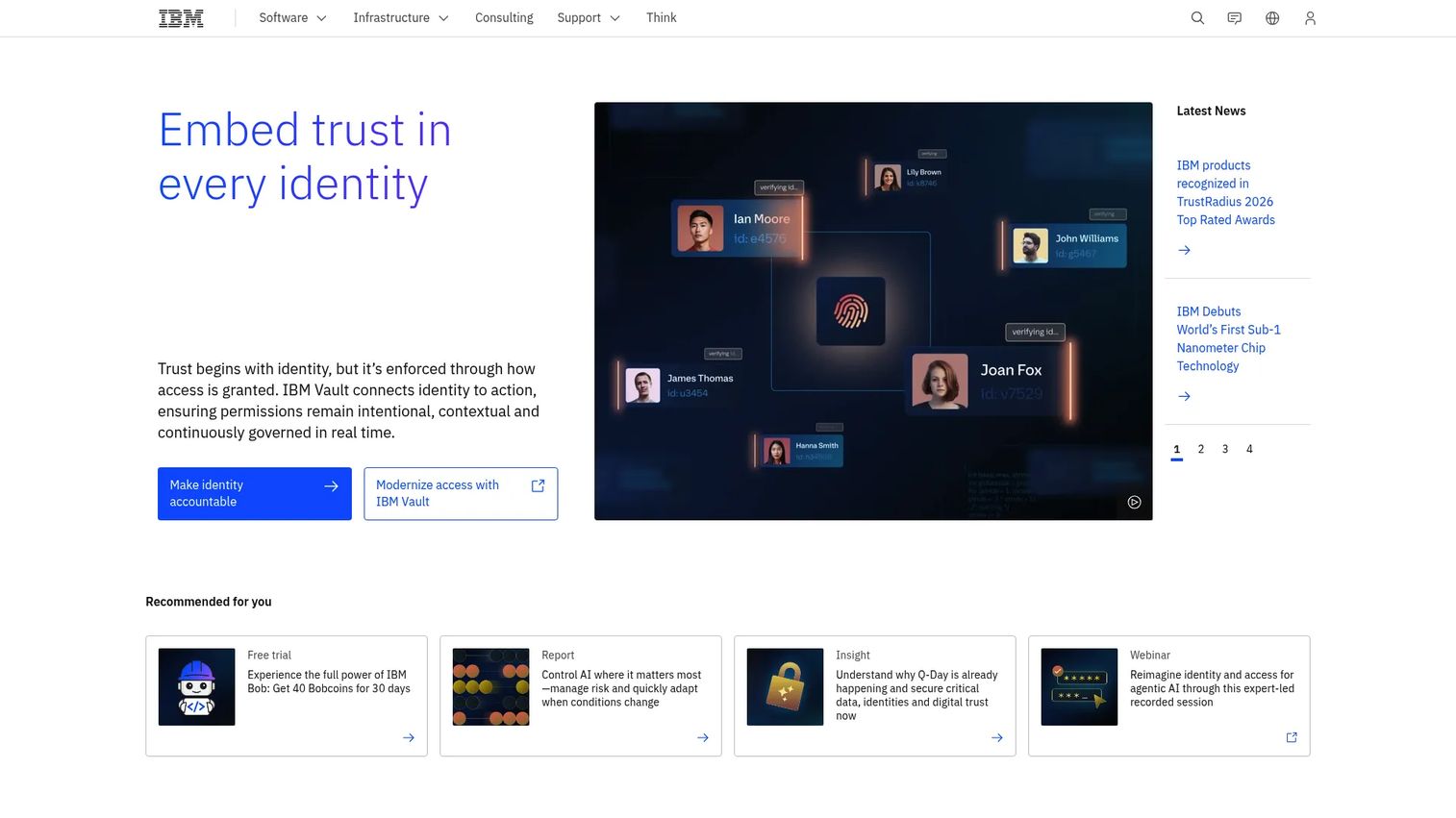
IBM is an enterprise technology company offering AI, hybrid cloud, software, infrastructure, and consulting. For conversational commerce, IBM's relevance is architectural: watsonx and IBM's AI tooling power structured conversational experiences, NLP, and voice, with the scale and automation enterprises need across omnichannel support and post-purchase use cases. It is less a turnkey commerce app and more a foundation for building one.
Best for: Large enterprises that want AI-first conversational architecture, with NLP and voice, built on hybrid cloud and broad automation capabilities.
Key strengths
- AI development and deployment: watsonx platforms for building and running conversational AI.
- Hybrid cloud infrastructure: Scalable foundation for high-volume conversational workloads.
- Enterprise data and automation: Data, automation, and analytics software for complex environments.
Why choose IBM: When governance, scale, and customization matter more than out-of-the-box commerce features, IBM is a strong reference point for conversational commerce AI architecture. It fits enterprises with engineering resources that want to build conversational experiences on a trusted, secure foundation rather than buy a packaged commerce suite. For broader context on this category, see our guide to agentic AI platforms.
IBM pricing: IBM's pricing is product-specific. watsonx.ai offers a free Toolbox playground, an Essentials plan starting at $0/month on a pay-as-you-go basis, and a Standard plan starting at $1,110/month. Many IBM products use usage-based or quote-based pricing. IBM holds a 4.3/5 rating on G2.
How to choose the right conversational commerce platform
Use these criteria to narrow a shortlist before you book demos.
Channel coverage
List the channels your customers actually use, then check each platform against that list. WhatsApp commerce matters in some regions and barely registers in others. If SMS and Instagram drive your sales, a platform strong only in web chat will leave gaps. Prioritize true omnichannel conversational commerce if you sell across markets.
AI and NLP quality
Conversational commerce AI is only as good as its understanding. Test how each tool handles vague questions, follow-ups, and intent switches. A demo with your own product questions reveals far more than a feature list. Ask how the AI hands off to a human, and how much it can resolve on its own.
Integration depth
A platform that does not connect cleanly to your CRM, CDP, and ecommerce systems creates the tool sprawl you are trying to escape. Confirm native integrations with Shopify, your CRM, and your marketing automation before committing. The fewer custom connectors you need, the faster you reach value.
Purchase journey coverage and measurement
Decide whether your primary need is discovery, checkout, or post-purchase support, then weight the tools accordingly. Just as important: confirm you can attribute conversations to revenue. A conversational commerce platform you cannot tie to conversion and retention is a platform you cannot defend to your CFO.
Conclusion
The right conversational commerce platform depends on where your stack is strongest and where it leaks. Enterprise teams already on Salesforce gain the most from consolidating commerce, support, and CRM there. Teams chasing conversion through better discovery should look hard at Bloomreach. Ecommerce brands that lead with service will find Gorgias and Intercom turn support into a sales channel, while Insider One and SAP Emarsys excel at cross-channel orchestration grounded in customer data. IBM remains the reference for enterprises building conversational AI on their own foundation.
The next step is simple: shortlist two or three tools based on whether your priority is discovery, checkout, or post-purchase support. Then run a demo using your real product questions and your real customer data. That is the fastest way to see which platform actually moves your numbers.
FAQs
A conversational commerce platform is software that lets brands sell, support, and engage customers through chat, messaging apps, SMS, and voice. It uses AI to guide shoppers from product discovery through purchase and post-purchase support inside a single conversation, connecting that activity to CRM, CDP, and ecommerce systems.
It collapses discovery, purchase, and support into one thread. A shopper can ask for a recommendation, receive a payment link, complete checkout, and later check order status without switching channels. The platform carries context across each stage, so the conversation gets more relevant over time.
It depends on your market. Web chat and SMS are near-universal, while WhatsApp commerce dominates in regions like Latin America, India, and parts of Europe. Instagram and Messenger matter for social-led brands. The strongest conversational commerce solutions unify all of these in one inbox.
No. Chatbots are one layer. A full platform adds personalization, recommendation engines, payment and checkout support, omnichannel messaging, CRM and CDP integration, and analytics. A conversational ecommerce chatbot without those layers is a widget, not a platform.
AI and NLP let the platform understand intent, answer open-ended questions, handle follow-ups, and recommend products in natural language. Conversational AI ecommerce engines also automate routine post-purchase tasks like order tracking and returns, freeing agents for complex cases and improving response speed.
Track conversation-to-conversion rate, average order value from assisted conversations, cart-recovery rate, ticket deflection rate, CSAT, and repeat-purchase rate. Tie each back to revenue so you can defend the investment. Attribution from conversation to closed sale is the metric that matters most.
Weigh channel coverage, AI and NLP quality, integration depth with your CRM, CDP, and ecommerce systems, purchase-journey coverage, and measurement. Decide whether discovery, checkout, or post-purchase support is your priority, then test the shortlist with your own product questions and data.
Yes, and the best platforms treat them as one motion. The same conversation that answers "is this in stock?" can recommend a product and complete a sale, while post-purchase support like returns and order tracking runs in the same thread. That overlap is exactly what makes conversational commerce examples like Gorgias and Intercom compelling for ecommerce teams.