Picking the wrong API can cost your team a sprint. The wrong marketplace can cost it two.
According to Postman's 2025 State of the API Report, 82% of organizations have adopted some level of an API-first approach, and 65% now generate revenue directly from their API programs. With APIs embedded into product roadmaps at that scale, the platform where your team discovers, evaluates, and publishes them matters as much as the APIs themselves.
A marketplace should shorten API evaluation, not bury your team in listings. The best ones make it easy to compare docs, pricing, latency notes, and integration paths before a sprint gets committed. The worst ones send engineers down a two-week rabbit hole on an API that turns out to have a 30-day support SLA and an undocumented rate limit.
This guide cuts through the catalog noise with 15 API marketplaces evaluated across coverage, developer experience, trust signals, pricing transparency, and enterprise fit.
What's inside
This guide compares 15 API marketplaces for developers, product managers, platform teams, and API providers.
- Who it's for: PMs evaluating third-party APIs for the roadmap, developers building integrations, platform teams governing internal API reuse, and providers publishing APIs to new audiences
- Selection criteria: Catalog breadth and quality, API documentation and developer experience, pricing transparency, trust signals (ratings, reviews, uptime), and provider monetization support
- Scope: Public API marketplaces, cloud marketplace catalogs, enterprise API hubs, and API exchange platforms
- Pricing and G2 ratings are drawn from live vendor sources
TL;DR
- Best overall for broad API discovery: RapidAPI covers the widest range of categories with a searchable hub, testing console, and subscription management in one place
- Best for AI, data, and emerging API types: API.market supports AI models and MCP endpoints alongside traditional API categories
- Best for data and utility APIs: APILayer specializes in finance, geolocation, aviation, and business utility APIs with free tiers on every listing
- Best for enterprise procurement: AWS Marketplace and Microsoft Azure Marketplace consolidate purchasing, billing, and vendor approval inside existing cloud contracts
- Best for internal API governance: Google Cloud API Hub, MuleSoft Anypoint Exchange, and Gravitee API Marketplace give platform teams visibility, ownership, and access controls across distributed API estates
- Best for developer experience and SDK packaging: APIMatic converts API specs into production SDKs, portals, and AI-agent integrations
What are API marketplaces?
API marketplaces are searchable platforms where developers, product teams, and businesses discover, evaluate, buy, publish, and monetize APIs.
They sit at the intersection of API discovery and API distribution. A buyer uses a marketplace to find an endpoint that handles currency conversion, geolocation, identity verification, or a hundred other jobs the product team does not want to build from scratch. A provider uses it to reach developers who need exactly that.
Core elements of an API marketplace:
- Searchable API catalog with category filters and keyword search
- API listing pages with documentation, endpoints, and authentication details
- Code samples, SDKs, and language-specific quickstarts
- Pricing or subscription options (free, pay-per-use, tiered plans)
- Authentication setup and API key management
- Ratings, reviews, or provider verification signals
- Sandbox or test console access before committing
- Provider tools for billing, usage analytics, and subscriber management
Not all marketplaces are the same shape. A public API marketplace like RapidAPI aggregates thousands of third-party APIs in one searchable catalog. A cloud marketplace like AWS Marketplace bundles APIs inside a broader procurement system. An enterprise API hub like Google Cloud API Hub focuses on internal visibility and governance. An API exchange like MuleSoft Anypoint Exchange is built around reusable integration assets.
Why product managers should care:
API dependency affects roadmap risk. An API with poor documentation creates engineering opportunity cost before the first endpoint call. One with unclear rate limits can break onboarding when usage spikes. Poor uptime becomes your team's incident, not the provider's. And if the marketplace makes pricing opaque or subscription changes are unpredictable, you end up with unit economics drift that is hard to explain in a quarterly review.
Evaluating the marketplace itself, not just the API listing, is the faster path to a stable, maintainable integration.
When to use API marketplaces
Validate third-party APIs before engineering commits
Before an API goes on the roadmap, PMs can use a marketplace's listing page, test console, rating history, and documentation to create a shortlist. This replaces anecdotal developer research with a structured evaluation that security, product, and engineering can all review from the same source. API testing tools pair well here for deeper technical validation once a shortlist is formed.
Publish and monetize API products
API providers use marketplaces to reach developers who are already searching by category. The right marketplace handles subscription billing, API key provisioning, usage tracking, and developer onboarding, so the provider's team focuses on the API, not the infrastructure around it. According to Postman's 2025 State of the API Report, 22.1% of organizations said APIs generated new revenue streams in the past 12 months, and marketplace distribution is a key driver.
Standardize API discovery across teams
Platform and engineering teams at larger organizations use enterprise API hubs to prevent duplicated integrations and enforce governance. When APIs are centralized with ownership metadata, lifecycle status, and access controls, PMs can spot what already exists before committing engineering time to something the company is already paying for. This connects directly to the API development tools and API gateway software that govern API traffic at runtime.
API marketplace comparison
The table below reflects verified pricing and G2 ratings drawn from live vendor pages. Pricing varies by individual API listing on open marketplaces; the pricing column captures the platform's model, not any single API's cost.
| # | Product | Best for | Key differentiator | Pricing | G2 rating |
|---|---|---|---|---|---|
| 1 | RapidAPI | Broad API discovery | Searchable hub with testing console and subscription management | Free tier; paid APIs vary by provider | 3.5/5 |
| 2 | API.market | AI, data, and emerging APIs | Unified gateway with MCP endpoints and AI model support | Free tier; usage-based pricing varies by API | N/A |
| 3 | APILayer | Data and utility APIs | 40+ production-ready APIs managed under one account | Free tier on every API; paid plans vary by API | 3.8/5 |
| 4 | OpenAPI | Business and identity APIs | 400+ services with pay-per-request pricing from €0.001 | From €0.001 per request | N/A |
| 5 | Nokia API Hub | Telecom and network APIs | Programmable network capabilities for developers and partners | Contact Nokia for pricing | N/A |
| 6 | Google Cloud API Hub | Internal API governance | Centralized API catalog with lifecycle, ownership, and dependency tracking | Contact Google Cloud for pricing | N/A |
| 7 | Postman API Network | Discovery tied to testing | Public API network integrated with Postman collections | Free plan; Team from $19/user/month (billed annually) | 4.6/5 |
| 8 | AWS Marketplace | Enterprise cloud procurement | Consolidated AWS billing, private offers, and vendor governance | Varies by listing; free and paid options available | N/A |
| 9 | Microsoft Azure Marketplace | Microsoft-aligned procurement | Azure ecosystem integration with private plans and centralized billing | Varies by publisher listing | N/A |
| 10 | IBM API Hub | Hybrid and enterprise API management | AI-assisted management across hybrid, multicloud, and on-premises environments | Custom pricing; 30-day trial available | 4.3/5 |
| 11 | MuleSoft Anypoint Exchange | Enterprise integration asset reuse | Internal catalog for APIs, connectors, templates, and AI assets | Contact MuleSoft for pricing | N/A |
| 12 | Gravitee API Marketplace | Governed self-service API marketplace | Branded portal with subscription plans, policies, and analytics | From $2,500/month (Planet plan) | 4.7/5 |
| 13 | Kong Konnect Service Catalog | Platform engineering and API governance | Service catalog connected to Kong's API gateway | From $25/month plus usage | 4.4/5 |
| 14 | APIMatic | API provider developer experience | SDK generation, documentation portals, and MCP server generation from API specs | From $10/month (Starter, billed annually) | N/A |
| 15 | Zyla API Hub | Broad self-serve API access | 10,000+ APIs under one account and API key | Free trials on most APIs; paid pricing varies by API | N/A |
Best 15 API marketplaces for 2026
1. RapidAPI
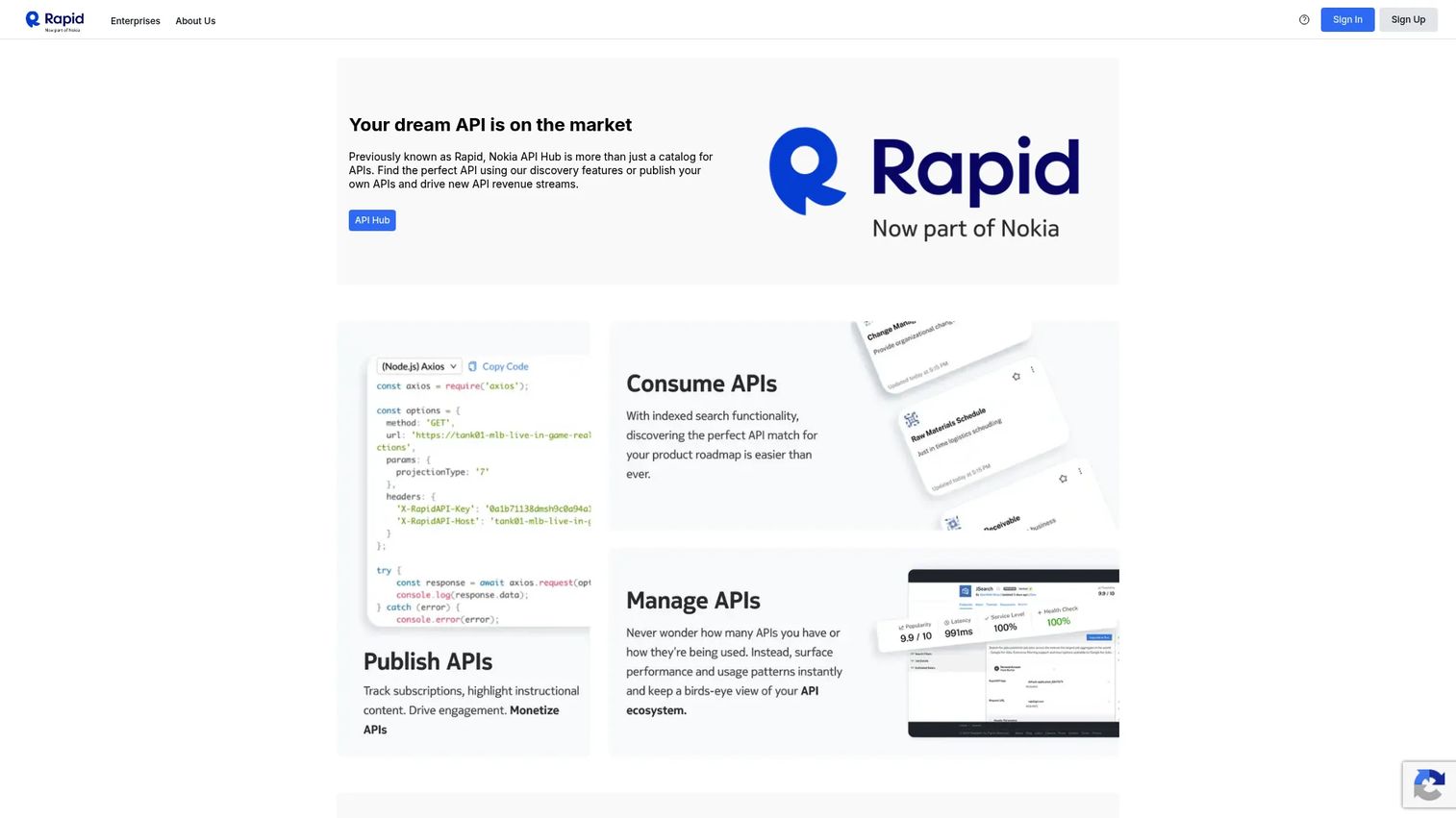
RapidAPI is an API hub for discovering, testing, connecting to, publishing, and managing APIs across categories including AI, weather, finance, social media, and sports. Teams can search the marketplace, run test calls directly in the browser, and subscribe to APIs from a single account. Providers publish through the same hub and control monetization, plans, and usage analytics from a unified dashboard.
Best for: Developers and product teams that want broad API discovery across many categories in one searchable catalog.
Key features
- Searchable API hub with category and keyword filters
- Browser-based API testing console with code snippet generation
- Unified API key and subscription management across APIs
- API analytics covering usage, latency, errors, and billing
- Team access controls and internal API sharing
Why choose RapidAPI: Strong fit when your team wants one starting point for evaluating many external APIs before engineering spikes begin. For PMs, the test console turns "can we integrate this?" into a verified shortlist without waiting on a developer to build a local prototype.
RapidAPI pricing: A free tier is available. Browsing the marketplace costs nothing; individual API pricing is set by each provider and may include free, freemium, pay-per-use, or fixed monthly plans. The Pro plan for the platform's own Web Traffic API runs $39.99/month, Ultra $89.99/month, and Mega $250/month, but individual API subscriptions will differ.
G2 rating: 3.5/5
2. API.market
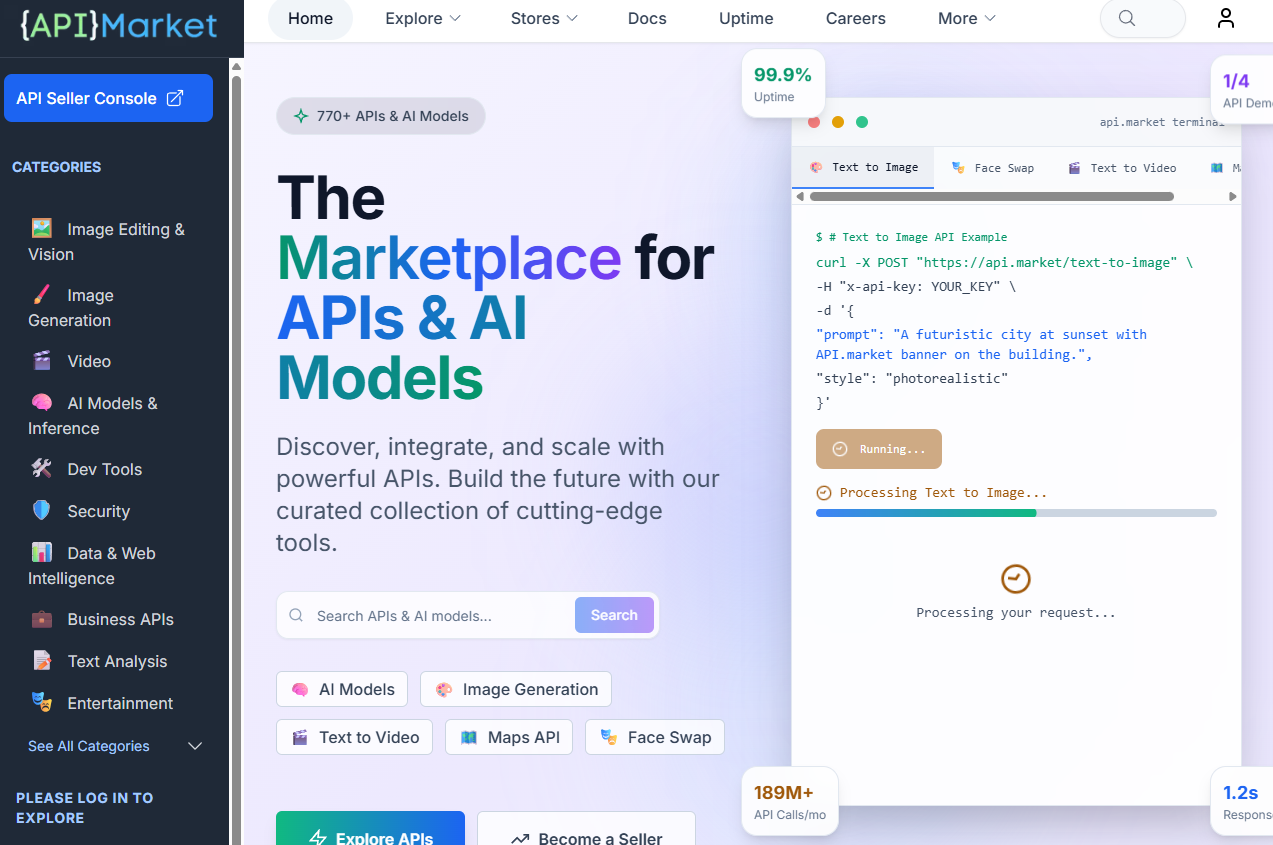
API.market is a marketplace for discovering, integrating, and monetizing APIs and AI models, with a particular focus on fast-moving categories like generative AI, data enrichment, image processing, and automation. It supports MCP endpoints designed for AI-agent workflows, which makes it useful for teams building on top of large language models. Providers can configure free trials, usage tiers, and subscription plans directly on the platform.
Best for: Teams comparing AI, data, image, video, and utility APIs in one marketplace, including teams building AI-driven product features.
Key features
- AI API and AI model catalog across multiple categories
- MCP endpoint support for AI-agent integrations
- Unified gateway with authentication, rate limiting, and billing
- Hosted documentation and interactive API testing
- Free trials and configurable pricing plans for API products
Why choose API.market: Good fit when a team is experimenting across fast-moving API categories and needs a proof-of-concept environment before committing engineering time. The MCP endpoint support is a practical advantage for PMs whose roadmap includes AI-agent or workflow automation features.
API.market pricing: A free tier is available with pay-as-you-go access starting at $0/month. Paid tiers (Basic, Pro, Ultra, Mega) and custom plans are offered, but individual API pricing is set by each provider. Check each listing's pricing tab before subscribing.
G2 rating: N/A
3. APILayer
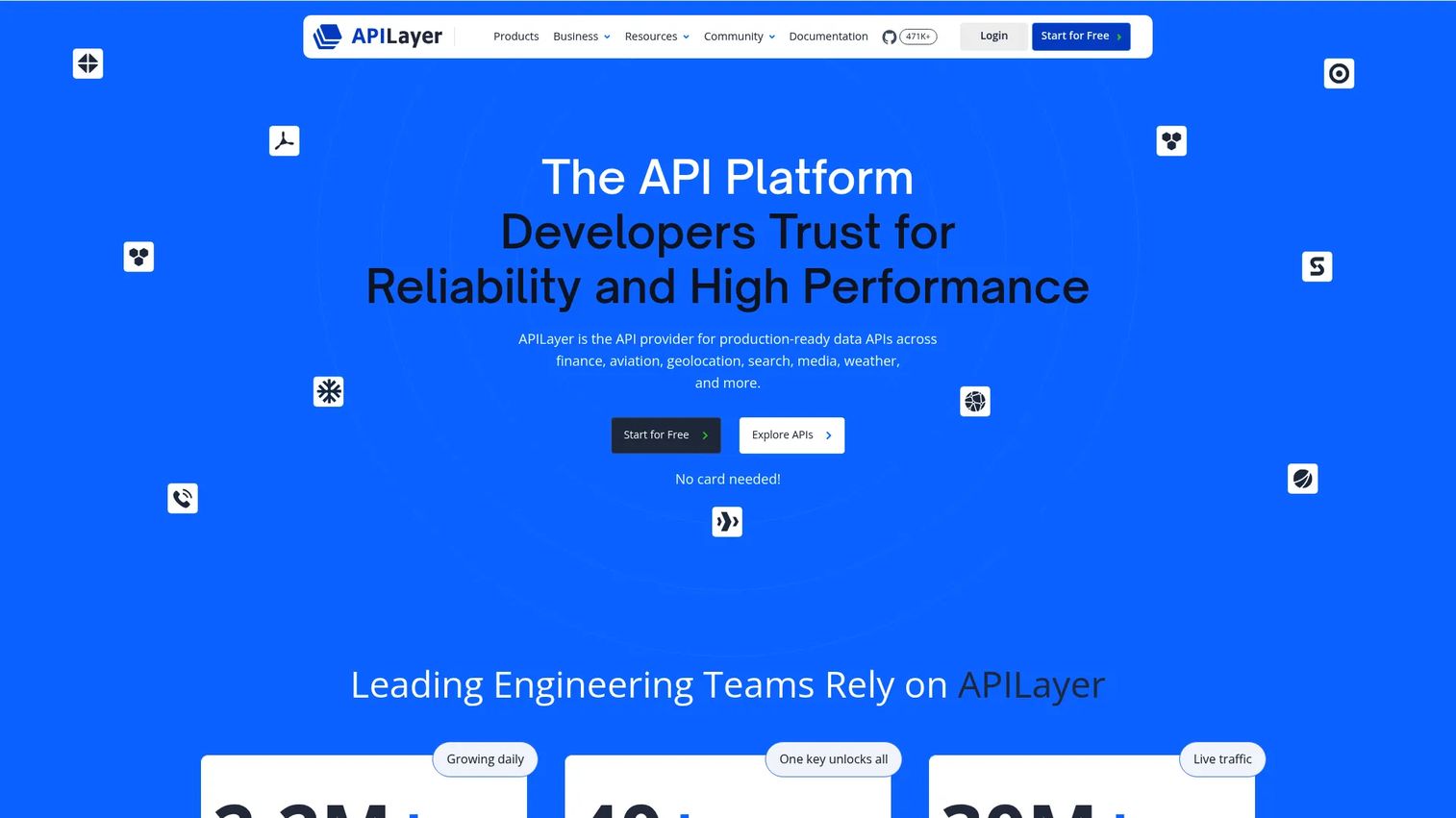
APILayer provides more than 40 production-ready APIs across finance, aviation, geolocation, media, weather, scraping, search, and business utility categories. All APIs are accessible under one account and API key, which reduces the overhead of managing multiple credentials across vendors. Listings include interactive documentation, code samples, and category-specific guidance.
Best for: Product and engineering teams buying data, finance, geolocation, or utility APIs that need a managed, production-grade starting point.
Key features
- 40+ APIs accessible through one account and API key
- Centralized documentation and interactive usage guides
- Finance, aviation, geolocation, search, media, and weather API coverage
- Free plan available on every API listing
- Category filters for discovery across API types
Why choose APILayer: Strong choice when the product need is specific and data-driven, such as phone validation, currency conversion, or IP geolocation. The free tier on every listing lets you validate behavior before paying, which reduces the risk of committing a sprint to an integration that does not perform as expected.
APILayer pricing: Every API on the platform includes a free plan. Paid tiers exist per API and are priced separately on each listing's pricing page. There is no universal platform subscription; the cost you see depends on the API and the usage tier you select.
G2 rating: 3.8/5
4. OpenAPI
Openapi is an API marketplace offering more than 400 API services spanning business, identity, real estate, automotive, finance, communication, digital trust, and AI categories. The platform operates on pay-per-use and subscription models with no annual fees, making it accessible for teams that want to test before committing. Registration and the testing environment are free.
Best for: Business teams evaluating API services around customer data quality, identity verification, CRM enrichment, or revenue operations workflows.
Key features
- 400+ API services across business, identity, finance, and AI categories
- Pay-per-use pricing from €0.001 per request
- Subscription pricing from €0.0034 per request
- Unlimited testing environment with free registration
- Official, continuously updated documentation and multi-language code samples
Why choose OpenAPI: Use it when API needs sit close to customer data quality or revenue operations and you want to run volume-based cost modeling before a procurement conversation. The pay-per-request model keeps early validation cheap.
OpenAPI pricing: Single requests start at €0.001. Subscription pricing begins at €0.0034 per request. No annual fees are required, and the testing environment is free to use after registration.
5. Nokia API Hub

Nokia's network API platform exposes programmable telecommunications capabilities to developers, enterprises, and ecosystem partners. Capabilities include quality on demand, location services, device status, identity, and fraud-related network services. A developer portal provides documentation, examples, SDKs, and sandbox access for testing network API integrations.
Best for: Product teams building applications that depend on programmable network capabilities, carrier partnerships, or telecom-grade connectivity services.
Key features
- Network API catalog for telecom and connectivity use cases
- Developer portal with documentation, SDKs, and sandbox testing
- Quality on demand, location, identity, and device status APIs
- Secure API exposure and management tools
- Partner ecosystem access for operators and enterprise developers
Why choose Nokia API Hub: Choose it when API discovery is tied to telecommunications infrastructure, network intelligence, or operator-grade services. It is more specialized than broad developer marketplaces, which is a strength when your product requires carrier-grade reliability and you need a formal partner relationship to access network capabilities.
Nokia API Hub pricing: Nokia describes transparent pay-as-you-go pricing and customizable packages for its network API platform. Specific numeric pricing requires a direct conversation with Nokia to confirm current terms and partner access requirements.
6. Google Cloud API Hub
Google Cloud API Hub is a centralized catalog and governance platform for discovering, organizing, managing, and governing an organization's APIs. It supports API specification parsing including OpenAPI, semantic search, dependency tracking through an API supply-chain view, and lifecycle visibility across deployments and versions. It integrates with Google Cloud services and third-party gateways through plugins.
Best for: Enterprise teams standardizing API discovery and governance across distributed Google Cloud environments.
Key features
- Centralized API catalog with searchable resources and metadata
- API specification parsing, linting, and OpenAPI support
- Semantic and filter-based API search
- API dependency tracking through a supply-chain view
- Lifecycle visibility across versions, deployments, and operations
Why choose Google Cloud API Hub: Strong fit when API discovery is an internal scaling problem, not just a third-party buying problem. For PMs, it helps reduce duplicated API work across teams by surfacing what already exists before new integrations go on the roadmap. The AI governance tools dimension of API lifecycle control is increasingly relevant here as AI-driven APIs require tighter oversight.
Google Cloud API Hub pricing: Pricing is part of the Google Cloud pricing structure. Contact Google Cloud or check the Google Cloud pricing console for current plan details, as no standalone public price page was verified for this product.
7. Postman API Network
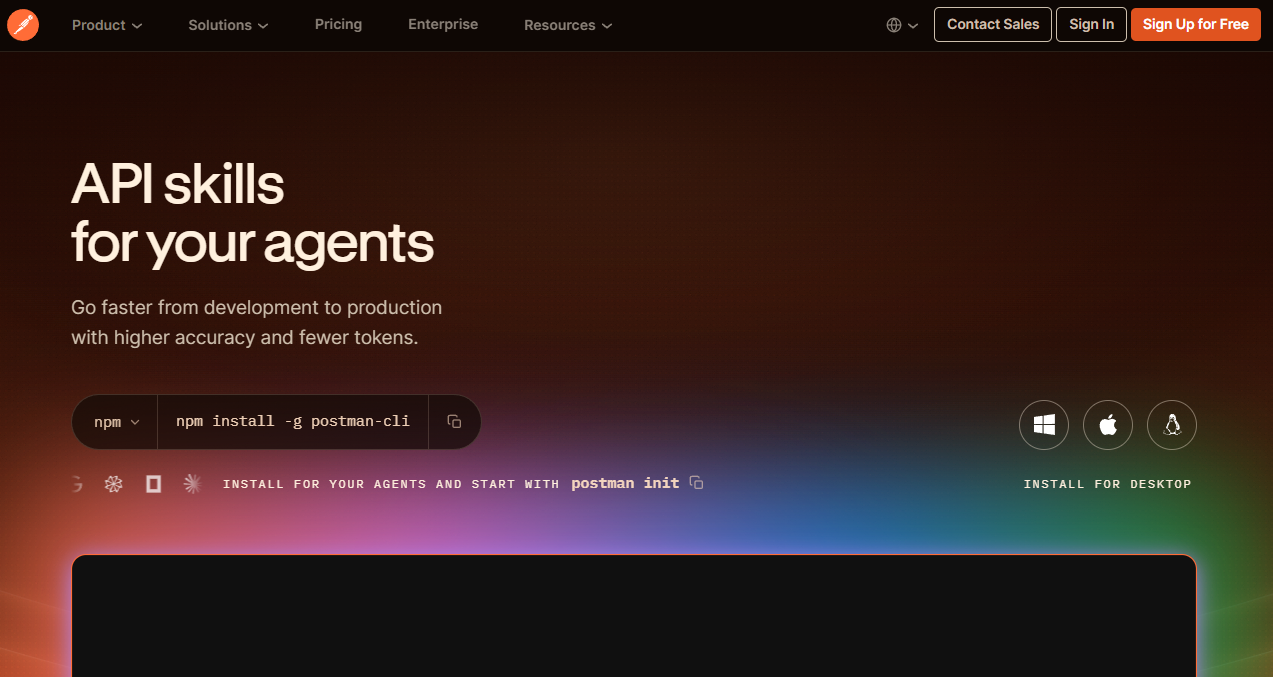
Postman API Network is a public network for discovering, publishing, sharing, and consuming APIs through Postman. Teams can search public APIs, browse workspaces and collections, and fork collections directly into their own Postman workspace to start testing immediately. API providers publish listings with documentation, endpoints, and ownership details that are visible to the broader developer community.
Best for: Developers and PMs who want API discovery connected directly to hands-on testing without switching tools.
Key features
- Public API catalog with searchable APIs, workspaces, and collections
- Direct fork-to-workspace for immediate testing
- API documentation with Postman collections and code examples
- Team collaboration workspaces for API evaluation and integration work
- Provider publishing tools for listing APIs publicly
Why choose Postman API Network: Use it when API evaluation needs to move quickly from discovery to a working sample request. PMs benefit because engineers can test candidate APIs inside a workflow they already use, which reduces context switching and accelerates the validation cycle before sprint commitment. For teams already using API testing tools, this integration is a natural fit.
Postman API Network pricing: The Free plan supports basic individual API work at $0/month. Solo runs $9/month billed annually. Team is $19/user/month billed annually, and Enterprise requires a sales conversation. Individual API provider pricing on the network is set separately by each provider.
G2 rating: 4.6/5
8. AWS Marketplace
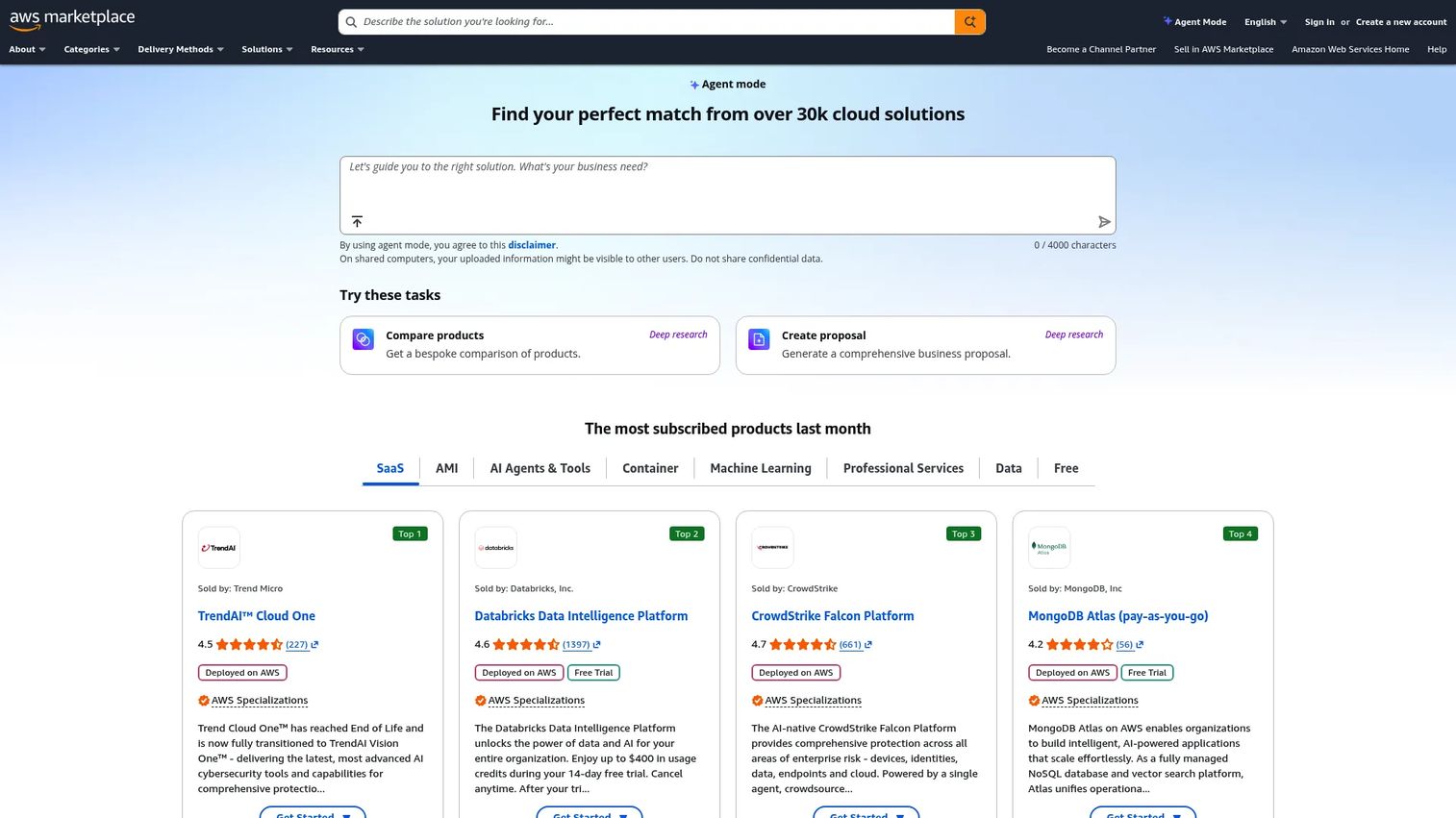
AWS Marketplace is a curated digital catalog for finding, buying, deploying, and managing third-party software, data products, and services on AWS. It supports API-enabled services and SaaS products alongside AMIs, containers, data subscriptions, and professional services. Enterprise teams use it to consolidate vendor procurement inside AWS billing, negotiate private offers, and enforce governance through Private Marketplace catalogs.
Best for: Enterprise teams buying API-enabled products and services through existing AWS procurement workflows with consolidated billing.
Key features
- Product discovery with search, reviews, free trials, and product comparisons
- Flexible procurement including pay-as-you-go, subscriptions, and private offers
- Consolidated AWS billing and cost management
- Private Marketplace catalogs for enterprise governance and vendor approval
- Deployment through AMIs, SaaS, containers, data products, and CloudFormation
Why choose AWS Marketplace: Choose it when procurement, vendor approval, and cloud billing matter as much as discovery. PMs should involve procurement and security early because the platform's strength is governance and consolidated purchasing, not API-by-API technical comparison. If your organization already standardizes on AWS cloud spend, this reduces the friction of getting a new vendor through approval.
AWS Marketplace pricing: The marketplace itself does not carry a platform fee. Individual listing pricing is set by each vendor and may be free, hourly, monthly, annual, usage-based, or structured as a private offer negotiated directly with the seller.
9. Microsoft Azure Marketplace
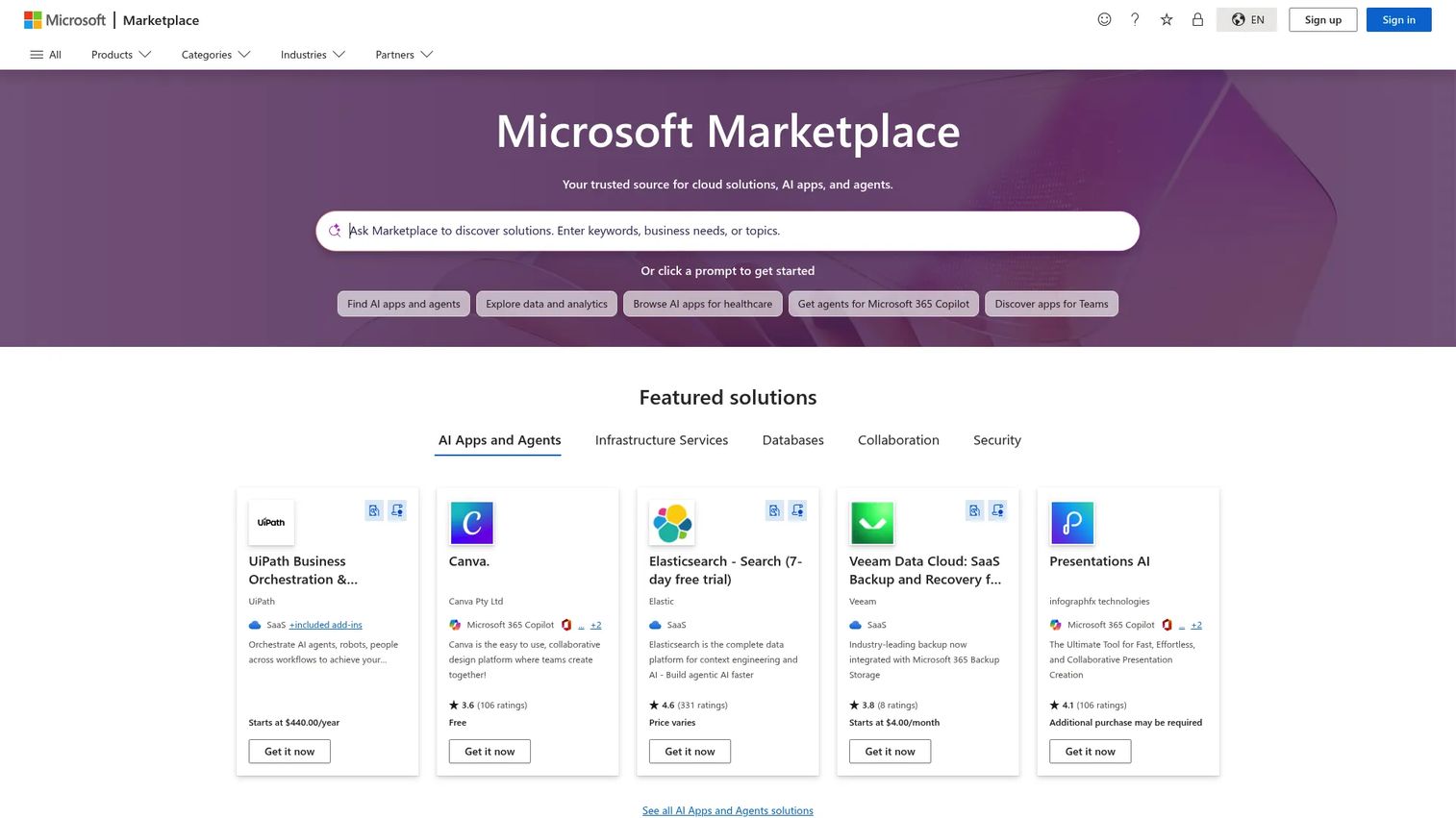
Microsoft Azure Marketplace is a catalog for discovering, evaluating, purchasing, and deploying cloud solutions, AI apps, SaaS products, and professional services aligned with the Microsoft ecosystem. It supports Azure-compatible deployments, Microsoft identity integration, private plans for enterprise buyers, and eligible Azure Consumption Commitment credit toward marketplace purchases.
Best for: Microsoft-aligned enterprises buying API-enabled services and cloud tools through Azure procurement with centralized billing.
Key features
- Broad catalog of cloud, AI, SaaS, and professional-service offerings
- Azure portal deployment and Microsoft identity alignment
- Free trials, test drives, private offers, and Azure Consumption Commitment credit
- Centralized billing and procurement through Azure accounts
- Publisher-set pricing models including free, BYOL, per-user, and usage-based
Why choose Microsoft Azure Marketplace: Good fit when the organization standardizes on Microsoft contracts, cloud spend, and identity workflows. Product teams get a cleaner approval path than one-off vendor purchasing because the commercial relationship, billing, and identity are already established. This matters most at mid-market and enterprise organizations where each new vendor requires security review and procurement sign-off.
Microsoft Azure Marketplace pricing: Pricing is set independently by each publisher and varies by offer type. Models include free, bring-your-own-license, subscriptions, flat-rate, per-user, and usage-based pricing. Check each listing's plan page for the specific numbers before submitting a procurement request.
10. IBM API Hub
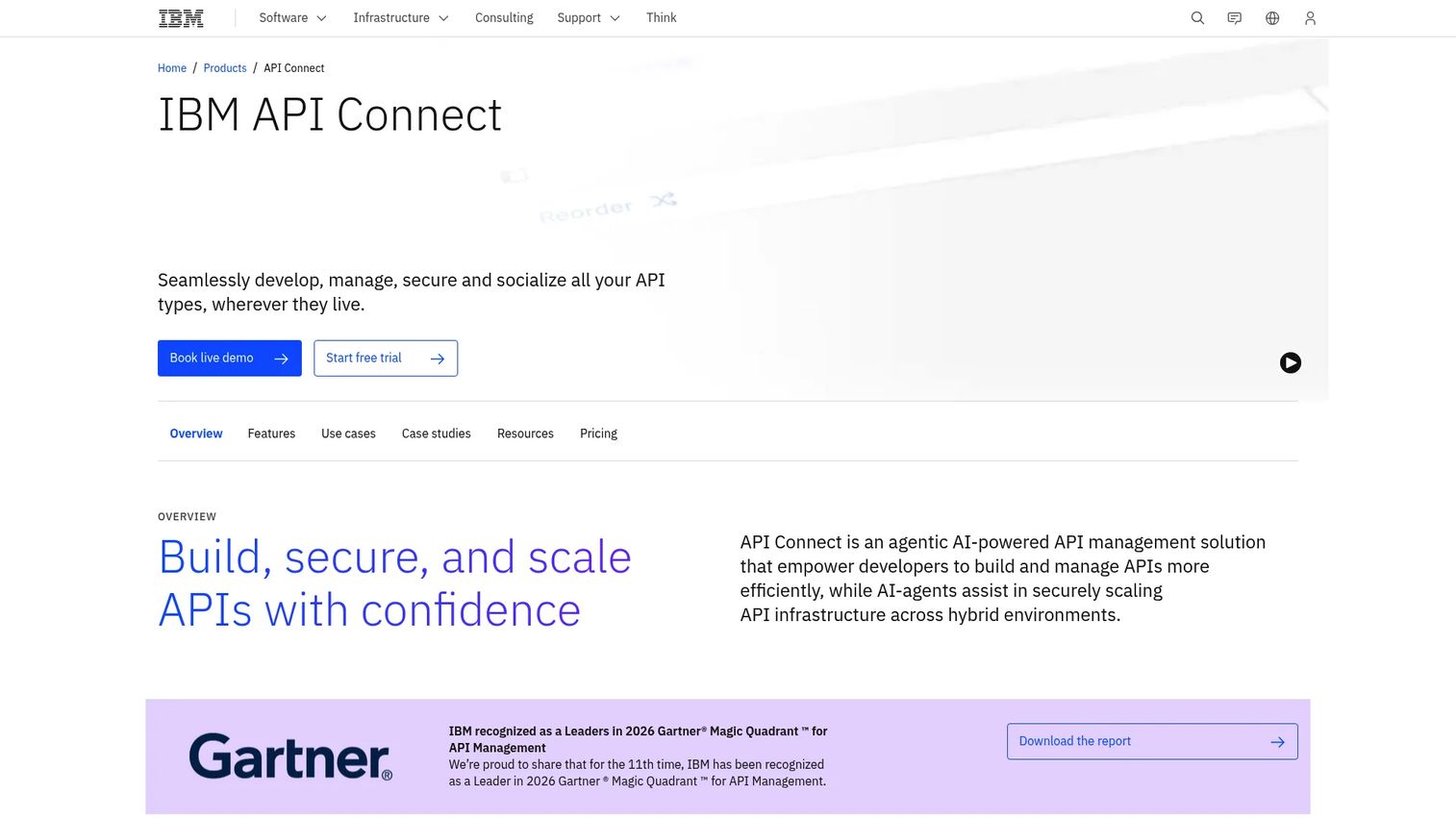
IBM API Connect is an AI-assisted API management platform for developing, securing, managing, and socializing APIs across hybrid, multicloud, and on-premises environments. Its Developer Portal supports API discovery, subscription management, and interactive testing. The platform covers REST, SOAP, GraphQL, WebSockets, AsyncAPI, and event-driven APIs, with governance across the full API lifecycle.
Best for: Enterprises managing and securing large API estates across hybrid, multicloud, and on-premises environments with governance requirements.
Key features
- Full-lifecycle API management with versioning, access control, and analytics
- API gateway security with authentication, authorization, and IBM DataPower Gateway
- Developer Portal for API discovery, testing, and subscription management
- AI-assisted API development, governance, and remediation
- Deployment across SaaS, cloud, hybrid, multicloud, and on-premises
Why choose IBM API Hub: Good fit when APIs need to align with enterprise integration strategy and hybrid architecture, not just developer convenience. PMs should evaluate whether IBM's ecosystem matches the organization's architecture and support expectations before committing, since this is a significant platform investment rather than a self-serve catalog subscription.
IBM API Hub pricing: IBM offers pay-as-you-go, Standard SaaS, Premium SaaS, Reserved Instance, and self-managed deployment options. A 30-day free trial is available. Specific pricing requires a quote from IBM sales, as no public numeric price is displayed on the pricing page.
G2 rating: 4.3/5
11. MuleSoft Anypoint Exchange
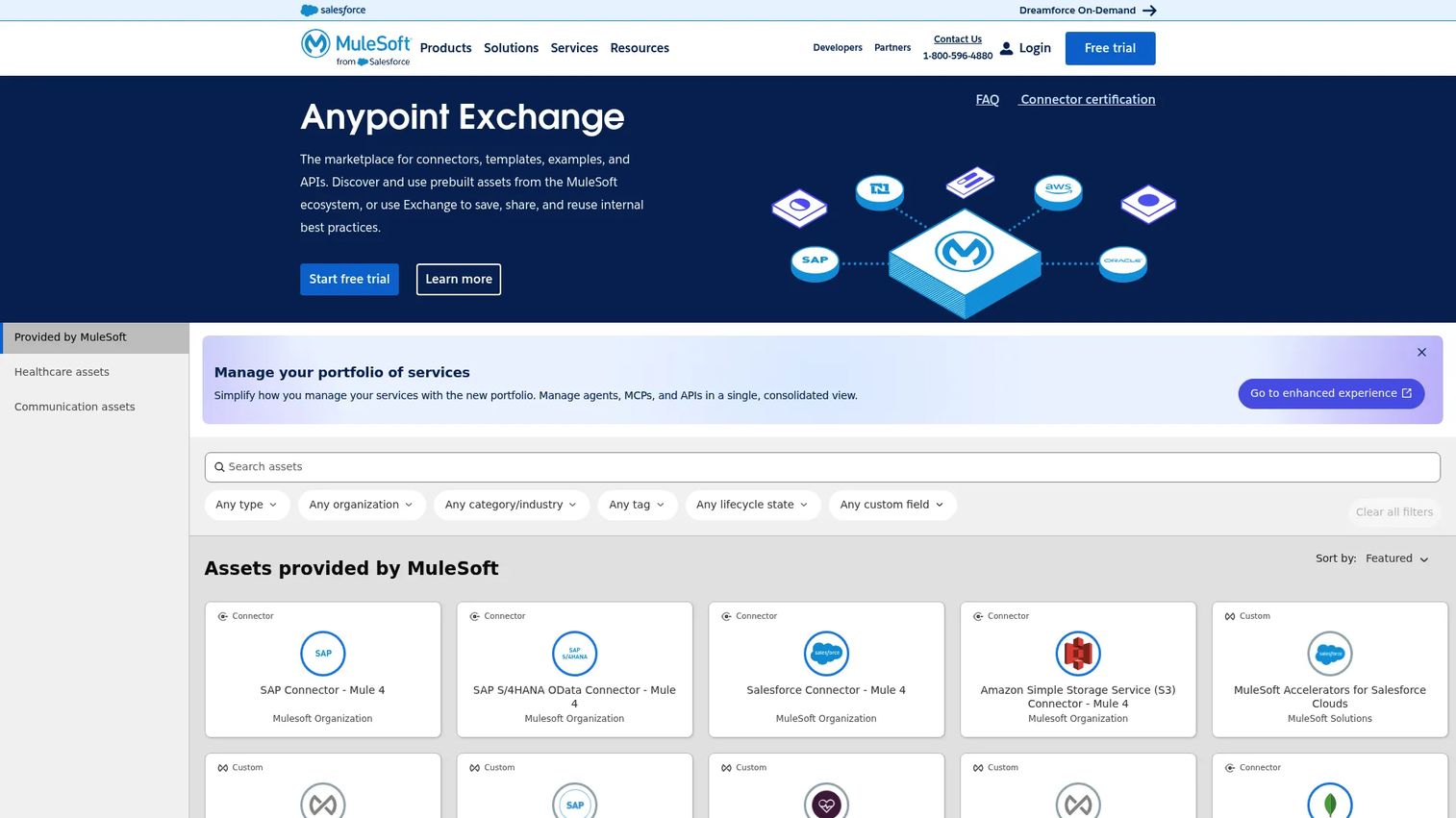
MuleSoft Anypoint Exchange is a centralized catalog for discovering, sharing, publishing, testing, and reusing integration assets including APIs, connectors, templates, examples, and AI-related assets. Teams build developer portals with documentation and interactive API consoles directly on the platform. It also supports AI agents, large language model integrations, and MCP server assets, extending its catalog beyond traditional integration patterns.
Best for: Enterprises that need an internal API marketplace tied to a broader integration strategy and existing MuleSoft architecture.
Key features
- Catalog for reusing APIs, connectors, templates, examples, and AI assets
- Developer portals with documentation and interactive API consoles
- Built-in mocking service for REST API testing
- Asset usage and engagement metrics
- Support for AI agents, LLM integrations, and MCP servers
Why choose MuleSoft Anypoint Exchange: Choose it when your organization needs to standardize reuse across teams and systems and already runs on MuleSoft for integration. PMs should weigh the platform investment required: Anypoint Exchange is part of the broader MuleSoft Anypoint Platform, not a standalone self-serve marketplace, so adoption requires engineering alignment and organizational buy-in.
MuleSoft Anypoint Exchange pricing: Pricing is part of the broader MuleSoft Anypoint Platform licensing. Contact MuleSoft sales for a quote, as no standalone public price for Anypoint Exchange was displayed on the reviewed pages.
12. Gravitee API Marketplace
Gravitee is a centralized API marketplace and developer portal for discovering, documenting, subscribing to, and governing APIs. Teams create branded portals with self-service subscription plans, approval workflows, policy enforcement, and usage analytics. It covers access management, rate limiting, quotas, and API lifecycle management from a single platform.
Best for: Platform teams building a governed, self-service API marketplace for internal developers, partners, or external consumers.
Key features
- Centralized API catalog with interactive documentation and API discovery
- Self-service API subscriptions with plans and approval workflows
- Authentication, authorization, rate limiting, and policy enforcement
- Usage analytics, monitoring, and API governance controls
- Branded developer portal for internal or external audiences
Why choose Gravitee API Marketplace: Strong fit when you are not just consuming APIs but operating a marketplace around your own. PMs should use it when API adoption, developer experience, and governance are product requirements, not just IT infrastructure concerns. The platform-level investment is significant, but it gives teams full control over how APIs are packaged, accessed, and measured. For teams exploring API generation software alongside governance tooling, Gravitee handles the distribution side.
Gravitee API Marketplace pricing: The Planet plan starts at $2,500/month and includes unlimited users, unlimited APIs under management, one production gateway, and Gold Support. Galaxy and Universe plans carry custom pricing with additional gateways and enterprise capabilities.
G2 rating: 4.7/5
13. Kong Konnect Service Catalog
Kong Konnect includes a centralized service catalog for discovering, describing, and governing an organization's APIs, AI models, services, and related resources. It surfaces service ownership, dependency relationships, and API specifications alongside Kong's API gateway, giving platform engineering teams visibility across runtime infrastructure and the catalog simultaneously.
Best for: Platform engineering and enterprise teams connecting API discovery to gateway management and service ownership.
Key features
- Centralized catalog of APIs and services with searchable metadata
- Service ownership and dependency visibility across teams
- API and specification discovery with governance metadata
- Connected to Kong's API gateway for runtime context
- Developer portal access for internal and external consumers
Why choose Kong Konnect Service Catalog: Choose it when API discovery needs to connect to runtime infrastructure, not just documentation. PMs working on platform roadmaps where service ownership and lifecycle governance matter will find the gateway integration useful for understanding which APIs are active, who owns them, and what depends on them. Teams already using Kong for API gateway software will see the most immediate value.
Kong Konnect Service Catalog pricing: The Plus plan starts from $25/month plus usage, billed monthly, with a 30-day free trial. Enterprise requires custom annual billing.
G2 rating: 4.4/5
14. APIMatic
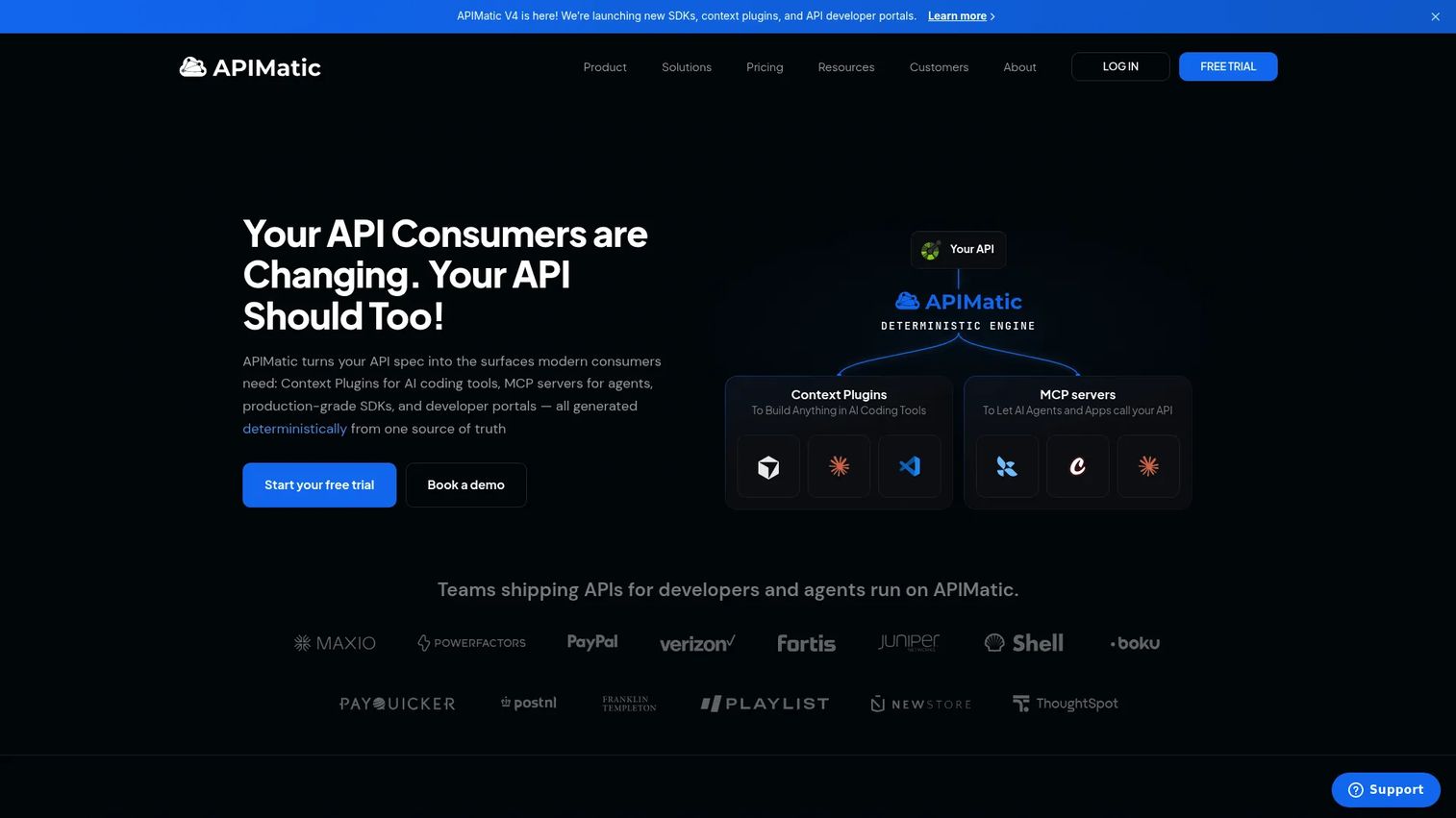
APIMatic turns API specifications into production SDKs, documentation portals, code samples, and AI-agent integrations. It supports SDK generation across multiple programming languages, API specification validation and linting, live developer playgrounds, and MCP server generation for AI-agent access. Providers preparing to publish APIs on any marketplace can use APIMatic to deliver the developer experience that reduces integration friction before the first subscriber.
Best for: API providers improving developer experience before publishing or scaling API adoption, particularly those generating SDKs or building developer portals from spec files.
Key features
- SDK generation across multiple programming languages
- Documentation portals with live playgrounds and reactive code samples
- API specification validation, linting, and transformation
- API Copilot and context plugins for AI-assisted integrations
- MCP server generation for AI-agent access
Why choose APIMatic: Choose APIMatic when the marketplace problem is poor developer experience, not lack of distribution. PMs can use it to reduce the integration friction that causes developers to abandon an API after the first failed call. For teams publishing APIs and working alongside API documentation tools, APIMatic automates the documentation and SDK layer that most teams build manually.
APIMatic pricing: The Starter plan is $10/month billed annually ($15/month billed monthly). Basic is $300/month per language billed annually. Business and Enterprise plans require a quote. A 14-day trial is available.
15. Zyla API Hub
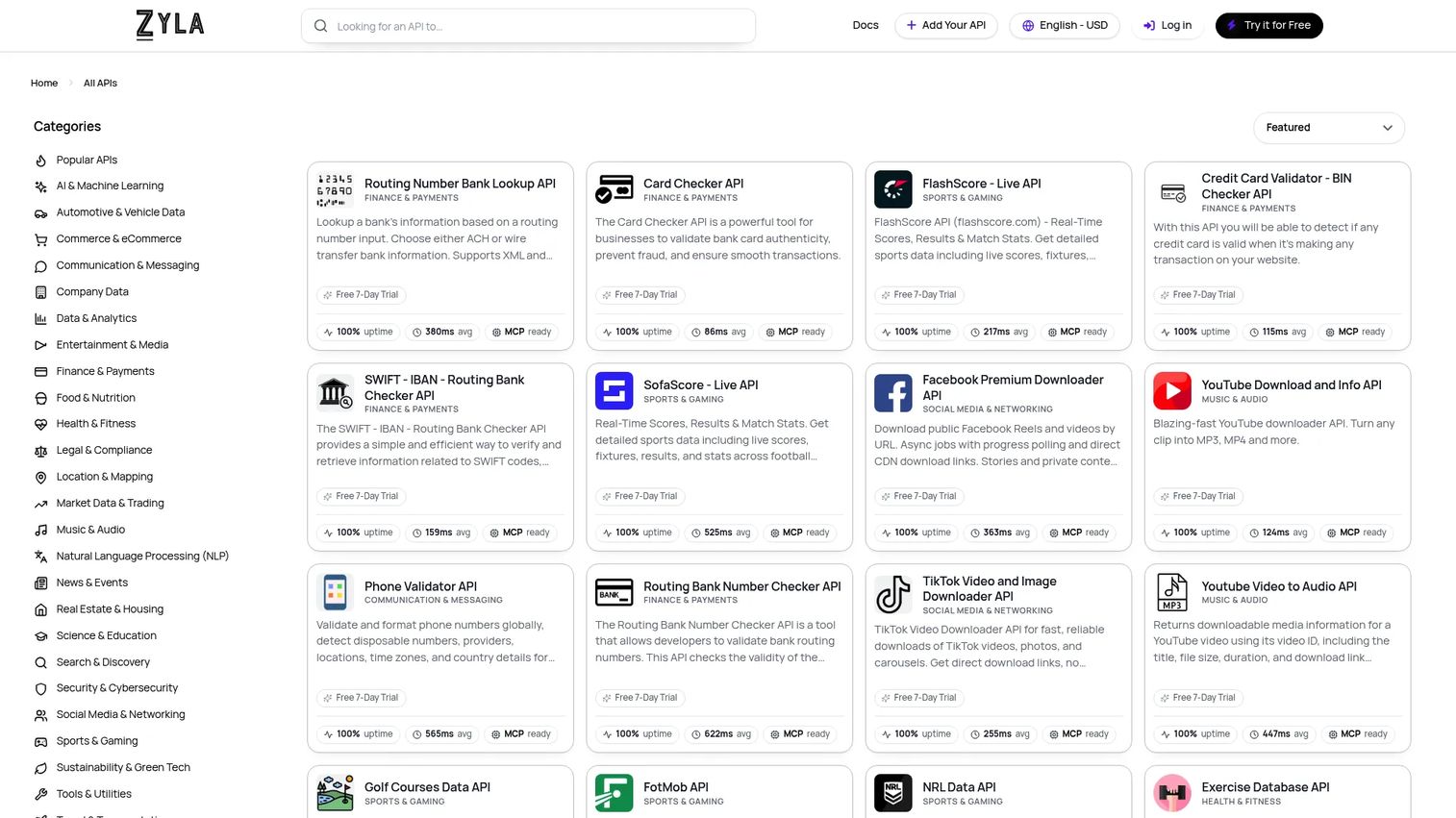
Zyla API Hub is an API marketplace providing access to thousands of APIs across categories including finance, data, AI, sports, and social media, all accessible through one account and API key. It supports Postman and cURL integration, endpoint testing, and MCP-compatible AI-agent access. Most APIs offer a 7-day free trial with up to 50 requests to evaluate behavior before subscribing.
Best for: Developers and startups looking for broad API catalog access with a single account setup and self-serve trials.
Key features
- 10,000+ APIs across finance, data, AI, sports, and social media categories
- Single account and API key across all subscribed APIs
- API documentation, endpoint testing, and Postman/cURL integration
- MCP-compatible AI-agent support
- 7-day free trials with up to 50 requests on most APIs
Why choose Zyla API Hub: Good fit for smaller teams testing APIs across categories without starting inside a cloud procurement system. The single API key model reduces credential management overhead, and the trial structure lets PMs validate API behavior on a short timeline. Before depending on any listing, compare documentation depth and support responsiveness, since quality varies by provider.
Zyla API Hub pricing: Most APIs offer a 7-day free trial with up to 50 requests. Paid pricing is defined by each API provider separately. Annual billing is available on subscriptions, but no universal starting price applies across the catalog.
Considerations when choosing API marketplaces
Catalog breadth versus API quality
A large catalog is helpful only when search, filtering, documentation, and provider verification make evaluation practical. Some marketplaces list thousands of APIs with minimal curation; others publish fewer APIs but enforce quality standards on docs, uptime, and support. Evaluate whether the marketplace makes it faster to find good APIs, not just more APIs.
Documentation, SDKs, and sandbox testing
Poor documentation converts directly into sprint risk. An API with missing authentication examples, unclear error codes, or no sandbox environment forces engineers to build test harnesses before they know whether the integration is viable. Before shortlisting any API, check whether the listing includes interactive testing, code samples in your team's primary language, and a clear onboarding path. The opportunity cost of a poorly documented API is high.
Pricing, rate limits, and procurement path
Free tiers and trials reveal behavior, but they rarely reveal the pricing you will actually pay at production volumes. Model expected usage volume against the API's rate limits and overage costs before committing. On enterprise marketplaces like AWS and Azure, also verify private offer availability, cloud commitment eligibility, and how vendor approval flows through your procurement team.
Trust signals and reliability
Ratings, reviews, provider verification status, uptime history, SLA documentation, and support responsiveness are all risk signals. An API with a 3.5 rating and no SLA poses more onboarding risk than one with a 4.7 rating and documented 99.9% uptime. Check whether the marketplace surfaces these signals clearly, or whether you have to hunt for them outside the listing page.
Provider monetization and marketplace fit
The best marketplace for buying APIs may not be the best place to publish one. Evaluate marketplace reach, listing control, subscriber analytics, billing flexibility, and developer onboarding experience separately from your buying criteria. A marketplace that gives providers strong monetization tools, clear subscriber data, and billing automation serves a different job than one optimized purely for discovery.
Conclusion
The right API marketplace depends on what your team is trying to do. For broad discovery, RapidAPI and Zyla API Hub cover the widest catalog surface. For data and utility APIs with free entry points, APILayer is a reliable starting point. Teams building on AI workflows will find API.market's MCP and AI model coverage useful. Enterprise procurement runs most smoothly through AWS Marketplace and Microsoft Azure Marketplace when you already standardize on those cloud contracts.
Internal governance is a separate job: Google Cloud API Hub, MuleSoft Anypoint Exchange, and Kong Konnect Service Catalog address the platform engineering problem of who owns what and what is already available. Gravitee covers the case where you want to run your own branded API marketplace. APIMatic belongs in the stack when your team is publishing APIs and needs production-grade developer experience before the first subscriber arrives.
A practical next step: Pick two marketplaces for initial discovery, run a technical evaluation on two or three APIs against your target use case, model pricing under expected usage volumes, and confirm security and support terms before any roadmap commitment. That sequence keeps API evaluation from becoming its own project.
FAQs about API marketplaces
An API marketplace is a searchable platform where developers, product teams, and businesses discover, evaluate, buy, publish, and monetize APIs. It aggregates API listings with documentation, pricing, authentication details, and usage reviews, so buyers can compare options before integration and providers can reach developers who need their services.
The answer depends on what you are building. RapidAPI covers the broadest range of categories in one searchable hub, making it a strong first stop for general discovery. Postman API Network works well when you want discovery directly connected to collection-based testing. APILayer is worth checking when the need is specific, such as currency conversion, phone validation, or geolocation data, because every listing includes a free tier and clear documentation.
Business models vary. Open marketplaces like RapidAPI earn revenue through provider subscription fees and platform transaction fees on API purchases. Enterprise cloud marketplaces like AWS and Azure charge sellers a percentage of transactions or take a share of private offer value. Platform providers like Gravitee and IBM charge organizations directly for the software that powers their API management and marketplace capabilities.
Before adding an API dependency to the roadmap, verify documentation quality, rate limits at expected usage volumes, uptime history, authentication requirements, support SLA, security documentation, overage pricing, and whether an alternative exists if the provider changes terms or reliability. Running a technical spike against the sandbox before committing sprint capacity is the clearest way to reduce integration risk.
No. Some marketplaces function as public catalogs for buying third-party APIs. Others are internal API hubs, like Google Cloud API Hub or MuleSoft Anypoint Exchange, where the goal is governance and reuse across an organization's own services. Cloud procurement platforms like AWS and Azure Marketplace combine vendor discovery with enterprise purchasing. And platforms like Gravitee let organizations operate their own branded marketplace for internal or external developers.
Yes, on marketplaces that support provider onboarding. RapidAPI and API.market allow providers to publish APIs with listing pages, documentation, pricing plans, API keys, and usage analytics. Gravitee and Kong Konnect give organizations the tools to run a marketplace for their own APIs. APIMatic helps providers prepare marketplace-ready developer experiences before going live on any platform.
An API portal is typically a branded destination for one company's APIs, where that company controls the catalog, documentation, and access. An API marketplace aggregates APIs from multiple providers, or enables broader discovery and monetization across an organization. The distinction blurs at the enterprise level: Platforms like IBM API Connect and Gravitee include both a developer portal for a company's own APIs and marketplace-style catalog features for broader distribution.
Start by separating platform cost from API cost. On open marketplaces, the platform may be free to browse while each API carries its own pricing tier, from free to pay-per-use to monthly subscriptions with overage fees. On enterprise platforms, the platform itself has licensing costs that sit above any individual API subscription. Model your expected usage volume, check overage terms, and confirm whether cloud billing commitments (on AWS or Azure) reduce the effective cost before making a final comparison.