Your product analytics dashboard shows who signed up, which features they touched, and where they dropped. Your CRM shows a list of leads someone scored manually last quarter. Neither connects to the other, and the handoff to sales is still driven by gut feel.
That gap is where revenue leaks. PQL software closes it by turning raw product behavior into scored, routed, actionable pipeline. According to ProductLed PLG Benchmarks (2025), product-qualified leads convert to paid customers at 25 to 30%, compared to 5 to 10% for marketing qualified leads. That roughly 3x to 5x conversion advantage compounds fast when you're running a trial or freemium motion at scale.
The challenge isn't recognizing the value. It's building the instrumentation to act on it without spinning up a six-month data engineering project.
What's inside
This guide is for Product Managers, PLG operators, and RevOps teams that need to move from scattered product signals to a functioning PQL model. Items were chosen based on four criteria:
- Behavioral depth: Does the tool track meaningful product usage, not just form fills?
- Routing and automation: Can it trigger sales outreach, lifecycle emails, or CRM updates?
- Integration quality: Does it fit into Salesforce, HubSpot, or your data stack?
- Operational maintenance: How much ongoing engineering time does it require?
TL;DR
- Best for building PQL models from product data: Correlated, with lifecycle scoring and automated GTM playbooks
- Best for Salesforce-native qualification workflows: Qualified, with AI-driven inbound routing and meeting scheduling
- Best for turning demo engagement into PQL signals: Guideflow, with step-level interactive demo analytics that feed sales workflows
- Best for lightweight lead verification before CRM handoff: Lead Qualifier, with usage-based call and SMS verification
- Best for qualification by buying power: SimpleCheck, with soft-pull credit and income data
- Best for inbound speed-to-lead workflows: QuickOn, with AI qualification and instant CRM sync
- Best for outcome-based pricing: LeadPass, with per-qualified-lead volume models
What is product qualified lead software
Product qualified lead software is a category of tools that identifies users or accounts ready for sales or lifecycle follow-up based on actual product behavior, rather than form submissions or demographic fits.
Traditional lead scoring uses firmographics (company size, industry, job title) and behavioral proxies like email opens. PQL software adds a third signal layer: What the user actually did inside the product. That might mean reaching a specific feature, completing an activation milestone, sharing the product with a colleague, or hitting a usage threshold that correlates with paid conversion.
The best tools in this category typically do five things:
- Track product usage and intent signals: Capture events like feature activations, workflow completions, or session frequency
- Apply scoring models: Weight signals against PQL criteria you define, whether rules-based or ML-driven
- Route leads to sales or lifecycle workflows: Trigger CRM tasks, Slack alerts, email sequences, or sales rep assignments
- Sync to CRM and marketing automation: Push enriched lead records to Salesforce, HubSpot, or equivalent
- Report on conversion and funnel progress: Show which signals actually predict revenue, and where the model needs adjustment
PQL software matters most for SaaS teams with a self-serve or trial motion, where users experience the product before talking to sales. According to OpenView Product Benchmarks (2023), tracking product qualified leads is associated with a 61% higher likelihood of fast growth among SaaS companies.
When to use
When product behavior outperforms form fills
If your buyers can try the product before committing, their in-app actions carry far more predictive weight than what they typed into a landing page form. PQL software is the right layer when you want those signals to drive sales prioritization, not sit in a product analytics tool that no one in revenue looks at.
When your trial or freemium motion needs automation
Free accounts hit activation moments at different rates. PQL software catches those moments automatically, so a user who just completed a key workflow gets routed to an AE or a targeted nurture sequence without anyone on your team manually checking usage dashboards.
When sales needs better handoffs
Noisy pipeline is expensive. A rep spending time on accounts that never crossed a meaningful product threshold is opportunity cost measured in deal cycles. PQL systems filter that noise, so every handoff arrives with behavioral context and a reason the account crossed the threshold.
Product qualified lead software comparison
The table below covers the seven tools in this guide, ordered by relevance to the PQL use case. Pricing and G2 ratings reflect verified data as of August 2026.
| # | Product | Best for | Key differentiator | Pricing | G2 rating |
|---|---|---|---|---|---|
| 1 | Correlated | PLG revenue intelligence | Lifecycle scoring with GTM playbooks | Free trial; custom pricing | N/A |
| 2 | Qualified | Salesforce-native inbound qualification | AI SDR agent for real-time routing | Custom pricing | 4.9/5 |
| 3 | Guideflow | Demo engagement as PQL signal | Step-level interactive demo analytics | Free plan; paid from $40/mo | N/A |
| 4 | Lead Qualifier | Pay-as-you-go lead verification | Live call and SMS verification before CRM | From 4¢ per credit; 500 free credits | 4.9/5 |
| 5 | SimpleCheck | Qualification by buying power | Soft-pull credit score and income data | From $97/mo | No reviews yet |
| 6 | QuickOn | Inbound AI qualification | Universal Lead API with explainable AI scoring | Free plan; paid from $49/mo | N/A |
| 7 | LeadPass | Voice-based lead screening | AI verdicts: Pass, Review, No pass | From $49/mo | N/A |
Best product qualified lead software for 2026
1. Correlated
Correlated is a revenue intelligence platform built for PLG SaaS teams that need to turn product usage data into expansion, conversion, and retention signals. It connects to your product analytics, CRM, and sales engagement tools to score accounts by lifecycle stage and surface the ones ready for outreach. The platform focuses on signals and playbooks, meaning it moves data into the hands of sales and CS without requiring manual dashboard monitoring.
Best for: Product-led SaaS companies where RevOps or a dedicated growth team owns the PQL model and needs automated downstream actions.
Key strengths
- Lifecycle scoring: Propensity models across conversion, expansion, and retention
- GTM playbooks: Automated workflows to Outreach, Salesloft, and Slack
- CRM integrations: Native connections to HubSpot and Salesforce
Why choose Correlated: If your team has product events instrumented and wants a layer that translates those events into scored accounts and automated sales motions, Correlated handles the middle step most teams try to build themselves.
Correlated pricing: A free trial is available for teams getting started. The core product runs on custom enterprise pricing; the Magic Enrichment feature shows tiered volume pricing on-site, but full product plans require a conversation with their team.
2. Qualified
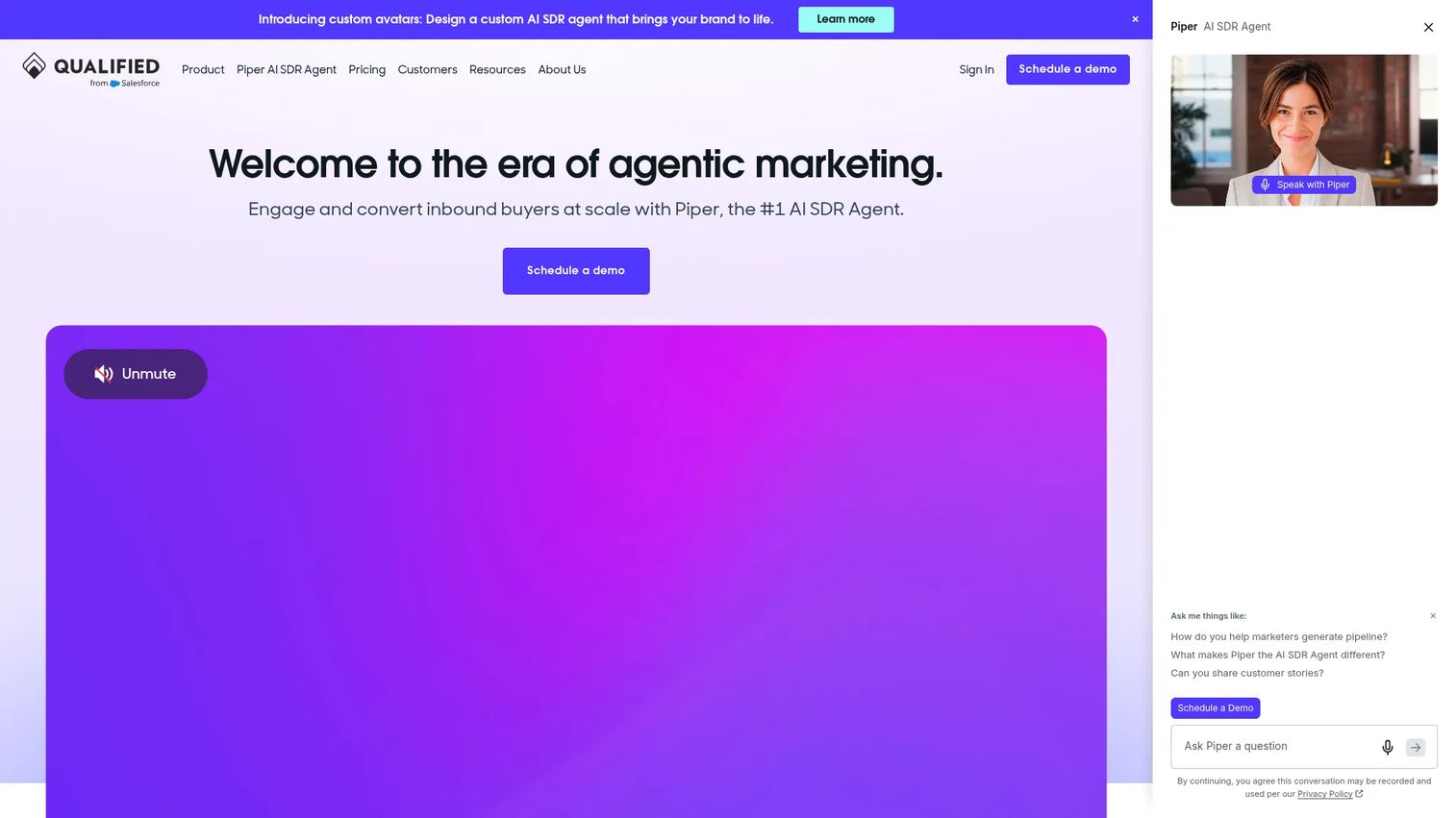
Qualified is an agentic marketing platform centered on its AI SDR agent, Piper, which qualifies and engages website visitors in real time. It's designed for Salesforce-native revenue teams that want to intercept high-intent prospects, route them to the right rep, and book meetings without manual follow-up. The platform combines real-time conversation, AI-generated email outreach, and meeting scheduling into one workflow.
Best for: Enterprise B2B revenue teams running Salesforce as their system of record, where capturing inbound intent at the moment of visit matters as much as post-signup product behavior.
Key strengths
- Real-time visitor qualification: Identifies and engages high-intent site visitors live
- AI outreach: Generates and sends email sequences automatically
- Meeting scheduling: Books calls directly within the qualification flow
Why choose Qualified: Qualified excels when the qualification moment happens on your website before a user even signs up. It's the right layer for teams that have strong inbound traffic and need to qualify and route that traffic without adding headcount. It rated 4.9 on G2 across verified enterprise reviews.
Qualified pricing: The pricing page lists Premier, Enterprise, and Ultimate tiers, all requiring a demo conversation. No starting figure appears on-site. G2 reviewers describe Qualified as enterprise-focused with contracts typically in the five-figure annual range.
3. Guideflow
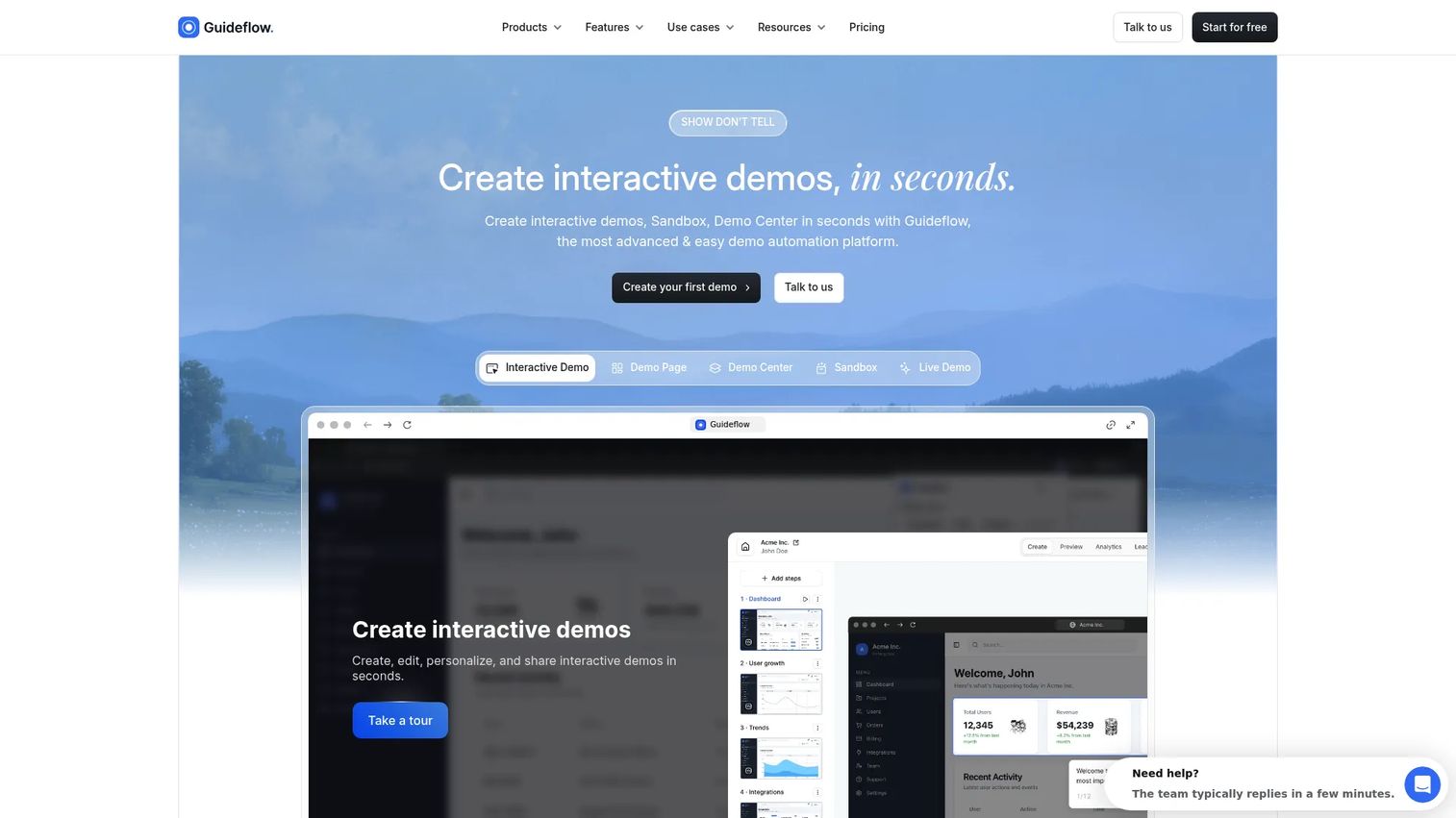
Guideflow is an interactive demo automation platform that generates the kind of behavioral engagement data most PQL models lack: What a prospect clicked through, where they progressed in a guided product experience, whether they replayed a specific step, and whether they shared the demo with someone else. Those signals, surfaced through Guideflow's analyze feature, can feed directly into CRM records and lead scoring logic via its integrations layer.
For Product Managers building a PQL model, demo engagement fills a meaningful gap. Product usage data captures behavior inside a live account. Demo engagement captures intent before signup, during sales evaluation, and across the buying committee, including stakeholders who never touched the live product.
Best for: Product, PMM, and revenue teams that want engagement signals from interactive demos, sandbox environments, and Demo Center visits to count as first-party intent signals in their qualification model.
Key strengths
- Step-level analytics: Tracks completion rates, drop-offs, and replays per demo step
- CRM and Slack sync: Pushes engagement signals to Salesforce, HubSpot, and Slack automatically
- Personalization at scale: Personalize demo content per account, segment, or persona
- Multi-format coverage: Interactive demo, sandbox, demo center, mobile demo, and live demo signals captured in one place
Why choose Guideflow: If your PQL model currently relies only on post-signup product events, adding pre-signup and mid-evaluation demo engagement signals gives a richer picture of intent. A prospect who clicked through a sandbox environment three times, watched a feature demo twice, and shared the demo center link internally is showing buying behavior that product usage data alone won't surface. Guideflow connects those moments with capture and routes them into your existing GTM workflow.
Guideflow pricing: A free plan is available with no credit card required. Paid plans start at $40/month for Solo, with Startup at $599/month and Advanced at $1,799/month. Enterprise plans start from $3,499/month.
Start your journey with Guideflow today!
4. Lead Qualifier
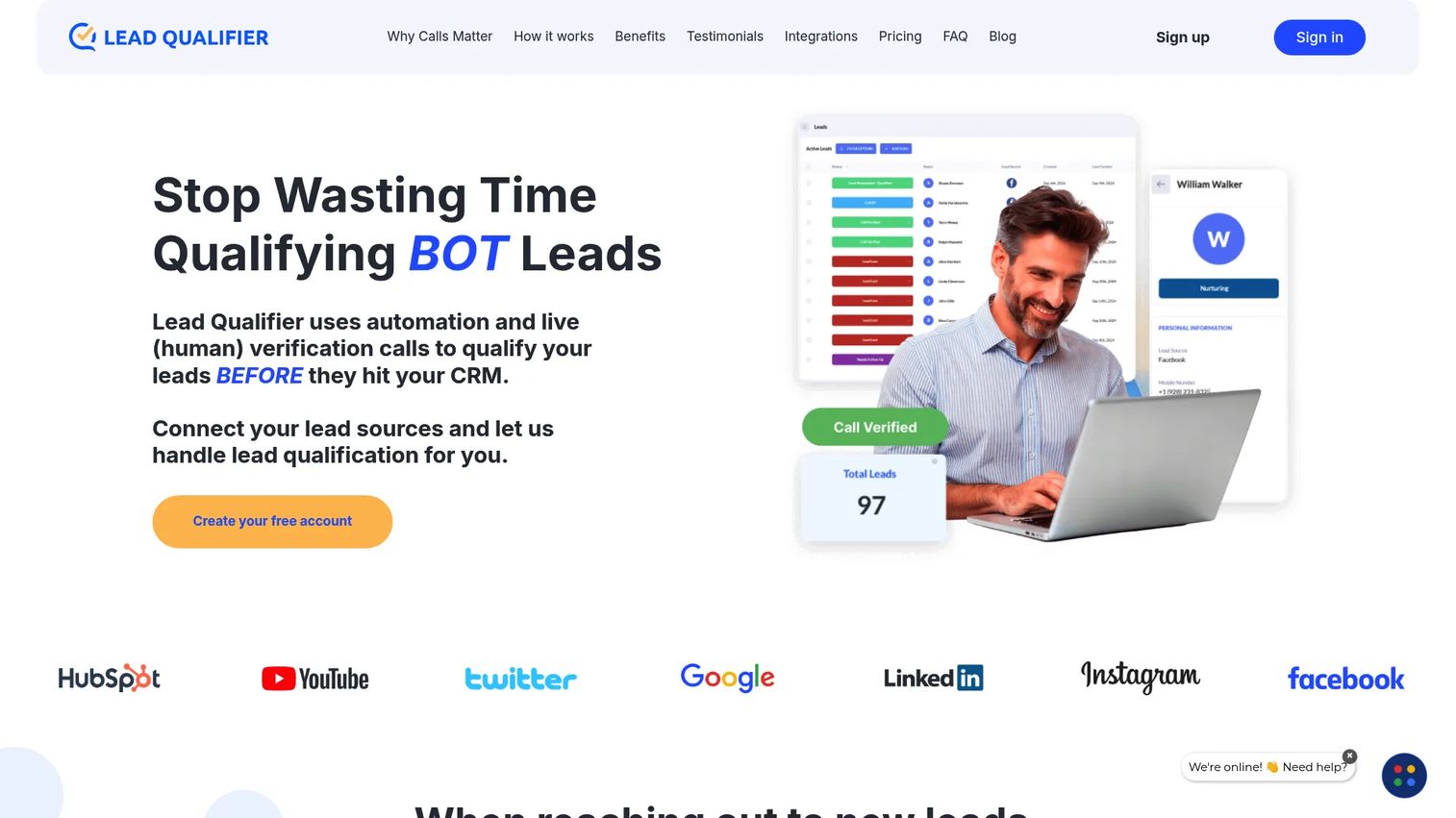
Lead Qualifier takes a different approach: It qualifies leads through automated live calls, SMS, and email verification before they reach your CRM. Rather than scoring product behavior, it contacts inbound leads directly, verifies the information they provided, and transfers qualified records to your sales team. The model works well for teams handling high inbound volumes where data quality is the primary barrier, not behavioral scoring.
Best for: Sales teams processing high-volume inbound leads who need verified, clean records in the CRM before reps spend time on outreach.
Key strengths
- Live call verification: Automated calls confirm lead intent and contact accuracy
- Multi-channel outreach: Calls, SMS, and email channels in one verification flow
- CRM transfer: Qualified leads route automatically to HubSpot, Salesforce, or equivalent
Why choose Lead Qualifier: The usage-based model means you pay only for what you process. For teams where bad data is the primary problem rather than missing behavioral context, Lead Qualifier addresses that upstream rather than adding scoring logic on top of inaccurate records.
Lead Qualifier pricing: There's no monthly subscription. Each new account includes 500 free credits. Email and SMS each cost 1 credit, while live verification calls cost 25 credits. Credit pricing scales from 6 cents per credit for entry-volume accounts down to 4 cents per credit at enterprise volumes. Lead Qualifier holds a 4.9 rating on G2.
5. SimpleCheck
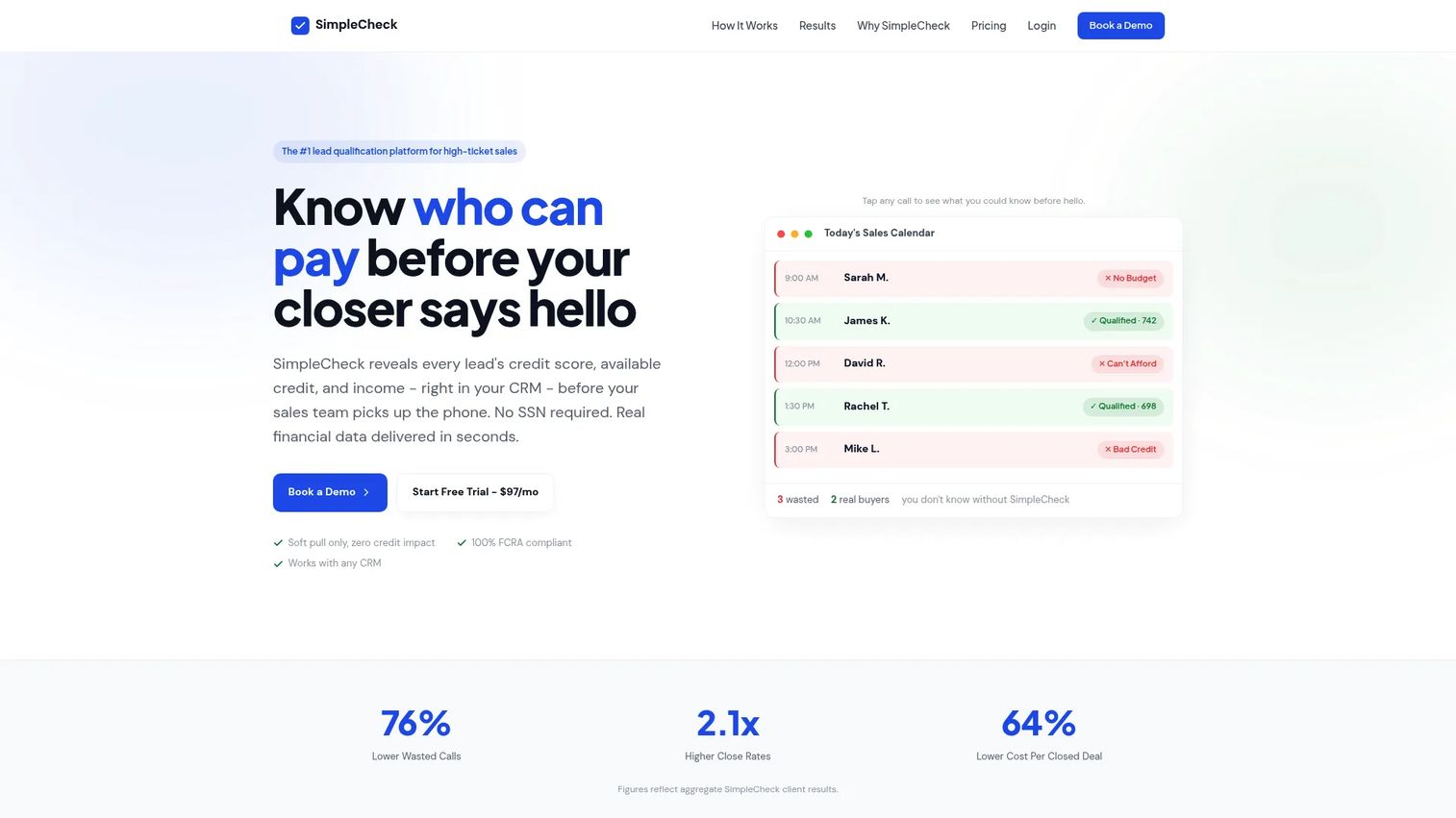
SimpleCheck qualifies prospects by revealing their credit score, available credit, and reported annual income before a sales call happens. It uses a soft pull that leaves no mark on the prospect's credit report and runs FCRA-compliant checks through its SmartForm and SmartRoute workflow. The focus is financial qualification: Are these leads actually able to buy?
Best for: High-ticket sales teams in finance, insurance, or premium software where a prospect's ability to pay is as important as their intent to buy.
Key strengths
- Real-time credit and income data: Credit score, available credit, and reported annual income in one pull
- FCRA-compliant soft pull: Zero credit impact for the prospect
- SmartRoute: Routes leads to the right team based on financial qualification tier
Why choose SimpleCheck: Most PQL models assume the prospect can afford the product. SimpleCheck is the right layer when that assumption needs verifying before your sales team invests time. This narrows its fit to specific deal types, but it's the most direct tool for that specific job.
SimpleCheck pricing: The SmartForm plan runs $97/month, with a 7-day free trial and per-report charges on top of the base fee. Enterprise and custom build plans require a $15,000 setup fee plus $1,250/month for 12 months (or $10,000 upfront), with lower per-report rates at volume. G2 shows no reviewer ratings at this time.
6. QuickOn
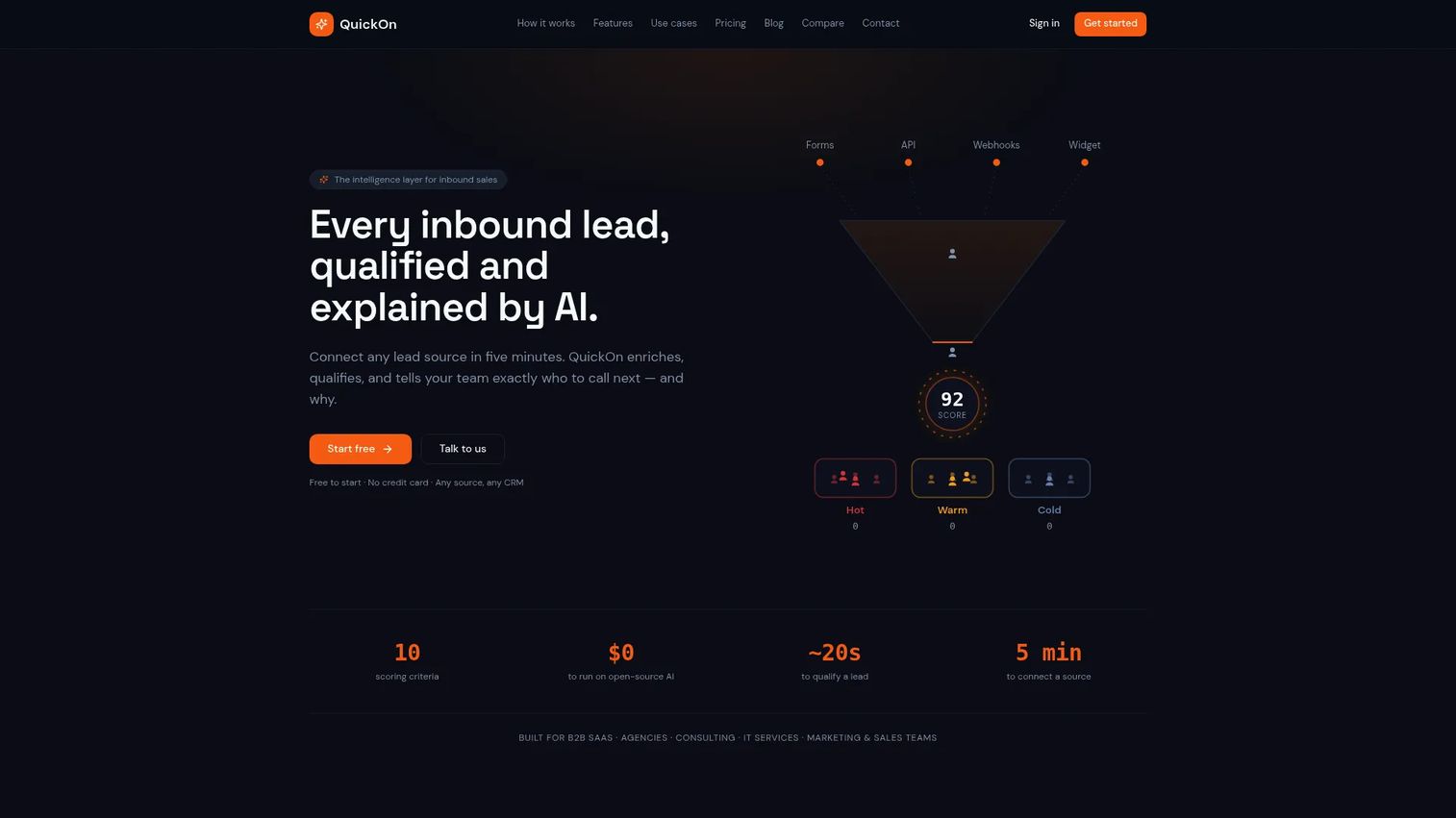
QuickOn is an AI lead qualification platform that scores inbound leads the moment they submit a form, then syncs qualified records to your CRM. Its Universal Lead API accepts submissions from any source, and its explainable AI scores each lead against your qualification criteria with visible reasoning, not a black-box number. Teams can configure rules, review the AI's logic, and see exactly why a lead passed or didn't.
Best for: B2B teams with active inbound lead flows that want to reduce rep time on unqualified outreach without building custom scoring logic.
Key strengths
- Universal Lead API: Accepts lead submissions from any form or source
- Explainable AI scoring: Shows reasoning behind each qualification decision
- CRM sync: Pushes qualified leads to Salesforce, HubSpot, or equivalent in real time
Why choose QuickOn: The explainable AI model is the most useful differentiator here. Most lead scoring tools give you a number with limited transparency. QuickOn shows the logic, which means RevOps and Product Managers can audit and refine the model without digging into a black box.
QuickOn pricing: A free forever plan is available. Paid plans start at $49/month for Starter, $149/month for Growth, and $499/month for Scale. Enterprise pricing requires contacting their team. G2 rating is not yet verified for this tool.
7. LeadPass
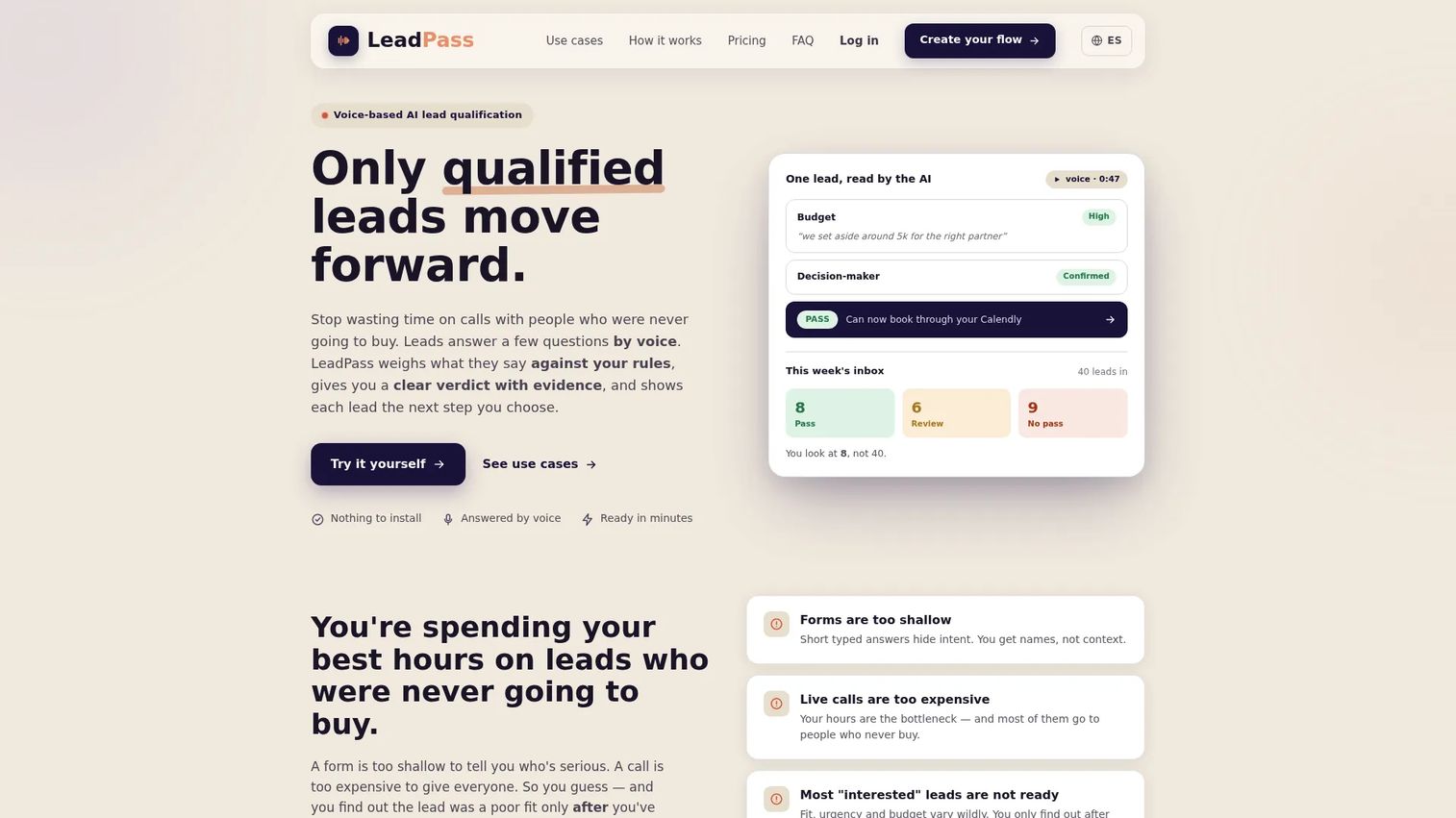
LeadPass screens inbound leads by having them answer voice questions, which the AI then evaluates against your qualification criteria. Each lead receives a verdict: Pass, Review, or No pass, with the AI's reasoning attached. The model is straightforward: Define your criteria, collect voice answers, let the AI decide, and route the passes to your team.
Best for: Teams handling inbound demo or trial requests that want a human-feeling qualification step before booking calls, without adding manual review time.
Key strengths
- Voice-based qualification: Leads answer spoken questions, adding friction that filters casual submissions
- AI verdict with evidence: Pass, Review, and No pass decisions come with the AI's reasoning
- Volume-based flows: Multiple flows at higher tiers for teams qualifying across different product lines
Why choose LeadPass: The voice step adds a layer of intent verification that form-based scoring can't replicate. A lead willing to record a voice answer is demonstrating a different level of engagement than one who filled out a form in 15 seconds.
LeadPass pricing: Starter costs $49/month (or $468 billed annually) and includes 1 flow and 100 completed qualifications per month. Pro runs $99/month ($948 annually) with 3 flows and 300 qualifications. Scale is $299/month ($2,868 annually) with 10 flows and 1,000 qualifications per month. No free plan is available. G2 rating is not yet verified.
Considerations
Data sources and tracking quality
Before choosing a tool, map where your product events currently live. If your instrumentation is incomplete or inconsistent, adding a scoring layer on top of bad data produces bad scores. Audit your event tracking first, then match the tool to what you can actually feed it.
Routing and workflow fit
The best PQL model fails if routing doesn't connect to how your sales team operates. Check whether the tool triggers your existing sales engagement platform, CRM task queues, or Slack channels rather than requiring reps to log into a separate dashboard.
CRM and automation integrations
Most teams run Salesforce or HubSpot as their source of truth. Verify that the tool writes enriched records back to the right object, field, and owner. An integration that creates duplicate contacts or writes to the wrong record type adds cleanup overhead that negates the time savings.
Reporting and attribution
You need to know whether the PQL program is working. Look for tools that report free-to-paid conversion rates by signal type, not just total leads passed. According to ProductLed PLG Benchmarks (2025), companies that track PQLs see roughly 3x higher free-to-paid conversion than those that don't. That gap is worth measuring against your own baseline.
Maintenance and ownership
Product UIs change. Scoring thresholds go stale. PQL systems need a named owner who reviews the model on a defined cadence (monthly or per release cycle). Factor in that maintenance cost when evaluating tools, and choose ones where threshold updates don't require engineering support.
Conclusion
The core problem this category solves is simple to state and hard to execute: Turn product behavior into revenue actions without building a custom data pipeline. The tools above address different points in that workflow.
Correlated and Qualified focus on scoring and routing signals that already exist. Lead Qualifier and LeadPass add a verification layer before the signal reaches your CRM. SimpleCheck addresses financial qualification specifically. QuickOn handles inbound form leads with explainable AI. And Guideflow surfaces engagement signals from demos, sandboxes, and demo centers that most PQL models miss entirely.
For Product Managers building a PQL program, the sequence matters: Get your instrumentation right, define what a qualified signal looks like for your motion, then pick the tool that fits the routing and integration requirements of your revenue team.
If demo engagement is a meaningful part of your qualification signal or you want to generate richer behavioral data from pre-signup interactions, start there.
Start your journey with Guideflow today!
FAQs about product lead software
A product qualified lead (PQL) is a user or account that has demonstrated meaningful product engagement and meets the criteria your team associates with readiness to buy or expand. Unlike an MQL, which relies on marketing actions like email opens or ad clicks, a PQL is defined by what the user actually did inside the product, such as activating a key feature, completing a core workflow, or hitting a usage threshold.
An MQL (marketing qualified lead) is scored on marketing interactions: Form submissions, content downloads, email clicks, and page visits. A PQL adds product behavior to that picture, meaning it measures direct interaction with the product itself. PQLs convert to paid customers at 25 to 30% on average, versus 5 to 10% for MQLs, according to ProductLed PLG Benchmarks (2025).
The most reliable signals combine product depth with ICP fit. On the behavioral side, look for feature activation on core workflows, session frequency above a defined threshold, collaboration actions like inviting teammates, and pricing page visits from within the product. On the fit side, layer in company size, industry, and job title. Start with three to five signals, measure their correlation with paid conversion, and expand from there.
Yes. Step completion in a guided demo, replays of specific feature steps, shares of a demo link, and repeat visits to a demo center all indicate buying intent from stakeholders who may never have touched your live product. These signals are particularly useful for mapping buying committee engagement, where multiple people evaluate without a single shared account.
Most tools in this category write enriched records to CRM objects (contacts, accounts, or opportunities) when a user crosses a defined threshold. The routing trigger can be a task assignment to a specific rep, a Slack alert, an email sequence enrollment, or a change in lead status. The key variable is whether routing is event-based (triggered immediately when the threshold is crossed) or batched (sent in a scheduled sync).
Track free-to-paid conversion rate by signal type, time from PQL threshold to sales contact, and pipeline generated per qualified account. A functioning program should show higher conversion rates for PQL-flagged accounts than for unscored leads. OpenView Product Benchmarks (2023) found that companies tracking PQLs show a 61% higher likelihood of fast growth compared to those that don't.
Freemium is one of the strongest use cases for PQL software. Free users generate behavioral data from day one, but without a scoring layer, that data sits unused. PQL software identifies which free accounts have crossed activation milestones, hit usage thresholds, or shown expansion signals, so your team can prioritize outreach or trigger lifecycle automations before those accounts churn or self-convert at a lower tier.
Review thresholds at least quarterly, and any time you ship a significant change to your product's core flows. Usage patterns shift as the product evolves, and a threshold set six months ago may no longer correlate with conversion. Pair threshold reviews with cohort analysis: Look at accounts that hit the PQL score but didn't convert, and accounts that converted without hitting it, to find where the model needs adjustment.