
Your ambassador program started as a spreadsheet. Then a Slack channel. Then a second spreadsheet for payouts, a shared folder for content, and a group chat where three people approve things nobody tracks.
It worked at 20 ambassadors. It stops working at 200.
The global brand ambassador software market was valued at USD 2.29 billion in 2024 and is projected to reach USD 5.8 billion by 2035 at an 8.8% CAGR, according to WiseGuy Reports (2024). That growth is not marketing hype. It reflects a real shift toward community-led growth, where brands lean on advocates, referrers, and creators instead of paid channels alone.
For a product marketing manager, the problem is rarely recruitment. It is attribution. Who drove that sale? Which mission moved the needle? Can you defend the ROI reporting to a finance stakeholder without three days of manual reconciliation? An ambassador program management platform is supposed to answer those questions automatically. Most spreadsheets never will.
This guide compares seven platforms built to recruit, manage, reward, and track ambassadors at scale.
What's inside
This guide is for PMMs, growth marketers, and community leads evaluating brand ambassador management software. We picked tools that handle the full workflow, not just one slice of it.
We evaluated each platform on four criteria:
- Workflow fit: recruitment, onboarding, missions, and approvals in one place
- Rewards and payouts: commission automation, credits, gift cards, and fraud handling
- Attribution and reporting: referral tracking and defensible ROI reporting
- Integrations: Shopify integration, WooCommerce integration, and CRM connections
TL;DR
- Best for enterprise-scale orchestration: Ambassador Program Management Platform, for closed-loop referral, affiliate, and loyalty programs under one roof
- Best for branded ambassador portals: BrandChamp, for teams running ambassador, referral, and UGC motions together
- Best for community-led growth: Club, for mission-based programs tied to community engagement
- Best for ecommerce and creators: Endlss, for Shopify brands running creator programs
- Best for structured ambassador operations: SocialLadder, for recurring tasks, challenges, and rewards
- Best for influencer plus ambassador work: IZEA, for teams blending paid collaboration with ambassador activation
A hybrid ambassador program that mixes ambassador referral software with UGC and loyalty usually needs one platform, not four disconnected tools.
What is ambassador program software
Ambassador program software is a platform that helps brands recruit, onboard, manage, reward, and track brand ambassadors across referral, affiliate, loyalty, and community-led motions. It replaces spreadsheets, manual payout math, and scattered content folders with one system that handles the full lifecycle and produces clean attribution.
Most brand ambassador management software includes the following:
- Recruitment and onboarding: application forms, approval flows, and ambassador onboarding sequences
- Mission or task management: assign challenges, campaigns, and mission-based campaigns to segments
- Rewards and payouts: commission automation, credits, gift cards, and payout scheduling
- Referral tracking and attribution: track links, codes, and sales back to the right ambassador
- Ambassador portal or ambassador community hub: a branded space where ambassadors see tasks, rewards, and content
- Analytics and ROI reporting: an attribution dashboard that ties activity to revenue
- Ecommerce integrations: Shopify integration and WooCommerce integration for order-level tracking
- UGC collection and approvals: gather, approve, and reuse ambassador content
The core job is simple to state and hard to execute: connect what an ambassador does to what it earned you. A referral tracking system that stops at "clicks" does not help a PMM defend spend. One that ties a referral code to a closed order does.
When to use ambassador program software
Scale beyond manual spreadsheets
A spreadsheet works until approvals pile up and nobody knows who owns what. When you are re-explaining the same onboarding steps every week, chasing content across DMs, and reconciling payouts by hand, the program has outgrown ad hoc management. Automation, approval flows, and a real ambassador portal remove the operational drag so you can add ambassadors without adding chaos.
Track referrals and commissions accurately
Manual attribution breaks the moment two ambassadors share the same customer. Once you are guessing which link drove which order, or paying commissions from memory, you need referral tracking with order-level attribution. Accurate rewards and payouts protect both trust and margin, and they give finance a number they can audit.
Run hybrid ambassador, affiliate, and loyalty motions
Some programs are pure ambassador. Many are not. If you want referral rewards, affiliate commissions, loyalty points, and UGC collection running together, a hybrid ambassador program needs one platform that models all of them. Splitting motions across four tools splits your reporting too, and that kills defensible ROI.
Comparison table
The table below ranks platforms by relevance to running a full ambassador program management platform, from enterprise orchestration to ecommerce and creator programs. Pricing and G2 ratings reflect verified sources at the time of writing.
Best ambassador program software for 2026
1. Ambassador Program Management Platform
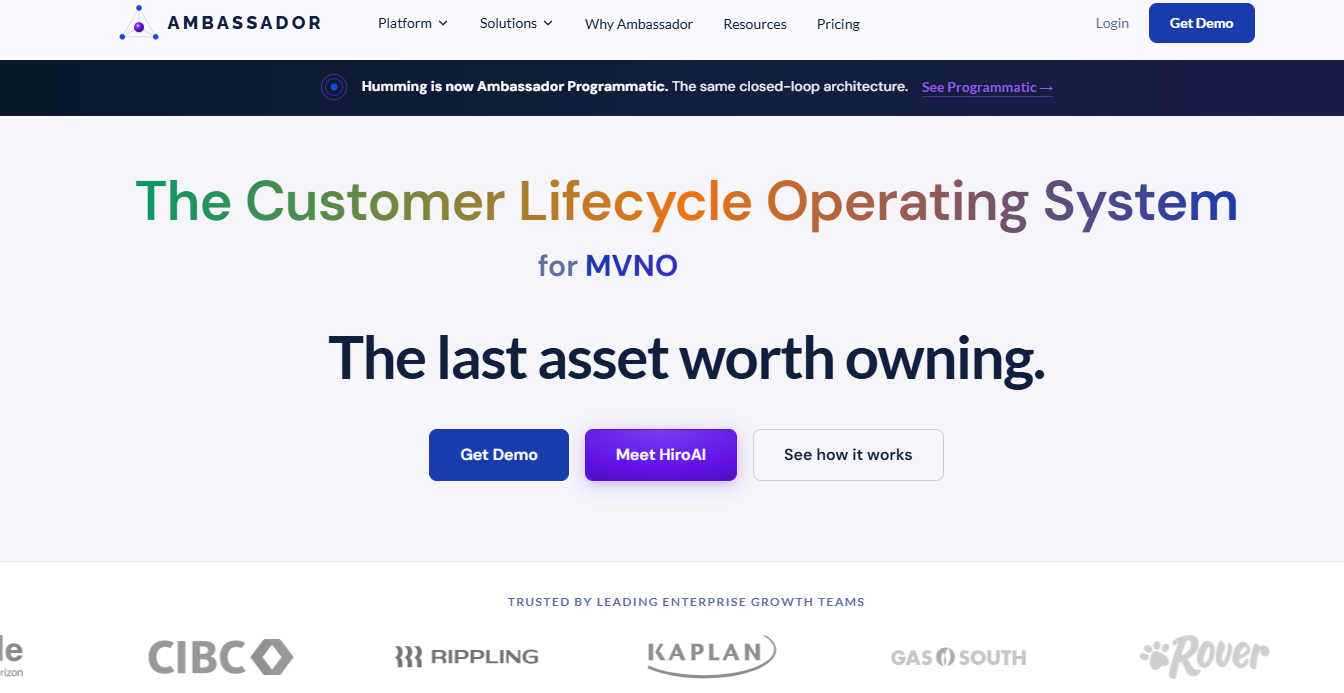
Ambassador positions itself as a customer lifecycle operating system, running referral, affiliate, influencer, loyalty, advocacy, and communication programs from one place. For a PMM juggling several growth motions, that consolidation is the point. Instead of stitching attribution across separate tools, you get closed-loop tracking, automated payouts, and reporting that holds up in a board deck.
The platform leans enterprise. It handles compliance, fraud detection, and program governance, which matters when multiple stakeholders touch the same program and legal wants a paper trail.
Best for: Mid-market and enterprise teams that need attributable, multi-program customer growth software.
Key strengths
- Runs referral, affiliate, influencer, loyalty, and advocacy programs on one platform
- Native integrations with Salesforce, HubSpot, Shopify, BigCommerce, and Stripe
- Automated tracking, attribution, payouts, and reporting
- Built-in fraud detection for high-volume programs
Why choose Ambassador: If you run more than one motion and need clean attribution across all of them, this is the platform built for that reality. It fits teams that treat ambassador programs as revenue infrastructure, not a side project.
Ambassador pricing: Pricing is scoped to program goals, activated engines, and customer base size. The site directs prospects to request an enterprise demo rather than listing a public starting price.
2. BrandChamp
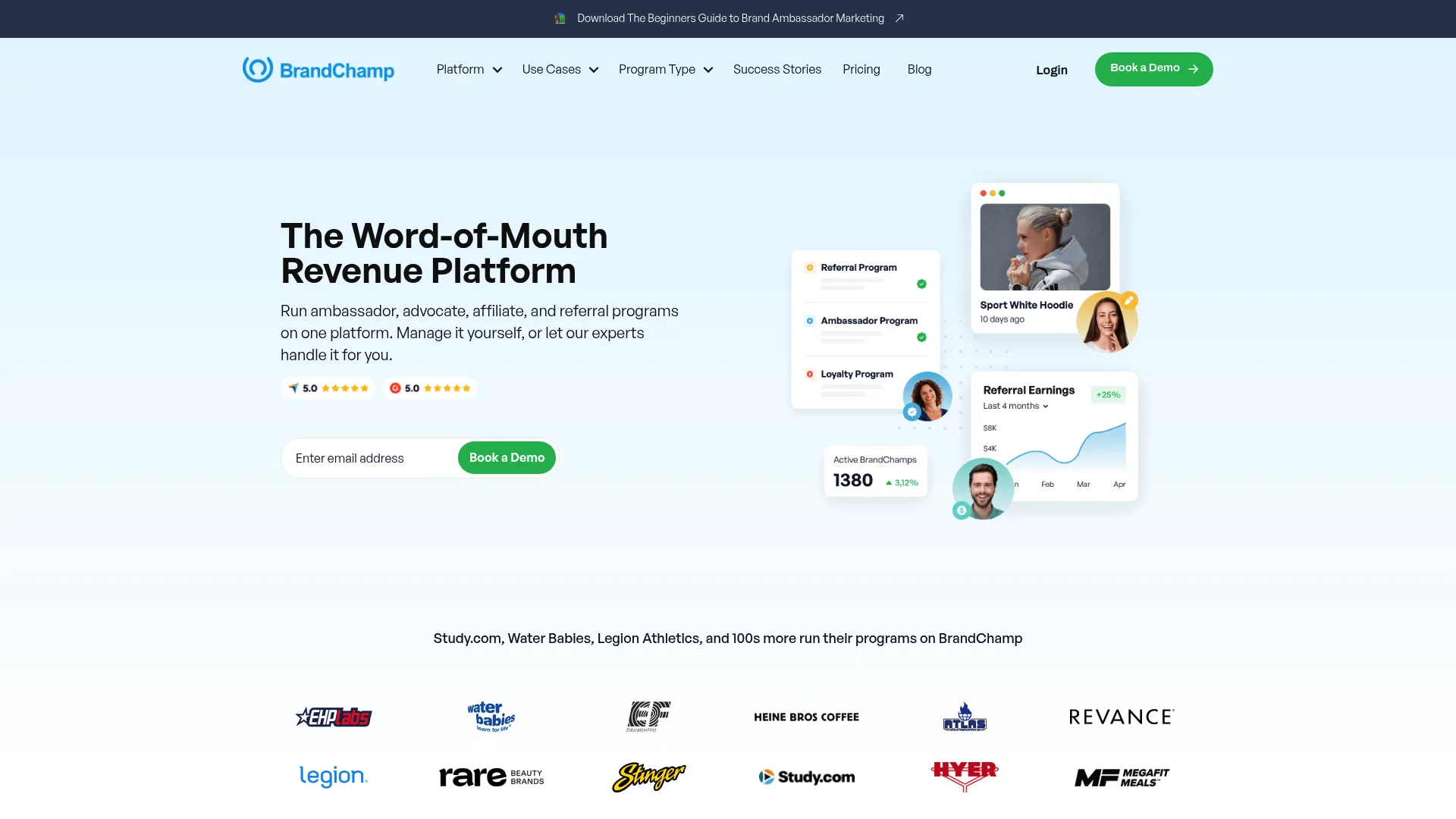
BrandChamp is word-of-mouth and ambassador marketing software built to run referral, advocacy, loyalty, and UGC programs together. Its branded ambassador portal gives advocates a single dashboard for tasks, rewards, and content, which cuts the "how do I do this?" questions that eat a community manager's week.
For ecommerce and creator-heavy programs, the referral sales tracking is the draw. It ties activity to orders, and it supports Shopify integration and WooCommerce integration so attribution reaches order level rather than stopping at clicks.
Best for: Brands that want to manage ambassador, referral, and UGC programs in one platform.
Key strengths
- Branded ambassador portal and management
- Referral sales tracking with ecommerce attribution
- UGC collection and activity tracking
- Rewards and loyalty tooling in one place
Why choose BrandChamp: It fits teams that treat content and referrals as one motion, not two. If UGC collection and referral tracking both matter, running them in a single portal keeps your reporting whole.
BrandChamp pricing: BrandChamp lists Launch, Essential, Pro, Premium, and Enterprise plans. Public dollar amounts are limited on the brand's own plans page. G2 reports a Micro plan starting at $249/mo, with a custom quote for Enterprise.
3. Club
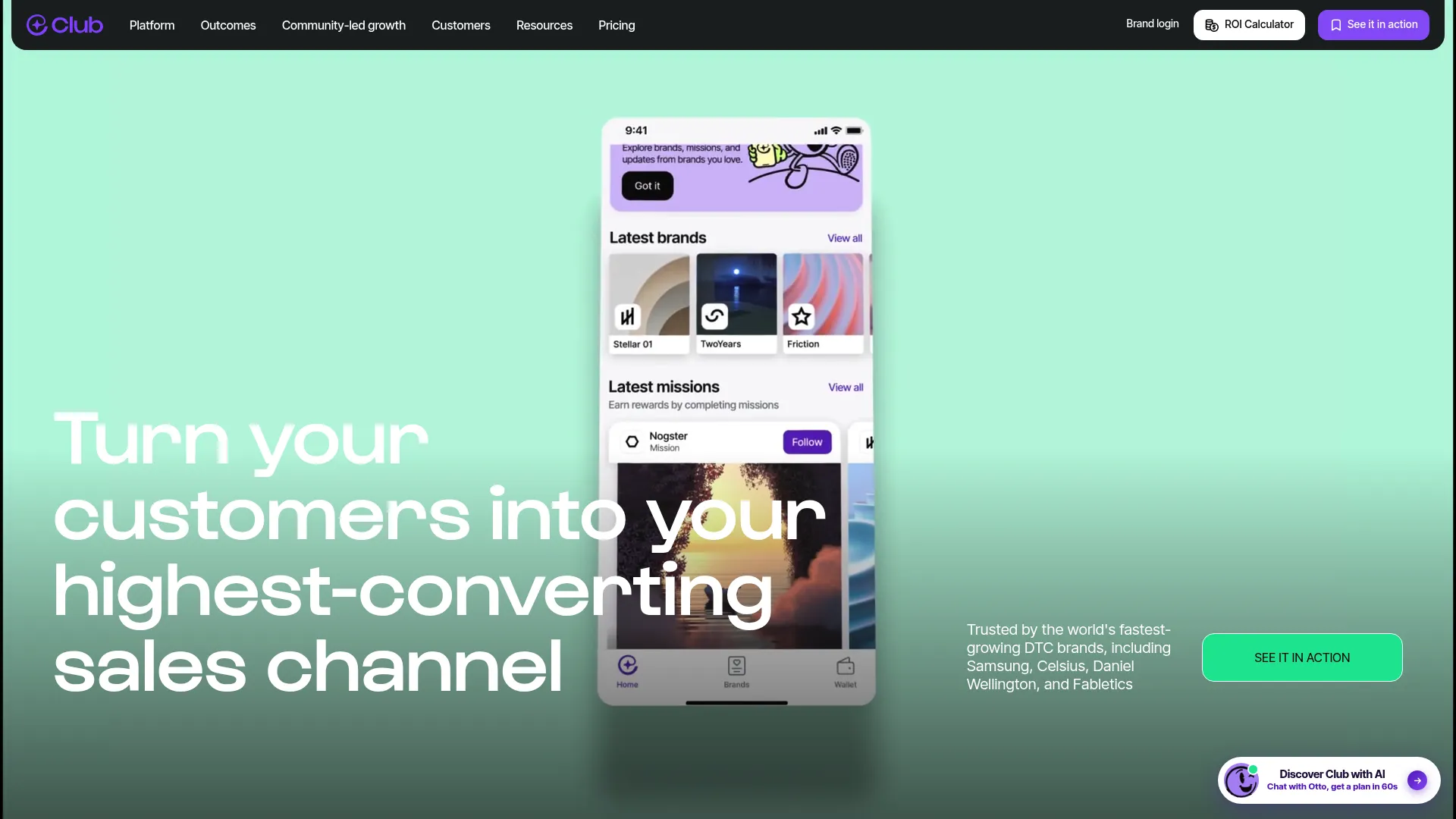
Club is community-led growth and ambassador marketing software for brands that want programs tied to community, not run beside it. Its mission-based campaigns let you assign challenges to segments, then track engagement, affiliate links, and rewards in one flow. That structure suits teams building an ambassador community hub rather than a transactional referral list.
The affiliate tracking and link tools mean referral and community motions coexist. Ambassadors complete missions, earn rewards, and drive attributable sales without you managing three separate systems.
Best for: Brands wanting an ambassador and community-led growth platform with affiliate and engagement tooling.
Key strengths
- Ambassador and community engagement with mission management
- Affiliate tracking and link tools
- Communication, recruitment, and loyalty tools
- Community insights and segmentation
Why choose Club: It fits teams whose ambassador program is really a community strategy. If engagement and belonging drive your advocates more than commission, mission-based campaigns give you the right mechanics.
Club pricing: Club lists Club Hub, Club Suite, and Club Universe plans, all shown as pricing upon request. No public numeric price is displayed on the pricing page.
4. Endlss
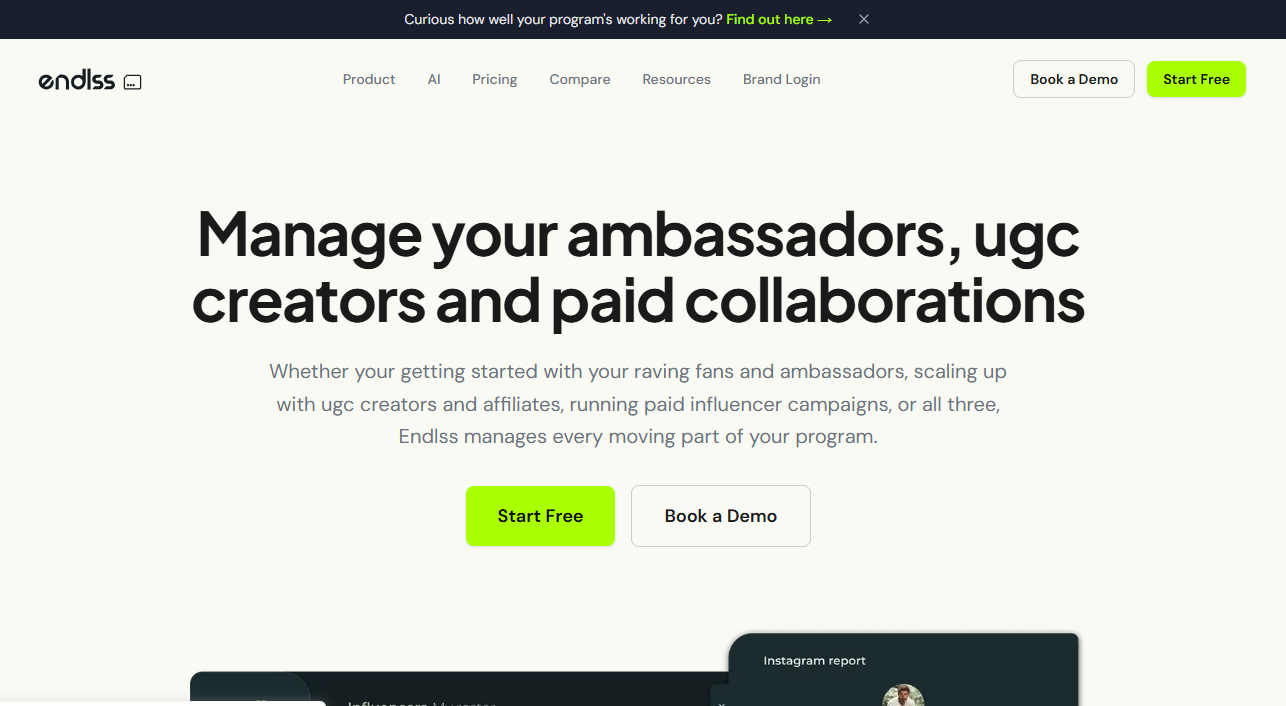
Endlss is creator management software for brands on Shopify. It focuses on the ecommerce and creator overlap, with AI-powered discovery across a large profile set, Smart Links, and Shopify gifting that pushes product to advocates without manual fulfillment. For DTC brands, that gifting-to-content loop is the operational core.
The UGC agreement builder and analytics round out a workflow aimed at brands running creator programs at ecommerce speed. A free starter tier lets small programs test the mechanics before committing budget.
Best for: Shopify brands running creator or influencer programs.
Key strengths
- AI-powered discovery across a large profile index
- Smart Links and Shopify gifting
- UGC agreement builder and analytics
- Free tier to start small
Why choose Endlss: It fits Shopify-native teams that want gifting, UGC collection, and tracking without enterprise overhead. The free tier makes it a low-risk way to prove a creator program works before scaling.
Endlss pricing: Launch is free with up to 5 creators. Paid plans are Activate at $149/mo, Grow at $549/mo, and Scale at $899/mo, all billed annually. Custom pricing applies for 750+ creators.
5. SocialLadder
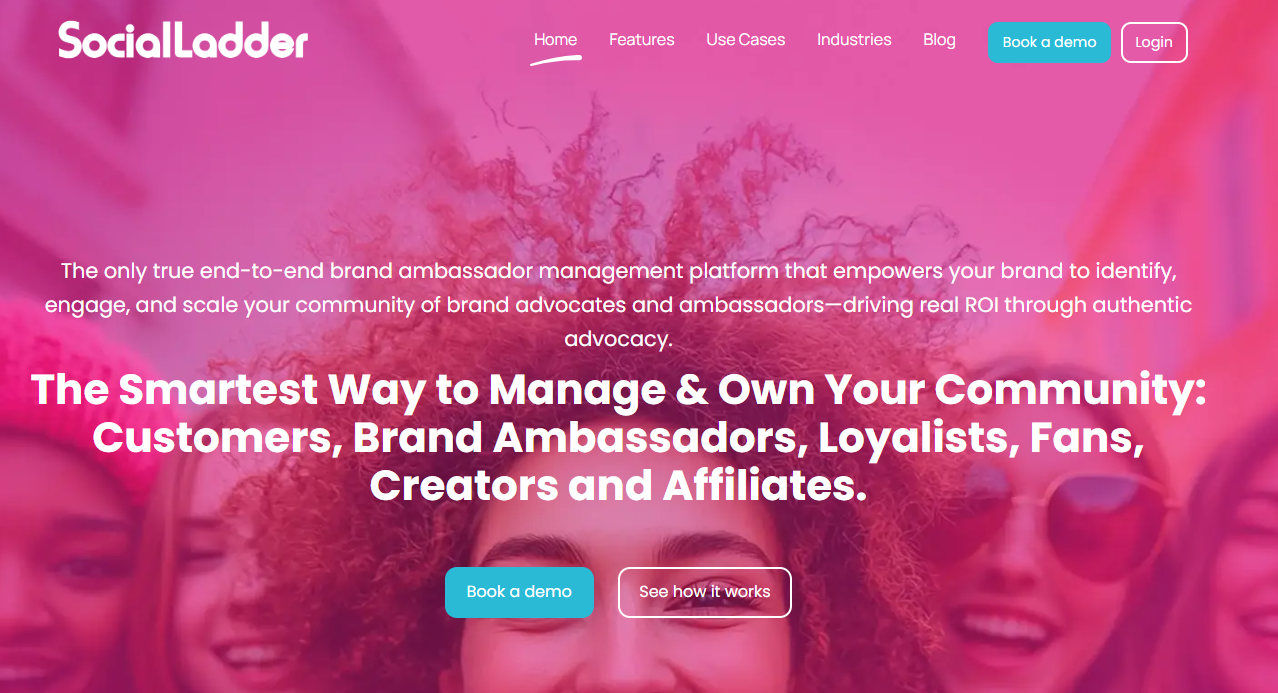
SocialLadder is a brand ambassador and community management platform for recruiting, engaging, tracking, and rewarding ambassadors and creators. Its strength is structure. Task assignment and challenge tracking give recurring programs a repeatable rhythm, which matters when you run seasonal campaigns or ongoing advocacy rather than one-off pushes.
Rewards, payments, and ROI analytics close the loop, so you can see which ambassadors and which tasks actually move revenue. For owned ambassador communities, that reporting is what turns activity into a defensible number.
Best for: Brands that want to run owned ambassador or creator communities with tasking, rewards, and performance tracking.
Key strengths
- Ambassador recruiting and onboarding
- Task assignment and challenge tracking
- Rewards, payments, and payout handling
- ROI analytics tied to activity
Why choose SocialLadder: Choose it when your program runs on recurring tasks and challenges, not just referral links. The tasking model keeps a large community active and measurable over time.
SocialLadder pricing: SocialLadder states pricing includes a setup fee, a base monthly subscription, and seat fees where applicable. No public numeric prices are shown on the site; contact the vendor for a quote.
6. IZEA
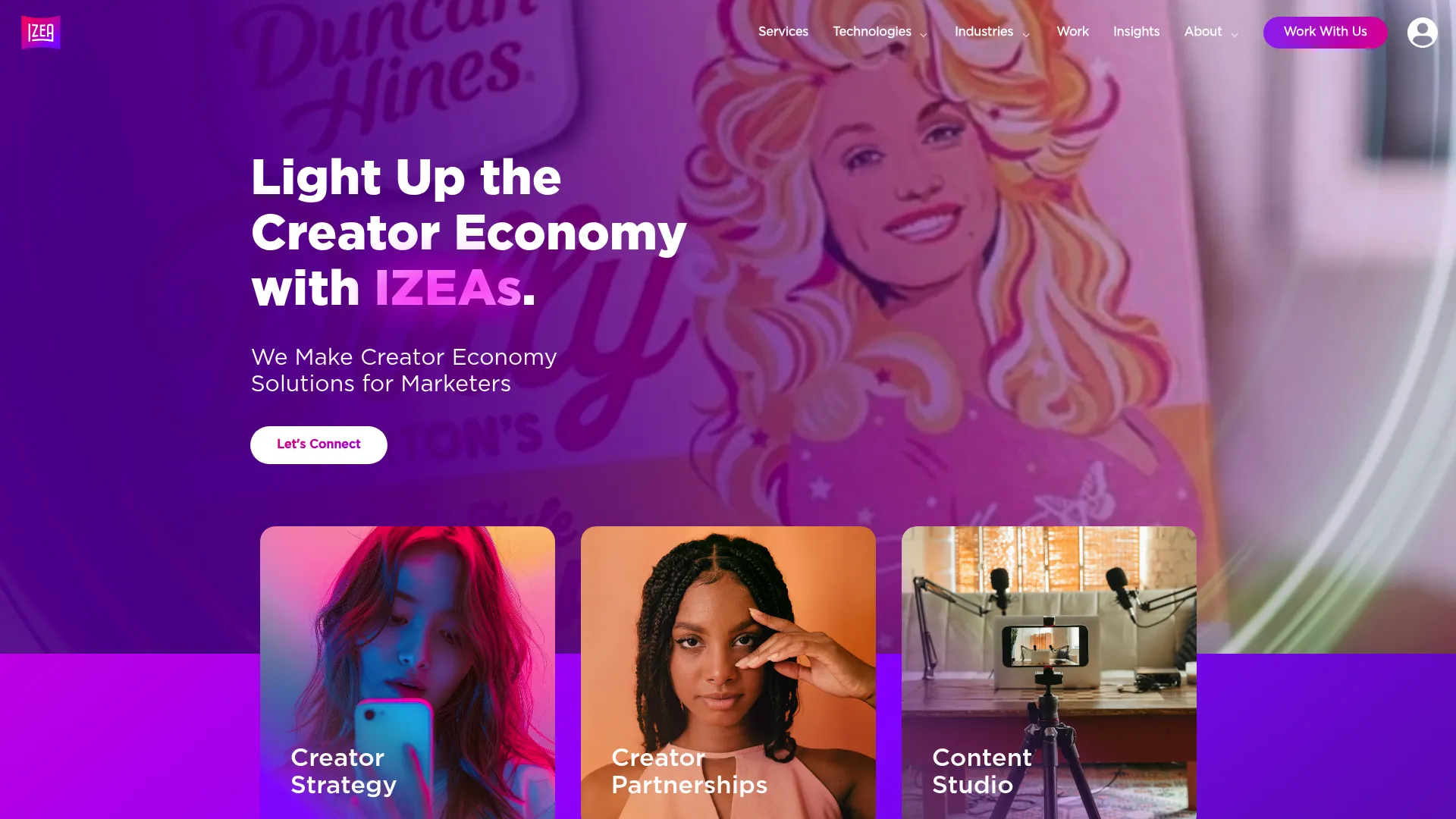
IZEA is influencer marketing and creator economy software, combining a marketplace, campaign tools, and managed services. It fits teams that blend paid influencer collaboration with ambassador activation, since the same platform can source creators, run campaigns, and handle content. The Creator Marketplace gives you a discovery entry point, and FormAI adds generative tooling for briefs and content.
For programs that sit between influencer marketing and ambassador management, IZEA covers both ends. You can run paid collaborations and longer-term advocacy without switching tools.
Best for: Brands and agencies running influencer marketing campaigns with software plus managed support.
Key strengths
- Creator Marketplace for brands and creators
- IZEA Flex campaign operations tools
- FormAI generative AI suite
- Managed services option for hands-off teams
Why choose IZEA: Pick IZEA when your ambassador work overlaps with paid influencer campaigns. The marketplace plus managed services model suits teams that want software and optional hands-on support.
IZEA pricing: The Creator Marketplace is free to access, with Pro plans starting at $6/month. Managed Services requires a custom proposal rather than a public price.
7. Modash
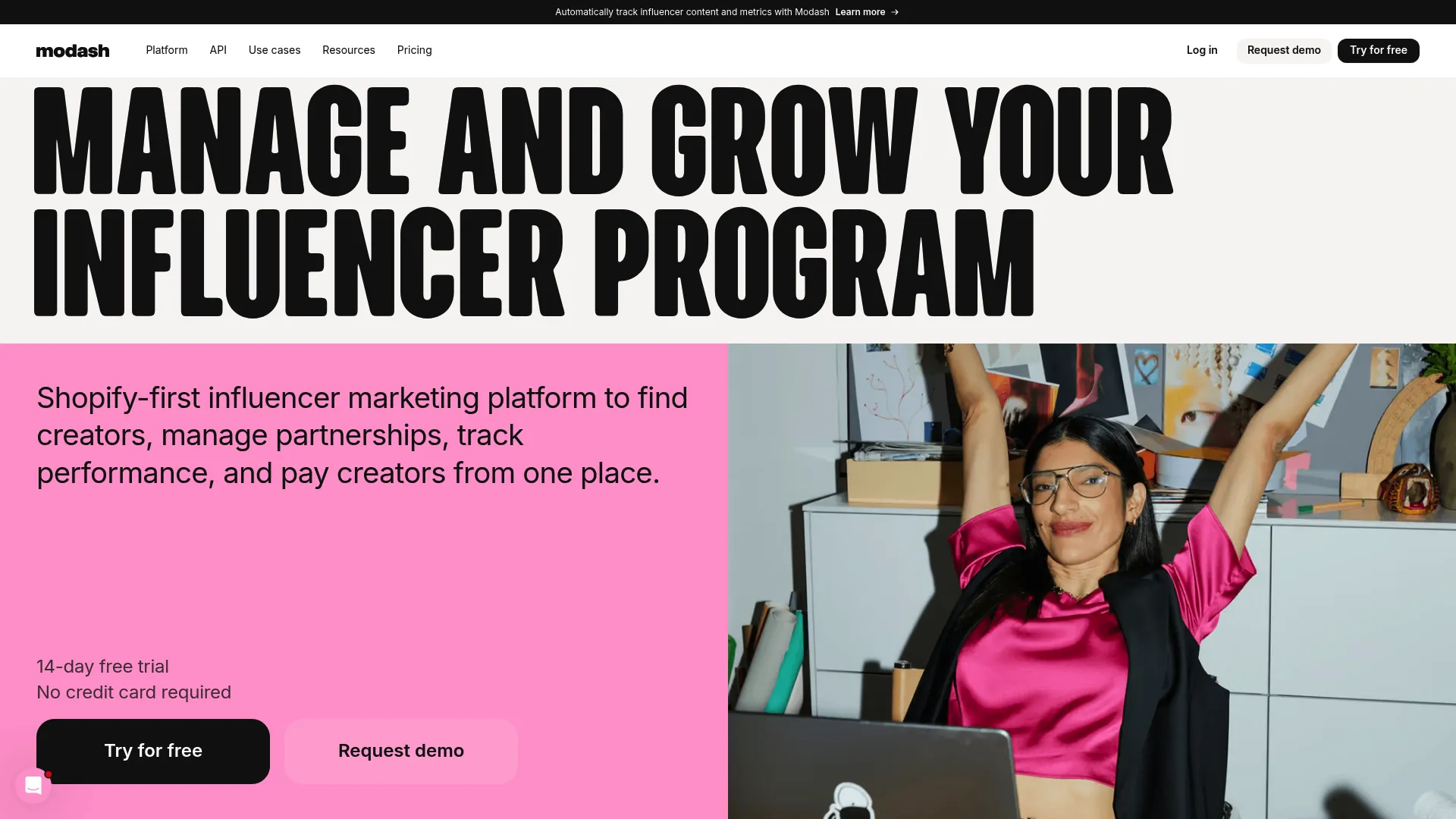
Modash is an influencer marketing platform for discovering creators, managing relationships, tracking campaigns, and paying creators. It leans more creator-first than pure ambassador, but for programs where ambassadors are also creators, the discovery layer and CRM earn their place. AI-powered search across a large creator index helps you find advocates who already fit your audience.
Campaign content and sales tracking connect creator activity to outcomes, and the built-in payments plus Shopify integration keep rewards and payouts inside one tool.
Best for: Brands running influencer or creator-led campaigns that need discovery, CRM, tracking, and payments in one tool.
Key strengths
- Creator discovery with AI search and advanced filters
- Influencer CRM and relationship management
- Campaign content and sales tracking
- Creator payments and Shopify integration
Why choose Modash: Pick Modash when your ambassadors are creators and you need to find them before you can manage them. The discovery-to-payment flow suits programs that recruit on reach and content quality.
Modash pricing: Essentials starts at $299/month, Performance at $599/month, and Enterprise at $14,700/year. A 14-day free trial is offered, with no free tier listed.
Considerations
Decide what kind of program you are actually running
Before you shortlist, name the motion. A pure ambassador program, a referral-heavy program, an affiliate-heavy program, and a hybrid all reward different behavior. Ambassador and Club fit multi-motion and community-led programs. Modash, Endlss, and IZEA lean creator and influencer. Match the tool to the motion, not the buzzword.
Check how rewards and payouts are handled
Rewards and payouts are where trust breaks or holds. Look for commission automation, store credit, gift cards, and payout scheduling, plus fraud handling if volume is high. Ask how a payout gets triggered, who approves it, and how disputes get resolved. Manual payout math does not scale, and late payments cost you ambassadors.
Verify attribution and reporting depth
A PMM lives or dies by the attribution dashboard. Confirm that referral tracking reaches order level, not just clicks, and that reporting ties activity to revenue you can defend to finance. Ask whether you can export, segment by ambassador, and see which missions drove sales. Shallow reporting turns every ROI conversation into a guessing game.
Confirm ecommerce and CRM integrations
Check that the platform connects to your stack. Shopify integration and WooCommerce integration matter for order-level attribution, and CRM connections like Salesforce or HubSpot matter for lead and lifecycle motions. An integration gap means manual data movement, and manual data movement means stale reporting.
Make sure ambassadors get a usable experience
The best attribution in the world fails if ambassadors will not participate. Evaluate the ambassador portal from their side: clear tasks, visible rewards, easy submission, and simple ambassador onboarding. If participation takes effort, engagement drops, and your program quietly stalls no matter how good the backend is.
Conclusion
The right pick depends on your program's shape. For enterprise-scale orchestration across referral, affiliate, and loyalty, the Ambassador Program Management Platform is the strongest fit. For branded portals that combine ambassador, referral, and UGC motions, BrandChamp leads. For community-led growth built on missions, Club stands out. And for Shopify and creator programs, Endlss, Modash, and IZEA each cover a distinct slice of the influencer-to-ambassador spectrum, while SocialLadder anchors structured, task-driven communities.
Your next step is simple. Shortlist two or three platforms based on your program model, your integration needs, and the depth of ROI reporting you can defend. Then run a scoped pilot with a real cohort of ambassadors before you commit budget. The winner is the one that makes attribution automatic and keeps your advocates active without adding operational chaos.