A guest texts asking for late checkout. Another wants a dinner recommendation. A third reports a broken AC unit. If those three requests land in three different places, nobody at the front desk has a concierge process. They have a service backlog.
The cost of disconnected guest communication shows up in missed requests, inconsistent follow-through, and lost ancillary revenue. The concierge software market reached $1.14 billion in 2025 and is projected to grow to $1.83 billion by 2032, according to ReportPrime (2026), reflecting how seriously the hospitality industry is taking the operational gap. Meanwhile, 70% of U.S. travelers say they would check themselves into a hotel using an app or self-service kiosk, rising to 82% among Gen Z travelers, according to Mews and Talker Research (2025). Guests increasingly expect digital-first service, and properties without coordinated tools are feeling it in satisfaction scores and repeat-stay economics.
The right hotel concierge software turns incoming communication into routed work, reliable follow-through, and measurable revenue opportunities. Which type fits the way your property actually serves guests?
What's inside
This guide covers seven hotel concierge software tools for 2026. It is written for hotel operators, ownership groups, and software buyers evaluating platforms for one property or a portfolio. Tools were selected based on:
- Guest messaging and communication channel coverage
- Request-routing workflows and staff accountability features
- Digital concierge content, directories, and self-serve guest experiences
- Integration depth with PMS, POS, and payment systems
- Suitability across independent hotels, boutique groups, and larger portfolios
TL;DR
- Best for hotel operations workflows: Actabl, for request routing, guest-service coordination, and cross-department accountability
- Best for digital guest directories: Monscierge, for local recommendations, property content, and on-screen guest information
- Best for broad guest engagement: Canary Technologies, for messaging, digital compendiums, check-in, and upsells in one platform
- Best for AI-led messaging automation: Akia, for automated guest journeys, a unified inbox, and in-chat mini apps
- Best for chatbot and direct-booking conversations: HiJiffy, the only tool on this list with published monthly pricing starting at $109
- Best for high-touch staff-led messaging: Kipsu, for teams that want digital conversations without centering the experience on automation
- Best for mobile-first guest experiences: Intelity, for branded hotel apps, digital keys, and smart-room integrations
What is concierge software?
Concierge software is hotel technology that centralizes guest requests, communications, recommendations, reservation workflows, and service delivery into one coordinated operating layer.
What hotel concierge software does
- Guest messaging: Communicates with guests via SMS, web chat, messaging apps, and email from a shared inbox
- Service-ticket creation: Converts guest requests into routed tasks assigned to housekeeping, maintenance, front desk, or concierge
- Digital guest directories: Presents property information, local recommendations, dining options, and itineraries in a guest-facing format
- Request tracking: Applies escalation rules, staff reminders, and shift handoffs so requests don't fall through
- Automation: Sends pre-arrival, in-stay, and post-stay messages without manual triggers
- Upsell and booking workflows: Surfaces upgrades, late checkout, spa, transport, and dining as paid offers inside guest journeys
- Integrations: Connects with PMS, CRM, POS, payments, and booking engines to pull stay context and guest profiles
- Reporting: Tracks response time, request volume, guest engagement, and conversion across the operation
What concierge software is not
Understanding the category boundary helps avoid buying the wrong tool. A PMS manages reservations and room inventory. A standalone chatbot handles questions but may not coordinate operational follow-through. A CRM tracks guest relationships for marketing. Concierge software sits between all three, connecting guest communication to actual service delivery.
| Category | Primary job | Where concierge software fits |
|---|---|---|
| PMS | Reservation and room operations | Supplies guest data and stay context |
| Guest messaging tool | Communication only | Captures conversations but may not route work |
| Concierge software | Request coordination and guest experience | Routes, tracks, personalizes, and measures service |
| Upsell platform | Ancillary revenue | Adds paid offers to the guest journey |
When to use concierge software
Centralize guest requests across departments
When requests move between front desk, housekeeping, maintenance, and concierge staff via radio, paper notes, and separate inboxes, accountability disappears. A concierge platform assigns ownership, sets response expectations, and creates an audit trail for each request. This is the starting point for properties where service recovery happens too late or not at all.
Give guests a self-serve digital concierge
Digital directories reduce the volume of repetitive questions, from "Where's the gym?" to "Can you recommend a restaurant?" without making service feel impersonal. Guests browse property information, local recommendations, and booking options on their own device. Staff time shifts toward higher-value interactions.
Turn guest communication into revenue signal
Pre-arrival messages, in-stay check-ins, and post-stay follow-ups create natural moments to surface upgrades, dining reservations, spa bookings, and late checkout. Beyond revenue, these touchpoints generate data on what guests need most and where requests stall. A property that tracks this systematically has a measurable advantage over one that doesn't.
Concierge software comparison
Pricing, integration depth, and feature scope all shift with room count, property count, module selection, and contract length. Use this table as a shortlist starter, then verify figures directly with each vendor.
| # | Product | Best for | Key differentiator | Pricing | G2 rating |
|---|---|---|---|---|---|
| 1 | Actabl | Hotel operations and portfolio management | Request routing and cross-department accountability | Custom quote | Not listed |
| 2 | Monscierge | Digital guest directories and local discovery | Guest-facing web experiences, hospitality TV, and property content | Custom quote | 5.0/5 |
| 3 | Canary Technologies | Broad guest engagement and digital service stack | Messaging, digital compendium, AI responses, and upsells | Custom quote | 4.8/5 |
| 4 | Akia | AI-led guest messaging and service automation | Unified inbox, automated journeys, and in-chat mini apps | Custom quote | 2.5/5 |
| 5 | HiJiffy | Hotel chatbot and direct-booking conversations | Hospitality AI across web, messaging, social, and OTA channels | From $109/month | Not listed |
| 6 | Kipsu | High-touch staff-led messaging | Digital conversations with team ownership and service coordination | Custom quote | 2.5/5 |
| 7 | Intelity | Mobile guest experience and smart-room integration | Branded hotel app, digital keys, and connected in-stay service | Custom quote | 3.5/5 |
Pricing and G2 ratings verified October 2026 from each vendor's pricing page and G2 listing.
Best concierge software tools for hotels in 2026
1. Actabl
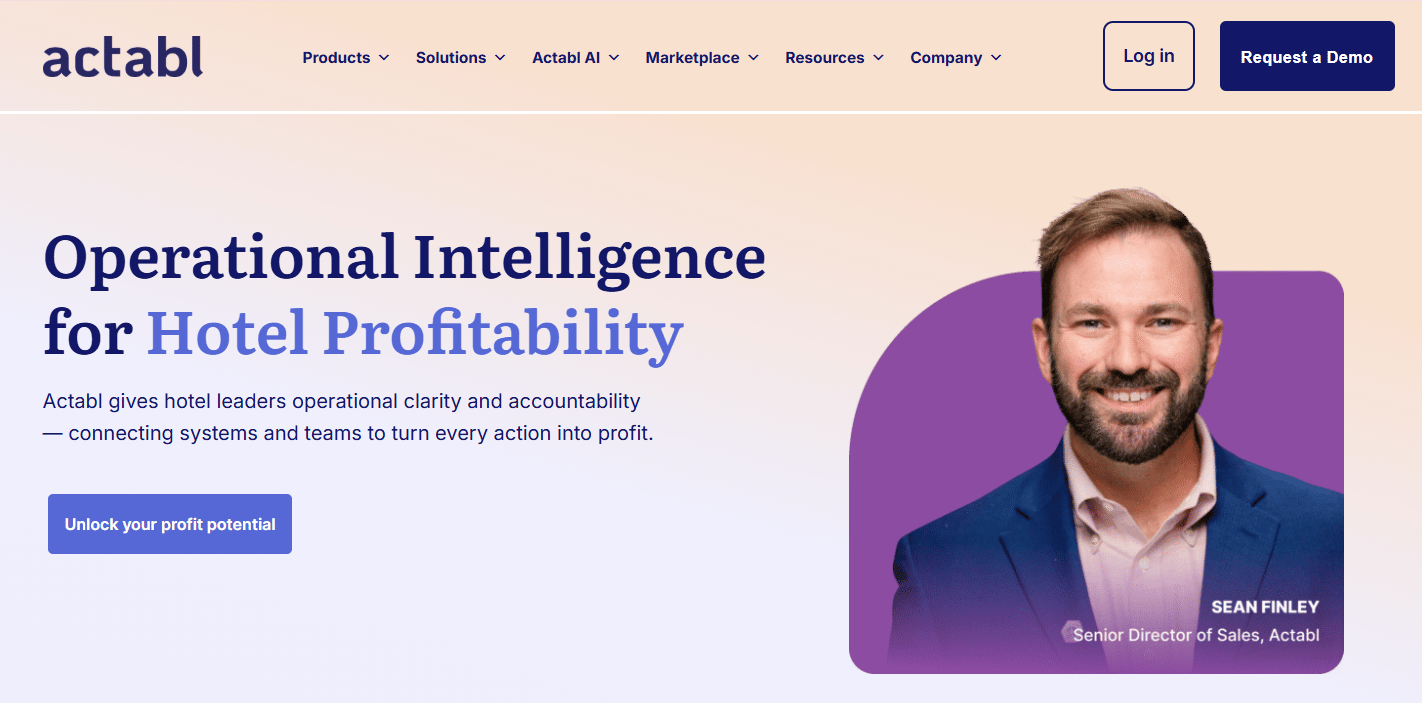
Actabl is a hospitality operations platform that consolidates business intelligence, labor management, hotel operations, asset management, and CapEx planning into one system for hotel groups and management companies. On the guest-service side, it handles request routing, task assignment, housekeeping coordination, preventative maintenance, and guest messaging. Properties using Actabl typically operate at portfolio scale, where consistency across properties matters as much as performance at any single site.
Best for: Hotel owners, operators, and management groups that need integrated portfolio intelligence alongside structured guest-service workflows.
Key features
- Guest request and complaint tracking with department routing
- Task assignment and escalation rules by shift or department
- Real-time portfolio business intelligence and financial reporting
- Labor productivity benchmarking and scheduling tools
- Asset management and preventative maintenance workflows
Why choose Actabl: This is the right fit when the hotel's primary bottleneck is operational execution after a guest makes a request, not just communication volume. The portfolio-level data layer makes it particularly relevant for ownership groups managing multiple properties who need consistency and visibility across sites.
Actabl pricing: Actabl uses custom quote pricing, configured around property requirements, room count, selected modules, and rollout scope. Published reference figures from an Actabl-hosted document suggest select-service hotels have historically run $500 to $2,000 per month and full-service hotels $1,500 to $6,000 per month, though current pricing requires a direct quote. Ask specifically for first-year total cost including onboarding and integrations.
2. Monscierge
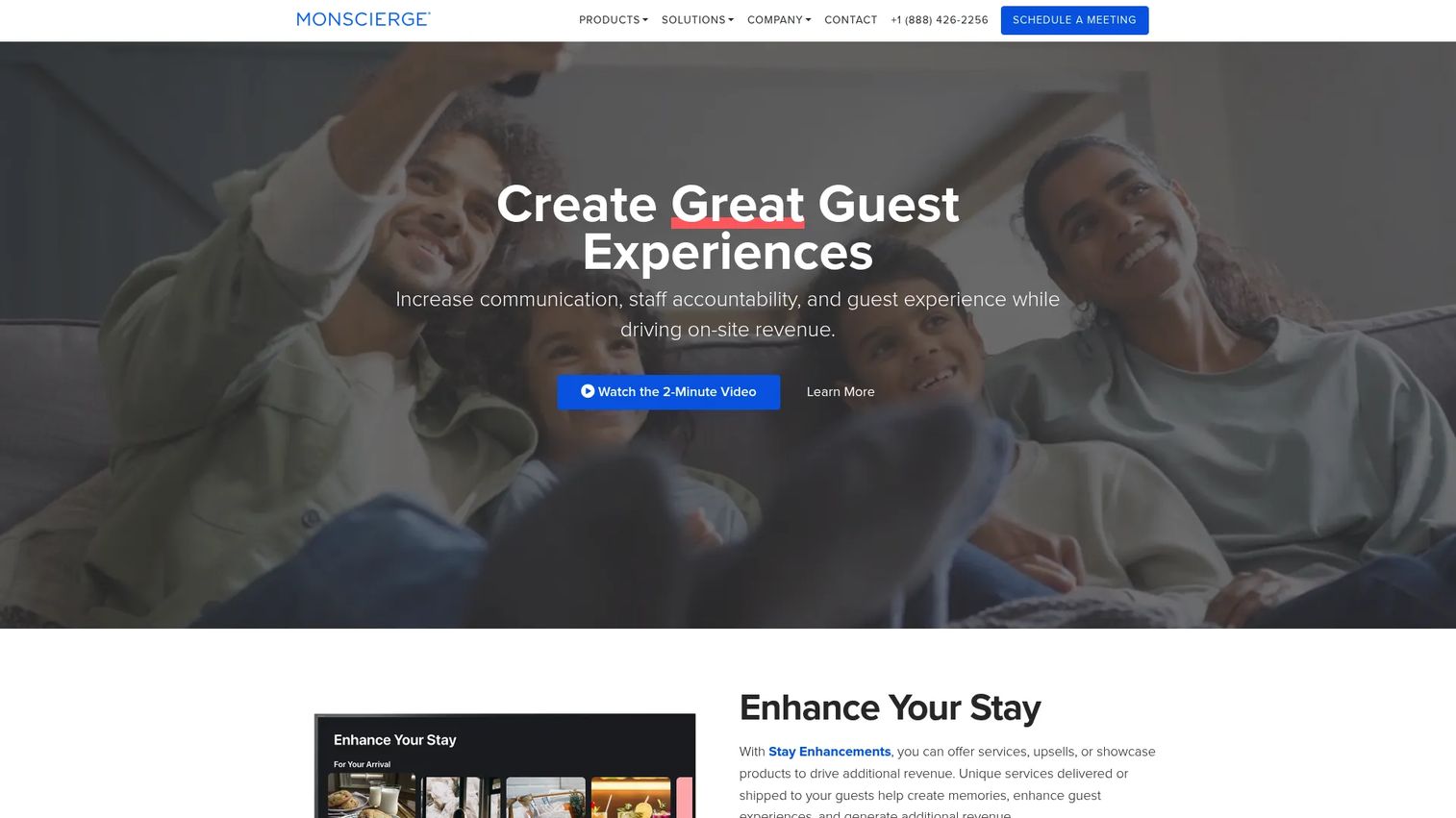
Monscierge is a hospitality technology platform focused on guest-facing digital experiences: Branded web directories, Apple TV hospitality streaming, digital signage, SMS-accessible guest guides, and property content tools. Hotels use it to replace printed collateral and scattered recommendation lists with a single, always-current digital destination. It also supports guest request management, escalations, scheduling, and analytics on the operational side.
Best for: Hotels, resorts, and vacation rentals that want a guest-facing digital concierge with local recommendations, property content, and on-screen information without heavy operational complexity.
Key features
- Digital guest directory via link or QR code
- Apple TV hospitality streaming and property-information displays
- SMS-accessible guest experiences without an app download
- Guest request management with escalations and scheduling
- Digital signage and interactive lobby displays
Why choose Monscierge: Use this when the property wants to replace printed binders, room compendiums, and outdated front-desk recommendation sheets with a live digital experience. The TV streaming and QR-linked guide capability makes it practical for properties that want guest-facing content without asking guests to download an app.
Monscierge pricing: Monscierge's services store lists one-time service fees for specific deliverables: A pre-loaded device deployment starts at $5, a Pro Launch for Hospitality TV at $500, a full property build-out at $4,500, and a design consultation at $295. Recurring software subscription pricing is not displayed on the official pages reviewed. Contact the vendor for a recurring software quote and ask how annual licensing differs from one-time build-out fees.
G2 rating: 5.0/5 based on 1 review on G2.
3. Canary Technologies
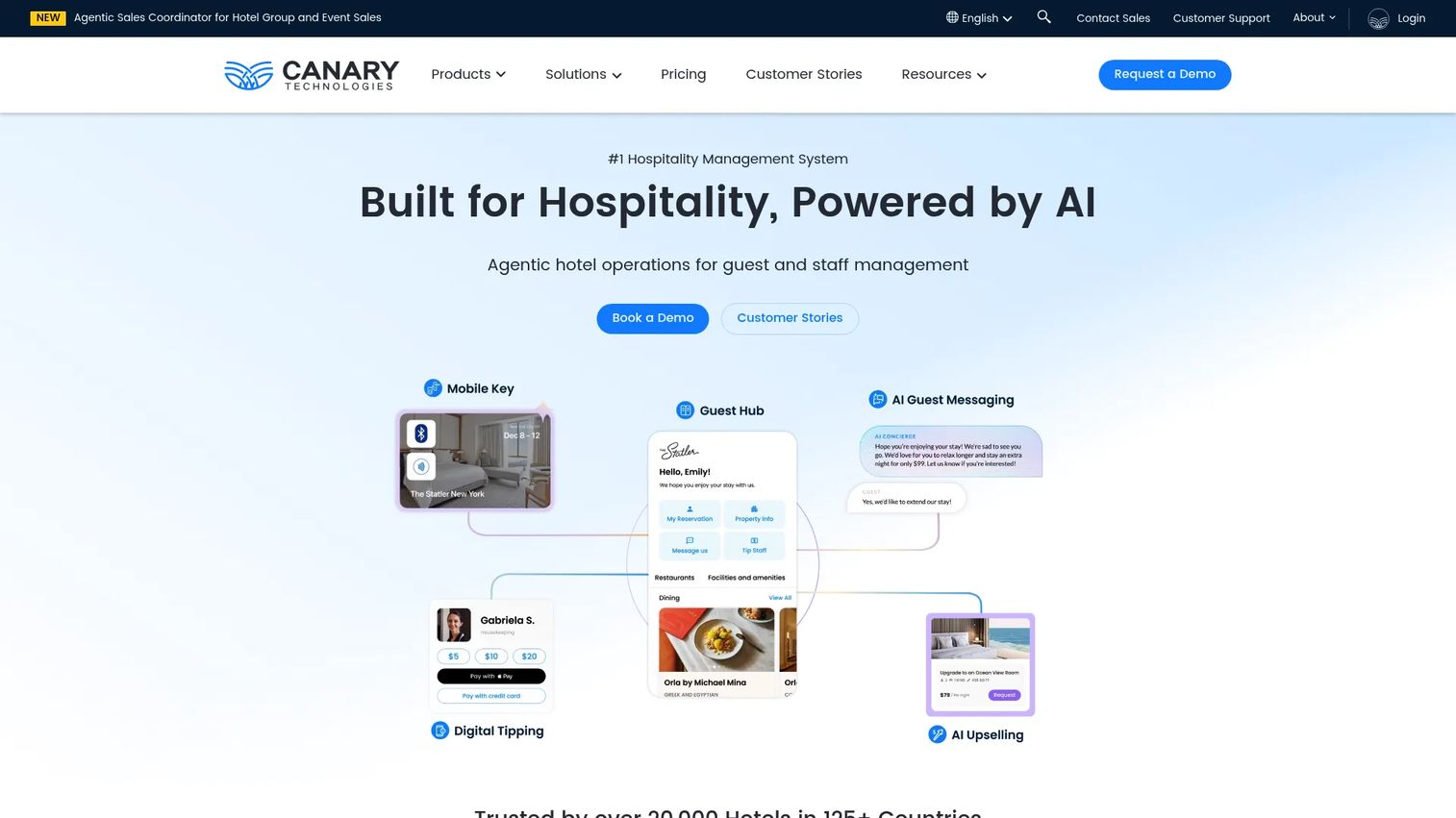
Canary Technologies offers a broad hotel guest-management platform covering messaging, digital compendium, mobile check-in, tablet registration, AI-powered response and translation in over 100 languages, dynamic upsells, digital tipping, smart checkout, and AI webchat. The suite is designed so hotels can consolidate several touchpoints from pre-arrival to post-stay into one vendor relationship with unlimited users and data across all tiers.
Best for: Hotels that want to consolidate guest messaging, digital service, check-in workflows, and ancillary revenue into a single platform without managing multiple point solutions.
Key features
- Unified guest messaging with AI responses and 100-language translation
- Digital compendium for property information
- Dynamic upsells with no commission on revenue generated
- Mobile check-in and tablet registration
- Smart checkout and digital tipping
Why choose Canary Technologies: The platform makes the most sense for teams that want messaging connected to check-in, guest information, upsells, and post-booking workflows rather than handling those as separate products. The zero-commission upsell model is a meaningful cost consideration for properties generating meaningful ancillary revenue.
Canary Technologies pricing: All plans use custom pricing. Core covers guest engagement essentials, Advanced adds revenue and profitability features, and Pro adds automated personalized communication. Canary includes unlimited users, data, and support across all tiers. Request a quote at canarytechnologies.com/pricing to see tier-specific module details for your property type.
G2 rating: 4.8/5 on G2.
4. Akia
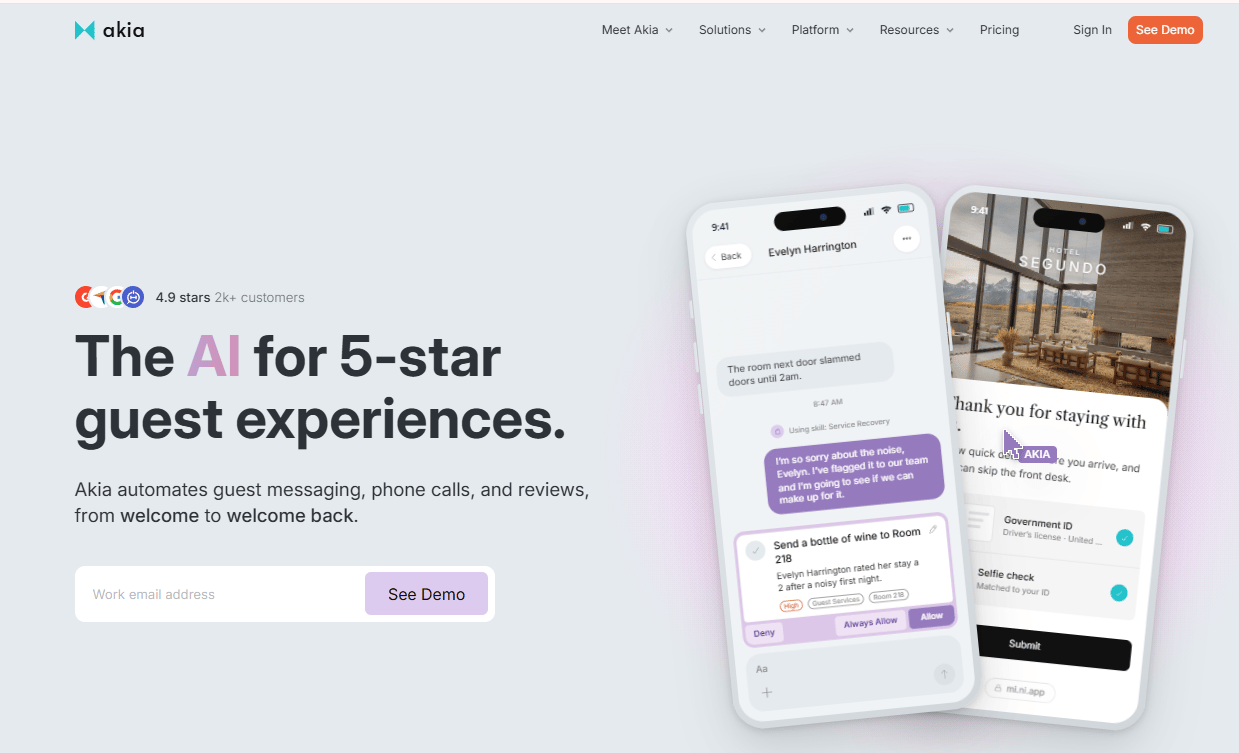
Akia is an AI-powered guest experience platform built for hotels and vacation rentals. It handles guest messaging across SMS, WhatsApp, email, web chat, social, and OTA channels from a unified inbox, with an AI responder managing routine questions. The platform also covers digital check-in with ID verification, Mini Apps for arrival guides, tipping, menus, and upsells, PMS integrations, automated messaging journeys, and an optional AI voice add-on for call handling.
Best for: Hotels that want to reduce manual inbox work by automating routine guest communication while retaining staff handoff capability for complex or high-value requests.
Key features
- AI responder across SMS, WhatsApp, email, and web chat
- Unified inbox with conversation routing and assigned ownership
- Digital check-in with ID verification and payment authorization
- Mini Apps for arrival guides, tipping, menus, and upsells
- PMS-connected task management and automated message journeys
Why choose Akia: The operational value is in pairing a guest messaging hub with automated pre-arrival, upgrade, service, and post-stay moments so the team handles fewer repetitive exchanges. The Basic, Pro, and Max plan structure lets properties start with core AI messaging and add ID verification, PCI capture, and advanced routing as needed.
Akia pricing: All three plans (Basic, Pro, Max) are priced through a sales conversation. Basic includes core AI agent features, PMS integration, tasks, and team chat. Pro adds the unified inbox, Mini Apps, scheduled messaging, automations, and upsells. Max adds ID verification, PCI payment capture, advanced routing, and assigned inbox. Voice, CRM, and Device Hub are optional add-on modules with separate pricing.
G2 rating: 2.5/5 based on 2 reviews on G2.
5. HiJiffy
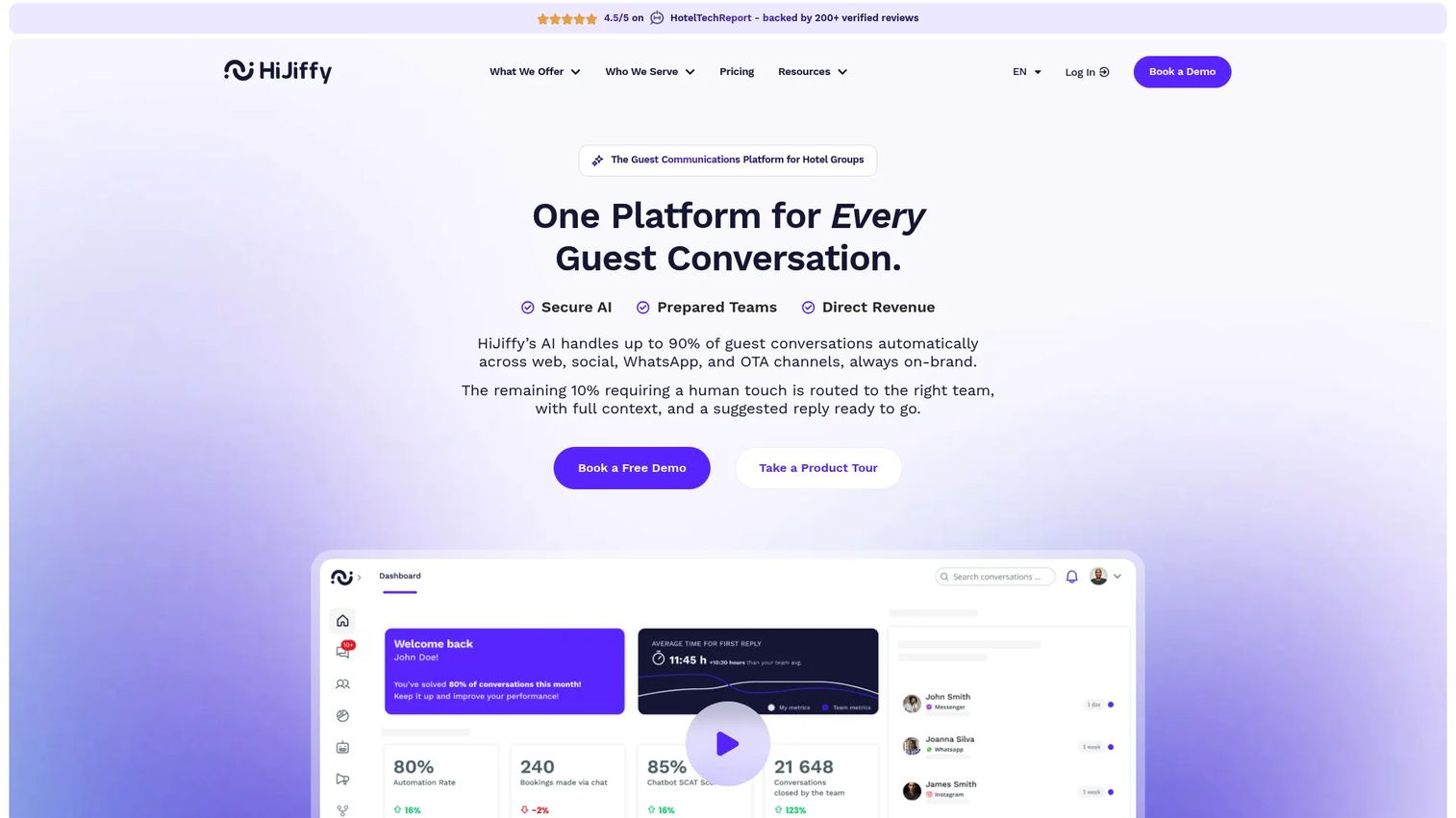
HiJiffy is a hospitality AI and chatbot platform with an omnichannel communication console covering the hotel website, WhatsApp, Facebook, Instagram, email, voice, and OTA channels. The core capability is automating high-volume guest questions through an AI chatbot with a knowledge base tuned for hospitality use cases, reducing the volume of repetitive pre-booking and in-stay inquiries the front desk handles. Staff can take over any AI conversation when personal attention is needed.
Best for: Hotels receiving high volumes of repetitive guest questions and booking inquiries across several messaging channels, and wanting to automate the majority without a fully custom development project.
Key features
- Hospitality AI chatbot with knowledge management
- Omnichannel inbox across web, messaging, social, email, voice, and OTA
- Direct-booking support and reservation conversations
- Proactive guest messaging campaigns
- AI-to-staff handover with full conversation context
Why choose HiJiffy: HiJiffy is the only tool in this comparison with publicly listed monthly pricing, which makes budgeting straightforward for independent properties and smaller groups. The fit is strongest for properties that receive high question volume before arrival and want automation without significant implementation complexity.
HiJiffy pricing: Basic starts at $109/month, Pro at $179/month, and Premium at $359/month, all billed monthly. Annual billing reduces these figures. Pricing scales with room count, and setup fees apply in addition to subscription costs. Enterprise pricing is custom. Verify current room-count thresholds at hijiffy.com/plans-and-pricing.
6. Kipsu
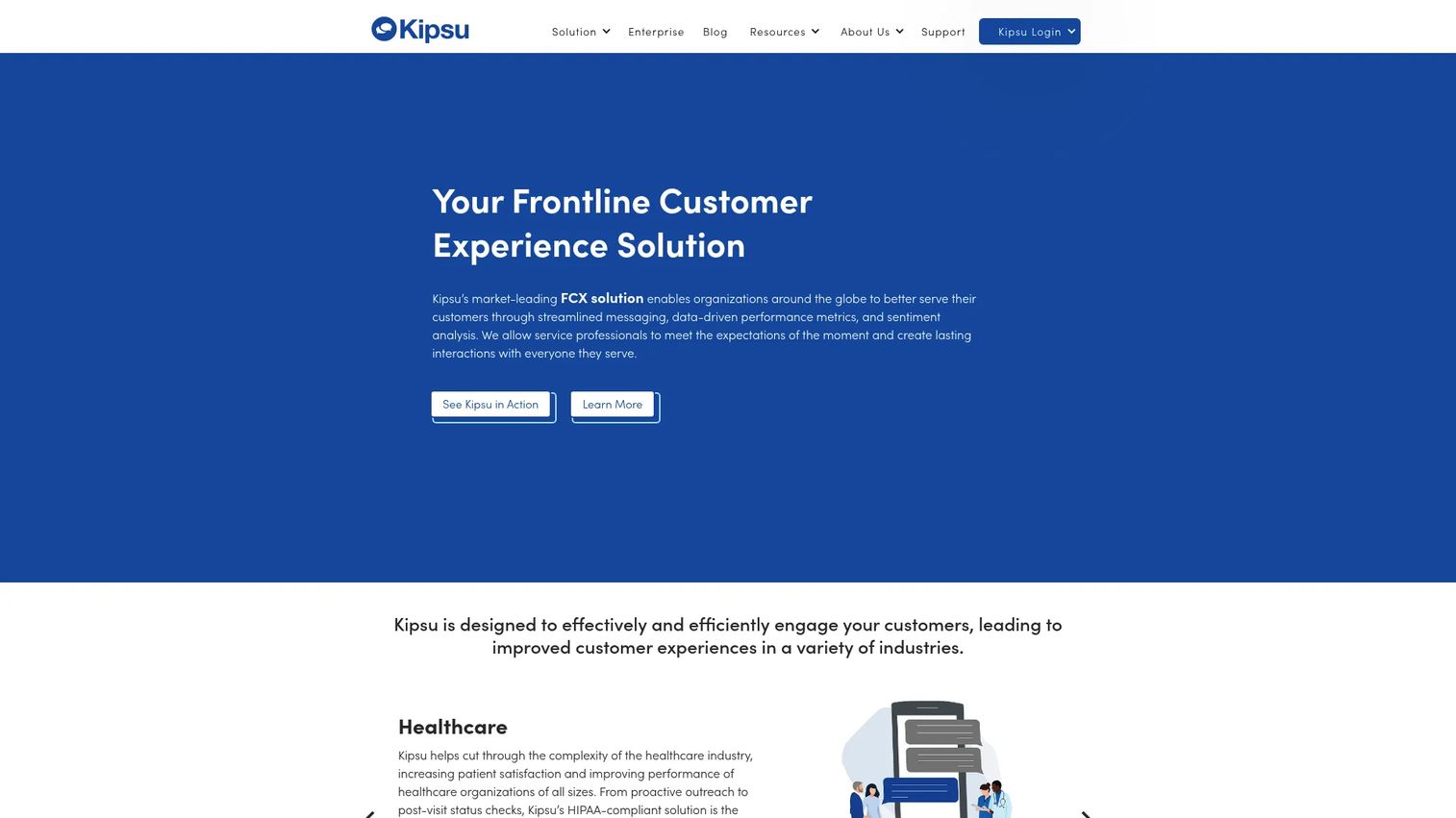
Kipsu is a frontline customer experience platform built around real-time digital messaging for hospitality, healthcare, and other service-oriented industries. In hotel contexts, it provides a shared team inbox for guest conversations across SMS, WhatsApp, LINE, Facebook, Google Business Messages, Apple Business Chat, and other channels. Staff see who owns each conversation, track response times, and coordinate service requests without routing everything through a single front-desk terminal.
Best for: Hospitality teams that want to extend concierge-level human service into digital channels while maintaining clear conversation ownership and accountability.
Key features
- Real-time guest messaging across SMS, WhatsApp, and additional channels
- Shared team inbox with conversation ownership assignment
- Service-request ticketing for maintenance, housekeeping, and back-of-house
- Response-time and department-level reporting
- PMS integrations and staff-facing mobile app
Why choose Kipsu: Use this when the property wants digital messaging that feels like an extension of the concierge desk rather than a chatbot layer. The tool works well for brands where human responsiveness is a differentiator and automation would dilute the service promise.
Kipsu pricing: Pricing is available through a request form. Kipsu does not display numeric pricing on its website. The pricing structure is confirmed as custom, so ask whether it is based on room count, property count, or a portfolio model, and request the first-year total including onboarding fees.
G2 rating: 2.5/5 based on 3 reviews on G2.
7. Intelity
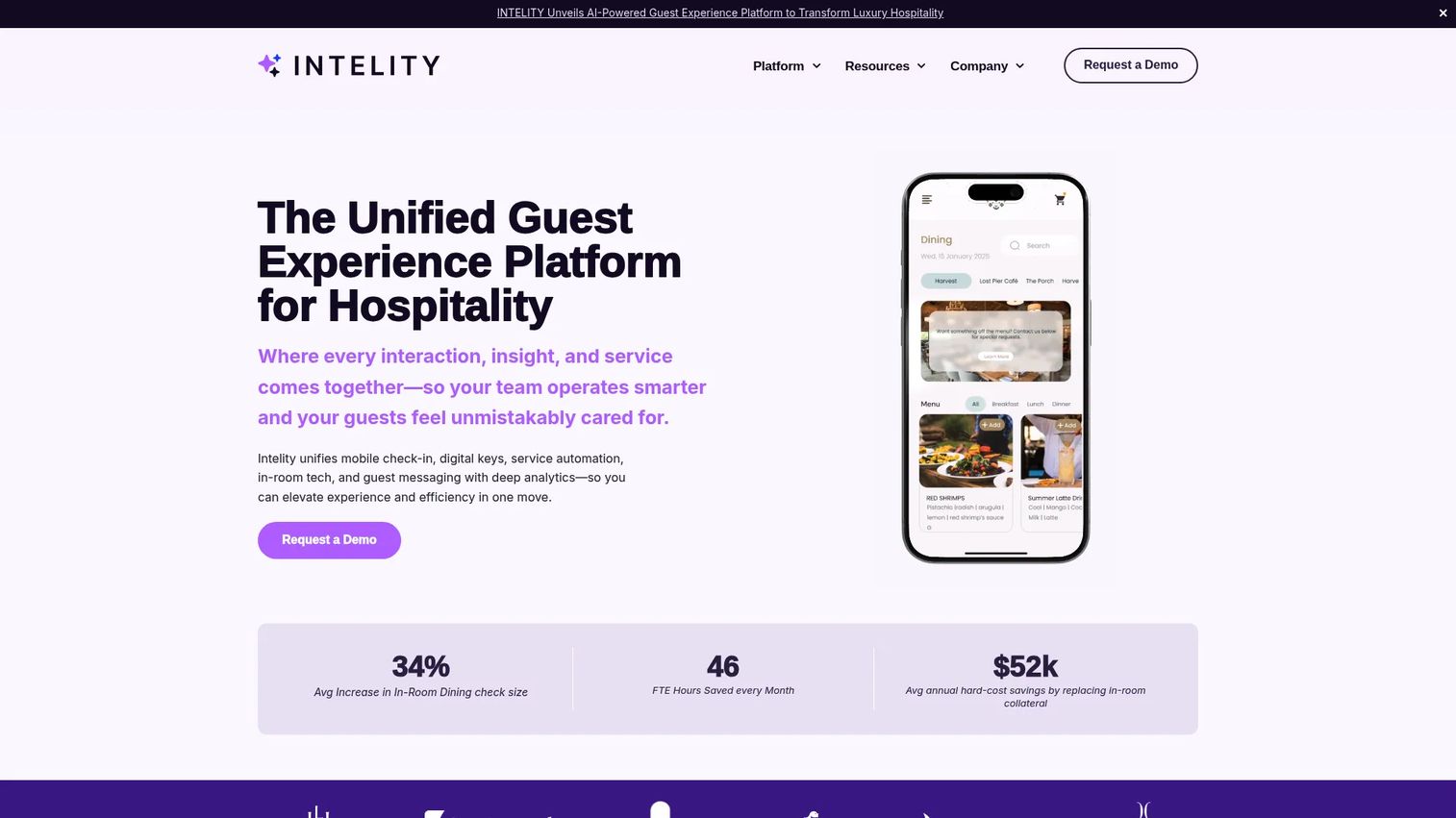
Intelity is a unified guest experience and staff operations platform built for hotels, resorts, casinos, and luxury properties. The guest-facing side includes a branded mobile app, mobile check-in, digital key support, in-room tablets with a digital compendium, digital dining menus, and in-room dining ordering. The staff-facing side handles service-request ticketing, workflow management, smart-room controls, and business intelligence. Intelity connects to PMS, POS, room-control, and ticketing systems through its integration layer.
Best for: Hotels and luxury properties that want a branded mobile guest experience connected to in-room technology, smart-room infrastructure, and back-of-house staff workflows.
Key features
- Branded hotel mobile app with mobile check-in and digital key
- In-room tablets with digital compendium and dining menus
- Guest messaging and in-room service requests
- Smart-room controls and AI-powered personalization
- Staff ticketing, workflow management, and business intelligence
Why choose Intelity: The platform makes sense when the guest app is a strategic service channel, not just a messaging add-on. Properties investing in smart-room technology, digital keys, and connected in-stay service delivery will get more from Intelity's integration depth than from a messaging-only tool. Guest adoption of the app is a variable worth planning around.
Intelity pricing: Intelity does not display numeric pricing on its website. Pricing is provided through direct consultation and reflects the property type, room count, selected modules, hardware requirements, and integration scope. Ask vendors to separate recurring software costs from one-time deployment and hardware fees when comparing quotes.
G2 rating: 3.5/5 based on 1 review on G2.
Considerations when choosing concierge software
Clarify your primary bottleneck first
Some properties lose revenue because guest requests go unanswered. Others lose it because guests can't find information without asking staff. The right platform depends on which problem is measurably larger. Routing and accountability tools solve the first; digital directory and self-serve tools solve the second.
Verify PMS integration before committing
A guest-service platform can only personalize and route effectively when it has access to reservation data, stay dates, room assignments, and guest profiles. Ask each vendor which PMS systems they support, what data fields sync, how often, and who manages exceptions when the sync breaks.
Evaluate the whole guest journey, not just arrival
Test pre-arrival, in-stay, and post-stay workflows separately. The tool that handles pre-arrival messaging best may not be the right fit for in-room service requests or local recommendation delivery. Map your highest-volume moments first, then check which platform covers all of them without requiring separate tools for each.
Model total first-year cost, not subscription price
Most hotel concierge software uses custom pricing that changes with room count, property count, selected modules, onboarding depth, and contract length. A subscription that looks affordable at first quote often carries implementation, integration, and training fees on top. Ask for a first-year total in writing before shortlisting.
Plan for staff adoption before signing
Software does not fix a service process with no owner. Define routing rules, response-time expectations, escalation paths, and the person responsible for maintaining local content and automated replies before selecting a vendor. The property that plans for this in advance gets to value faster.
Conclusion
For most hotel operators, the shortlist narrows to one question: Does the property need better routing and task ownership, or better guest-facing communication and self-service?
Actabl is the fit for hotel groups where cross-department operations and portfolio reporting are the bottleneck. Monscierge handles digital directories, on-screen content, and guest-facing property information. Canary Technologies works for properties consolidating messaging, check-in, and upsells into one vendor. Akia and HiJiffy both address AI-led messaging automation, with HiJiffy offering published pricing and Akia covering more of the in-stay operational workflow. Kipsu is built for teams where staff-led digital conversations are the differentiator. Intelity is for properties that see the guest app and smart-room infrastructure as strategic investments.
Run each vendor demo against the specific workflow that fails most often at your property. That scenario, not a generic product tour, will tell you which platform actually fits.
Start your journey with Guideflow today!
FAQs
Hotel concierge software is a platform that centralizes guest communication, service requests, task routing, digital information, local recommendations, and operational follow-through in one system. It connects what guests ask for to what staff actually deliver. The category is broader than a messaging tool; it typically covers the full arc from pre-arrival to post-stay.
Guest messaging software handles communication: Sending and receiving messages across SMS, chat, and other channels. Hotel concierge software may include messaging but extends into task routing, request tracking, staff accountability, digital directories, upsell workflows, and guest-experience data. Think of messaging as one capability inside a broader concierge platform.
Yes, by surfacing paid offers inside moments guests are already engaged. Pre-arrival messages, in-stay check-ins, and digital compendiums create natural openings for upgrades, late checkout, dining reservations, spa bookings, and local experiences. The revenue impact depends on how consistently those offers are presented and how well they match guest context. The software creates the surface; the property's content and pricing strategy drives conversion.
Most platforms in this category offer PMS integrations to pull reservation data, stay dates, room assignments, and guest profiles. The depth of integration varies significantly by platform and by which PMS you use. Verify the specific integration before committing: Confirm which data fields sync, how frequently, and what happens when the sync breaks or a guest record is incomplete.
A chatbot automates guest questions and conversations. It is one component that some concierge platforms include. Full hotel concierge software connects those conversations to staff workflows, service delivery, request tracking, recommendations, and guest-experience management. A standalone hotel AI chatbot that only handles the conversation layer without routing to operations is narrower than concierge software.
Pricing changes based on room count, number of properties, selected modules, onboarding requirements, integration scope, and contract length. HiJiffy is the only tool in this roundup with published monthly pricing, starting at $109/month for Basic. All others use custom quotes. When comparing vendors, ask for a first-year total that includes subscription, setup, integrations, training, and any hardware costs, not just the monthly rate.
Focus on ease of setup, a clear PMS integration for your existing system, guest messaging that works across SMS and web chat, and a digital guest guide that reduces repetitive front-desk questions. Avoid purchasing a broader platform than your team can maintain. A tool that a two-person front-desk team can actually operate consistently will outperform a feature-rich platform that sits underused.
Portfolio-level groups need governance controls, property-level permissions, shared content libraries, and reporting that aggregates across sites. Confirm that the vendor supports centralized updates to automated messages and digital content so a change made at the group level propagates across all properties. Integration consistency across different PMS systems within the portfolio is also a common friction point worth checking early.