Most review cycles fail before the first form is sent. Feedback gets collected in a spreadsheet, shared in a one-on-one, and forgotten by the next quarter. Managers walk away with no clearer picture of how their team actually performs, and reps receive ratings without context for what to change.
The underlying problem is not motivation. It is structure. Multi-rater feedback only works when anonymity is enforced, reminders fire automatically, and results connect to a development plan someone will actually act on.
The 360-degree feedback software market reflects how seriously organizations are taking this gap. Fortune Business Insights valued the global market at approximately USD 1.2 billion in 2025, with forecasts projecting growth to roughly USD 2.5 to 3.0 billion by the early 2030s at an 8 to 11 percent CAGR. That trajectory is driven by continuous performance management, remote team dynamics, and rising demand for structured coaching.
This guide compares eight 360 review platforms by governance, automation, development planning, reporting, and integrations, the factors that determine whether a review process actually changes behavior.
What's inside
This guide is for HR leaders, People Ops managers, and sales enablement professionals evaluating 360 feedback software in 2026. Tools were selected based on:
- Anonymous feedback controls and rater masking capabilities
- Automated review distribution and reminder workflows
- Development planning and coaching follow-through features
- Reporting depth, competency frameworks, and admin governance
- Integrations with HRIS, CRM, and SSO infrastructure
TL;DR
- Best for structured 360 programs: Performance Pro handles appraisal routing and competency models for organizations running formal review cycles
- Best for continuous performance management: Culture Amp connects 360 feedback to goals, manager conversations, and development in one platform
- Best for enterprise workflows: Trakstar (now part of Mitratech) covers performance reviews, 360 feedback, and learning in a unified talent suite
- Best for focused 360 programs: Spidergap specializes in clean, configurable feedback reports with strong anonymity and development plan output
- Best for OKR-linked feedback: Peoplebox ties 360 reviews directly to goal tracking at $8 per employee per month
- Best lightweight option: SurveyMonkey works for teams running ad hoc or survey-style 360 processes without needing a dedicated performance platform
What is 360 review software
360 review software is a category of HR technology that collects structured feedback about an employee from multiple rater groups, typically managers, peers, direct reports, and sometimes external stakeholders, and consolidates it into reports used for development and performance conversations.
Unlike a standard manager review, 360 feedback captures how an individual is perceived across relationships and contexts. The goal is a fuller picture that supports both individual growth and organizational calibration.
Core capabilities to look for:
- Multi-rater feedback collection: Invite managers, peers, direct reports, and self-assessments from one workflow
- Anonymous and confidential response controls: Enforce thresholds that protect individual responses in small groups
- Review scheduling and reminder automation: Send invitations, nudges, and deadline alerts without manual follow-up
- Competency frameworks and question templates: Map questions to behaviors, leadership models, or custom competencies
- Reporting and dashboards: Aggregate results into individual and team-level views for HR and manager use
- Development plan linkage: Connect feedback findings to individual development plans, goals, or coaching notes
- Goal tracking integration: Align review outcomes to OKRs, IDPs, or performance improvement plans
- Admin governance: Control access, versioning, approval paths, and data export permissions
The distinction between standalone 360 feedback tools and full performance suites matters during evaluation. Standalone tools like Spidergap focus on the feedback process itself and produce clean, shareable reports. Full suites like Culture Amp and Trakstar embed 360 feedback inside a broader performance management workflow covering goals, engagement, and development in a single system.
When to use 360 review software
Build a more balanced view of performance
Manager-only feedback creates blind spots, especially for leaders and senior individual contributors whose impact is felt laterally across teams. When a sales enablement manager wants to understand how a rep handles cross-functional collaboration or how a manager coaches their team, a single-rater review misses most of what matters. Multi-rater data surfaces patterns that one perspective cannot.
Standardize reviews across a growing team
Ad hoc review processes break down fast as headcount scales. When managers run reviews inconsistently, HR loses the ability to compare, calibrate, or identify systemic coaching gaps. A structured 360 platform enforces the same questions, timelines, and anonymity rules across every team, making results comparable and the process repeatable.
Link feedback findings to development plans
Collecting ratings is the easy part. The harder question is what happens after. Choose a 360 tool when your goal is not just reporting but follow-through: Development plans with owners, goals tied to feedback themes, and manager coaching notes that stay attached to the employee record. Without that connection, feedback cycles become surveys no one acts on.
360 review software comparison
The eight tools below cover a range of use cases, from focused standalone 360 programs to full performance management suites. They differ most on anonymity controls, automation depth, development plan integration, and pricing model.
| # | Product | Best for | Key differentiator | Pricing | G2 rating |
|---|---|---|---|---|---|
| 1 | Performance Pro | Structured appraisal and 360 programs | Competency-based appraisal routing | Custom pricing | 4.3/5 |
| 2 | Trakstar | Enterprise talent development suites | Unified performance, hiring, and learning | Custom pricing | 4.4/5 (Capterra) |
| 3 | Culture Amp | Continuous performance and engagement | Integrated engagement plus 360 and goals | Custom pricing | 4.5/5 |
| 4 | Qualaroo | Survey-style feedback collection | In-context survey targeting and analytics | Free; from $19.99/mo | 4.3/5 |
| 5 | Peoplebox | OKR-linked performance and 360 reviews | Module-based pricing with goal alignment | From $8/emp/mo | N/A |
| 6 | PeopleGoal | Configurable performance and HR workflows | Flexible app-style workflow builder | From $4/user/mo | 2.0/5 |
| 7 | Spidergap | Focused 360 feedback programs | Clean individual reports with development plans | From $1,099/year | 4.5/5 |
| 8 | SurveyMonkey | Lightweight survey-based 360 collection | Mature survey platform with AI and templates | Free; from $30/user/mo | 4.4/5 |
Best 360 review software for 2026
1. Performance Pro
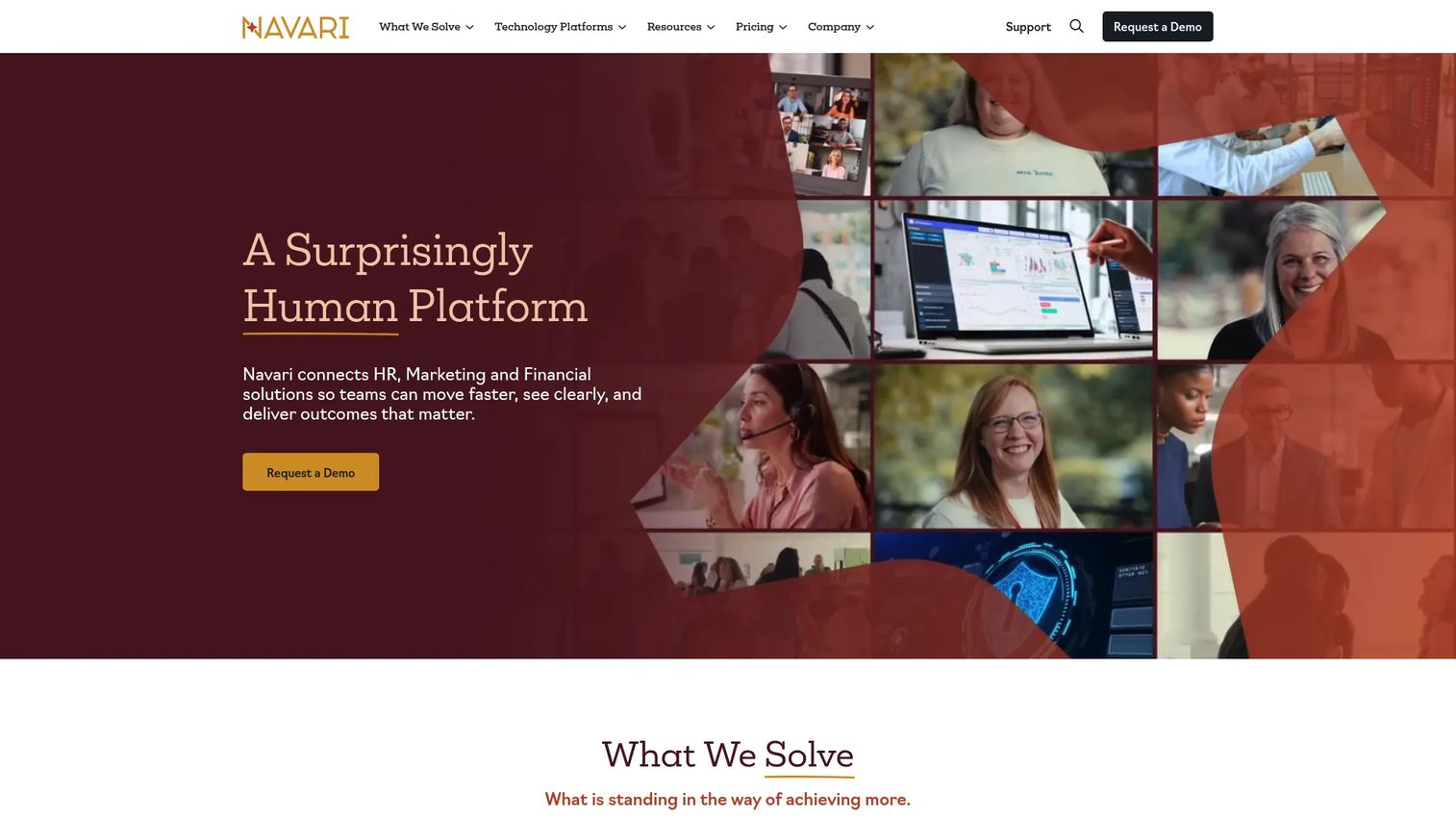
Performance Pro is a performance management platform built by HR Performance Solutions that handles employee appraisals, goal tracking, and review routing for organizations that need configurable, structured evaluation workflows. It supports 360-degree feedback as part of a broader appraisal system, with competency-based question design and multi-step routing for approvals. Teams that run formal annual or semi-annual review cycles and want a system that enforces governance through routing and access controls tend to get the most from it.
Best for: HR teams running structured, recurring review programs that require appraisal routing and competency model alignment.
Key features
- Appraisal routing: Configurable approval paths for multi-step review sign-off
- SMART goal support: Goal tracking tied to appraisal outcomes
- Competency configuration: Position-level competency and question mapping
- 360 multi-rater collection: Structured feedback from peers, managers, and direct reports
Why choose Performance Pro: If your organization runs formal review cycles with defined competencies and approval workflows, Performance Pro gives HR the governance infrastructure to enforce consistency across managers. It suits mid-market organizations that want more structure than a survey tool but do not need a full enterprise talent suite.
Performance Pro pricing: Pricing is based on employee count and annual subscription terms; contact HR Performance Solutions directly for a quote. G2 reviewers rate the platform 4.3 out of 5.
2. Trakstar
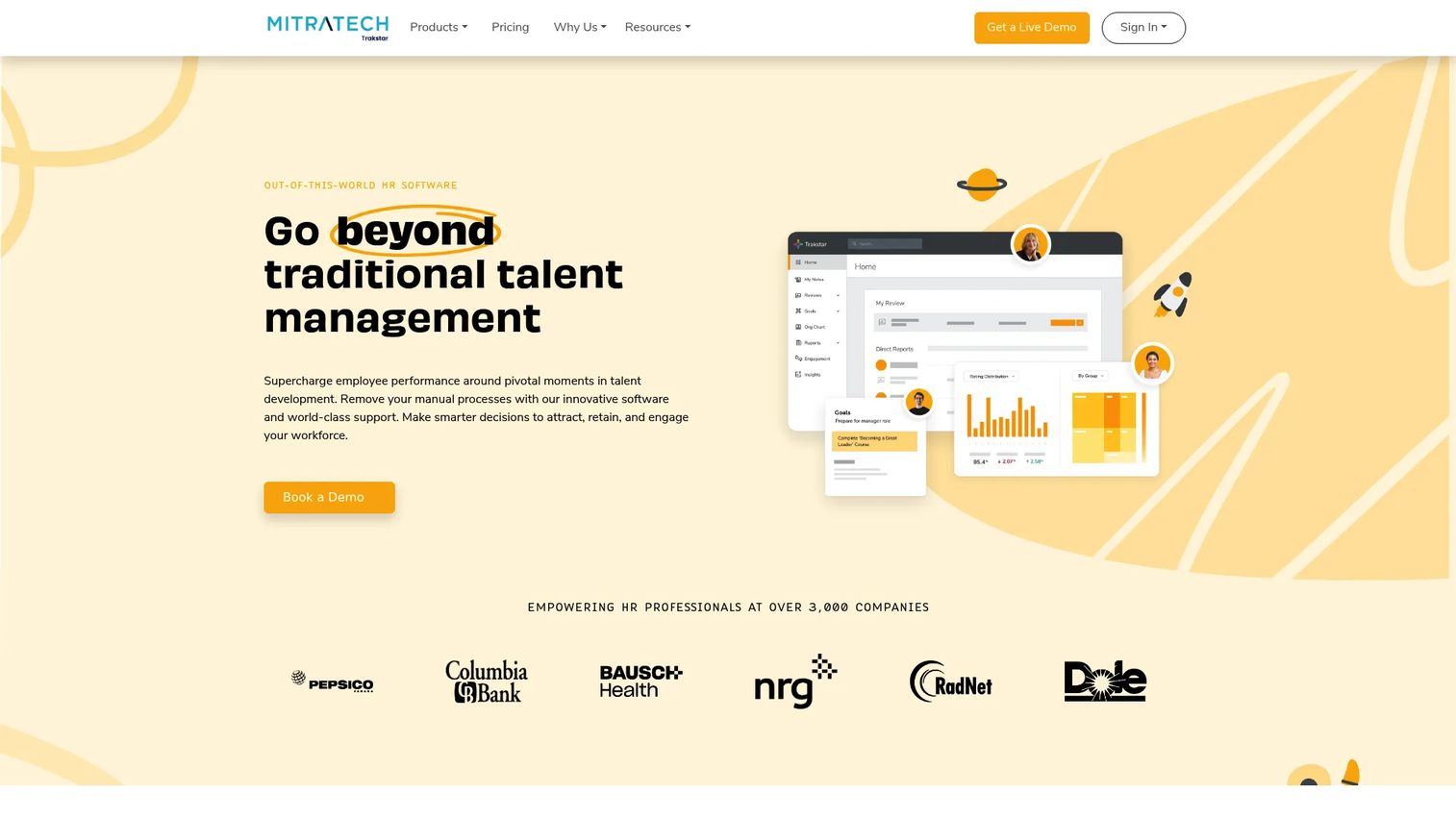
Trakstar is a cloud-based talent development platform that covers performance management, applicant tracking, learning management, and workforce analytics under one product suite. Acquired by Mitratech in April 2023, Trakstar Perform handles 360-degree feedback alongside goal tracking and engagement surveys, making it a fit for HR teams that want a connected talent process rather than a point solution for feedback collection.
Best for: Mid-market and enterprise HR teams that want performance, hiring, and learning managed in a single platform.
Key features
- Performance reviews and 360 feedback: Configurable review cycles with multi-rater support
- Applicant tracking: Collaborative hiring, sourcing, and offer workflows
- Learning management: Auto-enrollment, content delivery, and upskilling tracking
- Workforce analytics: Cross-module reporting on performance and engagement data
Why choose Trakstar: Organizations that have outgrown standalone review tools and want one platform covering the talent lifecycle will find Trakstar's suite reduces the number of point-solution integrations to manage. The Mitratech acquisition added enterprise compliance and workflow capabilities relevant to larger HR teams.
Trakstar pricing: Pricing is not displayed on the Trakstar site; request a personalized quote through their website.
Capterra reviewers rate Trakstar Perform 4.4 out of 5.
3. Culture Amp
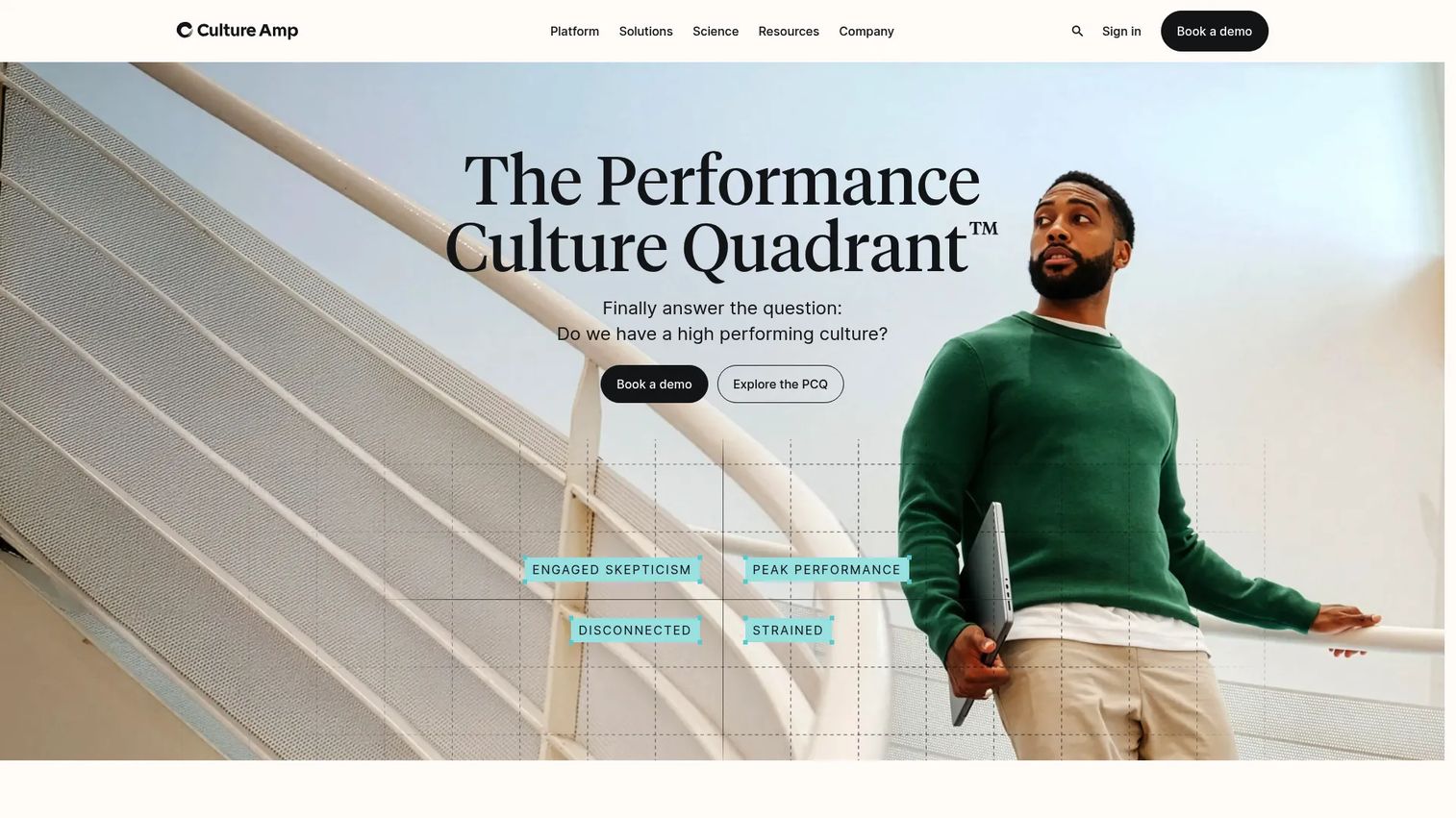
Culture Amp is an employee experience platform that combines engagement surveys, performance reviews, 360-degree feedback, and development planning in one product. It is built around a people science approach, meaning its templates and frameworks are grounded in organizational psychology rather than generic HR templates. The platform's AI Coach feature supports managers in interpreting feedback and identifying development actions, which matters when the goal is coaching follow-through rather than just collecting ratings.
Best for: Mid-market and enterprise teams that want engagement, performance, and development managed together rather than in separate tools.
Key features
- Engagement and pulse surveys: Continuous listening with benchmarked reporting
- 360 feedback and performance reviews: Multi-rater cycles connected to development and goals
- Goal tracking and 1:1 support: Integrated goal management tied to feedback outcomes
- AI Coach: Manager guidance on interpreting feedback and taking action
Why choose Culture Amp: Teams that struggle to connect feedback results to manager behavior change will find Culture Amp's development integration more actionable than tools that stop at reporting. It is particularly strong for organizations that want engagement and performance data in the same view for calibration conversations.
Culture Amp pricing: All plans are billed annually; pricing is quote-based and scales by employee count and the combination of products selected. Contact Culture Amp for a current quote.
G2 reviewers rate the platform 4.5 out of 5.
4. Qualaroo
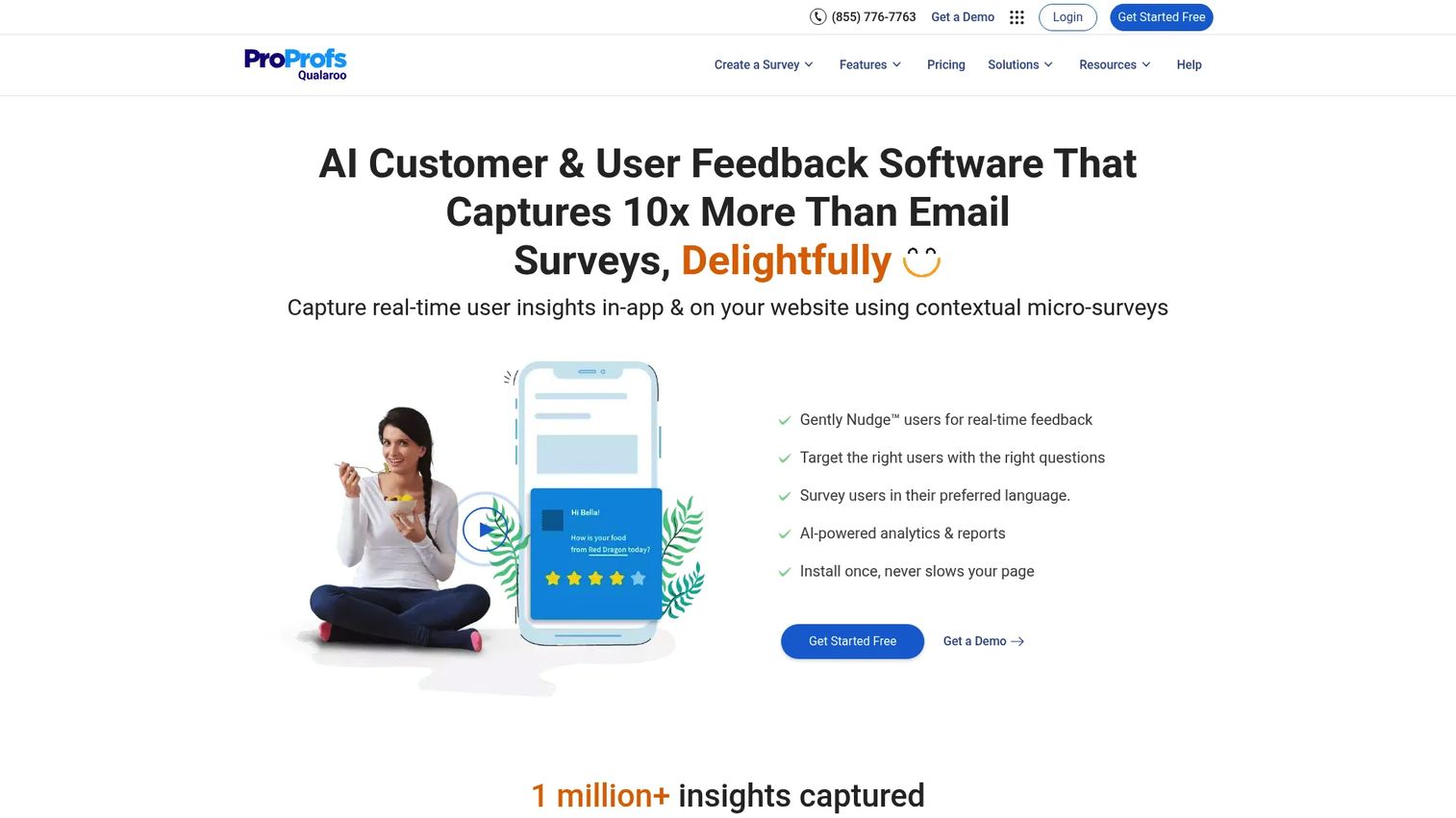
Qualaroo is primarily a customer and user feedback platform built around in-app and website survey nudges. It is not a purpose-built 360 review tool, but its survey customization, advanced targeting, and sentiment analysis make it usable for teams that want lightweight, survey-style peer feedback collection without investing in a full performance suite. Teams with experimental or informal feedback programs sometimes use Qualaroo alongside their existing HRIS rather than replacing it.
Best for: Teams running lightweight, survey-driven peer feedback that do not need a dedicated 360 performance platform.
Key features
- In-app and website survey nudges: Targeted in-context feedback delivery
- Advanced targeting and custom variables: Segment surveys by role, behavior, or attribute
- Sentiment analysis: Automated theme detection across open responses
- Integrations: Connects to HubSpot, Salesforce, Slack, and analytics tools
Why choose Qualaroo: Choose Qualaroo when the primary need is survey flexibility and targeting rather than structured performance management. It works for HR teams piloting peer feedback before committing to a full 360 platform, or for teams that already use it for product feedback and want to extend it internally. It does not replace dedicated review software for organizations that need competency frameworks, development plans, or formal appraisal routing.
Qualaroo pricing: A free plan is available. Paid plans run $19.99 per month for Essentials, $49.99 per month for Business, and from $149.99 per year for Enterprise. An enterprise white-label add-on is available for an additional $300 per year.
G2 reviewers rate Qualaroo 4.3 out of 5.
5. Peoplebox
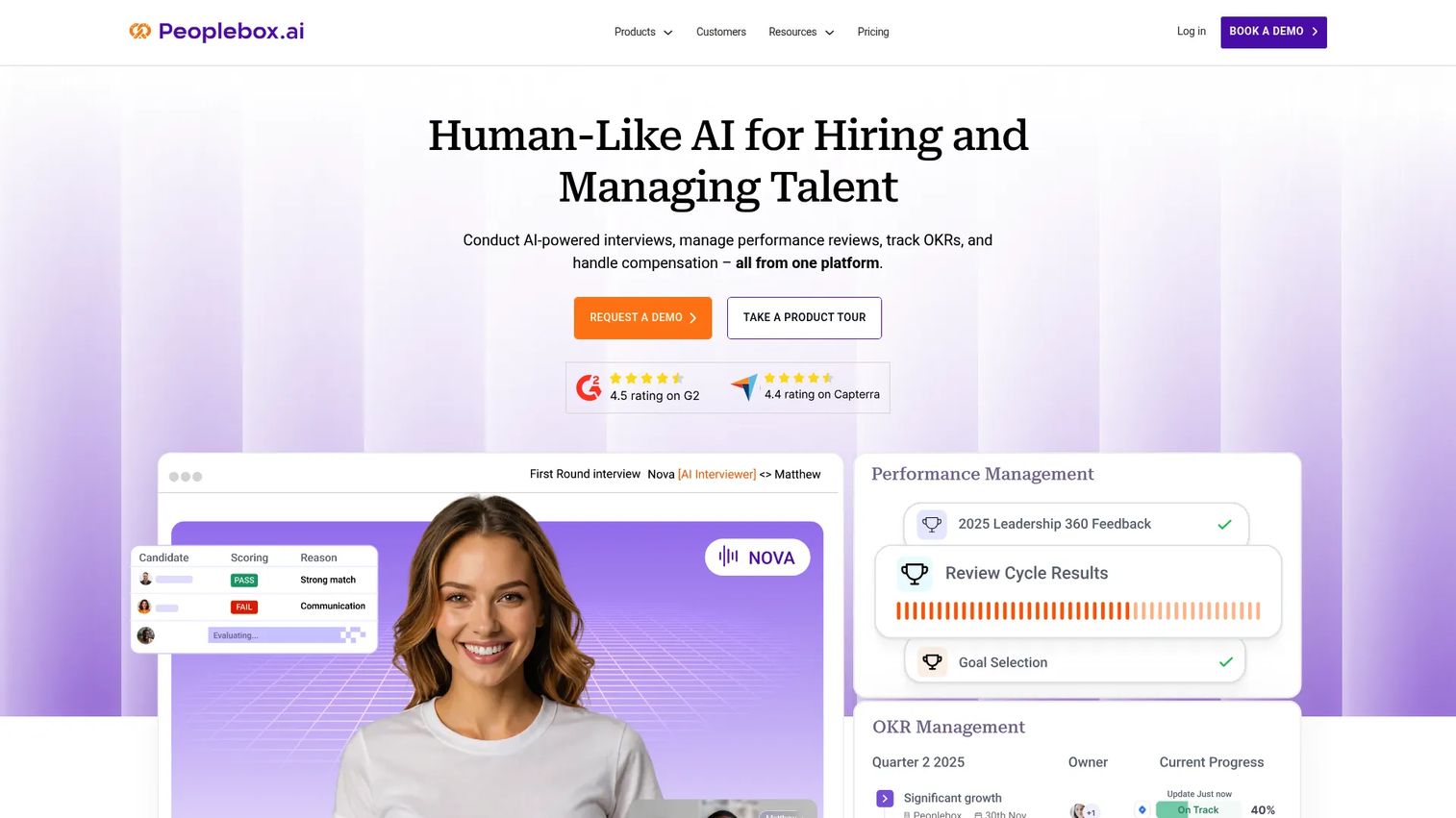
Peoplebox is an AI-powered talent platform that covers performance management, OKRs, engagement surveys, 360-degree feedback, and compensation workflows in a modular structure. Its pricing is module-based, so teams can start with engagement or goal tracking and add the 360 feedback module when ready. The platform also includes AI recruiting capabilities, making it a broader HR automation platform for organizations that want talent acquisition and performance in one place.
Best for: HR teams that want 360 feedback integrated with OKR tracking and goal alignment at a transparent, per-employee price.
Key features
- Performance reviews and 360 feedback: Multi-rater cycles with configurable templates
- OKR and goal tracking: Goal alignment tied directly to review outcomes
- Engagement surveys: Continuous listening alongside performance data
- AI recruiting: Resume screening, AI interviews, and sourcing automation
Why choose Peoplebox: The module-based pricing model lets teams add 360 feedback incrementally without paying for capabilities they do not yet need. Organizations that already manage OKRs and want feedback data in the same system will benefit from the goal-to-review alignment. The AI recruiting layer makes it a fit for teams that want to consolidate hiring and performance under one vendor.
Peoplebox pricing: The 360 degree module is $8 per employee per month billed annually. Other modules start at $2 per employee per month for engagement, $3 for individual development plans, $5 for compensation, and $8 for performance management. AI recruiting pricing requires a custom quote.
G2 rating not confirmed at time of drafting.
6. PeopleGoal
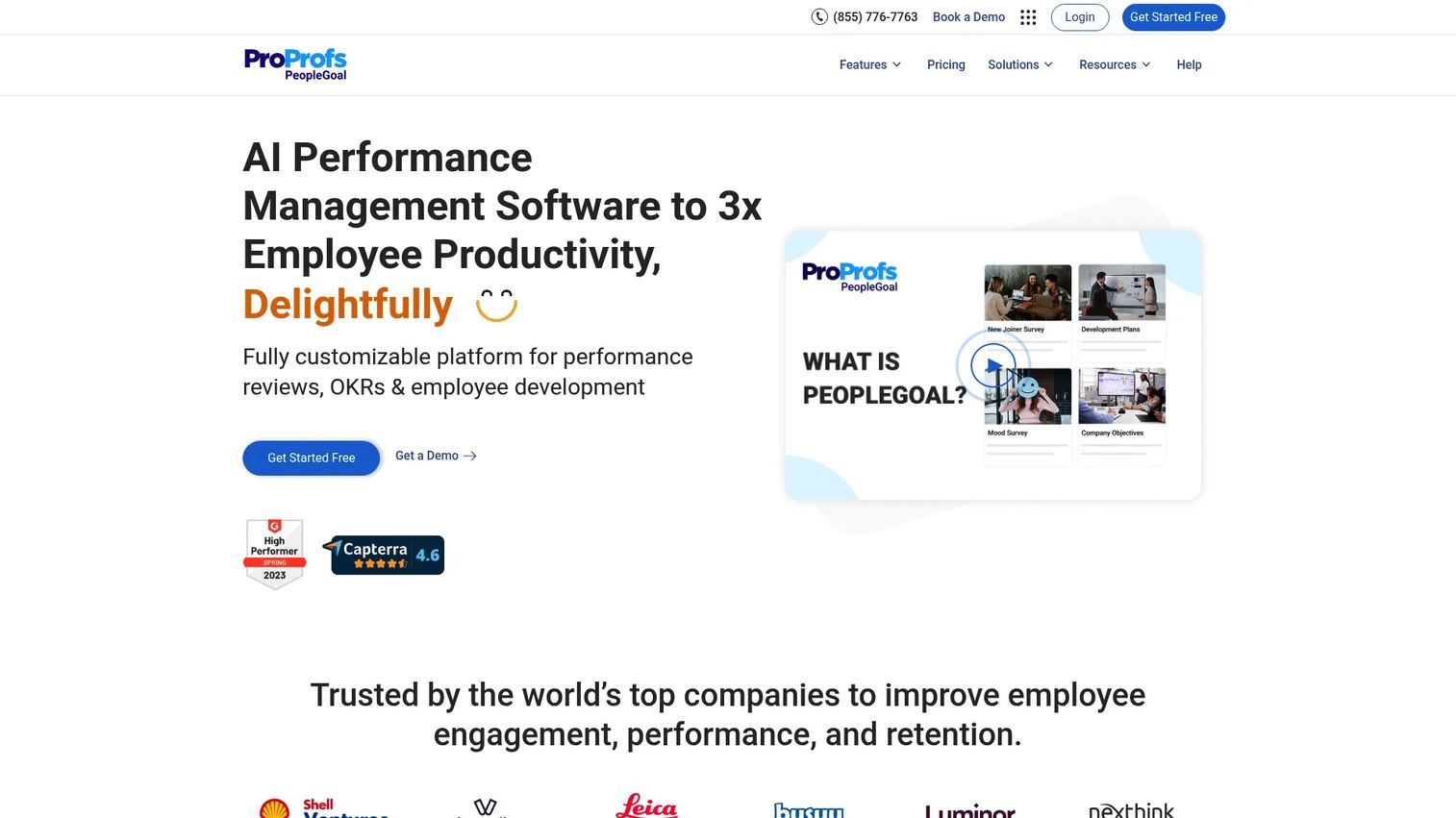
PeopleGoal is a configurable HR and performance management platform that lets teams build custom workflows for performance reviews, engagement surveys, onboarding, and core HR processes. Its app-style workflow builder gives HR teams the ability to design feedback forms, routing, and goal-tracking flows without developer support. It supports 360-degree feedback collection as part of its performance module, with options to connect feedback findings to OKR tracking and development planning.
Best for: Organizations that need a highly configurable platform and want to build their own feedback and review workflows rather than adopt a fixed structure.
Key features
- Performance management and OKRs: Configurable review cycles with goal linkage
- Employee engagement surveys: Feedback collection with reporting dashboards
- Core HR and onboarding workflows: Employee data, onboarding automation, and workflow management
Why choose PeopleGoal: Teams that need flexibility over out-of-the-box structure will appreciate PeopleGoal's configurable approach. It suits organizations with unique review processes that standard templates do not cover. Note that G2 reviewers currently rate PeopleGoal 2.0 out of 5, so validate current user sentiment and support responsiveness before committing.
PeopleGoal pricing: Plans start at $4 per user per month billed annually for teams up to 50 users. A people development suite is available from $499 per month. A 14-day free trial is included, with no credit card required.
G2 reviewers currently rate PeopleGoal 2.0 out of 5.
7. Spidergap
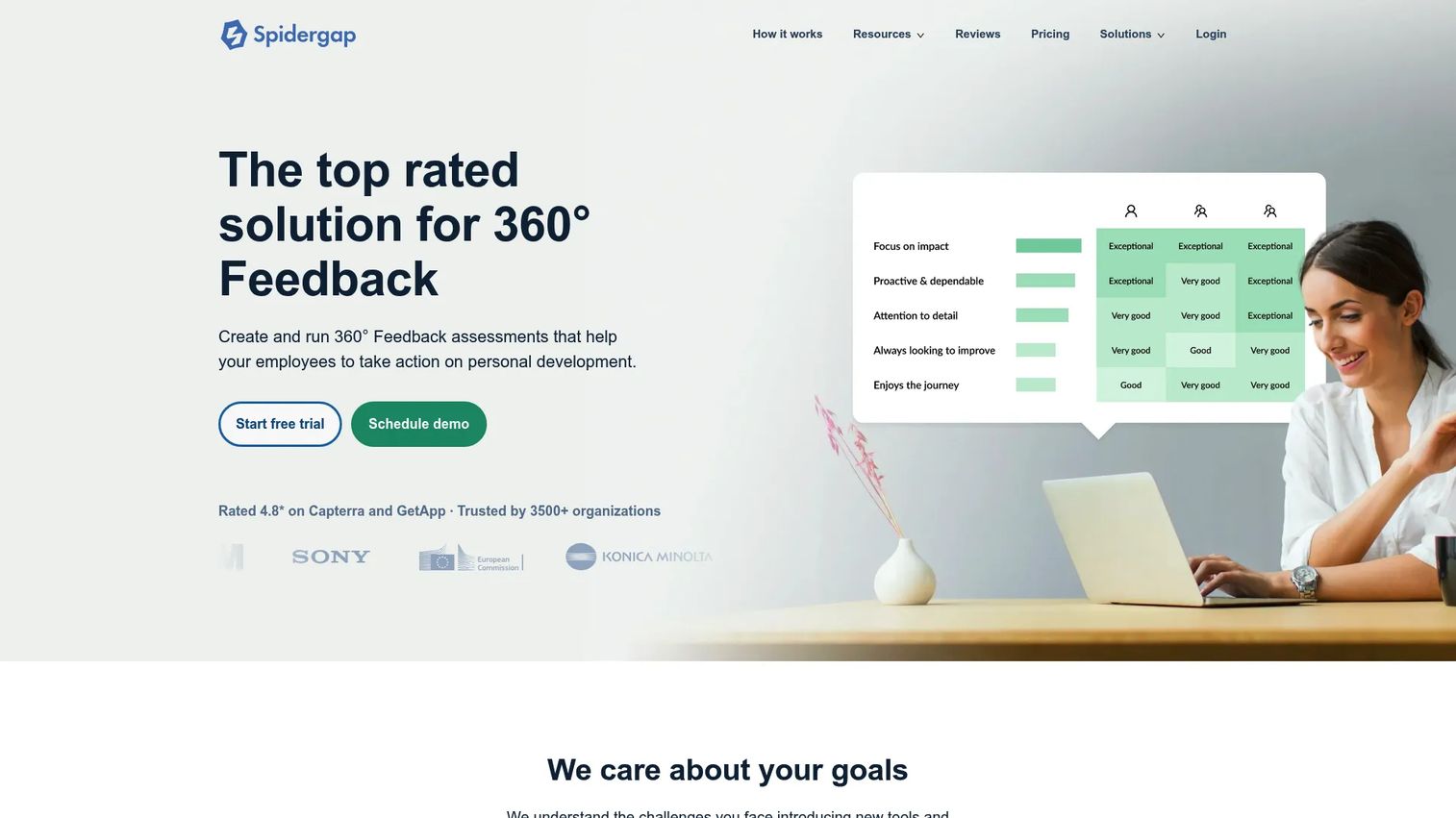
Spidergap is a focused 360-degree feedback platform built specifically for collecting, analyzing, and sharing individual feedback reports. Unlike full performance suites, it does not try to cover hiring, LMS, or engagement surveys. Its strength is the quality of the output: Individual reports that clearly present strengths, development areas, and suggested personal development plans in a format managers and employees can actually use in a conversation. HR consultants running external 360 programs also use it frequently.
Best for: Teams or HR consultants running a clean, focused 360-degree feedback program where report quality and anonymity control are the primary requirements.
Key features
- Customizable 360 questionnaires and email templates: Tailor questions and communications per program
- Individual feedback reports: Structured output with strengths, improvement areas, and development plan prompts
- SSO support: Available on the Pro plan for enterprise authentication requirements
- Multi-currency, international pricing: USD, GBP, and EUR plans with explicit pricing per tier
Why choose Spidergap: If the goal is a clean feedback process with high-quality reports rather than a full performance management suite, Spidergap is the most focused option on this list. Its report format is designed for the development conversation, not just data collection. The limitation is scope: It does not replace a performance management system for organizations that need goal tracking or engagement data alongside 360 results.
Spidergap pricing: The Starter plan is $1,099 per year and includes 10 feedback recipients plus a free trial. The Pro plan is $2,199 per year and adds self-enrollment, file hosting, configurable report pages, and SSO. Enterprise pricing requires a conversation with the team and includes volume discounts, a dedicated account manager, and a 99.5% uptime guarantee.
G2 reviewers rate Spidergap 4.5 out of 5 based on a small review sample.
8. SurveyMonkey
SurveyMonkey is a mature survey and forms platform used across industries for collecting structured feedback at scale. It is not purpose-built for 360 performance reviews, but its 500-plus templates, advanced logic, multilingual support, and AI-assisted analysis make it a practical option for teams running informal peer feedback programs or organizations that want survey infrastructure without a dedicated HR platform. It handles the collection and reporting side well; development plan integration and anonymity enforcement require manual process design on the HR team's part.
Best for: Teams that need a mature, scalable survey platform for peer feedback collection and can handle development follow-through outside the tool.
Key features
- AI-assisted survey creation and analysis: Question recommendations and response theme detection
- 500-plus templates and 25-plus question types: Pre-built survey structures including 360 feedback templates
- Advanced logic and multilingual support: Branching, skip logic, and multi-language survey delivery
- Team collaboration tools: Shared workspaces, role-based access, and comment workflows
Why choose SurveyMonkey: Choose SurveyMonkey when 360 feedback is one of many survey use cases, not the primary HR workflow. It is a strong fit for teams that already use the platform for other research and want to extend it to peer feedback without a second tool. For organizations that need competency frameworks, automatic rater masking, or development plan output baked into the platform, a dedicated 360 tool will serve the process better.
SurveyMonkey pricing: A free basic plan is available. Team Advantage starts at $30 per user per month for three or more users billed annually. Team Premier is $92 per user per month at the same minimum. Enterprise plans for five or more users require a demo request. Overage responses above plan limits cost $0.15 each. G2 reviewers rate SurveyMonkey 4.4 out of 5.
Considerations
Anonymous feedback controls
Verify how each platform handles anonymity at the group level, not just the form level. Most tools enforce a minimum rater threshold before showing individual responses, but the threshold varies. For small teams, a threshold of three raters may still make responses identifiable. Ask vendors how they handle edge cases where a group has fewer raters than the threshold requires, and whether managers can ever see individual responses tied to a name.
Development planning
A review cycle that ends at a report has a completion rate problem. Look for platforms that connect feedback findings to individual development plans, goal records, or coaching notes within the same system. If the tool exports a PDF report but has no mechanism for follow-up ownership, the development conversation will happen in a slide deck that no one revisits. The stronger tools keep action items inside the workflow.
Automation and reminders
Manual reminder management kills adoption. Confirm that the platform sends automated invitations, progress reminders, and deadline alerts without HR intervention on each cycle. The more configurable the timing and messaging, the more likely review completion rates hold up across busy quarters. This matters especially for enablement teams running review cycles alongside active sales motions.
Integrations and security
Check which HRIS systems the platform syncs with for employee data, whether SSO is available at your plan tier, and how data is exported if you need to move to a different tool. For organizations with Salesforce or HubSpot in the stack, confirm whether feedback data can feed into manager records or enablement dashboards. GDPR and SOC 2 compliance documentation should be available on request before any contract is signed.
Reporting depth
Dashboards that show completion percentages are table stakes. The more useful question is whether the reporting layer surfaces competency gaps across a team, tracks development plan progress over time, and gives HR a calibration view without requiring a manual export. Ask for a demo of the reporting environment specifically, not just the feedback collection flow.
Conclusion
The right tool depends on where you are in the maturity curve. For organizations running their first structured 360 program, Spidergap gives you clean feedback reports with strong anonymity without the overhead of a full performance suite. For teams that already manage goals and engagement and want 360 feedback inside the same system, Culture Amp or Peoplebox are the natural next step.
If the priority is connecting feedback to development plans and coaching accountability, avoid tools that stop at report generation. The platforms that change behavior are the ones where action items live inside the tool, not in a downloaded PDF.
For enterprise teams with talent acquisition and learning already in scope, Trakstar's suite reduces point-solution sprawl. And if the team needs maximum configurability over an out-of-the-box review structure, Performance Pro and PeopleGoal both offer workflow customization that generic survey tools cannot match.
Start by mapping your anonymity requirements, your HRIS integrations, and whether development follow-through needs to live inside the platform or can sit in an adjacent system. Those three decisions will narrow the shortlist faster than any feature comparison.
Start your journey with Guideflow today!
FAQs
For small teams, anonymity enforcement is the hardest constraint to satisfy. Spidergap is the most focused option for running a clean feedback process with configurable anonymity thresholds, and its Starter plan at $1,099 per year covers up to 10 feedback recipients. SurveyMonkey works for very lightweight or experimental programs, though it requires more manual process design to protect individual responses in small groups.
Most platforms enforce a minimum rater threshold, typically three to five respondents in a group, before revealing aggregated responses. Individual ratings and comments below that threshold are either suppressed or combined with another group. Some platforms give HR admins visibility into group-level data while keeping individual responses masked from managers. During evaluation, ask specifically how the platform handles groups that fall below the minimum threshold mid-cycle.
Several platforms on this list do this natively. Culture Amp connects feedback findings to manager 1:1s, goal tracking, and development conversations within the platform. Peoplebox links review outcomes to OKR records. PeopleGoal offers a configurable workflow that can route feedback results to an IDP or performance improvement plan. Tools like Spidergap and SurveyMonkey stop at report generation, so development follow-through requires a separate system or process.
Start with anonymity controls and rater masking logic, since this determines whether respondents trust the process enough to give honest feedback. Then evaluate automation depth for invitations and reminders, because completion rates fall sharply with manual management. Third, look at how feedback results connect to development plans or goal records. Reporting and integrations matter for scale and calibration, but the first three gates determine whether the process produces usable data.
It depends on the tool. Standalone platforms like Spidergap focus specifically on the multi-rater feedback process and produce development-oriented reports, but they do not cover goal setting, calibration, or compensation workflows. Full performance management suites like Culture Amp and Trakstar embed 360 feedback inside a broader system that includes engagement, goals, and manager development. Choosing between them is a question of whether you need a point solution or a connected performance infrastructure.
Pricing models vary significantly across this category. Spidergap charges per program at $1,099 to $2,199 per year for defined recipient counts. Peoplebox charges $8 per employee per month for the 360 module billed annually. SurveyMonkey team plans start at $30 per user per month. PeopleGoal starts at $4 per user per month. Culture Amp, Trakstar, and Performance Pro are quote-based and price by employee count, product selection, and service tier. Enterprise contracts typically run annually with minimum seat requirements.
A traditional performance review is manager-led and evaluates an employee's performance against role expectations, usually as part of a compensation or promotion decision. A 360 feedback process collects input from multiple rater groups, including peers, direct reports, and sometimes external stakeholders, to build a broader picture of how someone is perceived across relationships. The purpose of 360 feedback is primarily developmental rather than evaluative, though some organizations use both processes in the same cycle.
Alignment comes first. Managers and participants need to understand why feedback is being collected, how anonymity works, and what will happen with the results before any form is sent. Pilot the process with one team or level before rolling it out broadly, so you can identify gaps in question design or reporting before they affect the full organization. Train managers on how to deliver feedback conversations rather than just hand over a report, and assign clear ownership for development plan follow-through with a defined check-in cadence.