Your donor data lives in five places. Names in a spreadsheet. Gift history in your payment processor. Event attendance in a separate signup tool. Board notes in someone's inbox. Volunteer hours in a shared doc nobody updates.
So when a major donor calls, nobody can pull up their full history in under two minutes. That gap costs money. Nonprofits that centralize constituent data close it, and the numbers back the shift: the global CRM software market is expected to reach USD 181.9 billion by 2030, growing at a 10.4% CAGR from 2023, according to Cirrus Insight (2025). The specialized constituent data platform software market is moving even faster, forecast to grow at a 19.8% CAGR through 2033.
Constituent management software fixes the fragmentation problem. It pulls donors, volunteers, members, board members, and grant relationships into one nonprofit database, so every interaction lives in a single record. The right nonprofit CRM software gives you a 360-degree constituent view, cleaner donor segmentation, and reporting your board actually trusts.
But the category is crowded, and vendor landing pages rarely tell you who each tool is really for. A marketplace built for procurement is not the same as an enterprise fundraising platform, and a foundation-focused system solves different problems than a museum admissions CRM. This guide ranks seven options and tells you which nonprofit fits each one, so you can shortlist fast instead of sitting through seven demos.
What's inside
This is a buyer's shortlist for nonprofit and foundation leaders comparing constituent relationship management software in 2026. It covers development directors, foundation staff, membership organizations, museums and attractions, and marketers supporting nonprofit fundraising.
We selected tools based on four criteria that matter most when replacing scattered data: centralized constituent data and a true 360-degree constituent view, donor segmentation and engagement depth, reporting dashboards leadership can defend, and integrations that prevent new data silos. Each entry includes verified pricing where public, a G2 rating, and a clear "best for" so you can match the tool to your organization type.
TL;DR
- Best for discounted procurement: TechSoup, the nonprofit marketplace for donated and discounted software across many vendors.
- Best integrated suite: Bonterra, spanning fundraising, CRM, volunteer, and case management.
- Best for foundations and grantmakers: Foundant, built around grants, scholarships, and fund accounting.
- Best for cultural attractions: Doubleknot, unifying admissions, memberships, events, and fundraising.
- Best for small and mid-sized fundraising teams: Bloomerang, a donor-focused giving platform with strong usability.
- Best for large, complex nonprofits: Blackbaud, an enterprise fundraising and financial suite.
- Best all-in-one for lean teams: Keela, combining donor management, email, and automation with contact-based pricing.
What is constituent relationship management software?
Constituent relationship management software is a nonprofit database that centralizes every relationship an organization manages, including donors, volunteers, members, board members, grantees, and community contacts, into a single system of record. It extends the logic of a commercial CRM to the mission-driven world, where a "customer" is any constituent an organization needs to cultivate over time.
A constituent relationship management system tracks interactions, gifts, event attendance, and engagement history so staff can build relationships rather than reconstruct them from memory. This is where the term overlaps with donor management software, though constituent relationship management is broader: donor management focuses on giving, while constituent relationship management covers every stakeholder type.
Core capabilities most nonprofit CRM software shares:
- Centralized constituent records: One profile per person or organization, with a complete 360-degree constituent view of gifts, contacts, and history.
- Donor segmentation: Group constituents by giving level, recency, interest, or campaign for targeted outreach.
- Fundraising and gift tracking: Record donations, pledges, recurring gifts, and campaign performance in one place.
- Reporting dashboards: Board-ready reports on retention, revenue, and pipeline without manual spreadsheet work.
- Engagement tools: Email, appeals, and personalization built into the donor relationship management workflow.
- Board member tracking and volunteer management: Record governance roles, terms, and volunteer hours alongside donor data.
- Integrations: Connections to payment processors, email platforms, and accounting systems that keep data silos from reforming.
Adoption of this software class is now mainstream. Cirrus Insight (2025) reports that 91% of companies with 11 or more employees use CRM systems, and 87% of businesses run cloud-based deployments rather than on-premises. Nonprofits are following the same curve, replacing spreadsheets with purpose-built constituent management software.
When to use constituent relationship management software
Centralize constituent data across teams
If your donor history, event lists, and volunteer records live in separate tools, you already need a nonprofit database. The trigger is usually a missed opportunity: a lapsed major donor nobody followed up with, or a duplicate ask sent to the same household twice. A constituent relationship management system consolidates records so every team works from one source.
Improve donor segmentation and outreach
When mass appeals underperform, the problem is often targeting, not copy. Donor segmentation lets you separate first-time givers from lapsed donors from monthly sustainers, then tailor the message to each. If you are sending the same email to everyone, a CRM with strong segmentation and personalization is the upgrade that moves response rates.
Report to your board with confidence
Boards want retention rates, campaign ROI, and pipeline, not a screenshot of a spreadsheet. If quarterly reporting eats days of manual work, reporting dashboards inside a constituent relationship management system produce those numbers automatically. This matters most for foundations and larger nonprofits with governance and compliance demands.
Comparison table
Here is how the seven tools compare on intent, differentiation, pricing, and rating. Pricing and G2 ratings reflect verified values as of July 2026. Where a vendor gates pricing behind a sales conversation, we say so rather than guessing.
| # | Product | Intent | Key use case | Pricing | G2 rating |
|---|---|---|---|---|---|
| 1 | TechSoup | Discounted procurement | Donated and discounted tech for eligible nonprofits | Free; Plus $200/yr | 5/5 |
| 2 | Bonterra | Integrated suite | Fundraising, CRM, volunteer, and case management | Free hub; quote-based products | 4.5/5 |
| 3 | Foundant | Foundations | Grantmaking, scholarships, and fund accounting | Quote-based | 4.5/5 |
| 4 | Doubleknot | Cultural attractions | Admissions, memberships, events, fundraising | Demo-based | 4.5/5 |
| 5 | Bloomerang | Donor-focused CRM | Donor management, fundraising, volunteers | From $40/mo | 4.6/5 |
| 6 | Blackbaud | Enterprise nonprofits | Fundraising CRM and financial management | Quote-based | 3.8/5 |
| 7 | Keela | Lean all-in-one | Donor CRM with email and automation | From $134/mo | 4.6/5 |
1. TechSoup
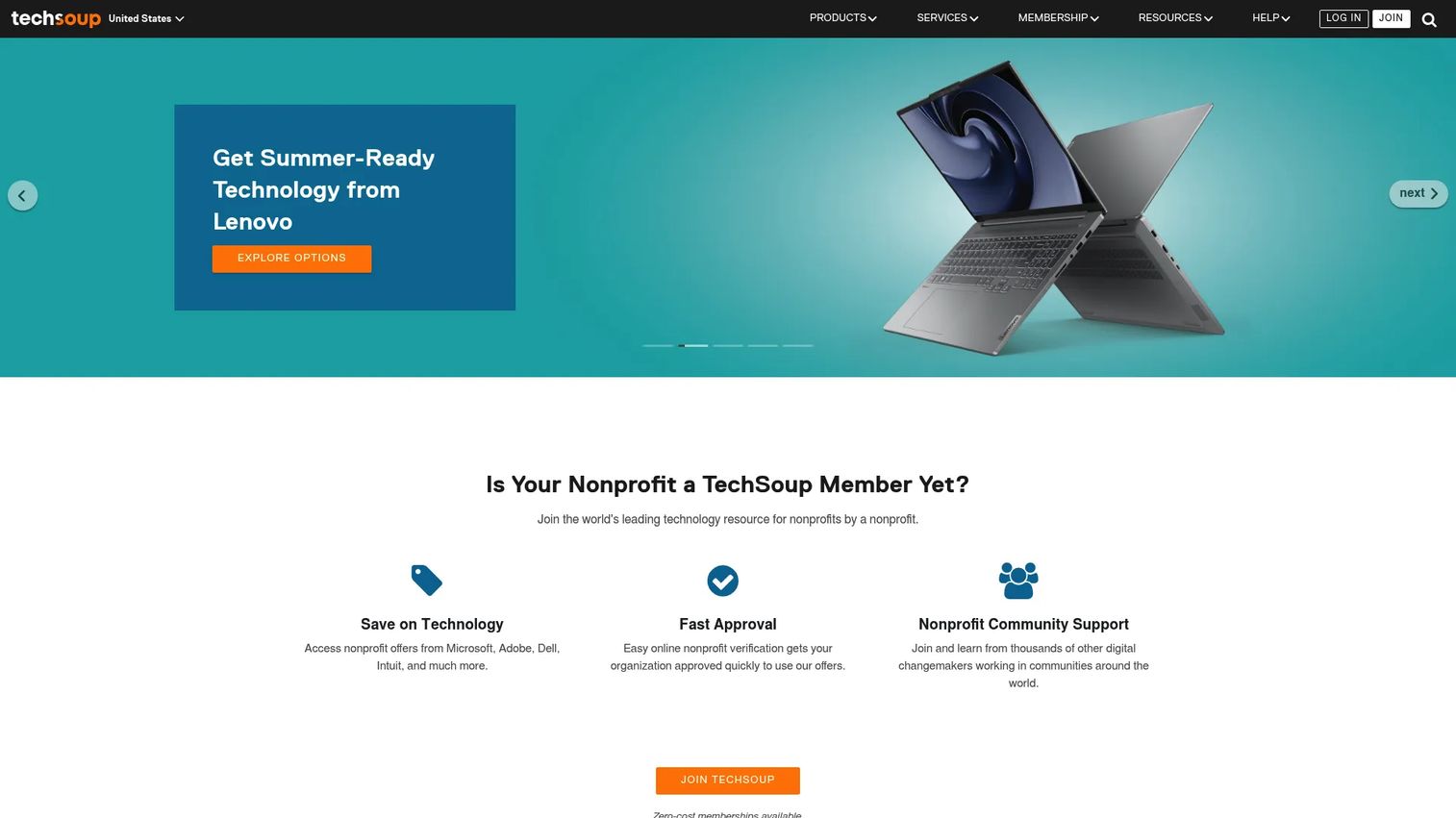
TechSoup is the nonprofit technology marketplace and resource hub, not a single CRM but the procurement entry point where eligible organizations access donated and discounted software, hardware, and services. For a nonprofit comparing constituent relationship management software, TechSoup is often the first stop, because many CRM vendors offer discounted or donated licenses through it. It pairs those offers with education resources, webinars, and forums that help small teams choose wisely before they commit budget.
Best for: Nonprofits and libraries that want discounted technology and donation programs before selecting a CRM.
Key strengths
- Donated and discounted offers: Access reduced-cost technology from many vendors in one catalog, useful when budget is tight.
- Free membership: A free TechSoup membership opens eligibility, with optional TechSoup Plus for added benefits.
- Education and support: Webinars, guides, forums, and articles help small teams evaluate constituent management software with context.
Why choose TechSoup: TechSoup fits the discovery and procurement stage rather than the daily fundraising workflow. If you are early in evaluation and want to compare eligibility, discounts, and vendor options across a broad catalog, it saves money and reduces guesswork. It complements a dedicated nonprofit CRM software choice rather than replacing it.
TechSoup pricing: TechSoup Membership is free. TechSoup Plus Membership is $200 billed annually. Fees for individual marketplace offers vary by product and are set by each participating vendor. On G2, TechSoup carries a 5/5 product rating on the current listing.
2. Bonterra
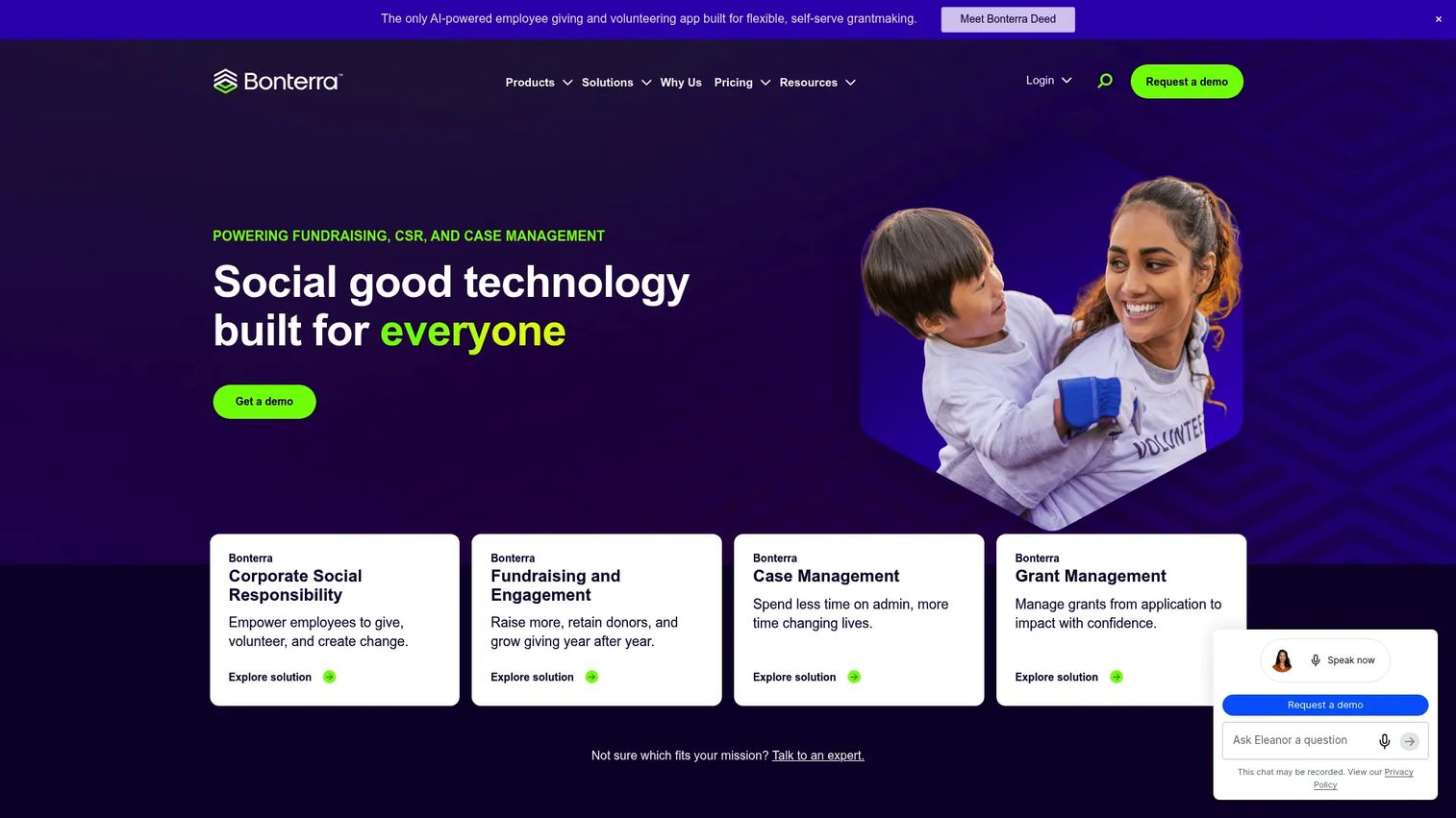
Bonterra is a social good software company offering an integrated portfolio across fundraising, donor management, volunteer coordination, grantmaking, and case management. For nonprofits that want strategy and software together, Bonterra stands out because it spans multiple constituent workflows under one vendor rather than forcing you to stitch point tools together. It serves nonprofits, foundations, corporations, and government, which makes it a fit for organizations whose constituent base is broader than donors alone.
Best for: Mission-driven organizations needing an integrated suite for fundraising, CRM, volunteer, grant, or case management.
Key strengths
- Integrated portfolio: Fundraising, donor management, volunteer coordination, and case management products that share a common ecosystem.
- AI-powered fundraising intelligence: Intelligence features across the portfolio surface engagement and giving signals.
- Breadth of audience: Products built for nonprofits, foundations, corporations, and government constituent relationships.
Why choose Bonterra: Bonterra fits teams that want a constituent relationship management system covering more than gifts, with case management and volunteer coordination alongside fundraising. If your organization manages complex constituent relationships beyond donations, the integrated approach reduces data silos across programs. It suits buyers who value one vendor over a patchwork of tools.
Bonterra pricing: Bonterra Nonprofit Hub is listed as free on the product page. Other products, including Network for Good, EveryAction, DonorDrive, Mobilize, Deed, CyberGrants, and Apricot for Government, use customized or request-based pricing. On G2, Bonterra holds a 4.5/5 rating.
3. Foundant
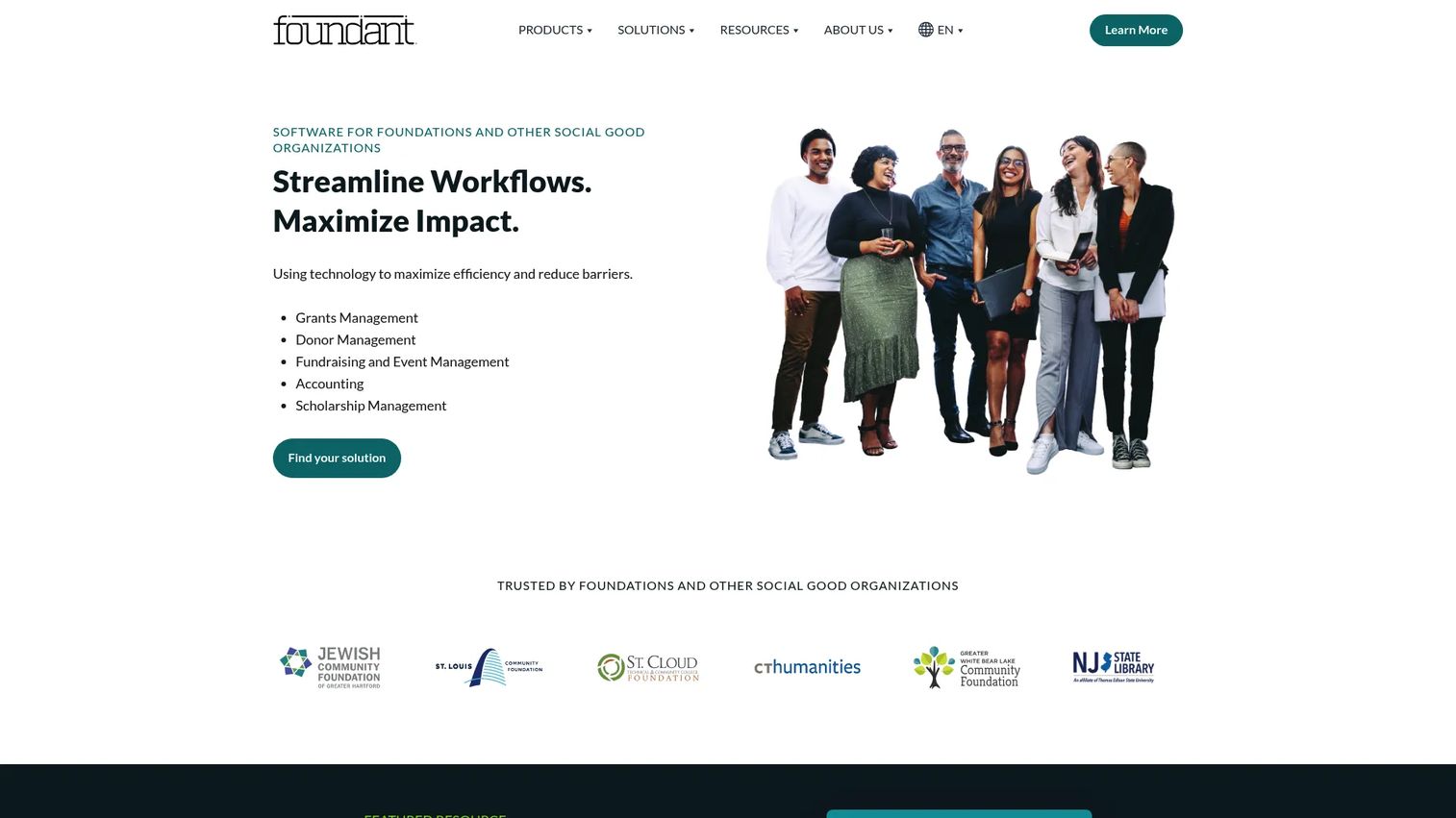
Foundant is philanthropy software built for grantmaking, scholarship management, and community foundation operations. Where most nonprofit CRM software centers on donor cultivation, Foundant approaches constituent relationship management from the foundation side, tracking grantees, applicants, and fund relationships alongside donors. Its CommunitySuite combines fund accounting, CRM, fundraising, and donor portals, which aligns constituent data with the financial reality foundations have to report against.
Best for: Foundations and philanthropic organizations needing grants, scholarships, or community foundation software.
Key strengths
- Grant Lifecycle Manager: End-to-end grantmaking from application through award and reporting.
- Scholarship Lifecycle Manager: Purpose-built workflows for scholarship applications and disbursement.
- CommunitySuite: Fund accounting, CRM, fundraising, and donor portals in one system for a 360-degree constituent view.
Why choose Foundant: Foundant fits foundations and grantmakers whose constituents include applicants and grantees, not only donors. If your reporting has to reconcile with fund accounting, the accounting alignment inside CommunitySuite removes a common source of friction. It is a focused choice for philanthropic organizations rather than a general-purpose fundraising CRM.
Foundant pricing: Foundant does not publish CommunitySuite pricing. The pricing page directs prospects to a form to discuss cost. On G2, Foundant Technologies carries a 4.5/5 rating across its products.
4. Doubleknot
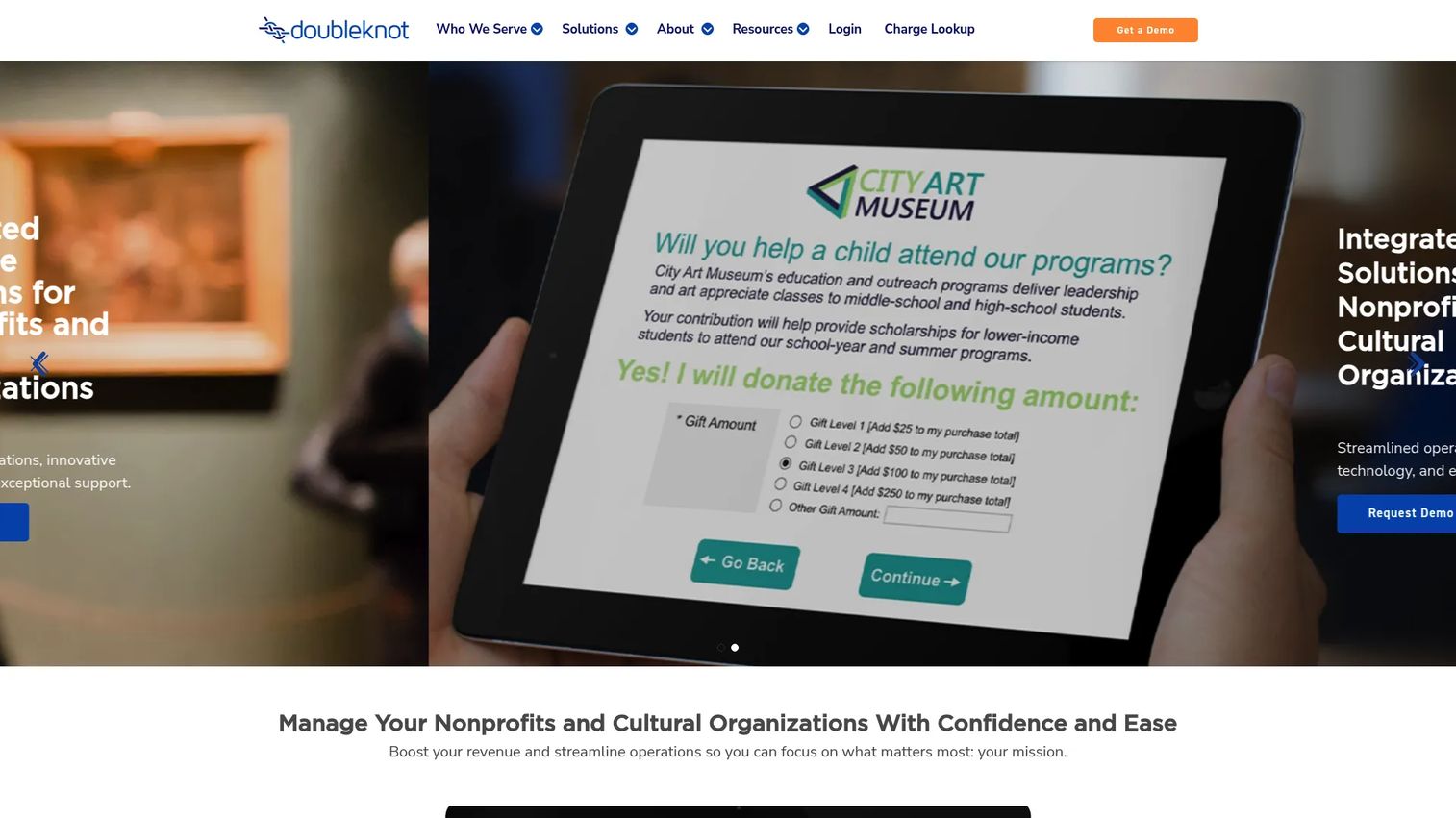
Doubleknot is integrated software for nonprofits and cultural attractions, unifying admissions, memberships, events, fundraising, point of sale, and CRM in one system. Museums, zoos, aquariums, and other admission-based organizations have a constituent problem most donor tools ignore: the same person might be a ticket buyer, a member, an event attendee, and a donor. Doubleknot links those touchpoints into complete constituent profiles, so a single record reflects every way a visitor engages.
Best for: Cultural nonprofits needing one system for admissions, memberships, events, and fundraising.
Key strengths
- Timed ticketing and admissions: Manage entry, capacity, and admissions revenue inside the same platform.
- Membership and fundraising management: Track memberships and gifts so constituent value is visible across both.
- Event registration and POS: Registration and point-of-sale data flow into the same constituent record.
Why choose Doubleknot: Doubleknot fits museums, attractions, and membership organizations that need admissions and CRM in one database. If your constituents interact through tickets, memberships, and events rather than gifts alone, unifying that data enables targeted offers and a fuller donor relationship management picture. It is a niche choice, and that focus is its strength for cultural organizations.
Doubleknot pricing: Doubleknot does not publish pricing on its site and routes visitors to request a demo. On G2, Doubleknot holds a 4.5/5 rating.
5. Bloomerang
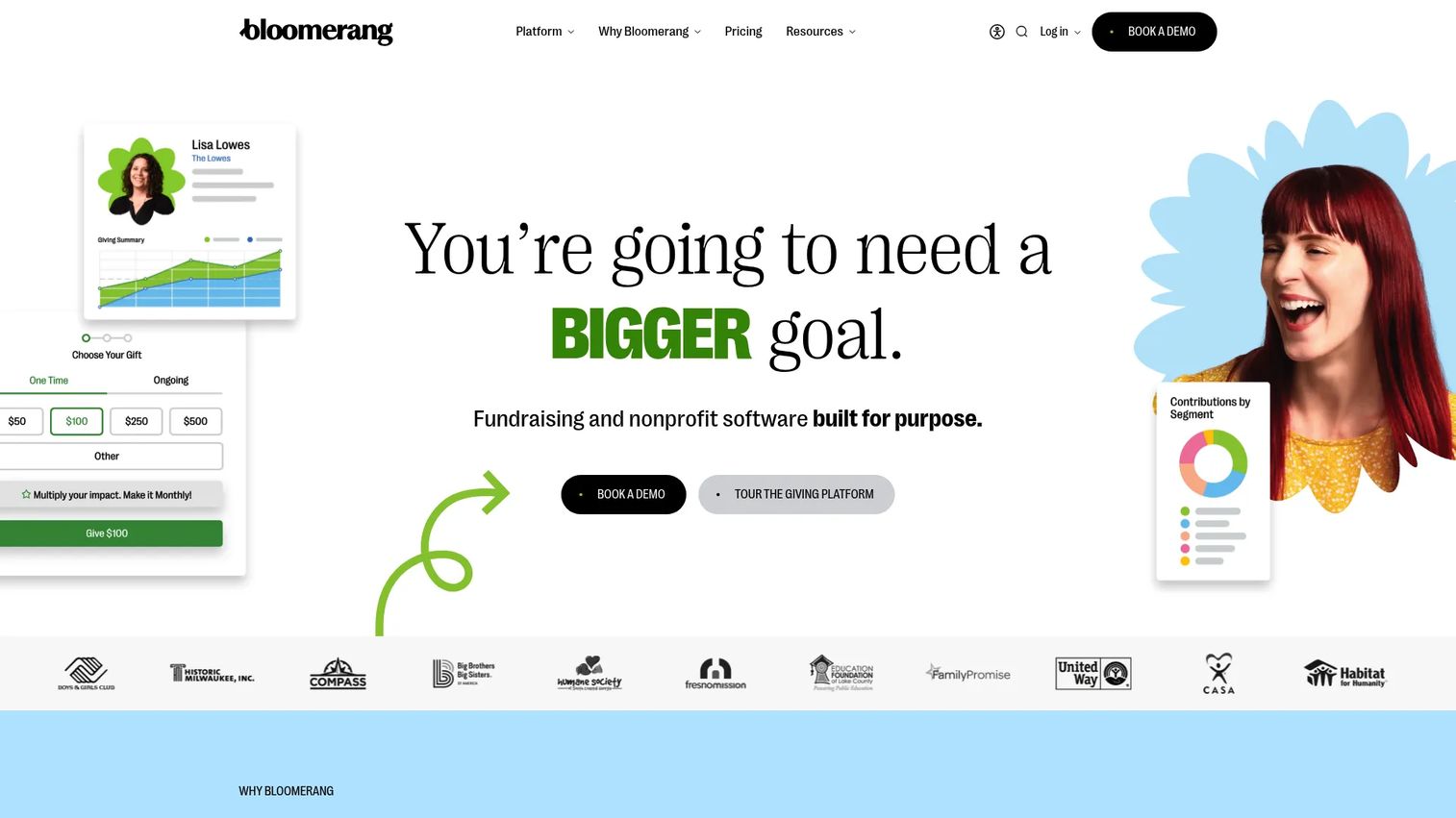
Bloomerang is a nonprofit giving platform built around donor management, fundraising, volunteer engagement, and reporting. It is designed for small and mid-sized organizations that want a straightforward fundraising CRM without enterprise complexity. Bloomerang leans hard into donor retention, surfacing the engagement signals that predict whether a donor will give again, which is where many nonprofits lose the most revenue.
Best for: Nonprofits needing an all-in-one donor, fundraising, and volunteer platform with strong usability.
Key strengths
- Donor management CRM: Centralized donor records with retention-focused engagement scoring.
- Fundraising tools: Donation forms, events, auctions, peer-to-peer, and text fundraising in one platform.
- Volunteer management: Scheduling, messaging, and reporting for volunteer coordination alongside donor data.
Why choose Bloomerang: Bloomerang fits development teams that want practical donor segmentation and retention tracking without a heavy implementation. If your priority is keeping donors engaged and reducing lapse, the retention focus is a genuine differentiator. Its public pricing also makes budgeting easier than quote-only alternatives.
Bloomerang pricing: Bloomerang Fundraising starts at $40/month billed annually. Bloomerang CRM starts at $125/month billed annually. Bloomerang Volunteer starts at $119/month billed annually. Some bundles use personalized pricing. On G2, the Bloomerang Giving Platform holds a 4.6/5 rating.
6. Blackbaud
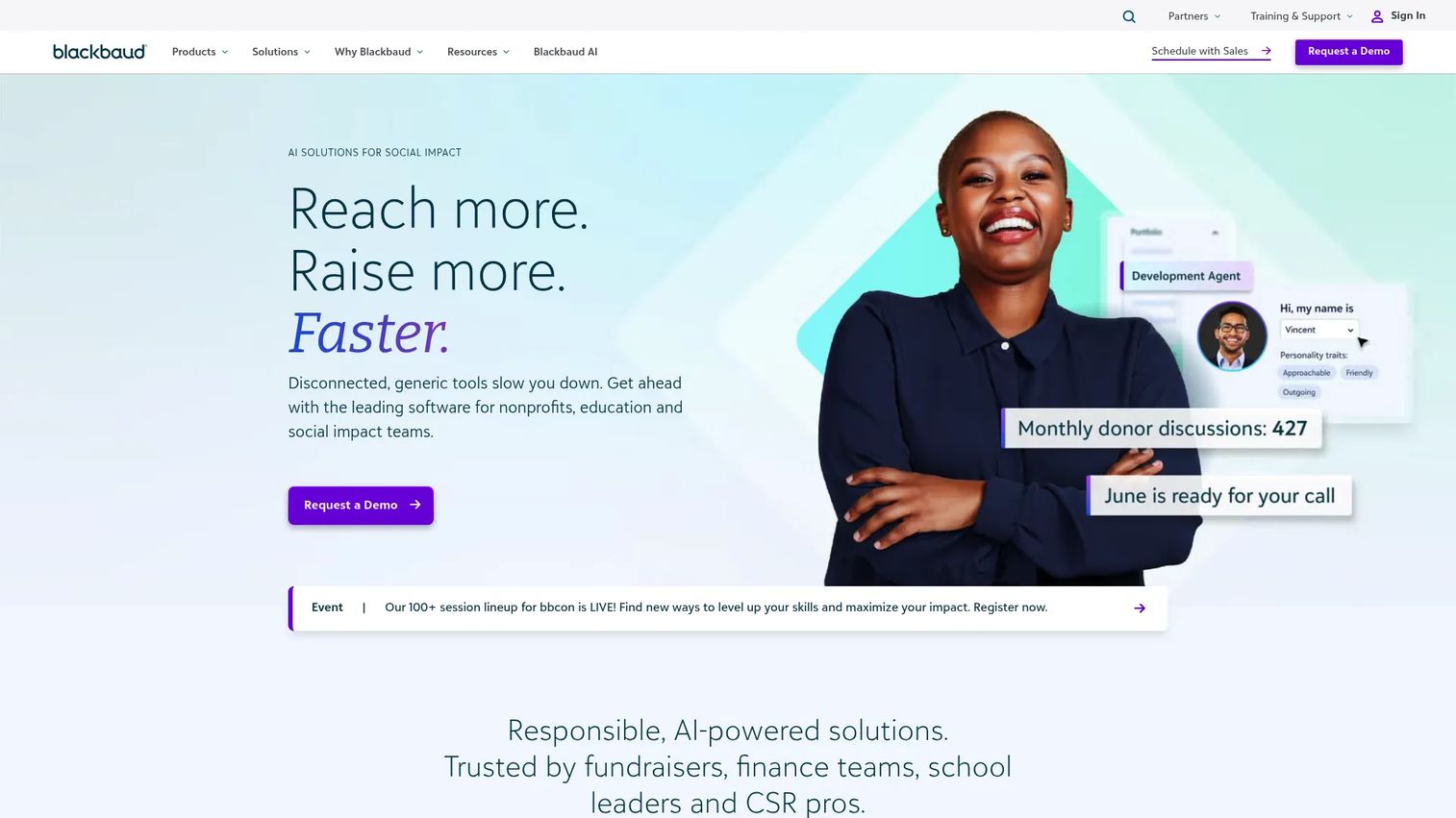
Blackbaud is an enterprise-grade software provider for nonprofit, education, fundraising, financial management, grantmaking, digital giving, and corporate social responsibility. Large nonprofits with complex fundraising and reporting needs evaluate Blackbaud for the depth of its ecosystem, which links constituent records to fund accounting, grantmaking, and payments. When your constituent base runs into the hundreds of thousands and your governance requirements are strict, that integration depth is the draw.
Best for: Large nonprofits and education institutions needing an integrated social impact software suite.
Key strengths
- Fundraising CRM and donor management: Deep constituent records and donor segmentation built for scale.
- Nonprofit financial management: Fund accounting integrated with fundraising for aligned reporting.
- Digital giving, grantmaking, and payments: Integrated giving and grant tools across the ecosystem.
Why choose Blackbaud: Blackbaud fits large organizations that need governance, integrations, and analytics across many constituent types. If your reporting spans fundraising and finance, the connected suite reduces the reconciliation work that plagues fragmented stacks. Implementation is a real project, so it rewards teams with the capacity to onboard a comprehensive system.
Blackbaud pricing: Blackbaud uses customized, quote-based pricing and asks prospects to request a call rather than displaying a public starting price. On G2, Blackbaud carries a 3.8/5 rating.
7. Keela
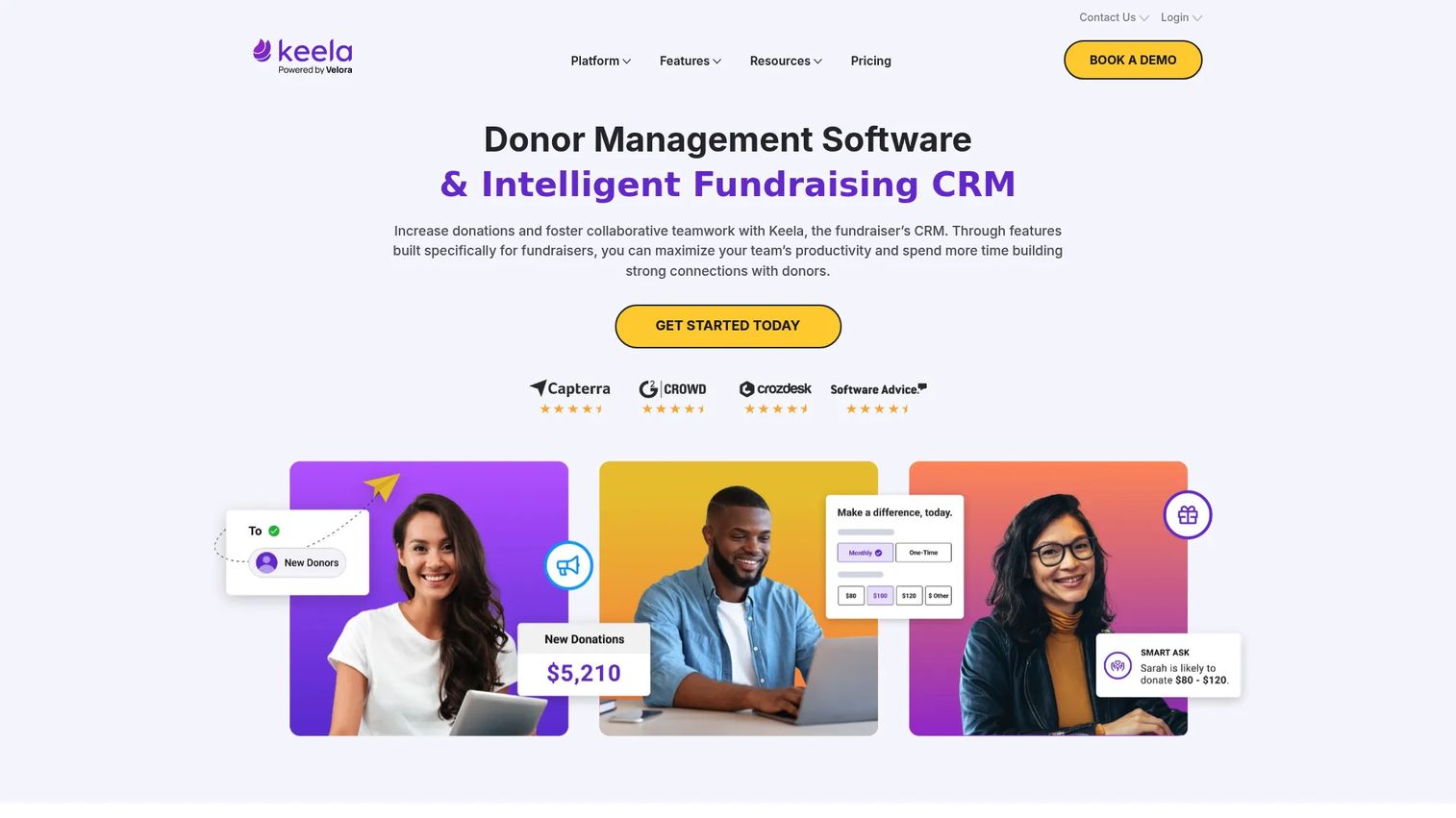
Keela is a donor management and fundraising CRM built for smaller nonprofit teams that want donor management, engagement, and automation in one place. Lean teams rarely have the bandwidth to run separate tools for email, donations, and reporting, so Keela consolidates them. Its contact-based pricing scales with your database rather than charging per feature, which appeals to organizations watching every dollar.
Best for: Nonprofits wanting an all-in-one donor CRM with fundraising and email tools.
Key strengths
- Donor profiles and contact management: Complete constituent records for a clear donor relationship management view.
- Automated outreach and workflows: Automation for appeals, acknowledgments, and follow-up without manual effort.
- Donation forms, email, and reporting: Fundraising, email marketing, and reporting dashboards in one system.
Why choose Keela: Keela fits lean teams that need practical all-in-one functionality with predictable pricing. If a small staff is juggling donor data, email, and reporting across separate tools, consolidating into one CRM cuts the busywork. Contact-based pricing keeps costs aligned to database size as you grow.
Keela pricing: Keela uses contact-based pricing starting at $134/month for up to 1,000 contacts, rising to $209/month for 1,001 to 2,500 contacts, $274/month for 2,501 to 5,000, $329/month for 5,001 to 7,500, and $379/month for 7,501 to 10,000 or more. All plans include unlimited forms, emails, donations, and support. Custom quotes cover databases over 10,000 contacts. On G2, Keela holds a 4.6/5 rating.
Considerations before you buy
Centralized data and a 360-degree constituent view
The whole point of constituent relationship management software is one record per constituent. Check that the tool merges duplicates cleanly and links gifts, events, volunteer hours, and board roles to a single profile. If data still lands in separate modules that do not talk to each other, you have rebuilt your data silos inside one login.
Donor segmentation and personalization
Evaluate how easily you can build segments and act on them. Look for filtering by giving level, recency, campaign, and interest, plus the ability to push those segments into personalized outreach. Segmentation that lives only in reports, with no path to action, is half a feature.
Reporting dashboards your board trusts
Ask to see the actual retention, revenue, and pipeline reports, not a marketing screenshot. The reporting dashboards should produce board-ready output without exporting to a spreadsheet first. For foundations, confirm the reporting reconciles with fund accounting.
Integrations that prevent new silos
Confirm the CRM connects to your payment processor, email platform, and accounting system. Integrations are what keep a nonprofit database from becoming yet another island. Verify the specific tools you use are supported natively, not only through paid add-ons or manual import.
Pricing and implementation reality
Public starting prices, like those from Bloomerang and Keela, make budgeting straightforward. Quote-based vendors, including Foundant, Doubleknot, and Blackbaud, require a sales conversation, so factor implementation time and onboarding cost into the total, not just the license.
Conclusion
The best constituent relationship management software depends on your organization type, not a single ranking. Small and mid-sized fundraising teams that want public pricing and strong retention tooling should shortlist Bloomerang and Keela. Foundations and grantmakers whose constituents include applicants and grantees fit Foundant. Cultural attractions juggling admissions, memberships, and gifts belong with Doubleknot. Large nonprofits with complex fundraising and financial reporting evaluate Blackbaud, while teams wanting an integrated suite across programs look at Bonterra. And if you are early in evaluation, TechSoup helps you access discounted licenses across many vendors before you commit.
Start with the two or three tools that match your fundraising complexity, constituent types, and integration needs, then book demos with a clear checklist: centralized data, segmentation, reporting, and integrations. Match the tool to how your constituents actually engage, and the shortlist gets short fast.
FAQs
Constituent relationship management software is a nonprofit database that centralizes donors, volunteers, members, board members, and other stakeholders into one system of record. It tracks interactions, gifts, and engagement history so staff can build relationships instead of reconstructing them from scattered spreadsheets. Think of it as a CRM adapted for mission-driven organizations.
Donor management software focuses specifically on giving: tracking donations, pledges, and campaign performance. A constituent relationship management system is broader, covering every stakeholder type, including volunteers, members, grantees, and board members. Most nonprofit CRM software includes donor management as a core module while extending to the full constituent base.
Prioritize centralized constituent records with a true 360-degree constituent view, donor segmentation you can act on, reporting dashboards your board trusts, and integrations with your payment processor, email, and accounting tools. Engagement features and board member tracking add value depending on your model. Skip features you will not use, because complexity slows adoption.
Any organization where one person engages in multiple ways benefits from a 360-degree constituent view. Cultural attractions see it clearly, where a visitor is a ticket buyer, member, event attendee, and donor at once. Foundations tracking applicants and grantees, and larger nonprofits with layered relationships, also depend on unified profiles.
Donor segmentation groups constituents by giving level, recency, interest, campaign, or engagement so outreach can be targeted rather than blanket. A nonprofit might separate first-time donors, lapsed donors, and monthly sustainers, then send each group a tailored appeal. Effective segmentation flows directly into personalized email and campaigns, not just static reports.
Foundations need grantmaking and scholarship workflows, applicant and grantee tracking, and reporting that reconciles with fund accounting. Tools like Foundant are built around this, combining grants, scholarships, and fund accounting with CRM. General fundraising platforms often miss the grant lifecycle and accounting alignment that foundations require.
Integrations connect your CRM to payment processors, email platforms, and accounting systems so data flows automatically instead of being re-entered by hand. Without them, each tool becomes its own data silo, and constituent records drift out of sync. Confirm native support for the specific tools you use before committing, rather than relying on manual imports.
Compare total cost, not just the license. Public starting prices, like Bloomerang from $40/month or Keela from $134/month, make budgeting predictable, while quote-based vendors such as Foundant, Doubleknot, and Blackbaud require a sales conversation. Factor in implementation time, data migration, training, and any paid integrations, since those often exceed the first-year subscription for larger systems.