Clinicians finish their last patient of the day, then spend the next two hours closing notes. Some call it pajama time. Most call it burnout. According to a 2026 study published in npj Digital Medicine, adoption of ambient AI scribes across 2,901 ambulatory clinicians at one academic health system ranged from 16% to 69% by specialty, suggesting that the demand is real but adoption is far from uniform.
The hard part is not finding a tool that writes a note. Finding one that clinicians will trust, EHR teams can integrate without a six-month project, and compliance teams can approve before the next board meeting is the actual challenge.
Ambient AI scribe platforms promise to cut documentation time by listening to patient-clinician conversations and generating structured draft notes. But the category varies widely across specialty depth, EHR connectivity, clinician review controls, and pricing transparency. This guide gives you the shortlist and the criteria to build it.
What's inside
This guide compares nine ambient AI scribe platforms for 2026, evaluated against the factors that matter most to healthcare operators and clinical technology leaders.
- Who it's for: Healthcare executives, CMIOs, practice leaders, clinical operations teams, and SaaS operators studying the category
- Selection criteria: Clinical workflow fit, EHR integration depth, specialty coverage, clinician review controls, and security posture
- What you'll see: A side-by-side comparison table, per-platform analysis, and a buyer's checklist
- A note on data: Pricing and G2 ratings reflect figures verified at generation time. Confirm current figures before publication or vendor meetings
TL;DR
- Best for large health systems: Abridge and Dragon Copilot are the enterprise shortlist for organizations running broad clinical documentation programs
- Best EHR-native option: Epic suits organizations already standardized on its clinical environment and wanting documentation without adding a new vendor
- Best for specialty care: DeepScribe targets specialty-heavy practices, particularly oncology, with pre-visit context and coding support
- Best for smaller teams or faster onboarding: Heidi offers a free tier and paid plans from $110/user/month, while Tali Ambient Scribe starts at $60/month for independent and smaller-practice workflows
- Best for clinical conversation intelligence beyond the visit: Corti fits teams that need AI support across documentation, coding, and care quality workflows
What is ambient AI scribe software?
Ambient AI scribe software listens to a clinician-patient encounter, identifies medically relevant information, and generates a draft clinical note for clinician review inside or alongside the EHR.
Unlike dictation tools, which capture what the clinician says verbally, ambient scribing captures the full clinical conversation and translates it into structured documentation. The workflow difference is meaningful: Less manual narration from the clinician, more review and correction of an AI-generated draft. Adoption depends on how much review time remains after the AI output, not just whether a note was generated.
Key capabilities to look for
- Conversation capture without requiring voice commands
- Real-time transcription and speech recognition
- Natural-language processing to identify clinical relevance
- Draft SOAP note or specialty note generation
- EHR integration with note delivery and sign-off support
- Clinician review and editing controls
- Specialty-specific vocabulary and templates
- Multiple-speaker recognition
- Privacy controls, audit logs, and BAA availability
- Analytics on adoption and documentation time
How ambient AI scribes differ from dictation tools
Dictation software captures what a clinician explicitly narrates. The clinician drives the content verbally, word by word.
Ambient scribing captures the natural patient-clinician conversation. The AI does the heavy lifting of identifying what is clinically relevant and structuring it into a draft note.
That shift changes the workflow. Clinicians spend less time narrating and more time reviewing. For high-volume settings, that trade-off is the point.
Why clinician review and sign-off still matter
Ambient AI scribes generate draft documentation, not final notes. Every platform in this list requires clinician review, editing, and sign-off before a note goes into the medical record.
Buyers should evaluate how much editing work remains after the AI produces its draft. A tool that generates a note quickly but requires heavy correction on every visit has a different cost model than one with higher accuracy out of the box.
When to use ambient AI scribe platforms
Reduce after-hours documentation
Clinicians who close notes after hours spend real time on work that ambient scribes can shift closer to the visit itself. The goal is not to eliminate review but to reduce the gap between the encounter and a completed note. Faster closure means less cognitive load carried home.
Standardize clinical notes across teams
Structured templates and specialty-aware vocabulary help clinical leaders reduce variation without removing judgment. When a documentation platform applies consistent formatting across a department, downstream coding, compliance, and reporting all become easier to manage.
Support higher-volume care models
Primary care, urgent care, and telehealth settings often face the highest documentation load per clinician per day. Ambient scribes are particularly useful here because the volume-to-accuracy ratio matters. A 2026 Canadian Medical Association survey, as reported in the Canadian Journal of Emergency Medicine, found that 28% of Canadian physicians were already using an AI scribe, with 45% ranking AI scribing tools among their top priorities to explore.
Ambient AI scribe platform comparison
The table below shows each platform's primary fit, key differentiator, pricing, and G2 rating. Pricing and ratings reflect figures verified at generation time. Confirm current figures directly with each vendor before a purchasing decision.
| # | Product | Best for | Key differentiator | Pricing | G2 rating |
|---|---|---|---|---|---|
| 1 | Abridge | Enterprise health systems | Broad ambient documentation with EHR-integrated actionable outputs | Custom pricing | 4.3/5 |
| 2 | Dragon Copilot | Microsoft and Nuance ecosystem buyers | Ambient documentation built on Dragon clinical speech heritage, with PAYG ambient billing | From $0.25/AI-assisted session | N/A |
| 3 | Epic | Epic-native health systems | Documentation embedded directly in the EHR environment | Custom pricing | 4.2/5 |
| 4 | Ambience Healthcare | Multi-specialty provider groups | Pre-visit to post-visit workflow automation including coding | Custom pricing | N/A |
| 5 | DeepScribe | Specialty care and oncology | Pre-visit summaries, SmartPrep context, and AI coding support | Custom pricing | 4.1/5 |
| 6 | Tali Ambient Scribe | Smaller practices and telehealth | SOAP note generation with a free personal plan | From $60/month | N/A |
| 7 | Heidi | Individual clinicians and smaller teams | Free unlimited AI documentation with a strong paid tier | Free; from $110/user/month | 4.9/5 |
| 8 | Augmedix | Organizations wanting documentation model flexibility | AI-only, hybrid, and full-service documentation tiers | Custom pricing | 4.4/5 |
| 9 | Corti | Clinical conversation intelligence and coding | Usage-based API pricing for builders and enterprises | From $0.0065/min | N/A |
Best 9 ambient AI scribe platforms for 2026
1. Abridge
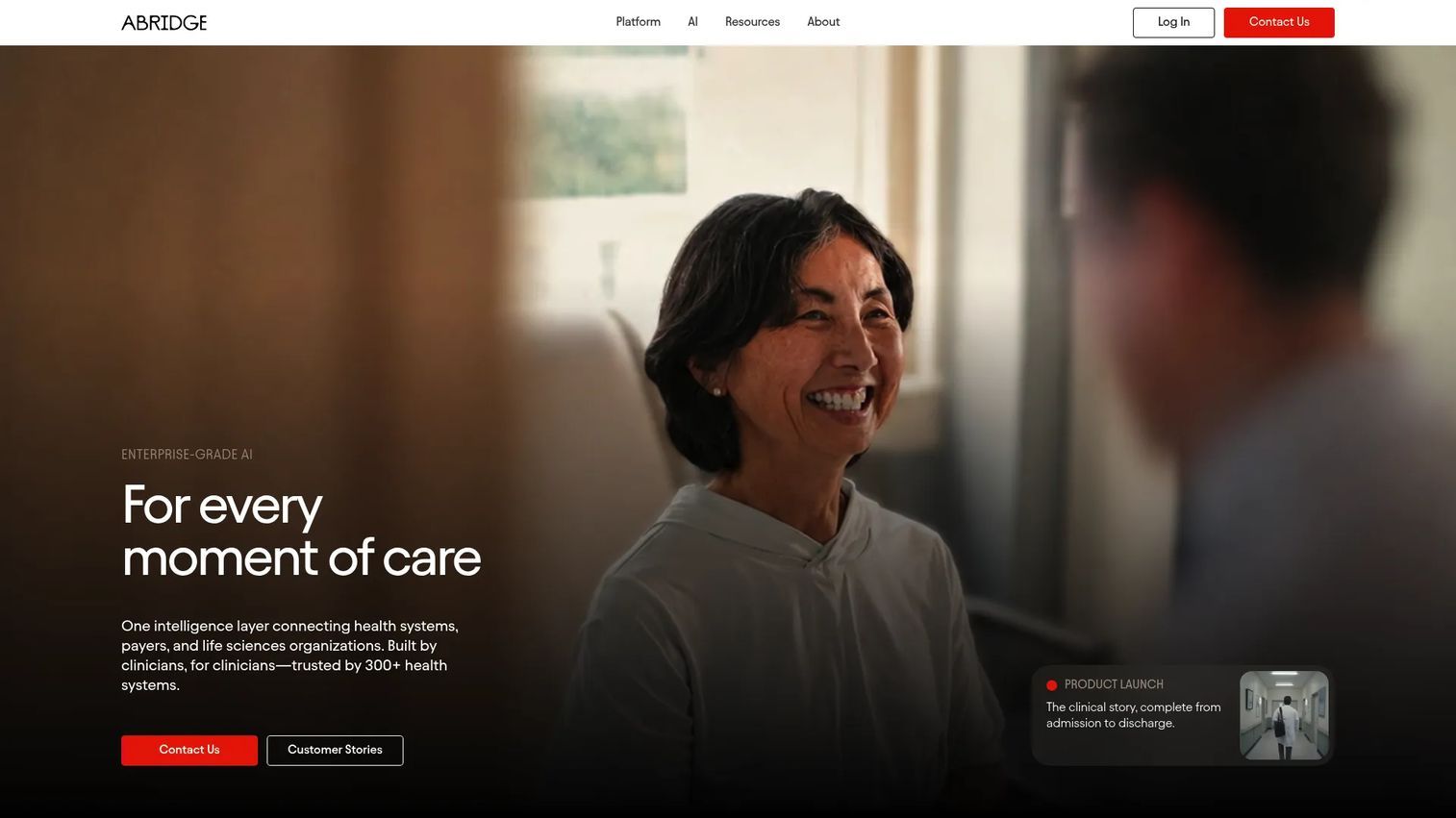
Abridge is an enterprise clinical AI platform that converts patient-clinician conversations into structured, billable documentation within EHR workflows. The platform supports outpatient, emergency, and inpatient care settings with multispecialty and multilingual conversation understanding. It generates AI-grounded clinical notes and includes an Abridge Assistant feature for chart summaries, cited clinical questions, and draft handoffs.
Best for: Large healthcare systems seeking enterprise ambient clinical documentation across multiple specialties and care settings.
Key features
- Ambient visit capture with AI-generated clinical notes
- EHR-integrated actionable outputs including orders
- Multispecialty and multilingual conversation support
- Chart summaries and cited clinical questions via Abridge Assistant
- Support for outpatient, emergency, and inpatient workflows
Why choose Abridge: Abridge is built for health system scale, with enterprise deployment support and evidence-grounded note generation. It suits organizations that want deep workflow integration across a large clinician population, not just a point solution for individual practices.
Abridge pricing: Abridge sells through enterprise contracts. Contact their sales team for pricing based on clinician count, specialties, EHR environment, and rollout scope.
G2 rating: 4.3/5
2. Dragon Copilot
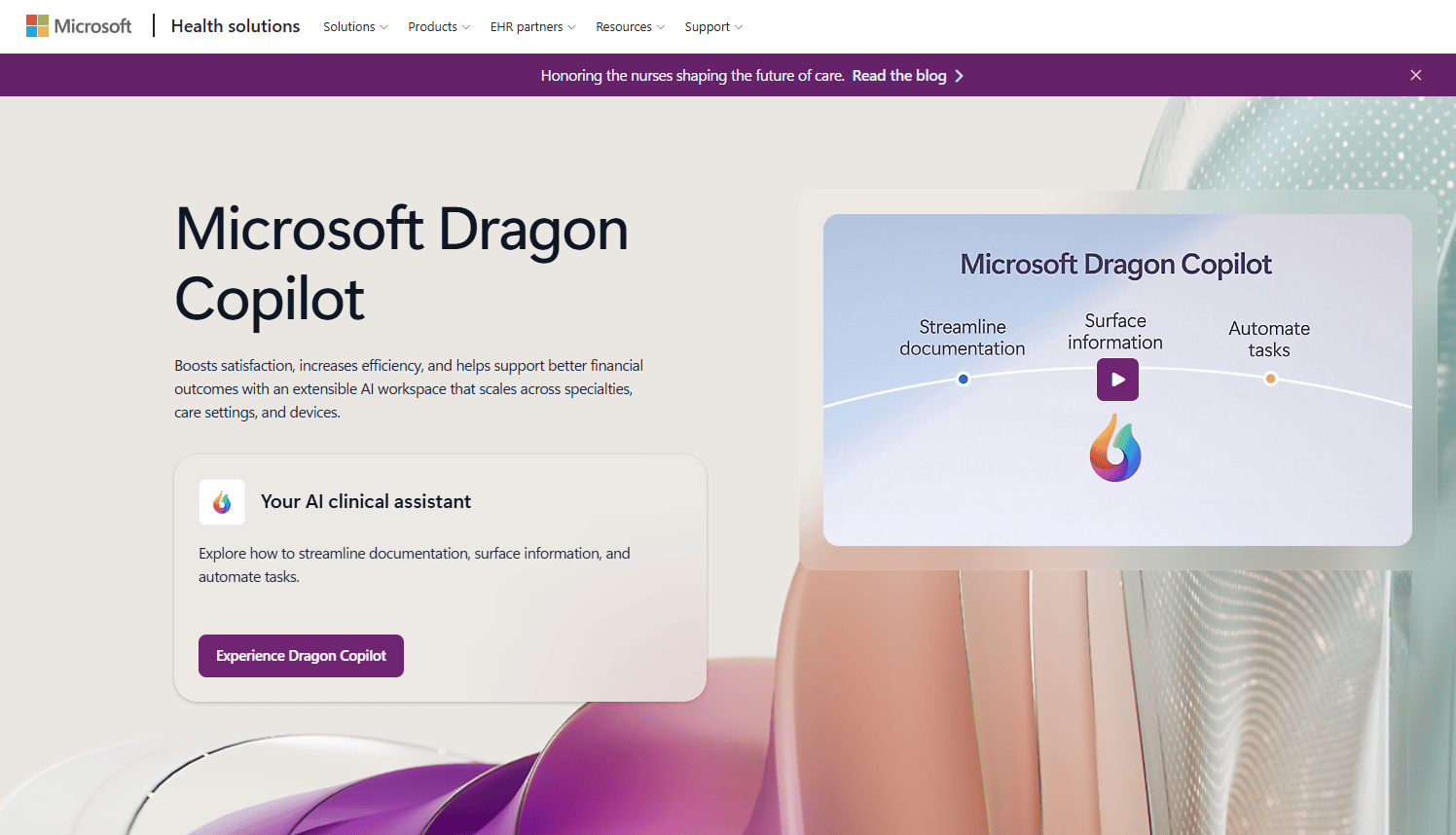
Dragon Copilot is Microsoft's clinical AI assistant for ambient documentation, built on the Dragon Medical speech recognition heritage and integrated into the Microsoft healthcare cloud. The platform captures conversations and generates clinical notes, discrete clinical data, orders, and after-visit summaries. It supports physicians, nurses, and radiologists through per-user and pay-as-you-go licensing options.
Best for: Health systems already invested in Microsoft, Nuance, or Dragon clinical speech workflows that want continuity across their AI tooling.
Key features
- Ambient conversation capture and clinical note generation
- Speech-to-text, natural-language dictation, and voice commands
- Generation of discrete clinical data including orders and conditions
- AI summaries, referral letters, and after-visit summaries
- Flowsheet capture and nursing-note generation
Why choose Dragon Copilot: Organizations with existing Dragon or Microsoft infrastructure can extend into ambient documentation without introducing a separate vendor. The Physician Flex tier adds pay-as-you-go billing for ambient sessions, which suits teams that want flexibility before committing to full per-user licensing.
Dragon Copilot pricing: Per-user licenses are sold through Microsoft agreements or certified partners. The Physician Flex plan adds usage-based ambient billing at $0.25 per AI-assisted session, based on consumption units priced at $0.01 each.
3. Epic
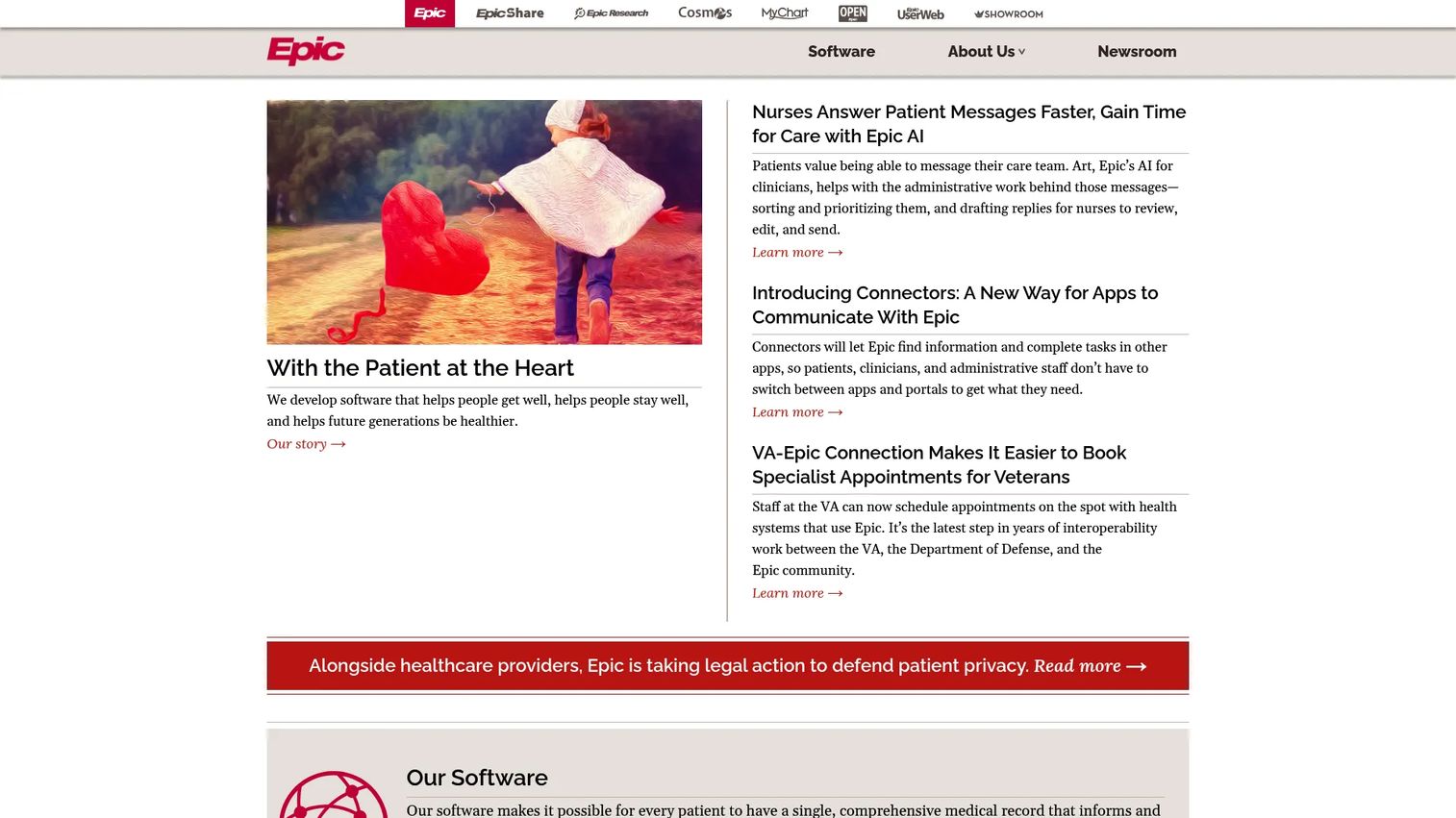
Epic is an integrated healthcare software platform covering clinical workflows, patient experience, analytics, interoperability, and AI for revenue cycle and operations. For organizations already standardized on Epic, the platform offers ambient documentation capabilities embedded directly in the EHR environment. Evaluation happens through the organization's existing Epic contract and roadmap rather than a separate vendor relationship.
Best for: Epic customers that want ambient documentation tied directly into the clinical workflows their teams already use every day.
Key features
- EHR-native workflow with AI for clinicians and operations
- Patient experience tools including MyChart and telehealth
- Healthcare intelligence and analytics
- Cross-organization health-record exchange and interoperability
- Real-world evidence and data integration
Why choose Epic: For organizations deeply embedded in Epic, adding ambient documentation through the same environment avoids a separate integration project, a new security review, and vendor sprawl. The tradeoff is that evaluation and pricing happen through your existing Epic relationship, so the buying motion differs from standalone scribe vendors.
Epic pricing: Epic pricing is handled through customer contracts. Budget depends on modules, licensing, services, and implementation scope. Contact your Epic account team for current ambient documentation options and pricing.
G2 rating: 4.2/5
4. Ambience Healthcare
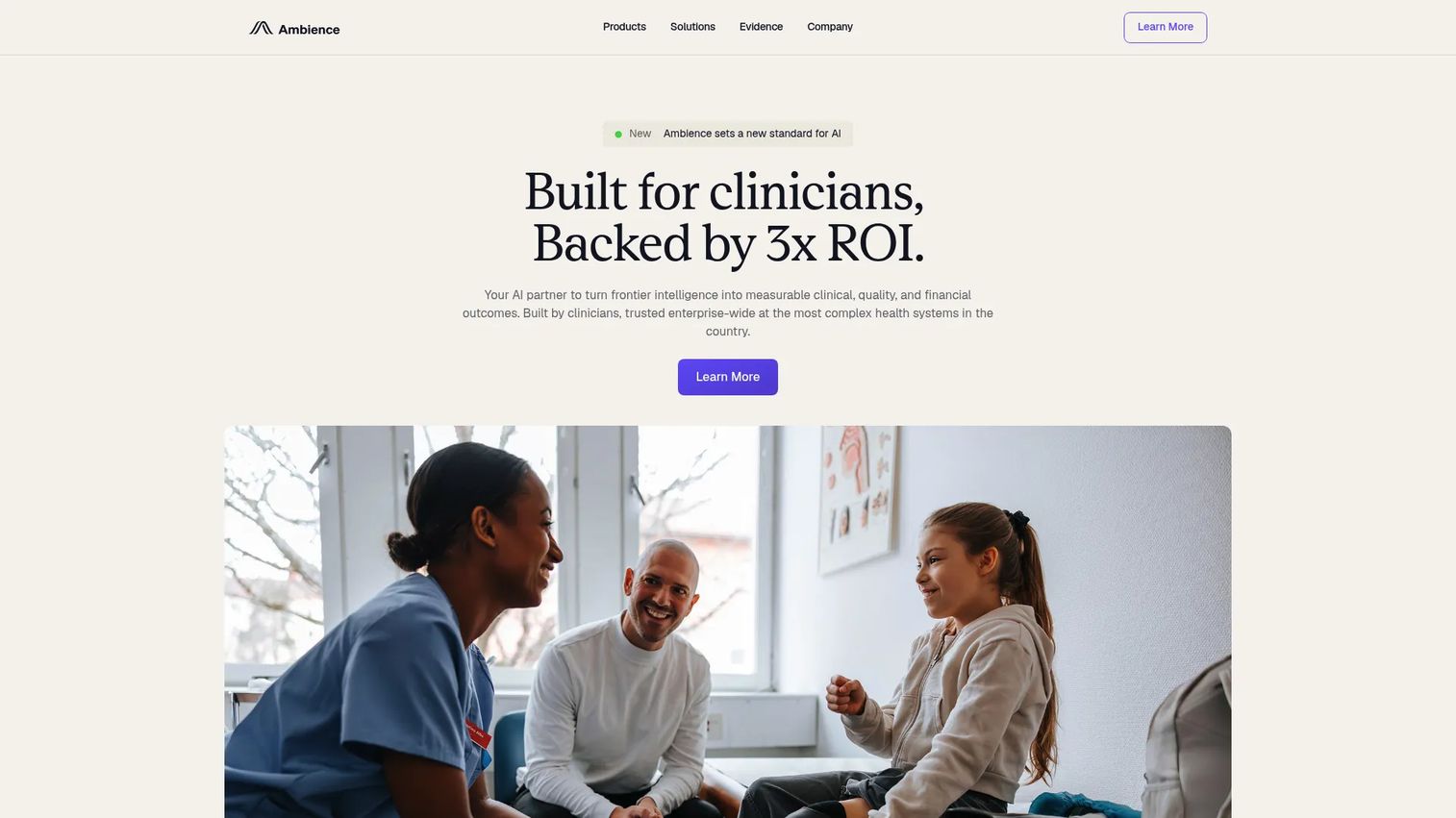
Ambience Healthcare is an AI platform built for the full clinical workflow, covering pre-visit preparation, real-time ambient documentation, clinical guidance, coding, compliance, and post-visit tasks. The platform includes features such as multiple-speaker attribution, translation for documentation, ICD-10 code assist, E/M code advisor, and an HCC compliance validator alongside its core ambient scribe functionality.
Best for: Provider groups and health systems that need ambient documentation plus adjacent clinical admin workflows like coding and compliance in a single platform.
Key features
- Ambient Scribe with multiple-speaker attribution
- Pre-visit patient summaries and Chart Chat
- ICD-10 Code Assist and E/M Code Advisor
- HCC Compliance Validator
- Patient instructions generator and referral letters
Why choose Ambience Healthcare: The breadth of Ambience's workflow coverage sets it apart from platforms focused solely on note generation. Teams that want to consolidate documentation and coding workflows rather than manage separate tools have a reason to evaluate it closely. Verify specialty coverage and EHR support for your specific setting before committing.
Ambience Healthcare pricing: Ambience Healthcare prices through sales-led contracts. Ask for pricing by clinician count, specialty mix, and EHR requirements.
5. DeepScribe
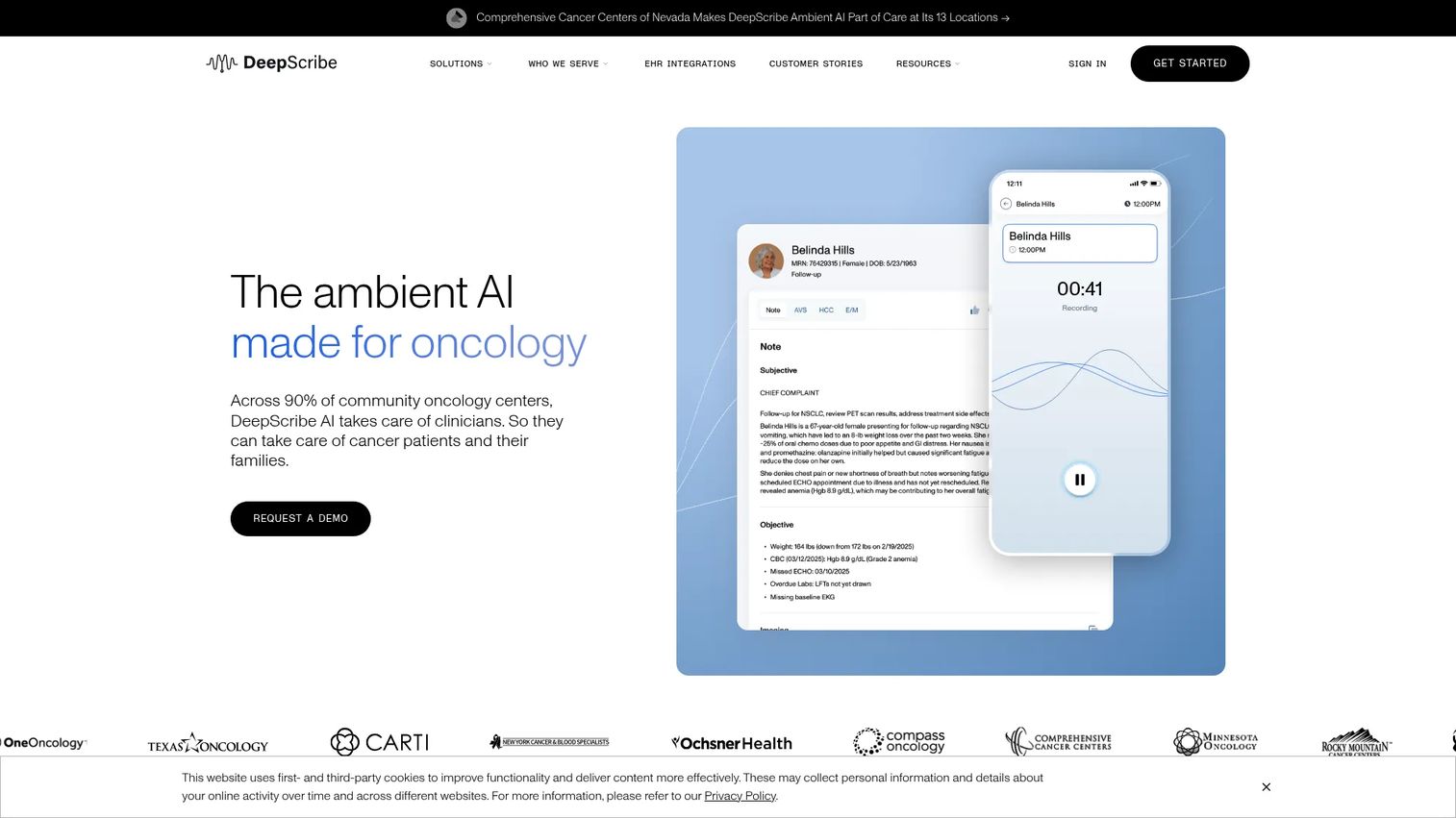
DeepScribe provides ambient AI clinical documentation designed for specialty care, with particular depth in oncology workflows. The platform includes SmartPrep pre-visit patient summaries, AI coding support for diagnoses and reimbursement, a Customization Studio for personalized note formatting, and EHR integrations including OncoEMR and iKnowMed. For practices dealing with complex clinical context and high coding requirements, that combination matters.
Best for: Specialty-care organizations, particularly oncology practices, where pre-visit context, complex documentation, and accurate coding all affect revenue and care quality.
Key features
- Ambient AI medical scribe for specialty documentation
- SmartPrep pre-visit patient summaries
- AI coding for diagnoses and reimbursement
- Customization Studio for personalized note formats
- EHR integrations including OncoEMR and iKnowMed
Why choose DeepScribe: Most ambient scribes optimize for primary care visit patterns. DeepScribe is built for the complexity of specialty care, where note structure, historical context, and coding accuracy require more than a generic template. Evaluate how well its templates match your specialty and how much editing clinicians need to do after the AI produces a draft.
DeepScribe pricing: DeepScribe prices through sales. Ask for pricing by specialty, user count, EHR integration, and coding requirements.
G2 rating: 4.1/5 (from 26 verified reviews)
6. Tali Ambient Scribe
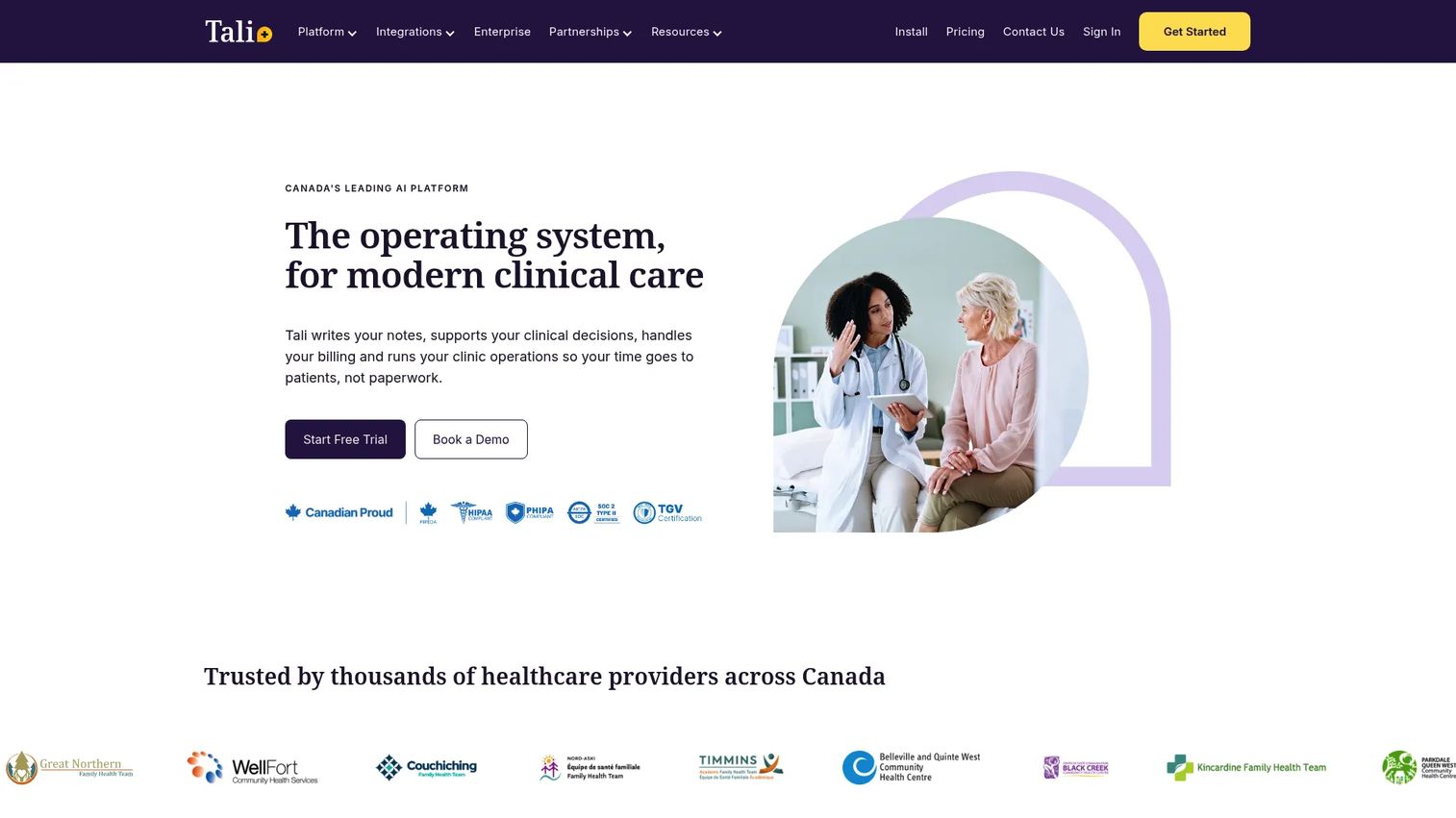
Tali Ambient Scribe captures patient conversations or spoken visit summaries and generates structured clinical SOAP notes without requiring explicit voice commands. The platform supports telehealth recording and integrates with web-based and desktop EHR systems. Tali offers a free personal plan with limited usage and a paid Starter tier, making it one of the more accessible entry points in this category.
Best for: Clinicians and smaller practices that want a practical ambient scribe workflow with a self-serve entry point before committing to a full enterprise contract.
Key features
- SOAP note generation from natural conversation
- Telehealth recording support
- Web-based and desktop EHR integration
- Note review and editing workflow
- Cross-platform availability (Chrome, Windows, Mac)
Why choose Tali Ambient Scribe: Tali is worth evaluating when you want to test ambient scribing without a sales-led procurement process. The free personal plan lets individual clinicians verify fit before the practice commits. Verify regional availability, supported EHR export paths, and plan limits for your setting.
Tali Ambient Scribe pricing: The Personal plan is free with limited usage. The Starter plan is US $60/month. The Pro plan is CA $68/month. Enterprise pricing is custom through sales.
7. Heidi
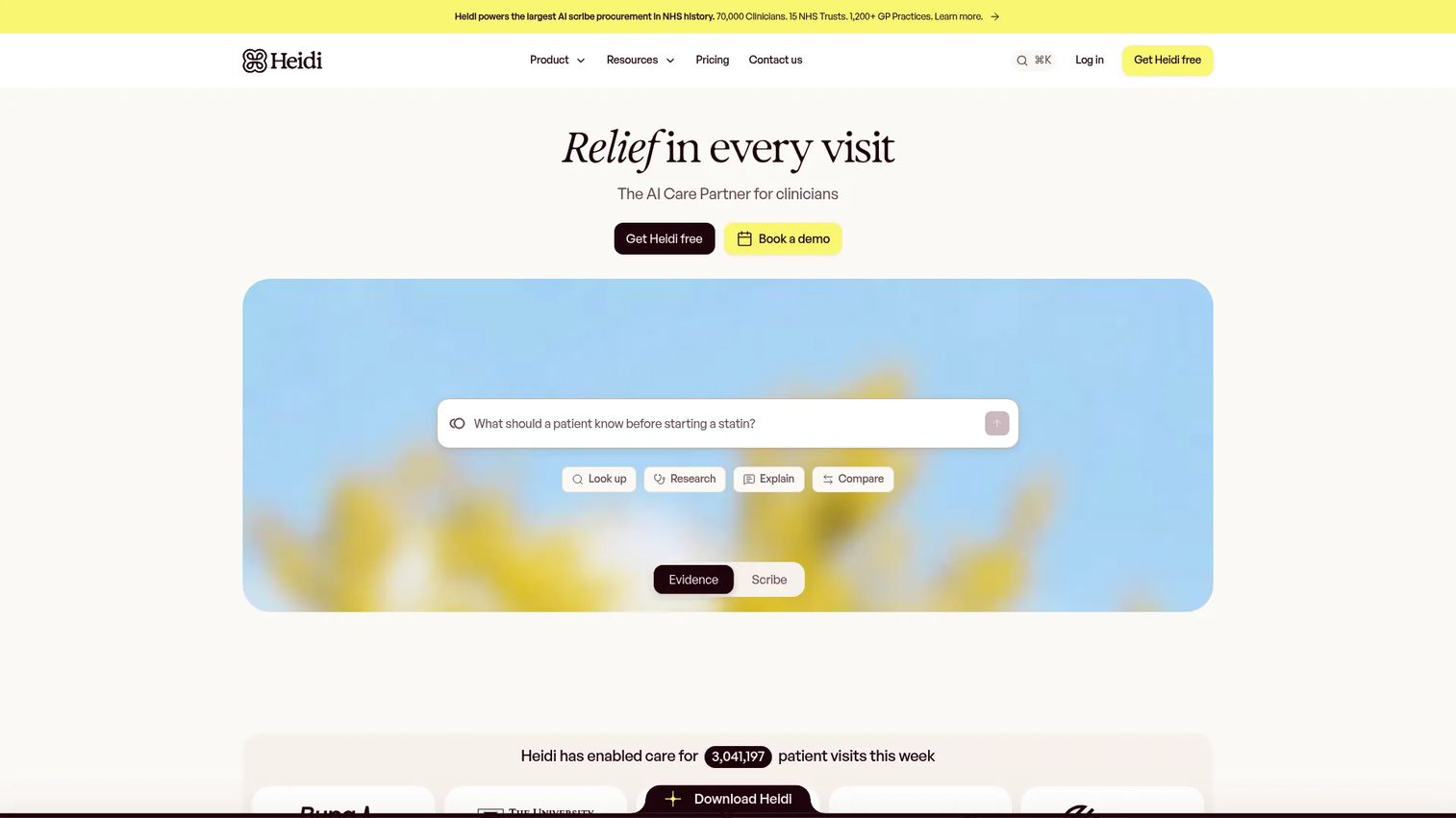
Heidi is an AI medical scribe that transcribes consultations, generates clinical notes, and helps clinicians produce related documents including referrals, letters, and coding suggestions. The platform includes an Ask Heidi assistant for evidence-backed clinical answers with citations, custom templates, and EHR integrations. A permanently free tier covers unlimited AI documentation with clinical evidence, which makes it one of the few platforms where individual clinicians can verify fit before spending anything.
Best for: Individual clinicians and smaller teams that want an accessible AI scribe with strong note quality and a genuinely usable free tier.
Key features
- AI transcription and clinical note generation
- Evidence-backed clinical answers with citations
- Custom templates and document generation
- Ask Heidi assistant with patient and session context
- Forms, tasks, coding suggestions, and EHR integrations
Why choose Heidi: Few ambient scribes offer a free tier with meaningful functionality. Heidi's Free plan includes unlimited AI documentation and clinical evidence access, which removes the trial-with-a-time-limit friction that slows adoption. The Clinician plan at $110/user/month (billed annually) adds advanced templates and in-visit evidence features, while the Practice plan at $180/user/month adds team and sharing controls.
Heidi pricing: Free plan available with unlimited AI documentation. The Clinician plan starts at $110/user/month (billed annually). The Practice plan is $180/user/month (billed annually). Enterprise pricing is custom.
G2 rating: 4.9/5
8. Augmedix
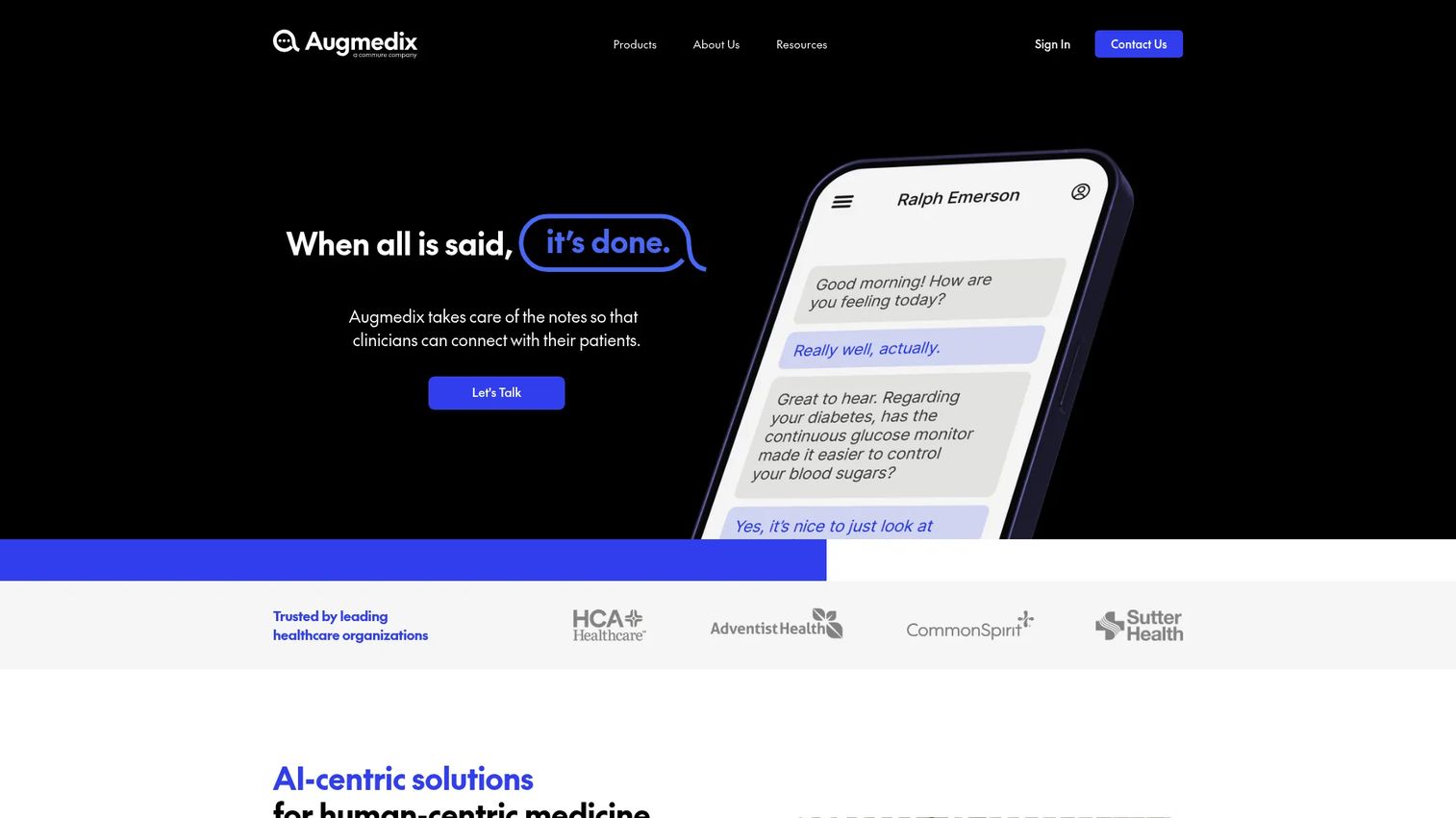
Augmedix provides ambient AI and human-assisted clinical documentation through three service tiers: Augmedix Go for self-service AI documentation, Augmedix Assist for hybrid AI plus human support, and Augmedix Live for full-service documentation-specialist support. The platform supports 32 languages, integrates with Epic, Cerner, Meditech, and athenahealth, and includes features such as CareCues for real-time care-gap reminders, ICD-10 code suggestions, and discharge instructions.
Best for: Organizations that want a spectrum of documentation support options, from fully automated AI to service-backed human assistance, depending on clinician preference and workflow complexity.
Key features
- Three service tiers: Go (AI), Assist (hybrid), Live (human support)
- Bi-directional EHR integrations with Epic, Cerner, Meditech, and athenahealth
- Support for 32 languages
- CareCues real-time care-gap and billing reminders
- CPT, E&M, LOS, and HCC coding support
Why choose Augmedix: Not every clinical team is ready for fully automated documentation. Augmedix gives organizations the option to start with more human oversight and move toward automation as trust builds. The tiered model is particularly useful during phased rollouts where different specialties or clinician cohorts need different levels of AI involvement.
Augmedix pricing: Augmedix prices by contract. Contact sales for pricing by documentation model (Go, Assist, or Live), clinician count, and EHR integration.
G2 rating: 4.4/5
9. Corti
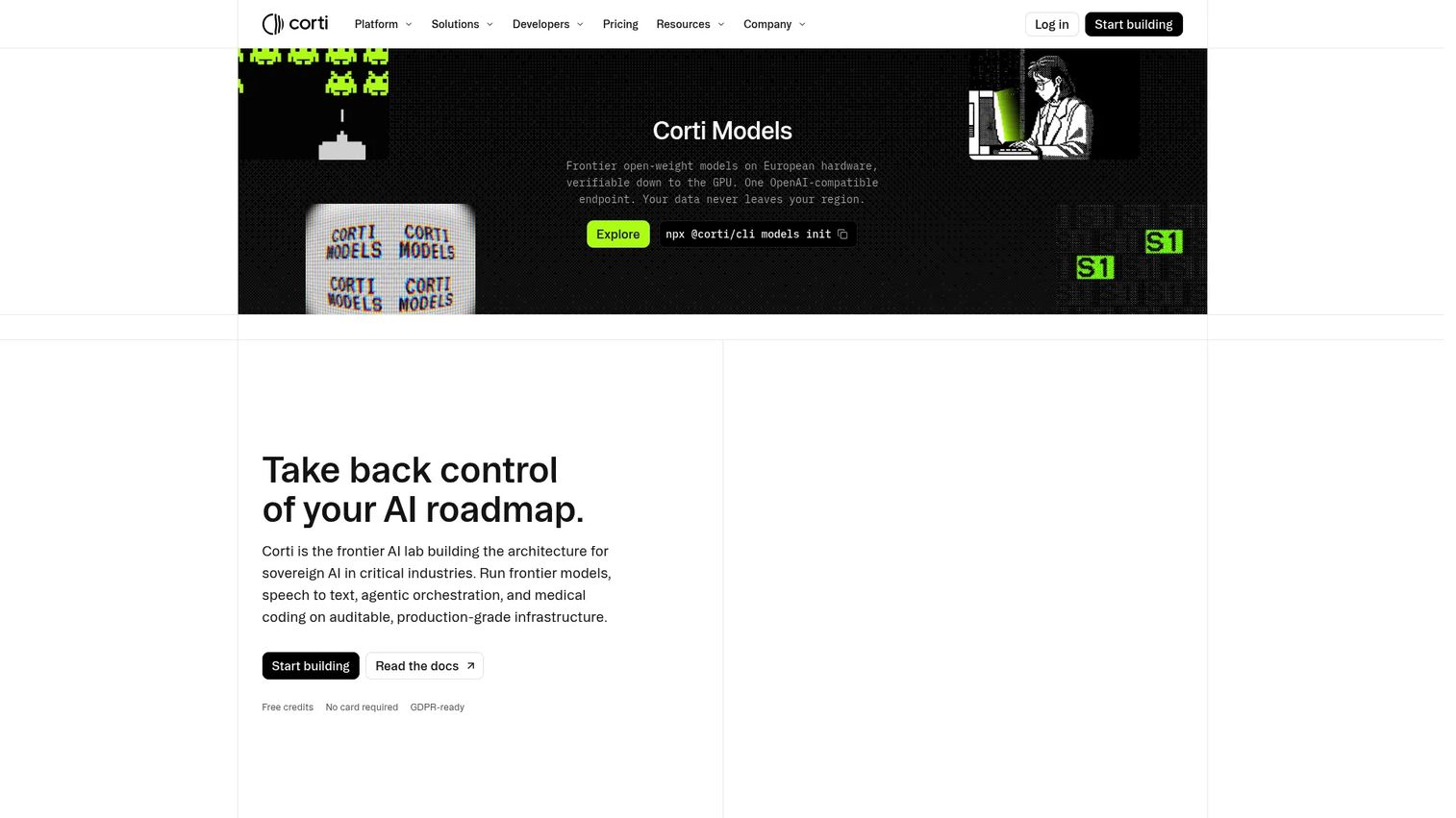
Corti provides production-grade AI infrastructure for healthcare, covering clinical speech-to-text, templated document generation, medical coding with audit trails, and agentic orchestration for clinical workflows. The platform is built as an API-first infrastructure layer rather than a pure end-user ambient scribe, which makes it more relevant for healthcare technology teams building auditable AI products than for practices looking for a plug-and-play documentation tool.
Best for: Healthcare technology teams and health systems building custom clinical AI products that need auditable documentation, coding, and conversation intelligence across multiple care settings.
Key features
- Clinical speech-to-text transcription
- Templated clinical document generation
- Medical coding with evidence and audit trails
- Agentic orchestration for healthcare workflows
- OpenAI-compatible models on sovereign EU infrastructure
Why choose Corti: Corti fits a different buyer than the other platforms on this list. If you are evaluating a documentation tool for a clinic or health system deployment, most of the other platforms will be a faster path. If you are building a clinical AI product and need a governed infrastructure layer with usage-based pricing and regional hosting options, Corti is worth a detailed look.
Corti pricing: Free credits are available to start. Speech-to-text is $0.0065/min. Text generation, medical coding, and agentic orchestration are priced at $4.00 per MTok input and $16.00 per MTok output. Enterprise plans add dedicated capacity, custom rate limits, regional or on-premises hosting, and SLAs.
Considerations when choosing ambient AI scribe platforms
EHR integration
EHR integration is often the difference between a pilot that clinicians adopt and one that stalls. Ask where the generated note appears, how it flows into the chart for editing, and how sign-off works within your existing EHR version. A tool that requires copy-paste rather than native delivery creates friction that erodes adoption quickly.
Clinician review burden
Adoption depends on trust. Measure editing time, correction patterns, and note closure time during a pilot. A draft note that requires 10 minutes of correction per visit may still save time overall, but the math changes fast in high-volume settings. Set a baseline before rollout so you can measure the actual impact.
Specialty and template fit
Primary care, oncology, behavioral health, and urgent care have meaningfully different documentation structures. Test any candidate platform with real clinical scenarios from your specialty, not generic demo visits. A tool that works well for internal medicine may require significant customization before it handles oncology workflows accurately.
Security, privacy, and governance
Verify data handling practices, encryption, access controls, retention policies, audit log availability, and BAA terms before a pilot. Some platforms publish compliance documentation directly; others require a security review process. Do not treat a vendor's self-reported compliance posture as a substitute for your organization's own security review.
Adoption and rollout support
A platform adoption question is not just a technology question. It is a change management question. Ask how the vendor supports pilot design, clinician training, champion identification, and escalation workflows when adoption stalls. The platforms with the best long-term track records tend to be the ones with the most structured rollout support.
Conclusion
The right ambient AI scribe is a workflow decision before it is a technology decision. Start from the clinical setting, the EHR environment, and the documentation load, then match the platform to those constraints.
For large health systems running enterprise programs, Abridge and Dragon Copilot are the natural starting points. Epic is the obvious evaluation for organizations that want to avoid adding a new vendor to an already complex environment. DeepScribe and Ambience Healthcare warrant close attention in specialty-heavy settings where generic templates fall short. Tali Ambient Scribe and Heidi lower the barrier for smaller teams and individual clinicians who want to verify fit before entering a sales cycle. Augmedix suits organizations that want flexibility across automation levels during a phased rollout. Corti is a different category of buyer entirely: Infrastructure teams building clinical AI products rather than practices deploying a documentation tool.
Whatever your setting, run a specialty-specific pilot, measure note closure time and clinician editing burden before and after deployment, and involve your compliance team early. A tool that earns its place in the first quarter is worth more than one that generates a compelling demo but stalls in production.
Start your journey with Guideflow today!
FAQs
An ambient AI scribe platform is software that listens to a patient-clinician encounter, identifies clinically relevant information from the conversation, and generates a structured draft note for the clinician to review inside or alongside the EHR. The clinician reviews, edits, and signs the note before it enters the medical record. The platform does not replace clinical judgment; it reduces the manual documentation workload.
The platform captures audio from the encounter, runs it through speech recognition, then uses natural-language processing and large-language model summarization to identify relevant clinical content and structure it into a draft note. The output follows a template matched to the visit type or specialty. The clinician then reviews the draft, makes corrections, and signs off. The accuracy of that draft determines how much review time remains.
Dictation software transcribes what the clinician explicitly narrates. The clinician drives the content by speaking directly into the tool. Ambient scribing captures the natural back-and-forth of the patient-clinician conversation and structures it into documentation without requiring the clinician to narrate. The workflow difference is significant: Ambient scribing reduces the interruption to the encounter itself.
Many platforms support EHR workflows, but integration depth varies considerably. Some tools deliver notes natively into the chart for in-EHR editing and sign-off. Others require a separate review step or manual export. Before selecting a platform, verify whether it inserts notes directly, supports your EHR version, works with your specialty templates, and handles sign-off within your existing workflow. Check with your EHR vendor as well, since integration support varies by EHR release.
That determination requires your organization's own security and compliance review, not a vendor's self-reported posture. Evaluate encryption in transit and at rest, access controls, data retention periods, audit log availability, and whether the vendor will sign a Business Associate Agreement. Platforms like those covered here vary in what they publish about their security infrastructure, so request detailed documentation during the procurement process rather than relying on marketing materials.
Pricing varies considerably across the category. Heidi starts at $0 for a free individual tier and $110/user/month for the Clinician plan. Tali Ambient Scribe's Starter plan is $60/month. Dragon Copilot offers a pay-as-you-go option at $0.25 per AI-assisted session. Corti's speech-to-text API starts at $0.0065 per minute. Enterprise platforms including Abridge, Ambience Healthcare, DeepScribe, Augmedix, and Epic price through custom contracts. The price drivers are clinician count, care setting, EHR integration complexity, and the level of implementation support required.
Set a baseline before the pilot starts. Track note closure time (the gap between visit end and signed note), clinician editing time per note, and overall adoption rate by clinician cohort. Collect clinician satisfaction signals and document common correction patterns to identify where the AI output needs improvement. Where relevant to your setting, also track downstream coding accuracy and billing cycle time. Without a baseline, the pilot produces impressions rather than evidence.
For many documentation workflows, ambient AI scribes can reduce or eliminate dependence on human scribes. The right answer depends on specialty complexity, note accuracy requirements, clinician adoption, and the organization's risk tolerance for AI-generated draft content. Some organizations run hybrid models, particularly in high-acuity or high-complexity settings where a human review layer adds quality assurance. The platforms on this list span the spectrum from fully automated to human-assisted, so the choice does not have to be all-or-nothing.
Related reading: AI medical diagnostic platforms, best AI note-taking tools, AI governance tools, aged care management software, agentic AI platforms