

A caregiver finishes a shift. The handover note lives on a paper roster. The billing detail sits in a spreadsheet. The family update never gets sent. Multiply that by every shift, every resident, and every site, and you understand why aged care operators lose so many hours to coordination that software should handle.
The pressure is not going away. The global aged care software market is projected to reach USD 6.3 billion by 2032, growing at a 9.4% CAGR from 2026, according to Verified Market Research (2024). Demand for efficient care operations is rising faster than most providers can staff for.
That is the real problem. When scheduling, documentation, billing, and compliance live in too many places, information falls through the cracks between people. Good aged care software pulls those workflows into one system so staff coordinate, records stay accurate, and finance teams get visibility. This guide compares seven platforms so you can pick the one that fits how you actually run care.
What's inside
This guide is for operators evaluating aged care software across care homes, home care agencies, and community senior services. We looked at platforms that reduce manual admin and improve day-to-day coordination, not feature lists for their own sake.
We chose and ranked tools against four criteria:
- Scheduling, rostering, and mobile task assignment
- Documentation, care planning, and reporting workflows
- Billing, invoicing, and financial visibility
- Compliance, stakeholder visibility, and mobile caregiver access
Each entry covers what the tool does well, who it fits, and current pricing where it is published.
TL;DR
- Best for all-around operations: SafetyCulture, if you want a broad operational layer with mobile workflows and staff enablement.
- Best for senior living depth: Yardi Senior Living Suite, if you run a larger facility or multi-community operation.
- Best for dignity-first care operations: myneva, if you want stakeholder transparency, documentation depth, and a holistic care model.
- Best for home care scheduling: ShiftCare, if route planning, caregiver communication, and mobile access matter most.
- Best for nonprofit service coordination: NewOrg, if you manage volunteers, transport, and service planning.
- Best for documentation-heavy care: myUnity Senior Living for structured senior living EHR needs, or StoriiCare for person-centered community and adult day care.
What is aged care management software
Aged care management software is a system that helps care providers manage scheduling, documentation, care plans, communication, billing, and staff coordination in one place, replacing spreadsheets, paper rosters, and disconnected notes.
Most aged care software systems bring together a core set of capabilities:
- Care planning and documentation, including progress notes and assessments
- Staff scheduling and task assignment across shifts and sites
- Mobile caregiver access for updates from the field
- Billing, invoicing, and financial reporting
- Communication and stakeholder visibility for families and staff
- Compliance controls and audit readiness
The category overlaps with adjacent terms. Elderly care management software and senior care software usually describe the same operational job. Care home management software and nursing home management software tend to emphasize resident-based facility workflows. Care coordination software leans toward communication and continuity across providers. Most modern platforms cover several of these at once.
When to use aged care management software
Replace manual procedures and paper workflows
Paper rosters and spreadsheets work until they do not. Once you run multiple shifts, sites, or care types, the handoffs multiply and mistakes creep in. This is the point where care management software earns its place: fewer missed notes, less double entry, and one source of truth instead of five.
Coordinate staff, families, and stakeholders in one place
Continuity of care breaks when information sits in silos. When a caregiver, a coordinator, and a family member all see the same record, the back-and-forth drops sharply. Shared visibility is the difference between reactive firefighting and proactive care coordination.
Improve scheduling, billing, and reporting consistency
Manual invoicing and reporting get error-prone fast, especially with reimbursements and jurisdiction-specific rules. Workforce management software for aged care and integrated billing give finance teams operational visibility, so planning, invoicing, and reporting stay consistent as you scale.
Comparison table
The list is organized by operational fit rather than alphabetically, starting with the broadest operational layer and moving toward specialized care home management software and nursing home management software.
| # | Product | Best for | Key differentiator | Pricing | G2 rating |
|---|---|---|---|---|---|
| 1 | SafetyCulture | Mobile-first inspections, audits, and safety workflows | Checklist-driven operational execution across teams | Free plan; Premium from $24 per user/month | 4.6/5 |
| 2 | Yardi Senior Living Suite | Senior living operators needing integrated operations | Resident care, accounting, and operations in one platform | Custom pricing | 3.6/5 |
| 3 | myneva | Care and social-service providers | Documentation depth with relatives communication | From 69 EUR base + 9 EUR per user/month | Not published |
| 4 | ShiftCare | Home care and disability care agencies | Scheduling, EVV, and billing in one platform | From $8 per staff/month (annual) | 4.6/5 |
| 5 | NewOrg | Nonprofits and senior service organizations | Configurable case management and reporting | From $250/month | 4.7/5 |
| 6 | myUnity Senior Living | Senior living organizations needing a unified EHR | Single record across post-acute care settings | Custom pricing | 3.4/5 |
| 7 | StoriiCare | Community-based and adult day care providers | Person-centered care planning and family engagement | Custom pricing | 4.8/5 |
Best 7 aged care management software tools
1. SafetyCulture

SafetyCulture is a workplace operations platform for inspections, audits, safety, and quality management. In an aged care context, it fits providers that want a broad operational layer sitting on top of daily execution: checklists for care tasks, mobile reporting for issues, and compliance workflows that staff complete from a phone. It is not a purpose-built EHR, so it works best alongside a clinical record rather than as a standalone care planning system.
The strength here is operational consistency. Teams turn recurring procedures into repeatable digital checklists, then track completion and flag problems in real time. For distributed care teams, that means fewer missed steps and a clear audit trail without paper.
Best for: Care operators who need mobile-first inspections, audits, and safety or compliance workflows across sites.
Key strengths
- Inspection and audit workflows
- Risk and compliance management
- Mobile task and issue reporting
- Integrations and data export
Why choose SafetyCulture: Choose it when your bottleneck is operational execution and compliance consistency, not clinical documentation. It layers cleanly over an existing care record and gets frontline staff off paper fast.
SafetyCulture pricing: A free plan is available. The Premium plan is $24 per user/month billed annually, with custom enterprise pricing on request.
2. Yardi Senior Living Suite

Yardi Senior Living Suite is senior living property management software built around Voyager Senior Housing. It brings community management, financial accounting, and resident services into one platform, which makes it a strong fit for larger or multi-community operations that need operations and finance tightly connected.
Where it stands out is depth for structured environments. General ledger, resident billing, census, maintenance, procurement, and analytics all sit in the same system, alongside integrated add-ons like Senior IQ, EHR, eMAR, Senior CRM, and a resident portal. State-specific Medicaid billing is part of the picture, which matters for facility operators managing reimbursements.
Best for: Senior living operators needing an integrated platform for resident care, accounting, and operations.
Key strengths
- Community management, accounting, and resident services in one platform
- General ledger, resident billing, census, and maintenance
- State-specific Medicaid billing
- Add-ons for Senior IQ, EHR, eMAR, and CRM
Why choose Yardi Senior Living Suite: Choose it when you run at scale and want property, financial, and care operations under one roof. It is heavier than a point solution, which is exactly the point for multi-community operators.
Yardi Senior Living Suite pricing: Yardi does not publish pricing on its product page and uses contact and demo prompts instead. Pricing is quoted based on scope.
3. myneva

myneva is a software platform for care and social-sector organizations, focused on documentation, coordination, reporting, and digital assistants. It leans into a dignity-first care model, with strong stakeholder transparency and shared visibility for staff and relatives. For providers who want documentation depth without losing sight of the person behind the record, it is a distinctive option.
The platform pairs AI-powered voice input and mobile documentation with communication tools for relatives and data-driven reporting. That combination reduces the time caregivers spend typing and keeps families informed, which supports both continuity and compliance in European care settings.
Best for: Care and social-service providers needing an integrated documentation and operations platform.
Key strengths
- AI-powered voice input and mobile documentation
- Communication with relatives
- Data-driven insights and reporting
- Admissions and billing modules
Why choose myneva: Choose it when documentation quality and stakeholder transparency are central to how you deliver care. Its regional focus and holistic model suit providers who want more than a scheduling tool.
myneva pricing: Public pricing for myneva.daarwin runs across three tiers. Essential starts from 69 EUR base plus 9 EUR per user/month, Professional from 449 EUR base plus 11 EUR per user/month, and Enterprise from 4,199 EUR base plus 10 EUR per user/month.
4. ShiftCare
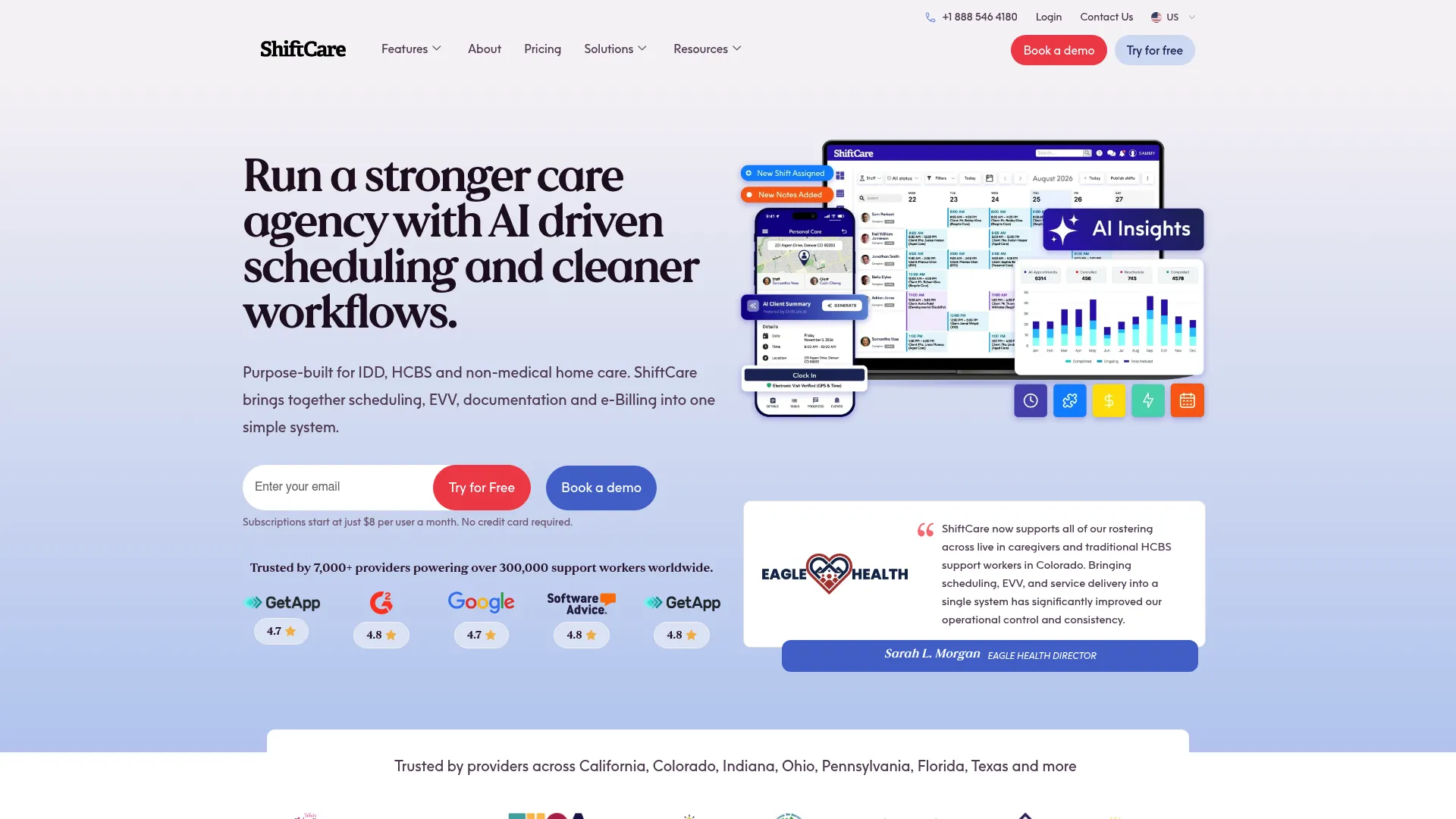
ShiftCare is AI-driven care management software built for home care, HCBS, and disability care agencies. It brings scheduling, electronic visit verification, documentation, and billing together in one system, with a caregiver app that keeps field staff connected. For agencies whose day revolves around route coordination and shift planning, this is the strongest fit on the list.
The value is time savings on the operational grind. Rostering, EVV, and e-billing sit in one place, so coordinators stop stitching together tools and caregivers update visits from their phones. As workforce management software for aged care goes, it keeps the mobile experience simple and practical.
Best for: Home care and disability care agencies needing scheduling, EVV, and billing in one platform.
Key strengths
- Care management and scheduling
- Rostering and shift planning
- EVV (electronic visit verification)
- e-Billing, invoicing, and caregiver app
Why choose ShiftCare: Choose it when mobile access and route-based coordination drive your operation. It is purpose-built for agencies that need admin savings without a heavy implementation.
ShiftCare pricing: Three paid tiers, billed monthly or annually. Annual billing starts at $8 per staff/month (Basic), $13 (Professional), and $20 (Premium). Monthly billing runs $9, $15, and $25. A 7-day free trial is available, with a minimum of 5 licenses and SMS billed at $0.10 per message.
5. NewOrg
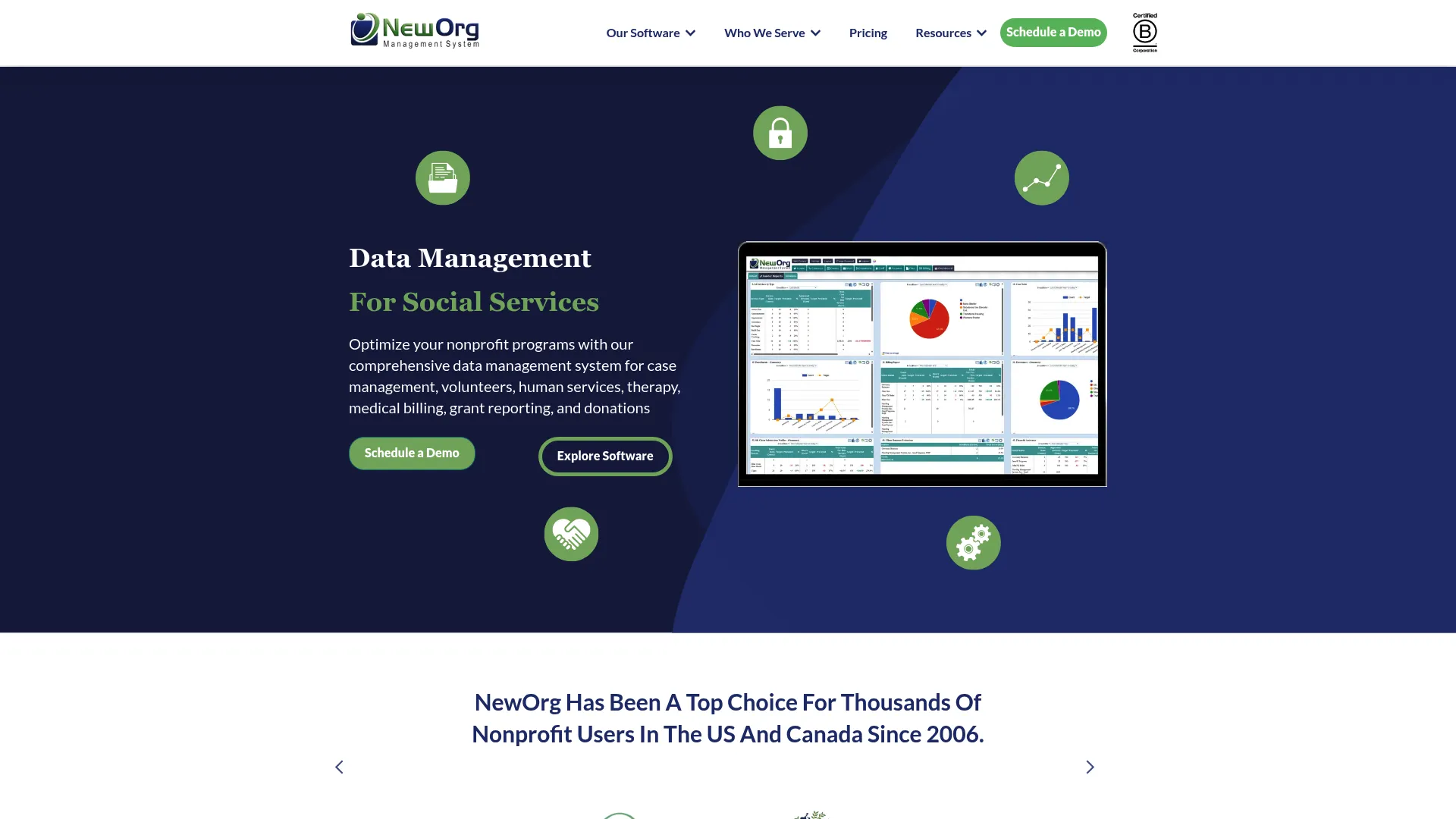
NewOrg is cloud-based nonprofit data management software covering case management, reporting, volunteers, donors, and related workflows. For senior service organizations that are broader than residential care, it fits the coordination model well: managing volunteers, transportation, service planning, and billing from a configurable core.
Its strength is flexibility across service delivery. Case management, document management, and mass communication adapt to how a community-based organization actually works, rather than forcing a residential care template onto a service model.
Best for: Nonprofits and social service organizations needing configurable case management and reporting.
Key strengths
- Flexible reporting
- Document management
- Mass communication
- Volunteer and service coordination
Why choose NewOrg: Choose it when your organization coordinates services rather than running a facility. It is strongest for nonprofit senior services with volunteers, transport, and program planning.
NewOrg pricing: Pricing is based on paid staff users, with volunteer and public portal access free. Starter is $250/month for 2 paid staff users, Standard is $400/month for 5 users, and Plus is $900/month for 20 users, plus one-time implementation and training fees.
6. myUnity Senior Living

myUnity Senior Living is Netsmart's post-acute EHR for senior living and other care settings. It fits structured senior living operations that want a single resident record spanning multiple care settings, with the interoperability to connect across health systems and networks.
The depth shows in connected care. A single record follows the resident across post-acute settings, and the platform interoperates with HIEs, ACOs, hospitals, and major EHRs. Analytics dashboards, billing tools, and role-based workflows round out a system built for compliance-heavy documentation.
Best for: Senior living organizations needing a unified EHR across care settings.
Key strengths
- Single resident record across post-acute settings
- Interoperability with HIEs, ACOs, and major EHRs
- Analytics dashboards and billing tools
- Role-based workflows
Why choose myUnity Senior Living: Choose it when clinical documentation and interoperability are the priority. It suits organizations that need an EHR backbone rather than a lightweight coordination tool.
myUnity Senior Living pricing: Netsmart does not publish list prices. Per its disclosures, the subscription is priced on average daily census and includes a one-time implementation fee.
7. StoriiCare

StoriiCare is a cloud-based EHR platform for community-based care providers, with a clear focus on person-centered care. It covers digital care planning, family engagement, and activity programming, which makes it well suited to adult day, residential, and community-based providers that want documentation and engagement in one place.
The platform balances records with relationships. Care planning and progress notes sit alongside family updates and activity calendars, so the human side of care stays visible in the record. For smaller to mid-sized providers, that focus is often a better match than a heavier enterprise suite.
Best for: Community-based care organizations needing EHR, activity, and family-engagement tools.
Key strengths
- Care management and digital care planning
- Family engagement and updates
- Activity calendars and programming
- Community and adult day care focus
Why choose StoriiCare: Choose it when person-centered documentation and family engagement matter as much as compliance. It fits community and adult day providers better than a facility-first enterprise platform.
StoriiCare pricing: StoriiCare lists three plans, Activity Pro, Care Pro, and Enterprise, and directs visitors to request a demo. No public price is displayed.
Considerations
Scheduling and shift planning
Look at how the tool handles roster automation, route planning, and daily task assignment. The best senior care software lets coordinators build shifts fast and lets caregivers see and update their day from a phone. Check whether real-time changes push to staff instantly and whether the system flags conflicts before they become gaps in coverage.
Documentation and reporting
Evaluate how care plans, progress notes, and audit trails are stored and exported. The question that matters is how much manual entry the system removes. Voice input, templates, and structured assessments cut typing time, and clean export keeps you audit-ready without a scramble when reporting deadlines hit.
Billing and financial control
Check invoicing, reimbursements, expense capture, and reporting. Aged care billing software should give finance teams operational visibility, not just generate invoices. Confirm whether it handles jurisdiction-specific rules, reimbursement workflows, and the reporting your funders or regulators expect.
Mobile access for caregivers
A caregiver app is only useful if staff actually use it in the field. Verify that caregivers can update notes, tasks, and visit status from a phone, and check offline behavior if your teams work in low-signal areas. Mobile UX quality is not a nice-to-have here; it decides whether records stay current.
Compliance, security, and data protection
Verify permissions, data handling, and jurisdiction-specific requirements before you buy. Aged care compliance software should give you role-based access, clear audit trails, and controls that match where you operate. Keep this practical: confirm who can see what, how data is protected, and what evidence the system produces for an audit.
Conclusion
The right pick depends on how you run care, not on which vendor has the longest feature list. For a broad operational and compliance layer, SafetyCulture fits. For large or multi-community senior living, Yardi Senior Living Suite and myUnity Senior Living bring the depth. For dignity-first documentation, myneva stands out.
If you run a home care agency where scheduling and mobile access decide your day, ShiftCare is the most direct fit. If you coordinate volunteers, transport, and services as a nonprofit, NewOrg matches that model. And if person-centered documentation and family engagement matter most, StoriiCare is built for it.
Your next step is simple. Name your operating model, shortlist the two closest matches, and book demos to test them against your real scheduling, documentation, and billing workflows. The senior living software that removes the most manual coordination is the one worth paying for.
FAQs
For home care agencies, ShiftCare is usually the strongest fit. It combines scheduling, electronic visit verification, and billing in one system with a caregiver app built for field staff. That mobile-first, route-based design is what home care operations need most.
Scheduling, documentation, communication, billing, mobile access, and compliance are the core. The priority order depends on your model: home care leans on scheduling and mobile, while facilities lean on documentation and reimbursement. Look for a system that covers the workflows you run daily rather than the longest feature list.
It removes duplicate entry by keeping records in one place and automating repetitive tasks like rostering and invoicing. Fewer manual handoffs mean fewer errors and less time reconciling spreadsheets. Staff update information once, and it flows to the people who need it.
Yes. Shared visibility, task assignment, and mobile updates keep caregivers, coordinators, and families working from the same record. That reduces the back-and-forth calls and messages that eat into care time and improves continuity across shifts.
Care home management software centers on resident-based facility workflows: census, rooms, on-site care, and facility billing. Home care software is built around mobile, route-based delivery, with scheduling, visit verification, and caregiver apps at its core. The right choice follows where care actually happens.
Check role-based permissions, audit trails, and data protection controls first. Confirm the system meets the jurisdiction-specific requirements you operate under and produces the evidence an audit needs. Treat this as a practical checklist, not a legal exercise, and involve the people who own compliance.
Yes. Most platforms handle invoicing, expense tracking, reimbursements, and financial reporting, giving finance teams visibility they lack with spreadsheets. The stronger elderly care management software options also support jurisdiction-specific billing rules and clean export for funders and regulators.