You listed your rental on one site. Two weeks later, still no qualified applicant. So you copy the listing to a second site. Then a third. Now you're tracking leads across four inboxes, screening applicants through a separate service, chasing lease signatures over email, and reconciling rent payments in a spreadsheet.
Every disconnected step costs you time and, worse, costs you vacancy days. The global property management software market hit USD 3.6 billion in 2025 and is projected to reach USD 5.9 billion by 2033, according to Grand View Research (2026). That growth is landlords doing exactly what you're trying to do: consolidate the mess.
The problem isn't finding a tool. It's finding one that covers the full workflow, listing distribution, tenant screening, lease signing, and online rent collection, without forcing you into an enterprise contract you don't need. Most rental listing software now bundles these together. The difference is where each tool is strongest and what it costs you to get there.
What's inside
This guide is for small landlords, DIY landlords, and property managers who want to reduce tool sprawl and handle listings, screening, leasing, and payments in fewer places.
We picked these seven tools based on four criteria that matter most when you're evaluating a stack:
- Listing syndication: how many rental listing sites the tool pushes to
- Workflow coverage: screening, leases, rent collection, communication, accounting
- Free-tier value: what you get without paying, and where paid plans start
- Ease of use: how fast a solo landlord can go from signup to a live listing
TL;DR
- Best free all-in-one for DIY landlords: Avail. A genuinely free plan, listings across 19 sites, TransUnion screening, and digital leases.
- Best free listing reach: Zillow Rental Manager. The Zillow network puts your listing in front of a massive renter audience at no landlord cost.
- Best fully-free platform: Innago. No monthly fee, no setup fee, no contract, with rent collection, screening, and maintenance.
- Best for financial visibility: Baselane. Banking, bookkeeping, and rent collection tied to property-level reporting.
- Best balanced free-plus-paid workflow: TurboTenant. Free core with low-cost premium upgrades for landlords managing 1 to 50 units.
- Best operational depth for growing portfolios: DoorLoop. Full property management with accounting, maintenance, and tenant portals.
What is rental listing software?
Rental listing software is a platform that lets landlords and property managers create, distribute, and manage rental property listings across multiple sites, then handle the downstream workflow of applications, tenant screening, leasing, and rent collection from one place.
Most rental management software today goes well beyond posting an ad. The category has consolidated so that a single landlord software account can run the entire leasing cycle. That matters because the alternative, stitching together separate tools for each step, is where vacancy days and manual errors pile up.
Core features you'll find across rental listing platforms:
- Listing syndication: one listing pushed to many rental listing sites (Zillow, Apartments.com, Realtor.com, and others) from a single entry
- Tenant screening software: background checks, credit reports, eviction history, and income verification, often powered by TransUnion or similar bureaus
- Lease signing software: digital lease templates with e-signature so tenants sign without printing anything
- Online rent collection: ACH and card payments, autopay, late fees, and payment reminders
- Communication tools: a shared thread with applicants and tenants instead of scattered email
- Accounting and reporting: income and expense tracking tagged by property for tax time
- Maintenance management: tenant-submitted requests routed to you or a service pro
The property management software market is growing fast because these workflows used to require a full-time coordinator. Industry Research (2025) found that 62% of real estate agencies now use software for property management, analytics, and transaction tracking. For a solo landlord, that same software collapses a week of coordination into a few clicks.
When to use rental listing software
Fill vacancies faster with listing syndication
When a unit turns over, every day empty is lost rent. Listing syndication posts your rental to a dozen or more sites at once, so you widen the applicant pool without manually re-entering the same listing everywhere. This is the single fastest lever for cutting vacancy time.
Screen tenants without a separate service
When applications start arriving, you need credit, background, and eviction data quickly. Built-in tenant screening software pulls those reports inside the same tool where you posted the listing, so you're not exporting applicant data to a standalone screening vendor and back.
Collect rent and sign leases in one flow
When you've picked a tenant, lease signing software and online rent collection close the loop. The tenant signs digitally, sets up autopay, and you stop chasing paper checks. For DIY landlords, this is the workflow that most justifies switching from spreadsheets.
Rental listing software comparison
Here's how the seven tools compare on the factors that decide most evaluations: who each is best for, the standout differentiator, entry pricing, and rating. Pricing and ratings below reflect each vendor's own published figures as of 2026.
| # | Product | Best for | Key differentiator | Pricing | G2 rating |
|---|---|---|---|---|---|
| 1 | Avail | DIY landlords with small-to-medium portfolios | Free plan with listings across 19 sites | Free; $9/unit for Unlimited Plus | 4.8/5 |
| 2 | TenantCloud | Landlords wanting all-in-one operations | Depth across leasing, accounting, maintenance | From $25/mo | 4.4/5 |
| 3 | Zillow Rental Manager | Landlords prioritizing listing reach | Free listing on the Zillow network | Free for landlords | 4.1/5 |
| 4 | Innago | Landlords wanting no-cost basics | Fully free, no monthly or setup fee | Free | 4.8/5 |
| 5 | Baselane | Landlords focused on finances | Banking plus bookkeeping plus rent collection | Free; $20/mo for Smart | Not listed |
| 6 | TurboTenant | Independent landlords, 1 to 50 units | Free core with low-cost upgrades | Free; from $12.42/mo | 4.5/5 |
| 7 | DoorLoop | Growing portfolios and property managers | Operational depth and accounting | From $69/mo | 4.8/5 |
Best 7 rental listing software tools for 2026
1. Avail

Avail is all-in-one landlord software built for DIY rental owners who want listing, screening, leasing, and rent collection without an enterprise price tag. Post a listing once and Avail distributes it across 19 rental listing sites, then routes applications, screening reports, and communication back into a single dashboard. The free plan is genuinely usable, which is rare in this category.
Best for: DIY landlords managing a small-to-medium rental portfolio.
Key strengths
- Rental listings distributed across 19 sites
- Tenant screening with TransUnion reports
- Digital leases and online rent collection
- Centralized applicant communication
Why choose Avail: If you want the widest built-in listing syndication on a free plan, Avail is the strongest fit. It's the tool for the landlord who wants real workflow coverage without committing budget before proving value.
Avail pricing: The Unlimited plan is free at $0/unit. The paid Unlimited Plus plan is $9/unit per month and adds features like faster payments and custom lease clauses. Avail holds a 4.8/5 rating on G2.
2. TenantCloud
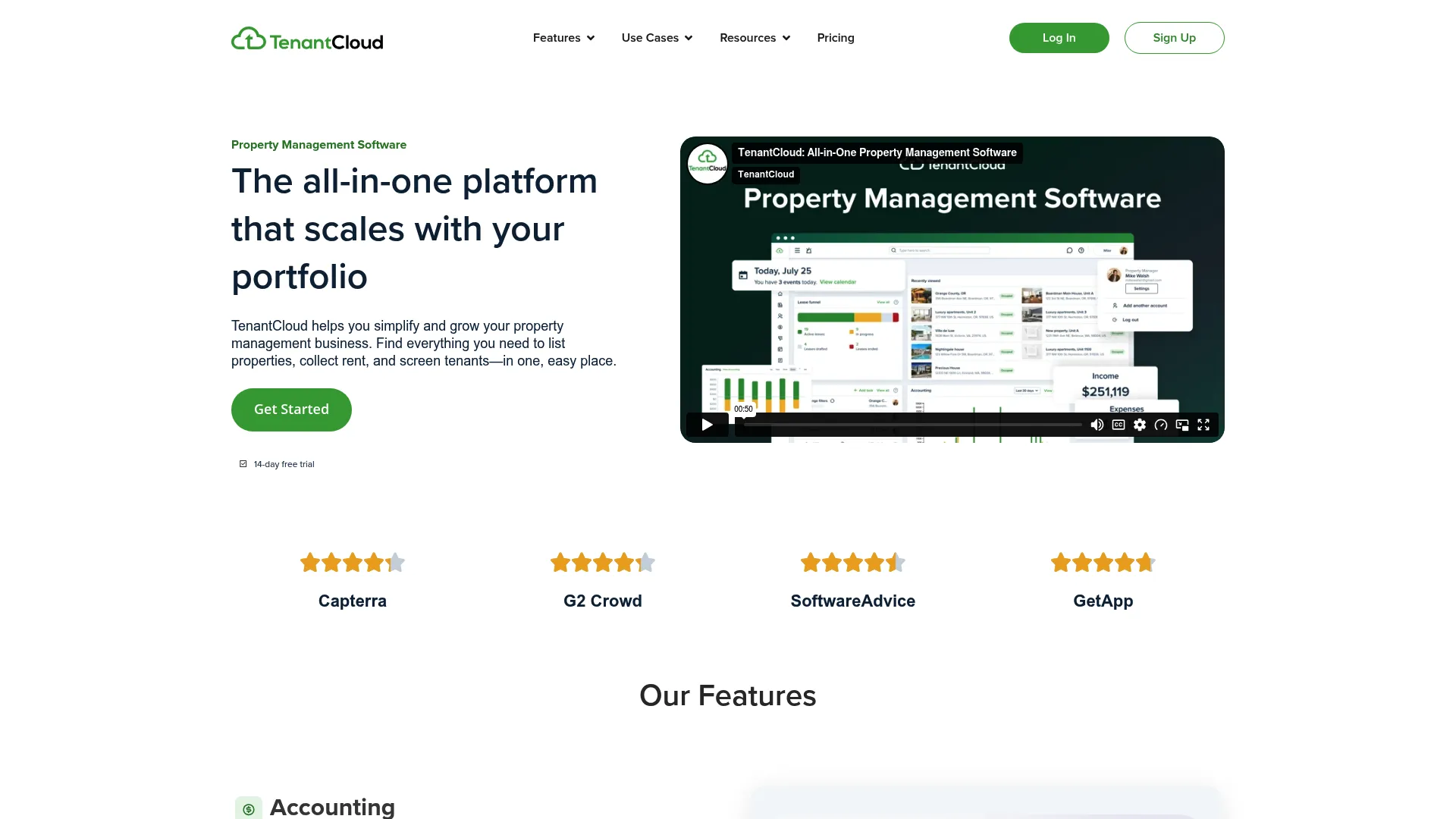
TenantCloud is cloud-based property management software that leans into workflow depth. Beyond listing and screening, it covers accounting, maintenance, and reporting, with distinct experiences for landlords, property managers, tenants, owners, and service pros. That segmentation is what makes it work for teams, not just solo landlords.
Best for: Landlords and property managers wanting an all-in-one rental operations platform.
Key strengths
- Online rent collection with autopay
- Tenant screening and rental applications
- Leases, accounting, maintenance, and reporting
- Role-based access for owners and service pros
Why choose TenantCloud: Choose TenantCloud when you're managing enough units that accounting and maintenance tracking matter as much as listing distribution. It rewards landlords who want one platform to run operations end to end.
TenantCloud pricing: Plans start at $25/mo for Starter ($180/yr billed annually), with Growth at $35/mo, Pro at $60/mo, and Business starting around $100/mo. A 14-day trial is available. TenantCloud holds a 4.4/5 rating on G2.
3. Zillow Rental Manager

Zillow Rental Manager gives landlords online property management tools to list rentals, screen tenants, sign leases, and collect rent. Its biggest advantage is reach: listings run on the Zillow network, which puts your unit in front of one of the largest renter audiences online without any landlord listing cost.
Best for: Landlords who want a free all-in-one tool for listing, screening, leasing, and rent collection.
Key strengths
- Free rental listing distribution on the Zillow network
- Tenant screening with background, credit, and eviction checks
- Online lease creation and e-signing
- Online rent collection with free ACH
Why choose Zillow Rental Manager: If discovery is your priority, nothing matches the built-in audience of the Zillow network. Landlord-facing core workflows are free, which makes it an easy first stop for a single vacancy.
Zillow Rental Manager pricing: Listing a rental, sending and signing leases, and collecting rent are free for landlords. Tenants pay processing fees on credit and debit card payments, while ACH transfers are free. Zillow holds a 4.1/5 rating on G2.
4. Innago
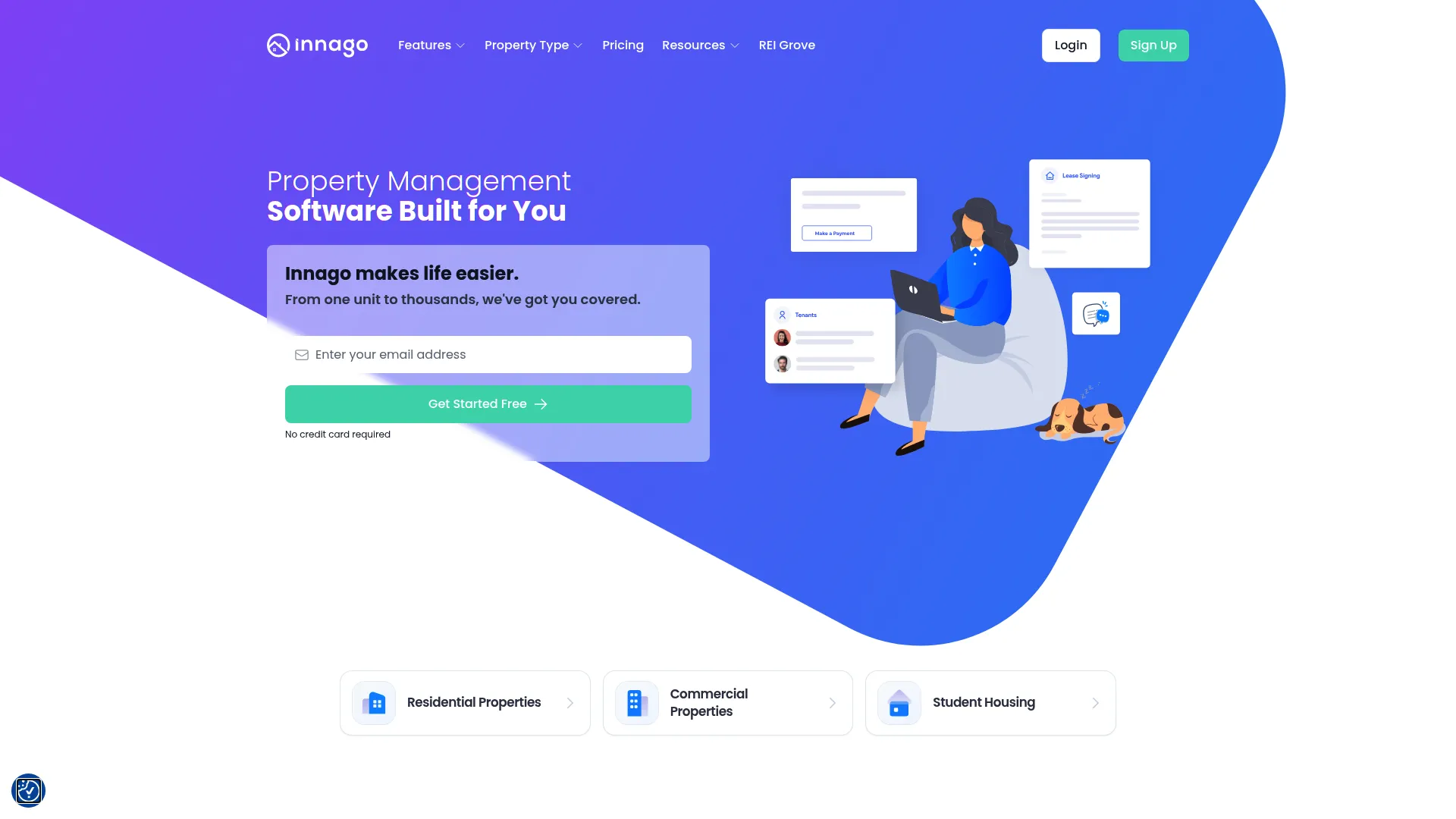
Innago is free property management software for landlords and property managers who want no-cost basics without a catch. It handles rent collection, tenant screening, lease signing, maintenance, and tenant-landlord communication, and it ships with a mobile app so you can manage on the go.
Best for: Landlords and property managers wanting a no-cost all-in-one rental management platform.
Key strengths
- Online rent collection
- Tenant screening
- Maintenance management
- Lease signing and tenant communication
Why choose Innago: For small portfolios, Innago's simplicity is the point. No monthly fee, no setup fee, and no contract means you can run essential workflows at zero cost, which is why its review-based trust signals stay high.
Innago pricing: Innago is free with no monthly fee, no setup fee, and no contract. Innago holds a 4.8/5 rating on G2.
5. Baselane

Baselane approaches the landlord workflow from the financial side. It combines banking, automated bookkeeping, and rent collection so you can see cash flow and property-level performance in one place. It complements listing tools rather than replacing them end to end, and shines for landlords who care most about rent tracking and clean books.
Best for: Independent landlords and real estate investors who want banking, bookkeeping, and rent collection in one platform.
Key strengths
- Unlimited banking accounts and virtual cards
- Automated bookkeeping with property-level tagging and reporting
- Rent collection with tenant portal and late-fee tools
- Payment reminders and reconciliation
Why choose Baselane: Choose Baselane when financial visibility is your bottleneck, not listing distribution. It's the tool for the investor who wants rent, expenses, and reporting to reconcile automatically instead of living in a spreadsheet at tax time.
Baselane pricing: The Core plan is free. The Smart plan is $20/mo and adds advanced automations, with a 30-day trial.
6. TurboTenant
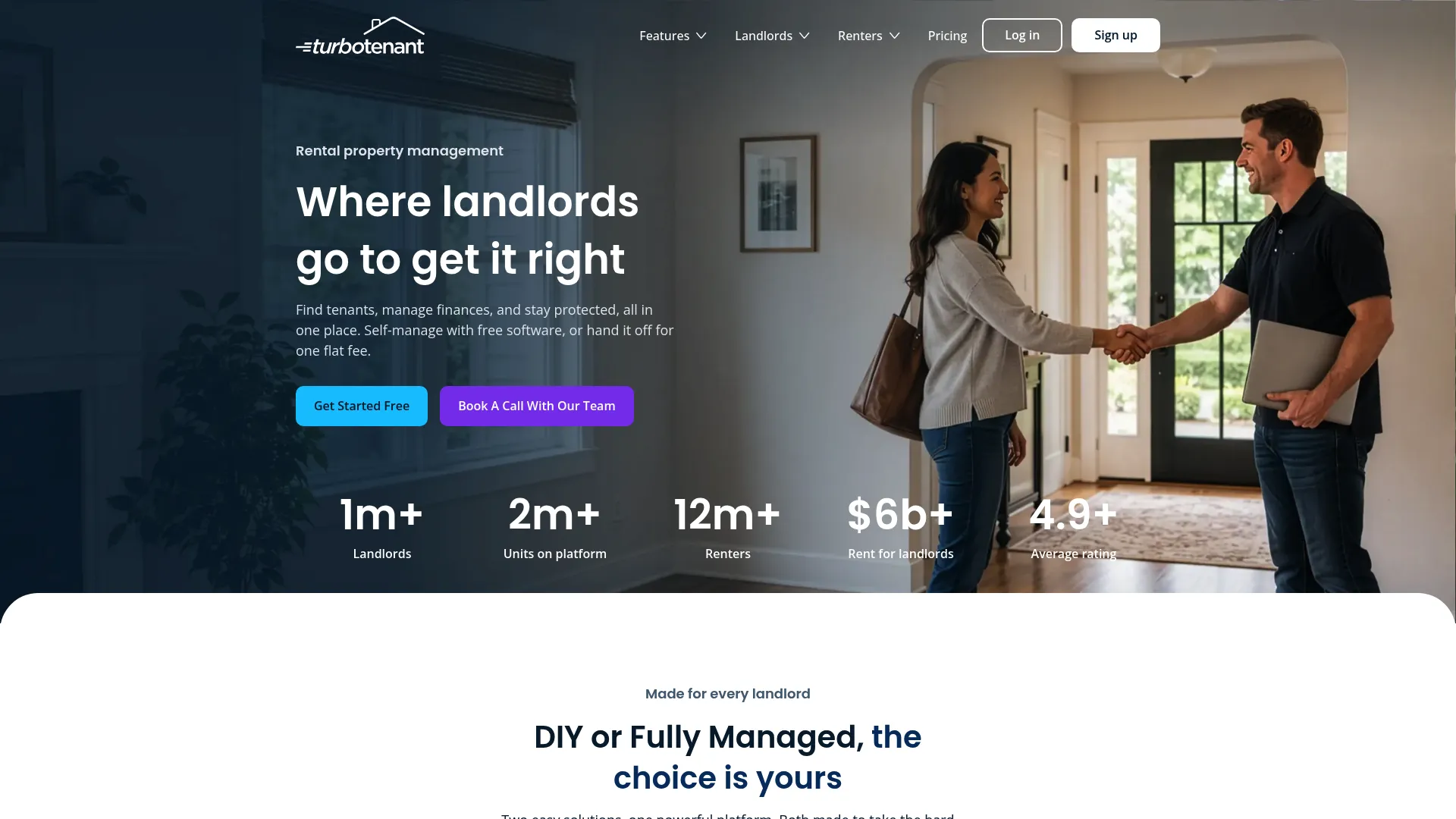
TurboTenant is property management software that balances a free core workflow with optional low-cost upgrades. It covers rental advertising, tenant applications and screening, lease generation with e-signatures, and rent collection, aimed at independent landlords who want a full feature set without a steep learning curve.
Best for: Independent landlords managing 1 to 50 units who want a free core workflow with optional paid upgrades.
Key strengths
- Rental advertising and listing syndication
- Tenant applications and screening
- Lease generation and e-signatures
- Online rent collection
Why choose TurboTenant: Pick TurboTenant when you want free basics now but room to upgrade as your portfolio grows. It hits the middle ground between fully-free tools and heavier paid platforms without asking you to relearn everything to scale up.
TurboTenant pricing: The Free plan is $0/mo. Premium plans are Essentials at $12.42/mo (billed annually at $149) and Pro at $16.58/mo (billed annually at $199). TurboTenant holds a 4.5/5 rating on G2.
7. DoorLoop

DoorLoop is property management software built for operational depth. It handles listing and lead workflows, online rent and fee collection, a tenant portal, maintenance request tracking, and accounting, making it the more complete option for landlords and small property managers whose needs go past a single vacancy.
Best for: Landlords and property managers needing an all-in-one rental property management platform.
Key strengths
- Online rent and fee collection
- Tenant portal
- Maintenance request tracking
- Listing and lead workflows
Why choose DoorLoop: Choose DoorLoop when your portfolio has outgrown lightweight tools and you need accounting and maintenance handled inside the same system. It's built for growing portfolios that need operational depth more than a free tier.
DoorLoop pricing: The Starter plan starts at $69/month for the first 10 units, billed yearly, with annual billing offering up to 20% off. Pro and Premium tiers are also available. DoorLoop holds a 4.8/5 rating on G2.
Considerations before you choose
Match the tool to your portfolio size
A solo landlord with two units has different needs than a manager running 40. Free tools like Innago and Avail cover the essentials for small portfolios, while DoorLoop and TenantCloud earn their price once accounting and maintenance volume grows. Buy for where you'll be in a year, not just today.
Verify syndication reach
Not all listing syndication is equal. Confirm which specific rental listing sites a tool posts to and whether those sites match where your renters actually search. Avail's 19-site distribution and the Zillow network are strong on reach, but reach only matters if it hits your local market.
Check what screening actually includes
Tenant screening software varies in depth. Some tools include credit, background, and eviction history; others charge extra or route you to a partner. Confirm the bureau, what reports are included, and who pays, you or the applicant, before you commit.
Confirm the real cost of "free"
Free property management software often shifts costs to tenants through payment processing fees, or gates key features behind a paid tier. Read where the money actually flows. A free landlord plan with high tenant card fees may cost you applicants at lease signing.
Test the leasing and payment flow
Lease signing software and online rent collection are where day-to-day friction lives. Run a test lease and a test payment before you migrate. The tool your tenants find easiest to use is the one that gets rent paid on time.
Conclusion
The right rental listing software depends on your portfolio and the workflow gap you're closing. For the widest free listing syndication, Avail leads with distribution across 19 sites plus screening and leases. For raw discovery, Zillow Rental Manager's network is hard to beat, and it's free for landlords. If you want zero cost with no catch, Innago covers the basics for small portfolios.
For financial visibility, Baselane ties banking, bookkeeping, and rent collection together. TurboTenant is the balanced pick when you want free basics with room to upgrade. And when your portfolio outgrows lightweight tools, DoorLoop delivers the operational and accounting depth growing property managers need.
Start with the workflow that's costing you the most right now, whether that's vacancy days, screening delays, or messy books, and pick the tool strongest there. Most offer a free plan or trial, so you can test the listing and payment flow before you migrate. Reduce the tool sprawl first; the ROI follows.
FAQs
Rental listing software lets landlords and property managers create and distribute rental listings across multiple sites, then manage applications, tenant screening, leasing, and rent collection from one platform. Modern tools combine listing syndication with the full leasing workflow, so you handle a vacancy end to end without juggling separate services.
Look for listing syndication to major rental listing sites, tenant screening software with credit and background checks, lease signing software with e-signature, and online rent collection with autopay. Stronger platforms add tenant communication, accounting, and maintenance tracking so the whole workflow lives in one place.
Yes, for many small landlords. Free property management software like Avail, Innago, and Zillow Rental Manager covers listing, screening, leasing, and rent collection at no landlord cost. Just confirm where fees actually land, some free plans pass payment processing costs to tenants or gate advanced features behind paid tiers.
For DIY landlords with small portfolios, Avail and Innago stand out for free workflow coverage, while Zillow Rental Manager wins on listing reach. TurboTenant is a strong middle option if you want a free core with room to add low-cost upgrades as you grow.
Yes. Listing syndication is a core feature. You enter a listing once and the tool posts it to many rental listing sites at once. Avail distributes across 19 sites, and Zillow Rental Manager publishes to the Zillow network. Always verify the specific sites a tool covers against where your local renters search.
Most full-featured platforms do. Tenant screening software pulls credit, background, and eviction reports, often via TransUnion, inside the same tool. Lease signing software provides digital templates with e-signature. Avail, TenantCloud, Zillow Rental Manager, TurboTenant, and others bundle both alongside online rent collection.
Choose Zillow Rental Manager when listing reach and a free landlord workflow matter most. Choose Avail when you want free syndication across 19 sites plus screening and digital leases. Choose TenantCloud when you're managing enough units that accounting, maintenance, and role-based access justify a paid plan with deeper operational coverage.