Sales teams are being asked to do more with the same headcount. Generate more pipeline, respond to leads faster, keep the CRM clean, forecast with confidence, and still have time to actually close deals. According to Salesforce's State of Sales report (2024), 81% of sales teams are already using or experimenting with AI. The tools exist. The harder question is which one actually fits your workflow.
The wrong AI sales agent creates a new problem: Another system the team has to babysit, another data source that disagrees with the CRM, another vendor that promises autonomous prospecting and delivers a chatbot with a fancy UI.
This guide cuts through the category noise. Each tool here was selected because it solves a specific sales bottleneck, whether that's inbound lead response, outbound personalization, call coaching, pipeline visibility, or CRM cleanup. If you've been asked to shortlist AI sales tools for your team, start here.
What's inside
This guide covers 15 AI sales agents evaluated for 2026. Tools were selected and ranked on four criteria:
- Workflow fit: Does it solve a real job for SDRs, AEs, RevOps, or sales leadership?
- CRM and channel depth: How well does it integrate with existing sales infrastructure?
- Automation level: Is it assistive, partially autonomous, or fully agentic?
- Pricing transparency: Can you model the cost before getting on a call?
Ratings and pricing were verified from vendor pricing pages and G2 listings.
TL;DR
- Best CRM-native AI sales agent: Salesforce Agentforce, for teams already running on Salesforce
- Best for HubSpot teams: HubSpot Breeze AI, embedded across marketing, sales, and service
- Best for conversation intelligence and coaching: Gong, the strongest tool for rep performance after the meeting happens
- Best for multichannel live conversations: SalesCloser, covering phone, chat, video, and WhatsApp
- Best for outbound data and research: Clay, the highest-leverage tool for building accurate prospect lists
- Best for autonomous SDR workflows: 11x, for teams exploring AI-native prospecting capacity
- Best for forecasting and pipeline visibility: Clari, for RevOps and sales leadership
What is AI sales agent software?
AI sales agent software uses artificial intelligence to perform or assist sales tasks such as prospecting, lead qualification, follow-up, meeting booking, CRM updates, coaching, forecasting, and buyer engagement.
The category spans a wide range of automation levels. An assistive AI sales agent acts as a copilot: It surfaces recommendations, drafts emails, summarizes calls, and flags pipeline risk, but a rep reviews and approves each action. An autonomous AI sales agent can initiate outreach, respond to leads, update CRM records, and book meetings without rep involvement. Most tools in this list sit somewhere between these two modes. Few are genuinely fully autonomous across an entire sales workflow.
AI SDRs are a specific subset of this category. They focus on outbound prospecting, sequence execution, inbound response, and meeting booking. Broader AI sales agents may also cover coaching, forecasting, revenue intelligence, and deal support. These are different jobs, and conflating them is a common buying mistake.
Key capabilities to evaluate:
- Lead capture and qualification
- Account research and data enrichment
- Outreach across email, phone, chat, and messaging
- CRM record creation and updates
- Meeting scheduling and routing
- Sales coaching and call analysis
- Pipeline inspection and forecast signals
- Human handoff rules and escalation controls
- Audit logs and governance
AI sales agents are a subset of the broader agentic AI tools for sales category. The distinction matters: Not every AI sales tool is an agent, and not every agent is production-ready for your specific workflow.
When to use AI sales agents
Respond to inbound leads before momentum dies
Speed-to-lead is the most measurable inbound failure. A lead that fills out a form at 11pm and hears back the next morning at 9am has already talked to two competitors. AI sales agents can qualify website visitors, answer common questions, route high-value leads, and book meetings without waiting for a rep to come online. The bottleneck here is not effort. It's coverage.
Scale outbound without lowering quality
Outbound AI agents support account research, message personalization, sequence execution, and follow-up cadences. They can send more messages, but they cannot fix bad targeting. Poor prospect data produces poor outreach at higher volume, which damages deliverability and rep reputation. AI amplifies what's already in your data, good and bad.
Improve execution quality across the team
Coaching, CRM hygiene, meeting prep, and forecast accuracy are cross-role problems. AI agents can flag deal risk from call transcripts, surface missing CRM fields, generate meeting summaries, and give RevOps cleaner pipeline data to work from. This is where AI sales coaching software and revenue intelligence tools add the most durable value.
AI sales agents comparison
The 15 tools below are ranked by relevance to the full sales-team workflow, from CRM-native platforms to specialized outbound and inbound agents. Pricing and G2 ratings were verified from vendor pages and live G2 listings.
| # | Product | Best for | Key differentiator | Pricing | G2 rating |
|---|---|---|---|---|---|
| 1 | Salesforce Agentforce | Enterprise CRM-native agents | Deep Salesforce data and workflow integration | From $2/conversation or $5/user/month | 4.4/5 |
| 2 | HubSpot Breeze AI | HubSpot sales and marketing teams | CRM-native prospecting, closing, and data agents | Free tier; paid from $7/seat/month | 4.4/5 |
| 3 | Gong | Sales coaching and revenue intelligence | Conversation intelligence plus deal insights | Custom pricing | 4.7/5 |
| 4 | Microsoft Dynamics 365 Sales | Microsoft ecosystem teams | Copilot across Dynamics, Outlook, and Teams | From $65/user/month (paid yearly) | 3.8/5 |
| 5 | Zoho CRM | SMB and mid-market CRM automation | Zia AI inside Zoho sales workflows | Free tier; paid from $14/user/month | 4.1/5 |
| 6 | SalesCloser | Multichannel live AI sales conversations | Phone, chat, video, and WhatsApp coverage | Custom pricing | 2.7/5 |
| 7 | Creatio | No-code CRM and agent workflows | No-code process automation plus AI agents | From $15/user/month; AI packages from $5,000/year | 4.6/5 |
| 8 | Salesforge.ai | Outbound prospecting teams | AI cold email, LinkedIn, and deliverability | From $40/month (billed annually) | 4.6/5 |
| 9 | VoiceSpin | Call-center sales teams | AI calling and contact center workflows | From $300/month (5 seats) | Not yet rated on G2 |
| 10 | Clay | Account research and enrichment | Multi-provider enrichment and AI web research | Free tier; paid from $167/month | 4.6/5 |
| 11 | Clari | Forecasting and revenue teams | Pipeline inspection and forecast intelligence | Custom pricing | 4.6/5 |
| 12 | Common Room | Signal-led and community-led sales | Buyer signal detection across product, social, and community | From $2,500/month | 4.5/5 |
| 13 | Fin for Sales | Inbound sales qualification | Usage-based AI agent for prospect engagement | From $0.99/outcome; $9.99/qualification | 4.5/5 |
| 14 | Qualified | Website pipeline generation | AI SDR for website visitor conversion | Custom pricing | 4.9/5 |
| 15 | 11x | Autonomous SDR workflows | AI digital workers for outbound and inbound | From $2,417/month (Alice or Julian, billed annually) | 4.5/5 |
Best 15 AI sales agents for 2026
1. Salesforce Agentforce
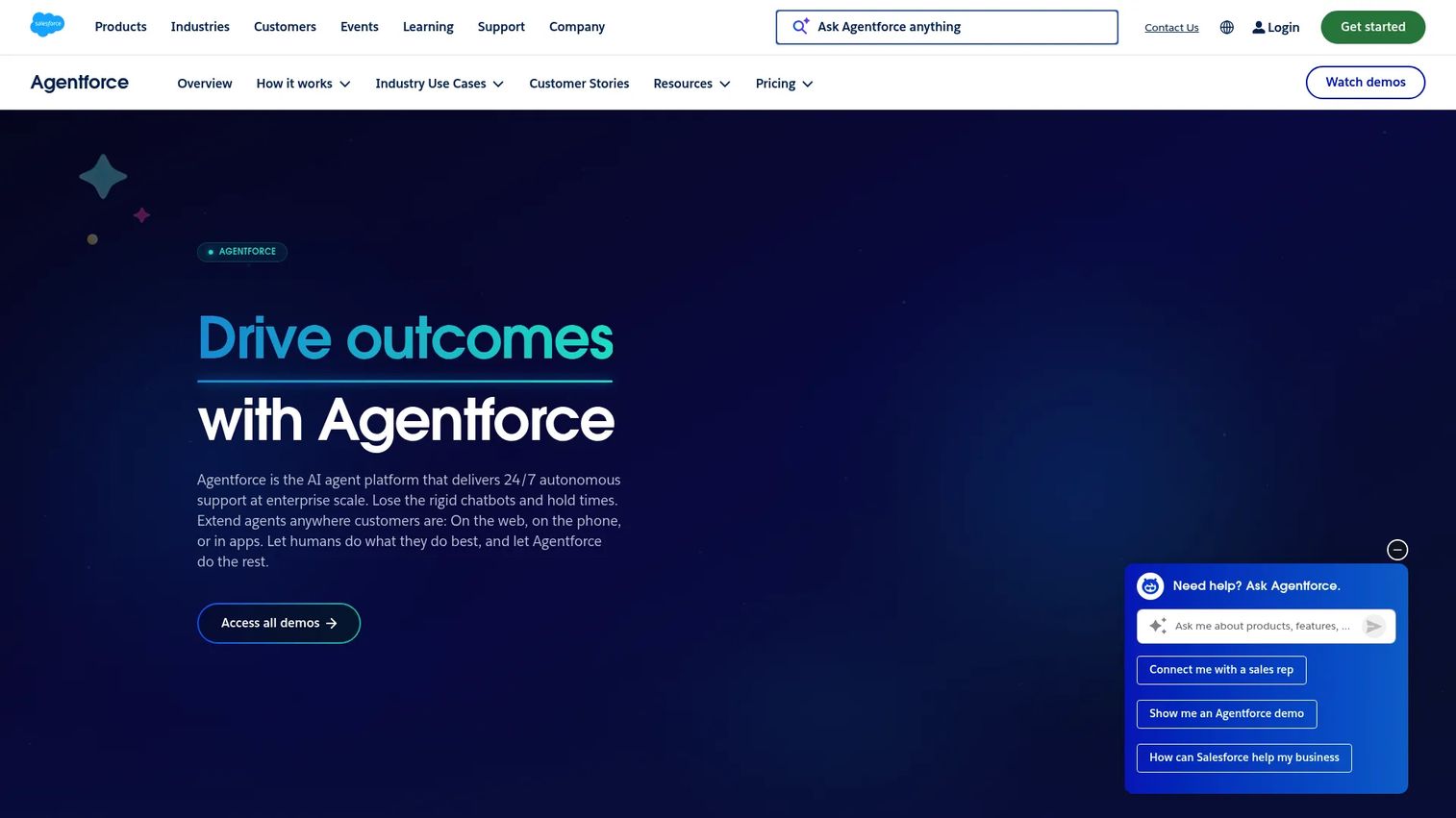
Salesforce Agentforce is Salesforce's AI agent platform for autonomous, 24/7 task execution across customer and employee workflows. Built directly into the Salesforce platform, it gives enterprise teams a low-code Agent Builder for configuring agents, subagents, and instructions tied to live CRM data. Agentforce supports multi-agent orchestration and connects to Salesforce Flows, MuleSoft APIs, and Apex.
Best for: Enterprise sales teams that want AI agents operating inside existing Salesforce processes and data.
Key features
- Low-code Agent Builder for custom agent configuration
- 24/7 autonomous action across web, phone, and messaging channels
- CRM-native integration with Salesforce Data Cloud and Flows
- Multi-agent orchestration for collaborative AI task execution
- Enterprise trust controls and audit logging
Why choose Salesforce Agentforce: Choose Agentforce when the sales org already runs on Salesforce and you want agents that read and write to CRM records without a middleware layer. Implementation success depends heavily on CRM data quality and admin ownership.
Salesforce Agentforce pricing: A free Foundations tier is available. Consumption-based pricing starts at $2 per conversation or $500 per 100k Flex Credits. User licensing starts at $5/user/month, with Agentforce add-ons from $125/user/month and Max Editions from $550/user/month.
G2 rating: 4.4/5
2. HubSpot Breeze AI
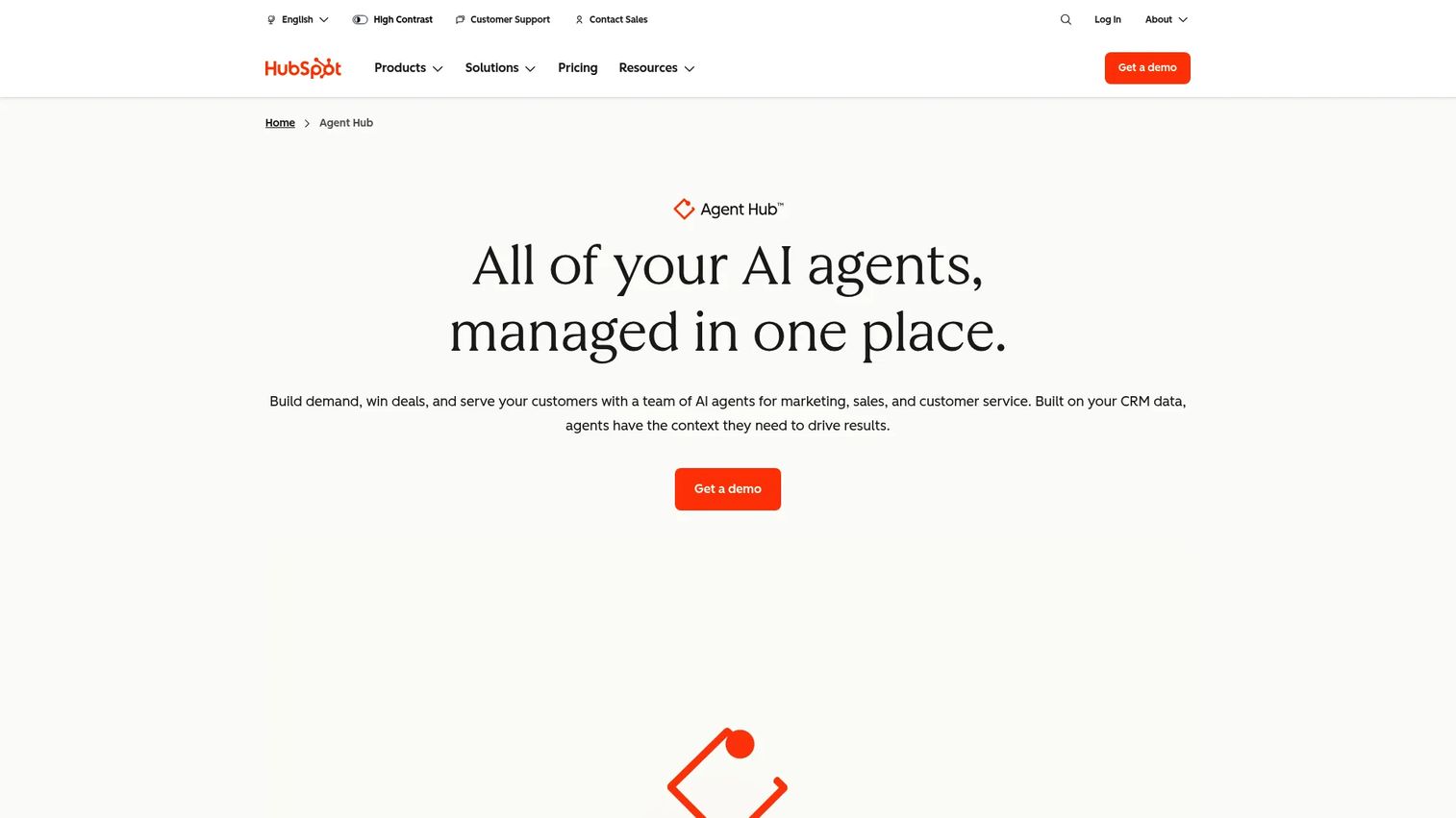
HubSpot Breeze AI is HubSpot's AI layer for sales, marketing, service, and CRM workflows. It includes AI agents for prospecting, closing, customer support, and knowledge-base management, alongside conversational AI for content generation, record summaries, and meeting preparation. Everything sits inside HubSpot's existing product suite without requiring a separate platform.
Best for: SMB and mid-market teams that want AI assistance embedded in HubSpot across both sales and marketing workflows.
Key features
- Prospecting agent for outbound research and contact identification
- Closing agent for deal assistance and next-step recommendations
- AI-powered content generation for pages, blogs, and email
- CRM-native record summaries and meeting preparation
- Data enrichment across HubSpot contact and company records
Why choose HubSpot Breeze AI: Strong choice when sales and marketing share the same HubSpot instance. Value compounds when both teams adopt it, since the agent draws on the full CRM context rather than a siloed data view.
HubSpot Breeze AI pricing: A free plan is available. Starter plans begin at $7/seat/month. Professional plans start at $800/month. Breeze AI capabilities vary by plan, with some agents requiring Starter or Professional tiers.
G2 rating: 4.4/5
3. Gong
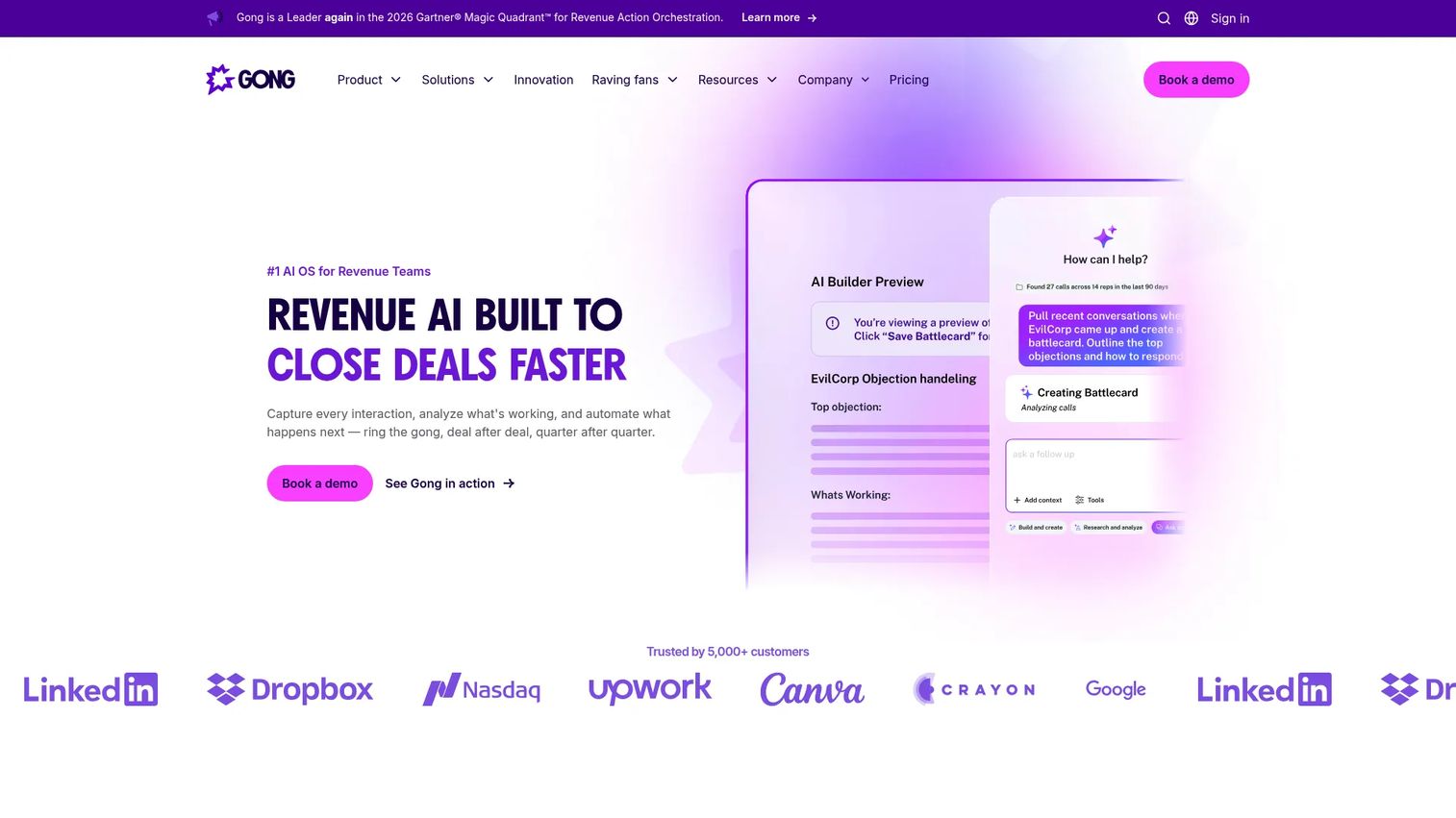
Gong is a Revenue AI platform that captures and analyzes customer interactions to surface coaching opportunities, deal risks, and forecast signals. It records and transcribes calls, identifies conversation patterns, flags pipeline risk from rep behavior, and helps managers coach reps with data rather than intuition. Gong is not an outbound prospecting tool. Its power is what happens after the first call.
Best for: Sales managers, RevOps leaders, and revenue teams who need data-driven coaching and deal visibility.
Key features
- Call recording, transcription, and conversation analysis
- Deal health tracking and risk flagging
- Sales coaching workflows with rep-level insights
- Forecast inspection tied to engagement signals
- Sales engagement for sequencing and follow-up
Why choose Gong: Choose Gong when the main bottleneck is execution quality and pipeline accuracy after meetings happen. If reps are having the right conversations but deals are still stalling, Gong surfaces why. It is an assistive intelligence layer, not an AI SDR replacement.
Gong pricing: Gong prices by team size, per-user license, and a platform fee. Contact Gong for a customized proposal. G2 reviewers report pricing varies significantly by contract size and term.
G2 rating: 4.7/5
4. Microsoft Dynamics 365 Sales
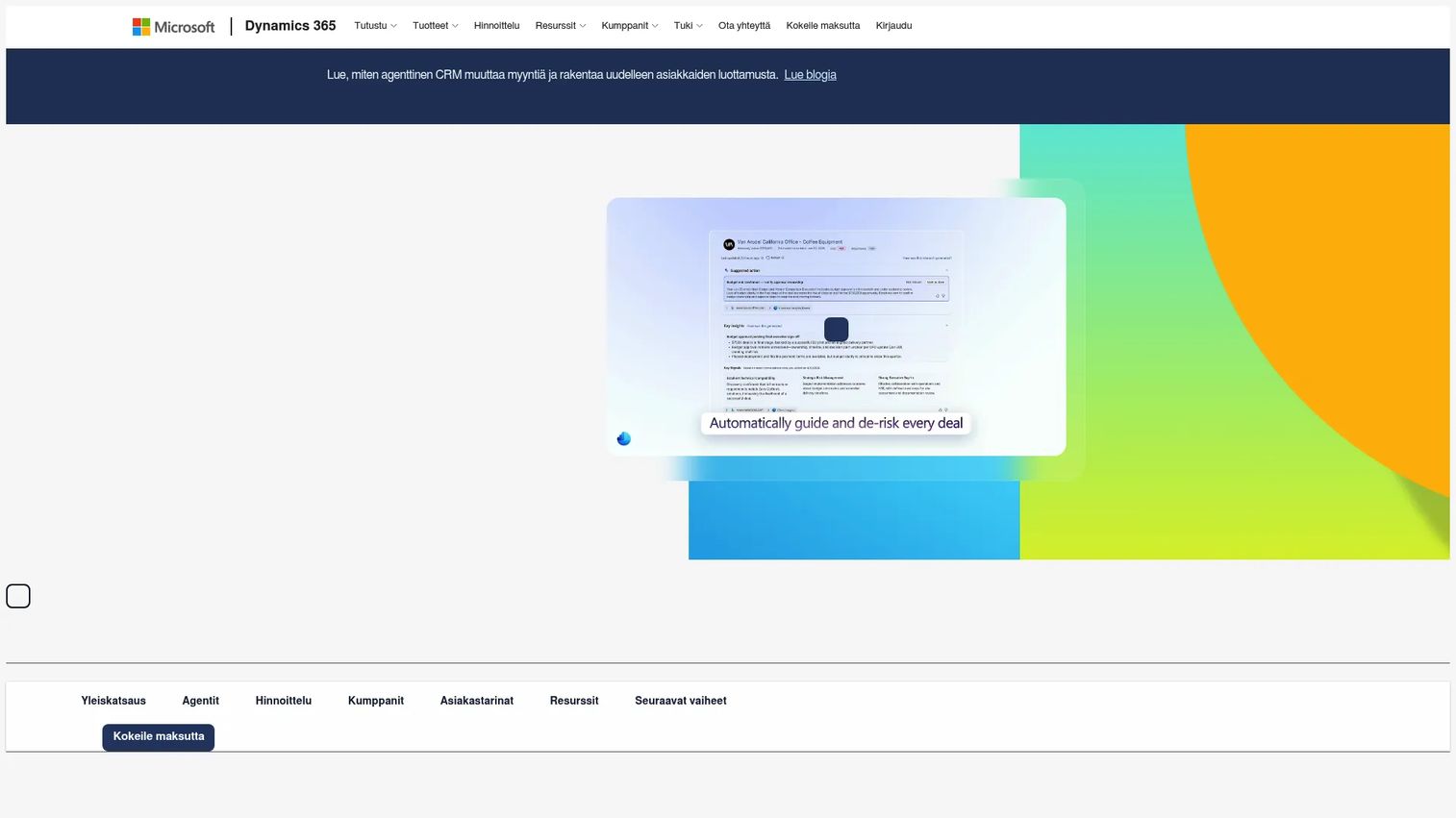
Microsoft Dynamics 365 Sales is an agentic CRM for organizations standardized on the Microsoft stack. It integrates Copilot assistance directly into Dynamics, Outlook, and Teams, giving reps context-aware support inside tools they already use. The Premium tier adds advanced sales intelligence and 1,000 Copilot Credits for agentic task execution.
Best for: Sales teams operating inside a Microsoft-first environment who want AI embedded in their existing workflow without a new platform.
Key features
- Copilot AI assistance inside Dynamics and Outlook
- Pipeline management, forecasting, and reporting dashboards
- Sales force automation from lead capture to close
- Teams meeting context and CRM record updates
- Microsoft 365 integration across the full sales workflow
Why choose Microsoft Dynamics 365 Sales: Strong fit when the organization is already committed to Microsoft infrastructure. Buyers should evaluate Copilot packaging, Dynamics configuration requirements, and licensing before assuming Copilot features are included at every tier.
Microsoft Dynamics 365 Sales pricing: Professional starts at $65/user/month (paid yearly). Enterprise is $105/user/month. Premium, which adds agentic AI and Copilot Credits, is $150/user/month. A free trial is available.
G2 rating: 3.8/5
5. Zoho CRM
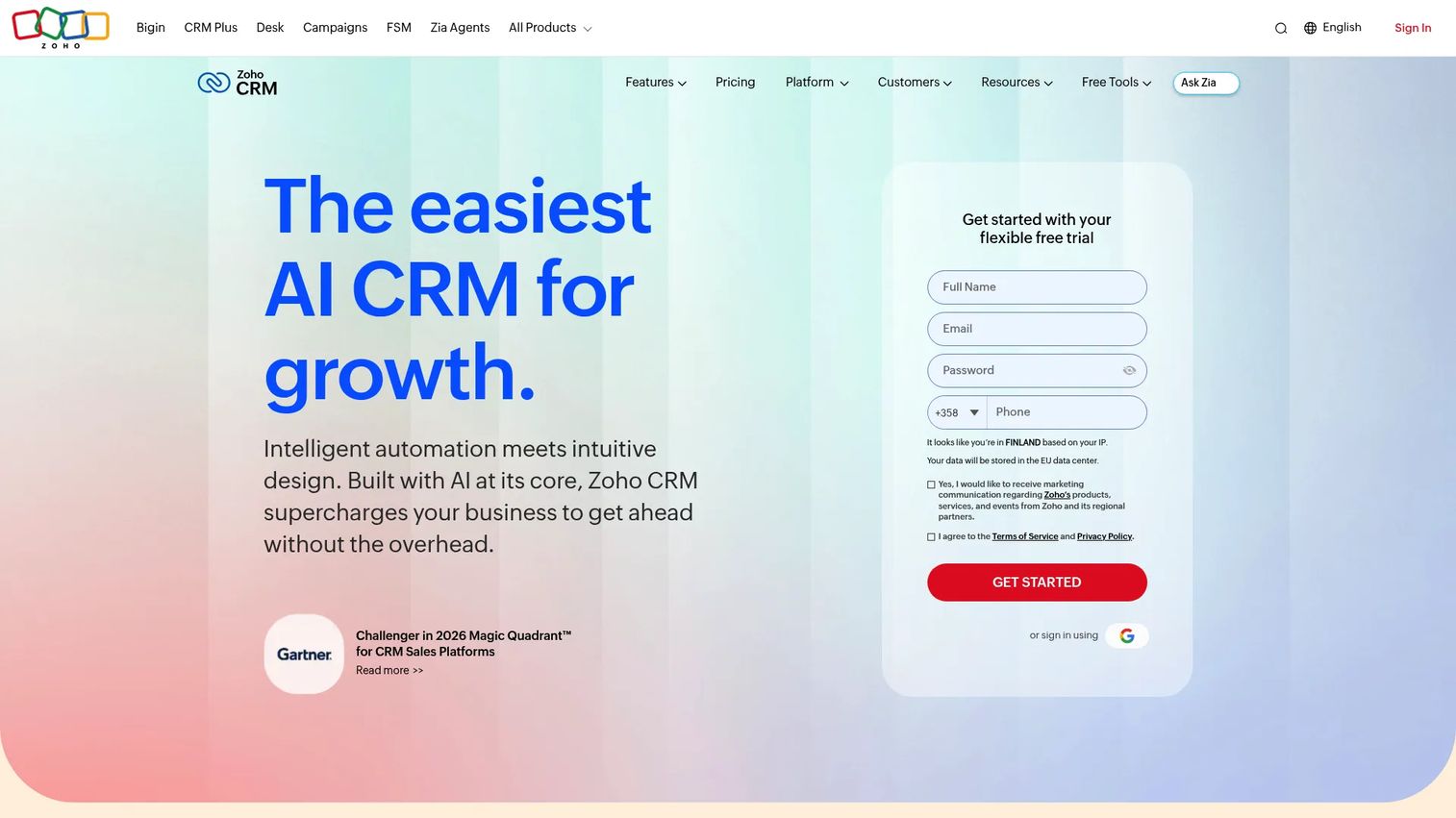
Zoho CRM is an AI-assisted CRM with Zia, Zoho's built-in AI engine for sales insights, lead scoring, workflow automation, and anomaly detection. It supports highly customizable layouts, cadences, and processes without requiring engineering. Zia is not a standalone outbound agent. It works best as an AI layer on top of CRM data that the sales team already manages.
Best for: SMB sales teams that want AI-assisted CRM automation at a price point that doesn't require enterprise procurement.
Key features
- Zia AI for lead scoring, suggestions, and anomaly detection
- Sales-process automation with blueprints and cadences
- Customizable modules, layouts, and Canvas pages
- Analytics dashboards and forecasting reports
- Email intelligence and engagement tracking
Why choose Zoho CRM: Good option when budget drives the decision and the team wants a CRM with AI built in rather than bolted on. Zia delivers more value when sales operations takes time to configure the workflows it uses.
Zoho CRM pricing: A free edition covers up to 3 users. Standard plans start at $14/user/month and Professional at $23/user/month, both billed monthly or annually.
G2 rating: 4.1/5
6. SalesCloser
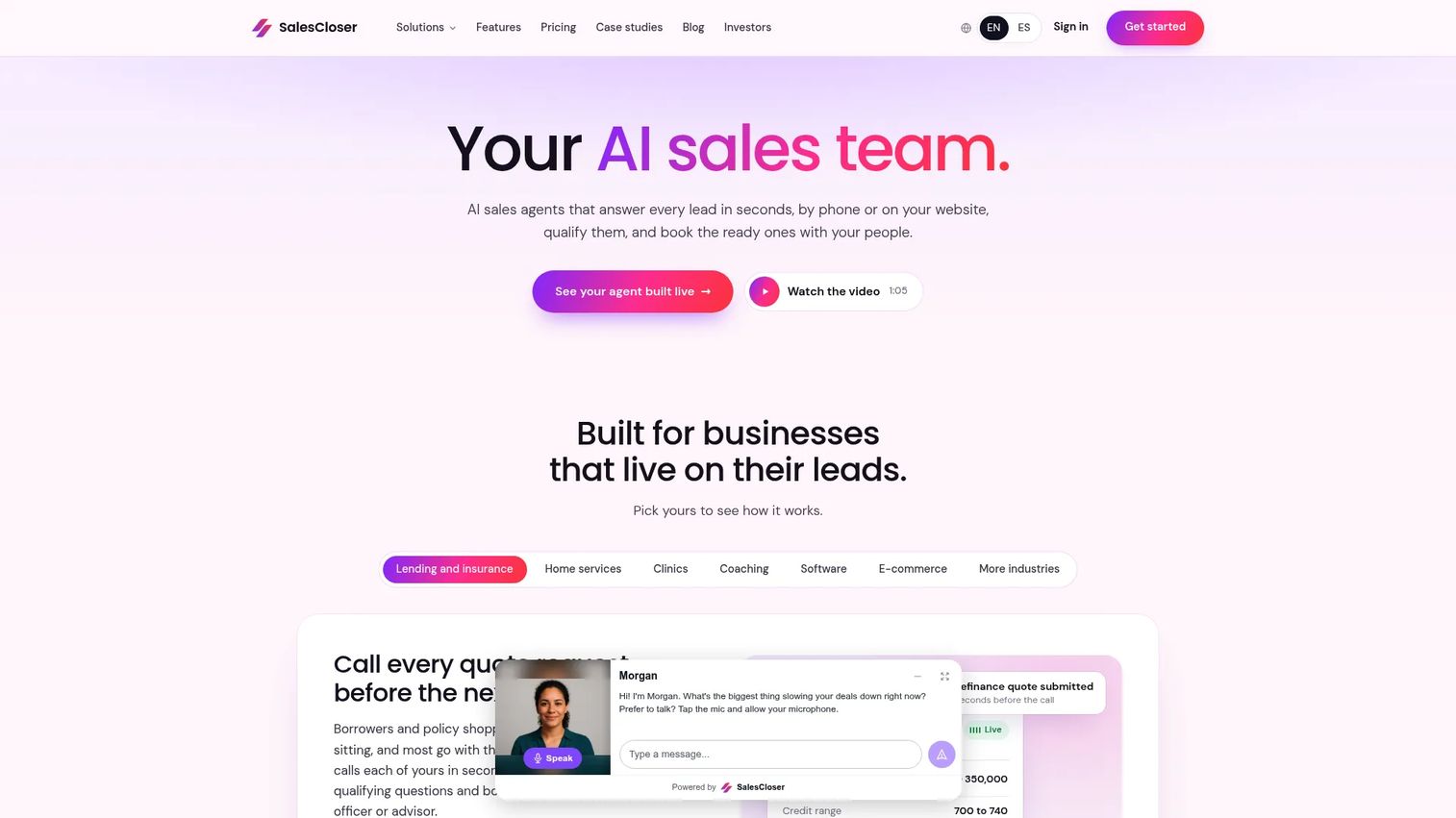
SalesCloser deploys AI sales agents across website chat, voice, video, phone, and WhatsApp. It engages inbound leads, qualifies them against configured criteria, answers product questions, books appointments, and hands off to human reps when the conversation requires it. SalesCloser is primarily an inbound lead engagement tool, not a CRM or outbound sequencing platform.
Best for: Teams that need AI agents to handle live lead conversations across multiple channels around the clock.
Key features
- Website chat, voice, video, and WhatsApp agent coverage
- Lead qualification and calendar booking
- Outbound calling campaigns and callback scheduling
- CRM, Zapier, and Meta lead-ad integrations
- Configured human handoff rules
Why choose SalesCloser: Strong choice when the sales motion centers on live inbound conversations and appointment booking. Buyers should test handoff quality and answer accuracy before scaling, since the G2 rating reflects early-stage user feedback rather than a large review base.
SalesCloser pricing: Pricing is quote-based and determined by the number of agents, channels, and conversation volume. Contact SalesCloser directly for a demo and proposal.
G2 rating: 2.7/5
7. Creatio
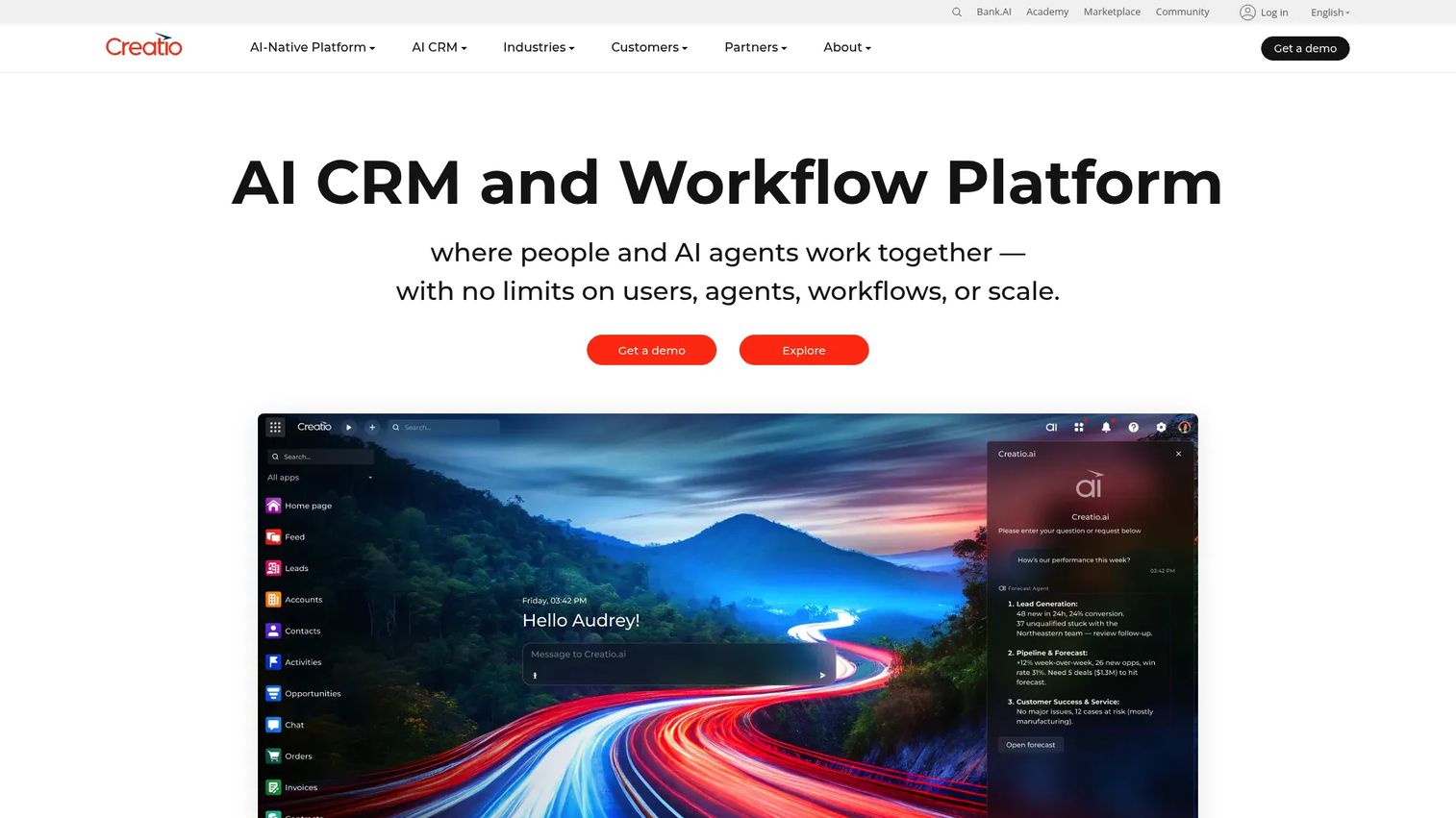
Creatio is an AI-native CRM and workflow platform for sales, marketing, and service teams that need extensive process customization without developer dependency. Its no-code environment lets sales operations configure agent workflows, automated processes, and CRM logic without filing engineering tickets. The AI agent library covers lead generation, next-best-step recommendations, and forecast support.
Best for: Mid-market and enterprise sales teams that need highly configurable CRM processes alongside AI agent automation.
Key features
- No-code workflow and application development
- AI agent library for configurable sales tasks
- Unified CRM for sales, marketing, and service
- Omnichannel customer engagement across channels
- Enterprise governance and observability controls
Why choose Creatio: Right choice when sales processes are complex and changing, and the team needs flexibility that generic CRMs don't provide. Note that Creatio requires a minimum purchase of $10,000 per year with a standard three-year contract, so it's sized for mid-market and above.
Creatio pricing: Sales, Marketing, and Service products each start at $15/user/month. Platform plans (Growth, Enterprise) range from $40 to $75/user/month. AI packages start at $5,000/year. The minimum commitment for new customers is $10,000/year.
G2 rating: 4.6/5
8. Salesforge.ai
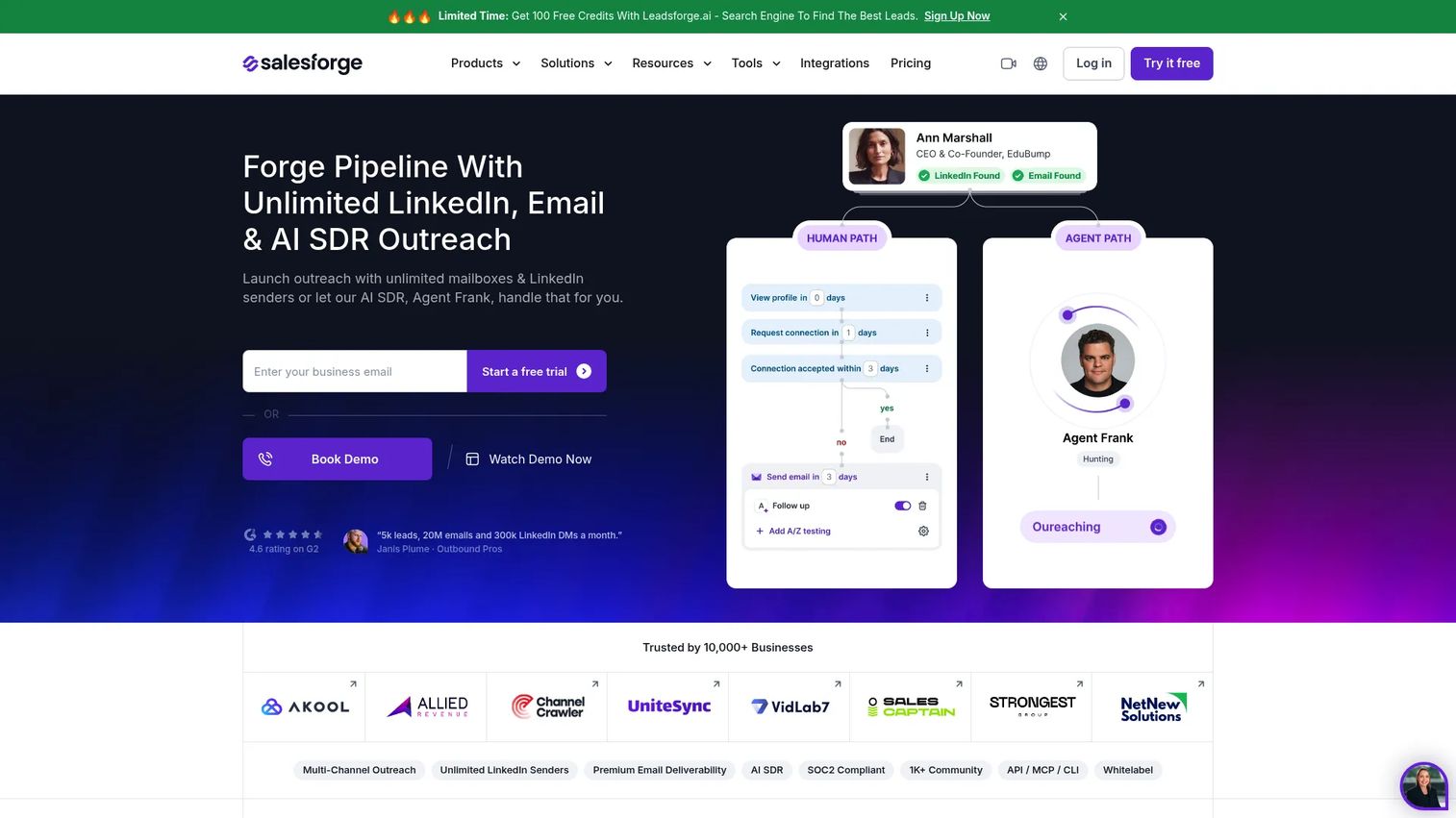
Salesforge.ai is an outbound sales engagement platform combining AI email personalization, LinkedIn outreach, mailbox management, deliverability monitoring, and Agent Frank, its built-in AI SDR. It handles multi-channel outbound campaigns with AI-generated personalization and a unified reply inbox called Primebox. This is a tool for SDR teams where outbound volume and personalization quality both matter.
Best for: Outbound sales teams scaling personalized email and LinkedIn campaigns without sacrificing deliverability.
Key features
- AI-personalized email and LinkedIn sequences
- Unlimited mailboxes and LinkedIn senders on Growth
- Agent Frank AI SDR for automated prospecting
- Primebox unified reply management
- Email warm-up and deliverability monitoring
Why choose Salesforge.ai: Strong pick when the outbound workflow needs both volume and personalization, and when deliverability is a persistent problem. Buyers should test tone control and sequence logic with real prospect data before committing.
Salesforge.ai pricing: Pro starts at $40/month (billed annually) for 1,000 active contacts and 5,000 emails/month. Growth is $80/month (billed annually) for 10,000 active contacts and 50,000 emails/month. Agent Frank is $499/month (billed annually).
G2 rating: 4.6/5
9. VoiceSpin
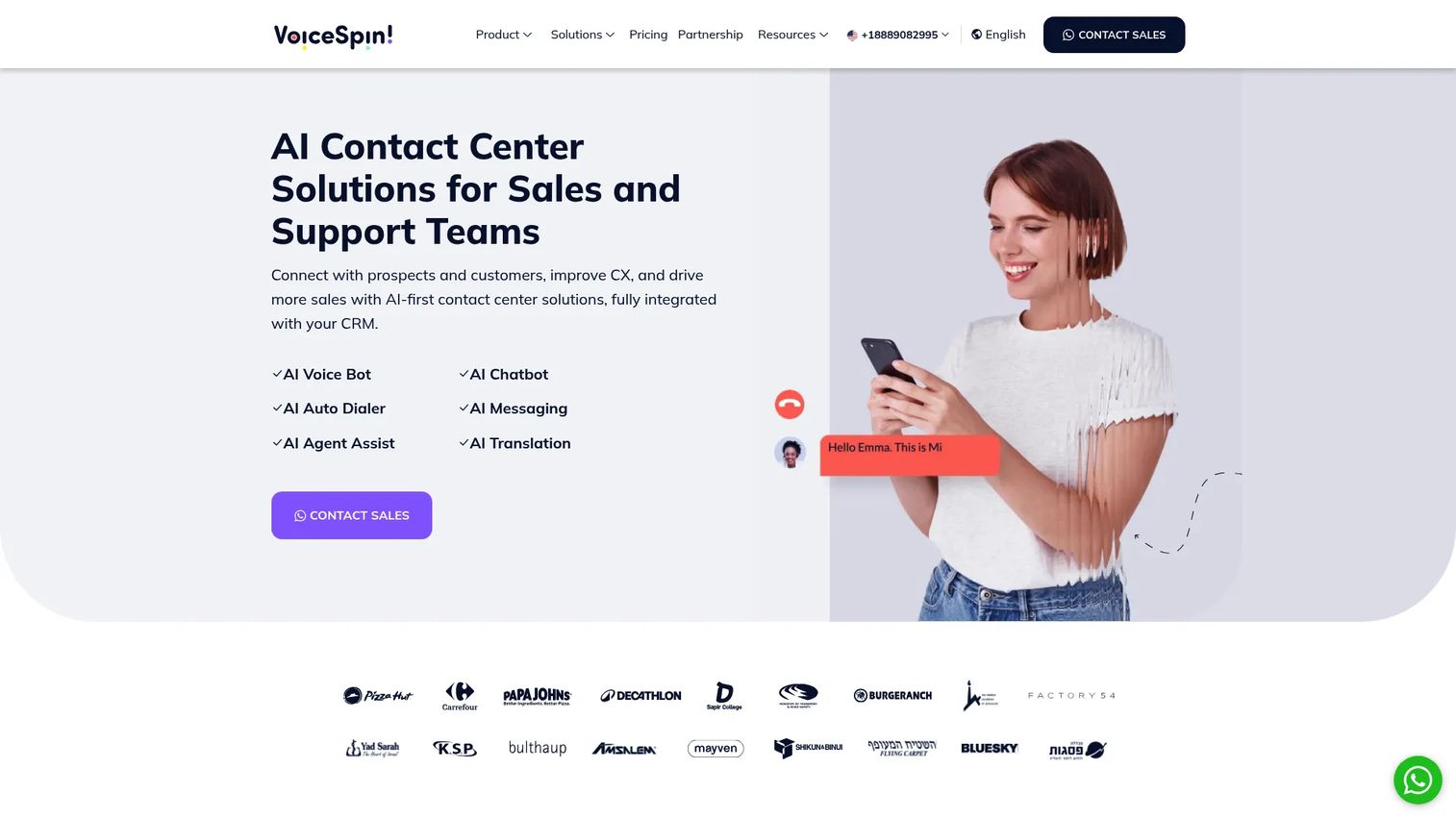
VoiceSpin is an AI-first contact center platform built for sales and support teams with high phone call volume. It combines an AI voice bot, predictive auto dialer, speech analytics, IVR, and omnichannel messaging in one platform. CRM integrations connect call activity to pipeline records. VoiceSpin suits teams where the phone is the primary sales channel.
Best for: Sales and support teams that run high-volume inbound or outbound phone operations and need AI automation across the calling workflow.
Key features
- AI voice bot and AI auto dialer
- AI speech analyzer for call quality and coaching
- Interactive Voice Response (IVR) and call routing
- Omnichannel messaging with SMS and chat
- CRM integrations and reporting dashboards
Why choose VoiceSpin: Strongest fit when phone conversion is the core sales motion and the team needs AI applied to the full calling workflow, from dialing through coaching. Evaluate call compliance requirements and list quality before rollout.
VoiceSpin pricing: Basic starts at $300/month (monthly) or $270/month (yearly) for 5 seats. Advanced starts at $525/month (monthly) or $472/month (yearly). Enterprise starts at $1,000/month (monthly) or $900/month (yearly). DID and call costs are not included.
10. Clay
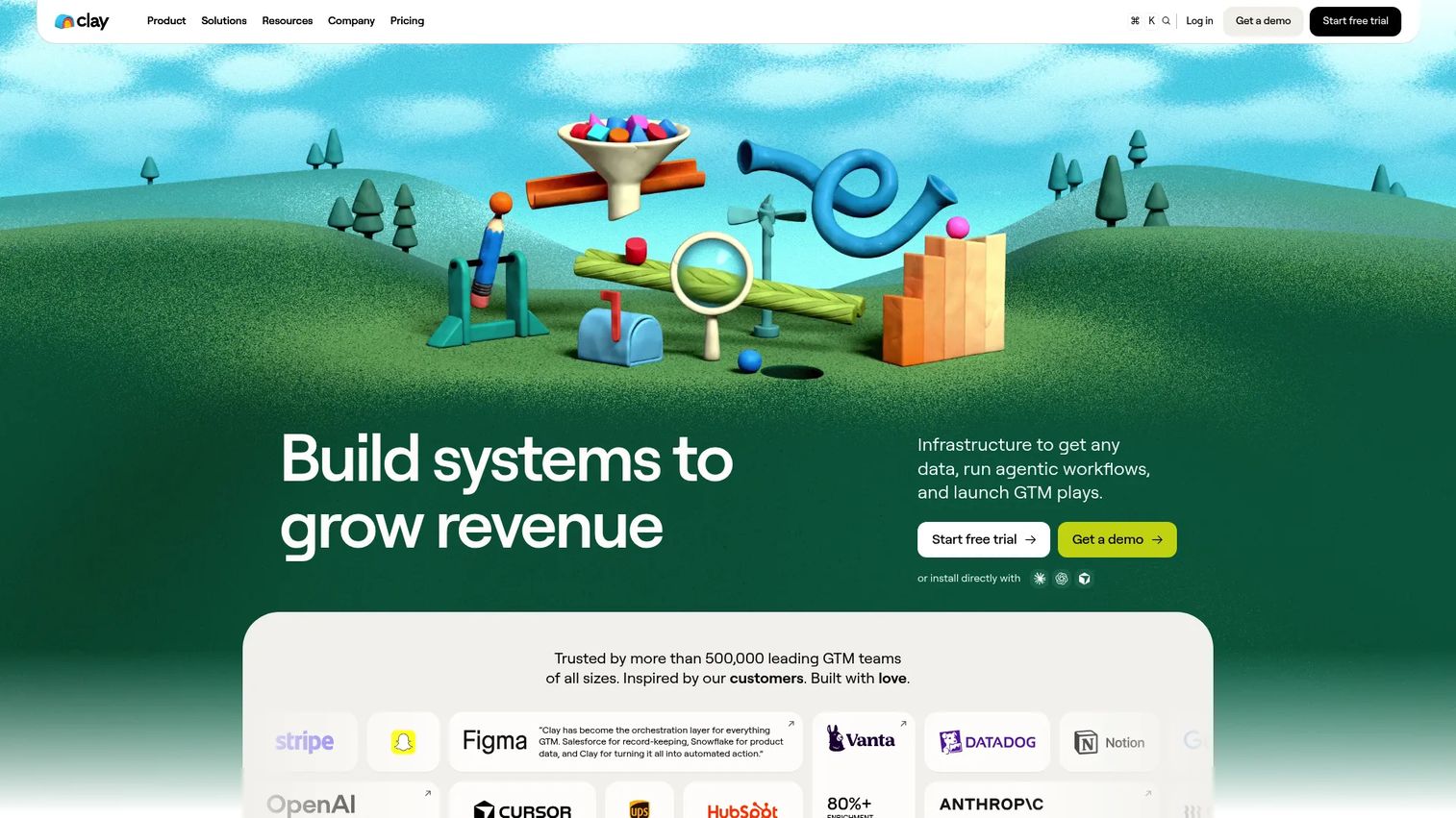
Clay is a go-to-market platform for data enrichment, AI research, intent signals, and audience building. Sales teams use it to build accurate prospect lists, enrich accounts with multi-provider data, run AI web research via its Claygent feature, and pipe enriched records into outbound execution tools or the CRM. Clay sits upstream of outreach, not inside it.
Best for: GTM teams where weak targeting or incomplete account data is the main drag on outbound results.
Key features
- Multi-provider data enrichment from a single interface
- Claygent AI web research for custom prospect data
- Job-change, intent, and social signal tracking
- CRM and data warehouse sync
- Audience building and activation for outbound and advertising
Why choose Clay: Choose Clay when the outbound problem is data quality rather than send volume. It pairs well with outbound execution platforms and sales automation software, but requires process discipline to get the most from the enrichment layer.
Clay pricing: Free tier includes 500 actions/month. Launch starts at $167/month (billed annually) or $185/month (billed monthly). Growth is $446/month (billed annually) or $495/month (billed monthly). Enterprise pricing is custom.
G2 rating: 4.6/5
11. Clari
Clari is a revenue orchestration platform that unifies pipeline management, forecasting, sales engagement, and customer retention workflows. RevOps and sales leadership use it to inspect deal health, improve forecast accuracy, and surface revenue risk before the quarter goes sideways. It is not a prospecting tool. Clari's value is downstream, in the deals already in motion.
Best for: Revenue teams and sales leadership who need reliable pipeline visibility and forecast accuracy across a team with real volume.
Key features
- AI-driven forecasting and pipeline management
- Opportunity management and deal inspection
- Conversation intelligence and rep coaching
- Mutual action plans and buyer collaboration tools
- Activity autocapture and CRM data alignment
Why choose Clari: Right fit when the pain is pipeline opacity and forecast misses rather than top-of-funnel gaps. Clari earns its value at scale. Smaller teams without enough deal volume may not see the return on the investment required.
Clari pricing: Custom pricing. Clari states there are no extra platform fees for integrations or ongoing support. Contact Clari to build a proposal based on team size and use case.
G2 rating: 4.6/5
12. Common Room
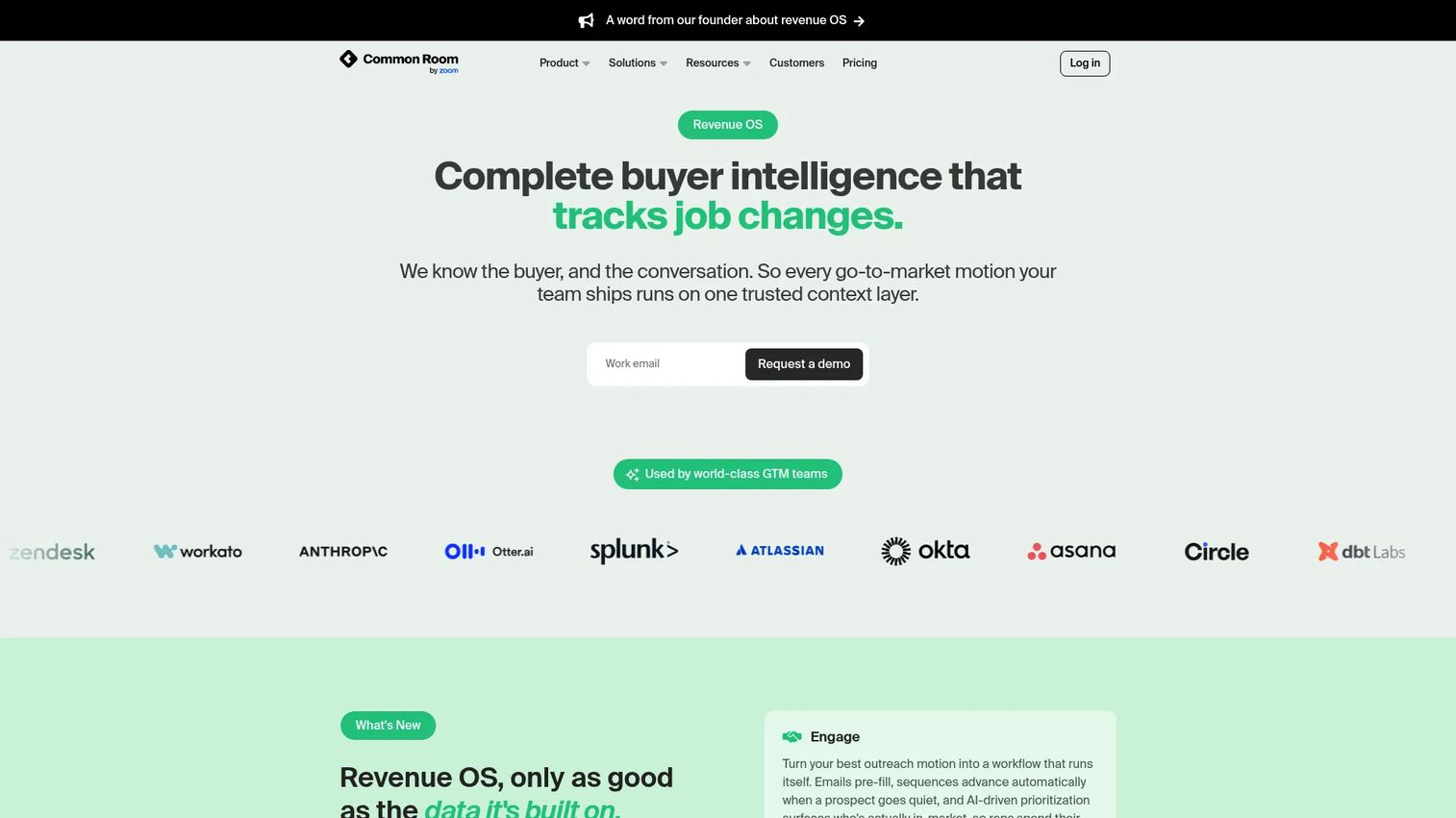
Common Room is a buyer-intelligence platform that aggregates product usage signals, CRM data, social activity, and community engagement into unified contact profiles. Sales teams use it to find accounts showing buying intent before those accounts fill out a form. RoomieAI and Prospector help reps act on signals with outreach recommendations and CRM sync.
Best for: B2B sales teams with meaningful product, community, or ecosystem activity that currently doesn't route into pipeline.
Key features
- Signal aggregation across product, CRM, social, and community data
- Person360 identity resolution for unified contact profiles
- Automated segments and engagement workflows
- RoomieAI research and Prospector for outreach
- Alerts, reporting, and CRM integration
Why choose Common Room: Strong fit when the best buyer signals are happening outside traditional lead forms, in product dashboards, Slack communities, LinkedIn activity, or GitHub. Teams need clear routing rules so signals translate into rep action rather than a data backlog.
Common Room pricing: Essential starts at $2,500/month (billed annually) for 5 seats and up to 100k contacts. Advanced and Enterprise tiers use custom pricing with expanded limits and dedicated CSM support.
G2 rating: 4.5/5
13. Fin for Sales
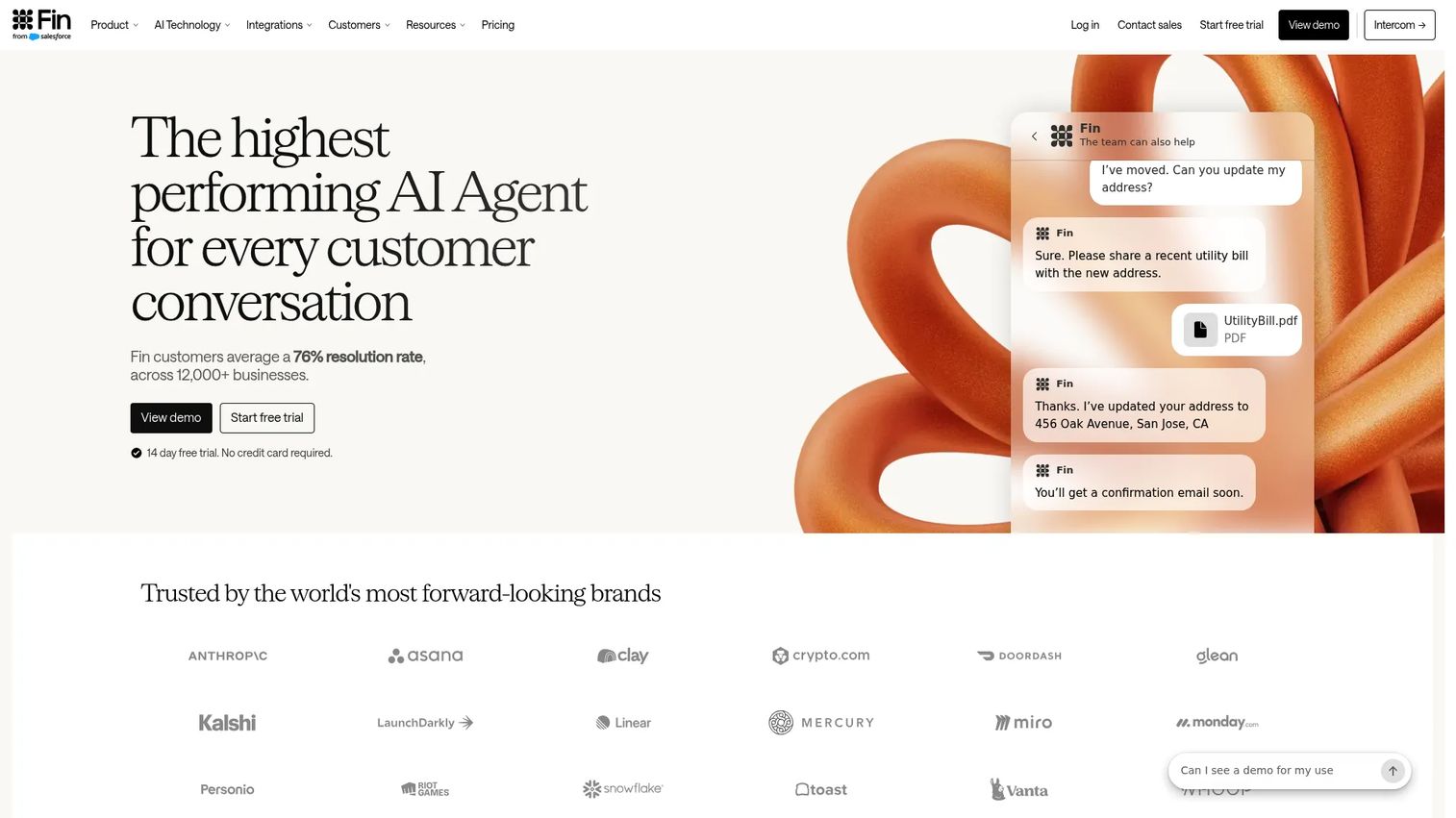
Fin for Sales is Intercom's AI agent for inbound sales conversations. It engages website visitors proactively, guides product discovery, qualifies leads against configured criteria, enriches CRM records, books meetings via Calendly or Chili Piper, and routes high-value prospects to human reps. Fin for Sales works across chat, email, WhatsApp, social, and SMS. It runs on a usage-based model tied to outcomes rather than seats.
Best for: B2B teams with inbound sales motions who want AI to cover prospect engagement without full-time staffing on every channel.
Key features
- Proactive prospect engagement across chat, email, and WhatsApp
- Product discovery, pricing answers, and objection handling
- Lead qualification, CRM enrichment, and intelligent routing
- Meeting booking with Calendly and Chili Piper
- Lead recovery, multilingual support, and performance reporting
Why choose Fin for Sales: Good fit when inbound volume exceeds rep capacity, especially across time zones. The usage-based pricing model rewards teams that see high outcome volume. Test escalation rules and answer accuracy carefully before full deployment.
Fin for Sales pricing: Requires an Intercom Essential, Advanced, or Expert plan. Self-serve routing, disqualification, and resolution are priced at $0.99 per outcome. Full qualification runs $9.99 per qualification. A 14-day free trial of sales outcomes is available.
G2 rating: 4.5/5
14. Qualified
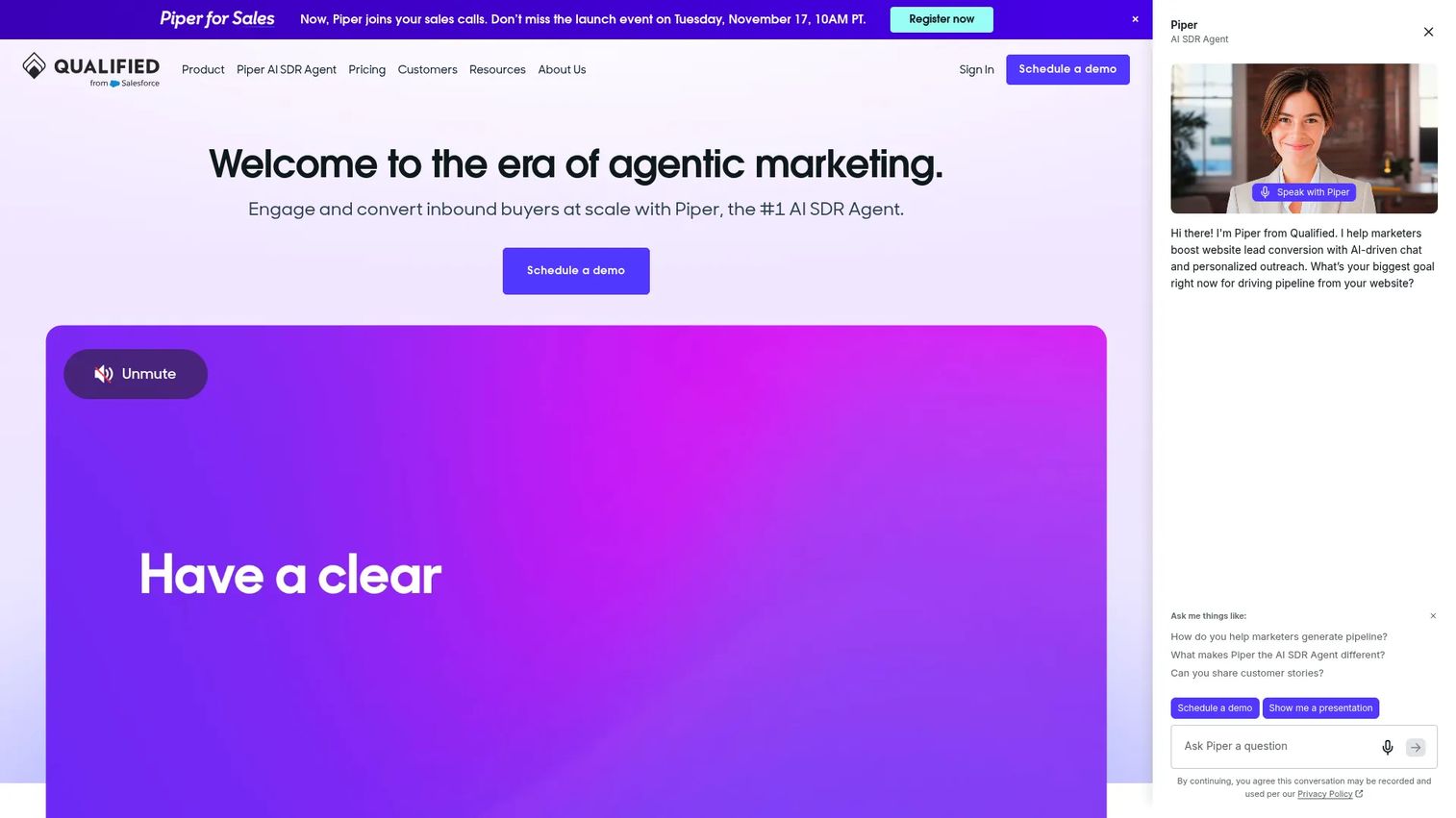
Qualified is a B2B agentic marketing platform featuring Piper, an AI SDR that engages website visitors via text, voice, video, and email. It identifies and enriches accounts in real time, qualifies intent signals, books meetings, routes conversations to the right rep, and syncs data to Salesforce. Qualified is purpose-built for B2B teams where the website is a primary pipeline source.
Best for: B2B marketing and revenue teams that want to convert high-intent website visitors into qualified pipeline at scale.
Key features
- AI SDR conversations via text, voice, video, and email
- Real-time account identification, enrichment, and intent scoring
- Meeting booking and intelligent routing workflows
- Pipeline analytics and engagement reporting
- Deep Salesforce integration with sandbox support on Enterprise
Why choose Qualified: Strong choice when website traffic is meaningful and the gap is conversion, not traffic. It performs best with strong routing logic, a well-defined qualification model, and a Salesforce-based CRM. Pricing requires a sales conversation for all three tiers.
Qualified pricing: Three tiers, Premier, Enterprise, and Ultimate, are available. All are priced on request. Premier covers core AI SDR features. Enterprise adds agent handoff and API access. Ultimate adds multiple agent profiles and high-volume contact databases.
G2 rating: 4.9/5
15. 11x
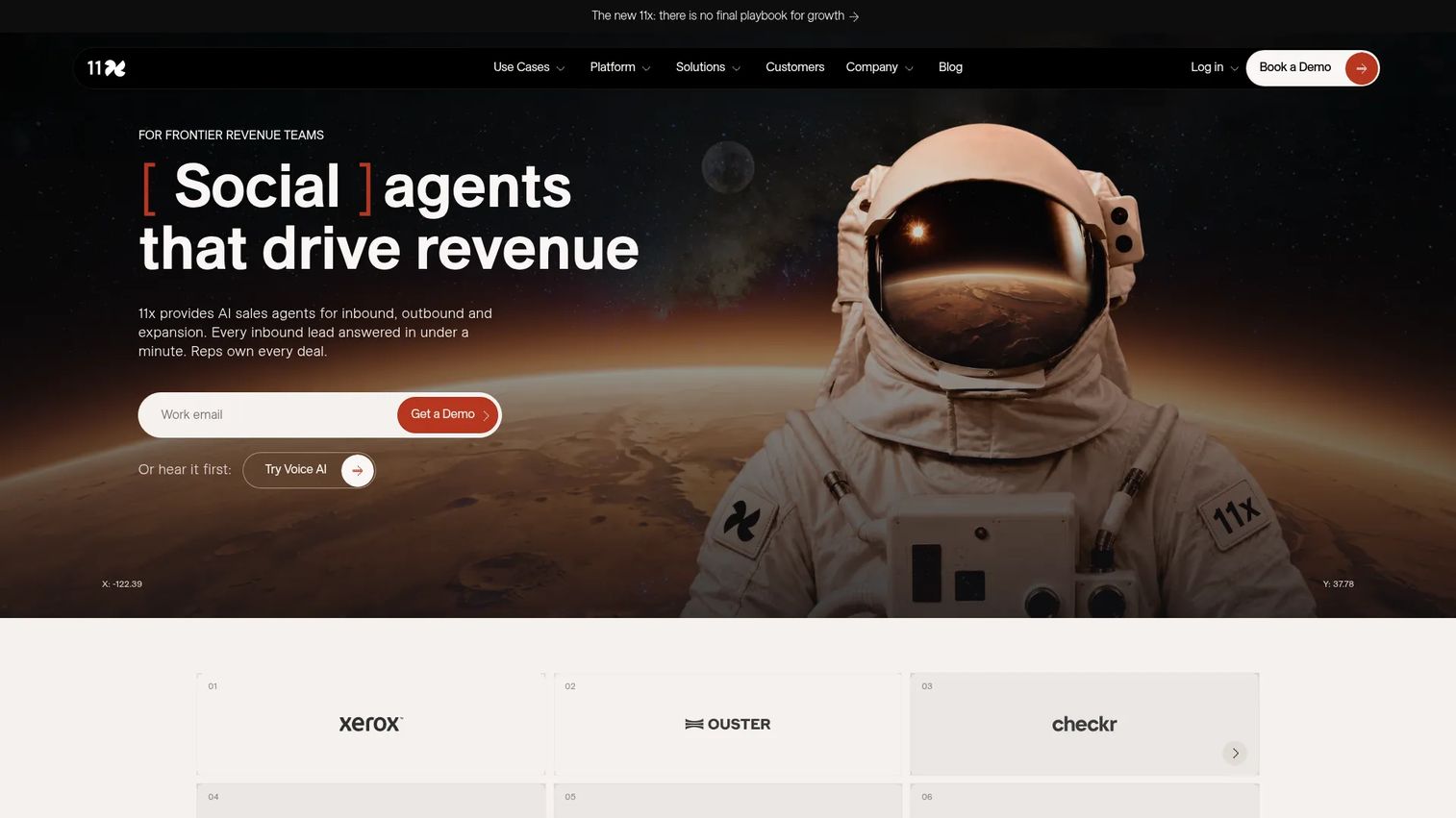
11x is an AI go-to-market platform with autonomous digital workers for outbound prospecting and inbound lead response. Alice handles outbound: Prospect identification, personalized multi-channel outreach, reply handling, and meeting booking. Julian handles inbound: Responding to leads in under 60 seconds via phone, chat, SMS, or WhatsApp, then qualifying and routing. Both workers integrate with CRM systems and run ongoing without rep intervention.
Best for: Revenue teams testing autonomous SDR capacity for outbound prospecting or rapid inbound lead response.
Key features
- Alice: Outbound prospecting, research, and meeting booking
- Julian: Inbound lead response in under 60 seconds
- Multi-channel outreach across email, LinkedIn, phone, and chat
- CRM integration, deliverability monitoring, and analytics
- Live web research and lead qualification
Why choose 11x: Right pick for teams that want to test whether autonomous digital workers can absorb the repetitive parts of an SDR workflow. Run a controlled pilot before shifting quota assumptions, and define clear escalation rules for deals that need a human touch.
11x pricing: Alice Growth starts at $3,750/month (billed annually). Julian Chat Growth starts at $2,417/month (billed annually). Julian Voice Growth starts at $5,333/month (billed annually). Alice Pro and Enterprise use custom pricing. No free tier is available.
G2 rating: 4.5/5
Considerations when choosing AI sales agents
Match the agent to the workflow
Inbound qualification, outbound prospecting, coaching, forecasting, and CRM cleanup are different jobs. A tool that handles one well rarely handles all of them at the same level. Define the specific bottleneck first, then match the tool to it. Buying a generic "AI for sales" platform and hoping it covers everything is how you end up with another underused system.
Check CRM and calendar integration depth
AI sales agents need clean access to the systems where sales work happens. Evaluate how the tool connects to your CRM (Salesforce, HubSpot, Dynamics, or Zoho), your calendar, and your existing sales engagement platform. Surface-level integrations that require manual data entry defeat the purpose. Look at how records are created, what triggers them, and what happens when the agent makes an error.
Define human handoff rules before launch
Every AI agent needs clear rules for when it stops and a rep takes over. Pricing objections, enterprise stakeholder introductions, security questions, competitor mentions, and low-confidence answers should all trigger a handoff. Teams that skip this step end up with an agent that closes conversations it should escalate. Test handoff behavior with real objection scenarios, not vendor demo scripts.
Model the total cost, not just the subscription
Software pricing is one input. Add implementation time, data cleanup, compliance review, workflow design, rep training, and ongoing monitoring. Some tools require dedicated admin ownership to stay effective. Per-seat pricing that scales aggressively as the team grows is a flag to review carefully before signing.
Test with real sales conversations, not vendor demos
Vendor demos show the agent at its best. Production performance depends on your lead source quality, CRM data, objection mix, and routing setup. Run a pilot with actual leads, real objection scenarios, and rep review before committing to a full rollout. This matters more for autonomous agents than for assistive ones.
Conclusion
The best AI sales agents in 2026 are not the ones with the most features. They're the ones that own a specific workflow without creating a new handoff problem.
For enterprise teams on Salesforce, Agentforce is the strongest CRM-native choice. HubSpot teams get the most value from Breeze AI without leaving their existing platform. Gong remains the most defensible choice for coaching and pipeline intelligence. Clay is the highest-leverage investment when outbound data is the constraint. Qualified and 11x are worth serious evaluation for teams with meaningful website traffic or enough outbound volume to justify autonomous SDR capacity. Clari belongs in any RevOps stack where forecast accuracy is under pressure.
Pick one workflow, pick the tool that fits it, and run a measured pilot. AI sales agents only earn their place when the data is clean, the handoff rules are defined, and the outcome is measurable.
Start your journey with Guideflow today!
FAQs
An AI sales agent is software that uses artificial intelligence to perform or assist sales tasks such as prospecting, lead qualification, follow-up, meeting booking, CRM updates, coaching, and forecasting. The level of autonomy varies significantly by product. Some agents require rep approval for each action; others execute entire workflows without human involvement.
Traditional chatbots follow scripted decision trees. AI sales agents can use context from CRM records, prior conversations, and account signals to take goal-directed action, update systems, trigger downstream workflows, and hand off to reps with full context. The key difference is that agents act on objectives rather than just responding to inputs.
An AI SDR focuses specifically on prospecting, outreach, qualification, and meeting booking, typically handling the top of the funnel. An AI sales agent is a broader category that may also include coaching, deal support, CRM automation, and forecasting. Many tools marketed as AI sales agents are actually AI SDRs with a wider feature set.
Pricing varies by model, seat count, usage volume, CRM tier, and add-ons. Assistive tools embedded in existing CRMs, such as Zoho's Zia or HubSpot Breeze, can start under $25/user/month. Specialist platforms like Clay start around $167/month for teams. Autonomous SDR products like 11x start at $2,417/month per product, billed annually. Model total cost including implementation, data cleanup, and admin time before comparing subscription prices.
They can automate repetitive and high-volume tasks: Prospecting research, sequence execution, inbound response, meeting booking, and CRM updates. They do not replace rep judgment in complex discovery, enterprise negotiation, security conversations, or relationship-driven deals. The teams that see the most value use AI agents to handle repeatable work so reps focus on the conversations that actually close.
Test with real lead sources, actual CRM data, representative objections, and your existing routing setup. Evaluate how the agent handles a pricing objection, a competitor mention, and a question it wasn't trained on. Check that escalation to a human rep works correctly and that CRM records are created accurately. A controlled pilot with a named set of leads is more informative than any vendor-led demonstration.
The right choice depends on your existing stack and inbound volume. Fin for Sales works well for teams with high chat and email volume that want usage-based pricing tied to outcomes. Qualified fits B2B teams with significant website traffic and a Salesforce-centered workflow. 11x's Julian handles rapid response across voice and chat for teams that want autonomous inbound coverage.
Outbound fit depends on data quality, personalization controls, deliverability setup, and CRM sync. Clay is the strongest upstream enrichment and research layer. Salesforge.ai handles multi-channel outreach with built-in deliverability management. 11x Alice manages the full outbound cycle autonomously, from prospect identification through meeting booking. Poor targeting cannot be fixed by AI copy alone, so start with the data layer before adding automation on top. For a broader view of agentic AI platforms that extend beyond sales, see our separate guide.