Your campaign backlog did not shrink when AI arrived. It got louder. More variants, more nurture logic, more reports, more pressure to prove pipeline instead of activity. According to Basis (2026), 51.1% of marketing organizations now use AI agents, up 155.5% year over year. That number tells you adoption is accelerating. It does not tell you which tool will finish the job inside your stack.
The honest framing: AI marketing agents can reduce repetitive execution work, but only when data, integrations, and approval workflows are solid underneath them. If your lifecycle stages are messy, the agent will automate messy. Start with the workflow, not the vendor demo.
This guide evaluates 15 platforms across campaign automation, lead qualification, content production, lifecycle orchestration, and marketing automation to help you pick the right fit without adding stack chaos.
What's inside
This guide is for growth marketers, demand gen managers, and marketing ops leads evaluating AI marketing agents for real campaign work in 2026.
- Tools covered: 15 platforms spanning enterprise suites, lifecycle platforms, no-code automation builders, and content agents
- Selection criteria:
- Real marketing workflow coverage, not generic AI claims
- Stack integrations with CRM, CDP, MAP, and ad platforms
- Human approval and governance controls
- Pricing clarity and fit across startup, mid-market, and enterprise
TL;DR
- Best enterprise campaign agent: Salesforce Agentforce, strongest when marketing and customer data already live in Salesforce
- Best for HubSpot teams: HubSpot Breeze, native AI inside a familiar CRM and marketing automation interface
- Best for cross-channel lifecycle teams: Blueshift Launchpad or BrazeAI Agent Console, depending on your engagement platform
- Best for ecommerce lifecycle marketing: Klaviyo Marketing Agent (K:AI), purpose-built for revenue-per-recipient outcomes
- Best for custom marketing agents: Relevance AI, for teams that want agents built to their exact workflows
- Best for automation builders: Zapier for no-code breadth, Make for visual scenario control, n8n for technical teams who need self-hosting
- Watch the data layer: Weak events, duplicate contacts, and broken attribution will make any agent perform worse than it should
What are AI marketing agents?
AI marketing agents are software systems that can plan, create, execute, optimize, or report on marketing work with some level of autonomy, usually within guardrails a marketer sets. They differ from adjacent categories this way:
- Assistants: Respond to prompts and help with specific tasks
- Copilots: Work alongside a marketer inside an existing platform
- Agents: Pursue a goal across multiple steps, tools, and data sources with minimal hand-holding
- Traditional automation: Follows predefined rules and trigger-based logic humans configure in advance
The capabilities that distinguish AI agents from earlier automation include goal-based campaign planning, audience segmentation and prioritization, lead scoring and qualification, lifecycle journey orchestration, content creation across formats, send-time and channel optimization, and reporting with anomaly detection.
Governance matters as much as capability. Strong marketing agent platforms include approval controls, audit logs, brand voice guardrails, role-based access, PII handling rules, and opt-out logic. Platforms that skip these push all the risk back onto the marketer.
One practical caution worth repeating: AI marketing agents are only as useful as the customer, event, consent, and attribution data they can read. Poor UTM discipline, missing lifecycle stages, and duplicate contact records do not get fixed by adding an agent. They become the agent's output.
For teams exploring the agentic AI platforms landscape more broadly, the same data-readiness principle applies across categories.
When to use AI marketing agents
Qualify and route leads faster
Agents score inbound leads, enrich accounts, summarize intent signals, and trigger the right nurture flow or SDR alert. This works best when lifecycle stages, CRM ownership rules, and scoring thresholds are already defined. Without that foundation, the agent routes noise, not intent.
Build campaign variants without waiting on every team
Marketers use agents to draft email copy variants, ad headlines, audience segments, and follow-up sequences. The key phrase is "draft." Human approval before launch is not optional for regulated content, legal claims, or any copy that speaks to price or compliance. Start with low-risk content like subject line tests before letting agents write customer-facing claims autonomously.
Turn campaign data into next actions
Agents can summarize performance across segments, flag when a metric shifts outside expected ranges, and recommend the next test to run. This is where growth marketers who need to prove pipeline impact to RevOps get the most immediate value. Attribution your CFO will believe starts with clean data, not a smarter dashboard.
AI marketing agents comparison
Shortlist by stack fit first, then workflow depth, then governance. The table below gives you a starting orientation, not the buying decision.
| # | Product | Best for | Key differentiator | Pricing | G2 rating |
|---|---|---|---|---|---|
| 1 | Salesforce Agentforce | Enterprise Salesforce teams | Autonomous agents across Salesforce CRM and data | From $0 (Foundations); $2/conversation | 4.3/5 |
| 2 | HubSpot Breeze | HubSpot-centric growth teams | Native AI agents inside HubSpot CRM and marketing hub | From $7/mo/seat | 4.3/5 |
| 3 | Blueshift Launchpad | Cross-channel lifecycle teams | Conversational AI for segmentation and campaign execution | From $1,250/mo | 4.4/5 |
| 4 | BrazeAI Agent Console | Mobile and lifecycle engagement teams | Agentic orchestration inside Braze Canvas workflows | Custom pricing | 4.5/5 |
| 5 | Iterable Nova Agent | Lifecycle marketing teams | Conversational AI for journey creation and campaign analysis | Custom pricing | 4.4/5 |
| 6 | Klaviyo Marketing Agent (K:AI) | Ecommerce and retail marketers | AI for commerce messaging and customer journey automation | Free plan available; paid varies by volume | 4.6/5 |
| 7 | Adobe Journey Optimizer | Enterprise experience teams | Real-time omnichannel journey orchestration with AI decisioning | Custom pricing | 4.2/5 |
| 8 | Relevance AI | Teams building custom marketing agents | No-code and low-code AI agent workforce builder | Custom pricing | 4.3/5 |
| 9 | Zapier | No-code marketing automation | AI workflows across 9,000+ apps | Free plan; from $19.99/mo | 4.5/5 |
| 10 | Jasper AI | Brand-led content teams | Brand voice controls and campaign content generation | From $59/seat/mo (annual) | 4.7/5 |
| 11 | Copy.ai | GTM content operations | Workflow-based AI content for sales and marketing copy | From $24/mo (annual) | Ratings vary by listing |
| 12 | Lindy AI | Lean teams automating repetitive ops | AI agents for email, meetings, CRM tasks, and lead workflows | Free plan; from $29.99/mo | 4.9/5 |
| 13 | Make | Visual automation builders | Flexible visual scenario automation with AI workflow support | Free plan; paid plans available | Not confirmed |
| 14 | n8n | Technical marketing ops teams | Self-hostable automation with AI workflow nodes | From 20€/mo (annual cloud) | 4.7/5 |
| 15 | OfferFit | Experiment-heavy lifecycle teams | Self-learning decisioning for offer and channel personalization | Custom pricing | 4.6/5 |
Best 15 AI marketing agent tools for 2026
Each entry focuses on workflow fit, not raw feature count. The question for every tool: Can it finish a meaningful marketing job inside the stack you already run?
1. Salesforce Agentforce
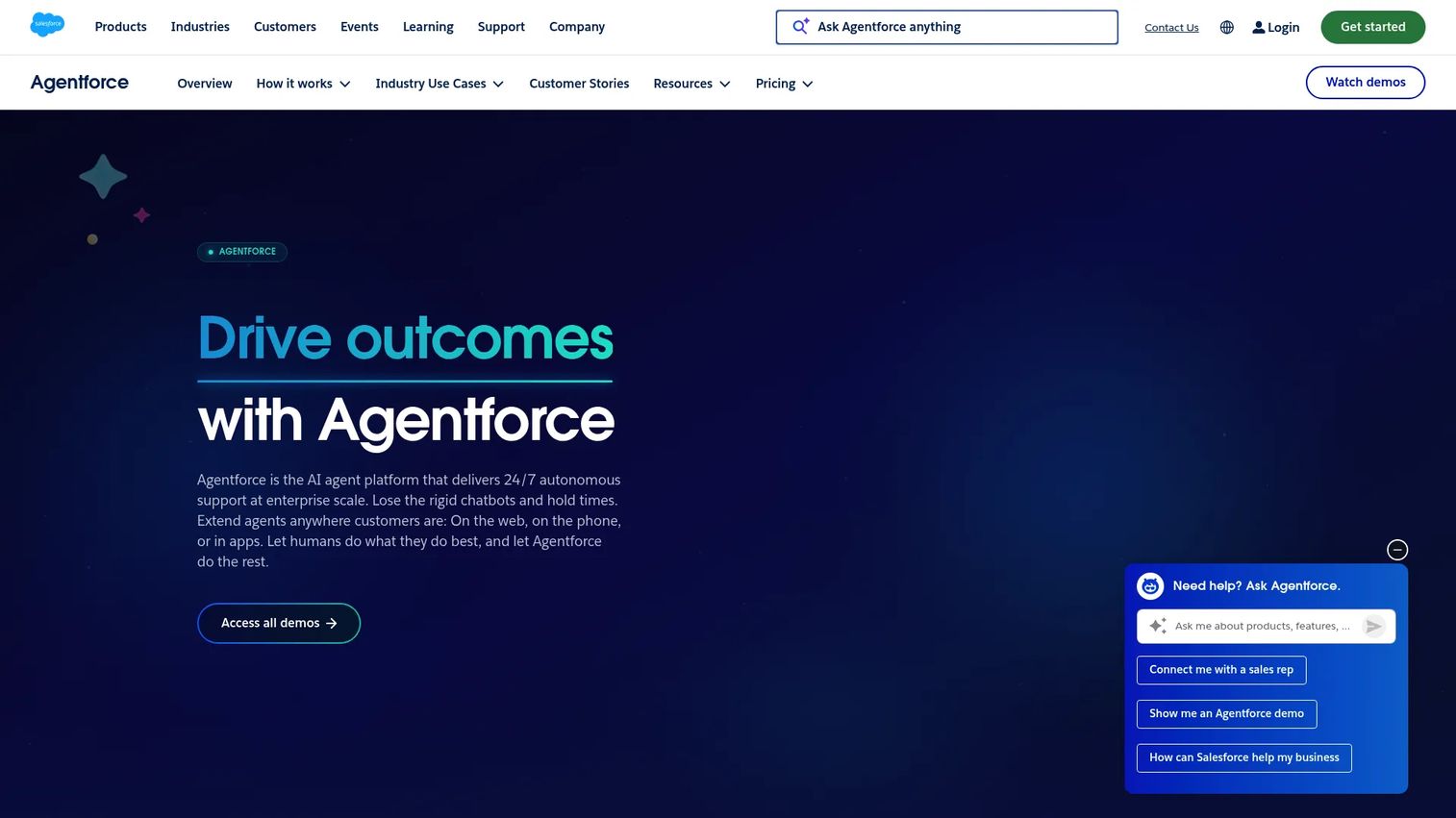
Salesforce Agentforce is an AI agent platform for deploying autonomous, job-specific agents across sales, service, HR, and IT workflows. For marketing teams, it means agents that can work inside the Salesforce data layer, connecting customer records, campaign data, and business rules inside a single governed environment. It is built for organizations where Salesforce is already the system of record, not a bolt-on.
Best for: Enterprise marketing teams with Salesforce as their primary CRM and data platform.
Key features
- Purpose-built agents for sales, service, and marketing workflows
- Multi-agent orchestration with shared Salesforce data context
- Low-code and conversational agent builder (Agentforce Builder)
- Approval and governance controls with agent health monitoring
- Enterprise security model with role-based access
Why choose Salesforce Agentforce: Choose it when marketing, sales, and customer data already live in Salesforce and you want agents that read and act on that full context. Teams outside the Salesforce stack will not get the same value.
Salesforce Agentforce pricing: Salesforce Foundations is free. Conversations are priced at $2 per conversation; Flex Credits cost $500 per 100k credits. The Agentforce user license starts at $5 per user per month, with add-ons from $125 per user per month. Full enterprise editions start from $550 per user per month. Ask sales about Marketing Cloud requirements, data usage limits, and edition compatibility when scoping.
G2 rating: 4.3/5
2. HubSpot Breeze
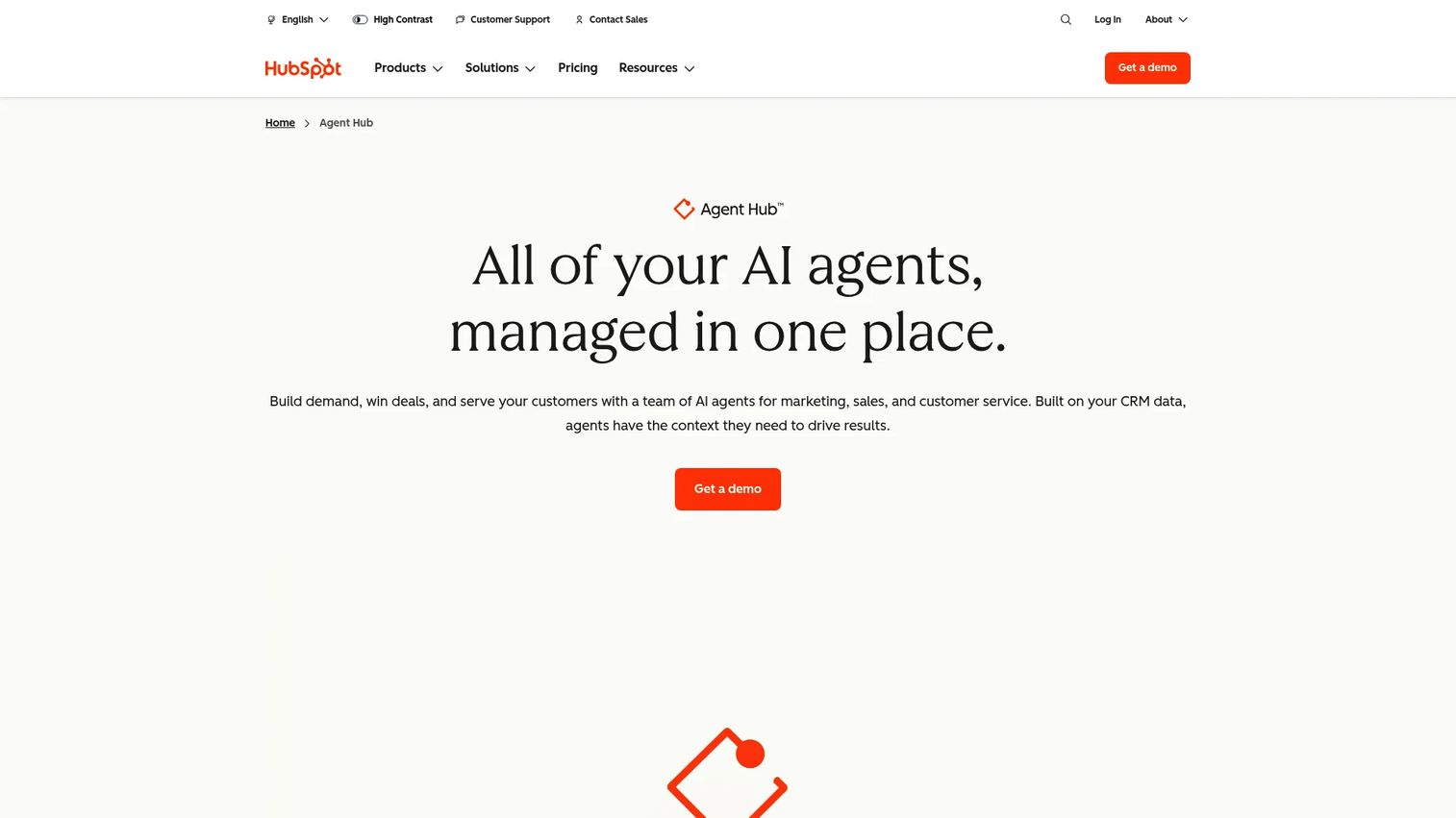
HubSpot Breeze is HubSpot's AI platform for marketing, sales, and customer service workflows. Breeze agents run on top of native HubSpot CRM data, so marketers using HubSpot for email, forms, landing pages, and reporting get AI assistance without wiring a separate system. It covers content generation, prospecting enrichment, and customer-service routing as distinct agent types.
Best for: Small and mid-market growth teams already running campaigns, CRM, and reporting inside HubSpot.
Key features
- Ready-made agents for marketing, sales, and customer service
- Custom agent and workflow builder with no coding required
- Native HubSpot CRM data for every agent action
- Agent activity tracking and performance visibility
- Marketing automation connection through HubSpot workflows
Why choose HubSpot Breeze: Choose it when HubSpot is the center of your marketing stack and you want AI without learning a new interface. Teams running campaigns outside HubSpot will hit integration friction quickly.
HubSpot Breeze pricing: A free HubSpot plan exists. The Starter tier begins at $7 per seat per month (billed monthly; annual billing prices differ). Professional plans start at $1,300 per month. Enterprise runs $4,700 per month. Breeze Agent capabilities are included with Starter, Professional, and Enterprise. Additional AI usage pulls from HubSpot Credits at $0.010 per credit.
G2 rating: 4.3/5
3. Blueshift Launchpad
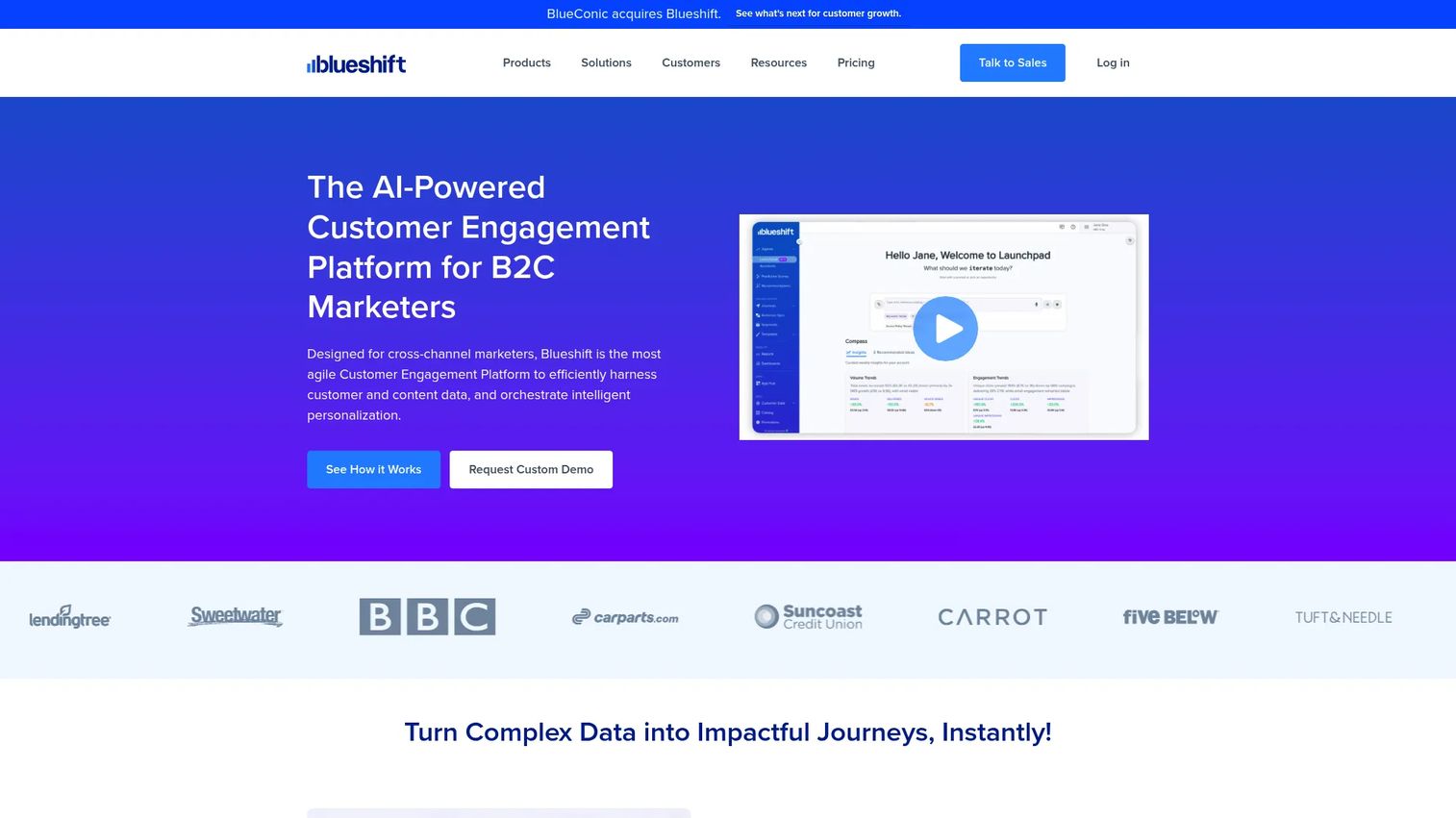
Blueshift Launchpad is a conversational AI workspace built into the Blueshift customer engagement platform. Marketers can describe an audience in plain language, generate campaign drafts, build journeys, and analyze performance, all through a chat-based interface that connects to Blueshift's CDP-backed customer profiles. Launchpad was in beta at the time of research.
Best for: B2C and subscription teams already on Blueshift that want AI assistance for segmentation, campaign assembly, and cross-channel journey execution.
Key features
- Natural-language audience definition and segment creation
- Campaign, journey, and workflow generation from conversational prompts
- Creative variation and message drafting with editable outputs
- Performance analysis and reporting through natural-language queries
- Human approval controls before any campaign goes live
Why choose Blueshift Launchpad: It suits teams that need AI inside a cross-channel lifecycle platform rather than a separate content or automation tool. Teams not using Blueshift for customer engagement will need to evaluate the platform alongside Launchpad.
Blueshift Launchpad pricing: Blueshift platform plans start at $1,250 per month (billed annually) on the Starter tier. Growth and Enterprise tiers carry separate pricing; contact Blueshift for those quotes. Launchpad pricing is not broken out separately from the platform price.
G2 rating: 4.4/5
4. BrazeAI Agent Console
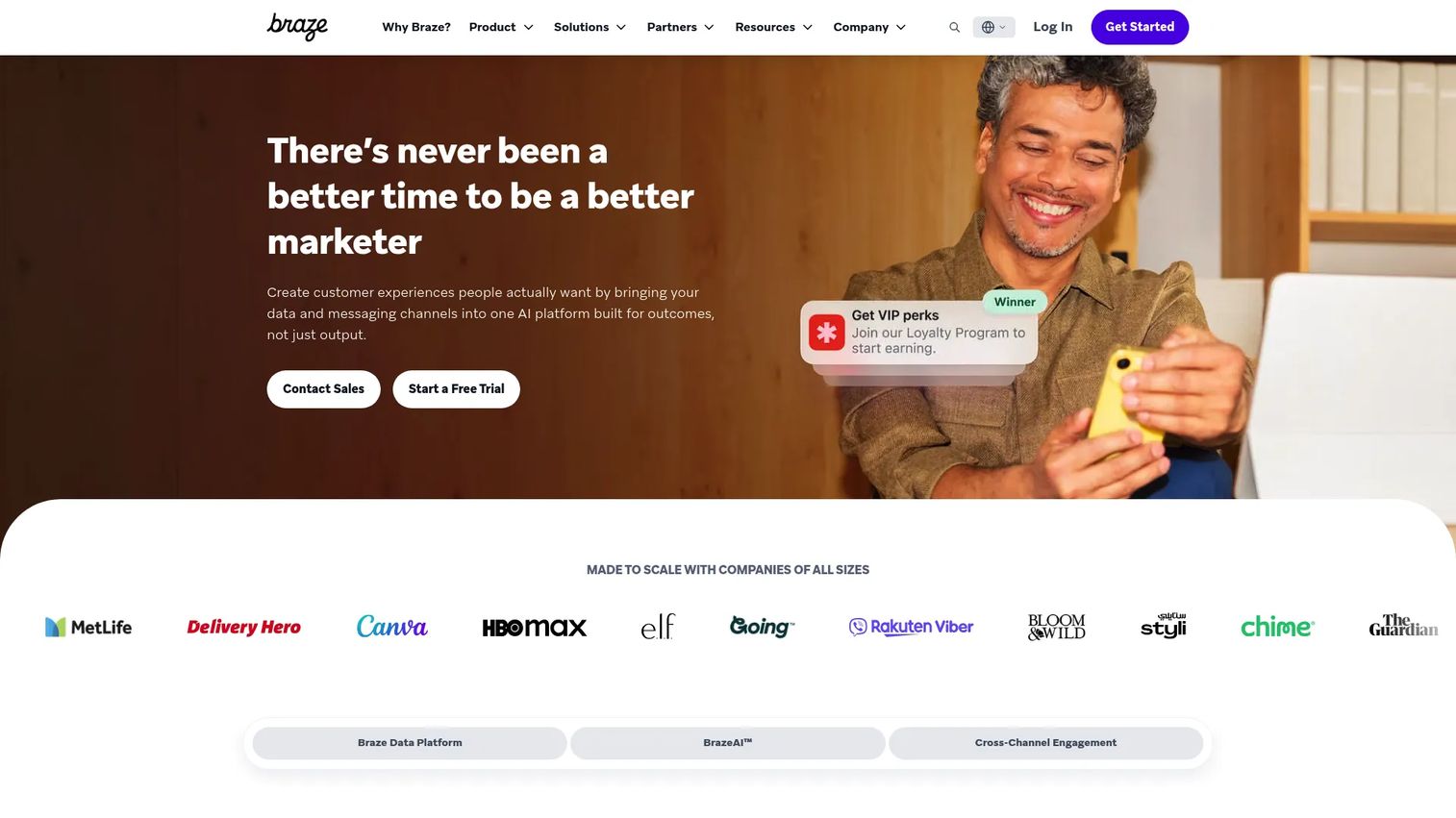
BrazeAI Agent Console is the AI agent layer inside Braze for lifecycle, mobile, and customer engagement teams. Agents can generate and localize dynamic message content, segment customers, route users through personalized journeys in Braze Canvas, and test against brand standards before deployment. It supports a range of AI model providers, including OpenAI, Anthropic, Google Gemini, Amazon Bedrock, and Microsoft Foundry.
Best for: Enterprise and mid-market teams running high-volume customer journeys inside Braze.
Key features
- Dynamic content generation and localization using customer and catalog context
- Customer segmentation and journey routing inside Braze Canvas
- Agent creation, testing, versioning, and deployment in Braze workflows
- Support for multiple external AI model providers
- Agentic Standards for evaluating agents against brand and technical requirements
Why choose BrazeAI Agent Console: Choose it when Braze already powers lifecycle campaigns and you want AI assistance inside existing customer journeys. Teams not on Braze will need to price the full platform alongside the agent layer.
BrazeAI Agent Console pricing: Plans (Go, Select, Pro, Enterprise) each include AI invocation allowances: 10,000 for Go, 25,000 for Select, 50,000 for Pro, and 100,000 for Enterprise. Additional invocations require Action Credits. Contact Braze sales to price message volume, channels, data points, workspaces, and support.
G2 rating: 4.5/5
5. Iterable Nova Agent
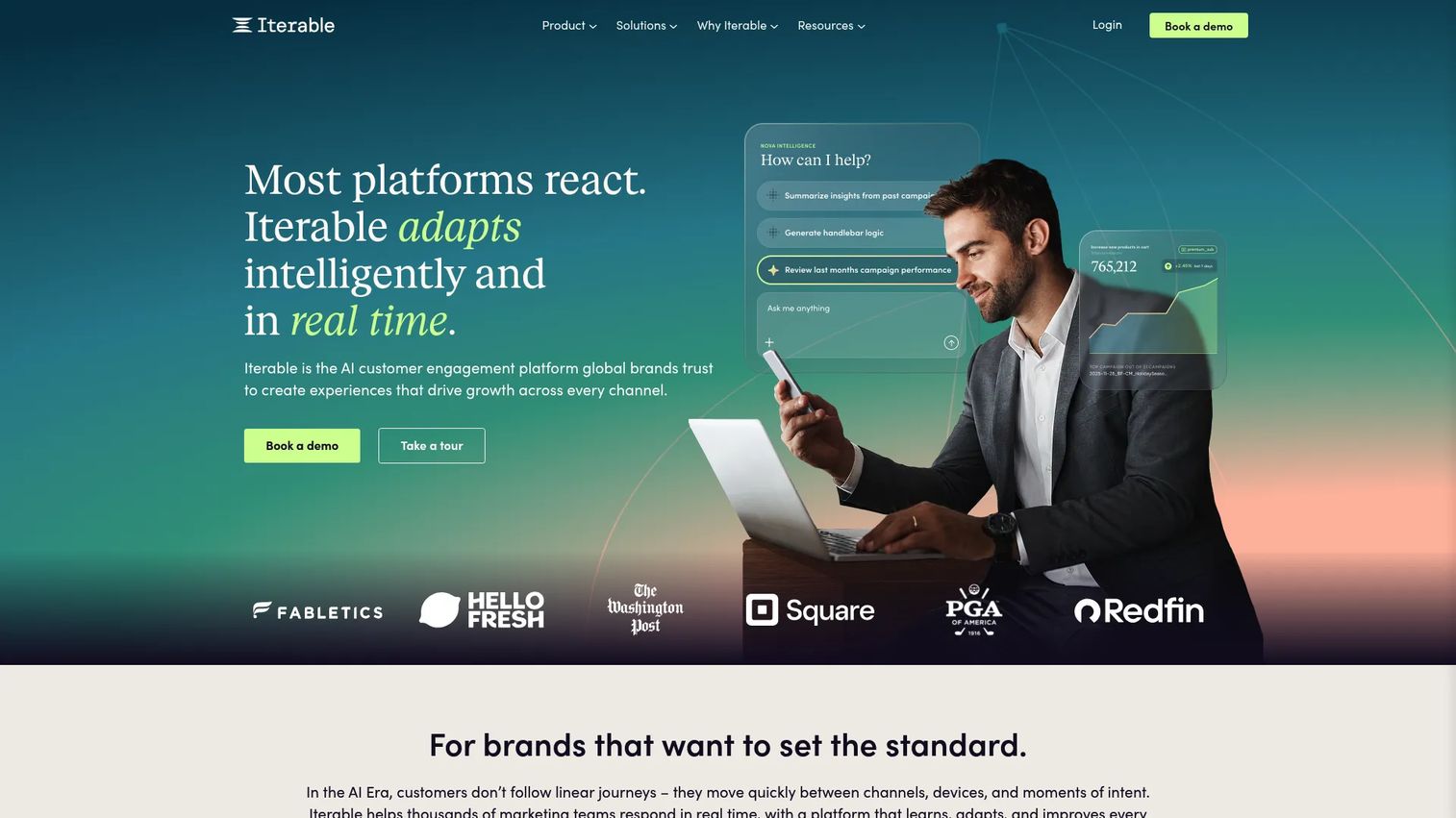
Iterable Nova Agent is Iterable's conversational AI for reviewing, creating, editing, analyzing, and troubleshooting campaigns, templates, experiments, and journeys inside the Iterable platform. Marketers can ask Nova Agent to check templates for errors, configure campaigns, and answer performance questions in natural language without leaving their existing workflow environment.
Best for: Enterprise lifecycle marketing teams already running campaigns in Iterable.
Key features
- Template review for alt text, grammar, links, and Handlebars syntax
- Campaign, template, journey, and experiment creation and editing
- Natural-language campaign analytics and performance queries
- Decisioning support for lifecycle journey optimization
- In-platform agent access inside Iterable's campaign environment
Why choose Iterable Nova Agent: Choose it when your team uses Iterable as the lifecycle platform and wants AI help with journey planning, content review, and performance analysis. Nova Agent adds value on top of Iterable, not instead of it.
Iterable Nova Agent pricing: Iterable prices each account by audience size, channels, and required features. Contact Iterable sales for a quote. No standard public tiers or entry prices are shown.
G2 rating: 4.4/5
6. Klaviyo Marketing Agent (K:AI)
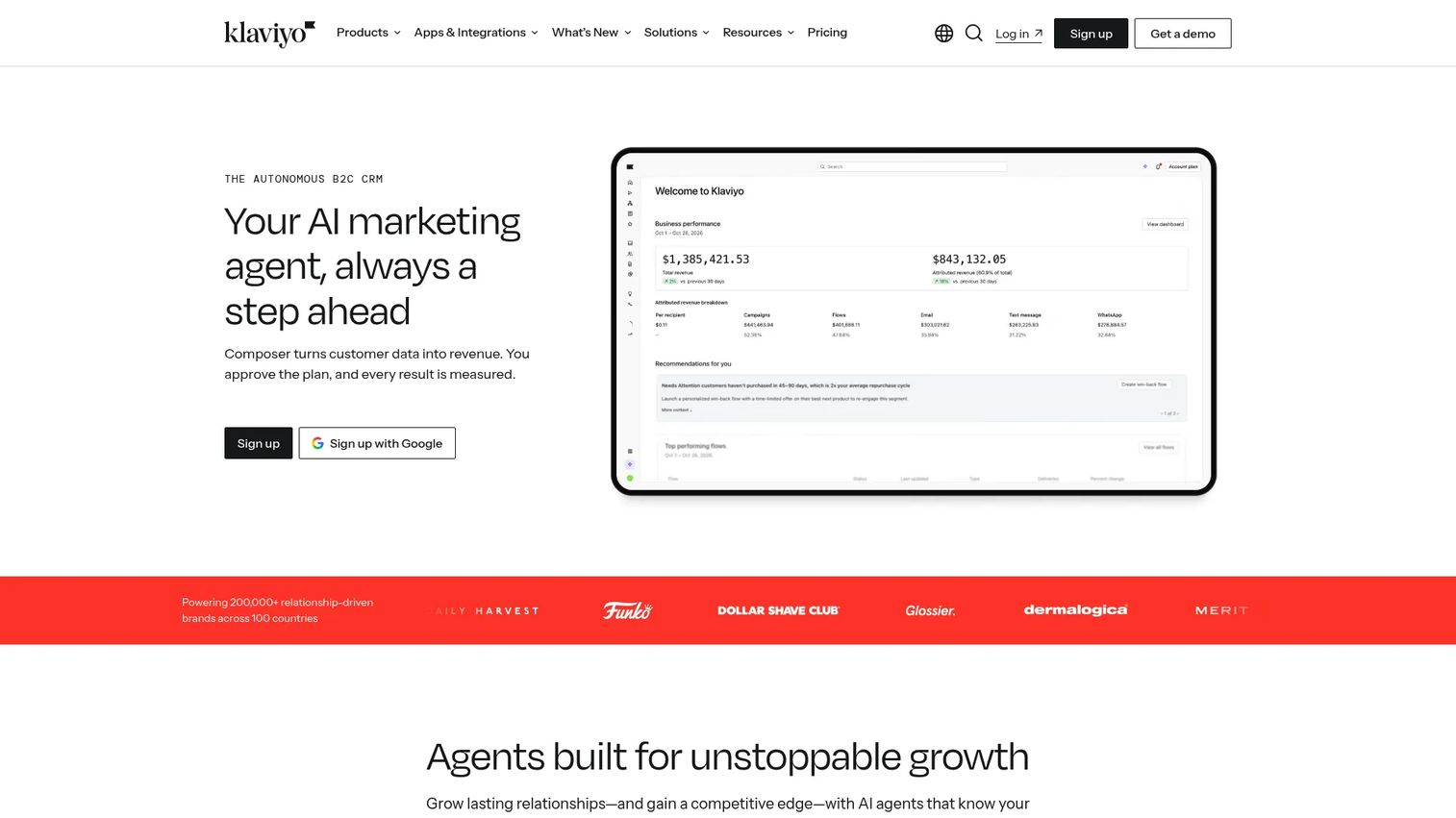
Klaviyo Marketing Agent (K:AI) is built into the Klaviyo platform as an AI agent for planning, creating, launching, and optimizing on-brand marketing campaigns, flows, and signup forms. It draws on brand voice, product catalog, customer data, and historical performance to generate marketing strategies from a simple starting point like a website URL, then produces campaigns across email, SMS, MMS, and push.
Best for: Ecommerce and retail marketers whose growth motion centers on Klaviyo for email, SMS, and customer lifecycle automation.
Key features
- Marketing strategy generation from a website URL or business description
- On-brand campaign, flow, and signup form creation using brand and catalog data
- Audience segmentation, personalization, and optimization
- Support for email, SMS, MMS, push, and other Klaviyo-connected channels
- Human approval controls and predictive segmentation
Why choose Klaviyo Marketing Agent (K:AI): Choose it when Shopify or ecommerce lifecycle marketing is the center of your operation and you care about metrics like revenue per recipient, repeat purchase rate, and lifecycle automation. It is purpose-built for commerce, not general B2B demand gen.
Klaviyo Marketing Agent (K:AI) pricing: Klaviyo offers a free plan that covers up to 250 active profiles and 500 email sends per month, with limited Composer access. Paid pricing is usage-based and varies by profile count and messaging volume; contact Klaviyo or check the pricing page for current tier rates.
G2 rating: 4.6/5
7. Adobe Journey Optimizer
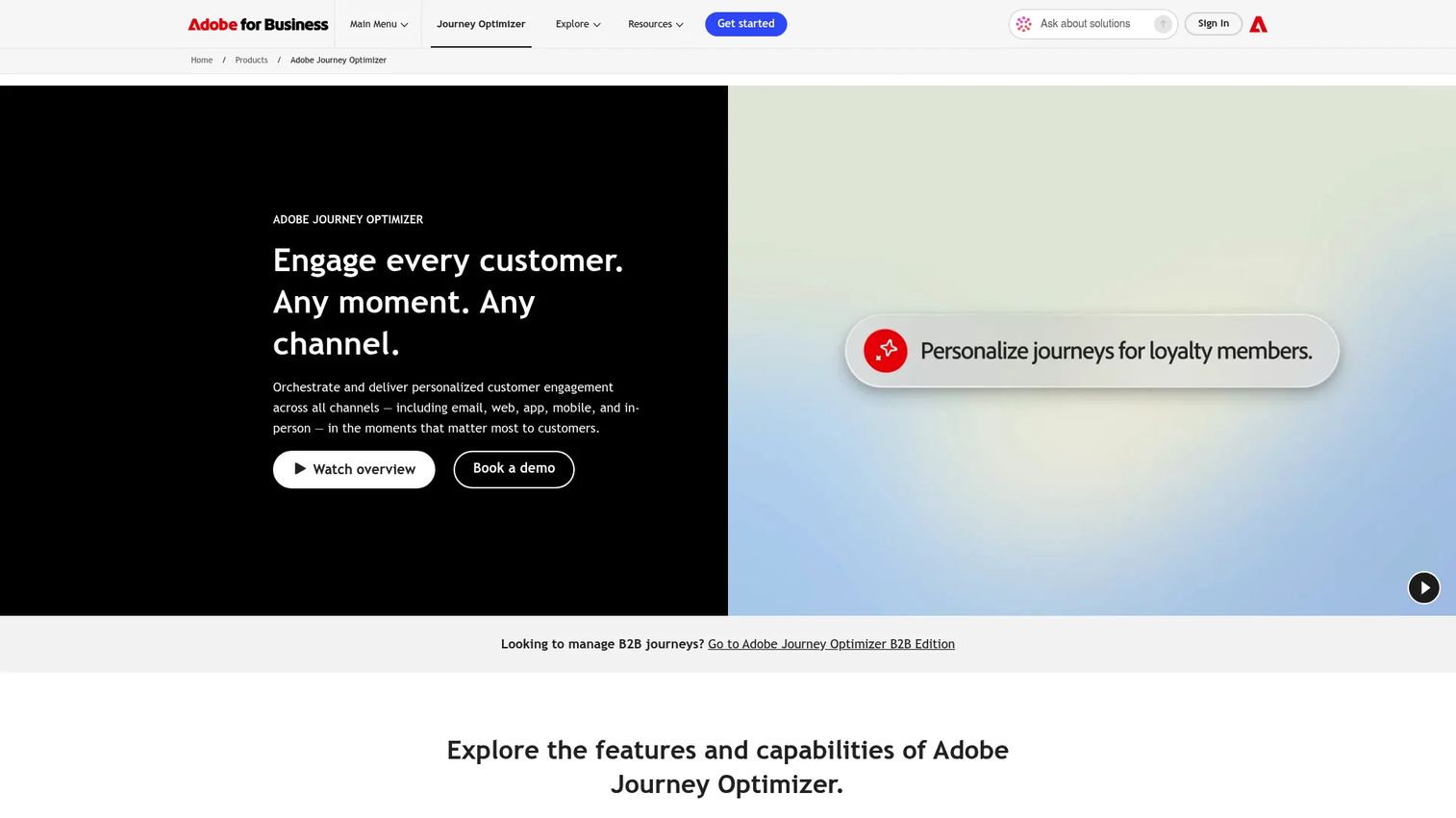
Adobe Journey Optimizer is a real-time customer journey management solution for orchestrating personalized engagement across email, web, mobile, app, and in-person channels. It connects to Adobe Experience Platform for unified customer profiles, includes AI decisioning and next-best-action optimization, and supports both batch and API-triggered campaign orchestration across enterprise buying teams.
Best for: Mid-market and enterprise teams already running on Adobe Experience Cloud who need real-time, omnichannel journey orchestration.
Key features
- Unified customer profiles and audience orchestration via Adobe Experience Platform
- Real-time omnichannel journey design and execution
- AI decisioning, experimentation, and next-best-action optimization
- Dynamic content personalization for email, SMS, app, and web
- Enterprise governance with Select, Prime, and Ultimate packaging
Why choose Adobe Journey Optimizer: Choose it when your marketing stack already sits inside Adobe Experience Cloud. Its value compounds when connected to Adobe Real-Time CDP, Adobe Target, and campaign history. Teams outside the Adobe ecosystem will face significant integration work before seeing results.
Adobe Journey Optimizer pricing: The Select, Prime, and Ultimate packages each require a customized quote. Contact Adobe sales and factor in Adobe Experience Platform profile volume, channel requirements, implementation support, and licensing for connected Adobe products.
G2 rating: 4.2/5
8. Relevance AI
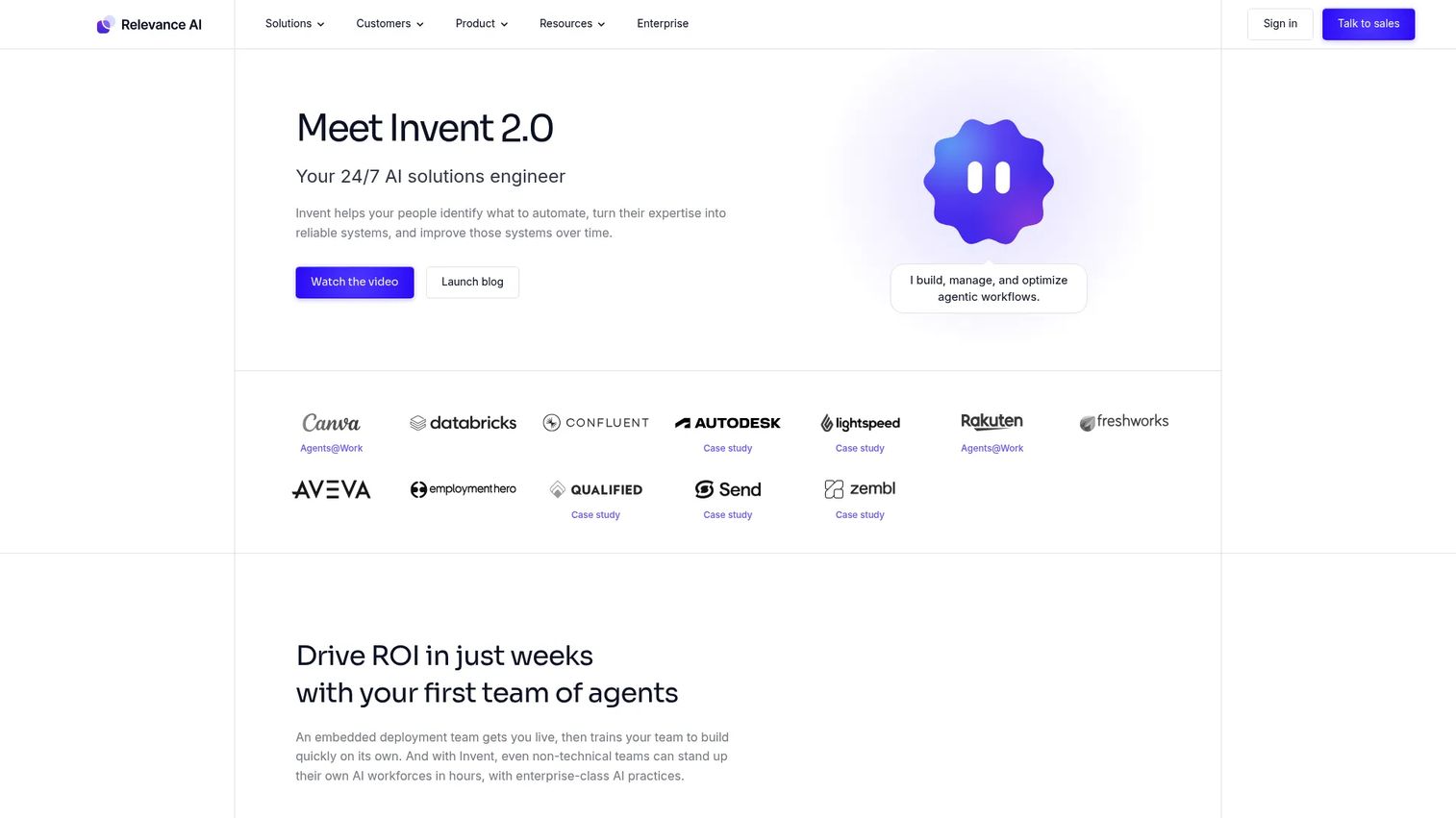
Relevance AI is an enterprise-grade platform for building, running, evaluating, and governing AI agents and multi-agent workforces. For marketing teams, it means custom agents for lead qualification, inbound engagement, content repurposing, campaign reporting, SEO brief generation, event follow-up, and old-deal re-engagement, built through a visual drag-and-drop interface without engineering support.
Best for: Operations and marketing teams that want custom AI agents spanning CRM, email, documents, enrichment, and reporting tools rather than a prebuilt platform.
Key features
- Visual drag-and-drop agent and workforce builder with AI-assisted creation
- Multi-agent orchestration with parallel and branching execution
- 1,000+ app integrations plus webhooks, schedules, and API triggers
- Human approval controls, role-based access, SSO/SAML, and audit logs
- Agent evaluations, production monitoring, tracing, and drift detection
Why choose Relevance AI: Choose it when you need agents that work across a stack of CRM, email, document, and enrichment tools and no prebuilt platform covers your specific workflows. It suits teams with someone who owns operations and can maintain agent configurations over time.
Relevance AI pricing: Relevance AI currently offers an Enterprise plan with custom pricing. Contact the team for credits, user limits, and workspace configuration.
G2 rating: 4.3/5
9. Zapier
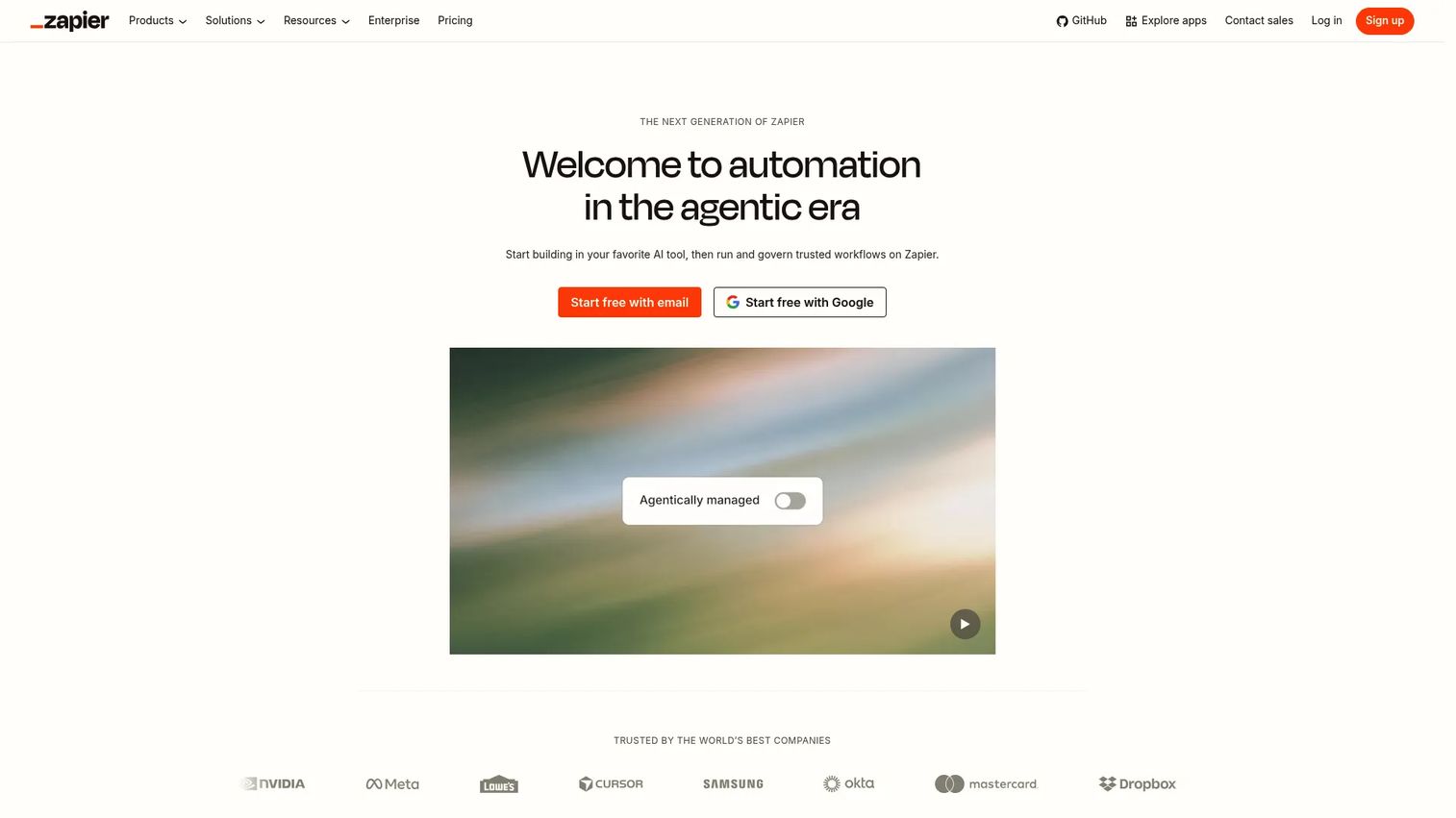
Zapier is an AI-powered automation platform for connecting apps, data, and business processes. For marketers, it handles handoffs between forms, CRM, email, spreadsheets, ad platforms, and reporting tools through multi-step Zaps, plus AI agents, chatbots, and a workflow copilot. It connects to over 9,000 apps, which is the main reason teams reach for it when the problem is cross-stack coordination rather than deep lifecycle orchestration.
Best for: Growth teams that need to connect tools quickly without engineering support, especially for lead routing, event follow-up, and campaign data handoffs.
Key features
- Multi-step Zaps with filters, paths, webhooks, and scheduling
- AI agents, chatbots, and workflow copilot
- Tables and Interfaces for lightweight data management
- 9,000+ app integrations
- Free plan for getting started without a credit card
Why choose Zapier: Choose it when the main bottleneck is connecting tools quickly and creating reliable data handoffs. It is not a full lifecycle orchestration suite, but it handles cross-stack automation faster than any other tool on this list. For deeper agentic AI tools for sales and marketing, pair Zapier with a dedicated platform.
Zapier pricing: The free plan includes 100 tasks per month. The Professional plan starts from $19.99 per month; the Team plan starts from $69 per month. Enterprise pricing requires contacting Zapier sales.
G2 rating: 4.5/5
10. Jasper AI
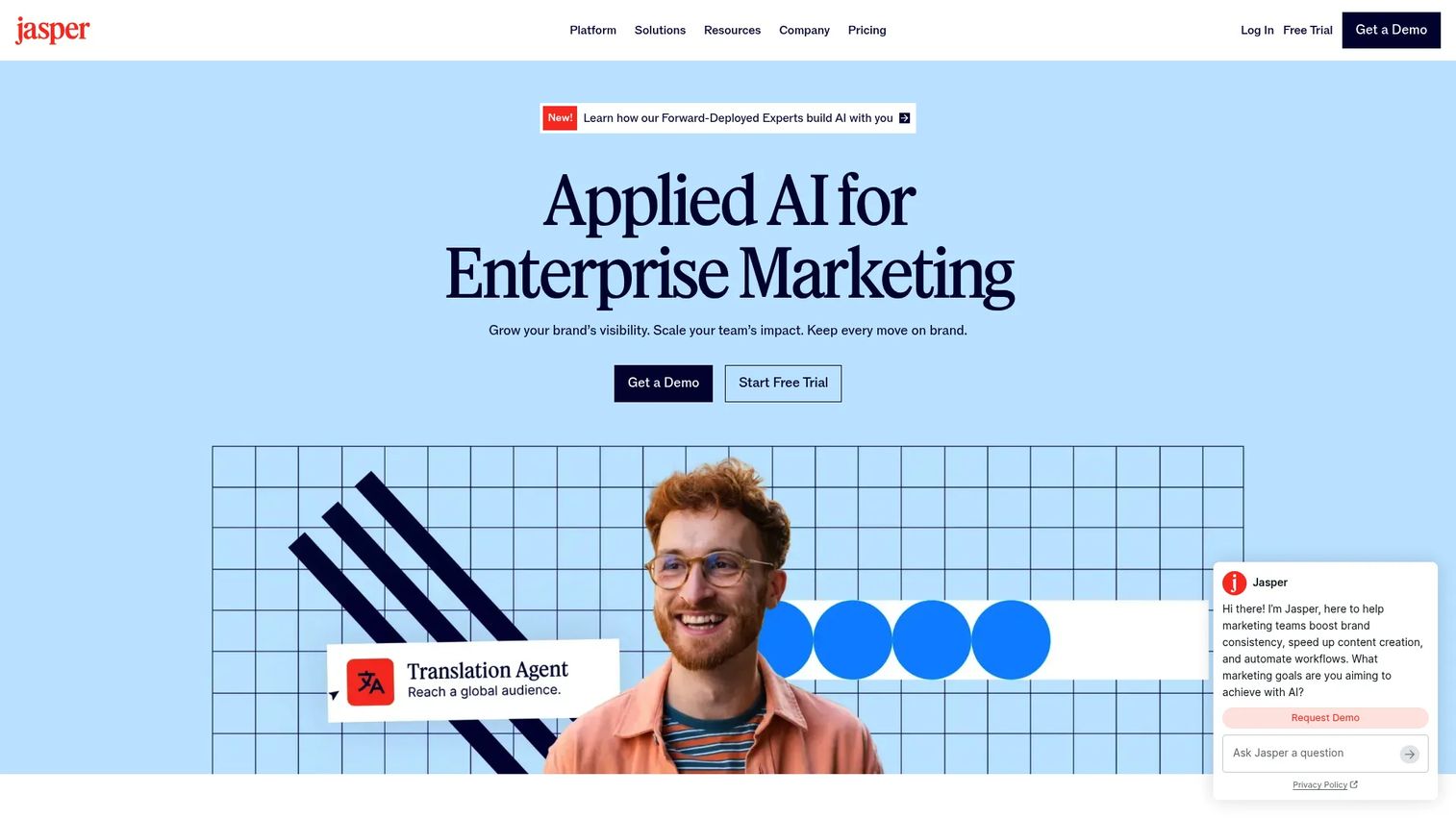
Jasper AI is an AI platform for enterprise marketing that combines brand context, governance controls, purpose-built agents, and content creation in a single environment. Marketing teams use it for campaign copy, landing page drafts, ad variants, email sequences, and content repurposing, with Brand Voices, Knowledge assets, and Style Guides keeping outputs consistent across writers and regions. It also includes GEO and AI search visibility optimization, which is increasingly relevant as marketing attribution shifts toward answer-engine visibility. For teams exploring AI content creation tools more broadly, Jasper is one of the more mature options for brand governance at scale.
Best for: Enterprise marketing teams where content throughput and brand consistency are the primary bottlenecks.
Key features
- On-brand content creation with Canvas and campaign workflow support
- Brand Voices, Knowledge assets, Audiences, and Style Guides
- Purpose-built marketing agents and custom agent workflows
- GEO and AI search visibility optimization
- Image generation, API access, and browser extension
Why choose Jasper AI: Choose it when content volume and brand consistency are the core problem. It works best as a content agent inside a broader campaign workflow, not as the system that runs campaign execution or lifecycle orchestration.
Jasper AI pricing: The Pro plan is $69 per seat per month (billed monthly) or $59 per seat per month (billed annually). Business plans carry custom pricing and add complex marketing agents, custom agent workflows, Jasper Grid, API access, governance controls, and account management. No free plan exists, but a 7-day free trial is available.
G2 rating: 4.7/5
11. Copy.ai
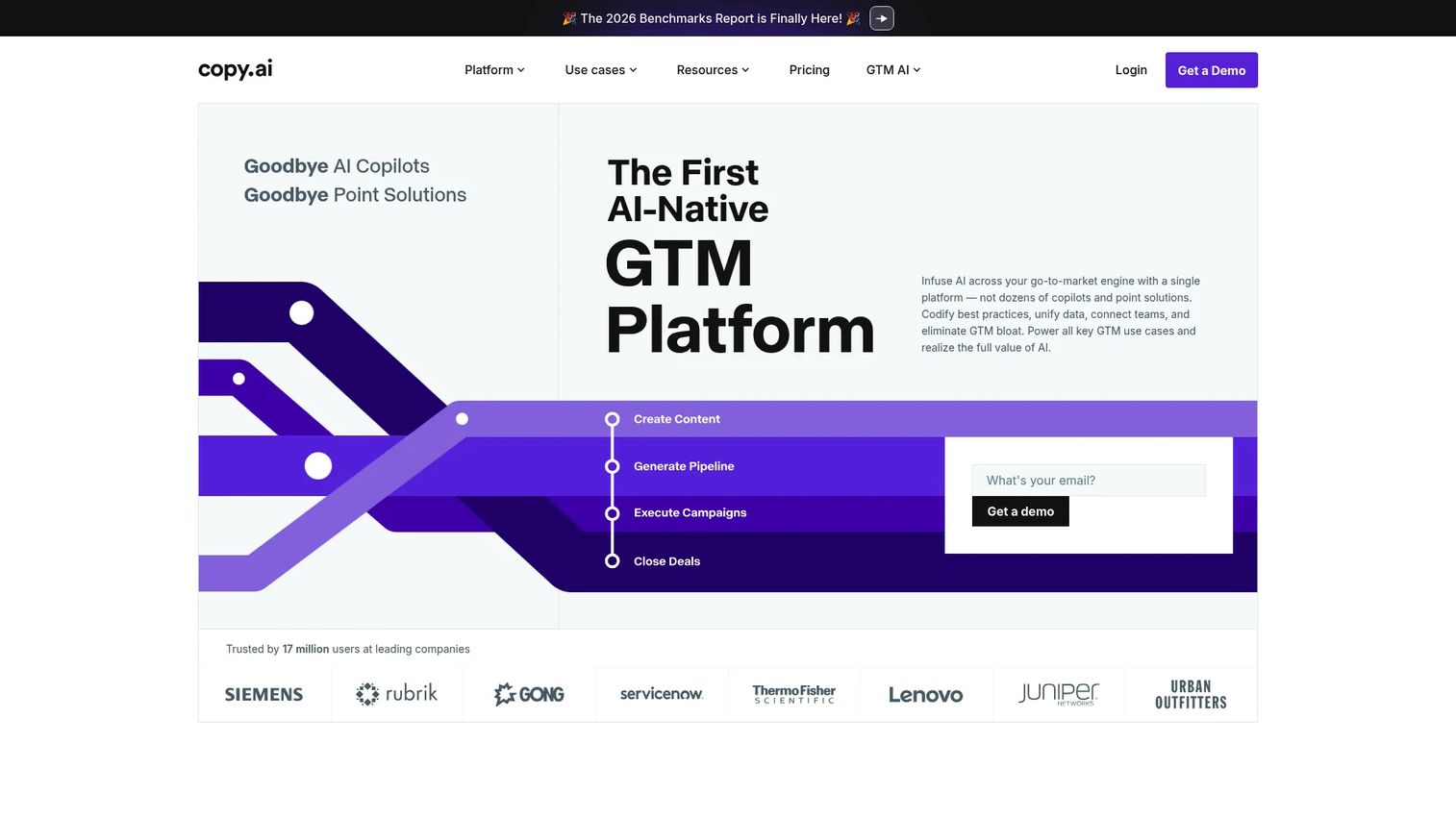
Copy.ai is an AI-native go-to-market platform for codifying processes, unifying data, and automating sales, marketing, and operations workflows. Beyond content generation, it includes Tables, Actions, Agents, an Infobase, and Brand Voice tools that help teams standardize repeatable GTM work, from prospecting sequences to campaign content to CRM enrichment tasks.
Best for: GTM teams whose output is primarily copy-heavy content across sales enablement, demand gen, and content marketing.
Key features
- AI-powered workflows for codifying marketing and sales processes
- Brand Voice, Infobase, and team templates for consistent outputs
- Tables, Actions, Agents, and Chat for multi-step workflow automation
- Sales and marketing use cases including prospecting and content repurposing
- CRM enrichment and third-party integrations
Why choose Copy.ai: Choose it when your team needs repeatable GTM content workflows across marketing and sales. It is strongest when output is copy-heavy and the workflow structure is defined. Teams looking for lifecycle journey orchestration will need a different platform alongside it.
Copy.ai pricing: The Chat plan costs $29 per month (billed monthly) or $24 per month (billed annually) and includes five seats. The Growth plan is $1,000 per month (billed annually at $12,000 per year). Expansion runs $2,000 per month and Scale runs $3,000 per month. Enterprise pricing is custom.
12. Lindy AI
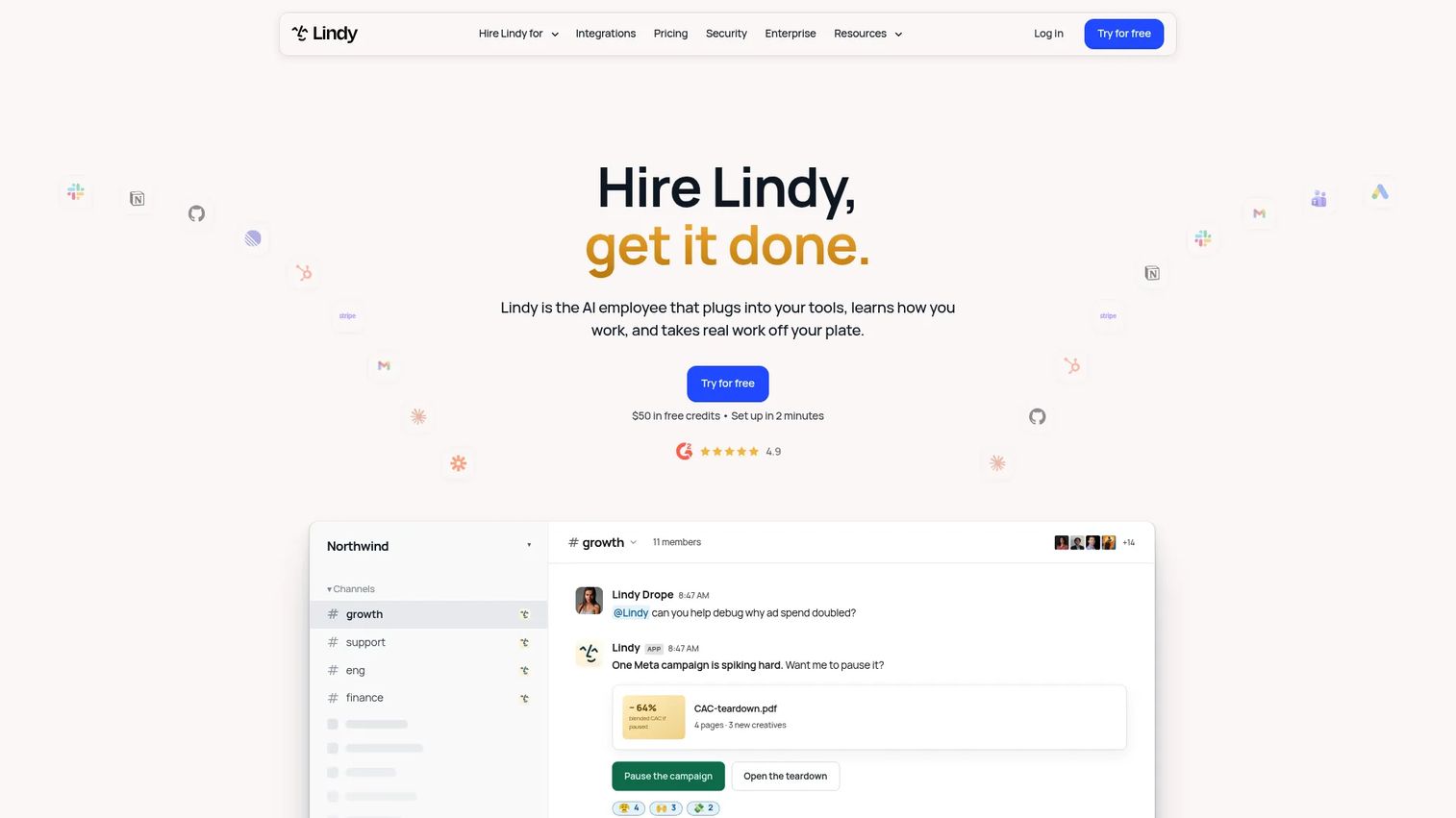
Lindy AI is an AI employee platform that connects to your tools, learns how your team operates, and handles recurring business tasks. For marketing and ops teams, it handles inbox management, meeting notes and follow-ups, lead management workflows, scheduled reports, and CRM task updates, without requiring a full marketing suite purchase.
Best for: Lean marketing and ops teams automating repetitive operational work around campaigns, without buying a dedicated lifecycle platform.
Key features
- 40+ built-in skills plus custom skill creation
- Inbox management with drafted reply suggestions
- Meeting recording, notes, follow-ups, and a searchable meeting library
- 1,500+ integrations plus MCP server support
- Phone call handling and computer use capabilities
Why choose Lindy AI: Choose it when a small marketing team needs help with operational repetition around campaigns: Email triage, CRM updates, lead follow-up, and meeting documentation. It is broader than a marketing-specific tool, which is both its strength and its scope limit.
Lindy AI pricing: The free plan includes $50 in credits (lasting 7 days). The Team plan is $29.99 per month for 3,000 credits, with additional credit bundles available as top-ups. Enterprise plans carry custom credits and billing.
G2 rating: 4.9/5
13. Make
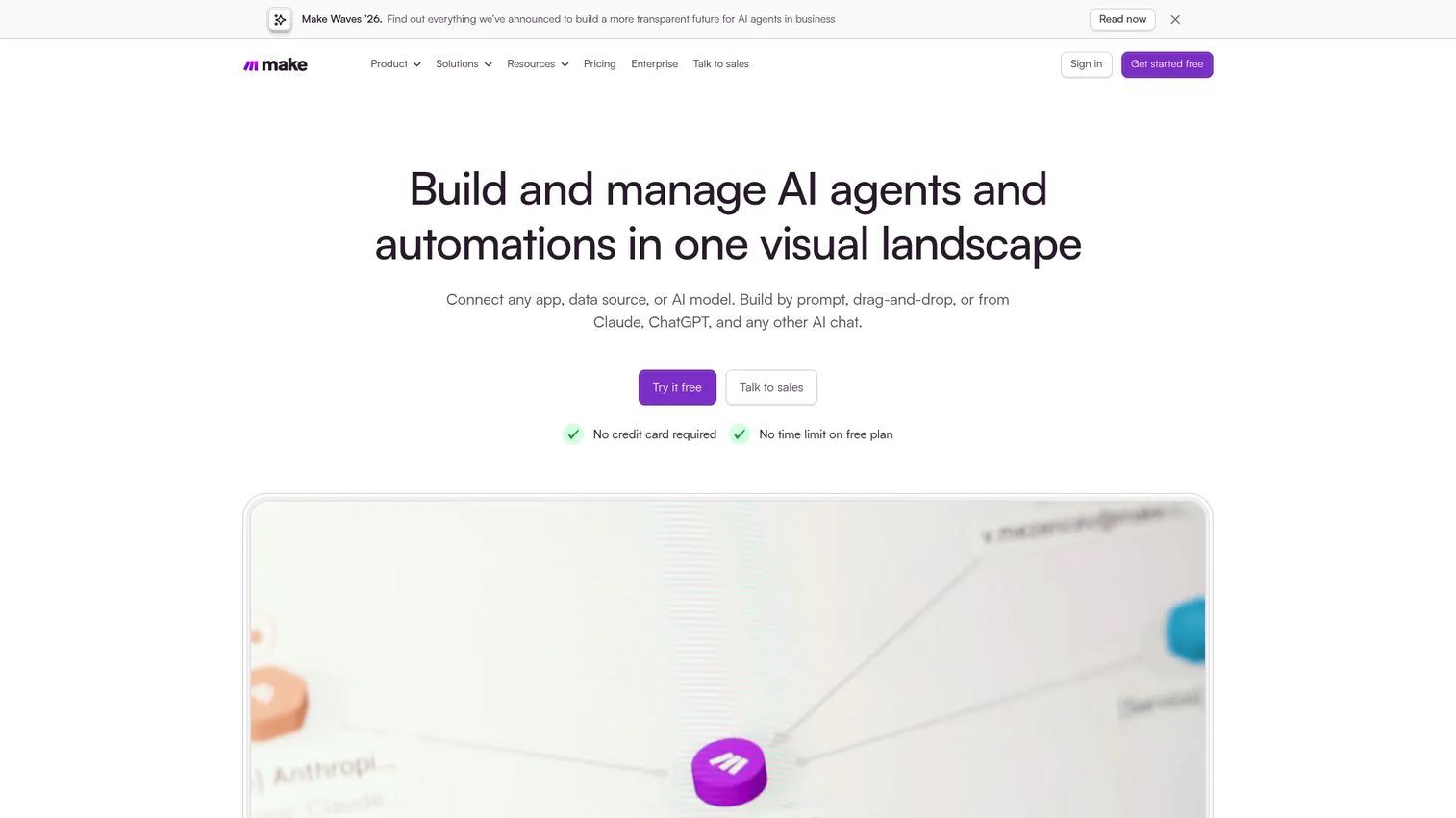
Make is an AI automation platform for visually building, observing, and governing workflows, AI agents, and integrations. Marketing teams use it for scenario automation across CRM, forms, databases, ad platforms, email tools, and internal alert systems. It connects to over 3,500 integrations and supports custom API integrations, JavaScript, Python code steps, and AI workflow nodes.
Best for: Teams with an ops-minded builder who wants flexible, visual marketing automations that go beyond simple triggers.
Key features
- Visual workflow building by drag-and-drop, AI prompt, or chat
- 3,500+ integrations with custom API support
- Execution history, observability, error handling, and automatic retries
- Role-based access, SSO, 2FA enforcement, audit history, and separated environments
- AI agents and AI workflow nodes
Why choose Make: Choose Make when marketers need flexible visual workflows with detailed error handling and execution monitoring. It is stronger than most no-code tools for complex, multi-branch automations, but it benefits from someone on the team who can maintain scenarios over time. For teams exploring the broader best AI orchestration platforms landscape, Make sits in the visual automation tier rather than the full agentic decisioning tier.
Make pricing: A free plan is available with 1,000 credits per month and no credit card required. Core, Pro, Teams, and Enterprise paid plans are available; contact Make or check the pricing page for current tier prices, as specific amounts were not displayed in the retrieved pricing page at research time.
14. n8n
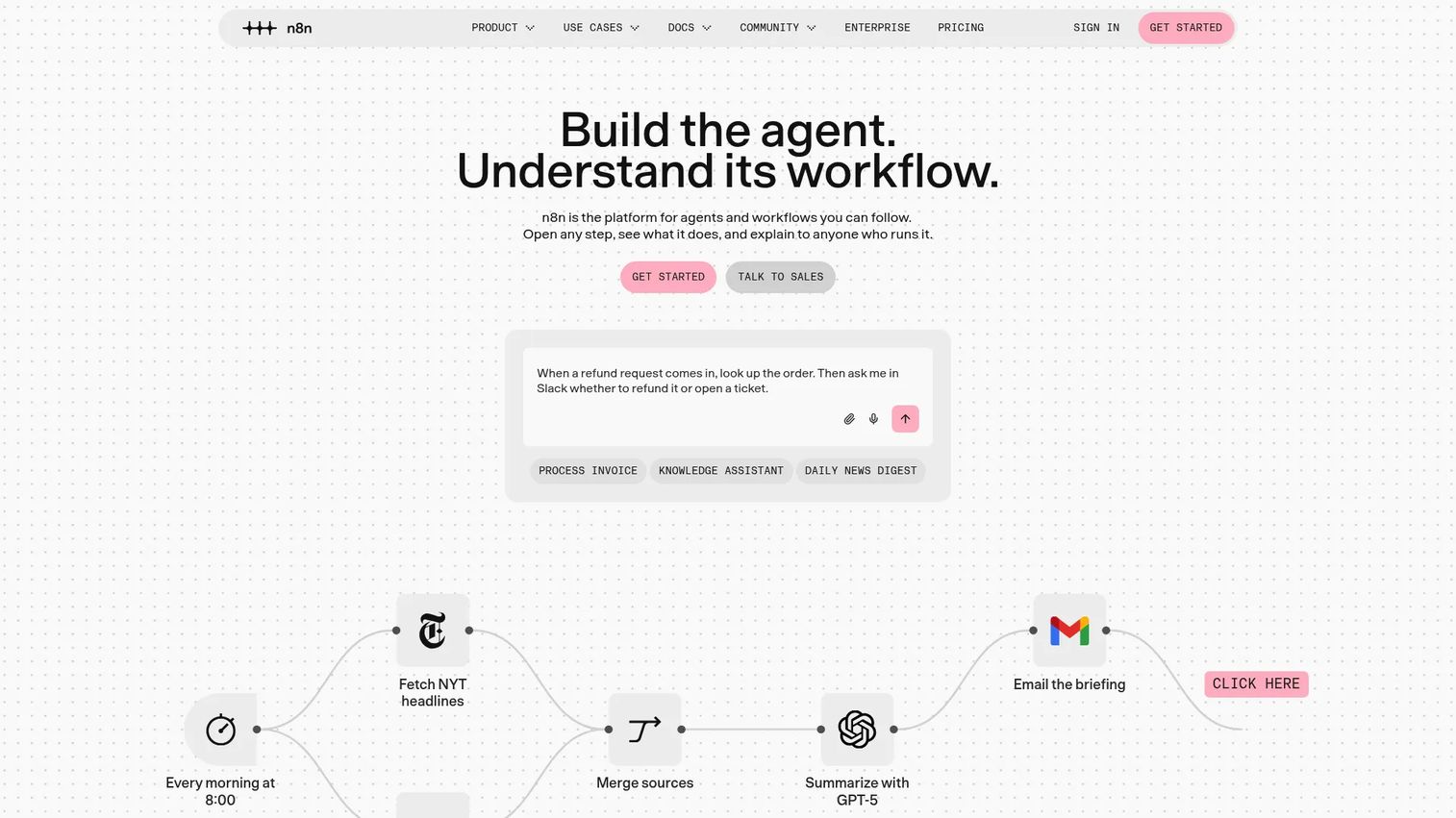
n8n is a workflow automation platform for building AI agents and business process automations with visual tools, integrations, and custom code. It offers self-hosting for teams with data residency requirements, privacy constraints, or a need for deeper workflow control than typical no-code platforms allow. Marketing ops teams use it for complex multi-step automations across data pipelines, campaign systems, and reporting infrastructure.
Best for: Technical marketing ops teams that need self-hosting, data control, custom integrations, and AI workflow nodes beyond what cloud-only tools offer.
Key features
- Visual workflow editor with 500+ integrations
- JavaScript and Python code steps inside workflows
- AI agents and AI workflow nodes
- Self-hosting and managed cloud deployment options
- Projects, roles, SSO, LDAP, and Git-based version control on applicable plans
Why choose n8n: Choose it when marketing operations needs more control than typical no-code automation provides. Data-sensitive teams, those building in regulated industries, or ops teams managing complex multi-system automations will get more from n8n than from simpler cloud-only tools. It requires someone who can read and maintain workflow configurations. For teams comparing this category, see also marketing workflow automation options across the full stack.
n8n pricing: The Starter cloud plan is 20€ per month (billed annually). Pro is 50€ per month (billed annually). The Business plan is 667€ per month (billed annually) and is self-hosted only. Enterprise plans are custom. A free Community Edition is available for self-hosting.
G2 rating: 4.7/5
15. OfferFit
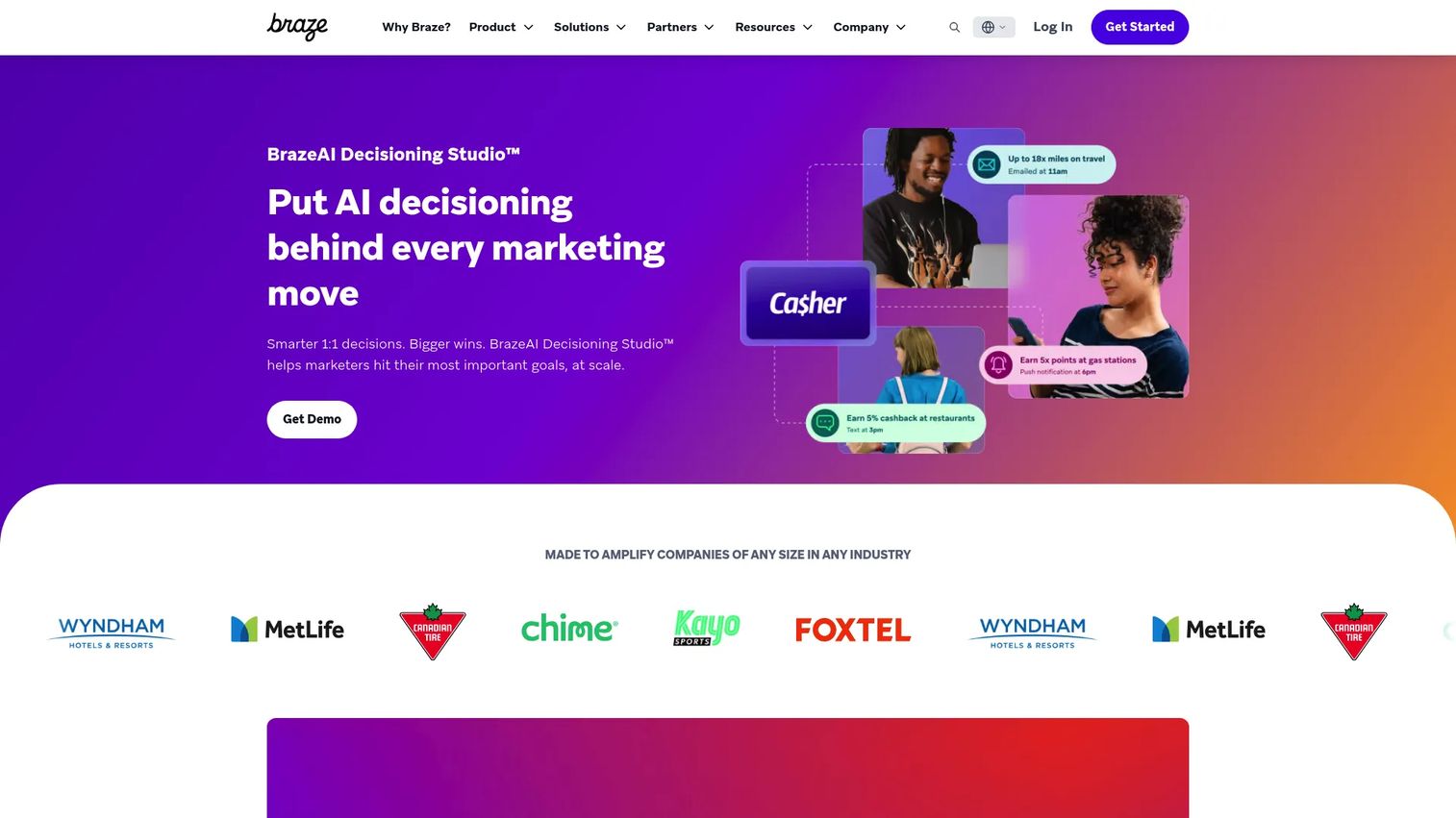
OfferFit (now operating as BrazeAI Decisioning Studio) is an AI decisioning platform for enterprise lifecycle marketers that personalizes customer actions to maximize business metrics like revenue or customer lifetime value. It uses first-party customer data and continuous autonomous experimentation to personalize channel, offer, timing, creative, and communication frequency for each customer, replacing traditional A/B testing with self-learning optimization.
Best for: Enterprise lifecycle marketing teams with enough data volume to support continuous learning and optimization across customer communications.
Key features
- Self-learning decisioning that optimizes against business KPIs
- Per-customer personalization of channel, offer, timing, and creative
- Autonomous experimentation replacing manual A/B test design
- Insights into the drivers of customer behavior
- First-party data integration across lifecycle platforms
Why choose OfferFit: Choose it when continuous optimization across existing lifecycle campaigns is the core problem. It suits large-scale teams with enough customer interactions to train the decisioning model. Teams with smaller contact lists or limited first-party data signals will not see the same return. Note that OfferFit now operates under the BrazeAI Decisioning Studio product identity; confirm the current go-to-market structure with the sales team.
OfferFit pricing: Contact the OfferFit/BrazeAI Decisioning Studio team directly. When scoping, factor in data volume, number of channels, use cases, and implementation support requirements.
G2 rating: 4.6/5 (reflected under BrazeAI Decisioning Studio on G2)
Considerations when choosing AI marketing agents
Start with data readiness
No AI marketing agent performs well on top of broken data. Before evaluating platforms, check: Are CRM lifecycle stages current? Are UTM parameters applied consistently? Are consent fields populated? Are event names standardized? Are duplicate contacts resolved? A simple audit here will save significant implementation pain later.
Check integration depth, not just connector count
A tool advertising a Salesforce or HubSpot connection is not the same as one that can read, write, trigger, enrich, and sync data reliably. Ask vendors whether the integration supports bidirectional sync, field-level mapping, permission scoping, and trigger support, not just whether a connector exists.
Decide how much autonomy you can allow
Approval models range from draft-only outputs to fully autonomous campaign execution. Start agents on low-risk tasks: Performance summaries, subject line variants, event follow-up sequences. Human approval before send is mandatory for any content touching price, compliance, or regulated claims. Build toward more autonomy after the agent has proven accuracy on simpler work.
Price the workflow, not the seat
The seat price is rarely the full cost. Factor in: CDP or data warehouse requirements, implementation partners, message volume limits, AI credit consumption, premium connector fees, and ongoing admin time. For enterprise lifecycle platforms, the platform cost often dwarfs the agent feature cost.
Protect brand voice and compliance
Look for brand voice profiles, locked templates, prompt libraries, role-based access, audit logs, PII handling rules, and opt-out logic. Teams in regulated industries or running co-brand campaigns need these controls before allowing any agent to generate customer-facing content. Reviewer workflows for legal and compliance review are not optional in those contexts.
Conclusion
The right AI marketing agent depends on where your biggest execution gap is, not which tool has the most impressive demo.
For Salesforce-heavy enterprise teams, Salesforce Agentforce delivers the deepest data context. HubSpot Breeze is the natural choice for HubSpot-centric growth teams. Blueshift Launchpad, BrazeAI Agent Console, Iterable Nova Agent, and Adobe Journey Optimizer each serve lifecycle and customer engagement teams inside their respective platforms. Klaviyo Marketing Agent (K:AI) is purpose-built for ecommerce. OfferFit fits teams running continuous decisioning across large contact volumes.
For teams that want agents they build themselves, Relevance AI, Zapier, Make, Lindy AI, and n8n cover different points on the technical spectrum from no-code to developer-first. Jasper AI and Copy.ai address content throughput specifically.
Pick one workflow first. Qualifying 50 inbound leads, repurposing a webinar into five assets, or summarizing last month's campaign performance will tell you more about fit than any vendor demo alone.
Once your AI agents start driving higher-intent traffic, give buyers something better than a static landing page. Use interactive demos to show your product, capture engagement signals, and understand what prospects explored before they talk to sales. A demo center gives your whole buying committee a self-serve destination organized by use case.
Start your journey with Guideflow today!
FAQs
An AI marketing agent is a software system that pursues a marketing goal across multiple steps, tools, and data sources with some level of autonomy. Unlike a chatbot that answers prompts or a copilot that assists within one platform, an agent can plan a task, gather context, produce outputs, and trigger downstream actions within guardrails a marketer defines. The key distinction from traditional automation is goal-orientation rather than rule-following.
Stack fit matters more than feature rankings here. Salesforce Agentforce is strongest for enterprise teams with Salesforce as their system of record. HubSpot Breeze fits growth teams already running campaigns inside HubSpot. For cross-stack automation without a dedicated lifecycle platform, Zapier covers the most apps with the fastest time to value, while Make offers more visual control for complex scenarios.
Traditional marketing automation follows predefined triggers and branches that humans configure in advance. An AI agent can interpret context, generate content, recommend actions, and coordinate multi-step work, adapting based on data rather than a fixed decision tree. The practical difference: Automation executes a rule you wrote; an agent interprets a goal you gave it and decides how to pursue it, within the guardrails you set.
No. They can reduce repetitive execution, campaign reporting, content variation, and lead routing work. Marketers still own positioning, strategic decisions, budget allocation, customer insight, and final approval on what goes out. The teams seeing the clearest ROI are those who use agents to handle defined, repeatable tasks while freeing time for the judgment-heavy work agents cannot do.
Many claim integration with these platforms, but depth varies considerably. For each vendor, verify: Does the connection support bidirectional data sync? Can the agent read and write CRM fields reliably? Which trigger types are supported? What permissions does the integration require? A connector listed on a pricing page is not evidence of reliable, production-ready data flow.
Pricing spans from free entry plans (Zapier, Lindy AI, Klaviyo, HubSpot Breeze) to enterprise quote-only platforms where the full cost includes platform fees, data volume, message limits, and implementation support. When evaluating, price the total workflow: Add the agent platform, data requirements, any necessary CDP or warehouse work, connector fees, and admin time alongside the seat price.
The stronger tools use dedicated brand voice profiles, approved content examples, style guides, locked templates, and reviewer workflows. Jasper AI and Copy.ai have the most developed brand voice controls among the content-focused tools. Enterprise lifecycle platforms like BrazeAI include brand standard evaluation as part of their agent governance layer. Even with strong controls, human review for claims, regulated language, and legal copy remains necessary.
Run one real workflow end to end before committing. Useful tests include: Qualifying 50 inbound leads and comparing agent output to your team's manual calls, repurposing one webinar into email and social assets and measuring time saved, summarizing last month's campaign performance against a reporting threshold, or building an event follow-up sequence and tracking send accuracy and approval edits. Measure time saved, accuracy of output, number of edits before approval, and downstream conversion where trackable. For teams exploring the full best AI agents landscape, the same test-first approach applies across categories.