You collected the feedback. Then it vanished. Some responses sit in a spreadsheet nobody opens, some hide in a support inbox, and a few get screenshotted into a launch retro deck and forgotten. Meanwhile a churned account had told you exactly why they were leaving three weeks before they left.
That gap between collecting feedback and acting on it is where retention leaks. Customer satisfaction survey software exists to close it. The best CSAT survey software does not just field a form. It captures sentiment on the channel where it is freshest, routes low scores to a human before the account goes cold, and turns raw responses into trends you can defend in a QBR.
The market is not slowing down. The customer satisfaction (CSAT) survey software market is projected to reach USD 2.68 billion by 2033, up from USD 1.84 billion in 2025, at a 4.82% CAGR, according to Maia Research (2025). Across industries, tracked satisfaction scores cluster around 75 to 80%, with SaaS near 78% per The Small Business Expo (2026). Widespread, but improvable, and only if the customer feedback tools you pick make action easy.
This guide ranks ten customer feedback survey software platforms on what actually matters: channels, closed-loop workflows, analytics, integrations, and value. For product marketing managers running voice-of-customer and launch feedback programs, the goal is the same as any GTM tool, consistent signal you can act on and prove.
What's inside
This guide compares the best customer satisfaction survey software for teams that need CSAT, NPS, and CES collection plus real actionability, not just a form builder. It is written for product marketing managers, CX teams, and customer-facing operators who have to turn responses into retention and churn reduction moves.
We evaluated each tool on five criteria: survey flexibility and customization, distribution channels (email, in-app, web, SMS, helpdesk), analytics and benchmarking, integrations with CRM and helpdesk stacks, and pricing versus value. Every pricing figure and rating below reflects verified, current vendor and G2 data.
TL;DR
- Best overall for connected data and broad workflows: SurveyMonkey, with a free plan, deep integrations, and built-in analysis.
- Best for CSAT collection with built-in AI analysis: Zonka Feedback, with omnichannel triggers and theme-level sentiment scoring.
- Best for conversational survey UX and response rates: SurveySparrow.
- Best for enterprise research depth: Qualtrics.
- Best budget-friendly customer satisfaction tools: ProProfs Survey Maker.
- Best for service teams and closed-loop follow-up: AskNicely.
- Best for in-app CSAT and product-led feedback: Userpilot.
- Best modern multichannel CSAT tools: Survicate and SurveySensum.
If you want a fast pick: match the platform to your feedback motion first, your stack second. A tool that cannot route a low CSAT score into your CRM is a report, not a system.
What is customer satisfaction survey software?
Customer satisfaction survey software is a tool for creating, distributing, and analyzing surveys that measure how customers feel about a product, service, or interaction, then routing that feedback into action. It differs from a generic survey builder in one way that matters: it is built to measure specific experience metrics and close the loop, not just collect responses.
Generic survey tools capture answers. Customer feedback survey software adds the operational layer, metric-specific templates, real-time alerts on detractors, CRM sync, and benchmarking, so feedback becomes a retention lever instead of an archive.
Three core metrics anchor most programs:
- CSAT (Customer Satisfaction Score): measures satisfaction with a specific interaction or moment, usually on a 1 to 5 scale.
- NPS (Net Promoter Score): measures loyalty and likelihood to recommend, on a 0 to 10 scale, splitting respondents into promoters, passives, and detractors.
- CES (Customer Effort Score): measures how easy it was to get something done, a strong predictor of repeat behavior.
Key capabilities to expect from a customer satisfaction platform:
- Omnichannel surveys: email, in-app, web, SMS, and helpdesk delivery.
- Templates and branding: ready-made CSAT, NPS, and CES surveys you can match to your brand.
- Branching logic: conditional paths so respondents only see relevant questions.
- Real-time alerts: instant notifications when a score drops below threshold.
- Analytics and reporting: trend tracking, segmentation, and benchmarking.
- CRM integrations and helpdesk integrations: push responses to Salesforce, HubSpot, Zendesk, and Slack so feedback triggers work.
The pattern that separates a satisfaction platform from a form: feedback collection is the input, but the value is in the response workflow.
What customer satisfaction survey software buyers should look for
Survey distribution channels
Sentiment is freshest at the moment of the experience. A post-checkout web survey, an in-app CSAT prompt after a feature is used, an SMS after a service visit, and an email NPS pulse each catch a different truth. Look for omnichannel surveys so you can match the channel to where the emotion actually lives, not where your tool happens to reach.
The more channels a platform supports natively, the fewer blind spots in your voice-of-customer data. In-app and helpdesk delivery tend to pull the highest response rates because they meet customers inside the workflow rather than in a crowded inbox.
Closed-loop actionability
Feedback without a response workflow goes stale fast. A detractor who never hears back churns quieter and faster. The tools worth paying for route low scores to an owner, create follow-up tasks, and track resolution. Ask how alerts fire, where they land (Slack, email, CRM), and whether you can assign and close the loop inside the tool.
This is the difference between a survey and a system. Collection is table stakes. The workflow that turns a 2-out-of-5 into a saved account is the product.
Analytics and benchmarking
Scores in isolation lie. You need trend lines, segmentation by plan, cohort, or channel, and benchmarks to know whether 78% CSAT is good or a warning. For product marketing managers, this is the layer that turns raw feedback into launch-readiness signals and win-loss context you can bring to the roadmap conversation. Tie every metric back to retention and churn, not vanity dashboards.
Integrations and governance
If feedback has to trigger action, CRM integrations and helpdesk integrations are a hard requirement, not a nice-to-have. Verify the exact connectors: Salesforce, HubSpot, Zendesk, Intercom, Slack, and your BI tool. Then check governance, who owns templates, who edits routing rules, and how reporting stays clean as more teams start surveying. Message drift and duplicate surveys are the CSAT equivalent of CRM rot.
When to use customer satisfaction survey software
After onboarding milestones
The first week decides retention. Fire a CSAT or CES survey after a user hits activation, completes setup, or finishes onboarding to catch friction while it is fixable. Early feedback surfaces the confusion that quietly kills trials before they convert. Route anything below threshold to CS immediately, before the account decides the product is not for them.
After support interactions or product changes
Use CSAT or CES right after a ticket resolves, a bug is fixed, or a feature ships. This is where transactional sentiment is sharpest and most honest. Fast follow-up on a low score, ideally within hours, turns a frustrated customer into a loyal one more often than any campaign. Post-release pulses also give product marketing managers clean signal on whether a launch landed.
Across lifecycle and account health programs
Recurring NPS and relationship surveys track loyalty and customer health over time. Trend a segment quarter over quarter and you see churn risk and expansion signals before they show up in revenue. Feed these scores into account-health scoring so CS and sales prioritize the accounts that need attention and the ones ready to grow.
Comparison table
The lens here is simple: which tool fits your feedback motion and stack, at a price that matches your stage. Pricing and G2 ratings below are verified current values.
| # | Product | Intent | Key use case | Pricing | G2 rating |
|---|---|---|---|---|---|
| 1 | Zonka Feedback | AI-native CSAT/NPS/CES platform | Omnichannel CSAT triggers with built-in AI theme and sentiment analysis | Custom, scales with volume; contact sales | 4.7/5 |
| 2 | SurveyMonkey | Broad connected-data platform | CSAT, NPS, CES with built-in analysis and 200+ integrations | Free; paid from $46/mo (Advantage, billed annually) | 4.4/5 |
| 3 | SurveySparrow | Conversational CX surveys | High response-rate surveys and feedback workflows | Free; Basic from $19/mo (billed yearly) | 4.4/5 |
| 4 | Qualtrics | Enterprise experience management | Large-scale CX, EX, and research programs | Small Business $420/mo (billed annually); Enterprise custom | 4.3/5 |
| 5 | ProProfs Survey Maker | Budget-friendly survey builder | AI-assisted surveys with logic and embedded distribution | Free (50 responses); Essentials from $19.99/mo (billed annually) | Not published |
| 6 | SurveySensum | AI-powered CX platform | Unified CSAT, NPS, CES with managed services | Starter CX $3,600/yr; Managed CX custom | 4.6/5 |
| 7 | Userpilot | Product-led in-app feedback | In-app NPS and CSAT microsurveys tied to product usage | Starter from $249/mo (billed annually); Growth and Enterprise custom | 4.6/5 |
| 8 | Survicate | Multichannel feedback platform | In-product and lifecycle surveys with AI analysis | Free; Growth from $114/mo (billed annually) | 4.6/5 |
| 9 | AskNicely | Service CX and closed-loop | NPS/CSAT for multi-location service teams | Scales with response volume (annual) | 4.7/5 |
| 10 | QuestionPro | Survey and research platform | Flexible surveys with deeper research options | Free; Advanced $99/user/mo (billed annually) | 4.5/5 |
Best customer satisfaction survey software for 2026
1. Zonka Feedback
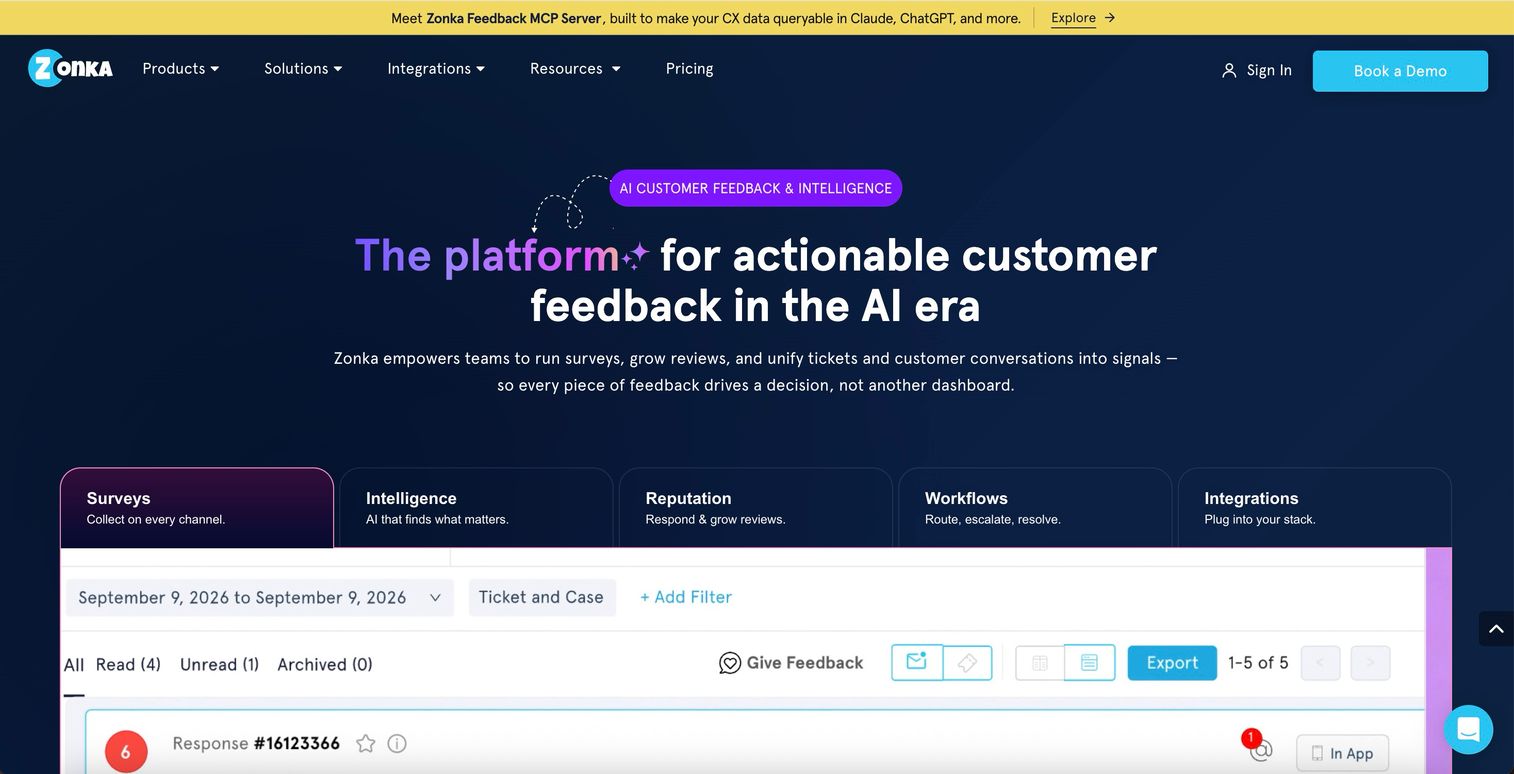
Zonka Feedback is an AI customer feedback and intelligence platform for collecting CSAT, NPS, and CES surveys and understanding what is actually driving the score. It combines omnichannel collection with AI analysis in the same platform, so open-text responses get read and acted on rather than just tallied. For teams currently exporting scores into a second tool to find out why they moved, that consolidation is the whole pitch.
Best for: Teams that want CSAT collection and AI theme and sentiment analysis running on one platform, without adding a separate analytics tool.
Key strengths
- Omnichannel CSAT delivery: Trigger surveys after support tickets, purchases, or onboarding across email, SMS, WhatsApp, web, in-app, and kiosk.
- AI theme and sentiment analysis: Cluster open-text responses into themes automatically and score sentiment per theme, not just as one overall number.
- Entity-level reporting: See CSAT trends by agent, team, location, or product, so you know exactly where satisfaction is slipping.
Why choose Zonka Feedback: Pick it when you want the transactional CSAT trigger and the analysis of why scores move sitting in the same platform. It fits teams tired of exporting scores into a separate tool to find out what is driving them. The tradeoff is pricing opacity, with no published tier to compare against, so budgeting starts with a sales conversation.
Zonka Feedback pricing: Pricing is custom and scales with response volume for feedback management, and with data credits for the AI intelligence layer; contact sales for a quote. A 14-day free trial is available.
Its G2 rating is 4.7/5.
2. SurveyMonkey
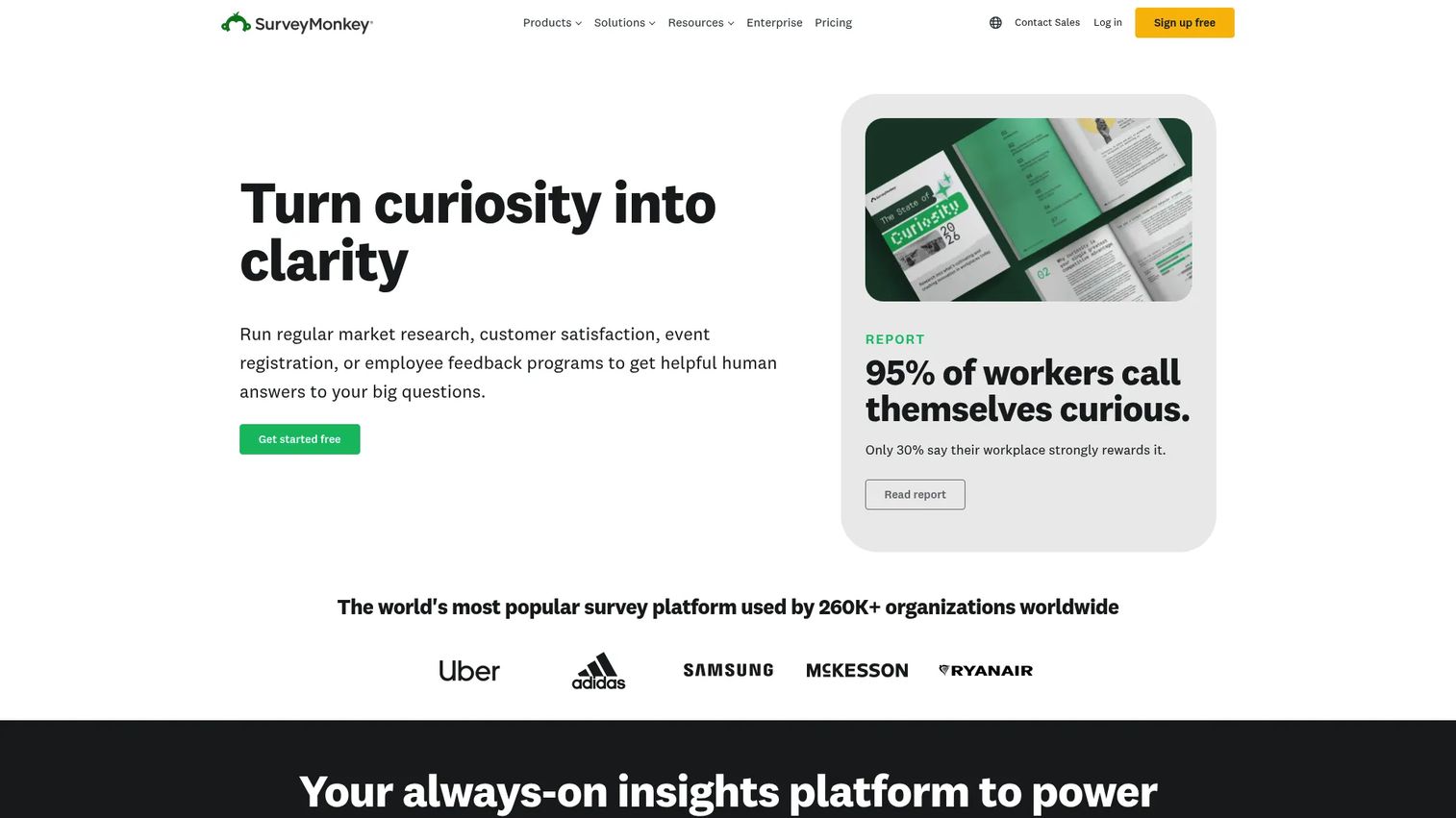
SurveyMonkey is survey and feedback management software for creating, sending, and analyzing surveys, forms, polls, and quizzes. It is the broadest connected-data pick on this list, with a large integration library, CX templates, and built-in analysis that makes it a safe default for teams that want a proven, mainstream customer satisfaction platform without a heavy rollout.
Best for: Teams and individuals who need quick survey creation plus built-in analysis and reporting across CSAT, NPS, and CES.
Key strengths
- Build with AI: Generate surveys quickly from a prompt, so you spend less time formatting and more time reading responses.
- Skip logic: Branch respondents down relevant paths, which lifts completion rates and cleans your data.
- Data exports: Push results out to your BI and analytics tools for deeper segmentation and benchmarking.
Why choose SurveyMonkey: It hits the widest set of use cases with the least friction. If you want omnichannel surveys, deep integrations, and reporting that most stakeholders already recognize, it is the low-risk choice. The tradeoff is that highly specialized CX programs may outgrow it, but for the majority of PMM and CX teams it covers the job.
SurveyMonkey pricing: A free Basic plan is available. Paid individual plans include Standard Monthly at $99/month, Advantage Annual at $46/month ($552 billed annually), and Premier Annual at $139/month ($1,668 billed annually). Team plans are also offered.
Its G2 rating sits at 4.4/5.
3. SurveySparrow
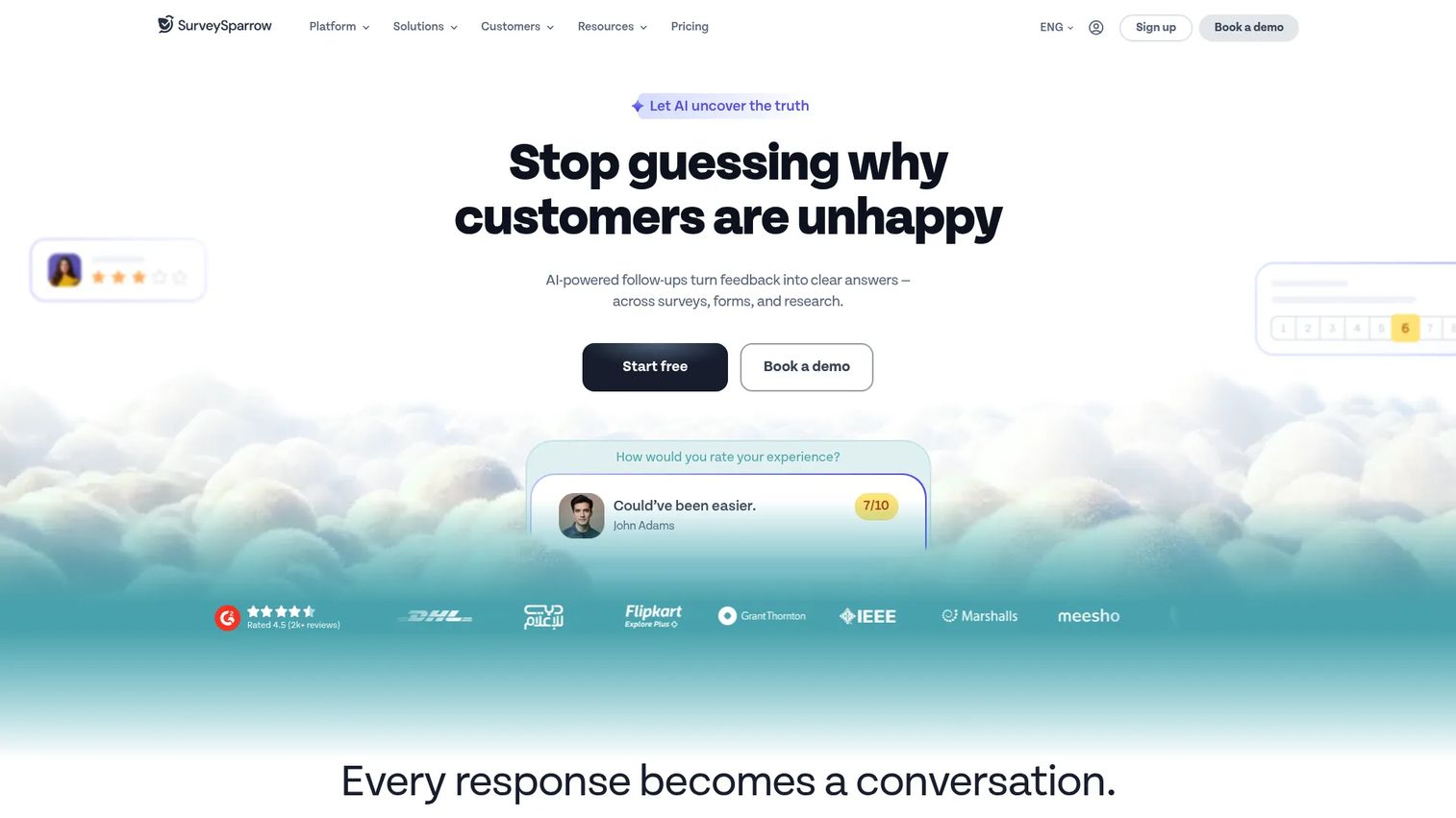
SurveySparrow is conversational survey and customer-experience software. Instead of a static grid of questions, it presents surveys as a chat-like flow, one question at a time, which tends to lift response rates. That makes it a strong pick when your problem is not collecting feedback but getting enough people to finish the survey.
Best for: Teams that want conversational surveys with feedback workflows and clear CX use cases.
Key strengths
- Conversational surveys: A chat-style format that feels less like a chore, improving completion and honest answers.
- Free plan and 14-day trial: Test the workflow before committing budget, useful for lean teams proving value first.
- Integrations, logic, and workflows: Branch questions and route responses so feedback connects to your existing stack.
Why choose SurveySparrow: Pick it when response rates are your bottleneck and you want CSAT, NPS, and CES surveys that people actually finish. The conversational UX is the differentiator here, and the workflow layer means low scores can trigger follow-up rather than sit idle.
SurveySparrow pricing: A forever-free plan is available, plus a 14-day trial on paid tiers. Paid plans include Basic at $19/month, Starter at $39/month, and Business, all billed yearly, with Enterprise on custom pricing.
Its G2 rating is 4.4/5.
4. Qualtrics
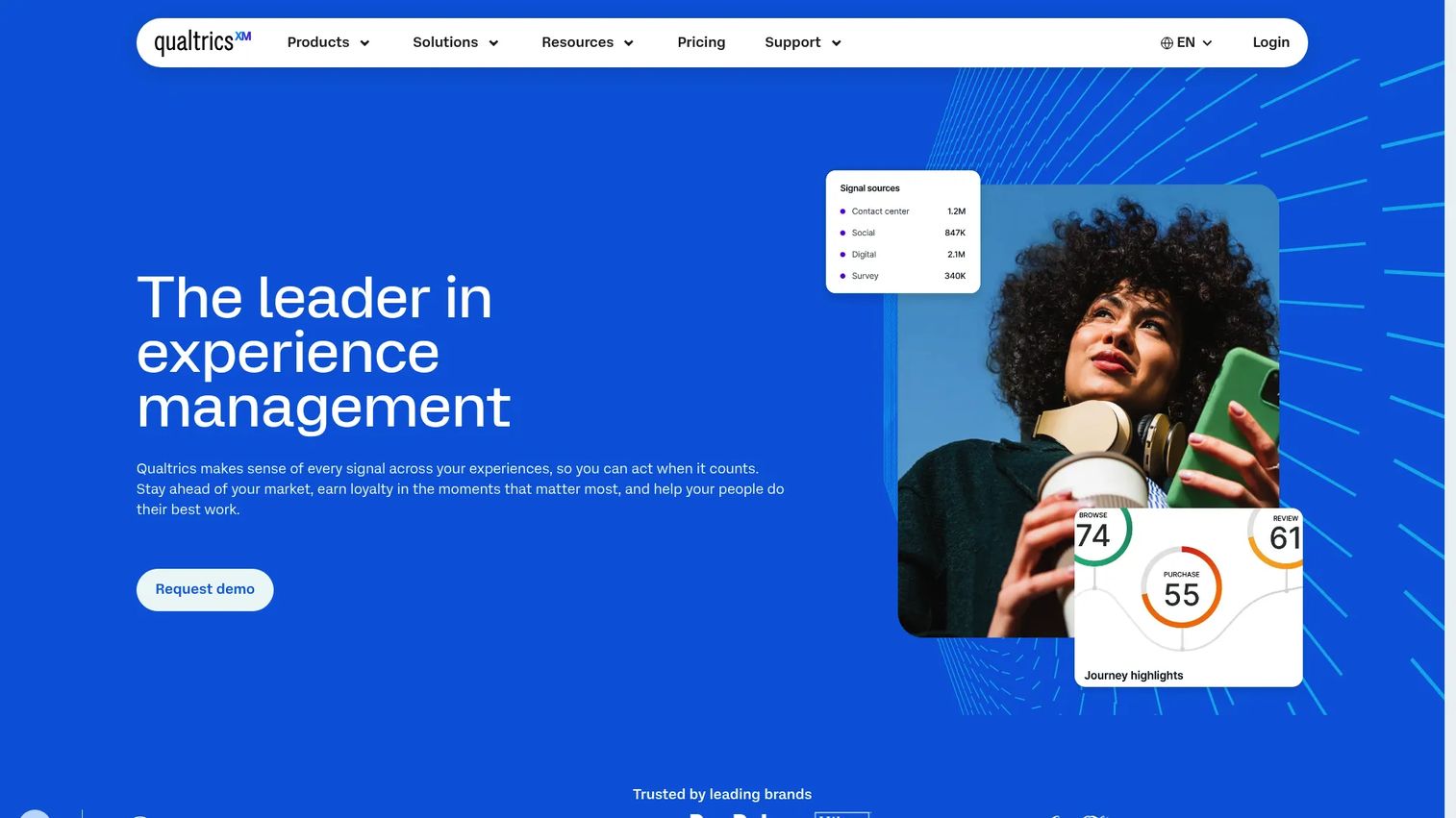
Qualtrics is experience management software for customer, employee, and research programs. This is the enterprise-grade option, built for teams running complex, multi-program CX at scale with advanced analytics and AI-assisted action workflows. If your voice-of-customer program spans dozens of touchpoints and stakeholders, this is the depth you are paying for.
Best for: Teams that need a configurable experience management platform for CX, EX, or research programs.
Key strengths
- Customer Experience suite: Voice of customer, digital experience analytics, contact center analytics, and online reputation management in one place.
- Full experience platform: CX, EX, and Strategy & Research suites so satisfaction data connects to employee and market insight.
- AI-assisted workflows: Collect, analyze, and act on feedback with AI guidance, reducing manual triage on large volumes.
Why choose Qualtrics: Choose it when scale and sophistication outweigh setup speed. It rewards teams with dedicated research or CX ops resources and the volume to justify the investment. Smaller teams will find it more platform than they need, but at the enterprise end its depth is hard to match.
Qualtrics pricing: A For Small Business plan runs $420/month ($5,040 billed annually for 1,000 responses shared across users). The For Enterprise plan uses custom, interaction-based pricing tied to response and video-feedback volume.
Its G2 rating is 4.3/5.
5. ProProfs Survey Maker
ProProfs Survey Maker is survey software for creating, sending, and analyzing online surveys, forms, and NPS/CX feedback. It leans into affordability and ease of use, making it a practical fit for smaller teams or anyone who wants lightweight deployment without a long ramp. The AI survey builder gets you from blank page to fielded survey quickly.
Best for: Teams that need an AI-assisted survey tool with embedded distribution, logic, and analytics on a modest budget.
Key strengths
- AI survey builder: Generate surveys fast with 20+ question types, cutting setup time for lean teams.
- Skip logic and branching: Keep surveys relevant per respondent to protect completion rates.
- Flexible distribution: Share via email, embed, social, and QR code, plus integrations with tools like Zendesk and Salesforce.
Why choose ProProfs Survey Maker: It is the value pick. When you need functional CSAT, NPS, and CES collection without enterprise pricing or complexity, it covers the essentials with reporting and analytics attached. Larger CX programs may want deeper closed-loop tooling, but for straightforward feedback collection it is simpler and cheaper.
ProProfs Survey Maker pricing: A free plan covers up to 50 responses. Paid plans include Essentials at $19.99/month (billed annually), Business at $49.99/month (billed annually), and Enterprise at $149.99/month (annual only).
6. SurveySensum
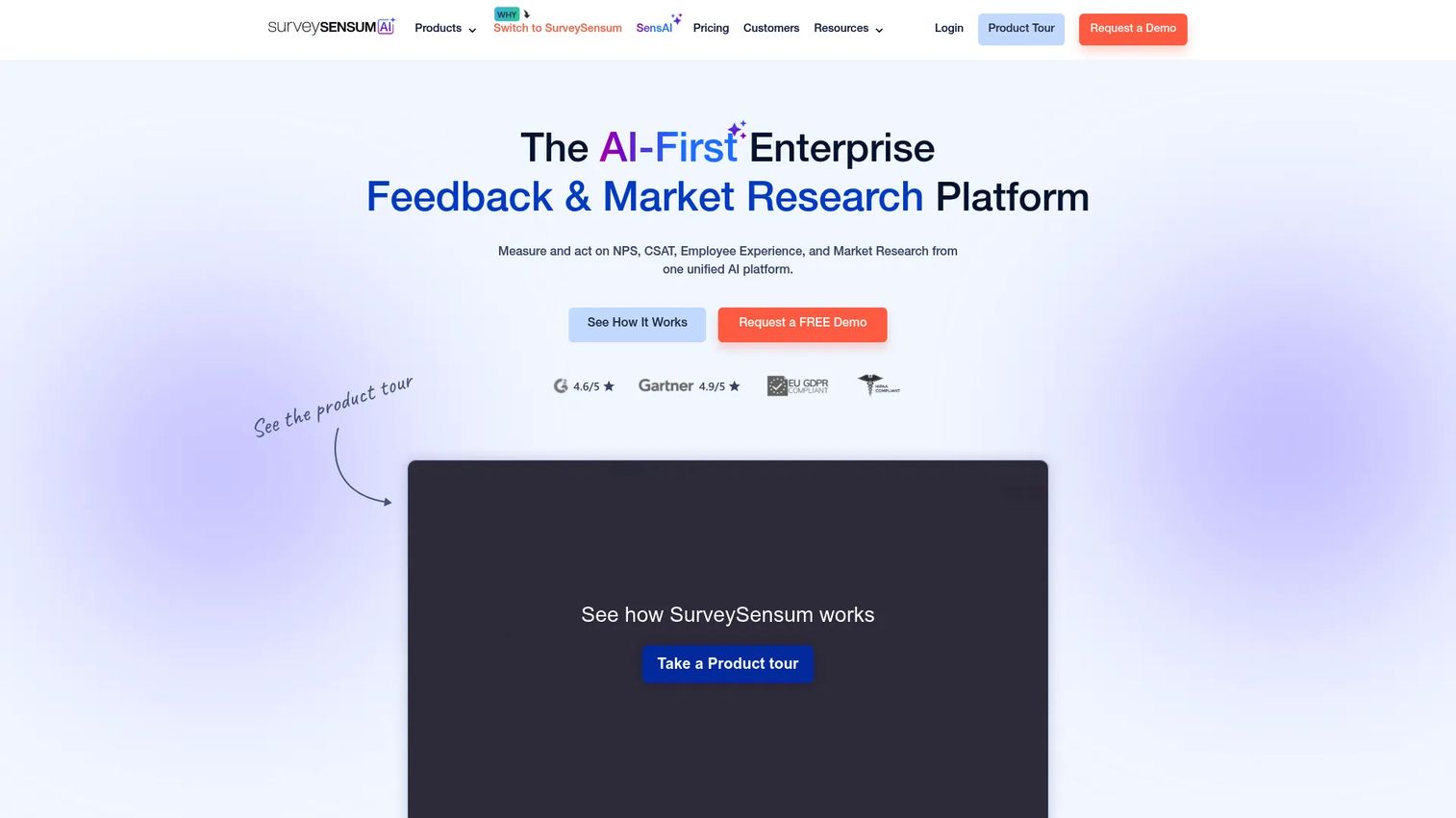
SurveySensum is an AI-powered survey, CX, and market research platform for collecting feedback and turning it into action. It takes a CX-first approach, unifying CSAT, NPS, and CES workflows with AI dashboards and alerts, and it offers managed services for teams that want help running the program rather than just software.
Best for: Teams needing an AI-assisted survey and customer feedback platform with managed services available.
Key strengths
- Multichannel distribution: Field surveys across email, WhatsApp, in-app, SMS, and CRM to catch sentiment where it lives.
- AI dashboards, alerts, and drilldowns: Surface themes and detractors automatically, so triage does not eat your week.
- Conditional logic and multilingual surveys: Personalize paths and reach global segments in their own language.
Why choose SurveySensum: Pick it when you want a modern CX toolkit and optional expert help. The managed CX option suits teams that lack in-house research capacity but still need trustworthy voice-of-customer output. The AI layer keeps analysis fast as response volume grows.
SurveySensum pricing: Publicly listed annual plans include Starter CX at $3,600/year and Self-Serve CX at $6,000/year, with Managed CX on custom pricing. A one-month free trial covering up to 25 responses is available.
Its G2 rating is 4.6/5.
7. Userpilot
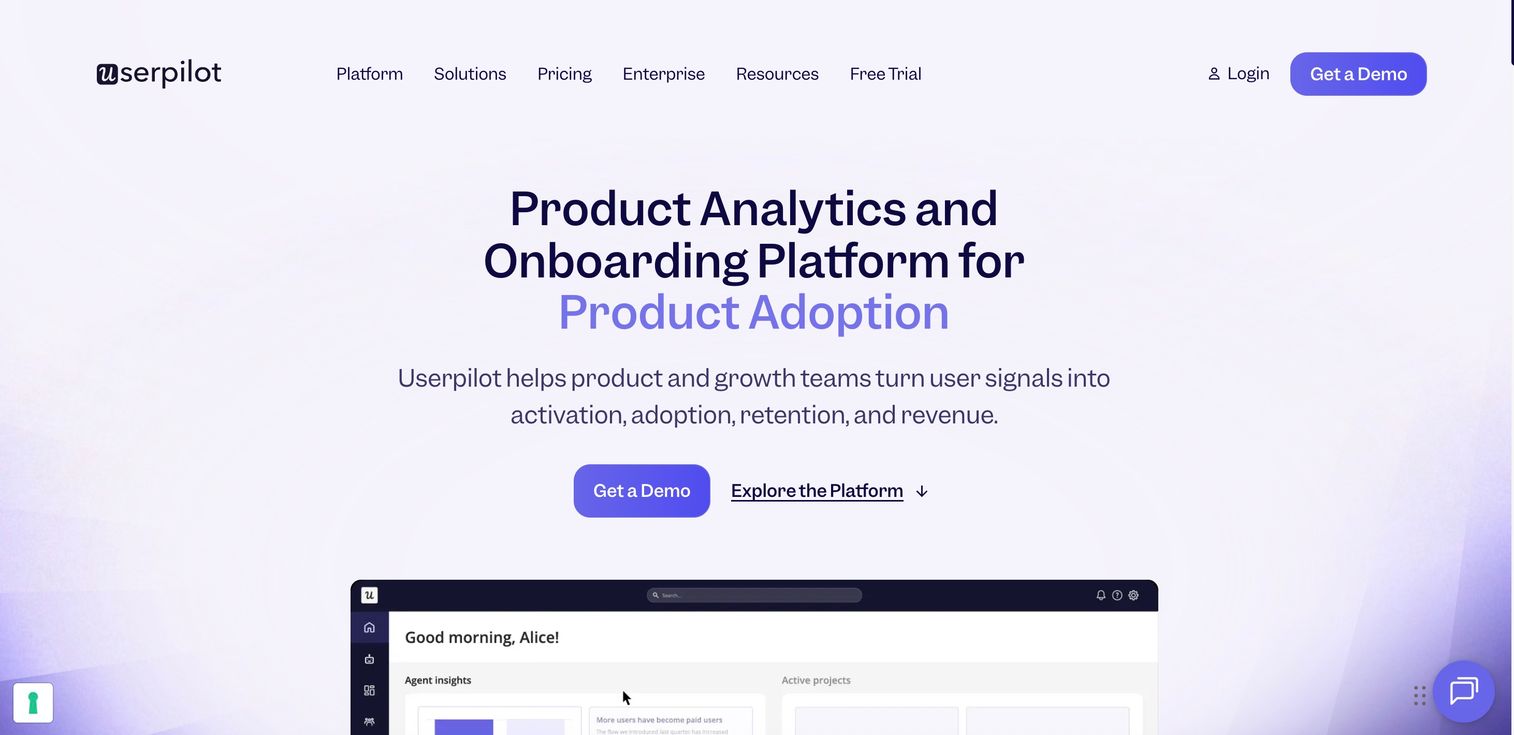
Userpilot is a product experience platform that pairs in-app onboarding and engagement flows with native survey tooling. For customer satisfaction, its strength is context: NPS and CSAT microsurveys fire inside the product at the exact moment a user completes a workflow, hits a feature, or reaches a milestone, so sentiment ties directly to behavior rather than an out-of-context email pulse.
Best for: Product-led SaaS teams that want in-app CSAT and NPS surveys tied to real product usage and user segments.
Key strengths
- In-app microsurveys: Trigger NPS and CSAT prompts based on user actions, events, and segments, capturing sentiment at the moment of experience.
- Behavioral targeting and segmentation: Fire surveys to specific cohorts and tie responses to product analytics for retention and adoption insight.
- Closed-loop follow-up: Route responses into your stack and pair feedback with in-app flows that act on detractor signals.
Why choose Userpilot: Pick it when your feedback motion lives inside the product and you want CSAT and NPS wired to actual usage, not just inbox pulses. For product marketing managers measuring feature adoption and launch reception, the ability to connect survey scores to behavioral data makes it a natural fit for product-led programs.
Userpilot pricing: Paid plans start with Starter at $249/month (billed annually) for a capped number of monthly active users, with Growth and Enterprise tiers on custom pricing that scale with MAUs and features.
Its G2 rating is 4.6/5.
8. Survicate
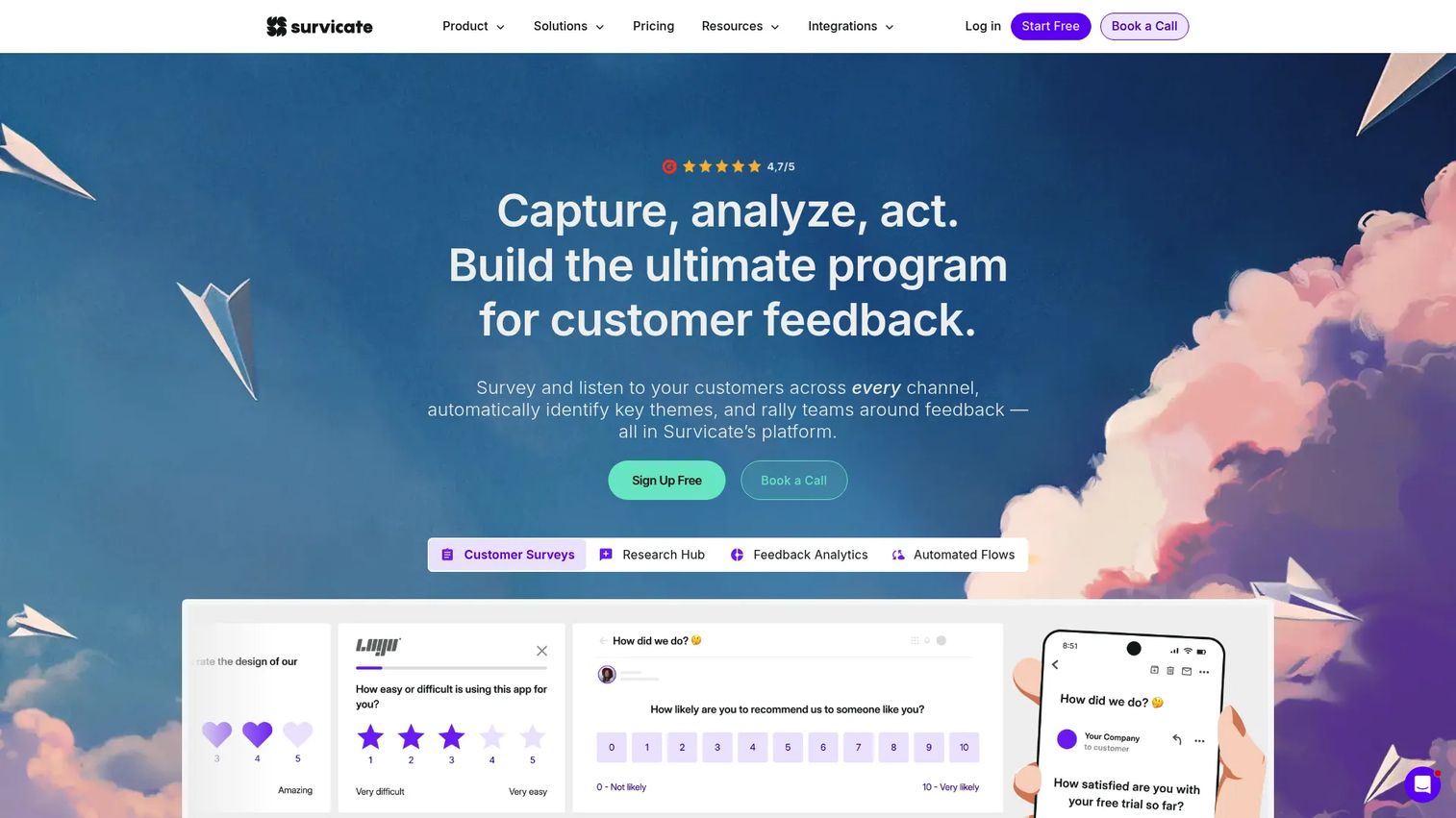
Survicate is a customer feedback platform for collecting and analyzing feedback across surveys and other channels. It is a practical multichannel option that suits product marketing managers and growth teams, with in-product and lifecycle survey use cases plus AI-assisted analysis that turns open text into themes. A free plan lowers the barrier to getting started.
Best for: Teams that need multichannel customer feedback collection plus AI-assisted analysis.
Key strengths
- AI feedback analysis: Automatically categorize open responses so qualitative feedback becomes usable at scale.
- Research Hub: Store and organize feedback in a research repository, useful for ongoing voice-of-customer work.
- Dashboards and survey analytics: Track CSAT, NPS, and CES trends and segment by cohort for retention insight.
Why choose Survicate: It fits teams that run feedback across the lifecycle and want analysis they do not have to do by hand. The in-product survey use cases make it a natural fit for PMMs measuring launch reception and feature adoption. The free tier makes it easy to prove value before scaling.
Survicate pricing: A free plan is available. Paid plans include Growth starting at $114/month (billed annually), Pro starting at $349/month, and Enterprise starting at $569/month.
Its G2 rating is 4.6/5.
9. AskNicely
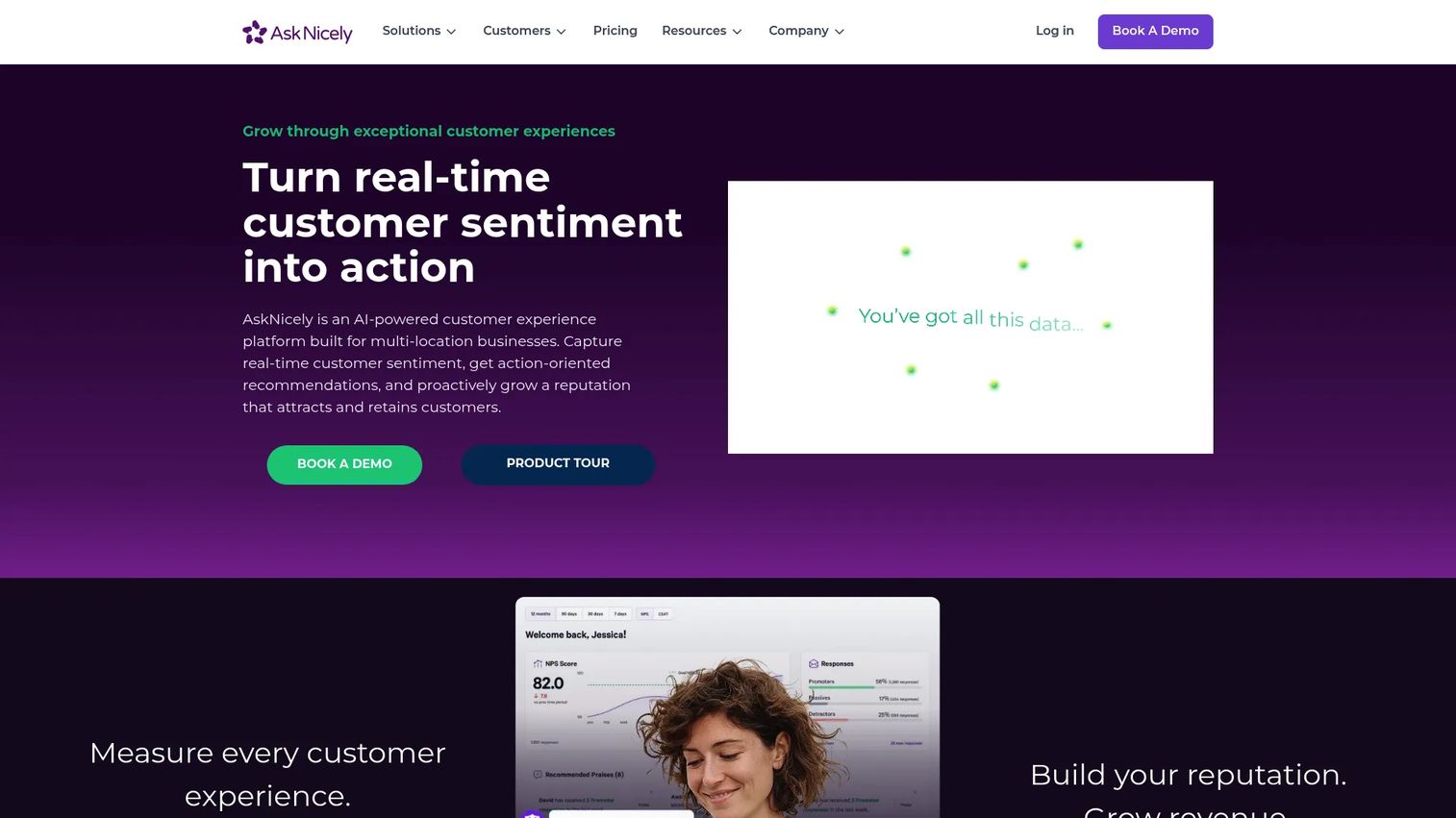
AskNicely is customer experience software for collecting feedback, analyzing it with AI, and driving action, built with service businesses in mind. Its strength is the closed-loop layer: multi-channel surveys feed real-time dashboards, automated workflows, and response management that pushes frontline teams to act on feedback fast.
Best for: Multi-location service businesses that want NPS/CSAT feedback, AI analysis, and workflow-driven CX improvement.
Key strengths
- Multi-channel surveys: Collect via email, SMS, web, in-app, and kiosk to reach customers across every touchpoint.
- Real-time dashboards and text analysis: Read sentiment and themes as responses land, not weeks later.
- Automated workflows and response management: Route feedback to the right person and track follow-up to close the loop.
Why choose AskNicely: Choose it when your priority is action, not just measurement. The workflow and coaching emphasis makes it a strong fit for customer success and support orgs, especially those managing distributed or multi-location teams that need feedback to change frontline behavior.
AskNicely pricing: Plans (Learn, Grow, Transform, plus Basic, Business, and Enterprise) are annual and scale with response volume, starting from 500 responses. Public numeric pricing is not displayed, so request a quote for your volume.
Its G2 rating is 4.7/5.
10. QuestionPro
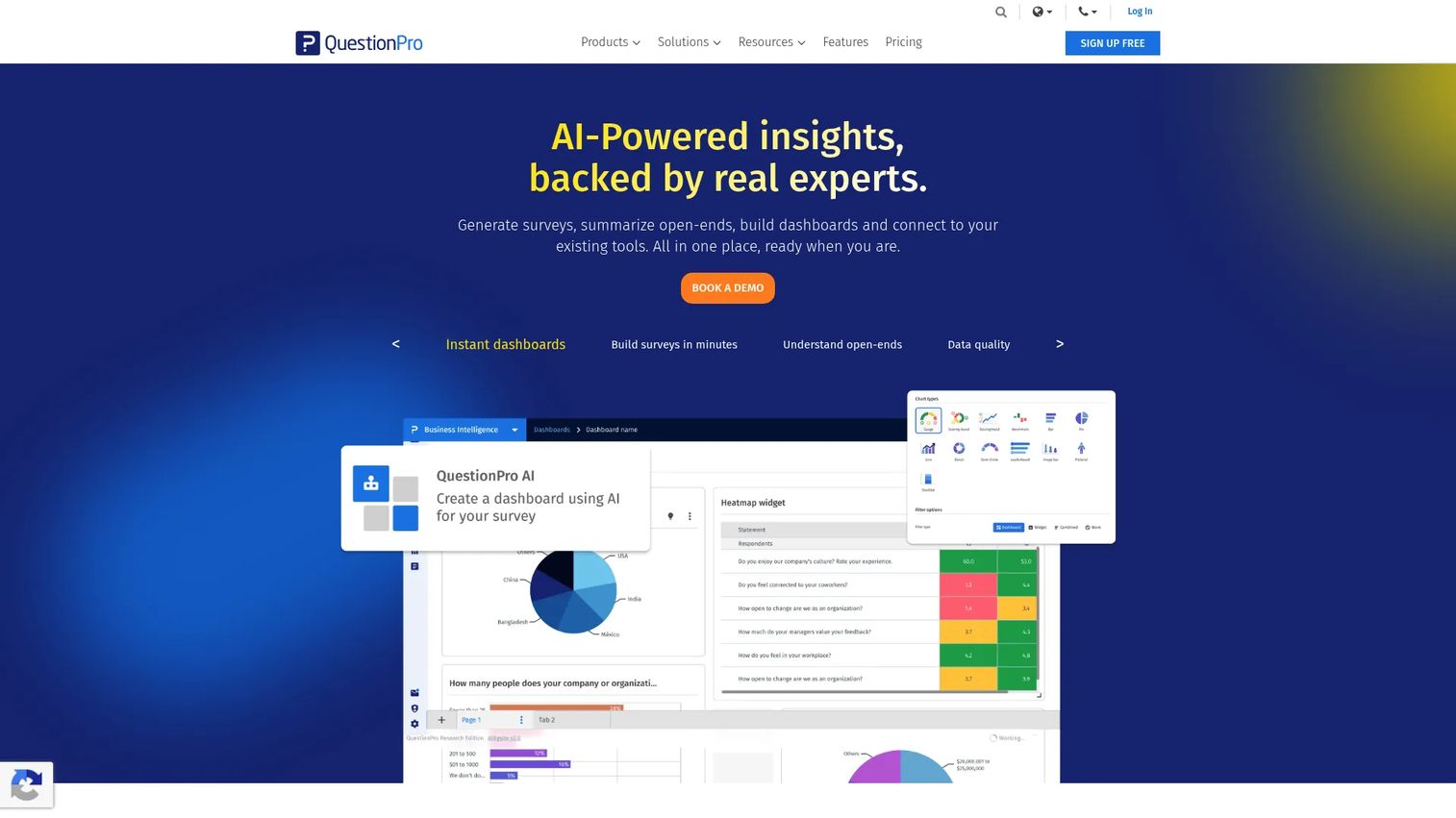
QuestionPro is survey, research, CX, and employee-experience software. It is a strong fit when you need more than a basic CSAT form, with flexible logic, deeper research options, and AI-powered survey and insights tools. A free entry tier plus paid business plans makes it scalable from a single survey to a full research program.
Best for: Teams needing an all-in-one survey and research platform with a free entry tier and paid business plans.
Key strengths
- Survey creation and distribution: Build and field surveys across channels with flexible question types and logic.
- Analytics and reporting: Segment, trend, and benchmark responses for retention and CX insight.
- AI-powered survey and insights tools: Speed up survey creation and surface patterns in responses automatically.
Why choose QuestionPro: Pick it when your needs span both operational CSAT and deeper research, and you want one platform to cover both. The free Essentials tier lets you start small, while the Research Suite scales into serious voice-of-customer and market research work.
QuestionPro pricing: The Essentials plan is free. Paid plans include Advanced at $99 per user/month and Team Edition at $83 per user/month, both billed annually, with a Research Suite on custom pricing.
Its G2 rating is 4.5/5.
Considerations when choosing customer satisfaction survey software
Match the tool to the feedback motion
Post-purchase, post-ticket, and account-health surveys each need different setup. A transactional CSAT prompt after a support ticket needs helpdesk triggering; a relationship NPS pulse needs scheduling and cohort segmentation. Map your motions first, then check which tool handles them natively rather than forcing a workaround.
Verify integrations before buying
If feedback must trigger action, make CRM integrations and helpdesk integrations a hard requirement. Confirm the exact connectors you rely on (Salesforce, HubSpot, Zendesk, Intercom, Slack) support the direction of data you need. A survey score that cannot reach the account owner in real time is a missed save.
Decide how much analysis you need
Some teams only need scores and a trend line. Others need segmentation, benchmarking, and text analysis on open responses. Buying enterprise analytics you will never configure wastes budget; under-buying leaves you exporting to spreadsheets. Be honest about your team's capacity to actually use the depth. For a wider view of the category, including feature voting and AI analytics platforms that sit alongside survey tools, see our guide to the best customer feedback tools.
Check governance and ownership
As more teams start surveying, ask who owns templates, routing rules, and reporting. Without clear ownership you get duplicate surveys, survey fatigue, and conflicting numbers in different dashboards. Governance is what keeps a multi-team feedback program trustworthy over time.
Evaluate ease of deployment
Product marketing managers and CX teams need tools that ship fast without brittle setup. A quick-win pilot beats a six-month rollout that stalls in IT review. Favor platforms with free tiers or trials so you can validate the workflow on a real feedback motion before committing budget.
Conclusion
The best customer satisfaction survey software is the one that matches your feedback motion and plugs into your stack, not the one with the longest feature list. Zonka Feedback is the pick when you want collection and AI theme analysis running on one platform instead of two. SurveyMonkey is the safest broad option for connected data and reporting most teams already understand. SurveySparrow wins when response rates are your bottleneck. Qualtrics is built for enterprise-scale CX and research. ProProfs Survey Maker keeps budget-conscious teams moving, while SurveySensum and Survicate offer modern, AI-assisted multichannel toolkits. AskNicely earns its rating on closed-loop action for service teams, and QuestionPro spans operational CSAT and deeper research in one place.
Start by naming your primary feedback motion, then shortlist the two tools that field that motion natively and integrate with your CRM. Run a free trial on a real survey, measure completion and how fast a low score reaches an owner, and let that decide. The right customer satisfaction tools do not just collect feedback. They help you close the loop and reduce churn before it shows up in the numbers.
For SaaS teams who want to show the product before asking customers what they think of it, Start your journey with Guideflow today!
FAQs
A CSAT (Customer Satisfaction Score) survey asks customers how satisfied they were with a specific interaction, product, or experience, usually on a 1 to 5 scale. The score is the percentage of respondents who rate you positively (typically 4 or 5). It is best used right after a defined moment, like a support ticket or a completed onboarding step.
CSAT measures satisfaction with a specific moment. NPS measures long-term loyalty and likelihood to recommend on a 0 to 10 scale. CES measures how much effort a task took, a strong predictor of repeat behavior and churn. Most mature voice-of-customer programs use all three: CSAT and CES for transactional moments, NPS for relationship health.
Prioritize omnichannel surveys, real-time alerts, branching logic, templates, analytics and benchmarking, and CRM and helpdesk integrations. The single most important feature is closed-loop workflow, the ability to route a low score to an owner and track follow-up. Collection without a response workflow leaves feedback stale.
Map your feedback motions first (post-purchase, post-ticket, account health), then shortlist tools that field those natively and integrate with your CRM and helpdesk. Run a free trial on a real survey and measure completion rate plus how fast a low score reaches an owner. Match analytics depth to your team's actual capacity to use it.
Match the channel to where sentiment is freshest: in-app or web prompts after a product action, SMS after a service visit, helpdesk surveys after a ticket, and email for relationship NPS pulses. Omnichannel customer feedback tools let you run all of these from one platform and unify the results, reducing blind spots in your data.
Set score thresholds that trigger real-time alerts, route detractors to an owner in Slack or your CRM, and create follow-up tasks with resolution tracking. On the analytics side, trend responses by segment to find systemic issues, not just one-off complaints. The fastest closed-loop follow-up, ideally within hours of a low score, saves the most accounts.
Yes, when it closes the loop. Surveys surface at-risk accounts before they churn, often weeks in advance, and routing low scores to a human for fast follow-up is what converts a detractor into a retained customer. Feeding scores into account-health programs also helps CS prioritize the accounts that need attention.
Product marketing managers use CSAT tools for launch feedback, message testing, win-loss and customer interviews, and post-release pulse checks. The scores and open responses become proof points and roadmap signals you can defend across sales, product, and leadership. Tied to retention data, they turn voice-of-customer work into a repeatable, measurable GTM input.