Most finance teams know their spend data exists. The problem is that it lives across four ERP instances, two AP automation platforms, a P-card program, and spreadsheets maintained by three different people who all use different supplier names. According to the Association of Certified Accounts Payable Professionals (2024), 74% of AP teams were only partially automated, while just 5% had reached full automation. That gap is exactly where spend visibility breaks down: Invoices get processed, payments go out, but no one can answer "how much did we spend with this supplier last quarter?" without a manual extraction exercise.
The global AP automation market reached $6.17 billion in 2025 and is projected to reach $12.46 billion by 2031, according to Mordor Intelligence (2026). The spend analysis software market tells a similar story, valued at $3.29 billion in 2025 with a projected rise to $6.47 billion by 2030, per The Business Research Company (2026). Teams are investing because the status quo, invoice data in one system and spend insight in another, is no longer acceptable when leadership wants spend answers in hours, not weeks.
This guide cuts through the category to give you a shortlist of 15 tools worth evaluating.
What's inside
This guide covers 15 accounts payable and spend analysis software tools for finance, procurement, and operations teams in 2026. Tools were selected based on four criteria:
- AP data fit: Does the tool ingest and analyze invoice, payment, and supplier data?
- Spend analytics depth: Does it classify spend, surface opportunities, and support category management?
- Integration coverage: Does it connect to ERP, procurement, and finance source systems?
- Procurement workflow support: Does it link analytics to sourcing, contracting, or savings execution?
The guide separates AP automation platforms, spend analytics specialists, ERP-native analytics layers, and source-to-pay suites to help you shortlist tools that match your data environment. You can explore related evaluations for accounts payable automation software and accounts payable software for adjacent category coverage.
TL;DR
- Best overall for enterprise source-to-pay spend analysis: Ivalua Spend Analysis Software, for teams that need auditable classification connected to procurement action
- Best for AP automation with built-in analytics: Medius Analytics and AvidXchange, for finance teams whose spend data lives primarily in invoices and payment workflows
- Best for procurement spend analytics specialists: Sievo Spend Analytics, SpendHQ, and Simfoni, for category managers who need depth beyond ERP reporting
- Best for ERP-native finance analytics: Oracle Fusion Data Intelligence ($3/month per hosted employee minimum) and SAP Spend Control Tower, for teams already committed to those platforms
- Best for consulting-backed spend transformation: Spendscape by McKinsey, for organizations running procurement transformation programs alongside software rollout
- Best for logistics and freight spend: Loop Logistics Data Platform, for companies where transportation and carrier costs drive the biggest leakage
What is accounts payable and spend analysis software?
Accounts payable and spend analysis software helps finance and procurement teams turn invoice, payment, supplier, ERP, and procurement data into usable spend visibility, savings opportunities, and control signals.
The category sits at the intersection of two distinct workflows. AP automation handles invoice capture, coding, approval routing, and payment execution. Spend analysis takes the data those workflows generate, plus data from ERP, procurement, contracts, P-cards, and T&E, and turns it into supplier-level and category-level insight a procurement team can act on.
Core capabilities this category covers:
- Invoice and payment data ingestion from AP platforms and ERP systems
- Supplier normalization and duplicate supplier cleanup across source systems
- Spend classification by category, GL account, department, and cost center
- Dashboards for supplier spend, category spend, contract compliance, and savings opportunity tracking
- Tail-spend and maverick-spend detection
- Budget variance analysis and payment timing insight
- Workflow links to sourcing, supplier management, and payment controls
The boundary between adjacent categories matters for tool selection:
- AP automation: Processes invoices and payments, often with limited analytics beyond operational KPIs
- Spend analysis: Explains where money goes across all spend categories and surfaces savings opportunities
- Spend management: A broader category covering sourcing, procurement, contracts, supplier management, and payment workflows together
- ERP analytics: Reports on data already inside a single ERP, without cross-system normalization or enrichment
The right tool depends on where your spend data lives and who needs to act on it. An AP team trying to understand invoice-level patterns needs something different from a category manager building a supplier consolidation strategy.
For broader context on data-driven analytics approaches, see our guide on big data analytics software.
When to use accounts payable and spend analysis software
Find savings hidden in invoice data
AP data is often the fastest path to spend insight because invoices carry supplier, amount, GL code, and payment timing data that already exists in your systems. The problem is that the same supplier may appear as "Acme Corp," "ACME Corporation," and "Acme Corp Ltd" across three systems, making aggregation unreliable. Spend analysis software normalizes those records so you can see total supplier exposure, detect duplicate purchases, and spot recurring small invoices that are bypassing preferred contracts.
Control supplier and category spend
Procurement teams need category-level visibility to negotiate better terms, consolidate fragmented buying across business units, and identify maverick spend before it compounds. When category spend is maintained manually in spreadsheets, the data is usually stale and inconsistently classified. Dedicated spend analytics tools maintain consistent taxonomy, automate classification against UNSPSC or custom category trees, and refresh data on a schedule that makes the insight actionable, not historical.
Replace spreadsheet-based spend reporting
Spreadsheet spend cubes collapse under the weight of multiple source systems, stale extracts, and unclear taxonomy ownership. When a new data source is added or a supplier changes its billing name, manual classification rules break silently. Automated spend analysis handles ingestion, cleansing, and reclassification continuously, with audit trails that show how every spend record was categorized and who changed what.
Accounts payable and spend analysis software comparison
The table below covers all 15 tools in the order they appear in this guide. Pricing reflects what was verifiable at time of publication. For tools without public pricing pages, the table indicates that buyers contact sales. G2 ratings are sourced from each tool's live G2 listing.
| # | Product | Best for | Key differentiator | Pricing | G2 rating |
|---|---|---|---|---|---|
| 1 | Ivalua Spend Analysis Software | Enterprise procurement and AP teams | Auditable classification with source-to-pay workflow depth | Contact sales | 4.3/5 |
| 2 | Medius Analytics | AP teams modernizing spend visibility | AP analytics bundled with invoice automation | Contact sales | 4.3/5 |
| 3 | AvidXchange | Mid-market AP and payments teams | AI-powered invoice and payment automation | Contact sales | 4.4/5 |
| 4 | Spendscape by McKinsey | Consulting-led spend transformation | AI analytics backed by McKinsey procurement methodology | Contact sales | N/A |
| 5 | Sievo Spend Analytics | Procurement analytics specialists | Specialist spend classification with spend-based pricing | Contact sales | 4.1/5 |
| 6 | Coupa | Enterprise spend management | Broad spend management platform covering procurement to payment | Contact sales | 4.2/5 |
| 7 | Suplari | AI-driven spend intelligence | AI agents for savings and supplier opportunity detection | Contact sales | 5.0/5 |
| 8 | JAGGAER ONE | Complex procurement organizations | Source-to-pay suite with 1,000+ ERP connectors | Contact sales | 4.1/5 |
| 9 | Oracle Fusion Data Intelligence | Oracle ERP environments | Prebuilt finance and procurement analytics inside Oracle Cloud | From $3/month per employee | N/A |
| 10 | SAP Spend Control Tower | SAP-centric procurement teams | SAP-native spend visibility with automated S/4HANA connectors | Contact sales | N/A |
| 11 | Simfoni | Procurement teams needing managed analytics | Pay-As-You-Save pricing with savings pipeline tracking | Contact sales | 4.8/5 |
| 12 | SpendHQ | Procurement spend visibility | AI-powered spend intelligence with supplier risk coverage | Contact sales | 4.4/5 |
| 13 | Zycus Source to Pay Suite | Enterprise procurement automation | Full source-to-pay with autonomous negotiation and AI intake | Contact sales | 3.6/5 |
| 14 | Unit4 Source-to-contract by Scanmarket | Source-to-contract teams | Strategic sourcing and RFx with integrated spend analytics | Contact sales | 4.1/5 |
| 15 | Loop Logistics Data Platform | Logistics and freight spend teams | Specialized logistics spend and transportation cost visibility | Contact sales | N/A |
Best 15 accounts payable and spend analysis software tools
1. Ivalua Spend Analysis Software
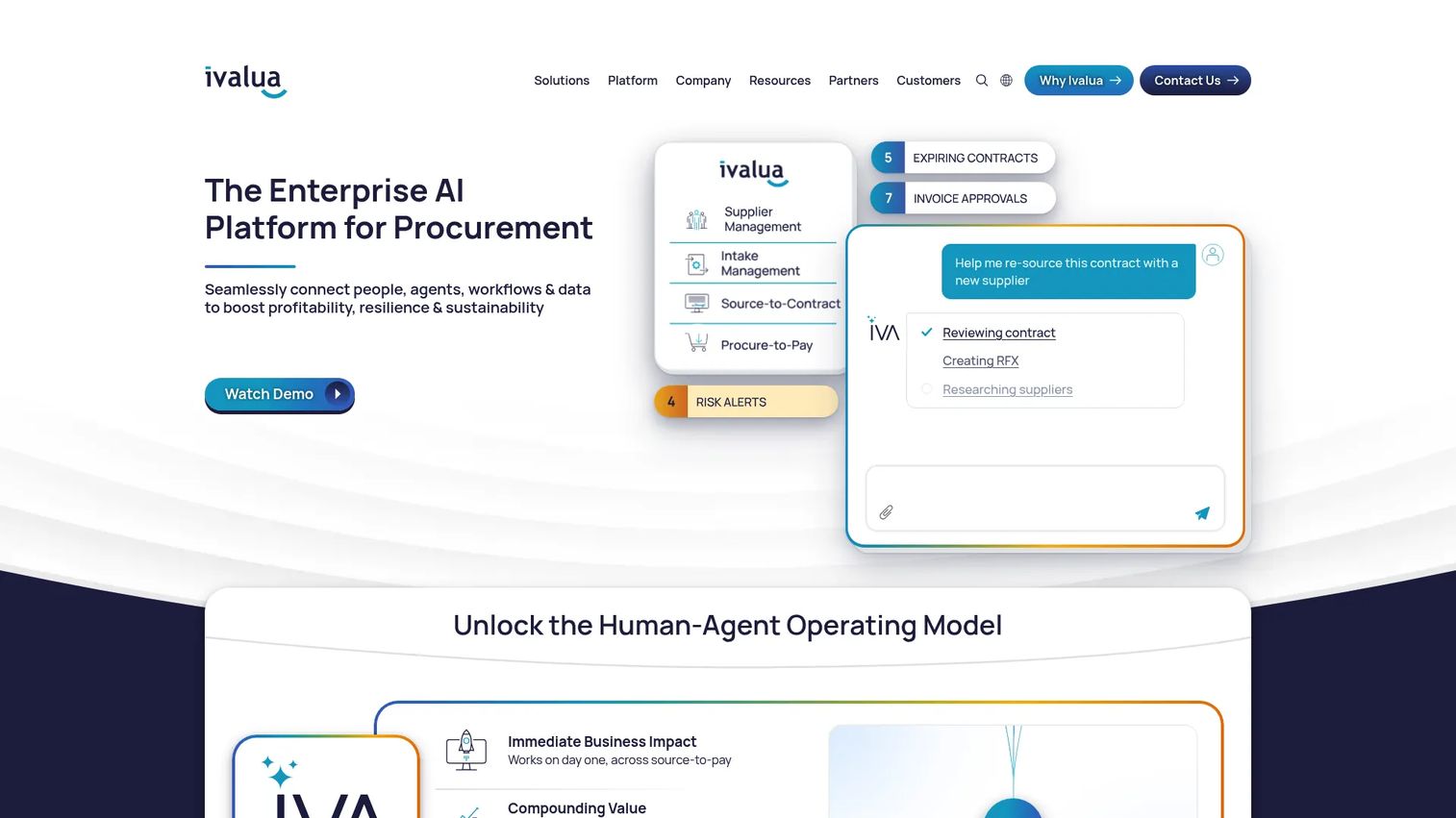
Ivalua is an enterprise spend analysis platform built for organizations that need to aggregate, normalize, and classify spend across AP, ERP, procurement, P-card, and external data sources. Its classification engine is auditable, meaning you can inspect exactly which rules were applied to each spend record. The source-to-pay integration means spend insight can feed directly into sourcing decisions and savings tracking rather than sitting in a separate dashboard.
Best for: Large enterprise finance and procurement teams that need spend analysis connected to sourcing action, not only reporting.
Key features
- Multi-source spend data ingestion and normalization
- Transparent, auditable spend classification rules
- Configurable category taxonomy support
- Savings opportunity identification dashboards
- Source-to-pay workflow links for procurement action
Why choose Ivalua Spend Analysis Software: Choose Ivalua when spend classification governance matters as much as the dashboards. It fits organizations where audit trails on taxonomy decisions are a compliance or governance requirement.
Ivalua pricing: Ivalua uses sales-led enterprise pricing. Contact Ivalua directly for a quote. Pricing typically reflects spend volume, number of modules, user count, and implementation scope.
G2 rating: 4.3/5
2. Medius Analytics
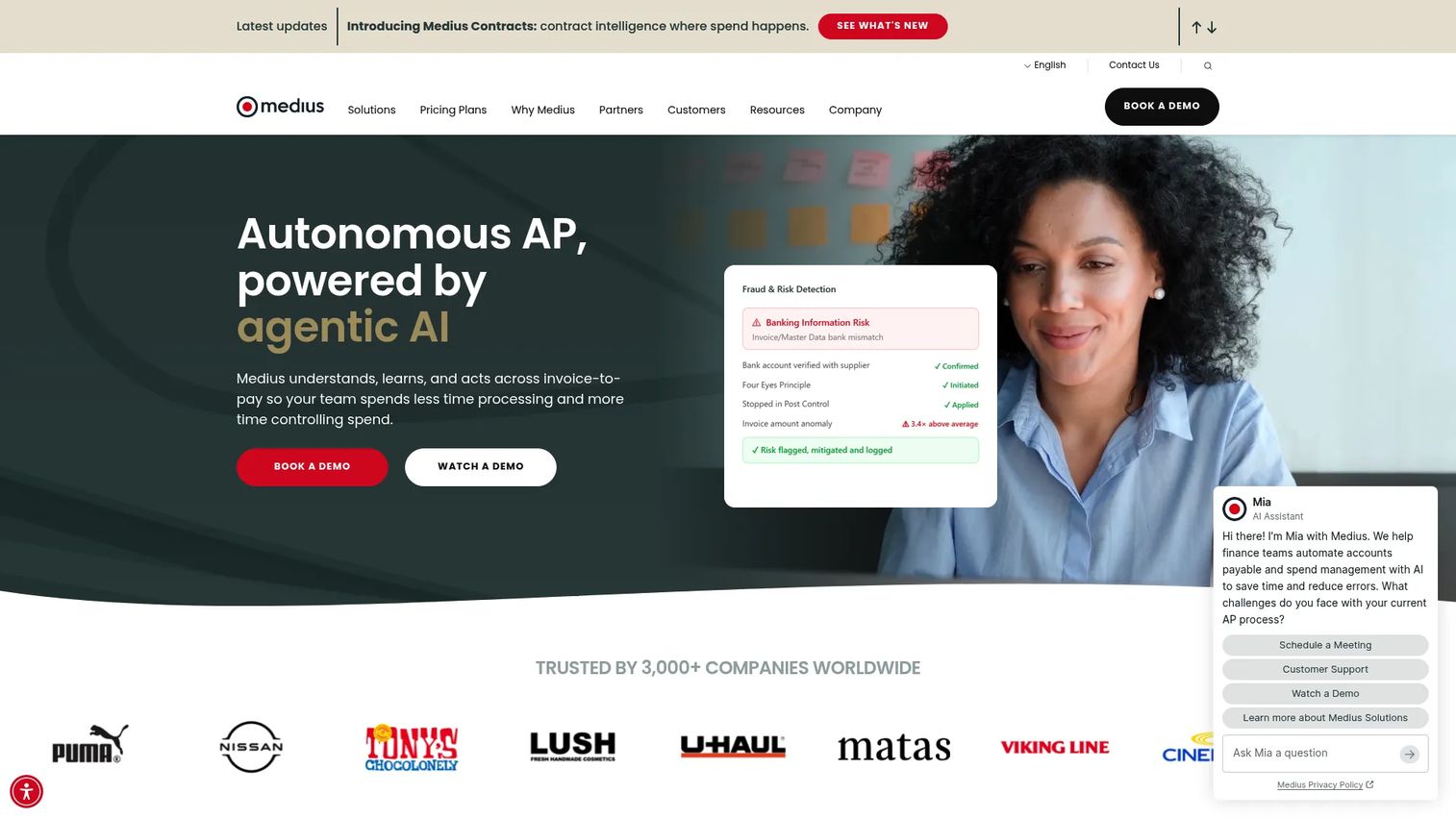
Medius Analytics is built for AP teams that want spend visibility embedded in their invoice and payment workflows. Rather than adding a separate analytics layer, Medius bundles dashboards, cash-flow insight, and supplier spend analysis into its AP Essentials and AP 360 plans. Touchless capture rates, first-time-right invoice processing, and straight-through-processing metrics sit alongside spend and cost dashboards in the same interface.
Best for: Mid-market and enterprise AP teams replacing spreadsheet reporting with analytics close to invoice processing and supplier payment data.
Key features
- Real-time spend, cost, and cash-flow dashboards
- Invoice touchless capture and extraction-rate analytics
- Supplier performance and payment-option analysis
- First-time-right and straight-through-processing metrics
- Risk-factor reporting for Fraud and Risk Detection users
Why choose Medius Analytics: Medius makes the most sense when AP owns the spend data problem and wants insight in the same platform as invoice processing. It is a practical fit for teams whose spend visibility requirement starts and ends with AP and supplier payments.
Medius pricing: Medius Analytics is bundled within Medius AP Essentials and Medius AP 360. Medius directs buyers to contact sales for a custom quote, as pricing is not displayed on its pricing page.
G2 rating: 4.3/5
3. AvidXchange
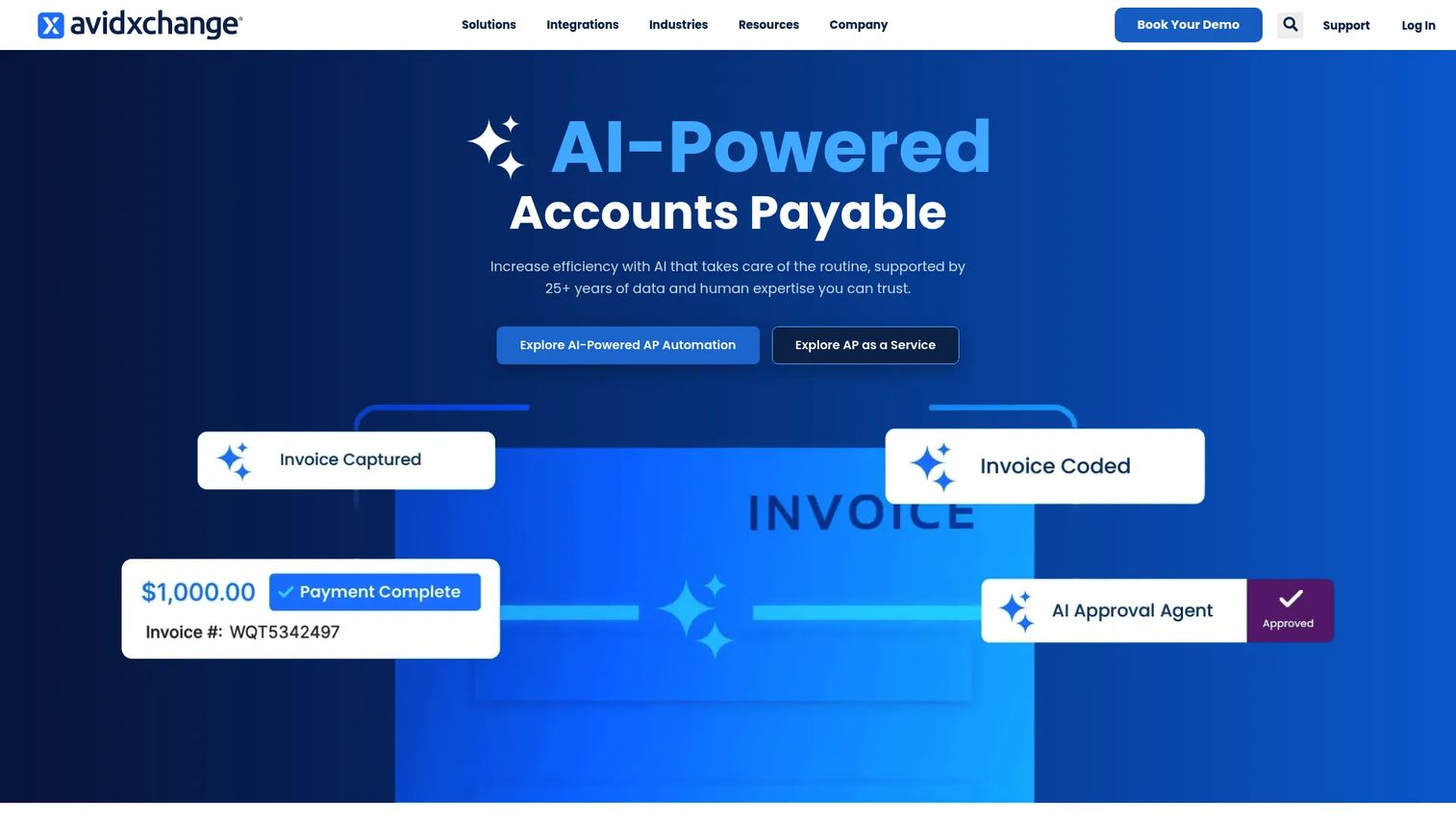
AvidXchange focuses on mid-market businesses that need to automate purchase-to-pay, invoice capture, and payment workflows without replacing their existing accounting system. Its AI-powered engine handles invoice data capture, coding, two- or three-way matching, and approval routing. Spend visibility comes from the payment and invoice data the platform processes, making it most relevant for AP teams whose primary goal is reducing manual work before extracting spend insight.
Best for: Mid-market AP and finance teams that want to reduce manual invoice and payment workload, with spend reporting as a secondary output.
Key features
- AI-powered invoice data capture, coding, and matching
- Purchase order creation with visual approval workflows
- Electronic payment automation with reconciliation support
- AP reporting dashboards built from invoice and payment data
- Two- or three-way invoice matching for purchase orders
Why choose AvidXchange: AvidXchange is a strong choice when the AP team's immediate priority is eliminating manual processing rather than building a procurement analytics program. Spend visibility is a downstream benefit of better AP data quality, not the primary product.
AvidXchange pricing: AvidXchange uses custom pricing. Cost drivers include invoice volume, payment volume, modules selected, and implementation scope. Contact AvidXchange sales for a quote.
G2 rating: 4.4/5
4. Spendscape by McKinsey
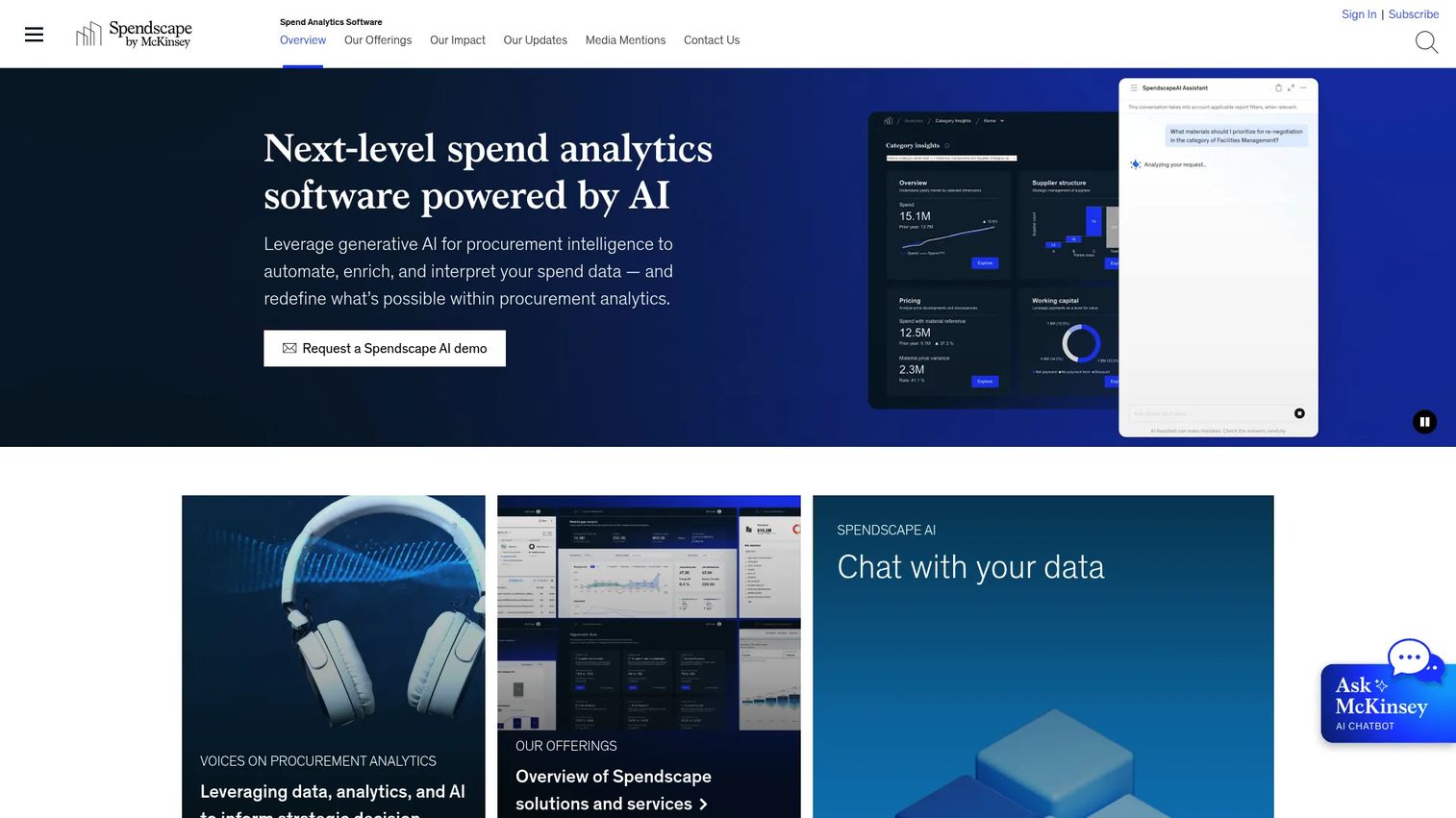
Spendscape is McKinsey's AI-powered spend analytics platform, designed for organizations that want software capabilities alongside procurement methodology. The platform creates a single source of truth from procurement data, then applies AI-powered supplier consolidation, spend categorization, and opportunity detection. It covers spend analytics, carbon and sustainability analytics, negotiation support, and input-cost tracking in one environment.
Best for: Large organizations running a procurement transformation program that want expert-backed category insight and savings prioritization alongside software.
Key features
- AI-powered supplier consolidation and spend categorization
- Spend, opportunity, carbon, and sustainability analytics
- Negotiation support and input-cost analytics
- Savings and impact management tracking
- Generative AI for procurement intelligence
Why choose Spendscape by McKinsey: Choose Spendscape when leadership wants a spend analytics program tied to a procurement transformation mandate, not a standalone dashboard. The McKinsey methodology backing adds value for teams that benefit from benchmarks and procurement expertise alongside the tool.
Spendscape pricing: Spendscape is subscription-based SaaS. McKinsey directs prospective buyers to request a demo for pricing. No verifiable public pricing range was available at time of publication.
5. Sievo Spend Analytics
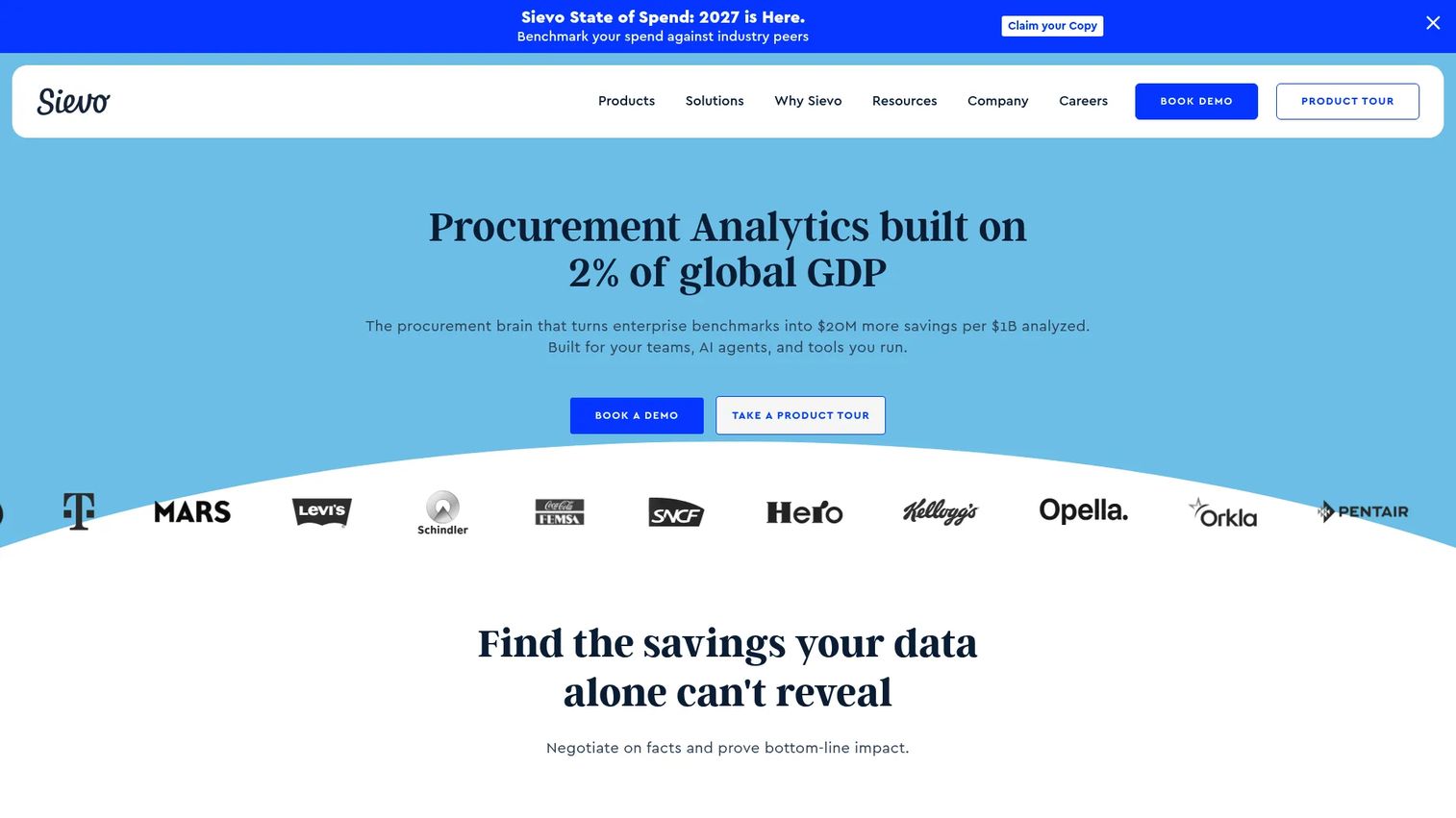
Sievo is a specialist spend analytics platform built for procurement teams that need depth in data cleansing, supplier classification, and category management. It pulls data automatically from ERP systems, data lakes, and procurement platforms, then applies AI-powered classification and supplier normalization. Pricing is based on customer spend volume rather than user seats, which makes it possible for larger teams to access the platform without per-seat cost escalation.
Best for: Enterprise procurement analytics teams that need a dedicated spend analysis system beyond ERP reporting or AP automation.
Key features
- Automated data extraction from ERP, data lakes, and procurement systems
- AI-powered spend classification and supplier normalization
- Personalized AI-powered insights and automated action suggestions
- Customizable dashboards and self-service analytics
- External data enrichment and procurement benchmarking
Why choose Sievo Spend Analytics: Sievo is strongest when procurement category managers need to act on spend insight, not just review it. The spend-based pricing model benefits larger teams that would otherwise pay heavily per seat.
Sievo pricing: Sievo prices by customer spend volume with unlimited user seats. No public numeric price is listed. Contact Sievo directly for a quote.
G2 rating: 4.1/5
6. Coupa
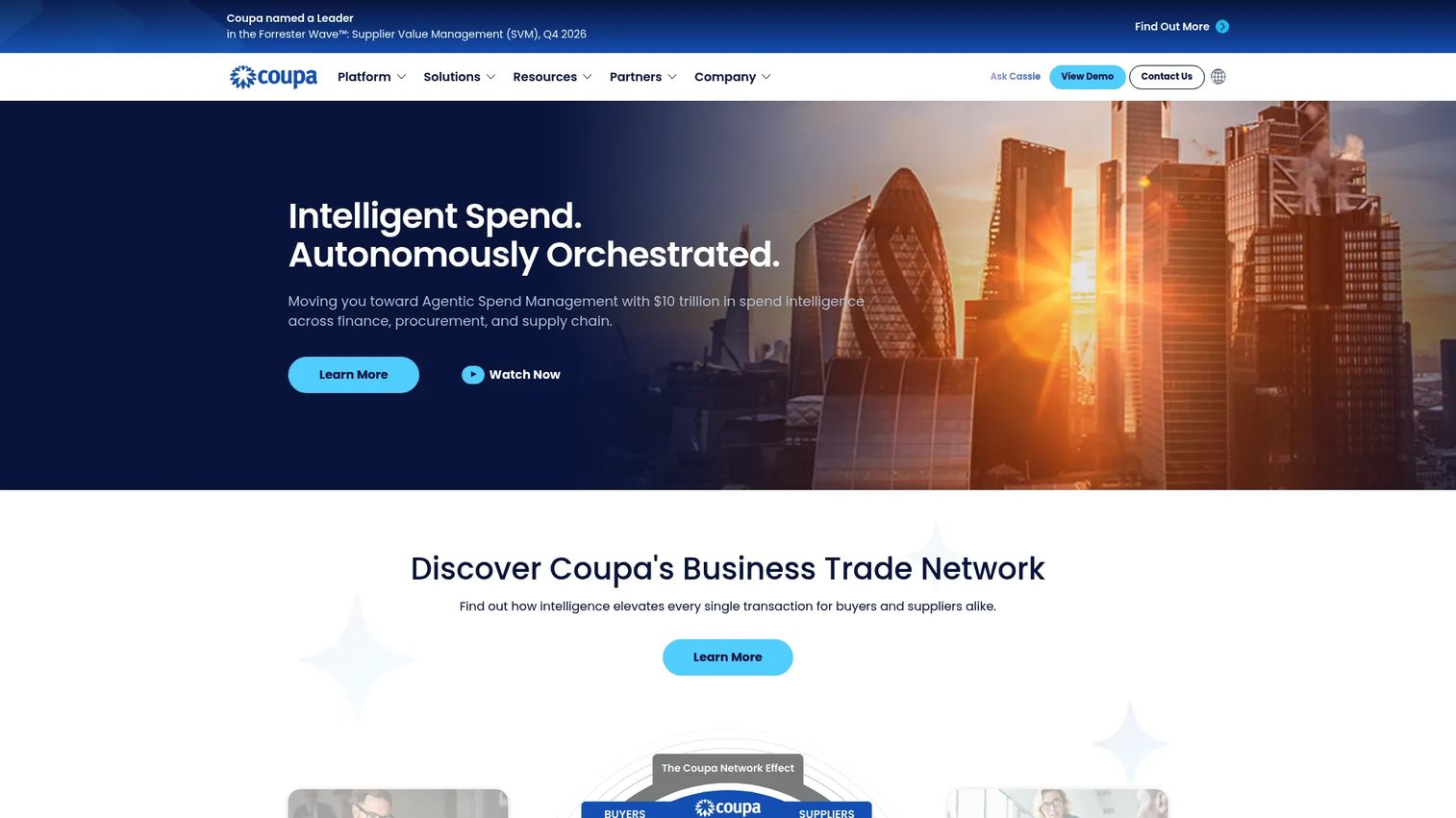
Coupa is a broad business spend management platform covering procurement, invoice management, expense management, supplier management, and spend analytics across the full purchase-to-pay cycle. Its Platform Standard and Platform Plus variants give enterprise teams a configurable operating environment for managing spend across categories, geographies, and business units. Spend analytics sits inside a larger workflow suite rather than functioning as a standalone analytical layer.
Best for: Enterprise organizations that want spend analysis inside a wider spend management platform covering procurement through payment.
Key features
- Procurement and purchase-order management
- Invoice management and AP automation
- Spend analytics and reporting dashboards
- Supplier management and risk monitoring
- Expense management workflows
Why choose Coupa: Choose Coupa when the organization wants to consolidate procurement, invoicing, supplier management, and spend analytics into one platform rather than integrating separate point solutions. It is a fit for companies standardizing spend operations at scale.
Coupa pricing: Coupa uses subscription-based pricing with Platform Standard and Platform Plus variants. Buyers contact Coupa sales, and cost depends on modules, users, transaction volume, and implementation scope.
G2 rating: 4.2/5
7. Suplari
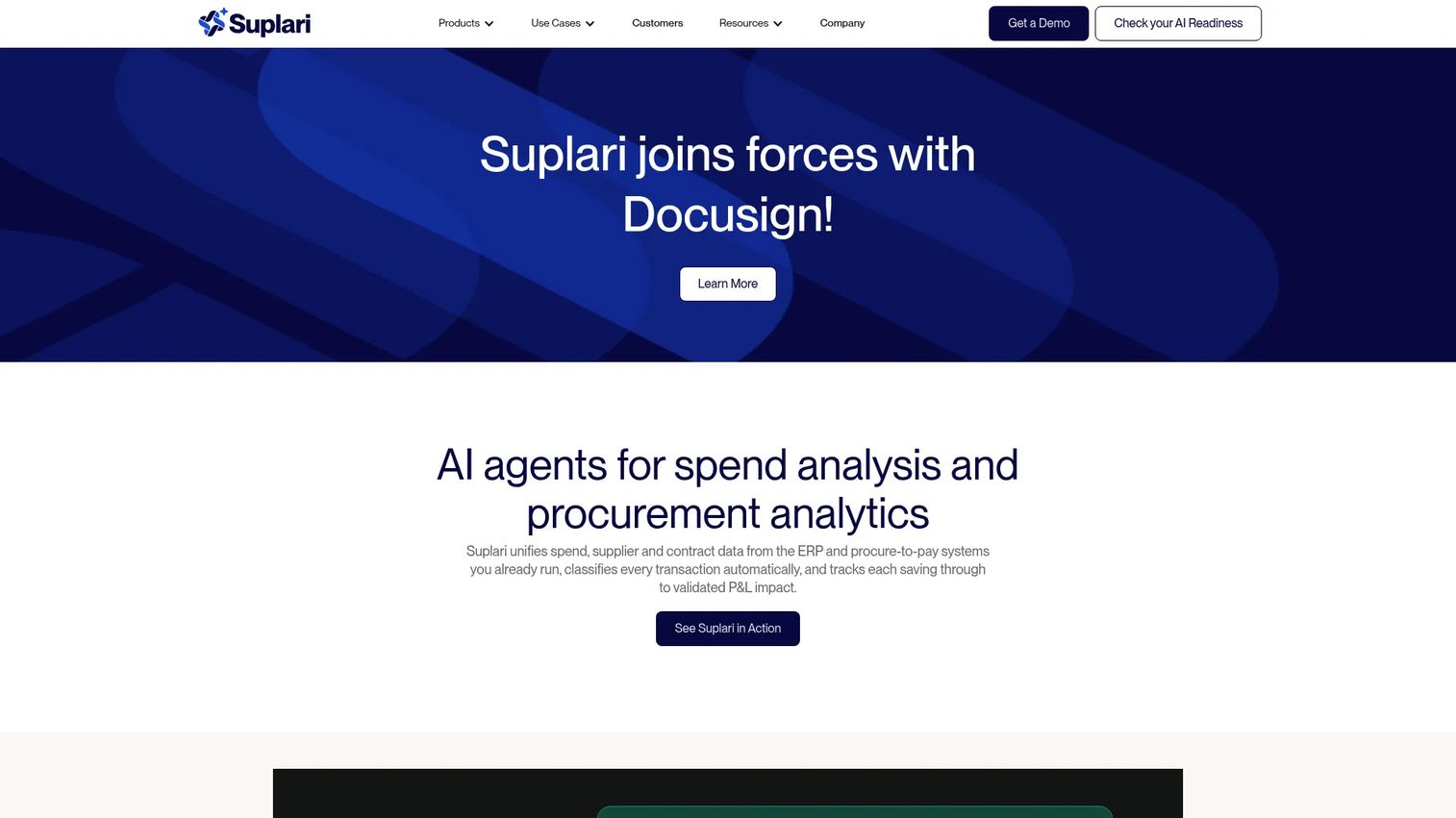
Suplari is an enterprise procurement intelligence platform that unifies spend, supplier, and contract data, then uses AI agents to surface savings opportunities, detect anomalies, and monitor supplier risk. Rather than presenting data in static dashboards, Suplari applies AI to highlight specific actions, such as supplier consolidation opportunities and contract renewals at risk. It is designed for teams with fragmented data across multiple ERP and P2P systems.
Best for: Mid-size and large enterprises with fragmented procurement data across ERP, P2P, supplier, and contract systems that want AI-assisted savings recommendations.
Key features
- Spend data aggregation, classification, and supplier normalization
- AI agents for anomaly detection and savings opportunity identification
- Supplier risk monitoring and contract renewal tracking
- Contract intelligence linking terms with spend and invoice data
- Procurement dashboards with action-oriented insight
Why choose Suplari: Suplari works best for teams that want the system to highlight what to do next rather than presenting data for manual interpretation. It fits procurement teams moving from static reporting to AI-assisted spend management.
Suplari pricing: Buyers contact sales for pricing. No verified G2-reported pricing range was available at time of publication.
G2 rating: 5.0/5 (based on 1 review)
8. JAGGAER ONE
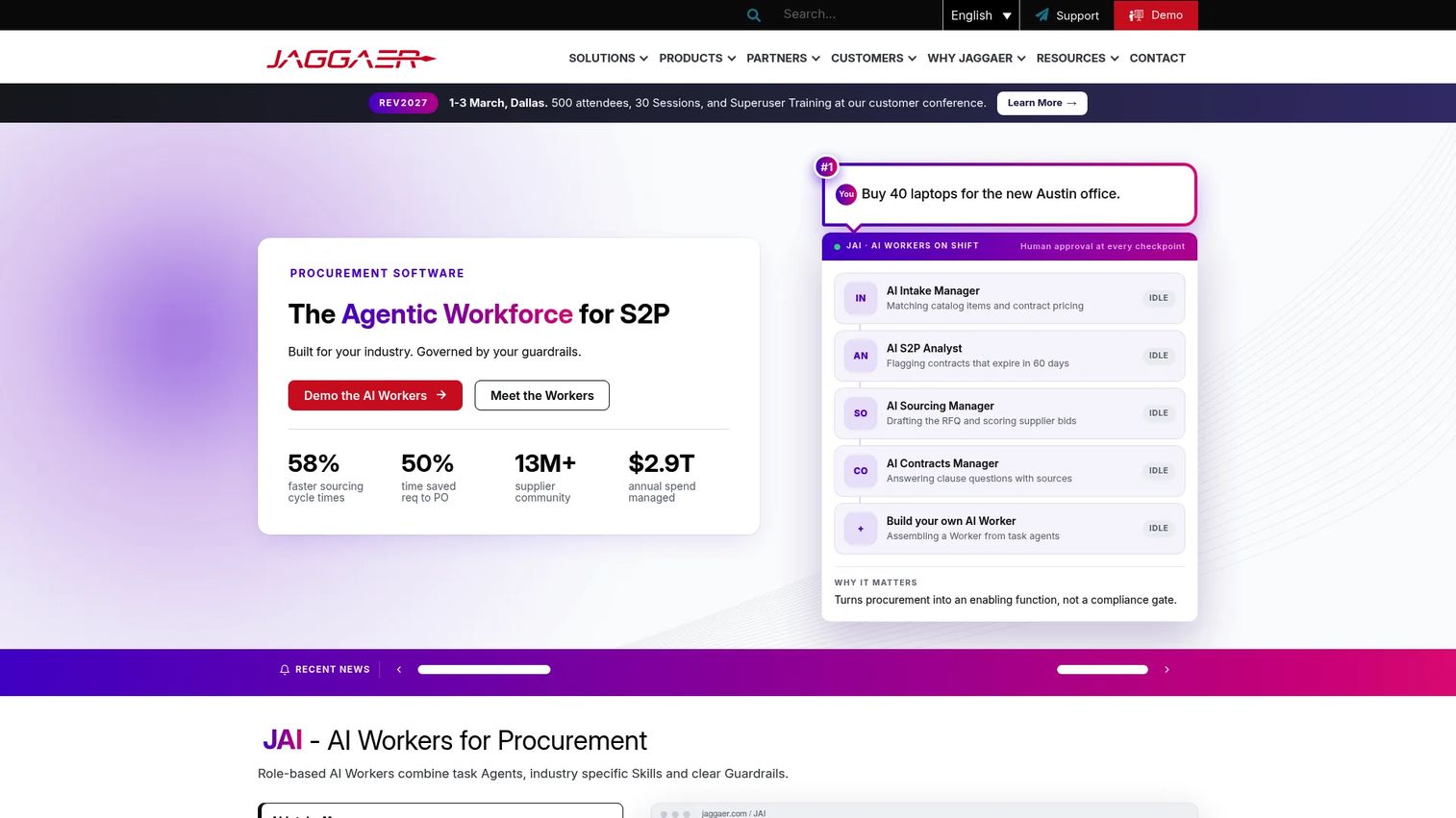
JAGGAER ONE is an AI-powered source-to-pay suite covering sourcing, contracting, supplier management, eProcurement, invoicing, AP automation, spend analytics, and supply-chain collaboration. It connects to over 1,000 ERP and business systems through native connectors and APIs, which matters for complex organizations with heterogeneous source systems. Spend analytics includes AI-powered classification, savings tracking, and supplier rationalization as part of the broader procurement operating model.
Best for: Large and complex procurement organizations that need a full source-to-pay platform with deep supplier management and broad ERP connectivity.
Key features
- AI-powered procurement assistance and workflow automation
- Spend analytics with AI classification and savings tracking
- Source-to-pay modules covering sourcing through payment
- 1,000-plus ERP and business system connectors
- Invoice capture, validation, matching, and payment automation
Why choose JAGGAER ONE: Choose JAGGAER ONE when spend analysis must sit inside a full procurement operating model with sourcing, contracting, and supplier management running in the same system. It is a fit for organizations managing complex, multi-source procurement workflows.
JAGGAER ONE pricing: JAGGAER uses custom enterprise pricing. Contact JAGGAER sales for a quote. No verified public pricing range was available.
G2 rating: 4.1/5
9. Oracle Fusion Data Intelligence
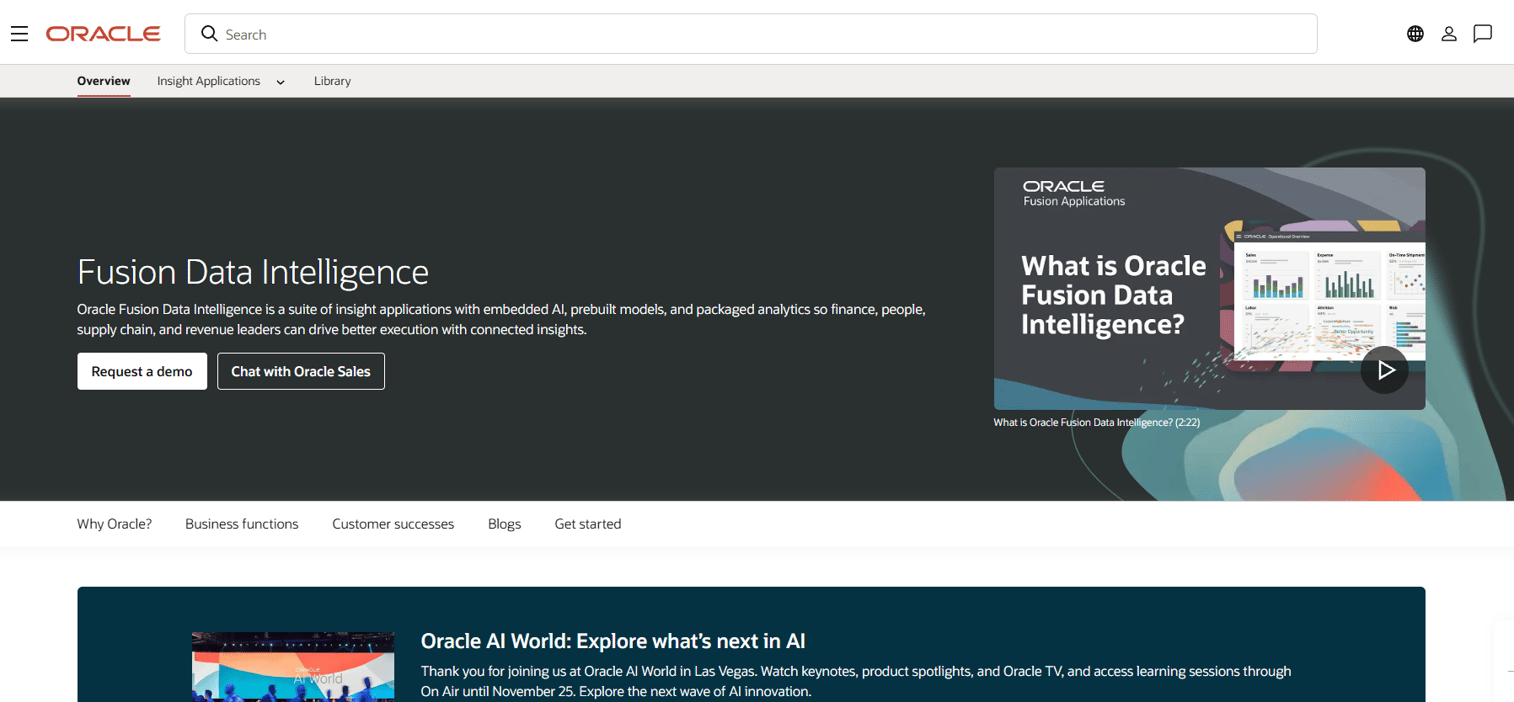
Oracle Fusion Data Intelligence is a cloud-native analytics suite built for organizations already running Oracle Fusion Cloud Applications. It provides prebuilt AI models, data pipelines, KPIs, and dashboards for finance, procurement, HR, supply chain, and customer operations. For procurement and finance teams, the value is in reducing integration work: Spend and AP data that already lives in Oracle Cloud is available for analysis without building custom pipelines.
Best for: Oracle Cloud Application environments that want governed, prebuilt finance and procurement analytics without custom integration work.
Key features
- Prebuilt AI models, data pipelines, KPIs, and dashboards
- Finance, procurement, HR, and supply chain analytics
- Natural-language query and augmented analysis
- Enterprise data governance and semantic modeling
- ERP-connected reporting with minimal setup for Oracle environments
Why choose Oracle Fusion Data Intelligence: Choose Oracle when your spend and AP data already lives in Oracle Cloud Applications. The prebuilt analytics reduce implementation effort significantly compared to building a custom analytics layer. It is less compelling for organizations with heterogeneous ERP environments.
Oracle Fusion Data Intelligence pricing: Oracle publishes subscription prices by product and metric. Fusion ERP Analytics starts at $450/month per hosted named user (minimum 20) or $15/month per hosted employee (minimum 1,000 employees). Fusion Operational Analytics starts at $100/month per hosted named user (minimum 35) or $3/month per hosted employee (minimum 1,200 employees). Additional refresh capacity is priced at $30,000 per unit.
10. SAP Spend Control Tower
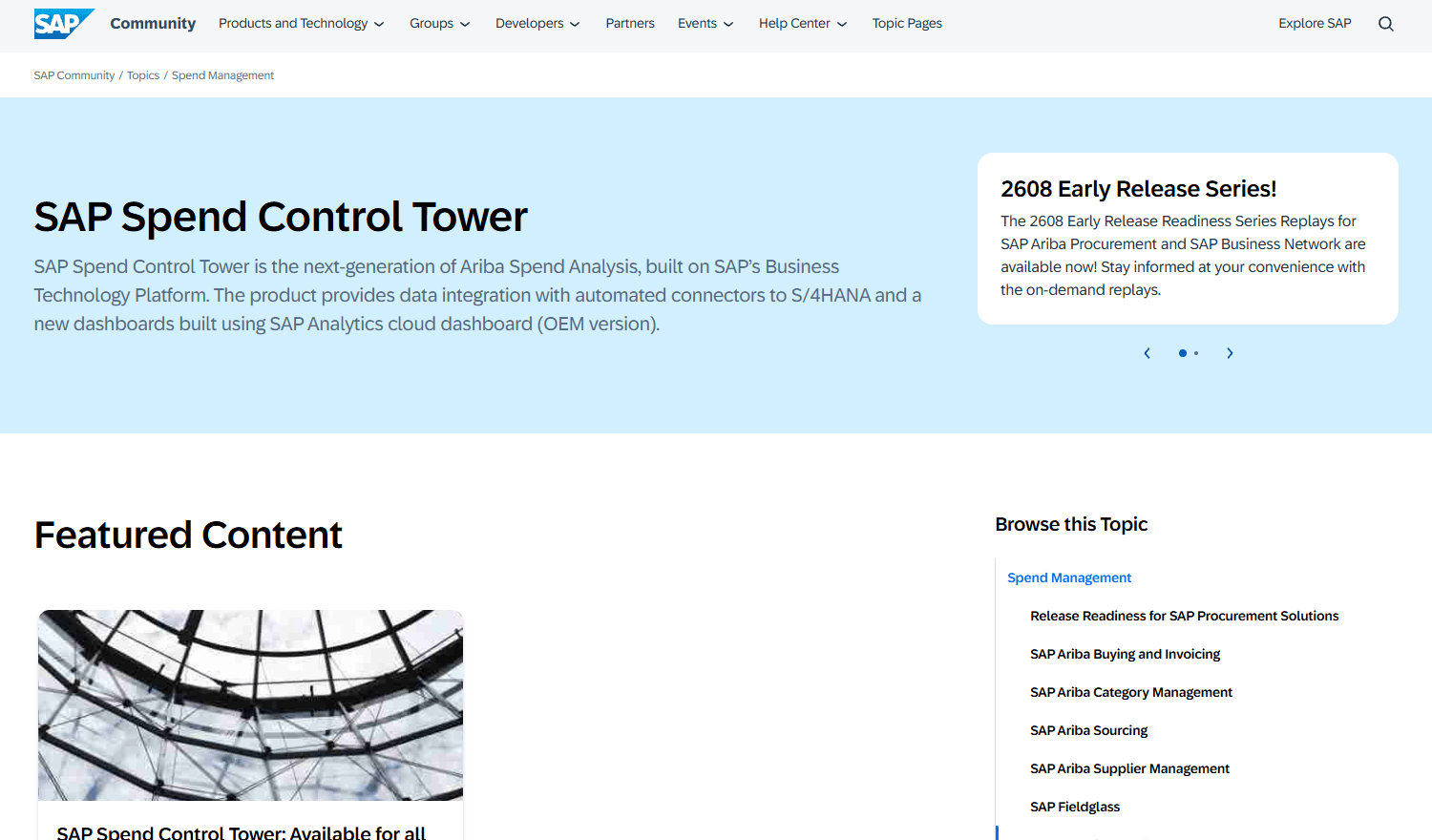
SAP Spend Control Tower is an SAP Business Technology Platform application that gives enterprise procurement teams a centralized view of total spend. It connects automatically to SAP S/4HANA and SAP ECC through native connectors, and accepts CSV uploads from third-party systems. AI-enabled classification, supplier matching, custom taxonomy support, and multi-currency coverage make it a natural choice for teams whose procurement data is primarily SAP-native.
Best for: SAP-centric enterprise procurement teams that need spend visibility and classification without leaving the SAP environment.
Key features
- Configurable spend dashboards across suppliers, categories, and business units
- Automated connectors for SAP S/4HANA and SAP ECC
- AI-enabled spend classification with custom taxonomy support
- Supplier matching across multi-currency and multi-language data
- CSV upload from third-party systems for non-SAP spend
Why choose SAP Spend Control Tower: Choose SAP Spend Control Tower when the team needs spend classification and visibility aligned to SAP data models and procurement governance. The native connectors mean less integration work for SAP-heavy organizations compared to third-party tools requiring custom extraction.
SAP Spend Control Tower pricing: SAP requires buyers to contact an SAP account executive for licensing.
11. Simfoni
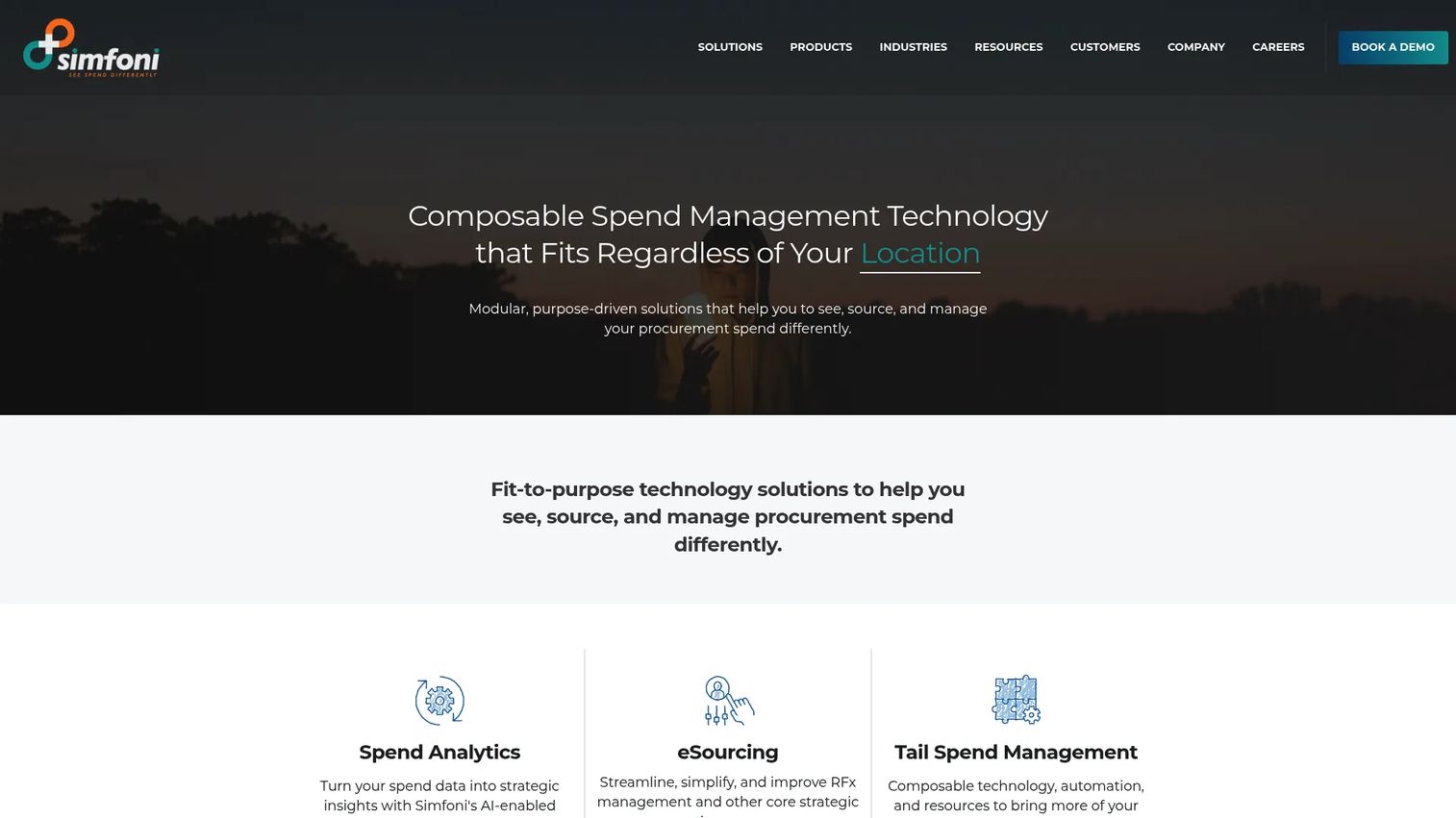
Simfoni provides AI-powered spend intelligence and spend automation for procurement and finance teams, with a focus on turning spend visibility into a managed savings pipeline. Its Pay-As-You-Save pricing model aligns vendor incentives with procurement outcomes. The Strategic Spend Hub uses consumption-based pricing through Snowflake credits. Simfoni covers spend analytics, eSourcing execution, maverick spend governance, and supplier diversity tracking in one platform.
Best for: Procurement teams that want spend analytics connected to savings pipeline management, with pricing tied to outcomes rather than fixed subscription seats.
Key features
- AI-powered spend analytics and data classification
- Sourcing pipeline management and eSourcing execution
- Savings opportunity assessment and tracking
- Maverick spend detection and governance controls
- Supplier diversity and ESG tracking
Why choose Simfoni: Simfoni works well for teams that want analytics to drive a savings program, not just produce reports. The Pay-As-You-Save model is appealing for procurement teams that need to show measurable savings to justify software investment.
Simfoni pricing: Simfoni uses Pay-As-You-Save and consumption-based pricing models. The Strategic Spend Hub is priced through Snowflake credits. Contact Simfoni for a quote specific to your spend volume and module requirements.
G2 rating: 4.8/5
12. SpendHQ
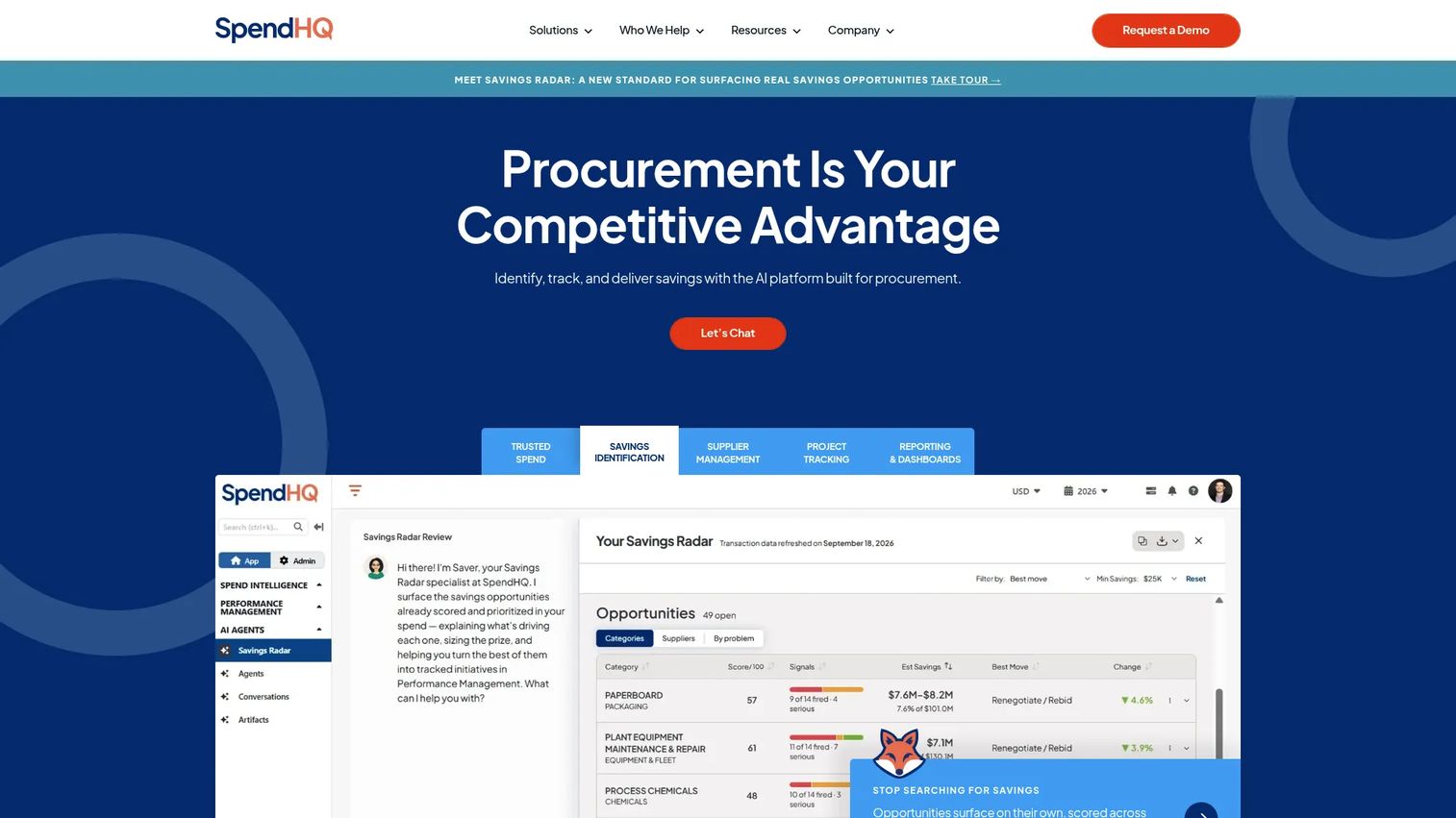
SpendHQ is an AI-powered procurement platform combining spend intelligence, supplier visibility, supplier risk management, and procurement project tracking. Its spend analytics engine processes and classifies spend data, normalizes supplier records, and identifies opportunities across categories and business units. Supplier risk visibility is an increasingly relevant capability as procurement teams manage concentration and geopolitical exposure alongside spend optimization.
Best for: Enterprise procurement teams that want clean spend visibility, supplier normalization, and risk coverage without relying on ERP reporting.
Key features
- AI-powered spend intelligence and data processing
- Supplier normalization and opportunity identification
- Supplier risk visibility and performance management
- Procurement project tracking and performance metrics
- Spend cube analytics with category and supplier drill-down
Why choose SpendHQ: SpendHQ is a strong fit for procurement teams standardizing spend analysis outside spreadsheets and looking for supplier risk alongside spend insight. It is narrower than a full source-to-pay suite, which makes it easier to adopt for teams not ready for broader platform change.
SpendHQ pricing: SpendHQ requires a demo or sales conversation for pricing. No public pricing page or numeric price was available at time of publication.
G2 rating: 4.4/5
13. Zycus Source to Pay Suite
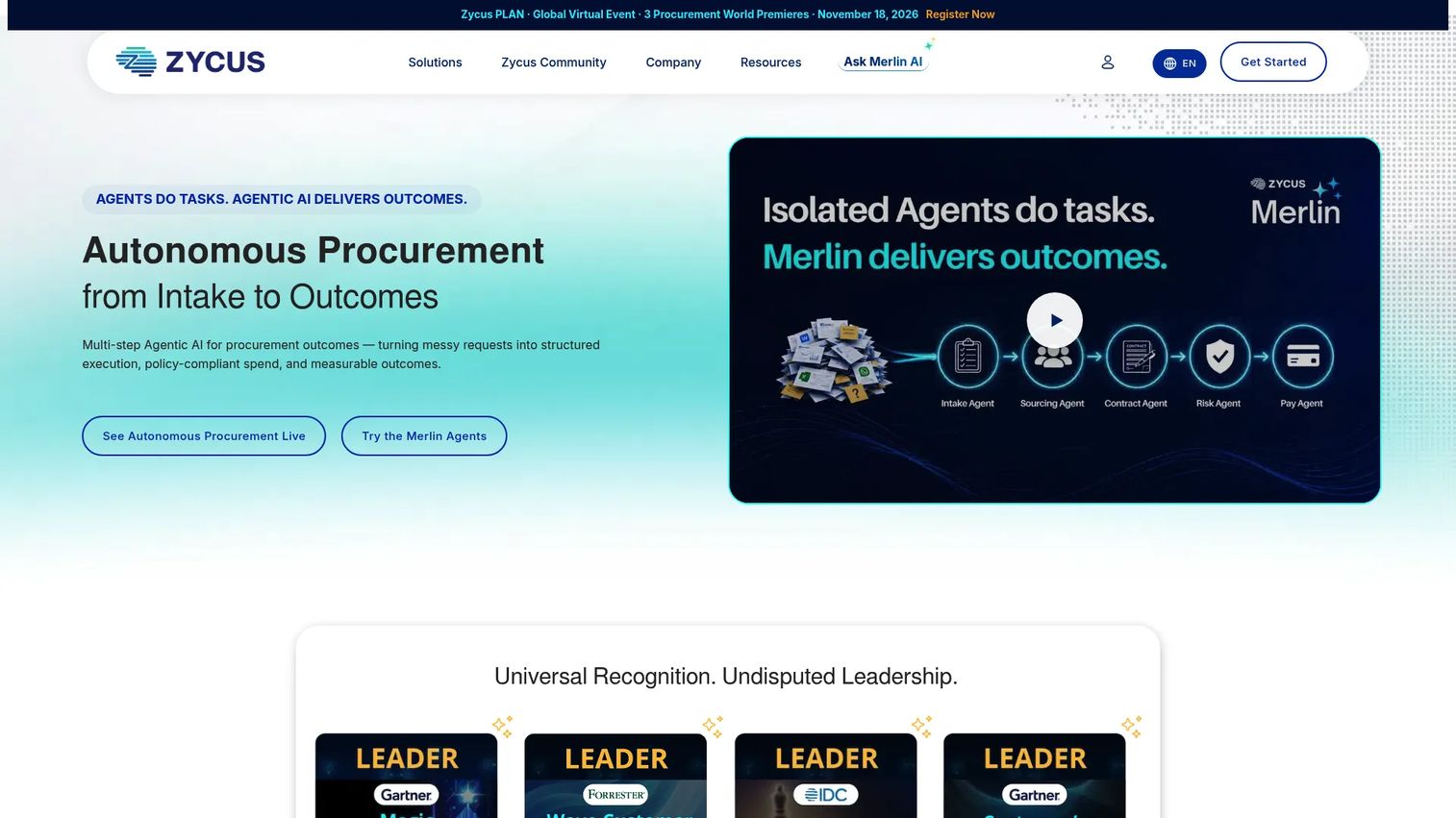
Zycus is an AI-powered enterprise source-to-pay suite covering intake management, strategic sourcing, contract lifecycle management, supplier onboarding and risk monitoring, eProcurement, guided buying, eInvoicing, AP automation, spend analytics, and ERP integrations with SAP, Oracle, and NetSuite. Its autonomous negotiation capability and AI intake orchestration differentiate it from suites that focus primarily on workflow rather than AI-assisted procurement decisions.
Best for: Large enterprise procurement organizations that want AI-assisted procurement across the full source-to-pay lifecycle with native ERP connectivity.
Key features
- AI-powered intake management and procurement orchestration
- Strategic sourcing, RFx, bid analysis, and autonomous negotiation
- Contract lifecycle management
- Supplier onboarding, risk management, and performance monitoring
- Spend analytics and procurement insights with ERP integration
Why choose Zycus Source to Pay Suite: Choose Zycus when procurement wants broad workflow automation across sourcing, contracting, purchasing, invoicing, and analytics rather than a standalone analytics tool. Its AI capabilities in negotiation and intake orchestration stand out for teams running high-volume procurement operations.
Zycus pricing: Zycus uses custom enterprise pricing. Contact Zycus sales for a quote. No public pricing page or pricing range was verifiable at time of publication.
G2 rating: 3.6/5
14. Unit4 Source-to-contract by Scanmarket
Unit4 Source-to-contract by Scanmarket is a source-to-contract platform for procurement teams that need strategic sourcing, supplier management, spend analytics, and contract visibility in one system. Its strength is in sourcing event management and supplier collaboration rather than deep AP analytics. Spend analytics provides visibility to inform sourcing decisions rather than serving as the primary output of the platform.
Best for: Mid-market and enterprise procurement teams focused on improving source-to-contract maturity, with spend analytics supporting sourcing and supplier decisions.
Key features
- Strategic sourcing and RFP/RFx management
- Spend analytics and purchasing visibility
- Supplier management and third-party risk management
- Contract lifecycle management
- Supplier collaboration tools
Why choose Unit4 Source-to-contract by Scanmarket: Choose Scanmarket when the main job is improving sourcing execution and contract discipline, with spend analytics providing the context for those decisions. It is a fit for teams that have not yet centralized sourcing workflows and need a structured source-to-contract environment.
Unit4 Source-to-contract by Scanmarket pricing: Pricing consists of a core platform, optional modules, user count, and a one-time implementation fee, sold on an annual license basis. Contact Scanmarket or Unit4 for a quote.
G2 rating: 4.1/5
15. Loop Logistics Data Platform
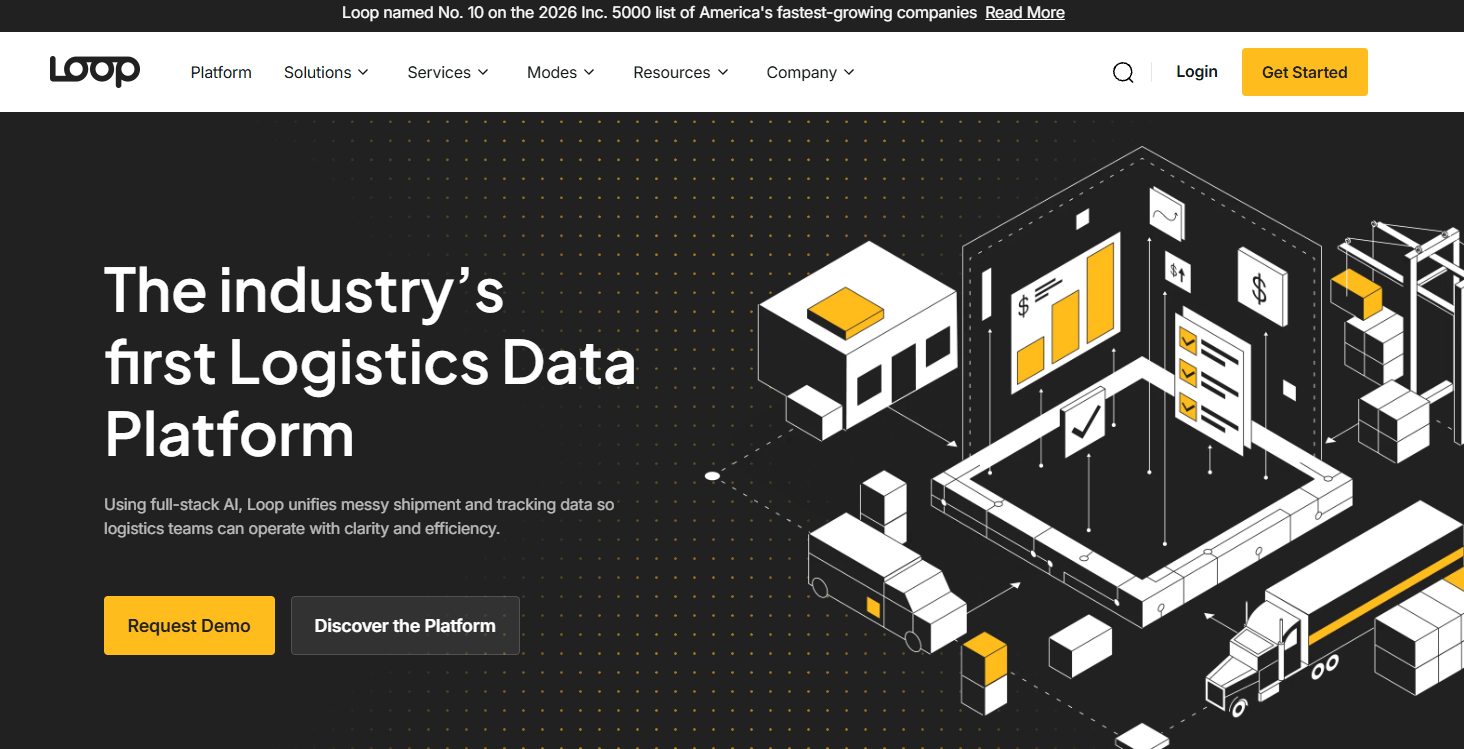
Loop Logistics Data Platform is a specialized logistics spend and transportation data platform for companies where freight, carrier, and logistics costs represent a material portion of total spend. It provides logistics spend visibility, freight audit data, carrier analytics, and transportation cost analysis. Its scope is narrower than a general AP spend analysis platform, but it delivers granular insight into transportation spend that general procurement tools often miss.
Best for: Companies with high logistics, freight, or carrier spend where transportation cost management is a primary procurement priority.
Key features
- Logistics spend visibility and transportation cost analysis
- Freight audit data and carrier analytics
- Shipment data reporting
- Transportation cost benchmarking
Why choose Loop Logistics Data Platform: Choose Loop when spend leakage is concentrated in freight and logistics rather than general procurement categories. For companies spending heavily on transportation, a general spend analytics tool may lack the data model depth to identify carrier-level savings opportunities.
Loop Logistics Data Platform pricing: Loop's official pricing page was not accessible at time of publication. Contact Loop directly for pricing and packaging details, as cost drivers are likely to include shipment volume, data sources, and analytics scope.
Considerations when choosing accounts payable and spend analysis software
Data source coverage
Before evaluating tools, map every source system where spend data lives: ERP instances, AP automation platforms, invoice management systems, P-card programs, T&E tools, procurement platforms, contracts, and supplier master data. A tool cannot classify spend it cannot ingest. Ask vendors to demonstrate ingestion from your specific source systems, not a generic list of supported connectors.
Classification accuracy and governance
Spend classification is where tools differentiate most significantly in practice. Evaluate supplier normalization depth, duplicate supplier handling, support for standard taxonomies like UNSPSC alongside custom category trees, audit trails for classification decisions, and whether business users can manage classification rules without engineering involvement. A clean taxonomy that your category managers maintain is more valuable than a sophisticated one that requires a data team to update.
AP workflow fit versus procurement analytics depth
AP-heavy teams should prioritize invoice line-item capture, non-PO spend visibility, payment timing analysis, and ERP reconciliation. Procurement teams focused on category strategy and sourcing benefit more from deep classification, savings pipeline tracking, and supplier consolidation analysis. Many tools do both, but they do one better than the other, so align tool selection with where your spend data problem actually lives.
Reporting depth and actionability
Dashboards are the output, not the goal. The right tool shows where to act: Which suppliers to consolidate, which categories have contract leakage, where tail spend is uncontrolled, and which payment timing decisions are creating cash-flow exposure. Ask vendors to demonstrate how their platform gets from raw spend data to a prioritized list of savings actions.
Implementation effort and total cost
The lowest license price can still be expensive if data cleanup, taxonomy configuration, and ERP integration require months of professional services. Ask vendors specifically about historical data migration requirements, cleansing workload, refresh cadence, and admin ownership expectations. For teams evaluating budgeting and forecasting software or business intelligence software in parallel, consider how spend analysis data will feed those adjacent systems.
Conclusion
The right accounts payable and spend analysis software depends on where your spend data lives and who needs to act on it.
For AP-first teams whose spend insight problem starts with invoice and payment data, Medius Analytics and AvidXchange offer analytics close to the workflows that generate that data. Procurement analytics specialists Sievo, SpendHQ, and Simfoni deliver depth in classification, category management, and savings pipeline tracking for teams whose primary need is procurement intelligence. Enterprise suite buyers evaluating Ivalua, Coupa, JAGGAER ONE, or Zycus get spend analytics as part of a broader source-to-pay operating model. Teams committed to Oracle or SAP environments will find the least integration friction in Oracle Fusion Data Intelligence and SAP Spend Control Tower respectively. For logistics-intensive organizations, Loop offers transportation spend depth that general procurement tools lack.
Before shortlisting, test each vendor against your actual data. Run a sample of your historical invoice and supplier records through their classification engine. The quality of that output, specifically how accurately they normalize duplicate suppliers and classify ambiguous spend, tells you more than any demo.
Start your journey with Guideflow today!
FAQs
Accounts payable and spend analysis software helps finance and procurement teams turn invoice, payment, supplier, ERP, and procurement data into usable spend visibility and savings opportunities. AP automation handles invoice processing and payment execution, while spend analysis classifies that data and surfaces patterns across categories, suppliers, and business units. Some platforms bundle both capabilities, while others specialize in one or the other.
AP automation processes invoices, routes approvals, and executes payments. Spend analysis software takes the data those workflows generate, plus data from ERP, procurement, and contracts, and turns it into supplier-level and category-level insight. AP automation tells you that an invoice was processed; spend analysis tells you whether that spend was at the right price, with the right supplier, and within contracted terms.
The primary users are procurement, category management, and finance operations teams. AP managers use it to understand invoice-level patterns and supplier payment behavior. Category managers use it to consolidate suppliers, reduce maverick spend, and build sourcing strategies. FP&A teams use it for budget variance analysis. IT and platform owners evaluate it for integration fit with ERP and data infrastructure. For related analytics platforms context, the buying team typically spans finance, procurement, and IT.
The most common sources are ERP systems (SAP, Oracle, Microsoft Dynamics), AP automation platforms, invoice management systems, P-card programs, T&E tools, source-to-pay platforms, supplier master data, and contract repositories. The more source systems the tool can ingest and reconcile, the more complete the spend picture. Gaps in data source coverage create classification blind spots that distort category and supplier totals.
Savings identification typically works through several mechanisms: Supplier normalization reveals fragmented buying from the same vendor across multiple supplier records; price variance analysis highlights invoices above contracted rates; tail-spend analysis surfaces uncontrolled purchases outside preferred suppliers; maverick spend monitoring identifies buying outside approved channels; and contract leakage detection flags spend on expired or underused contracts. AI-based tools increasingly automate these patterns and prioritize opportunities by estimated savings value.
ERP reporting works when spend data is clean, supplier naming is consistent, and the organization buys from a small supplier base using a single ERP. It breaks down when spend data spans multiple systems, supplier names are inconsistent across those systems, or procurement teams need to analyze categories and suppliers across geographies and business units. Dedicated spend analysis software handles multi-source ingestion, supplier normalization, and classification at a depth that ERP reporting was not designed to support.
AP teams should prioritize invoice line-item capture, non-PO spend visibility, duplicate invoice detection, payment timing analysis, and ERP reconciliation capabilities. They should also test how the tool handles messy historical data, specifically supplier name variants, inconsistent GL coding, and invoices without purchase orders. Tools that perform well on clean demo data but struggle with real AP extracts will create ongoing data quality problems. See our guide on accounts receivable software for context on how AP and AR data management approaches compare.
Refresh frequency depends on the use case. Monthly refreshes may work for category planning and strategic sourcing decisions. AP controls, payment leakage monitoring, and budget variance analysis typically need weekly or near-real-time updates to catch problems before they compound. Ask vendors specifically about batch processing cadence, on-demand refresh availability, and how they handle mid-period data corrections when source system records are updated after extraction.