A record 3.7 million patent applications were filed worldwide in 2024, up 4.9% from the previous year, according to WIPO's 2025 Global Innovation Index. That volume means more prior art to search, more crowded technical spaces to navigate, and more IP risk sitting quietly inside product roadmaps.
The problem is not access to patent documents. Most teams can find them. The real cost is decision speed: Knowing whether a technical approach is clear, whether a competitor's claims actually cover your implementation, or whether a market is worth entering before engineering commits six months of roadmap. Poor patent research software slows that down or, worse, creates false confidence.
According to Clarivate's 2026 survey, 85% of IP professionals reported using AI in some capacity in 2025, up from 57% in 2023. That shift has pulled patent research software well past simple keyword search into semantic analysis, claim chart generation, and portfolio intelligence. Choosing the wrong tool for your workflow means paying for capabilities you won't use, or missing coverage you need. This guide cuts through that.
What's inside
This guide compares 12 patent research software tools for 2026, selected across patent search, patent analytics, AI prior-art research, and public patent database categories. Tools were evaluated on:
- Database coverage and jurisdiction depth
- AI, semantic, and natural-language search quality
- Workflow support for prior art, FTO, invalidity, and patentability research
- Analytics, reporting, and portfolio intelligence
- Pricing transparency and G2 review availability
The guide is written for founders, product leaders, and R&D teams who need a fast, defensible shortlist they can hand to legal or IP counsel.
TL;DR
- Best AI-first option: Patlytics, for teams that want natural-language patent workflows across search, claim analysis, and patent strategy
- Best for enterprise patent analytics: LexisNexis PatentSight+ with Protégé, for portfolio quality, benchmarking, and executive IP intelligence
- Best for broad innovation teams: Patsnap, for R&D and competitive intelligence teams that need patent and innovation data together
- Best for semantic prior-art search: IPRally, for concept-based search that goes beyond keyword matching
- Best free starting points: The Lens, USPTO, and WIPO, for early research before committing to a commercial platform
- Best for deep professional search: Derwent Patent Search or Orbit Intelligence, depending on your team's data model and workflow depth
What is patent research software?
Patent research software helps users search, analyze, monitor, and interpret patent data so they can assess prior art, patentability, freedom to operate, infringement risk, competitive activity, and technology trends. A database helps you retrieve documents; a research platform helps you turn those documents into a decision. These tools do not replace qualified patent counsel. They reduce search time, improve coverage, and organize evidence.
Key capabilities to understand before comparing vendors:
- Patent search: Keyword, classification, assignee, inventor, citation, and family search across global databases
- Semantic search: Concept-based search that finds related inventions beyond exact terminology
- AI and natural-language search: Plain-English queries, automated summaries, claim analysis, and evidence surfacing
- Prior-art workflows: Patentability, invalidity, novelty assessment, and citation review
- FTO and infringement review: Claim mapping, product overlap checks, and risk triage
- Patent analytics: Portfolio strength, filing trends, citation impact, family coverage, and jurisdiction analysis
- Landscape analysis: Technology clustering, whitespace discovery, and competitor monitoring
- Reporting and visualization: Dashboards, charts, exports, and executive-ready summaries
- Collaboration tools: Saved searches, alerts, annotations, shared reports, and team review workflows
The boundary between categories matters. Patent search software retrieves documents. Patent analytics software interprets large datasets through portfolio metrics, competitive benchmarking, and trend visualization. Some platforms do both; others specialize. The right choice depends on your workflow, not on feature count.
When to use patent research software
Validate a product bet before engineering commits
Founders and product teams use patent research to understand crowded technical areas before allocating roadmap time. The goal is not to become a patent attorney; it is to spot IP risk early enough to route it. A six-week software evaluation that surfaces a blocking patent costs far less than six months of engineering on something that cannot ship.
Run prior art, patentability, and invalidity research
IP teams use patent research software for novelty searches, prosecution support, litigation preparation, and defensive analysis. AI patent research software now surfaces semantic matches and non-patent literature alongside traditional classification searches. Teams that handle recurring prior-art search workflows benefit most from platforms with collaboration features, saved queries, and citation tracking.
Map competitors and technology trends
R&D and strategy teams use patent analytics to find emerging technology clusters, monitor competitor filing behavior, and evaluate acquisition targets before due diligence. Patent landscape analysis software can brief leadership on market whitespace or flag when a competitor is quietly building around a core technical area. For founders, that visibility feeds directly into roadmap decisions and board presentations.
Patent research software comparison
The table below is a fast scan. Pricing and G2 ratings reflect data verified at drafting time from each vendor's official pricing page and live G2 listing. Run your own query through any shortlisted tool before committing budget.
| # | Product | Best for | Key differentiator | Pricing | G2 rating |
|---|---|---|---|---|---|
| 1 | Patlytics | IP law firms and in-house patent teams | AI agent with 200+ patent-work skills | Custom pricing | 4.9/5 |
| 2 | Patsnap | R&D and innovation intelligence teams | Patent and scientific research in one workspace | Free tier; paid plans from $100/mo | 4.3/5 |
| 3 | PatSeer | Patent analysts needing search plus analytics | Search, analytics, alerts, and reporting combined | Quote-based; 2-week trial available | 4.7/5 |
| 4 | IPRally | Semantic prior-art and invalidity search | Graph-based, concept-driven patent search | Quote-based; free trial available | 4.7/5 |
| 5 | Derwent Patent Search | Experienced professional patent searchers | Expert-authored invention summaries and curated indexing | Quote-based; demo available | 4.7/5 |
| 6 | Orbit Intelligence | Enterprise IP teams | AI-assisted query generation and visual patent intelligence | Quote-based | 4.7/5 |
| 7 | PQAI | Researchers and small teams | Free semantic prior-art search with API access | Free; PQAI+ from $20/mo | N/A |
| 8 | LexisNexis PatentSight+ with Protégé | Executive IP and strategy teams | Portfolio benchmarking and Patent Asset Index metrics | Custom pricing | N/A |
| 9 | LexisNexis TotalPatent One | Global patent database search | Full-text search with machine translation across jurisdictions | Custom pricing | N/A |
| 10 | The Lens | Free patent and scholarly research | Open patent search linked to scholarly and biological data | Free; individual commercial use $1,000/year | N/A |
| 11 | USPTO | U.S. patent lookup and official records | Official U.S. patent and application search | Free | N/A |
| 12 | WIPO | International patent search | Official PatentScope for PCT and national collections | Free | N/A |
Best 12 patent research software tools for 2026
1. Patlytics
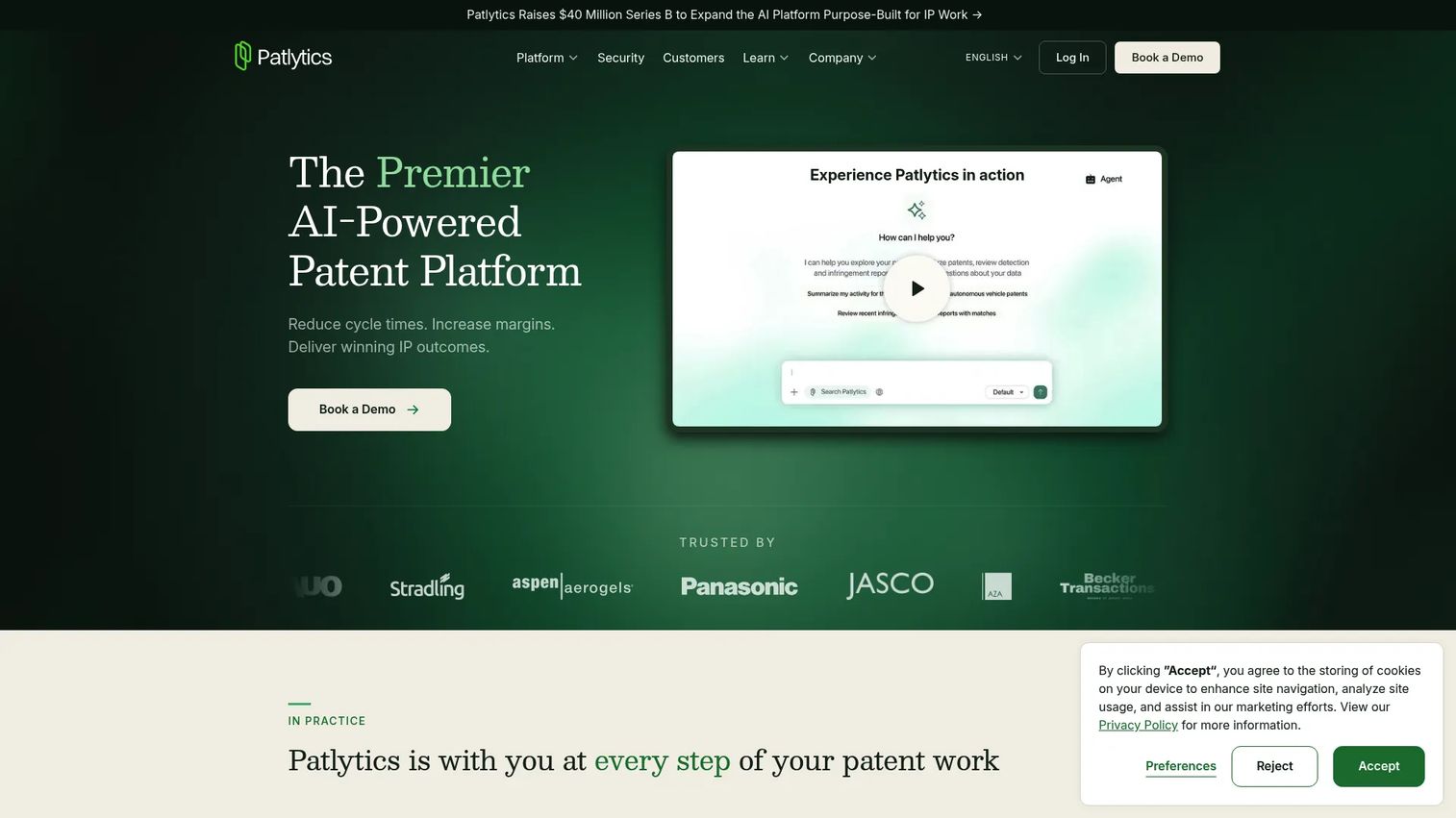
Patlytics is an AI-native patent workflow platform built for IP law firms and in-house teams. It handles prior-art analysis, freedom-to-operate research, invalidity analysis, and standard-essential patent analysis within a single environment. The platform includes an AI agent trained on 200+ patent-work skills, which means it can generate citation-backed claim charts and conduct prosecution-history-aware claim construction, not just surface documents for a human to interpret.
Best for: Legal, IP, and innovation teams that want AI sitting inside the patent workflow, from search through claim analysis to portfolio review.
Key features
- Natural-language and semantic patent search across patent and non-patent literature
- Infringement and invalidity analysis with citation-backed claim charts
- Freedom-to-operate analysis
- Portfolio analysis and ranking
- AI agent with 200+ patent-work skills
Why choose Patlytics: The right fit when legal and product need a faster shared read on IP risk, not just a document retrieval tool. Its AI agent goes deeper than a summary layer.
Patlytics pricing: Patlytics prices by quote. Contact the team directly for a demo and to understand what a seat or team license covers.
G2 rating: 4.9/5
2. Patsnap
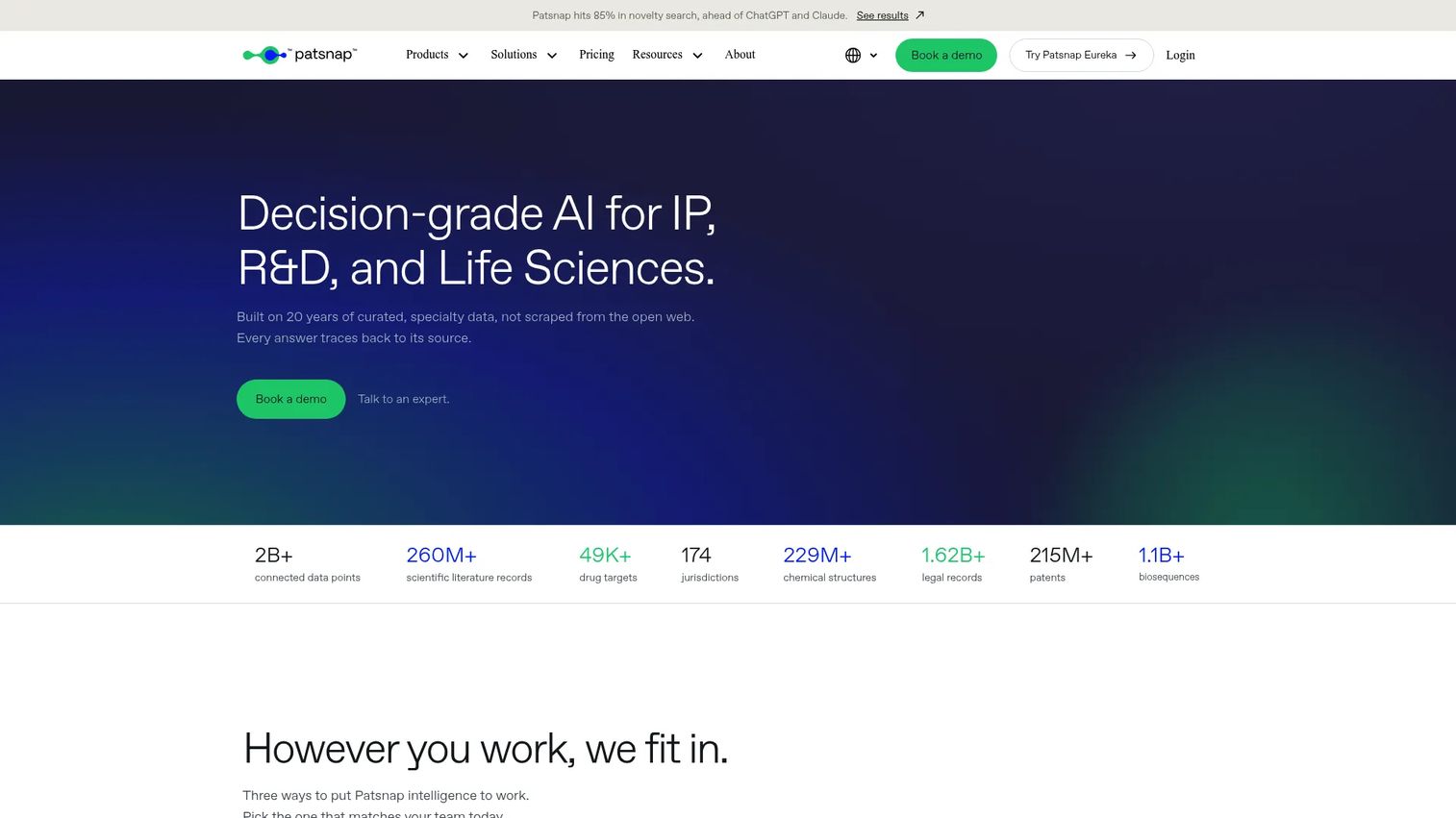
Patsnap is an AI-powered innovation intelligence platform used by R&D, IP, and strategy teams. Beyond patent search, it covers chemical and bioinformatics research, competitive intelligence dashboards, and technology landscaping, which makes it a broader tool than a pure patent search application. Teams that need to connect patent filings to product strategy and market trends find the breadth useful.
Best for: R&D and corporate innovation teams that need patent intelligence tied to product strategy and competitive monitoring.
Key features
- Patent search and analytics across global patent databases
- AI-powered innovation intelligence dashboards
- Patent landscape analysis and competitive monitoring
- Chemical, bioinformatics, and life sciences research
- Collaborative workspaces with exports and alerts
Why choose Patsnap: Choose it when the patent question connects to product strategy, competitor moves, or market expansion, not when the team needs deep litigation-grade prior-art search alone.
Patsnap pricing: A free Basic plan is available. Paid plans start at $100 per month (monthly billing). Enterprise and custom tiers require a quote; pricing varies by modules, data collections, and user count.
G2 rating: 4.3/5
3. PatSeer
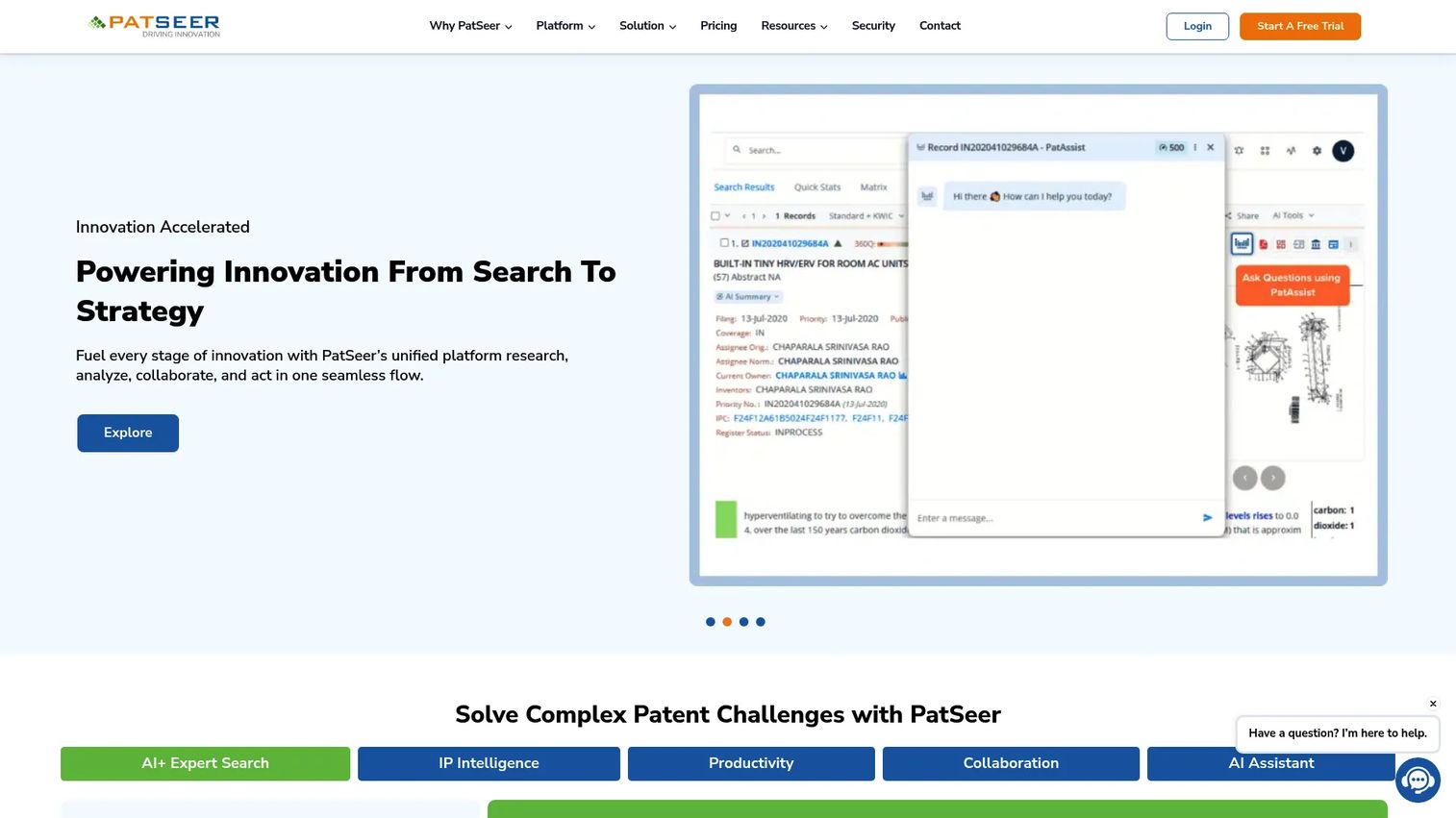
PatSeer is a patent search and analytics platform with tools for searching, monitoring, analyzing, and reporting on global patent data. It includes AI summaries, a PatAssist AI assistant, semantic mapping, citation analytics, and custom dashboards inside one workspace. The platform suits IP research teams doing recurring patent searches and monitoring rather than one-off queries.
Best for: Patent analysts and IP teams that need search depth, citation analytics, watch alerts, and reporting without switching between tools.
Key features
- Worldwide patent database with AI-powered search and semantic mapping
- Citation analytics and competitive benchmarking
- Custom dashboards and visual analytics
- Watch alerts for patent and assignee monitoring
- Report exports and project collaboration
Why choose PatSeer: A practical fit for teams doing recurring patent surveillance and analysis workflows. The two-week full-feature trial lets teams validate fit before committing to a contract.
PatSeer pricing: PatSeer uses quote-based pricing across its Premier, PremierPlus, ProX, and Explorer plan tiers. A two-week trial with full feature access is available. Ask about seat count, database access, analytics modules, and export volume when requesting a quote.
G2 rating: 4.7/5
4. IPRally
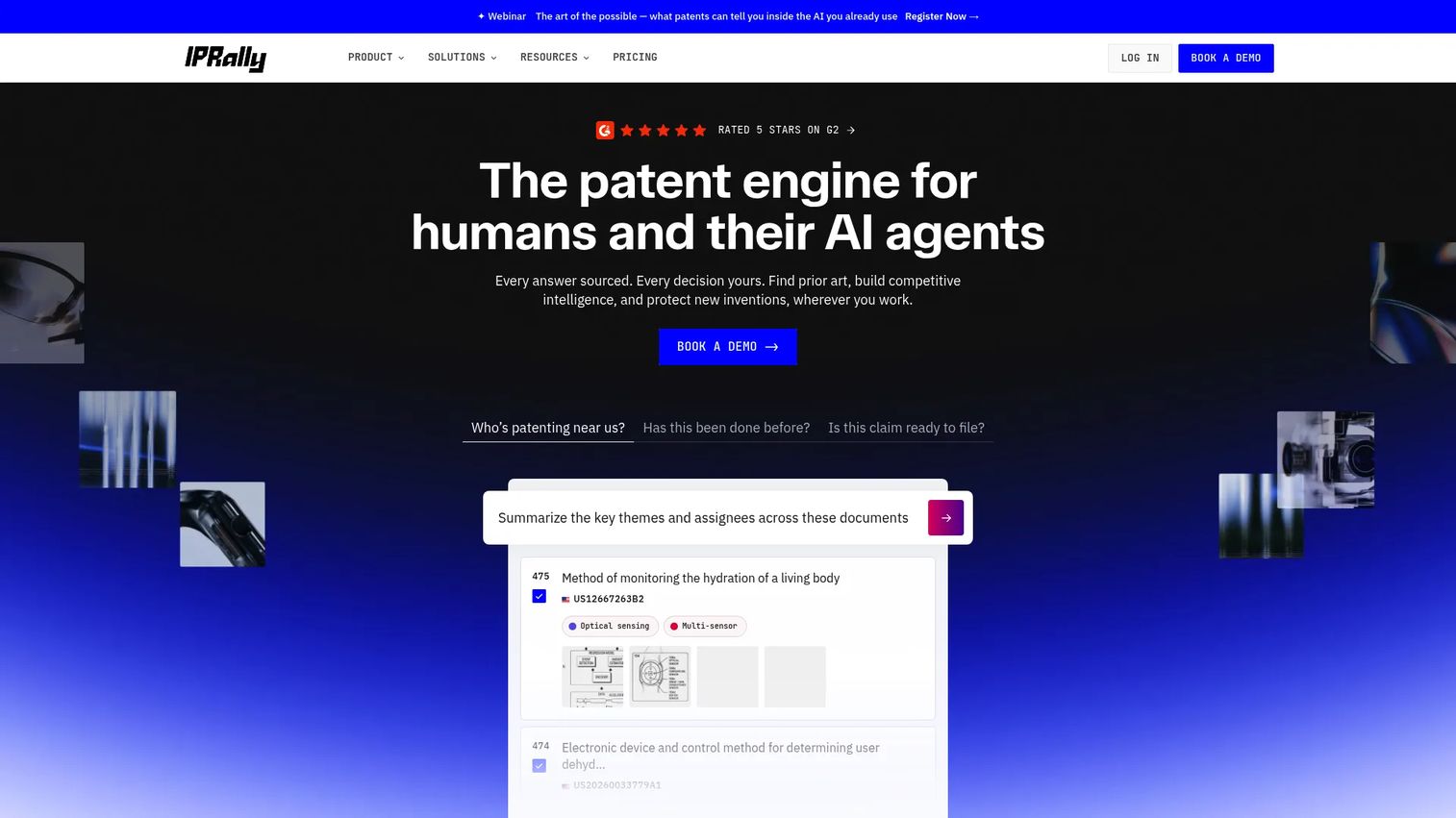
IPRally uses graph-based technology to search by invention concepts rather than only keywords. Patents use inconsistent language across jurisdictions and time periods, so keyword-only search can miss relevant prior art. IPRally's approach ranks results by conceptual similarity and surfaces explainable evidence, which matters when legal needs confidence that adjacent inventions haven't been overlooked.
Best for: Patent searchers focused on semantic prior-art research, invalidity analysis, and patentability review where language variation is a known risk.
Key features
- Graph-based semantic patent search and similarity ranking
- Concept query builder for invention-level search
- AI agents producing interactive feature charts and written reports
- Ask AI and multi-patent analysis
- Custom AI classification and multi-format exports
Why choose IPRally: Strong when the problem is language mismatch rather than document retrieval. It includes explainability in results, so a searcher can trace why a patent was surfaced.
IPRally pricing: Plans are quote-based across Single User, Team, and Enterprise tiers, all on annual contracts. Seat configurations include Lite, Pro, and Intelligence levels. A free trial is available; confirm current terms with the team.
G2 rating: 4.7/5
5. Derwent Patent Search
Derwent Patent Search from Clarivate is built around curated patent data and expert-authored invention summaries. Its value comes from normalized, enhanced patent records covering 178 million-plus publications across 109 jurisdictions, combined with Derwent's proprietary indexing. Searchers get cleaner data, better family coverage, and summaries written to describe novelty, use, and advantage, not just abstract text.
Best for: Experienced patent professionals who rely on curated records, professional query tools, and Derwent indexing for high-stakes patentability, FTO, and invalidity research.
Key features
- Expert-authored invention summaries describing novelty and advantage
- Enhanced patent data across 109 jurisdictions and 178M+ publications
- AI search using natural-language descriptions or invention disclosures
- Patent family citations and Web of Science literature integration
- 300+ searchable fields and patent litigation data from 140+ jurisdictions
Why choose Derwent Patent Search: The right choice when data quality and indexing depth matter more than cost. Teams with trained patent searchers who trust the Derwent record set find this platform a natural fit.
Derwent Patent Search pricing: Pricing is quote-based. Clarivate directs buyers to request a demo or free trial. Ask which data collections and workflow modules are included at each contract level.
G2 rating: 4.7/5
6. Orbit Intelligence
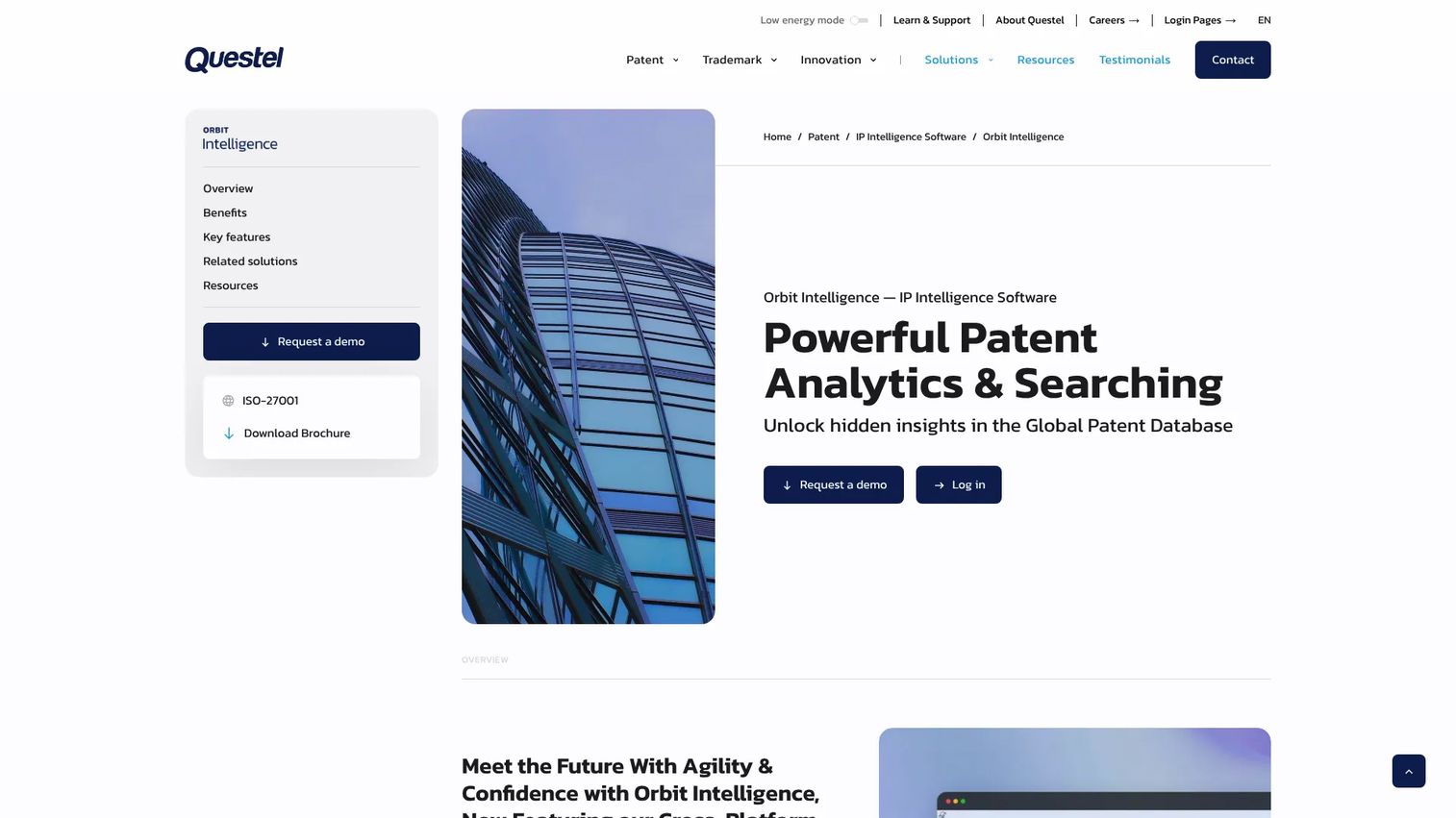
Orbit Intelligence from Questel is an enterprise IP intelligence platform for patent search, analytics, portfolio review, and competitive monitoring. Its Sophia AI assistant converts natural-language queries into patent searches, while automatic similarity search and visual analytics help teams move from raw data to insight. The platform covers patent, design, and non-patent literature databases, with guided analyses for technology scouting, portfolio pruning, and licensing.
Best for: Enterprise IP teams that need a strong mix of search depth, visual patent data intelligence, and portfolio workflow tools.
Key features
- AI-assisted natural-language query generation with Sophia
- Automatic similarity search and visual patent data intelligence
- Interactive analytics, customized graphs, and PowerPoint exports
- Guided analyses for technology scouting and portfolio pruning
- Alerts and monitoring for technologies, players, citations, and legal status
Why choose Orbit Intelligence: More relevant once a company has dedicated IP ownership or a team conducting regular competitive monitoring. For founders, it earns consideration when board-level patent landscape reporting is part of the job.
Orbit Intelligence pricing: Pricing is quote-based. Questel directs buyers to request a customized demo. Ask about user seats, modules, jurisdiction coverage, and training costs.
G2 rating: 4.7/5
7. PQAI
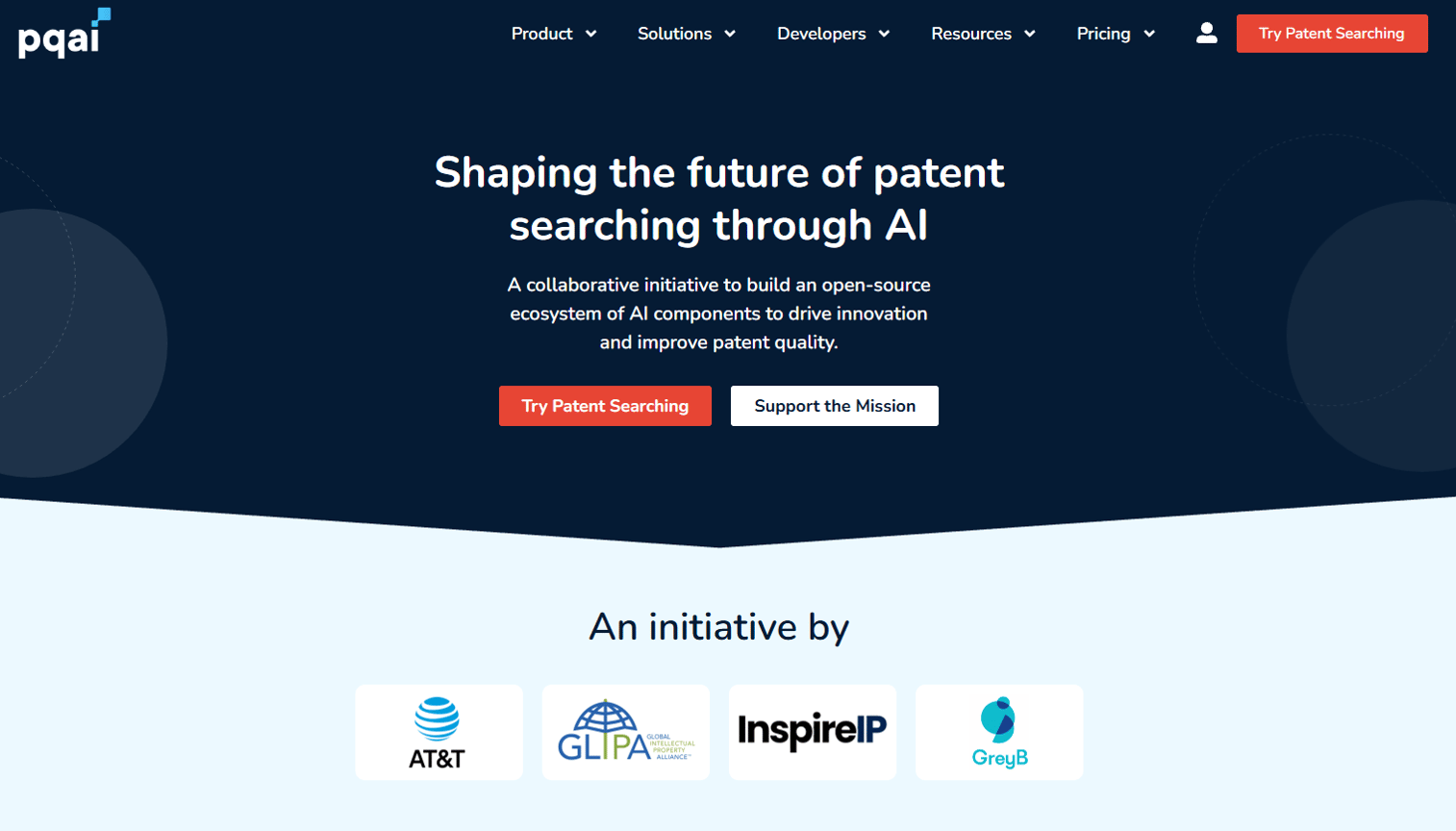
PQAI is an AI-powered semantic prior-art search engine for patent documents and technical literature. It accepts natural-language queries, applies concept extraction, and returns ranked results from patent and non-patent sources. The platform is not a full enterprise workflow tool, but it is a useful starting point for initial prior-art exploration before committing to a paid platform.
Best for: Inventors, researchers, and small teams that want free or low-cost semantic prior-art search to run early-stage diligence.
Key features
- Natural-language AI patent and prior-art search
- CPC classification prediction and technical concept extraction
- Non-patent literature search alongside patent data
- Up to 500 results per query on PQAI+
- API access for programmatic integration
Why choose PQAI: The low-cost starting point before engaging a paid commercial platform. For founders, it covers initial diligence checks, but it is not a substitute for counsel-led invalidity or FTO analysis.
PQAI pricing: A free tier is permanently available. PQAI+ adds higher result limits and faster search at $20 per month (monthly) or $216 per year. API plans range from $20 per month (Starter) to $700 per month (Enterprise). Confirm current access terms at projectpq.ai.
8. LexisNexis PatentSight+ with Protégé
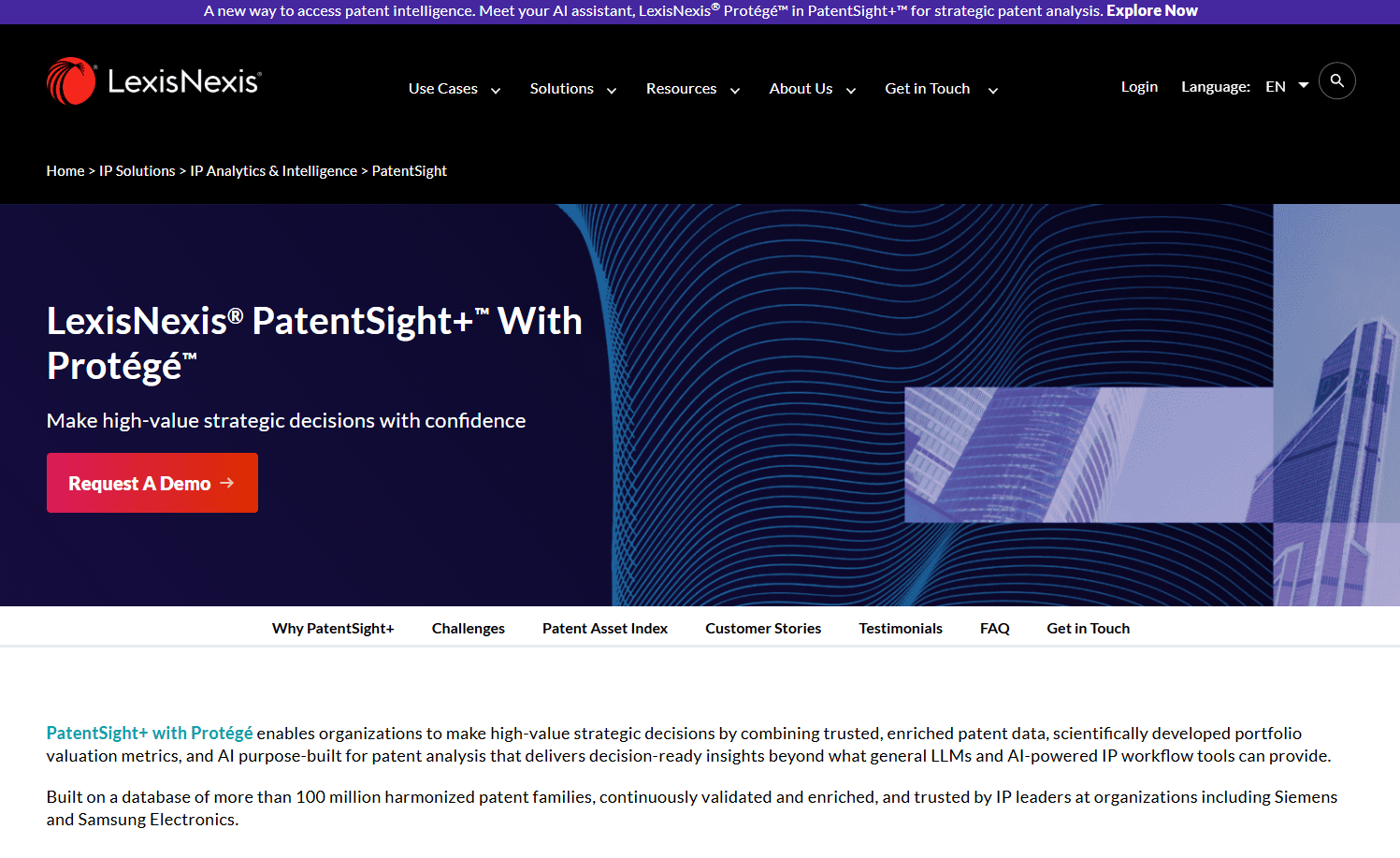
LexisNexis PatentSight+ with Protégé is a patent analytics and portfolio intelligence platform. It combines curated global patent data covering more than 100 million patent families with the Patent Asset Index, portfolio benchmarking, and AI-assisted visualization. Protégé converts natural-language questions into structured patent analyses with PowerPoint-ready outputs, which makes it faster to bring patent intelligence into leadership conversations.
Best for: Executive IP, R&D, and strategy teams conducting portfolio benchmarking, competitive positioning, and technology trend analysis for board-level decisions.
Key features
- Patent Asset Index and portfolio quality metrics
- Portfolio benchmarking and competitive positioning analysis
- Natural-language questions converted into structured visual analyses
- Emerging-trend analysis and filing-trend comparisons
- External data enrichment and exportable PowerPoint visualizations
Why choose LexisNexis PatentSight+ with Protégé: Less about finding a single prior-art reference and more about understanding portfolio strength relative to competitors. The right tool when IP strategy feeds directly into M&A evaluation, licensing decisions, or investor reporting.
LexisNexis PatentSight+ with Protégé pricing: Custom pricing. Ask about portfolio size, user seats, analytics modules, and data services when requesting a quote.
9. LexisNexis TotalPatent One
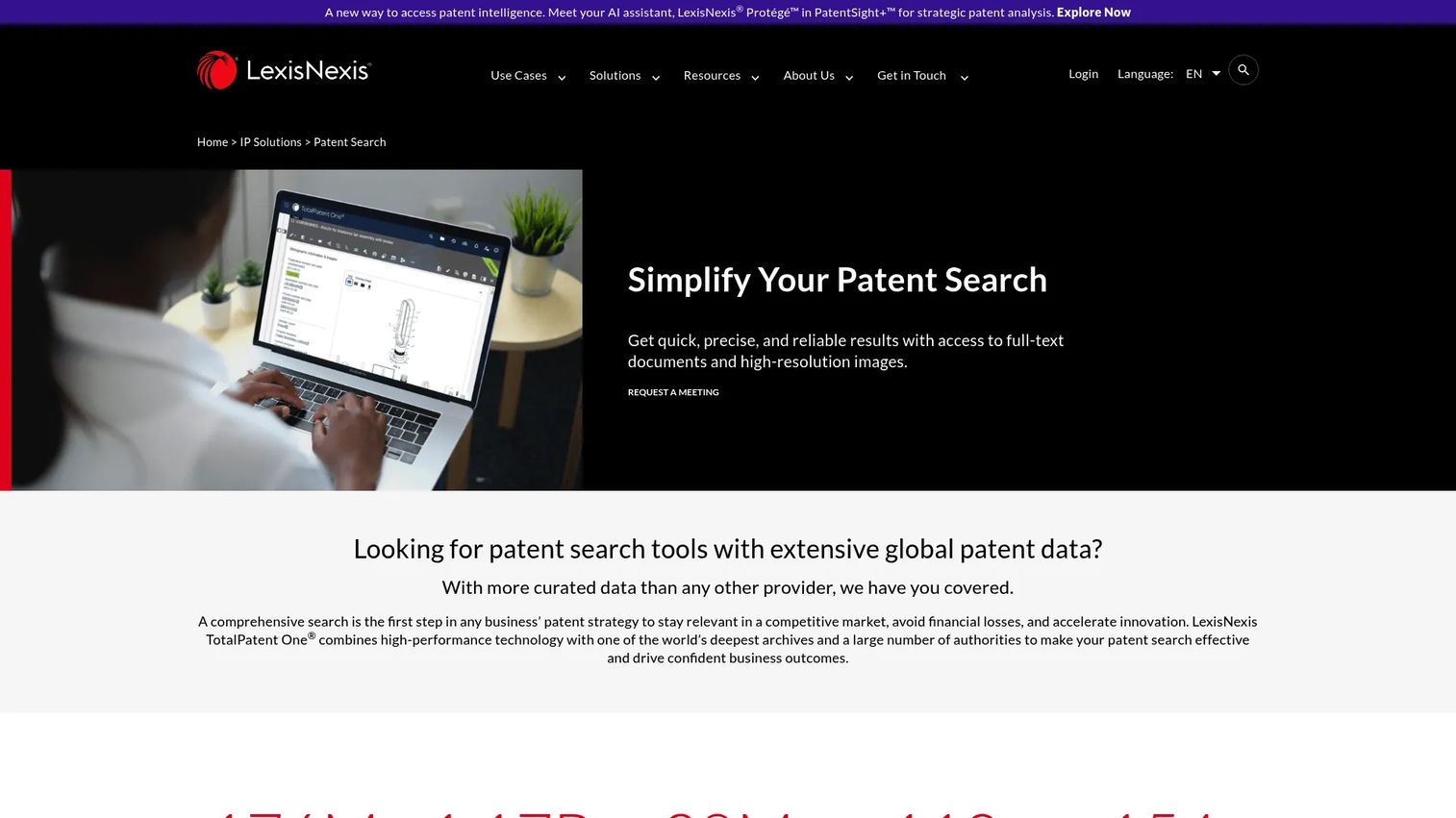
LexisNexis TotalPatent One is a global patent search platform focused on full-text document access, not portfolio scoring. It supports full-text patent searching across multiple jurisdictions, patent-family search across Domestic, Main, Complete, and Extended family types, machine translation, pharmaceutical-specific search fields, and high-resolution patent images. Teams that need broad retrieval coverage and professional search tools find it stronger than portfolio analytics tools.
Best for: Patent professionals, law firms, and corporate IP teams that need global full-text coverage and professional search capability.
Key features
- Global patent search with full-text record access and high-resolution images
- Patent family search across Domestic, Main, Complete, and Extended families
- Machine translation and original-language searching
- Pharmaceutical search fields including Orange Book and SPC data
- Automated alerts and exportable reports
Why choose LexisNexis TotalPatent One: Strong when coverage, retrieval, and query-building capability matter more than portfolio scoring. Distinct from PatentSight+ in that it focuses on document search rather than portfolio valuation.
LexisNexis TotalPatent One pricing: Custom pricing. Ask about jurisdiction coverage, record exports, user access, and integration options when requesting a quote.
10. The Lens
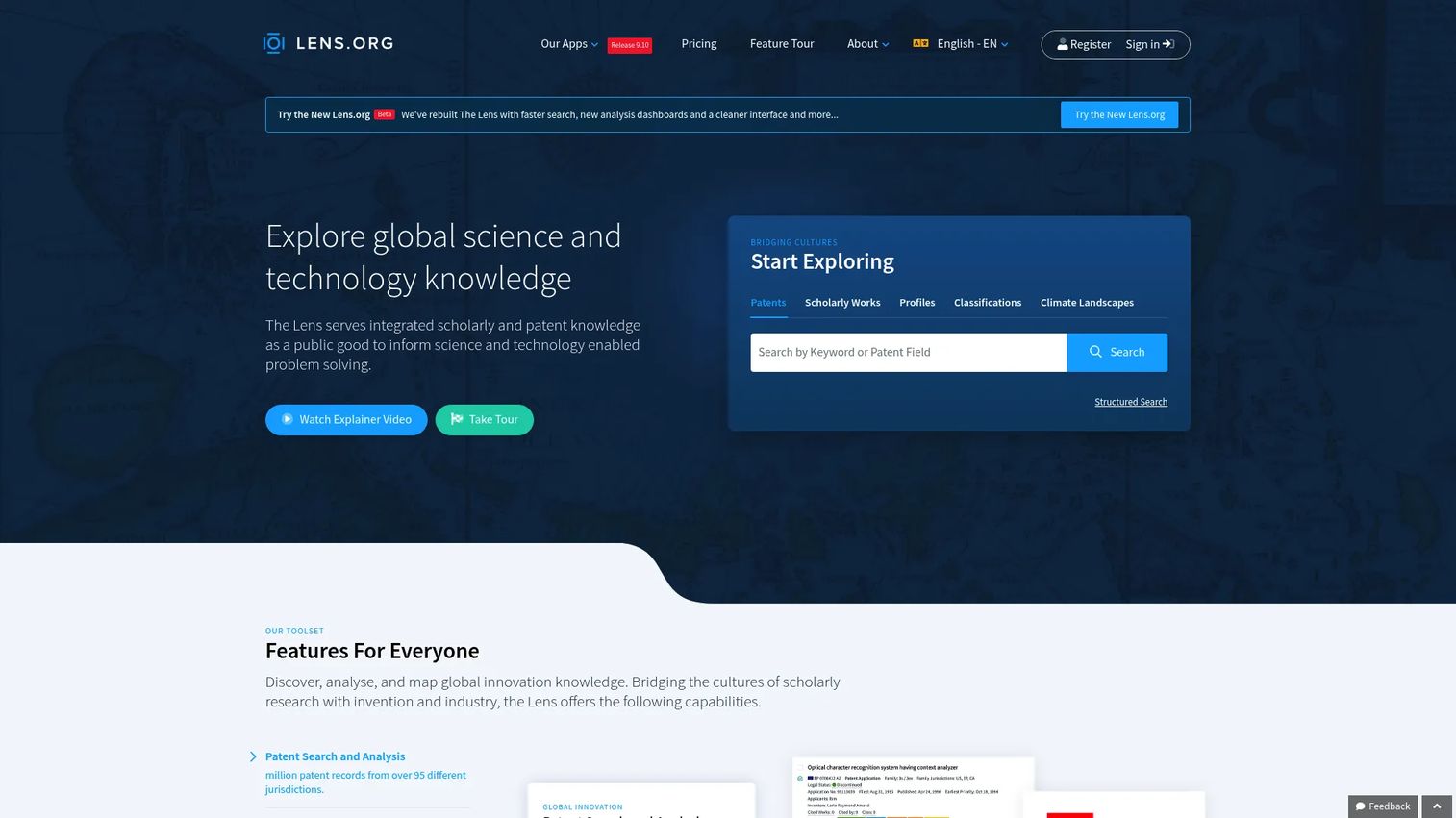
The Lens is an open innovation platform for searching and connecting global patent and scholarly knowledge. It supports advanced Boolean, structured, and biological sequence search, alongside scholarly works discovery and ORCID-linked inventor profiles. Its PatSeq Finder handles biological sequence searches, and academic users can access the full platform fee-waived. For teams that need a free starting point for patent and scholarly research before engaging commercial tools, it covers substantial ground.
Best for: Researchers, patent professionals, and innovation teams that need a free tool for patent and scholarly exploration, including biological sequence data.
Key features
- Patent search with advanced Boolean, structured, and classification search
- Scholarly works discovery and scholarly-patent linking
- Biological sequence search through PatSeq Finder
- Saved queries, collections, dashboards, notes, tags, and alerts
- API and bulk data access
Why choose The Lens: A strong free tool for exploratory research and document discovery. It does not replicate the account management, governance, and legal-team workflow tools of a paid enterprise platform.
The Lens pricing: Anonymous access is free with no account required. Academic Workspace access is fee-waived for eligible academic users. Individual commercial use costs $1,000 per year. Institutional and Enterprise Toolkit pricing is custom.
11. USPTO
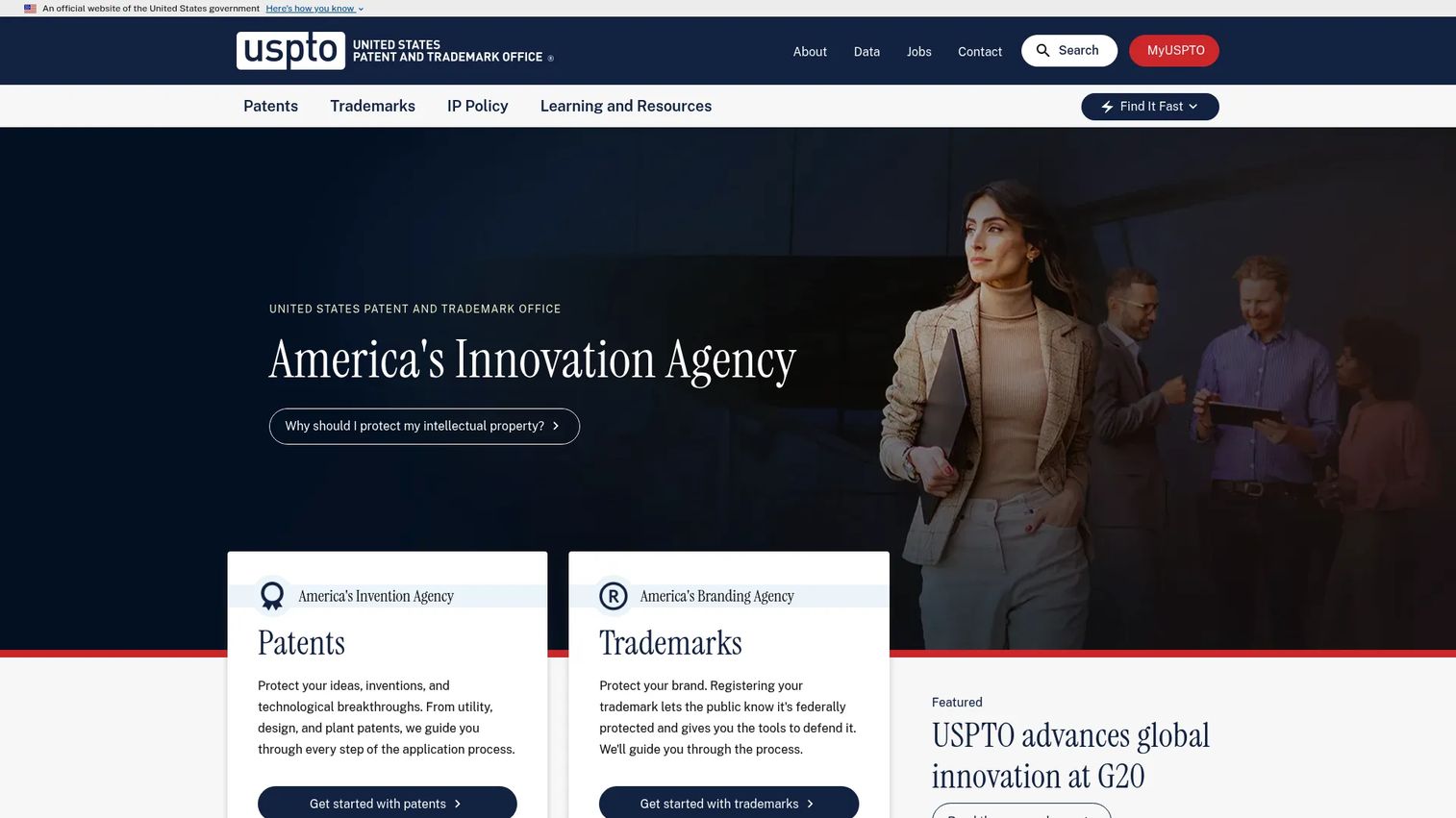
USPTO provides the official U.S. patent and application search databases, including tools for looking up granted patents, pending applications, assignments, and patent status. It is the required official source for U.S. patent records, and anything found through commercial platforms should be validated against it. The search interface is not built for complex multi-jurisdiction workflows, but it covers U.S. patent lookup completely.
Best for: U.S. patent lookup, official record verification, early public research, and inventors checking application or assignment status.
Key features
- Official U.S. patent grant and application search
- Assignment search and ownership records
- Patent status and prosecution history access
- Fee schedules and online filing resources
- Free IP guidance and educational support
Why choose USPTO: The necessary official source for U.S. patent research. It does not replace commercial analytics or multi-jurisdiction workflow tools, but no U.S. patent search is complete without it.
USPTO pricing: Patent search and status tools are free. USPTO also publishes one-time filing fees for patent applications, which start at $60 for micro-entity plant and design applications. Research access carries no subscription cost.
12. WIPO
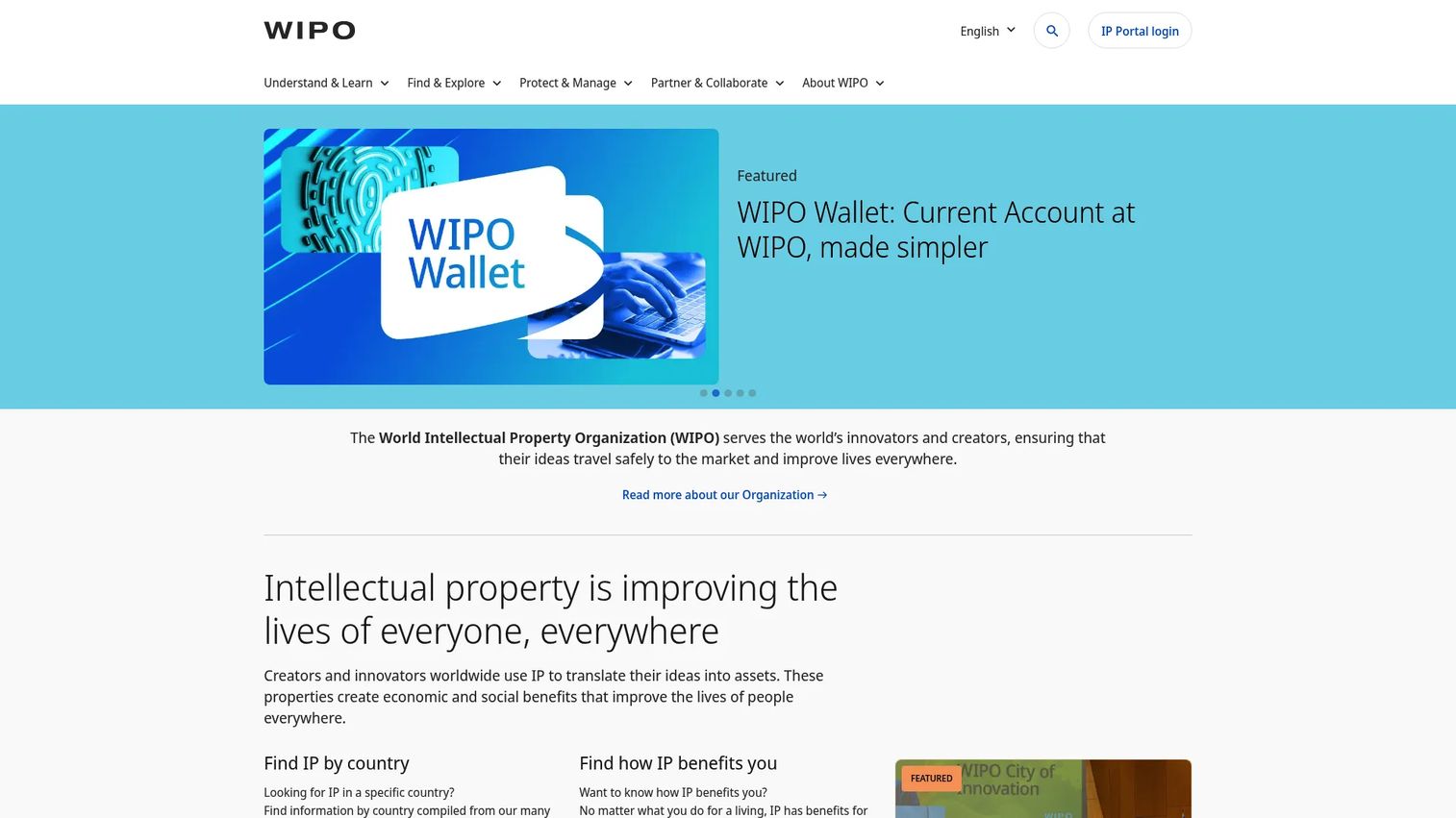
WIPO PatentScope is the official international patent search resource, covering PCT applications and national patent collections from member states. It provides machine translation, classification search, and international patent visibility at no cost. For any product operating across jurisdictions, PatentScope is a necessary reference point alongside national office tools.
Best for: International patent research, PCT application search, and teams that need a free first look at global patent filings before engaging commercial platforms.
Key features
- PCT application search and international patent collections
- Machine translation tools for cross-language searching
- Classification search and IPC browse tools
- Free global access with no subscription required
- National collection coverage from WIPO member states
Why choose WIPO: A required public tool for any international patent research workflow. Paid platforms add workflow, analytics, normalization, and support layers, but PatentScope provides the authoritative international record.
WIPO pricing: PatentScope access is free. WIPO publishes service-specific fees for filing and registration services rather than subscription plans. Confirm account requirements and usage terms at wipo.int.
Considerations when choosing patent research software
Match the tool to the workflow
A founder doing early competitive diligence needs a different platform than an enterprise IP team managing thousands of patent assets. Separate the job: Prior-art search, FTO review, portfolio analytics, and competitive intelligence all have different tool requirements. Buying a full analytics suite for occasional document lookup wastes budget.
Check patent data coverage
Ask which jurisdictions, full-text record types, legal status data, patent families, citations, and non-patent literature sources are included. For products operating across multiple geographies, coverage gaps can produce false confidence. Run the same search query across two shortlisted tools and compare what each returns.
Evaluate AI explainability
AI summaries are only useful if the team can trace conclusions back to source claims, citations, and original documents. Push vendors to demonstrate how they produce evidence. Tools that show the supporting passage alongside the summary reduce the risk that an AI-generated finding goes unchecked into a legal opinion.
Protect confidential invention data
Patent research often involves unpublished inventions, product strategy, and acquisition targets. Ask vendors directly about data retention policies, model training practices, access controls, audit logs, and enterprise security review options. This question matters more in AI-native platforms where queries and documents may pass through third-party model infrastructure.
Verify pricing before stakeholder buy-in
Patent software pricing typically depends on seats, modules, data collections, export volume, support tiers, and enterprise terms. Get enough pricing detail before asking a VP, CFO, or board to approve a budget line. Many vendors in this space gate full pricing behind a sales conversation; factor that into your evaluation timeline.
Conclusion
Patent research software spans a wide range, from free public databases to enterprise AI platforms. The right tool depends on the workflow, not the marketing.
Patlytics is the strongest AI-first choice for teams that want patent workflows in natural language from search through claim analysis. Patsnap suits innovation and R&D teams that need patent research tied to big data analytics software and product strategy. PatSeer, Derwent Patent Search, Orbit Intelligence, and TotalPatent One fit deeper professional search and monitoring workflows. IPRally and PQAI stand out for semantic prior-art search when language variation is the problem. PatentSight+ with Protégé is the clearest choice for portfolio analytics and executive-level benchmarking. The Lens, USPTO, and WIPO are essential free starting points for early research and official record validation, but they do not replace commercial workflow tools for high-stakes IP decisions.
A practical next step: Pick two tools from your shortlist, run the same patent question through both, and compare coverage, evidence traceability, explainability, and time-to-decision. That test tells you more than a sales demo.
If your team sells complex software, the same principle applies in your GTM motion: Show the product clearly before asking buyers for more time. Start your journey with Guideflow today!
FAQs
Patent research software supports patent search, prior-art discovery, patentability assessment, freedom-to-operate analysis, invalidity research, portfolio analysis, competitive intelligence, and technology trend discovery. It helps legal and R&D teams make faster, better-evidenced decisions. These tools support human judgment; they do not replace qualified patent counsel.
Patent search software helps teams find, retrieve, and review patent documents. Patent analytics software interprets larger patent datasets through portfolio metrics, competitive benchmarking, filing trend visualization, and citation impact analysis. Some platforms, like Patsnap and PatSeer, combine both functions. Others, like PatentSight+ with Protégé, focus squarely on analytics.
Patlytics, IPRally, PQAI, Derwent Patent Search, and Orbit Intelligence all emphasize AI or semantic search in different ways. Patlytics uses an AI agent trained on patent-work skills; IPRally uses graph-based concept search; PQAI uses natural-language queries for prior-art discovery. Test the same query across shortlisted tools and compare source evidence, not just summaries.
USPTO, WIPO, and The Lens cover early research and document lookup well. For high-stakes patentability assessment, invalidity research, FTO analysis, or portfolio strategy decisions, teams generally need stronger analytics, broader coverage, and workflow tools that support team collaboration and audit trails.
Focus on decision speed, explainability, confidentiality protections, and legal-team fit. Choose tools your legal or R&D owner will actually use in their workflow, not the platform with the most impressive demo. For early-stage diligence, a free tool like The Lens or PQAI may be enough. For product strategy and board-level IP reporting, a commercial platform adds measurable value. See related guidance in our roundup of best competitive intelligence tools.
Public tools including USPTO, WIPO, and The Lens (for non-commercial use) are free. Commercial platforms frequently use quote-based pricing. The cost typically scales with seats, modules, database collections, jurisdiction coverage, export volume, and support level. Patsnap publishes a free Basic plan and paid plans from $100 per month. PQAI+ starts at $20 per month. Enterprise IP platforms like Patlytics, Orbit Intelligence, and PatentSight+ price by custom quote.
No. Patent research software improves search coverage, speeds up analysis, and organizes evidence. Legal opinions on patentability, infringement, invalidity, and freedom to operate still require qualified patent counsel. The role of the software is to give counsel better inputs faster, not to replace their judgment.
Use the same invention disclosure, competitor name, patent number, or technical concept as the input across each tool. Compare the number of relevant results returned, how clearly each tool shows source evidence, the quality of filters and reporting, collaboration features, and total time from query to a defensible answer. Tools that surface more evidence with clearer traceability reduce the work your legal team has to do downstream.