A promising startup comes up in a board meeting. Someone mentions they spoke with the founders six months ago. Nobody can find the notes, the scorecard, or what happened next.
That situation is how most technology scouting breaks down. A spreadsheet captures links. It does not create a decision trail. According to Mordor Intelligence (2026), the global technology scouting-as-a-service market reached $1.45 billion in 2025, a figure that reflects how seriously organizations now treat external opportunity intelligence. Yet the internal process at most companies still runs through a mix of saved articles, founder networks, and documents nobody owns.
The bottleneck is not finding more companies. It is turning external signals into a repeatable decision process.
A software platform does not fix a broken process automatically. But it gives your team a shared place to discover, score, track, and report on technology opportunities, without everything routing through you.
What does a scouting system need to do beyond search?
What's inside
This guide compares seven technology scouting software platforms for 2026, chosen based on workflow depth, data coverage, pricing transparency, and fit for different organizational models. It covers:
- Platforms for end-to-end scouting from discovery through pilot tracking
- Innovation management suites that extend beyond pure scouting
- IP, patent, and research intelligence platforms for R&D-led teams
- Analyst-supported scouting services for teams that need a researched answer fast
- A buying checklist for deciding whether to buy software or commission a research engagement
The guide is written for founders, strategy leaders, and innovation or corporate development teams at Series B and beyond.
TL;DR
- Best for a structured scouting workflow: Traction Technology connects discovery, evaluation, RFI management, and pilot tracking in one operating process
- Best for enterprise innovation and partner scouting: HYPE Innovation suits large organizations running external ecosystem management alongside broader innovation programs
- Best for technology radars and strategic foresight: ITONICS helps teams map trends, signals, and portfolios across business units with visual radar views
- Best for IP, research, and technology transfer: Wellspring Scout serves R&D and technology transfer teams that need patent, publication, and startup intelligence
- Best for analyst-supported scouting: Ezassi delivers validated research reports and provider benchmarking for teams that need a decision-ready answer
- Best for collaborative innovation programs: InnovationCast suits teams that combine scouting with employee participation and structured innovation workflows
What is technology scouting software?
Technology scouting software helps organizations discover, evaluate, prioritize, and track emerging technologies, startups, research partners, and vendors that could affect their strategy, products, or operations.
It is the operating layer for a technology scouting process. The process itself involves identifying external opportunities, assessing their maturity and fit, deciding which to pursue, and tracking what happens after.
What the software does
Most platforms cover four workflow stages:
- Discovery: Aggregates signals from startup databases, patent filings, academic publications, market news, and partner sources
- Filtering and search: Lets teams query by technology domain, geography, funding stage, or strategic relevance, and save recurring queries as alerts
- Evaluation: Supports structured scoring, technology readiness indicators, evidence capture, and comparison
- Tracking: Maintains a record of decisions, pilots, partnerships, and portfolio outcomes over time
Key features to look for
- Multi-source technology and company discovery
- Saved searches, alerts, and topic monitoring
- Startup, vendor, patent, and research intelligence
- Scoring frameworks and evaluation workflows
- Technology radars and portfolio dashboards
- Collaboration, notes, ownership, and approval trails
- Partner pipeline, RFI, and pilot tracking
- Reporting formatted for leadership and board review
How it differs from adjacent tools
| Category | Primary job | Best fit |
|---|---|---|
| Technology scouting software | Find and qualify external technologies and partners | R&D, innovation, corporate development |
| Innovation management software | Run idea, initiative, and portfolio execution workflows | Enterprise innovation programs |
| Startup database | Identify companies and funding activity | Early market mapping |
| Competitive intelligence platform | Track competitors, markets, and messaging | Market strategy and product marketing |
| Managed scouting service | Deliver analyst-researched findings and recommendations | Teams needing expert support or a one-time answer |
A startup database helps you find companies. It will not manage a scorecard, track a pilot, or show your board what happened to the 12 vendors you evaluated last quarter. The right choice depends on whether your team needs discovery only or a repeatable evaluation workflow.
For teams tracking competitive intelligence alongside emerging technology signals, these two categories often run in parallel rather than replacing each other.
When to use technology scouting software
Build a repeatable technology radar
Product and strategy leaders who rely on founder networks for market sensing eventually hit a ceiling. A software platform turns scattered signals into a shared view that updates on a regular cadence. When your board asks what technologies you are monitoring, the answer should come from a system, not a founder's memory.
Qualify startups and vendors before a pilot
Every R&D team or partnerships function eventually standardizes its screening criteria. A platform gives evaluators a shared scorecard, captures the evidence behind each score, and assigns ownership so nothing falls between teams. This matters most when multiple people are evaluating the same opportunity from different angles.
Connect discovery to strategic execution
Discovery is only step one. The harder work is tracking what happens next: Which pilots moved forward, which partnerships stalled, what the board decided and why. A scouting platform that supports pilot management and portfolio reporting closes the loop between signal collection and operating performance. For broader application portfolio management, this kind of decision history becomes a foundation for strategic planning.
Technology scouting software comparison
The table below reflects verified pricing and G2 ratings as of October 2026. Ratings are drawn from each vendor's live G2 listing. Where a vendor does not display pricing on their website, that is noted in the relevant item section.
| # | Product | Best for | Key differentiator | Pricing | G2 rating |
|---|---|---|---|---|---|
| 1 | Traction Technology | End-to-end enterprise scouting workflows | Discovery plus evaluation, RFI, pilot, and partnership tracking | From $4,000/year per seat | 4.5/5 |
| 2 | HYPE Innovation | Corporate innovation and external partner scouting | Partner discovery connected to enterprise innovation governance | Custom pricing | 4.8/5 |
| 3 | ITONICS | Technology radars and strategic portfolio intelligence | Radar views, horizon scanning, workflow governance | From $3,000/year (10 seats); free trial available | 4.4/5 |
| 4 | Wellspring Scout | IP, research, and technology transfer intelligence | 400M+ innovation records across patents, publications, startups | Custom pricing | 5.0/5 |
| 5 | InnovationCast | Collaborative innovation programs | Crowdsourced scouting with structured workflows | From $2,999/month | Not listed on G2 |
| 6 | Ezassi | Analyst-supported scouting | AI-generated reports with analyst validation | Custom pricing | 4.8/5 |
| 7 | Qmarkets | Enterprise innovation programs with configurable workflows | Idea, scouting, and portfolio management in one platform | Custom pricing | 4.5/5 |
The best technology scouting software for 2026
1. Traction Technology
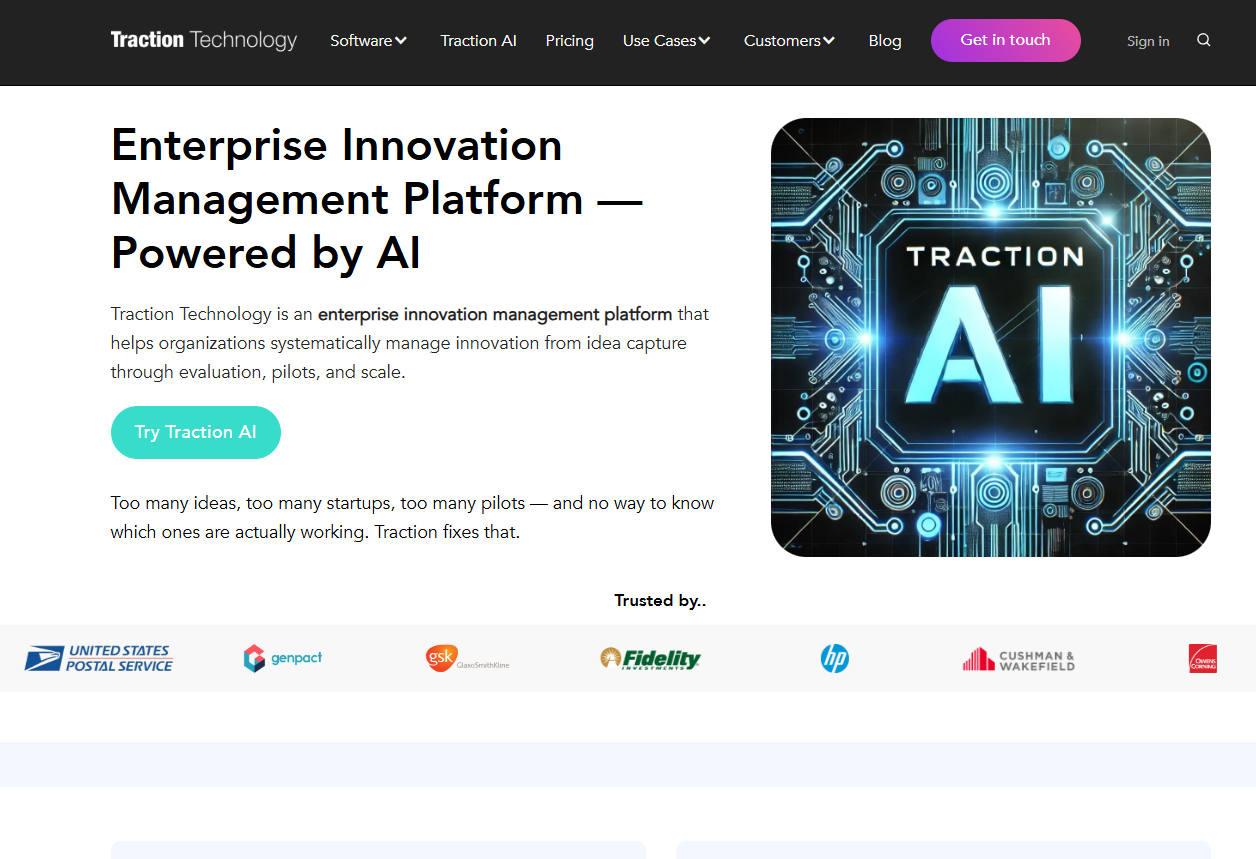
Traction Technology is an enterprise innovation management platform with a dedicated technology scouting motion. It connects discovery with vendor qualification, structured scoring, RFI workflows, pilot tracking, and outcome reporting. The platform is built for teams that have moved beyond ad hoc research and need a repeatable operating process across innovation, R&D, and business development.
Where many platforms stop at discovery, Traction Technology extends into the governance layer: Who owns each opportunity, what evidence supports the score, and what happened after a pilot was launched.
Best for: Enterprise innovation and R&D teams that need to show a decision trail from first signal to pilot outcome.
Key features
- Technology and company discovery with search and filtering
- Structured vendor scorecards and evaluation workflows
- RFI management and vendor communication tracking
- Pilot and partnership status tracking
- Innovation program reporting and portfolio dashboards
- AI-assisted innovation workflows
Why choose Traction Technology: If your team needs to move from external signal to a documented, measurable decision, this platform offers more workflow depth after discovery than most alternatives. It is the right fit when you need a system that a VP of Innovation or Head of Corporate Development can own on day one.
Traction Technology pricing: The Standard plan runs $4,000 per seat per year and includes the full platform plus all AI capabilities. Unlimited view-only users are included at no additional cost. Enterprise pricing is custom and adds dedicated support, data migration, workflow configuration, and advanced integrations.
G2 rating: 4.5/5
2. HYPE Innovation
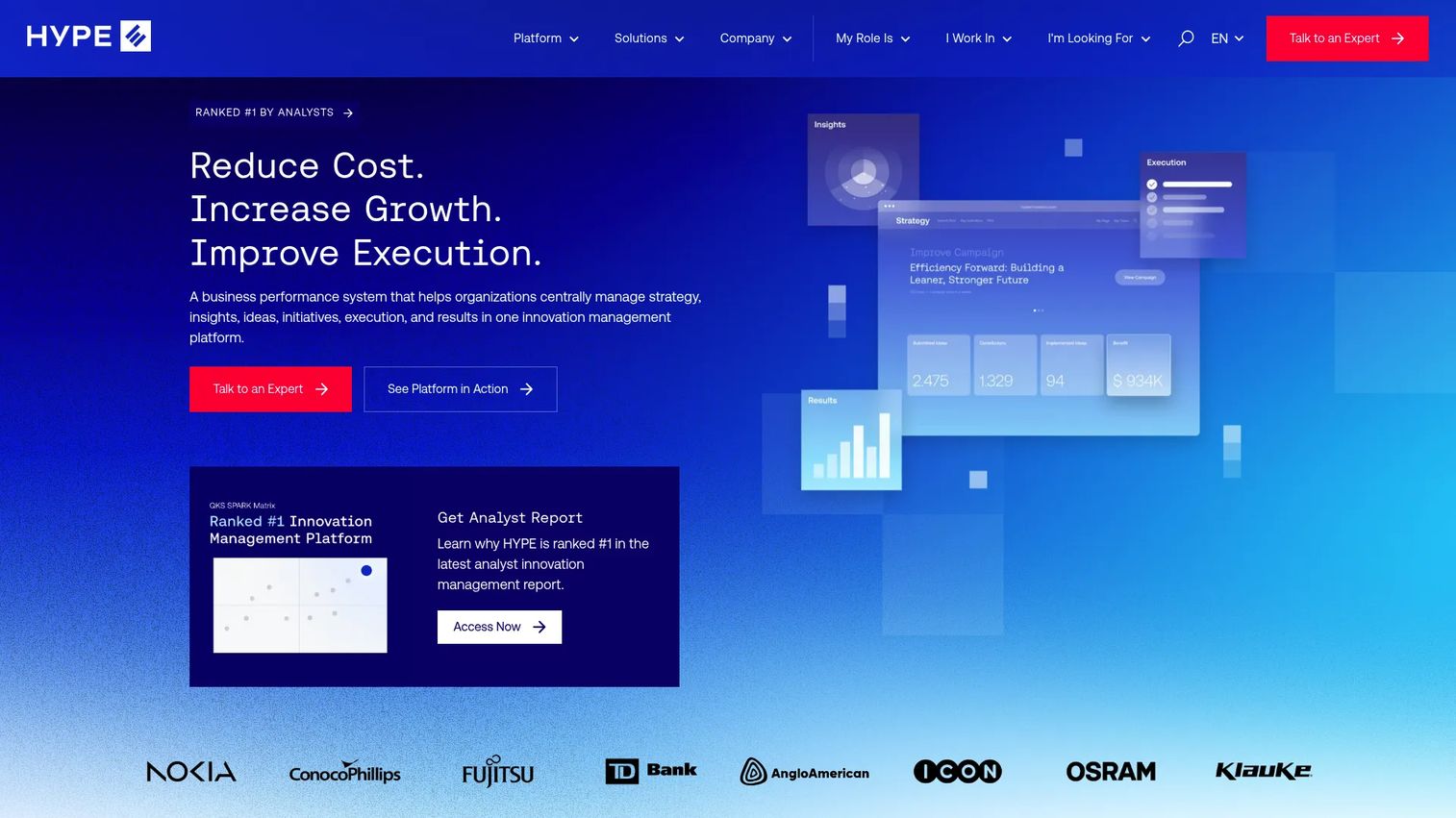
HYPE Innovation is an AI-first enterprise innovation management platform. Its relevance to technology scouting comes from its external partner management capability, which connects startup and technology discovery with innovation portfolio governance, configurable phase-gate processes, and cross-functional reporting. Large organizations use it to run partner scouting alongside broader transformation and continuous improvement programs.
HYPE goes further than a scouting-only tool by connecting discovery to strategic execution workflows across multiple innovation functions in the same environment.
Best for: Large enterprises that need technology scouting tied to broader innovation governance, partner relationship management, and portfolio reporting.
Key features
- Trends and technology management
- Partner ecosystem and startup scouting
- Strategic idea sourcing and evaluation
- Configurable phase-gate processes
- AI-powered insights and workflow automation
- Low-code customization for enterprise configuration
Why choose HYPE Innovation: It is the right choice when scouting is one input into a larger organizational transformation program, rather than a standalone function. Teams with multiple innovation initiatives and cross-functional evaluation committees will get more from HYPE than from a focused scouting platform.
HYPE Innovation pricing: Pricing is provided through tailored demos and direct discussions. Contact HYPE Innovation for a current quote based on organizational scope, user model, and module requirements.
G2 rating: 4.8/5
3. ITONICS
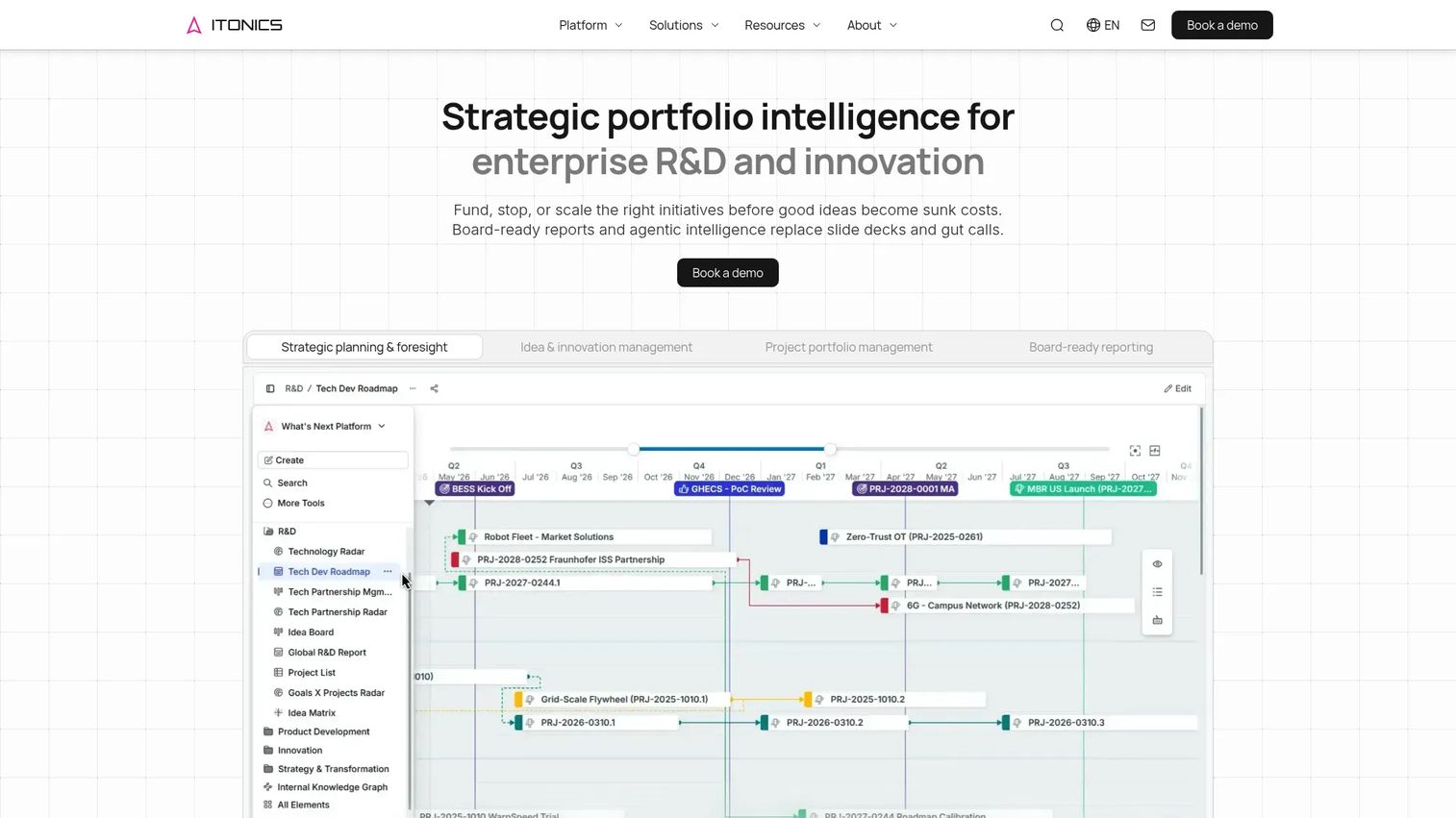
ITONICS is an enterprise platform for strategic foresight, innovation, and portfolio management. Its scouting relevance centers on radar visualization, horizon scanning, AI-powered monitoring, and the ability to move external signals into governance and portfolio decisions. Teams use it to build technology radars that connect trend data to roadmaps and strategic planning cycles.
ITONICS supports R&D, strategy, and innovation teams that need one system connecting foresight, ideas, portfolios, and execution, rather than separate tools for each.
Best for: Strategy and innovation teams that need technology radar views, structured portfolio governance, and board-ready reporting across multiple business units.
Key features
- Technology radar views and landscape visualization
- Horizon scanning and AI-powered signal monitoring
- Webclipper for capturing external research
- Configurable workflow builder with audit trails
- Stage-gate project and portfolio management
- Reporting, BI connectors, and real-time dashboards
Why choose ITONICS: Choose ITONICS when leadership needs a visible, repeatable foresight process. It performs best when scouting outputs must inform strategic portfolios and roadmaps rather than feed a narrow vendor qualification workflow.
ITONICS pricing: ITONICS offers Core, Pro, and Enterprise tiers. A starting reference of approximately $3,000 per 10 full-user seats per year appears in ITONICS-published content, though tier prices are not displayed on the official pricing page. A free guided trial is available. Contact ITONICS for current scope and configuration costs.
G2 rating: 4.4/5
4. Wellspring Scout
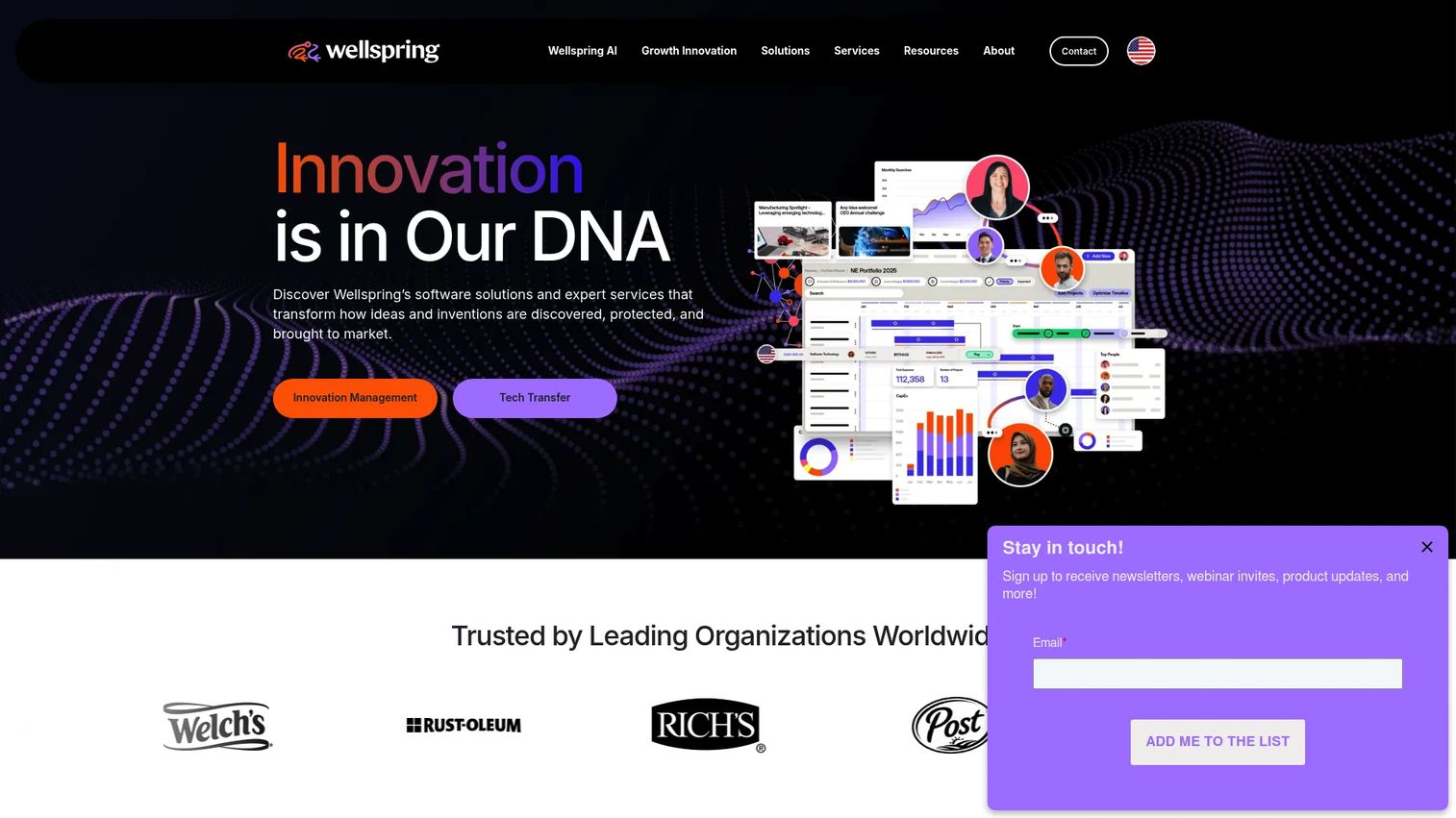
Wellspring Scout is a technology scouting and innovation intelligence platform with deep coverage of IP, research institutions, patents, academic publications, startups, and commercialization workflows. Its database spans over 400 million innovation records across patents, publications, grants, startups, technologies, and partners, making it a specialized choice for research-intensive organizations.
This is not a general-purpose startup discovery tool. Wellspring is relevant when the work begins with scientific or IP-led discovery and the team needs to understand the broader knowledge landscape before committing to a research partnership or licensing path.
Best for: R&D, university commercialization, IP, and corporate technology transfer teams that need research and patent intelligence alongside partner discovery.
Key features
- Search across 400M+ innovation records: Patents, publications, grants, startups, and partners
- Technology landscape analysis and whitespace mapping
- Organization profiles for corporations, startups, universities, and research institutions
- Technology readiness assessment
- Monitoring of global patent activity, competitor signals, and emerging trends
Why choose Wellspring Scout: Wellspring earns its place when the evaluation starts with a scientific question rather than a commercial one. For teams working in deep-tech, biotech, industrial sectors, or research-heavy markets, having patent and publication intelligence alongside startup data changes the quality of the analysis.
Wellspring Scout pricing: Wellspring Scout requires a direct engagement for pricing. Contact the vendor to understand the commercial model, which varies by data access, module configuration, and organizational scope.
G2 rating: 5.0/5
5. InnovationCast
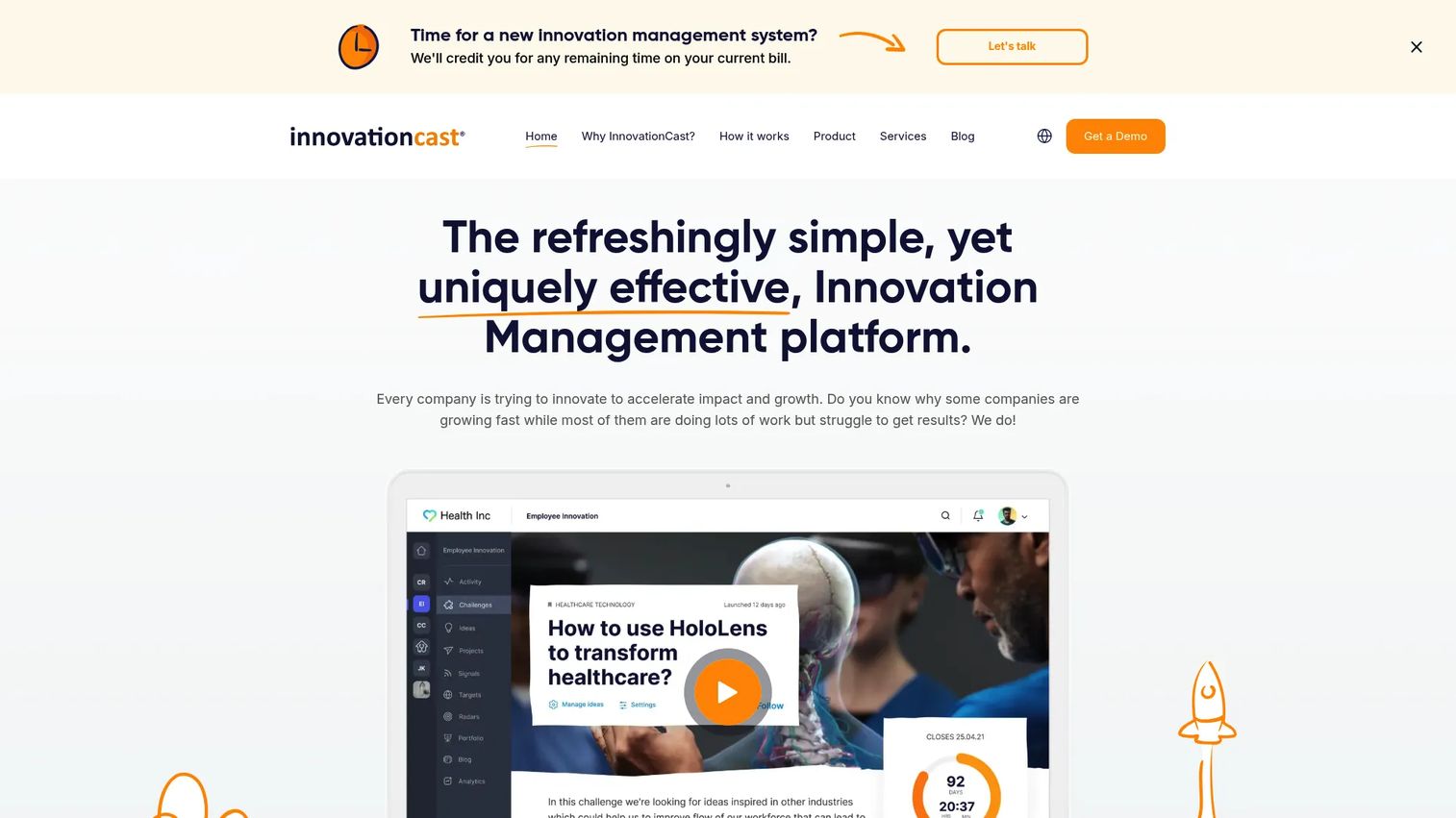
InnovationCast is a collaborative innovation management platform. Its approach to scouting centers on structured participation rather than raw data depth. Internal experts, external contributors, and innovation teams can submit, discuss, validate, and progress opportunities through a common workflow, making it useful when the signal you need lives inside your organization as much as outside it.
It covers discovery, idea challenges, community participation, portfolio monitoring, and analytics, with a focus on drawing out knowledge from distributed teams rather than aggregating external databases.
Best for: Innovation teams that need collaborative scouting, employee participation, and structured innovation workflows in the same platform.
Key features
- Innovation campaigns, challenges, and community participation tools
- Idea assessment, prioritization, and configurable workflows
- Environmental scanning and innovation scouting
- Portfolio monitoring and analytics dashboards
- Microsoft Teams integration and Power BI connector (Enterprise tier)
Why choose InnovationCast: It works best when scouting needs input from employees, operators, or subject-matter experts rather than a small central research team. If your team has deep domain knowledge that is currently undocumented, InnovationCast gives that knowledge a structured home.
InnovationCast pricing: Standard starts at $2,999 per month (1 community, 2 admins, 10 active challenges). Plus starts at $4,199 per month and adds branding, SSO, and a second community. Enterprise starts at $7,199 per month and includes 5 communities, unlimited active challenges, Microsoft Teams, Power BI, and 24/7 support.
6. Ezassi
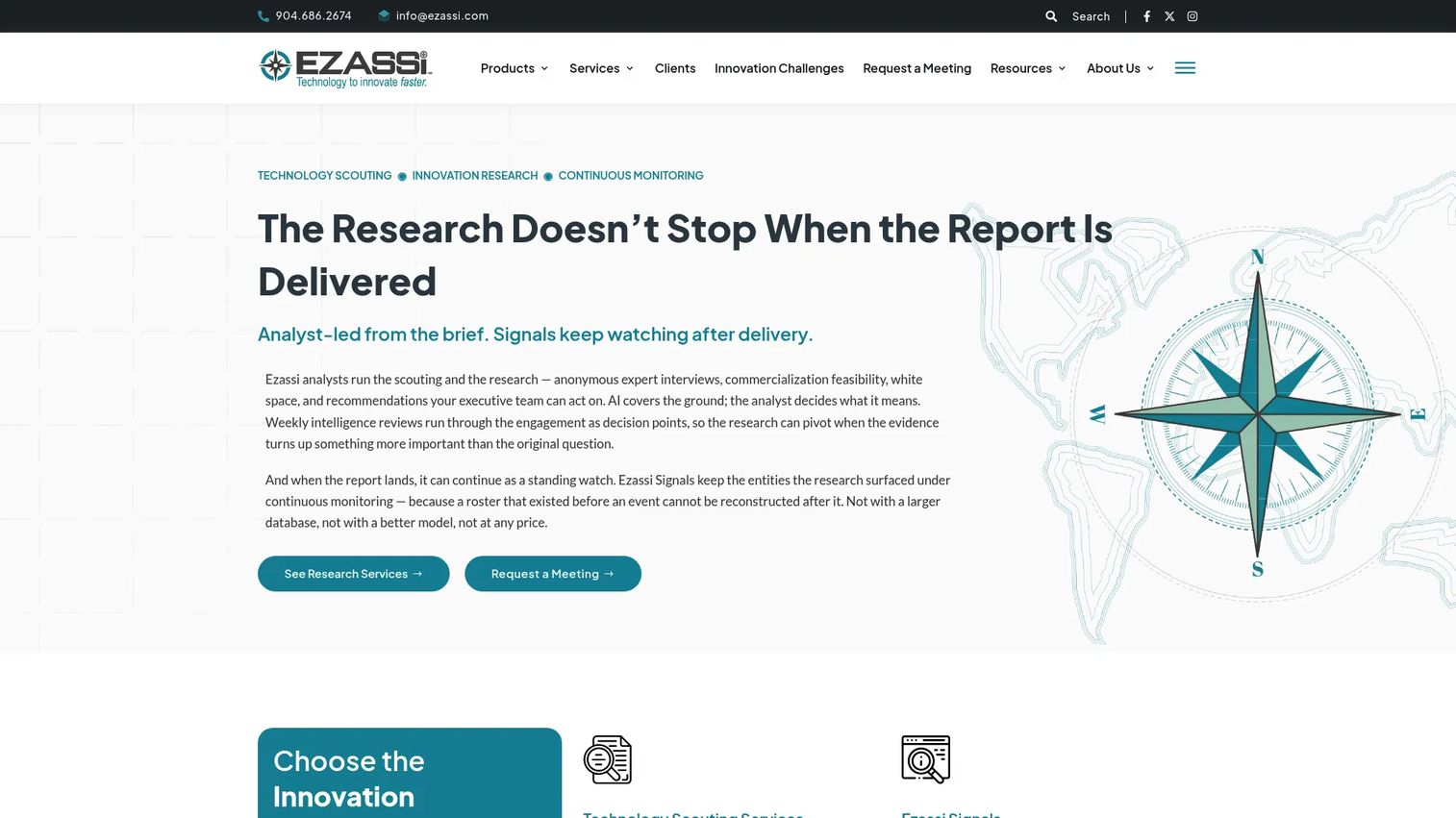
Ezassi combines AI-supported discovery with human analyst validation, technology scouting reports, provider profiles, benchmarking, and implementation recommendations. It sits at the intersection of software and managed research service. Teams get a platform for ongoing pipeline management alongside deliverables that a research team would otherwise produce manually.
Its clearest differentiation is the analyst layer. For a buyer who needs a researched conclusion rather than a search interface, Ezassi shortens the path from broad uncertainty to a focused shortlist.
Best for: Enterprise innovation, R&D, and strategy teams that need analyst-backed technology scouting, provider benchmarking, and implementation guidance for a specific strategic question.
Key features
- AI-generated research reports with analyst validation
- Technology scouting and discovery pipeline
- Provider profiles and comparative benchmarking
- White-space analysis and opportunity mapping
- Open innovation challenges and collaboration
- Continuous innovation and regulatory monitoring
Why choose Ezassi: Use it when the company has a time-sensitive research question but lacks internal scouting capacity to answer it thoroughly. It also works as a pre-platform engagement: Run a research project first, then evaluate whether recurring software is warranted.
Ezassi pricing: Ezassi prices by engagement scope. Contact the vendor for current project and platform rates.
G2 rating: 4.8/5
7. Qmarkets
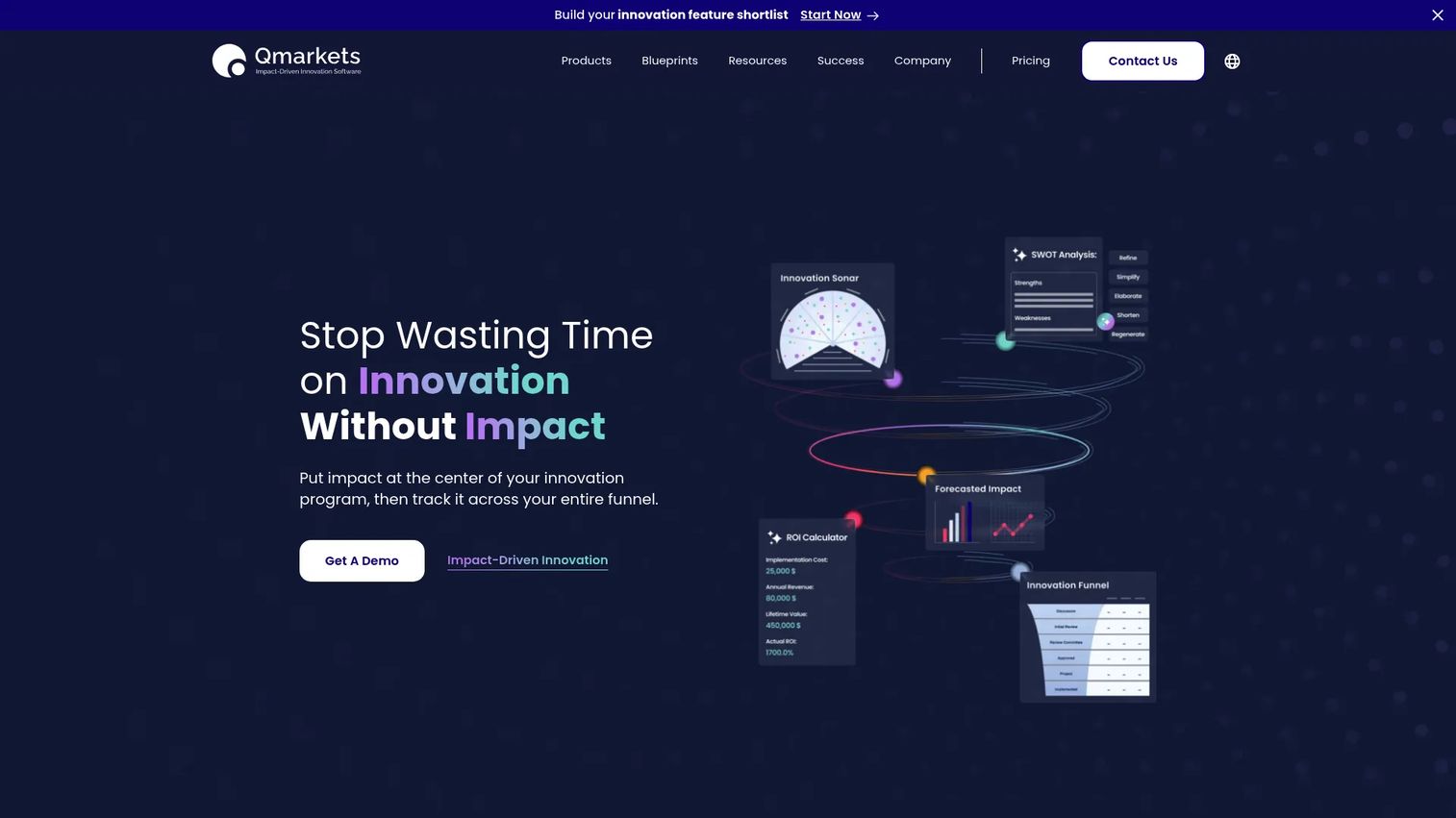
Qmarkets is an enterprise innovation management platform that supports idea collection, opportunity evaluation, technology scouting, campaign management, and portfolio execution. Its Q-scout module adds an AI-enhanced database of over 1 million companies for startup and technology discovery, sitting alongside modules for ideation, continuous improvement, and strategic foresight.
Qmarkets suits teams whose scouting activity is one component of a broader enterprise innovation program rather than the primary function.
Best for: Large organizations running structured enterprise-wide innovation, technology scouting, continuous improvement, and portfolio programs from one configurable platform.
Key features
- Technology and startup scouting with 1M+ company database
- AI-powered idea clustering, enrichment, and expert matching
- Idea challenges, evaluation, scoring, and configurable workflows
- Continuous improvement tracking and portfolio ROI management
- Custom roles, permissions, integrations, reporting, and dashboards
Why choose Qmarkets: It is relevant when the buying team wants to connect opportunity discovery with enterprise-wide participation and execution, not run a narrow research function. If your organization already runs structured innovation campaigns, Qmarkets extends that infrastructure to scouting without requiring a separate system.
Qmarkets pricing: Pricing is quote-based and depends on modules, user count, integrations, and deployment scope. Both Core and Enterprise packages are available for each product module, each on a recurring annual license plus a setup fee.
G2 rating: 4.5/5
Considerations when choosing technology scouting software
Decide whether you need software or a research engagement
A platform pays off when scouting is recurring and multiple people share the process. A managed engagement is often a better first step when the company needs a decision-ready answer to one strategic question. Buying software before the process is mature often means paying for a tool that nobody updates consistently.
Audit the data sources, not the feature list
Ask which sources feed the platform. Startup databases, patent filings, academic publications, funding records, and partner databases each produce different intelligence. Verify refresh frequency, geographic coverage, source transparency, and whether the data matches your actual market before signing a contract.
Evaluate workflow depth after discovery
Discovery is the entry point. Check whether the platform supports scorecards, evidence capture, ownership assignment, approval trails, RFI management, pilot status, and outcome measurement. A platform that stops at search leaves the hardest work to a spreadsheet.
Match governance to your operating model
A founder-led team may need a monthly review cycle and a shared shortlist. A larger organization may need role-based permissions, audit trails, SSO, and portfolio reporting for multiple business units. Both are valid operating models; the platform requirements are different.
Assign a named owner before buying
No tool fixes an unowned process. Name the person responsible for the scout-to-decision workflow, define the review cadence, and agree on what qualifies as a viable opportunity before implementation begins. This is the step most teams skip and most regret.
For teams managing broader business process management initiatives, this governance question applies across every new platform investment, not just scouting.
How to choose the right technology scouting software for your team
If you need a system from discovery through pilot tracking
Traction Technology is the strongest fit. It covers the full scouting workflow from first signal to documented outcome, with structured evaluation, RFI management, and portfolio reporting. It works well when a VP of Innovation or Head of Corporate Development will own the process and needs to show the board what happened after each technology was identified.
If technology scouting must feed an enterprise innovation portfolio
The right choice depends on the operating model:
- Choose HYPE Innovation when external partner scouting is one part of a broader enterprise transformation program with multiple innovation initiatives running simultaneously
- Choose ITONICS when leadership needs a technology radar that connects trend monitoring to strategic portfolios and roadmap cycles
- Choose Qmarkets when the organization already runs structured innovation campaigns and needs scouting to sit inside that same governance structure
If IP, research, and commercialization define the problem
Wellspring Scout is the right answer. Patents, publications, technology transfer, and research partnerships require a different intelligence layer than commercial startup scouting, and Wellspring's coverage of over 400 million records is purpose-built for that context. It is most relevant for SaaS companies serving deep-tech, biotech, or industrial markets.
If you need an answer before you need a platform
Ezassi delivers analyst-backed research, provider benchmarking, and implementation roadmaps without requiring a recurring platform rollout. Use it when the company has a time-sensitive strategic question and lacks the internal capacity to answer it. This is also a useful pre-purchase move: Commission a research engagement first, then evaluate whether the volume justifies ongoing software.
If broad employee input matters as much as external data
InnovationCast works best when scouting needs contributions from employees, operators, or domain experts across the company. If the knowledge you need is partly internal and partly external, InnovationCast gives both a structured place to land.
Conclusion
Technology scouting software is not a substitute for a strategy. Its value comes from making strategic sensing repeatable, inspectable, and connected to actual decisions, rather than leaving it to a founder's network and a shared folder nobody maintains.
Traction Technology is the strongest choice for an operational scouting workflow that moves from discovery into documented evaluation and pilot outcomes. HYPE Innovation, ITONICS, and Qmarkets fit broader innovation operating models where scouting is one of several interconnected functions. Wellspring Scout covers research, IP, and technology transfer contexts that need scientific depth alongside company data. Ezassi fits teams that need an analyst-backed answer before committing to a platform.
Start with one active scouting use case: A partner search, a technology radar, or a vendor shortlist for a specific product decision. Evaluate tools against that workflow. The largest feature list rarely wins when what you actually need is a process someone on your team will run every month.
Start your journey with Guideflow today!
FAQs
Technology scouting software is a system for discovering, evaluating, prioritizing, and tracking emerging technologies, startups, research partners, and vendors that could affect an organization's strategy or product roadmap. It converts external research into a shared decision process by combining discovery tools with evaluation workflows, scoring frameworks, and outcome tracking. The best platforms also maintain a decision history that leadership can review and audit.
Technology scouting focuses on identifying emerging technologies, external partners, and future opportunities that could shape product or market strategy. Competitive intelligence focuses on tracking competitor moves, pricing changes, messaging, and positioning in current markets. Many strategy teams run both in parallel because they answer different questions: Scouting tells you what is coming, while competitive intelligence tells you what competitors are doing now. For teams building out the second capability, a guide to competitive intelligence tools covers the relevant platforms.
R&D leaders, corporate innovation teams, product strategy executives, corporate development and business development functions, technology transfer offices, and founders in research-intensive markets all use technology scouting tools. The key ownership question is which team is accountable for turning insight into a decision. That team should own the platform and the review cadence, not just have access to it.
A startup database helps source companies. It typically lacks structured evaluation workflows, decision history, pilot tracking, and portfolio visibility. If your team only needs to identify who exists in a space, a database may be sufficient. Once scouting becomes a shared, recurring process with multiple evaluators and leadership reporting requirements, a database alone will not support the workflow.
Start with data coverage: Which sources does the platform aggregate, how fresh are they, and do they match your market? Then assess evaluation depth: Does the platform support scorecards, evidence capture, ownership, and approval trails? Add workflow fit, reporting for leadership, and governance requirements such as SSO and role permissions. The most reliable test is running a real scouting use case through the vendor's evaluation environment before signing a contract. For teams assessing software complexity, business process management software guides cover governance evaluation criteria that apply here too.
No. Smaller organizations should buy when scouting has become recurring, cross-functional, and strategically important. A founder can run a lightweight internal process with a defined framework and upgrade to a platform when volume, collaboration requirements, or decision risk rise. The question is not company size. It is whether the process has enough consistent activity to justify a shared system over a well-maintained document.
Use a service when you need expert research, a technology landscape, provider benchmarking, or an implementation recommendation quickly. Use software when the organization needs ongoing monitoring and a repeatable internal workflow that multiple people contribute to. The two are not mutually exclusive. A managed engagement can answer a strategic question while a parallel evaluation of platforms determines the right long-term system.
Track the source of the signal, the strategic rationale, the score and evidence behind it, the decision owner, pilot status, partnership or vendor outcome, expected value, and the actual result. Include a scheduled next review date for each active opportunity. This closes the loop between discovery and operating performance, and it gives your board the inspection trail they will eventually ask for.