EDI software sits in the unglamorous part of the business where mistakes get expensive. A purchase order arrives in the wrong format. An advance ship notice fails validation. An invoice gets rejected and finance finds out after the customer already filed a chargeback.
These failures are not just IT problems. They stall revenue, trigger compliance fines, and pull technical teams into manual fixes that should never happen in the first place. The global EDI software market was valued at $2.31 billion in 2025 and is projected to reach $6.49 billion by 2034, according to Fortune Business Insights (2026). That growth reflects how many organizations are still in the process of replacing brittle legacy infrastructure with cloud-based or managed electronic data interchange software.
If you are evaluating EDI platforms for a buying committee, shortlisting vendors before an RFP, or helping a customer justify a migration, this guide gives you a practical comparison you can use directly in discovery conversations.
What's inside
This guide compares 7 EDI software platforms for 2026, chosen for presales and technical evaluators who need a working shortlist, not a vendor brochure.
- Who it's for: IT leaders, supply chain operations teams, and presales engineers supporting integration-heavy buying cycles
- Selection criteria: EDI capability and standards coverage, integration depth with ERP, WMS, TMS, and eCommerce systems, trading partner onboarding model, managed service availability, and transaction visibility
- Pricing note: Most EDI providers price by quote because partner count, transaction volume, and integration scope all drive cost. Verified figures are shown where available.
- Ratings: G2 ratings are verified at generation time against live listings
TL;DR
- Best for cloud EDI and API integration: Cleo Integration Cloud handles EDI alongside API and file-based integration for teams modernizing beyond standalone translation tools
- Best for managed EDI and commerce networks: TrueCommerce suits manufacturers, wholesalers, and distributors that want a provider to handle onboarding and operational burden
- Best for specialist EDI expertise: Data Interchange fits organizations with complex partner requirements that need deep standards knowledge and hands-on support
- Best for enterprise B2B integration at scale: OpenText Business Network or IBM Sterling B2B Integrator for large enterprises with global trading networks, regulated document flows, and complex transaction orchestration
- Best for retail trading partner networks: SPS Commerce excels when your business sells into major retailers, grocers, or distributors with retailer-specific compliance requirements
- Best for global integration breadth: SEEBURGER Business Integration Suite covers EDI, API, managed file transfer, and application integration in a single platform for complex multinational environments
What is edi software?
EDI software is a platform that automates the exchange, translation, validation, and routing of structured business documents between companies and their trading partners.
Common document types handled by EDI systems:
- EDI 850 purchase order
- EDI 810 invoice
- Advance ship notice (ASN)
- Purchase order acknowledgment
- Inventory updates and replenishment signals
- Payment and remittance documents
Common EDI standards and formats:
- ANSI X12 (dominant in North America)
- EDIFACT (international, widely used in Europe)
- ODETTE and VDA (automotive sector)
- GS1 (retail and supply chain product data)
- HIPAA EDI (healthcare document exchange)
Typical integrations EDI platforms must support:
- ERP systems such as SAP, Oracle, and Microsoft Dynamics
- WMS systems for warehouse and inventory flows
- TMS systems for freight and carrier coordination
- eCommerce systems including Shopify and BigCommerce
- API integration for modern real-time workflows that run alongside legacy EDI
Core capabilities to evaluate in any EDI platform:
- Document mapping and translation across standards
- Trading partner onboarding, certification, and testing
- Validation rules and compliance checks per partner
- Transaction monitoring with real-time alerts
- Exception management with retry logic and root-cause detail
- Managed services for ongoing operational support
- VAN (value-added network) or direct AS2, SFTP, and API connectivity
- Audit trails, encryption, and access controls
One evaluation point most shortlists miss: Supporting ANSI X12 on paper is not the same as delivering a working integration. Ask vendors to walk through an end-to-end transaction, including ERP handoff, exception handling, and partner-specific rule enforcement, not just the mapping editor.
When to use edi software
Automate high-volume trading partner transactions
Manual portal entry, email-attached spreadsheets, and custom scripts stop working when transaction volume increases or partner requirements multiply. If your team is rekeying purchase orders, reconciling invoices by hand, or investigating advance ship notices that never arrived, that is the signal. EDI integration software automates those flows and replaces reactive firefighting with structured, monitored document exchange.
Connect ERP, WMS, TMS, and eCommerce systems
EDI software becomes critical when documents must move between internal systems and external trading partners without manual rekeying. A purchase order that enters your ERP system but never reaches your WMS creates fulfillment gaps. Modern platforms also handle API integration alongside EDI, which matters for teams managing both legacy partner requirements and newer real-time workflows simultaneously.
Scale supplier and customer onboarding
Partner onboarding is the most common bottleneck presales teams hear about in integration discovery calls. Each new retailer, distributor, or supplier brings its own document requirements, certification steps, and testing expectations. EDI platforms with structured onboarding workflows, mapping support, and partner-specific rule management reduce that timeline from months to weeks, and give the buying committee something concrete to evaluate.
EDI software comparison
EDI platforms differ significantly by deployment model, trading partner network reach, managed service depth, integration breadth, and onboarding support. The table below is a shortlist starting point. Verify integration fit, implementation timelines, and industry-specific requirements before committing.
| # | Product | Best for | Key differentiator | Pricing | G2 rating |
|---|---|---|---|---|---|
| 1 | Cleo Integration Cloud | Cloud EDI and API integration | Combines EDI, API, and file-based integration in one platform | Custom pricing | 4.4/5 |
| 2 | TrueCommerce | Managed EDI and commerce networks | Broad network connectivity with managed service options | From £75/month (UK); custom for other regions | 4.4/5 |
| 3 | Data Interchange | Specialist EDI expertise | 10,000+ trading partner network with deep standards support | Contact for pricing | N/A |
| 4 | OpenText Business Network | Enterprise B2B integration | Global network scale with AI-assisted monitoring | Contact for pricing | 4.1/5 |
| 5 | IBM Sterling B2B Integrator | Enterprise transaction orchestration | Hybrid-cloud B2B gateway with high-availability operations | Contact for pricing | 4.2/5 |
| 6 | SPS Commerce | Retail trading partner networks | Pre-built retailer compliance and fulfillment workflows | Contact for pricing | 4.3/5 |
| 7 | SEEBURGER Business Integration Suite | Global integration breadth | EDI, API, file transfer, and application integration combined | Contact for pricing | 4.6/5 |
Pricing and G2 ratings verified November 2026 from each vendor's pricing page and live G2 listing.
Best 7 EDI software platforms for 2026
1. Cleo Integration Cloud
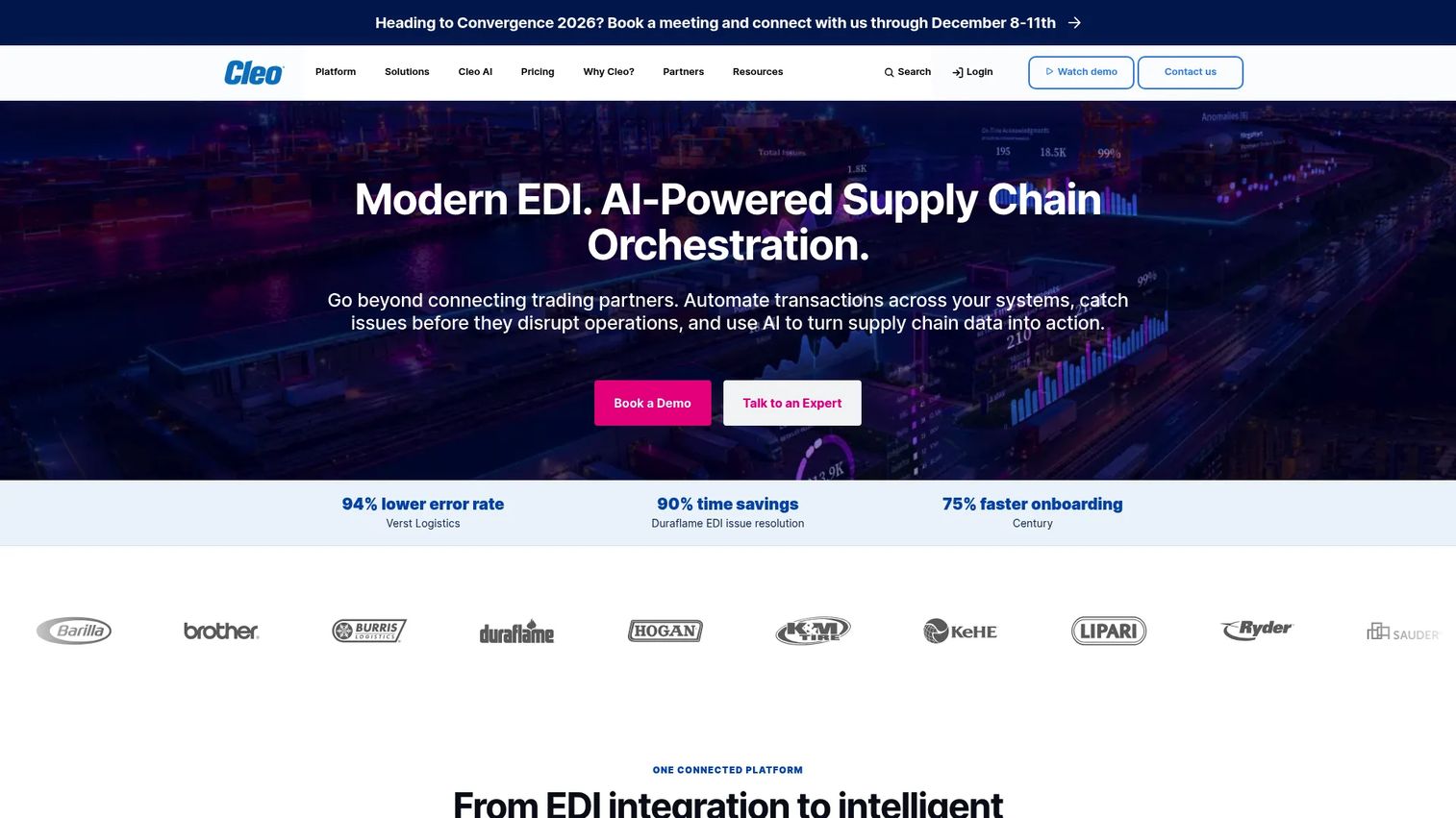
Cleo Integration Cloud is a cloud integration platform that handles EDI, API, application, and file-based integration from a single environment. It connects trading partners with ERP, WMS, TMS, accounting, and eCommerce systems, making it a strong fit for organizations that need more than a standalone translation engine. Cleo also includes AI-assisted mapping, anomaly detection, and exception management to surface problems before they become chargebacks or compliance failures.
Best for: Organizations modernizing B2B integration infrastructure who need EDI plus API and file workflows under one platform.
Key features
- EDI, API, application, and file-based integration in one platform
- AI-assisted mapping, anomaly detection, and exception management
- Real-time transaction visibility across partners and documents
- ERP, WMS, and TMS connectors
- Managed service options available alongside self-service
Why choose Cleo Integration Cloud: Cleo fits well when EDI is part of a broader integration modernization project and the buyer needs to validate end-to-end order, fulfillment, and invoice flows rather than just document translation. For presales teams, it gives you a clear story around cloud migration from legacy VANs or on-premise tooling.
Cleo Integration Cloud pricing: Cleo prices by quote, with cost driven by the number of systems connected, workflows configured, transaction volume, and selected service model. Contact Cleo directly for current figures.
G2 rating: 4.4/5
2. TrueCommerce
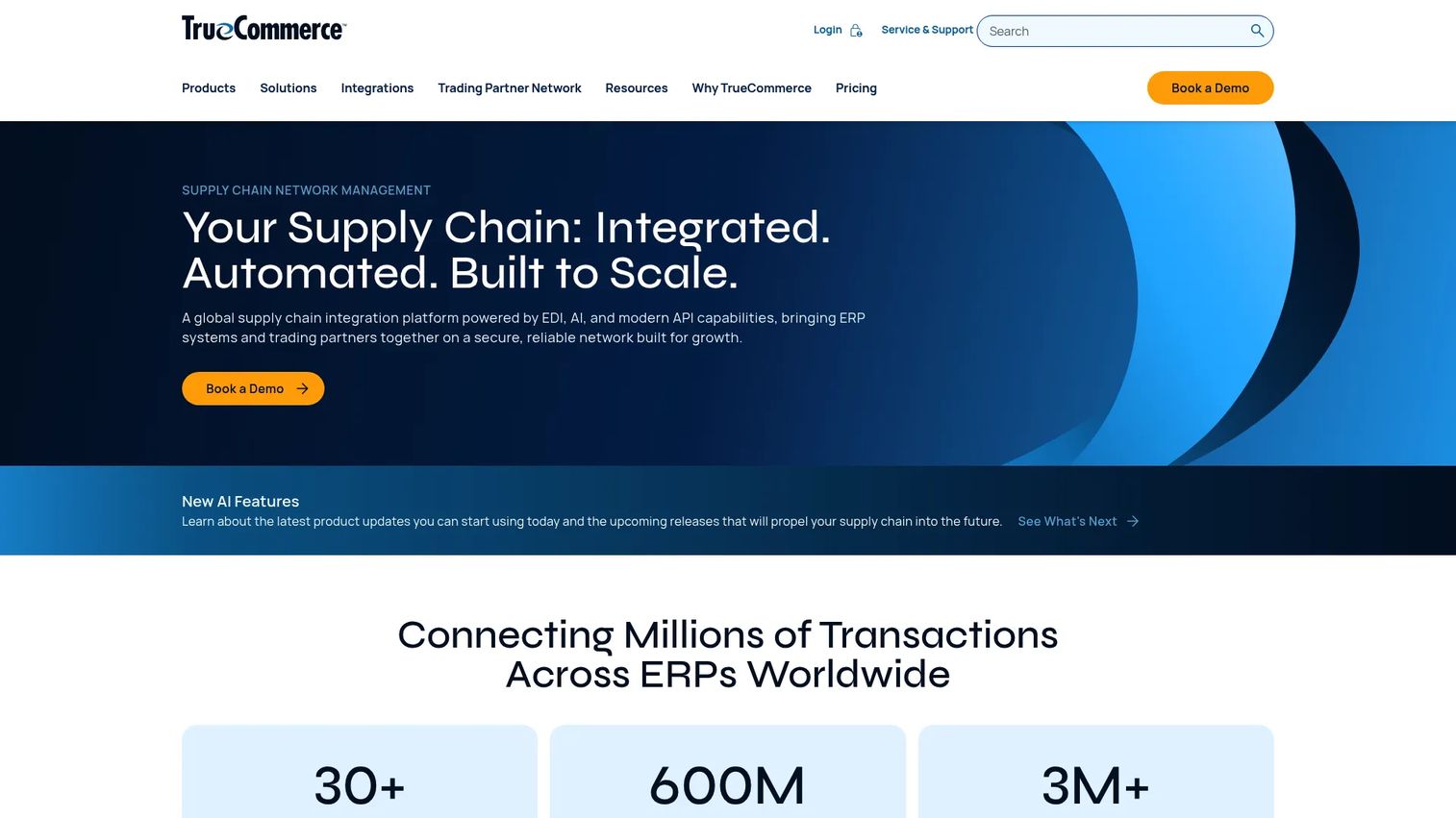
TrueCommerce provides supply-chain integration and automation covering EDI, e-invoicing, vendor-managed inventory, and B2B eCommerce. It serves manufacturers, wholesalers, distributors, and retailers that need managed EDI services alongside broader commerce network connectivity. TrueCommerce supports ERP, OMS, and WMS integrations with API access to transaction data, and its e-invoicing capability covers 60+ countries with Peppol connectivity.
Best for: Manufacturers, wholesalers, and distributors that want a managed EDI provider handling onboarding and ongoing operational tasks, not just the translation layer.
Key features
- EDI automating purchase orders, advance shipping notices, and invoices
- ERP, OMS, and WMS integrations with API access
- E-invoicing compliance across 60+ countries with Peppol
- AI-powered vendor-managed inventory with automated replenishment
- B2B eCommerce storefronts with customer-specific pricing
Why choose TrueCommerce: TrueCommerce works best when the buyer wants a provider to absorb more of the operational burden, particularly around trading partner onboarding and ongoing mapping maintenance. Validate the scope of managed responsibilities before signing, specifically who owns failed transaction resolution and partner-initiated mapping changes.
TrueCommerce pricing: UK pricing tiers start from £75 per month (Starter), £625 per month (Essentials), and £1,000 per month (Advanced); Enterprise pricing is custom. Pricing varies by region, so teams outside the UK should request a regional quote.
G2 rating: 4.4/5
3. Data Interchange
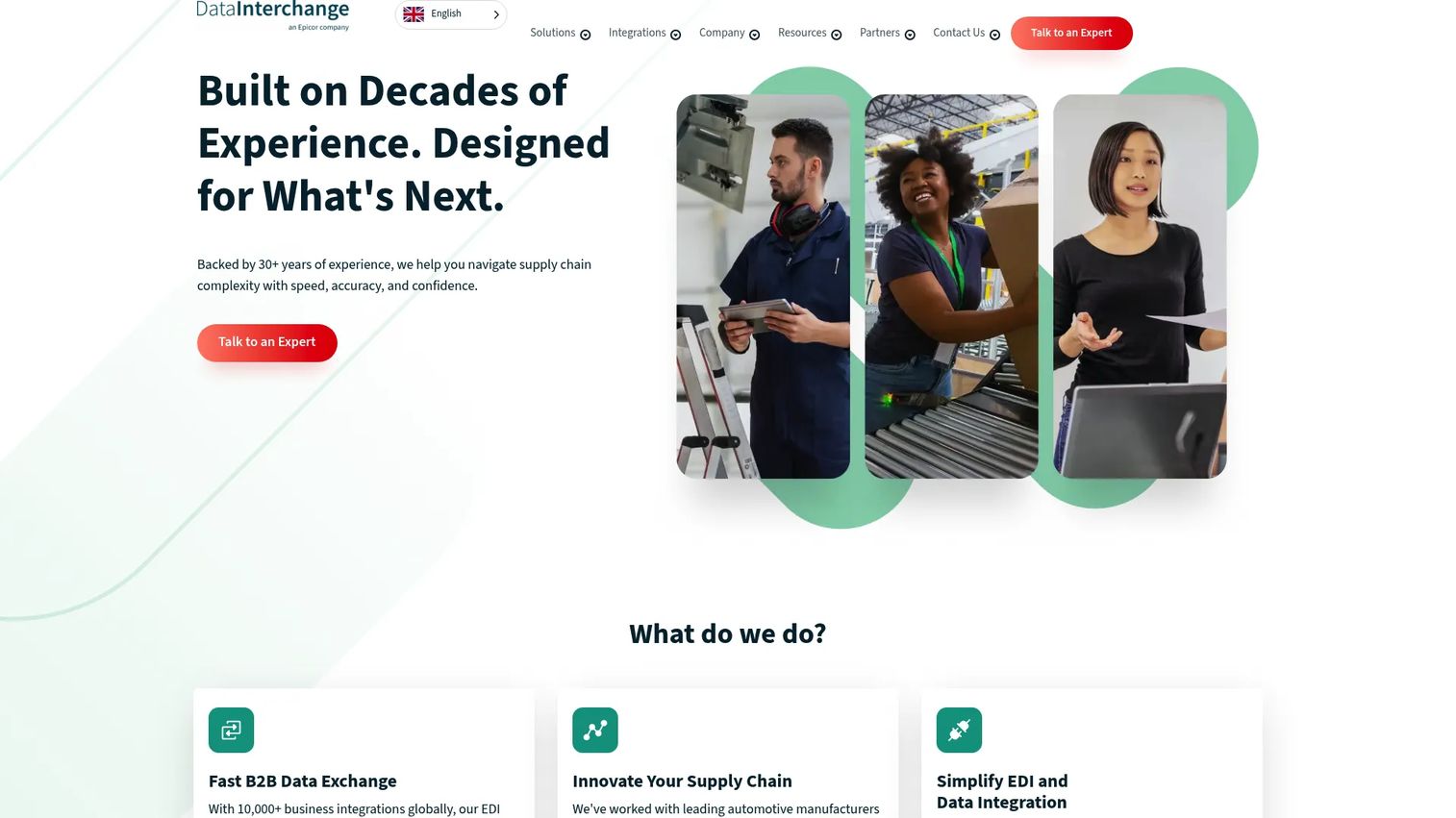
Data Interchange provides cloud-based EDI software, B2B integration, and managed services for connecting businesses and supply-chain partners. The platform covers EDI document-flow automation, ERP integration, automated file transmission, and access to a network of over 10,000 trading partners. Dashboards, analytics, and audit trails give operations teams visibility into what is moving and what has stalled.
Best for: Organizations with complex partner requirements that need specialist EDI delivery, deep standards coverage, and hands-on managed support rather than a broad multipurpose integration suite.
Key features
- EDI document-flow automation and workflow modeling
- ERP integration with automated file transmission
- Dashboards, analytics, and audit trails
- Support for extensive EDI protocols and standards
- Access to 10,000+ trading partners
Why choose Data Interchange: A specialist provider makes sense when the buying committee has partner-specific EDI requirements that general-purpose platforms handle inconsistently. Data Interchange's focus on EDI depth and managed support gives presales teams a concrete differentiator to probe during technical discovery.
Data Interchange pricing: Data Interchange prices by quote. The cost depends on trading partner count, standards coverage required, managed service scope, and integration complexity. Visit their cost guidance page or contact the team for a current estimate.
G2 rating: N/A (not confirmed at generation time from a live G2 listing)
4. OpenText Business Network
OpenText Business Network is a secure B2B integration platform that connects partners, systems, and data across financial, operational, and supply-chain processes at enterprise scale. It supports EDI and broader B2B data exchange with trading-partner onboarding and community management, ERP integration, and data translation across multiple formats and industry standards. AI-assisted setup, transaction monitoring, and troubleshooting reduce the manual overhead that large partner networks typically create.
Best for: Large enterprises managing global trading networks where EDI governance, multi-protocol support, and transaction visibility are core infrastructure requirements.
Key features
- EDI and B2B data exchange with multi-format translation
- Trading-partner onboarding and community management
- ERP integration across multiple communication protocols
- Transaction visibility, monitoring, and alerting
- AI-assisted setup, monitoring, and troubleshooting
Why choose OpenText Business Network: OpenText fits complex enterprise environments where EDI is a foundational integration layer, not a single-point connector. Presales teams should ask to see transaction monitoring in action and verify how the platform surfaces exceptions at the account level, not just in log files.
OpenText Business Network pricing: Pricing is not displayed on the OpenText site. OpenText routes prospects through a sales conversation, with cost driven by network usage, integration scope, transaction volumes, and enterprise service requirements.
G2 rating: 4.1/5
5. IBM Sterling B2B Integrator
IBM Sterling B2B Integrator is a hybrid-cloud and on-premises platform for automating complex B2B and EDI processes across trading-partner communities. It provides a unified gateway for B2B and EDI document flows, support for diverse communication protocols, and centralized trading-partner onboarding and management. High-availability operations through Global Mailbox and certified container deployment make it a fit for enterprise environments where resilience and governance are non-negotiable.
Best for: Large enterprises with high-volume, complex B2B and EDI transaction flows where mature governance controls, multi-protocol support, and operational resilience are the primary requirements.
Key features
- Unified gateway for B2B and EDI processes
- Support for diverse communication protocols and data transformation
- Centralized trading-partner onboarding and management
- High-availability operations with Global Mailbox
- Certified container deployment for hybrid-cloud environments
Why choose IBM Sterling B2B Integrator: IBM Sterling is a strong fit when the buyer's evaluation centers on resilience, governance, and the ability to handle complex partner transaction orchestration at scale. For presales readers, frame it as the right choice when the buying committee includes IT security and infrastructure stakeholders alongside supply chain operations.
IBM Sterling B2B Integrator pricing: IBM enterprise software pricing is quote-based. Cost drivers include deployment architecture, integration scope, transaction volume, support tier, and enterprise licensing terms. Contact IBM directly for current figures.
G2 rating: 4.2/5
6. SPS Commerce
SPS Commerce provides a connected retail supply-chain network and cloud solutions covering fulfillment, product data sharing, analytics, revenue recovery, and partner collaboration. Its EDI capability automates order workflows and trading-partner compliance across retailers, grocers, distributors, and marketplaces. Pre-built integrations with ERP, TMS, OMS, WMS, and accounting systems reduce implementation time for suppliers connecting to major retail networks.
Best for: Retail suppliers that need EDI connectivity with specific retailers or grocers, particularly where partner-specific compliance, deduction management, and fulfillment workflow automation matter.
Key features
- Automated order workflows and EDI compliance across trading partners
- Centralized product information sharing and assortment management
- Connected retail performance analytics and inventory visibility
- Revenue recovery for deductions, shortages, and compliance fines
- Pre-built integrations with ERP, TMS, OMS, WMS, and accounting systems
Why choose SPS Commerce: SPS Commerce performs best when the buyer's primary EDI use case is retail supplier connectivity and the trading partner list skews toward major retailers, grocery chains, or marketplace platforms. Presales teams should verify specific retailer coverage and ask how the platform surfaces compliance exceptions before a chargeback is issued.
SPS Commerce pricing: SPS Commerce prices by customized plan based on trading partner requirements, document volume, fulfillment workflows, and service scope. Request a quote directly through their EDI page.
G2 rating: 4.3/5
7. SEEBURGER Business Integration Suite

SEEBURGER Business Integration Suite is a cloud-native, AI-assisted enterprise integration platform connecting applications, data, partners, and processes across cloud, hybrid, and on-premises environments. It covers B2B and EDI integration, API management with lifecycle governance, managed file transfer, low-code workflow automation, and application-to-application integration in a single suite. Deployment flexibility across cloud, hybrid, and on-premises makes it a practical option for global organizations with mixed IT environments.
Best for: Large and complex organizations that need EDI, B2B integration, API management, and managed file transfer in a single platform, particularly in manufacturing, automotive, logistics, or regulated industries.
Key features
- B2B and EDI integration with partner onboarding
- API integration and management with lifecycle governance
- Low-code workflow automation and process orchestration
- Managed file transfer
- Cloud, hybrid, and on-premises deployment options
Why choose SEEBURGER Business Integration Suite: SEEBURGER is the right conversation when the buyer needs a broad integration layer rather than a dedicated EDI translator. Buyers should validate deployment model flexibility and ask specifically about support coverage and who owns integration ownership during post-go-live changes.
SEEBURGER Business Integration Suite pricing: Pricing is quote-based and depends on modules selected, deployment model, transaction volume, integrations configured, and managed service requirements. Contact SEEBURGER for a current estimate.
G2 rating: 4.6/5
Considerations when choosing EDI software
Use this checklist in discovery conversations and technical validation sessions before moving a vendor to the shortlist.
Integration depth
Verify ERP, WMS, TMS, and eCommerce integration against the buyer's exact workflow, not a generic connector list. Ask the vendor to demonstrate an order, shipment, invoice, and inventory document moving end to end through their platform into the buyer's specific ERP. A connector that exists and a connector that works in production are different things.
Trading partner onboarding
Onboarding speed determines how quickly the buyer can go live with a new retailer, supplier, or logistics partner. Ask vendors how they handle mapping, partner-specific rule configuration, testing cycles, certification, and status visibility. A platform that requires weeks of manual back-and-forth for each new partner creates a bottleneck that will frustrate every stakeholder on the buying committee.
Managed service model
Understand who owns what after go-live. Self-service, blended support, and fully managed EDI carry different operational responsibilities. Buyers should know specifically who handles mapping changes when a partner updates their requirements, who resolves failed transactions, and what the SLA looks like for critical document failures during peak order periods.
Visibility and exception management
Ask vendors to show a failed transaction from detection through resolution, not just the dashboard. Evaluate alerting granularity, retry logic, root-cause detail, and SLA tracking. Presales teams should confirm that operations staff can identify and act on exceptions without needing to open a support ticket or dig through raw logs.
Standards, security, and compliance
Confirm support for the specific standards the buyer's trading partners require: ANSI X12, EDIFACT, HIPAA EDI for healthcare workflows, ODETTE or VDA for automotive, GS1 for retail product data. Beyond standards, evaluate encryption in transit and at rest, audit trail retention, access controls, and any relevant data residency requirements. Do not conflate the vendor's own compliance certifications with what the buyer needs to demonstrate for their own compliance obligations.
Conclusion
The right EDI software depends on four factors: The trading partner model, the integration architecture, the internal expertise available to run it, and how much operational burden the buyer wants to hand to a provider.
For cloud EDI and API integration together, Cleo Integration Cloud is the practical starting point. TrueCommerce suits teams that want managed EDI services and broader commerce network reach. Data Interchange is the specialist choice when complex partner requirements demand deep standards knowledge and hands-on support. OpenText Business Network and IBM Sterling B2B Integrator both fit large enterprise environments, with OpenText leaning toward global network scale and IBM toward high-availability transaction orchestration. SPS Commerce is the clearest fit for retail suppliers managing retailer-specific compliance. SEEBURGER covers the widest integration scope for organizations that need EDI, API, and file transfer in a single platform.
Shortlist two or three vendors based on the buyer's partner network, integration requirements, managed service needs, and transaction monitoring expectations. Then ask each vendor to demonstrate an exception scenario, not just a clean transaction.
If your team also needs a better way to show complex software workflows to buyers, Start your journey with Guideflow today!
FAQs
EDI software is a platform that automates the exchange, translation, validation, and routing of structured business documents between trading partners. Common documents include purchase orders (EDI 850), invoices (EDI 810), advance ship notices, and inventory updates. EDI integration software typically connects external partner documents to internal ERP, WMS, TMS, and eCommerce systems without manual rekeying.
EDI uses standardized business document formats and partner-specific rules to exchange structured transactions, often through VANs or direct protocols such as AS2. APIs typically connect applications in real time using web standards. Most modern EDI platforms support both because supply chain workflows routinely combine legacy EDI requirements with newer API-driven integrations for the same partner network.
EDI integration is the connection between external trading partner documents and internal business systems such as ERP, WMS, and TMS platforms. It involves document mapping, translation between formats and standards, validation against partner-specific rules, and routing to the right internal system. A working EDI integration means a purchase order received from a retailer flows automatically into the buyer's ERP without manual intervention.
EDI systems typically handle purchase orders (EDI 850), invoices (EDI 810), advance ship notices, purchase order acknowledgments, inventory updates, payment and remittance documents, and industry-specific files such as healthcare claims under HIPAA EDI. The specific transaction sets supported depend on the trading partners and industries involved.
Cost depends on trading partner count, transaction volume, integration scope, deployment model, and managed service level. Most enterprise EDI providers require a sales conversation to generate a quote. TrueCommerce publishes UK tiered pricing starting from £75 per month for its Starter plan, which gives some pricing direction for smaller deployments. All other platforms in this list require a custom quote.
Ask the vendor to run an end-to-end transaction, not just show the interface. Verify partner onboarding steps, how mapping is configured for a new trading partner, where the document goes after translation (ERP handoff), how a failed transaction surfaces in the dashboard, what the alert looks like, and how the support team is engaged when a critical document fails. Also confirm specific standards support, integration connectors, and SLA terms for exception resolution.
Cloud EDI often reduces infrastructure ownership and can accelerate trading partner onboarding because the provider manages updates and maintenance. On-premise or hybrid deployment may fit organizations with strict data residency requirements, legacy system constraints, or existing investments in infrastructure that integration work has to accommodate. The right answer depends on the buyer's security posture, integration architecture, and internal EDI expertise.
Managed EDI services transfer operational responsibility for EDI workflows from the buyer's internal team to the EDI provider. This typically covers mapping configuration, trading partner onboarding, failed transaction resolution, partner-initiated mapping changes, compliance updates, and SLA monitoring. Fully managed EDI suits organizations with limited internal integration expertise. Blended models let internal teams retain control over some workflows while the provider handles the rest.